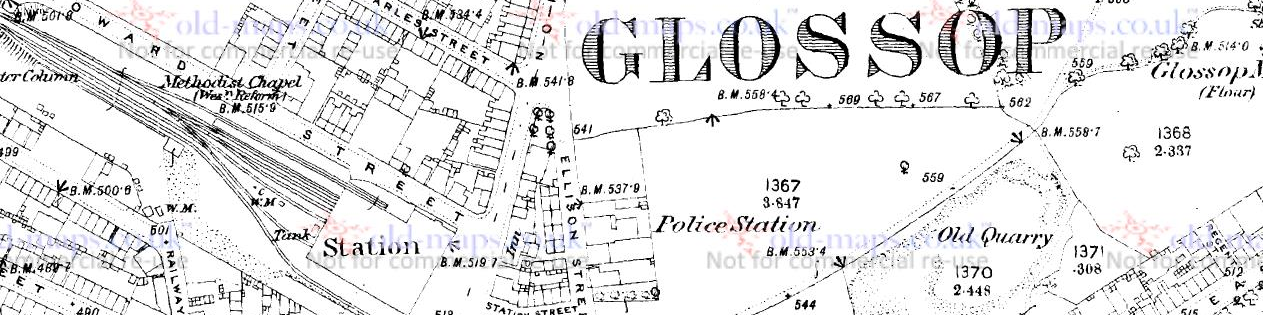
With an obvious predictability, I cannot resist having a poke around the brook whenever I’m in the neighbourhood – there is always something to find. Ok, so it’s not quite mudlarking on the Thames foreshore, but it is Glossop’s equivalent, and that makes it all the more important to us (if not quite as bountiful!). By the way, if anyone is interested in mudlarking, or the slightly haphazard and magpie approach to the past that this blog is following, then check out the book London in Fragments by Ted Sandling. I cannot recommend it enough – beautifully illustrated with fragments of pot, glass, pipe, stone, metal, etc. and each with a very interesting essay accompanying the item (be warned, the ‘Look Inside’ feature on Amazon misses out all of the photographs!). Just beautiful.
So then, the haul!
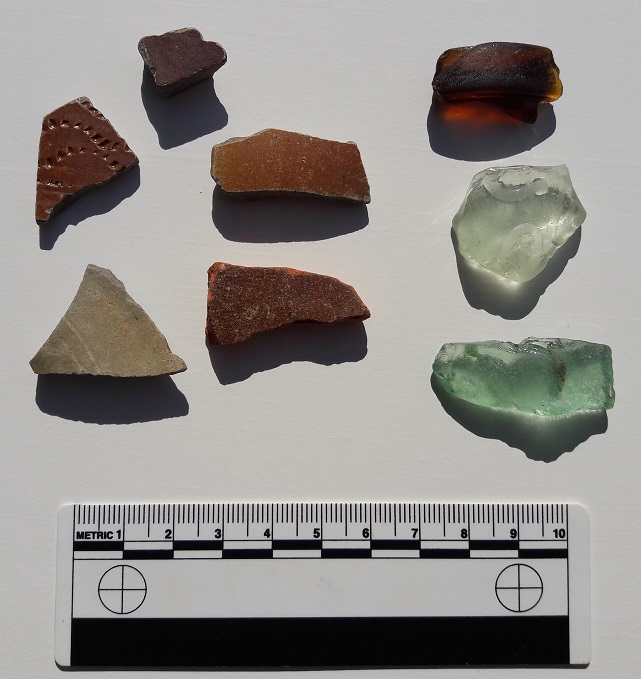
As is becoming my habit, unless they were decorated, or a rim, a base, or a handle, I left the white glazed earthernware and china in the brook. As a rule of thumb, these are the four criteria archaeologists use to sort out the ‘feature sherds’, which are diagnostic (giving us information about date, type, function, etc.) from the ‘body sherds’, which normally make up the majority of a assemblage. It is a rule of thumb, though, and some body sherds can be equally important if they are of an unusual fabric, or are able tell us more information.
So what can we see?
Pottery first. Top sherd is a from a small-ish and closed salt-glazed stoneware vessel. We can tell it is from a closed vessel (i.e. like a bottle, not open like a bowl), by the fact that the interior surface is rougher and unfinished – why waste your time glazing it properly if no one is going to see it? Also, the salt glazing process involves literally throwing salt into the high temperature kiln where it vapourises forming the characteristic glaze; this vapour will not readily reach the interior of the vessel. This vessel was probably something like an ink pot or similar, but by the late 19th century, the date of this sherd, salt-glazed stoneware was mass produced on a literal industrial scale, so it is difficult to be certain.
Middle right. Another closed salt-glazed stoneware vessel, same date, but larger – possibly a milk or lemonade bottle bottle or similar. This sherd is thickening slightly at the left, and so is perhaps forming the shoulder of the bottle.
Middle left, is another salt-glazed stoneware vessel. This one appears to be open, and is decorated by using the rouletting method – a small wheel with teeth was run over the surface to produce the characteristic incised decoration. This one has a very common motif of undulating lines around the body of the pot. The sherd is mid to late 19th century, and probably from a storage jar or crock, and despite being relatively thin, is probably from a large vessel.
Bottom left is the base to a milk or lemonade bottle (it is flat, but lifting slightly toward the middle of the base, and you can see the concentric lines that characterise the base of these bottles). Stoneware again, but a more conventional glaze which gives it the characteristic cream colour. Interestingly, when I flipped it over, you can see a manufacturing flaw – the glaze has pooled against the interior wall, and instead of vitrifying uniformly, it has bubbled and produced a very messy surface.
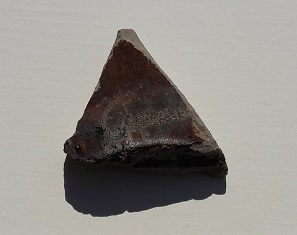
However, it won’t be seen because it is a what? “A closed vessel, Mr Hamnett”, chorused everyone – good to see you are paying attention. It also illustrates why it was probably unwise to reuse these bottles – if it contained milk (raw and unpasteurised, of course), there is no way you could hope to get that clean enough, even with a steriliser.
Bottom right. An interesting sherd… honest. It is a slip-glazed earthernware vessel, and to judge from the colour of the fabric (the clay itself) and the colour of the glaze, as well as the way it flakes away, it is probably 18th Century. Of course, I could be wrong… but there is something about that sherd that gives it an early-ish date.
Glass! Top is from a corked beer bottle… probably. Certainly corked, not capped or screw threaded, and almost certainly beer. And likely Victorian, or early Edwardian.
Middle is probably a Victorian mineral water bottle. The glass is thick and has an embossed ‘&’ sign and some other marks visible, which would have been the name of the maker and their logo. Without doing a lot of serious research, it would be very difficult to say who made it, as a lot of companies were called ‘Something & Something‘. That stated, there were so many mineral water companies that the bottles tended not to travel far, so theoretically there can’t be that many in the area, so it might be worth a look.
Bottom is just a bottle fragment, again probably from a mineral water bottle. i include it here because a) it is a blueish colour, and so potentially earlier than the rest, and b) it has two air bubbles trapped in the glass. At first I thought that it might have been hand blown, but no, I think it is just a feature of the manufacture. What is fun, though, is the fact that within those bubbles lies a tiny amount of Victorian air, preserved for eternity. I wonder what the Victorian period smelled like? Actually, on second thoughts…
So, nothing truly award winning, but a little slice of Glossop history nonetheless.
Just as I was about to walk away, I turned over a stone, and found the other side was flat and dressed.

It is a sandstone, and not local to the area as far as I can tell, but then I am no geologist. The dressing can be more clearly seen in this photograph, with the low winter sun picking out the chisel marks.

Obviously it was once part of a building, but what part? Maybe a door or window lintel perhaps? I don’t think it is particularly old, and it is quite a coarse dressing, so perhaps it is from a worker’s cottage or similar. The bank in this area seems to have been shored up against erosion, and it probably building demolition rubble dumped here from nearby.
As always, comments are welcome.
I shall post more in a day or so… this time on the subject of Victoria Bridge. Probably!

 The Glossop Cabinet of Curiosities
I tried to email you, but said email address was wrong?
Sent from my iPad
LikeLike