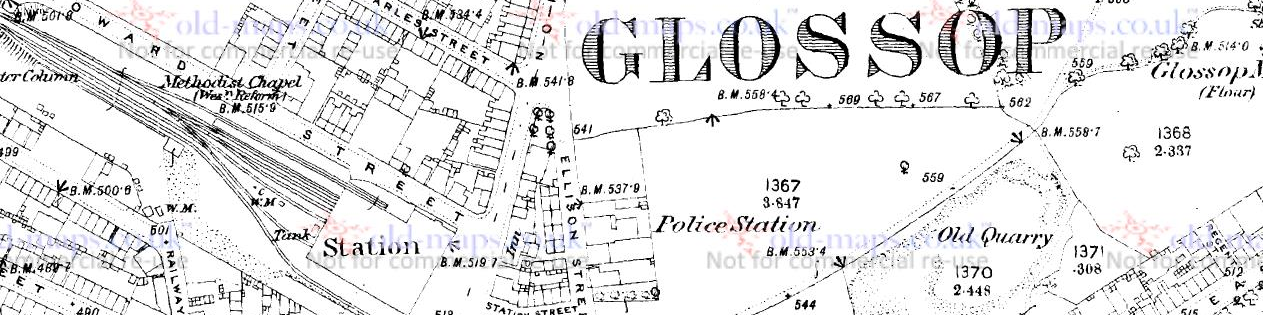
A while ago I posted a blog entry about some named wells in the Mottram area.
Read the post here to refresh your memory, it’ll help with what follows.
We were facing a slight conundrum. The issue was that there was the two wells in the one field – neither of which was really visible on the ground – coupled with the fact that one of them was called Boulder Well, a very specific place-name, despite there being no associated boulder. Oh, and there was a boulder in a different field, but with no associated well. Well, I think I have found out what it all means. Probably.
The map, first of all.

I was looking over some Lidar images of the area, and noticed something interesting. For those of you who don’t know, Lidar is a method of using light (laser) to map the ground surface, allowing for a greater contouring of the ground, and revealing every single bump and dip on the surface. Quite literally, everything – it simply strips away trees and vegetation. It’s application as an archaeological tool is enormous, and it allows us to not just identify, but to map, record, and categorise all sorts of things that are invisible on the ground.
Like old wells, for example.
So, using the government’s Lidar website (highly recommended, by the way), this is what I saw.
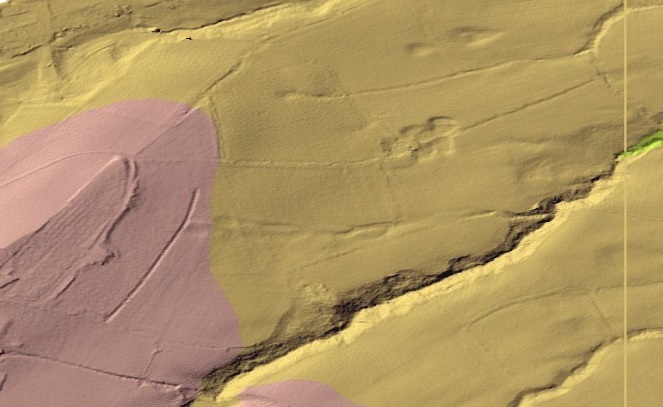
To help you identify the area better, here is the same image with the red circles on it.
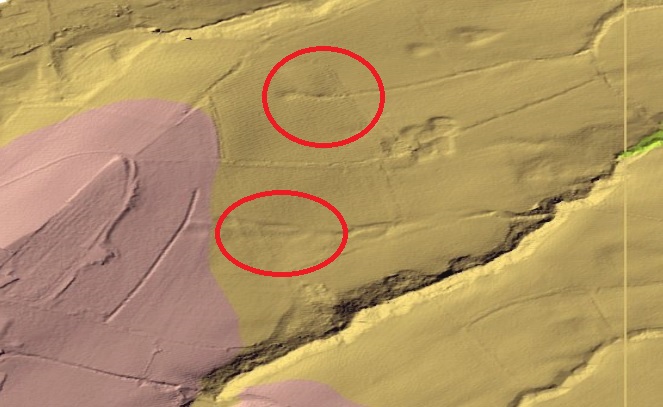
What the image shows is that where the two wells are recorded on the map – Grave Well and Boulder Well – there is only the remains of a single feature. You can see the line of the waterway moving from left to right, passing through the lower circle, and eventually draining into the small valley there. Single feature, a single well. Not the two wells recorded on the map.
Now look again at the upper circle. The field boundary where the boulder is can just be made out, but to the right, precisely where there is a ‘trough’ marked on the map, is a spring head, and you can see the drain, running east and again emptying into a small valley. There IS a well there, it’s just that you can’t see it on the ground.
Looking again at the map, we can see only one well place or structure in the lower circle. This, I humbly submit, is Grave Well, not Boulder Well – its location right next to the graveyard is the clue. Boulder Well is situated in the upper circle, next to… yup, you guessed correctly, the boulder, and the trough marked the place where the spring issued forth. This makes sense.
I am convinced, then, I have rediscovered the location of Boulder Well.
All this is clear on the Lidar, but as I say, cannot be seen on the ground. It also means that the OS people made a small mistake in naming the wells – but then if a local says “yes, Boulder Well is just above Grave Well”, how literally are you to take them?
I need to go back and take some more photographs.
So there you have it. As Bertie Wooster was fond of saying “The lark’s on the wing, the snail’s on the thorn, God’s in His heaven. All’s right with the world!”.
Comments and discussions, even arguments against the newly rediscovered well will all be gratefully received. Also, I have a few more blog posts that are about to be published, so keep your eye open.
As always, I remain your humble servant.
RH

 The Glossop Cabinet of Curiosities