What ho, wonderful folk! Apologies for not publishing something sooner than today… truthfully, I have been a little overwhelmed and burnt out. Recent events have caught up with me, and I’m tired and somewhat sore; nothing a breather couldn’t fix, but sometimes it all becomes a little too much – please do listen to your bodies and minds, as they will often steer you on a correct course. Anyhoo, I’m back, and happy to be so. So here we are, with a long overdue post.
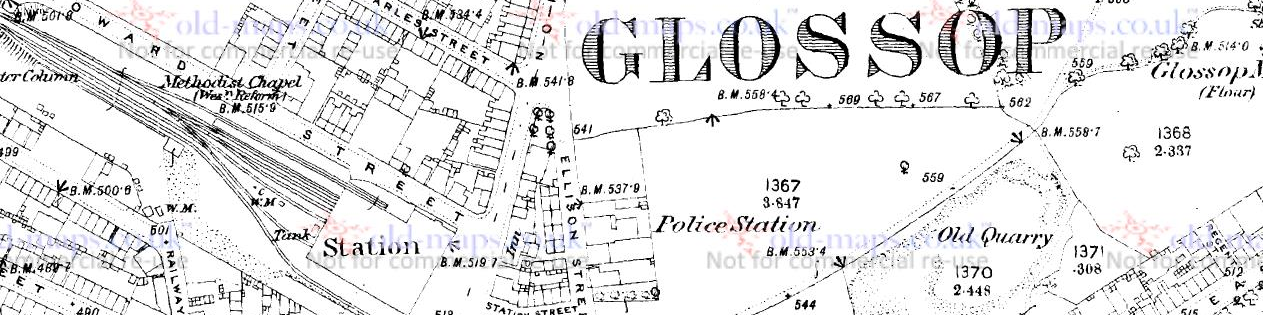
Last March, I went on a little Wander with a friend and family (hello GW). We had set off to do the first Where/When Wander, but having kids with us, we ended up playing around in the land by the allotments and behind Dinting Station. Aside from the fact that the area is interesting from a historical perspective (being connected with Dinting Station, and filled with old bits and pieces), it was also the location of the old Dinting Railway Centre/Museum. I vaguely remember visiting the museum several times as a child, and I recently bought a vintage guidebook on Ebay to try and fully remember what it was I went to.
The centre finally closed in 1990, and whilst all the trains and exhibition pieces moved elsewhere, the infrastructure – rails, and platforms, and buildings – all remains (here is a good article about the museum’s rise and fall, and there’s loads about it on the internet). Central in this wasteland – or forest of Silver Birch – the Engine Shed still stands, alone, derelict, and graffiti covered.
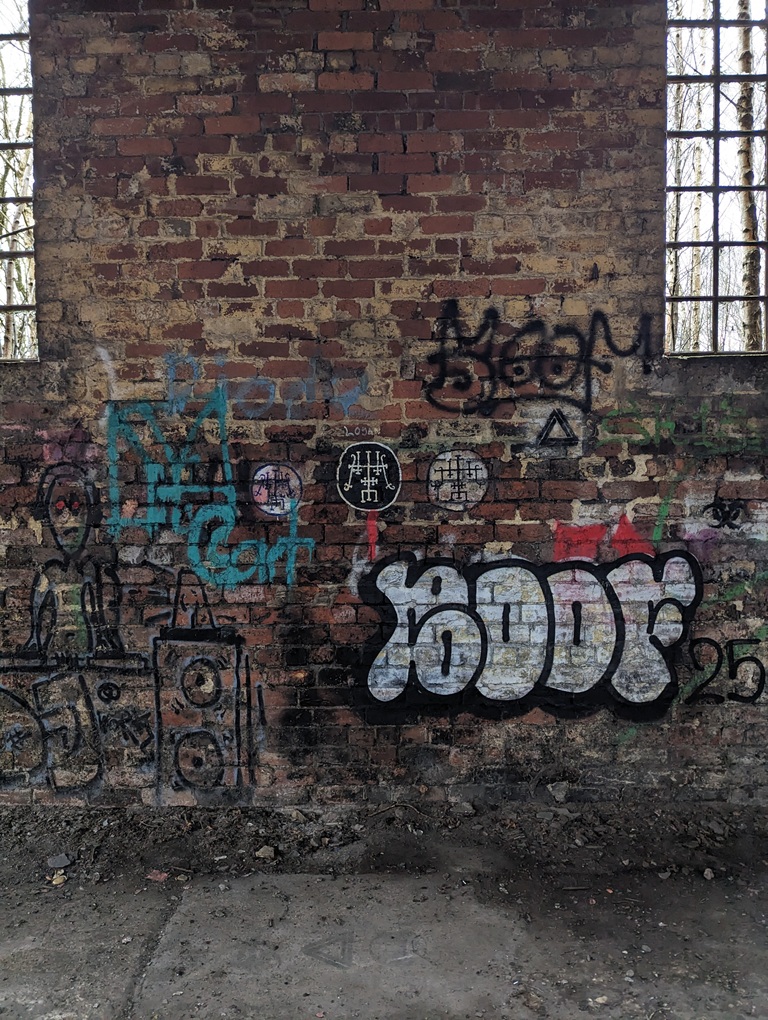
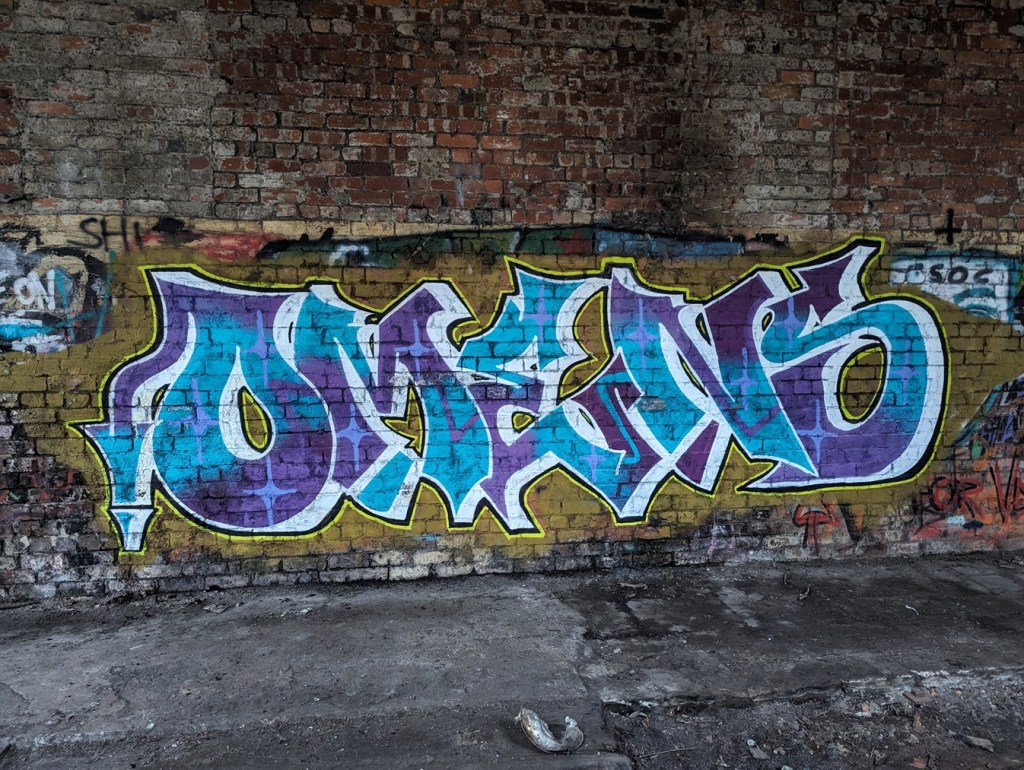
Here’s what it looked like in 1967, before the Railway Museum…And here’s a similar shot, nearly 60 years later, and after having been a museum in the meantime. Blimey! Honestly, the building is in there. Our old friend Boof makes an appearance, here represented by his/her older tag, and a newer (2025) bubble piece. His/her tag is all over the site.Some of it is quite good, this piece in particular ‘OMENS’ (strangely unsigned, presumably Omens is their ‘tag’), and this one……are very artfully done. Love the window in the background/part of of this one. So this is interesting. Because I am that sort of person, I knew this was something when I saw it. Rather bafflingly, this is the sigil of Foras, one of the 72 demons mentioned in the 17th century Lesser Key of Solomon. Apparently he was the president of Hell, and was associated with precious metals, logic, and lost things. Quite why his sigil is painted on the wall here is beyond me; teenage rebellion or demonic invasion? You decide.
Anyway, comparing the photographs of then with now is really quite interesting, and shows just how quickly nature retakes land back, even heavily used and industrialised land such as this. Give it another 100 years, and there will be very little recognisable, 500 years and it’ll need an archaeological excavation to make any sense of the site; understanding site formation processes like this is vital as an archaeologist, and our case study is right here.
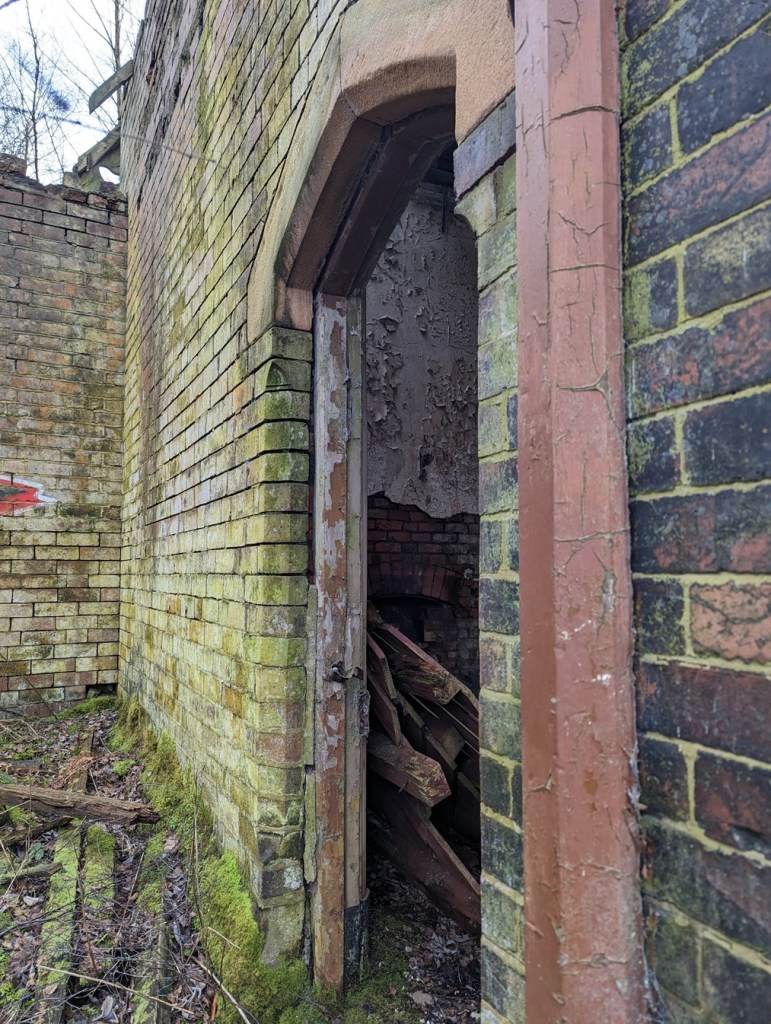
But today’s article is less about the centre, and more about a single aspect of the site. As generally happens, when a building is left derelict and unused, it slowly breaks down, and this is the case with Dinting station’s southern waiting room. Built in 1884, when the original 1848 station was rebuilt, you can see it from the train behind a fence; overgrown, derelict, absolutely terrifying. However, I didn’t know you could access the station from the back, via the patch of ground we were exploring. Well, I mean to say… one cannot simply say no when such gifts are presented to one! I had a brief explore! Brief because: a) I was probably trespassing, although it is very unclear to be honest (and I was by no means the only person there that day… or even that hour!), and b) we had children with us, and the place is phenomenally dangerous, with broken glass, falling masonry, and Jove knows what else. It was also going dark, and, I’m not going to lie to you, the place is spooky! Before we go on, I am also going to insert a cautionary statement here: I absolutely do not endorse you going to the place to look, and in fact recommend you don’t. So I took a very few, mostly terrible, photographs, and scarpered.
The station building from afar… the Silver Birch trees are amazing in this photo – and I actually find them frightening here. Random brickwork, and an odd framed shot of a corner with shamfered edged stone. Look, I had a quick look around, and then legged it! I wasn’t taking my time with perfection! Lovely Stoneware bottle; possibly a large ink bottle, but I suspect it is something more industrial – a chemical or oil, perhaps. The whole area is filled with burnt cinders and rubbish, amongst which are many interesting finds. It’s a beautiful building. Or at least could be. These windows are lovely, but then through them you can see sky through the roof. How long does this place have left before it all collapses? Who knows. The doorway, with what looks like a Cheshire sandstone lintel. I honestly feel something should be done about preserving this building. I don’t know what could be done with it, but something more than just leaving it to rot… surely?
So I had a quick look around, as you do, and in doing so, I noticed that the whole roof of the exterior platform area had collapsed, seemingly as one, and the floor was littered with rotting wooden roofing and broken slates. And then I saw it… a single slate seemed to have survived intact-ish. I pulled it up and thought… I say, here’s a nice little blog entry! And so here we are:
Amazingly, it had both copper nails still in-situ, and whilst it has broken a little at the top, it allows us to see how it was made.
The rougher edges are very characteristic, and I think I can see the result of individual hammer blows. Possibly.
Geologically, slate is dense, and was laid down in thin layers, which allows us to quarry it and split it into relatively thin sheets using a hammer and chisel. It is further shaped using a soft hammer whilst over hanging a hard edge (or later using a machine, although still hand held). There is a fascinating YouTube video here that shows the whole process, for those who like to know… it makes it look so easy! This gives it the characteristic nibbled edges.
The different areas of dark colouring on the slate itself is the result of differential exposure to smoky polluted air, with the bluer/greyer bits being protected by wood or other slates.
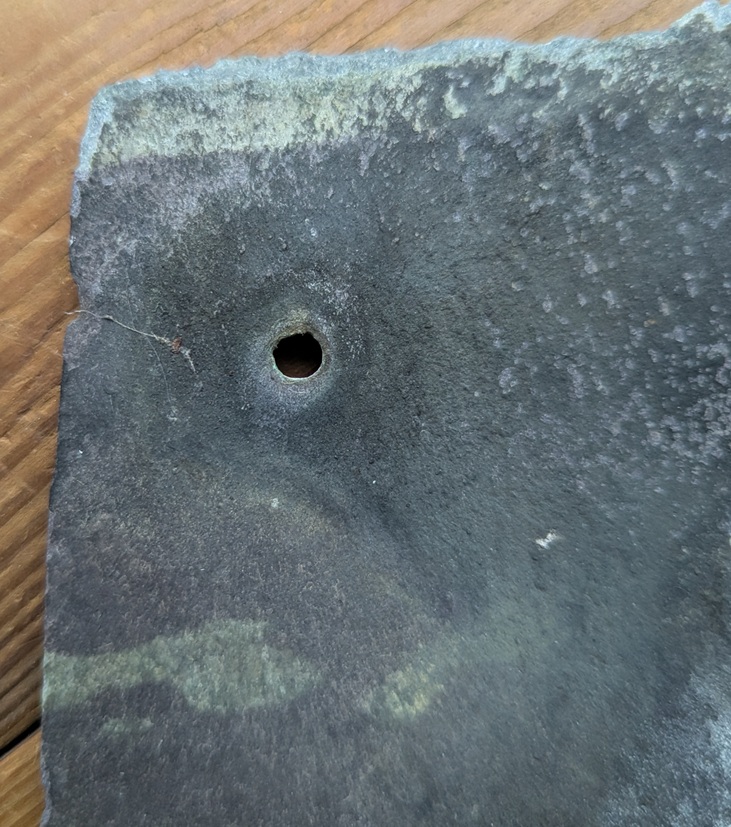
The holes to take the nails were made probably with a metal punch – a single blow delivered from a hammer on one side, and the force of the strike spread and created a characteristic ‘exit wound’, much wider than the entry.
The ‘entry wound’. I wonder if these have been partly drilled before being punched?The devastating ‘exit wound’.
Looking at the nails themselves, they are fairly standard mid/late Victorian copper nails, hand finished, and square in section.
I honestly love these things. The back side, showing the nail through the hole.
These wonderful things seem to be attracted to me, and I find them all over Glossop, or maybe it’s just I’m always looking down (I’m going to be Richard III-like before I’m 60 at this rate). And, as I can never resist them when I find them, I have quite a few, here in CG towers. I say “quite a few” like it’s 10 or 12. I actually have hundreds of the buggers, hiding in labelled bags, naturally, and hidden in drawers, but shhhhhh… don’t tell Mrs CG, this sort of thing makes her twitch. I wrote a little about how they are made, here, in this article, 8 years ago… man, do I feel old!
What a difference Welsh roof slates would have made to housebuilding. As I type this, I sit under a roof made from locally sourced gritstone (I think I can see the quarry from my house); each roof tile is an inch thick, solid stone, and I bet the whole roof must weigh somewhere in the region of 5 tonnes, with each individual tile moved up and positioned by hand. I watched them do it when my roof was re-laid, and it took a long time. Now think of the slate; each tile weighs a tenth of the stone one, meaning more could be carried up and laid quicker, it costs less per tile, and overall does the same job, but at a fraction of the weight of the roof, meaning smaller beams could be used. It’s no wonder that Welsh slate tiles took over almost immediately, ironically being brought here – safely and quickly – by the train. In fact, you can use the presence or absence of a slate roof as a quick and easy way of dating the buildings here in Glossop: stone roof, built pre-1850(ish), slate roof, post 1850(ish)
So there you go. Right, I have another article almost finished, and I’ll try to get it out to you before New Year, but I’m not going to make any promises! Just know that I’m always trying, but sometimes life gets in the way of this, what I want to actually be doing with my time!
Before I pop off, the new Where/When is now available – woohoo! #8 – The Bullsheaf Shuffle.
This edition is a great one! Two smaller Wanders to tickle your festive season.
Two Wanders, both starting and finishing at a pub in Old Glossop, and neither very long, but all filled with history – medieval field systems, prehistoric remains, Ordnance Survey benchmarks, Roman roads (or not!), post-medieval trackways, Georgian buildings, a Victorian rifle range, and bits of pottery! A perfect stocking filler, available from here, or from Dark Peak Books, in High Street West, Glossop. All back issues are also in stock again, too, so knock yourself and grab a couple!
Right then, I’m off. Lots to do, annoyingly – the Christmas season is so wonderful, but equally is a real faff! As is work… and real life. However, until we next meet, please do look after yourselves and each other – you are all very important, even if you don’t know how, and to whom.
What ho, kind and gentle folk of the Glossop-based blog reading world!
Firstly, please accept my apologies for the lack of activity on the blog as of late. I have been surprisingly busy in both my work life and my actual life, and have somewhat neglected the blog, which is frankly not on. I will atone for my sins by posting twice this month – this post, and another part of the “Guide To Pottery”. (What’s that…? Hmm? Look, it’s no use shouting “Dear God, spare us the pottery“, and no, I won’t “curl my hair with it“, thank you very much. No one is forcing you to read the blog, you know. Honestly, the nerve of some people.)
There is all sorts of exciting blog related news, more about which soon, but for now on with the show, so to speak.
As regular readers will know I do love a good carved stone or two, and from graffiti to bench marks, I am always interested. However, one category of carving in particular holds a fascination for me, and that is the mason’s mark. I have blogged about them previously, and regularly post them on Twitter when I see them around and about, as there is something about them I find captivating.
Briefly, mason’s marks are the unique signature of an individual stonemason, made using a chisel onto the stone they had finished carving or shaping. The reason for this was ostensibly two-fold. Firstly, the stonemason was hired on a piecework basis – he was paid for each stone he finished, so it was important that ownership was established.
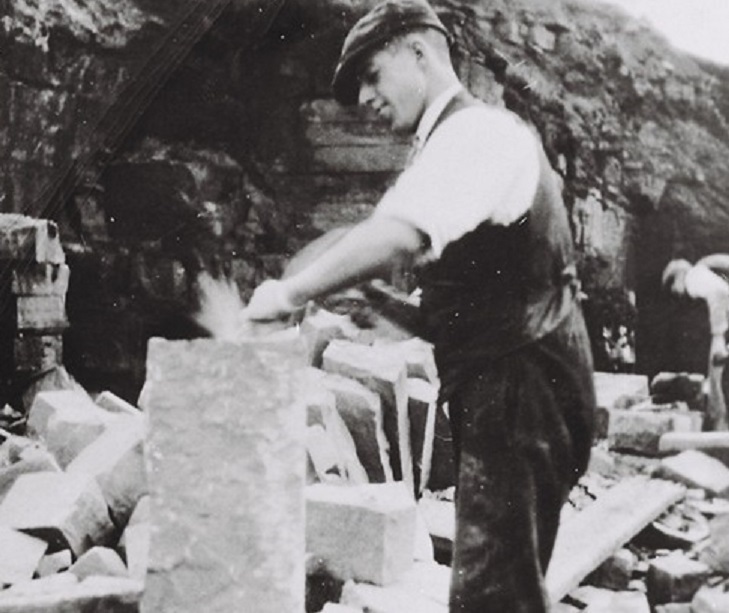
A quarryman of the Victorian period.
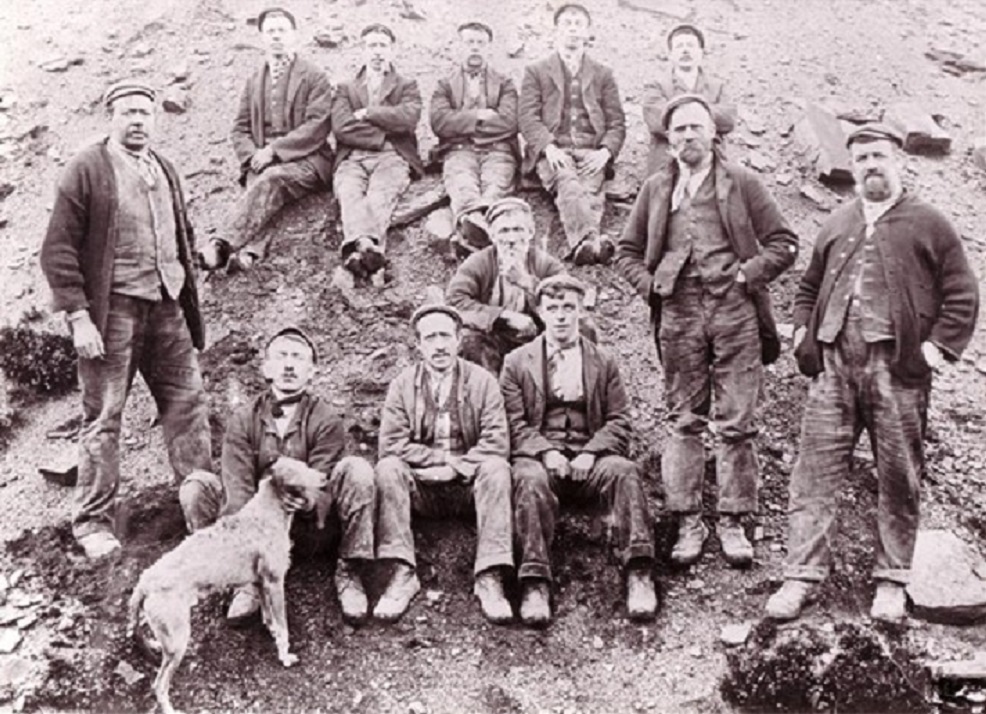
Some more Victorian quarrymen.
Secondly, it acted as a form of quality control; each stone was inspected and finished by the mason, with any flaws or issues noted, their reputation, and thus livelihood, being based on their work. It also meant that substandard work could be traced to an individual. But beyond this, I suspect also that making their mark was important to the masons themselves – a sense of pride in their work, to be able to stand back and say “I made that”, and being able to point it out to their children or grandchildren. It gave a sense of agency to the stonemason, allowing them ownership in both senses, and making them feel as an individual, rather than simply a cog in a much larger machine. This is a hugely important point, and the reason for my fascination with them: these are the personal signatures of the men who carved those stones, men who almost certainly couldn’t read, and most of whom couldn’t sign their name beyond an ‘X’. Indeed, it is entirely likely that, sub-contracted by a foreman, their names wouldn’t be recorded elsewhere either. Thus, these simple geometric shapes are all that remains of the men who built Dinting Arches, testament to their skill and backbreaking labour; this is them signing their work in the way an author does their book, or an artist does a painting. The silent stones speak for them.
Quarrymen in the Victorian period. Image taken from the very interesting Valley of Stone website that looks at the stone quarrying and masons of Rossendale – it tells a fascinating story of the men and their lives. Well worth a visit by following this link
Because I am that kind of person, I have a larger project in mind. Between 1841 and 1847 (ish) the line between Broadbottom and the Woodhead Tunnel, and including the branch line to Glossop, was completed. A massive undertaking, costing enormous amounts of money, and involving huge numbers of men, in that 6 year period, millions of tonnes of stone would have been blasted, shaped, finished, transported, and fitted into place. At some stage, most of the stone would have a mason’s mark put onto it. Not all survive – they might be placed with the mark facing inside the construction, or it might have been removed during the final finishing once the stone was in place. However, dotted around the railway lines – the bridges, underpasses, tunnels, retaining walls, as well as the two viaducts – some marks are still visible. I thought it might be a fun* – and worthy – thing to do to survey all the remaining railway stonework to see what is there, and to make a note of the mason’s marks before they disappear, and the lives of the men with them. We could also see how many match at different points along the track, indicating that the same men were working in different locations. I’d also like to see if any records exist of the men – quarrymen, rough shapers, or finishers – and see if it would be possible to put a name to a mark. Highly unlikely, I know, but you never know.
(* yes, I am painfully aware that ‘fun’ is a very subjective concept… as is Mrs Hamnett)
One has to start somewhere, and so I thought I’d give Dinting Viaduct a go.
An early image of Dinting Arches – taken before 1914 when the brick pillars were inserted. Interestingly, you can also see the track at Adderley Place that originally ran under the arches at the far end, but which is now filled in.
The technique is relatively simple; using eyes and binoculars, I surveyed all the stone I could see, taking a drawing of all the different marks I could make out, and taking photographs, where possible, of good examples of marks (I need to go back and highlight some in chalk). This is not rocket science, or indeed any kind of science, it’s a bloke with some binoculars and notebook. I compiled all the data, numbered each mark, uploaded the photographs, et voila… you are reading the result. Please enjoy. Or don’t, as you wish.
Some broad observations. By and large, the marks are placed centrally in the stone block, only occasionally toward the edges. It seems that only the more ‘natural’ looking blocks contain a mark, and particularly those on the lower courses. The other blocks seem to have been roughly dressed, a process which may have removed a mark, were one present. As expected, the marks are largely constructed from straight lines, with marks D1, D19, and D23 being the exceptions – straight edges are easy to carve, circles less so. The execution of the carving is often poor, with little precision shown – one wonders if they were done with speed before moving on to the next stone, after all, time is money for these men. It must also be remembered that, talented though they undoubtedly were, it is unlikely that these were the fine master-craftsmen who were carving scrollwork and lettering. Rather, they were focused on shaping the stone – accurately and with skill – so that it would fit.
So then, these are the marks, and in a sense these are the men. It is important to note that I have not included inverted example as separate – for example, mark D5 occurs both with 2 points up and with 1 point up, but as the mark was carved prior to it being installed, which way up it is depends entirely on which way up the stone was installed. Conversely, marks D1 and D19 might be the same stonemason’s mark, but the fact that D18 is off-centre in that the lines aren’t paralell to the rectangular edges as they are in D1, suggests they are two different men (unless he was carving it at an angle). It is also possible that some of the different marks noted here are actually the same mark which has been worn or damaged, leaving only the partial mark that I have transcribed – D6, D9, D13, and D15 for example.
So then, what did I see? A selection…
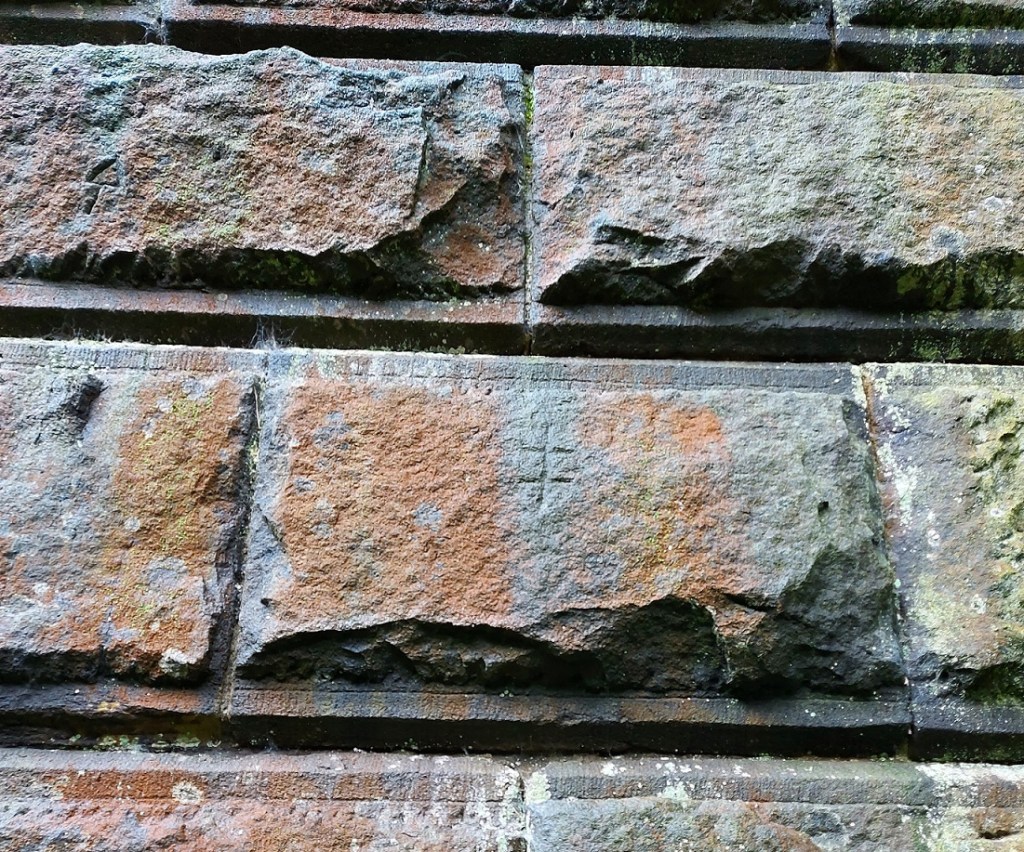
A type D1 carved into the stone.
Types D8 and D19 amongst others. This image makes me feel distinctly weird… I hate looking up under there.
D2 & D6
D15
The fantastically complex D14 – impressive! And another above it.
I could go on, but you get the picture. The whole of Dinting Arches are covered in mason’s marks, and it is well worth a trip down – it’s a fascinating bit of architecture, and of Glossop’s history. Below is the page of marks in my notebook, and I feel certain more are waiting to be discovered.
Here are the 25 marks so far identified. As I say, this is an ongoing project that will theoretically start at Broadbottom, and continue to Hadfield and along the Longdendale Trail to the Woodhead Tunnel.
I will move on to another section of the railway soon, and if anyone fancies joining me, drop me a line – many hands make light work! I’ll post the results, and see if we have any matches.
Right ho, another post soon… I promise. Until then, look after yourselves and each other, and I remain,
What ho, gentle readers! I trust you are all well in these trying times?
I’ve been wanting to make this post for a while, but I’ve only recently got round to doing the research. And my, it is a fascinating story of a turbulent period of history, and of a person who is much less well known than he ought to be – Glossop’s own almost saint, the Blessed Nicholas Garlick. Why I say ‘almostsaint‘ will become apparent, but here is a man who died a martyr, is venerated as such within the Roman Catholic Church, and yet – outside of St Mary’s Roman Catholic church here – he is little known about in Glossop. So, exactly 433 years to the day after his brutal death, read on.
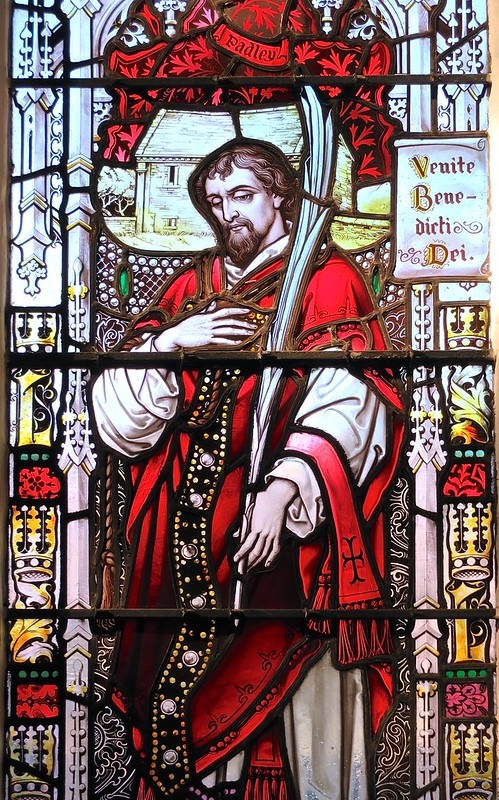
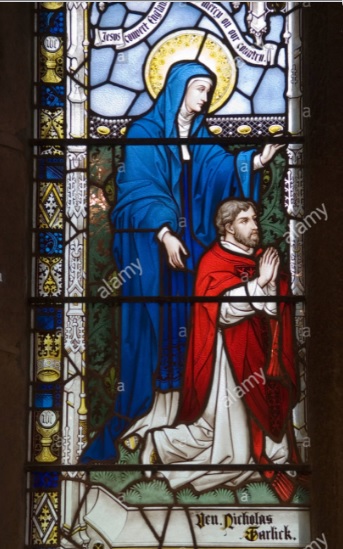
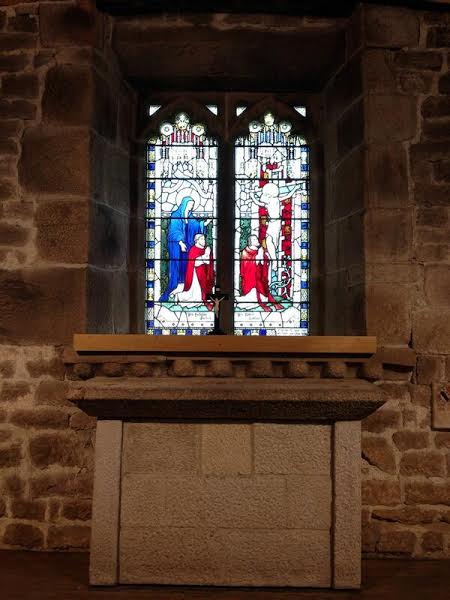
The Blessed Nicholas Garlick. This stained glass window is in the Lady Chapel of St Mary’s RC Church, in Derby.
Nicholas Garlick was born in about 1555 in Dinting, specifically in the hamlet now known as Higher Dinting, here:
The hamlet of Dinting as it was, one of the original settlements that made up Glossop.
Dinting is one of the oldest parts of Glossop. It is mentioned in the Domesday Book (I discussed it in a previous post – here), and I find it fascinating that somebody has lived on this very spot for at least 1000 years. The original Robert Hamnett notes that the Garlicks are an old family in the area, and the isolated hamlet was their home until relatively recently. Indeed, it is still quite a common surname in the Glossop area, and would seem to be chiefly associated with this part of the world.
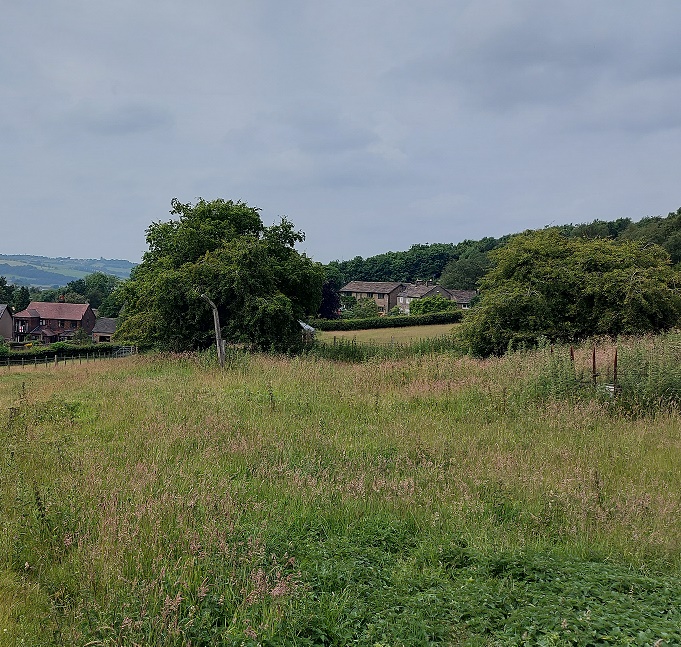
The hamlet of Dinting, nestled into Mouselow.
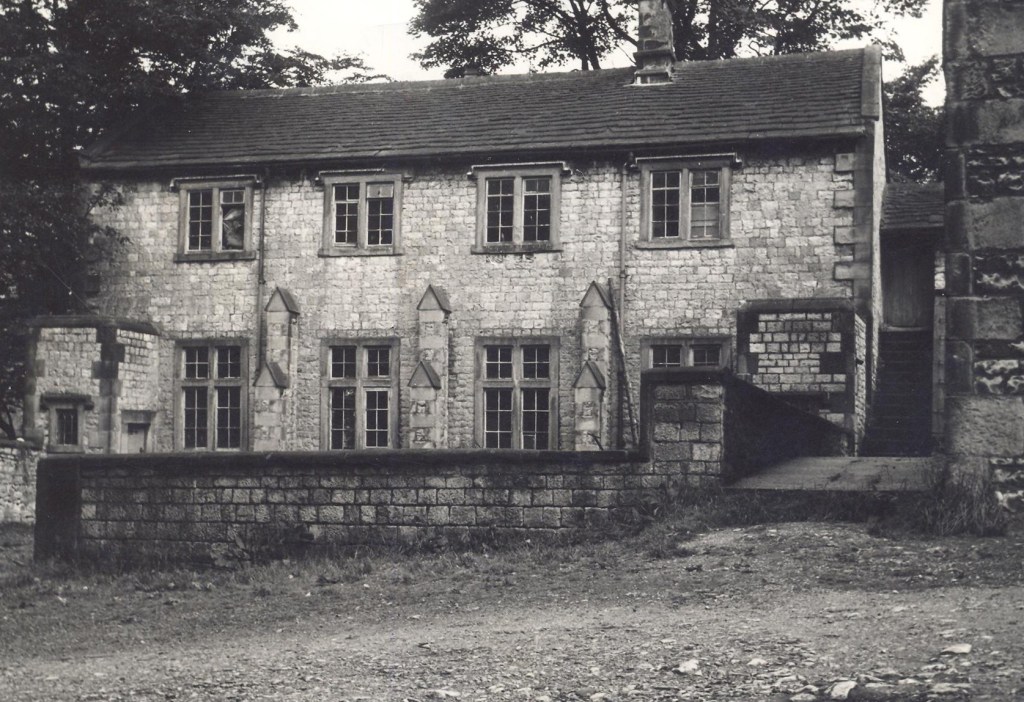
Dinting closer up. Surviving 17th and 18th century buildings cluster round this distinct place, far removed from what think of as Dinting – essentially the arches and the railway station.
Garlick was clearly an intelligent man and went to Oxford University, entering Gloucester Hall (now Worcester College) in January 1575. However, he lasted only 6 months at Oxford, and never graduated. Given what we know of his later actions, it is likely that he refused to take the Oath of Supremacy – something as a student he would be required to do – and was therefore dismissed. The Oath of Supremacy meant swearing acknowledgment that the monarch (Elizabeth I at the time) was Supreme Governor of the Church of England – something that a devout Roman Catholic simply couldn’t do, as he would have recognised only the Pope as the head of the Church. And here is the rub; Nicholas was a Roman Catholic in a time when Roman Catholics were mercilessly persecuted.
From 1533 onwards, Henry VIII’s ministers, led by the king himself, systematically dismantled the Roman Catholic faith in Britain, and replaced it with Protestant Christianity in the form of Anglicanism, and the Church of England. This was forced on the people, often against their will and under great duress, and much of what they had believed in prior to this was now declared ‘wrong’. I think it is difficult to overstate the effect that this would have on people, as the fundamentals of their religious world, that shaped their lives and structured their year, were upturned. Even simple things such as Mass now being celebrated in English, not Latin, or that praying for souls in purgatory, often loved ones, was pointless because there was no longer a purgatory. What was the simple man or woman to make of that? By the time Nicholas was born it was theoretically possible to be a practicing Roman Catholic, although you were known as a ‘recusant’ (somebody who refuses, in this case refuses to attend Anglican services), and were subject to heavy fines and social stigmatisation. However, the celebration of Mass in Roman Catholicism requires a priest, and both were expressly forbidden under pain of death.
After leaving Oxford he moved to Tideswell, near Buxton, and became a school master at the Bishop Robert Pursglove’s Grammar School for a number of years (the school was founded in 1560, and the later 18th century incarnation of the building still stands).
Tideswell Grammar School as it is now – a later 18th century building replacing the 1560 Elizabethan one.
His Catholic faith was clearly strong at this time, as three of his pupils later became priests, and one, Christopher Buxton, was himself executed for his faith.
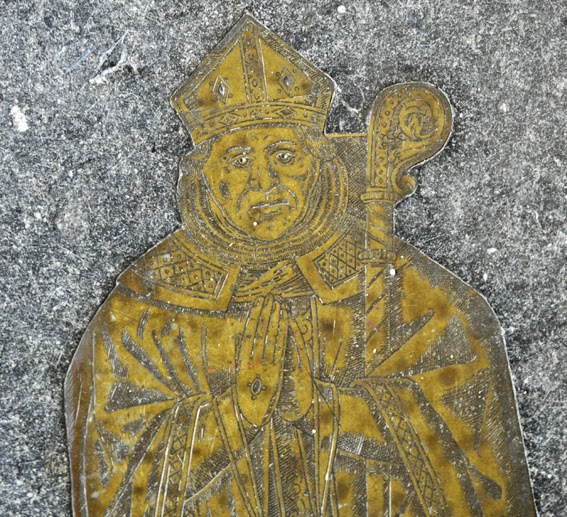
This is odd, though. Teaching of even a hint of Roman Catholic doctrine was expressly illegal, and could have landed Garlick a death sentence. So what’s going on? I dug around a bit, and it seems that Bishop Robert Pursglove who founded the school, and who employed Garlick, was an interesting character. A native of Tideswell, he was born in 1504, and later became a priest, then prior, then bishop. He seems to have swayed with the to-ing and fro-ing of the Reformation from Catholic to Protestant, and back again… and again. But, a little further research shows that he too refused to take the Oath of Supremacy on multiple occasions (something noted as highly suspect at the time), and an official Queen’s Council report of him records that he is “stiff in Papistry”, essentially he was clinging to the old religion, rather than embracing the new. He also enthusiastically embraced Queen Mary’s reintroduction of Roman Catholicism, becoming prebend of Southwell Minster, Nottinghamshire, during her reign. In addition, his memorial brass in Tideswell Church shows him in Roman Catholic Bishop’s dress, something that was also expressly forbidden by Elizabeth I.
Bishop Pursglove as a Roman Catholic bishop. The image is stolen from Distant Thoughts blog – written by a chap called Pursglove, and is an interesting read. Check out his mystery plate post, too. I’m dying to know more…
Pursglove also had strong connection with many recusant families in the area, some of whom were friends and relatives. North Derbyshire was known at the time as an area of strong recusancy, in particular in the area around Tideswell, and focussed on several local families – the Pegges, the Eyres, the Hunlokes, the Poles, and perhaps most important of all, the FitzHerberts. It seems, then, that the good Bishop played a significant role in that, even allowing distinctly Catholic teaching in his school. All this is speculative, of course, but the evidence does add up – Pursglove was probably a recusant Catholic. The fact that he was never investigated, arrested, or even publicly chastised, despite playing fast and lose with the rules, suggests he enjoyed a measure of protection, but I really don’t understand how. This too might explain Garlick’s next move. Bishop Pursglove died in May 1580, and on 22nd June 1581, Garlick enters the English College at Rheims in France. We might speculate that the death of Pursglove, and the loss of the protection he gave, forced Garlick to leave Tideswell, and probably hastily.
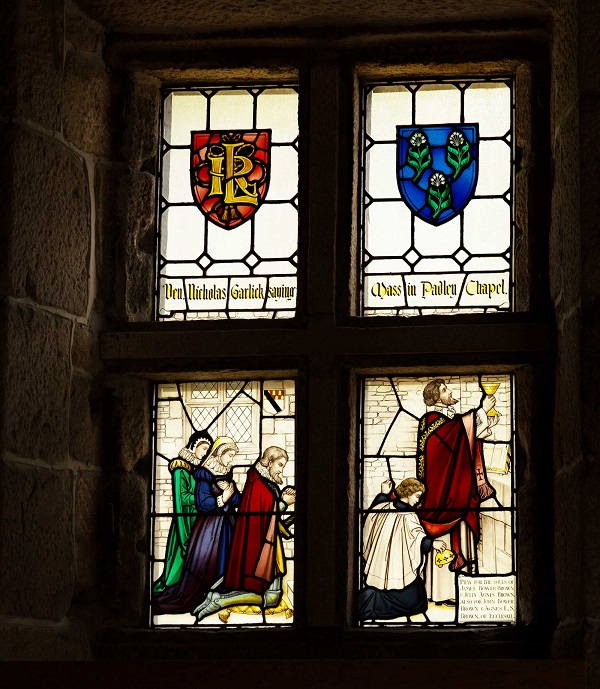
Garlick at prayer, Padley Chapel.
The English College was founded by exiled English Roman Catholic priests with the purpose of allowing English priests in training to continue their studies. But it also produced missionary priests who were to enter England covertly, minister to existing Catholics and attempt re-conversion of the country. This was what Nicholas trained to do, and he was ordained as a priest in March 1582, leaving for England as a missionary on 25th January 1583.
We know very little of his whereabouts until 1585 when he is caught, arrested, and banished, with the knowledge that if he is caught again he will be executed, as ministering as a priest was at the time a treasonable offence. The reason for this was simple – priests swear an oath of fealty to the Pope as head of the Church, and the papacy was at the time actively supporting France and Spain in their aggressions against England, and was actively seeking the conversion of the country back to Catholicism (indeed, Pope Sixtus V gave his blessing to the Spanish Armada as a crusade against the English). Garlick arrived back in Rheims on 17th October 1585, and two days later he headed back to England.
Once again his whereabouts are unclear, but a spy’s report of 16th September 1586 notes that he “laboureth with diligence in Hampshire and Dorsetshire”, and he crops up in Derbyshire in a government list of recusants in March 1588. He is clearly doing his duty, and is ministering to the needs of recusant Catholics in the area, and it this that is his undoing.
We have to remember that this is the time of Priest’s Holes: priests come to the houses of recusant Catholics and stay for periods of time, acting as a priest to the family and others nearby. However, there are significant networks of spies on the lookout for just such activity, so it all has to be done in secret, and if the officials come knocking, the priest has to be hidden in a Priest’s Hole. If they are caught the whole family would suffer, and the priest would be executed. Horrifically.
On the 12th July 1588 Garlick, and another priest was staying with the Catholic FitzHerbert family in Padley Hall, Padley, about 8 miles from Tideswell. The FitzHerberts were a well known and powerful recusant Catholic family, and whilst they carefully towed the legal line, they steadfastly refused to give up their faith, and this made them a huge target on the hit list of the authorities.
And the worst happened.
Garlick saying mass at the private chapel in Padley Hall. From the stained glass of Padley Chapel.
The sequence of events was actually set in motion by two individuals: Richard Topcliffe, and Thomas FitzHerbert, the son of John FitzHerbert of Padley Hall. Topcliffe was a Catholic catcher par excellence, who liked nothing more than to arrest, torture, and brutalise recusant Catholics and priests – he was, quite simply, a psychopath who enjoyed his work, and was allowed to do so by the authorities. He also had a personal vendetta against the FitzHerbert family. Thomas FitzHerbert on the other hand was seemingly an ambitious, cold-blooded, and immature moron who could think of nothing more than his inheritance. Between them, they came up with a plan that FitzHerbert would pay Topcliffe £3000 if he prosecuted to death his father (John), uncle (Sir Thomas), and cousin (William Basset) in order that Thomas would inherit the estate of Sir Thomas.
It was Thomas’s tip off that sent George Talbot, Earl of Shrewsbury, to arrest his father, and it was Nicholas Garlick’s bad luck to be at Padley Hall when he arrived. The priests, along with John FitzHerbert, his son Anthony, three of his daughters – Jane, Maud, and Mary – and ten servants were all arrested, and the whole party was transferred to jail in Derby. Another Glossop connection here is that George Talbot, Earl of Shrewsbury, was also the lord of Glossop – hence Talbot Road, Talbot Street, and Shrewsbury Street.
The arrest of Nicholas Garlick – from the stained glass of Padley Chapel.
On the 23rd July 1588, the priests were tried for High Treason, and for coming into the kingdom and “seducing” the Queen’s subjects. Garlick’s response was “I have not come to seduce, but to induce men to the Catholic faith. For this end have I come to the country, and for this will I work as long as I live“. Not the best defence, and he was inevitably found guilty. Garlick, along with Ludlam, and another priest, Richard Simpson, was sentenced to be hanged, drawn and quartered:
“That you and each of you be carried to the place from whence you came, and from thence be drawn on a hurdle to the place of execution, and be there severally hanged, but cut down while you are alive; that your privy members be cut off; that your bowels be taken out and burnt before your faces; that your heads be severed from your bodies; that your bodies be divided into four-quarters, and that your quarters be at the Queen’s disposal; and the Lord have mercy on your souls.”.
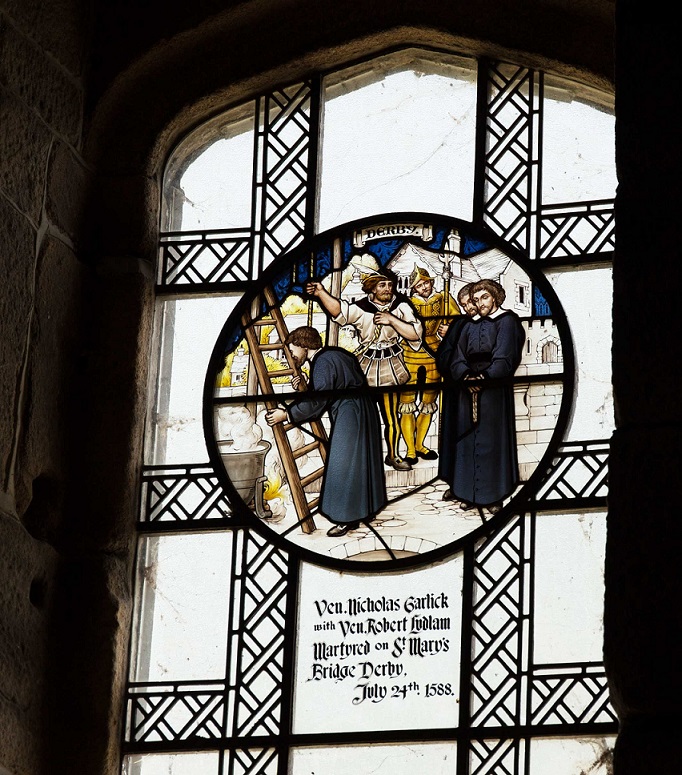
The sentence was carried out the next day, 24th July 1588. The three priests were taken to St Mary’s Bridge in Derby, with Garlick joking and making merry as they went, even reminiscing with a passer-by about the days they went shooting together, remarking that he was about to “shoot off such a shot as I never shot in all my life“. However, it seems that the local authorities were not well versed in this sort of execution, and the cauldron to be used for the burning of the condemned’s entrails was not hot enough, so there was a delay. Garlick, ever the priest, used this delay to deliver a final sermon, ending by throwing into the crowd religious texts extolling the virtue of the Roman Catholic faith; tradition states that everyone who read the texts were converted. At last, the time came. Simpson was to be executed first, but Garlick moved to the ladder ahead of him, and kissing it, calmly went to that most brutal of deaths. A further calamity occurred – he was hanged for a short time, but as he was taken down from the gallows to be disemboweled, it was noticed that he was still wearing his doublet, and by the time it was removed he was fully conscious and awake, alert to what was happening to him.
Garlick kissing the ladders to the execution platform. Again, from the stained glass of Padley Chapel.
The sentence duly carried out, the heads and quartered body parts of the three priests were put on spikes and displayed on the bridge and elsewhere around Derby, and then tarred and distributed.
Chapel of St Mary on the Bridge, Derby – here he was executed, and his head spiked on the bridge, the remains of which can be seen underneath and attached to the chapel. From here.
It is entirely likely that, given his birth and familial connection with Glossop, one part or another of his worldly remains would have been displayed here, and probably at the market cross in Old Glossop. A sobering thought. Another local legend records that the body parts were removed, and that Garlick’s head was buried at Tideswell church.
An anonymous poem written probably by someone who was a witness to the horrific scene runs thus:
When Garlick did the ladder kiss, And Sympson after hie, Methought that there St. Andrew was Desirous for to die.
When Ludlam lookèd smilingly, And joyful did remain, It seemed St. Stephen was standing by, For to be stoned again.
And what if Sympson seemed to yield, For doubt and dread to die; He rose again, and won the field And died most constantly.
His watching, fasting, shirt of hair; His speech, his death, and all, Do record give, do witness bear, He wailed his former fall.
In 1888, the two Padley Martyrs, as they became known, were given the title ‘Venerable’ by the church – this means they have been declared a ‘servant of God‘, and that they had ‘heroic virtue‘ – essentially the recognition of one’s life work, as well as one’s death. This led to the creation of an annual pilgrimage to Padley Chapel – the converted former gatehouse of the now ruined Padley Hall.
Commemorative card and medal printed and minted following the 1888 declaration of the title ‘Venerable’.
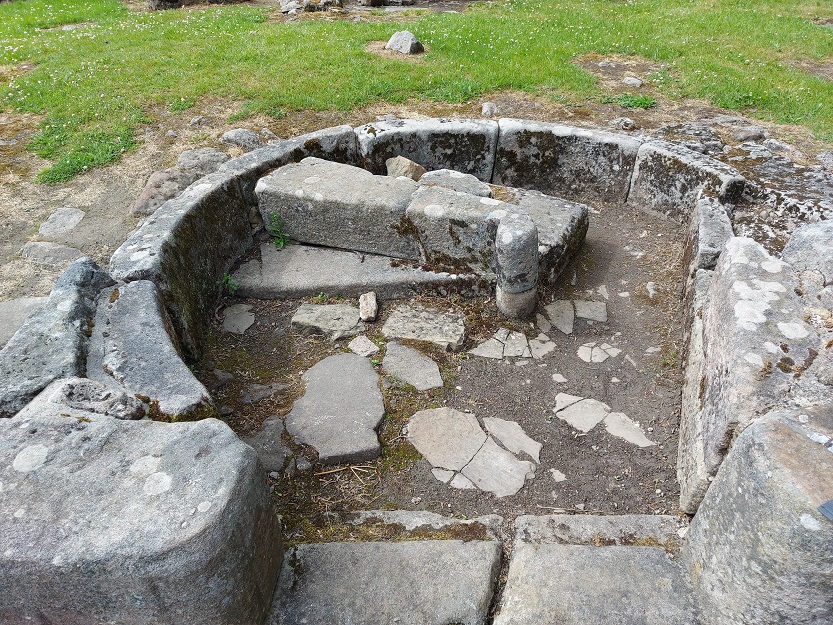
There would have been a private chapel in the hall, and it is suggested that this was in the upper part of the gatehouse. In 1934 the original 16th century altar stone was discovered buried in the garden where it had been hidden by the FitzHerberts prior to their arrest, and would have been the original one that Nichols would have used to celebrate Mass; it now forms the altar in the chapel there.
The altar at Padley Chapel, complete with original stone.
Then, on 22nd November 1987, Nicholas Garlick was Beatified by Pope John Paul II. This is a significant event, and is one of the necessary steps on the road to being declared a saint; if the Church confirms a miracle through his intercession, then he will officially be declared Saint Nicholas of Dinting. Whatever your personal beliefs, it is quite a journey from Dinting to the right hand of God.
Family Hamnett recently visited the chapel and ruined hall – it’s remarkable what is still standing and can be seen, and it’s a wonderful romantic ruin, set in lovely walking country, and with an astonishing, if grim, history:
Padley Chapel, originally the gatehouse to Padley Hall. And a standing stone, too – probably a track marker rather than a prehistoric stone.
The north western range, containing the great hall. There are three doors in front of us – left into the great hall with the huge fireplace behind, right into an ante-room, and middle up a spiral staircase, the base of which can be seen. Look how worn the door steps are.
Close up of the spiral staircase base. Fanstastic!
Master Hamnett exploring the ruined fireplace. It’s huge!
There are lots of medieval tracery and carved bits lying around – some have been incorporated into a wall, but others can be seen.
I also found a Victorian John Smith’s of Tadcaster beer bottle in a wall, which was a nice bonus!
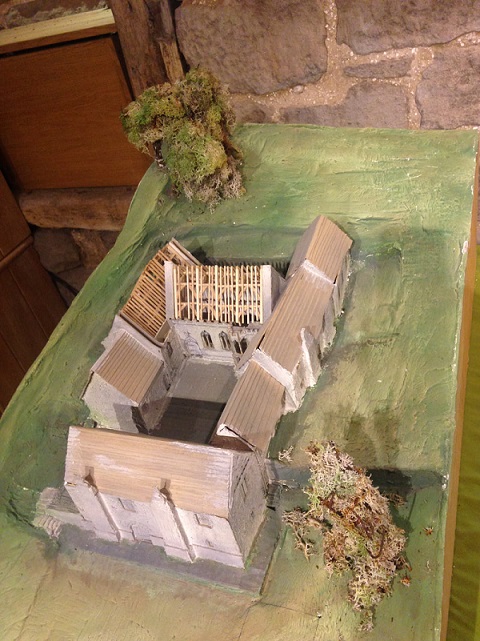
A photograph of a reconstruction of Padley Hall, shamelessly taken from the Time Travellers’ website – they seem to be a good bunch of archaeological types, so go check them out, especially if you live near Sheffield.
The whole place is amazing, and well worth a visit.
If you are interested in this period of history, I cannot recommend highly enough The Stripping Of The Altars by Eamon Duffy – it studies both the state of Catholic religion in England prior to the Reformation, as well as the sweeping and catastrophic changes that occur during and after. Have a look on Amazon, but please make sure you buy it at Bay Tree Books on High Street West in Glossop. An added bonus is that it might be me that sells it to you.
Another view of Nicholas Garlick. Here he is pictured holding a knife in the traditional style of portraying saints holding the method of their martyrdom. This one from the Lady Chapel of St Mary’s Church, Derby (via this website)
I hope you enjoyed this slightly longer than usual post, and unusual subject matter. More pottery next time. What do you mean, “no, please no, spare us the pottery“? I can hear you, you know. Honestly, the nerve of some people. More soon, but until then look after yourselves and each other, and as always, I remain.
























 The Glossop Cabinet of Curiosities