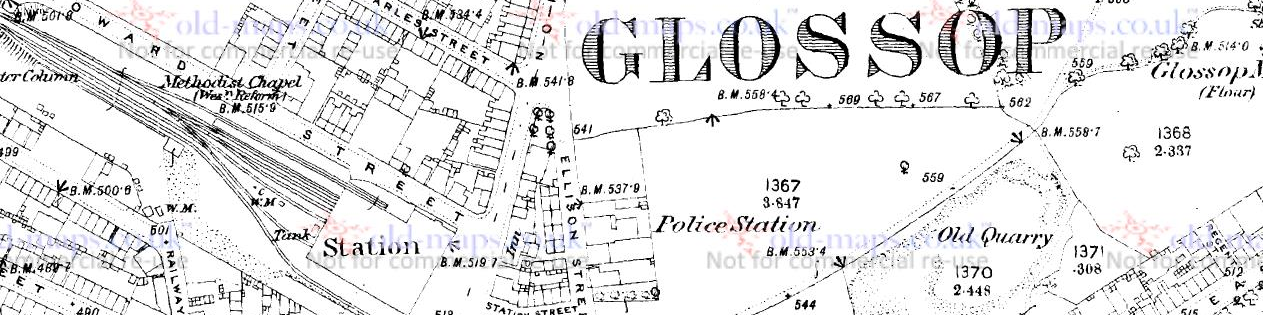
What ho, gentle readers! I trust you are all well in these trying times?
I’ve been wanting to make this post for a while, but I’ve only recently got round to doing the research. And my, it is a fascinating story of a turbulent period of history, and of a person who is much less well known than he ought to be – Glossop’s own almost saint, the Blessed Nicholas Garlick. Why I say ‘almost saint‘ will become apparent, but here is a man who died a martyr, is venerated as such within the Roman Catholic Church, and yet – outside of St Mary’s Roman Catholic church here – he is little known about in Glossop. So, exactly 433 years to the day after his brutal death, read on.
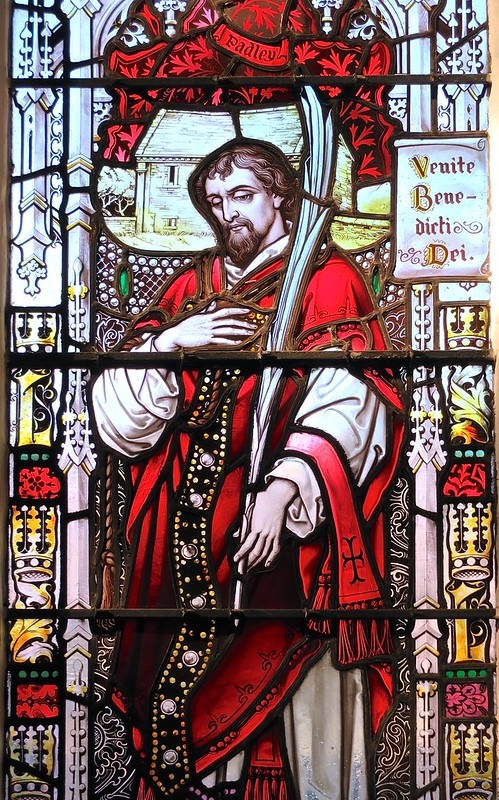
Nicholas Garlick was born in about 1555 in Dinting, specifically in the hamlet now known as Higher Dinting, here:

Dinting is one of the oldest parts of Glossop. It is mentioned in the Domesday Book (I discussed it in a previous post – here), and I find it fascinating that somebody has lived on this very spot for at least 1000 years. The original Robert Hamnett notes that the Garlicks are an old family in the area, and the isolated hamlet was their home until relatively recently. Indeed, it is still quite a common surname in the Glossop area, and would seem to be chiefly associated with this part of the world.
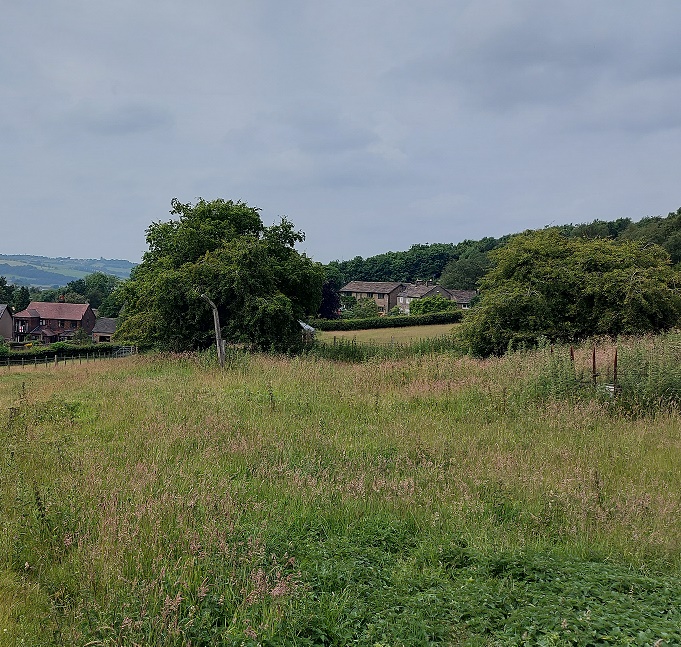

Garlick was clearly an intelligent man and went to Oxford University, entering Gloucester Hall (now Worcester College) in January 1575. However, he lasted only 6 months at Oxford, and never graduated. Given what we know of his later actions, it is likely that he refused to take the Oath of Supremacy – something as a student he would be required to do – and was therefore dismissed. The Oath of Supremacy meant swearing acknowledgment that the monarch (Elizabeth I at the time) was Supreme Governor of the Church of England – something that a devout Roman Catholic simply couldn’t do, as he would have recognised only the Pope as the head of the Church. And here is the rub; Nicholas was a Roman Catholic in a time when Roman Catholics were mercilessly persecuted.
From 1533 onwards, Henry VIII’s ministers, led by the king himself, systematically dismantled the Roman Catholic faith in Britain, and replaced it with Protestant Christianity in the form of Anglicanism, and the Church of England. This was forced on the people, often against their will and under great duress, and much of what they had believed in prior to this was now declared ‘wrong’. I think it is difficult to overstate the effect that this would have on people, as the fundamentals of their religious world, that shaped their lives and structured their year, were upturned. Even simple things such as Mass now being celebrated in English, not Latin, or that praying for souls in purgatory, often loved ones, was pointless because there was no longer a purgatory. What was the simple man or woman to make of that? By the time Nicholas was born it was theoretically possible to be a practicing Roman Catholic, although you were known as a ‘recusant’ (somebody who refuses, in this case refuses to attend Anglican services), and were subject to heavy fines and social stigmatisation. However, the celebration of Mass in Roman Catholicism requires a priest, and both were expressly forbidden under pain of death.
After leaving Oxford he moved to Tideswell, near Buxton, and became a school master at the Bishop Robert Pursglove’s Grammar School for a number of years (the school was founded in 1560, and the later 18th century incarnation of the building still stands).
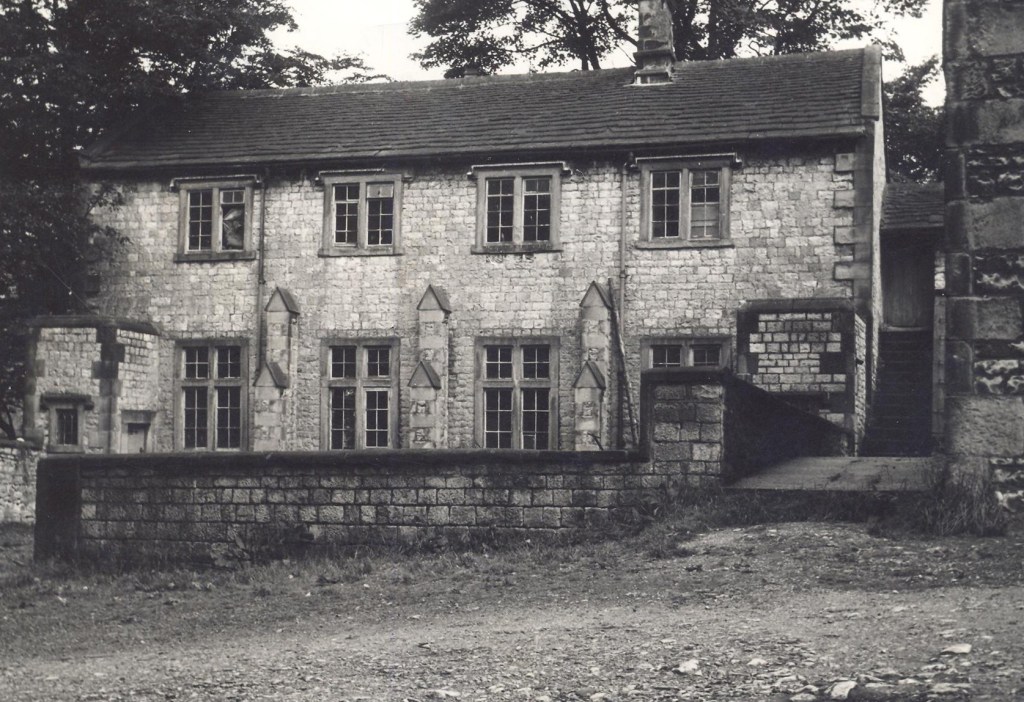
His Catholic faith was clearly strong at this time, as three of his pupils later became priests, and one, Christopher Buxton, was himself executed for his faith.
This is odd, though. Teaching of even a hint of Roman Catholic doctrine was expressly illegal, and could have landed Garlick a death sentence. So what’s going on? I dug around a bit, and it seems that Bishop Robert Pursglove who founded the school, and who employed Garlick, was an interesting character. A native of Tideswell, he was born in 1504, and later became a priest, then prior, then bishop. He seems to have swayed with the to-ing and fro-ing of the Reformation from Catholic to Protestant, and back again… and again. But, a little further research shows that he too refused to take the Oath of Supremacy on multiple occasions (something noted as highly suspect at the time), and an official Queen’s Council report of him records that he is “stiff in Papistry”, essentially he was clinging to the old religion, rather than embracing the new. He also enthusiastically embraced Queen Mary’s reintroduction of Roman Catholicism, becoming prebend of Southwell Minster, Nottinghamshire, during her reign. In addition, his memorial brass in Tideswell Church shows him in Roman Catholic Bishop’s dress, something that was also expressly forbidden by Elizabeth I.
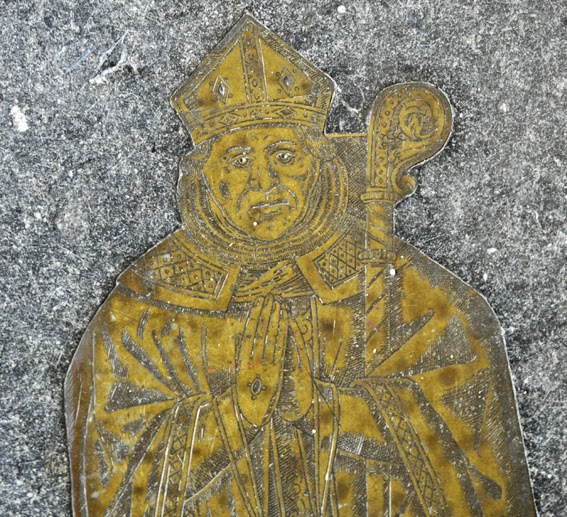
Pursglove also had strong connection with many recusant families in the area, some of whom were friends and relatives. North Derbyshire was known at the time as an area of strong recusancy, in particular in the area around Tideswell, and focussed on several local families – the Pegges, the Eyres, the Hunlokes, the Poles, and perhaps most important of all, the FitzHerberts. It seems, then, that the good Bishop played a significant role in that, even allowing distinctly Catholic teaching in his school. All this is speculative, of course, but the evidence does add up – Pursglove was probably a recusant Catholic. The fact that he was never investigated, arrested, or even publicly chastised, despite playing fast and lose with the rules, suggests he enjoyed a measure of protection, but I really don’t understand how. This too might explain Garlick’s next move. Bishop Pursglove died in May 1580, and on 22nd June 1581, Garlick enters the English College at Rheims in France. We might speculate that the death of Pursglove, and the loss of the protection he gave, forced Garlick to leave Tideswell, and probably hastily.
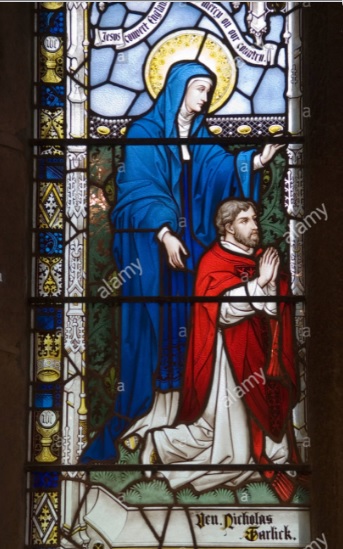
The English College was founded by exiled English Roman Catholic priests with the purpose of allowing English priests in training to continue their studies. But it also produced missionary priests who were to enter England covertly, minister to existing Catholics and attempt re-conversion of the country. This was what Nicholas trained to do, and he was ordained as a priest in March 1582, leaving for England as a missionary on 25th January 1583.
We know very little of his whereabouts until 1585 when he is caught, arrested, and banished, with the knowledge that if he is caught again he will be executed, as ministering as a priest was at the time a treasonable offence. The reason for this was simple – priests swear an oath of fealty to the Pope as head of the Church, and the papacy was at the time actively supporting France and Spain in their aggressions against England, and was actively seeking the conversion of the country back to Catholicism (indeed, Pope Sixtus V gave his blessing to the Spanish Armada as a crusade against the English). Garlick arrived back in Rheims on 17th October 1585, and two days later he headed back to England.
Once again his whereabouts are unclear, but a spy’s report of 16th September 1586 notes that he “laboureth with diligence in Hampshire and Dorsetshire”, and he crops up in Derbyshire in a government list of recusants in March 1588. He is clearly doing his duty, and is ministering to the needs of recusant Catholics in the area, and it this that is his undoing.
We have to remember that this is the time of Priest’s Holes: priests come to the houses of recusant Catholics and stay for periods of time, acting as a priest to the family and others nearby. However, there are significant networks of spies on the lookout for just such activity, so it all has to be done in secret, and if the officials come knocking, the priest has to be hidden in a Priest’s Hole. If they are caught the whole family would suffer, and the priest would be executed. Horrifically.
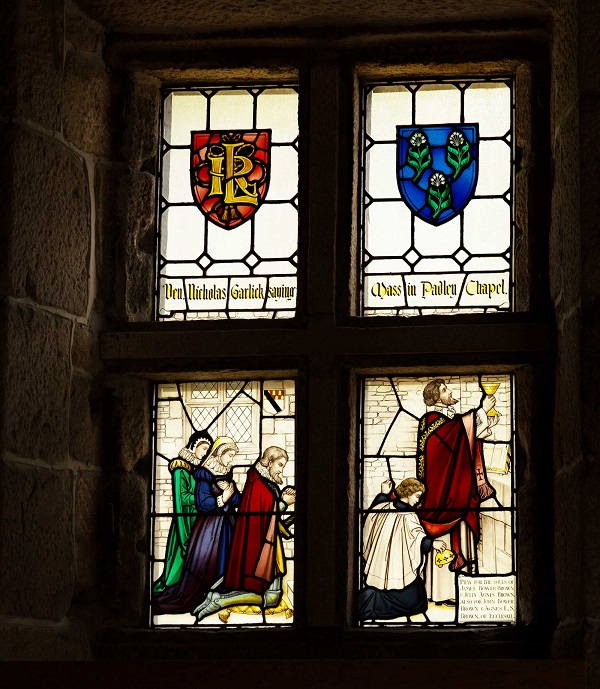
On the 12th July 1588 Garlick, and another priest was staying with the Catholic FitzHerbert family in Padley Hall, Padley, about 8 miles from Tideswell. The FitzHerberts were a well known and powerful recusant Catholic family, and whilst they carefully towed the legal line, they steadfastly refused to give up their faith, and this made them a huge target on the hit list of the authorities.
And the worst happened.
The sequence of events was actually set in motion by two individuals: Richard Topcliffe, and Thomas FitzHerbert, the son of John FitzHerbert of Padley Hall. Topcliffe was a Catholic catcher par excellence, who liked nothing more than to arrest, torture, and brutalise recusant Catholics and priests – he was, quite simply, a psychopath who enjoyed his work, and was allowed to do so by the authorities. He also had a personal vendetta against the FitzHerbert family. Thomas FitzHerbert on the other hand was seemingly an ambitious, cold-blooded, and immature moron who could think of nothing more than his inheritance. Between them, they came up with a plan that FitzHerbert would pay Topcliffe £3000 if he prosecuted to death his father (John), uncle (Sir Thomas), and cousin (William Basset) in order that Thomas would inherit the estate of Sir Thomas.
It was Thomas’s tip off that sent George Talbot, Earl of Shrewsbury, to arrest his father, and it was Nicholas Garlick’s bad luck to be at Padley Hall when he arrived. The priests, along with John FitzHerbert, his son Anthony, three of his daughters – Jane, Maud, and Mary – and ten servants were all arrested, and the whole party was transferred to jail in Derby. Another Glossop connection here is that George Talbot, Earl of Shrewsbury, was also the lord of Glossop – hence Talbot Road, Talbot Street, and Shrewsbury Street.

On the 23rd July 1588, the priests were tried for High Treason, and for coming into the kingdom and “seducing” the Queen’s subjects. Garlick’s response was “I have not come to seduce, but to induce men to the Catholic faith. For this end have I come to the country, and for this will I work as long as I live“. Not the best defence, and he was inevitably found guilty. Garlick, along with Ludlam, and another priest, Richard Simpson, was sentenced to be hanged, drawn and quartered:
“That you and each of you be carried to the place from whence you came, and from thence be drawn on a hurdle to the place of execution, and be there severally hanged, but cut down while you are alive; that your privy members be cut off; that your bowels be taken out and burnt before your faces; that your heads be severed from your bodies; that your bodies be divided into four-quarters, and that your quarters be at the Queen’s disposal; and the Lord have mercy on your souls.”.
The sentence was carried out the next day, 24th July 1588. The three priests were taken to St Mary’s Bridge in Derby, with Garlick joking and making merry as they went, even reminiscing with a passer-by about the days they went shooting together, remarking that he was about to “shoot off such a shot as I never shot in all my life“. However, it seems that the local authorities were not well versed in this sort of execution, and the cauldron to be used for the burning of the condemned’s entrails was not hot enough, so there was a delay. Garlick, ever the priest, used this delay to deliver a final sermon, ending by throwing into the crowd religious texts extolling the virtue of the Roman Catholic faith; tradition states that everyone who read the texts were converted. At last, the time came. Simpson was to be executed first, but Garlick moved to the ladder ahead of him, and kissing it, calmly went to that most brutal of deaths. A further calamity occurred – he was hanged for a short time, but as he was taken down from the gallows to be disemboweled, it was noticed that he was still wearing his doublet, and by the time it was removed he was fully conscious and awake, alert to what was happening to him.
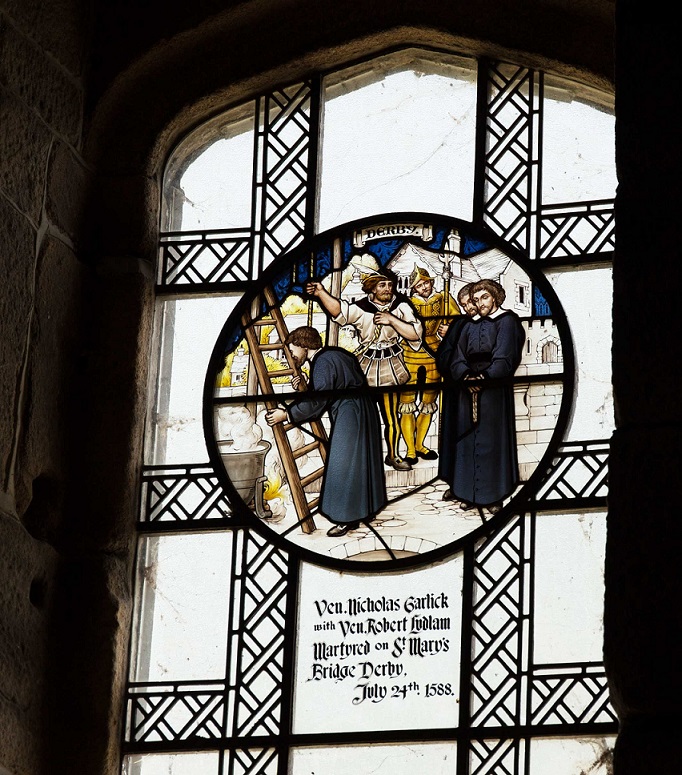
The sentence duly carried out, the heads and quartered body parts of the three priests were put on spikes and displayed on the bridge and elsewhere around Derby, and then tarred and distributed.
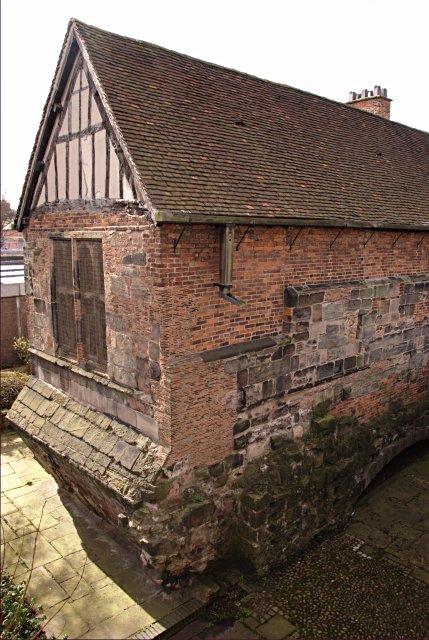
It is entirely likely that, given his birth and familial connection with Glossop, one part or another of his worldly remains would have been displayed here, and probably at the market cross in Old Glossop. A sobering thought. Another local legend records that the body parts were removed, and that Garlick’s head was buried at Tideswell church.
An anonymous poem written probably by someone who was a witness to the horrific scene runs thus:
When Garlick did the ladder kiss,
And Sympson after hie,
Methought that there St. Andrew was
Desirous for to die.
When Ludlam lookèd smilingly,
And joyful did remain,
It seemed St. Stephen was standing by,
For to be stoned again.
And what if Sympson seemed to yield,
For doubt and dread to die;
He rose again, and won the field
And died most constantly.
His watching, fasting, shirt of hair;
His speech, his death, and all,
Do record give, do witness bear,
He wailed his former fall.
In 1888, the two Padley Martyrs, as they became known, were given the title ‘Venerable’ by the church – this means they have been declared a ‘servant of God‘, and that they had ‘heroic virtue‘ – essentially the recognition of one’s life work, as well as one’s death. This led to the creation of an annual pilgrimage to Padley Chapel – the converted former gatehouse of the now ruined Padley Hall.

There would have been a private chapel in the hall, and it is suggested that this was in the upper part of the gatehouse. In 1934 the original 16th century altar stone was discovered buried in the garden where it had been hidden by the FitzHerberts prior to their arrest, and would have been the original one that Nichols would have used to celebrate Mass; it now forms the altar in the chapel there.
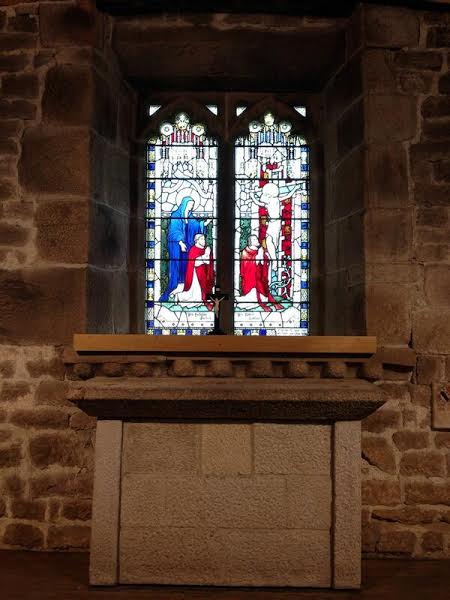
Then, on 22nd November 1987, Nicholas Garlick was Beatified by Pope John Paul II. This is a significant event, and is one of the necessary steps on the road to being declared a saint; if the Church confirms a miracle through his intercession, then he will officially be declared Saint Nicholas of Dinting. Whatever your personal beliefs, it is quite a journey from Dinting to the right hand of God.
Family Hamnett recently visited the chapel and ruined hall – it’s remarkable what is still standing and can be seen, and it’s a wonderful romantic ruin, set in lovely walking country, and with an astonishing, if grim, history:


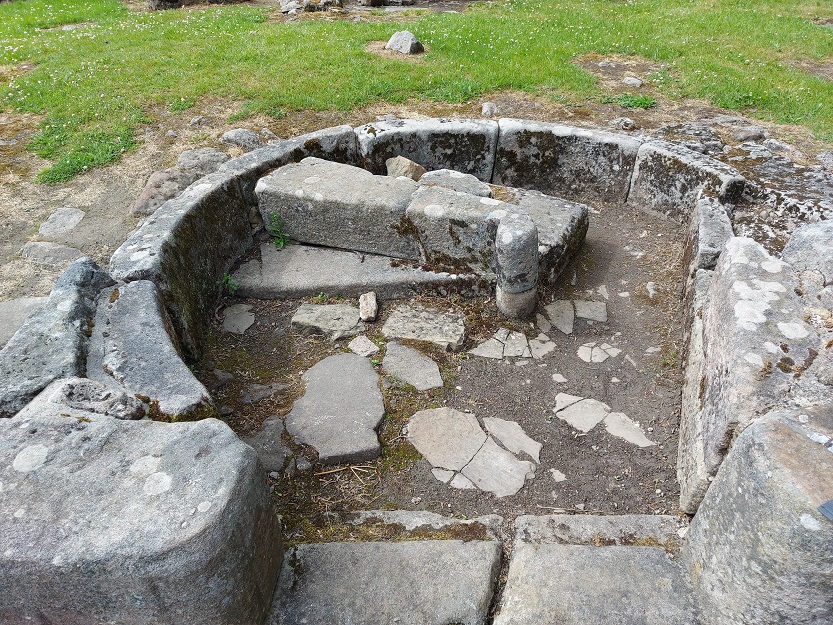


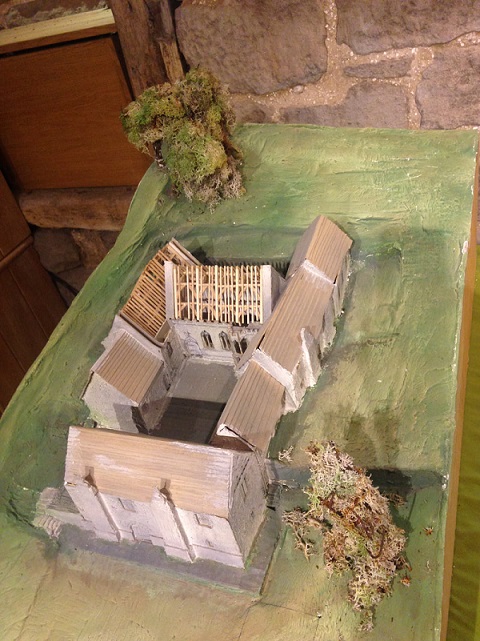
The whole place is amazing, and well worth a visit.
If you are interested in this period of history, I cannot recommend highly enough The Stripping Of The Altars by Eamon Duffy – it studies both the state of Catholic religion in England prior to the Reformation, as well as the sweeping and catastrophic changes that occur during and after. Have a look on Amazon, but please make sure you buy it at Bay Tree Books on High Street West in Glossop. An added bonus is that it might be me that sells it to you.

I hope you enjoyed this slightly longer than usual post, and unusual subject matter. More pottery next time. What do you mean, “no, please no, spare us the pottery“? I can hear you, you know. Honestly, the nerve of some people. More soon, but until then look after yourselves and each other, and as always, I remain.
Your humble servant,
RH
 The Glossop Cabinet of Curiosities