Archaeology · Dinting · History · Where / When

Slate

What ho, wonderful folk! Apologies for not publishing something sooner than today… truthfully, I have been a little overwhelmed and burnt out. Recent events have caught up with me, and I’m tired and somewhat sore; nothing a breather couldn’t fix, but sometimes it all becomes a little too much – please do listen to your bodies and minds, as they will often steer you on a correct course. Anyhoo, I’m back, and happy to be so. So here we are, with a long overdue post.

Last March, I went on a little Wander with a friend and family (hello GW). We had set off to do the first Where/When Wander, but having kids with us, we ended up playing around in the land by the allotments and behind Dinting Station. Aside from the fact that the area is interesting from a historical perspective (being connected with Dinting Station, and filled with old bits and pieces), it was also the location of the old Dinting Railway Centre/Museum. I vaguely remember visiting the museum several times as a child, and I recently bought a vintage guidebook on Ebay to try and fully remember what it was I went to.

The centre finally closed in 1990, and whilst all the trains and exhibition pieces moved elsewhere, the infrastructure – rails, and platforms, and buildings – all remains (here is a good article about the museum’s rise and fall, and there’s loads about it on the internet). Central in this wasteland – or forest of Silver Birch – the Engine Shed still stands, alone, derelict, and graffiti covered.

Here’s what it looked like in 1967, before the Railway Museum…
And here’s a similar shot, nearly 60 years later, and after having been a museum in the meantime. Blimey! Honestly, the building is in there.
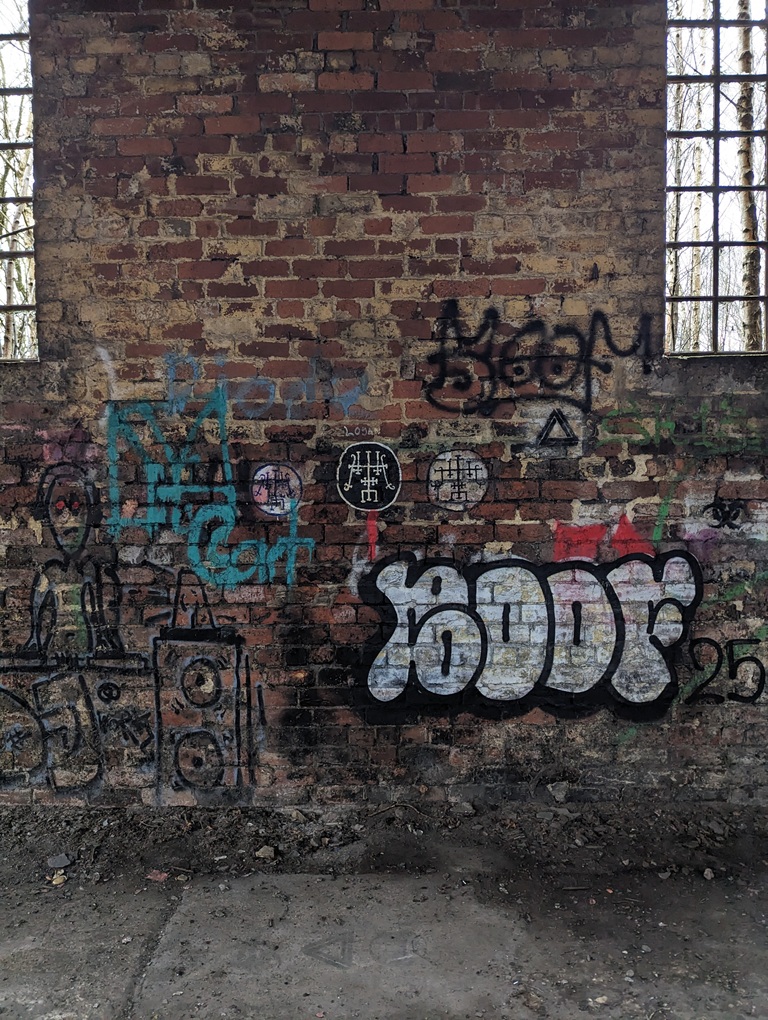
Our old friend Boof makes an appearance, here represented by his/her older tag, and a newer (2025) bubble piece. His/her tag is all over the site.
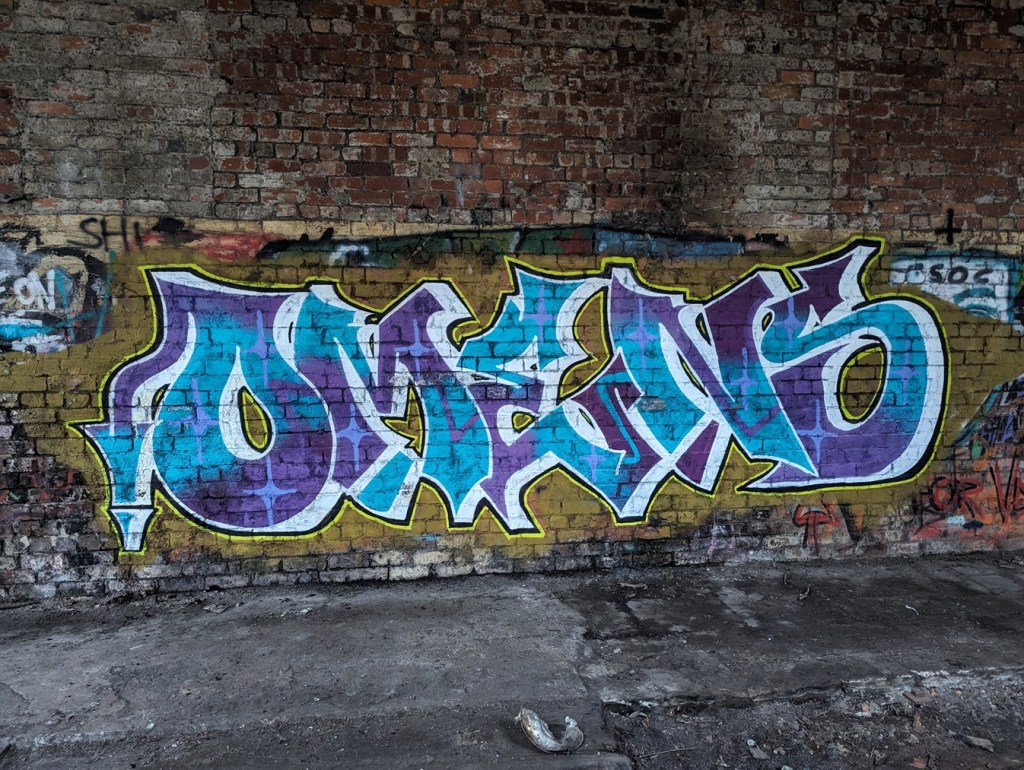
Some of it is quite good, this piece in particular ‘OMENS’ (strangely unsigned, presumably Omens is their ‘tag’), and this one…
…are very artfully done. Love the window in the background/part of of this one.
So this is interesting. Because I am that sort of person, I knew this was something when I saw it. Rather bafflingly, this is the sigil of Foras, one of the 72 demons mentioned in the 17th century Lesser Key of Solomon. Apparently he was the president of Hell, and was associated with precious metals, logic, and lost things. Quite why his sigil is painted on the wall here is beyond me; teenage rebellion or demonic invasion? You decide.

Anyway, comparing the photographs of then with now is really quite interesting, and shows just how quickly nature retakes land back, even heavily used and industrialised land such as this. Give it another 100 years, and there will be very little recognisable, 500 years and it’ll need an archaeological excavation to make any sense of the site; understanding site formation processes like this is vital as an archaeologist, and our case study is right here.

But today’s article is less about the centre, and more about a single aspect of the site. As generally happens, when a building is left derelict and unused, it slowly breaks down, and this is the case with Dinting station’s southern waiting room. Built in 1884, when the original 1848 station was rebuilt, you can see it from the train behind a fence; overgrown, derelict, absolutely terrifying. However, I didn’t know you could access the station from the back, via the patch of ground we were exploring. Well, I mean to say… one cannot simply say no when such gifts are presented to one! I had a brief explore! Brief because: a) I was probably trespassing, although it is very unclear to be honest (and I was by no means the only person there that day… or even that hour!), and b) we had children with us, and the place is phenomenally dangerous, with broken glass, falling masonry, and Jove knows what else. It was also going dark, and, I’m not going to lie to you, the place is spooky! Before we go on, I am also going to insert a cautionary statement here: I absolutely do not endorse you going to the place to look, and in fact recommend you don’t. So I took a very few, mostly terrible, photographs, and scarpered.

The station building from afar… the Silver Birch trees are amazing in this photo – and I actually find them frightening here.
Random brickwork, and an odd framed shot of a corner with shamfered edged stone. Look, I had a quick look around, and then legged it! I wasn’t taking my time with perfection!
Lovely Stoneware bottle; possibly a large ink bottle, but I suspect it is something more industrial – a chemical or oil, perhaps. The whole area is filled with burnt cinders and rubbish, amongst which are many interesting finds.
It’s a beautiful building. Or at least could be. These windows are lovely, but then through them you can see sky through the roof. How long does this place have left before it all collapses? Who knows.
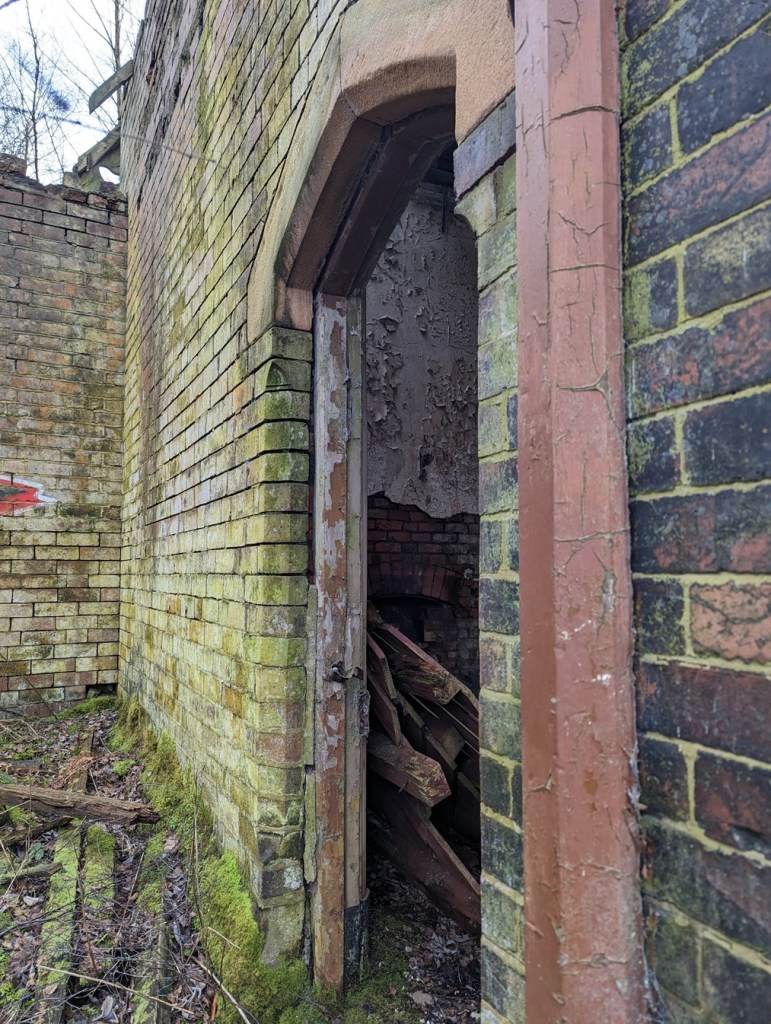
The doorway, with what looks like a Cheshire sandstone lintel. I honestly feel something should be done about preserving this building. I don’t know what could be done with it, but something more than just leaving it to rot… surely?

So I had a quick look around, as you do, and in doing so, I noticed that the whole roof of the exterior platform area had collapsed, seemingly as one, and the floor was littered with rotting wooden roofing and broken slates. And then I saw it… a single slate seemed to have survived intact-ish. I pulled it up and thought… I say, here’s a nice little blog entry! And so here we are:

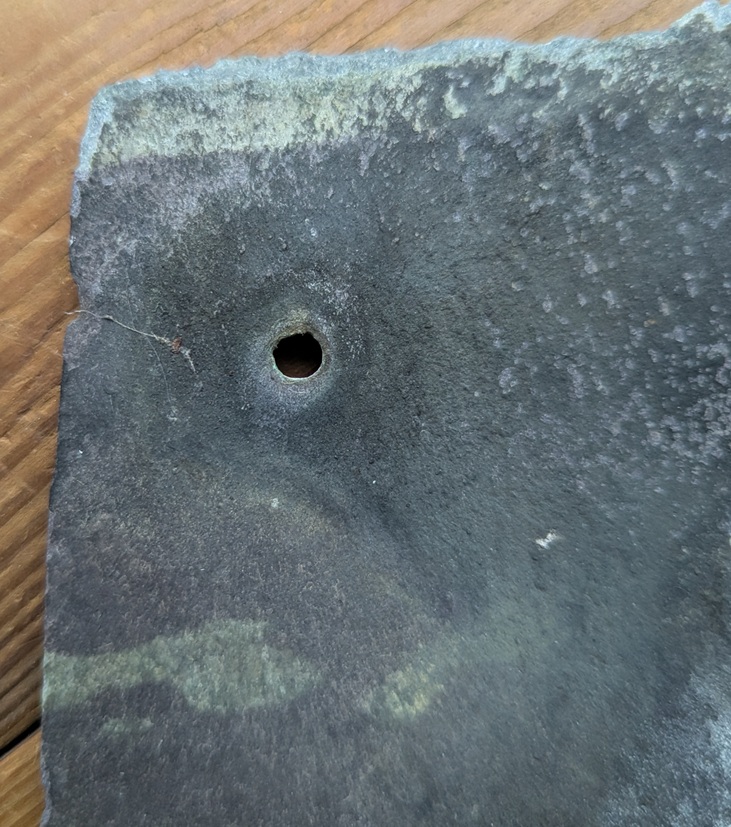
Amazingly, it had both copper nails still in-situ, and whilst it has broken a little at the top, it allows us to see how it was made.

The rougher edges are very characteristic, and I think I can see the result of individual hammer blows. Possibly.

Geologically, slate is dense, and was laid down in thin layers, which allows us to quarry it and split it into relatively thin sheets using a hammer and chisel. It is further shaped using a soft hammer whilst over hanging a hard edge (or later using a machine, although still hand held). There is a fascinating YouTube video here that shows the whole process, for those who like to know… it makes it look so easy! This gives it the characteristic nibbled edges.

The different areas of dark colouring on the slate itself is the result of differential exposure to smoky polluted air, with the bluer/greyer bits being protected by wood or other slates.

The holes to take the nails were made probably with a metal punch – a single blow delivered from a hammer on one side, and the force of the strike spread and created a characteristic ‘exit wound’, much wider than the entry.

The ‘entry wound’. I wonder if these have been partly drilled before being punched?
The devastating ‘exit wound’.

Looking at the nails themselves, they are fairly standard mid/late Victorian copper nails, hand finished, and square in section.

I honestly love these things.
The back side, showing the nail through the hole.

These wonderful things seem to be attracted to me, and I find them all over Glossop, or maybe it’s just I’m always looking down (I’m going to be Richard III-like before I’m 60 at this rate). And, as I can never resist them when I find them, I have quite a few, here in CG towers. I say “quite a few” like it’s 10 or 12. I actually have hundreds of the buggers, hiding in labelled bags, naturally, and hidden in drawers, but shhhhhh… don’t tell Mrs CG, this sort of thing makes her twitch. I wrote a little about how they are made, here, in this article, 8 years ago… man, do I feel old!

What a difference Welsh roof slates would have made to housebuilding. As I type this, I sit under a roof made from locally sourced gritstone (I think I can see the quarry from my house); each roof tile is an inch thick, solid stone, and I bet the whole roof must weigh somewhere in the region of 5 tonnes, with each individual tile moved up and positioned by hand. I watched them do it when my roof was re-laid, and it took a long time. Now think of the slate; each tile weighs a tenth of the stone one, meaning more could be carried up and laid quicker, it costs less per tile, and overall does the same job, but at a fraction of the weight of the roof, meaning smaller beams could be used. It’s no wonder that Welsh slate tiles took over almost immediately, ironically being brought here – safely and quickly – by the train. In fact, you can use the presence or absence of a slate roof as a quick and easy way of dating the buildings here in Glossop: stone roof, built pre-1850(ish), slate roof, post 1850(ish)

So there you go. Right, I have another article almost finished, and I’ll try to get it out to you before New Year, but I’m not going to make any promises! Just know that I’m always trying, but sometimes life gets in the way of this, what I want to actually be doing with my time!

Before I pop off, the new Where/When is now available – woohoo! #8 – The Bullsheaf Shuffle.

This edition is a great one! Two smaller Wanders to tickle your festive season.

Two Wanders, both starting and finishing at a pub in Old Glossop, and neither very long, but all filled with history – medieval field systems, prehistoric remains, Ordnance Survey benchmarks, Roman roads (or not!), post-medieval trackways, Georgian buildings, a Victorian rifle range, and bits of pottery! A perfect stocking filler, available from here, or from Dark Peak Books, in High Street West, Glossop. All back issues are also in stock again, too, so knock yourself and grab a couple!

Right then, I’m off. Lots to do, annoyingly – the Christmas season is so wonderful, but equally is a real faff! As is work… and real life. However, until we next meet, please do look after yourselves and each other – you are all very important, even if you don’t know how, and to whom.

And I remain, your humble servant.

TCG

Archaeology · Bench Marks · Mason's Marks · Where / When

Marking Time

What ho, wonderful, and slightly odd, folk of the blog reading sort. I hope you are all as well as can be expected, and as we move into autumn, you get out an about as much as you can – always keeping an eye open for pottery and other interesting things.

Which sort of leads me to today’s offering. It’s a mixture, to be honest, some updates, some new stuff, but all interesting. I have said before that I always have multiple half-written articles on the go, all moving at different speeds – but for one reason or another, none leapt out at me asking to be finished. So here we are… Marking Time!

I’ve always been obsessed with the idea of humans marking their surroundings, and the notions of permanence, even immortality, that accompany this; from palaeolithic cave art to bronze age cup and ring markings, to 17th century building datestones, to Victorian carved graffiti, to modern tags – and I’m looking here at you, Boof, whose name is everywhere around Glossop at the moment – it all amounts to broadly the same thing: marking time.

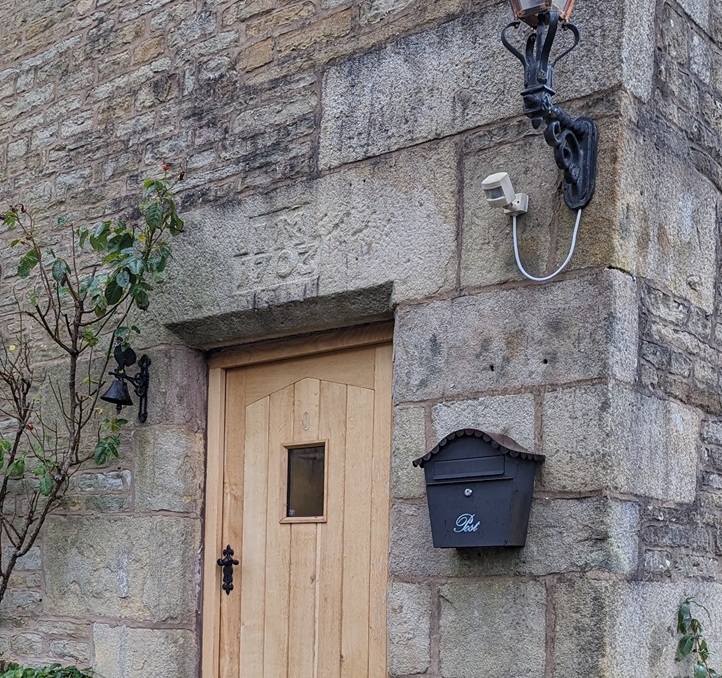
Datestones update: As always, I am on the lookout for more datestones of a pre Victorian date (pre-1837). I recently bagged this:

Herod Farm, Whitley Nab

Wonderful – ‘I.M. 1703’ – to the point, although I have no idea who I (or more likely J) M is. I have a whole article about Herod Farm and the surrounding area in progress, but wanted to share the datestone with you.

The always knowledgeable Roger Hargreaves emailed me a comment he tried to post on the site – technical issues prevented it, but here it is:

So there we have it – John Morton, and a teaser about the Lees Hall – a fascinating place, with a long history, and possibly a moat! Well worth an article and more. Thanks Roger, your input is always much appreciated.

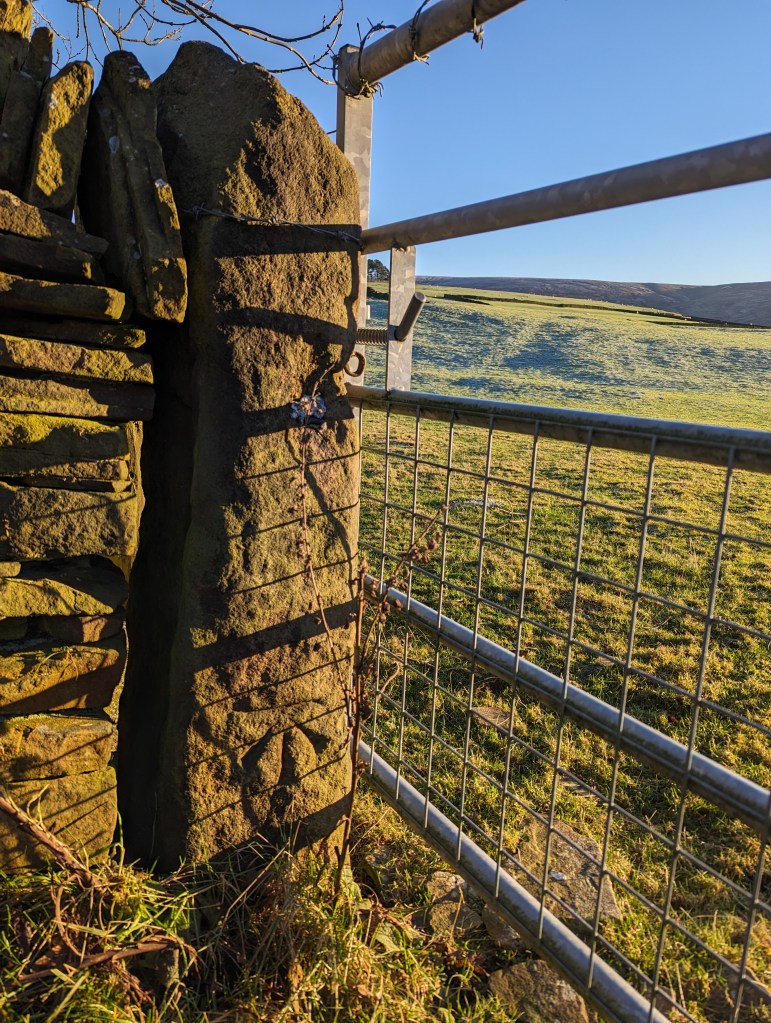
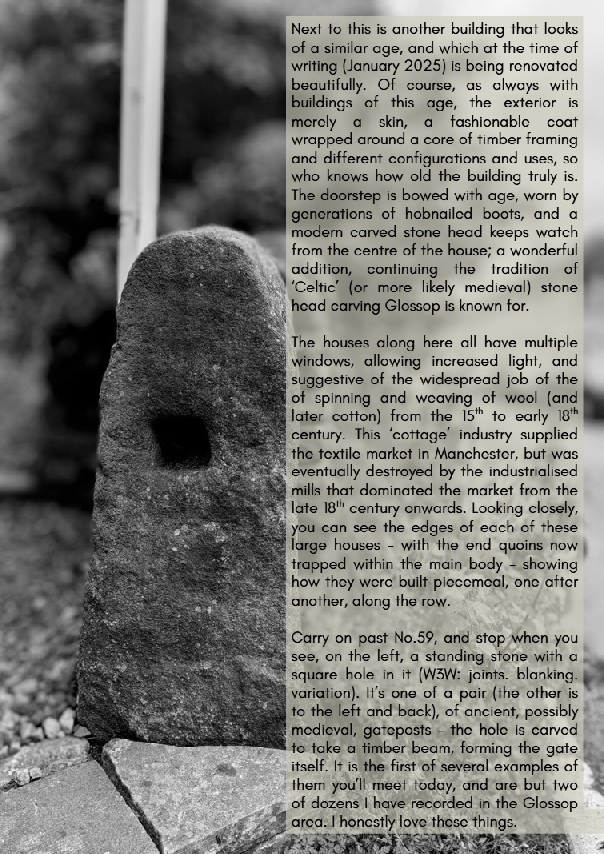
Update to the Gatepost article: We recently bought a campervan, a mobile home with beds and a stove, and all that. It’s marvellous, and is unmissably yellow, or more truthfully YELLOW! (give a shout and wave if you see it around). Our first adventure camping was to Peak Forest, near Buxton, and coming home we decided to take an odd route for the sake of exploration – a vehicular Wander, if you will. Coming through Wheston, south-east of Chapel-en-le-Frith, we came across lots of gateposts, modern and made of concrete, but each marked with initials and dates:

I have no idea who CTH is – presumably the farmer who is replacing gateposts – but I salute your attention to detail – initials and date – and respect your devotion to tradition; earlier, 19th century, examples of dated gateposts can be found here. It might be concrete, but the idea is exactly the same, and I want to buy you, CTH, a glass of the stuff that cheers. Wonderful.

Next we have things seen on pavements… Glossop seems to have inherited the whole street paving slabs second-hand from somewhere. I seem to remember a whole hoo-ha about these stones, and others, occurring maybe 20 years ago – their origin and how much was paid for them… or something. Whatever, but what is certain is that they have some interesting markings on them, and all of these were seen between Costa Coffee and the Norfolk Arms – almost certainly more await discovery, so look down people:

A simple cross, formed of two chisel strokes.
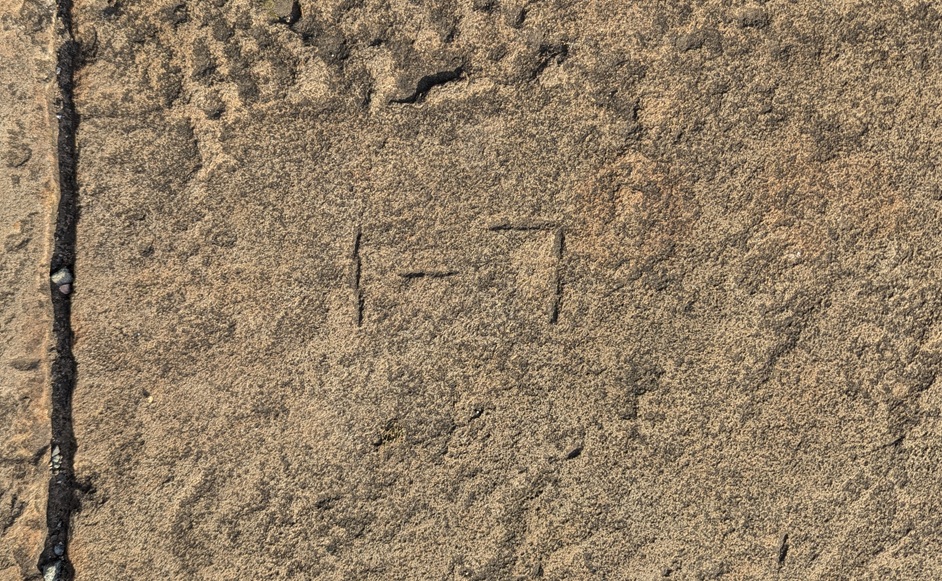
‘1 – 7’ with the ‘1’ formed apparently by three chisel strokes, the ‘seven ‘7’ by three down and two across. No idea of the meaning.
A cross, and a hole filled with a lead plug. It’s difficult to imagine what this large flat stone would need a hole with a lead fixing for – it’s not like it was used for a gatepost or similar. I genuinely cant imagine what or why!

Finally we have this beauty:

Where to start?

So, we have a name in the bottom left, clumsily written – ‘Joseph’ something or other… D? B? Can anyone make out this? The second letter could be an ‘E’. Possibly. But then we have what might be a landscape – the top right looks like a fat sun, drawn by a child, to me. And in the centre, at the bottom, possibly a house (I think I can see the roof and walls, with perhaps a person in it). This is really an enigma – a name, and a piece of art, undatable, and probably from a place far from Glossop… but imagine if we could put a person to it. And all this, lying under our feet.

Other bits and pieces under our feet include markings on kerbs:

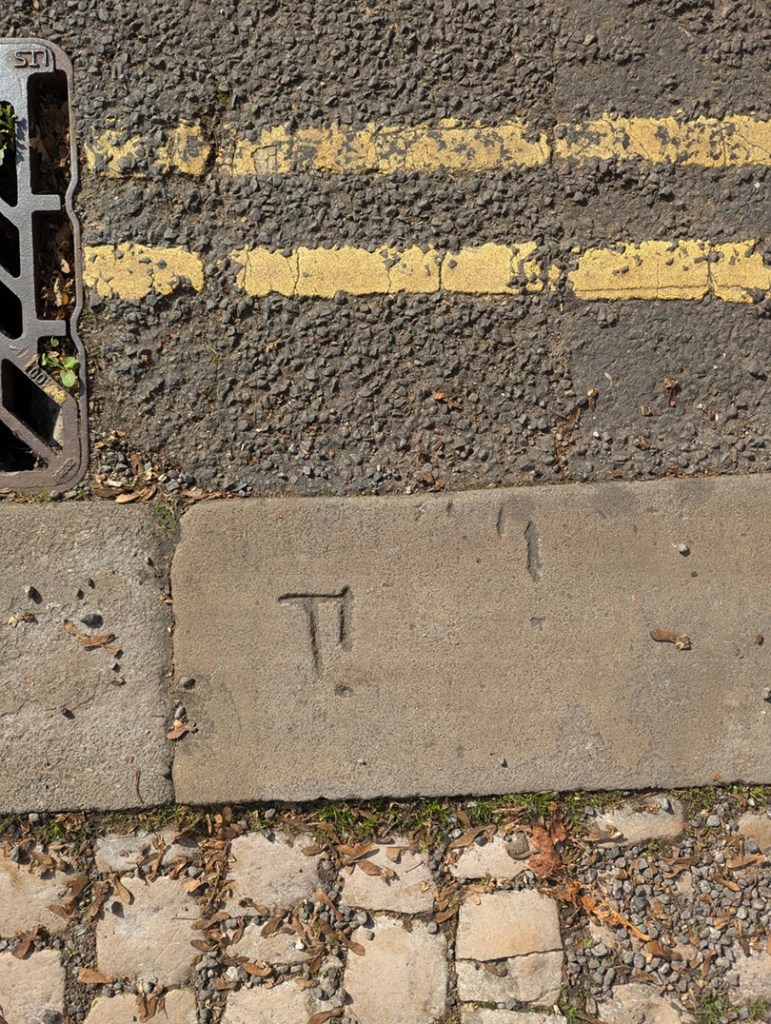
A simple ‘T’, probably referring to Telephone, and marking where the cable came into a property.

This is also sometimes marked by ‘GPO’ on kerbs, standing for General Post Office who were originally (from 1880’s until 1981) responsible for telephone communications. I once found an example on a kerb on Howard Street, but had not been able to find it since, until I came back from a blood test at the clinic there, and this was picked out of the dark by street lights:

Wonderfully carved, this was, I assume, where the telephones for the train station entered the buildings.
Another ‘T’, but this one in Old Glossop seems to have an errant exclamation mark after it!
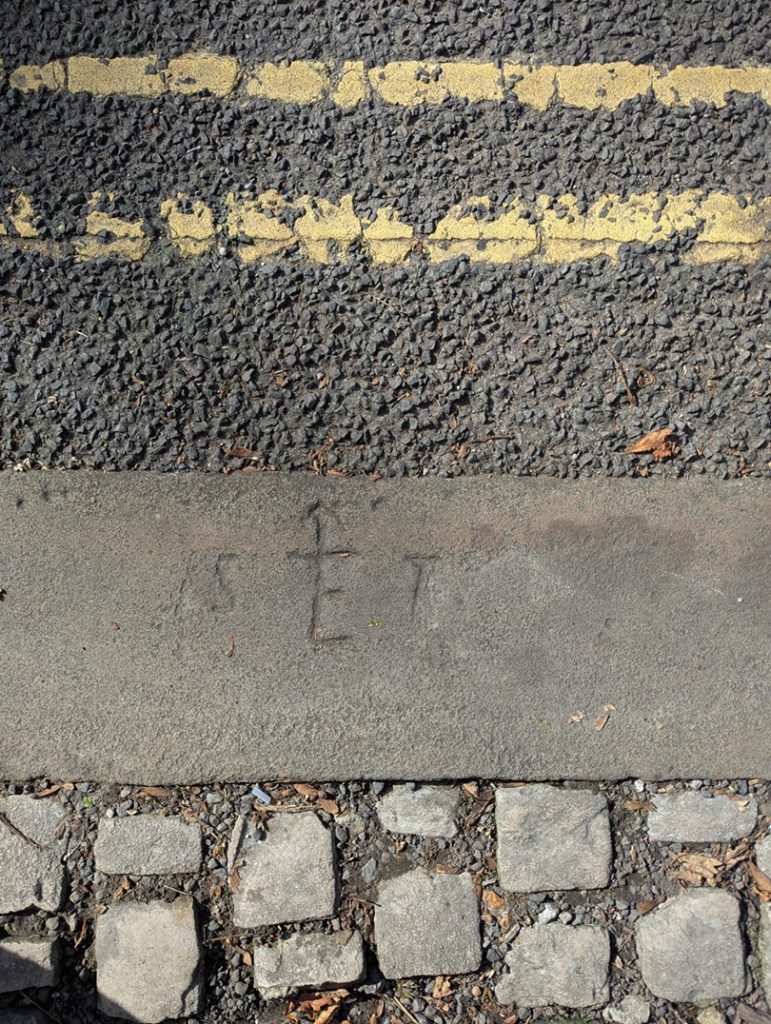
Another slightly odd kerbside marking – an ‘E’, which is believe marks the place where electricity cables enter a property. It is quite common, although in this case it is accompanied by an ‘S’ and a ‘T’, the meaning of which I have no idea.

I also saw this on Princess Street – another marker showing where electricity enters a property – this is also quite a commonly found one.

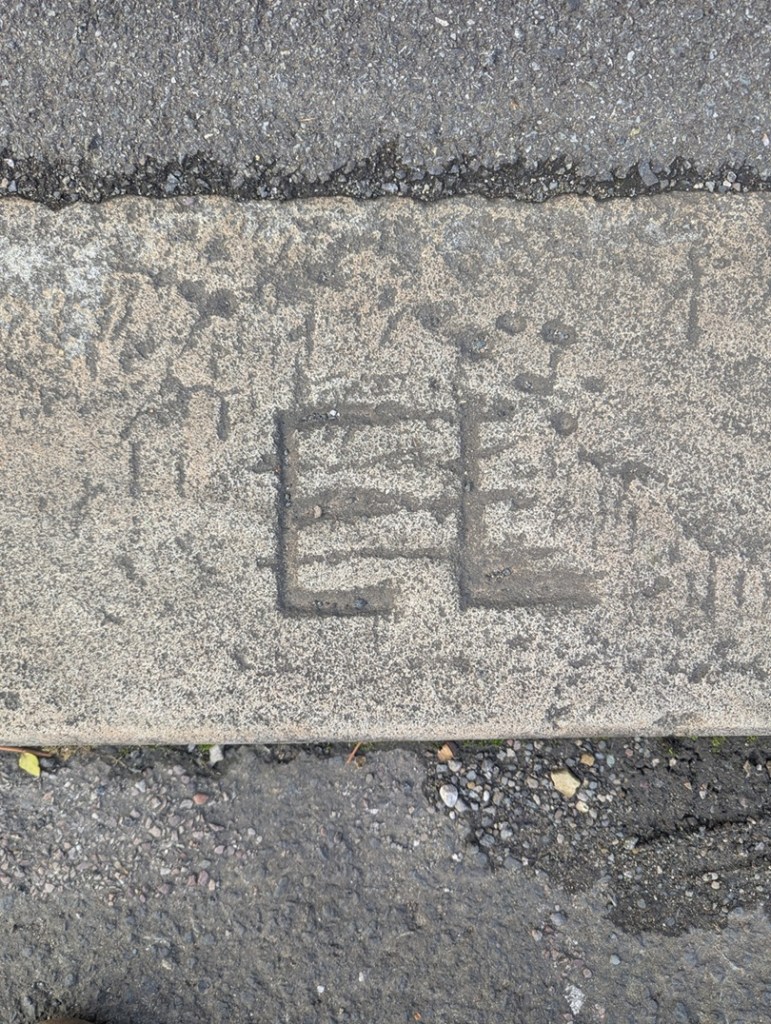
A no frills, very clear and functional, EL!

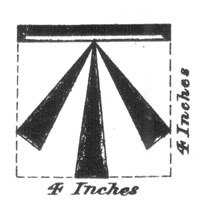
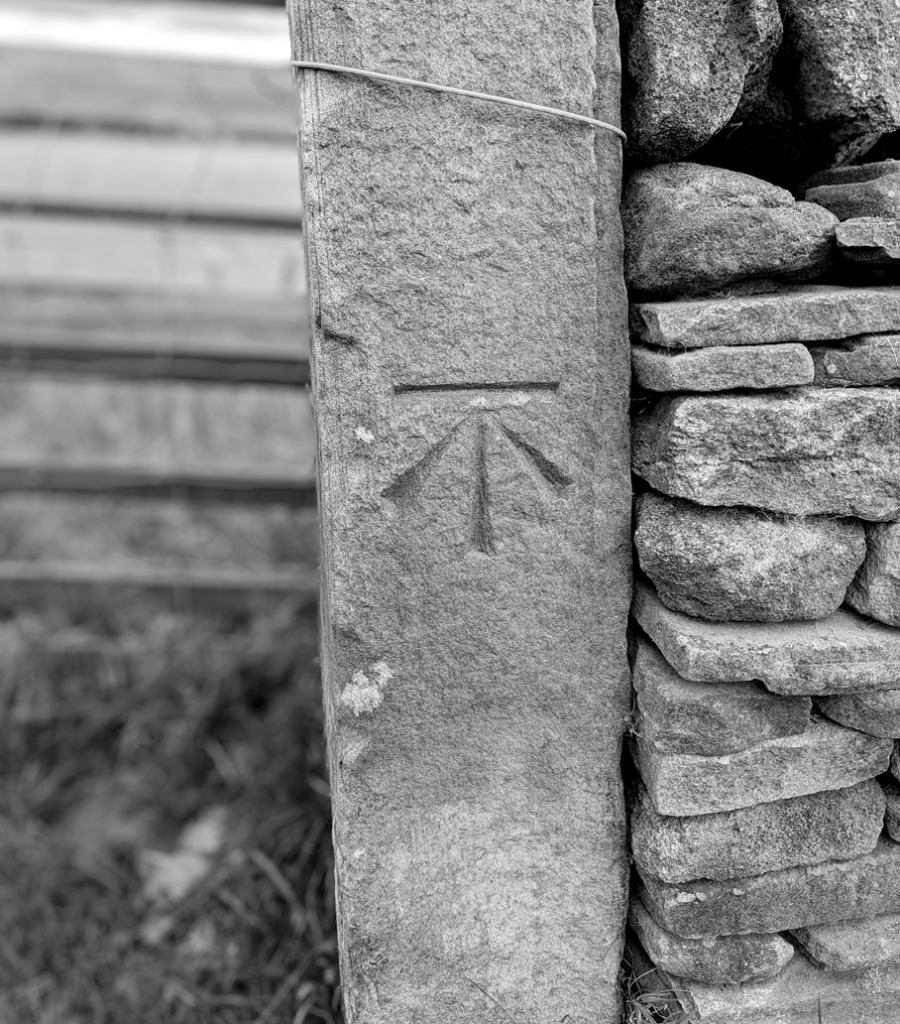
Here’s another mark that is commonly seen: a simple arrow, but not like the Ordnance Survey benchmark arrow, this is normally crudely carved, thin, and without the horizontal line above it… thus:

Literally an arrow, pointing.

This is another of those that points to a service – gas, possibly, or electricity – entering a building, although I truthfully don’t know… any help would be welcome.

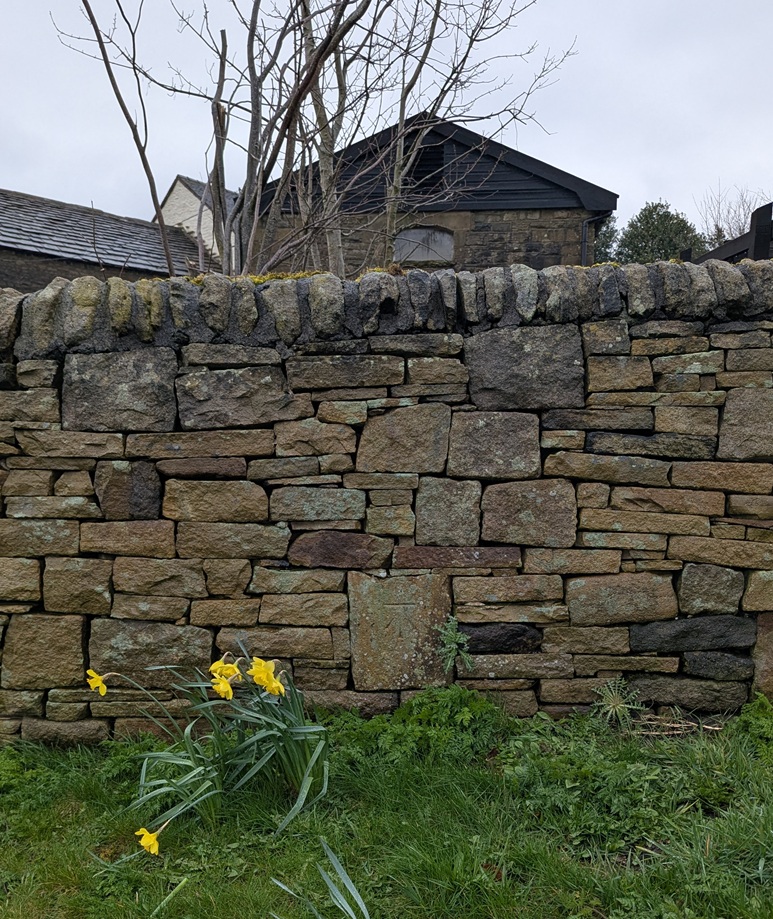
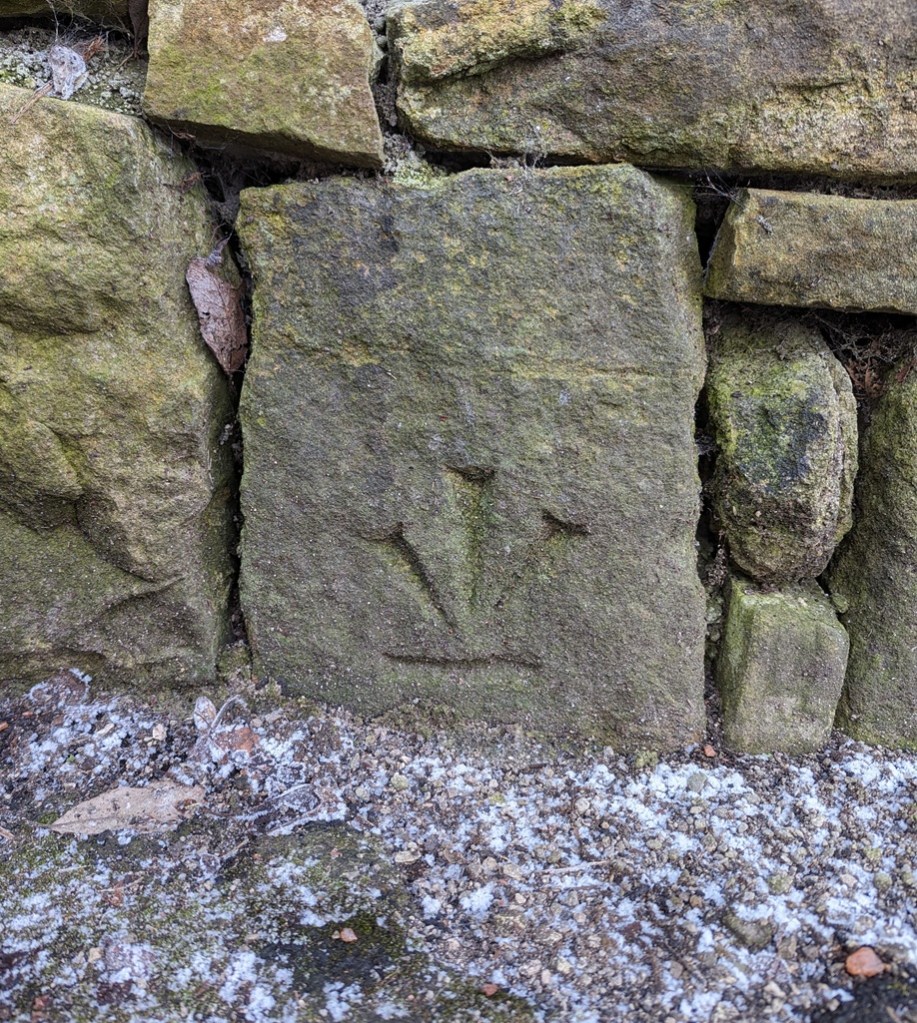
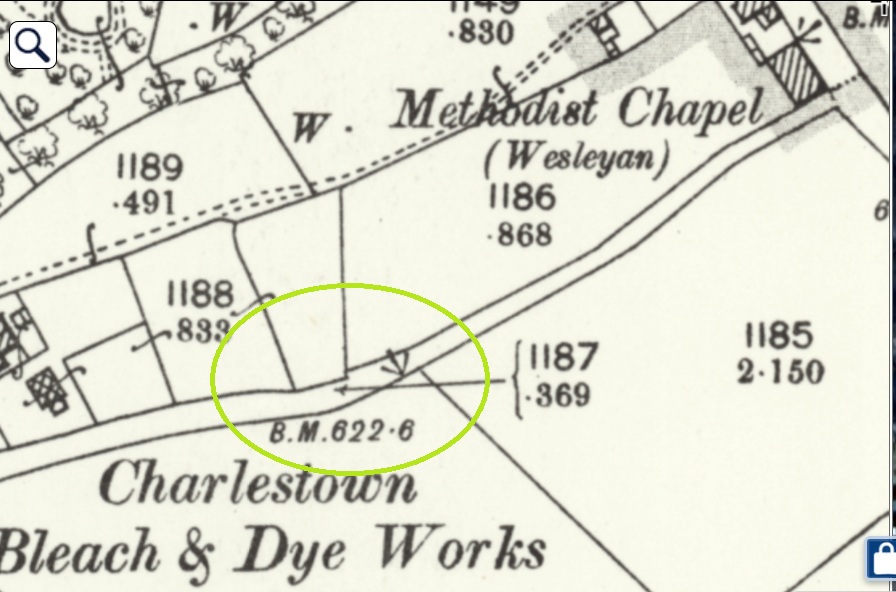
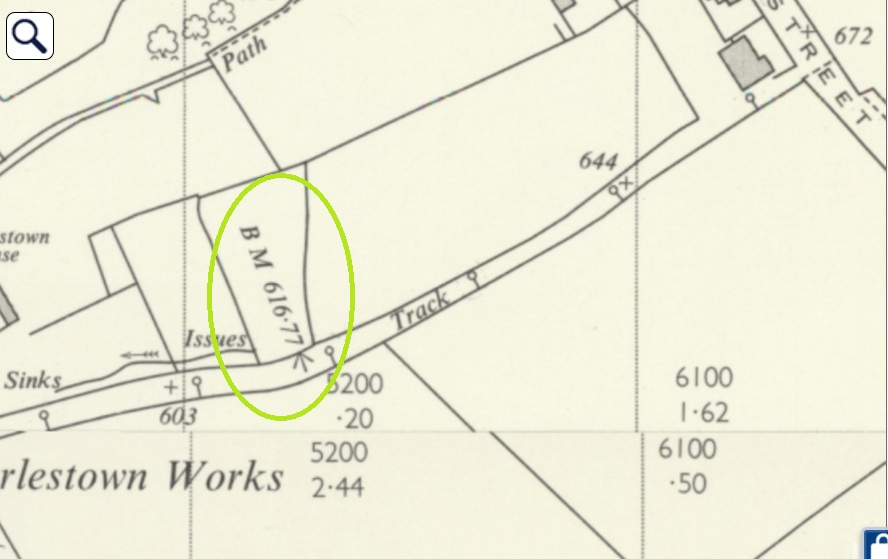
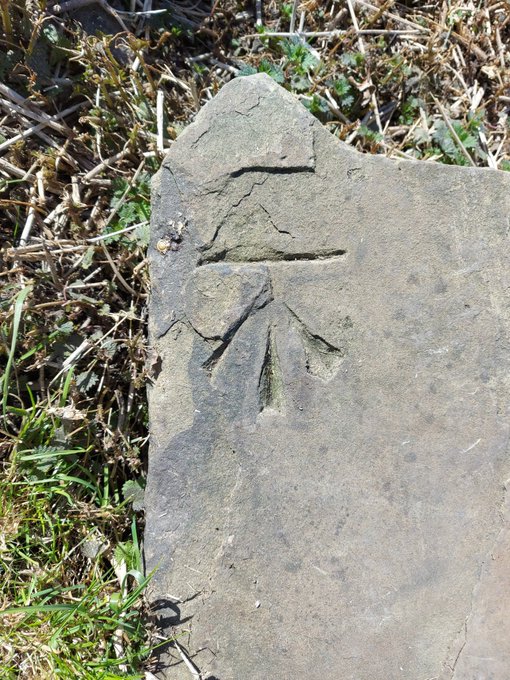
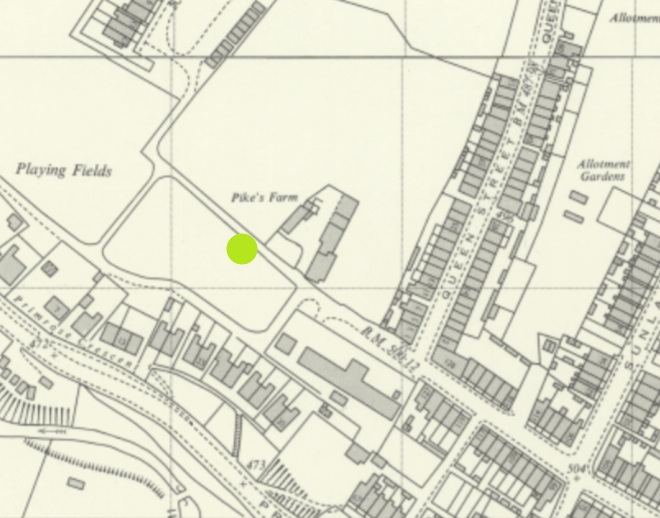
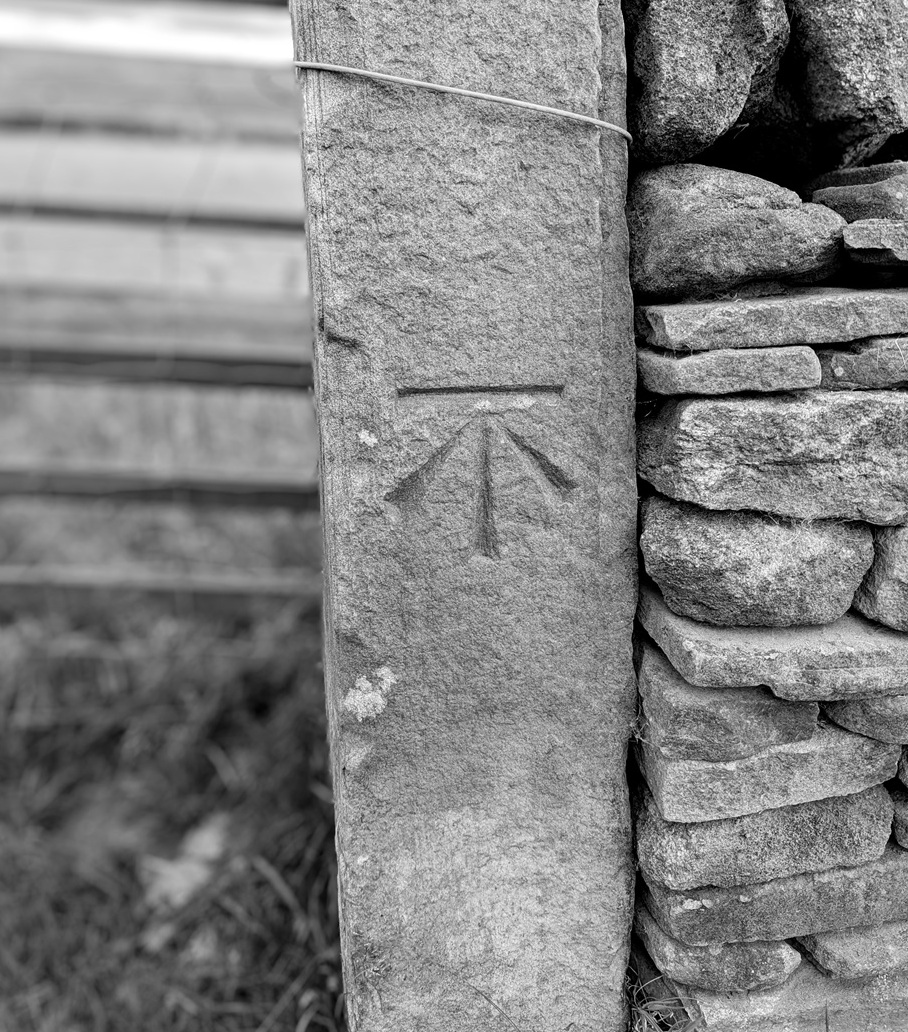
However, here is a Benchmark, newly found by me, under the railway bridge on Arundel Street, and which marks 501ft 8″ above sea level:

Worn, and almost camouflaged, there it is.

Also on the bridge are these single holes, often found in the upper part of the stone:

And here…

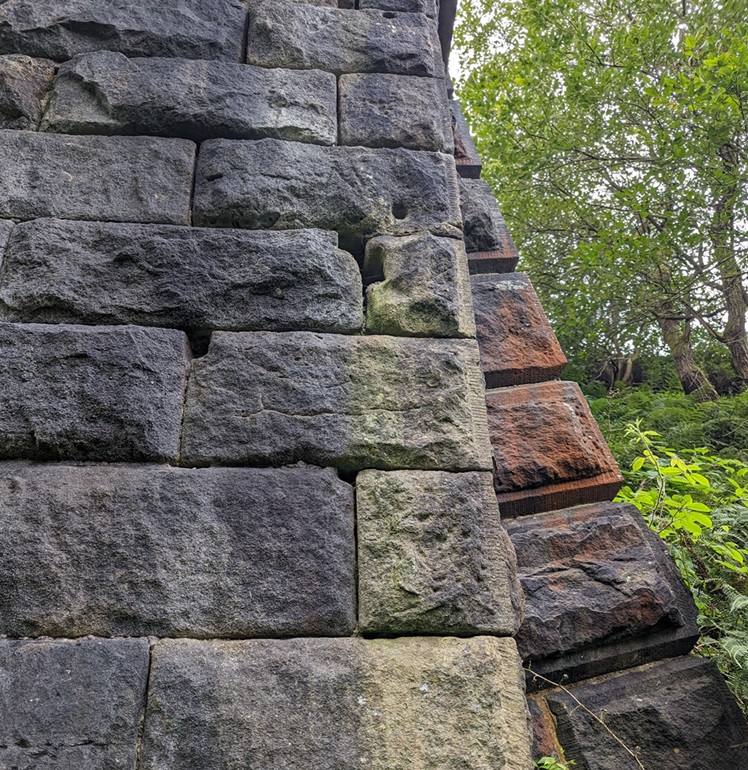
These small, shallow, holes were made in order to use a pincer, or external, Lewis and frame in order to move the blocks. A genius invention, it’s a simple iron tool that, via a chain, uses the weight of the block itself to hold it fast whilst it is moved, and enables even a single person to shift a huge piece of stone. But it requires a shallow hole in order to provide a point that gives a good grip. I love these, as they allow us to view how the bridge was built.

Another example of us viewing the method by which these wonderful Victorian structures were built is this:

Very characteristic.

Often occurring in pairs, these are drill marks made by quarrymen, into the rock face, which allow them to insert a splitter to pry away the stone from the quarry face. Once seen, they are very recognisable, and are the scars that show how, with a little physics and a lot of brute force, rock can be shifted.

Howard Street, which meets the Arundel Street bridge, has a few, sporadic, mason’s marks along the stretch of railway walling here:

A cross.
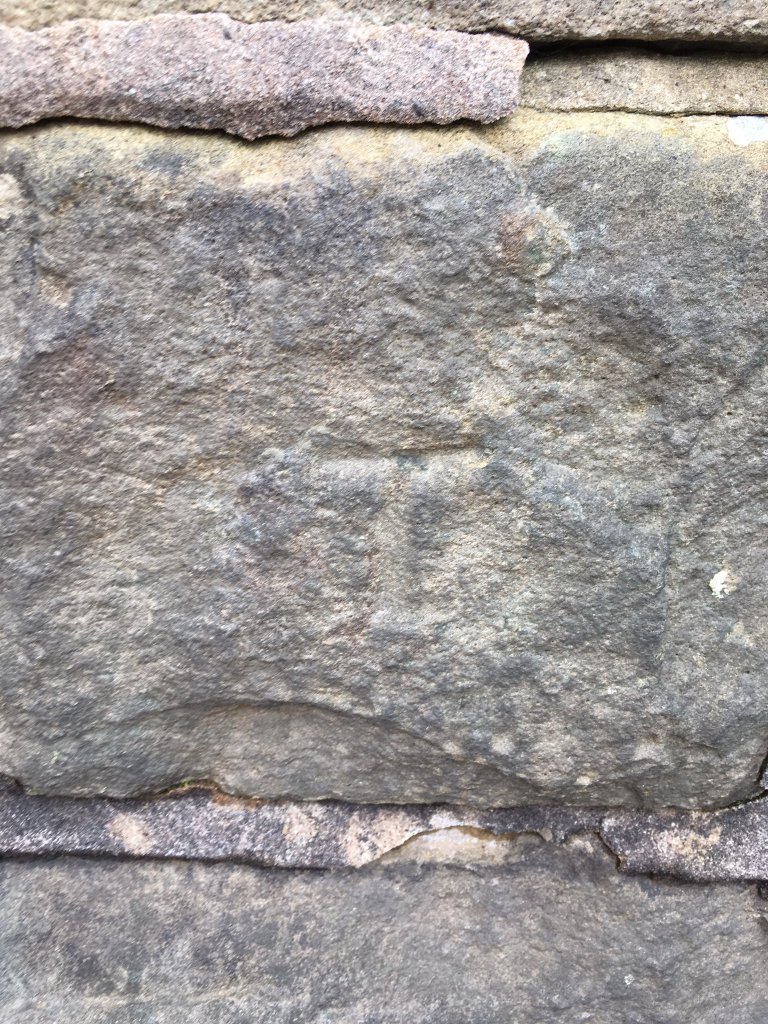
A ‘T’.

Low key, and not very common, these nonetheless represent the ‘signatures‘ of the men who shaped these stones. The cross is a common mark carved on stones – it is literally two strokes with a chisel – so it cannot be definitively linked to those masons who built Dinting Arches, but you never know.

Other mason’s marks can be found around…

A ‘B’, upended.

This is found on a lump of masonry from Wood’s Mill, and now stands where Wood’s Mill once stood, now Glossop Brook View, and by the houses there. Post-1842 in date, although possibly early, the mark was hidden until the mill was demolished – the rough dressing of the block indicates that it was never meant to be seen. I wonder who ‘B’ was.

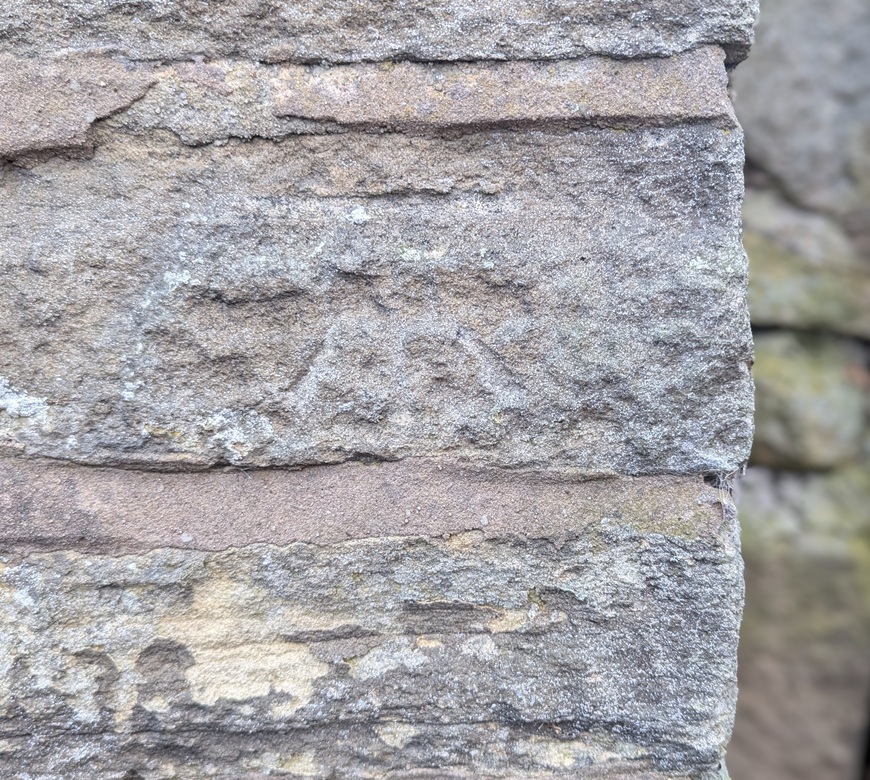
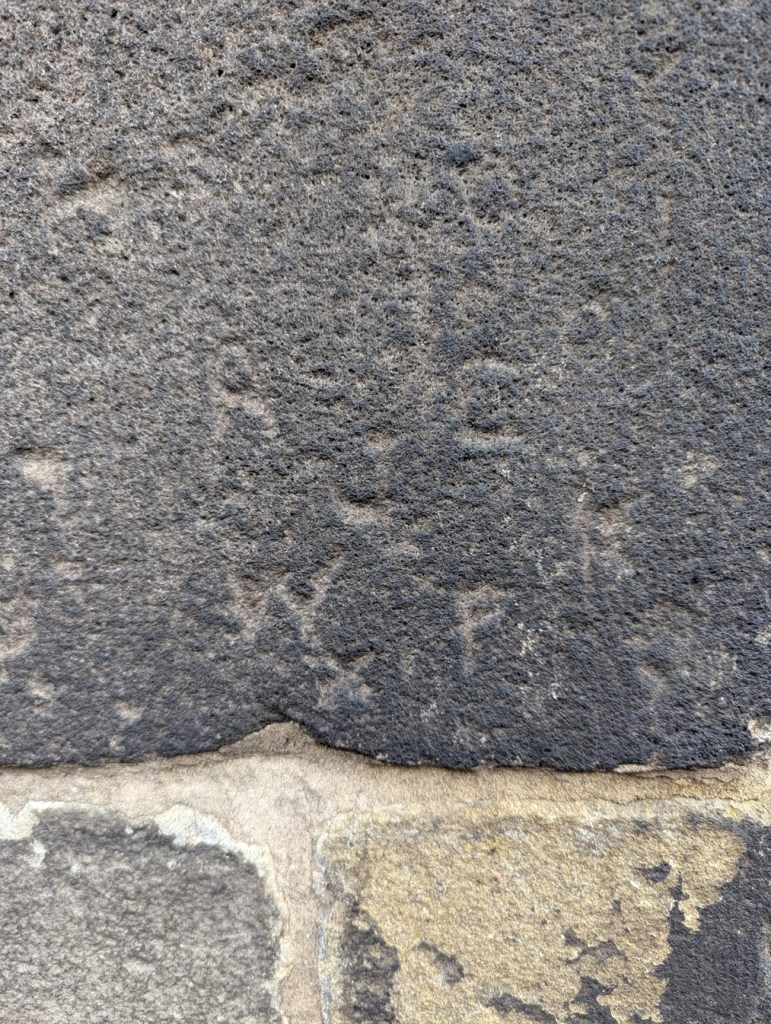
Another, difficult to see.

This last one is on the gatepost of the Crown Inn, Victoria Street (although the gates are on Hollincross Lane); very faint – and difficult to photograph – they are in the angular shape of a fish.

I also spotted this on Howard Street:

February 2022.

A dated piece of cement. This is either dated proof of work done – a modern form of mason’s mark – or possibly a dated repair that allows Network Rail to observe cracks forming and assess integrity. Either way, it’s kind of cool!

Finally, some bits of carved graffiti, a particular favourite of mine.

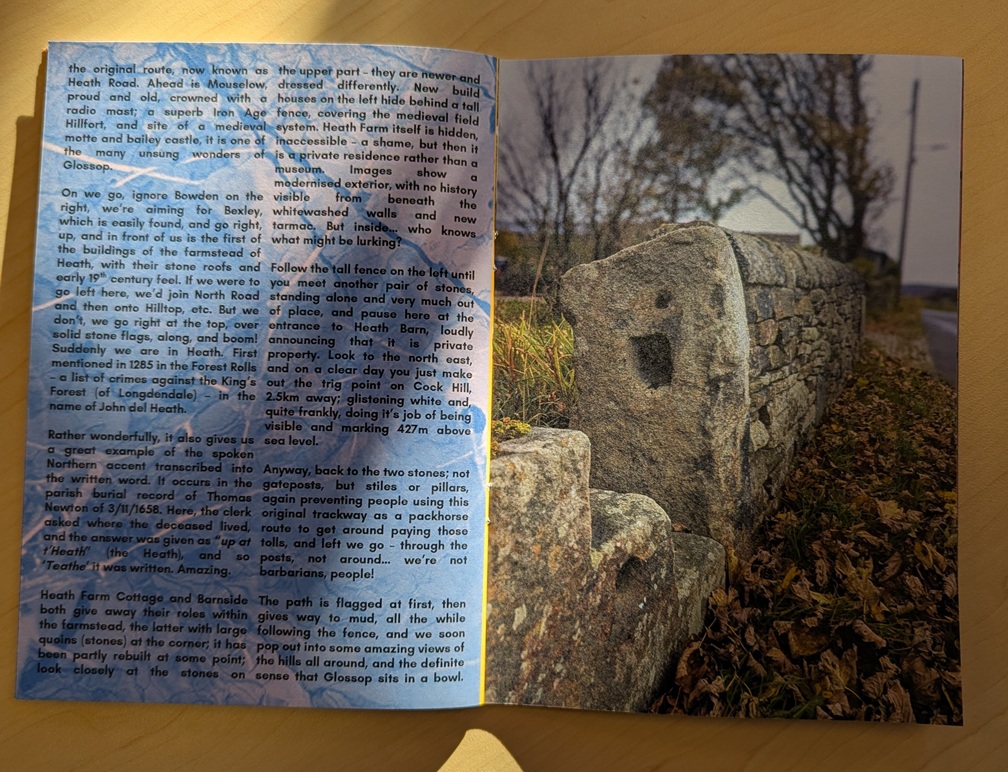
A single ‘J’ on the wall of Heath Barn, Heath.
‘S’ ‘H’ on the wall of Glossop Church.
Also on the north wall of Glossop churchyard, on Church Street – initials – R C J W P. The arrangement is odd, and I wonder if they were 4 members of a single family, with the surname ‘J’. That could surely be traced if it was the case!
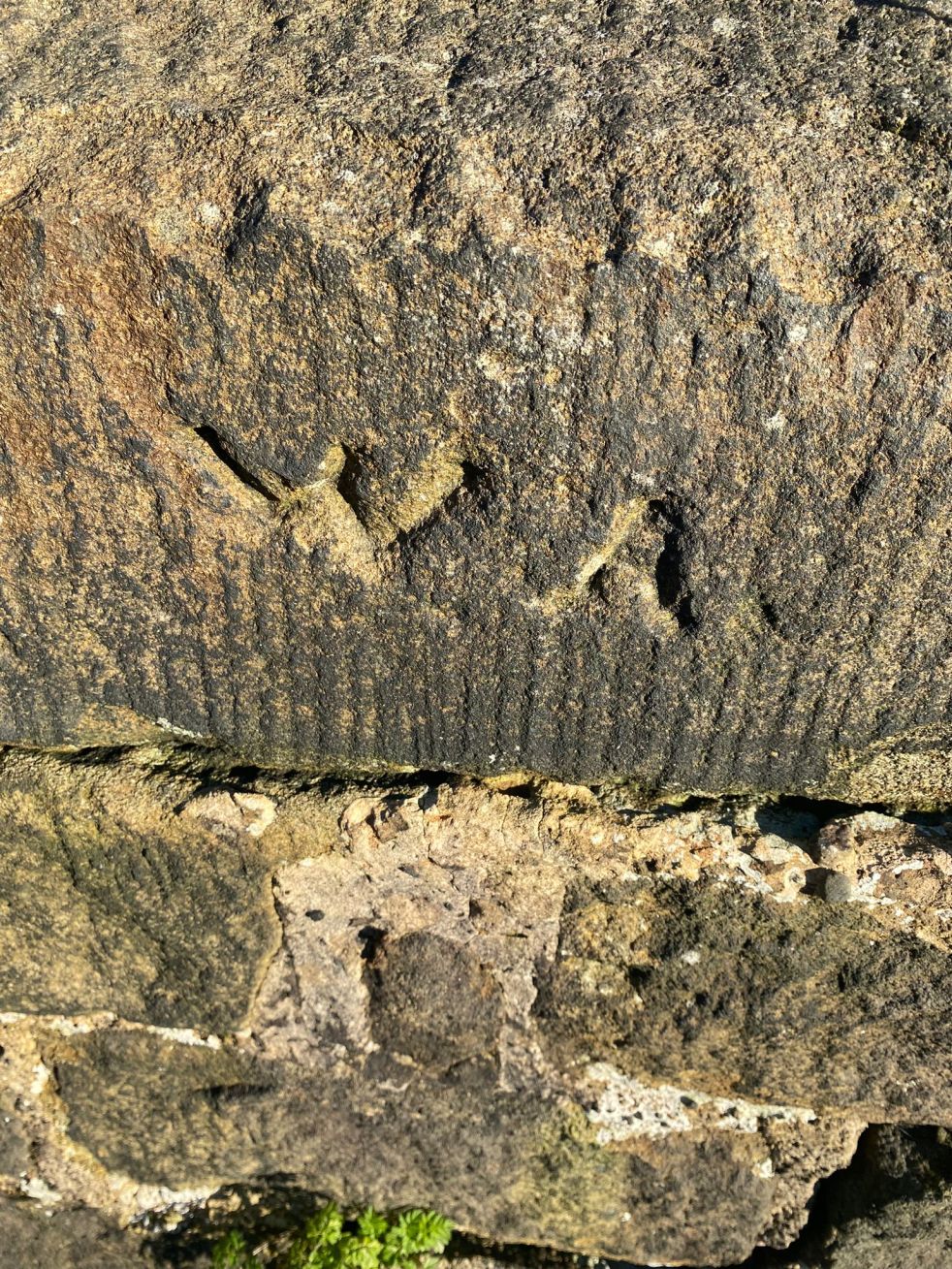
‘W’ ‘A’ (photo from Suze Hill)
‘W’ ‘G’ (photo from Suze Hill)

These last two were from the bridge over the Longdendale Trail on Padfield Main Road. The whole bridge has a lot of graffiti carved on it, including this wonderful example:

Old and the new. I love this photograph, and am very proud of it!

Here we have Victorian carved graffiti – ‘J.H’, possibly, along with some more letters, undecipherable under the frost, over an early incarnation of the now famous (infamous) BOOF graffiti tag made with a spraycan. I find it interesting that we would condemn one, but praise the other as historical and interesting. When does vandalism become history and worthy of study? A bigger discussion, and one I find fascinating (akin to when does something become archaeology?). I know graffiti, as in modern graffiti – put it down to a misspent youth and a love (despite appearances to the contrary) of Hip Hop – and I have followed BOOF’s career with a certain interest.

So here I shall leave it. Making marks, and marking time – it’s all about trying to achieve immortality, to leave your mark long after you are gone, and making people remember you, even if they don’t know who you are. I think that’s all any of us, myself included, can hope for. There are so many examples of this phenomena in the Glossop area, and I have an idea to produce a book looking at precisely this sort of thing – watch this space.

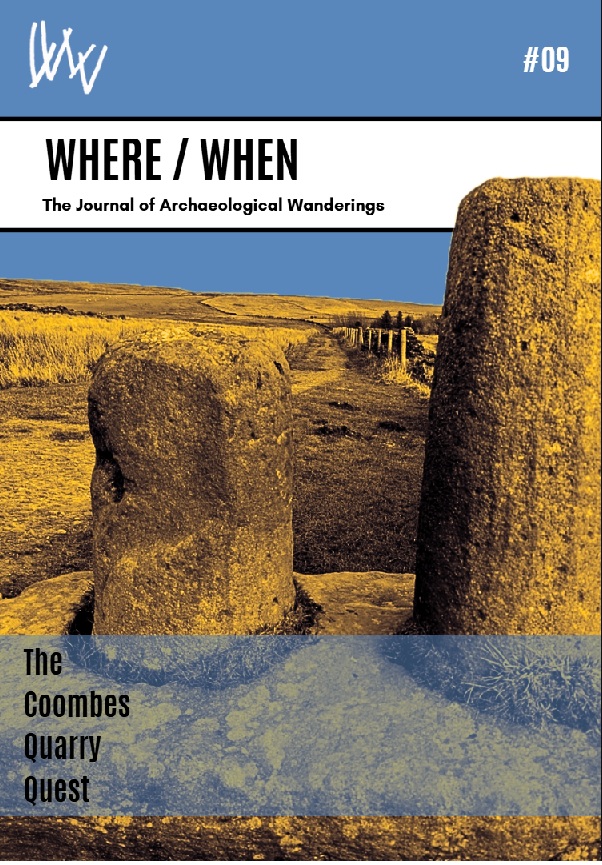
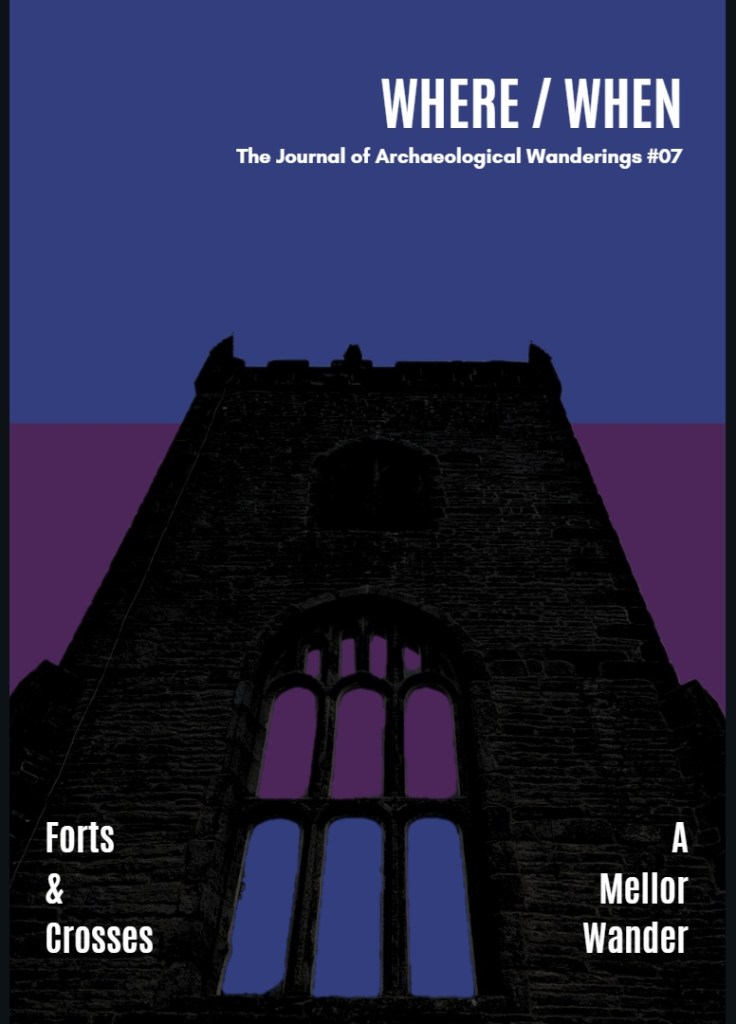
Talking of books, please check out Where/When Number 7 – Forts and Crosses: A Mellor Wander.

This one is a truly awesome Wander around Mellor – just over yonder! It has medieval field systems and farms, Victorian noise, an Iron Age hill fort, medieval crosses, cracking views, a terrifying viaduct, bench marks, a trig point, wonderful gateposts, and it starts and finishes at a pub… what’s not to love? Here’s the cover to tempt you.

Available from the shop, link above, or from Dark Peak Books and Gifts, High Street West, Glossop. Or, you know, just track me down and throw money at me.

Talking of which… if you enjoyed this, and fancy buying me a glass of the stuff that cheers, then please do so via this link to my Ko-Fi page. I do what I do here because I love doing it, and I feel it’s important we explore our shared heritage… but I’ll never say no to a pint in thanks!

So much more news to share, and so many things planned. Watch this space, wonderful people, as big things are coming.

But on a serious level, how are you doing? Genuine question. Personally, I’m a little down at the mo… the devastating loss of my brother (cheers Stephen, I’ll miss you), coupled with a dose of Covid, and the general malaise that accompanies the move from summer into autumn and winter, has meant a lull in the festivities here at CG Towers. Still, the wheel turns, the seasons they change, and life will inevitably continue, and on we go. But as I always say, look after yourselves and each other, you really are important, and too often we say “I’m aright” when we actually mean “I’m not alright, please help” – it’s ok to not be ok.

So then, more coming, but until next time, I remain.

Your humble servant,

TCG

Archaeology · Longdendale · Pottery · Where / When

Torside Sherds & Walls

What ho, what ho, what ho!

Well, this last month or so has been splendid in terms of weather, what? And indeed much has been done outside – archaeology and Where/When stuff.

Anyway… pottery as promised!

So… Master CG has taken up Windsurfing, which is to be applauded. Like a fish to water you might say, and he’s quite good, apparently (the instructors seem to be very pleased). This means that for a few hours at a weekend, myself and Mrs CG get to relax at the wonderful Glossop Sailing Club (who I cannot recommend highly enough – they are simply amazing), and in the neighbourhood of the wonderful Torside Reservoir in the Longdendale Valley, surrounded by the glacial formed hills; it’s truly a wonderful landscape.

Torside Reservoir is the fourth, and largest, in the Longdendale Chain of reservoirs which flooded this part of the valley in 1864. It is named after Torside Farm, first mentioned in the baptism of Alycia Hadfield in All Saint’s, Glossop, on 16th July 1621. Now whilst this may be the first mention, for two reasons I had a feeling the farm would be older: firstly, Alycia clearly had parents who didn’t just pop into existence in 1621. And secondly, if a place is good for farming in the 17th century, it would have been good in the 13th, 14th, and 15th centuries.

Torside Farm on 1882 OS map, borrowed from the National Library of Scotland website

Interestingly, this first mention in the parish register was actually written as “Thorsett” which, like many others in those pages, is a remarkable fixed record of the local dialect and pronunciation of the 17th century; the clerk asks “where do you live” and the answer from the parent is “Thorsett”, which is then written precisely as said, in clipped northern tones. Even as late as the 19th century, spellings of names and places is not fixed, and confusingly there is often quite a range of spellings for a single farm. Alas, the farm seems to have been demolished by the 1960’s, probably by the water board, and where it stood is now the carpark and public toilets.

Now, knowing this, and whilst young CG was floundering in the somewhat chilly waters, I went for a wander with the hope of finding something interesting and ceramic with which to entertain you wonderful people. Along the edge of the water, and up to the road I walked; I didn’t know what I was looking for as such, more a vague sense that something would be there, this close to an early 17th century farmhouse. And lo! What wonders did appear…

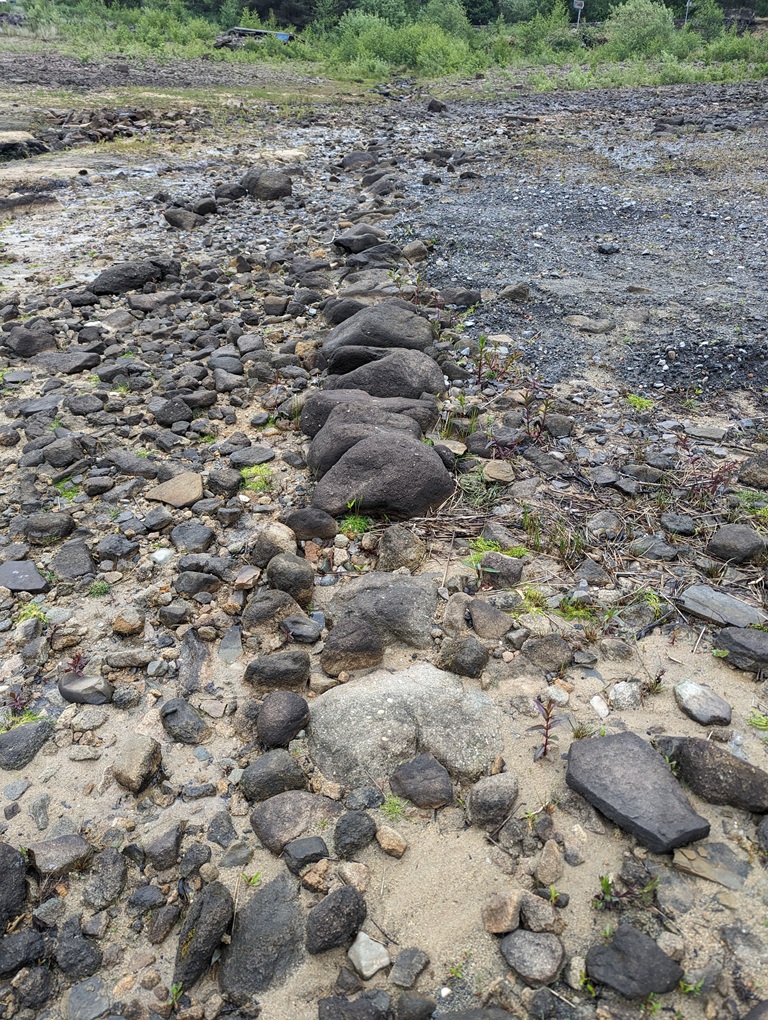
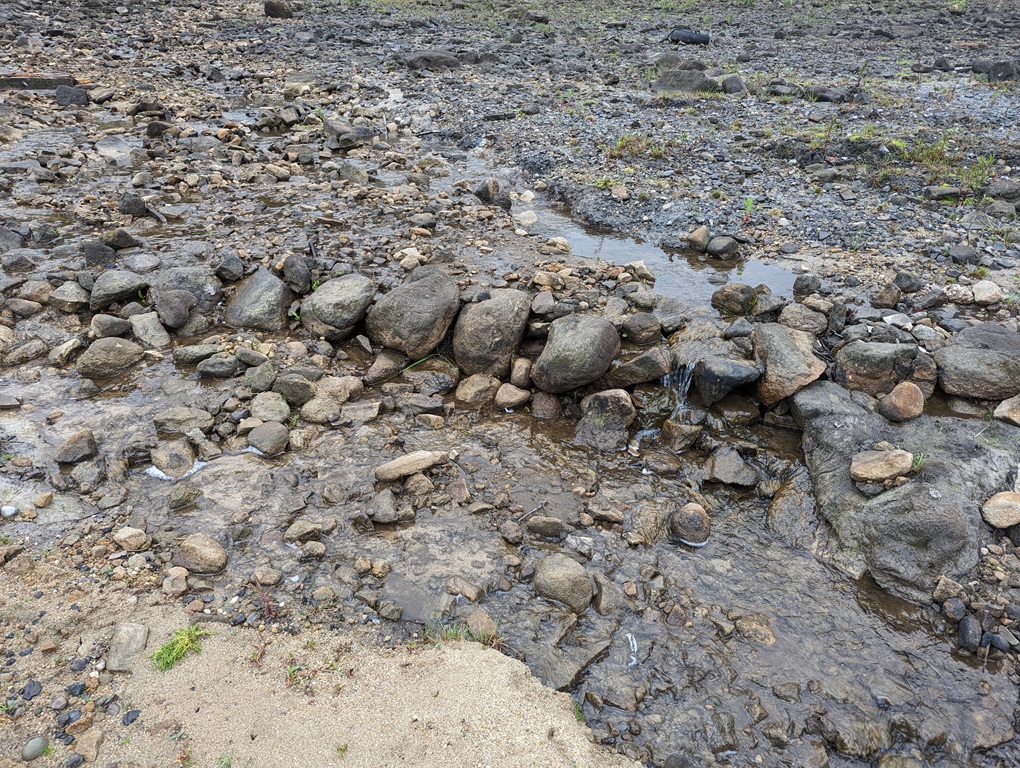
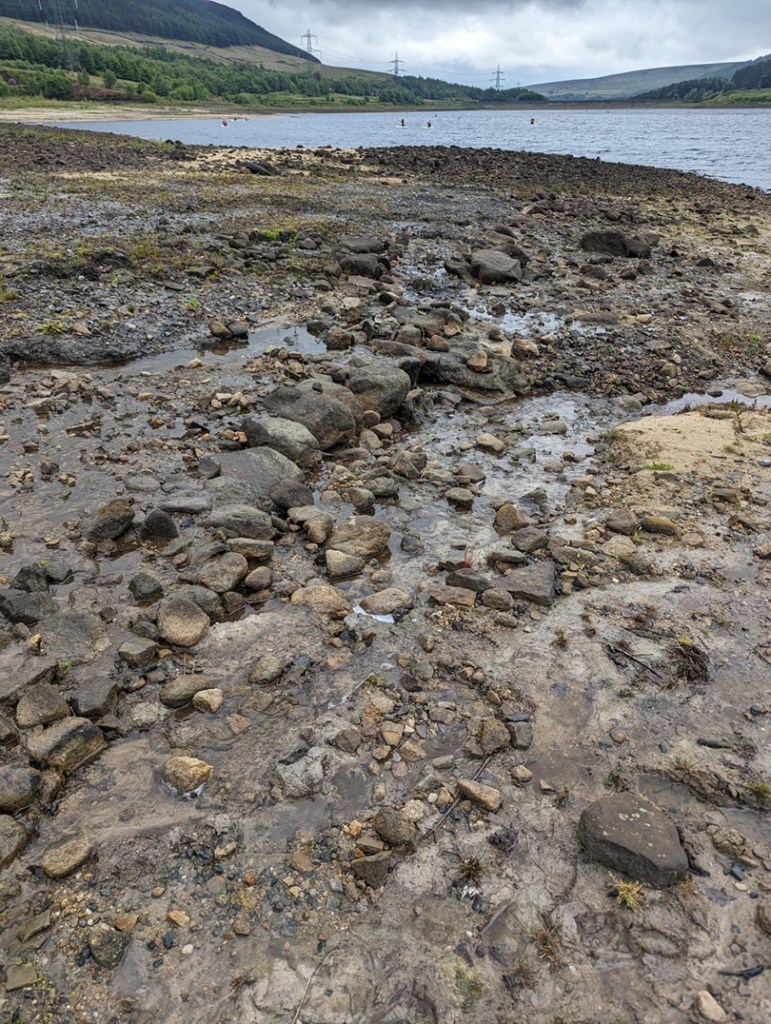
Firstly, I noticed two long walls amidst the general stony foreshore. Made from large boulders that would have, at one time, been plentiful in the fields; they were a convenient source of stone, as well as clearing the fields allowing them to be ploughed effectively.

A 30cm ruler in the foreground as a scale: I am professional… just on a budget!
Torside Reservoir, Longdendale: valley, pylons, windsurfing Master CG (and others) in full view… along with a mysterious wall running into the distance.

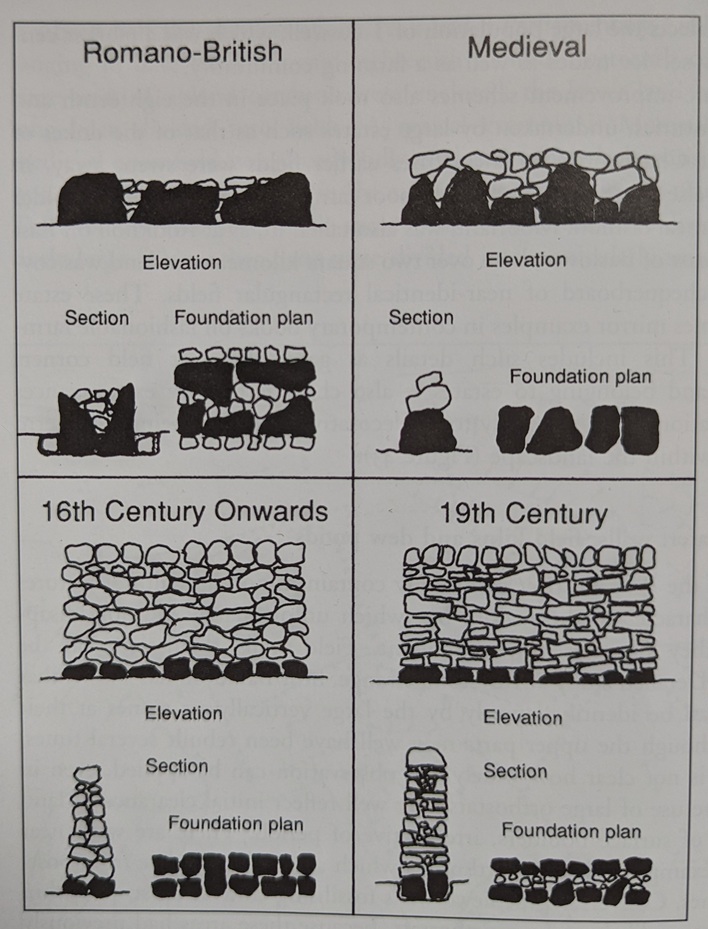
They would originally have stood higher, with this being the foundation course, and the size of the stones, combined with the lack of any map evidence, suggests an early, possibly medieval, date. There is a rough guide to dating walls in this area and hereabouts:

Taken from John Barnatt and Ken Smith’s highly recommended The Peak District: Landscapes Through Time. It’s based on data from Roystone Grange, and whilst it might be over simplistic, it does illustrate how walls changed over time.

It is a rough guide, and isn’t probably applicable everywhere, but it does serve to show differences in how walls were built. I honestly don’t know what these are, but I’m presuming field boundaries for a long lost field system. There are medieval field walls in Tintwistle, and they do look like this, but equally I have seen field clearance walls that date to the Bronze Age that look similar. The following is a rough map and rough measurements – maybe I should go back and really survey the walls properly… anyone fancy helping me?

But enough about the walls, “show us the good stuff… the pottery!” you shout (all except Mr Shouty-Outy, who shouted that he would apparently rather see my bottom…). Well here it is. The pottery that is, not my bottom.

All this was found on the surface, and it tells a very interesting story, but there are some genuinely important bits here. First up, we have a sherd of Manganese Glazed pottery.

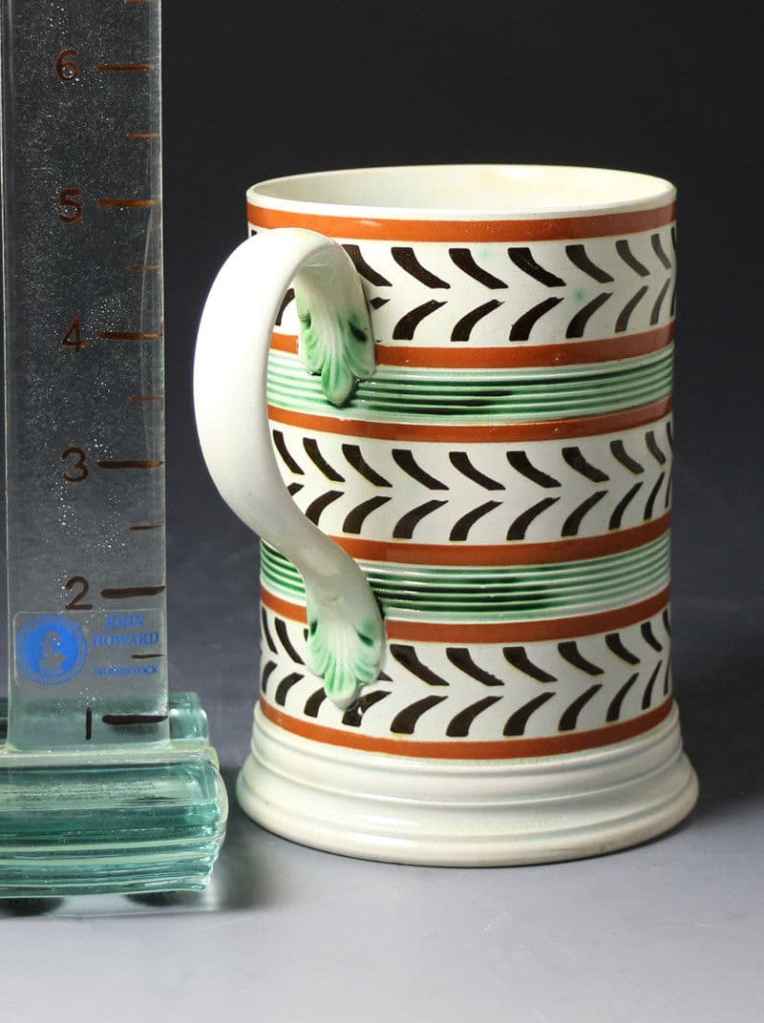
Early 18th century in date – it stops being made around 1750 – this stuff is fairly commonly found on sites of this date, and probably come from a jug or mug. I explored this stuff here.

Other bits of Manganese Glazed include these 4 rim sherds from cups and mugs.

Clockwise from top left: an open bowl measuring 16cm, a cup of 10cm, another cup of 10cm, and another measuring 12cm. Lovely stuff.

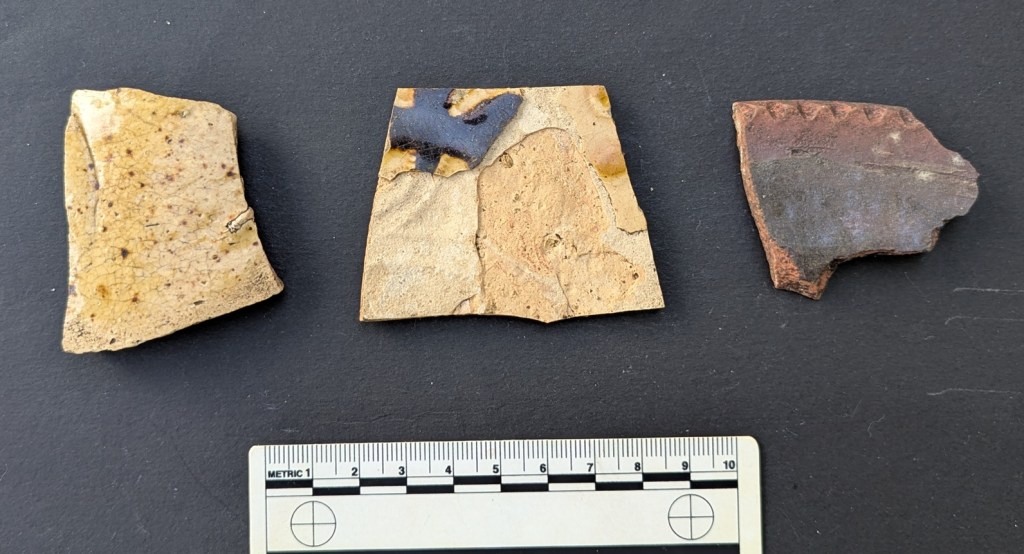
Next up, some slipware.

On the left, a chunky sherd probably from a large jug or similar. On the right we have the rim from a large platter (it has a rim diameter of 30cm); the piecrust edge is hugely characteristic and immediately recognisable (again, I explore it in this article):

The glazed interior didn’t quite make it to the rim, and would have created a striking image: this would have been an impressive vessel when it was whole.

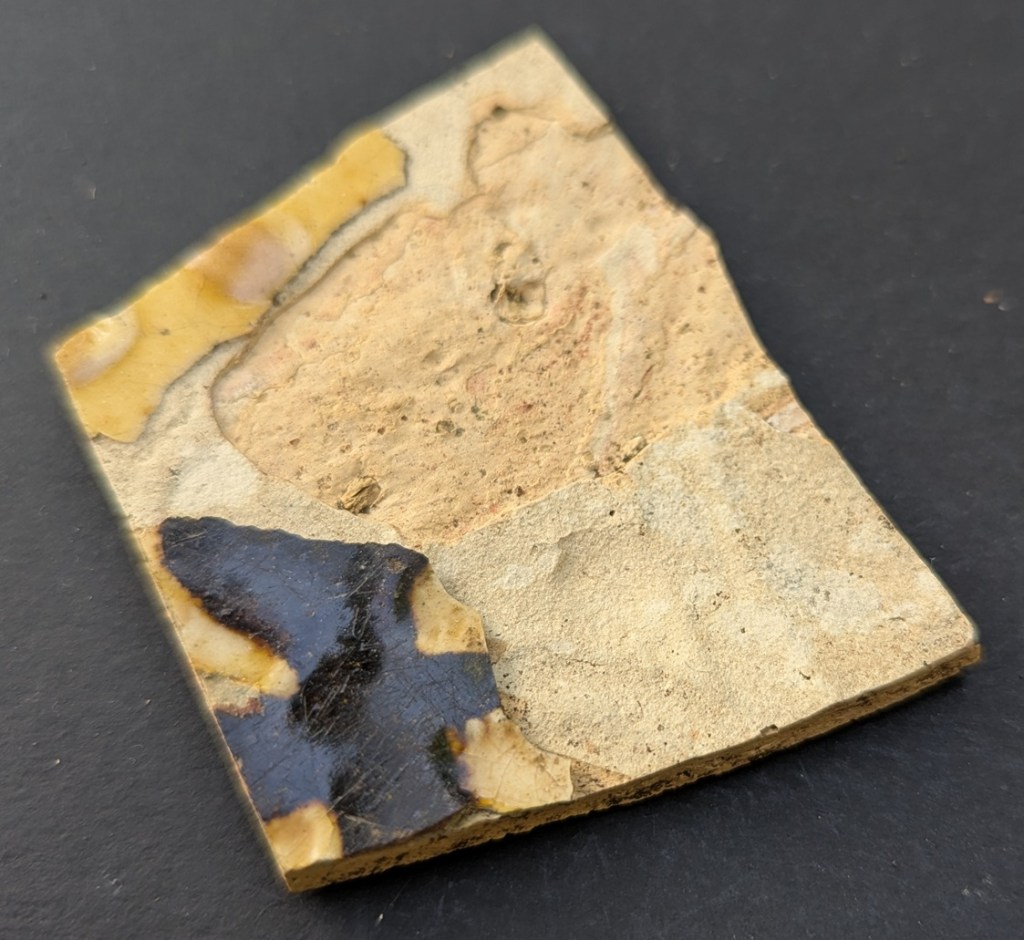
The middle sherd is Staffordshire Slipware, with a Dark on Light decoration. The reddish slip laid over the light background turns much darker when covered in the lead-based glaze. In this case it seems to be giving some form of geometric design – you can see the grooves where the slip was laid, but which has fallen away – the pottery is not particularly hardwearing, and the slip is often found to have delaminated from the body.

Wonderful stuff… you can just make out the linear design in the clay in this awful photo.

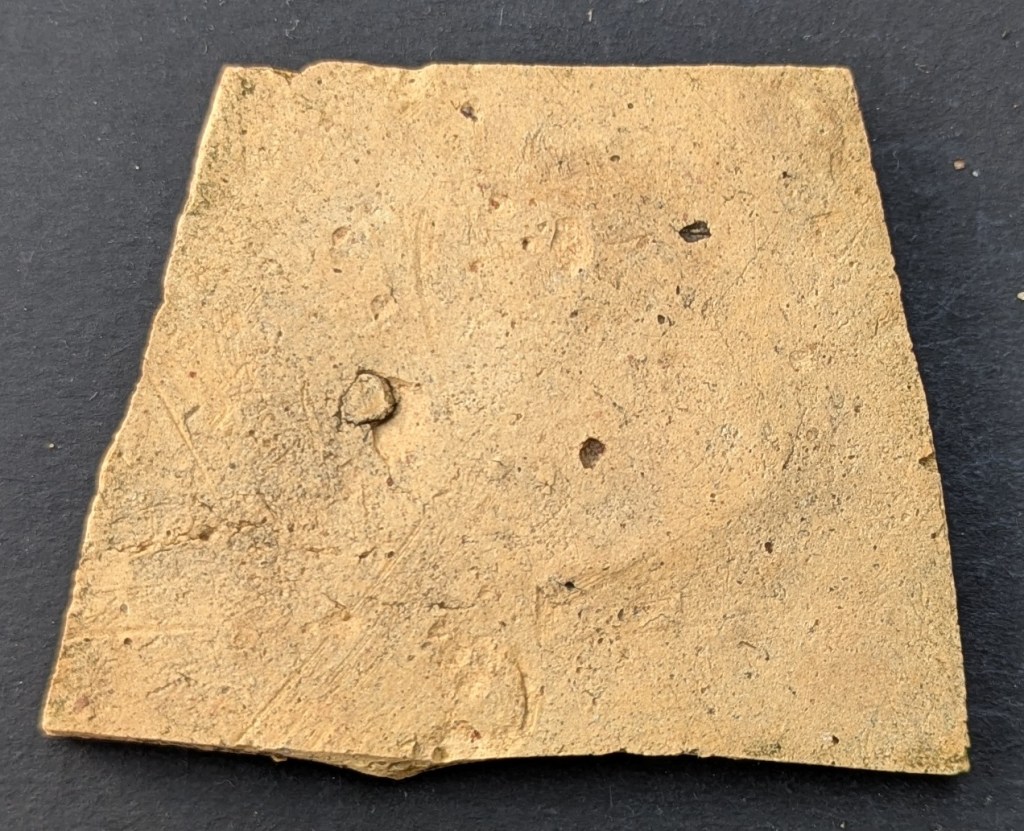
This is from the base of the vessel – probably a large platter used for presenting food on the table, and from which all the family would have taken their own share. Turning it over, you can see lots of interesting marks made during the manufacturing process.

When made, the pots are pressed into a mould until they are ‘leather’ hard – that is, hard enough to retain their shape, but not quite fully dry. What we can see on the base are the scars of manufacturing. There are numerous lines scraped into the clay, suggestive of tools used to remove the pot from the mould, or even string. There is also a small ball of clay lodged within the base – this would have been dry and sitting in the mould when the wet clay was placed in it, and when removed it became part of the base. The small holes around it suggest that there were others that didn’t become attached. I love this… it’s almost the secret side of pottery – whilst most people look at the decoration and say “oooh”, let’s instead flip it over and see what else it can tell us.

Next up, we have some Nottingham Stoneware:

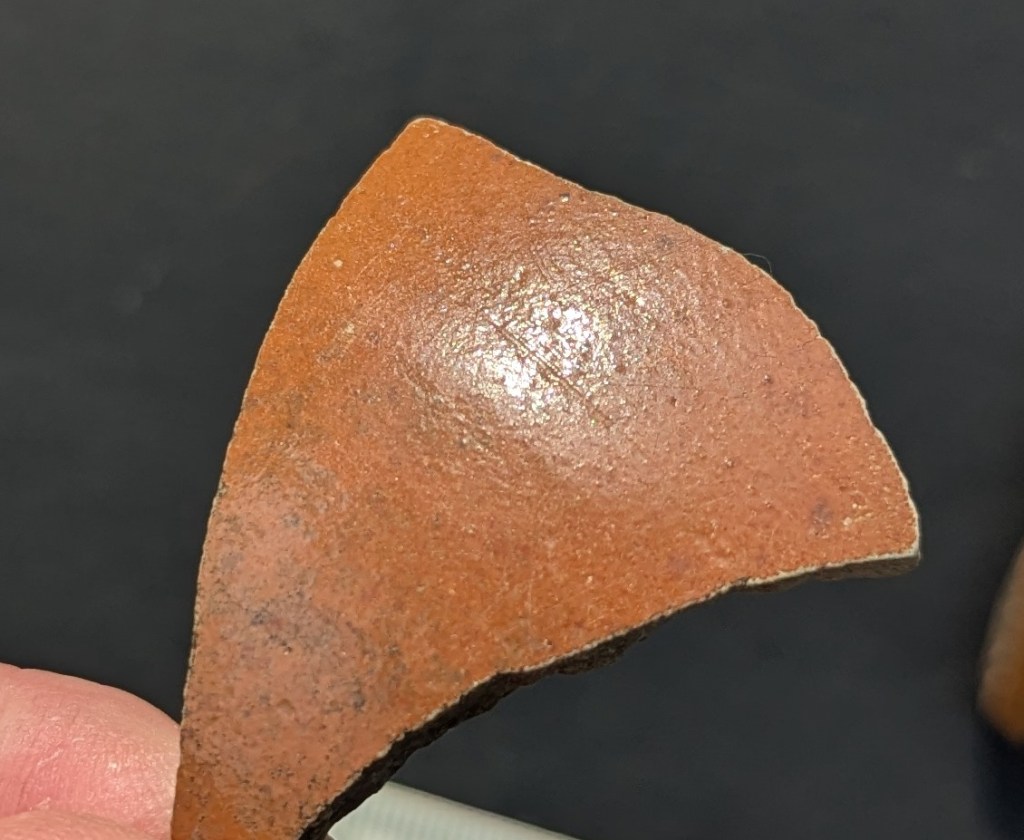
I explored this wonderful stuff back in the first instalment of the Rough Guide to Pottery so I won’t discuss it here, but it dates to the 18th century, which is a good date for us. You can see the ‘orange peel’ surface made by using a salt glaze in this sherd:

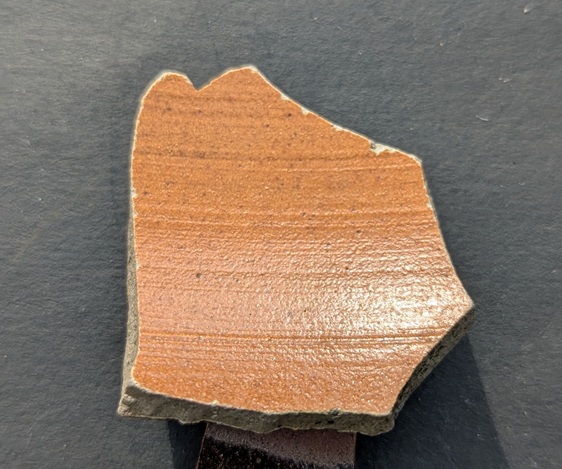
And on this sherd interior, you can see the horizontal smoothing lines.

I think 2 of the sherds come from jugs or bowls, whilst the base sherd on the left has a diameter of 7cm, so it might have come from a squat round-bellied tankard.

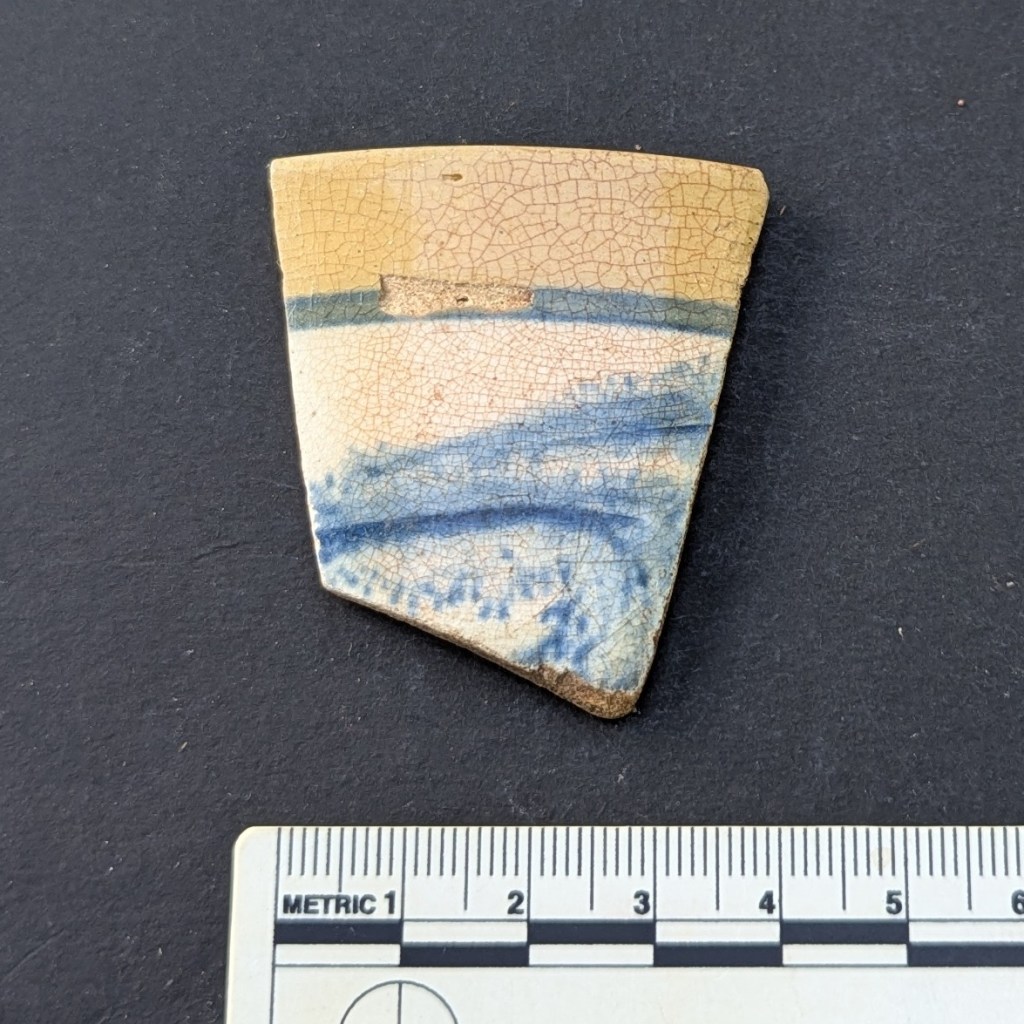
Slightly later than all this is a beautiful sherd of Industrial Slipware:

It’s a lovely fragment of a sugar bowl type thing, with a wide mouth and straight sides. I like how the decoration gently mirrors the environment it was found in – very suggestive of water and sky.

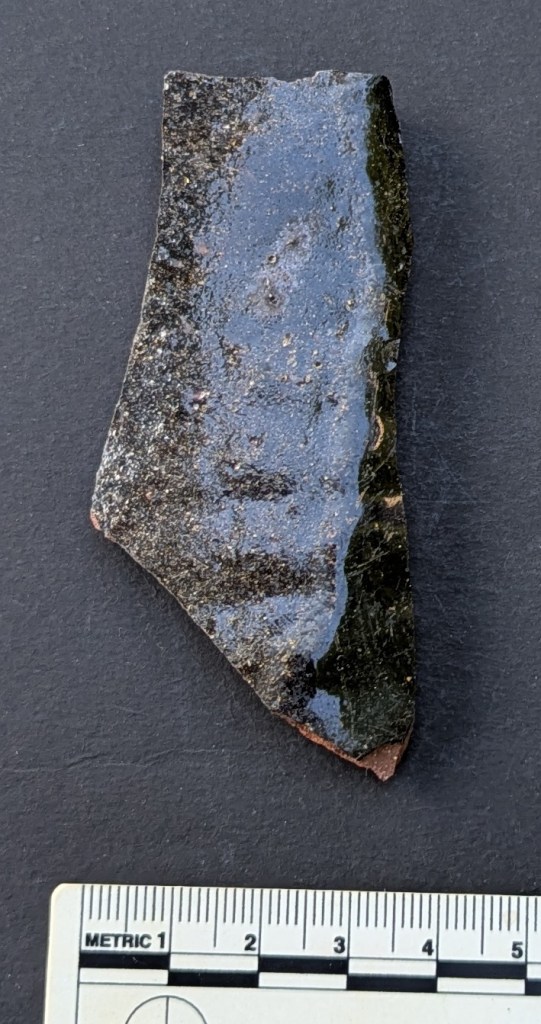
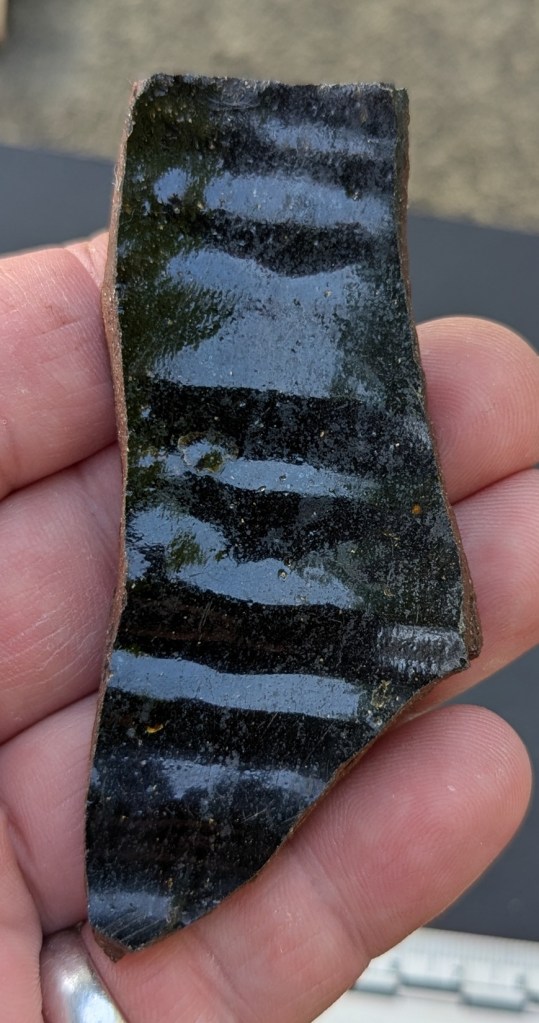
For me, though, the absolute gem of a find was this fragment of a large Cistercian Ware jug.

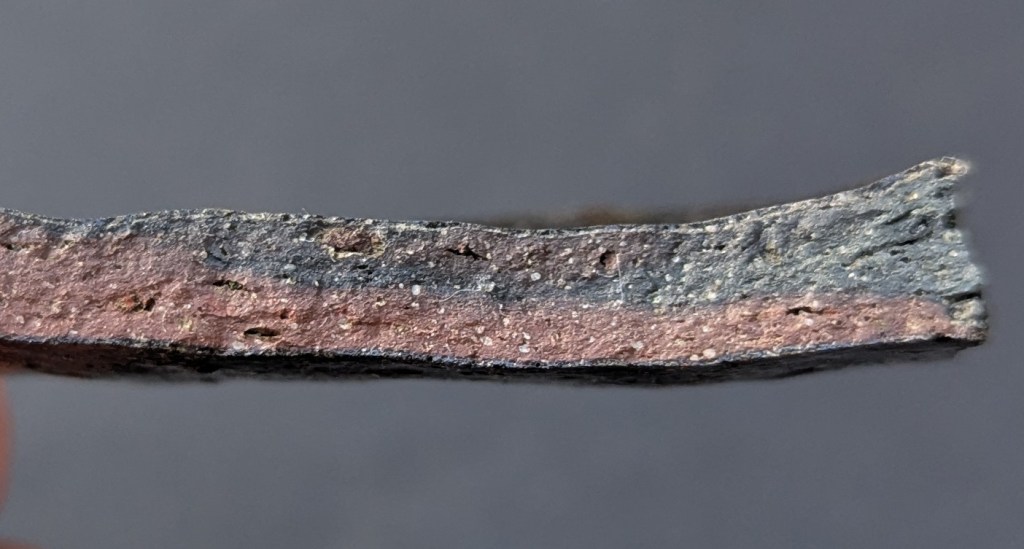
Dating to the earlier 16th century (1550, perhaps), this is quite special in that it not only pushes back the date of Torside Farm, it is also not something that is commonly encountered. The surface is wonderful in a deep black glaze, and the fabric is textbook purple and hard, with the classic ‘salt and pepper’ inclusions.

The purple colour is on the bottom, the darker grey colour in the fabric is on the inside of the jug, and is caused by the pot being fired in a reduced oxygen environment – essentially, a lack of oxygen during the firing as air couldn’t get into the jug interior properly.

It would have originaly looked something like this:

Image is lovingly stolen from the University of Leicester Archaeological Service’s Facebook page – here

Genuinely, this sherd is, I think, something significant and had me all of a quiver when I found it. I had to have a bracer or two, and thankfully I was soon back to my normal stiff upper lipped-ness.

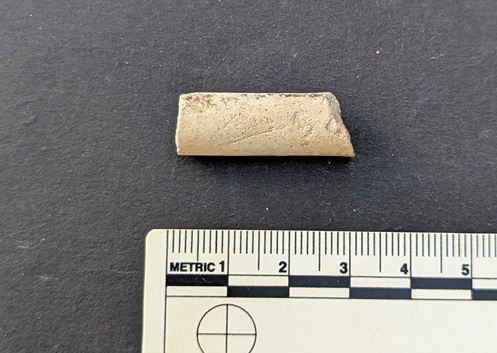
I also found some clay pipe stems here and there amongst the stones; all fairly standard and Victorian with the remarkable exception of this wonderful fragment.

The longer I look at it, the more it looks like it has two eyes, a nose… is singing to me!

It is chunky, being some 10mm thick, but crucially it is a large bore – the hole through the middle is 4mm – which is unusually large, and twice (or more) the width of a Victorian bore (sigh… yes thankyou Mr Shouty-Outy, calling me an ‘unusually large bore‘ says more about you than it does me). All of this means that the stem is early; early 17th century early… probably the same date as the earliest reference to the farm in 1621. It’s wonderful to imagine Alycia’s father sitting and smoking a nervous pipe in front of the fire, listening to the cries of his newborn daughter upstairs, and who knows… this could be the pipe. I love this, genuinely… it makes it real.

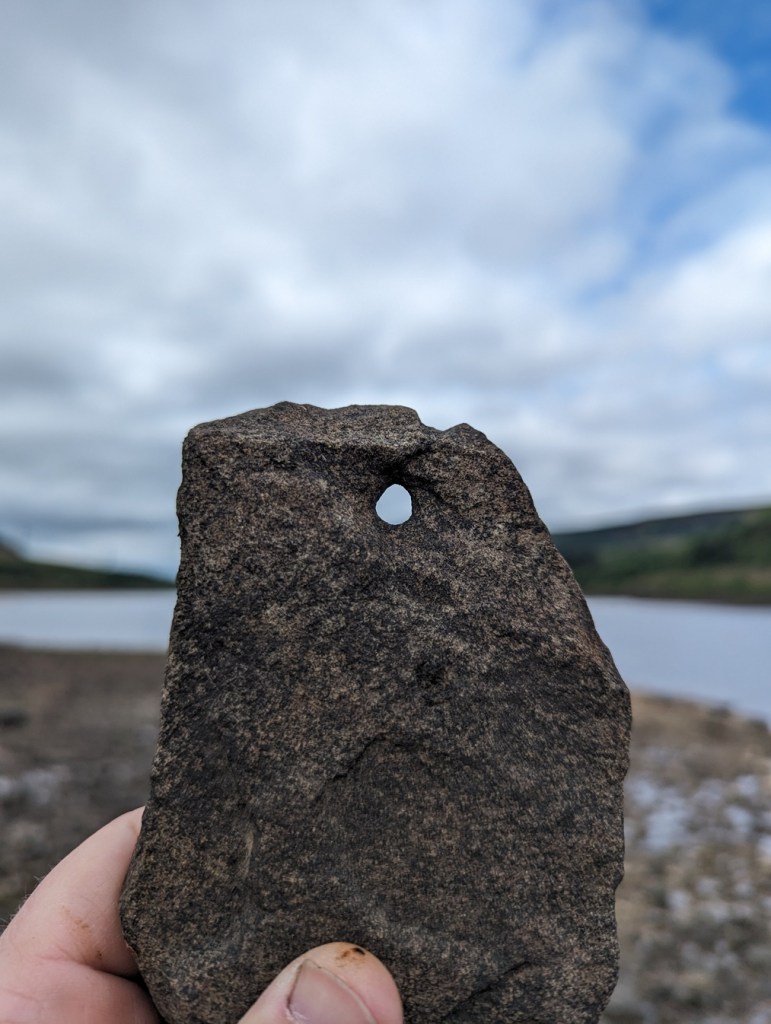
I also found a fragment of stone roof tile with the peg hole intact…

A nice shot, that! This must have come from the house or outbuilding, possibly as part of its demolition or perhaps during the course of its natural life.

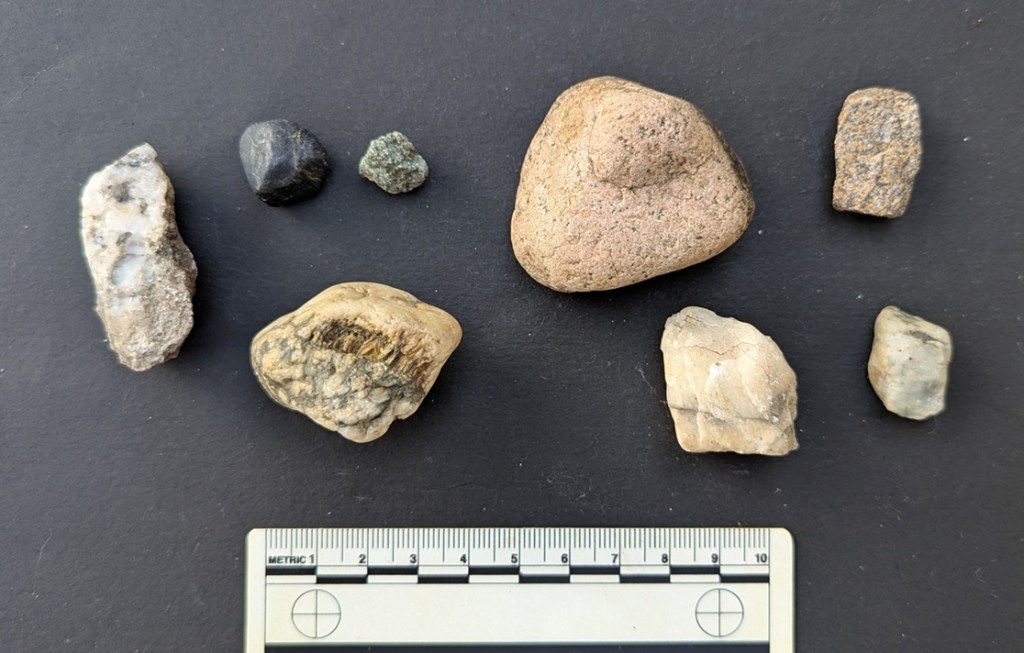
Slightly older… glacial erratics – bits of stone that are not part of the local geology, which in out case is Millstone Grit and coarse sandstone:

Another awful photo – I will get a proper camera soon, honestly.

I talked a little about glacial erratics here, but essentially they are bits of stone that have been picked up from all points north of here by glaciers moving south during the last ice age (granite, and large bits of quartzite, for example). The movement of these huge structures made of ice, mud, and stone, actually carved out the Longdendale Valley, and when they began to melt roughly 25,000 years ago, they dropped all this odd material. Glacial sand and clay can be found all over the Glossop area (my own house sits on glacial clay), but it is very prevalent in Longdendale. The types of stone, and indeed origin of these, I haven’t gone into; I am not a geologist, but perhaps I should write an article on them?

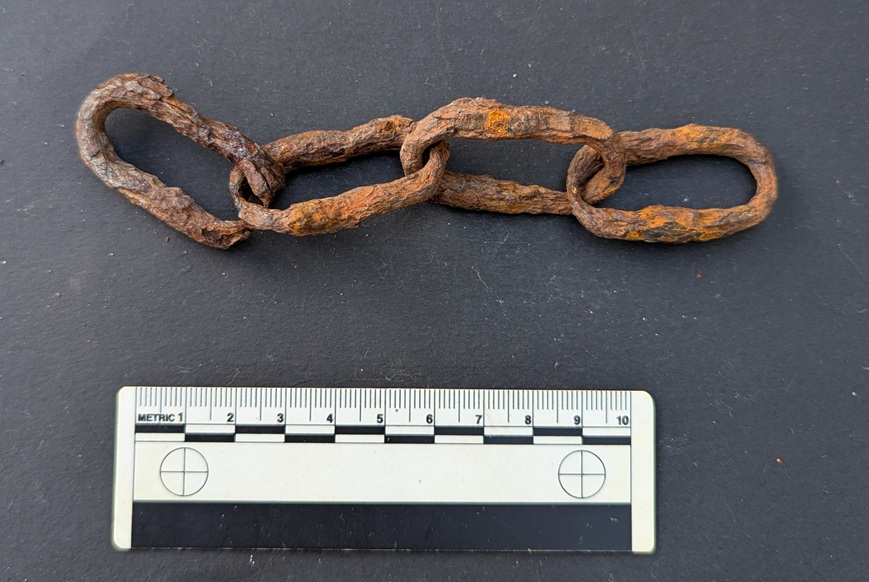
In addition to all that, I found a rather nice segment of hand forged, very worn, iron chain.

I have no idea of the age of it, but it’s certainly at least Victorian… and is very cool!

As I say, the first mention we have of the farmhouse at Torside is 1621, but I am fairly confident that the Cistercian Ware jug is earlier, and perhaps by as much as 150 years – which is very interesting and may point to an earlier incarnation of the farm in the area… which makes sense. The past is indeed all around us, and often at our feet… and it is always well worth having a look.

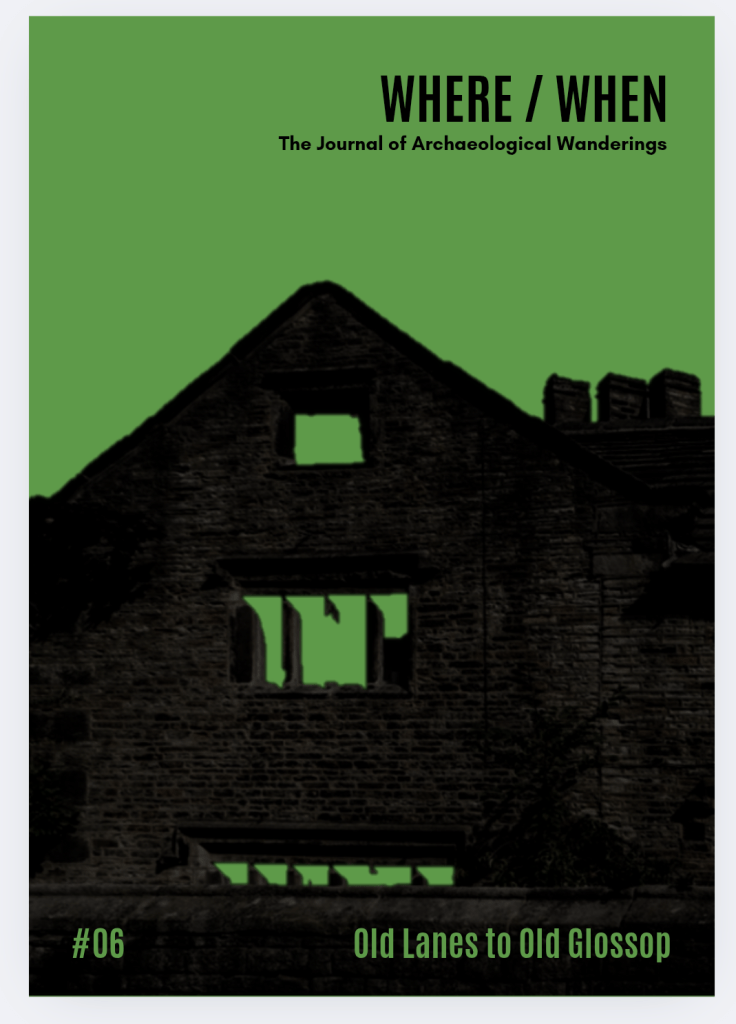
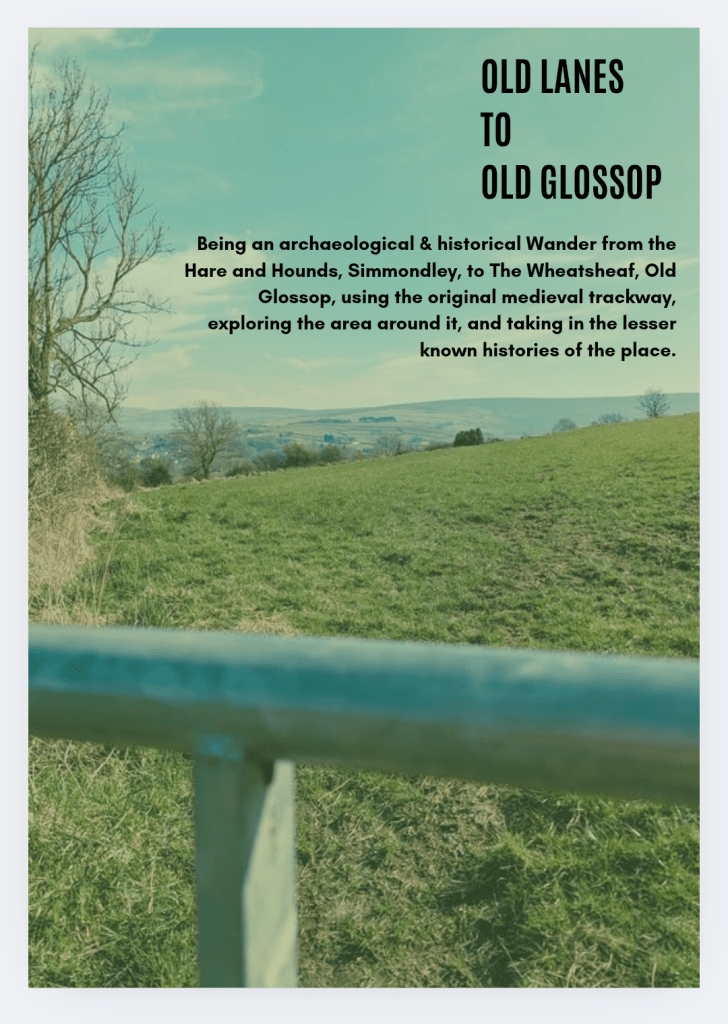
So then, in other news (and also having a look at), the new edition of Where/When has just come from the printers: No.6 – Old Lanes to Old Glossop.

This one is a Wander along the medieval main route between Simmondley and (Old) Glossop, now fossilised into footpaths and odd tracks between buildings. Filled with all manner of archaeological goodness and the usual nerdiness, with a pinch of psychedelia and a heavy hit of psychogeography. Put simply it’s a bloody good walk that goes between The Hare and Hounds and The Wheatsheaf, so what’s not to love?

Contact me here, buy it in the website store, buy it from my Etsy store, the Ko-Fi store, stop me in the street and say “what ho!”, or pop into Dark Peak Books on High Street West, Glossop and grab a copy. It is selling fast… worryingly fast, to be honest!

Right, I think that’s all for the archaeology this month… more soon, obviously. Perhaps more pottery; I’d like to finally wrap up the Rough Guide to Pottery – its unfinished status is frankly bothering my diverse and somewhat spicy mind, and I’d like to be able to wake up not screaming once in a while! Watch this space.

In the meantime, as always – and I do honestly mean it – look after yourselves and each other. This world is not always kind, so let’s – even you Mr Shouty-Outy – try and be kind instead. Until then, I remain, your humble servant.

TCG

Etsy Shop · Where / When

Where/When No.4 (The Melandra Meander) and More

What ho, historical types, what ho!

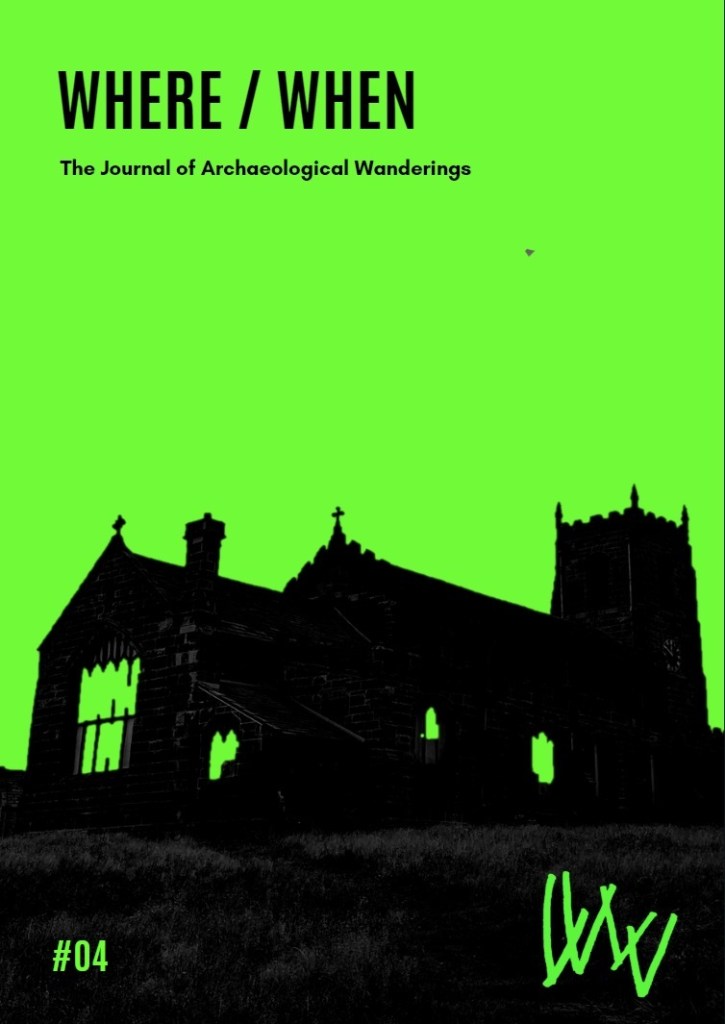
So, the new Where/When ‘zine has just arrived, and just in time for Christmas! How has a year passed since I nervously unpacked Issue No.1, hoping that someone might buy it? I now have t-shirts available… but more about that in a moment. So then, Issue No.4: the lurid green cover was suggested by Master CG, so blame him for the migraines.

This one is subtitled The Melandra Meander, and, as you might have guessed, has a brief furtle around that most neglected of all Roman forts, Melandra. The Wander starts there, and then wends its probably weary way up the hill to The Hague, then up to St Michael and All Angel’s church, Mottram, and then down various trackways to Broadbottom, the viaduct, and on to Gamesleys old and new, and eventually back to the fort.

It does give a brief overview of the fort, but I think that really should be the subject of a Where/When special, as it is a hugely important site. It’s also slightly longer than previous Wanders, but it isn’t particularly difficult… although be warned it is incredibly muddy in places. You have been warned! It contains all the usual website shenanigans – history, a carefully planned wander, archaeology, psychedelically tinged photographs, bad jokes, pottery, a sense of ‘something or other’ and the obligatory snifter of the stuff that cheers… I mean, what’s not to love?

All four of the Where/Whens are now available to buy – I reordered some more of the long out of print No.1, as people have asked for it.

The price is £5 each – a mere snip to have my words droning on and on about old things ready at hand, any time day or night! They are available from the wonderful Dark Peak Books, High Street West, Glossop, or from this website (click here, you won’t regret it). Or simply drop me a line in the contact page, and I’ll get them to you ASAP. Or you could track me down, and make vague threats to me in order to get me to sign it – you won’t be the first (madness, I tell you!).

I’m also in the Glossop Chronicle, which is bizarre to say the least! Check it out here: https://online.flippingbook.com/view/781848889/10/

In other matters… I have set up an Etsy shop! This gives me a platform to sell my wares, which is amazing. At the moment it largely features A4 art prints taken from Where/When, on really good quality paper stock, perfect for framing and brightening up even the darkest of rooms (yes, Mr Shouty-Outy, I’m sure it would look good in your downstairs toilet… as always, I thank you for your input).

But also, crucially, we have some merchandise! If you fancy buying a 100% cotton t-shirt for Christmas, please feel free – I certainly won’t stop you! Now you too can recognise fellow Wanderers without having to resort to those tattoos that some of you have got. And now you too can look somewhat snazzy as you slither down a muddy bank whilst looking for pottery, or indeed simply spiffing as you tumble A over T down a ‘medieval trackway’ cursing me as you go (again, you won’t be the first).

Four slogans are available, and in a variety of colours:

‘What ho, Wanderer’

‘Wandering Where? Wandering When?’

Not Walking… Wandering’

Wander Definition

There’s also hoodies, and mugs! What’s not to love? And, of course, the ‘zine itself. And with much more in the pipeline.

Check the shop out here – DrTCG’s – you won’t regret it, and you’ll be helping me, too!

Righty, shameless self-promotion over with – I’ll have a proper December post ready in time for Christmas (probably involving pottery!). Until then, look after yourselves, and, as always, each other. And I remain, your humble servant,

TCG

Archaeology · Pottery · Where / When

Updates: Cheese Town and Other Matters!

What ho, you wonderful – and slightly odd – folk who are reading this. You are here either because you have an interest in Glossop/Pottery/Old Things/The Ramblings of a Sherd-Nerd… or you’re lost. Either way, you might need some help. And either way, pour yourself a glass of the stuff that cheers, sit back and relax.

So then, we have a mixed bag today – some updates and some new stuff, and first up we have placenames.

WHITFIELD: THE PLACENAME

I originally published this post listing all the places in the Glossop area with their first appearance. Whitfield first appears in the Domesday Book of 1086 under the name Witfelt, which is normally understood to mean “White Field”, meaning an open (figuratively ‘white’) land or field, presumably to differentiate it from the surrounding moorland. However, I recently read an interesting article in Nomina: the journal of the Society for Name Studies in Britain and Ireland… as one does. The article is titled “Onomastic Uses of the Term “White“” by Carole Hough (read it here). Briefly, it suggests that amongst all the other possible meanings for the word ‘hwit‘ (White), one that is often overlooked is that relating to dairy foods and milk – literally ‘White Meat‘ – for which there is a lot of evidence, particularly when used in conjunction with a farm or land place name element. If we consider this in relation to Whitfield, we might understand it as the field where diary produce is made, and hence the Cheese Town of the title. We can’t say for certain, but it’s certainly a possibility that should be considered, for as we know cheesemaking was taking place here in the 18th century and earlier… so why not? Whitfield, land of cheese! Marvellous!

MASONS MARKS ON LONGDENDALE TRAIL

Back when I was a younger man (April 24th 2018, according to my records… 6 1/2 years ago!) I published an article on Mason’s Marks and Apotropaia on the stone infrastructure on the Longdendale Trail (read it here). Master CG was only just 2 years old then… and a lot can change in 6 1/2 years! Having recently got into riding his bike (!), off we went to the Longdendale Trail, giving me the opportunity to look for more marks… and Lo!

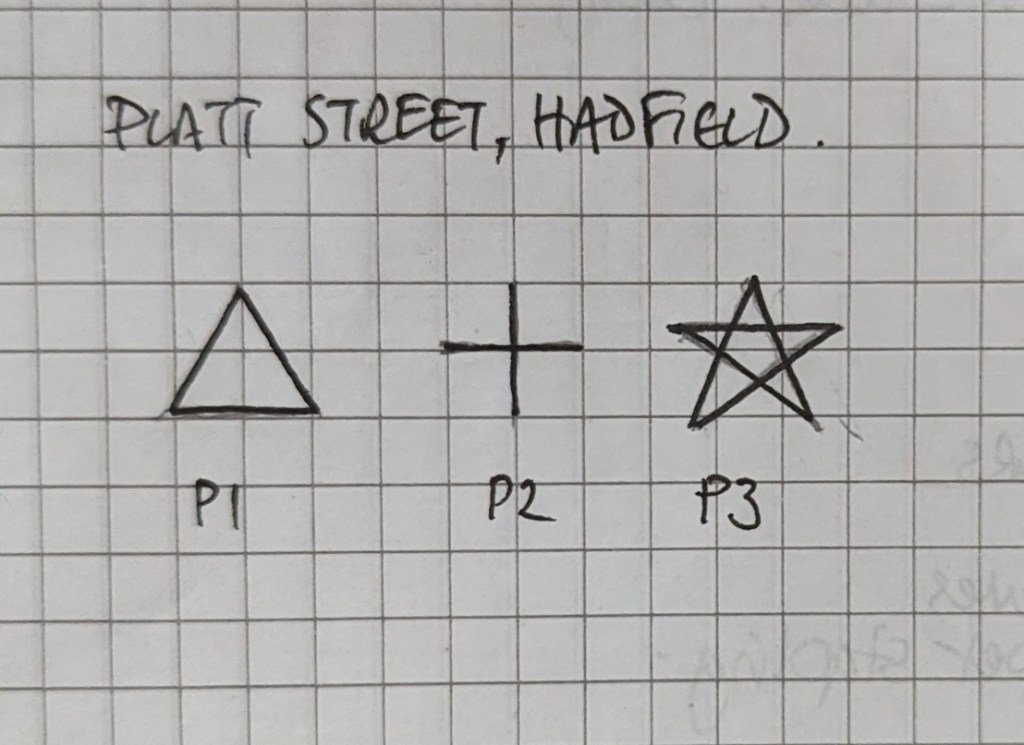
Here are the marks so far identified, to add to the corpus of mason’s marks along the line. The first are from Platt Street, the road bridge at the very start of the Longdendale Trail (What3Words is fortified.bracing.wage).

Photographed from my notebook… I just realised I should have rubbed out the pencil!

The second lot are from under a bridge that carries an apparently unnamed road leading from Padfield Main Road to Valehouse Farm (What3Words is leader.operated.courts).

V8 is also shown in the Platt Street marks. Some of these show up at other places along the line. Ooooh, I can’t wait to collate and analyse… I’m such a geek!

As you can see, some of these marks show up elsewhere on the track, suggesting that the same workers were shaping stone all the way from Broadbottom to Woodhead, which makes sense. Truly though, I need to survey the line properly, collecting the forms and locations, etc. I know I’ve said it before, but I honestly think a wonderful project could be made from these marks; recording and comparing them all along the line, researching who they might belong to, raising the profile of the men who physically built the line (not just those who financed it), as well as approaching it from an arts perspective. There’s lots to pick away at here, in fact… if anyone fancies joining me (or indeed, if anyone fancies funding/sponsoring me).

MYSTERY STONES ON THE GLOSSOP – MANCHESTER LINE

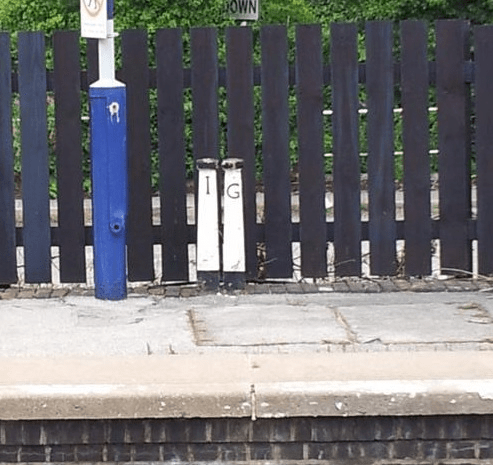
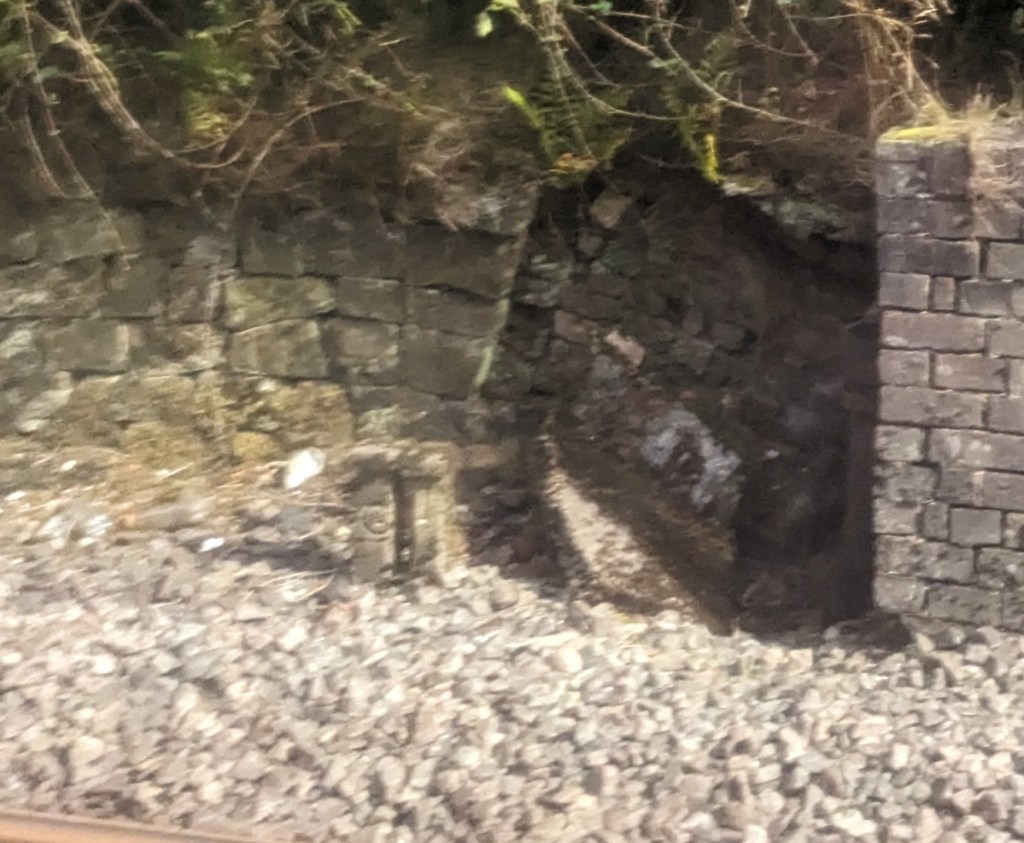
Talking of stones, a few years ago I published an article that looked at some odd stones I had noticed during the commute between Glossop and Manchester. Please read the article for more in-depth information, but essentially, 2 pairs of stones and a single example, all exactly the same shape and design, and all with the same single letter designs – ‘I’ and ‘G’. One pair on the platform at Guide Bridge station, and the single example just beyond the station, against a wall, and both of which I had photographs. And another pair just before one pulls into Hattersley station (coming from Glossop, on the right), which was in a ‘blink and you miss it’ position, and consequently of which I had no photograph.

The pair at Guide Bridge
The single post (possibly originally one of a pair) a little further on from Guide Bridge

And there the matter lay until the other day! Heading into Manchester, I noticed we seemed to be slowing down earlier than usual on the approach to Hattersley station, and having my phone in my hand, I tried to get a shot of the stones… and succeeded. Well, sort of… in a cruel twist of fate, young Master CG decided it would be an ‘hilarious’ jape to put sellotape over the cameral lens, and as a consequence the photograph looks like it was taken using a potato. Still, the jokes on him… I subsequently enrolled him in a special after-school long-distance running and extreme maths challenge club. That’ll teach him to mess with old TCG! Anyway, here’s the photograph:

Apologies for the poor quality, but the general area can be discerned.
The ‘G’ and ‘I’ can just be made out through the sellotape haze. I will keep trying to get a decent photograph.

So now we have photographic evidence of all of these mystery stones, which is great… but we still don’t know what they are! So, please, if anyone can suggest a meaning or purpose behind these “monogrammed mushrooms” as I have named them (patent pending), then in the name of great Jove, please let me know.

OOOOH… FLINT!

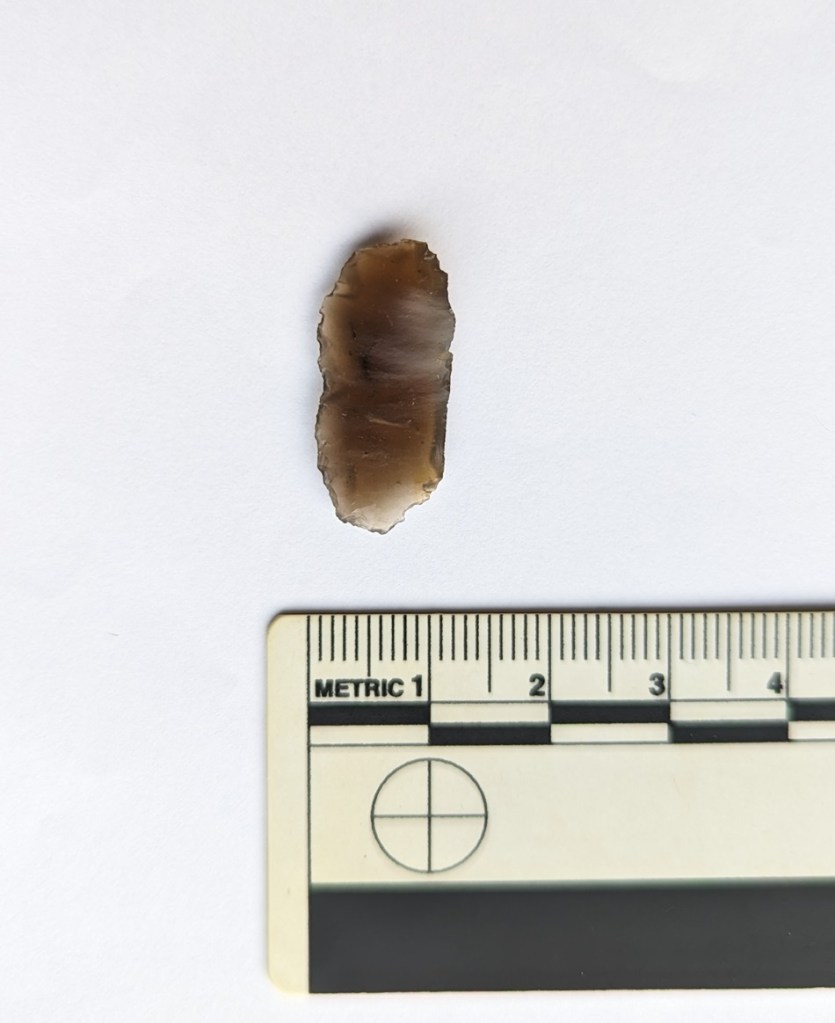
More stone… this a little older, though. Over the course of a number of years, I have picked up a few odds and ends of prehistoric flint from the Glossop area. The hills all around are full of these tiny fragments of a distant past – largely Mesolithic (Middle Stone Age, roughly 8000 – 4000 BC), with some that might be Bronze Age (roughly 2500 – 750 BC). But these three examples I have found much closer to Glossop itself, and always quite by accident. It is worth remembering that Glossop, the Peak District, and indeed most of the North West is not a flint area, and any flint found hereabouts has arrived either by glacial action, or it has been brought here by a human; so any flint you see pick it up! Honestly, flint and chert (a local, poorer quality, flint-like quartz) are both very distinctive against the local gritstone, and once you get your eye in, they stand out from some distance. I’m not a stone man, and whilst I can usually recognise flint that has been shaped deliberately, the finer points of dating I leave to people who know what they’re talking about. Here are the bits I have found:

This first came from a path just below Shire Hill, so might be Bronze Age.

Lovely stuff – a blade made from a chip of flint. You can see the ‘bulb of percussion’ – the bulbous bit at the top – where the blow was struck to break this chip off. When hit, flint acts as though it was liquid, and you can see the ‘waves’ made by the strike. You can also see the nibbling at the edges that suggest this blade was ‘retouched’, or sharpened after being used. Flint is very sharp (I have literal scars to prove it), but it is a fragile edge that needs work to maintain it.
The back side of the above flint piece – you can see where other pieces have been struck from this one, each creating a scar as the force travels along the core. It’s a fascinating subject flint knapping, and one that is not easily put into words… it has to be seen, and especially felt.

The next flake came from where the allotments are now at Dinting, sitting on a mole hill.
A chip off the old nodule! It’s been worked, but I’m not sure it was ever a tool.
Again, a crappy photo of a lovely flint tool. This time, a fragment of a thumbnail scraper – also here. Honestly, flint is better touched and seen in person, that’s why we archaeological types use drawing to illustrate flint… a photograph does not show what we want to see.

Whilst we know people were here in prehistory, its always nice to see the things they used in their everyday lives. I actually need to report these to the Find Liaison Officer (FLO) as this is prehistoric, and any information from this period, no matter how small, can potentially change our whole understanding of the history of the area. The FLO is the person to report anything interesting and potentially important you find (feel free to tell me as well, but honestly they are more important) – very helpful and genuinely the font of much knowledge.

POTTERY: SOME BITS AND PIECES

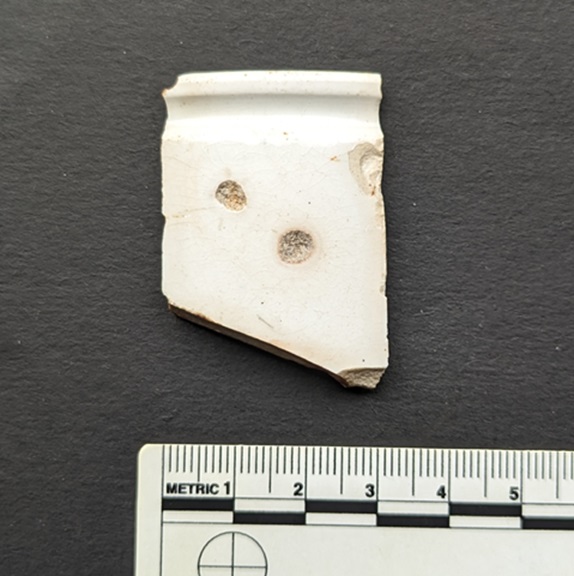
Never missing an opportunity to spread a little ceramic-based joy, I present to you a small selection of recently found pottery. Following my own newly introduced rules, I am only taking sherds that interest me, or which are good examples of the ware type. This means that there is more left for you wonderful folk to find, and more space in chez CG… much to the relief of Mrs CG.

First up, two very similar sherds.

Left has heavily crazed glaze, and I suspect it was burnt at some stage… that’s not normal ‘wear and tear’, even after being in the ground for 200 years or so.

Left is from High Lea Park in New Mills, and is the base to a mug or tankard some 8cm in diameter. The right was found on the track below Lean Town, and is the same in shape and dimension, although this is from the body somewhere, not the base. I got very excited both times I found these – they look like Scratch Blue stoneware, which would be very exciting. Alas, on closer inspection it’s clearly earthernware, and thus less exciting. Having said that, they are both from Industrial Slipware vessels, and both early 19th century in date – which is a bit rarer than the usual Late Victorian – and come from something like this:

Stolen, as always, without shame, from this website. Honestly, it’s a fascinating website filled with all sorts of historical pottery information from a collector’s perspective. I genuinely enjoy this site… which might be warning to some of you!

Sometimes, coming back from school with Master CG, we like to shake up what is in essence a somewhat linear journey from A to B by taking different routes; exploring, Wandering, and just seeing what we encounter along the way; blackberries, elastic bands, the occasional copper nail, a penny, holes in the ground to peer into, and if we are lucky a skip. There’s always something in either of those two latter.

Plain, but is still quite cool. I know, I know… but I can’t resist!

This was from a skip on Hadfield Place. Always, and I mean ALWAYS, look in a skip that has soil piled in it: Glossop’s history almost guarantees that there will be at least some Victorian sherds in that soil. Here we have a rim sherd from a late Victorian/early 20th century marmalade pot – something like this:

Stolen from this website… and you can buy it for £55.

The groove running around the pot, just below the rim, is to enable a piece of string to be tied around to keep the cloth lid in place… very characteristic.

Skips and holes… always have a look in both. This next sherd was from a utilities pipe trench on St Mary’s Road:

Lovely stuff. I think this might be fairly early

A lovely sherd of Industrial Slipware, again, this time of a Banded or Annular Ware type. It looks very modern as it is still made, particularly as Cornishware, but it is genuinely early to mid-Victorian in date, and probably from a large bowl or jug. Looking and feeling it again again, I think jug.

This last sherd is another Industrial Slipware – a tiny fragment of Variegated Ware, this one being in the ‘earthworm’ design:

Truly awful photograph. I know a bad workman blames his whassnames, but my new phone has no macro setting, so my up close photos are not great.

Probably from a jug or bowl, similar to the one in the above article, and dates to about 1800-1820. Interestingly, this one was found in a quarry that was used during the construction of Bottoms Reservoir, and was later used as a tip. Bottoms Reservoir was opened in 1877, and thus the tip can only have been used from, say, 1880 onwards, and actually, judging from what is found there, I think perhaps from 1900 onwards. This means that this sherd – and the pot it came from – was as much as 100 years old when it was broken and thrown away. This makes sense – I still have my great grandmother’s 1920’s salt-glazed stoneware pie dish (I use it to make a really nice tomato and white bean bake with a feta topping, if anyone fancies…) – and is a cautionary tale about using pottery to precisely date certain contexts. People in the past also had heirlooms, and all objects have a biography.

AND FINALLY… WHERE/WHEN 3

Well, Where/When no.3 is now on sale… and selling well. You good folk seem to like a walk, some history, and a pint… who knew? Well, I think we all did to be honest. You can get it in Dark Peak Books (93 High Street West in Glossop), or via the Cabinet of Curiosities shop (here). Or you could track me down and snag a copy.

For those of you who are unaware, Where/When is a quarterly journal of Archaeological Wanderings. Essentially, a walk in the Glossop area, with yours truly chiming in about the archaeology and history of where you are wandering; think a pinch of pottery, a hint of psychogeography, some groovy photographs, a dash of discovery, a toe stub of psychedelia, and a splash of the usual Glossop Curiosities shenanigans. No.3 Takes us on a walk from The Beehive in Whitfield to The Bulls Head in Old Glossop via medieval trackways, a Saxon stone cross, 18th century buildings, and a 10,000 year old glacial erratic boulder. Marvellous stuff!

A sneak preview of Where/When 4 – The Melandra Meander.

And Where/When No. 4 is in preparation; titled “The Melandra Meander“, it will detail a circular walk from Melandra Roman Fort to Mottram Church on the hill above – via Hague and medieval trackways – and then back again, and is full to the brim with the kinds of historical and archaeological goodies that you have come to expect. It’ll be in stores in December, just in time for Christmas.

I have a whole pile of ideas for Where/When, and the Cabinet of Curiosities in general… all kinds of stuff: t-shirts, anyone? Art prints? The Rough Guide to Pottery in booklet form? And in particular I’d like to start a series of monthly guided Wanders – where you and me can Wander together. Let me know what you think about this. Or indeed anything about the website, or what I have written. It’s nice to know I’m not just shouting into the void!

Right then, apologies for the late post of this article, and for generally being behind in most things – there’s often a lot less of old TCG to go around than I believe, so I end up dropping some of the things I’m juggling. More soon, I promise.

Until then, though, please do look after yourselves and each other, and remember – a person might look ok on the outside, but can be struggling inside. We all matter.

I remain, your humble servant,

RH

Archaeology · Where / When

Where/When #2 (and other news)

What ho, what ho, and indeed… what ho!

A quick one now, just to spread some news. A bigger article is in the offing, honest.

So, the big news is that the second edition of the archaeological Wandering zine Where/When is now at the printers, and promises to be with us sometime next week. Fingers crossed.

As you can see, it’s blue. Not that that makes much of difference to anything, as it’s chock full of the usual noodlings and doodlings, history and archaeology colliding with my, er… ‘unique voice’, as it has been described – in a psychedelic swirl of colour and trackways.

This one describes the route between The Bull’s Head in Old Glossop and The Beehive in Whitfield, using – where possible – the medieval and post-medieval trackways, often preserved in surprising ways. Along the way we encounter all manner of archaeology and history, a ghost, a hall, two 1960’s housing estates, a team of oxen, a well, and a Roman road.

It’ll be available to buy from Dark Peak Books and George Street Books for the very reasonable price of £5. Or you can track me down and buy one. It will also be available to download as a PDF from the Where/When page at the top of the site (for the price of a glass of the stuff that cheers, via my Ko-Fi page (and do feel free to buy me a glass anytime!).

This second volume is actually the first of a two-parter, the next volume being the return journey from The Beehive to The Bulls Head, using entirely different tracks, and exploring entirely different archaeology. This is titled, naturally, ‘Of Hives and Heads‘, and will be available very soon – watch this space.

The other big news is I’m doing a talk for the George Street Community Bookshop – one of their Curiosity Club events. It on Thursday 25th April at 7pm at Bradbury Community House, on Market Street in Glossop. The subject is the vague sounding ‘Archaeological Wanderings‘, which is just how I like it – expect old stuff; medieval trackways, Wanders, flint, idle talk of wondrous things, pottery, Romans, and possibly some Anglo Saxon crosses thrown in. A psychedelically-tinged swirl to the thrum of history, if you will. Or if you prefer (and why wouldn’t you), I’ll be talking about the history of the Glossop area to a group of people who may or may not be interested.

But do come along, it’ll be a blast, and you’ll get the opportunity to ask me all sorts of awkward questions. No, not you, Mr Shouty Outy… you are barred. You can book a place here, on eventbrite – tickets are priced as you wish, and it’ll be good to see any of the seven of you who read the site (sorry Juan, unless you can fly out from Caracas on Tuesday, you’ll miss it. Lo siento amigo, ¿la próxima vez quizás?).

Right. I have a proper article almost written – obviously pottery related – that I need to finish, so forgive me for rushing off… I’ll be back soon, I promise.

Until then, take care of yourselves, and each other, and I remain.

Your humble servant,

TCG
Where / When

Where / When – The ‘Zine

What ho!

At long last… it’s here!

So, welcome to the official launch of the new Glossop Cabinet of Curiosities magazine:

WHERE/WHEN – The Journal of Archaeological Wanderings.

Whoopee“, I hear you cry! “Tell us all about it, TCG!” Well, the basic idea behind the ‘zine is to give a guided walk in the same irreverent, but academically sound, way the website does, but with added psychedelic and arty photographs and exploring weirder elements. This first edition – titled Ashes, Arches, and Harehills – is essentially a walk from Point A (The Friendship Inn) to Point B (The Oakwood), though some of the lesser known parts of Glossop (Ashes, Dinting Arches, Adderley Place, Roman and Medieval Roads, and a 1920’s bridge). Along the way, I add what I know about the history and archaeology of where we are walking, and filling out any hidden or overlooked bits and pieces. Simple, fun, and hopefully interesting.

This last word is important, as I want you to experience the place you are walking: to stop, look, and listen; to feel. To look at a track and ask “what’s down there?” Or pick up a piece of pottery or stone and ask “what is it?” Or better “why is it?”. Or to feel the past in a place, to experience it with your senses. Every part of Glossop has traces of the past on it – every building stone show multiple holes, carvings, fixings, splashes of paint, chips taken out, or repairs. And walls stop and start, or take odd angles for no reason; trackways bending to avoid something that is no longer there. Odd bits machinery or re-used stonework appear and disappear in the mist, and trees form shapes that may or may not be real. If we don’t stop to look, we miss them and we miss the experience.

I hope Where/When will get you walking and thinking, exploring and pondering… wandering. Which all sounds as though old TCG has lost his marbles, and that may well be the case, but our heritage is all around us, sometimes hidden, often vague or confusing: so let’s wander together and see if we can find it.

It is also most certainly the first in a series issues of Where/When, and I have already planned out several future editions, including No. 2 – Of Bulls and Bees, and No. 3 – Of Hives and Heads. These are a two part wander from The Bulls Head in Old Glossop to The Beehive in Whitfield, and back again, using only the preserved remains of medieval and post-medieval (17th century) trackways. I fully intend to offer an ‘event’ for this – let’s walk it together from pub to pub, and I’ll give a full rambling account. Well, perhaps not… don’t want to frighten the natives, what! But what’s not to love… a wander, some history, a pub, and the company of old TCG! Watch this space in the new year.

I also have an idea for some slightly more far flung editions (Alderley Edge for example, and possibly Chester), but let’s see how this first edition does. And I honestly have big ideas for this – it’s really quite exciting (drone flights? Podcasts, with old TCG’s dulcet tones accompanying you on the route? Guest spots?). Also, if any of you feel like you want to offer a wander to be published in Where/When, please drop me a line and we can talk it through.

The ‘zine is 40 full colour pages, filled with interesting words (in an order that broadly make sense) and some pretty awesome images – a perfect Christmas stocking filler for the Glossop people, or those in the greater Glossop diaspora! The price is £5.00 per copy, and it will be available from Dark Peak Book at 96 High Street West – the added bonus is that it might be me that serves you! Or you can also drop me an email and I can post one out to you, wherever you are. Or simply track me down, I’m not hard to find! Or you could even dig a hole in the ground and wait… like a moth to a light!

I have also added a download link to the Where/When section at the top of the website where you can download a free Pdf copy of the zine. It’s exactly the same zine, just in electronic form… and free! I’m also adding a ko-fi link next to the download button so you can buy me a glass of the stuff that cheers, should you wish to, but don’t feel obligated.

Where/When page here

Free Pdf here

Ko-Fi – Buy TCG a glass of the stuff that cheers here

There will be a regular post before Christmas, but I wanted to strike whilst the iron was hot and get this out there.

So until then, look after yourselves and each other – and happy wandering – and I remain, your humble servant.

TCG