Archaeology · Pottery · Where / When

Updates: Cheese Town and Other Matters!

What ho, you wonderful – and slightly odd – folk who are reading this. You are here either because you have an interest in Glossop/Pottery/Old Things/The Ramblings of a Sherd-Nerd… or you’re lost. Either way, you might need some help. And either way, pour yourself a glass of the stuff that cheers, sit back and relax.

So then, we have a mixed bag today – some updates and some new stuff, and first up we have placenames.

WHITFIELD: THE PLACENAME

I originally published this post listing all the places in the Glossop area with their first appearance. Whitfield first appears in the Domesday Book of 1086 under the name Witfelt, which is normally understood to mean “White Field”, meaning an open (figuratively ‘white’) land or field, presumably to differentiate it from the surrounding moorland. However, I recently read an interesting article in Nomina: the journal of the Society for Name Studies in Britain and Ireland… as one does. The article is titled “Onomastic Uses of the Term “White“” by Carole Hough (read it here). Briefly, it suggests that amongst all the other possible meanings for the word ‘hwit‘ (White), one that is often overlooked is that relating to dairy foods and milk – literally ‘White Meat‘ – for which there is a lot of evidence, particularly when used in conjunction with a farm or land place name element. If we consider this in relation to Whitfield, we might understand it as the field where diary produce is made, and hence the Cheese Town of the title. We can’t say for certain, but it’s certainly a possibility that should be considered, for as we know cheesemaking was taking place here in the 18th century and earlier… so why not? Whitfield, land of cheese! Marvellous!

MASONS MARKS ON LONGDENDALE TRAIL

Back when I was a younger man (April 24th 2018, according to my records… 6 1/2 years ago!) I published an article on Mason’s Marks and Apotropaia on the stone infrastructure on the Longdendale Trail (read it here). Master CG was only just 2 years old then… and a lot can change in 6 1/2 years! Having recently got into riding his bike (!), off we went to the Longdendale Trail, giving me the opportunity to look for more marks… and Lo!

Here are the marks so far identified, to add to the corpus of mason’s marks along the line. The first are from Platt Street, the road bridge at the very start of the Longdendale Trail (What3Words is fortified.bracing.wage).
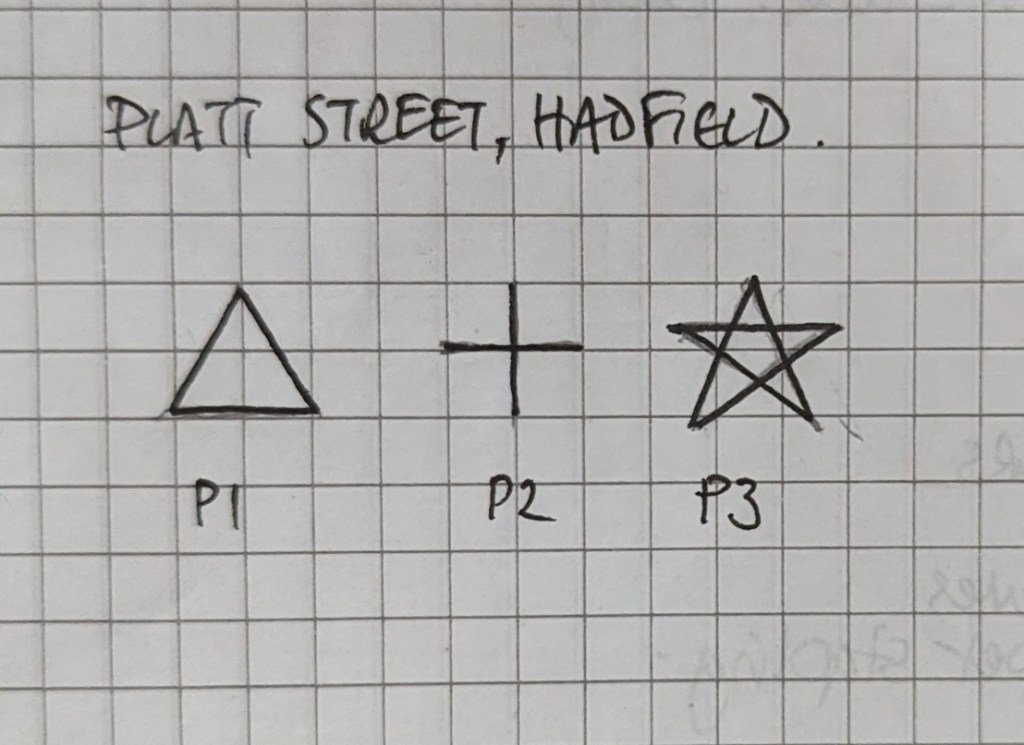
Photographed from my notebook… I just realised I should have rubbed out the pencil!

The second lot are from under a bridge that carries an apparently unnamed road leading from Padfield Main Road to Valehouse Farm (What3Words is leader.operated.courts).

V8 is also shown in the Platt Street marks. Some of these show up at other places along the line. Ooooh, I can’t wait to collate and analyse… I’m such a geek!

As you can see, some of these marks show up elsewhere on the track, suggesting that the same workers were shaping stone all the way from Broadbottom to Woodhead, which makes sense. Truly though, I need to survey the line properly, collecting the forms and locations, etc. I know I’ve said it before, but I honestly think a wonderful project could be made from these marks; recording and comparing them all along the line, researching who they might belong to, raising the profile of the men who physically built the line (not just those who financed it), as well as approaching it from an arts perspective. There’s lots to pick away at here, in fact… if anyone fancies joining me (or indeed, if anyone fancies funding/sponsoring me).

MYSTERY STONES ON THE GLOSSOP – MANCHESTER LINE

Talking of stones, a few years ago I published an article that looked at some odd stones I had noticed during the commute between Glossop and Manchester. Please read the article for more in-depth information, but essentially, 2 pairs of stones and a single example, all exactly the same shape and design, and all with the same single letter designs – ‘I’ and ‘G’. One pair on the platform at Guide Bridge station, and the single example just beyond the station, against a wall, and both of which I had photographs. And another pair just before one pulls into Hattersley station (coming from Glossop, on the right), which was in a ‘blink and you miss it’ position, and consequently of which I had no photograph.
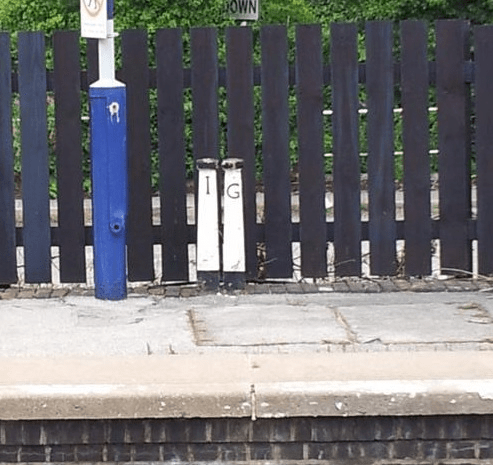
The pair at Guide Bridge
The single post (possibly originally one of a pair) a little further on from Guide Bridge

And there the matter lay until the other day! Heading into Manchester, I noticed we seemed to be slowing down earlier than usual on the approach to Hattersley station, and having my phone in my hand, I tried to get a shot of the stones… and succeeded. Well, sort of… in a cruel twist of fate, young Master CG decided it would be an ‘hilarious’ jape to put sellotape over the cameral lens, and as a consequence the photograph looks like it was taken using a potato. Still, the jokes on him… I subsequently enrolled him in a special after-school long-distance running and extreme maths challenge club. That’ll teach him to mess with old TCG! Anyway, here’s the photograph:

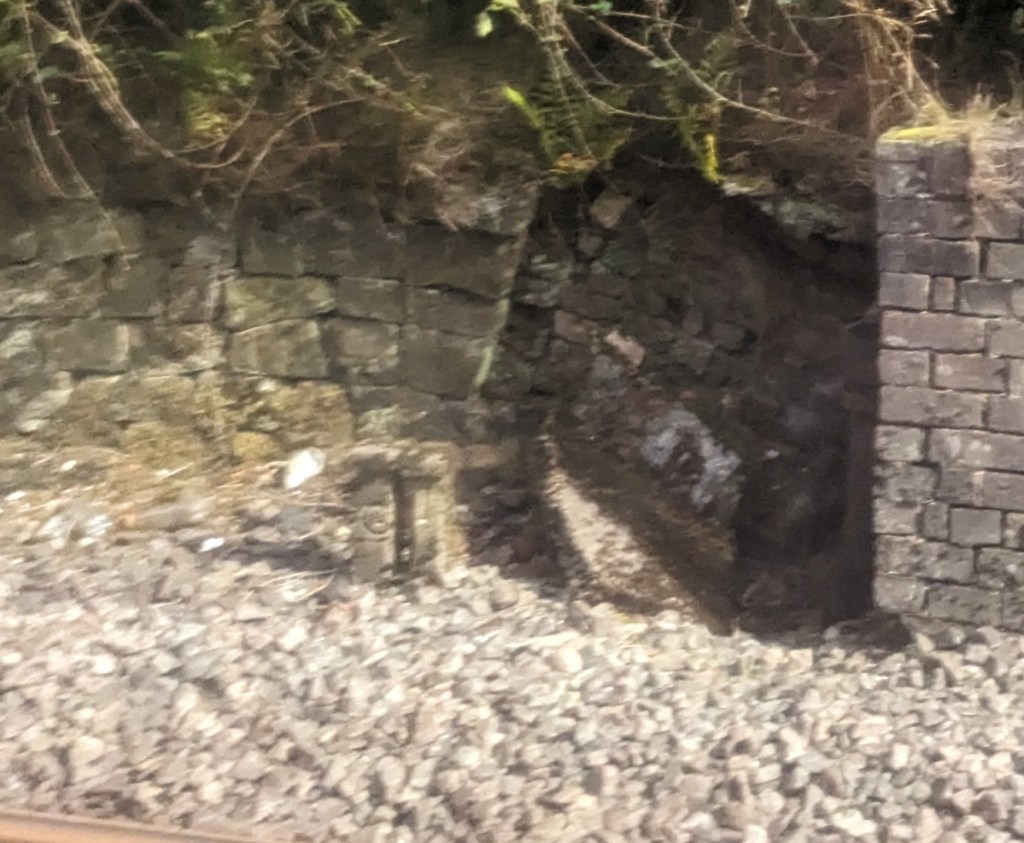
Apologies for the poor quality, but the general area can be discerned.
The ‘G’ and ‘I’ can just be made out through the sellotape haze. I will keep trying to get a decent photograph.

So now we have photographic evidence of all of these mystery stones, which is great… but we still don’t know what they are! So, please, if anyone can suggest a meaning or purpose behind these “monogrammed mushrooms” as I have named them (patent pending), then in the name of great Jove, please let me know.

OOOOH… FLINT!

More stone… this a little older, though. Over the course of a number of years, I have picked up a few odds and ends of prehistoric flint from the Glossop area. The hills all around are full of these tiny fragments of a distant past – largely Mesolithic (Middle Stone Age, roughly 8000 – 4000 BC), with some that might be Bronze Age (roughly 2500 – 750 BC). But these three examples I have found much closer to Glossop itself, and always quite by accident. It is worth remembering that Glossop, the Peak District, and indeed most of the North West is not a flint area, and any flint found hereabouts has arrived either by glacial action, or it has been brought here by a human; so any flint you see pick it up! Honestly, flint and chert (a local, poorer quality, flint-like quartz) are both very distinctive against the local gritstone, and once you get your eye in, they stand out from some distance. I’m not a stone man, and whilst I can usually recognise flint that has been shaped deliberately, the finer points of dating I leave to people who know what they’re talking about. Here are the bits I have found:

This first came from a path just below Shire Hill, so might be Bronze Age.
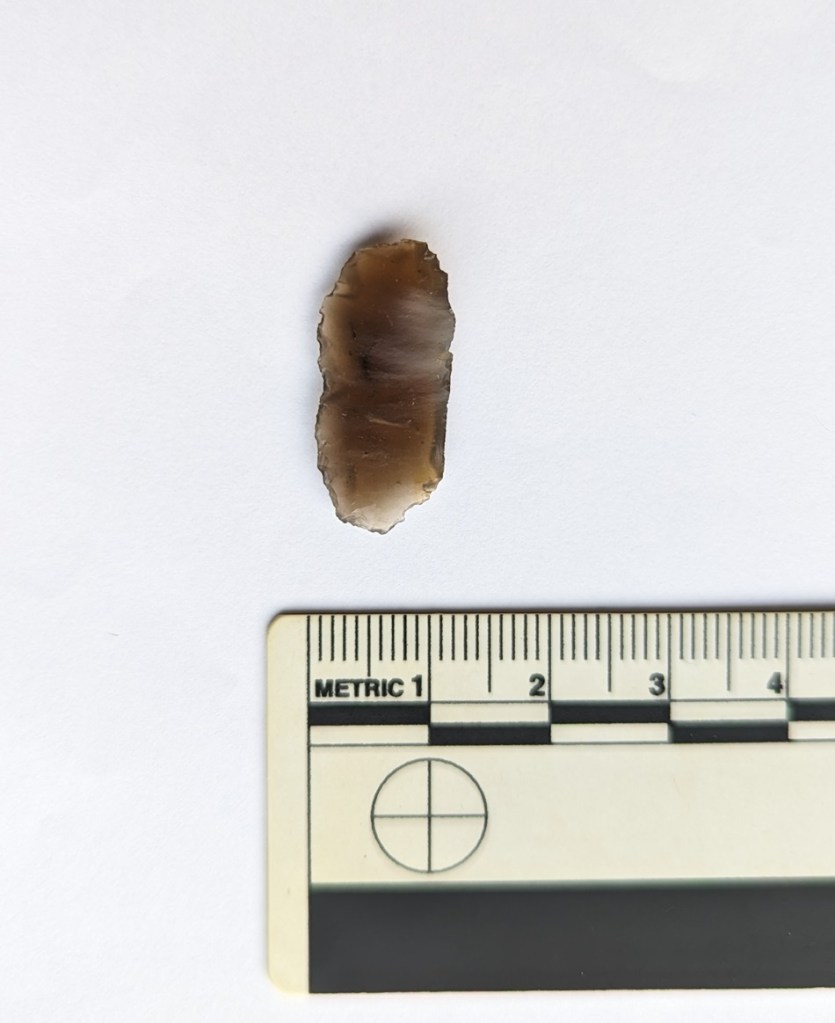
Lovely stuff – a blade made from a chip of flint. You can see the ‘bulb of percussion’ – the bulbous bit at the top – where the blow was struck to break this chip off. When hit, flint acts as though it was liquid, and you can see the ‘waves’ made by the strike. You can also see the nibbling at the edges that suggest this blade was ‘retouched’, or sharpened after being used. Flint is very sharp (I have literal scars to prove it), but it is a fragile edge that needs work to maintain it.
The back side of the above flint piece – you can see where other pieces have been struck from this one, each creating a scar as the force travels along the core. It’s a fascinating subject flint knapping, and one that is not easily put into words… it has to be seen, and especially felt.

The next flake came from where the allotments are now at Dinting, sitting on a mole hill.
A chip off the old nodule! It’s been worked, but I’m not sure it was ever a tool.
Again, a crappy photo of a lovely flint tool. This time, a fragment of a thumbnail scraper – also here. Honestly, flint is better touched and seen in person, that’s why we archaeological types use drawing to illustrate flint… a photograph does not show what we want to see.

Whilst we know people were here in prehistory, its always nice to see the things they used in their everyday lives. I actually need to report these to the Find Liaison Officer (FLO) as this is prehistoric, and any information from this period, no matter how small, can potentially change our whole understanding of the history of the area. The FLO is the person to report anything interesting and potentially important you find (feel free to tell me as well, but honestly they are more important) – very helpful and genuinely the font of much knowledge.

POTTERY: SOME BITS AND PIECES

Never missing an opportunity to spread a little ceramic-based joy, I present to you a small selection of recently found pottery. Following my own newly introduced rules, I am only taking sherds that interest me, or which are good examples of the ware type. This means that there is more left for you wonderful folk to find, and more space in chez CG… much to the relief of Mrs CG.

First up, two very similar sherds.

Left has heavily crazed glaze, and I suspect it was burnt at some stage… that’s not normal ‘wear and tear’, even after being in the ground for 200 years or so.

Left is from High Lea Park in New Mills, and is the base to a mug or tankard some 8cm in diameter. The right was found on the track below Lean Town, and is the same in shape and dimension, although this is from the body somewhere, not the base. I got very excited both times I found these – they look like Scratch Blue stoneware, which would be very exciting. Alas, on closer inspection it’s clearly earthernware, and thus less exciting. Having said that, they are both from Industrial Slipware vessels, and both early 19th century in date – which is a bit rarer than the usual Late Victorian – and come from something like this:
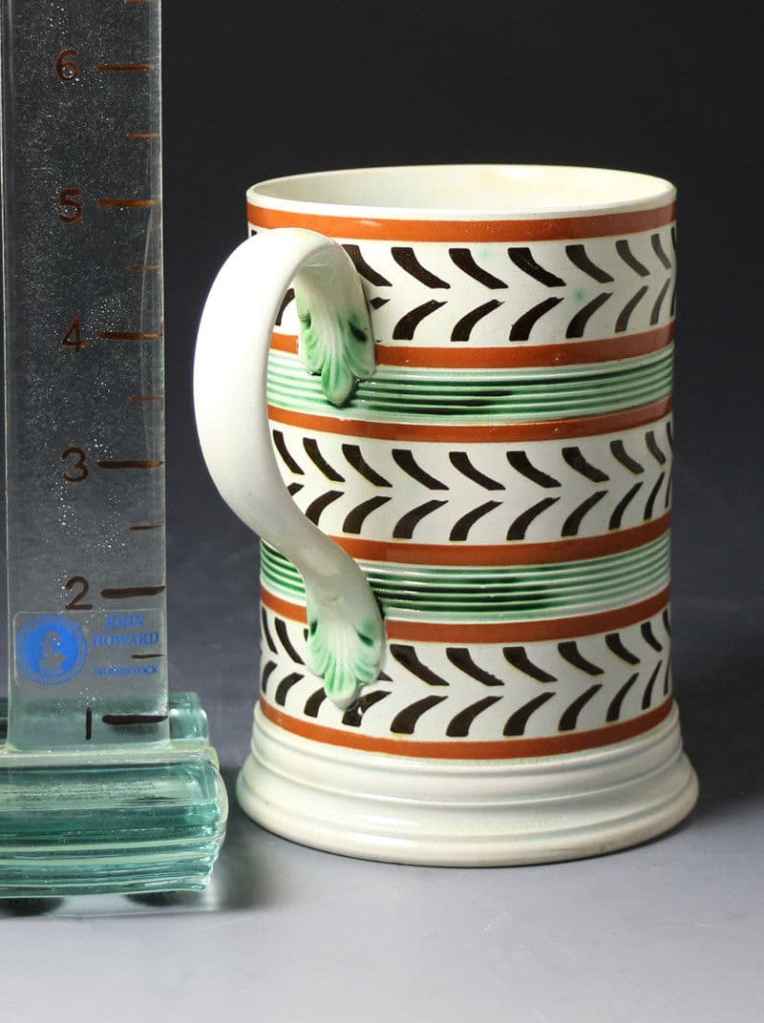
Stolen, as always, without shame, from this website. Honestly, it’s a fascinating website filled with all sorts of historical pottery information from a collector’s perspective. I genuinely enjoy this site… which might be warning to some of you!

Sometimes, coming back from school with Master CG, we like to shake up what is in essence a somewhat linear journey from A to B by taking different routes; exploring, Wandering, and just seeing what we encounter along the way; blackberries, elastic bands, the occasional copper nail, a penny, holes in the ground to peer into, and if we are lucky a skip. There’s always something in either of those two latter.
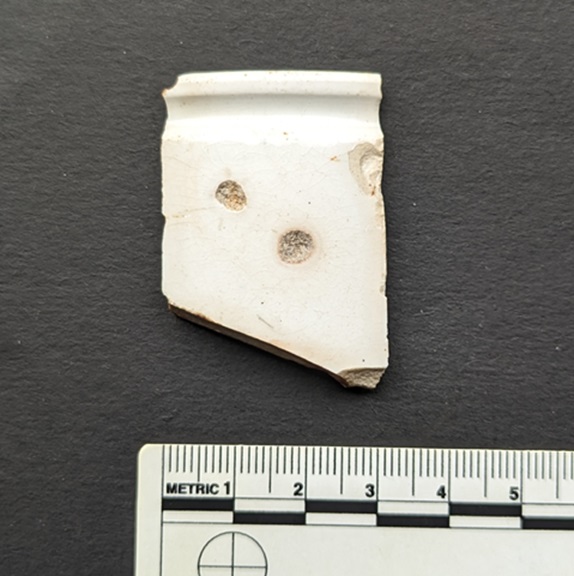
Plain, but is still quite cool. I know, I know… but I can’t resist!

This was from a skip on Hadfield Place. Always, and I mean ALWAYS, look in a skip that has soil piled in it: Glossop’s history almost guarantees that there will be at least some Victorian sherds in that soil. Here we have a rim sherd from a late Victorian/early 20th century marmalade pot – something like this:

Stolen from this website… and you can buy it for £55.

The groove running around the pot, just below the rim, is to enable a piece of string to be tied around to keep the cloth lid in place… very characteristic.

Skips and holes… always have a look in both. This next sherd was from a utilities pipe trench on St Mary’s Road:

Lovely stuff. I think this might be fairly early

A lovely sherd of Industrial Slipware, again, this time of a Banded or Annular Ware type. It looks very modern as it is still made, particularly as Cornishware, but it is genuinely early to mid-Victorian in date, and probably from a large bowl or jug. Looking and feeling it again again, I think jug.

This last sherd is another Industrial Slipware – a tiny fragment of Variegated Ware, this one being in the ‘earthworm’ design:

Truly awful photograph. I know a bad workman blames his whassnames, but my new phone has no macro setting, so my up close photos are not great.

Probably from a jug or bowl, similar to the one in the above article, and dates to about 1800-1820. Interestingly, this one was found in a quarry that was used during the construction of Bottoms Reservoir, and was later used as a tip. Bottoms Reservoir was opened in 1877, and thus the tip can only have been used from, say, 1880 onwards, and actually, judging from what is found there, I think perhaps from 1900 onwards. This means that this sherd – and the pot it came from – was as much as 100 years old when it was broken and thrown away. This makes sense – I still have my great grandmother’s 1920’s salt-glazed stoneware pie dish (I use it to make a really nice tomato and white bean bake with a feta topping, if anyone fancies…) – and is a cautionary tale about using pottery to precisely date certain contexts. People in the past also had heirlooms, and all objects have a biography.

AND FINALLY… WHERE/WHEN 3

Well, Where/When no.3 is now on sale… and selling well. You good folk seem to like a walk, some history, and a pint… who knew? Well, I think we all did to be honest. You can get it in Dark Peak Books (93 High Street West in Glossop), or via the Cabinet of Curiosities shop (here). Or you could track me down and snag a copy.

For those of you who are unaware, Where/When is a quarterly journal of Archaeological Wanderings. Essentially, a walk in the Glossop area, with yours truly chiming in about the archaeology and history of where you are wandering; think a pinch of pottery, a hint of psychogeography, some groovy photographs, a dash of discovery, a toe stub of psychedelia, and a splash of the usual Glossop Curiosities shenanigans. No.3 Takes us on a walk from The Beehive in Whitfield to The Bulls Head in Old Glossop via medieval trackways, a Saxon stone cross, 18th century buildings, and a 10,000 year old glacial erratic boulder. Marvellous stuff!
A sneak preview of Where/When 4 – The Melandra Meander.

And Where/When No. 4 is in preparation; titled “The Melandra Meander“, it will detail a circular walk from Melandra Roman Fort to Mottram Church on the hill above – via Hague and medieval trackways – and then back again, and is full to the brim with the kinds of historical and archaeological goodies that you have come to expect. It’ll be in stores in December, just in time for Christmas.

I have a whole pile of ideas for Where/When, and the Cabinet of Curiosities in general… all kinds of stuff: t-shirts, anyone? Art prints? The Rough Guide to Pottery in booklet form? And in particular I’d like to start a series of monthly guided Wanders – where you and me can Wander together. Let me know what you think about this. Or indeed anything about the website, or what I have written. It’s nice to know I’m not just shouting into the void!

Right then, apologies for the late post of this article, and for generally being behind in most things – there’s often a lot less of old TCG to go around than I believe, so I end up dropping some of the things I’m juggling. More soon, I promise.

Until then, though, please do look after yourselves and each other, and remember – a person might look ok on the outside, but can be struggling inside. We all matter.

I remain, your humble servant,

RH

Archaeology · Pottery · Whitfield Well

The Walk Part 3: A Wall and Its Secrets

Welcome back for the third and final instalment… it was a very productive walk indeed! The first two are here and here.

As we continued along the track, we came down, toward the place where it joins Cliffe Road, near where the Guide Stoop is. Here, the wall on the left has been removed, and replaced by a fence, but at the bottom of the track, there is a stump of the wall left, ruined. And spilling out of the wall’s innards, so to speak, I noticed some glass, some pottery and a black tubular object. Well, I could hardly leave them there, could I?

Wall 1
As you can see, the wall is not in great condition, and the bits spilled out.

So then, what do we have?

Firstly, fragments of a Codd Bottle.

Wall - Codd 1
The fragment on the right is from the neck going into the rim.

Invented by Hiram Codd (great name!), he patented the famous design in 1872, and began manufacturing them on a large scale in 1877, or thereabouts. This groundbreaking design was a way of keeping fizzy drinks carbonated using a glass ‘marble’ inside the bottle, with the gas keeping the marble pushed firmly against a rubber seal.  When empty, they were often broken open by children to retrieve the marble; here is one I found in my garden a few months ago.

Wall Codd Ball
Hand made in two halves (you can just about make out the seam), it contains many small air bubbles. It’s quite a pretty, if utilitarian, thing. I really should blog about my garden finds sometime.

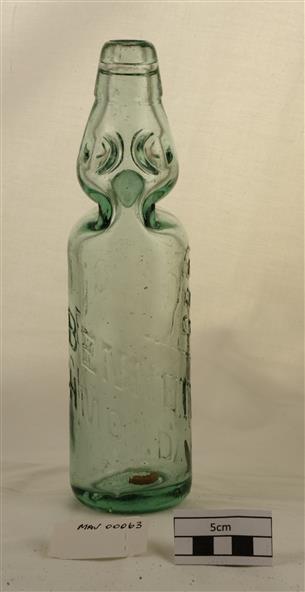
The bottle was broken before it went into the wall, and you can see that different fragments had different amounts of soot and air exposure, causing the variation in colour. I spent a happy 5 minutes gluing this together – superglue really is a marvel! Anyway, here is a complete Codd Bottle, showing its very distinctive ‘pinched’ shoulder/neck, very thick glass, and you can just make out the marble in the neck.

Wall - Codd
A lemonade Codd bottle from this great website here. Worth an explore.

It remained in use until perhaps the 1910’s, when other, more simple, designs – mainly the screw stopper – replaced it as a way of keeping drinks carbonated. Here is an excellent website that talks a bit about them – it is well worth an explore.

Next is a piece of green glass bottle dating from the 1870’s on, and which probably held mineral water or beer.

Wall gree
A moulded bottle – probably a beer bottle. You can see the shield border on the left.

This one was moulded, not blown, and has the remains of an embossed decorative shield that would have shown the manufacturer. Each company would have its own design, and usually they were locally made, so it might be a Glossop bottle. Here is a whole example of a bottle showing what I mean.

Wall - Green Bottle
One green bottle…

There is a fascinating website here that discusses coloured glass from a historical archaeological approach, and despite being American in focus, it is very useful, and well worth an explore – it is one I return to time and again for facts and identification help.

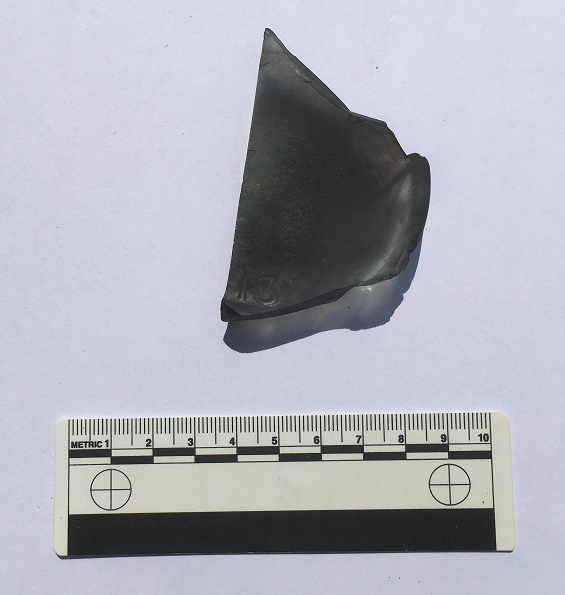
Another bottle fragment, this time a concave base, and with an moulded number ’13’ on the bottom.

wall - bott
You can see the number ’13’ clearly at the bottom.

It has a base diameter of 8cm, is made of thick glass, and judging from the wear marks on the base rim, the bottle was used over a period of time, or possibly used and re-used. Late Victorian is a guess in terms of date (thick glass & greenish hue).

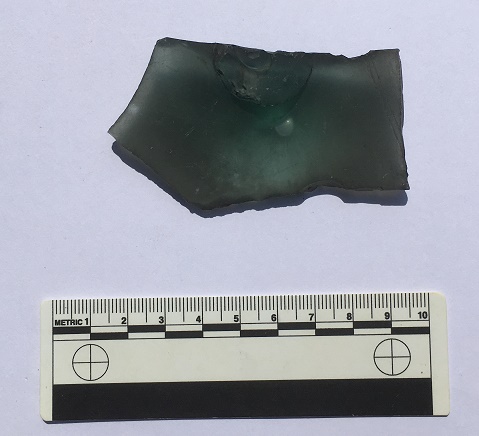
Then there is this…

wall - gla
Nope… not a clue!

It is glass, broken, and has a raised bump on one side, centred over a feature on the other side. This feature – visible in the above photograph – is circular, tube-like and hollow, and has an impressed mark in the centre, made when the glass was still soft. The only other features are a pair of parallel lines running diagonally to the right of this central feature, and scored onto the object when the glass was cold. The glass itself is thick, full of air bubbles, and has a greenish tint, all of which suggests that it is old (Victorian or earlier)

I have literally no idea what this is. None whatsoever.  Answers on a postcard, please.

The black object is interesting; on closer inspection, it turns out that it is a pipe stem.

Wall pi pe
Hollow throughout, the left side is flattening to the mouthpiece.

Made from Ebonite (also known as Vulcanite), a type of hardened rubber, it is the bit that fits into the mouth, and through which the smoke is drawn. It is made as a separate part, fitting into the bowl via a metal ferrule – you can see the rounded end in the photograph. The other end, though broken, is of the ‘fish tail’ type stem, flat and wide, and would have originally had a lip at the end. Ebonite is still used for making pipe stems, but was first created by Charles Goodyear in 1839, with the process of making it patented in England by a Thomas Hancock in 1843. It was immediately put to all sorts of uses as a cheap durable alternative to Ebony wood, and from the 1850’s on, it was used in the making of pipe stems (another interesting website here).

Wall - Pipe
You can see the way it was used in this Late Victorian trade catalogue – the wall example even has the slight curve.


So far, so Late Victorian. So what, then, is this doing in the mix?

Wall MP2
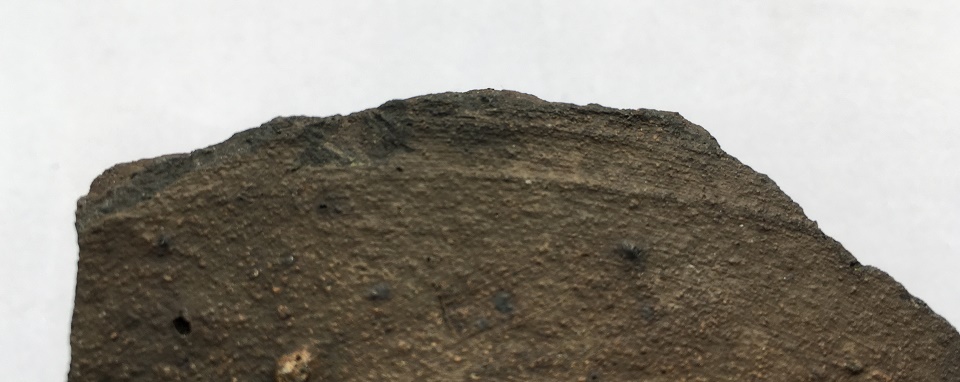
Midlands Purple Ware dating from roughly the early 18th Century.

This is Midlands Purple Ware, a type of coarse stoneware. It is hard (fired at a high temperature), purple (though can be more orange or red), and has a large number of black and white inclusions (they look like salt and pepper). It’s very characteristic, and once you know it, you can spot it a mile away. Midlands Purple was made in huge quantities between about 1600 and 1750 (although some sources state its production started earlier, I go with this date for the classic Midlands Purple), although I think this example is late (early to mid 18th century). What is interesting is that this pot was found mixed with the Victorian material – in the top photo, you can see the pipe stem lying underneath one of the Purple Ware sherds. I’ll return to this below.

These fragments (mended) come from the base of a pot, and using the internal wiping marks at the start of the upturn of the vessel wall, I would suggest a base diameter of 25cm, and it probably comes from a large storage vessel, such as this beer container. Most houses and farms would have brewed their own beer as it was cleaner than the water at the time.

wall - mid
The bunghole at the bottom is for draining the home brewed beer, leaving the grain on the base of the vessel.

Wall - MP Wipe
Close up showing the internal wiping marks (where the potter had run a rag around inside the vessels when it was still wet) and the start of the vessel wall. From these marks I was able to extrapolate a base diameter of 25cm.


So what does all this mean?

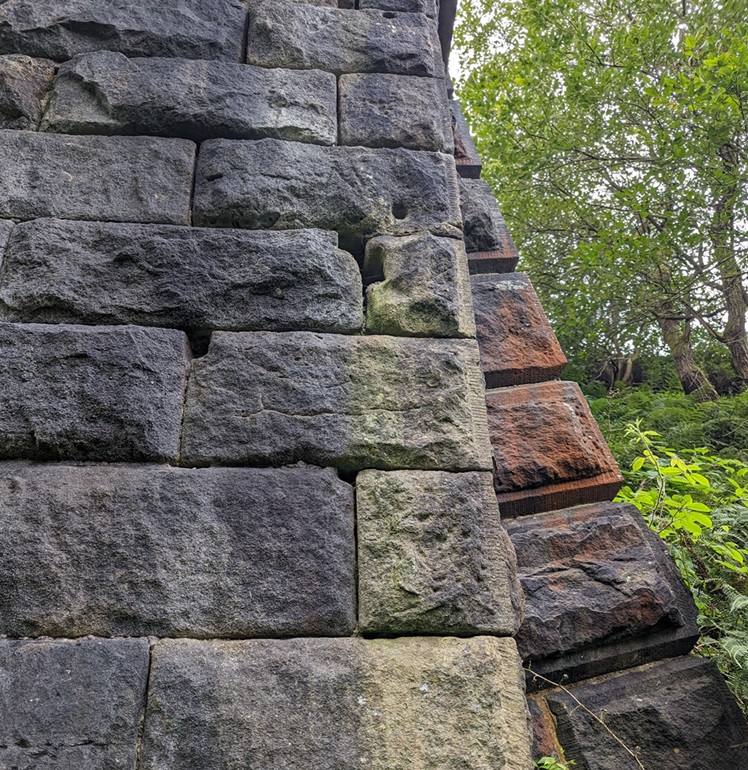
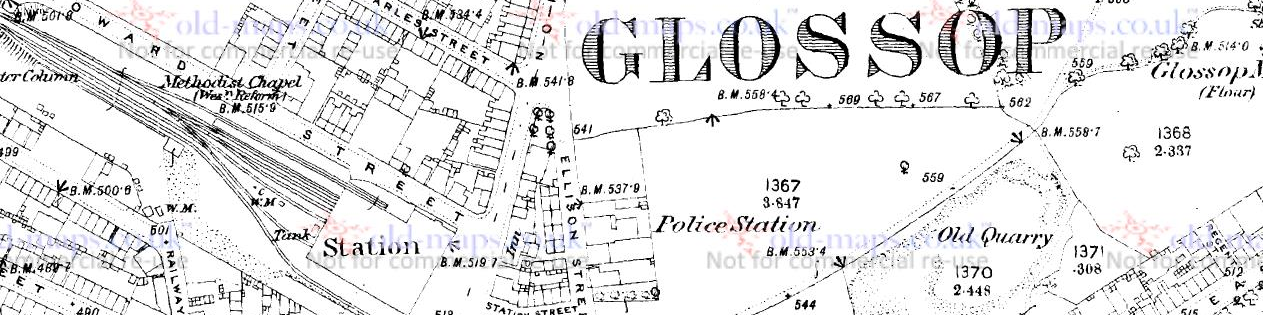
Well, we know that the wall is much earlier than the Victorian glass – it is here on the 1857 Poor Law map of Whitfield, for example – and almost certainly dates from the initial enclosure of the fields and moors in 1813.

Wall - poor law
1857 Poor Law map. The wall is running NW-SE between two large quarries.

The Late Victorian material probably represents a rebuilding episode. The wall itself is still in bad repair, and I think I can detect at least three phases of construction too.

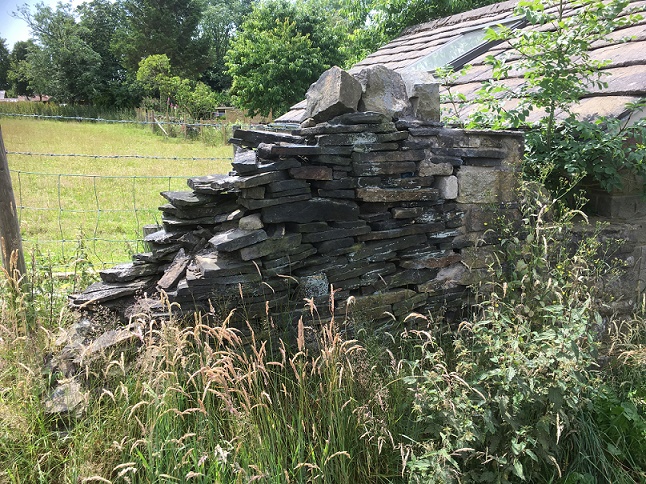
Wall Wall
The wall showing multiple rebuilds and repairs.

The Midlands Purple Ware is clearly much older than the wall, and is something of a conundrum – what is it doing here? It might represent residual rubbish incorporated into the wall. However, it is perhaps more likely the pot was still in use 100 years after it was made, but broke as the wall was being built in 1813, and ended up used as filler. Possibly. And it was then reincorporated into the wall as it was being repaired in the 1890’s.    Again, possibly.

Now here is where it gets interesting.

Why would the repairer of a field wall place a Codd bottle, a beer bottle, and a pipe stem in the wall? Pottery and rubbish is often used as a foundation bedding for a wall at this period (I have a pile from my garden that I need to blog about), but these are high up in the wall. But it does seem that the obvious answer is rubbish disposal. In this scenario, the builder has a break, smokes his pipe, but then accidentally breaks it. He finishes his bottle of fizzy water, and another of beer, then accidentally breaks them both. He curses, then places some, but not all, of the fragments in the wall, along with some other bits and pieces, and carries on building. 100 years later I find it, and here we are.

This interpretation seems fair enough. But it seems a little too convenient – a discrete, neat, bundle, carefully walled up. And the fact that only fragments were placed, not the whole thing. It would also have taken effort to do this, too, when surely it would have been easier to simply have thrown them into the field.

“Hmmm…” I say.

However, there might be another reason.

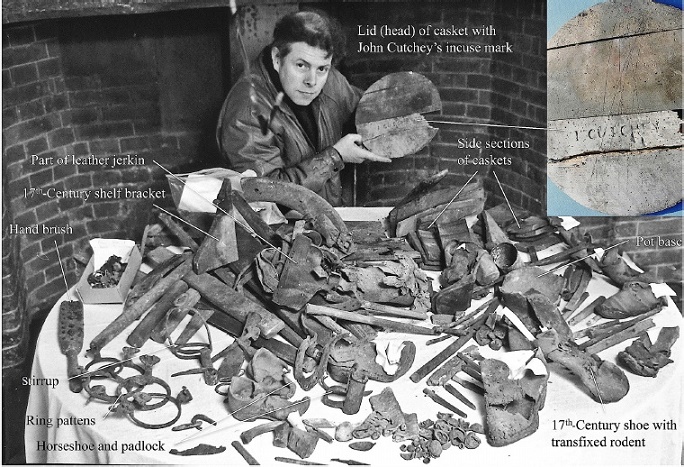
I have recently been doing research into the tradition of hidden objects within the fabric of buildings (here is a great website that deals with the subject). Shoes, famously, have been found in the roof and around the fireplace of 1000’s of buildings up and down the country, as well as in colonial America and Australia (I have one from the Glossop area that needs to be blogged about). But it is not just shoes, these caches contain all sort of clothes, and indeed all sorts of objects – including bottles, pottery, and pipes – and all dating from c.1600 to 1900.

9-e7d12363f2
A deposit of various objects from a farmhouse in Suffolk. Taken from an article by Timothy Easton (the copyright is all his, and I have stolen the photograph for illustrative purposes only). And no, that’s not me in the photo.

The term used to describe these caches is a ‘Spiritual Midden’, with the idea being that each of the objects is placed in the cache at the end of its useful life, and is then sealed away and hidden from view in a midden. The study of this tradition is relatively new – bundles of rags and objects when discovered are usually thrown away – and it is little understood beyond a general consensus that they are broadly connected with concepts of ‘luck’ and ‘protection’ from evil or witchcraft. They are believed to be ‘apotropaic’ (that is, they ‘turn away’ evil – I blogged about the subject here and will return to it again, as I find it fascinating). Briefly, spiritual middens seemed to have functioned by making the deposit of clothing and objects the target of bad luck or witchcraft, rather than the people within the house. In a real sense the cache stands for, or personifies, the individuals within, and acts as a lightning rod for any negative energy, safely diffusing it.

The ‘meaning’ of the individual items within the midden is unclear. The shoes, gloves, trousers, and other garments are the most obvious – they are very personal items, and are usually deposited worn out, meaning they have, in a sense, moulded to the individual, and have been imbued with their essence. The bottles are less clear; perhaps connected with ‘witch bottles‘. Bones may relate in some sense to food, and pipes have been suggested as connected with fire, or more specifically fire prevention. This is all speculation, of course, but something is going on with deposits of objects from the early 17th century on, and which lasts until the end of the Victorian period. Perhaps, then, we are seeing a decayed form of this deposition ritual in the objects hidden during the wall rebuild in the 1890’s. Of course, by this time the ‘meaning’ of the caches, whatever it was, would likely have been lost, and the ritual of hiding certain objects was carried out as a ‘tradition’ or ‘thing we do’, or simply ‘for luck’, with none of the belief that drove and informed earlier caches.

This interpretation is made all the more plausible by the fact that the location of the ‘cache’, if such it is, is at the very end of the wall. Thus, it represents either the very first part of the wall begun, or it forms the last section made; either way, the deposition of objects there seems appropriate. There is also the tantalising possibility that the Midland Purple Ware pot base also represents the remains of a similar, earlier, cache. A small cache of objects deposited for luck, to help the wall stay upright, and the land and its owner prosper.

But then again, of course, it could just be rubbish!

If you are interested in Spiritual Middens and hidden objects, there is an excellent paper here which discusses the contents and their meaning. It’s written for the general reader, so it’s not too theory heavy, and it contains links to other papers on the subject. Also, you can email me for more information, as it is a special interest of mine, and one that is only now receiving attention.

As always, comments are welcomed… even encouraged. More soon, I promise, but until then, I remain,

Your humble servant.

RH