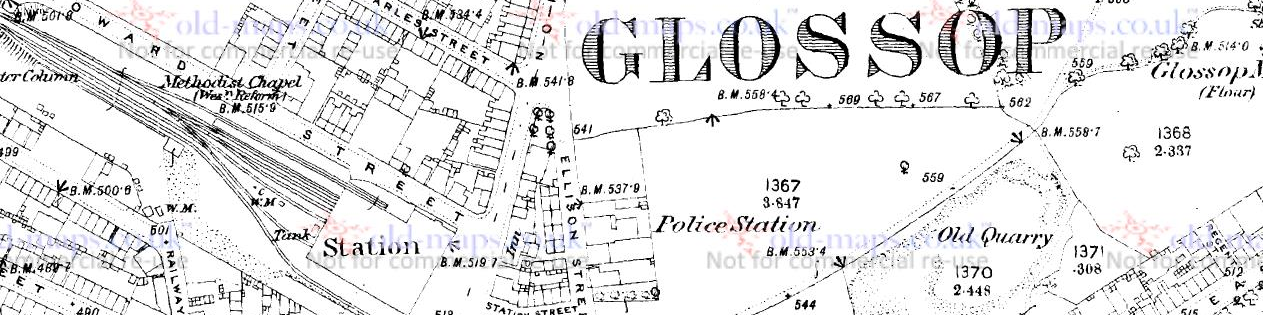
I found an interesting thing the other day. I was walking down Bank Street, down to Milltown on the way to the park. For those of you who don’t know it, it is a cobbled path (setts, actually!) that winds its way through demolished mill-scapes, and which allows access to High Street East. I nearly wrote ‘easy access’, but with a push-chair it is a nightmare! That said, I really like it. It has the air of a long forgotten path, Tolkein-esque, leading to who knows what adventure.

I want to do a longer post on Bank Street at some stage in the near future – it is interesting and full of history. It was originally believed to follow the path of a Roman road, although more recent research suggests, however, that this is in fact an early-modern (16th Century or so) track.
However, for now, I want to share my find.

It is a bottle stop made from vulcanised rubber. It had eroded out of the side of the path from behind a partly ruined wall, and was just lying on top of a trickle of soil on the left hand side going up. The screw-thread winds into the neck of a thick-walled glass bottle containing a carbonated liquid – often a soft drink such as water, but also beer. Originally it would have had a soft rubber ring around the cap that would form a seal to keep the drink fresh until it was unscrewed. The design was patented in the early 1880’s by Henry Barrett, and immediately became very popular, with various design improvements ensuring the basic concept was in use for nearly 100 years. Generally speaking, though, the date of such a screw top is roughly 1890-1920, after which time the crimped rim top became popular. There is a really interesting website that details quite a bit about these bottle stops here.
More interestingly, and as was quite common, the top of the screw cap carried the logo of the company manufacturing the drink inside the bottle – in this instance, the company is Jewsbury and Brown Ltd, Manchester.
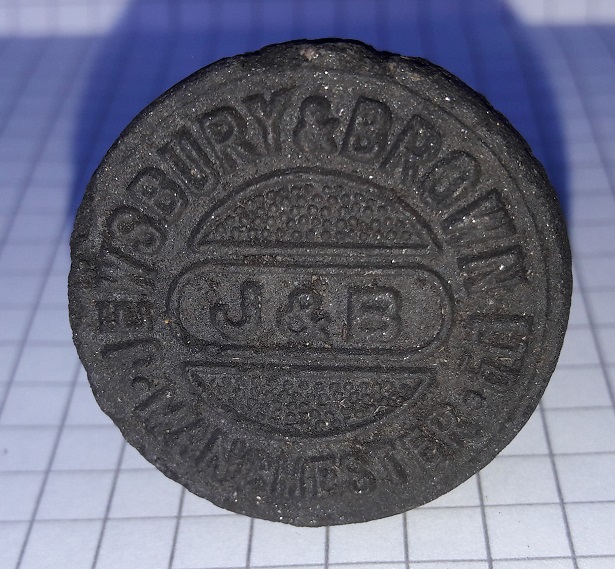
Jewsbury and Brown were a large company founded in 1826 and based in Manchester, their premises being at 113 Market Street, and later Ardwick Green. They produced carbonated drinks that were sold in Lancashire and the north, and beyond, until they were bought out by Schweppes in 1964. A bit of internet research reveals that they specialised in non-alcoholic carbonated drinks, fizzy water, and toothpaste – but, disappointingly, never beer! Here is a bit of their history, but much more is available online with a little search.
I love this – not just a bit of archaeology that quite literally threw itself at me, but a real tangible insight into the lives of those of the past. There was nothing else associated with the screw-top, and one gets the impression that it was simply unscrewed from the bottle and thrown over the wall, the thrower determined to drink whatever was within the bottle in a single sitting. Let’s imagine them walking along that uneven path when they did it, clogs striking the setts, perhaps on a hot summer’s day, and at the end of a long shift in the mill, appreciating the fizzy drink playing on their tongue… 100+ years ago.
It’s a neat little thing, and one that will be added to the collection. It also makes me wonder what else is behind that wall, waiting to tumble out, so keep your eyes peeled!
 The Glossop Cabinet of Curiosities