Archaeology · Bench Marks · Mason's Marks · Where / When

Marking Time

What ho, wonderful, and slightly odd, folk of the blog reading sort. I hope you are all as well as can be expected, and as we move into autumn, you get out an about as much as you can – always keeping an eye open for pottery and other interesting things.

Which sort of leads me to today’s offering. It’s a mixture, to be honest, some updates, some new stuff, but all interesting. I have said before that I always have multiple half-written articles on the go, all moving at different speeds – but for one reason or another, none leapt out at me asking to be finished. So here we are… Marking Time!

I’ve always been obsessed with the idea of humans marking their surroundings, and the notions of permanence, even immortality, that accompany this; from palaeolithic cave art to bronze age cup and ring markings, to 17th century building datestones, to Victorian carved graffiti, to modern tags – and I’m looking here at you, Boof, whose name is everywhere around Glossop at the moment – it all amounts to broadly the same thing: marking time.

Datestones update: As always, I am on the lookout for more datestones of a pre Victorian date (pre-1837). I recently bagged this:
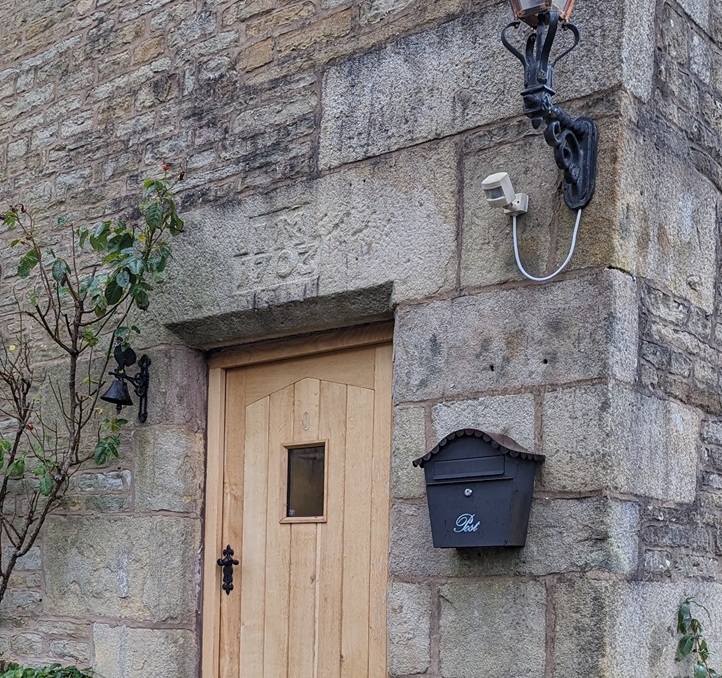
Herod Farm, Whitley Nab

Wonderful – ‘I.M. 1703’ – to the point, although I have no idea who I (or more likely J) M is. I have a whole article about Herod Farm and the surrounding area in progress, but wanted to share the datestone with you.

The always knowledgeable Roger Hargreaves emailed me a comment he tried to post on the site – technical issues prevented it, but here it is:

So there we have it – John Morton, and a teaser about the Lees Hall – a fascinating place, with a long history, and possibly a moat! Well worth an article and more. Thanks Roger, your input is always much appreciated.

Update to the Gatepost article: We recently bought a campervan, a mobile home with beds and a stove, and all that. It’s marvellous, and is unmissably yellow, or more truthfully YELLOW! (give a shout and wave if you see it around). Our first adventure camping was to Peak Forest, near Buxton, and coming home we decided to take an odd route for the sake of exploration – a vehicular Wander, if you will. Coming through Wheston, south-east of Chapel-en-le-Frith, we came across lots of gateposts, modern and made of concrete, but each marked with initials and dates:

I have no idea who CTH is – presumably the farmer who is replacing gateposts – but I salute your attention to detail – initials and date – and respect your devotion to tradition; earlier, 19th century, examples of dated gateposts can be found here. It might be concrete, but the idea is exactly the same, and I want to buy you, CTH, a glass of the stuff that cheers. Wonderful.

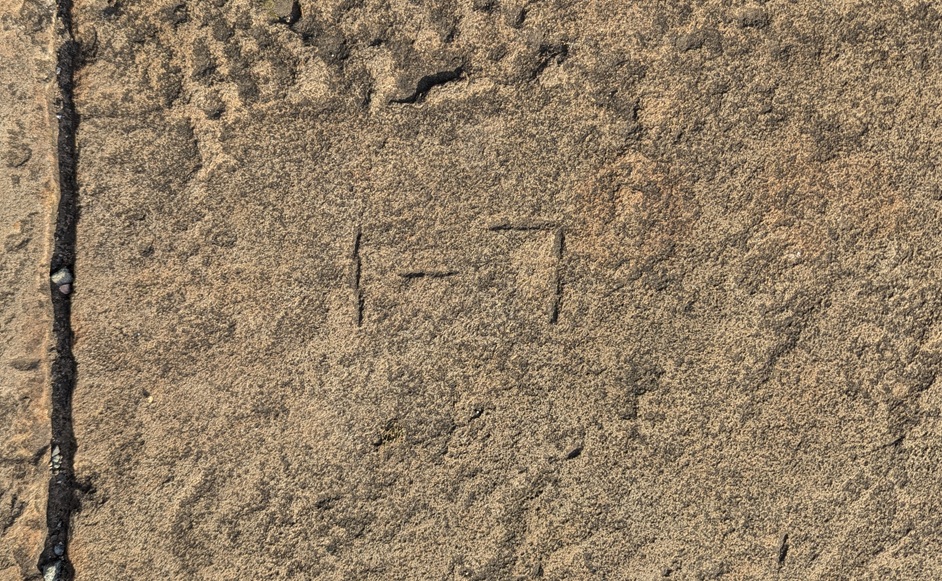
Next we have things seen on pavements… Glossop seems to have inherited the whole street paving slabs second-hand from somewhere. I seem to remember a whole hoo-ha about these stones, and others, occurring maybe 20 years ago – their origin and how much was paid for them… or something. Whatever, but what is certain is that they have some interesting markings on them, and all of these were seen between Costa Coffee and the Norfolk Arms – almost certainly more await discovery, so look down people:

A simple cross, formed of two chisel strokes.
‘1 – 7’ with the ‘1’ formed apparently by three chisel strokes, the ‘seven ‘7’ by three down and two across. No idea of the meaning.
A cross, and a hole filled with a lead plug. It’s difficult to imagine what this large flat stone would need a hole with a lead fixing for – it’s not like it was used for a gatepost or similar. I genuinely cant imagine what or why!

Finally we have this beauty:

Where to start?

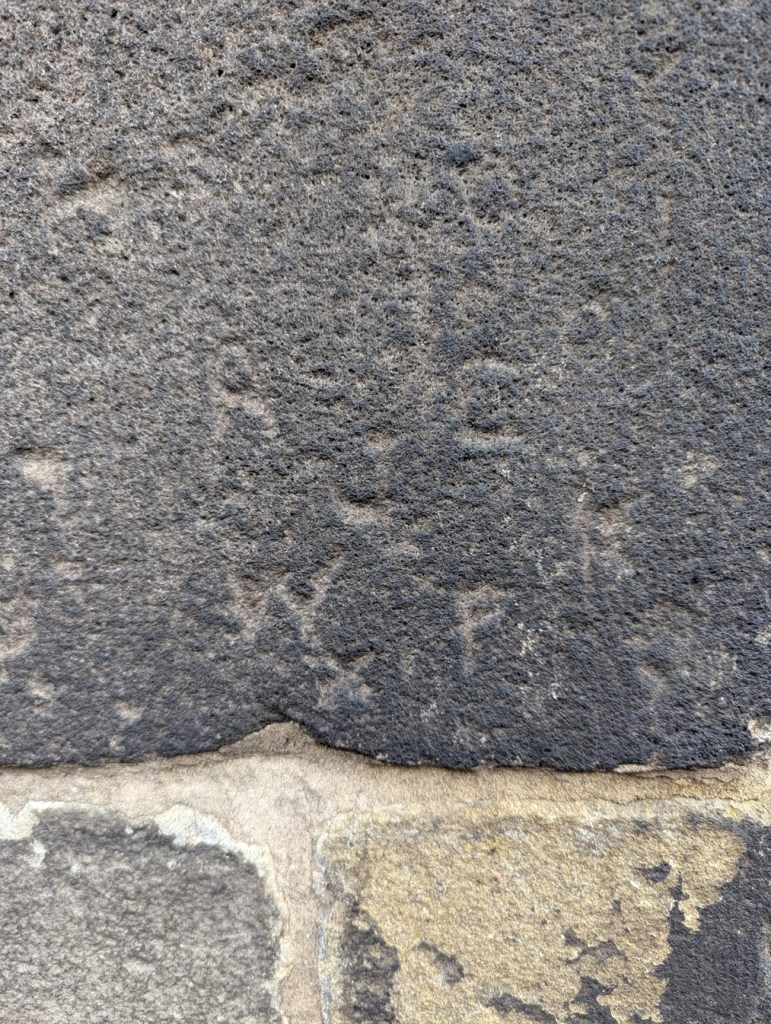
So, we have a name in the bottom left, clumsily written – ‘Joseph’ something or other… D? B? Can anyone make out this? The second letter could be an ‘E’. Possibly. But then we have what might be a landscape – the top right looks like a fat sun, drawn by a child, to me. And in the centre, at the bottom, possibly a house (I think I can see the roof and walls, with perhaps a person in it). This is really an enigma – a name, and a piece of art, undatable, and probably from a place far from Glossop… but imagine if we could put a person to it. And all this, lying under our feet.

Other bits and pieces under our feet include markings on kerbs:

A simple ‘T’, probably referring to Telephone, and marking where the cable came into a property.

This is also sometimes marked by ‘GPO’ on kerbs, standing for General Post Office who were originally (from 1880’s until 1981) responsible for telephone communications. I once found an example on a kerb on Howard Street, but had not been able to find it since, until I came back from a blood test at the clinic there, and this was picked out of the dark by street lights:

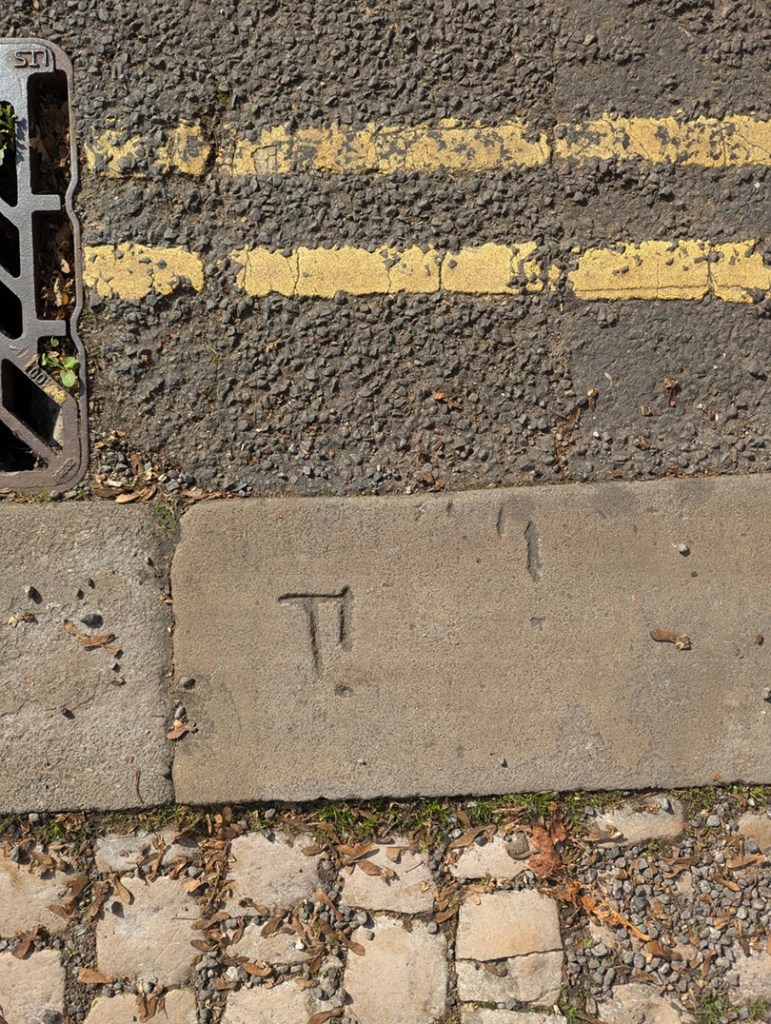
Wonderfully carved, this was, I assume, where the telephones for the train station entered the buildings.
Another ‘T’, but this one in Old Glossop seems to have an errant exclamation mark after it!
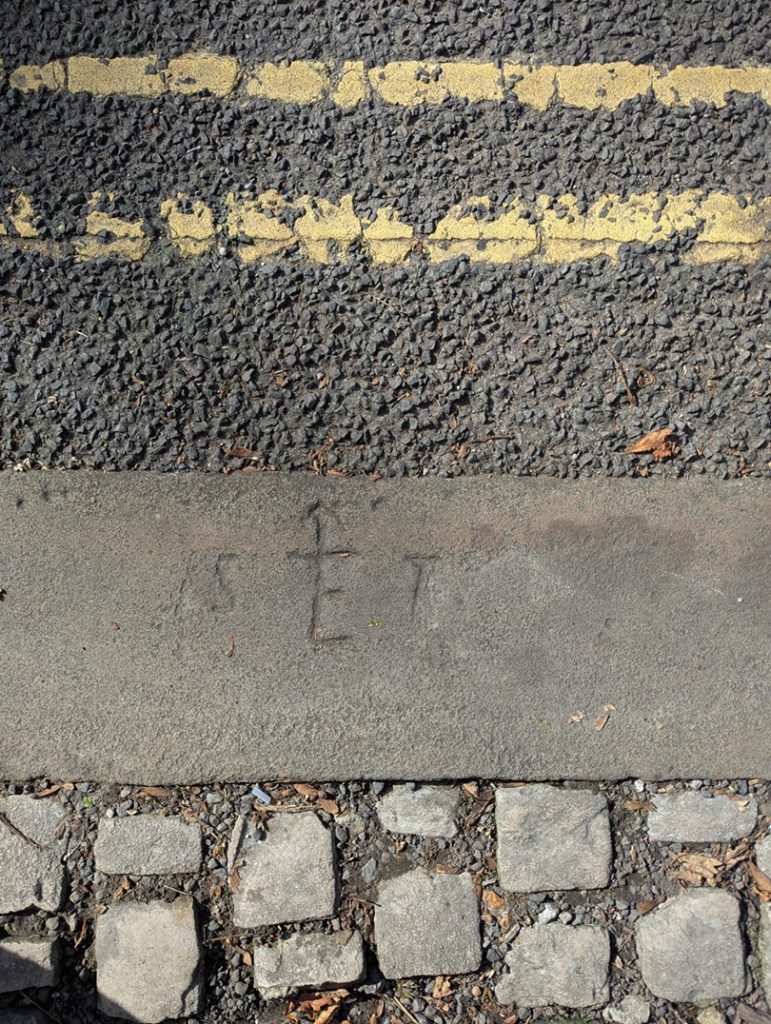
Another slightly odd kerbside marking – an ‘E’, which is believe marks the place where electricity cables enter a property. It is quite common, although in this case it is accompanied by an ‘S’ and a ‘T’, the meaning of which I have no idea.

I also saw this on Princess Street – another marker showing where electricity enters a property – this is also quite a commonly found one.
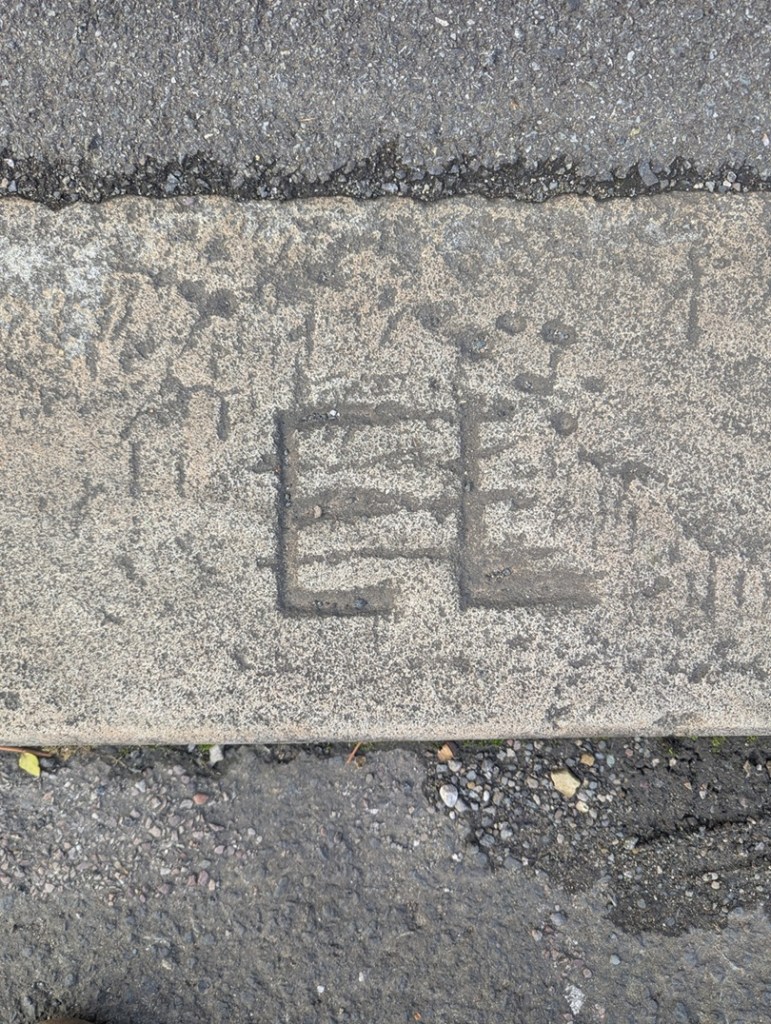
A no frills, very clear and functional, EL!

Here’s another mark that is commonly seen: a simple arrow, but not like the Ordnance Survey benchmark arrow, this is normally crudely carved, thin, and without the horizontal line above it… thus:

Literally an arrow, pointing.

This is another of those that points to a service – gas, possibly, or electricity – entering a building, although I truthfully don’t know… any help would be welcome.

However, here is a Benchmark, newly found by me, under the railway bridge on Arundel Street, and which marks 501ft 8″ above sea level:

Worn, and almost camouflaged, there it is.

Also on the bridge are these single holes, often found in the upper part of the stone:

And here…

These small, shallow, holes were made in order to use a pincer, or external, Lewis and frame in order to move the blocks. A genius invention, it’s a simple iron tool that, via a chain, uses the weight of the block itself to hold it fast whilst it is moved, and enables even a single person to shift a huge piece of stone. But it requires a shallow hole in order to provide a point that gives a good grip. I love these, as they allow us to view how the bridge was built.

Another example of us viewing the method by which these wonderful Victorian structures were built is this:

Very characteristic.

Often occurring in pairs, these are drill marks made by quarrymen, into the rock face, which allow them to insert a splitter to pry away the stone from the quarry face. Once seen, they are very recognisable, and are the scars that show how, with a little physics and a lot of brute force, rock can be shifted.

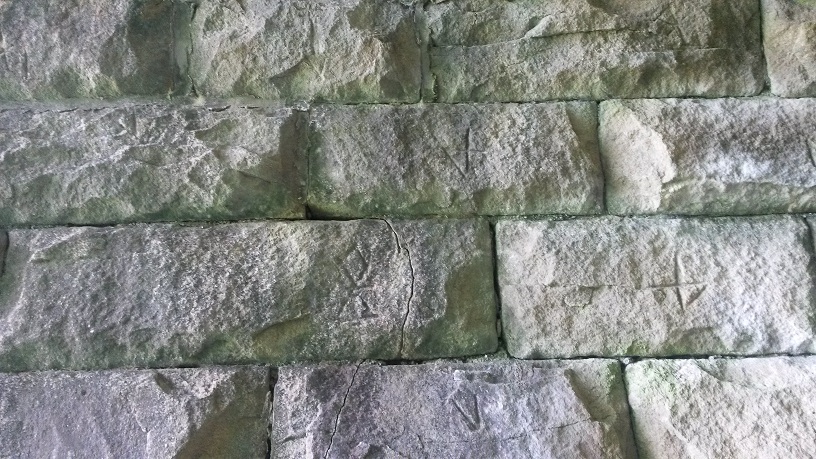
Howard Street, which meets the Arundel Street bridge, has a few, sporadic, mason’s marks along the stretch of railway walling here:

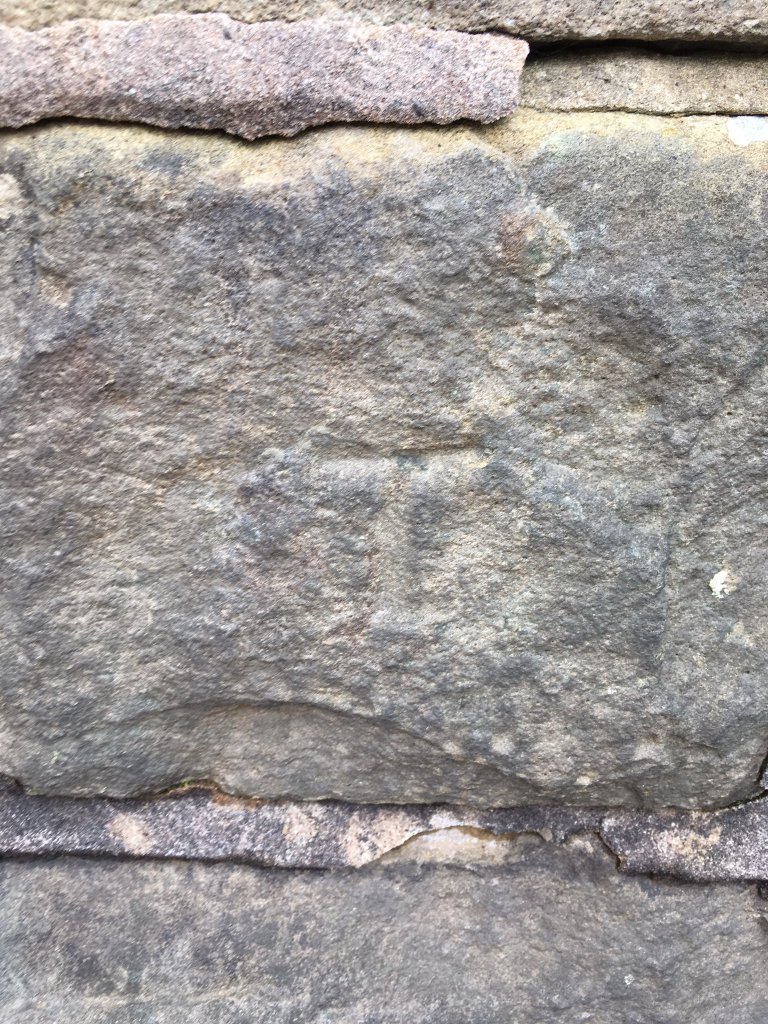
A cross.
A ‘T’.

Low key, and not very common, these nonetheless represent the ‘signatures‘ of the men who shaped these stones. The cross is a common mark carved on stones – it is literally two strokes with a chisel – so it cannot be definitively linked to those masons who built Dinting Arches, but you never know.

Other mason’s marks can be found around…

A ‘B’, upended.

This is found on a lump of masonry from Wood’s Mill, and now stands where Wood’s Mill once stood, now Glossop Brook View, and by the houses there. Post-1842 in date, although possibly early, the mark was hidden until the mill was demolished – the rough dressing of the block indicates that it was never meant to be seen. I wonder who ‘B’ was.

Another, difficult to see.

This last one is on the gatepost of the Crown Inn, Victoria Street (although the gates are on Hollincross Lane); very faint – and difficult to photograph – they are in the angular shape of a fish.

I also spotted this on Howard Street:
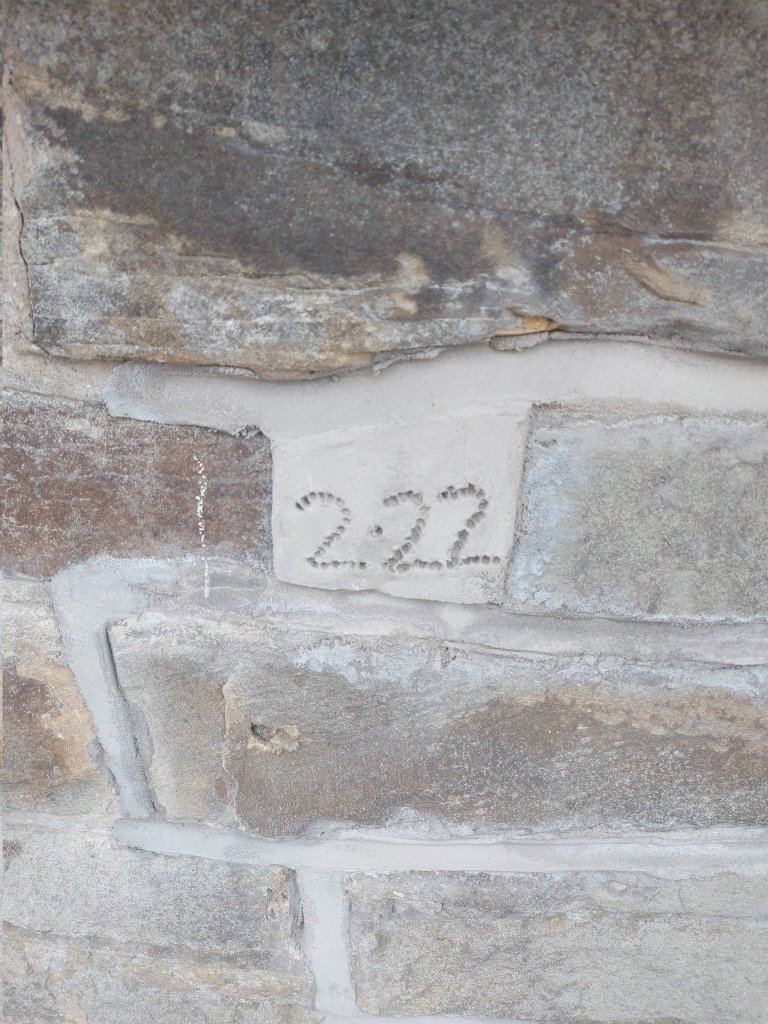
February 2022.

A dated piece of cement. This is either dated proof of work done – a modern form of mason’s mark – or possibly a dated repair that allows Network Rail to observe cracks forming and assess integrity. Either way, it’s kind of cool!

Finally, some bits of carved graffiti, a particular favourite of mine.

A single ‘J’ on the wall of Heath Barn, Heath.
‘S’ ‘H’ on the wall of Glossop Church.
Also on the north wall of Glossop churchyard, on Church Street – initials – R C J W P. The arrangement is odd, and I wonder if they were 4 members of a single family, with the surname ‘J’. That could surely be traced if it was the case!
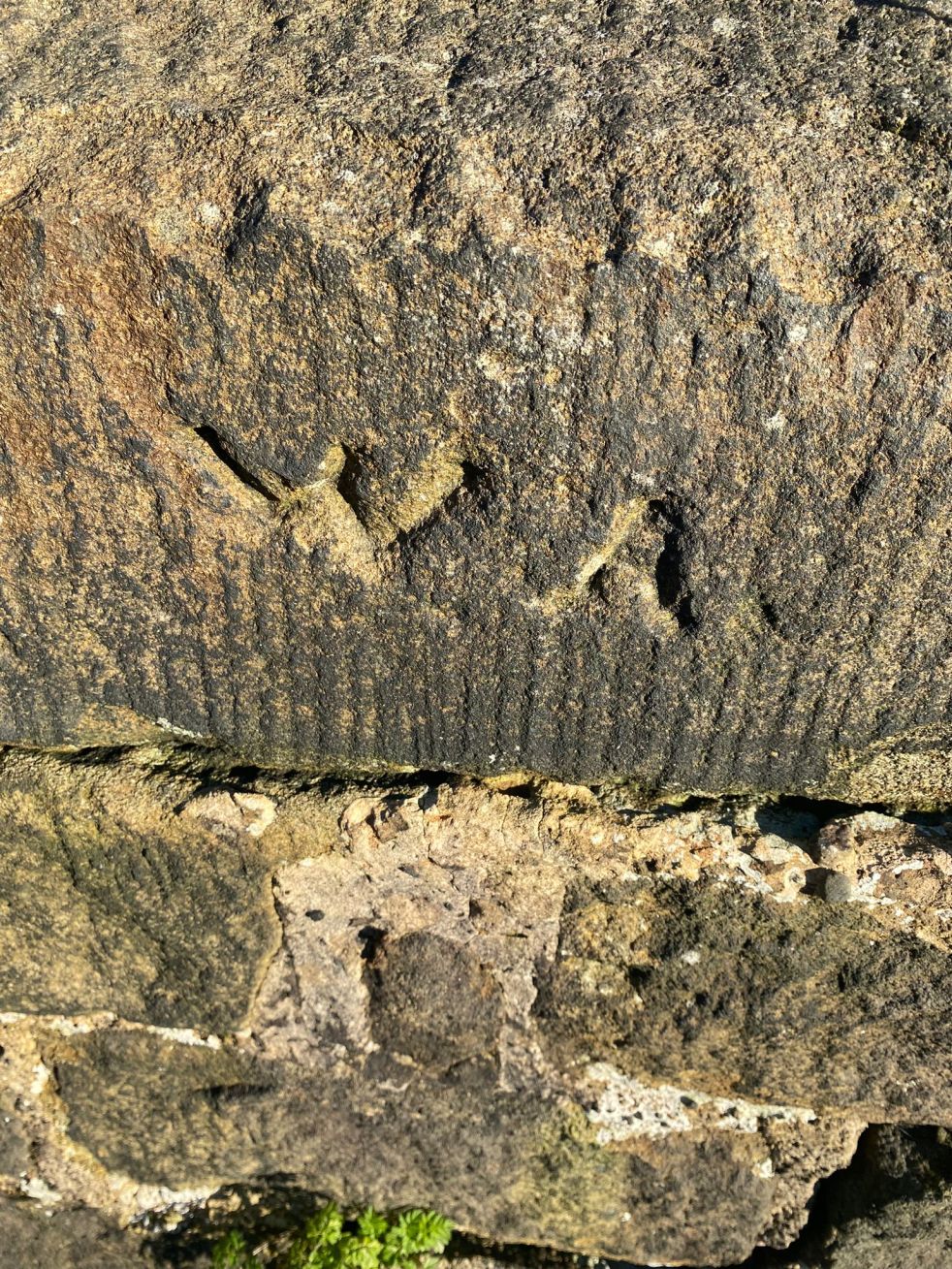
‘W’ ‘A’ (photo from Suze Hill)
‘W’ ‘G’ (photo from Suze Hill)

These last two were from the bridge over the Longdendale Trail on Padfield Main Road. The whole bridge has a lot of graffiti carved on it, including this wonderful example:

Old and the new. I love this photograph, and am very proud of it!

Here we have Victorian carved graffiti – ‘J.H’, possibly, along with some more letters, undecipherable under the frost, over an early incarnation of the now famous (infamous) BOOF graffiti tag made with a spraycan. I find it interesting that we would condemn one, but praise the other as historical and interesting. When does vandalism become history and worthy of study? A bigger discussion, and one I find fascinating (akin to when does something become archaeology?). I know graffiti, as in modern graffiti – put it down to a misspent youth and a love (despite appearances to the contrary) of Hip Hop – and I have followed BOOF’s career with a certain interest.

So here I shall leave it. Making marks, and marking time – it’s all about trying to achieve immortality, to leave your mark long after you are gone, and making people remember you, even if they don’t know who you are. I think that’s all any of us, myself included, can hope for. There are so many examples of this phenomena in the Glossop area, and I have an idea to produce a book looking at precisely this sort of thing – watch this space.

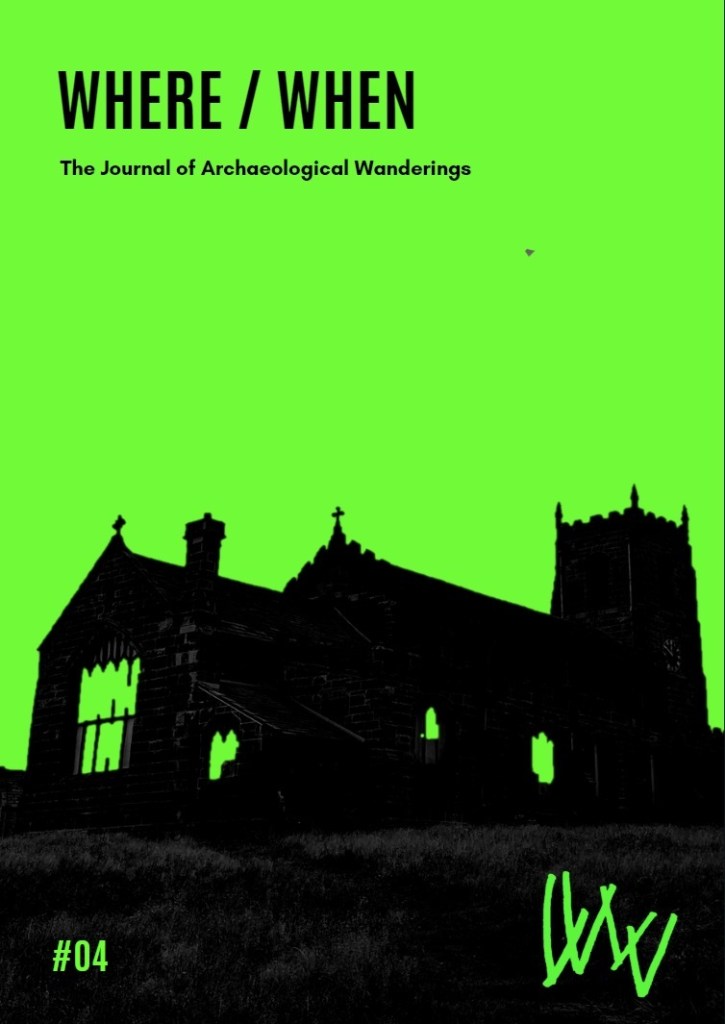
Talking of books, please check out Where/When Number 7 – Forts and Crosses: A Mellor Wander.

This one is a truly awesome Wander around Mellor – just over yonder! It has medieval field systems and farms, Victorian noise, an Iron Age hill fort, medieval crosses, cracking views, a terrifying viaduct, bench marks, a trig point, wonderful gateposts, and it starts and finishes at a pub… what’s not to love? Here’s the cover to tempt you.
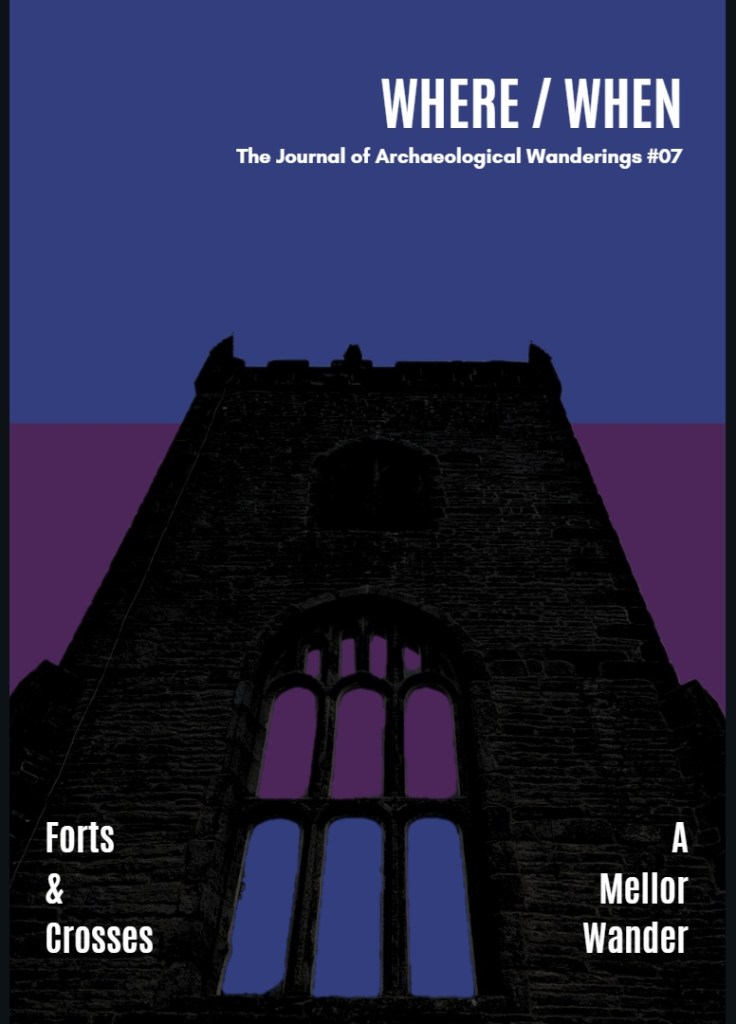
Available from the shop, link above, or from Dark Peak Books and Gifts, High Street West, Glossop. Or, you know, just track me down and throw money at me.

Talking of which… if you enjoyed this, and fancy buying me a glass of the stuff that cheers, then please do so via this link to my Ko-Fi page. I do what I do here because I love doing it, and I feel it’s important we explore our shared heritage… but I’ll never say no to a pint in thanks!

So much more news to share, and so many things planned. Watch this space, wonderful people, as big things are coming.

But on a serious level, how are you doing? Genuine question. Personally, I’m a little down at the mo… the devastating loss of my brother (cheers Stephen, I’ll miss you), coupled with a dose of Covid, and the general malaise that accompanies the move from summer into autumn and winter, has meant a lull in the festivities here at CG Towers. Still, the wheel turns, the seasons they change, and life will inevitably continue, and on we go. But as I always say, look after yourselves and each other, you really are important, and too often we say “I’m aright” when we actually mean “I’m not alright, please help” – it’s ok to not be ok.

So then, more coming, but until next time, I remain.

Your humble servant,

TCG
Archaeology · Mason's Marks · Pottery · Pottery Guide

A Fireplace Finds Frenzy

What ho! Autumn is here… it was cold this morning, and leaves are already turning, and hopefully this article will be published on the Autumn Equinox. Probably. I mean to say… that’s what I’m aiming for*. It’s been a very weird and stressful week or two for a variety of reasons too complicated to go into here, but in the spirit of hopefully moving on, I present this short(ish) offering, which I hope satisfies at least the craving for pottery.

*Ok, so I failed… but only by two days.

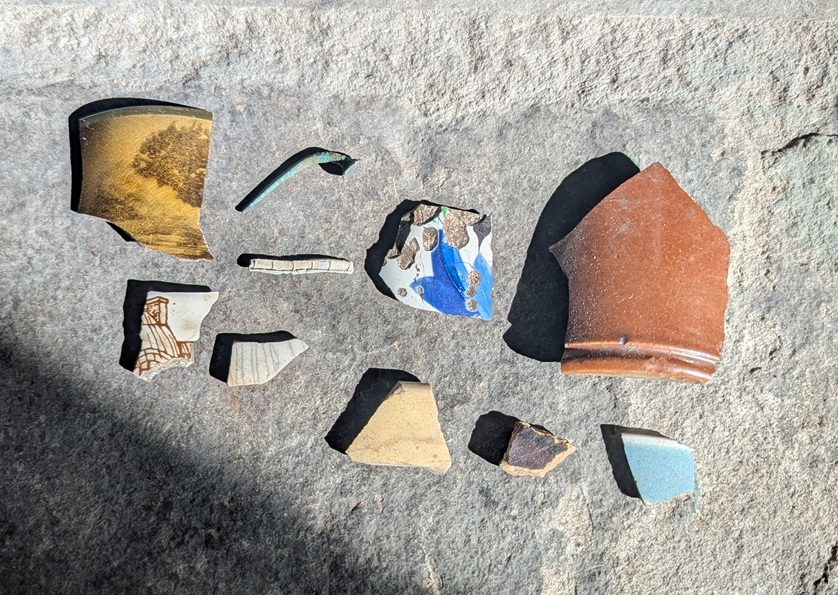
So, I have a large inglenook style fireplace in my house, and the hearthstone in front of the wood burner in said fireplace has, much to the annoyance of Mrs CG, become something of a drying and sorting zone for the bits and pieces I have found along the course of my normal life! And precisely because the nights are getting colder, and the burner might need to be used soon, I am forced to clear up the archaeology. Well… hold my glass of stuff that cheers, as the saying goes, the challenge has been accepted.

There they are, on the hearthstone.

It’s interesting in that it represents a sort of snapshot of the kinds of things I have found very recently, and actually from all over, too, not just Glossop. I’ve also tried to keep to my new rule of only keeping things that I find interesting, or that you might find interesting – so no more simple and plain Blue and White Transfer Printed Ware or similar. And in all honesty, I won’t keep some of this, and I’ll return it. Anyway – here we go.

Lovely stuff.

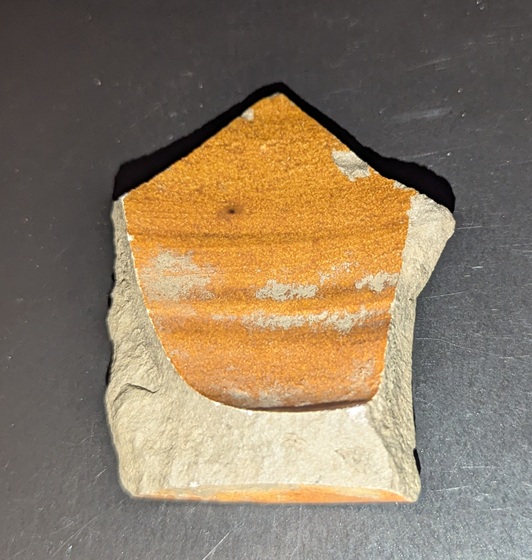
First up, a Derbyshire Salt Glaze Stoneware bottle base, with a diameter of 8cm – you can see the ‘orange-peel’ effect of the salt glaze on the exterior. It probably contained some form of drink, perhaps alcoholic, and although they often contained ink, too, I think it would have been to nice for that, with the fancy groove running around the bottom. The interior is also glazed, and has wonderful grooves, evidence of how the bottle was hand made on a potter’s wheel.

The rising of the grooves on the inside, showing where the potter pulled the clay into the bottle shape.

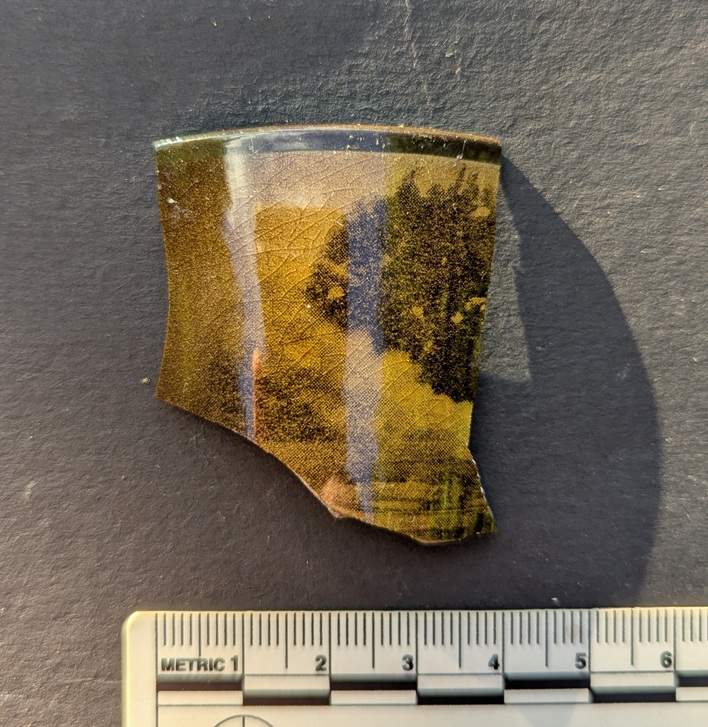
Next up is this lovely teacup sherd in an unusual colour. Measuring 9cm in diameter, it seems to have straight sides, and is decorated with what might be a tree in front of stormy clouds, or perhaps just clouds, in a brown and yellow transfer. It’s probably 20th century in date, and it’s odd, but I quite like it.

Found in Alexandra Park, Oldham, having been dug out of a badger’s sett in the woods.

Next up, a chimney…

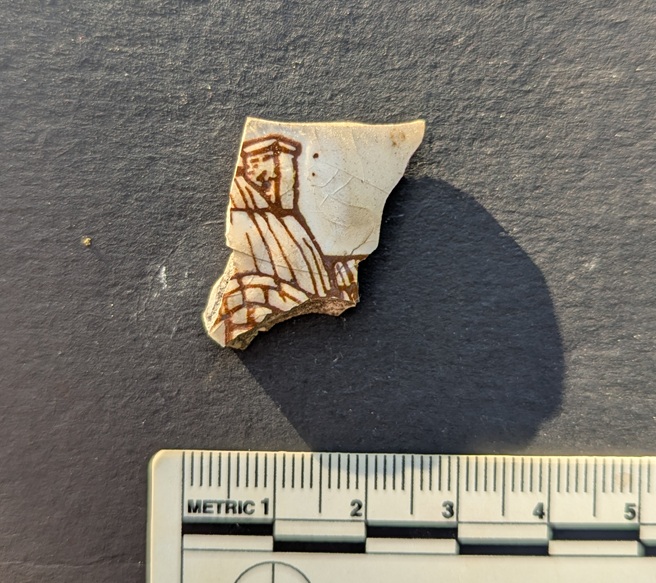
A tiny sherd of transfer printed ware, dating to the late Victorian period, and showing what was probably a cottage scene, of which the roof and chimney is the only bit to survive. I couldn’t leave that behind, could I? Found on the footpath by Pyegrove, Glossop.

Next we have a…

…copper roof nail. Found at the top end of Whitfield Cross, the result of someone having roof work done, with the old nail being pulled out and the slate replaced. Contrary to what I had thought, the nail is not bent accidentally, but rather it is driven into the wooden battens a short distance, and then bent over deliberately in order to secure the slate in place. Lovely stuff; I love the colour, but also the square shape in section of the shaft. I wrote a little about them and how they were made, here, and oddly they seem to seek me out – I’m always finding them in the street, and I have hundreds!

Next up, a Victorian clay pipe stem:

Awful shot, but I think I am due to get a new phone soon…

The pipe stem and mouthpiece is to the left, and the bowl should have been to the right – the bit that sticks down is the spur of the pipe. This sort of thing.

Interestingly, the spur – designed to keep the pipe from rolling around and to keep the hot bowl from burning surfaces – has a circular (or annular) maker’s mark or decoration on it. I have no more information to offer, sadly, but I think it is quite a common marking. Love it!

I also love this:

I know, I know… I haven’t washed it!

A lovely sherd of Victorian Hand-Painted pottery. You can see (through the mud – apologies) the individual brush strokes that make up the delicate blue flower that once adorned a probable . I have the next Rough Guide to Pottery planned that, among other pottery types, looks at this Hand-Painted stuff; you lucky people, you! Anyway, enough of the shouting and cursing… this was also found on the Pyegrove path, as indeed was this next one:

I think this was well used and quite worn when it went into the ground.

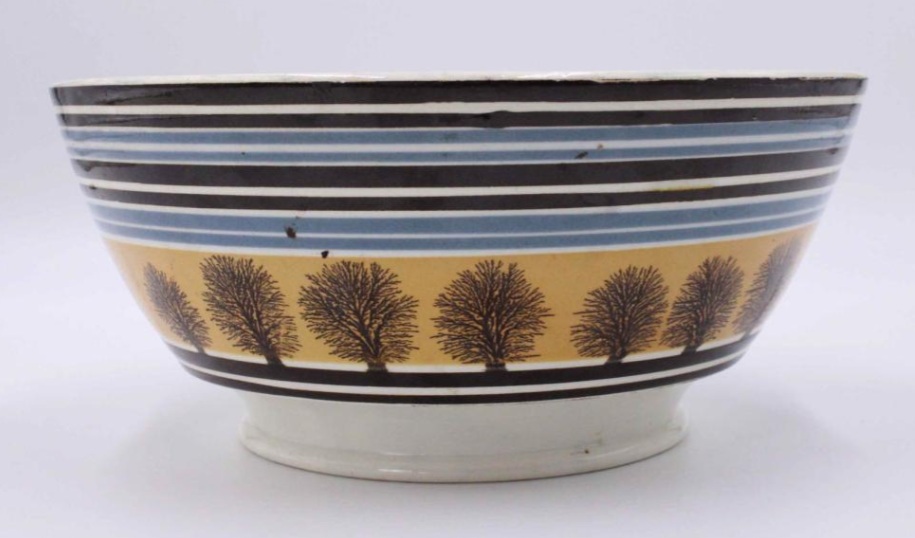
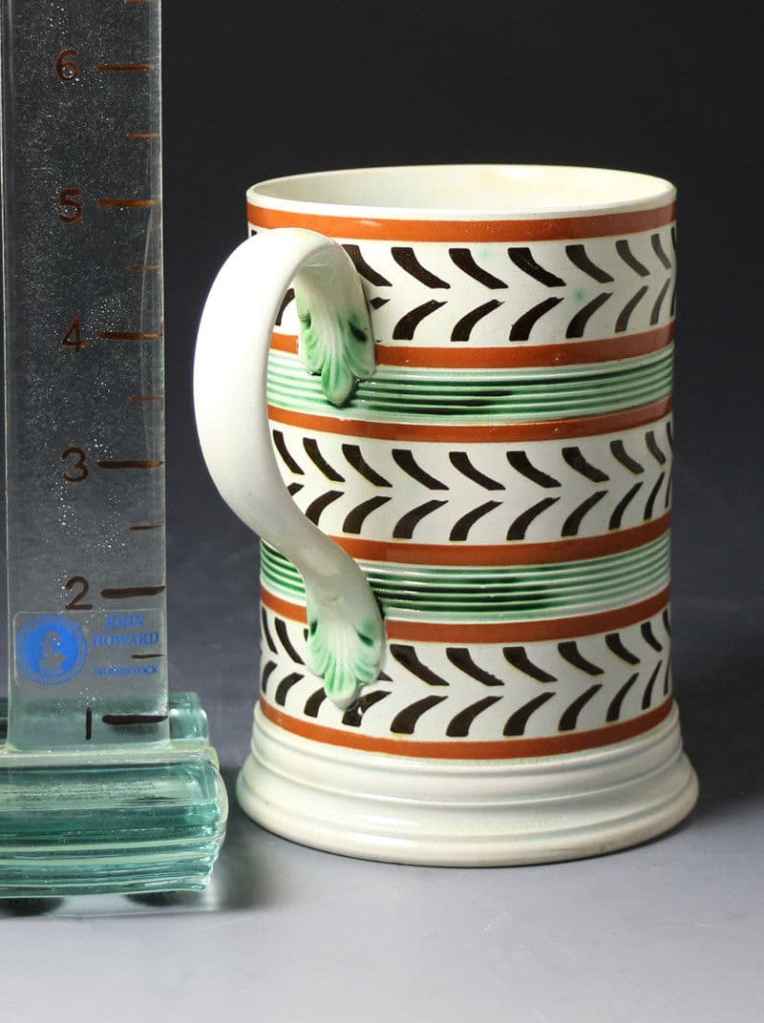
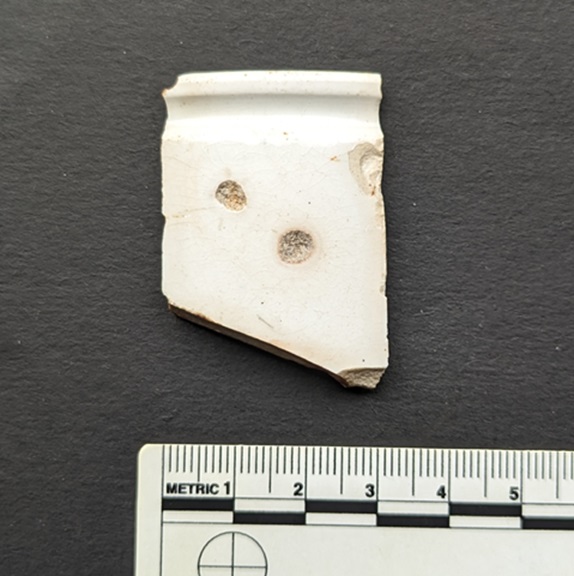
It’s a sherd of Industrial Slipware, in a lovely pale grey colour, and, measuring a diameter of 14cm, it’s probably a rim to a Georgian/early 19th century Mocha Ware open bowl, perhaps like this:

Found on the internet and shamelessly stolen – you could have bought this lovely example from only $225, which is probably well worth it.

The next two were found on the track from Pyegrove to Old Glossop – along the track to Hall Fold:

Another rim sherd.

and…

And a bit of a body sherd – tiny, really, but characteristic.

The first sherd is a rim sherd from a large open bowl or plate, and is in a 17th century Midlands Yellow Ware. It’s impossible to get a rim diameter – despite being a rim sherd – because it is such a small fragment (thus we see the limits of the Rim Chart). However, it is chunky and well made, so it is likely to be large, and as it is a relatively fine fabric, so it is likely to be later in date. Probably.

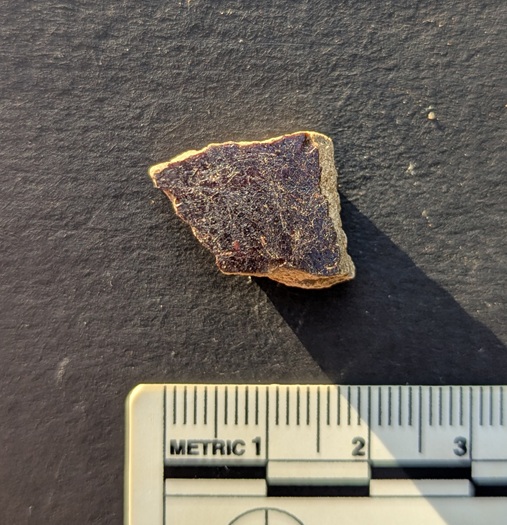
The second sherd is a fragment of a Manganese Glazed vessel. Honestly, I have no idea about the shape – most are open, rather than a closed shape, and this has glaze on the interior and exterior, which also suggests open shape. Date… 17th to very early 18th century.

Both of these are lovely bits, and really bring home the age of these trackways that I keep banging on about! I have a future blog post planned… don’t worry.

Next is this wonderful thing:

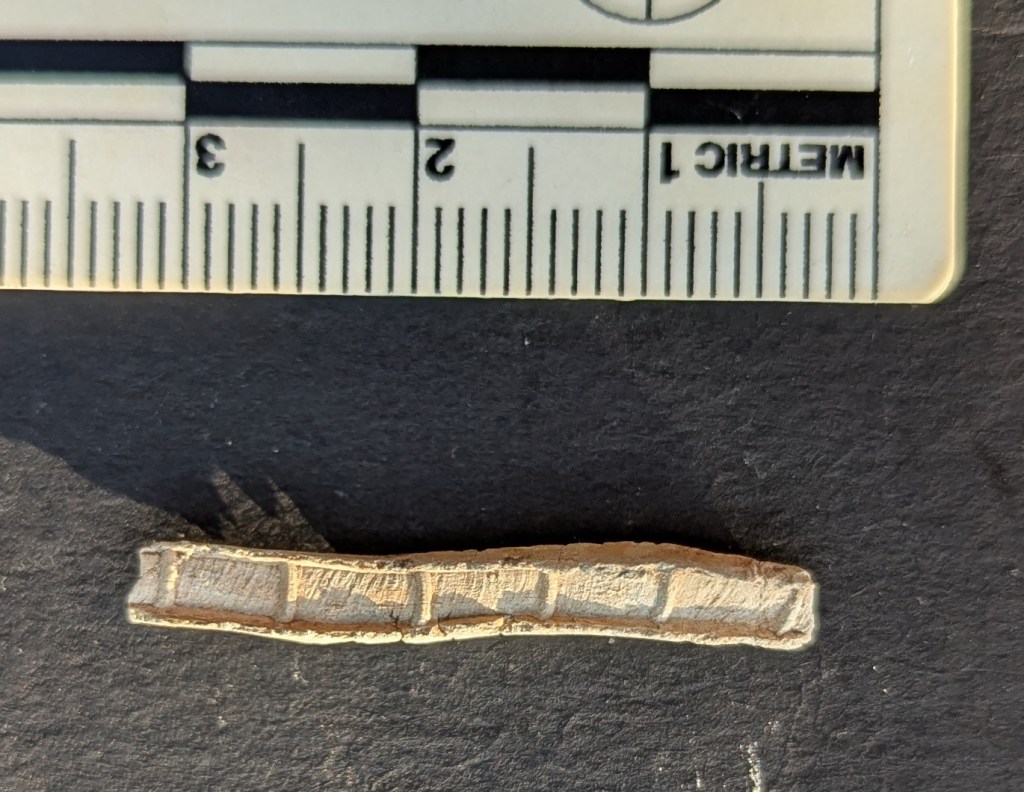
The low evening sunlight really brings out the features.

A single piece of lead came – window lead. This lead came held the small pieces of window glass together to make up a window, and is made by squeezing the lead through a former, whose cogs leave grooves in the lead. It seems that, as a rule of thumb, the smaller the gaps between these ‘reeds’, the newer the came, and vice versa. So it seems that this piece of came is quite early – 17th, or possibly 16th century? It was found on the banks of Erwood Reservoir, near Buxton, along with a whole pile of other 17th century material (the subject of a future article, especially as it very much mimics the same material found on the valley sides around here). This is the fabric of a long lost farm, and I wonder who last looked through the glass it once held.

And to finish this ramshackle wander around my hearthstone, I present the following: a mason’s mark from the railway bridge at the bottom of the Hayfield Road (A624) at Chinley.

In the central larger stone.

Here’s what it looks like:

A rough sketch from my catalogue of mason’s marks in the area.

I realise that it’s not really a fireplace related thing, but I like this sort of thing, and so do most of you, and besides… I don’t know where else to put it! It’s one of several examples of this mark on the bridge, and has maddeningly resisted me taking a photograph for one reason or another. However, the other day we were travelling in our new camper van, and all the planets aligned, and I managed to get this snap! Whilst very similar, it’s not like any of the others in the area that I have documented, and whilst this is disappointing, it makes sense as there were hundreds of stonemasons working on building the rail network in the early to mid-Victorian period (the line here was opened in 1867). This whole area is interesting, and following the construction of the railway, the road system was monkeyed around with, with roads no longer connecting, or moved over and replaced by newer ones. I should explore it a little, who knows what might be uncovered.

In terms of mason’s marks, I’m still toying with the idea of a project that studies all the marks, to catalogue, photograph, and cross reference them. If anyone fancies coming with me on a few walks to make this happen – from Broadbottom to Longdendale, and then the Chinley Line, perhaps – give me a shout.

So, there you go, the Fireplace Finds Frenzy… I hope you enjoyed it.

More soon, honestly. But until then, I know I say this every month, but please do look after yourselves and each other; I have recently learned just how important this is, and in particular, you never know when your time is up.

And as always, I remain, your humble servant.

TCG

Archaeology · Pottery · Where / When

Updates: Cheese Town and Other Matters!

What ho, you wonderful – and slightly odd – folk who are reading this. You are here either because you have an interest in Glossop/Pottery/Old Things/The Ramblings of a Sherd-Nerd… or you’re lost. Either way, you might need some help. And either way, pour yourself a glass of the stuff that cheers, sit back and relax.

So then, we have a mixed bag today – some updates and some new stuff, and first up we have placenames.

WHITFIELD: THE PLACENAME

I originally published this post listing all the places in the Glossop area with their first appearance. Whitfield first appears in the Domesday Book of 1086 under the name Witfelt, which is normally understood to mean “White Field”, meaning an open (figuratively ‘white’) land or field, presumably to differentiate it from the surrounding moorland. However, I recently read an interesting article in Nomina: the journal of the Society for Name Studies in Britain and Ireland… as one does. The article is titled “Onomastic Uses of the Term “White“” by Carole Hough (read it here). Briefly, it suggests that amongst all the other possible meanings for the word ‘hwit‘ (White), one that is often overlooked is that relating to dairy foods and milk – literally ‘White Meat‘ – for which there is a lot of evidence, particularly when used in conjunction with a farm or land place name element. If we consider this in relation to Whitfield, we might understand it as the field where diary produce is made, and hence the Cheese Town of the title. We can’t say for certain, but it’s certainly a possibility that should be considered, for as we know cheesemaking was taking place here in the 18th century and earlier… so why not? Whitfield, land of cheese! Marvellous!

MASONS MARKS ON LONGDENDALE TRAIL

Back when I was a younger man (April 24th 2018, according to my records… 6 1/2 years ago!) I published an article on Mason’s Marks and Apotropaia on the stone infrastructure on the Longdendale Trail (read it here). Master CG was only just 2 years old then… and a lot can change in 6 1/2 years! Having recently got into riding his bike (!), off we went to the Longdendale Trail, giving me the opportunity to look for more marks… and Lo!

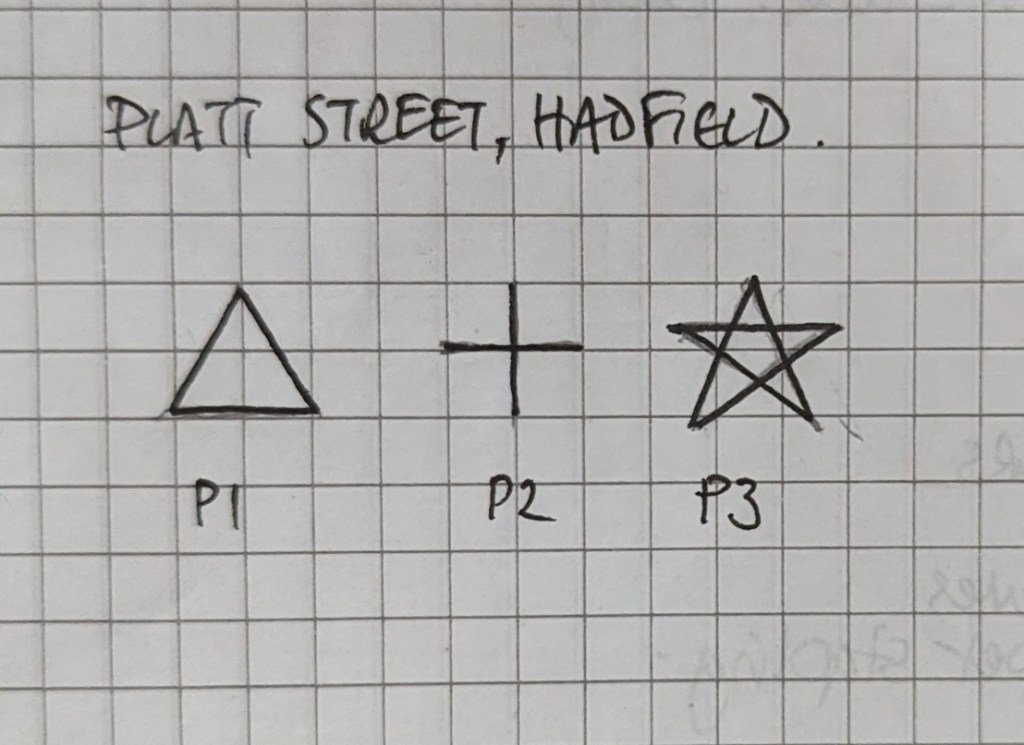
Here are the marks so far identified, to add to the corpus of mason’s marks along the line. The first are from Platt Street, the road bridge at the very start of the Longdendale Trail (What3Words is fortified.bracing.wage).

Photographed from my notebook… I just realised I should have rubbed out the pencil!

The second lot are from under a bridge that carries an apparently unnamed road leading from Padfield Main Road to Valehouse Farm (What3Words is leader.operated.courts).

V8 is also shown in the Platt Street marks. Some of these show up at other places along the line. Ooooh, I can’t wait to collate and analyse… I’m such a geek!

As you can see, some of these marks show up elsewhere on the track, suggesting that the same workers were shaping stone all the way from Broadbottom to Woodhead, which makes sense. Truly though, I need to survey the line properly, collecting the forms and locations, etc. I know I’ve said it before, but I honestly think a wonderful project could be made from these marks; recording and comparing them all along the line, researching who they might belong to, raising the profile of the men who physically built the line (not just those who financed it), as well as approaching it from an arts perspective. There’s lots to pick away at here, in fact… if anyone fancies joining me (or indeed, if anyone fancies funding/sponsoring me).

MYSTERY STONES ON THE GLOSSOP – MANCHESTER LINE

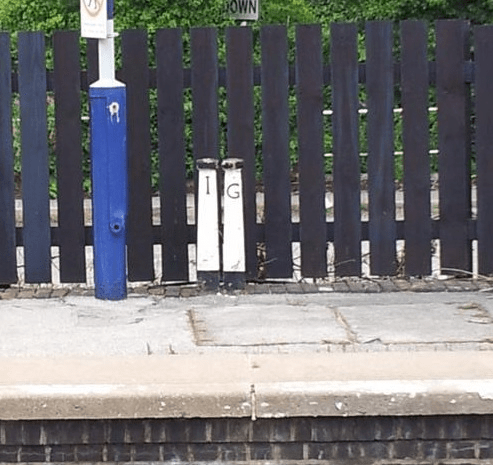
Talking of stones, a few years ago I published an article that looked at some odd stones I had noticed during the commute between Glossop and Manchester. Please read the article for more in-depth information, but essentially, 2 pairs of stones and a single example, all exactly the same shape and design, and all with the same single letter designs – ‘I’ and ‘G’. One pair on the platform at Guide Bridge station, and the single example just beyond the station, against a wall, and both of which I had photographs. And another pair just before one pulls into Hattersley station (coming from Glossop, on the right), which was in a ‘blink and you miss it’ position, and consequently of which I had no photograph.

The pair at Guide Bridge
The single post (possibly originally one of a pair) a little further on from Guide Bridge

And there the matter lay until the other day! Heading into Manchester, I noticed we seemed to be slowing down earlier than usual on the approach to Hattersley station, and having my phone in my hand, I tried to get a shot of the stones… and succeeded. Well, sort of… in a cruel twist of fate, young Master CG decided it would be an ‘hilarious’ jape to put sellotape over the cameral lens, and as a consequence the photograph looks like it was taken using a potato. Still, the jokes on him… I subsequently enrolled him in a special after-school long-distance running and extreme maths challenge club. That’ll teach him to mess with old TCG! Anyway, here’s the photograph:

Apologies for the poor quality, but the general area can be discerned.
The ‘G’ and ‘I’ can just be made out through the sellotape haze. I will keep trying to get a decent photograph.

So now we have photographic evidence of all of these mystery stones, which is great… but we still don’t know what they are! So, please, if anyone can suggest a meaning or purpose behind these “monogrammed mushrooms” as I have named them (patent pending), then in the name of great Jove, please let me know.

OOOOH… FLINT!

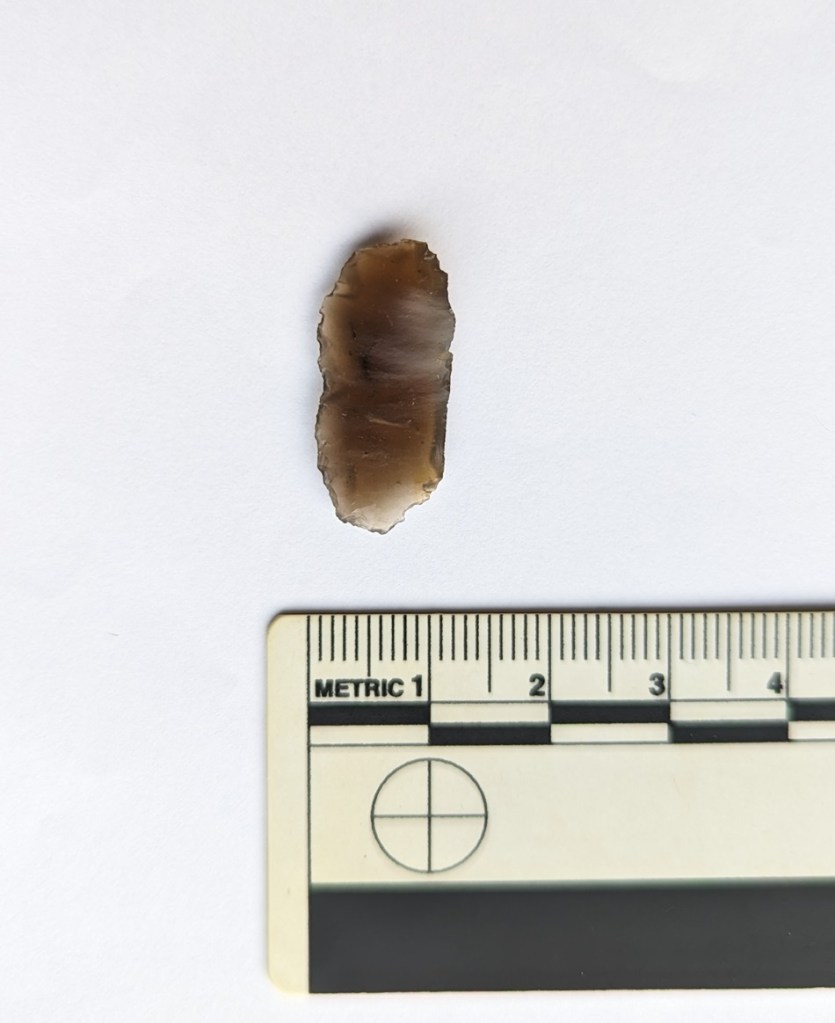
More stone… this a little older, though. Over the course of a number of years, I have picked up a few odds and ends of prehistoric flint from the Glossop area. The hills all around are full of these tiny fragments of a distant past – largely Mesolithic (Middle Stone Age, roughly 8000 – 4000 BC), with some that might be Bronze Age (roughly 2500 – 750 BC). But these three examples I have found much closer to Glossop itself, and always quite by accident. It is worth remembering that Glossop, the Peak District, and indeed most of the North West is not a flint area, and any flint found hereabouts has arrived either by glacial action, or it has been brought here by a human; so any flint you see pick it up! Honestly, flint and chert (a local, poorer quality, flint-like quartz) are both very distinctive against the local gritstone, and once you get your eye in, they stand out from some distance. I’m not a stone man, and whilst I can usually recognise flint that has been shaped deliberately, the finer points of dating I leave to people who know what they’re talking about. Here are the bits I have found:

This first came from a path just below Shire Hill, so might be Bronze Age.

Lovely stuff – a blade made from a chip of flint. You can see the ‘bulb of percussion’ – the bulbous bit at the top – where the blow was struck to break this chip off. When hit, flint acts as though it was liquid, and you can see the ‘waves’ made by the strike. You can also see the nibbling at the edges that suggest this blade was ‘retouched’, or sharpened after being used. Flint is very sharp (I have literal scars to prove it), but it is a fragile edge that needs work to maintain it.
The back side of the above flint piece – you can see where other pieces have been struck from this one, each creating a scar as the force travels along the core. It’s a fascinating subject flint knapping, and one that is not easily put into words… it has to be seen, and especially felt.

The next flake came from where the allotments are now at Dinting, sitting on a mole hill.
A chip off the old nodule! It’s been worked, but I’m not sure it was ever a tool.
Again, a crappy photo of a lovely flint tool. This time, a fragment of a thumbnail scraper – also here. Honestly, flint is better touched and seen in person, that’s why we archaeological types use drawing to illustrate flint… a photograph does not show what we want to see.

Whilst we know people were here in prehistory, its always nice to see the things they used in their everyday lives. I actually need to report these to the Find Liaison Officer (FLO) as this is prehistoric, and any information from this period, no matter how small, can potentially change our whole understanding of the history of the area. The FLO is the person to report anything interesting and potentially important you find (feel free to tell me as well, but honestly they are more important) – very helpful and genuinely the font of much knowledge.

POTTERY: SOME BITS AND PIECES

Never missing an opportunity to spread a little ceramic-based joy, I present to you a small selection of recently found pottery. Following my own newly introduced rules, I am only taking sherds that interest me, or which are good examples of the ware type. This means that there is more left for you wonderful folk to find, and more space in chez CG… much to the relief of Mrs CG.

First up, two very similar sherds.

Left has heavily crazed glaze, and I suspect it was burnt at some stage… that’s not normal ‘wear and tear’, even after being in the ground for 200 years or so.

Left is from High Lea Park in New Mills, and is the base to a mug or tankard some 8cm in diameter. The right was found on the track below Lean Town, and is the same in shape and dimension, although this is from the body somewhere, not the base. I got very excited both times I found these – they look like Scratch Blue stoneware, which would be very exciting. Alas, on closer inspection it’s clearly earthernware, and thus less exciting. Having said that, they are both from Industrial Slipware vessels, and both early 19th century in date – which is a bit rarer than the usual Late Victorian – and come from something like this:

Stolen, as always, without shame, from this website. Honestly, it’s a fascinating website filled with all sorts of historical pottery information from a collector’s perspective. I genuinely enjoy this site… which might be warning to some of you!

Sometimes, coming back from school with Master CG, we like to shake up what is in essence a somewhat linear journey from A to B by taking different routes; exploring, Wandering, and just seeing what we encounter along the way; blackberries, elastic bands, the occasional copper nail, a penny, holes in the ground to peer into, and if we are lucky a skip. There’s always something in either of those two latter.

Plain, but is still quite cool. I know, I know… but I can’t resist!

This was from a skip on Hadfield Place. Always, and I mean ALWAYS, look in a skip that has soil piled in it: Glossop’s history almost guarantees that there will be at least some Victorian sherds in that soil. Here we have a rim sherd from a late Victorian/early 20th century marmalade pot – something like this:

Stolen from this website… and you can buy it for £55.

The groove running around the pot, just below the rim, is to enable a piece of string to be tied around to keep the cloth lid in place… very characteristic.

Skips and holes… always have a look in both. This next sherd was from a utilities pipe trench on St Mary’s Road:

Lovely stuff. I think this might be fairly early

A lovely sherd of Industrial Slipware, again, this time of a Banded or Annular Ware type. It looks very modern as it is still made, particularly as Cornishware, but it is genuinely early to mid-Victorian in date, and probably from a large bowl or jug. Looking and feeling it again again, I think jug.

This last sherd is another Industrial Slipware – a tiny fragment of Variegated Ware, this one being in the ‘earthworm’ design:

Truly awful photograph. I know a bad workman blames his whassnames, but my new phone has no macro setting, so my up close photos are not great.

Probably from a jug or bowl, similar to the one in the above article, and dates to about 1800-1820. Interestingly, this one was found in a quarry that was used during the construction of Bottoms Reservoir, and was later used as a tip. Bottoms Reservoir was opened in 1877, and thus the tip can only have been used from, say, 1880 onwards, and actually, judging from what is found there, I think perhaps from 1900 onwards. This means that this sherd – and the pot it came from – was as much as 100 years old when it was broken and thrown away. This makes sense – I still have my great grandmother’s 1920’s salt-glazed stoneware pie dish (I use it to make a really nice tomato and white bean bake with a feta topping, if anyone fancies…) – and is a cautionary tale about using pottery to precisely date certain contexts. People in the past also had heirlooms, and all objects have a biography.

AND FINALLY… WHERE/WHEN 3

Well, Where/When no.3 is now on sale… and selling well. You good folk seem to like a walk, some history, and a pint… who knew? Well, I think we all did to be honest. You can get it in Dark Peak Books (93 High Street West in Glossop), or via the Cabinet of Curiosities shop (here). Or you could track me down and snag a copy.

For those of you who are unaware, Where/When is a quarterly journal of Archaeological Wanderings. Essentially, a walk in the Glossop area, with yours truly chiming in about the archaeology and history of where you are wandering; think a pinch of pottery, a hint of psychogeography, some groovy photographs, a dash of discovery, a toe stub of psychedelia, and a splash of the usual Glossop Curiosities shenanigans. No.3 Takes us on a walk from The Beehive in Whitfield to The Bulls Head in Old Glossop via medieval trackways, a Saxon stone cross, 18th century buildings, and a 10,000 year old glacial erratic boulder. Marvellous stuff!

A sneak preview of Where/When 4 – The Melandra Meander.

And Where/When No. 4 is in preparation; titled “The Melandra Meander“, it will detail a circular walk from Melandra Roman Fort to Mottram Church on the hill above – via Hague and medieval trackways – and then back again, and is full to the brim with the kinds of historical and archaeological goodies that you have come to expect. It’ll be in stores in December, just in time for Christmas.

I have a whole pile of ideas for Where/When, and the Cabinet of Curiosities in general… all kinds of stuff: t-shirts, anyone? Art prints? The Rough Guide to Pottery in booklet form? And in particular I’d like to start a series of monthly guided Wanders – where you and me can Wander together. Let me know what you think about this. Or indeed anything about the website, or what I have written. It’s nice to know I’m not just shouting into the void!

Right then, apologies for the late post of this article, and for generally being behind in most things – there’s often a lot less of old TCG to go around than I believe, so I end up dropping some of the things I’m juggling. More soon, I promise.

Until then, though, please do look after yourselves and each other, and remember – a person might look ok on the outside, but can be struggling inside. We all matter.

I remain, your humble servant,

RH

Dinting · Mason's Marks

Mason’s Marks at Dinting Arches

What ho, kind and gentle folk of the Glossop-based blog reading world!

Firstly, please accept my apologies for the lack of activity on the blog as of late. I have been surprisingly busy in both my work life and my actual life, and have somewhat neglected the blog, which is frankly not on. I will atone for my sins by posting twice this month – this post, and another part of the “Guide To Pottery”. (What’s that…? Hmm? Look, it’s no use shouting “Dear God, spare us the pottery“, and no, I won’t “curl my hair with it“, thank you very much. No one is forcing you to read the blog, you know. Honestly, the nerve of some people.)

There is all sorts of exciting blog related news, more about which soon, but for now on with the show, so to speak.

As regular readers will know I do love a good carved stone or two, and from graffiti to bench marks, I am always interested. However, one category of carving in particular holds a fascination for me, and that is the mason’s mark. I have blogged about them previously, and regularly post them on Twitter when I see them around and about, as there is something about them I find captivating.

Briefly, mason’s marks are the unique signature of an individual stonemason, made using a chisel onto the stone they had finished carving or shaping. The reason for this was ostensibly two-fold. Firstly, the stonemason was hired on a piecework basis – he was paid for each stone he finished, so it was important that ownership was established.

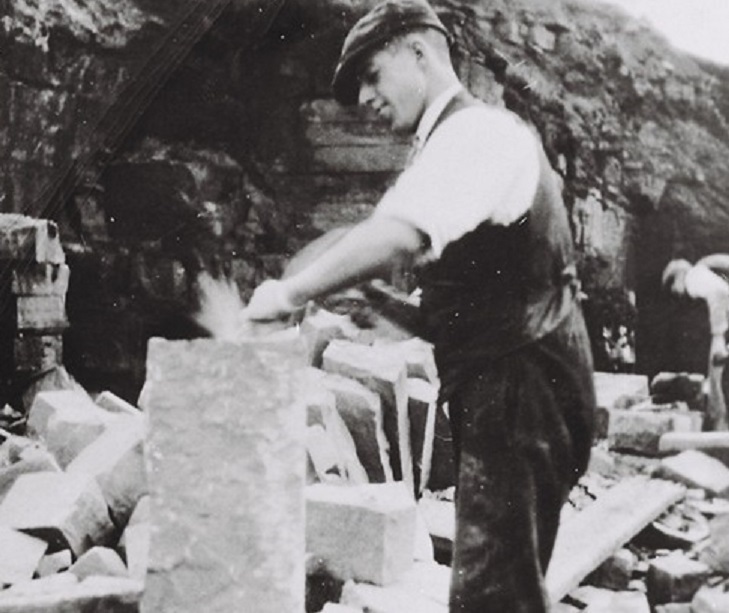
A quarryman of the Victorian period.
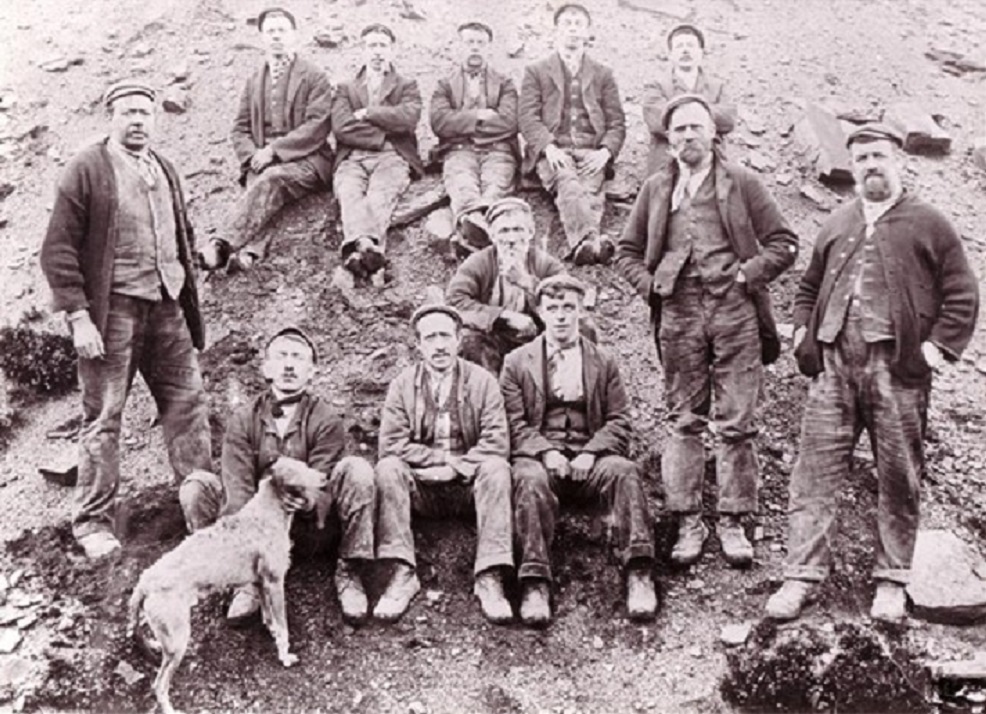
Some more Victorian quarrymen.

Secondly, it acted as a form of quality control; each stone was inspected and finished by the mason, with any flaws or issues noted, their reputation, and thus livelihood, being based on their work. It also meant that substandard work could be traced to an individual. But beyond this, I suspect also that making their mark was important to the masons themselves – a sense of pride in their work, to be able to stand back and say “I made that”, and being able to point it out to their children or grandchildren. It gave a sense of agency to the stonemason, allowing them ownership in both senses, and making them feel as an individual, rather than simply a cog in a much larger machine. This is a hugely important point, and the reason for my fascination with them: these are the personal signatures of the men who carved those stones, men who almost certainly couldn’t read, and most of whom couldn’t sign their name beyond an ‘X’. Indeed, it is entirely likely that, sub-contracted by a foreman, their names wouldn’t be recorded elsewhere either. Thus, these simple geometric shapes are all that remains of the men who built Dinting Arches, testament to their skill and backbreaking labour; this is them signing their work in the way an author does their book, or an artist does a painting. The silent stones speak for them.

Quarrymen in the Victorian period. Image taken from the very interesting Valley of Stone website that looks at the stone quarrying and masons of Rossendale – it tells a fascinating story of the men and their lives. Well worth a visit by following this link

Because I am that kind of person, I have a larger project in mind. Between 1841 and 1847 (ish) the line between Broadbottom and the Woodhead Tunnel, and including the branch line to Glossop, was completed. A massive undertaking, costing enormous amounts of money, and involving huge numbers of men, in that 6 year period, millions of tonnes of stone would have been blasted, shaped, finished, transported, and fitted into place. At some stage, most of the stone would have a mason’s mark put onto it. Not all survive – they might be placed with the mark facing inside the construction, or it might have been removed during the final finishing once the stone was in place. However, dotted around the railway lines – the bridges, underpasses, tunnels, retaining walls, as well as the two viaducts – some marks are still visible. I thought it might be a fun* – and worthy – thing to do to survey all the remaining railway stonework to see what is there, and to make a note of the mason’s marks before they disappear, and the lives of the men with them. We could also see how many match at different points along the track, indicating that the same men were working in different locations. I’d also like to see if any records exist of the men – quarrymen, rough shapers, or finishers – and see if it would be possible to put a name to a mark. Highly unlikely, I know, but you never know.

(* yes, I am painfully aware that ‘fun’ is a very subjective concept… as is Mrs Hamnett)

One has to start somewhere, and so I thought I’d give Dinting Viaduct a go.

An early image of Dinting Arches – taken before 1914 when the brick pillars were inserted. Interestingly, you can also see the track at Adderley Place that originally ran under the arches at the far end, but which is now filled in.

The technique is relatively simple; using eyes and binoculars, I surveyed all the stone I could see, taking a drawing of all the different marks I could make out, and taking photographs, where possible, of good examples of marks (I need to go back and highlight some in chalk). This is not rocket science, or indeed any kind of science, it’s a bloke with some binoculars and notebook. I compiled all the data, numbered each mark, uploaded the photographs, et voila… you are reading the result. Please enjoy. Or don’t, as you wish.

Some broad observations. By and large, the marks are placed centrally in the stone block, only occasionally toward the edges. It seems that only the more ‘natural’ looking blocks contain a mark, and particularly those on the lower courses. The other blocks seem to have been roughly dressed, a process which may have removed a mark, were one present. As expected, the marks are largely constructed from straight lines, with marks D1, D19, and D23 being the exceptions – straight edges are easy to carve, circles less so. The execution of the carving is often poor, with little precision shown – one wonders if they were done with speed before moving on to the next stone, after all, time is money for these men. It must also be remembered that, talented though they undoubtedly were, it is unlikely that these were the fine master-craftsmen who were carving scrollwork and lettering. Rather, they were focused on shaping the stone – accurately and with skill – so that it would fit.

So then, these are the marks, and in a sense these are the men. It is important to note that I have not included inverted example as separate – for example, mark D5 occurs both with 2 points up and with 1 point up, but as the mark was carved prior to it being installed, which way up it is depends entirely on which way up the stone was installed. Conversely, marks D1 and D19 might be the same stonemason’s mark, but the fact that D18 is off-centre in that the lines aren’t paralell to the rectangular edges as they are in D1, suggests they are two different men (unless he was carving it at an angle). It is also possible that some of the different marks noted here are actually the same mark which has been worn or damaged, leaving only the partial mark that I have transcribed – D6, D9, D13, and D15 for example.

So then, what did I see? A selection…

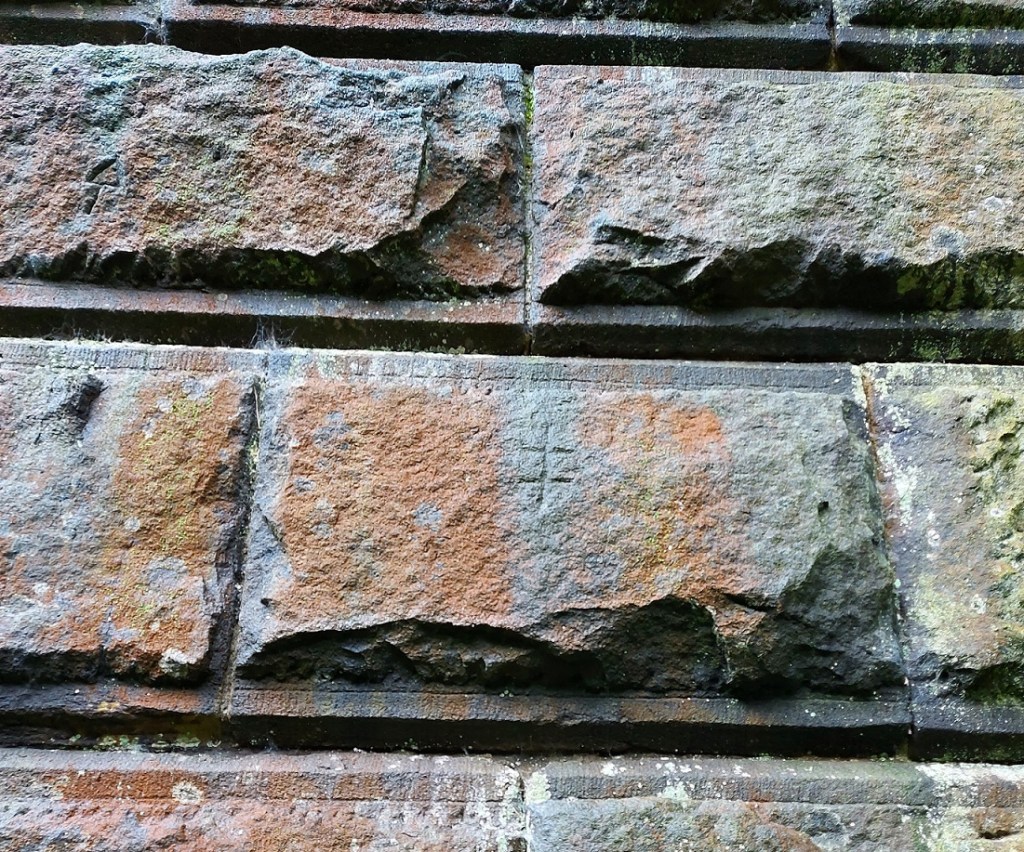
A type D1 carved into the stone.
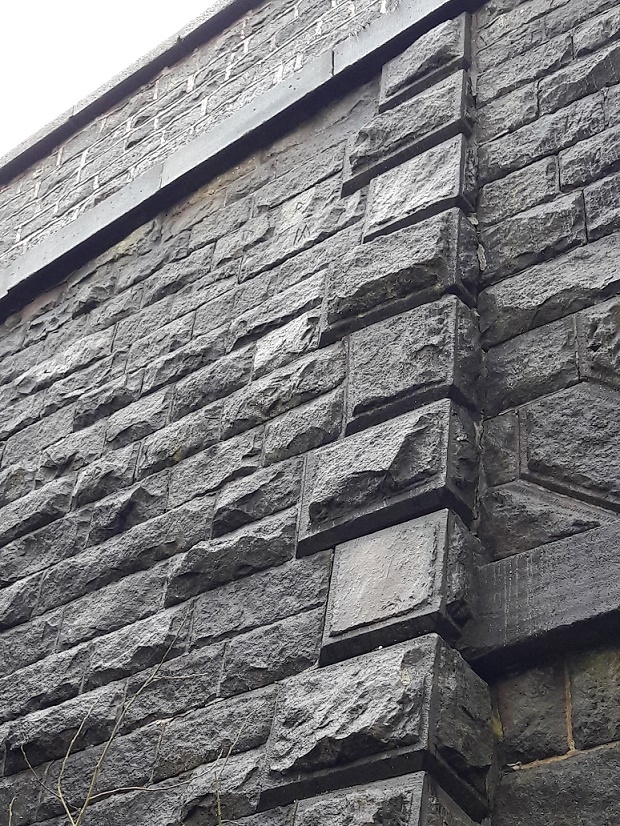
Types D8 and D19 amongst others. This image makes me feel distinctly weird… I hate looking up under there.
D2 & D6
D15
The fantastically complex D14 – impressive! And another above it.

I could go on, but you get the picture. The whole of Dinting Arches are covered in mason’s marks, and it is well worth a trip down – it’s a fascinating bit of architecture, and of Glossop’s history. Below is the page of marks in my notebook, and I feel certain more are waiting to be discovered.

Here are the 25 marks so far identified. As I say, this is an ongoing project that will theoretically start at Broadbottom, and continue to Hadfield and along the Longdendale Trail to the Woodhead Tunnel.

I will move on to another section of the railway soon, and if anyone fancies joining me, drop me a line – many hands make light work! I’ll post the results, and see if we have any matches.

Right ho, another post soon… I promise. Until then, look after yourselves and each other, and I remain,

Your humble servant.

RH

Mason's Marks

Mason’s Marks and Apotropaia

I love that word… but more about it in a bit.

I went for a walk with some friends a few weeks ago, from Old Glossop to the New Lamp pub in Hadfield, via Valehouse Reservoir and the Longdendale Trail. It runs along the old Woodhead Line train track there from Hadfield Station to the Woodhead Tunnel entrance. All the way along it you can see evidence of its former existence – signal cable carriers, track equipment, assorted bits and pieces, and bridges.

As I passed under one bridge (the Padfield Main Road) I glanced up and saw this.

20180127_133345 (1)
Fantastic Victorian stonework on the Padfield Main Road bridge – 1840ish in date.

well, more specifically, this bit.

20180127_133345
Close-up, but rather awful quality… I need a decent camera with a zoom lens.

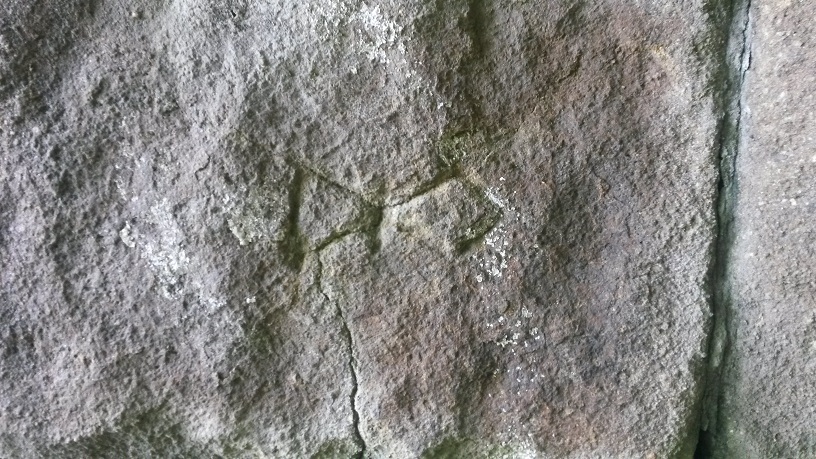
High up and hidden amongst the stonework were a number of mason’s marks. Awesome, thought I.

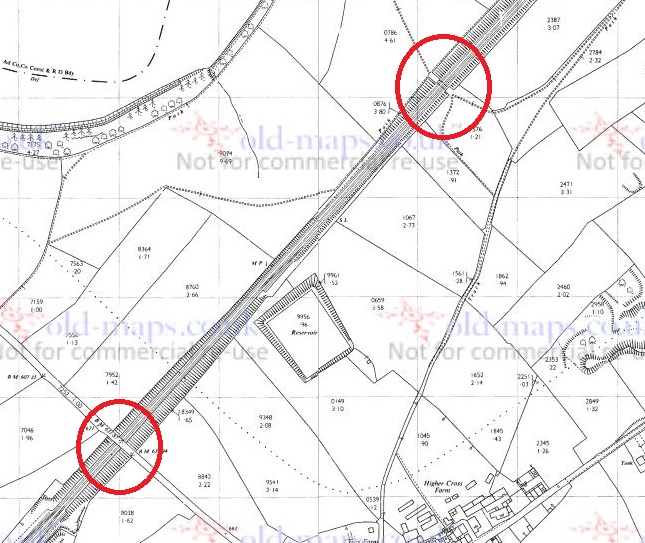
It’s here on the map.

Bridge map
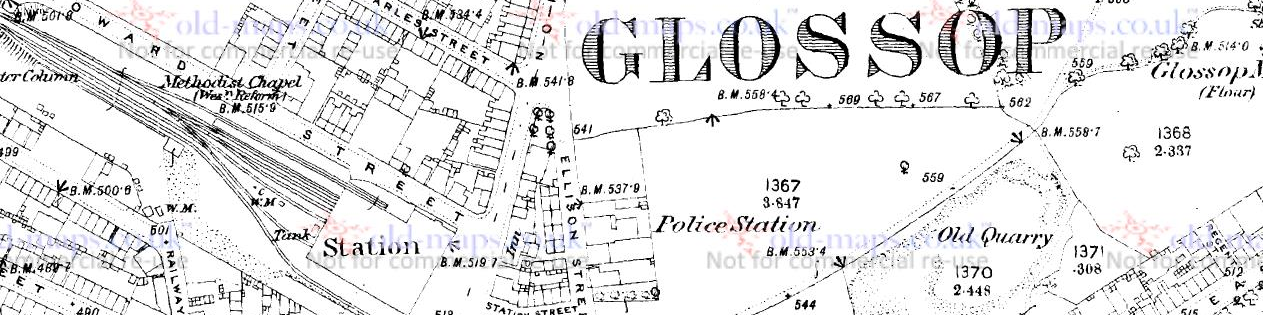
Bottom red circle is Hadfield Station, the top red circle is where the mason’s marks are. This is from the 1968 1:2500 OS map, via old-maps.co.uk. Thanks, again!

Mason’s marks are a really fascinating aspect of stone masonry. Essentially, the stone masons were paid by the piece – the more they carved, the more they got paid, and in order to make sure they they got paid for the correct number of stones worked on, each mason signed their piece with their individual mark. It also acted as a form of quality control – if a piece of stone was not up to scratch, the master mason could see at a glance who carved it. This concept of signing your work had been going on since the Medieval period, and continues to this day. It’s not often you get to see them, as more often than not they are on the reverse of the stone, hidden within the fabric of the building. But here, for some reason, a group of masons (I count three different marks, but with perhaps another three possibles) decided to display their signs. Still, nice to see these out in the open.

Imagine my surprise, then, when we decided to go through an underpass, underneath the old track bed, and head down to the reservoir at this location, here:

Blimey!
Bottom red circle is the bridge with the mason’s marks, the top red circle is the underpass. This is the same map as above, just further down the track/footpath.

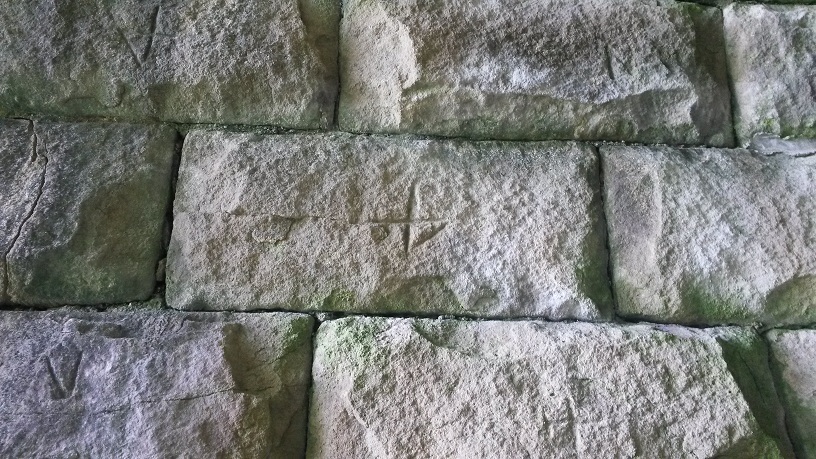
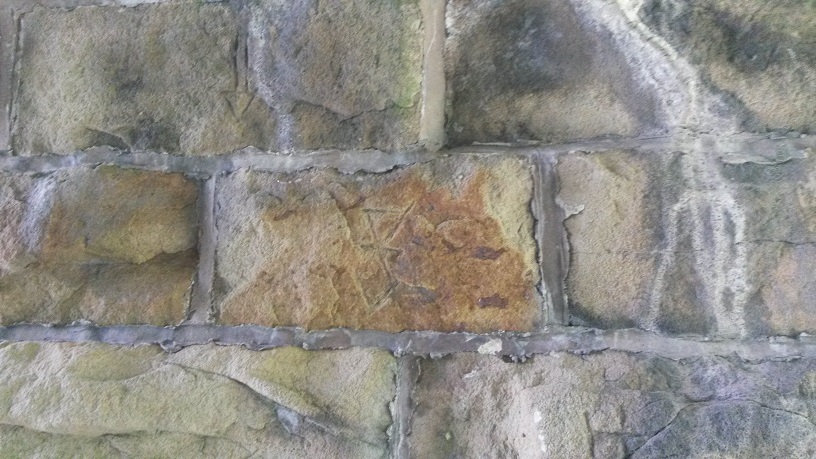
Wow… just wow. A grotto of mason’s marks. Quite literally, every stone was covered in mason’s marks, all of them. Outside and inside… amazing.

x1

x2

x3

x4

x5

x6

x8
This is the roof… honestly, every stone is marked.

x7

It is wonderful!

Now, I’m not sure why there is this cluster of marks on this specific underpass. Perhaps they were allowed to go wild and leave their marks in the open in this one place. Or perhaps, there was a competition between two rival gangs of stonemasons, each working to complete the stones fastest. I simply don’t know.

I have made a list of the mason’s marks.

Marks
These are the mason’s marks on the wall of the underpass.

The mark bottom right is probably a square and compass symbol – both tools are used by stone masons. It is also a symbol used in Freemasonry, which takes a lot of its signs and symbols from stonemasonry.

It would be interesting to compare them with others on the Longdendale line, to see where else these men were working here. Also, as they would be itinerant stone masons, travelling where the work is, we could compare them with others further afield. After all they are a signature, and whilst we may not know their names as such, they left their mark on our landscape. They don’t seem to match those on the bridge, though it’s difficult to make out. There have been attempts to create a database of masons marks, particularly those from the medieval period in the catherdrals. However, whilst at first glance this seems a great idea, there is flaw in the plan: there are a finite number of marks you can make with a chisel and using only straight lines. It was found that many marks were reused by different masons, sometimes separated by centuries. There is something deeply interesting about mason’s marks, though, and some are more interesting than others… Looking back at the bridge mark, I was struck immediately by the ‘M’ mark.

Apotropaia. From the Greek, apotropos, meaning literally ‘to turn away’, and more specifically in this case, to turn away or prevent evil.

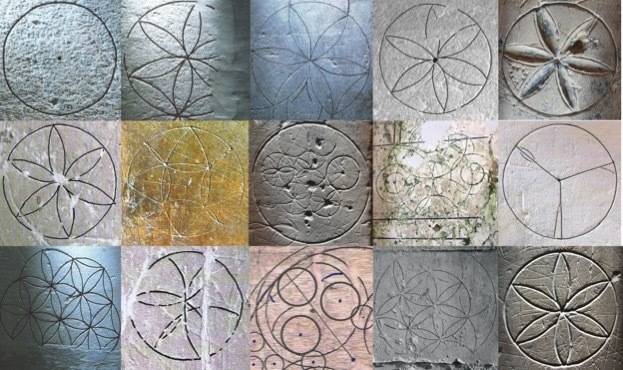
People have always used signs and symbols to act as magic charms to stop bad things, and bad people, from affecting them. Apotropaic marks became very common in the 16th-18th centuries, and any domestic dwelling of the period would have had these marks carved literally into the frame of the house. At this time, the reality of evil was not questioned, and people intent on causing you damage and sickness – witches – were a real threat and believed in utterly. Indeed, the marks are sometimes referred to as “witch marks”, and have only recently begun to be researched. I can almost guarantee that any timber framed house from the period will contain at least a few. Often they are placed by windows, doors, and fireplaces – essentially, any opening, anywhere that a witch, ghost, devil, or other evil thing might gain access to the house. The marks take many different forms, but two of the most common are the ‘daisy wheel‘ mark – usually carved into stone or wood with a compass…

dw
The Daisy Wheel or Hexafoil mark – the idea is the evil/witch would get stuck in the wheel, and be trapped for eternity.

…and the ‘double V’ sign. This latter is very interesting; it is largely understood as standing for ‘Virgo Virginum’ – the Virgin of Virgins, or the Virgin Mary, and may be seen as a plea for her help.

SONY DSC
The double V mark, or Virgo Virginum. Photo taken from here. Thanks to another really interesting blog.

Now, given that the marks are occurring at a time when it was illegal and/or extremely dangerous to be a Catholic, it is unclear what is happening here. Either we are seeing an underground following of Roman Catholicism amongst the population, which is very unlikely. Or more probably, it represents a popular belief or superstition that, whilst nodding to the Virgin Mary, is just understood as a protective symbol, without the trappings of Catholicism that would mean you were burnt at the stake. Essentially, by the 1600’s, people no longer understood the more religious meaning of the symbol, but carried on the use of it as a form of protection.

As further evidence of this, it is often found inverted, as an ‘M’, not a ‘W’. The letters are not important, the shape of the lines is.

witches+symbols
W or M, the meaning is the same.

Which brings us back to the bridge mason’s mark

20180127_133345

Is the mason: a) A catholic, proclaiming his faith, and marking his work thus? b) Aware of the ‘good luck’ aspect of the sign, but has no idea of its origins? c) A mason who is using it solely as his mark, with no understanding of the meaning beyond its shape?

Personally, I’m going with b, but with a small dash of c.

There is so much more to be said about this subject, it is really a genuinely remarkable field of research (and one in which I am involved), and as it is just emerging as worth studying, I urge all of you to keep an eye out for any marks on buildings, especially internally, and particularly if they are built before 1850.

Right, I have a glass of wine waiting for me, so cheers. And next time, I think some more pottery is in order. Oh, and apologies for the long post, again.

RH