Marple Bridge · Oddities

Matlock’s Leap – A Story of Improbable Escapes… and Graverobbing.

Welcome, welcome, one and all. I hope you are all well, and that in these uncertain times you are staying safe as we stumble towards something approaching real life. Today’s post does something I try not to do very often: it strays from Glossopdale and Longdendale. Don’t panic however,  we’re still in Derbyshire. Marple Bridge to be specific. And there may be a link to Mottram, so there’s that. And quite frankly this story is just too good to miss.

I was looking through some online sources a while back, specifically the ones posted on the North West Derbyshire Sources website. There’s all kinds of interesting primary historical sources published there – censuses, trade catalogues, personal recollections, etc. and all of them are for this area – Glossop, Charlesworth, Hadfield, Hayfield – it’s well worth checking out, a truly award-winning website. One of the sources for Charlesworth is the diary of a certain George Booth, dated between 1832 and 1834. The diary is not perhaps what you would describe as the most riveting record of life in a small village; typical entries are very short, personal, and along the lines of “Today and yesterday I have been building a wall as a spur against the weir” (April 11th 1832) and “Daniel Thorneley’s wife died today” (April 28 1832), but these are recorded history, and for this it is invaluable. Certainly, the wall against the weir isn’t important in the grand scheme of history, but it provides us with the date and a personal record of who built it, and why – and these are surely the aims of all historical and archaeological inquiry? And it is these little snapshots – who built what wall, who moved house where, crimes committed, the price of pork, and tales of fire, flood, and cholera – that escape the archaeological record, making the diary an invaluable source. Here, read it for yourself, you won’t regret it.

And of course, although it is Charlesworth/Chisworth based, Mr Booth wanders all over the area, to Glossop, Gamesley, Chinley, Marple Bridge, Broadbottom, and beyond. It was one of these entries that caught my eye:

3rd May 1832

A Stone to commemorate Matlock’s Leap was fastened in the wall by the river side a little above Marple Bridge on the Derbyshire side, on this occasion there was a Mare [Mayor] chosen (I suppose the first Mare there ever was at Marple Bridge of this sort) and a regular Mare’s Walk consisting of the Mare (John Kirk) and a great many of the neighbouring Gentlemen after the walk the partook of a good Dinner at one of the Inns. which was paid for out of a subscription raised for that purpose this took place last Easter Monday.

So what was Matlock’s Leap? And why was it so important that it required a stone and a slap up meal to celebrate it, and particularly on a bank holiday Easter Monday (it would have been held on 23rd April 1832), and at the same time as choosing a mayor? Clearly it was so familiar to George Booth that it required no further explanation – it is almost a throwaway comment. And yet, the phrase “Matlock’s Leap” typed into Google provides just one relevant hit. It turns out that whilst the mystery was relatively easily solved, it is nonetheless quite a tale, and there may be yet more to be uncovered.

The single reference to the ‘leap’ is in ‘Cheshire Notes and Queries‘. This Victorian weekly periodical allowed readers to post questions of a historical or literary nature, and others to answer these questions, or to post some historical research they had undertaken. They are an absolute mine of folklore, history, archaeology, gossip, rumour, and all round fascinating stuff, and the Cheshire version is published online by the archive.org project – you can read it by following the link above (alas, the ‘Derbyshire and Nottinghamshire’ volumes have not yet been digitised). Here’s what was printed:

30th March 1889

About fifty years ago I recollect seeing a tablet in the wall, about twenty yards from the bridge, on the Derbyshire side, with the words Matlock’s Leap, and I think the date was upon it. I recollect being told at the time that it had been placed there by the landlord, Mr James Boulton, who, at that time kept the Norfolk Arms Inn, to commemorate a miraculous escape that a man named Matlock had one dark night. This man was in the Norfolk Arms, and he was suspected of having committed some depredation, and he was told the constable was at hand, when he immediately ran out of the house, ran across the road, and jumped over the wall down into the river, which I should think is here about forty feet perpendicular. I was told the man was not hurt. His friends got a ladder and got him up again all right. I have noticed that the tablet referred to has been removed from the wall where it was fixed. I shall be glad if any of your readers can tell me why and where it has gone.

Ashton-under-Lyne. I. W. B.

Now this was interesting.

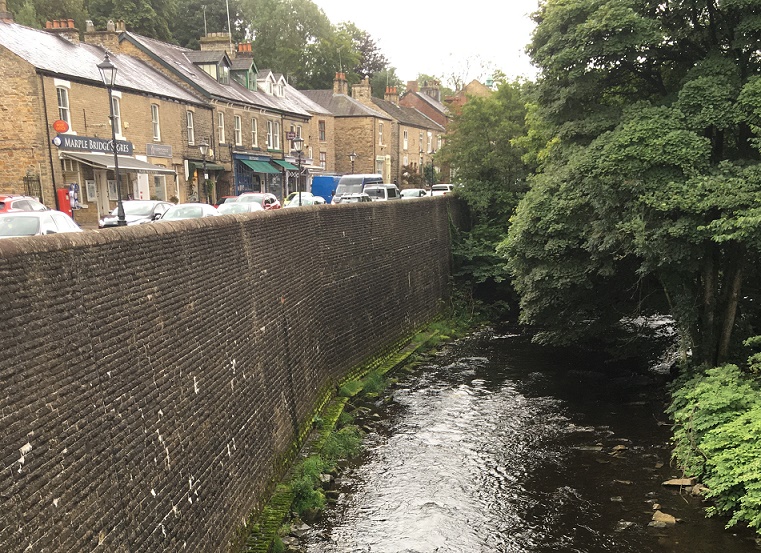
Firstly, Matlock’s Leap was a thing… which is a relief. So Matlock was a person, and the leap was one over a wall and 40ft into the river Goyt… and he lived. Blimey! But also here is a wealth of detail. The tablet commemorating the event had evidently disappeared by 1889, but at least we know where it was – about here, to be exact:
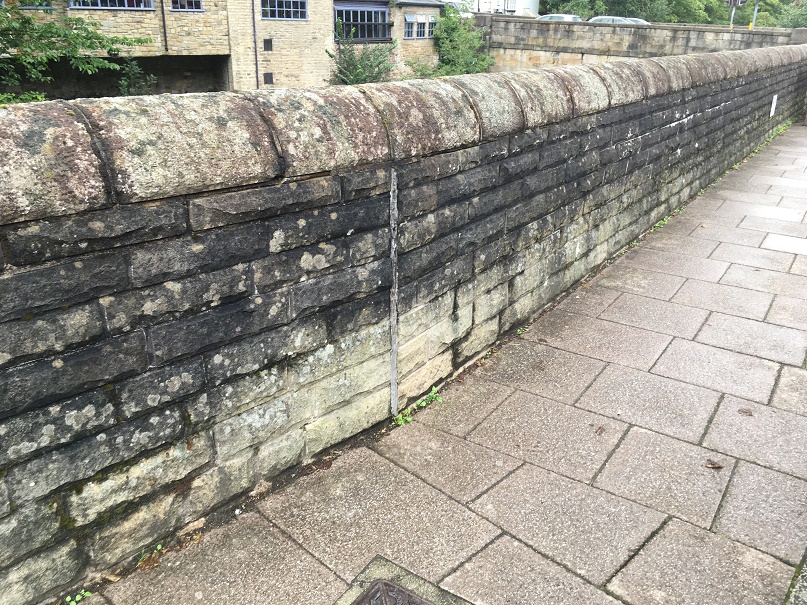
Matlock's Leap 8
About 20 yards down from the Norfolk Arms. No sign of the “stone” or “tablet”, alas.

I looked, and could see no sign of where the stone would have been fixed, and looking along, it seems to me that the whole of the wall has been replaced at some stage post-1832 – it looks Victorian, rather than Georgian, and it may have been then that the stone was removed.
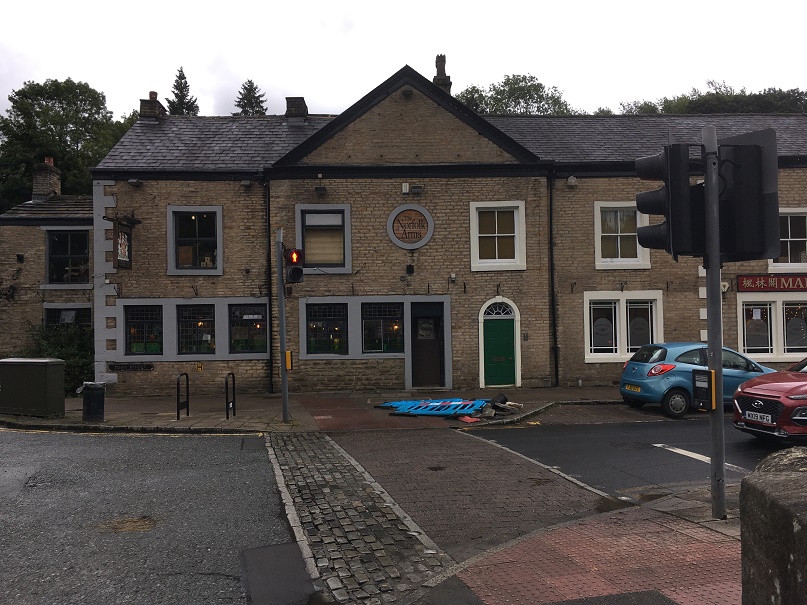
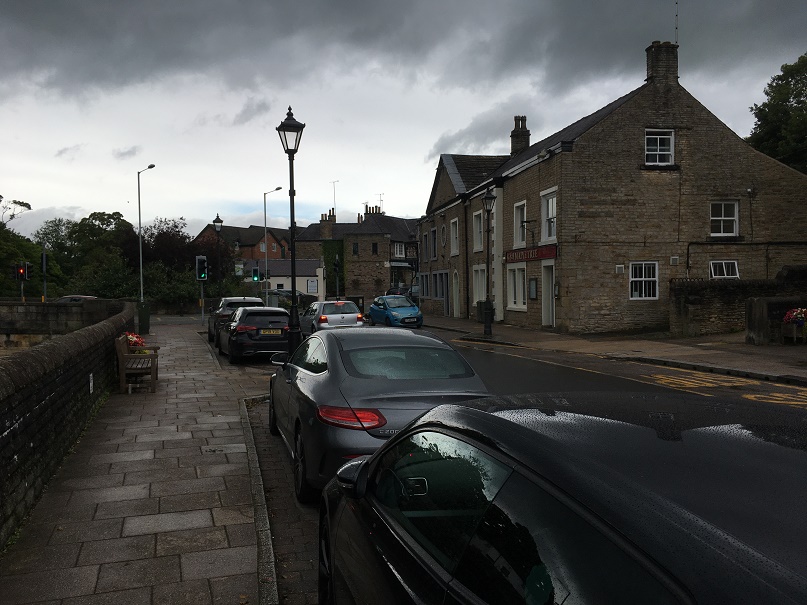
No
The wonderful Norfolk Arms.
Matlock's Leap 9
The view of the Norfolk Arms from the place where Matlock jumped into the Goyt.
Matlock's Leap 6
This photo, taken from the bridge, shows the place where the leap took place – roughly 20 yards from the Norfolk Arms – is just about where the kink in the wall is. That’s 40ft if it’s an inch. I am certain, though, that the wall has been rebuilt since the 1830’s, and it may be that the riverbed has altered. Even so, that’s a hell of a jump!
Matlock's Leap 7
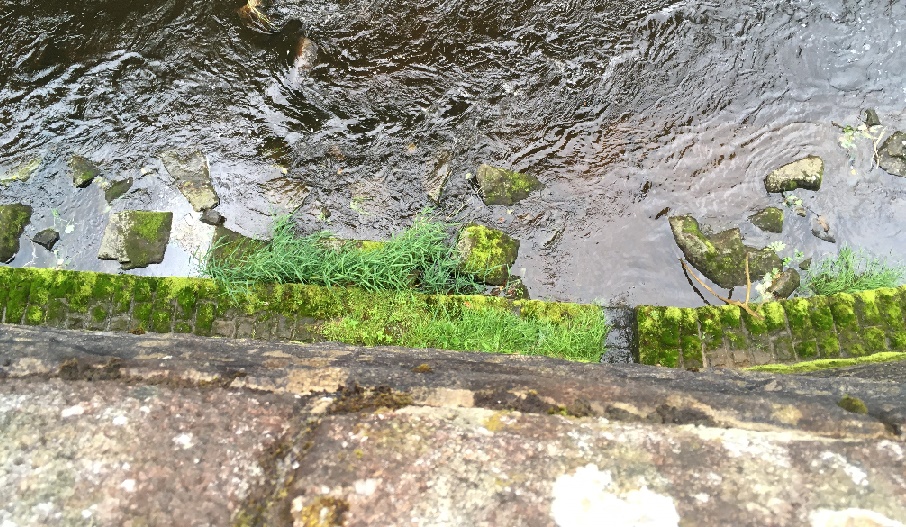
The same stretch of the river viewed directly down from the bank. Here is where Matlock landed in the river. I would love to doubt this, but all the evidence points to it being a real event.

Presumably, given the Norfolk Arms was the location of the leap, and that the landlord had put the tablet up, the pub was also the location of the slap up meal mentioned by George Booth. I was also intrigued by the ‘depredation‘ of which Matlock was accused.

DEPREDATION. noun.                                                                                                                                       The act or an instance of plundering; robbery; pillage

That’s an oddly specific word… what did he do?

Two weeks after the above query was published, a comprehensive answer was given, one which reveals the whole story – it’s easier to reproduce the whole thing:

13th April 1889

MATLOCK’S LEAP.

In reply to your correspondent who asks about Matlock’s Leap, I may say that I do not profess to give anything I know personally, but I recently accidentally met a friend who lived at Marple when a youth, now he is over 70 years of age, and he told me a few matters he remembers about it. His first recollection of Matlock was before the “leap” had taken place, but he had often heard of “burkers,” “body snatchers,” and “resurrection men,” and was no little alarmed when he was told that these men stole dead bodies from churchyards for the doctors, and that the doctors made physic out of them which caused physic to taste “so bad.” One day, quite 60 years ago, my friend went to the Horse Shoe Inn for his father, who was indulging rather unduly to the neglect of his business. When he got there he found his parent in conversation with a man, and the father wishing to let the lad know who he was, contrived to whisper to him, and said, “that is Matlock; he is a burker, fetches dead people out of church yards at nights.” This was so strongly impressed on his youthful mind that he remembers it yet quite distinctly.

With regard to the stone that formerly marked the place of Matlock’s leap, my friend informed me that a present alderman of Stockport told him on one day that he last saw it in Compstall Gardens when they were kept by Mr Calab Warhurst.

The wide-awake “burker” had received a commission from a local practitioner, who, to tell the truth, was a most successful doctor, to supply him with a subject to operate on. And one night when the doctor was very busy in his surgery with patients, in walked Matlock with a bag on his back. The wily doctor did not wish to enter into any conversation or explanation with the “burker,” or seem negligent with his patients by leaving them to attend to him, so he simply gave him a well understood motion to go on through the surgery, which he did, and shortly returned, the doctor giving him five shillings, with which instalment he left the place. But, lo! when the doctor went to examine his bargain, he found that his hitherto trusty agent had hoaxed him, for instead of a corpse the bag was filled with lumber. So much my informant can vouch for, to which rumour adds – and, with a knowing nod, my friend says it was so – that the doctor was not only very clever in his medical profession, but also of much more robust build, and more capable of self-defence than was his tricky agent; and that when he next met with the ”burker” he give him a sufficient fisticuff chastisement. After this reconciliation and better understanding was entered into between then, and their friendship and business engagements were resumed from time to time as it suited their various purposes.

A short account that I have had from another source about the immediate cause of the leap, may be of interest to some of your readers. On the day I read your last issue and saw the account of Matlock’s leap, I met with a person who resides not far from the place, so, in a jocular manner, I said to him, “Do you know anything about Matlock’s leap and the resurrectioning case?” He replied “Yes,” and added, “and you will be surprised when I tell you whose body it was. Then he told me that the grave had been watched fop seven nights for fear that some one should come and snatch a body which he said was that of a large stout man that had been buried in Mellor Churchyard, in the year 1831, and after watching the grave for so long, the family and friends thought there would not then be any attempt made to take the body, but on the eight night it was ‘snatched’ or taken away, and a week after the coffin was found in a lime hole in the neighbourhood” and, he continued, “I have a cousin now living at Hazel Grove who was one of the watchers, and the body was that of my father.” The informant was only six weeks old when this occurred, so of course only knows what he has been told, perhaps chiefly by his own family.

I will conclude with a short account of the leap as it has been told to me by my elder informant who was living on the spot at the time. One night a number of men of the village were at the Norfolk Arms, and were bent on having a lark. It had been agreed that there should be a tap-room trial of Matlock for the ” snatching ” of this body. A judge was appointed, a jury was empanneled, and Matlock was on his trial; when matters were at their height, one, Dick (Richard) Middleton, a plumber and glazier, went into the room and said to Matlock “the constable is after you d_____l “. Now, just what was expected, happened. Matlock was startled, and rushed out of the house; it had been planned that a number of men should be outside – on the right side of the house, and a like number on the left side – so that whichever way he went they were to pretend to try and catch him. He first ran up the bridge and was met, and a scuffle took place, from which he was permitted to escape, and ran to try the other way; here again he was met by another gang and again there was a scuffle, without any serious attempt to secure him, for that, too early accomplished, would have spoiled their sport ; but he saw the two crowds meeting together, and himself hemmed in between them and in such close quarters, and having only time to think of the judge and jury in the house, the crowd on the right hand and the crowd on the left, in a sort of despair, he took the terrible leap into the river, as stated by your correspondent. This is correct in the main. If any little error of detail is seen by anyone who may be better informed, perhaps they will be kind enough to correct it.

H.H. Stockport.

Well, there we have the full story… Matlock was a bodysnatcher. Blimey!

Prior to 1832 only the bodies of people executed could be cut up and examined anatomically, it was actually a part of their punishment. There was, then, a serious shortage of cadavers with which to teach anatomy, which in turn meant that doctors, and in particular surgeons, often had little experience in the reality of the human body and how it worked. In order to address this, an illegal trade in corpses was started, in which criminals – ‘resurrectionists’ – dug up the newly buried, and removed them to be sold to doctors, surgeons, and medical schools. Seemingly few questions were asked, and from a rational and medical perspective, this made sense – the dead are dead, but they can in turn help the living. Ethically and morally, however, the trade left a little to be desired, and the public at large, as well as grieving widows and parents in particular, were outraged. As the ‘trade’ reached fever pitch in the 1820’s and 30’s, watch groups were set up to keep a watch over newly buried bodies to ensure they got their eternal rest.

Matlock must have been connected to a certain Captain Seller and his gang of ressurectionists based in Cocker Hill, Stalybridge; their fascinating story is told on the Cocker Hill website here and in this Facebook post here (well worth a read). It seems the gang were active in the Hollingworth area as well, so Marple and Mellor are but a cart ride away. Bodies were dug up by the gang and spirited away to Stalybridge, where they were transported via canal to Manchester. However, the Peak Forest Canal actually passes through Marple Bridge on the Cheshire side, so the journey from Mellor church (mentioned in H. H.‘s answer above) would be easier to make.

Might we suggest, then, that he was also connected to the taking of bodies from Mottram Church? Famously the churchyard of Mottram St. Michael and All Angels is the home of the empty grave of 15 year old Lewis Brierley, whose corpse was stolen in 1827. His grieving father displayed the empty coffin at the Crown Pole at Mottram, opposite what was once the White Hart pub (now being converted to houses), giving the eulogy that was later inscribed on the gravestone above the empty grave:

Tho’ once beneath the ground his corpse was laid
For use of surgeons it was thence convey’d.
Vain was the scheme to hide the impious theft
The body taken, shroud and coffin left.
Ye wretches who pursue this barb’rous trade
Your corpses in turn may be convey’d
Like his to some unfeeling surgeons room
Nor can they justly meet a better doom.

In memory of Lewis, son of James and Mary Brierley of Valley Mill, who died October 3rd 1827 in the 15th year of his age

The father apparently kept the coffin and was eventually himself buried in it. The gravestone, complete with inscription, is to be found to the north of the church.
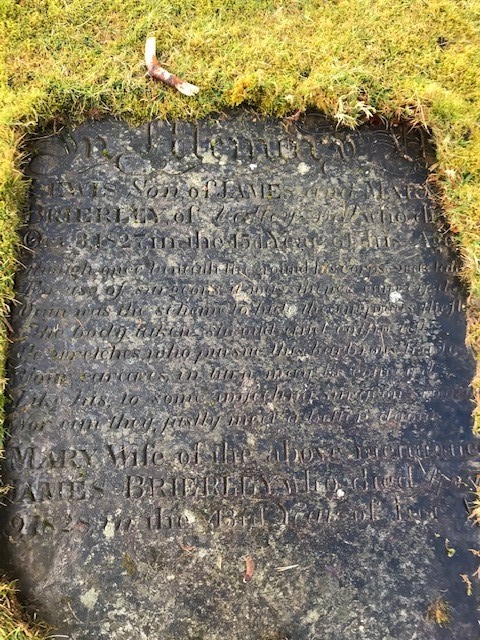
Mattle
The gravestone. My thanks to the wonderful Sandra Teasdale who took this photo and sent it to me after I failed to find it despite stumbling around the graveyard for an afternoon. Not that I’m bitter.

The proximity of Mottram to Stalybridge, and the fact that it is unlikely that there was more than one group active in the area, suggests strongly that Matlock was indeed connected. I’d like to return to this subject at some stage in the future, as I find it fascinating, if a little grim.

In 1832 parliament passed the Anatomy Act, which effectively ended the trade by allowing any unclaimed body to be anatomised, and from then on poorhouses in particular supplied the surgeons with their dissection corpses in great numbers.

So where is the stone now? The above letter by ‘H.H.’ of Stockport suggests it was last seen in Compstall Gardens sometime prior to 1889 (when they were kept by a Calab Warhurst). I presume that this refers to the pub once known as The Compstall Gardens Inn and the “private recreation and dancing grounds” that were attached to the pub – here, for example. These are still attached to the pub, which is now known as The Spring Gardens, and are shown here on the 1898 OS map.

Spring Gardens
Compstall Gardens, now The Spring Gardens. The pub is marked PH, and the formal gardens are visible. For orientation, the Windsor Castle pub (PH) and Glossop Road are at the bottom
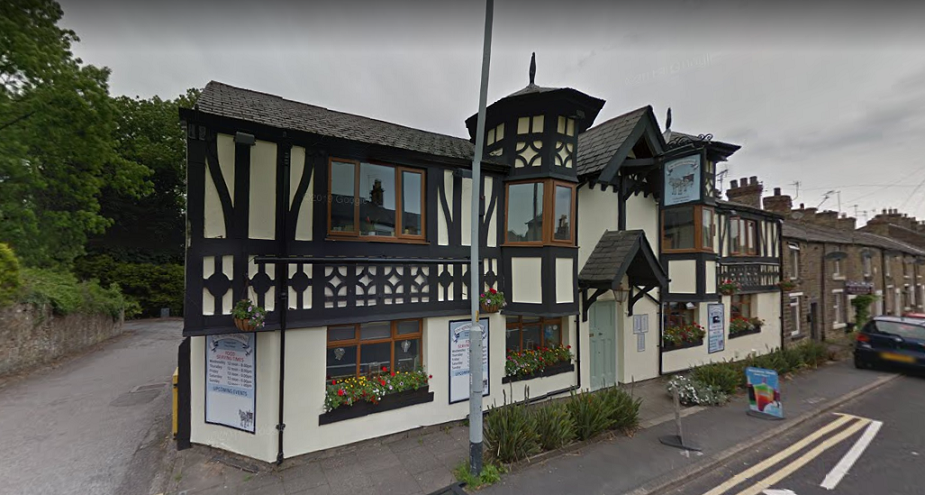
Spring
The Spring Gardens on Compstall Road. A photograph taken from Google streetview, because it is so much better than the photograph I took.

And here the matter must rest, alas… the trail went cold. I emailed the Spring Gardens asking if they had any information about the stone’s whereabouts, but sadly to date I have not heard anything back. I will pop in for a pint (or two) when lockdown ends and make an enquiries then, but I am not holding out hope. Even the wonderful Marple Local History Society people had no information about it (my thanks to Hilary Atkinson for her help). It was most likely lost or made into part of a patio, which is a shame as this little slice of history is no longer widely known about.  

So there we have it, a tale of improbable escapes and graverobbing. If I find anything more about the stone or the graverobbing, I’ll let you all know. In the meantime, stay safe and look after yourselves and each other, and until then I remain, 

Your humble servant, 

RH 
Archaeology · Wells

Some Lost Mottram Wells – An Update

A while ago I posted a blog entry about some named wells in the Mottram area.
Read the post here to refresh your memory, it’ll help with what follows.

We were facing a slight conundrum. The issue was that there was the two wells in the one field – neither of which was really visible on the ground – coupled with the fact that one of them was called Boulder Well, a very specific place-name, despite there being no associated boulder. Oh, and there was a boulder in a different field, but with no associated well. Well, I think I have found out what it all means. Probably.

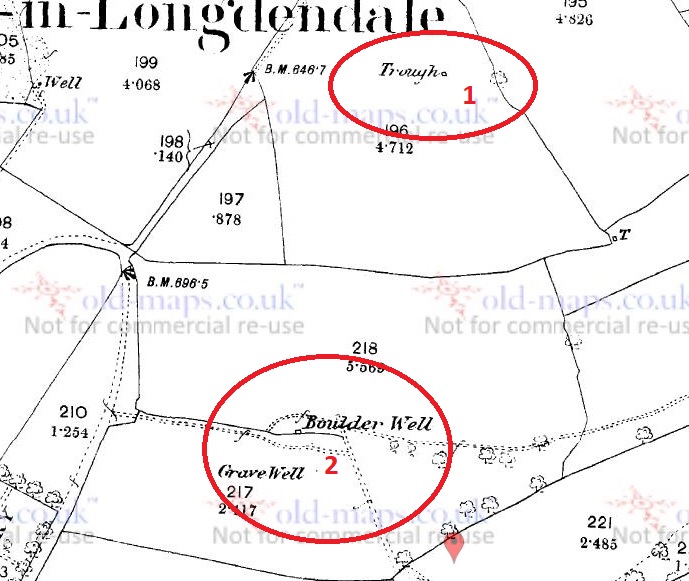
The map, first of all.

Well 1
The two named wells are in the bottom circle, marked with a ‘2’. The boulder in the original blog post is in the upper circle, roughly where the tree is on field boundary. 

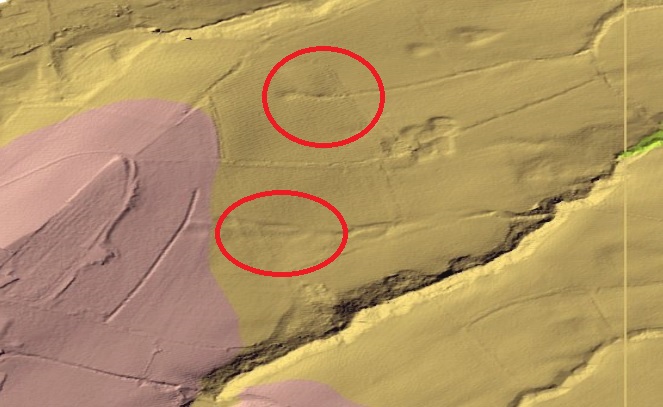
I was looking over some Lidar images of the area, and noticed something interesting. For those of you who don’t know, Lidar is a method of using light (laser) to map the ground surface, allowing for a greater contouring of the ground, and revealing every single bump and dip on the surface. Quite literally, everything – it simply strips away trees and vegetation. It’s application as an archaeological tool is enormous, and it allows us to not just identify, but to map, record, and categorise all sorts of things that are invisible on the ground.

Like old wells, for example.

So, using the government’s Lidar website (highly recommended, by the way),  this is what I saw.

Lidar 1
Despite being a mass of lumps and bumps, this is broadly the same area as the map above.

To help you identify the area better, here is the same image with the red circles on it.

Lidar 2
The upper circle is where the boulder is, the lower is where the two wells are on the map. 

What the image shows is that where the two wells are recorded on the map – Grave Well and Boulder Well – there is only the remains of a single feature. You can see the line of the waterway moving from left to right, passing through the lower circle, and eventually draining into the small valley there. Single feature, a single well. Not the two wells recorded on the map.

Now look again at the upper circle. The field boundary where the boulder is can just be made out, but to the right, precisely where there is a ‘trough’ marked on the map, is a spring head, and you can see the drain, running east and again emptying into a small valley. There IS a well there, it’s just that you can’t see it on the ground.

Looking again at the map, we can see only one well place or structure in the lower circle. This, I humbly submit, is Grave Well, not Boulder Well – its location right next to the graveyard is the clue. Boulder Well is situated in the upper circle, next to… yup, you guessed correctly, the boulder, and the trough marked the place where the spring issued forth. This makes sense.

I am convinced, then, I have rediscovered the location of Boulder Well.

All this is clear on the Lidar, but as I say, cannot be seen on the ground. It also means that the OS people made a small mistake in naming the wells – but then if a local says “yes, Boulder Well is just above Grave Well”, how literally are you to take them?

I need to go back and take some more photographs.

So there you have it. As Bertie Wooster was fond of saying “The lark’s on the wing, the snail’s on the thorn, God’s in His heaven. All’s right with the world!”.

Comments and discussions, even arguments against the newly rediscovered well will all be gratefully received. Also, I have a few more blog posts that are about to be published, so keep your eye open.

As always, I remain your humble servant.

RH

Stones of Glossop

Multiple Milestones

Well, three to be precise.

What ho, what ho, what ho! So, I’m back from my summer holiday. Actually, I was only in France for two weeks (with lots of cheese and wine), and the rest of the time I have been busy with life… alas. I have loved the weather here for the last 10 weeks – a decent summer at long last, and the polar opposite of the spring we had. Bizarre.

So, missing out August completely, I’m back with a bang, and hopefully more than one post over the weekend, here we go.

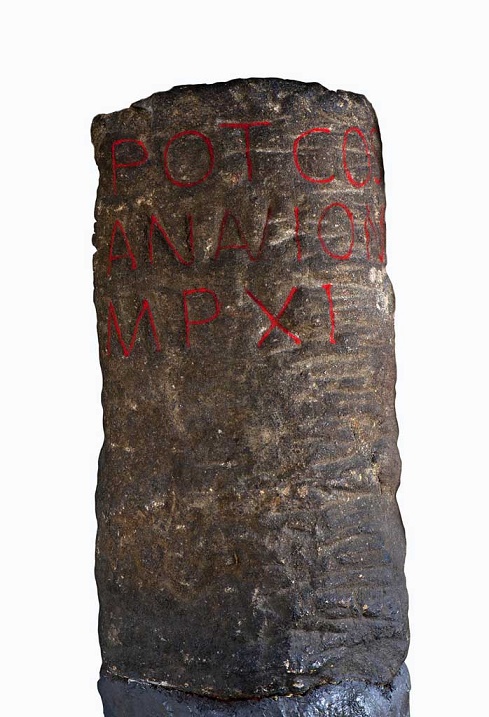
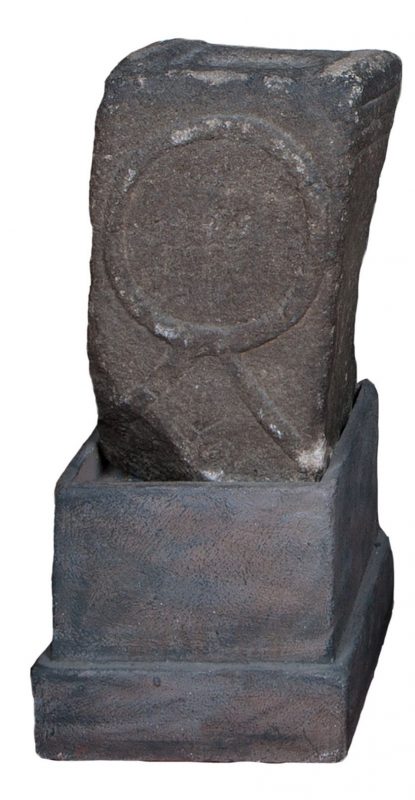
I love milestones. There is something so definite and so grounding about them, and the way in which they locate with reference to other places – you are X miles from Y – you know exactly where you are in the world. They have a long history – the Romans used them all the time, and in reality, they haven’t changed since. This one was found in Buxton, and is inscribed with the following: “TRIB POT COS II P P A NAVIONE M P XI”.

Roman Milestone
Buxton Roman Milestone, found in 1862 (and shamelessly stolen by me from the wonderful  ‘Wonders of the Peak‘ website). Honestly, it is well worth taking the time to look around the site.

Which translates as “With tribunician power, twice consul, father of this country, from Navio, 11 miles”. The Roman fort of Navio is at Brough, near Castleton (information here). This is a great little fortlet, right on the river there, and well worth a trip out to see it. There’s not a great deal to see as such – rather like Melandra, it is lumps on the ground, requiring a bit of imagination – but it produced some fascinating archaeology. My favourite being an altar to the goddess Arnomecta – a local goddess, about whom we know nothing at all. She may be the same as the Goddess Arnemetiae who gave her name to Roman Buxton – Aquae Arnemetiae, but then again possibly not. Something about that both fascinates and frightens me – a lost Goddess.

DERSB-1979-1301-415x800
Altar dedicated to Arnomecta – stolen again from the wonderful Wonders of the Peak website (use the link in the text above it for more information on the stone).

But I digress… where were we?

Milestones. Mine are nothing like as old, but they are interesting. Honest.

The first is located on the Woodhead Road/B6105 by Allmans Heath Farm and B&B. It is carved into the side of a mounting block, used for getting onto horses, is/was painted white, and it simply states ‘Glossop 1 mile’ with an arrow pointing the direction.

MB1
The milestone is at the bottom, carved into a niche. The ring on the block would have held your horse in place whilst you climbed aboard.

MB2
Close up of the milestone: “Glossop 1 Mile”

Now, the mounting block is clearly old. They don’t make them anymore, for one, and the fact that the ring has been set in place using lead would certainly age it to the Victorian period, and potentially earlier. The carving is another matter altogether. I had assumed that the words would have been carved in the Victorian period, but on the way to take the photograph, I got speaking to the owner of the house there who informed me that they were only 10 years or so old – her ex-husband, being a stonemason, carved them. Well, why not? The fact that the mounting block sits next to a very old stone gatepost (on the right in the upper picture) suggests that the owners had moved the stone to the front wall in order to create a feature, which it does.

So, this one might not be of any great age, but the next two certainly are, even if they are slightly out of the area.

I went looking for the fabled White Stone of Roe Cross the other day.

I say fabled as there is very little information about it, and I was hoping to see it to put in my two penn’orth about what it is, why it is, and where it is. It is mentioned in Sharpe’s “Crosses of the Peak District” as potentially marking the junction of the boundaries of Matley, Hollingworth, and Mottram, so I thought it would be worth a look. Alas, I failed utterly to locate it, although I did get as near as White Stone Cottage, so I could’t be too far away. It has almost no presence online, either, besides a letter that was written to protest against the proposed Mottram bypass which mentions it in passing, and references to White Stone Cottage.

If anyone knows the location of the stone, please let me know, as I’d love to see it – and you all know how much I love a good stone.

Now, that same letter, also mentions a carved milestone in that area, and thinking it might be worth a look, young Master Hamnett and I set off down Dewsnap Lane to find it. Which we did in record time – standing alone in a right hand turn into the riding stables there (the location is shown by the red circle on the map below).

IMG-0810
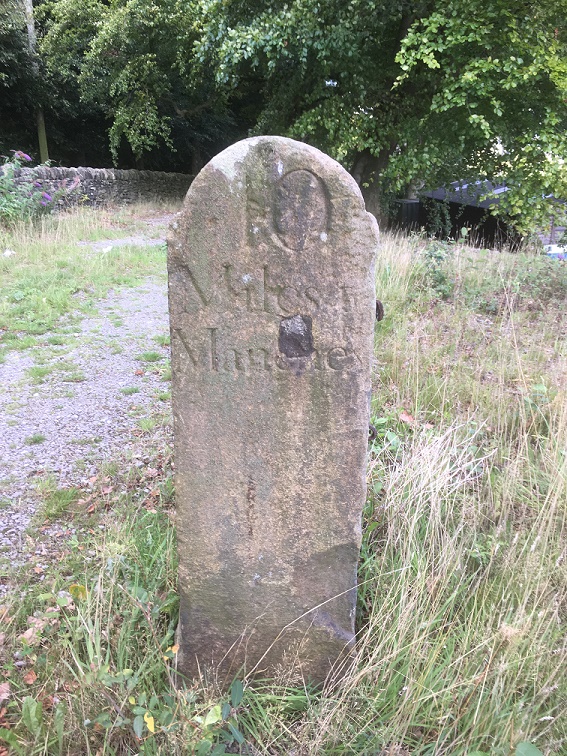
The Lonely Milestone

The stone states it is “10 Miles From Manchester” and I have no reason to doubt that. It has clearly been used as a gatepost at some stage, and you can see the hole where the hinge was mounted.

IMG-0811
Close up of the writing and hinge hole. 

As I turned around to leave the stables area I noticed another milestone, this one placed against the wall.

IMG-0808
Another milestone

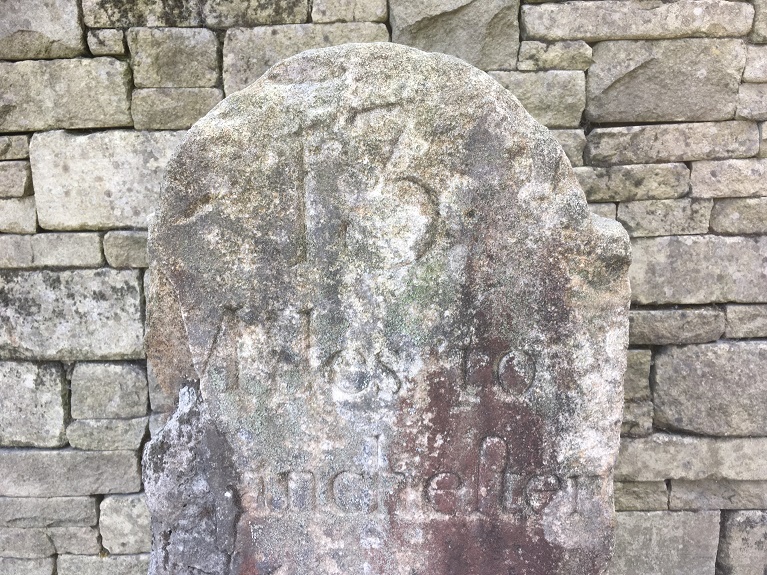
This one proclaimed itself to be ’13 Miles From Manchester’.

“Hmmmmm”, thought I. “Ice cream” thought Master Hamnett.

IMG-0809
Close up of the carving.

Now, I know what you are thinking… that Roe Cross is a geographical anomaly, being simultaneously both 10 and 13 miles from Manchester; a quantum place, if you will.

The two stones are obviously carved by the same hand and at the same time – the rounded top and squared shoulders are the same in both instances, and the stone is the same – a coarse sandstone. The writing is also the same, and with the ‘long S‘ in the word ‘Manchester’, we can roughly date it to not later than the first half of the 19th Century, and possibly a little before. After this time it falls out of use, and people used the ‘short S’.

So what are they doing there? I don’t know for certain, but I have a possible/probable answer.

The ‘Deep Cutting’ between Mottram and Matley/Roe Cross was opened in 1826 as part of the Manchester to Saltersford turnpike road. Essentially, it allowed easy access between Yorkshire and the east of the country, and Manchester and the west. Prior to this, the roads were in a terrible state of repair, and the heavily laden packhorses that made that journey really had to struggle. The turnpike roads were privately financed and built, and in order to recoup costs they operated as toll roads, charging for their use (think M6 Toll road for a modern comparison).

The toll gate at Roe Cross, the place you had to pay for passage, was situated here:

Map - Roe Cross
The Roe Cross Toll Gate is marked on the map (indicated by the arrow). The circle shows where the milestones are now situated. This from the 1875 1:2,500 OS map.

Now, obviously, the milestones are not in their original location, and I would like to suggest that they were originally situated near to, or at, the toll gate, showing the distance to Manchester along the road. However, if that was the case, then why the difference in distance? Well, perhaps the ’10 Mile’ sign was put next to the new road, whilst the ’13 Mile’ sign was by the original, old, road. With both signs showing, most people would want to shave 3 miles off their journey, and travel along a new well surfaced road, rather than along a muddy track, pitted with animal and cart ruts – after all look how many people use the M6 Toll Road. The tentative date of the stones, too, fits with the construction of the road – the first quarter of 19th Century.

Of course, once the toll gate ceased to exist, the stones lost their usefulness, and particularly once new, more clear, signs began to be used on the roads. However, instead of being broken up, their size and shape is perfect for a gatepost, and so they were hauled a few hundred yards up the hill and given a new function.

Well worth a look of you get chance, and there is lots of good walking to be had up there. I am going to have good explore myself sometime soon, particularly up Gallowsclough, which, as a placename, can have only one meaning – ‘the valley where they hanged people’. Blimey!

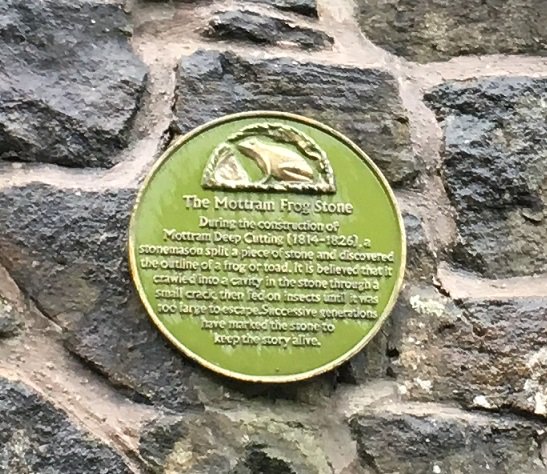
Incidentally, I love the Deep Cutting for the Mottram Frog Stone which is celebrated on the wall there, about half way down on the right (going from Mottram to Stalybridge). I couldn’t do this post and not mention it – I tweeted about it, but it is so good, that it needs to be celebrated on the blog, too.

The truth or plausibility of the story is much less important than the legend – no one criticises a fiction story for not being real, one just enjoys it!

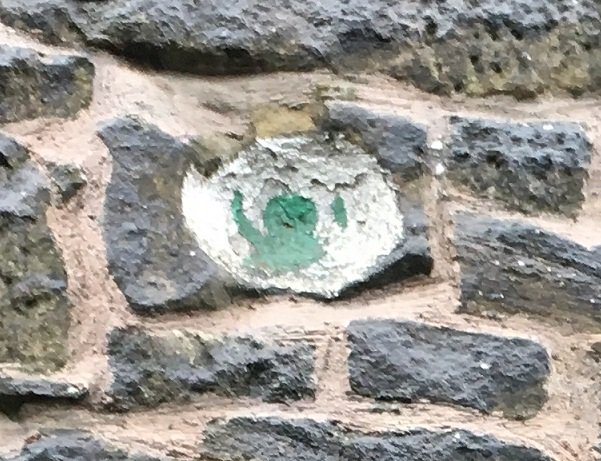
The stone itself, marked with a green frog. 

There may be more this weekend, if I can manage it, but I will try to get back to my one a week post target, so stick around. Thanks for reading, and please, as always, comments and corrections are always welcome.

RH

Archaeology · Wells

Some Lost Mottram Wells

I thought I’d venture a little farther afield this week. The blog is intended to explore Glossop’s heritage, but I feel that if I can see it from Glossop, I should be allowed to blog about it… even if it is in another county.

But don’t worry, we won’t be going to Yorkshire!

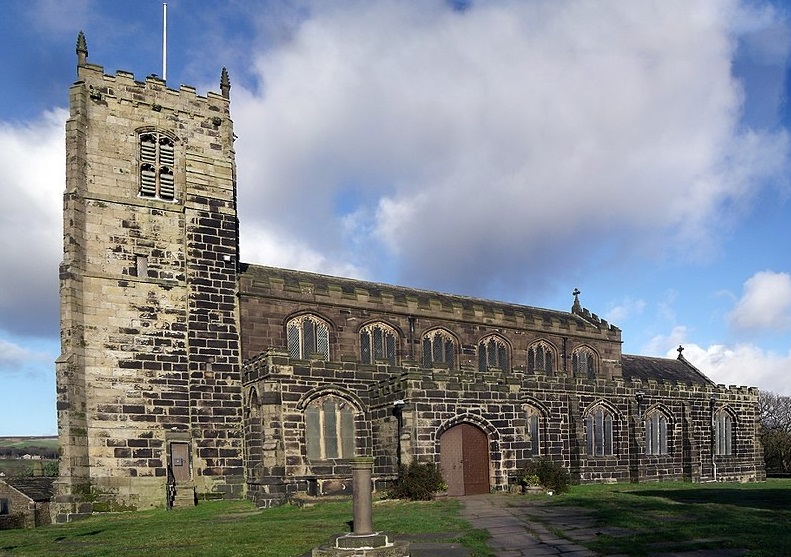
St Michael and All Angels church in Mottram dominates this end of Longdendale – it is visible from all sorts of angles, disappearing as you travel various roads and paths, only to pop up unexpectedly from behind buildings or between trees. Indeed, it’s presence keeps watch over the valley, almost as a reminder that the church watches over the people. In fact, I can see it from James’ window, on the distant brow.

Mottram Wells - Church
St Michael and All Angels, Mottram. Photograph by Stephen Burton.

It sits on a prominence called War Hill (from the Middle English Quarrelle, meaning quarry), and is a particularly bleak place, catching all the wind that roars down Longdendale from the moors. The church itself, though severely ‘improved’ during the Victorian period (read, monkeyed around with and partly rebuilt) is still at its heart essentially late medieval in date – mid 15th Century or so. Going further back, it may well have been the site of Saxon church prior to that. Travelling even further, there is evidence in the form of cropmarks that it might have been the site of a Roman signal station connected to Melandra – a perfect place with commanding views up and down Longdendale. Prior even to that, particularly given its prominent location in the landscape, it must surely have been attractive in prehistory, though there is no evidence at present.

As an interesting aside, during the late 17th Century a whole pile of my ancestors, the Williamsons, were ‘hatched, matched, and dispatched’ here (that is, they were baptised, married and buried). The Williamson family married into the Sidebottom family who were fairly big in this area, were important in the early Industrial period, and were consequently quite wealthy. Alas, my line gradually becomes poorer, and we end up in East Manchester working in a mill, rather than owning it.

Mottram Wells - Williamson
Signature of John Williamson, my great, great. great, great, great, great, great grandfather, born in 1678 in Mottram, and who married Elizabeth Sidebottom on 15th February 1703 in Mottram Church… exactly 315 years to the day, today, coincidentally, and rather spookily.  I will raise a glass to them whilst looking at the church as soon as I have published this post!

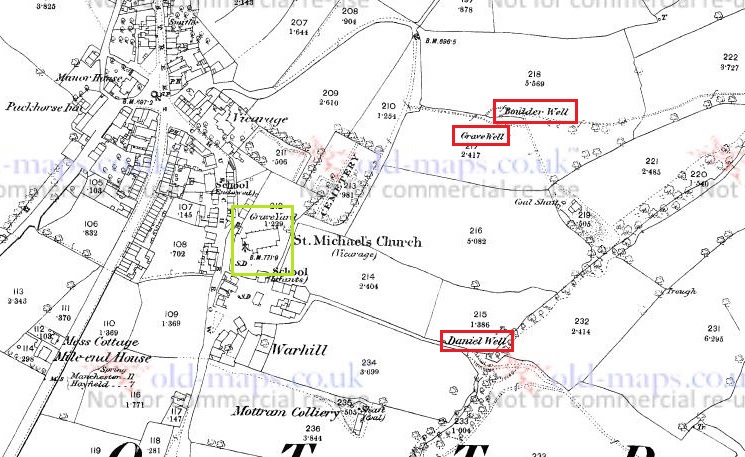
Perusing the old OS maps of the area, as I am wont to do (here), I noticed three wells in the immediate vicinity. Now, nothing unusual there, the whole area is teeming with them as we live in an area with a high number of springs. However, what was unusual is that all three, very close together, were named. Normally, a well is simply marked ‘well‘ on an OS map, but the fact that these have names could indicate that there may be more to them. And what names they are – Daniel Well, Grave Well, and Boulder Well – names that conjured up wonderful images. Well, well, well, I thought, this must be worth an investigation.

Mottram Wells - Map
The three wells, Daniel, Grave, and Boulder, are outlined in Red. Mottram church is outlined in green in order to get your bearings. This is from the 1886 1:2500 OS map. Note also the Coal Shaft and Mottram Colliery marked – the area has a very low quality coal seam running through it that was sporadically mined in the 18th and 19th centuries.

And so it was.

Daniel Well is situated on the left, northern, side of a track that comes from War Hill along the side of the school, and downhill to a pond. Interestingly, the only artefactual evidence from this exploration came from this first part of the track, just behind the school playground.

Mottram Wells - Bottle
1/3 pint of Co-Op school milk in a squat bottle. This really is a nostalgic trip!

I am just about old enough to remember free school milk, and these are the bottles they came in… It has been over 30 years since I touched one of these last, and the feeling was one of immediate nostalgia and a weird sense of happiness. Silver foil top and a blue plastic straw… I was back in Bradshaw Hall Infants School, just like it was yesterday! What I love about this artefact is that the only way it could have ended up on the track behind the playground is if some naughty child threw it over the fence… if you put it to your ear, I swear I can hear the “vip, vip, vip” sound of Parka coats rubbing together and the cries of “go on, I dare you… chuck it!”.

On to Daniel Well, then. The sunken path is muddy, but well constructed and was clearly used – I wondered if this was the main well for the area. My first sight of it seems to confirm that thought.

Mottram Wells - Daniel Well 1
Daniel Well, overgrown and unloved. Beyond is the playing field of Mottram School, and beyond that, Longdendale.

The path widens out at this point, and the stone built well head structure stands well built still. The path is very boggy, and although the well is overgrown and possibly relatively dry in terms of water within it, the spring that created the well is still flowing freely downhill.

Mottram Wells - Daniel Well 2
Close up of Daniel Well. Stone built arch, and side platforms upon which to put your buckets, bottles, etc.

The stone-built arch that is the front of the well goes back some three feet, although it is sadly now full of collapsed rubble. To me, this seems a sad end to what was one of the most vital aspects of the village – lives were, quite literally, saved with this water. Food, drink, laundry, baths, all came from this point. People who met drawing water here married in the church above, and had children. Gossip and community, focused on this place, and yet, no longer. I would love to see it restored, or just a little better cared for.

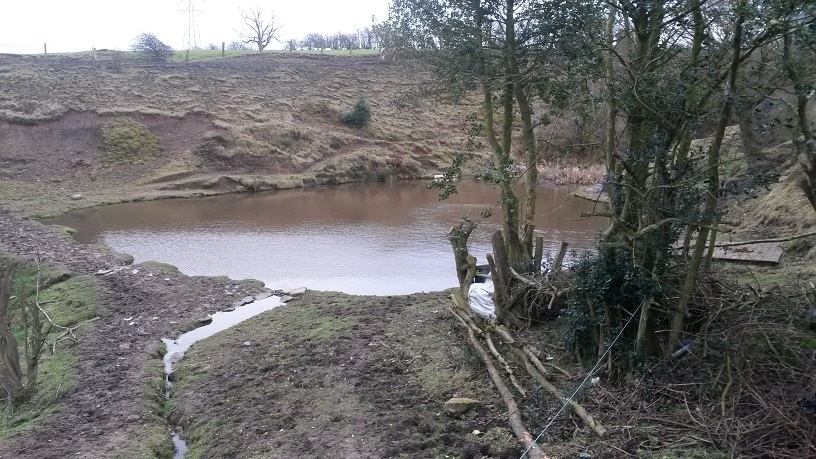
Following the path down, the water flows into this secluded and sheltered pond.

Mottram Wells - Pond
The pond from the end of the track. The water flowing into it from behind the camera comes from Daniel Well. It then flow out again through a channel to the left.

Clearly Daniel Well was an important well in the area – the path and the stone built well head attest to this. I have no idea about the name, though – possibly from a personal name of the person who owned the land? Something Biblical, maybe? Any thoughts, anyone? The 1954 1:10,00 sees the last mention of Daniel Well on an OS map, and clearly by that point it had ceased to be important as a water source. Sadly, I doubt anyone living nearby would know it was there now, or at least know that it had a name.

Making my way back up, I decided to look for the other two wells. I had studied Google maps before exploring, and took a while to work out the locations by superimposing the old map field boundaries onto the modern satellite image of the area.

Mottram Wells - Overlay2
4 is Daniel Well, 3 is Grave Well, and 2 is Boulder Well. 1 becomes important in the discussion below. The black lines are the field boundaries shown in the 1886 map that are no longer there to help with orientation.

Alas, there is nothing left of Grave Well except a muddy patch in the field.

Mottram Well - Grave Well Site
The muddy area in the middle ground, in the slight dip, corresponds to the location of Grave Well. The ground was boggy and is clearly a spring of some sort. The view is looking south.

I am not sure what would have stood here originally – perhaps a structure like that at Daniel Well, but I feel this is unlikely: it is in the middle of the field, and with only a minor footpath to get to the well. No, I think it more likely that it was a simple affair that held some water where it bubbled from the spring underneath. I love the name, though – obviously derived from its proximity to the burial ground of the church, out of view to the right in the photograph. Either that, or it may recall the discovery of a burial in the immediate area. Either way, it does raise interesting questions about water tables and burials, though, and I’m not sure I would like to drink from Grave Well! Its last mention before it disappears into the veil of history is on the 1882 1:10,000 OS map. It clearly lost its importance, and was gradually forgotten about.

Pushing further on I looked for the Boulder Well and, when I found it, was similarly a little disappointed… at least at first, anyway. It was another muddy patch.

Mottram Wells - Boulder Well
The muddy patch in the left foreground corresponds to the location of Boulder Well on the map. The view from here, looking east, is incredible – Longdendale Valley at the left, Glossopdale at the right, and the hump of Mouselow just right of centre. Melandra is somewhere dead centre of the photograph. Despite it being dark, I am quite proud of this photograph.

As with Grave Well, I am not sure what would have stood here originally – probably nothing much. Also, in common with Grave Well, the last mention of it on the OS map is the 1882 1:10,000 map, after which it disappears, and is gone forever. The name intrigued me, though: Boulder Well is a very specific name, deriving from… well, one assumes… a boulder. The lack of boulder is, then, confusing, and a little disappointing.

I pushed on regardless, to see what I could see. And lo! In the next field north, at the edge, there stood a bloody big boulder!

Mottram Wells - Boulder Well2
The boulder! Looking north. It is marked as point ‘1’ on the satellite map above.

Mottram Wells - Boulder Well3
Close up of the boulder. It is a glacial erratic of some sort, rounded and left behind by the retreating ice.

Now,  although it is in a different field, this must be the origin of the name Boulder Well. Indeed, it appears to have been moved ‘recently’ – it is sitting on top of the grass, rather than embedded in it. However, if it had been moved, this at least would explain why it is in a different field from the ‘well’, and why it now stands comfortably out of the way at the field boundary. I wonder when it was moved, and where it stood originally.

Mottram Wells - Boulder Well4
The boulder, with the Longdendale Valley behind it.

The fate of these wells is interesting, and is obviously tied to the introduction of clean piped drinking water directly into your home. We – and I am very guilty of this – have a tendency to romanticise the past, and a wish to remove the trappings of modern day living, to peel back all the ‘progress’ we have made, and to revert to a simpler way of life. I love the idea of having to walk to a well to draw pure cold water, it would be so… earthy, grounding, basic. Free and simple.
But then I have never done it in the rain, sleet, or snow, wearing ill fitting wooden clogs, wrapped in a basic cloth shirt, slipping down a muddy unmetalled path, after having worked 15 hours in a mill.
I may yearn for a less commercial, more simple life… but I don’t yearn for pneumonia.

Hope you enjoyed the jaunt around Mottram. I have a few more posts I’d like to do about various wells – they intrigue me – so watch this space.

As always, comments of any kind are most welcome.

RH

Graffiti · Mottram · TAS

Graffiti – Update

There is still lots to do, and lots more to find – but I saw this the other day, up on Cliffe Road, on the exterior wall of a garden.

Graf
T & J captured forever! I like to imagine a married couple (Tommy and Jane?) still together but now in their nineties, and who still feel a pang of guilt every time they walk past this wall. 

Who ‘T & J’ were, we may never know, but the stone has been re-used from elsewhere to build the wall – which means someone saw the graffiti and thought to keep it right side up and readable, which I think is nice.

Now, more seriously. I mentioned the book, Medieval Church Graffiti, in the last graffiti post (here). It is a really interesting read, and has resonance in the work I do at the Blackden Trust (link here), so I can’t recommend it highly enough. However, the rather incredible folk at Tameside Archaeological Society (website here) have begun their own project at Mottram St Michael and All Angels, looking at the graffiti there… and coming up spades (pun fully intended). Their brief report is here, but let’s hope for more soon. Actually, in a way, I’m annoyed, as as soon as I read the book, I thought “I know, Mottram church, that’ll have some graffiti, and I’ll be able to post it on the blog…”. But I have been beaten to the punch.

However… If anyone fancies spending an afternoon or two in Glossop’s All Saints Church looking for graffiti, give me an email. Although the building as it stands dates largely from 1831 onwards, it replaced the medieval church, and reused some stone in the rebuilding process, particularly in the nave. There may be something left behind… perhaps. Anyway, drop me a line – but at least glance at the book first (here).

The next post (Thursday… probably) will be based around Mottram church, so keep your eyes open. Oh, and more pottery is incoming.

TH