What Ho, dear and gentle readers!
I am tired. Honestly… I am beaten. Sincere apologies for the lack of activity here recently, but my life is now full, and I am having to do all manner of things in order to just exist! Full-time work at school (where I am Mr, or Dr, CG), volunteering at Cubs (where I am Bagheera, believe it or not), and being a parent (where I am dad – or Fat-Her, as Master CG insists on calling me), plus all manner of adult bollocks, like shopping and housework, get in the way of archaeology. As a consequence, balls that I would normally be easily juggling (and yes, I can juggle, before Mr Shouty-Outy asks) are occasionally dropped. And, as I say… I am tired.
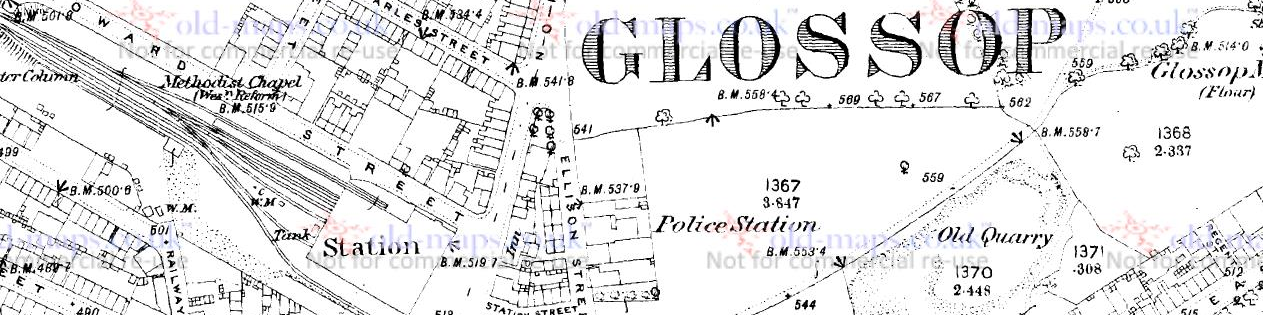
In addition to all that, I occasionally run guided walking tours in the area – essentially a live action version of Where/When, which, depending on your opinion could be a good thing… or a complete nightmare (yes, thank you, Mr SO… we all know which camp you are in). And so it was last Sunday – a Wander happened! A group of wonderful people honoured me by allowing me to bleat on at them about medieval field systems, Anglo-Saxon crosses, Victorian housing, and whatnot for 3 hours as we Wandered from The Beehive in Whitfield to the Bulls Head in Old Glossop. I enjoyed it, and they also seemed to. Well, no one physically assaulted me at least, so I’m chalking that up as a win.
As we were Wandering the track from Pyegrove to Old Glossop, and just after having a mini discussion about finding bits of pottery along here, I found one, then another, that were different from the usual background noise of Victorian stoneware and blue and white. And here, for your delectation, I present them to you.
Sherd 1 – The Brown One

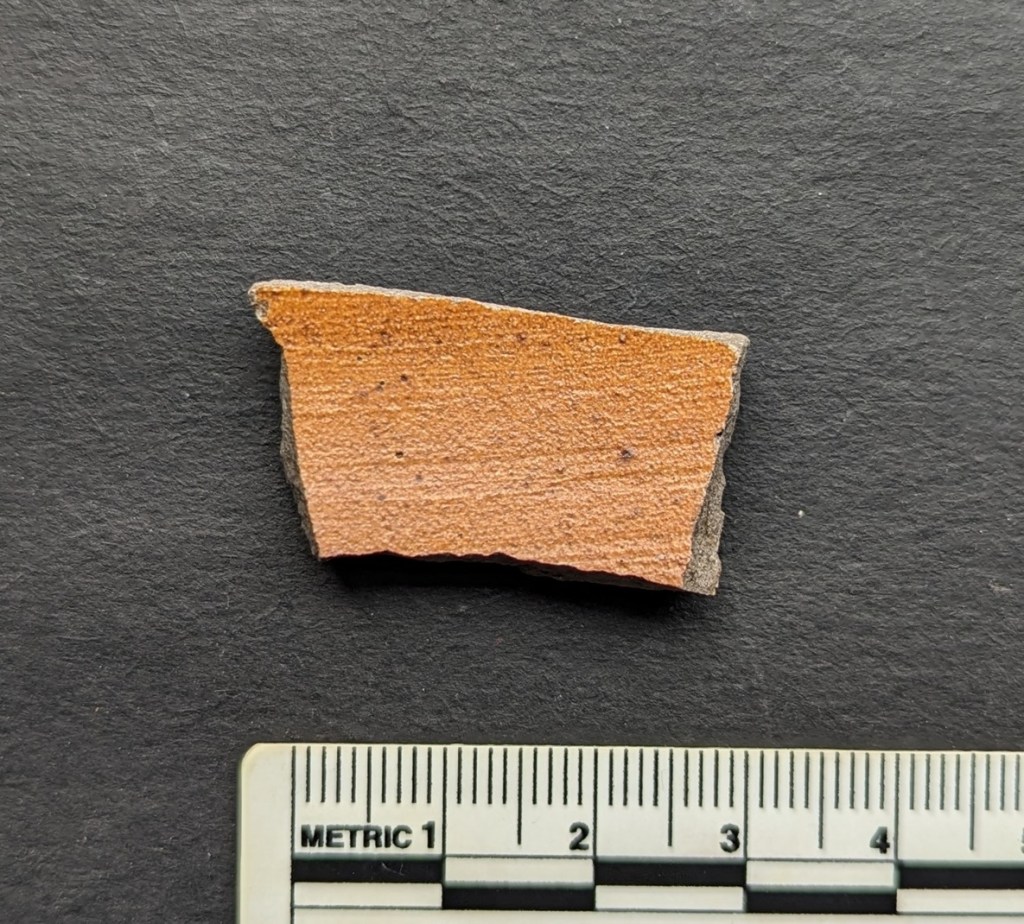
What we have here is a fragment of Nottingham Stoneware, and probably from the rounded belly of a jug or possibly a large ‘loving cup’ with large high handles – certainly something with a thin wall, anyway (it’s just 4mm thick). It has a diameter of c.16cm, and has very characteristic horizontal banding around its belly, engraved using a lathe whilst it was ‘leather hard’ during the drying process, and prior to firing in the kiln. The exterior was slipped in a white mixture, before the whole was covered in a salt glaze and then fired to this lovely warm brown. That stated, it doesn’t have that melted chocolate colour and feel that I associate with earlier examples, so is perhaps late in the Nottingham tradition? I’d say it dates to about 1730, possibly a smidge earlier… maybe 2 smidges.
The exterior surface is smooth – the result of the white slip applied, covering over the natural impurities (different coloured bits) in the clay that are visible in the fabric section (as darker bits against the almost uniform grey), and give it the ‘salt and pepper’ colouring. Also visible are the voids – often long and thin – caused by gases expanding within the clay whilst it is being fired.
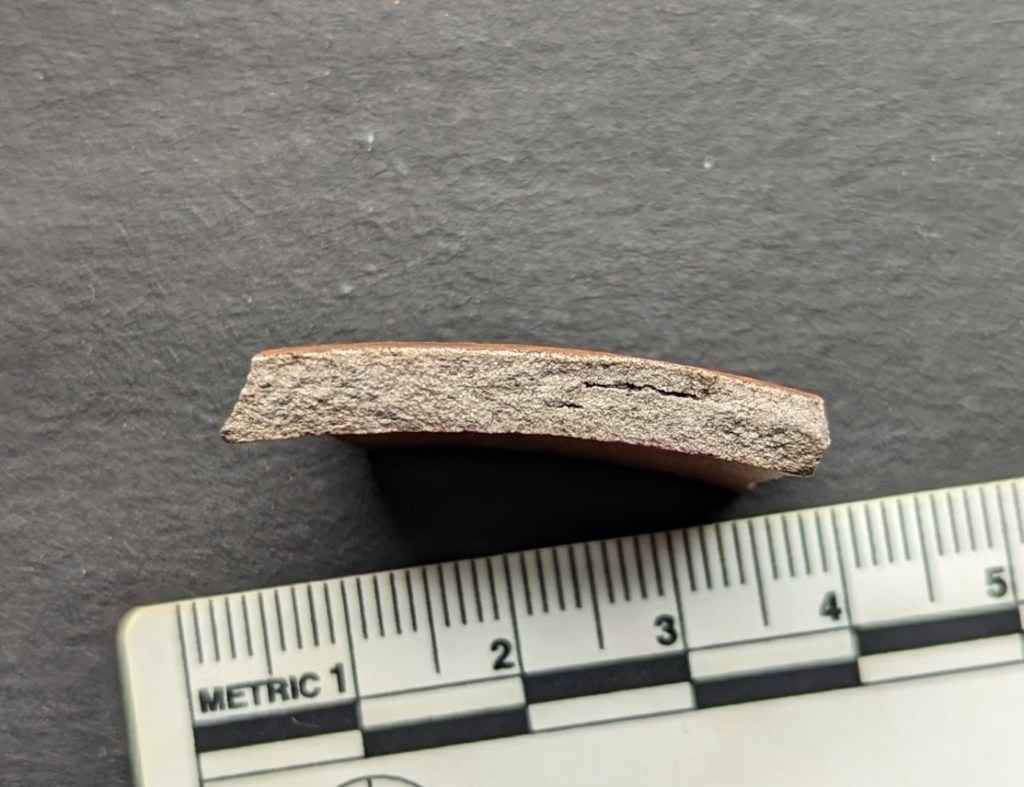
These ‘bits’ are also visible on the interior surface, which, along with the fact that this is much rougher than the exterior, suggests that it is a fragment of a jug rather than a ‘Loving Cup’, as this side was clearly never meant to be seen.
The ware type as a whole was discussed in the very first Rough Guide to Pottery back in 1722 2022 (I know, I know… it’s been a while; I’ll finish it soon, honestly), and I genuinely love it. Even the more commonly found Derbyshire Stoneware – the mass-produced Victorian utilitarian stuff – always makes me feel happy when I find it. And yes, I realise this says a lot about me, but, dear reader, I am always honest with you.
Interlude: I wrote that sentence, then read it back. Interesting. As archaeologists – or even as simply interested ‘normal’ people – we don’t often talk about this, the emotional response to finding a broken bit of old pot, the simple, almost childlike, joy in finding. I mean, a lot of people would simply never see it in the ground, walking over it and on. And of those that do, I’d wager a large number would also simply ignore it. Not so us, though. Nope, not us… we few, we happy few, we band of buggered! (apologies to Shakespeare, and my thanks to Whedon). No, we stoop and scoop it up. A little moment of joy, a fragment of history held in our hands, and a connection with the past in the form of decorated clay. It doesn’t matter if it’s the most mundane bit of plate, it’s all wonderful stuff.
Anyway, moving on.
Sherd 2 – The Other Brown One
Alright, so colour choice was not huge in the 18th century! This is a lovely fragment of a Staffordshire Slip Coated pot-bellied mug or perhaps more likely small jug. It has the characteristic dark brown/black exterior, and lovely honey coloured interior.
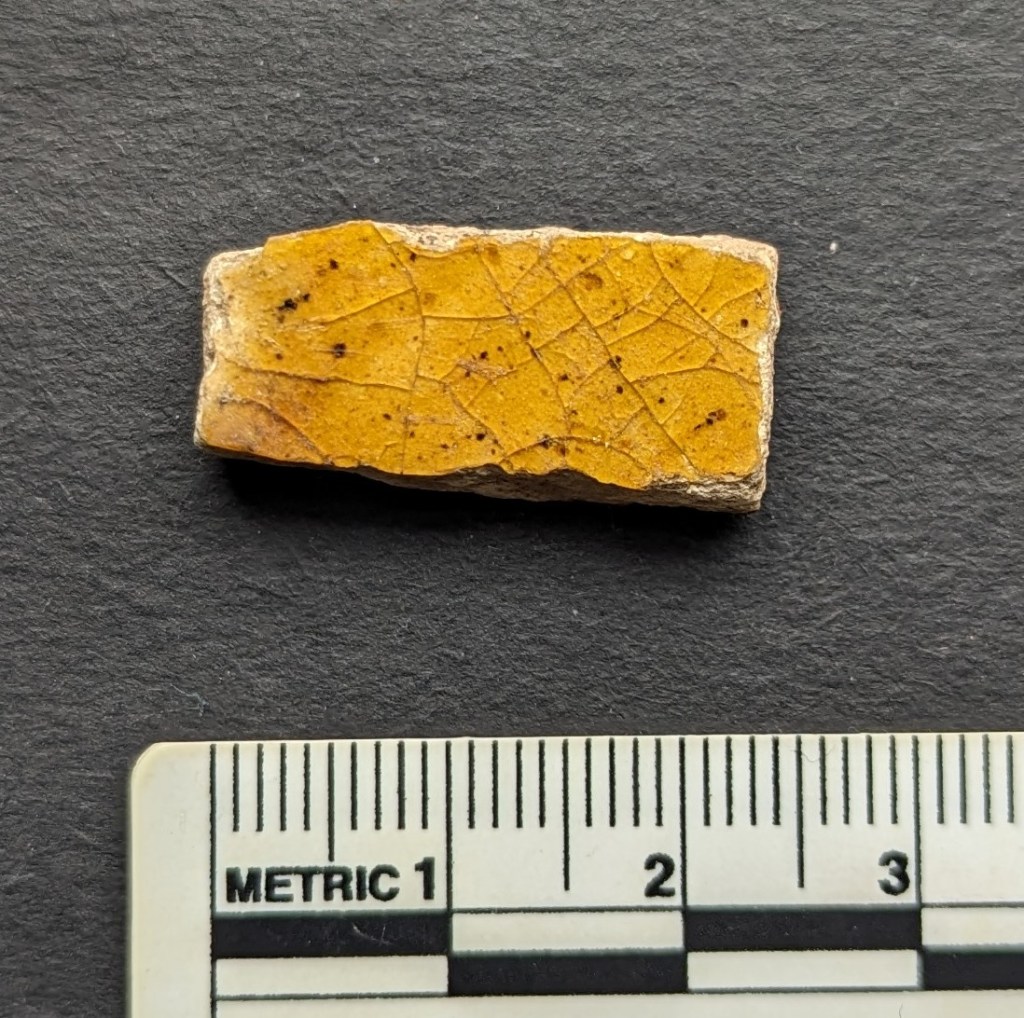

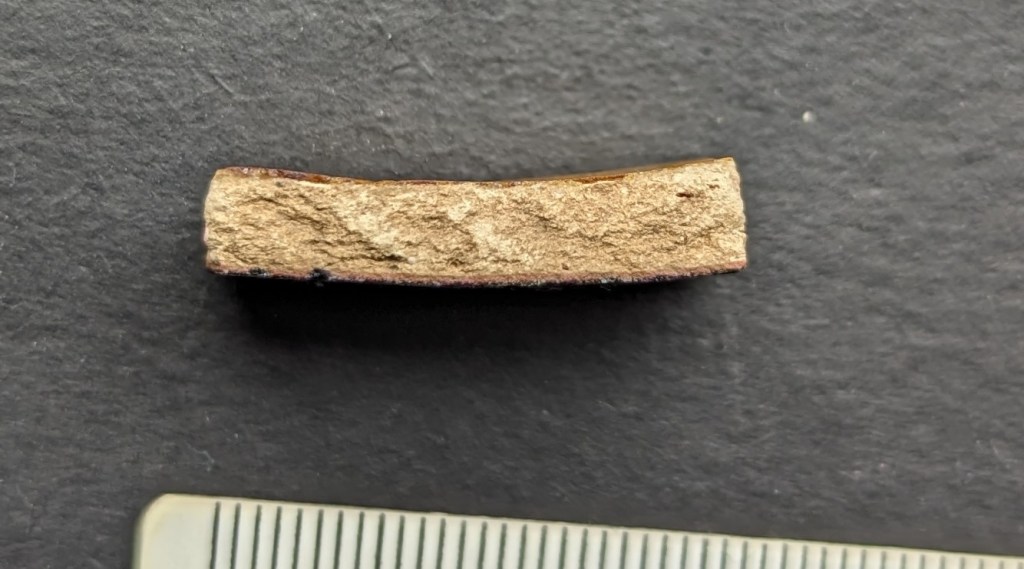
The colouring here was achieved by giving the exterior a slip of red (just about visible in the section), before the whole lot was glazed. The lead based glaze turns almost black where it covers the red slip, but fires yellow over the pale, un-slipped, interior surface.

The speckled colouring of the interior surface is the result of the glaze darkening over the inclusions in the clay – probably in this case natural small stones, but also reddish pieces of grog (crushed pottery) added to the clay to improve strength. You can see these bits in the fabric in section:
Originally, it probably looking something like this:
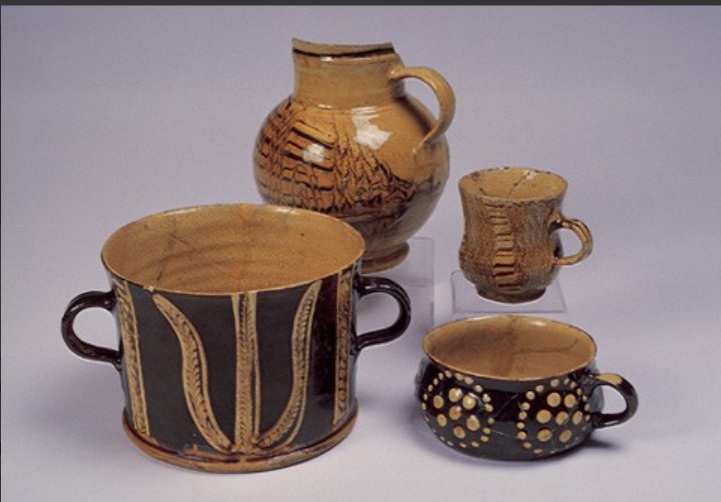
Date wise, it is similar to the Stoneware sherd above, but a little earlier – say 1700-1720? Although, potentially, it could be as early as 1650.
The track, as I said, leads from Pyegrove (first mentioned in 1631) to Old Glossop, and was an important route from Hurst (first mentioned in 1550) and Whitfield area at one point, and we may assume it is older than these first mentions. It has seen a lot of people travelling along it, and occasionally people drop things – the things we find.
Incidentally, this trackway is the subject of No.3 of Where/When – Of Hives and Heads – the archaeological and historical Wander from the Beehive to the Bulls Head. If you fancy walking the trackway, follow this link and buy a copy.
As I was writing this blog post, I was taking advantage of the unseasonably warm weather and was doing a spot of gardening. Digging through the soil, I was keeping an eye open for the Victorian pottery that occasionally pops up to say “what ho!”, and was rewarded by this wonderful sherd:


Nope, not Victorian, but somewhat older – I’d say early 18th century, or perhaps even late 17th at a push. It’s another fragment of Slip Ware, although again without any decoration, and again I think from a jug. The fabric is very similar to the other example, and it too was probably made Staffordshire.

It makes a nice change to find this instead of the normal Blue and White stuff, although where it came from, who knows. Whitfield is very old, as you know, gentle readers, so perhaps one of the houses that were here before the Victorian building boom utterly changed this once quiet rural place. Oh how I would love to have a Wander around 17th/18th century Whitfield.
And on that subject – Wanderings – the newest edition of Where/When is on sale as we speak:

An exploration of the Longdendale Trail from Hadfield (The Palatine) to the tunnel entrances – £5 from the above link, or pop into Dark Peak Books on High Street West. I’m also planning a series of other Wanders over the summer (watch this space) as well as some other interesting stuff – talks and the like.
More to follow later in the month (I hope), but for now, look after yourselves and each other, and I remain. Your humble servant,
TCG.



 The Glossop Cabinet of Curiosities