A glorious weekend – I got all my vegetables planted, the garden was tidied, the lawn was mown… and wine was drunk in the sunset. A very succesful weekend indeed.
I was going to blog about some bits and pieces I had found recently, but two wonderful things happened over the last few days. The first of which will have to wait… it will take a bit of unpicking (and cleaning and researching). It is very exciting. And lots of it.
But for now, I present the second wonderful thing, a gift from my raised bed of onions and garlic!

Ok, so I know it doesn’t look like much (so many of my blog posts start like that), but it’s the bottom end of a Victorian (or very early Edwardian) child’s slate pencil. Paper was a very expensive commodity in the Victorian period, and you certainly wouldn’t have given it to children to learn to write on. Instead, they practised their copperplate handwriting on slate writing tablets with slate pencils such as this.
Years ago, I found an old wooden pencil case in a junk store, and in it were two complete and several broken slate pencils – it’s nice to see a complete original one.

Last year, I was poking around a Victorian rubbish tip with a friend (as you do…), and I came across this broken example of a writing slate.

The thing is wonderful. You can clearly see the engraved lines – thin, thick, thin, for the upper, middle, and lower part of each letter – to keep the child’s letter forms perfect and copperplate. But look at the edges too – they are shaped – it may be mass produced, but some care has gone into how it looks.
I turned it over, and found this on the reverse
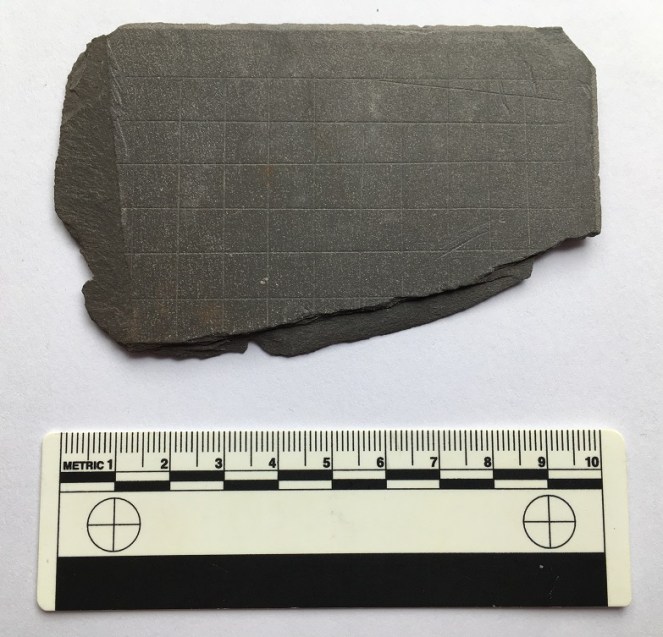
Wonderful – squared paper for maths problems, and probably for art too. I love this object, and it is among my favourite things that I have found. Sadly, it wasn’t in the Glossop area, but in deepest, darkest, Lancashire, but I thought I’d share it anyway to illustrate my pencil… so to speak.
Here’s what it would have looked like when it was being used.

The question is, then, how did the slate pencil fragment end up in my garden?
We archaeologists are obsessed with object biographies:
“Not only do objects change through their existence, but they often have the capability of accumulating histories, so that the present significance of an object derives from the persons and events to which it is connected.”
(Gosden C. and Y. Marshall. 1999. ‘The Cultural Biography of Objects’ p.170)
And this object has a fascinating biography. It starts with a pencil being dropped by a child and broken. It is then thrown away into the toilet with all the other rubbish, and taken away by the night soil man. Via the process of night soiling, it ended up spread onto a field. But not my field, yet. This is the interesting bit – the raised bed in which I found it was filled with soil that we bought from Lymefield Garden Centre in Broadbottom (highly recommended, by the way). The source for this soil is, I think, just behind the garden centre, but the original location for the pencil (i.e. the school) was probably Manchester, or perhaps Ashton Under Lyne (although, I suppose there is no reason to assume that it couldn’t have come from a school in Broadbottom).
The fact that the pencil may have started out being used in Manchester, and ended up in my onion patch in Glossop, via in a field in Broadbottom, is a cautionary tale for archaeological intepretation – we could have simply assumed that my house was once used as a school.
Anyway, slate pencils are not uncommon finds in fields and gardens – night soiling means they get around, and they stick around as, like pottery, they are virtually indestructible – Here, for example, is one on a blog run by a gardener who records the things she finds in the soil. And a brief glance around the internet produces a number of similar results. Still, it’s a nice little find, and a wonderful piece of social history.
As ever, comments and questions are most welcome.
More very soon.
RH

 The Glossop Cabinet of Curiosities
When I first joined St Andrews’s primary school in Hadfield we used slates for writing practice. That would be September 1943.
Sent from my iPad
>
LikeLike
Hi Brian
Thanks for commenting, and apologies for my delay in responding – that accursed real life keeps getting the way again!
That’s interesting – so they were used for a lot longer than I had realised. I suppose it makes sense… why waste paper? I am assuming this one, though, is Victorian as the process of ‘nightsoiling’ dies out at the turn of the century.
RH
LikeLike