What ho! A short one this time… well, relatively short. As I think I have mentioned previously, I normally have about 5 blog posts half written at any one time, and I pick away at them until one ends up finished. But how do I choose the subjects? Well, sometimes, they are obvious topics, and other times it is purely a coincidence, and fate picks it for me. Occasionally my own research throws up something that I think you, gentle readers, might be interested in. And then sometimes, as is the case with today’s entry, the subject simply throws itself at me and the blog almost writes itself.
As I think I have also mentioned previously, mine is not what you would describe as a normal life; I live and breath the stuff of this blog… to the point of obsession. But thankfully I am blessed with a wonderful and understanding wife (or ‘carer’ as she terms it, which is a bit off), and also a child who thinks growing up in a house filled with bits of pottery and odd bits of old tat is perfectly normal. But even I had a slightly discombobulating moment last week – the archaeological equivalent of the alcoholic hitting the fabled ‘rock bottom’.
“Oh no!” I hear you cry. But worry not, I’m not quitting… (and I’ll have another glass of red whilst you’re at it). No, this one was a case of opening my front door and being forced to confront an uncomfortable truth: it turns out I have now reached a point in my odd life whereby people leave bits of old pottery and other stuff in my garden, without so much as a by your leave. Clearly “it’s old and knackered, so give it to RH” is now a thing.
For there on my front wall, wonderful readers, was a spoon. An old spoon, granted, but a spoon nonetheless. “What ho!” said I, and leapt forward.

Now the sight of such might have caused a lesser man to quiver and fall, but I’ve been around spoons before – I’m no mere amateur when it comes to them. Indeed, it’s certainly no idle boast when I say “I know spoons”.
But from whence did said spoon come? The physical location of Hamnett Towers suggested only a few possibilities, and not knowing Uri Geller, my suspicion fell immediately on our clearly insane neighbours Helen and Sarah who, when not camping in their garden (mere metres away from a perfectly good house) or self harming by cycling to Tideswell and back, are amazing.
Turns out I was right! Sarah had found it in a wall in Whitfield, somewhere near the Beehive, and thought, correctly as it turns out, “good old RH might want that”. I looked closer, and my interest – already piqued – began to tingle. Writing… and possible decoration. The spoon was a welcome gift, but jokingly came with one condition, that I write a blog post about it. Well, here we are! Let’s look closer…

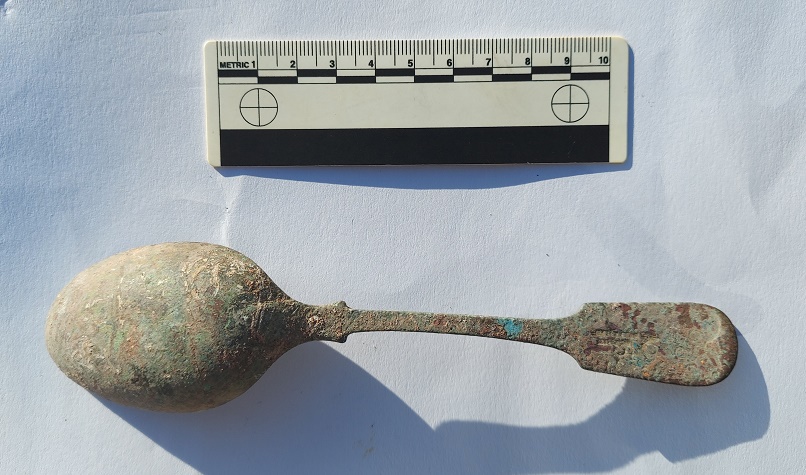

The spoon is of a soup rather than serving type, and vaguely Victorian in shape. It was also very worn and covered in greenish verdigris – I really do get the best presents. I couldn’t read what it said where the maker’s mark normally is, nor make out the decoration so I took some very fine sandpaper to it, and removed what I could.
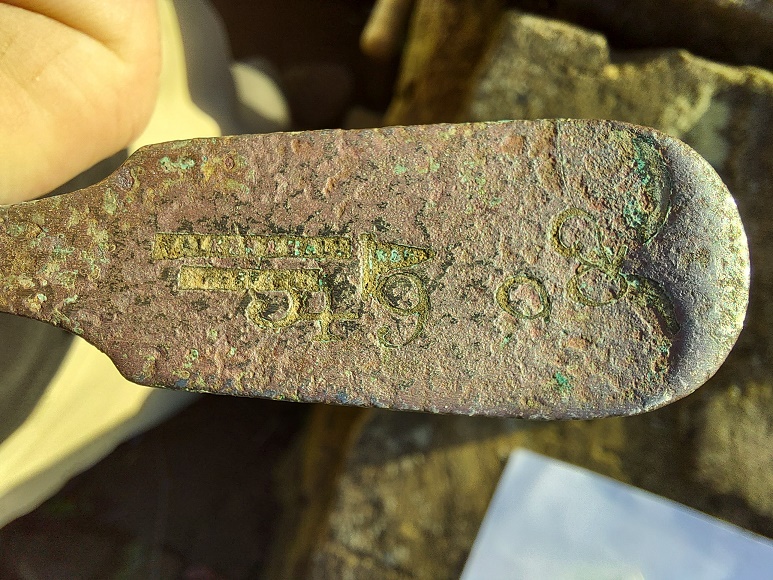
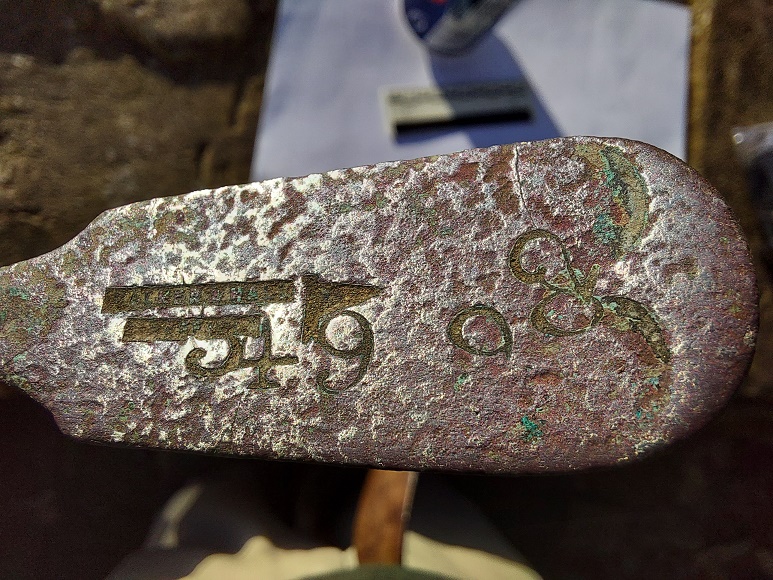
You can just make out the lettering – if you squint, and use the eye of faith – that reads “Walker and Hall. Sheffield” and a pennant/flag logo containing the letters “W&H“. And, over that a series of numbers stamped roughly onto the surface.
Walker and Hall were a company of silversmiths based in Sheffield. They were founded in 1845, but began operating with that name from 1853 onwards, and continued until 1920. This website suggests that the pennant logo should be dated between the late 19th century (say 1880) and World War 1 – which looks about right from the style of the spoon. Sadly, it’s not silver, but silver plated, and seemingly carries no mark, in which case it might date to before 1884 when Walker and Hall started putting marks on their cutlery.
As for the numbers, I have no idea what they might mean. I can make out “5, 4, 9, 9, 3, 2” Conceivably they could be the model number for the spoon type – there are examples of this being done – but these are very large and untidy, and seem to have been stamped in a haphazard way, with no easy way of reading them. Perhaps they were done by the owner as a way of identifying the spoon, but this leads to the question “why?”. The only explanation that I can come up with is that it was a ‘communal’ spoon, perhaps one connected with a pub or similar – the idea being it can’t be stolen because it is very easily identified. This fits nicely with where it was found, near the Beehive pub. It also fits with the wear pattern, too; it has been bent and straightened several times, as public cutlery often is, but also the huge amount of wear on the bowl.

This wear is very visible at the left hand tip, meaning it was used by a right handed person or people. I would argue that a personal spoon wouldn’t worn that much if it was used for at most a meal a day. However, at a busy pub serving good mutton stew, that spoon might be scraped around a bowl 20 times or more a day. Do we have an original Beehive spoon? Well, I’m almost convinced.
Why it was placed in a wall is, frankly, a mystery. People do strange things with objects that are deemed ‘public’ (I look sheepishly in the direction of a wine glass that mysteriously ended up in my house, but which originated in a certain drinking establishment in a certain town), but it may well be that the spoon was too knackered and was simply thrown away, ending up in the wall via child or bored adult.
So there we are – a spoon! From a wall, to my wall, via my neighbours, and finally to you.
Right, that’s all for now. More coming soon, including the much talked about roads and tracks post that I keep promising. In the meantime, I’m going to put a box outside – if anyone else has anything old they want to give me, pop it in as you pass… who knows what I could find in it.
Until next time take care of yourselves and each other. And I remain
Your humble servant
RH

 The Glossop Cabinet of Curiosities
2 thoughts on “A Spoon.”