What ho! What ho! And, if I may be so bold… What ho!
Well, as promised, here is the second post in the month of May. At this rate, I might make three posts… but let’s not tempt fate.
And also as promised, it’s a pottery one! Now, I know, I know… pottery is not to everyone’s taste (I say! Look here… calling me a “pottery obsessed hobbledehoy” says more about you than it does me), but it is important. And besides, it’s my blog!
Part 3 of the guide looks at ‘Industrial Slipwares’ – a broad group of commonly encountered Late Georgian and Victorian pottery (roughly 1780 to perhaps the 1850’s, and later). The term Industrial here refers both to the method used to make them – in factories, and often employing machines – but also in order to distinguish them from the earlier handmade 17th and early 18th century ‘Staffordshire’ type slipwares (which I’ll cover in a later post… you lucky folk, you). Originally called ‘Dipped’ wares, the process employed in making them involves dipping the formed clay vessel into a coloured slip – essentially a thin solution of clay suspended in water – and firing it. It is then glazed and fired for a second time to produce a hard-wearing pot. In terms of fabric, it is a fine earthernware with thin walls, in a clean white fabric – originally a Creamware or Pearlware, but later (1830’s onwards) a standard Whiteware.

Originally very fashionable amongst the elite, by the early 19th Century Slipware begins to lose its social status, until eventually it becomes a utilitarian ware of the commoner, very much associated with pubs and taverns.
I have to say, some of this stuff looks decidedly modern – particularly the stripey stuff – and their bright colours and bold slick designs must have been a welcome antidote to the often drab creams and endless blue and white transfer printed stuff that dominated the period. The emphasis is on natural, earthy, almost pastel-coloured slips – brown, blue, green, orange, yellow, grey, and violet are favoured. I have to say, though, that some of this stuff is a tad on the garish side, and wouldn’t look out of place in a Wild West Bordello. Not that I would know what that would look like. Or indeed have any knowledge of such places. At all. In fact, I don’t know why I said that. Anyway… moving swiftly on.
Ahem… the pottery, then. Broadly speaking, there are 5 types that can be readily identified, although there is some crossover between them, as you’ll see.
- Multi-Coloured (aka Variegated) (1780 – 1820)
Patterns of slip are made from multiple colours and smudged (the correct term is Joggled), giving a psychedelic effect that you either love or hate. Common patterns are the Cat’s Eye, Earthworm, Fan, and a nightmare-fuelled, migraine inducing, all-over slip. The crucial identifier is the joggled coloured slip.


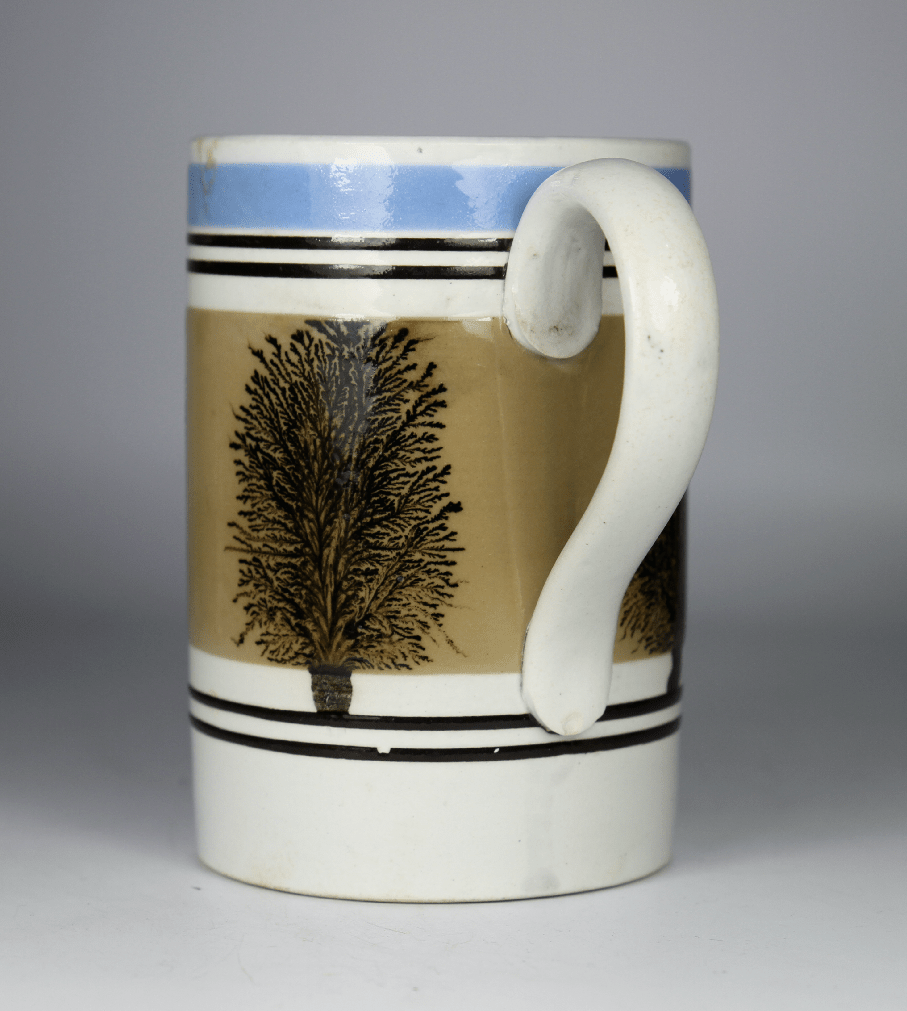
2. Mocha (aka Dendritic) (1780 – 1890)
Here, the slip is applied, and a substance – boiled tobacco juice, or urine, for example – was applied whilst still wet. This diffused producing the characteristic treelike (dendritic) decoration in a dark blue or black colour. Commonly associated with banded decoration (Annular, below) and in a brown or cream slip. Popular, but largely of early to mid-19th century, and less common later in the century.

3. Engine Turned (1790 – 1880)
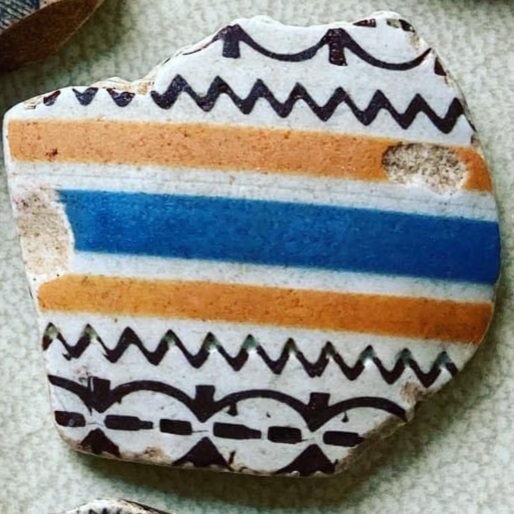
This looks particularly 20th century. Here the slip is applied one over another, and the vessel is turned on a lathe, with the upper slip removed by machine, revealing the contrasting colour below. Vertical stripes, horizontal bands, and patterned geometric designs are all common. Painted designs were also applied using a machine, creating complex linear bands. Mainly early 19th century in date, and particularly associated with Pearlware, so is much less common later.

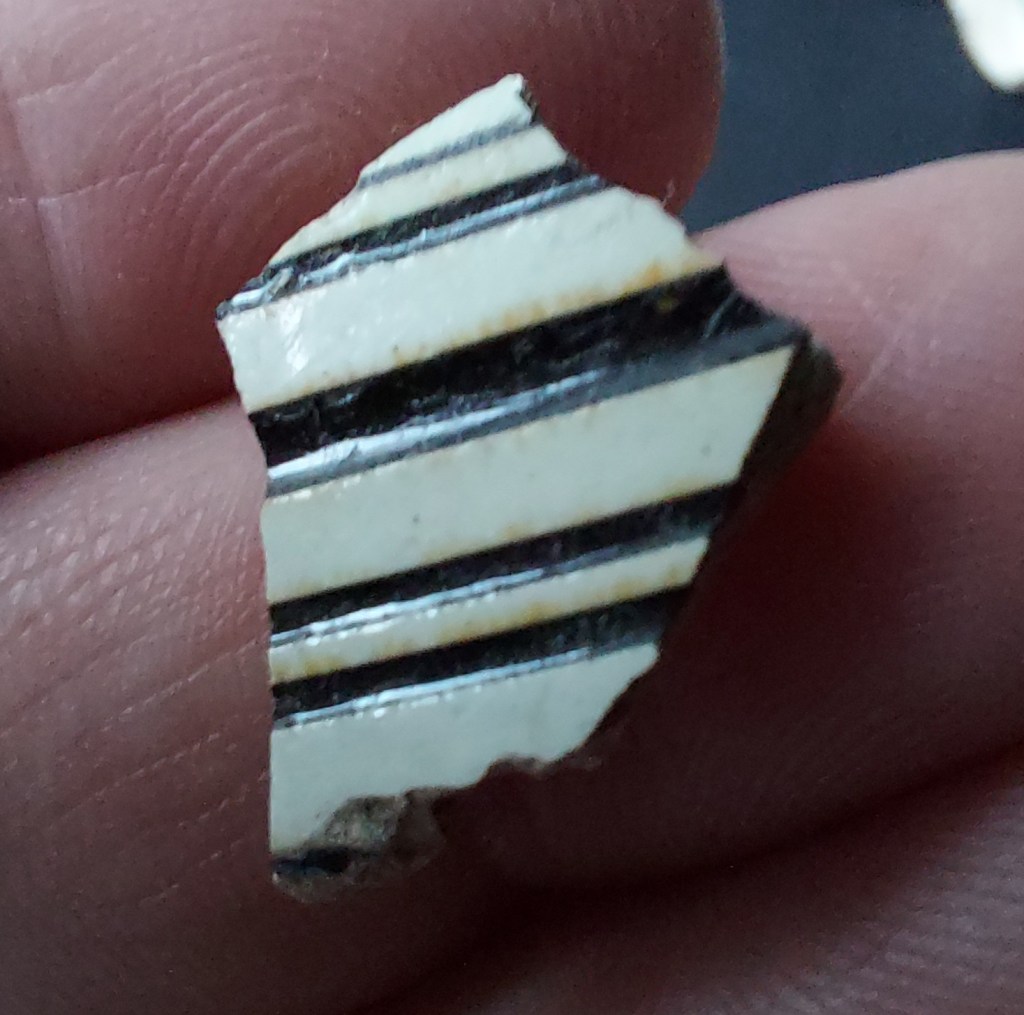
4. Banded (aka Annular) (1780 – 1890’s)
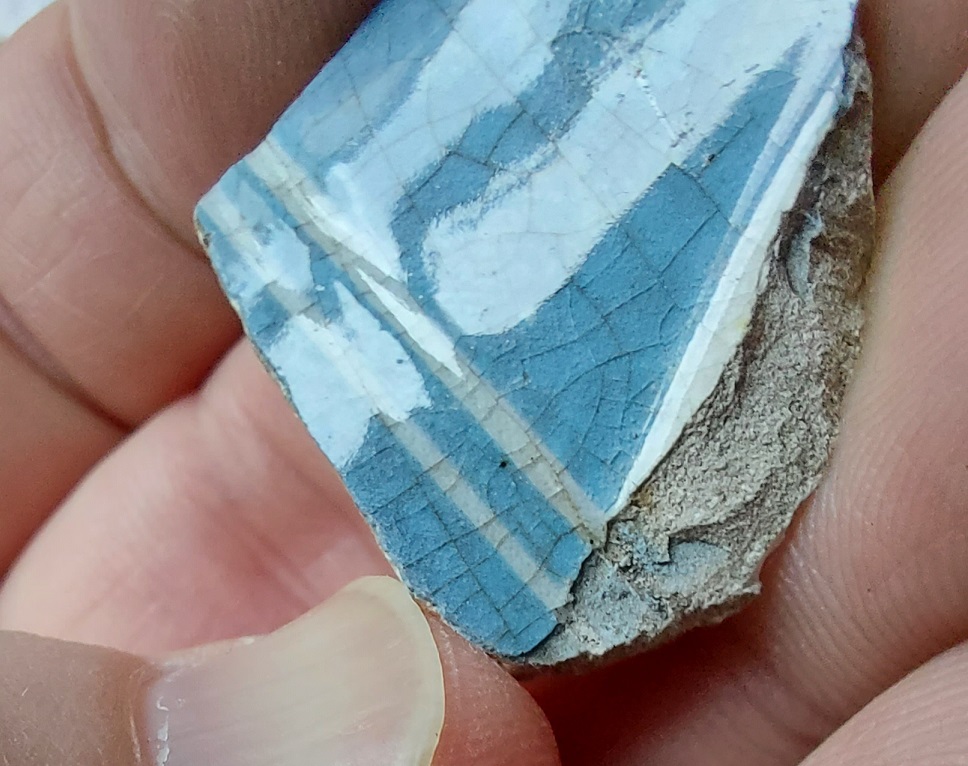
Simple horizontal bands of slip are painted on using a lathe in the manner of Engine Turned above, producing precise clean lines. Commonly contrasting blue and white, but also in browns, yellows, and creams. The banded decoration is also a large part of the decoration of the above three types, particularly Mocha, so there is considerable overlap. Also, the simple basic theme of bands continues into the 21st century, particularly in Cornishware pottery.


Date wise, it’s difficult to distinguish. My feeling, based on some evidence, is that prior to about 1840 Banded Ware used the browns, yellows, blues, and greys seen above. After that date however, banded decoration was confined largely to blue banding. Now, this is not absolute; the date is flexible; date of deposition is different to date of manufacture; ‘absence of evidence’ is not a strong argument; and it may even depend on such variables as availability, and even personal taste. But as a rule of thumb, I think it stands.
5. All Over (1780 – 1890’s)
The vessel is slipped, inside and out, in a single colour of the earthy colours common in Industrial Slip Ware, and then fired, producing a surface that is uniform in colour and treatment. Common in the 19th century, but less so as the century went on.


In terms of shapes, Industrial Slip Ware is exclusively a tableware, and very much liquid focused, so elegant mugs & tankards are common, as are jugs, and more rarely bowls.
Right then, armed with this new found knowledge, go forth and find! Honestly, this stuff shows up everywhere, in particular the banded Annular ware (very common in blue and white). Don’t forget to email/tweet/post any examples you find. I’d actually like to start posting finds that other people have found – a community of sherd nerds, if you will! So please, get in touch.
Honestly though, my life of late has been very busy, and increasingly I have started to realise that I am very bad at multi-tasking – meaning I can focus on only one big thing at a time – hence the lack of blog activity. I recently lead a Wan.Der (a curated historical walk, in association with the Glossop Creates mob). I thoroughly enjoyed it (despite the public speaking terror), and it seemed to be successful, which is nice – watch this space for news of others coming up, both more of the same, and new ones, too.
I’ve also started to upload some video onto the Glossop Cabinet YouTube account – there isn’t a huge amount on it at the moment, but more is coming soon. You can check it out here.
Right, that’s all for now. More later… I’m on a roll! But until then, look after yourselves and each other, and as always, I remain,
Your humble servant.
RH

 The Glossop Cabinet of Curiosities
Thank you so much for this information. So happy to find it. Me and my son have been collecting for the last few years and have lots of the annular sherds. We had no idea why they kept turning up and presumed they were more modern. Great to learn about how they were made and to see how they would have looked whole.
LikeLiked by 1 person
Hi Sarah
Many thanks for your comments, and my apologies for the *ahem* slight delay in responding. It honestly thrills me that I managed to help you, and it is the reason I write these articles, so I’m glad you enjoyed. Happy hunting, and feel free to mail me anything you find – I’ll put it up on the site.
TCG
LikeLike