Archaeology · Bench Marks · Mason's Marks · Where / When

Marking Time

What ho, wonderful, and slightly odd, folk of the blog reading sort. I hope you are all as well as can be expected, and as we move into autumn, you get out an about as much as you can – always keeping an eye open for pottery and other interesting things.

Which sort of leads me to today’s offering. It’s a mixture, to be honest, some updates, some new stuff, but all interesting. I have said before that I always have multiple half-written articles on the go, all moving at different speeds – but for one reason or another, none leapt out at me asking to be finished. So here we are… Marking Time!

I’ve always been obsessed with the idea of humans marking their surroundings, and the notions of permanence, even immortality, that accompany this; from palaeolithic cave art to bronze age cup and ring markings, to 17th century building datestones, to Victorian carved graffiti, to modern tags – and I’m looking here at you, Boof, whose name is everywhere around Glossop at the moment – it all amounts to broadly the same thing: marking time.

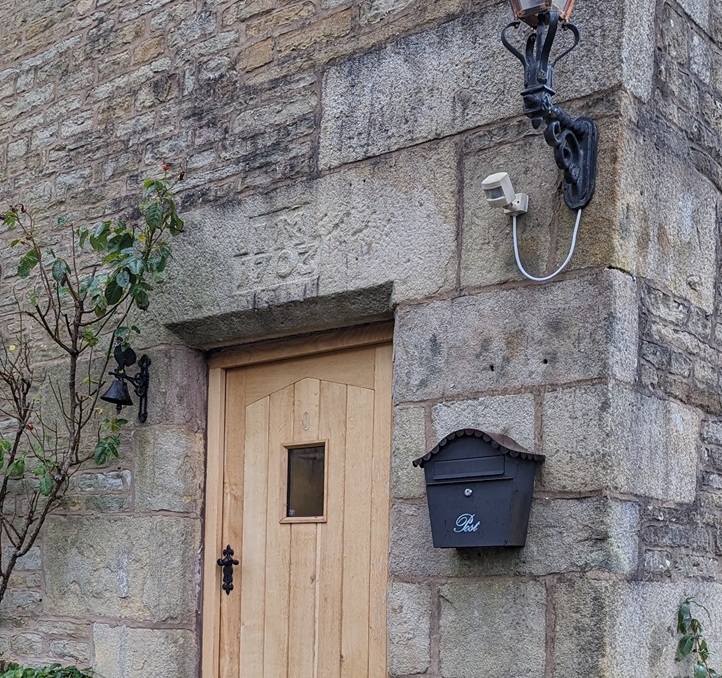
Datestones update: As always, I am on the lookout for more datestones of a pre Victorian date (pre-1837). I recently bagged this:

Herod Farm, Whitley Nab

Wonderful – ‘I.M. 1703’ – to the point, although I have no idea who I (or more likely J) M is. I have a whole article about Herod Farm and the surrounding area in progress, but wanted to share the datestone with you.

The always knowledgeable Roger Hargreaves emailed me a comment he tried to post on the site – technical issues prevented it, but here it is:

So there we have it – John Morton, and a teaser about the Lees Hall – a fascinating place, with a long history, and possibly a moat! Well worth an article and more. Thanks Roger, your input is always much appreciated.

Update to the Gatepost article: We recently bought a campervan, a mobile home with beds and a stove, and all that. It’s marvellous, and is unmissably yellow, or more truthfully YELLOW! (give a shout and wave if you see it around). Our first adventure camping was to Peak Forest, near Buxton, and coming home we decided to take an odd route for the sake of exploration – a vehicular Wander, if you will. Coming through Wheston, south-east of Chapel-en-le-Frith, we came across lots of gateposts, modern and made of concrete, but each marked with initials and dates:

I have no idea who CTH is – presumably the farmer who is replacing gateposts – but I salute your attention to detail – initials and date – and respect your devotion to tradition; earlier, 19th century, examples of dated gateposts can be found here. It might be concrete, but the idea is exactly the same, and I want to buy you, CTH, a glass of the stuff that cheers. Wonderful.

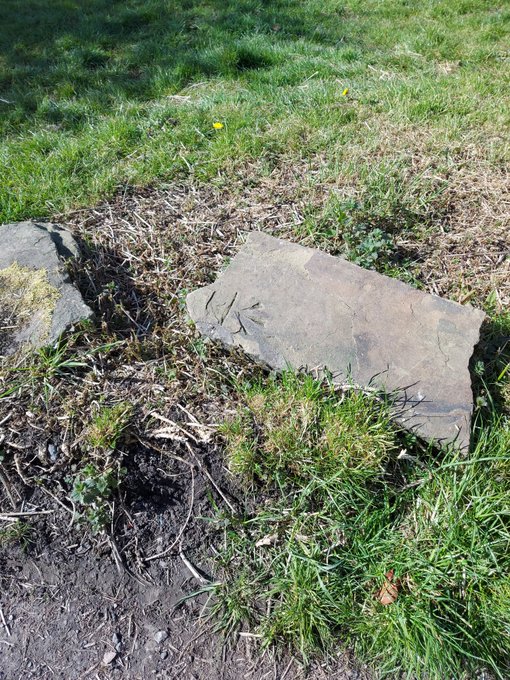
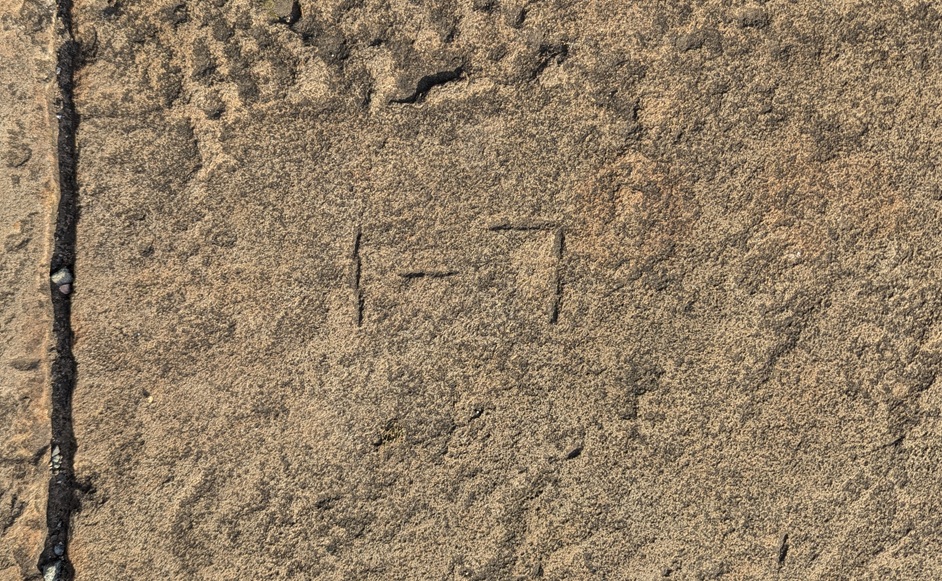
Next we have things seen on pavements… Glossop seems to have inherited the whole street paving slabs second-hand from somewhere. I seem to remember a whole hoo-ha about these stones, and others, occurring maybe 20 years ago – their origin and how much was paid for them… or something. Whatever, but what is certain is that they have some interesting markings on them, and all of these were seen between Costa Coffee and the Norfolk Arms – almost certainly more await discovery, so look down people:

A simple cross, formed of two chisel strokes.
‘1 – 7’ with the ‘1’ formed apparently by three chisel strokes, the ‘seven ‘7’ by three down and two across. No idea of the meaning.
A cross, and a hole filled with a lead plug. It’s difficult to imagine what this large flat stone would need a hole with a lead fixing for – it’s not like it was used for a gatepost or similar. I genuinely cant imagine what or why!

Finally we have this beauty:

Where to start?

So, we have a name in the bottom left, clumsily written – ‘Joseph’ something or other… D? B? Can anyone make out this? The second letter could be an ‘E’. Possibly. But then we have what might be a landscape – the top right looks like a fat sun, drawn by a child, to me. And in the centre, at the bottom, possibly a house (I think I can see the roof and walls, with perhaps a person in it). This is really an enigma – a name, and a piece of art, undatable, and probably from a place far from Glossop… but imagine if we could put a person to it. And all this, lying under our feet.

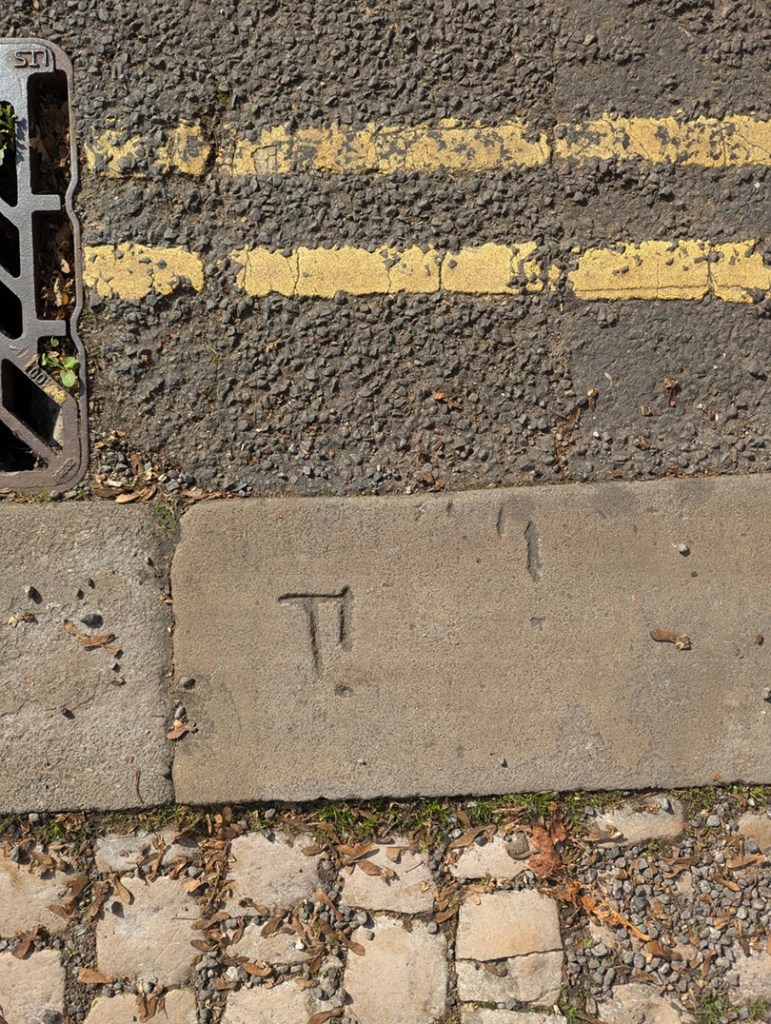
Other bits and pieces under our feet include markings on kerbs:

A simple ‘T’, probably referring to Telephone, and marking where the cable came into a property.

This is also sometimes marked by ‘GPO’ on kerbs, standing for General Post Office who were originally (from 1880’s until 1981) responsible for telephone communications. I once found an example on a kerb on Howard Street, but had not been able to find it since, until I came back from a blood test at the clinic there, and this was picked out of the dark by street lights:

Wonderfully carved, this was, I assume, where the telephones for the train station entered the buildings.
Another ‘T’, but this one in Old Glossop seems to have an errant exclamation mark after it!
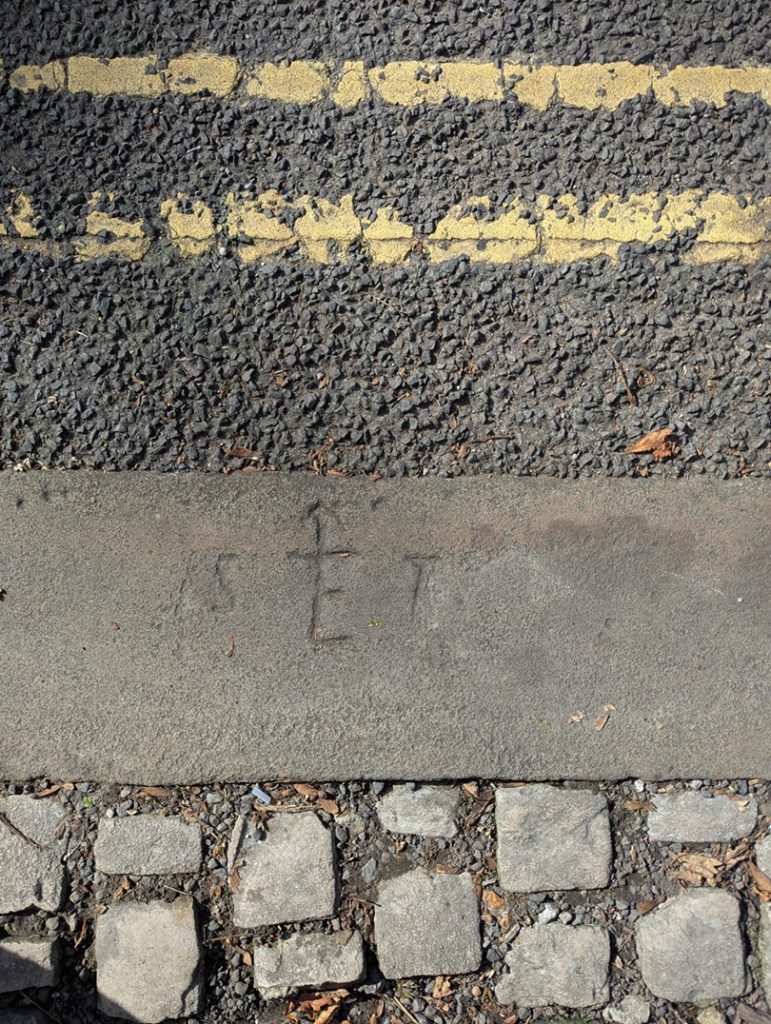
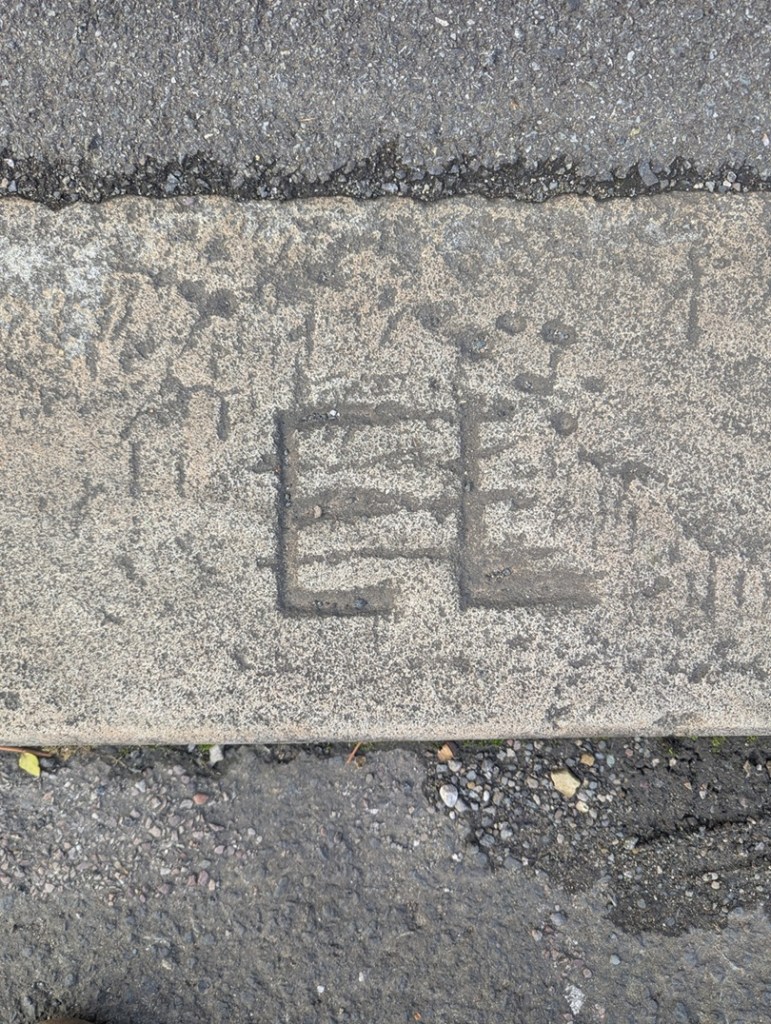
Another slightly odd kerbside marking – an ‘E’, which is believe marks the place where electricity cables enter a property. It is quite common, although in this case it is accompanied by an ‘S’ and a ‘T’, the meaning of which I have no idea.

I also saw this on Princess Street – another marker showing where electricity enters a property – this is also quite a commonly found one.

A no frills, very clear and functional, EL!

Here’s another mark that is commonly seen: a simple arrow, but not like the Ordnance Survey benchmark arrow, this is normally crudely carved, thin, and without the horizontal line above it… thus:

Literally an arrow, pointing.

This is another of those that points to a service – gas, possibly, or electricity – entering a building, although I truthfully don’t know… any help would be welcome.

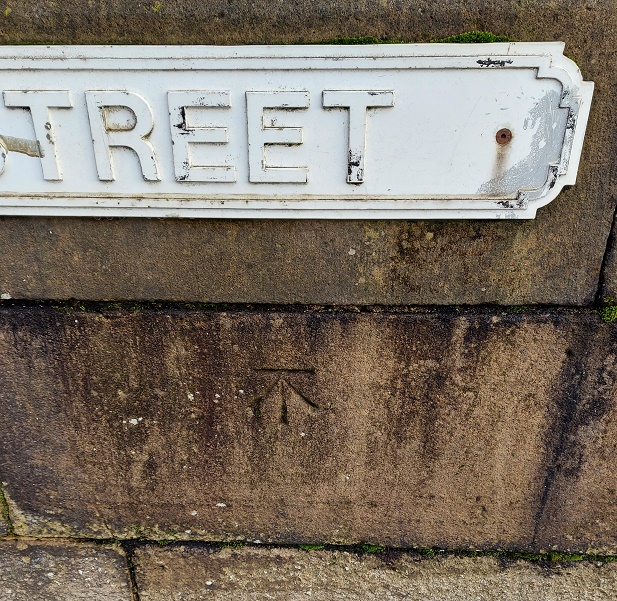
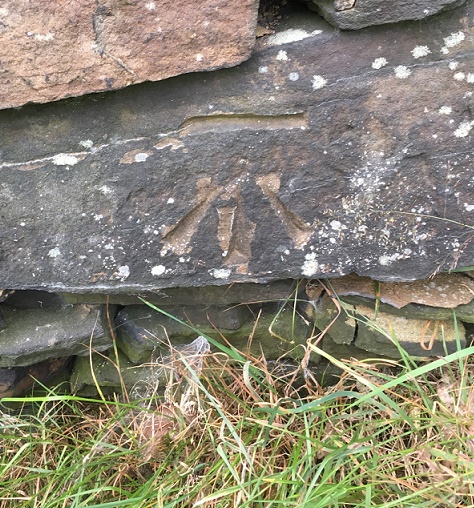
However, here is a Benchmark, newly found by me, under the railway bridge on Arundel Street, and which marks 501ft 8″ above sea level:

Worn, and almost camouflaged, there it is.

Also on the bridge are these single holes, often found in the upper part of the stone:

And here…

These small, shallow, holes were made in order to use a pincer, or external, Lewis and frame in order to move the blocks. A genius invention, it’s a simple iron tool that, via a chain, uses the weight of the block itself to hold it fast whilst it is moved, and enables even a single person to shift a huge piece of stone. But it requires a shallow hole in order to provide a point that gives a good grip. I love these, as they allow us to view how the bridge was built.

Another example of us viewing the method by which these wonderful Victorian structures were built is this:

Very characteristic.

Often occurring in pairs, these are drill marks made by quarrymen, into the rock face, which allow them to insert a splitter to pry away the stone from the quarry face. Once seen, they are very recognisable, and are the scars that show how, with a little physics and a lot of brute force, rock can be shifted.

Howard Street, which meets the Arundel Street bridge, has a few, sporadic, mason’s marks along the stretch of railway walling here:

A cross.
A ‘T’.

Low key, and not very common, these nonetheless represent the ‘signatures‘ of the men who shaped these stones. The cross is a common mark carved on stones – it is literally two strokes with a chisel – so it cannot be definitively linked to those masons who built Dinting Arches, but you never know.

Other mason’s marks can be found around…

A ‘B’, upended.

This is found on a lump of masonry from Wood’s Mill, and now stands where Wood’s Mill once stood, now Glossop Brook View, and by the houses there. Post-1842 in date, although possibly early, the mark was hidden until the mill was demolished – the rough dressing of the block indicates that it was never meant to be seen. I wonder who ‘B’ was.

Another, difficult to see.

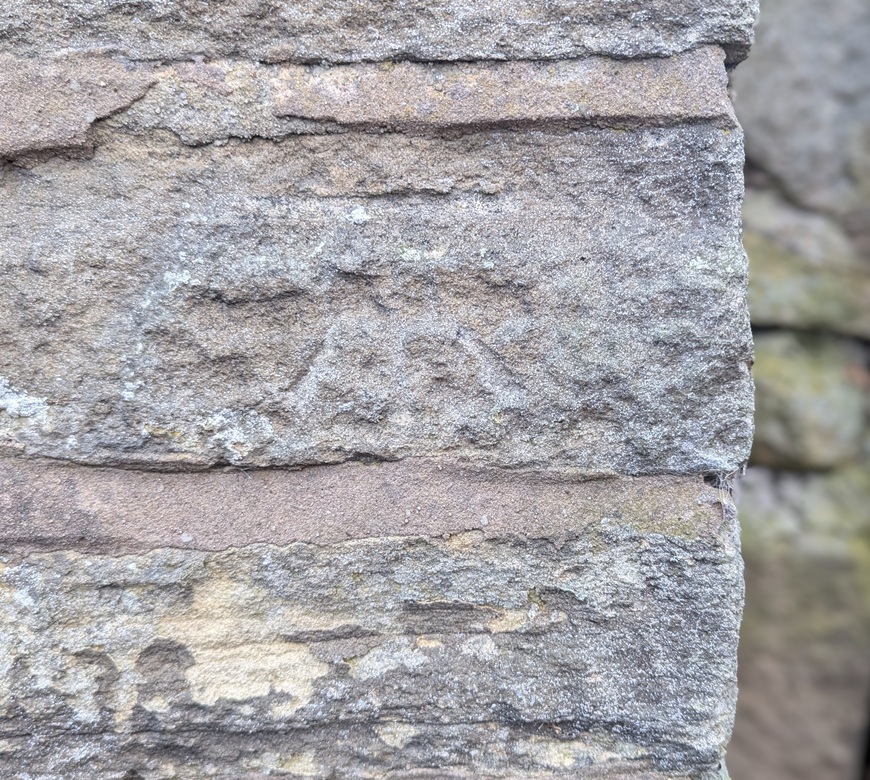
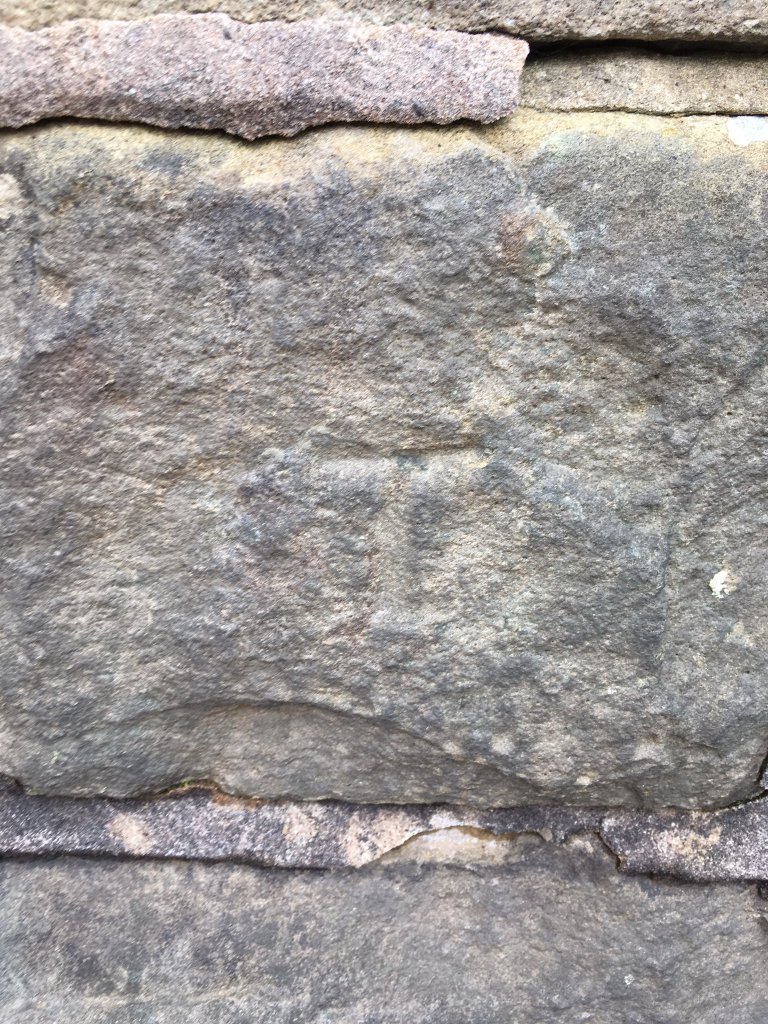
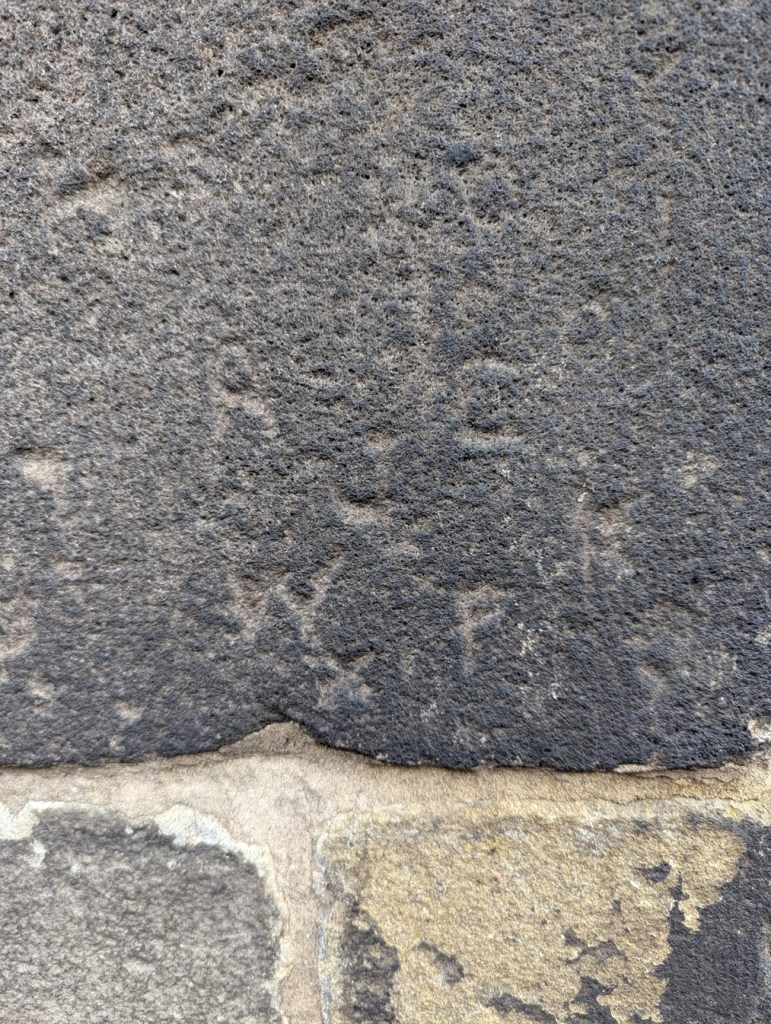
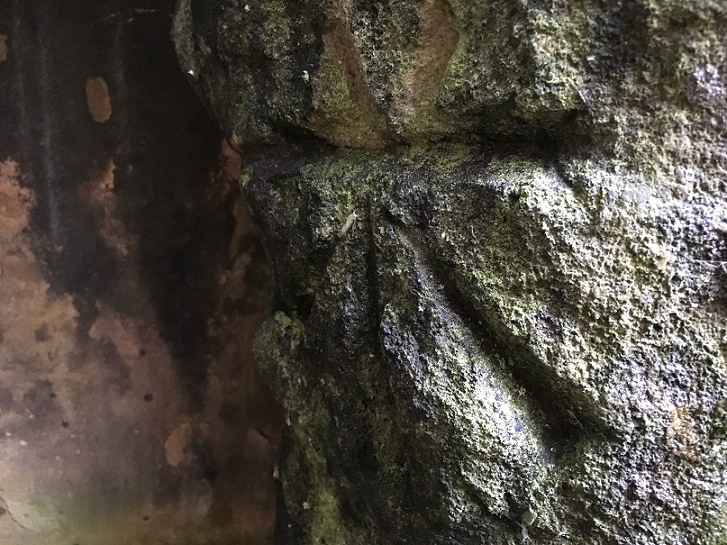
This last one is on the gatepost of the Crown Inn, Victoria Street (although the gates are on Hollincross Lane); very faint – and difficult to photograph – they are in the angular shape of a fish.

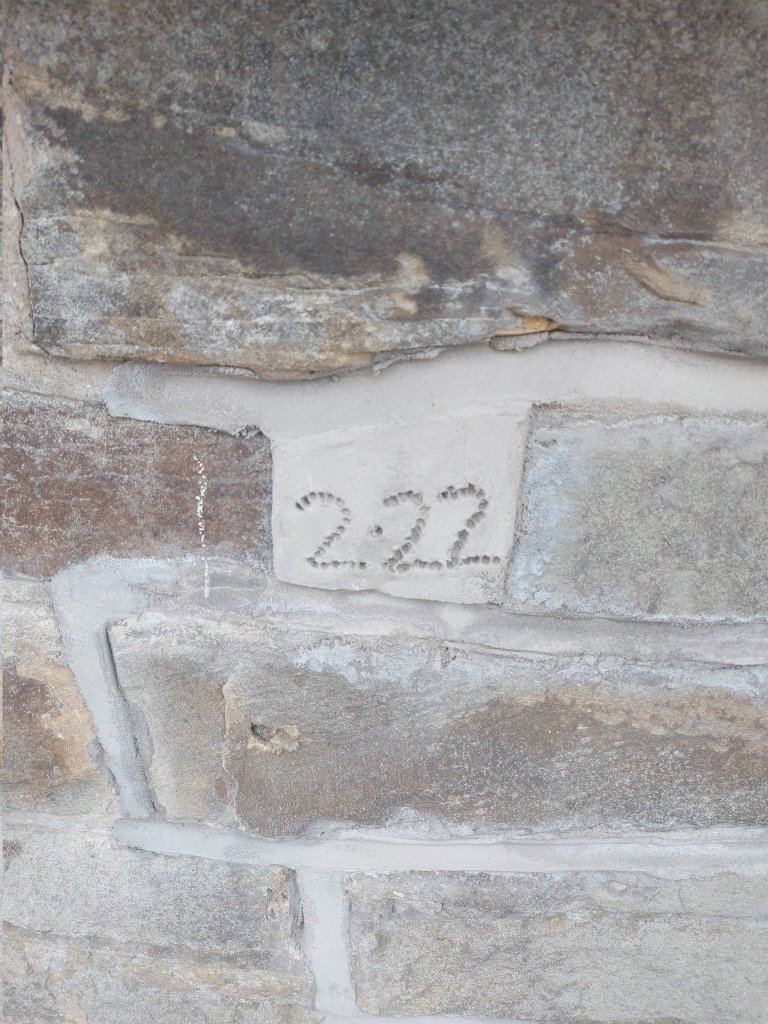
I also spotted this on Howard Street:

February 2022.

A dated piece of cement. This is either dated proof of work done – a modern form of mason’s mark – or possibly a dated repair that allows Network Rail to observe cracks forming and assess integrity. Either way, it’s kind of cool!

Finally, some bits of carved graffiti, a particular favourite of mine.

A single ‘J’ on the wall of Heath Barn, Heath.
‘S’ ‘H’ on the wall of Glossop Church.
Also on the north wall of Glossop churchyard, on Church Street – initials – R C J W P. The arrangement is odd, and I wonder if they were 4 members of a single family, with the surname ‘J’. That could surely be traced if it was the case!
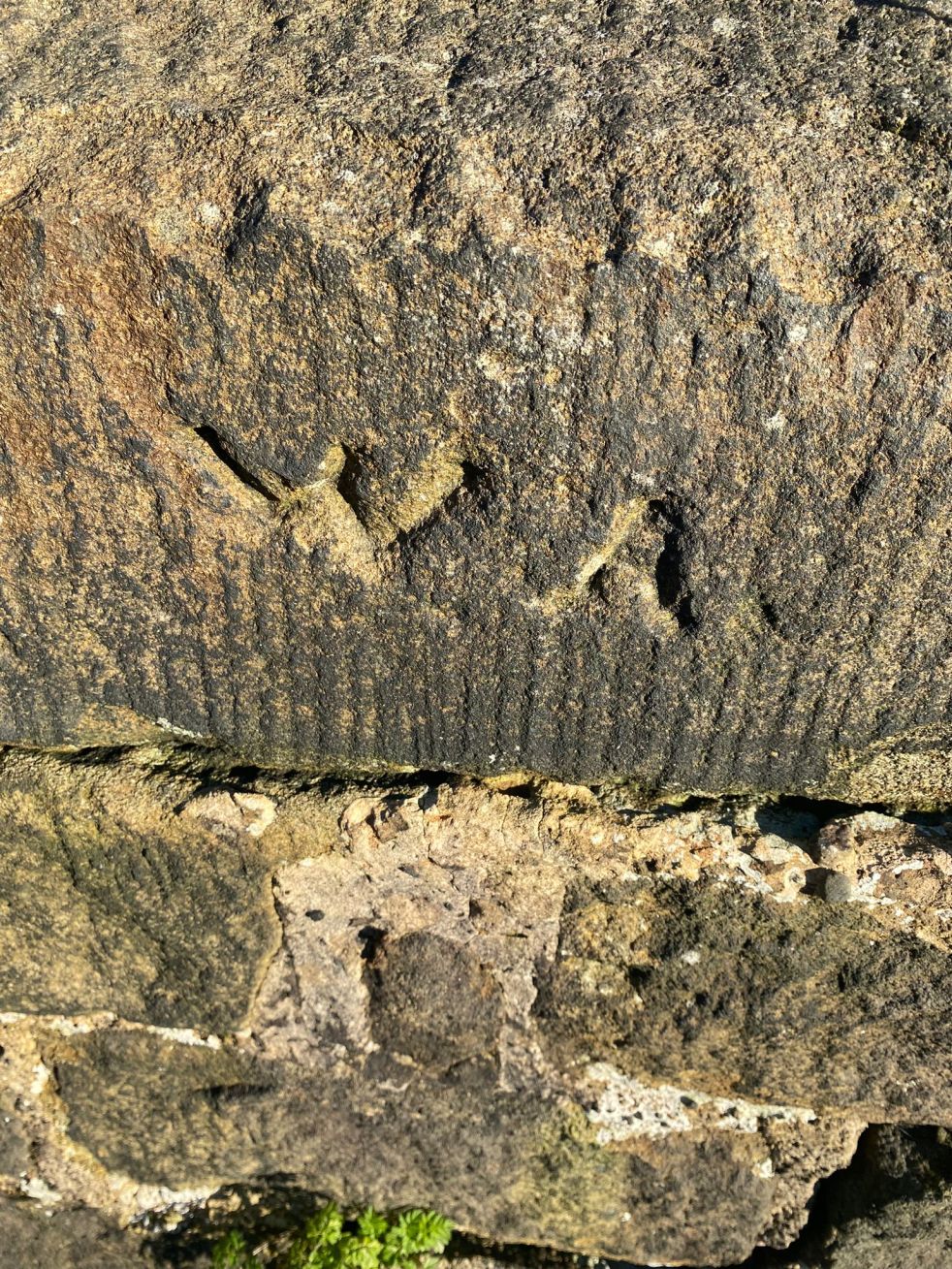
‘W’ ‘A’ (photo from Suze Hill)
‘W’ ‘G’ (photo from Suze Hill)

These last two were from the bridge over the Longdendale Trail on Padfield Main Road. The whole bridge has a lot of graffiti carved on it, including this wonderful example:

Old and the new. I love this photograph, and am very proud of it!

Here we have Victorian carved graffiti – ‘J.H’, possibly, along with some more letters, undecipherable under the frost, over an early incarnation of the now famous (infamous) BOOF graffiti tag made with a spraycan. I find it interesting that we would condemn one, but praise the other as historical and interesting. When does vandalism become history and worthy of study? A bigger discussion, and one I find fascinating (akin to when does something become archaeology?). I know graffiti, as in modern graffiti – put it down to a misspent youth and a love (despite appearances to the contrary) of Hip Hop – and I have followed BOOF’s career with a certain interest.

So here I shall leave it. Making marks, and marking time – it’s all about trying to achieve immortality, to leave your mark long after you are gone, and making people remember you, even if they don’t know who you are. I think that’s all any of us, myself included, can hope for. There are so many examples of this phenomena in the Glossop area, and I have an idea to produce a book looking at precisely this sort of thing – watch this space.

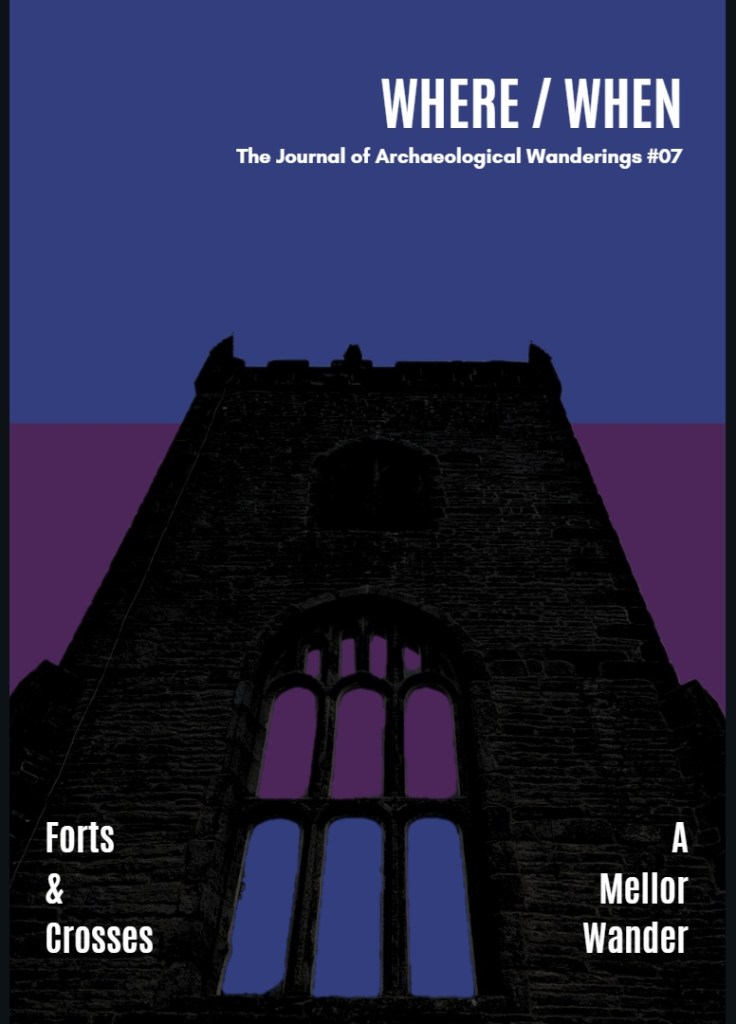
Talking of books, please check out Where/When Number 7 – Forts and Crosses: A Mellor Wander.

This one is a truly awesome Wander around Mellor – just over yonder! It has medieval field systems and farms, Victorian noise, an Iron Age hill fort, medieval crosses, cracking views, a terrifying viaduct, bench marks, a trig point, wonderful gateposts, and it starts and finishes at a pub… what’s not to love? Here’s the cover to tempt you.

Available from the shop, link above, or from Dark Peak Books and Gifts, High Street West, Glossop. Or, you know, just track me down and throw money at me.

Talking of which… if you enjoyed this, and fancy buying me a glass of the stuff that cheers, then please do so via this link to my Ko-Fi page. I do what I do here because I love doing it, and I feel it’s important we explore our shared heritage… but I’ll never say no to a pint in thanks!

So much more news to share, and so many things planned. Watch this space, wonderful people, as big things are coming.

But on a serious level, how are you doing? Genuine question. Personally, I’m a little down at the mo… the devastating loss of my brother (cheers Stephen, I’ll miss you), coupled with a dose of Covid, and the general malaise that accompanies the move from summer into autumn and winter, has meant a lull in the festivities here at CG Towers. Still, the wheel turns, the seasons they change, and life will inevitably continue, and on we go. But as I always say, look after yourselves and each other, you really are important, and too often we say “I’m aright” when we actually mean “I’m not alright, please help” – it’s ok to not be ok.

So then, more coming, but until next time, I remain.

Your humble servant,

TCG
Archaeology · Bench Marks · Graffiti · Standing Stones

Gateposts

What ho, lovely people of the blog world. I hope you are all well as we hurtle headlong into summer, each of us fearing what terrible weather will mar an otherwise splendid season. Nevermind, this too shall pass and all that, and indeed we must grasp the nettle by the horns, or something, and make H whilst the S shines…

Today’s post is one of those brought about by happy coincidence, where a series of events conspire, almost waving at you, until you finally notice and say, loudly, “what ho… a blog post!” Or, in this case, a Gate Post. The first event was posting a few photographs on Twitter and Instagram (@roberthamnett on Twitter, and @timcampbellgreen on Instagram, for those of you who might fancy checking it out). Turns out I’m not the only one who likes a good gatepost or two. And then the next event was my seeing a tiny piece of metal in the soil whilst doing a recce for a Where/When (No.7, to be precise… Of Forts and Crosses: A Mellor Wander). All will become clear, honestly.

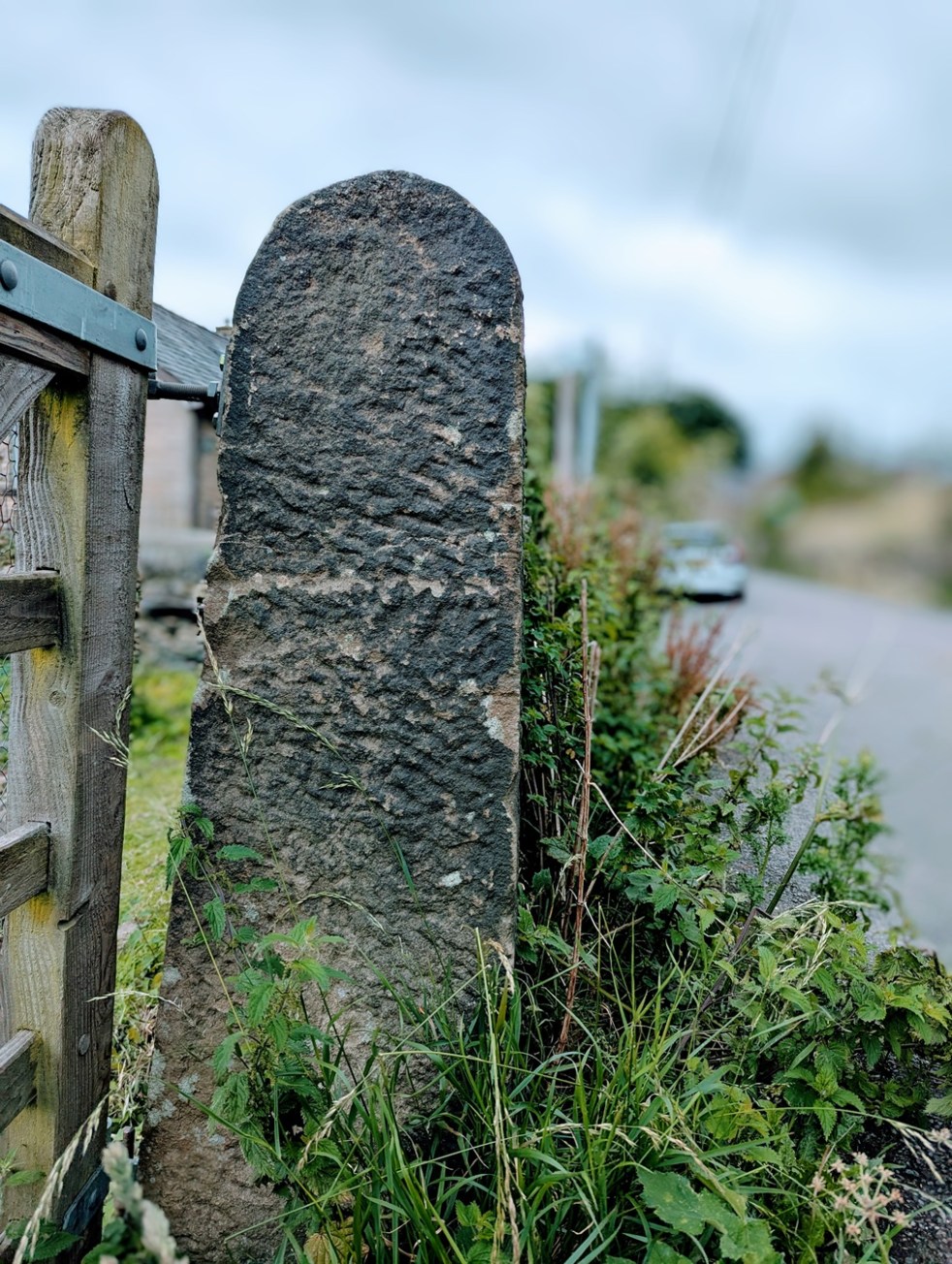
For years now I have been obsessed with gateposts. Mundane, utilitarian, and always overlooked, a good gatepost can be as interesting as a prehistoric standing stone to me, and truthfully, there is often very little difference: both made of stone, both standing upright, both important in the past, and also in the present. And if anything, gateposts have more interesting features! I mean, obviously prehistoric is fascinating, but they don’t really give us much to go on, whereas the later gateposts… well, read on.

They can be decorated – often just roughly dressed.

A simple rough dressing, to shape it in a uniform manner.

But sometimes some thought has gone into them, to create a pleasant design – which for a utilitarian functional object seemingly goes beyond what is needed.

A simple cross, surrounded by a border. I say simple… it takes some doing.

I mean, the only time you see the gateposts is when you are opening a gate to let sheep or cattle in and out, and it’s probably not something you’d see everyday. And even if you did, it’s only for a moment or two, it frankly doesn’t matter if it looks good, and I doubt farmers are wandering around making snarky comments about the plain decoration of another farmer’s gateposts. So why? What is the purpose behind them? I don’t mean they had some sort of secret meaning behind the decoration, rather they simply represent someone’s choices, but why those choices I wonder? Possibly it’s probably more to do with pride in the work taken by the stonemason who shaped it, perhaps a form of identifier: we know it’s person X who shaped it, as he always decorated it with a cross. But then there are those that go beyond simple decoration, and instead turn it into a work of art.

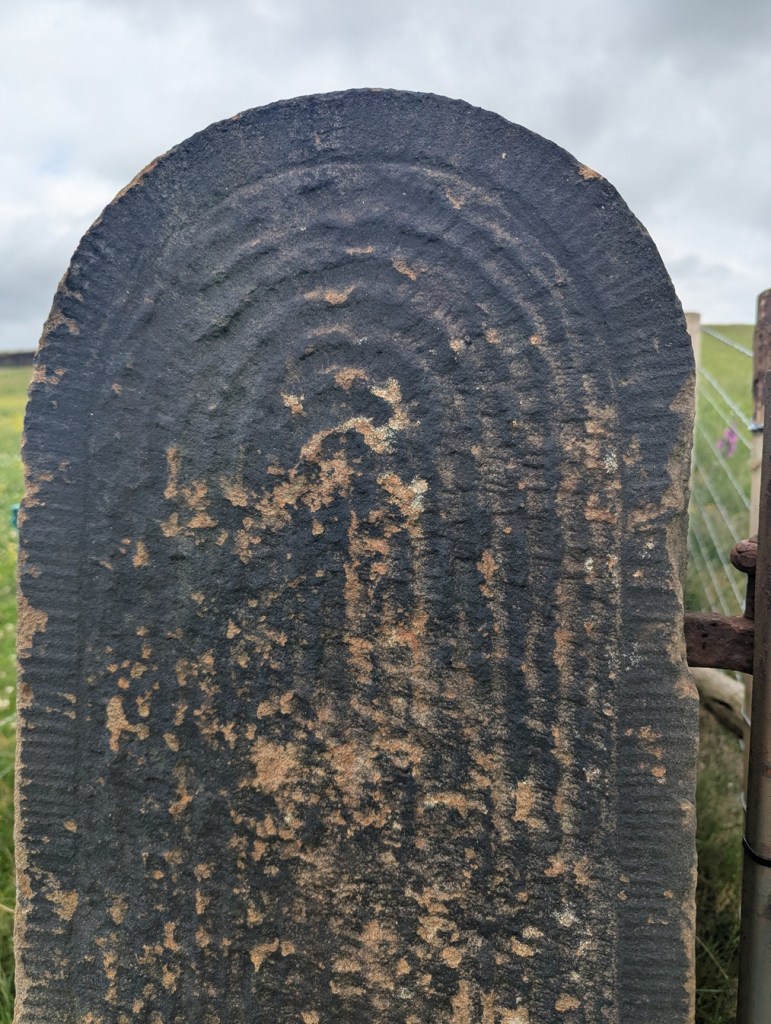
This is wonderful! The way it shifts from the upper band with a circular motif, to the lower aspect with the herringbone pattern is amazing. A lot of effort went into this.
This too, is truly wonderful. The circular motif, with a border, is just amazing. This post seems to be in the reddish Cheshire sandstone, which makes sense given that it, and the last gatepost was found in the Mellor area, rather than Glossop.

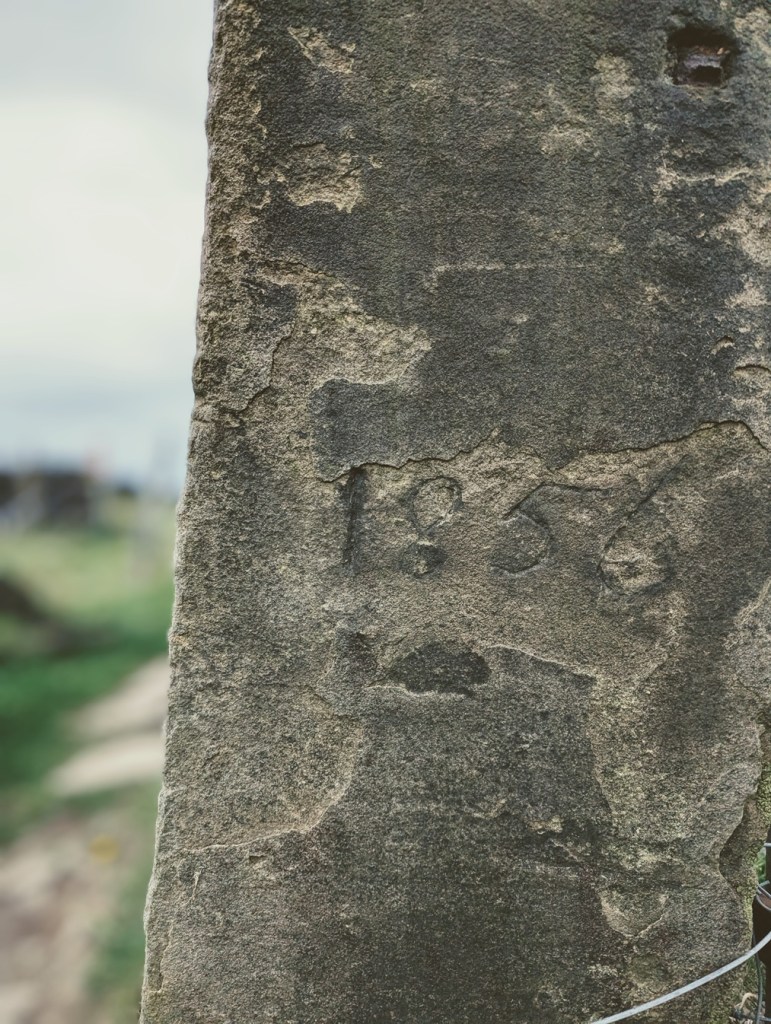
Other times, we find words and dates on gateposts. Often these are faded and barely legible, the weather and environment are not kind to these solid sentinels, and they have no shelter.

‘1856’, on the track from Fieldhead Farm to Whitfield Cross.
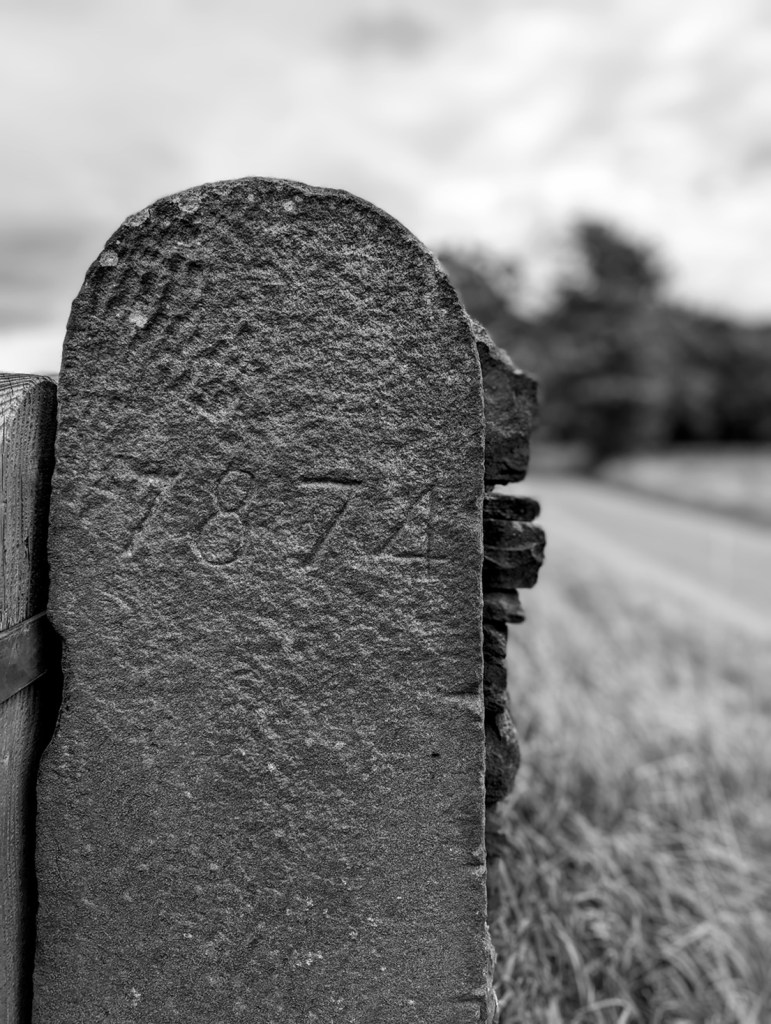
I went all arty with this shot… I’m quite proud of it! ‘1874’ in a very similar hand to that of the above gatepost – I wonder if it was the same person? This is on Kidd Road, just before its junction with Derbyshire Level.
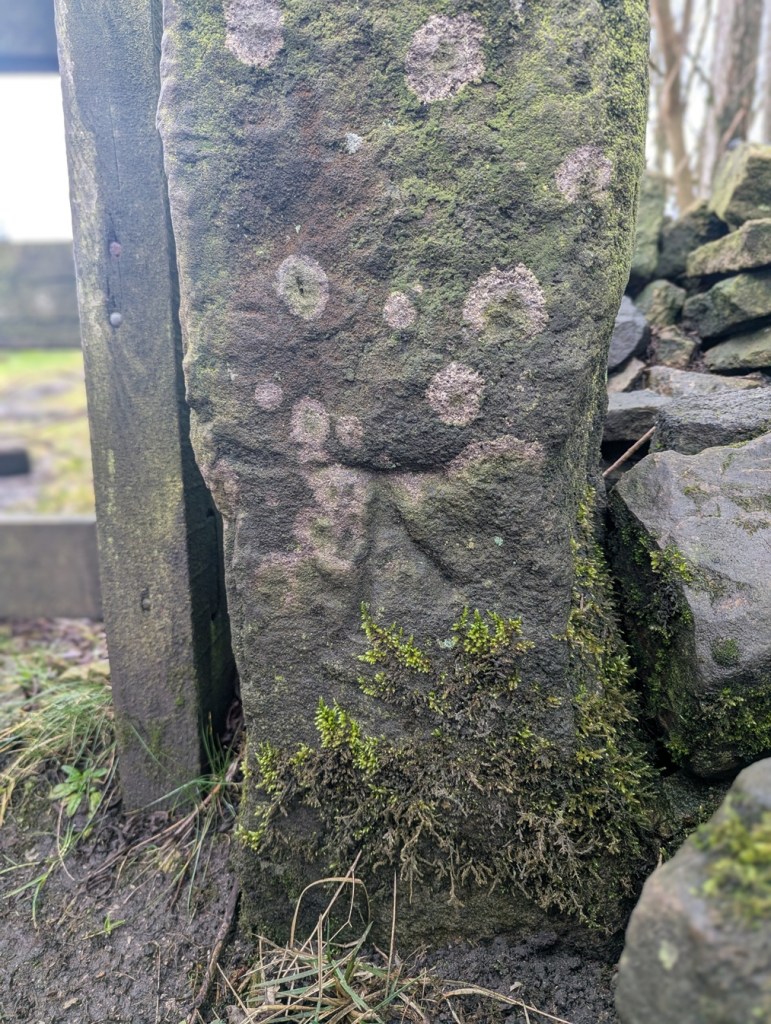
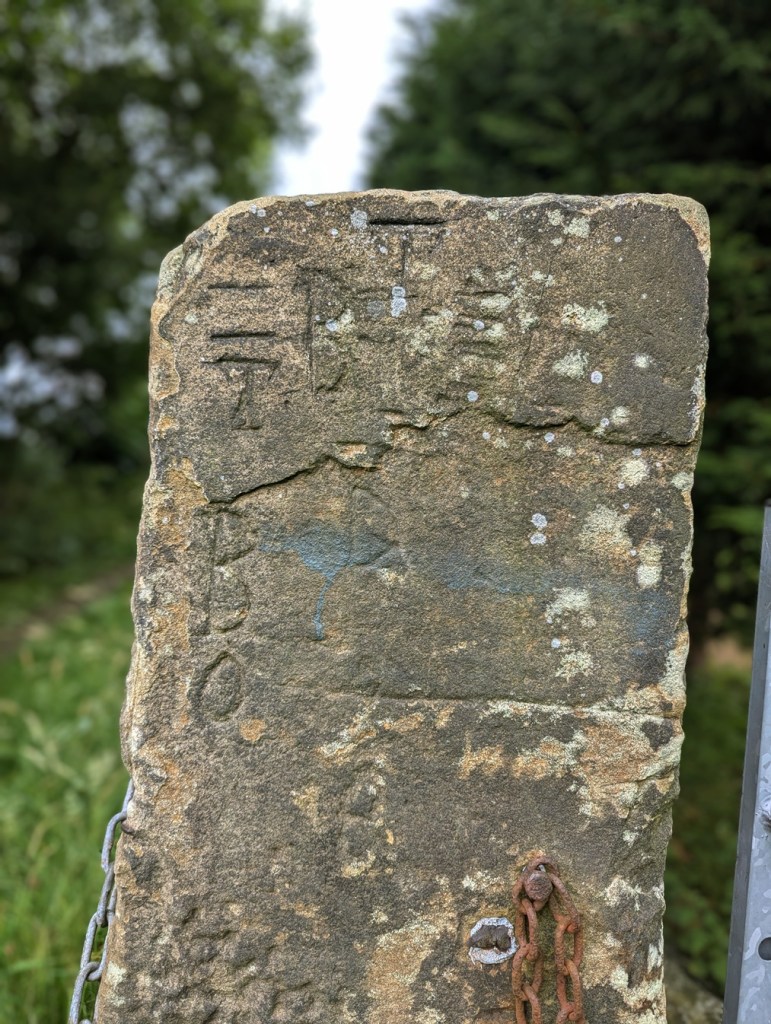
Multiple ‘B’, ‘D’, and ‘O’ – from a post just by Fieldhead Farm.

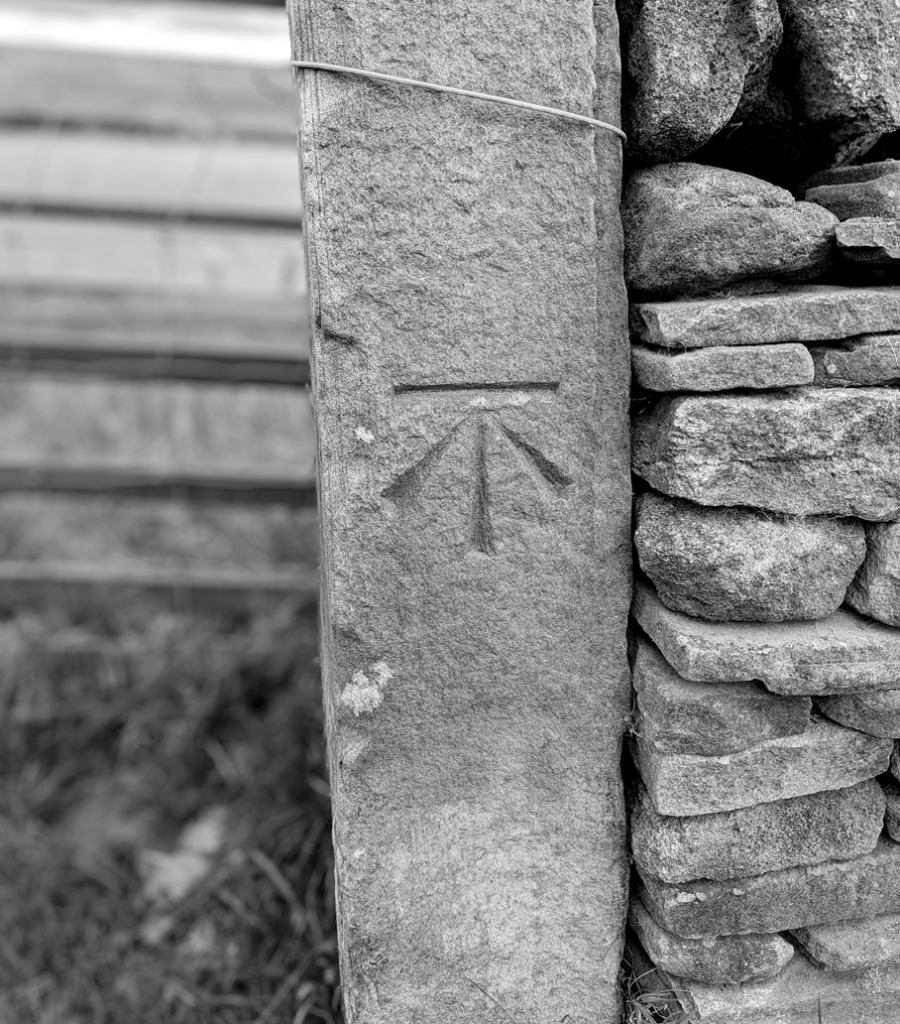
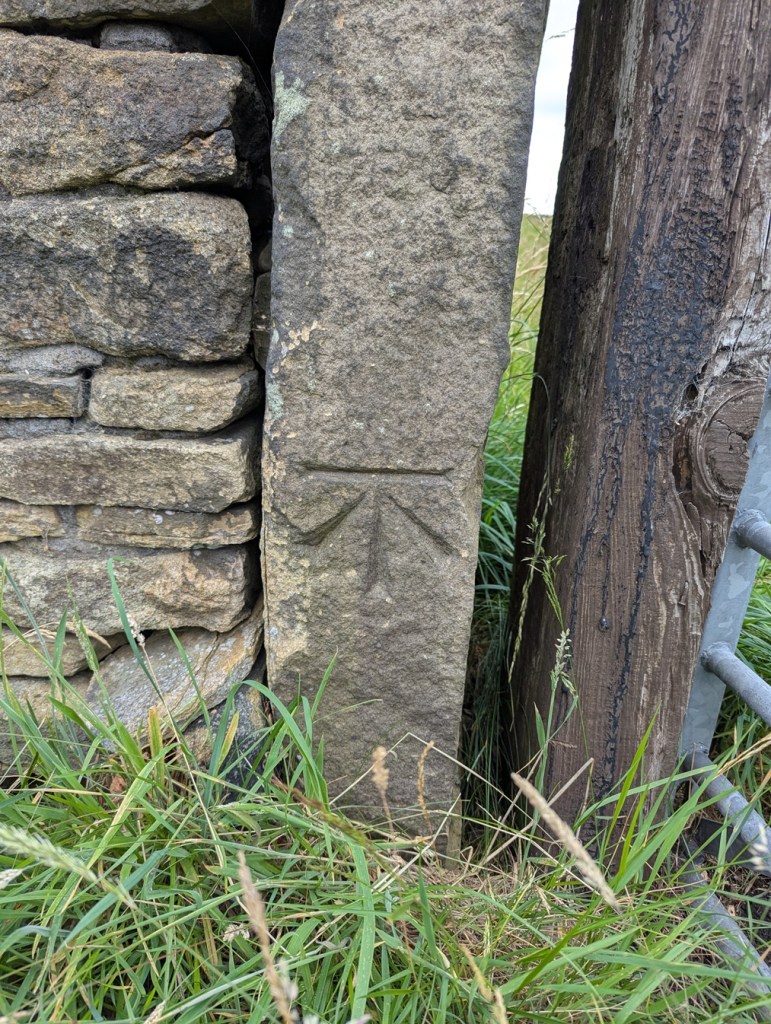
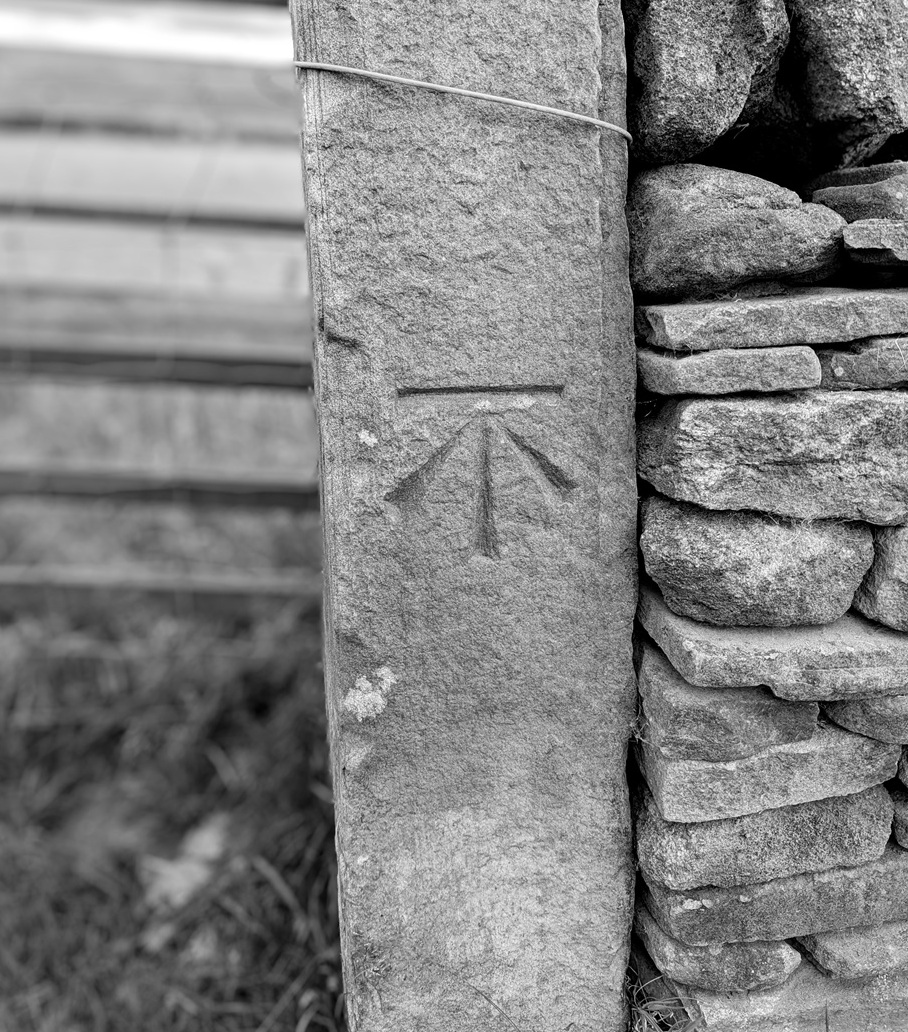
The Ordnance Survey often use them to carry benchmarks – after all they’re not likely to be moved, and so are a safe and permanent marker for heights above sea level.

The line above the arrow is 682 ft above sea level, precisely.
This one is 716ft 2″ above sea level.
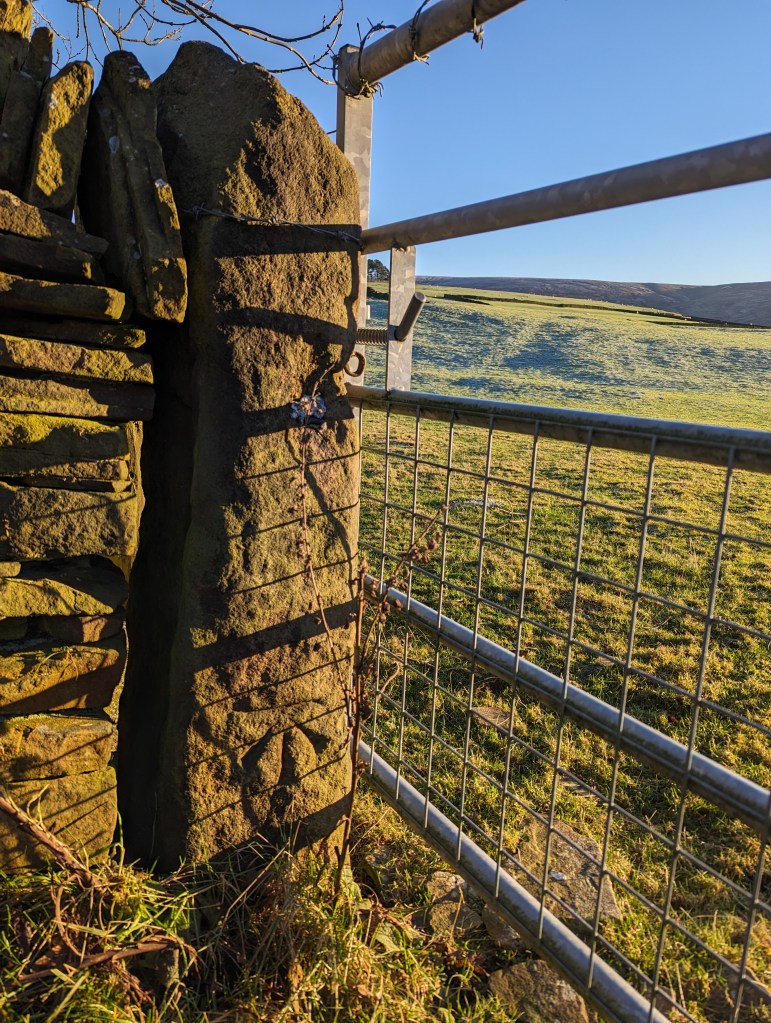
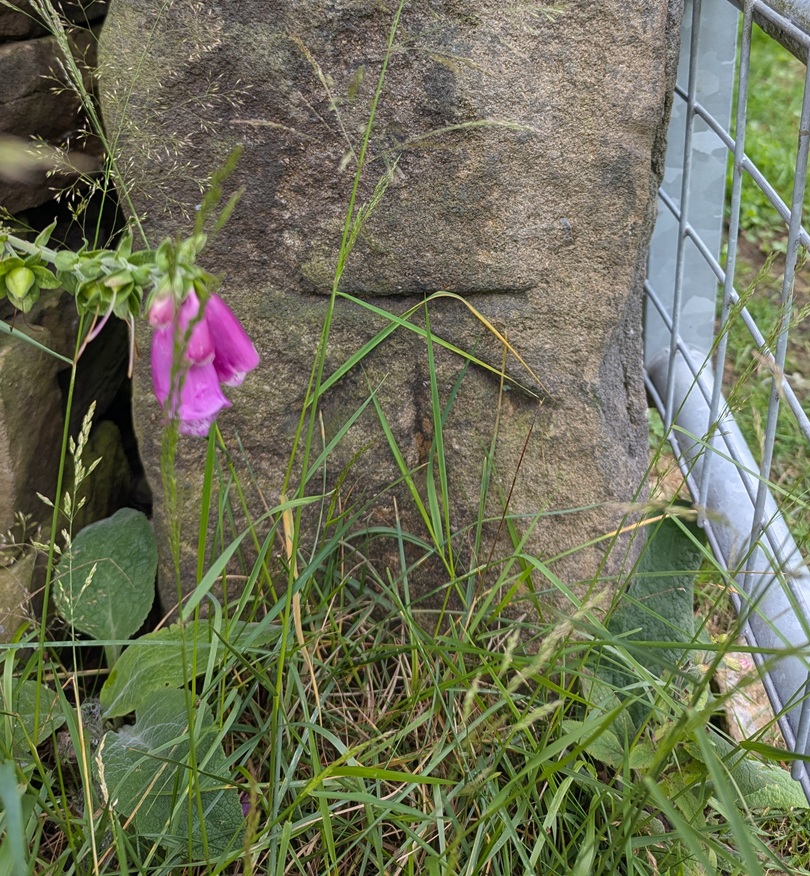
I love this photo… the grass almost mirrors the benchmark. Oddly, I don’t have a height for this mark – for some reason, no OS map I have come across shows its existence. Strange.

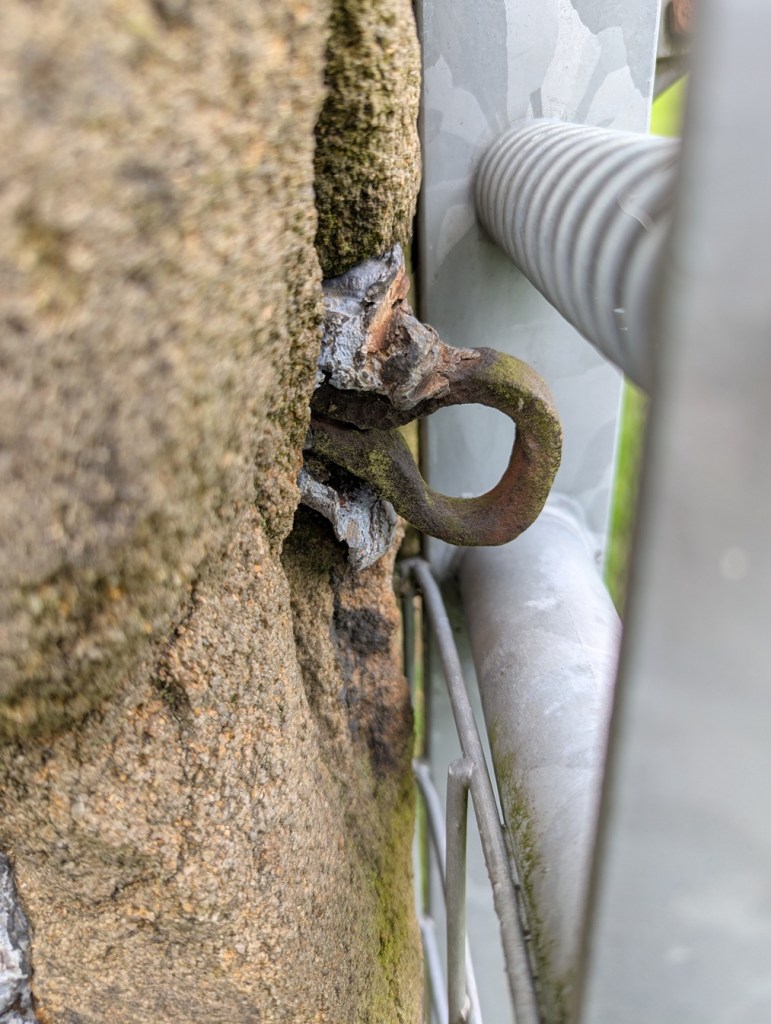
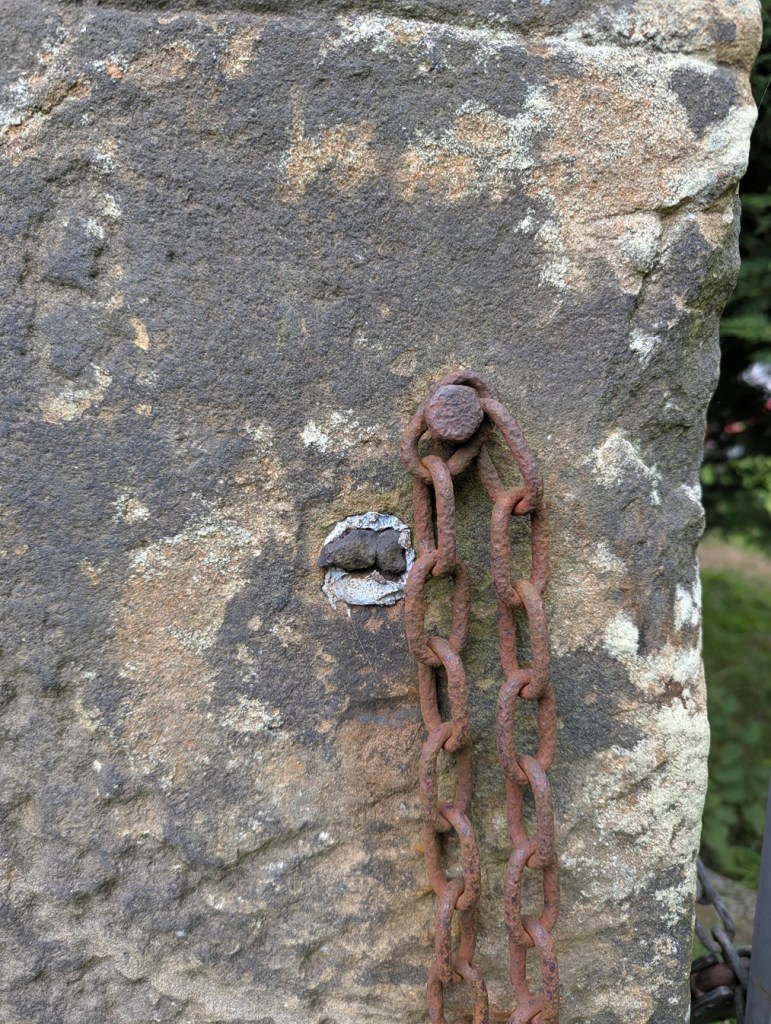
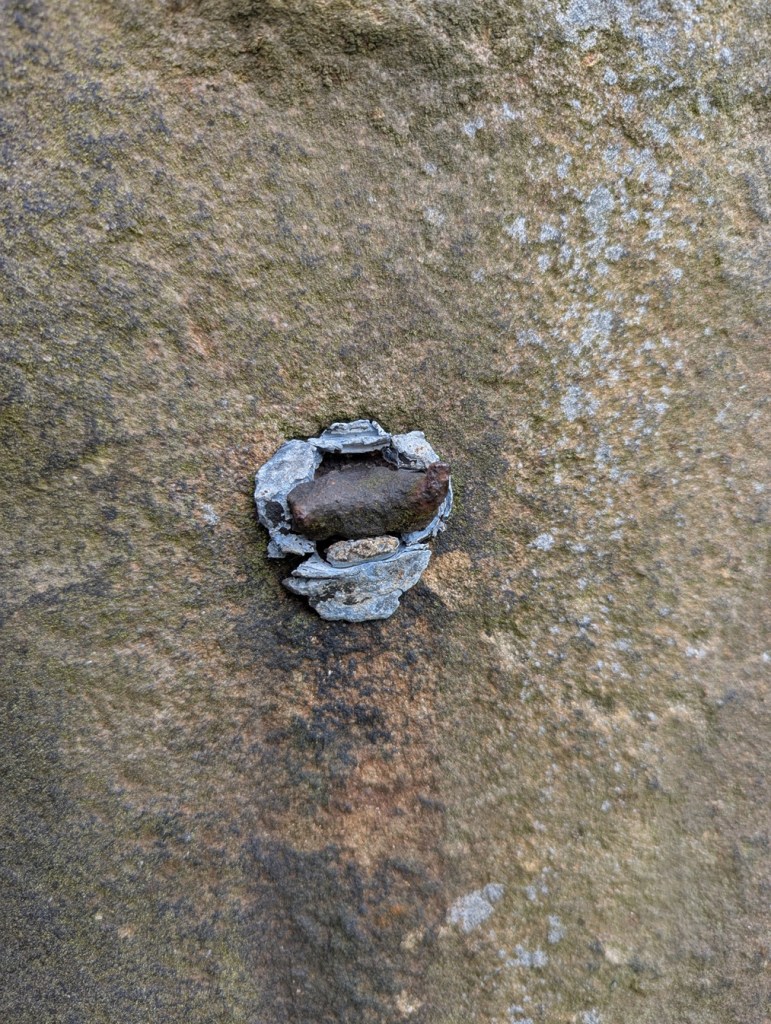
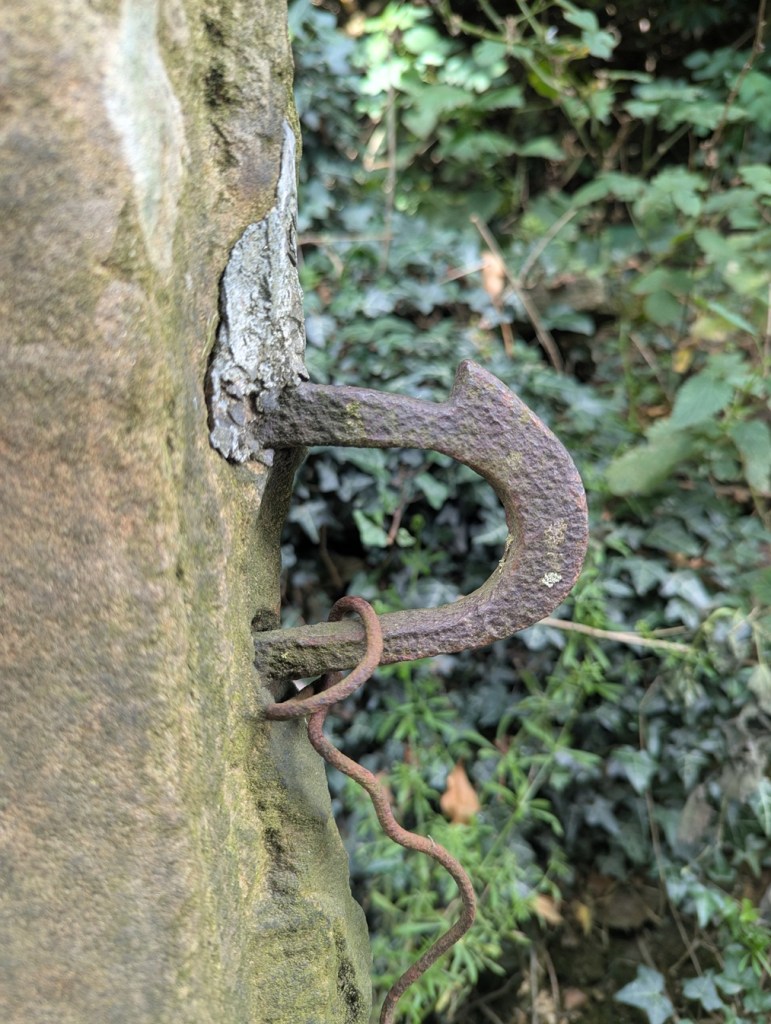
The fixtures and fittings of gateposts always fascinate me, too. Cast iron hoops and hooks, held in place by the tell tale grey/blue of lead. Sometimes you can only see the lead, the actual latch or pintle missing, it’s function no longer having purpose – it is just now a standing stone.

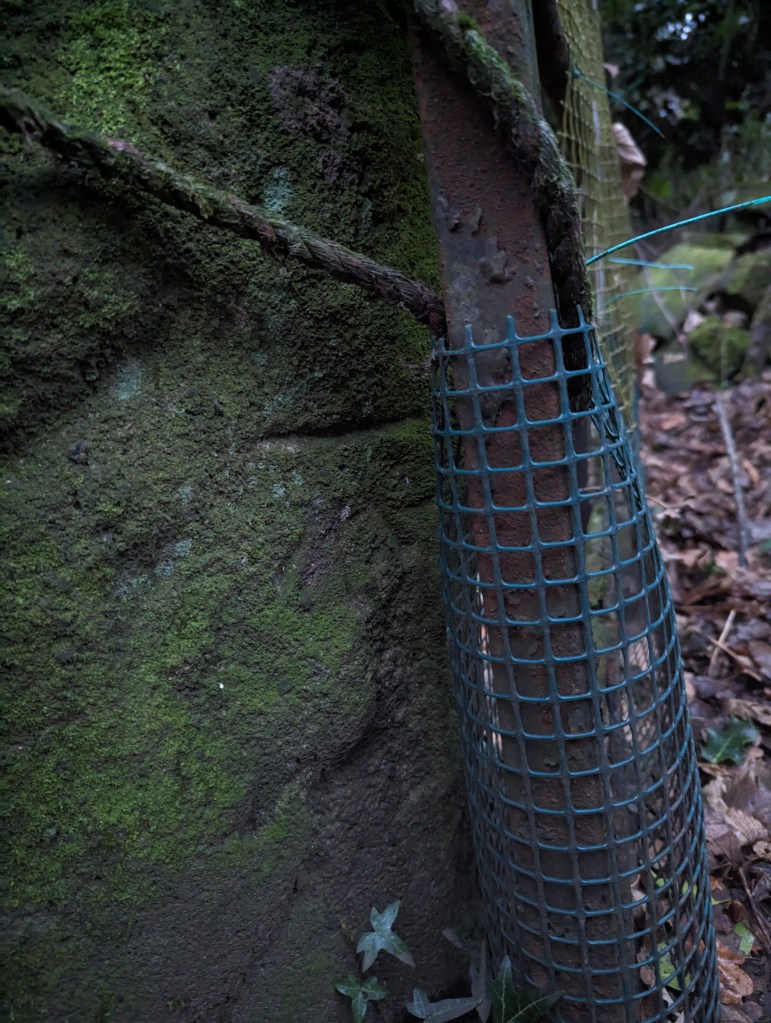
A now missing something or other, the metals eroding, staining the stone. It can get so bad that it actually kills the moss and lichen.
More something or other, now missing, but once important. The lead fixing is a tell-tale sign that the iron whatjamacallit is missing. I honestly love this, it really does show my theory of objects having a biography.
This is lovely… beautiful cast iron eyelet, twisted and shaped whilst red hot, and then held in place with lead. Although no longer needed to make the gatepost function – the modern steel gate does that (leaving it’s own scars on the stone) – it remains a part of its history.
Multiple phases of use, each leaving a mark.
Again, scars, but once meaning, purpose.
Hand made, and truly wonderful.

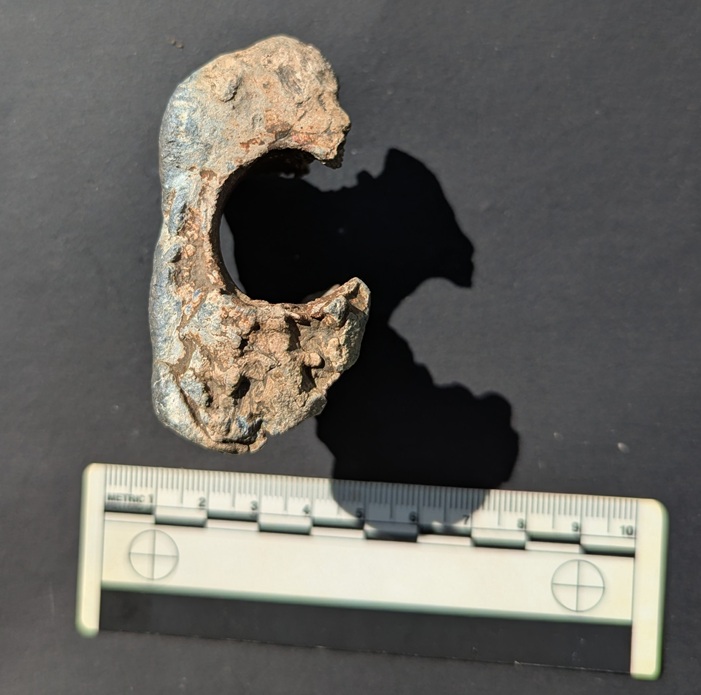
It was actually one of the lead fixings that I found that partly inspired this post. I saw what was obviously lead sticking out of the ground, and bending to remove it as I always do – it’s really not good for the environment – I realised it was bigger than I expected. I studied it for a moment trying to work out what it was, when suddenly: “aha” I thought “that’s a fixing“.

You can see rust on the inside, where the iron whatsit was held in place.

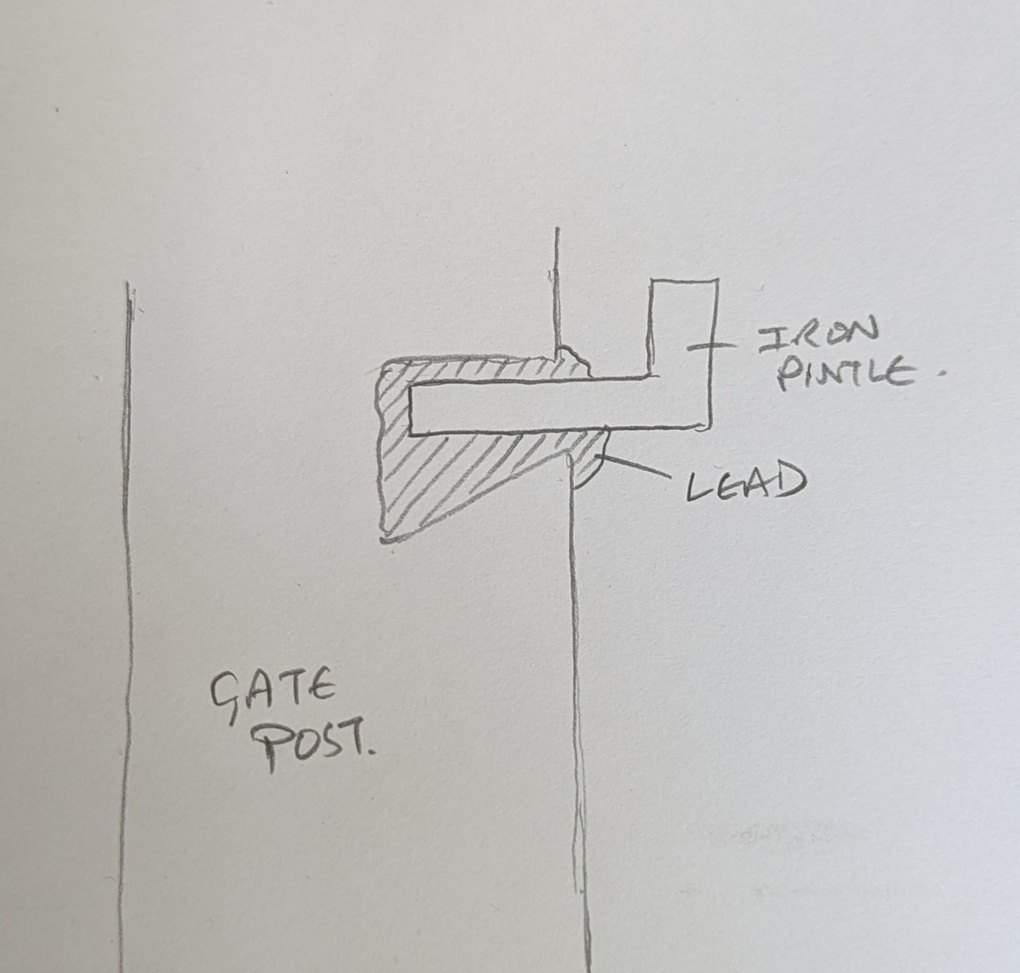
Looking at this lump, and using a small diagram, you can see what it is and how it worked. The long hollow through the middle once held the iron fixture – a pintle or latch, perhaps.

The iron whatsit was circular in section.

The shape of the lead piece is also a clue to how it actually held this in place. A hole is made into the side of the gatepost that needs the ironwork on it, with the lower part of the hole made deeper. The ironwork is placed in the hole, and the molten lead poured in using a funnel to hold it within the stone and around the iron whilst it cools.

If this makes sense.

When hardened, it forms a plug that is very difficult to move, keeping the iron work in place; clever, and elegantly simple. It’s also nice to see the ‘inside’ of the gatepost, or rather a cast of the inside, and one wonders why the lead has come away so intact from its original home – one can only imagine that the post itself was broken, freeing this fixing, which then found itself at my feet in the wilds of Derbyshire years later.

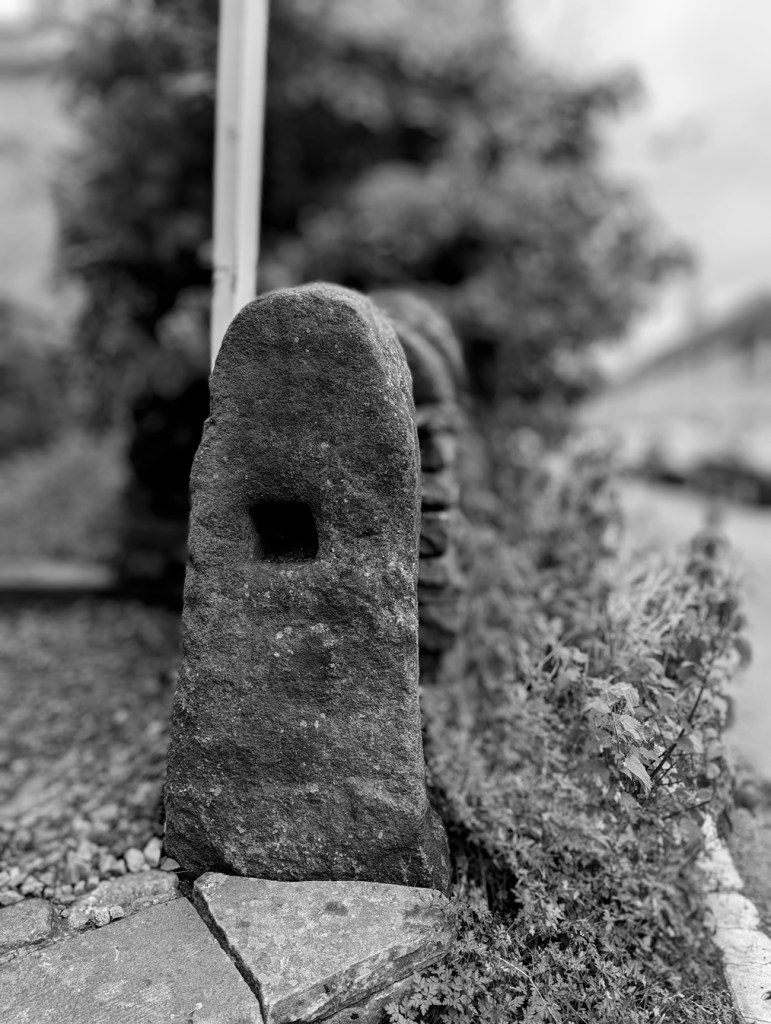
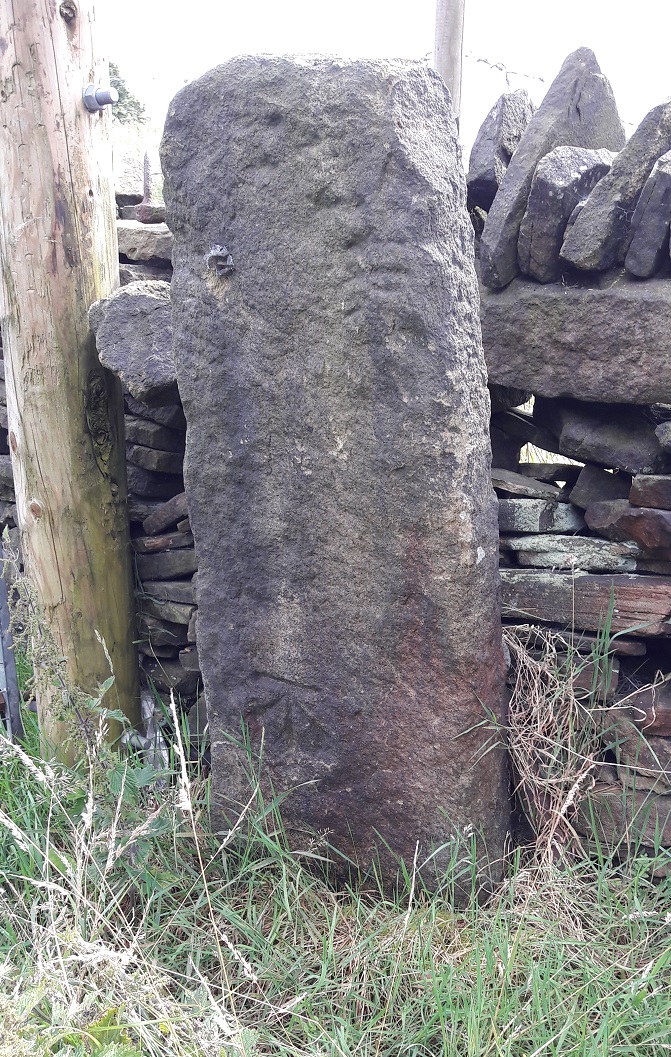
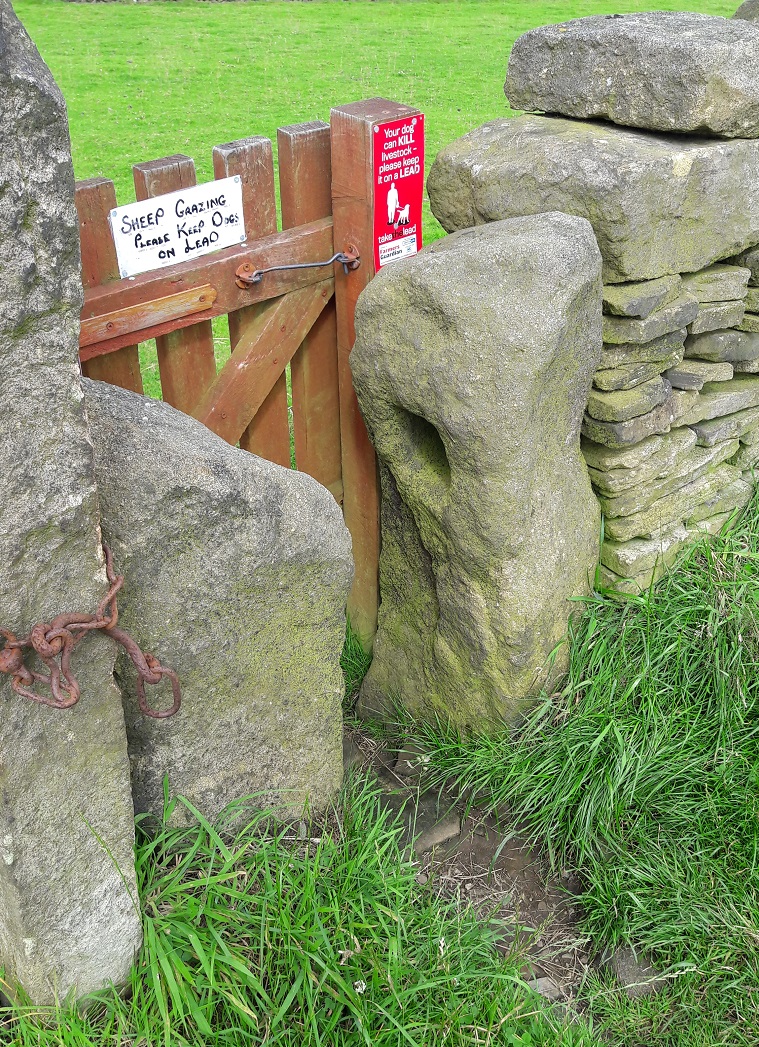
In terms of dates for these gateposts – well, it’s not clear. I think the more uniform stones, with a rounded head, are Georgian and Victorian – later 18th and 19th century. However, there are some that I think are significantly older – 17th, 16th, even 15th century, possibly. These are generally less formally worked, are shorter, and importantly are characterised by having a single straight hole through the stone a few feet above the ground.

Another arty shot, this one of the ancient gatepost on Hague Street.
Carrhouse Lane, Whitfield. And no, I didn’t stick my hand in the hole…

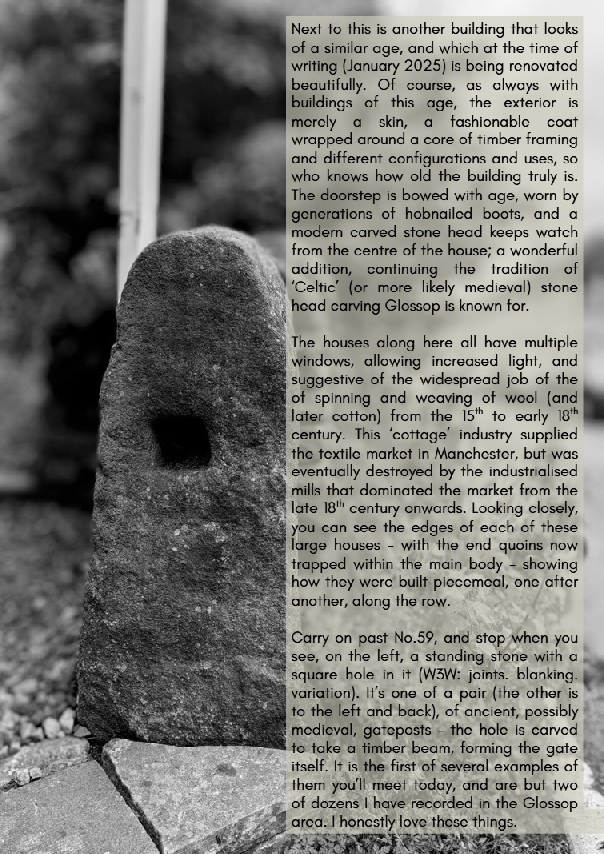
I was, until fairly recently, convinced that these were marker stones for trackways, the square hole perhaps taking a wooden pointer. However, I started to notice that this didn’t always fit the pattern, and despite multiple blog articles, twitter posts, and it even published in Where/When, I began to doubt this explanation. I then received an email that pretty much confirmed it for me (thank you PB, you amazing man!). In it, the author quoted a John Farey, whose 1815 book – General View of the Agriculture and Minerals of Derbyshire: With Observations on the Means of Their Improvement. Drawn Up for the Consideration of the Board of Agrigulture [sic] and Internal Improvement – gave the following quote:

Anciently, the Gates in the Peak Hundreds were formed and hung without any iron-work, even nails, as I have been told; and some yet remain in Birchover and other places, where no iron-work is used in the hanging: a large mortise-hole is made thro’ the hanging-post, perpendicular to the plane of the Gate, at about four feet and a half high, into which a stout piece of wood is firmly wedged, and projects about twelve inches before the Post; and in this piece of wood, two augur holes are made, to receive the two ends of a tough piece of green Ash or Sallow, which loosely embraces the top of the head of the Gate (formed to a round), in the bow so formed : the bottom of the head of the Gate is formed to a blunt point, which works in a hole made in a stone, set fast in the ground, close to the face of the Post. It is easy to see, by the mortise-holes in all old Gate-Stoops, that this mode of hanging Gates was once general.

Of course, it made sense, despite me banging on about them being marker stones. So, please accept my apologies for this; I am not always correct, and my knowledge is always growing. And thank you PB, who brought this to my attention – this is your discovery, not mine (you can read the book here – P.92 is the quote. There are about 20 of these gatepost types I know of, with many more awaiting discovery. And I actually think these are quite significant, as if we plot their location on a map, we might get a better grip on land use in the pre-industrial period. Marvellous.

I am obsessed with gateposts, and I want you to be, too. Everytime I pass one, I check it out, and often I am rewarded with some nugget of information, graffiti, decoration, or just a blast of the past. Let me know what you find via the contact page, and let’s keep an eye out for those holed ancient stones.

Right, I think that’s all for this month, and lucky you the next post will, I suspect, be a pottery post! Woohoo! I have found lots of cool stuff recently, and it all needs writing about. As always, I have about 30 projects ongoing, not all of which is coming to fruition anytime soon, but some will emerge relatively rapidly – watch this space. In the meantime, do please check out the Etsy store, or the Ko-Fi page – and feel free to buy me a beer coffee, or yourself a copy of Where/When, or even a t-shirt!

But until next time, please do look after yourselves and each other. I know I always say that, but you all matter, and we all need to take better care of each other… the world can be scary place at times, so lets band together and help each other.

And as always, I remain.

Your humble servant,

TCG

Bench Marks · Stones of Glossop · Towns of Glossop

A Bevy of Boundary Stones

Ho! Ho! And if I might dare, What Ho! A shortish one today, and actually one that is something of a relief, if I’m honest. Like the last post, this one has been years in the making, but this time for all the wrong reasons… all will become clear in a moment, but for now let’s crack on.

As the title suggests boundaries are today’s topic, apt as we hurtle to the Winter Solstice and the shortest day – that anciently observed boundary between the old year and the new. Boundaries such as these are often held to be dangerous places as they are a liminal space – neither one thing nor another, but somewhere in between. However, boundary stones in particular I find fascinating and strangely appealing objects; there is something very grounding about them in that they mark in a clear, permanent, and fixed way, an imaginary line. On one side ‘X’ and on the other ‘Y’, and there is no argument – the somewhat liminal boundary is made visible and real, and so it is the case with our stones today – three stones placed on bridges over various waterways delineating the townships that make up Glossop

All three, it seems, were carved and installed at the same time, and all are quite old – early Victorian. The first of the stones is the easiest found – Victoria Bridge in the centre of Glossop.

Bount
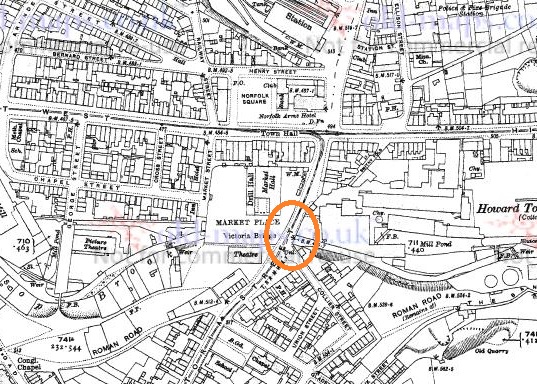
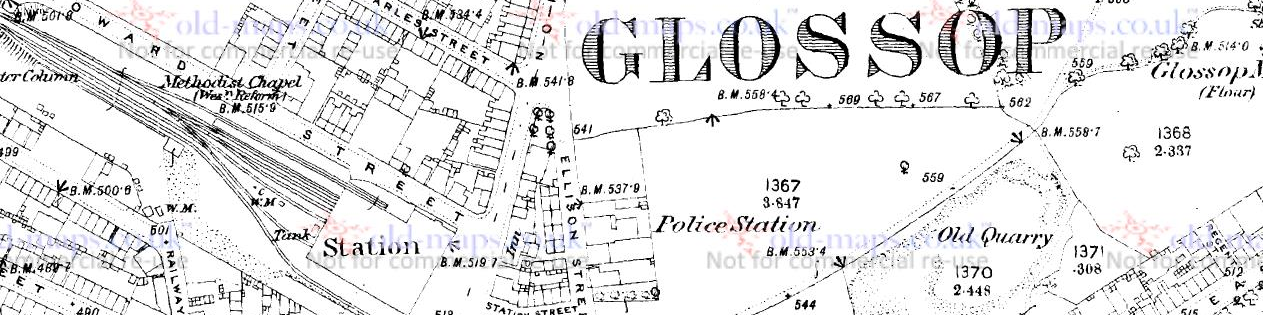
Station at the top, above the High Street crossroads. The bridge over Glossop Brook, and the stone, is circled in orange. Glossop is north of the Brook, Whitfield is south. 

And here it is in real life.

Boundary St
Victoria Bridge. Wetherspoons is in the background, and Glossop Brook runs beneath.

The bridge, and the stone, stand over Glossop Brook, which disappears under the market place and carpark, and the line carved between the words Glossop and Whitfield is the centre line of the brook below. Victoria Bridge was built in 1837, the year Queen Victoria ascended the throne, hence the name. This new bridge replaced an old and narrow hump-backed pack-saddle one. Indeed, the original line of the road that led over the bridge, down Smithy Fold, and along Ellison Street is traceable, and is preserved particularly in the buildings of the Brook Tavern, Cafeteria, Glossop Pizza, Balti Palace (all built in 1832). I have a blog post almost finished that looks at this area in more detail, so I won’t go into it here.

Looking closely, the inscription “Victoria Bridge” and the date “1837” are in a different font and slightly larger than the other lettering on the stone, and are more cramped, and it seems they were added at a later date. Indeed, compare this stone to the one below, and you can see they both once looked the same. 

And of course, it wouldn’t be the Glossop Cabinet of Curiosities without a bench mark, this one on the bridge and just to the left of the boundary stone. 

Victoria Bridge
This is what 495.7 ft above sea level looks like.

The next stone is to be found on Charlestown Road, on a bridge over Long Clough Brook – it’s very much a blink and you’ll miss it kind of affair, even if you are walking. 

Bounty
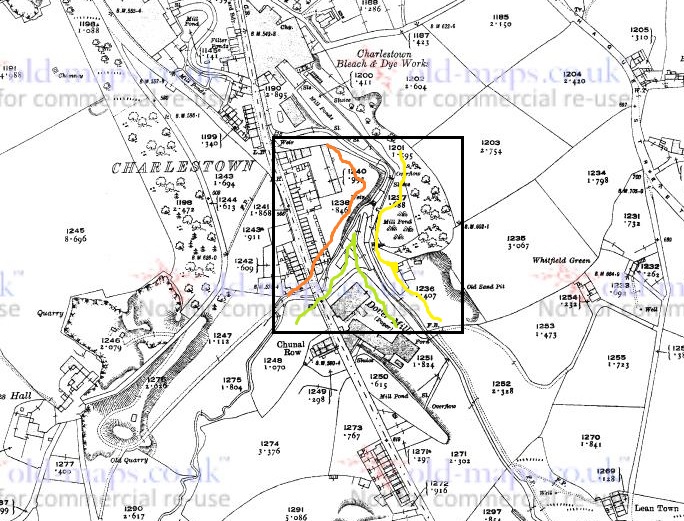
Turnlee and Charlestown Roads join at the top, with the boundary stone circled in orange.
bound3
Here is the bridge over Long Clough Brook on Charlestown Road. The stone is visible.
bound1
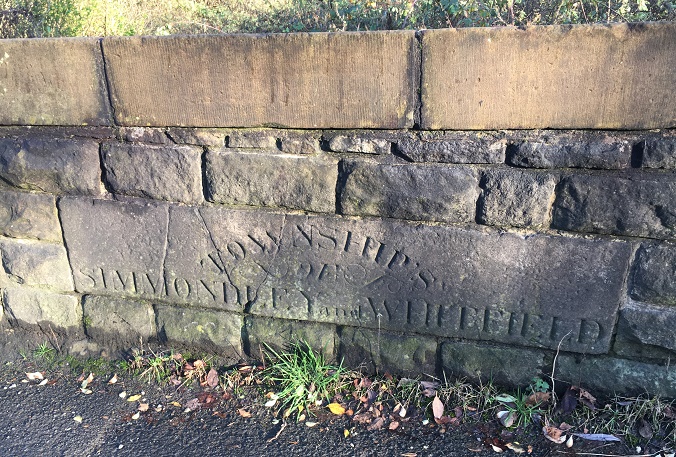
Here it is in close-up. Can you spot a mistake?

This stone follows the same formula as the Victoria Bridge stone, but is slightly rougher in execution. It seems to have been reset into a rebuilt stone wall at some stage, as it doesn’t really match the coarse  surface of the stone around it, and this resetting might explain the cracking. It also has an inexcusable mistake… there’s a bloody apostrophe after ‘township’! It should read ‘TOWNSHIPS’, the plural of township, but instead it reads that ‘Township’ owns something called an ‘of Simmondley and Whitfield’! Also, although it states that this is the boundary between Simmondley and Whitfield, it technically isn’t. This is the border between Chunal and Simmondley, but it seems that for administrative purposes, Chunal and Whitfield were often lumped together. The confluence of Bray Clough (from Gnat Hole) and Long Clough Brook (just east of the boundary bridge) is actually the meeting of the three townships of Chunal, Simmondley, and Whitfield, here:  

bounty2
The three townships illustrated at the junction of Bray Clough Brook and Long Clough Brook. Chunal in green, Simmondley in red, and Whitfield in yellow.

So far, so good.

Now, the third and final stone was a bit more of a mystery. According to Neville Sharp (Glossop Remembered p.184 – a great book, by the way, well worth seeking out – here for example, but order it from Bay Tree Books on the High Street, of course), a stone similar to the one on Victoria Bridge stood on the bridge over Hurst Brook which forms the north eastern boundary between Glossop and Whitfield. That is until it was washed away in a flash flood.

Bound4
High Street East at the top, with Derbyshire Level running from the Royal Oak off the map at the bottom. The word stone on the bridge over Hurst Brook is circled.

Then, whilst doing some research, I came across a reference to the stone and made a note in my notebook that until at least 1977 the stone stood next to the entrance to Golf Course. Annoyingly, I didn’t take down the reference and it’s taken me 3 years to track down the source of the information. Three years! Such is the level of detail and dedication I devote to this blog in order that you, gentle reader, can revel in such a fascinating subject as “bits of old plate” as it was once described by the person who runs the ‘Official Glossop‘ twitter account. Honestly, the nerve of some people…

So I re-found the source – this website – and blow me if it didn’t have a link to photographs of the stone taken in 1977:

Boundary Stone 1 (1977)
Entrance to the golf course on Derbyshire Level, the boundary stone bottom centre, in the glorious sunshine of the summer of 1977


Boundary Stone 2 (1977)
Close up of the boundary stone with part of the word ‘Glossop’ visible. Please note that I don’t have the copyright to these photographs, and make no claim to such, they are merely ‘borrowed’ from the above site.

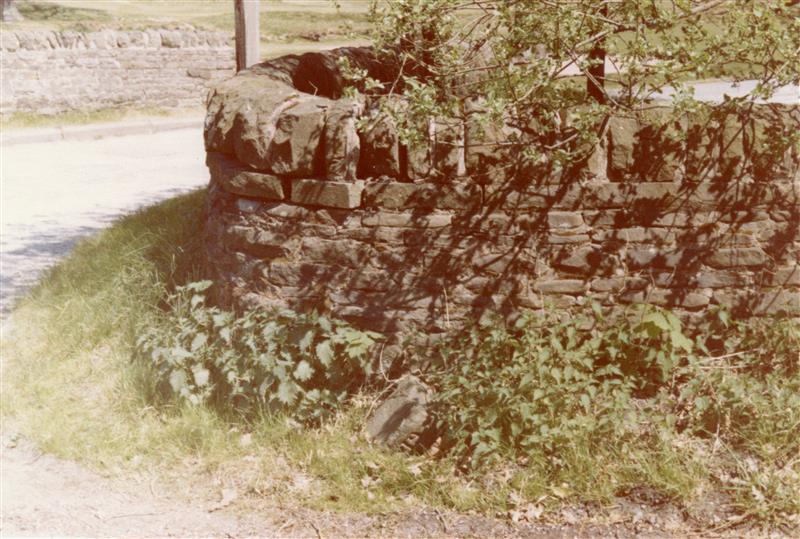
The stone was presumably recovered, in its broken state, and set up on the side of the Golf Club entrance, and whilst it doesn’t look like there is a lot left I went to have a look.

Boundary St1
The same view as the first photograph above, missing the important piece.

Alas… the stone is no longer there. I had a good look around at all the stones that might be a possibility, but to no avail. I suspect that someone has taken it – it was a nice piece of stone after all, but it is a shame. All is not negative, though, and from the 1977 photograph we might suggest where it originally stood; the fact that the fragmentary word ‘Glossop’ is visible at the left hand end of the stone means that it could only have stood at the eastern side of the bridge, closest the golf course, for it to make geographic sense – Glossop is north, Whitfield is south at this point. Here, in fact:

bound2
Here. You can see the modern(ish) bridge that must have replaced the one that was washed away. Here, Hurst Brook separates Whitfield (right) from Glossop (left).

Its fragmentary nature also suggests that more of it lies in the stream bed – I had a look, but couldn’t see any likely stones, but perhaps next summer I’ll have a poke around. 

Right ho, that’s all for this time. Hope you enjoyed a ramble around the boundaries, and in fact I am writing a blog post that actually covers the boundaries of medieval Glossopdale based on a 13th century perambulation. I’d also like to do another that looks at the boundaries of all 10 townships of Glossop as they are in the Domesday Book, which could be a bit of fun. ‘Could‘ being the operative word here. And ‘fun‘ being an entirely subjective concept, I realise. But you, kind and gentle people, know what I mean… after all, you’re reading this. Please drop me any thoughts or hints, even to point out my mistakes, or the fact that I need a haircut. Take care of yourselves and each other, have a very merry Christmas, and until next time, I remain.

Your humble servant, 

RH

Bench Marks

A Lost Bench Mark

Morning all. Apologies for the recent lack of activity; all usual reasons apply, but we’ll spare the grovelling and move swiftly on.

I was contacted recently by the wonderful Geoff Bell, who informed me that he knew the whereabouts of one of the bench marks that had been declared lost by me in this post. Specifically, this one.

GB BM
The location of the no longer missing bench mark, 562.5 ft above sea level. 

How wrong I was! I popped over to see him (and his wonderful garden), and he showed me the stone and mark. It wasn’t easy to get to, but at least I can now tick it off my list.

Here is the stone:

GB BM1
Stood at the end of, and incorporated into, the wall.

The stone is interesting. It is clearly in its original place, with the current wall being relatively recently added, but following the line of the original wall. This original wall used the stone as a reference point (it curves to meet it), and it was clearly here before the wall was built, leading to the question of… what was it? It seems not to have functioned as a gatepost, it has no evidence of metal ‘fixings’, nor is it shaped like other gateposts, and it would be an odd place to have it. It is possible that it was a free-standing standing stone, perhaps even prehistoric, but it is difficult to prove. It might also have marked a track, and although the probably Medieval or earlier Bank Street runs close by, it’s way below (some 39 ft and more, to be precise), and no one moves a stone that big very far up hill. No, it’s a bit of a mystery, but hey ho.

So, this is what 562.5ft above sea level looks like! Apologies for the close-up – there was no easier way of taking the shot – it really was quite inaccessible!

GB BM2
Exactly 562.5ft above sea level. 

So there we have it. My sincere thanks to Geoff (lovely to meet you) for alerting me to this. If anyone else wants to get in touch and tell me about anything interesting, please do… especially if it involves bench marks!

Oh, and on the way out of his garden, I saw these striking Fly Agaric mushrooms:

GB BM3
Amanita Muscaria – the Fly Agaric. 

Wonderful to look at, and used by shamen throughout the world to commune with the other worlds and work magic. Interesting, but I really wouldn’t recommend it.

Right. I ‘ll try and get another post done this evening, but for now, I remain.

Your humble servant

RH

Archaeology · Bench Marks · Pottery

Whitfield Avenue

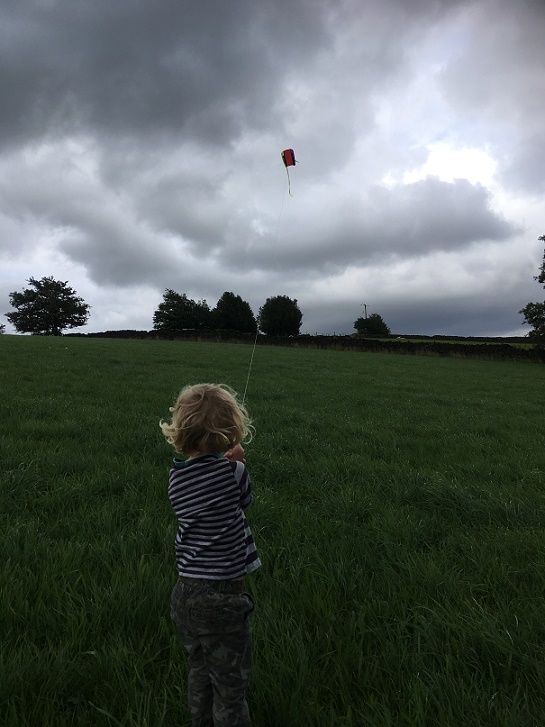
A brief one today. Taking advantage of the lull in the rain coupled with a bit of a breeze, Master Hamnett and I went to fly a kite in the fields off Hague Street. On the way back, I found some bits of pottery which spurred me into doing the blog post that I have been thinking of doing for some time.

WA2
Just in case you get lost. Actually, it’s a nice touch, and I wonder where else the impressed concrete road names were placed.

Whitfield Avenue runs downhill in a broadly NW – SE bearing from Hague Street to meet with Charlestown Road, and is parallel to Whitfield Cross.

WA4
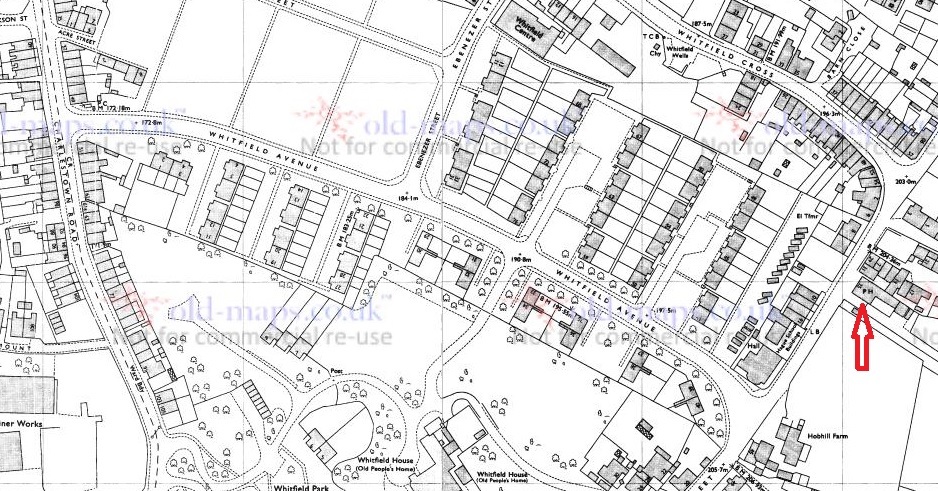
Whitfield Avenue runs north-west – south-east. For orientation, The Beehive pub is indicated by the arrow. (1974 OS map)

At first glance, it is not a particularly interesting road. The product of the 1960’s demolition and rebuild of the Whitfield area, the road didn’t exist prior to this, as you can see from the map below.

WA5
This is the 1921 OS map, and again, The Beehive is indicated.

What is there is a footpath, walled for most of its length, along the long thin fields that characterise the fields of Whitfield – possibly a survival of the medieval ‘croft and toft‘ field system, or more likely a result of the enclosure of the land there in the early 19th Century. This is interesting, as we shall see, but it also probably explains why the council chose there as the location of the road – using an already existing path.

wa22
Whitfield Avenue from Hague Street looking down to St James’s Church and Charlestown Road. On the ridge line in the distance, on either side of the left hand tree, is All Saints Mottram (left) and the Deep Cutting at Roe Cross (right).

Historically, then, it is interesting, but not exactly earth-shattering. That is, until you peel back the modern, and take a closer look.

Hague Street was the original packhorse road from Chapel en le Frith to Glossop (now, Old Glossop) – there is some discussion about the road, here, and there is the Glossop Guide Stoop, too (and more here). It was an important route, and the village of Whitfield grew around it – this is the oldest part of the area. Dating for this road is tricky – we know it was there in the 10th Century, as the Whitfield Cross was placed at the junction of Hague Street and Whitfield Cross (the road), and presumably some form of settlement – perhaps just a farmhouse – was there at the time. Beyond this, however, we have no evidence. However…

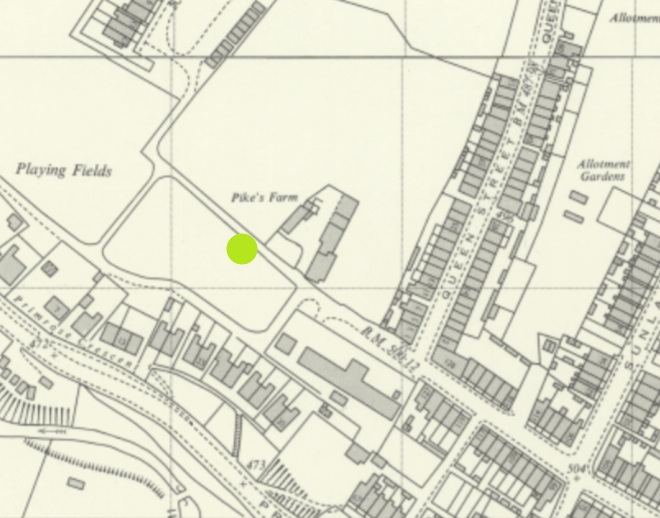
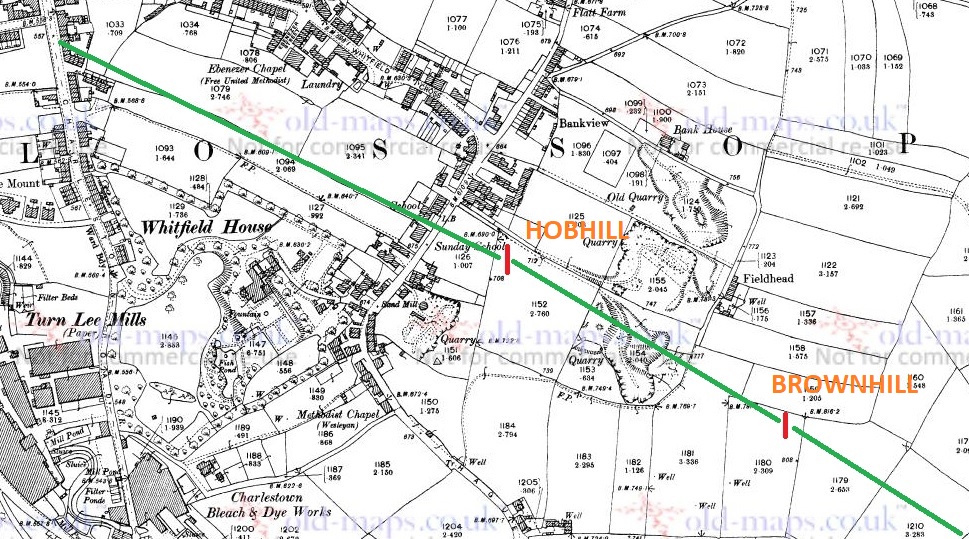
In the early 1970’s a series of excavations were carried out by two archaeologists – Peter Wroe and Peter Mellor – in order to establish the line of the Roman roads to and from Melandra Fort. Although this thorny and difficult subject has been much debated (and only recently – possibly – put to rest), they made great leaps. One of the roads, that coming from Navio Fort (Brough, near Castleton) passes through Brownhill, and comes through Hob Hill Meadows, and continues down the line of what is now Whitfield Avenue. From there it travels down the road that are now known as Hollincross Lane and Pikes Lane, and over into the fort.

Yes, you read that correctly, Hollincross Lane/Pikes Lane, especially its latter part toward Pikes Farm, is a Roman road.

WA6
The line of the Roman road is shown in green, leading down what will become Whitfield Avenue and onto Hollincross Lane and Pikes Lane, and then to Melandra Fort.

The excavations not only revealed the broad line of the road, but also how the road was built. The next picture shows what is called an archaeological section drawing – essentially a slice of the road was taken out, and the side of the slice was drawn showing the layers that made up the road. And all this is just 1ft below the ground, which is quite remarkable.

WA7
The upper section shows what is marked ‘Brownhill’ on the above map, the lower shows ‘Hobhill’. The road is very clear, and very large, too.

Interestingly, and as an aside, Hob Hill as a placename means ‘Devil’s Hill’ – I have said it before, I love it when folklore and history meet.

The ‘original’ footpath on the first map pretty much follows the line of the Roman Road. This is interesting, and suggests that the path used the surface of the Roman road, or a later incarnation of it; there is no point in making a new path if you can use an existing one, especially if that one has a good surface. What I like about this is that a road built 2000 years ago, directly dictated to the council the course of a road built in the 1960’s. History affects us in the present in many ways.

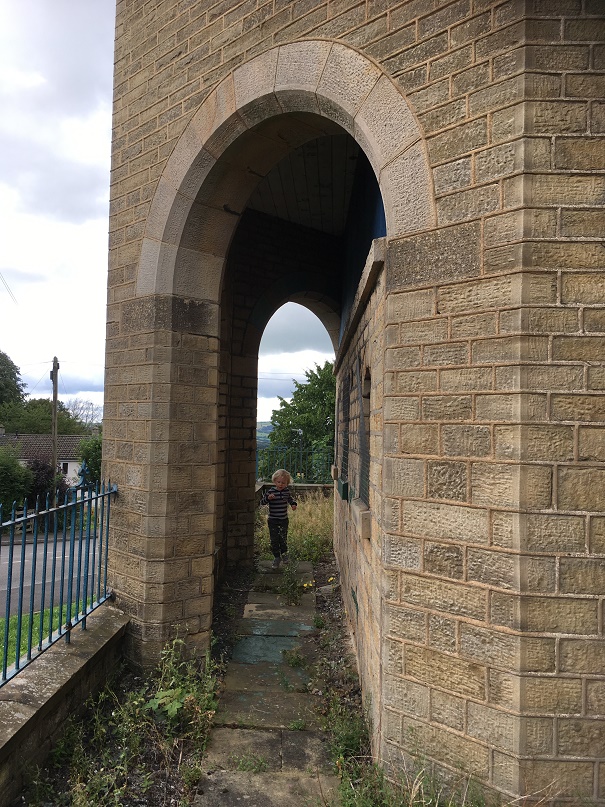
At the top of the road stands this wonderful, forlorn, and if I’m a little honest, slightly terrifying, building – the former Chapel/Sunday School.

WA9
I can’t be the only one who gets weird Amityville vibes from this building, can I? It is the ‘house on the hill’ after all.

I have always been intrigued by this building, and so taking advantage of the open gate, I had a look around.

WA13
Master Hamnett having a look around.

It’s really quite a lovely, if very Victorian, building, full of nice touches.

WA17
The quoins give it a rather grand air, with some nice masonry.

WA16
Ornamental ironwork, sadly in disrepair, and in need of painting. An artful shot looking down Whitfield Avenue – very unlike me!

There is also a datestone, helpfully recording the dates of the original construction, the rebuild, and what its function was.

WA11
I do love the Victorian literal approach to recording things – it really helps us historical types.

Actually, it was also altered a third time in 1931 to incorporate the chapel further up Hague Street which by then had fallen into disuse. This Methodist chapel (itself rebuilt from the original 1813 version), had once contained the pulpit from which John Wesley had preached, and which in 2010 was returned to its rightful home in New Mills (see here for information and photograph).

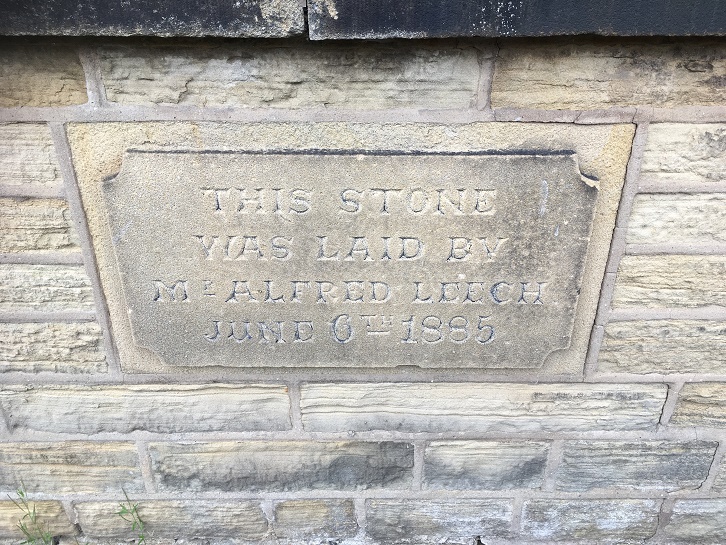
The 1885 rebuild had four cornerstones embedded into it, recording the local worthies who attended the ceremony, and which allow us a peek into Late Victorian Glossop life. Here they are:

WA18
“This stone was laid by Captain Partington. June 6th 1885”

WA19
“This stone was laid by Mr Alfred Leech. June 6th 1885”

WA20
“This stone was laid by Mr John Sellars. June 6th 1885”

WA21
“This stone was laid by W.S. Rhodes esq. J.P. June 6th 1885”

So these are the stones, but who are these people?

Captain Edward Partington: Partington was a very important person in Glossop’s Victorian history – his biography is impressive, but in summary he was born in 1836, and moved to Glossop in 1873, buying up all sorts of mill concerns, and ending up Rt. Hon. Edward Baron DoverdaleRt. Hon. Edward Baron Doverdale, dying in 1925. He did a huge amount of philanthropic work around the town (funding the library, for example), and served as Captain in the 3rd Derbyshire (Volunteers) Rifle Corps. Oh, and was a mean rugby player, by all accounts.

Alfred Leech: There is very little information about Mr Leech that I can find. He crops up in a number of interesting places associated with Glossop society, and he is mentioned in the London Gazette as being elected as a land tax commissioner. His address is given as Cowbrook Cottage, Sheffield Road, Glossop. More research is clearly needed!

John Sellars: He is even harder to pin down. He might be the Methodist lay preacher mentioned in “Echoes in Glossop Dale: The Rise and Spread of Methodism in the Glossop Circuit” by Samuel Taylor of Tintwistle (1873). Or then again, he might not.

W. S. Rhodes: William Shepley Rhodes was a councillor, alderman and mayor for varying amounts of time. The Rhodes family were involved in various mill concerns in the aream and are well known. William was also known as a strong athlete and a good sportsman, being the president of the Glossop Cricket Club for a while.

So there you are – the more you know… or less, in some cases.

The chapel/Sunday school continued in use until Easter Sunday 1968 when it had its last service. It is now known as the Spencer Masonic Hall, and is where, from 1973 onward, the Freemasons Lodge of Hadfield 3584 have met on the first Thursday of each month. And at some stage it was up for sale – the sales brochure can be seen here (complete with interior view!). It’s a lovely building, but very neglected and tatty on the outside, and it’s a bit of shame that something more isn’t made of it.

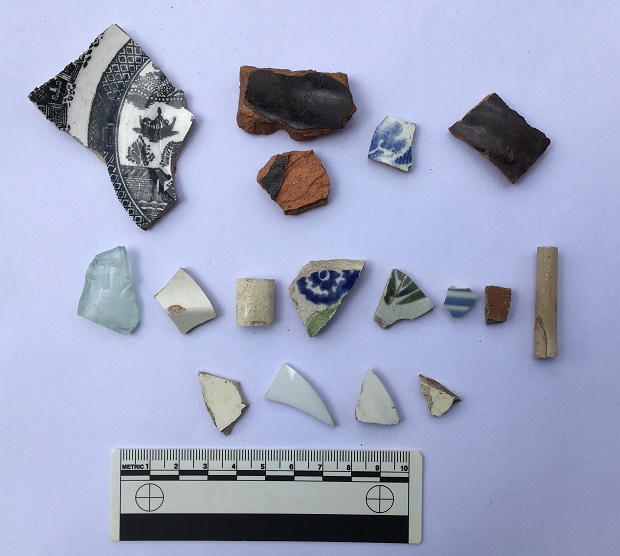
The pottery, then. Obviously it would be nice to find something Roman, but sadly no such luck. Instead, we have a selection of Victorian material, which might be the remains of household rubbish from the houses that once stood there (see above map), but equally might result from the process of nightsoiling. On balance, it is probably the former – there is no arable land in the area where I found the pottery, and the edges of the sherds are still sharp in some examples, and when pottery sherds are ploughed, the edges become rounded. There is nothing too exciting, but nice to see.

WA14
A modest selection of Victorian bits.

Top row, left to right: A shallow dish or saucer, transfer printed, and probably late Victorian, but difficult to date. Next to that are two sherds of a large Victorian cooking pot, very characteristic with thick walls, a black glazed interior, and a plain glazed reddish-orange exterior. They are made that way so that the heat can transfer through the unglazed side easily, but the glazed interior means that it is waterproof, and so holds the liquid well; quite clever really! Next is a willow pattern plate – very boring, but is patterned on both sides, so is from an open bowl type of vessel. Next, a glazed earthernware pot with grooved exterior – it’s probably a storage jar or something similar.

Middle row: Victorian glass fragment (the greenish/bluish tinge gives away its date), with a raised letter ‘T’ – clearly a company name or similar. Next, a plain sherd from a flaring rim from a soup bowl or similar; possibly early Victorian, as it has a slightly creamy opalescent glaze. Next, a handle from something – cup or bowl. Next, an early Victorian sponge ware sherd – the blue pattern actually printed, potato-like, on a sea sponge. This is the base to a bowl of some sort (base diameter is 12cm, so not huge), and judging from the wear on the ring foot, was a much used and loved bowl before it was broken. Next, a sherd from a large cup or similar (c.15cm diameter), with transfer printed decoration. After that is a blue and white striped fragment, probably from a cup or similar. Next is a stoneware fragment from a storage jar or similar, fairly bog standard (there is some discussion of the type and the method here). End, is a clay pipe stem (from toward the bowl), and has a some nice paring marks on the body, but is fairly boring stuff (although I do love them).

Bottom row: All featureless white body sherds.

As I said, overall a fairly standard, if uninspiring, collection of Victorian pottery, and almost exactly as one would expect to find (although I do like the spongeware!). The best find, however, was found by Master Hamnett amongst the rubble and rubbish outside the Masonic Hall.

WA12hgfdjklgg
C.1980 vintage plastic soldier, courtesy of eagle-eyed Master Hamnett.

This was pretty much my childhood – plastic soldiers at a 1:32 scale. Whilst this one is not Airfix, it is still a good quality World War 2 figure – possibly Polish or Russian to judge from the helmet and gun. He’s lost his foot, and his stand, but to his credit he’s still fighting. Interestingly, he was also painted at some stage, too, and not professionally, so I think he was a much loved toy (if anyone recognises it, I’ll happily post it to them… I still mourn the loss of some of my soldiers!).

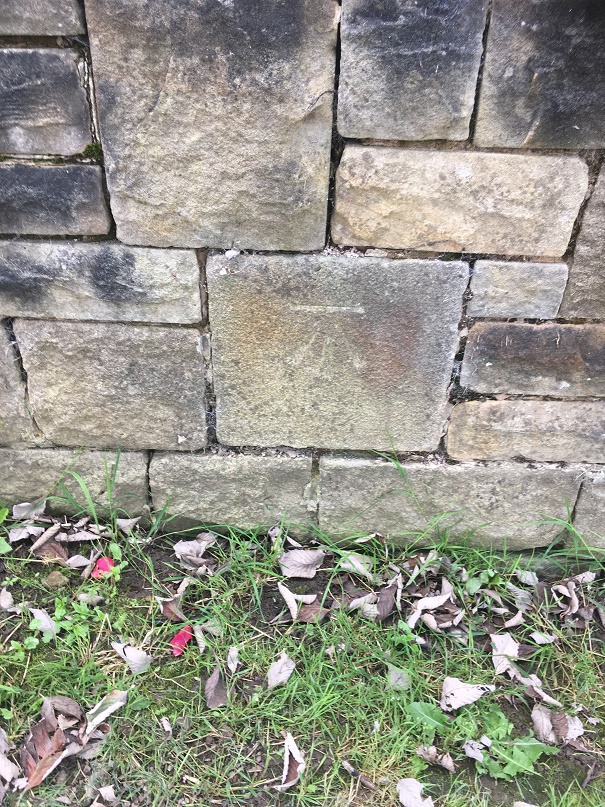
Of course, it wouldn’t be a decent post without a benchmark. On the original path there are three on the line of the track – from the top, a third of the way down (640.7 ft above sea level), one half way down (609.1), and one at the bottom (568.6).

The 1969 map (post Whitfield Avenue construction) has three benchmarks, but are of different heights (641.5, 601.5, & 564.9), and with this last on a now no longer existing ‘public convenience’ at the bottom of the road. Presumably they were re-surveyed and marked when the road was built, as the evidence of the carving seems to indicate. The only one that is still extant is the middle of the three, the others seem to have disappeared, alas.

WA10
An old stone block, rebuilt into the 1960’s wall, and with a new benchmark carved into it. 195.5 metres above sea level (641.4 ft in old money)

So, a lot of history and archaeology of a single road were explored on a single afternoon

WA15
Master Hamnett looking like he owns the place.

And, of course, we flew a kite, which was the best bit!

WA1
A successful day for Master Hamnett, too.

Well, that turned into a much larger post than I anticipated… who knew a 1960’s built street could be so interesting? Comments, as always, very welcome.

More soon, but until then, I remain.

Your humble servant,

RH

Bench Marks · Pottery

The Walk Part 2: Pottery

Here is the second installment of a terrific triptych of trivial twaddle.

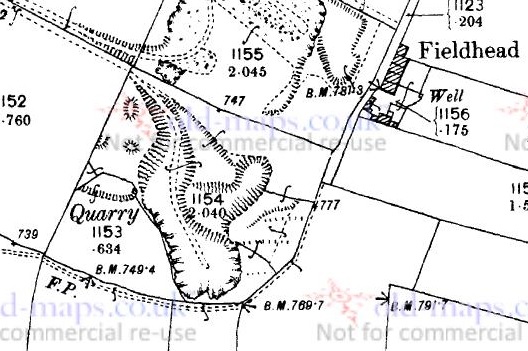
As previously mentioned, the path curves round to Fieldhead, and along the track, and here and there were bits of pottery and glass. Nothing earth-shattering or particularly old, but some interesting bits nonetheless. The question of ‘how did it get there?’ is a good one. In this case, it seems to have been a combination of nightsoiling, general littering in the past, and the presence of a rubbish dump. The quarry shown in the 1898 map below eventually goes out of use, and by the 1920’s has a new role as a miniature rifle range. Eventually, this too goes out of use, and the quarry is used as a refuse tip and filled in. Behold, the evolution of a quarry:

Wall 1898
A Quarry in 1898.

Wall 1921
A Miniature Rifle Range in 1921.

Wall 1968
A Rubbish Dump in 1969.

It’s been a well used area, and it’s no surprise that there is bits of pottery all around – in particular the stretch from point 1 to point 2 on the above map. Incidentally, point 2 is the location of the gatepost bench mark in the last post. I’m also well aware of other bench marks in the immediate vicinity, only some of which I have looked for (it’s on my (very long) to-do list!). However, I did find two – those marked points 1 and 3 on the map:

wall bm 1
BM No. 1 – 772.24 ft above sea level (or 769.7, according to the older OS maps). I think this is a more modern replacement for a missing older BM – the carving looks almost new.

wall bm 2
BM No.2 – 782.00ft above sea level (or 781.3, according to older maps). This one is on the side of Fieldhead Farm.

So then, the pottery/glass.

Wall pots

Left to right, top:

  1. The base of a small cylindrical bottle, measuring 3cm across. Probably a sauce or relish bottle (Henderson’s perhaps), and Late Victorian/early 20th century in date.
  2. Clay pipe stem – again, probably Late Victorian. It has some nice paring marks on it.
  3. Our old friend, a fragment of a stoneware marmalade pot. It has a 9cm wide body, and the usual distinctive fluting on the side.
  4. The neck and finish of a blue glass bottle. The finish looks like a ‘crown‘ type, and so is not particularly old, but the blue glass is interesting. I always thought that blue glass is associated with ‘poison’ or medicine bottles, but it seems I am mistaken.

Left to right, bottom:

  1. the rectangular corner and base of a sauce bottle, possibly a Garton’s HP Sauce bottle, although there were dozens of similar bottles. Probably Late Victorian or Edwardian in date.
  2. A tiny sherd of a glazed vessel with a raised decoration. Probably floral, although the sherd is to small to clearly see the motif. Almost certainly Victorian in date.
  3. Sherds (glued together) of a fine Victorian teacup. It has a deep ring foot that measures 4cm in diameter, and is thin walled, which usually indicates expensive potter. The decoration is floral based, transfer printed, but seems to be quite fine

I really should draw these sometime, so that you can see what they are… I’ll save that for another blog post though.

That is just about it for this post… though Part 3 will be coming very soon, and that should be a very interesting post. Honestly.

As always, comments and questions are welcome.

Until next time, I remain.

Your humble servant,

RH

Bench Marks · Graffiti

The Walk Part 1: Carvings

Greetings all. I’m back.

So, I have returned. I’m not going to bore you with the usual apologies for a lack of posts… let’s just ignore it and awkwardly move on.

Interesting things have occurred since I last blogged. I no longer work at a certain local museum, which means I now have more time to spend doing this sort of thing. For the first time in too many years, I put a trowel in the ground and went back to my roots of excavation rather than the academic theorising of more recent years. Even if it was only a 1m x 1m test pit, it was a good feeling, particularly as it was at Melandra, where my namesake excavated in the early part of last century. I didn’t find anything interesting (a piece of flint amongst some modern backfill), but the project as a whole seems to have made a significant discovery… more about that another time.

I have also recently returned from Florida, spending some time with my amazing daughter (hello Evie). Nothing archaeological to report from there, but we did find some nice bits of Native American flint in a flea market – I’ll blog about it, as it’s fun to look at.

So then, today’s post is a bit of a placeholder. I have almost finished a long and interesting post about a wall (stop groaning… I can hear you, you know!), but I need a few more photographs. Until then, I’ll post a short companion piece.

Mrs Hamnett, Master Hamnett, and myself, went on a short ramble the other day, to blow away the cobwebs so to speak (not a reflection on Mrs Hamnett’s housekeeping…). Being short in the leg department, and peculiarly large in the whingeing department, young Master Hamnett sets the length of our walks these days. And so, with much faffing and snot on the face, we set off “up and over” – that is, past The Beehive, along Hague Street,  left into the field, and then follow the path round until we arrive at Fieldhead, and then down to The Beehive (or if we are feeling full of energy and less full of whinge, we push on to Whitfield Cross (the cross) and then back. The last few times we have done this, I have picked up some bits and pieces of pottery and glass along the path – nothing earth shattering, but interesting nonetheless. I’ll post them tomorrow, as well as a third installment – the original post – later this week. Today’s post is made up of two of my obsessions: carved graffiti and benchmarks.

This is the route we took.

Wall Walk
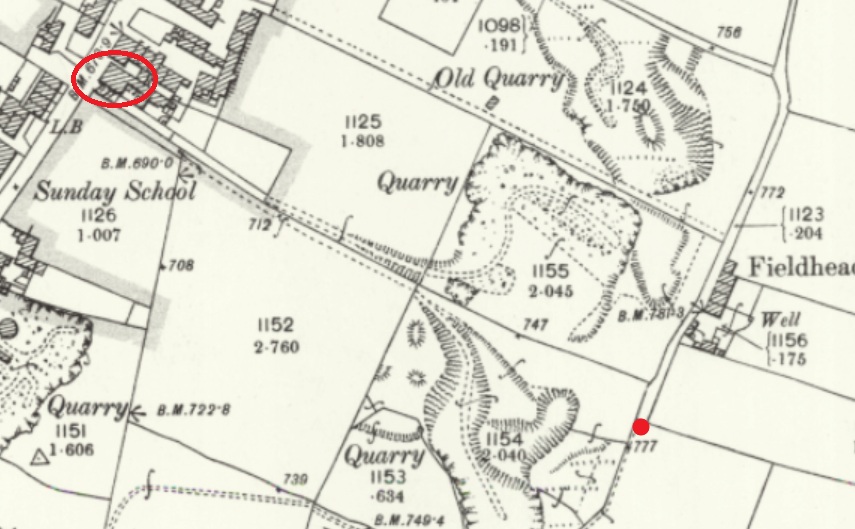
We didn’t get as far as the cross, but instead cut back towards the Guide Stoop. The red lines show the route taken (1898 1:2500 OS map via old-maps.co.uk)

Bits and pieces of pottery were along the path, as I say, but I stopped to take these photographs in the areas marked with a green circle.

The first, in the lower circle… a benchmark! I’ve not posted many recently, and I really must address that as, well, they’re great. There are several on this route, as you can see from the map above, and a few hidden in field walls in the middle of nowhere. I’d like to do an odyssey at some stage, and track them all down – if anyone fancies joining me, give me a shout! Anyway, here is the benchmark in all its glory:

Wall - BM
Fairly standard choice of immovable object – a gatepost – but some nice detailed carving on the mark.

This is a bit of an odd one. It’s clearly a bench mark, it’s clearly on an immovable object, and the gate is clearly marked on the maps, but… there is no bench mark marked on the map at that point – check it out in the map above. The nearest is a spot height of 777 ft above sea level. Spot heights are recorded OS heights above sea level, but are not marked on the landscape by carving them – they serve more as a guide, than a definite point. I trawled through a pile of maps, and eventually found a spot height at that point on the 1954 OS map of 779 ft above sea level. It is probably a late entry in the Ordnance Survey, and it seems whilst they marked it on the stone, they forgot to mark that on the map. If there was a category for ‘rare’ types of bench marks, this would surely be one (and no, I’m not looking for bench mark collectors websites; I have too many ‘collections’ as it is, if I get sucked into bench mark collecting, Mrs Hamnett will almost certainly divorce me*). The gatepost itself is interesting; it appears to be a roughly shaped upright stone, rather than a carefully dressed, more traditional, post. Whilst one is hesitant to say ‘standing stone‘ for several reasons, it is quite common for them to be used as gateposts, and a brief glance at all the other gateposts in the area reveals them to be like the photograph below – shaped properly for the job.

Here is the upper green circle… carved graffiti!

Wall - Carving
Another gatepost. Fieldhead is in the background.

 An inexperienced hand, but very clearly writing letters. At the top, we have a ‘T’ and a ‘B’ or ‘R’, and on the left, running down, are a ‘T’, a ‘B’, and an ‘O’, and there are other marks carved around the top, but nothing recognisable. The Ts are carved quite nicely with serifs, but overall it’s a bit messy… 3/10?

Right, that’s all for today. As I say, I have two more related posts almost ready to go (tomorrow for at least one of them, if I get chance), and lots more to go after that.

As always, comments are very welcome, and please feel free to email me with any information or questions.

More soon, I promise.

But until then I remain, your humble servant.

RH

*Alright, so I lied. I did check. And there are so many. So like a moth to a flame… apparently, we are called ‘bench mark baggers’. Here are two websites to whet your appetite: One is the central bench mark database, which is worth an explore, and the other is a blog run by someone worryingly like me, well worth checking out. I might be single again very soon.


Bench Marks

Bench Marks… The Return

I’m on a roll!

I realised recently that I still have quite a few Whitfield bench marks that I have not yet found, and that despite me having a bench mark obsession, I haven’t posted any for a long while. So here we are…

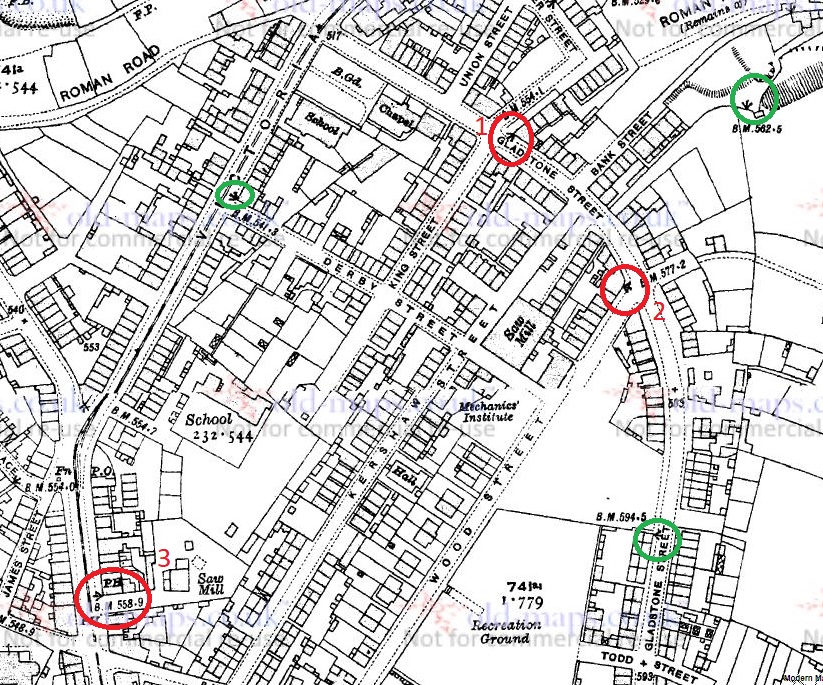
BM mapz
1921 1:2,500 OS map. The bench marks circled in red and numbered are photographed. Those circled in green are no longer there.

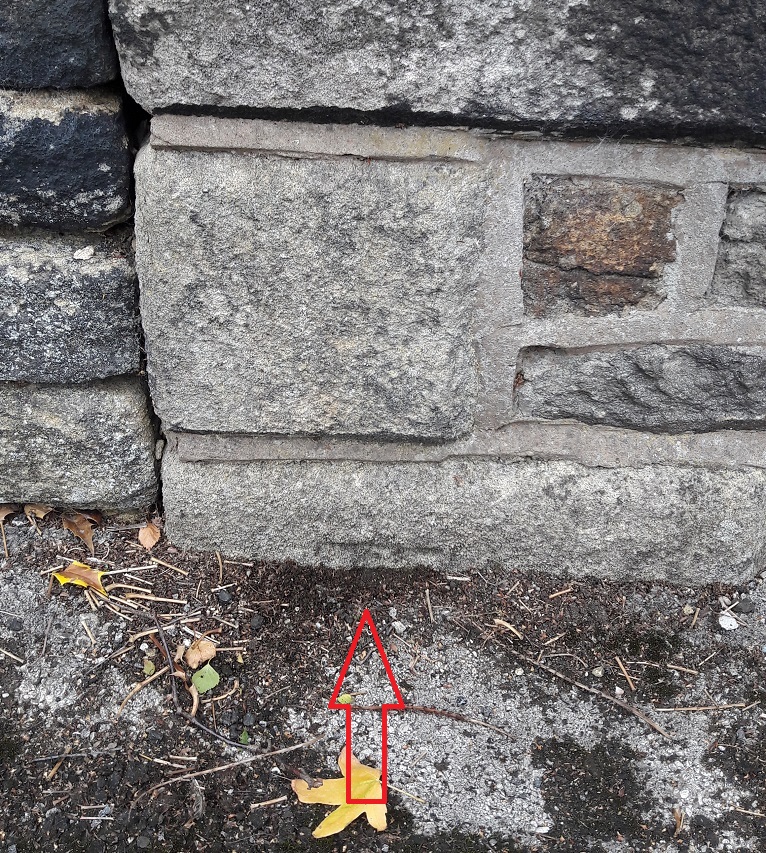
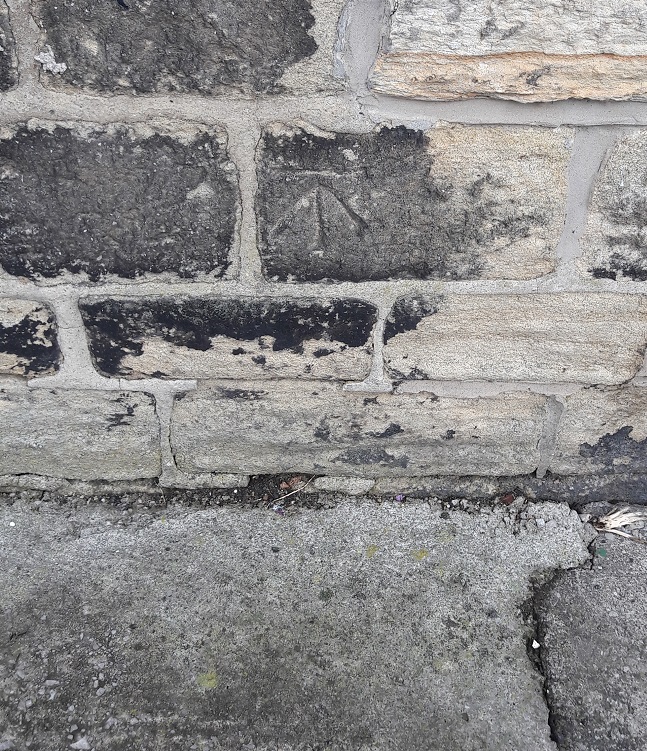
No 1 was extremely difficult to find at first – the building still stands, so it stands to reason that the mark would still be there. It is, but like the mark on the edge of Flatt Farm (No. 10, Here), the ground level had risen over the years – squint, and you can just about see the horizontal part of the mark. It took a while…

BM - King-Gladstone St
The mark is just about visible dead centre of the photo, just above the tarmac and just below the mortar. 554.1 ft above sea level.

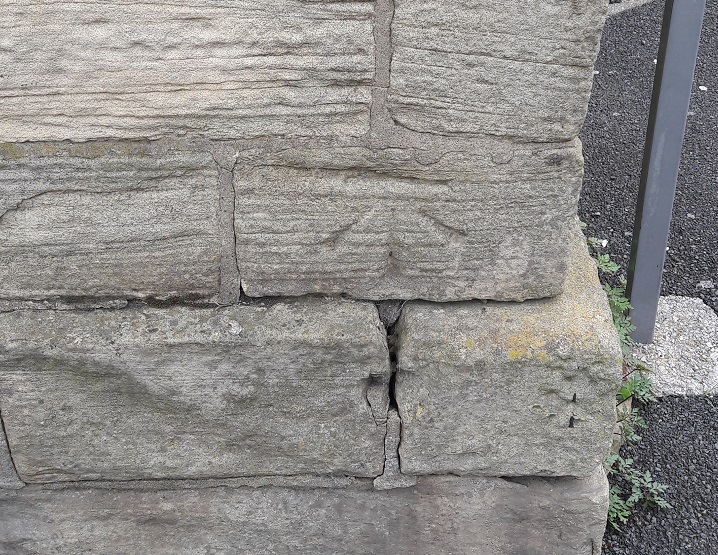
No 2 was fairly easy to spot:

BM - King-Gladstone - pub
On the corner of a building/house – 577.2 ft above sea level.

No. 3 is on the corner of the Surrey Arms on Charlestown Road. Bizarrely, this is a pub in which I have never actually set foot. I fully intend to rectify this outrageous omission at some stage in the near future – if anyone fancies joining me for a swift half or three, let me know. The Surrey Arms is an interesting place, and has strong local connections. According to the earlier incarnation of me, it was built just before 1846 by a James Robinson, who also owned the Naptha works near the Beehive pub.  This same James Robinson also built the Whitfield Brewery in 1849, and which was built on and used the waters from Whitfield Well. Hamnett then relates all the subsequent owners – Thomas Hampson in 1867, Samuel Clarkson in 1876, then later it became Walton’s Brewery with Adam Slater as the brewer who…

“made a special brew of ale for the late Lord Howard of Glossop to be consumed when the present Lord came of age. It was buried, and I have been told that when it was opened, it was stingo; only one pint for each person was allowed, and even that proved too much for some – it was true barley wine.”

Stingo (here and here) sounds like my kind of drink! The brewery eventually became a laundry, and was opened as such by Alderman B. Furniss in October 1895. Now that is a sad end.

BM - Surrey Arms
No. 3 – The Surrey Arms. 558.9 ft above sea level.

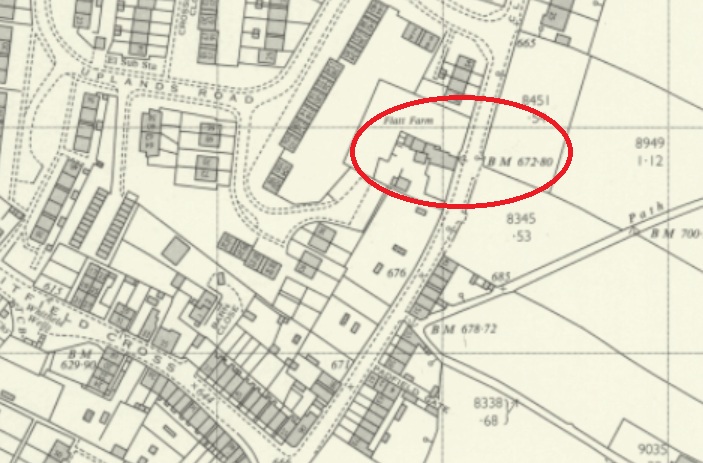
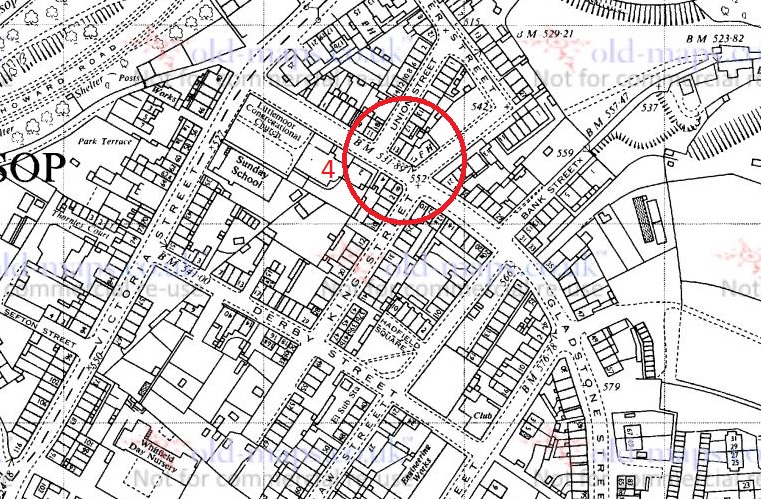
Comparing the 1921 map with the 1968 1:2.500 map reveals that the No. 1 bench mark above has moved – probably because of the shift in ground level. Thus we have No 4:

flinggg

It is now situated on the wall of a domestic house, but which was once The Sparrows pub, and more recently Flanagan’s. It stopped being a pub in about 2011, but I can find no more information about this pub, so would appreciate any thoughts.

BM - King Street - Pub
No.4 – the ex Sparrows pub, or more recently Flannagan’s Irish themed bar… begorrah. Anyway, it is 531.89 ft above Dublin… I mean, sea level.

Right, that’s almost it. There are one or two more in this area that need checking out (when I get time…), so watch this space. And anytime anyone fancies a quick walk to find these things, give me a yell.

RH

Bench Marks

More Bench Marks

Following on from the original Bench Mark post (here), I thought I would have a look around and see if any others were nearby. And so, after a fun evening spent poring over old maps, making notes, glass of wine in hand, I thought I’d spend a few hours stomping around Whitfield trying to find the lost Bench Marks.

I have used the 1898 1:2500 and the 1969 1:2500 Ordnance Survey maps. There are differences; marks have clearly disappeared, to be replaced by others, buildings have gone, and land has become altered meaning that some marks are now on private property. Here are the maps with the Bench Marks numbered, the photos follow. There are more Bench Marks on the maps that I haven’t numbered yet – I will update the blog when I get round to looking for them!

BM - 1898 Map 1
The 1898 1:2500 OS Map. Cliffe Road runs SW-NE, Whitfield Cross is just off the bottom left, and The Beehive pub is down, Volcrepe and Old Glossop are Straight up. The numbers in red correspond to photographs and discussion below.

What follows are the photographs I took of the various remaining Bench Marks, their number corresponding to that on the map.

1
1 (679.1 ft above sea level)
Tucked away at the side of the house, and quite worn. I wonder how many people living in these houses know they are there?

2
2 (700.8 ft above sea level)
Clear on a wall on the path.

3
3 (728.8 ft above sea level)
Marked on a gatepost


4 (698.8 ft above sea level)

Originally on a wall running down to Cliffe Road, and now on private land. It may well be still there, but I wasn’t able to see. It is not marked on the 1969 map.

5
5 (716.2 ft above sea level)
Another gate post, and again very clear and fresh.


In between Marks 5 and 6 you pass through this stile.

5a

Now, I will post more about this stile later on as I think there is a lot more going on here, really quite interesting things, and it deserves its own post.

6
6 (682.0 ft above sea level)
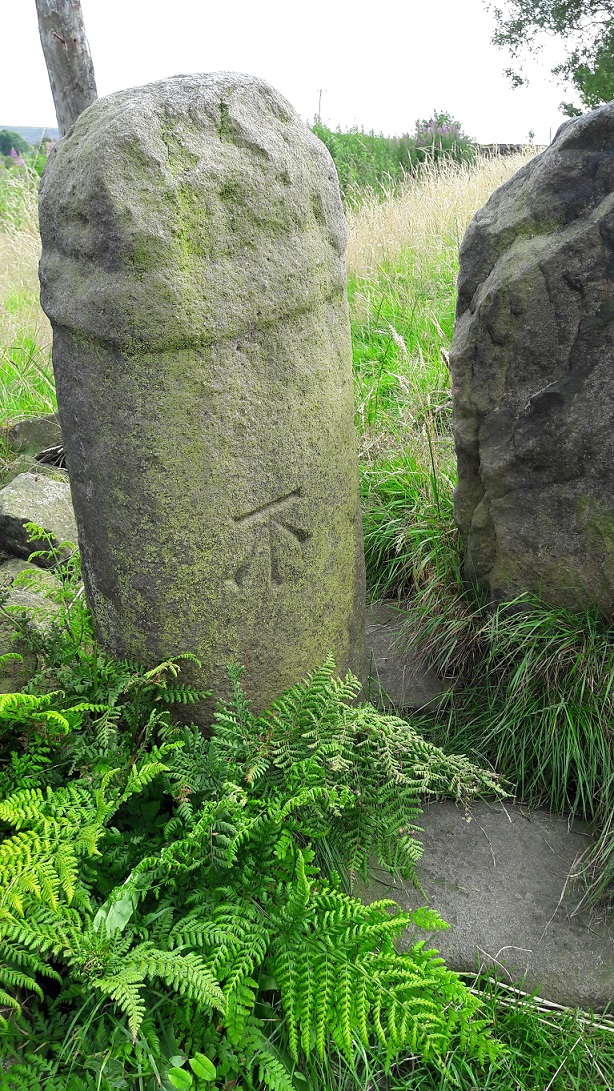
This is a particularly important bench mark as it has been placed on the actual Whitfield Cross. THE Whitfield Cross. The cross was moved from its original position at the top of Whitfield Cross (the road) in the 1790’s and ended up as a stile post in a field. The cross itself is Saxon in date (probably 9th Century) and is of a type known as a Mercian Round Shaft. You can see the band around the top that both dates it… and makes it look somewhat phallic! I will go into a lot more detail about the cross in a later post, as I think it is one of the most important pieces of history in the area, and one of the most overlooked, but for now, let’s move on


7 (682.6 ft above sea level)

Again, on a wall that is now on, I think, private land. I did have a quick look, but couldn’t see anything, so I left it and moved on.  This Bench Mark is not marked on the 1969 map.

8 - Location Only
8 (636.7 ft above sea level)
Originally on the corner of a retaining field wall. I searched high and low, even pulling over the stones that had fallen down hoping to find the mark, but to no avail. I suppose a full-scale excavation might uncover the stone, but I’m giving it up as a lost cause. It is not marked on the 1969 map.

9 - Location Only
9 (627.3 ft above sea level)
A similar story here, too. The stone has gone missing, perhaps one of the stones at the top that has collapsed down, although the wall itself looks like it has been rebuilt at some stage which may explain its absence.

10
10 (671.8 ft above sea level)
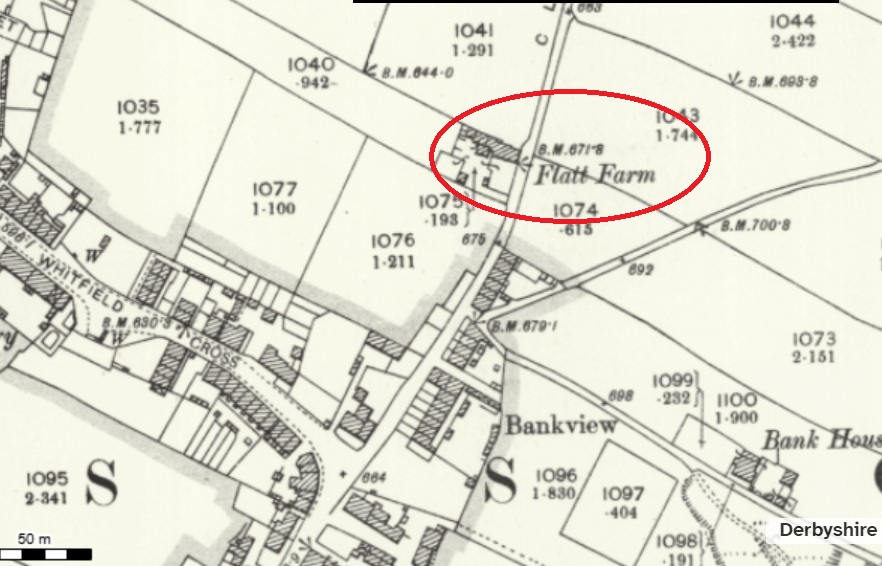
Flatt Farm, on the corner of the farm building, and very difficult to see. It took me a while, but the level of the pavement has risen in the last century or so, leaving the level just visible above the tarmac surface, the arrow now buried below.


Moving onto the 1969 map, there are two additions: 11 and 12. The Bench Marks that are not on the 1969 map have been noted above.


BM - 1969 Map 1

11
11 (657.64 ft above sea level)
This one should be on the corner of the last house on Bright’s Terrace – the last row of houses on Cliffe Road. I found no sign of it, and it is probably hidden behind the flower bed.

12
12 (611.48 ft above sea level)
A little down the hill on the right, clear on a wall.


And so ends my brief sojourn – both geeky and fun. I have done a bit more Bench Mark walking, and I’m sure they will feature in future posts, but that’s it for now.

Incidentally, both maps are available for free from http://www.old-maps.co.uk a truly marvellous website that has old Ordnance Survey maps for the whole country dating back to the mid 19th Century, and all for free. Seriously, if you find any of this interesting in any way, hop over and have fun!

Bench Marks

Whitfield Cross Bench Marks

Bench marks are a bit of an oddity. Most people would never know they were there, and of the people that do notice them, most have no clue what they are. And yet, they are quite literally all over the United Kingdom, and once you have seen one, you will start to see them everywhere!

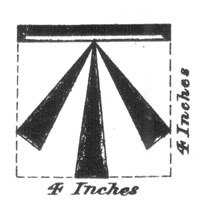
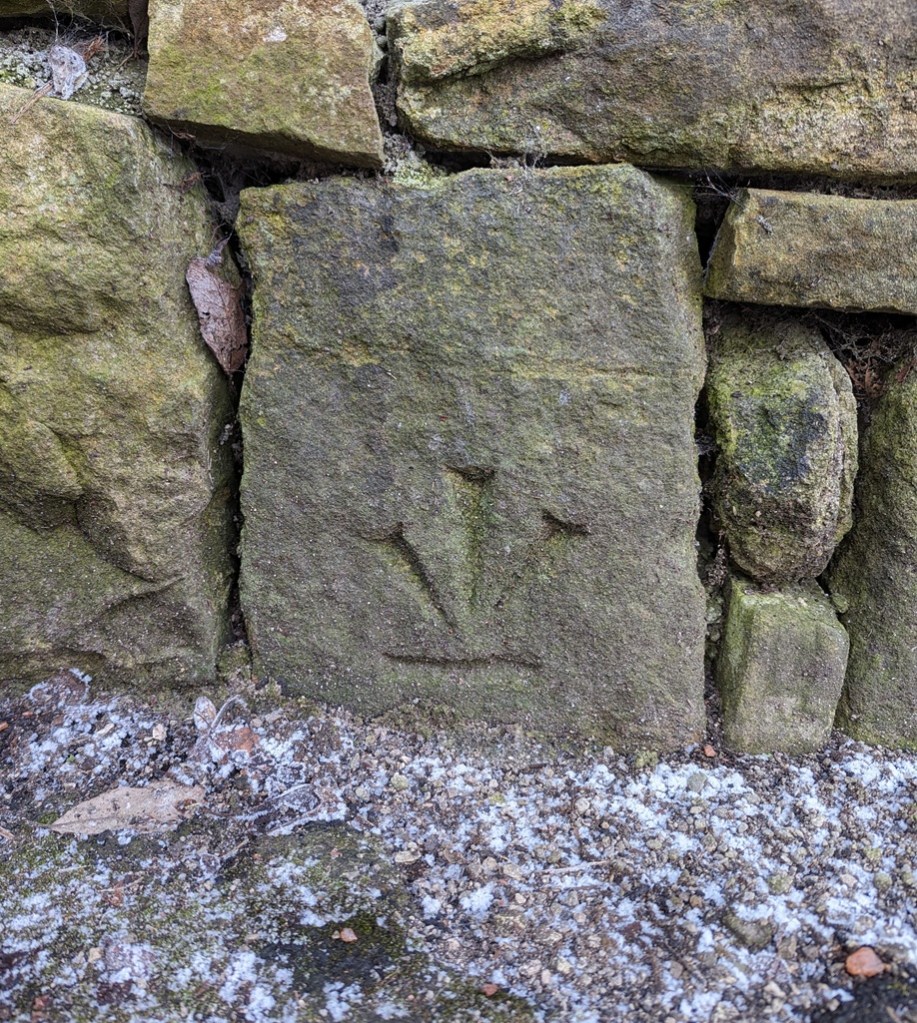
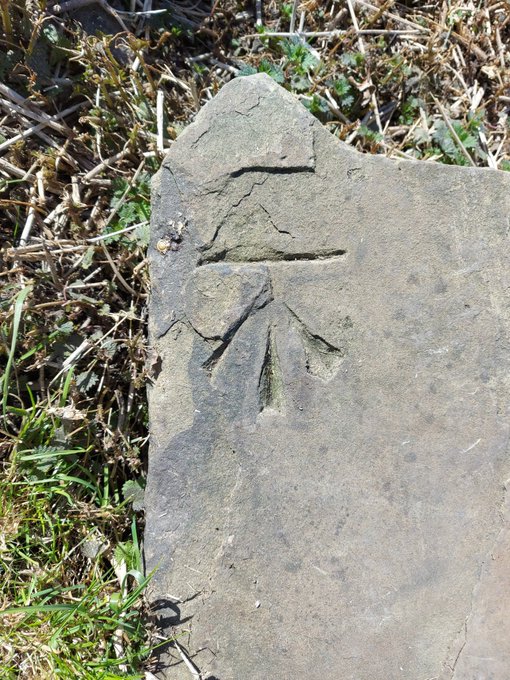
In short, when the original Ordnance Survey maps were being drawn up (1840’s or thereabouts, though work continued until the 1950’s), the surveyors needed to know the height above sea level at certain points in the landscape, so that they could work out hill heights, elevations, contour lines and such. These were marked on the map, but as translating the exact location on the map to that on the ground could leave room for mistakes, it was decided that a permanent and precise mark would be made on the place where the measurement was taken. This is the Bench Mark. They were carved very carefully by chisel onto stone that was either fixed, or very unlikely to be moved – churches, pubs, grand buildings, gate posts and the like. The symbol was usually paced at ground level, and was very simple, and very subtle – a single horizontal line (from where the measurement was taken), and underneath three lines forming a vertical arrow like this:

Benchmark - Example

Over half a million of these marks existed at one time, and the entire network of marks (at least 1 per square mile in rural areas, a much greater density in urban areas) was maintained by the Ordnance Survey until 1972 when they abandoned it as too expensive. Whilst large numbers of the marks have disappeared (buildings are demolished or changed, stones are moved, etc.) the majority are still here, hidden, waiting to be found. Whilst looking at an old OS map of Whitfield Cross (1898 1:2500), I noticed there were two on the road. They are marked BM, followed by a number (the height, in feet, above sea level), and their location is shown by the arrow.

BM Map

The first was at the bottom of Whitfield Cross, at the edge of the building that used to be The Roebuck pub.

BM1 - Actual

It is very worn, but you can just make out the three lines that make up the arrow – now just hollows – and the level on top. This particular Bench Mark is 598.1 feet above sea level.

The other Bench Mark is on the edge of a pair of houses, and is much clearer and better preserved. It seems the surveyors used the flat top of the bottom course of stone as the spot height, which is exactly 630.3 feet above sea level.

BM2

That’s a difference of 32 feet, or thereabouts; Whitfield Cross is a steep hill.

And for comparison, here is the Benchmark near the Beehive pub at the top of the hill

BM - By the BeehiveThis is at 670.9 – 70 or so feet higher.

It is a bit geeky, but there is something about Bench Marks that really intrigues me – information hidden in plain sight, and a piece of forgotten history. There are even people who ‘collect’ them, ticking them off against the log that the OS had (see here), but that is, I fear, a step too far down Geek Avenue for even me!

Now that you know what they are, and where they are, keep your eyes peeled.