Archaeology · Bench Marks · Graffiti · Standing Stones

Gateposts

What ho, lovely people of the blog world. I hope you are all well as we hurtle headlong into summer, each of us fearing what terrible weather will mar an otherwise splendid season. Nevermind, this too shall pass and all that, and indeed we must grasp the nettle by the horns, or something, and make H whilst the S shines…

Today’s post is one of those brought about by happy coincidence, where a series of events conspire, almost waving at you, until you finally notice and say, loudly, “what ho… a blog post!” Or, in this case, a Gate Post. The first event was posting a few photographs on Twitter and Instagram (@roberthamnett on Twitter, and @timcampbellgreen on Instagram, for those of you who might fancy checking it out). Turns out I’m not the only one who likes a good gatepost or two. And then the next event was my seeing a tiny piece of metal in the soil whilst doing a recce for a Where/When (No.7, to be precise… Of Forts and Crosses: A Mellor Wander). All will become clear, honestly.

For years now I have been obsessed with gateposts. Mundane, utilitarian, and always overlooked, a good gatepost can be as interesting as a prehistoric standing stone to me, and truthfully, there is often very little difference: both made of stone, both standing upright, both important in the past, and also in the present. And if anything, gateposts have more interesting features! I mean, obviously prehistoric is fascinating, but they don’t really give us much to go on, whereas the later gateposts… well, read on.

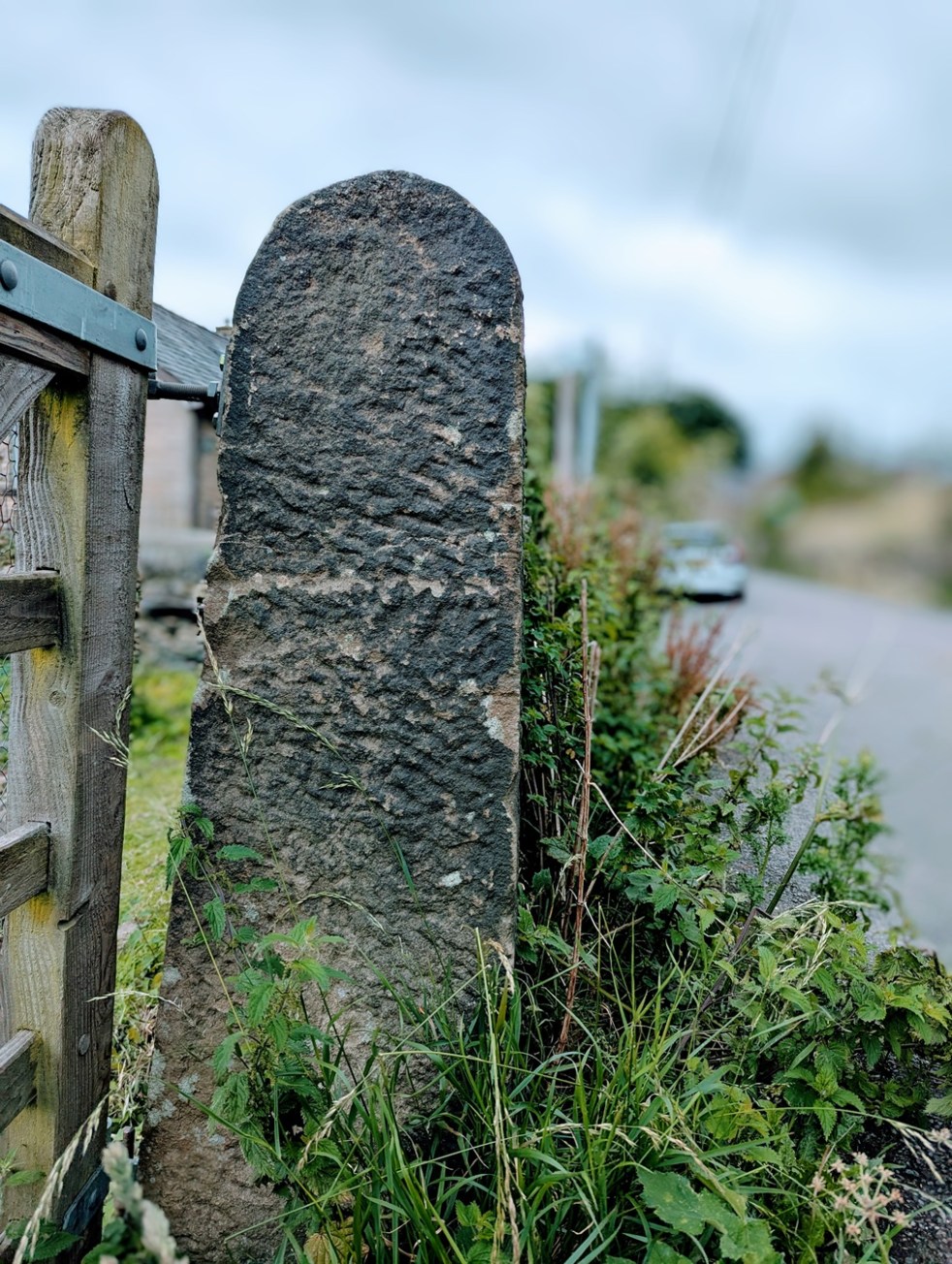
They can be decorated – often just roughly dressed.

A simple rough dressing, to shape it in a uniform manner.

But sometimes some thought has gone into them, to create a pleasant design – which for a utilitarian functional object seemingly goes beyond what is needed.

A simple cross, surrounded by a border. I say simple… it takes some doing.

I mean, the only time you see the gateposts is when you are opening a gate to let sheep or cattle in and out, and it’s probably not something you’d see everyday. And even if you did, it’s only for a moment or two, it frankly doesn’t matter if it looks good, and I doubt farmers are wandering around making snarky comments about the plain decoration of another farmer’s gateposts. So why? What is the purpose behind them? I don’t mean they had some sort of secret meaning behind the decoration, rather they simply represent someone’s choices, but why those choices I wonder? Possibly it’s probably more to do with pride in the work taken by the stonemason who shaped it, perhaps a form of identifier: we know it’s person X who shaped it, as he always decorated it with a cross. But then there are those that go beyond simple decoration, and instead turn it into a work of art.

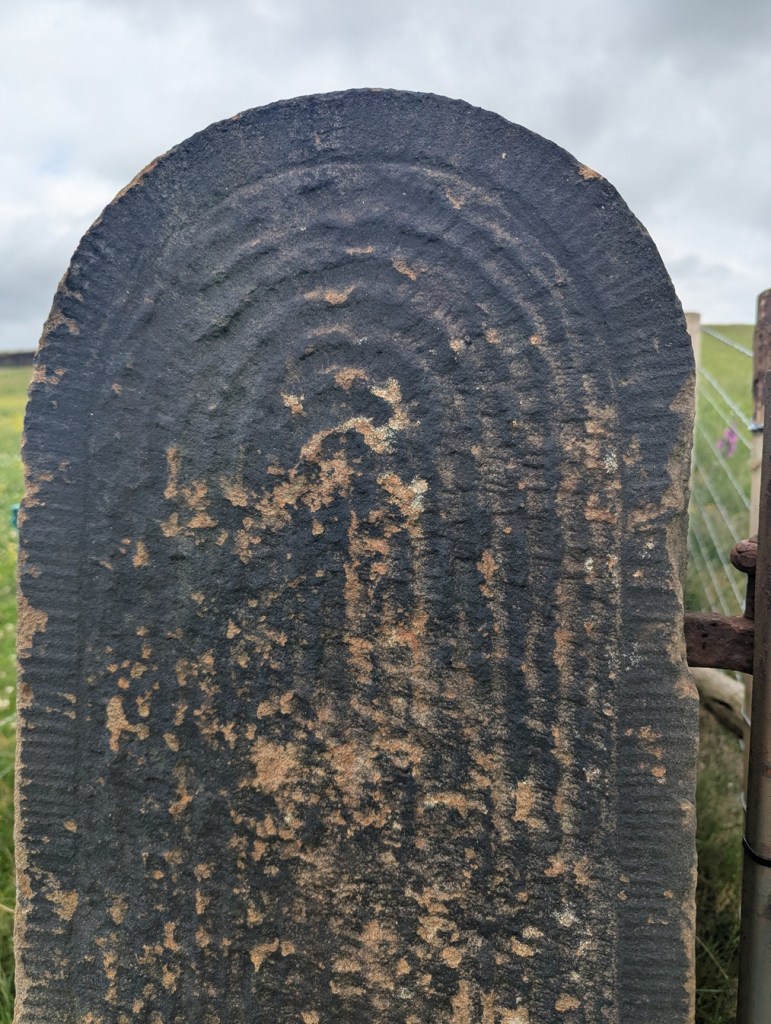
This is wonderful! The way it shifts from the upper band with a circular motif, to the lower aspect with the herringbone pattern is amazing. A lot of effort went into this.
This too, is truly wonderful. The circular motif, with a border, is just amazing. This post seems to be in the reddish Cheshire sandstone, which makes sense given that it, and the last gatepost was found in the Mellor area, rather than Glossop.

Other times, we find words and dates on gateposts. Often these are faded and barely legible, the weather and environment are not kind to these solid sentinels, and they have no shelter.
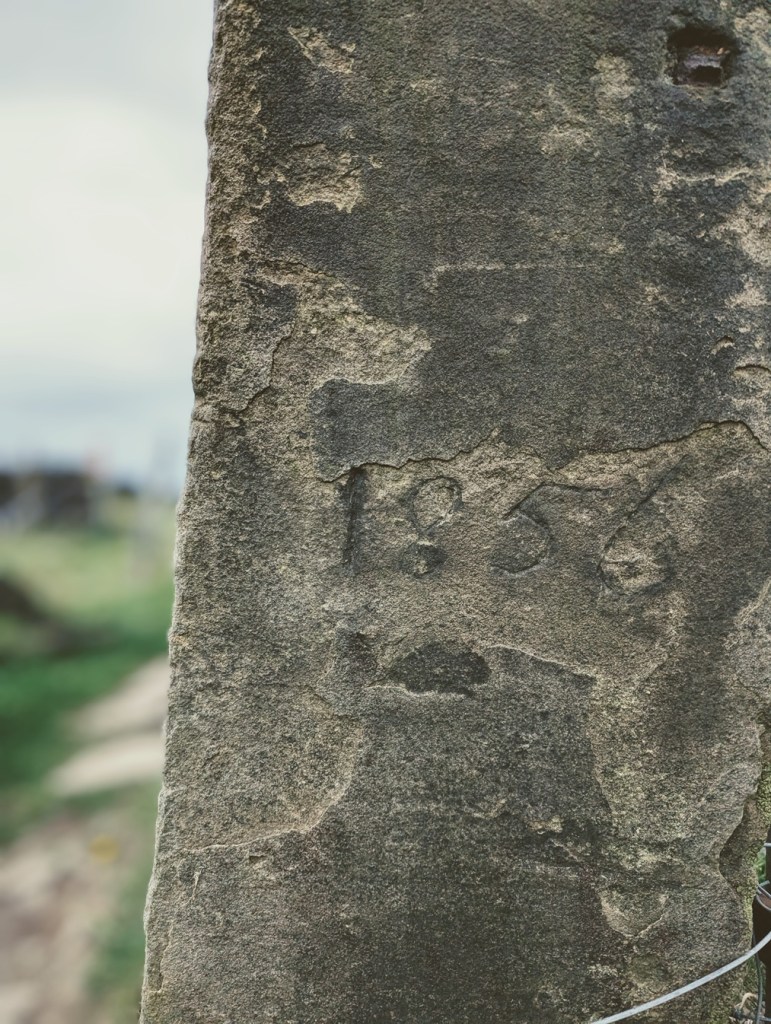
‘1856’, on the track from Fieldhead Farm to Whitfield Cross.
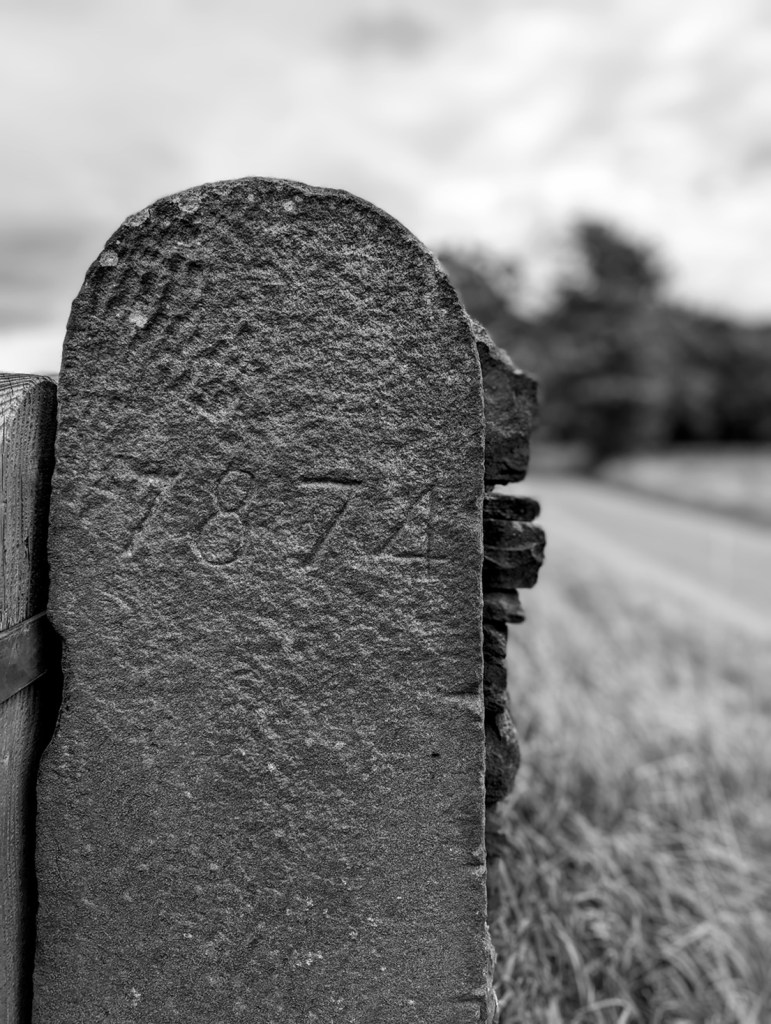
I went all arty with this shot… I’m quite proud of it! ‘1874’ in a very similar hand to that of the above gatepost – I wonder if it was the same person? This is on Kidd Road, just before its junction with Derbyshire Level.
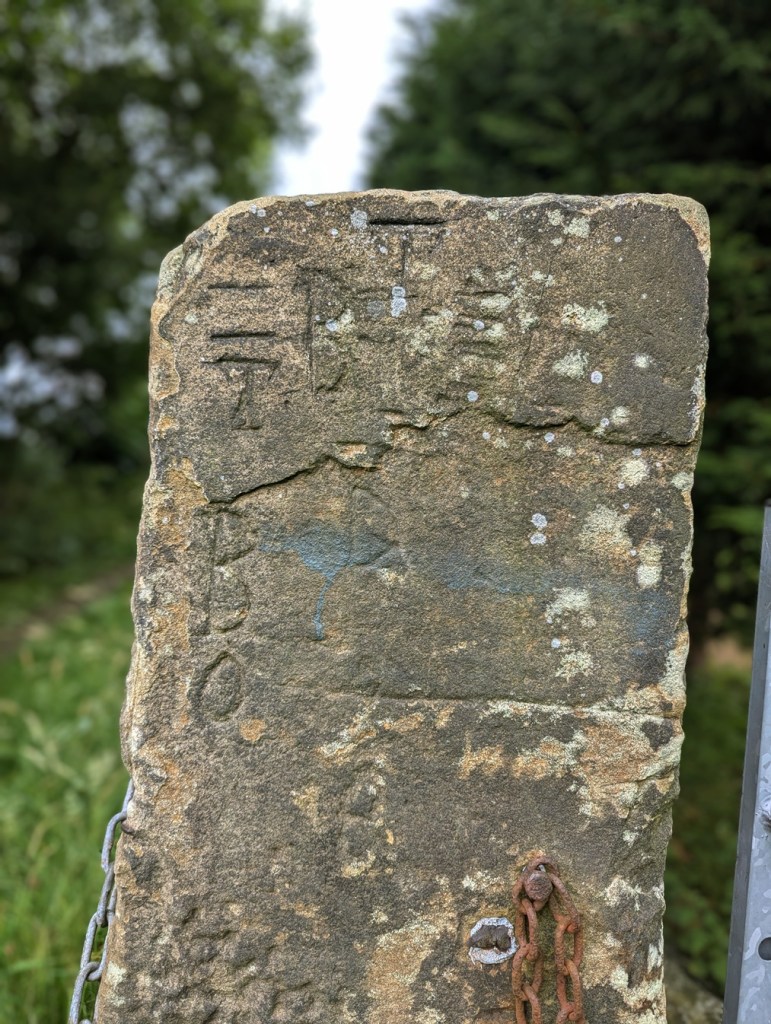
Multiple ‘B’, ‘D’, and ‘O’ – from a post just by Fieldhead Farm.

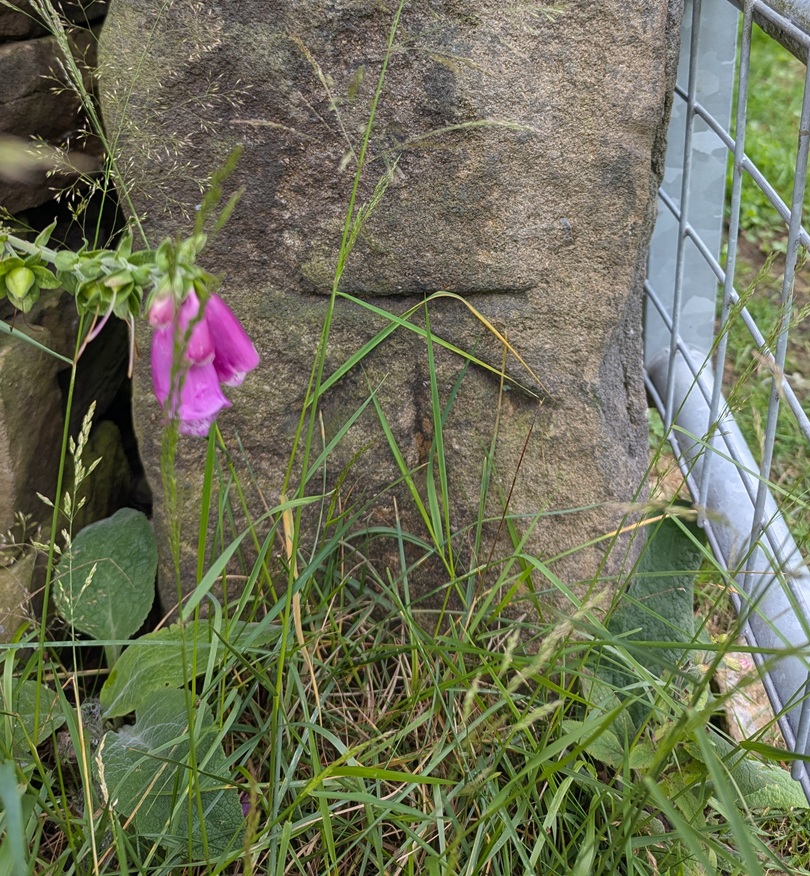
The Ordnance Survey often use them to carry benchmarks – after all they’re not likely to be moved, and so are a safe and permanent marker for heights above sea level.

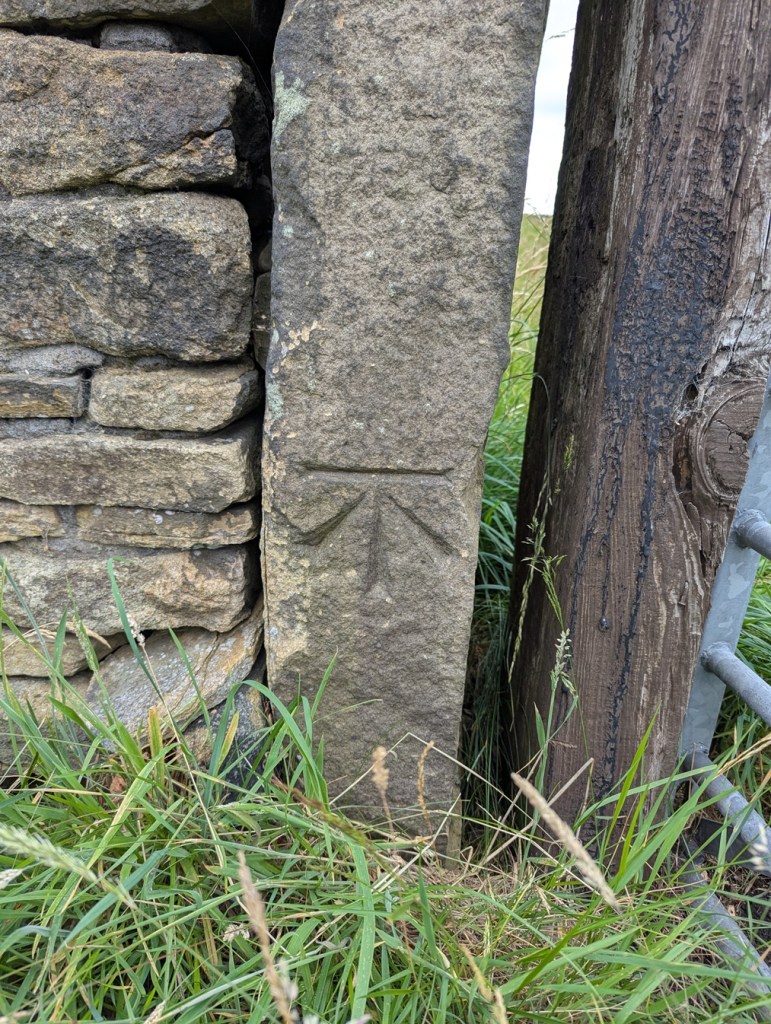
The line above the arrow is 682 ft above sea level, precisely.
This one is 716ft 2″ above sea level.
I love this photo… the grass almost mirrors the benchmark. Oddly, I don’t have a height for this mark – for some reason, no OS map I have come across shows its existence. Strange.

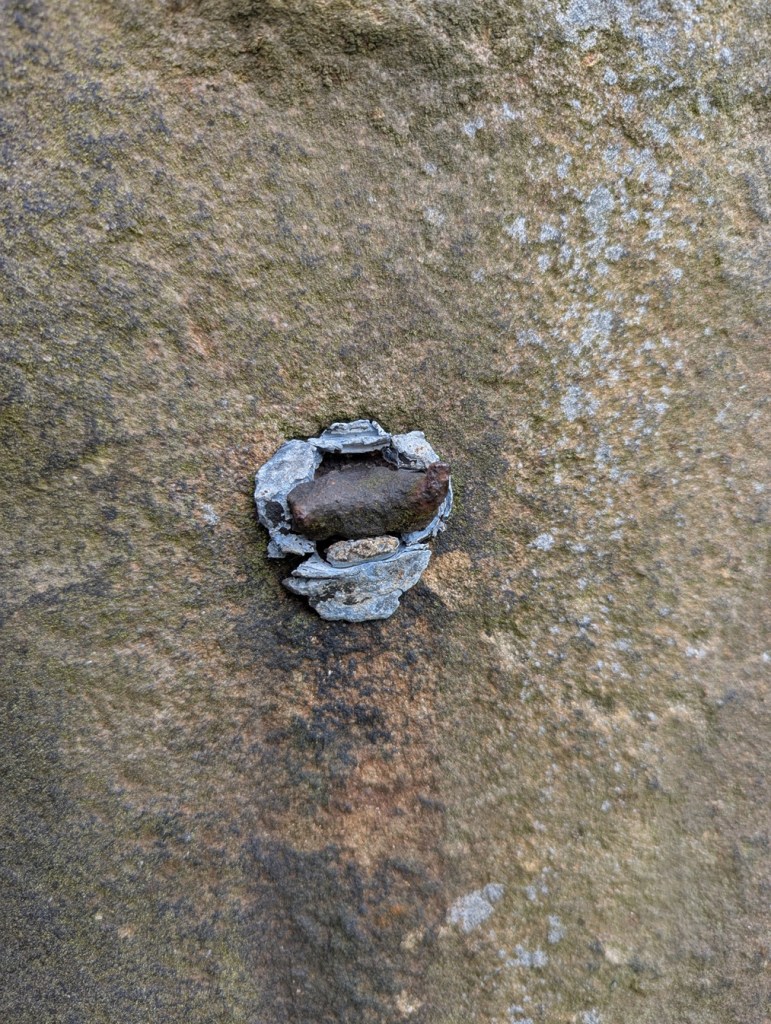
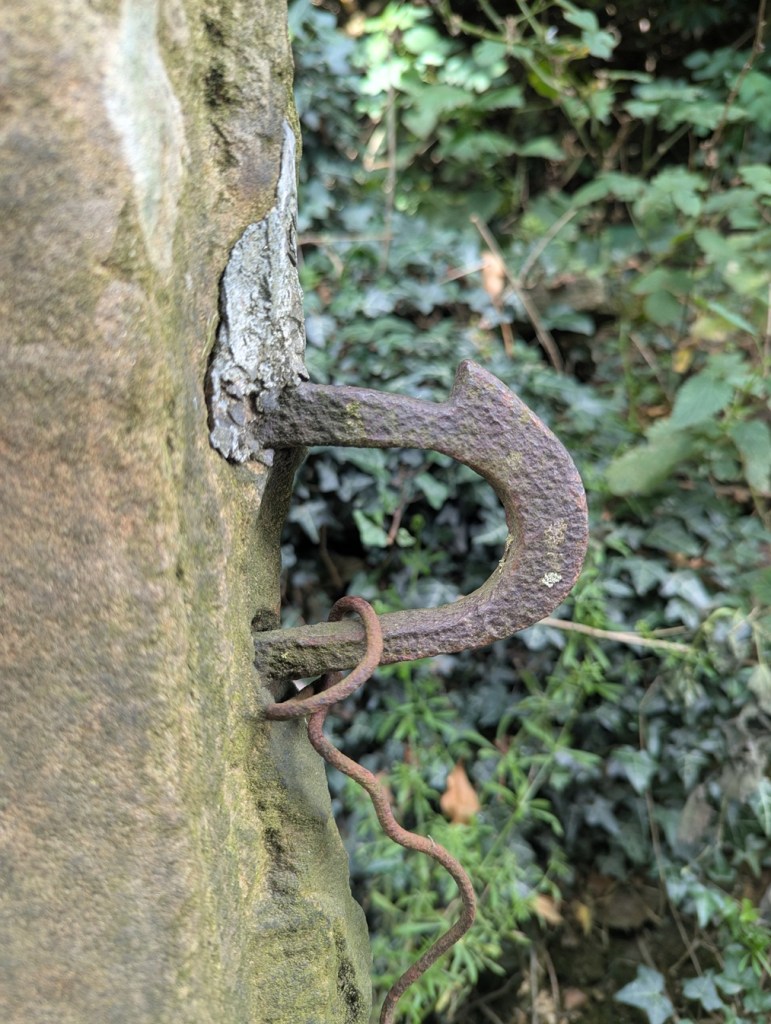
The fixtures and fittings of gateposts always fascinate me, too. Cast iron hoops and hooks, held in place by the tell tale grey/blue of lead. Sometimes you can only see the lead, the actual latch or pintle missing, it’s function no longer having purpose – it is just now a standing stone.

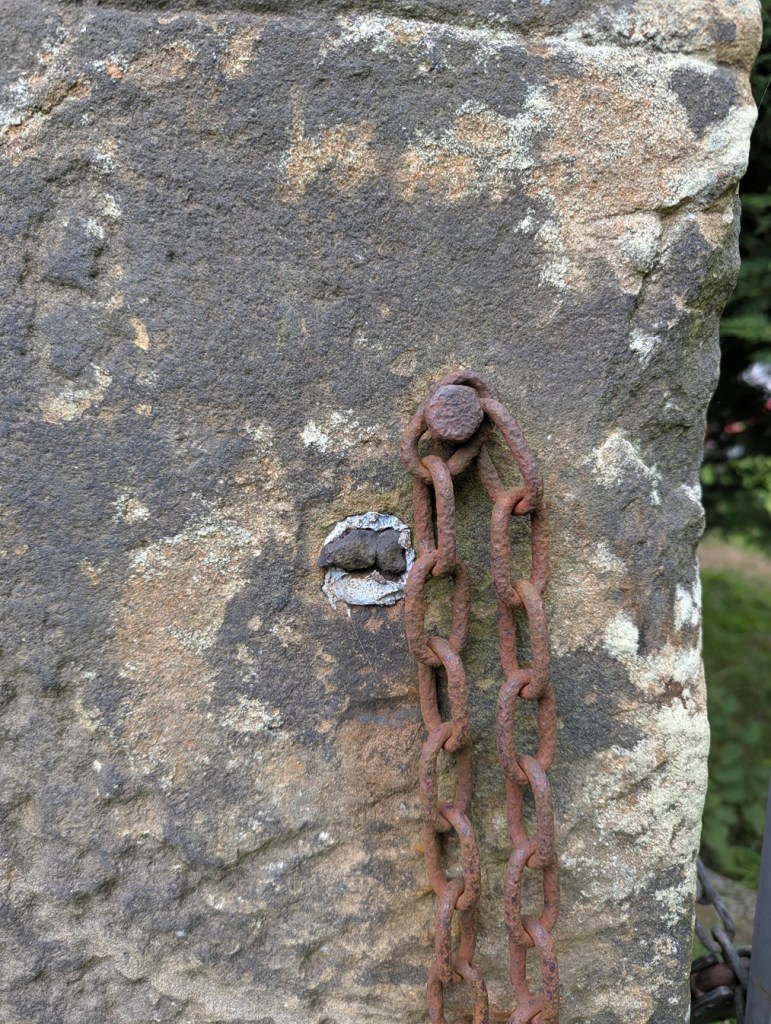
A now missing something or other, the metals eroding, staining the stone. It can get so bad that it actually kills the moss and lichen.
More something or other, now missing, but once important. The lead fixing is a tell-tale sign that the iron whatjamacallit is missing. I honestly love this, it really does show my theory of objects having a biography.
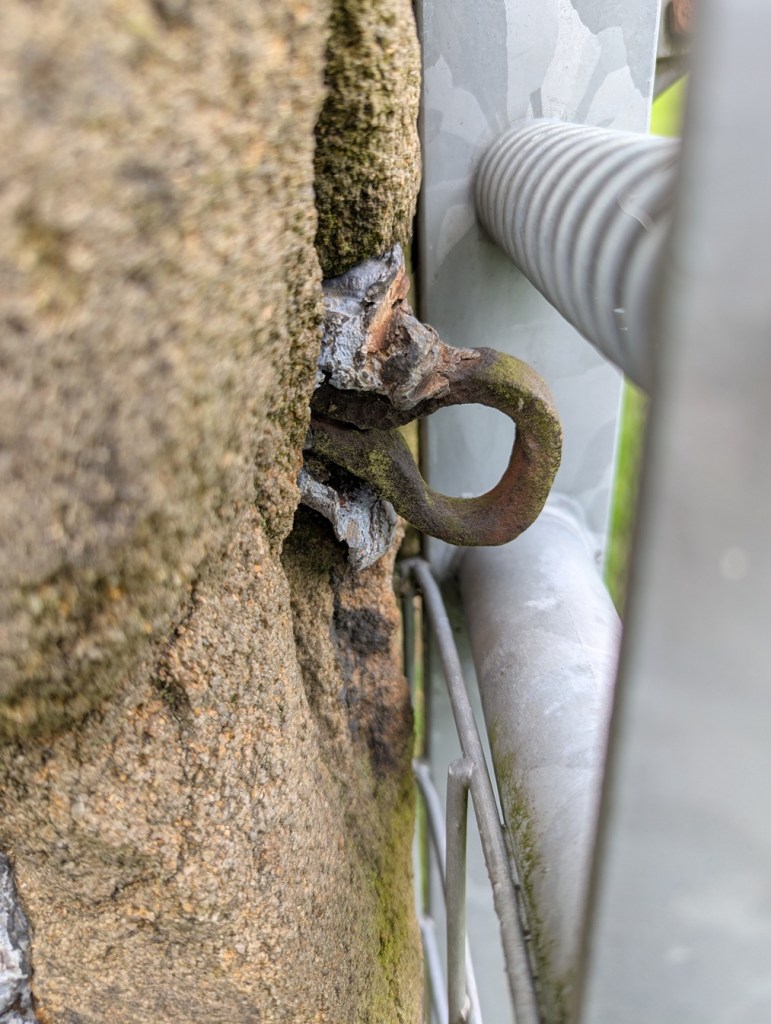
This is lovely… beautiful cast iron eyelet, twisted and shaped whilst red hot, and then held in place with lead. Although no longer needed to make the gatepost function – the modern steel gate does that (leaving it’s own scars on the stone) – it remains a part of its history.
Multiple phases of use, each leaving a mark.
Again, scars, but once meaning, purpose.
Hand made, and truly wonderful.

It was actually one of the lead fixings that I found that partly inspired this post. I saw what was obviously lead sticking out of the ground, and bending to remove it as I always do – it’s really not good for the environment – I realised it was bigger than I expected. I studied it for a moment trying to work out what it was, when suddenly: “aha” I thought “that’s a fixing“.

You can see rust on the inside, where the iron whatsit was held in place.

Looking at this lump, and using a small diagram, you can see what it is and how it worked. The long hollow through the middle once held the iron fixture – a pintle or latch, perhaps.
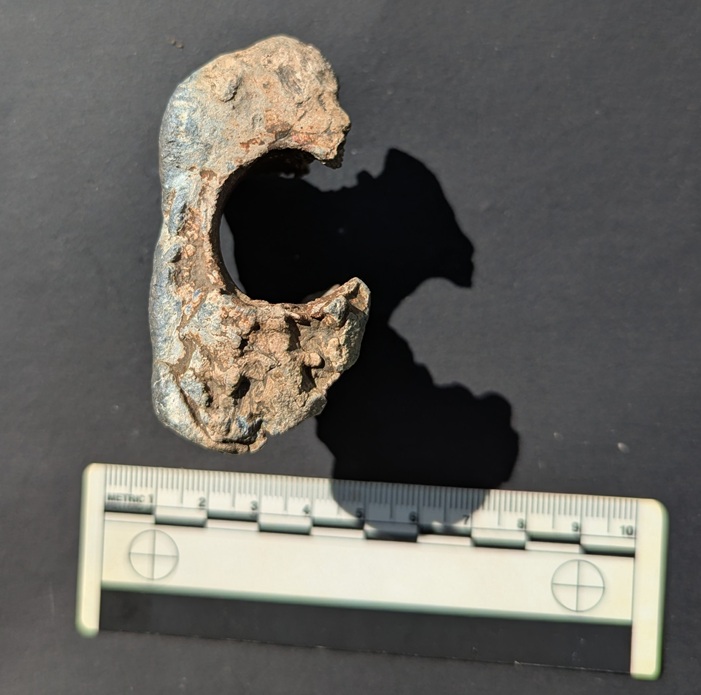
The iron whatsit was circular in section.

The shape of the lead piece is also a clue to how it actually held this in place. A hole is made into the side of the gatepost that needs the ironwork on it, with the lower part of the hole made deeper. The ironwork is placed in the hole, and the molten lead poured in using a funnel to hold it within the stone and around the iron whilst it cools.
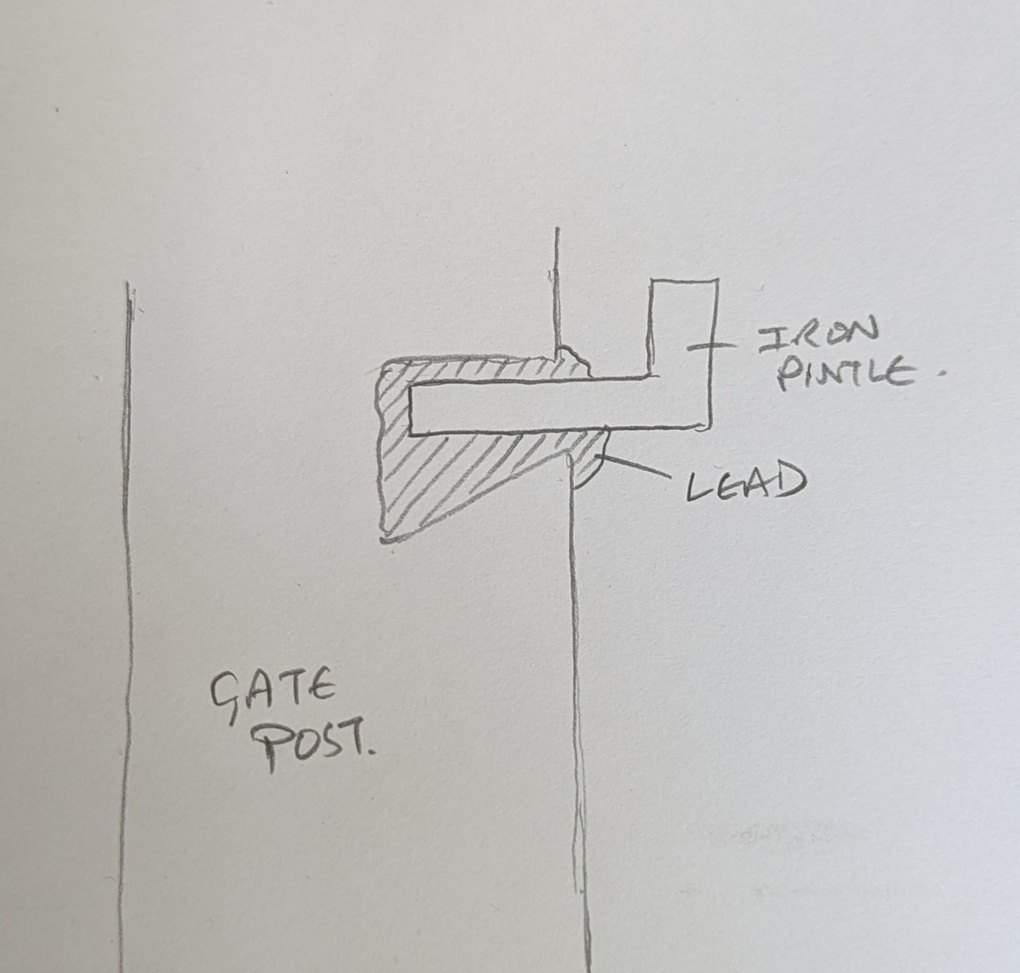
If this makes sense.

When hardened, it forms a plug that is very difficult to move, keeping the iron work in place; clever, and elegantly simple. It’s also nice to see the ‘inside’ of the gatepost, or rather a cast of the inside, and one wonders why the lead has come away so intact from its original home – one can only imagine that the post itself was broken, freeing this fixing, which then found itself at my feet in the wilds of Derbyshire years later.

In terms of dates for these gateposts – well, it’s not clear. I think the more uniform stones, with a rounded head, are Georgian and Victorian – later 18th and 19th century. However, there are some that I think are significantly older – 17th, 16th, even 15th century, possibly. These are generally less formally worked, are shorter, and importantly are characterised by having a single straight hole through the stone a few feet above the ground.
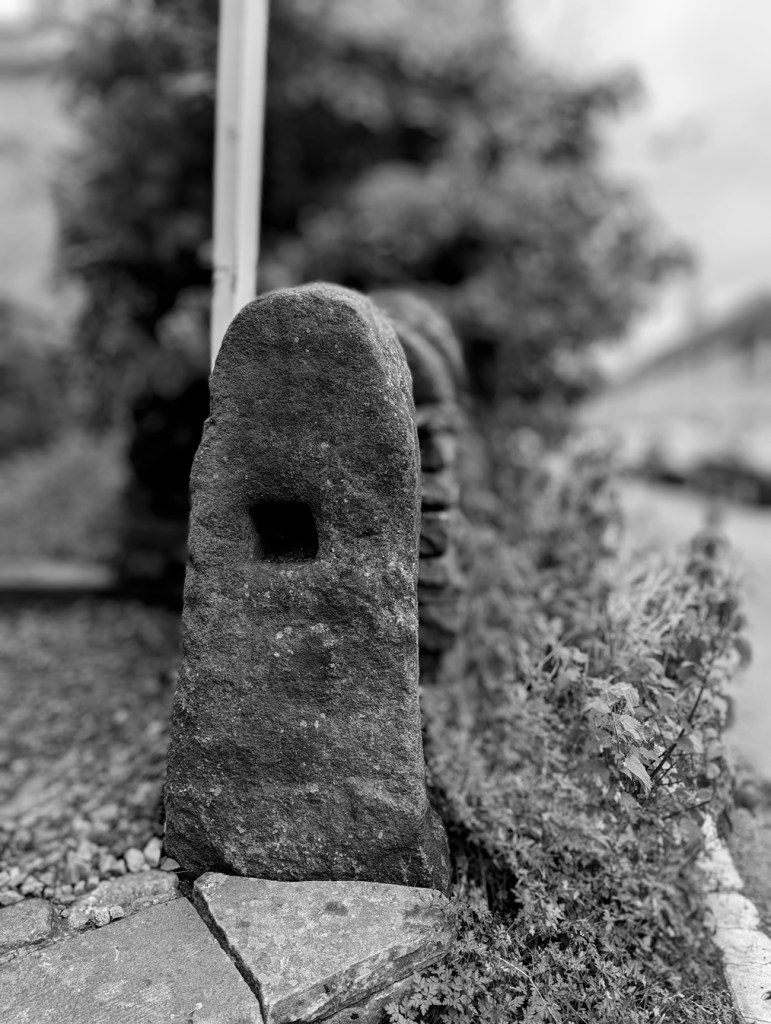
Another arty shot, this one of the ancient gatepost on Hague Street.
Carrhouse Lane, Whitfield. And no, I didn’t stick my hand in the hole…

I was, until fairly recently, convinced that these were marker stones for trackways, the square hole perhaps taking a wooden pointer. However, I started to notice that this didn’t always fit the pattern, and despite multiple blog articles, twitter posts, and it even published in Where/When, I began to doubt this explanation. I then received an email that pretty much confirmed it for me (thank you PB, you amazing man!). In it, the author quoted a John Farey, whose 1815 book – General View of the Agriculture and Minerals of Derbyshire: With Observations on the Means of Their Improvement. Drawn Up for the Consideration of the Board of Agrigulture [sic] and Internal Improvement – gave the following quote:

Anciently, the Gates in the Peak Hundreds were formed and hung without any iron-work, even nails, as I have been told; and some yet remain in Birchover and other places, where no iron-work is used in the hanging: a large mortise-hole is made thro’ the hanging-post, perpendicular to the plane of the Gate, at about four feet and a half high, into which a stout piece of wood is firmly wedged, and projects about twelve inches before the Post; and in this piece of wood, two augur holes are made, to receive the two ends of a tough piece of green Ash or Sallow, which loosely embraces the top of the head of the Gate (formed to a round), in the bow so formed : the bottom of the head of the Gate is formed to a blunt point, which works in a hole made in a stone, set fast in the ground, close to the face of the Post. It is easy to see, by the mortise-holes in all old Gate-Stoops, that this mode of hanging Gates was once general.

Of course, it made sense, despite me banging on about them being marker stones. So, please accept my apologies for this; I am not always correct, and my knowledge is always growing. And thank you PB, who brought this to my attention – this is your discovery, not mine (you can read the book here – P.92 is the quote. There are about 20 of these gatepost types I know of, with many more awaiting discovery. And I actually think these are quite significant, as if we plot their location on a map, we might get a better grip on land use in the pre-industrial period. Marvellous.

I am obsessed with gateposts, and I want you to be, too. Everytime I pass one, I check it out, and often I am rewarded with some nugget of information, graffiti, decoration, or just a blast of the past. Let me know what you find via the contact page, and let’s keep an eye out for those holed ancient stones.

Right, I think that’s all for this month, and lucky you the next post will, I suspect, be a pottery post! Woohoo! I have found lots of cool stuff recently, and it all needs writing about. As always, I have about 30 projects ongoing, not all of which is coming to fruition anytime soon, but some will emerge relatively rapidly – watch this space. In the meantime, do please check out the Etsy store, or the Ko-Fi page – and feel free to buy me a beer coffee, or yourself a copy of Where/When, or even a t-shirt!

But until next time, please do look after yourselves and each other. I know I always say that, but you all matter, and we all need to take better care of each other… the world can be scary place at times, so lets band together and help each other.

And as always, I remain.

Your humble servant,

TCG
Archaeology · Graffiti · Stones of Glossop

Naked Ladies… and a Quarry

Well that got your attention! What ho, wonderful people! What ho!

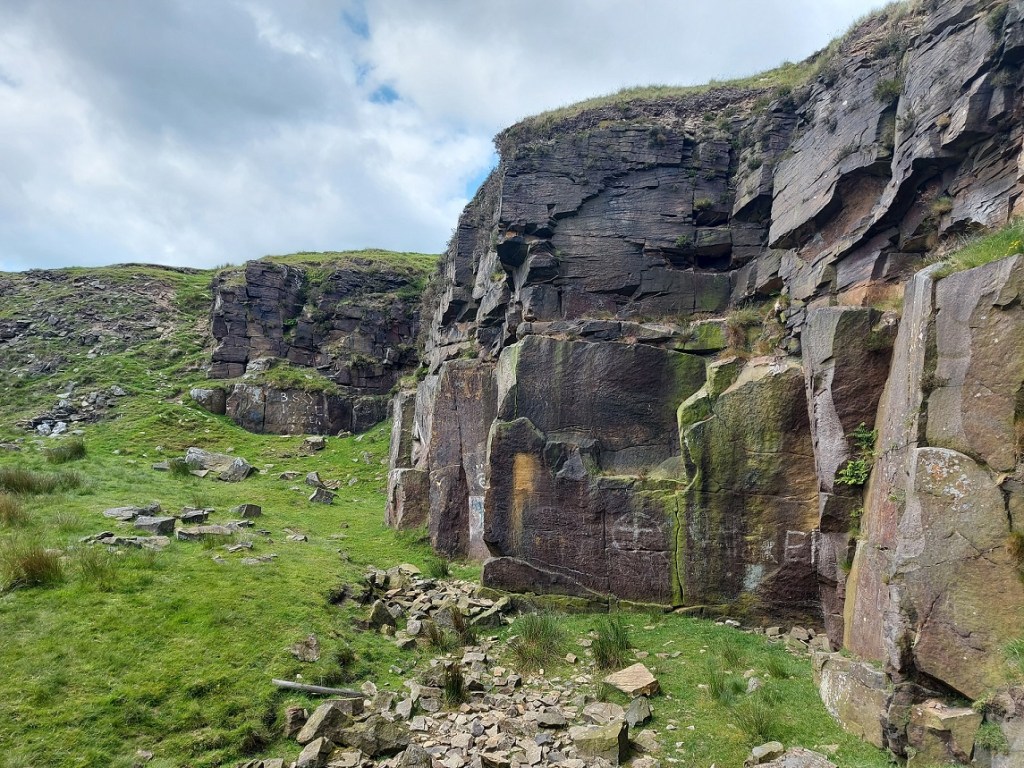
Up by Coombes Edge lies Cown Edge quarry. This quarry, long disused, contains a number of interesting, and oddly well executed, carvings on the walls. I have heard about this particular place – and its carvings – many times, and from many different people, but had never managed to get up there. No reason, simply that there are so many places to see, and so little RH. A few months ago, a friend (my thanks to Andy T) suggested a walk up that way and, well, I thought, let’s have a look.

What I like about this place is not just the ‘historical’ history, which is visible and tangible, but the ‘personal’ history which is similarly visible, but often better felt than seen. The quarry seems to be one of ‘those places‘; a destination, a space in the landscape that attracts; a shelter, an asylum, a place of freedom, and perhaps decadence. In particular, it’s place where ‘youths‘ go and be ‘youthful‘, frolicking, feeling, fumbling, and… well, you get the picture. I didn’t grow up in Glossop – I’m a ‘comer-inner‘, so to speak – but if I could take you to Cheadle Hulme where I did grow up, I could show you a few such places from my youth. Every town & village has them – and the similar stories they could tell of the first time drunk, illicit substances consumed, virginities lost, love discovered, best friendships forged, fights fought, and the always difficult transition from child to adult negotiated – often on the same evening. But perhaps most importantly, memories are made. To quote Wordsworth “Bliss it was in that dawn to be alive, but to be young was very heaven“. I have recently turned 47 (young for some of you, old for others… it’s all relative), and have been marvelling at the swift passage of time, so forgive the nostalgia. Now on with the show.

Cown Edge Quarry seems to have been started sometime in the early 19th Century, probably as a source of roofing stone. Geologically, the stone is Rough Rock – a type of sandstone of the Peak District and southern Pennines, and the most commonly occurring of the Millstone Grit group.

Incidentally, and as a rule of thumb, you can roughly date the buildings of Glossop by what the roof is made from. Prior to c.1850 roofs were made from stone taken from local quarries such as these. However, once the railway arrived (c.1850) Welsh slate could be imported on trains. Not only was slate cheaper, but it also weighed less so the roof could be constructed using less timber, and so roofs after 1850 tend to be made of this. A rule of thumb not an absolute guide, but useful nonetheless.

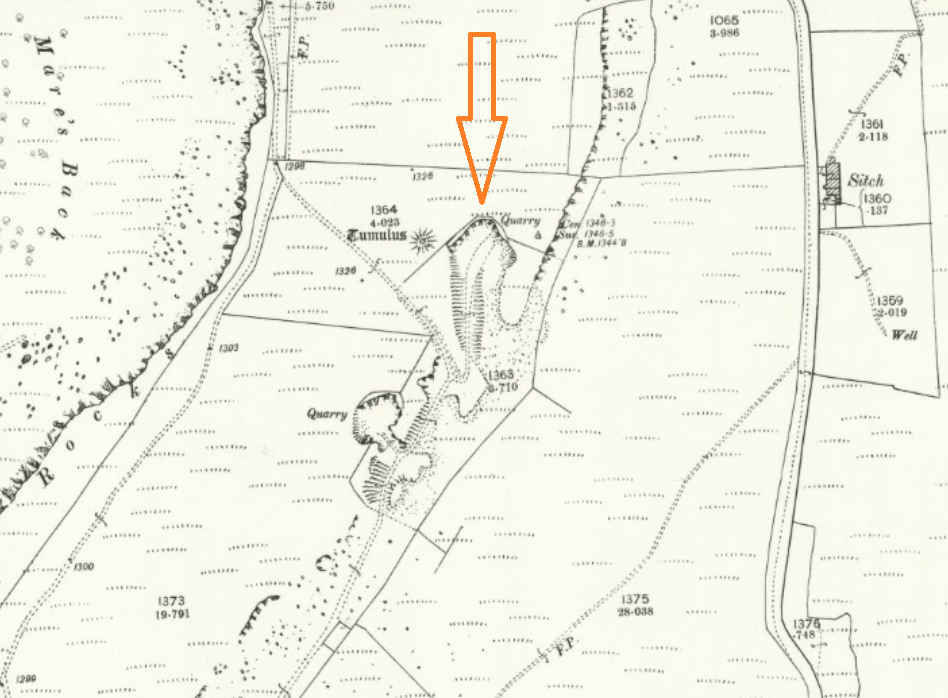
Anyway, the quarry is located here:

Thank you Google for the image.

And here it is in 1898:

And thanks to the National Libraries of Scotland for this image.

If you use the What Three Words app, the reference for the quarry entrance is: tribal.workers.crossword

Now, as subjects go, it isn’t perhaps the most interesting, but then as we know on this site more than most, ‘interesting’ is a veeery subjective word. However, it was deemed important enough to have its own Historic Environment Record – MDR10021. Largely overgrown now, and with none of the urgency and noise that would have marked it out as a place of work when it was operating, it is peaceful and still.

The view looking north from the quarry mouth
Looking west. Interesting, and a little odd, to think that the roof of my house, where I type these words, was almost certainly quarried from this place.

However, the walls are full of interesting graffiti, carved over the years since the place was abandoned. Some is more worthy than others, but all is a record of people, humans being, well… human. I have said elsewhere that there is something universal about the need to leave a mark on the environment, almost a way of achieving immortality, your name living on past you, perhaps. And hats off to those who did it before the invention of spray paint… if you wanted to put your name up in the past, you had to mean it – with a hammer and chisel. Here follows a sample of the carvings – mundane, as well as the more creative.

AKW 1942 – presumably there is no reason to lie about the date, so this is interesting… and asks further questions.
“Tim. Joey. Glossop”?
“.D” – quite modern, I suspect, and a worn hole.
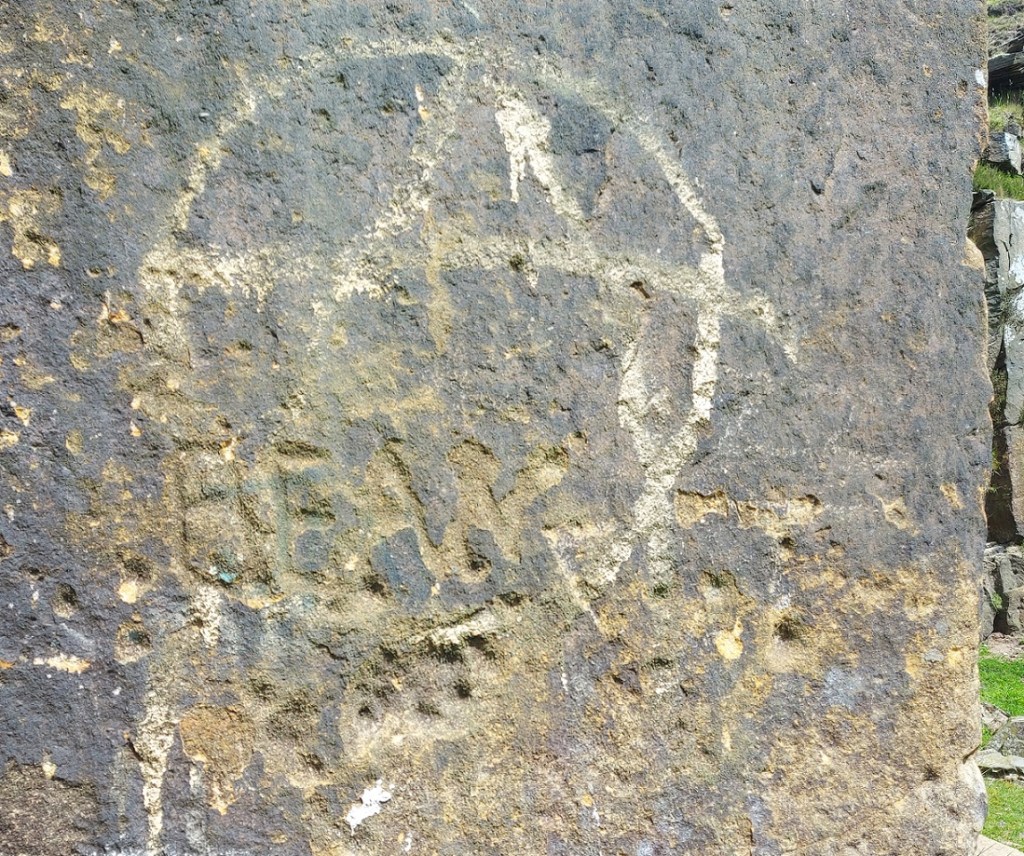
“BEAN”? and some pock marks. These overlay – and are later than – the painted anarchy sign.
“DUF, LEZ, ANT, GUS” 1994. “KEV” at the bottom is even probably even more modern.
“DAN”, “SID”, “LES”, “LYNN”, and some symbols. These seem to have been carved and re-carved.

Talking of symbols, there are what seems to me an unusual number of Christian crosses carved here:

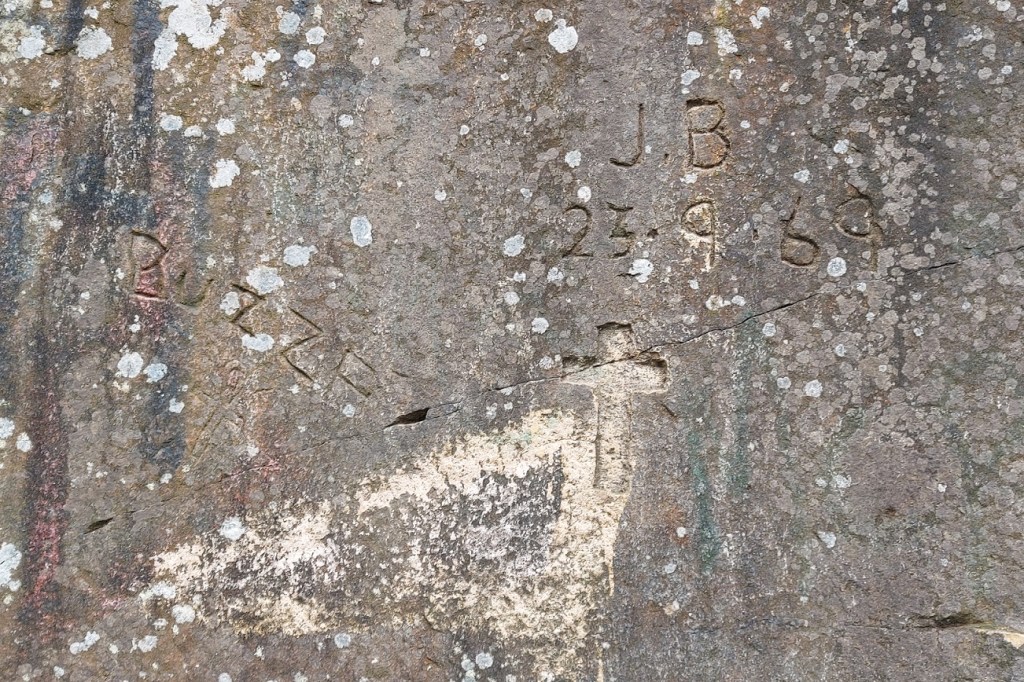
“BUZZB” and “JB 23.9.69” I love this one – the date is so specific. The cross is also very prominent.
An ancient Egyptian Ankh symbol – quite old (filled with slow-growing lichen), and odd to find on the rock face.
Another lichen-filled cross.

Perhaps it’s the crosses that give the quarry its reputation for Satanism and witchcraft? Anyway, the ‘religious’ iconography culminates in this, what the HER calls “a potential Calvary figure” – that is, Christ on the crucifix:

Well executed, and subsequently highlighted in paint.

This is a weird one – is it one figure, or two – a smaller, more feminine and naked, between the Christ-like figure’s legs? Or is it three? The more I look, the less I know. Is that the point? Is there a point? Even down to the almost-altar like outcrop of stone in front of the figure, this is very good.

It seems that this is a modern(ish) rendering, done by a known person – I have heard several different reasons and accounts – and people – but the story is not mine to tell, nor is it for me to name names. That I will save for the comments section, should anyone wish to do so.

However, it looks like it was the same hand that carved this naked lady, as well, so I’m not sure about any religious motivation as such:

It’s carved with skill, too.

There’s also this lower half of a person on their hands and knees.

Not sure what I can say about this… so I’ll say nothing!

Moving away from carvings, and back onto the safer territory of history and archaeology, there are traces of the original purpose to which the quarry was put here and there amongst the more modern intrusions.

The rough dressing is visible in the dark area of the quarry face.

Here we can see the rough dressing of the stone, done prior to it being broken out of the rock face. This provides it with a flat-ish surface before it is smoothed properly elsewhere. This was probably the last thing that was done in this quarry before it was shut down, as it is part of the quarrying process, but was never finished. I like that.

The quarry road, with spoil piles on the left.

The quarry road is very nicely preserved, but if you look closely at the stone at the bottom of the above photograph, you can see a groove worn into the rock there, running top to bottom. This is the track of a sledge repeatedly being drawn over the stone, day in, day out, for decades. A horse-drawn sledge is easier to use, more stable, and less likely to cause accidents, than a cart, and were often used in these remote quarries.

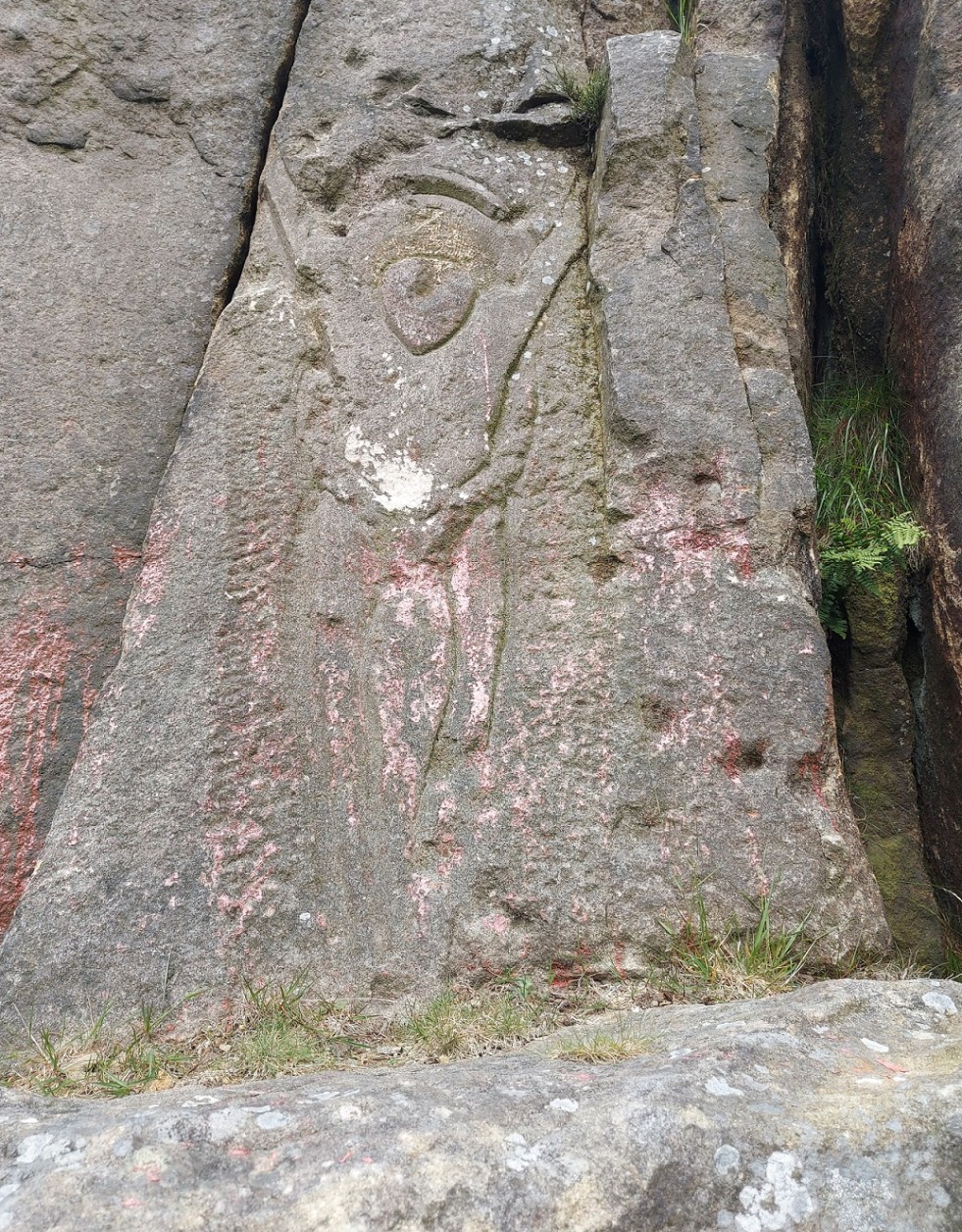
I also found also a concretion in the rock face of the quarry. Essentially, a concretion is a small boulder of one type of rock which is formed naturally, and which becomes trapped within the matrix of a surrounding rock when it was laid down as sediment millions of years ago.

I love that the concretion looks like an eye, the ‘eyelid’ accentuated by the red paint.

The concretion erodes at a different rate from the surrounding material, and so they stick out quite clearly. They’re fairly common in this type of Rough Rock, as indeed are plant fossils, apparently, but I didn’t see any of those… I need to go back.

Right, there you have it. More soon – including more pottery, you lucky, lucky, people. I’ve got so many ideas – walks, books, tours, blogs posts, pottery workshops, YouTube shenanigans, surveys, excavations, art, creativity, etc. – and so much I’d like to do. For now though, stay in touch and follow me here, or on Twitter (@roberthamnett), or even on Instagram (timcampbellgreen). Or just come up to me and say “What ho, Robert Hamnett!”.

But until next time, please look after yourselves and each other.

And I remain, your humble servant,

RH.

Archaeology · Graffiti · Pottery · Whitfield

Odd Bits and Pieces… and Cheese.

Well, this escalated quickly.

Apologies for the lack of posts recently, but things are a bit odd at the moment. Six weeks ago we were concerned about Covid19, but were still joking about it, and how it will amount to a fuss over nothing. Now, here I am in front of my computer in ‘lockdown’ for the foreseeable future, and a very real and sobering death count is still rising. It really is a strange time, and the country is a strange place; the start of it all reminds me of what my grandfather said of the ‘Phony War‘ – you knew something big was happening, but it wasn’t actually happening there and then. Well it is now.

Sadly, it also means that we have had to cancel all the tours and talks that I was involved in that were about to occur: in particular, the ‘By Seven Firs and Goldenstone‘ exploration of the legend and landscape of Alderley Edge, and the Objects Tell Stories evening of folklore and archaeology. Oh, and if you want to find out who I really am, you can watch me talking archaeology and ritual in the promo for that event here – I’m the one on the right.

More to the point, this has put something of a crimp in the Cabinet of Curiosities. Rest assured, though, I do have a backlog of posts that I have been trying to write that doesn’t involve me moving anywhere. And of course, there is now time to write… well there would be if Master Hamnett wasn’t being home schooled for the duration.

In the meantime let’s keep buggering on, as Churchill was fond of saying.

So I went for my state-mandated exercise the other day and found a few bits and pieces – random is the theme of today’s post. But first, a quiz. What’s this?

What
Ooooh, a mystery object!

I’ll give the answer at the end of the post… no peeking!

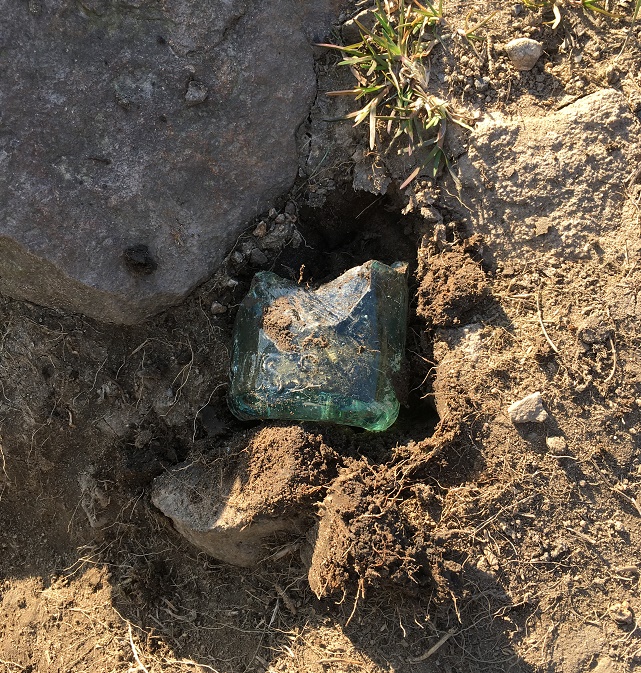
In the meantime, I spotted this sticking out of the ground:

What 2

Ooooh, thought I. The greenish colour of the glass gave it away as being older than mere litter, along with the thickness of the walls. Master Hamnett helped me hoik it out of the ground, and cleaned up it looks like this:

What 4
The lovely pale green colour is the result of impurities in the silicone, and dates it to the Victorian period or thereabouts.

You can just about make out the word ‘Glossop’ impressed in the glass. This was likely to have contained either carbonated water or beer, but a brief search of bottles reveals nothing similar. More research is definitely needed.

The small white object next to it is a fragment of a clay pipe, but interestingly, it has a some molded decoration on it. Here it is in close-up.

What 3

This is a fragment of stem, just at the point where it joins to the bowl. It is unclear what the completed decoration would look like – foliage perhaps? Dating clay pipe stems is always tricky, but the decorated types are usually late, so late Victorian is about right.

We later came across this stone with the letter ‘H’ carved on it, and being a connoisseur of such graffiti, I had to collect it.

What5
A Hague Street ‘H’

It’s nicely executed with a flourish of decoration in the form of drilled holes between the arms of the ‘H’ – I’d give it a 7/10.

Right. That mystery object… did you get it? I believe you, honestly!

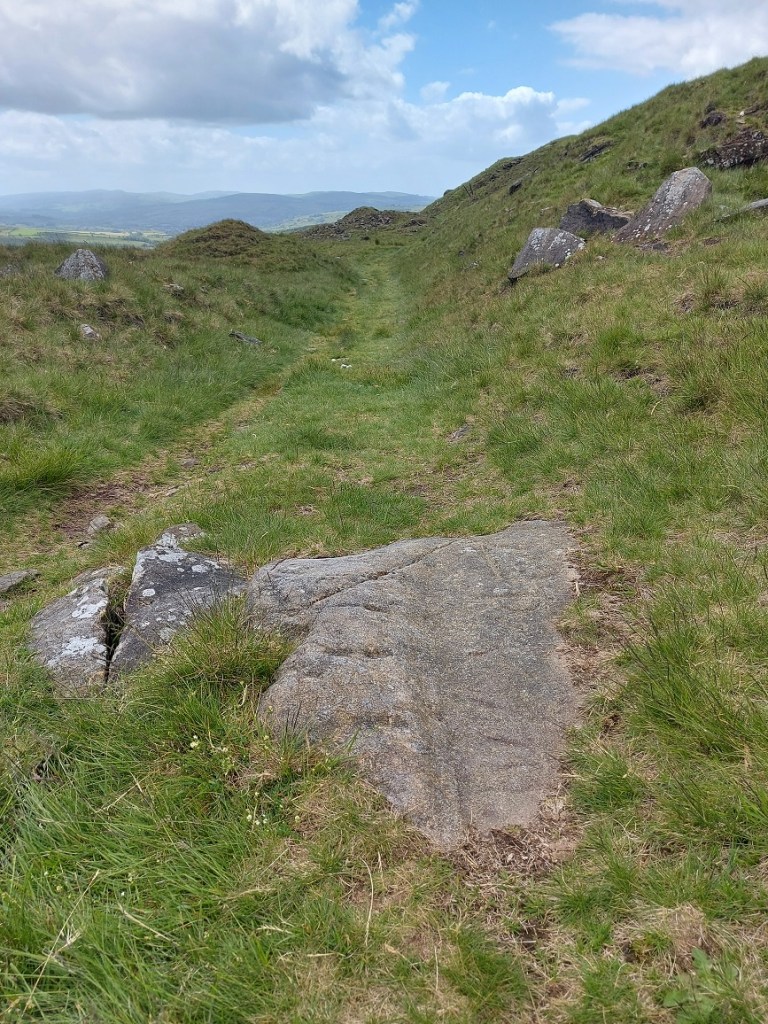
Ok, well, it’s a cheese press. Yes, you read that correctly! A cheese press. A thing for squeezing the whey out of cheese curds. Well, technically, it’s half of a cheese press – it’s missing the right half.

The square hole on the left is to house an upright pole which, along with another on the right, now missing, held the pressing weight in place. The circle and lines carved into the surface allowed the whey to run off, leaving behind the solids which are then matured to make cheese. Cheese was home made, or at least farm made in small batches, until relatively recently, so the press must  have belonged to a farm nearby, as you aren’t going to shift that stone any great distance, when others, closer, would do to fill a hole.

What
The mystery object again.

Here’s a complete one in Bashall Eves in Lancashire:

What Lancashire_Cheese_Press_-_geograph.org.uk_-_431556
Cheese press in Lancashire, and used to make, well, Lancashire Cheese. Image shamelessly stolen from Wikipedia.

  And here is another one carved in the same manner as ours:

cheese-press
The cheese press in Draycott in the Moors churchyard. Photograph is courtesy of their local blog, and I hope they don’t mind me stealing it – please visit the blog here, it’s very good.

This one caused a bit of confusion, apparently – read all about it at this wonderful blog.

In terms of date… who knows? Certainly not hugely old – possibly Victorian, but equally possibly earlier. The only other one I have seen (which is how I know what it is) is propped up where I work at The Blackden Trust, and was in fact carved on the reverse of an old gravestone dated to the early 18th century, which at least gives us a date to work with. I’m going to write a little more about this soon, as it involves two of my greatest loves – archaeology and cheese… if we could just work in wine somehow, then it would be perfect.

Incidentally, the press is currently being used to fill a pot hole in a trackway, which I think is a shame. Sigh… I’ll add it to the list of historical objects things that need to be hoiked out and displayed properly (along with Whitfield Cross and the Whitfield Guide Stoop) – I think it would look great displayed at the wells. Seriously, I think we need to do something about reclaiming our heritage, as it is being slowly eroded. The guide stoop is currently under 3ft of soil, and looks like it will be left like that, So then, who’s with me?

Right. I’m off do some more gardening.

Please stay inside and stay safe, and take care of yourselves and each other.

More soon, I promise, but until then I remain,

Your humble servant,

RH

Bench Marks · Graffiti

The Walk Part 1: Carvings

Greetings all. I’m back.

So, I have returned. I’m not going to bore you with the usual apologies for a lack of posts… let’s just ignore it and awkwardly move on.

Interesting things have occurred since I last blogged. I no longer work at a certain local museum, which means I now have more time to spend doing this sort of thing. For the first time in too many years, I put a trowel in the ground and went back to my roots of excavation rather than the academic theorising of more recent years. Even if it was only a 1m x 1m test pit, it was a good feeling, particularly as it was at Melandra, where my namesake excavated in the early part of last century. I didn’t find anything interesting (a piece of flint amongst some modern backfill), but the project as a whole seems to have made a significant discovery… more about that another time.

I have also recently returned from Florida, spending some time with my amazing daughter (hello Evie). Nothing archaeological to report from there, but we did find some nice bits of Native American flint in a flea market – I’ll blog about it, as it’s fun to look at.

So then, today’s post is a bit of a placeholder. I have almost finished a long and interesting post about a wall (stop groaning… I can hear you, you know!), but I need a few more photographs. Until then, I’ll post a short companion piece.

Mrs Hamnett, Master Hamnett, and myself, went on a short ramble the other day, to blow away the cobwebs so to speak (not a reflection on Mrs Hamnett’s housekeeping…). Being short in the leg department, and peculiarly large in the whingeing department, young Master Hamnett sets the length of our walks these days. And so, with much faffing and snot on the face, we set off “up and over” – that is, past The Beehive, along Hague Street,  left into the field, and then follow the path round until we arrive at Fieldhead, and then down to The Beehive (or if we are feeling full of energy and less full of whinge, we push on to Whitfield Cross (the cross) and then back. The last few times we have done this, I have picked up some bits and pieces of pottery and glass along the path – nothing earth shattering, but interesting nonetheless. I’ll post them tomorrow, as well as a third installment – the original post – later this week. Today’s post is made up of two of my obsessions: carved graffiti and benchmarks.

This is the route we took.

Wall Walk
We didn’t get as far as the cross, but instead cut back towards the Guide Stoop. The red lines show the route taken (1898 1:2500 OS map via old-maps.co.uk)

Bits and pieces of pottery were along the path, as I say, but I stopped to take these photographs in the areas marked with a green circle.

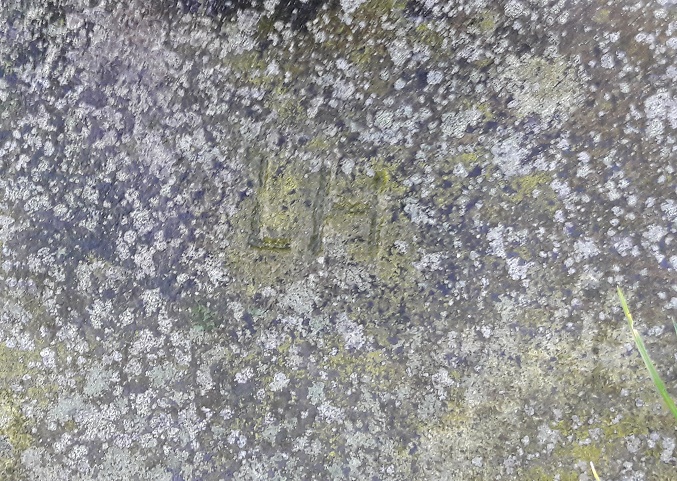
The first, in the lower circle… a benchmark! I’ve not posted many recently, and I really must address that as, well, they’re great. There are several on this route, as you can see from the map above, and a few hidden in field walls in the middle of nowhere. I’d like to do an odyssey at some stage, and track them all down – if anyone fancies joining me, give me a shout! Anyway, here is the benchmark in all its glory:

Wall - BM
Fairly standard choice of immovable object – a gatepost – but some nice detailed carving on the mark.

This is a bit of an odd one. It’s clearly a bench mark, it’s clearly on an immovable object, and the gate is clearly marked on the maps, but… there is no bench mark marked on the map at that point – check it out in the map above. The nearest is a spot height of 777 ft above sea level. Spot heights are recorded OS heights above sea level, but are not marked on the landscape by carving them – they serve more as a guide, than a definite point. I trawled through a pile of maps, and eventually found a spot height at that point on the 1954 OS map of 779 ft above sea level. It is probably a late entry in the Ordnance Survey, and it seems whilst they marked it on the stone, they forgot to mark that on the map. If there was a category for ‘rare’ types of bench marks, this would surely be one (and no, I’m not looking for bench mark collectors websites; I have too many ‘collections’ as it is, if I get sucked into bench mark collecting, Mrs Hamnett will almost certainly divorce me*). The gatepost itself is interesting; it appears to be a roughly shaped upright stone, rather than a carefully dressed, more traditional, post. Whilst one is hesitant to say ‘standing stone‘ for several reasons, it is quite common for them to be used as gateposts, and a brief glance at all the other gateposts in the area reveals them to be like the photograph below – shaped properly for the job.

Here is the upper green circle… carved graffiti!

Wall - Carving
Another gatepost. Fieldhead is in the background.

 An inexperienced hand, but very clearly writing letters. At the top, we have a ‘T’ and a ‘B’ or ‘R’, and on the left, running down, are a ‘T’, a ‘B’, and an ‘O’, and there are other marks carved around the top, but nothing recognisable. The Ts are carved quite nicely with serifs, but overall it’s a bit messy… 3/10?

Right, that’s all for today. As I say, I have two more related posts almost ready to go (tomorrow for at least one of them, if I get chance), and lots more to go after that.

As always, comments are very welcome, and please feel free to email me with any information or questions.

More soon, I promise.

But until then I remain, your humble servant.

RH

*Alright, so I lied. I did check. And there are so many. So like a moth to a flame… apparently, we are called ‘bench mark baggers’. Here are two websites to whet your appetite: One is the central bench mark database, which is worth an explore, and the other is a blog run by someone worryingly like me, well worth checking out. I might be single again very soon.


Graffiti

More Graffiti

Good day to you all.

Apologies for the lack of recent activity – the usual reasons apply here, annoyingly. I have been trying to keep active on twitter as a way of making it up to you, my valued readers… but I know, it’s not the same thing.

Anyway, here is a short entry to keep you going. I have bigger plans of more interesting things, and hopefully, given that it is a bank holiday, I might get it posted. In the meantime… graffiti!

Firstly, this cross from the wall outside the vets on Gladstone Street.

Graf 1
A simple cross carved onto the wall coping by the gate on the Gladstone Street side. 

Simply executed, and part of me wonders if there is some connection between this and the other crosses that I have noticed around Whitfield – here and here. Just a thought.

Now back to Whitfield Recreation Ground. I know I keep threatening to do it, but I really do have a post in the making on the rec. A very interesting place indeed.

Anyway, these are all from the Wood Street side of the ground.

Graf 2
‘WFHS’ perhaps – very unclear.

Graf 3
Er… no idea! It is almost like some sort of occult symbol. Witchcraft and devil worship in Whitfield… I knew it! But then it also looks a little like this Pokemon character, so who knows! And don’t ask how I know that…

Graf 4
‘Jo’ – nice and simple. There is also the hint of something below and to the right – geometric designs? It is easier to see in the flesh, so to speak. 

Graf 5
‘LH’ – nicely carved.

And to end… this! How and why someone did this, I don’t know, but they did.

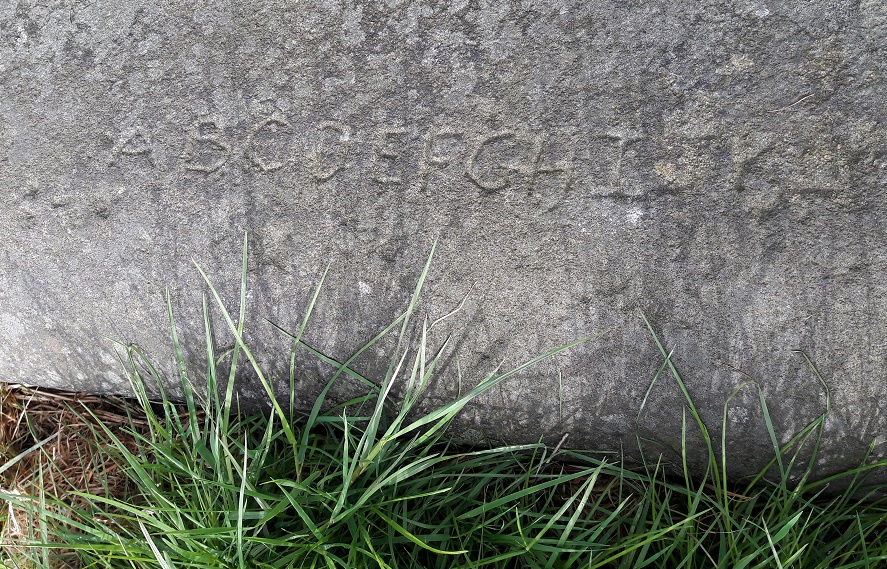
graf 6
Ladies and gentlemen… the alphabet!

It gets a little blurry in the middle, from ‘J’ onwards, but then picks up again from ‘W’. But it’s all there.

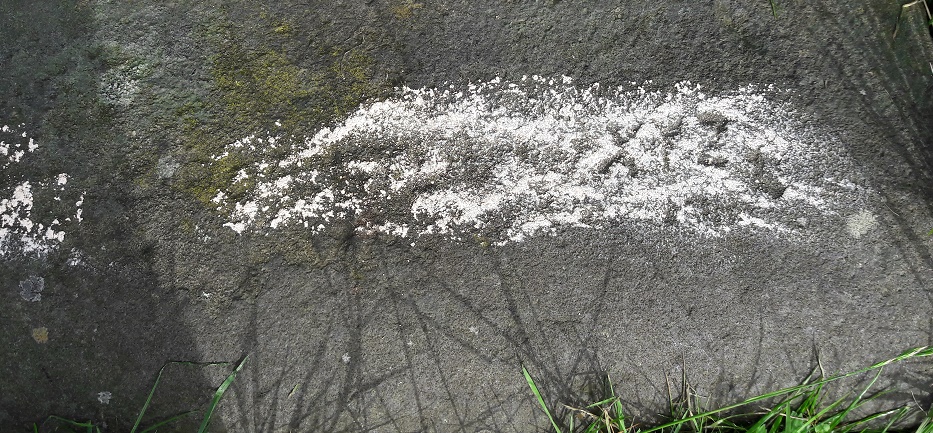
graf8
I used chalk to try and bring out the latter part. You can also make out ‘P’, ‘Q’, and ‘R’.

Truly weird and wonderful.

That’s all for now, but keep your eyes open, and send me photographs of any you find – I have a few from readers that I’ll publish next time. And I’ll try and post again before the bank holiday is over.

RH

Graffiti

Garden Graffiti

So, I finally got round to looking at the graffiti carved on the wall outside my house.

It’s a drystone wall with a flat top made of large thick stone laid horizontally. The flat surface has provided an opportunity for someone to inscribe graffiti onto it… and my, how they have!

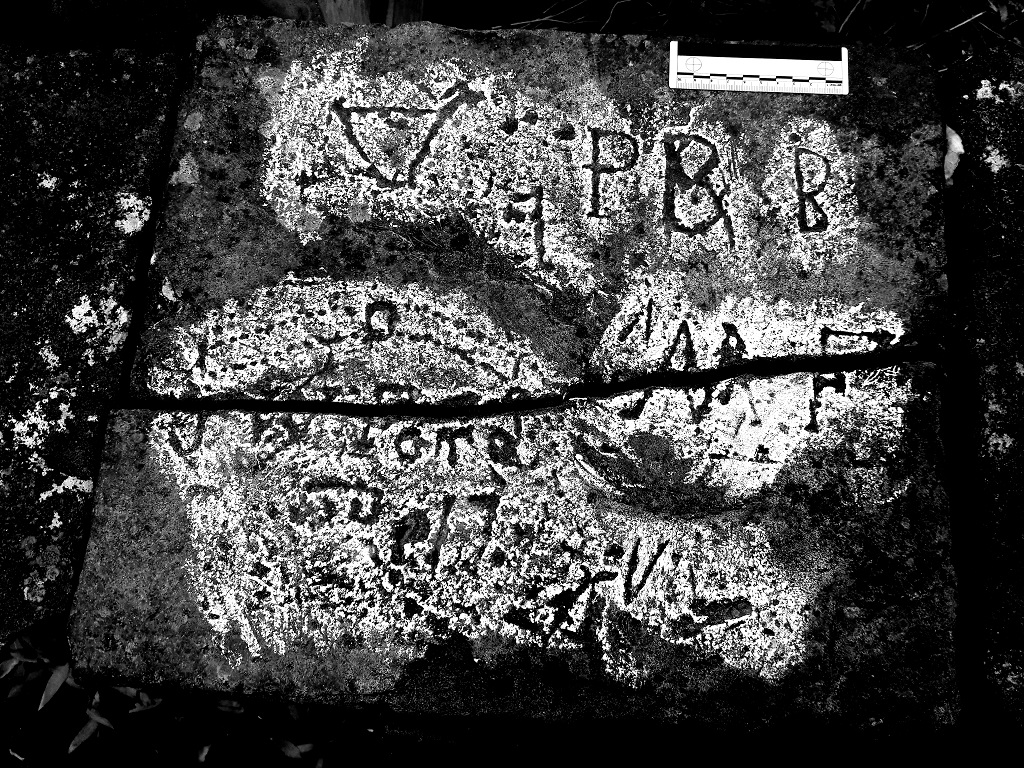
It is difficult to see in normal circumstances, even with low light, but I applied some chalk to the whole surface, leaving the carved bits in relief, and lo! It came to life.

Wall 2
The chalk really brings out the carving, and washes away in the rain, leaving no trace.

I took a photo, and then messed around with the results, enhancing the contrast.

So, what can we see?

The initials P.B. and M.F. are very clear. I would suggest these were done at the same time, as they are of a similar size and are located in the same area of the stone. I need to go back and check the census returns for the house to see if anyone who lived here had those initials; it would be nice to put a name to the carving.

There is a geometric triangular design at the top – no idea what it is, but it must have meant something to someone… it’s difficult to doodle with a hammer and chisel!

There is the number ’17’ at the bottom, amongst a pile of other indistinct marks, and possibly the initials ‘J.D.’. Possibly the ’17’ could be the year 1917?

However, the biggest and best one is the ‘J.W. Ford’ framed by an archway, middle left. This is executed in a controlled careful script, almost formal, and has been thought out in advance – one wonders if the person doing it traced it out first. The archway, too, with its central boss, is very carefully carved. Actually the archway reminds me a little of the archway set over the road at the Whitfield well dressing, and I wonder if that was the inspiration, as it seems an odd thing to do, put an arch over your name.

Anyway, I shall investigate further to see if I can match up the names to people living here, via the census records. Standby for further updates.

RH

Graffiti · Mottram · TAS

Graffiti – Update

There is still lots to do, and lots more to find – but I saw this the other day, up on Cliffe Road, on the exterior wall of a garden.

Graf
T & J captured forever! I like to imagine a married couple (Tommy and Jane?) still together but now in their nineties, and who still feel a pang of guilt every time they walk past this wall. 

Who ‘T & J’ were, we may never know, but the stone has been re-used from elsewhere to build the wall – which means someone saw the graffiti and thought to keep it right side up and readable, which I think is nice.

Now, more seriously. I mentioned the book, Medieval Church Graffiti, in the last graffiti post (here). It is a really interesting read, and has resonance in the work I do at the Blackden Trust (link here), so I can’t recommend it highly enough. However, the rather incredible folk at Tameside Archaeological Society (website here) have begun their own project at Mottram St Michael and All Angels, looking at the graffiti there… and coming up spades (pun fully intended). Their brief report is here, but let’s hope for more soon. Actually, in a way, I’m annoyed, as as soon as I read the book, I thought “I know, Mottram church, that’ll have some graffiti, and I’ll be able to post it on the blog…”. But I have been beaten to the punch.

However… If anyone fancies spending an afternoon or two in Glossop’s All Saints Church looking for graffiti, give me an email. Although the building as it stands dates largely from 1831 onwards, it replaced the medieval church, and reused some stone in the rebuilding process, particularly in the nave. There may be something left behind… perhaps. Anyway, drop me a line – but at least glance at the book first (here).

The next post (Thursday… probably) will be based around Mottram church, so keep your eyes open. Oh, and more pottery is incoming.

TH

Graffiti

Graffiti

The urge to leave a mark in the landscape – a part of you or a reminder that you were there, once, even long after you are gone – is undoubtedly a universal feeling, and one that has been with us since we humans first started ‘thinking’. The cave art seen in places like Lascaux and others are believed to be ritual and ‘Shamanic‘ in nature, as well as displaying entoptic traits, probably drawn under the influence of hallucinogenic substances, and again ritual in origin. However, I am also convinced that some of them are the Upper Palaeolithic equivalent of “Kilroy Woz ‘Ere”.

Graffiti can be an eyesore – scrawls and rude words for example. But it can also be rather beautiful; there is some amazing ‘street art’ out there, done by people with phenomenal talent. However, it must be stated that even the rude word variety has an impressive heritage – the Romans were famous for it! Even medieval churches were not immune to it – if eternal hellfire and damnation isn’t deterrent enough, an asbo certainly won’t cut the mustard.

But it is the humble name that is most often written; a cry in the wilderness of life, and wish to be remembered, to have left a mark, however small, so that some part of you is immortal. Now, I’m not about to post a bunch of photographs of random spraypainted words… no, no, no! This graffiti has some age to it.

Nowadays, any moron can (and frequently does) use spraypaint, marker pen, emulsion, or any one a number of other ways to leave their mark. However, back in the Victorian period, if you wanted to write your name, you really had to mean it! Armed with a hammer and a heavy duty chisel, and a good few minutes whilst you etched your initials permanently into stone. It is surprisingly common to come across this sort of thing, but recently I have been photographing the ones I see in Glossop. I have more photographs somewhere, but for now, may I present ‘Gone, But No Longer Forgotten’.

Bank Street - Graffiti
This is on Bank Street – my favourite path. Slightly haphazard initials – T.A. – carved into a stone that is oddly coloured. There are no other similarly coloured stones around it, and it looks like it has been burnt at some point before being used in this wall.

Whitfield Rec - Graffiti 1
This one is from Whitfield Recreational Ground, the Wood Street side. ‘B.D.’ carved into a capstone. It also looks like it has been filled in at some stage. Given that the park was opened properly in 1902, we have a firm date after which it must have been carved. It’s also nice to see the marks of the chisel that dressed the stone – all representing one person’s labour spent in shaping it.

Whitfield Rec - Graffiti 2
Whitfield Recreation Ground once again, this time the Wood Street stairs. ‘W.B.’ very messily carved – standards clearly slipping. There is possibly a ‘J’ carved below the W.

Whitfield Rec - Graffiti 3
This one is also on the Wood Street stairs. ‘F.F.R.C’? Unclear, and I think this is more modern than the others – there has been no attempt to carve the curves of each letter, and instead an unskilled hand has block carved the initials. Shocking!

As I say, I do have more somewhere, and I’ll post them when I find them. In the meantime, if anyone knows of any more, let me know. I have some on my garden wall that are particularly interesting, but I’m saving them for their own post.

Next blog post will involve pottery… probably.

Or Victoria Bridge.

Anyway, Happy New Year to you all, and as always, comments are welcome… especially if you know the identity of any of these miscreants!

RH