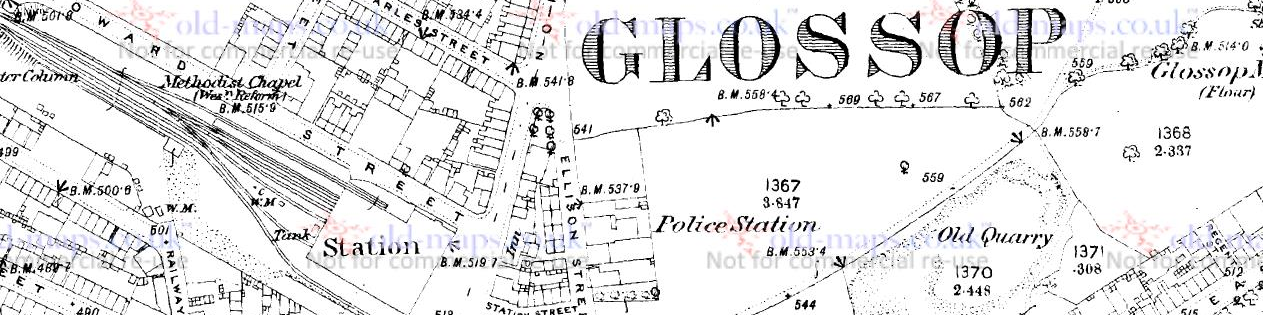
I know, I know, I promised pottery… and I can see you are upset by this, but something exciting has come up. Well, two things to be honest. Well, actually many things, but for now let’s focus on the two things that prompted me to write this post. And in particular, it seems appropriate to post it on the 80th anniversary of VE Day.
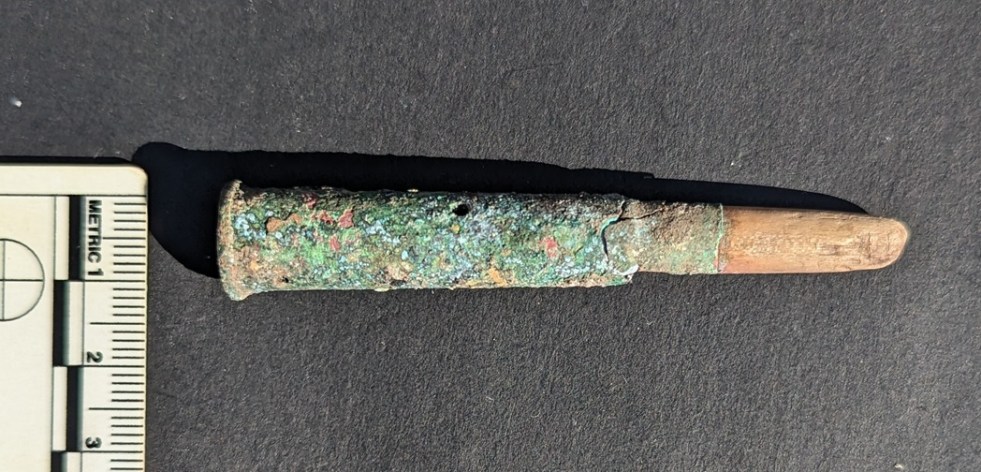
Ok, so, a friend showed me something interesting the other day (hello E.T.!) – a 1920’s dump site in the Glossop area. There are a few of these dumps around, including some early Victorian ones (and no, I honestly don’t know the location of any of these – this sort of thing is a closely guarded secret that even I’m not privy to… sadly!). This one was very small, and had mostly been built over by 1930’s/1940’s housing, sadly. I didn’t find much at all apart from a few bits of pottery (to be talked about in a later post), and some odds and ends including a bead, and some interesting looking buttons. However, Mrs CG found what we initially thought was a rifle cartridge. Well, it turns out it was a cartridge… of sorts, but is actually more of an interesting story than just that.
Now, you might remember a few years ago I blogged about the rifle range at Mossy Lea. It’s essentially the story of the local Rifle Volunteer Corps, and in particular their use of different weapons, and their corresponding bullets, at the range. One of these was the Lee-Metford .303 – the standard issue rifle leading up to WWI, and thing that fired one of these:

Well, I could tell that the found was a .303 cartridge by its shape – it has a lip around the base, and from the other – bullet – end I could tell that it was an early version (the later bullets are more tapered, whereas this looked more rounded); “what ho Lee-Metford!” I muttered to myself. So it was interest that I started to clean the cartridge, thinking that if it’s live I’ll have to hand it into the police station; live ammunition can be dangerous, but it is also very illegal to own without a licence, and I’m not going to argue with that.

As I moved round the bullet end, I was expecting a copper jacket covering a lead/nickel centre, the kind illustrated above, only complete. Instead, what I found was a wooden copy of a bullet – exactly the same shape, but made instead of wood, possibly Lignum Vitae or similar non-rotting type.
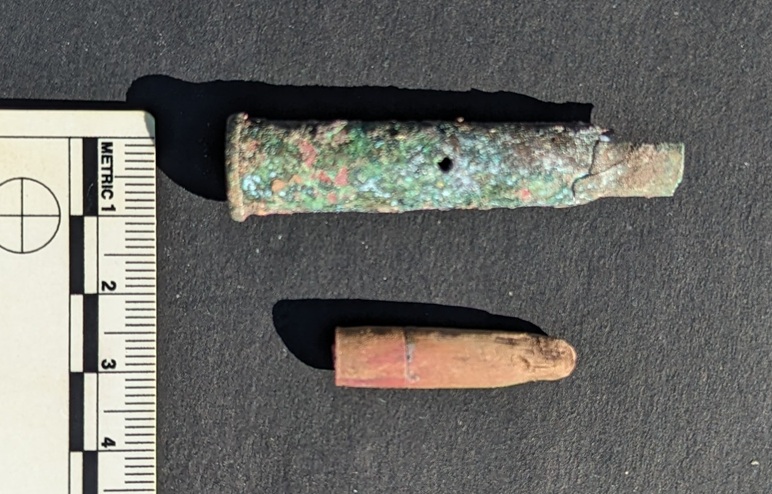
Ok, I thought, and looking closely at the end of the cartridge, I saw it had no primer cap – the bit that is hit by the firing pin which then explodes and sets off the main explosive charge in the cartridge proper. And looking again, I saw the body of the cartridge had 4 holes drilled in it . I quickly realised that it wasn’t live, and it was in fact a ‘dummy’ cartridge – an inert round, with neither actual explosive (hence the holes) nor fireable bullet – which was designed to be loaded into a rifle safely, allowing training in loading and shooting, without the danger of it being accidentally fired. And this tells a more interesting, story, I think.

There was the hint of a marking on the headstamp – the bit at the bottom where the cap is, and which contains all the details needed to identify the what, where, and when of the cartridge – but the only way to reveal it would be to sandpaper the corrosion away, revealing the metal itself. After some debating, I decided that the metal is too far corroded to do this – there is very little actual metal left, and it is largely just Verdigris, and that to try and ‘clean’ it would essentially destroy the artefact. And then, after debating some more, I thought “tally ho, let’s give it a go”. An interesting, if tense, 10 minute dalliance with some oil and very high grade sandpaper, and voila! The headstamp is revealed:

G. 13. VII
Well… down a rabbit hole I went, head first, and with a glass of ‘potion‘ glasped firmly in hand (the bottle said ‘Drink Me‘… who am I to argue with that?), I began researching headstamp markings of early British .303 cartridges. Blimey! I thought pottery was a niche and very geeky subject! I love coming to a focused and highly specialised collecting hobby as an outsider, just dipping in; the level of knowledge – and sheer insanity – on display in some of the collecting forums (fora, technically… I know) is truly outstanding. And whilst I don’t understand the finer points, nor understand why anyone would want to, I fully and completely understand the compulsion, the drive, the need to explore the subject, and to hyperfocus in order to give order to a noisy and disordered mind world. I am also only too aware of what this says about me: I know it… you know it… so let’s move on!
So then, what does it all mean? Well, the ‘G‘ references Greenwood and Batley Ltd of Leeds, the engineering firm who physically made the cartridge. The ‘13‘ is the year it was made – 1913. And ‘VII‘ is the Mark Number – think Version VII of the bullet’s development. Specifically, Mark VII was introduced in 1910 as a development on the earlier types. It contained cordite as an explosive charge (rather than nitrocellulose) and was fitted for the new ‘spitzer’ long pointed bullets (on the right in the photograph of the bullets above), rather than the older style rounded-end bullets – the kind I found on the rifle range. I presume that this was overlooked for the training cartridge, as the wooden bullet is round shaped, not a the ‘spitzer’ type, despite it being a Mark VII on the headstamp. Here is a very detailed article on these developments, should you have an interest in such matters.
So then… why does this matter, beyond a passing interest? Well, the only reason for there to be a training cartridge in Glossop, is if there was training! And the only military training going on here, was with the 6th Battalion of the Cheshire Regiment, the part-time territorial army that I blogged about in the original rifle range article. This training cartridge could only have been used by the Glossop Territorials, and somehow ended up on a 1920’s dumpsite. Genuinely, I love this – something used by one of the men in this photo.

Now, those buttons… I haven’t cleaned them yet, but I could see that one was different, and that I did clean. It came from the same ‘area’ as the bullet (on the surface, 1 metre away), and thus I believe to be from the same dumping episode.

It’s a simple General Service Button of a post-Queen Victorian type (the crown is of the male type), and was worn by those in military service as part of their uniform. Given that the dumpsite is roughly pre-1920, the button must date from the reigns of either Edward VI (1901-1910) or George V (1910-1936), and was made by the famous Firmin & Sons factory, who still make huge numbers of uniform buttons.
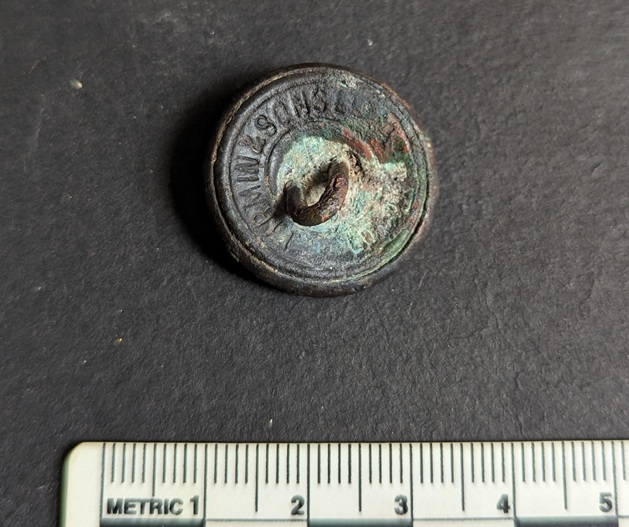
It strikes me that, given the close proximity of the button of post-Victoria (1901), with the training bullet of post-1910, one may assume they are related, and thus the button comes from the uniform of a member of the 6th Battalion, Cheshire Regiment.
One can imagine that following the death – pre-WWI – of a member of the regiment (someone senior enough to have ownership of a dummy cartridge – surely not every soldier had one of their own?), these military bits and pieces were thrown away by the family. In all honestly, I’d like to think it was our old friend, the archaeologist and historian, Robert Hamnett, who, as Colour Sergeant, was very active in the regiment, and who died in 1914… but obviously that can never be proven, however much one hopes! I should go back to see if anything else remains, although I’m almost certain we got everything that was worth finding.
As an interesting aside, I actually own, and have shot, a Short Magazine Lee Enfield rifle – the kind that would have shot the bullet discussed. Built in 1917, it saw active service during WWI, and is a much cherished gift that currently lives in Brandon, Mississippi, USA.
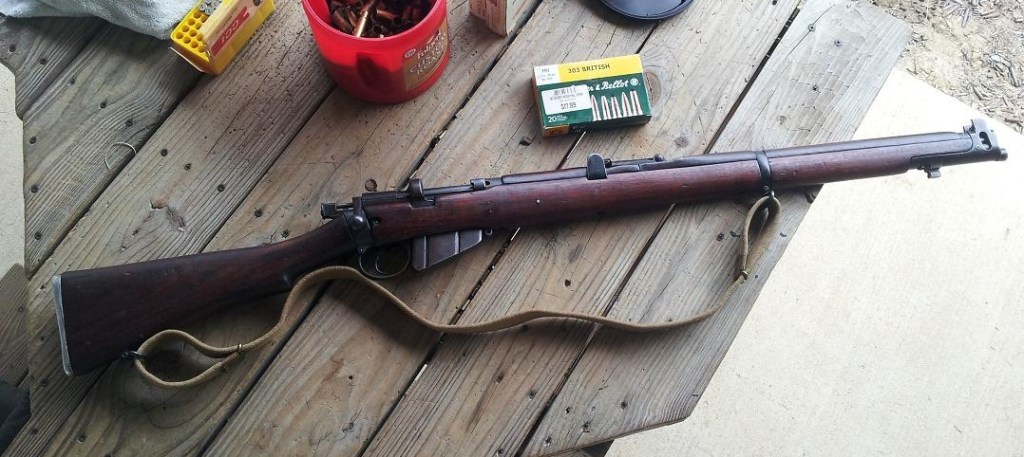
Alas, it would be difficult to import it from America over here as, quite rightly, there are all manner of complicated and expensive legal hoops through which I would have to jump. Maybe one day, but for now, here I am on a rifle range in Mississippi, firing it.

Right, that’s it for now. A short and sweet bit of historical archaeology to lighten your day.
I’ll be back soon for more shenanigans, probably involving pottery! What do you mean, “spare us“? Honestly, some people!
Until then, look after yourselves and each other. And I remain.
Your humble servant,
TCG
 The Glossop Cabinet of Curiosities