Archaeology · Pottery · Whitfield

A Green-Fingered Garden Grab*

*Ok, so I couldn’t think of a better title.

What ho, what ho, what ho!

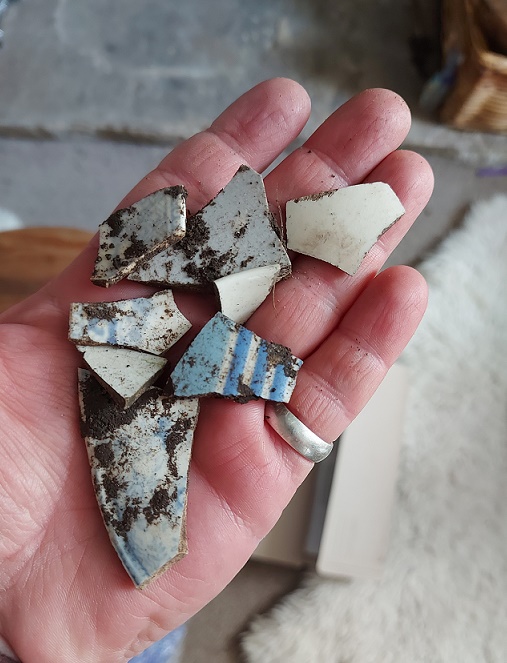
So, right now, as we hurtle toward the solstice, is my favourite time of the year. Spring into summer – the days are long, my birthday is hoving into view (19th July, if anyone is interested… and a dark fruity red, if anyone is feeling flush). It also means time spent in the garden, planting and preparing the soil. Hamnett Towers is blessed with a small back garden (utterly destroyed by chickens… honestly, it looks like the Western Front), and a slightly larger front garden where the vegetables are planted. Both of these forces of nature – chicken and man – excavate all sorts of goodies. Predictably, I have kept everything I have found, and kept them separate; Hamnett Towers was at one point two separate ‘back-to-back’ terraced houses, so the archaeology of either side might tell a slightly different story (old archaeological habit). And so far, this year has produced some very interesting bits.
So, please join me in the garden. Ah, sorry, no shorts or baseball caps please – this is an English gentleman’s abode; t-shirts I can just about cope with, but I mean, a chap has to have standards dash it!

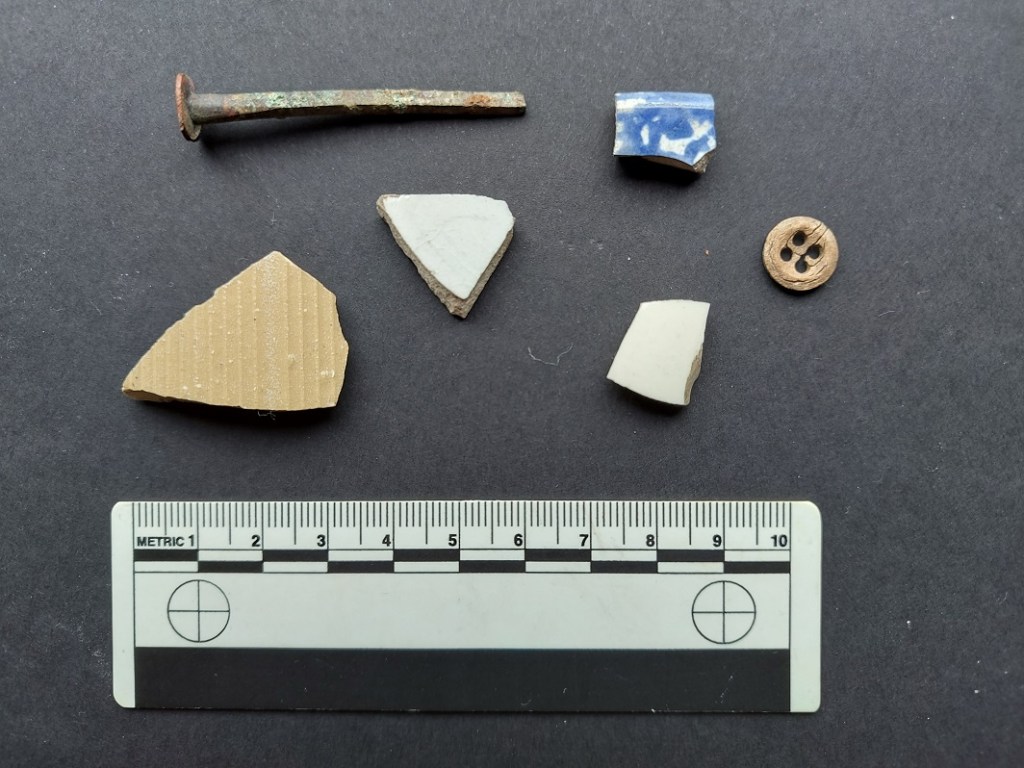
Here’s the day’s findings from the front garden:

A selection of the history of the land the garden has decided to show us this year… so far.

Let’s start with the nail – a Victorian, hand-made, copper roof nail, to be precise. I’m something of a magnet for these things, and they seem to find me wherever I go. They are truly mundane – the nail that holds on a roof tile – and yet are such lovely and tactile things (I’ve blogged about them before – here – FIVE years ago… blimey!). Copper was used as it is largely resistant to corrosion, and their square section is a dead giveaway of age.

Lovely green verdegris competes with rust (the result of it lying next to something iron based) on the surface.

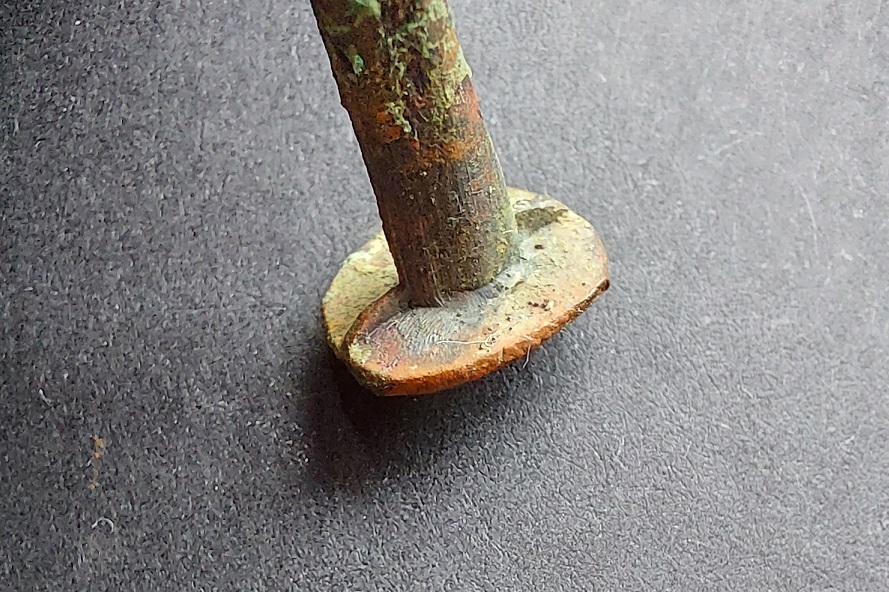
They are made relatively simply, but by hand. Each nail is cut via a press from a long flattened strip of copper (thus the square body of the nail). It is then placed into a small mold or former, point down, and the exposed top is hammered by hand until it flattens out, forming the nail head. Close-up you can see the two flashing strips formed as the soft copper is driven between the halves of the mold.

A close up of the underside of the nail head, clearly showing the copper flashing.

The nail may have come from my house roof, which is a great thought.

Next to the nail is a sherd of spongeware, probably from a large bowl or shallow dish. I find a lot of this particular vessel in the garden, and I might have to try and reconstruct it sometime (follow the link above, 3rd photograph down, on the right for more of the same bowl).

Next row, a sherd of marmalade/preserve jar (here, for more information), and then two thoroughly uninspiring sherds of white glazed pottery. Then, this beauty!

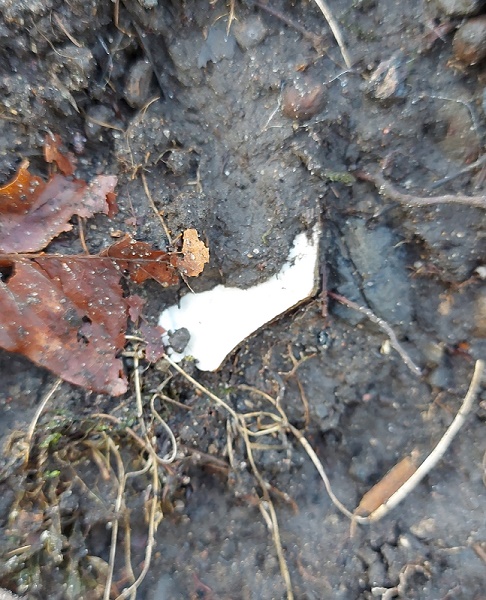
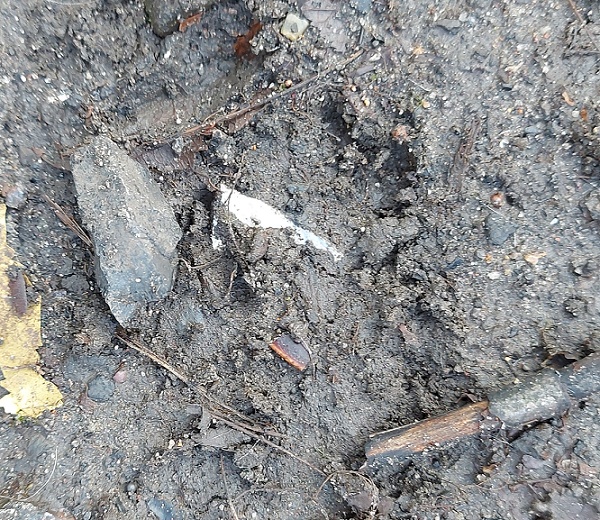
Super. An amazing chance find whilst whilst putting in some pea and bean plants… half of which were eaten on the first night by what can only be imagined as a biblical plague of famished slugs – honestly, I swear I could hear a very slow moving rumbling sound. If you’ll pardon the French… Bastards!

Wonderful! A small bone button, and almost certainly Victorian in date. Delicate, handmade, and slightly off-centre, it is lovely. Again, something so mundane – every item of clothing would have had a dozen of these; will people be cooing over the zips in our trousers in 100 years? And yet, here we are, admiring it’s beauty. Bone was such a common substance in the pre-20th century, and we tend to shy away from it as a material now – how many of us would brush our teeth with a bone toothbrush? Or use bone game pieces? I think we have become a little squeamish. Yet, it was a major resource in history – so many animals, so much bone. Bone preserves very well in the right conditions, and although this has cracked with age, I bet it could be sewn on and used again.

Right then, the image of the Somme, c.1916, that is the back garden. There’s always something that turns up here, not all of it interesting, but usually worth a look. And this year is no exception, with a couple of very nice finds.

A rather motley looking collection, I must admit.

So then… top left we have bonfire glass. Essentially glass that has been melted in a fire. This may have been accidental, or just the result of rubbish disposal. Often Victorian and later rubbish dumps were set on fire to keep the rat population down, and bonfire glass can be quite pretty. This one… not so much.

It’s quite a cool object, but not particularly pretty.

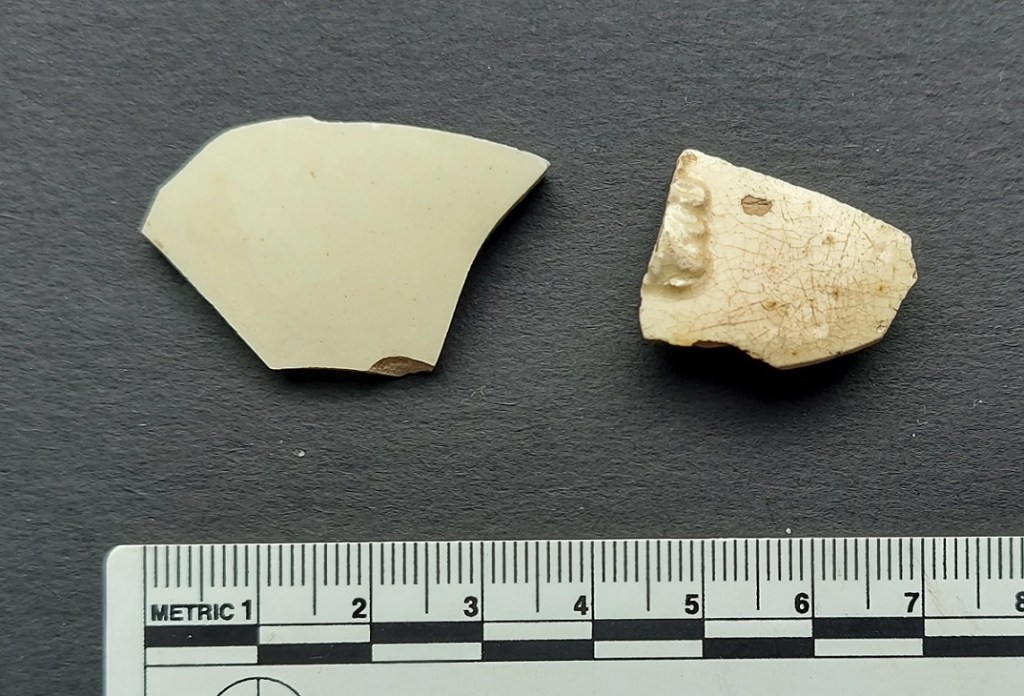
Ignore the next sherd for the moment, and move onto the cream coloured stoneware sherd, possibly from a flask or other oval shaped vessel. Then we have some glass – it is quite chunky, which indicates it is old, but isn’t that lovely green colour, nor full of bubbles, that would indicate a Victorian date. Probably Early 20th century, and likely from a small bottle – perhaps medicine or similar.

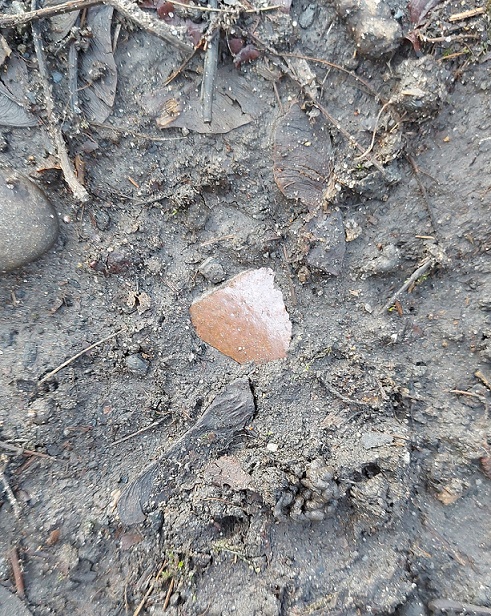
Ignoring the other reddish coloured sherds, again for the moment, we have this beauty:

You can see the striations caused by wiping the red under-glaze slip with a wet rag – the marks of the potter preserved for eternity in clay. Lovely stuff!

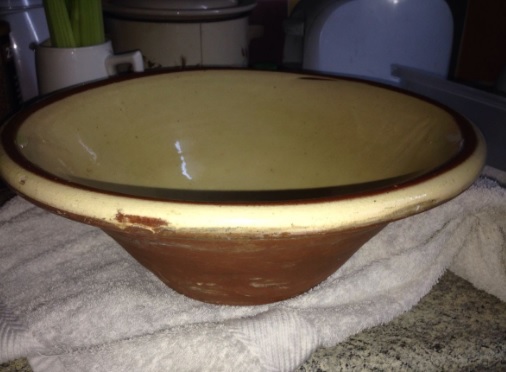
This is often called Pancheon Ware, after the large (50cm+) pancheon bowls that were extremely common from the 17th century to the early Victorian period. The correct term should be Post Medieval Redware, but that covers a multitude of pottery types and shapes from c.1550s to the Victorian period, of which this is just one.

Essentially a large mixing bowl, bread proving bowl, or vessel to allow cream to separate from milk. This is a lovely antique example, the image of which was stolen from this website which sold it for £195.

They often occur in huge chunks up to 2cm thick, and are usually glazed only on the interior to make it waterproof. I’ve talked about them before, but this is a nice example, showing the red slip on the surface, and then the dark brown glaze, made by adding iron oxide to a lead glaze, producing the deep shiny colour. The glaze on this, as with many, has been allowed to slop over the side and stop just below the rim, producing a messy natural decoration (the example above shows the glaze stopping on the rim, but you can see the effect they are going for).

Below and right of this sherd there are 4 sherds of standard Victorian to mid 20th century whitewares nothing inspiring, or even particularly worth writing about, although there is a rim of a bone china cup. Below and left is a single fragment of a clay pipe stem. Again, nothing exciting – the hole, or bore, through the middle of the stem is narrow which tells us that it is Victorian in date (broadly, a wide bore = 17th to early 18th century, a narrow bore = late 18th to 19th century). Still, it’s a bit of social history… I just wish I could find a bowl!

Then there was the treasure! Occasionally, certainly not often, I find something made of metal. And a few weeks ago, as those who follow me on twitter will know, I found a metal button.

Tiny, just 1cm in diameter, and very delicate. Amazing it survived, to be honest. And even more amazing it was seen.

Well, no… credit where credit’s due – I didn’t find it, Master Hamnett did, with his six year old eagle eyes. A lovely little 2 eye brass button, probably Victorian in date. It’s probably from a child’s dress, probably something like this:

A heavy linen dress for a child. It is beautifully decorated with hand-made edging.

And if you look closely using a decent magnifying glass, rather than the dodgy macro setting on my phone, you can see the remains of the original cloth that would have covered it:

Amazing that the cloth has been preserved, trapped between the two sides of the button’s lip.

It would have looked like this when new:

Small and delicate, and lovingly sewn on.

The thing I love about this is that the child must have lived and grown up exactly where Master Hamnett is now, and doing many of the same things. There is real sense of connection to the past through a single, small and dirty, seemingly uninspiring object. By the way, the story of the Victorian child’s dress (one of several, I hasten to add) is for another time, but it is from a probable apotropaic cache that was donated to me for safekeeping. One of two I now curate. I really don’t have enough time to write all this up, so if someone want to donate a stack of cash to allow me to write, please feel free!

And now this, the real treasure. Quite literally, for once.

Gnarled is the word. I had no idea what it was when I picked it up.

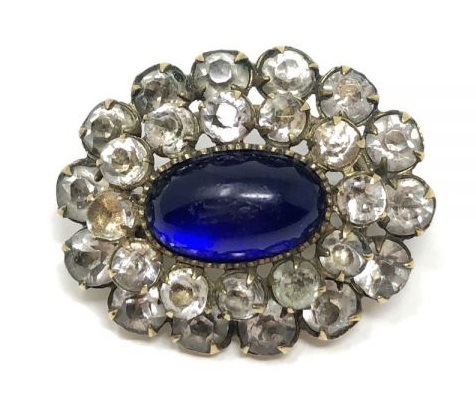
I know at first glance it looks like something has blown it up, but look beyond that, and it’s a wonderful, if completely knackered, piece Victorian costume jewellery brooch. It’s missing just about everything, including the central glass stone, but would have been very pretty – probably looking something like this:

Picture stolen from this website… the brooch is still there. Honest, guv.

I didn’t know what it was when I picked it up, but it was that greyish green that indicated a copper alloy (brass or bronze, for example), and is something I always pick up. It was only when cleaning it that I noticed the paste stones.

You can see the cut paste stone in it’s setting, and all the other setting missing theirs. There are three stones still on the brooch, and very little else.

Amazing, really. And this was just a small amount of time poking around, getting really close and personal with the soil in my garden. And my garden is not unique by any stretch, not even close. I guarantee, every garden in Glossop – no, the country – will produce some treasure – whether it’s early Victorian annular ware from a house near the station, a broken bottle rim from a former pub, a pipe stem from a current pub, or a piece of Victorian child’s plate from a modern garden in Simmondley (all examples from experience). Obviously, I realise that not everyone is lucky enough to have a garden, but we all can access some green space. As an experiment, this evening, pour yourself a drop of the stuff that cheers, and go and sit on what ever patch of earth is closest to you. This may be your garden, or it might be a park, or someone else’s garden, a playing field, or public footpath, or whatever. Now sit down and take a deep breath, listen to the sounds – birds or traffic – tune in, and simply look around you. If you can, dig about a bit, and don’t be frightened of getting your hands dirty, either. With enough time, something will turn up. And please, mail me the results.

Right, that’s about it I think. Next time more pottery – essentially a part 2 to this post, looking at the pottery I told you to ignore above. A competition! If you can get back to me and tell me what they are, and why they are not our type of thing, before I can post the next article, you can win those bits of pottery. Woohoo! (Now look here, Mr Shouty… some people like pottery, you know. And no, I’m not “having a laugh“).

More very soon, but until then, look after yourselves and each other.

And I remain, your humble servant,

RH

Archaeology · Pottery · Pottery Guide

The Rough Guide to Pottery Pt.3 – Industrial Slipware

What ho! What ho! And, if I may be so bold… What ho!

Well, as promised, here is the second post in the month of May. At this rate, I might make three posts… but let’s not tempt fate.

And also as promised, it’s a pottery one! Now, I know, I know… pottery is not to everyone’s taste (I say! Look here… calling me a “pottery obsessed hobbledehoy” says more about you than it does me), but it is important. And besides, it’s my blog!

Part 3 of the guide looks at ‘Industrial Slipwares’ – a broad group of commonly encountered Late Georgian and Victorian pottery (roughly 1780 to perhaps the 1850’s, and later). The term Industrial here refers both to the method used to make them – in factories, and often employing machines – but also in order to distinguish them from the earlier handmade 17th and early 18th century ‘Staffordshire’ type slipwares (which I’ll cover in a later post… you lucky folk, you). Originally called ‘Dipped’ wares, the process employed in making them involves dipping the formed clay vessel into a coloured slip – essentially a thin solution of clay suspended in water – and firing it. It is then glazed and fired for a second time to produce a hard-wearing pot. In terms of fabric, it is a fine earthernware with thin walls, in a clean white fabric – originally a Creamware or Pearlware, but later (1830’s onwards) a standard Whiteware.

Fabric. Ahhhhh… fabric. Creamware, Pearlware, and a plain Whiteware.

Originally very fashionable amongst the elite, by the early 19th Century Slipware begins to lose its social status, until eventually it becomes a utilitarian ware of the commoner, very much associated with pubs and taverns.

I have to say, some of this stuff looks decidedly modern – particularly the stripey stuff – and their bright colours and bold slick designs must have been a welcome antidote to the often drab creams and endless blue and white transfer printed stuff that dominated the period. The emphasis is on natural, earthy, almost pastel-coloured slips – brown, blue, green, orange, yellow, grey, and violet are favoured. I have to say, though, that some of this stuff is a tad on the garish side, and wouldn’t look out of place in a Wild West Bordello. Not that I would know what that would look like. Or indeed have any knowledge of such places. At all. In fact, I don’t know why I said that. Anyway… moving swiftly on.

Ahem… the pottery, then. Broadly speaking, there are 5 types that can be readily identified, although there is some crossover between them, as you’ll see.

  1. Multi-Coloured (aka Variegated) (1780 – 1820)

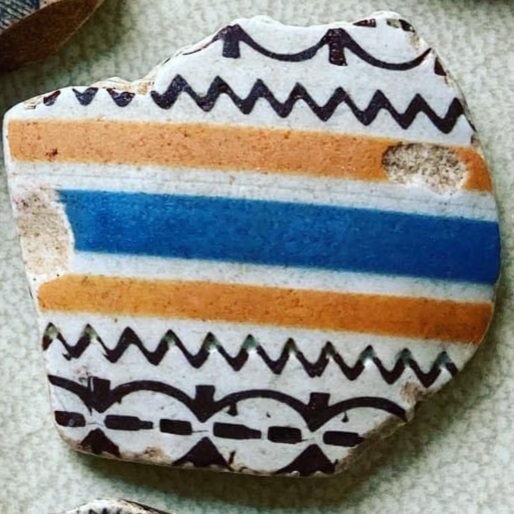
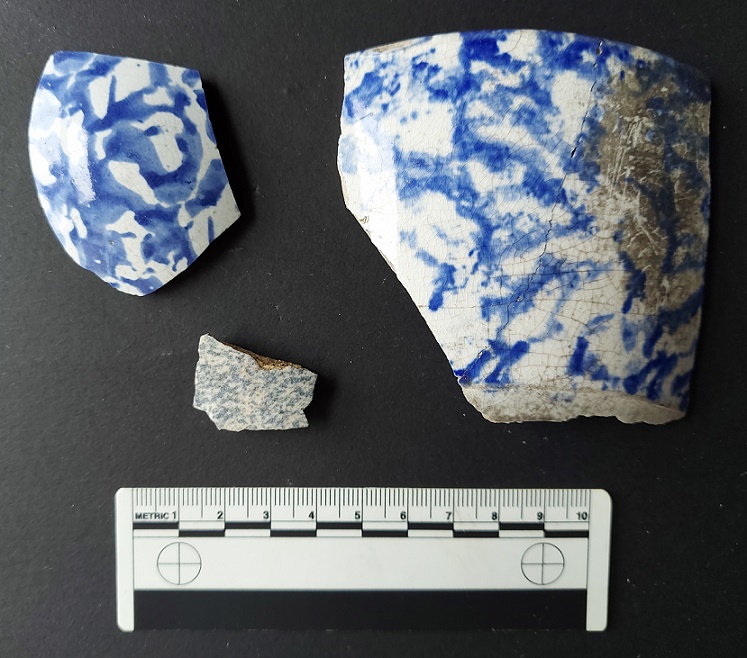
Patterns of slip are made from multiple colours and smudged (the correct term is Joggled), giving a psychedelic effect that you either love or hate. Common patterns are the Cat’s Eye, Earthworm, Fan, and a nightmare-fuelled, migraine inducing, all-over slip. The crucial identifier is the joggled coloured slip.

An ‘earthworm’ design on a Variegated bowl. You can see how the slip decoration was applied in three colours, and then ‘joggled’ to make the wormlike decoration. These sherds are courtesy of The Blackden Trust, where I work. An amazing place where history and creativity collide… well worth checking out.
The nightmarish ‘all over’ decoration.

2. Mocha (aka Dendritic) (1780 – 1890)

Here, the slip is applied, and a substance – boiled tobacco juice, or urine, for example – was applied whilst still wet. This diffused producing the characteristic treelike (dendritic) decoration in a dark blue or black colour. Commonly associated with banded decoration (Annular, below) and in a brown or cream slip. Popular, but largely of early to mid-19th century, and less common later in the century. 

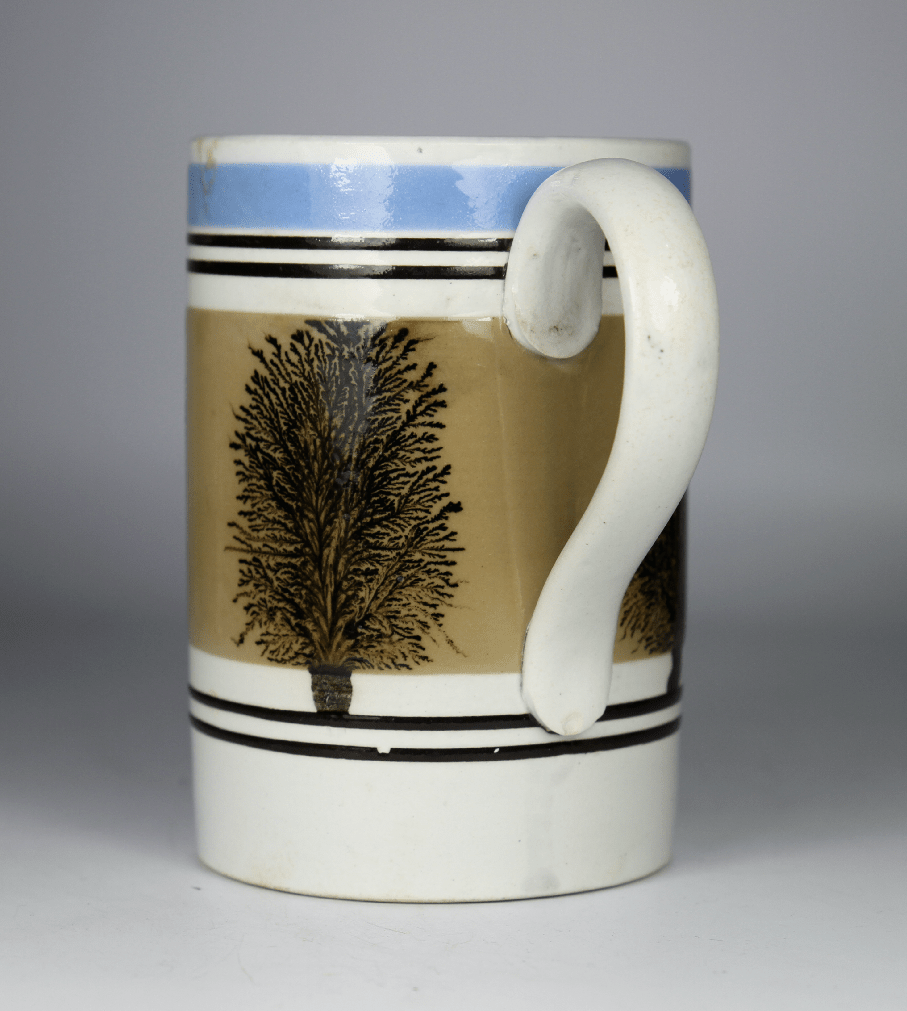
Two sherds of Mocha or Dendritic pottery. It’s difficult to get an understanding of what the whole looks like, so here is a shamelessly stolen photo from ebay…
You can buy this tankard for a mere snip of £125 here. You can get an idea of how it looks, though.

3. Engine Turned (1790 – 1880)

This looks particularly 20th century. Here the slip is applied one over another, and the vessel is turned on a lathe, with the upper slip removed by machine, revealing the contrasting colour below. Vertical stripes, horizontal bands, and patterned geometric designs are all common. Painted designs were also applied using a machine, creating complex linear bands. Mainly early 19th century in date, and particularly associated with Pearlware, so is much less common later. 

Sherds of Engine Turned, showing the patterns created by machine – putting the ‘Industrial’ into industrial Slipware.
An excellent example of the complex painted and turned designs found on Engine Turned pottery. Sherd is not mine, alas. It belongs to a friend, Helen D.
Good close-up of a sherd showing where the slip removed to create the pattern.
Another close-up showing the grooves… groovy! Sorry, that was terrible – although I think I got away with it as no one seems to read these captions.

4. Banded (aka Annular) (1780 – 1890’s)

Simple horizontal bands of slip are painted on using a lathe in the manner of Engine Turned above, producing precise clean lines. Commonly contrasting blue and white, but also in browns, yellows, and creams. The banded decoration is also a large part of the decoration of the above three types, particularly Mocha, so there is considerable overlap. Also, the simple basic theme of bands continues into the 21st century, particularly in Cornishware pottery. 

A selection of Annular pottery. The stripes were applied using a lathe, rather than by hand, hence their precision and uniform nature. This photo also gives us a sample of the kinds of colours that Industrial Slipware used.
The distinctly modern looking blue striped pottery, a predecessor to the Cornishware type you can still buy.

Date wise, it’s difficult to distinguish. My feeling, based on some evidence, is that prior to about 1840 Banded Ware used the browns, yellows, blues, and greys seen above. After that date however, banded decoration was confined largely to blue banding. Now, this is not absolute; the date is flexible; date of deposition is different to date of manufacture; ‘absence of evidence’ is not a strong argument; and it may even depend on such variables as availability, and even personal taste. But as a rule of thumb, I think it stands.

5. All Over (1780 – 1890’s)

The vessel is slipped, inside and out, in a single colour of the earthy colours common in Industrial Slip Ware, and then fired, producing a surface that is uniform in colour and treatment. Common in the 19th century, but less so as the century went on.  

Lovely stuff! The plain, All Over pottery.
The rim of a delicate tankard or mug. Beautiful colour, fantastic detail – this would have been lovely.

In terms of shapes, Industrial Slip Ware is exclusively a tableware, and very much liquid focused, so elegant mugs & tankards are common, as are jugs, and more rarely bowls.

Right then, armed with this new found knowledge, go forth and find! Honestly, this stuff shows up everywhere, in particular the banded Annular ware (very common in blue and white). Don’t forget to email/tweet/post any examples you find. I’d actually like to start posting finds that other people have found – a community of sherd nerds, if you will! So please, get in touch.

Honestly though, my life of late has been very busy, and increasingly I have started to realise that I am very bad at multi-tasking – meaning I can focus on only one big thing at a time – hence the lack of blog activity. I recently lead a Wan.Der (a curated historical walk, in association with the Glossop Creates mob). I thoroughly enjoyed it (despite the public speaking terror), and it seemed to be successful, which is nice – watch this space for news of others coming up, both more of the same, and new ones, too.

I’ve also started to upload some video onto the Glossop Cabinet YouTube account – there isn’t a huge amount on it at the moment, but more is coming soon. You can check it out here.

Right, that’s all for now. More later… I’m on a roll! But until then, look after yourselves and each other, and as always, I remain,

Your humble servant.

RH

Archaeology · Pottery · Pottery Guide

The Rough Guide to Pottery Pt.2 – Spongeware.

What ho, dear and gentle readers! Well, here we are again… pottery time! The second part of the Pottery Guide has hoved into view, and what a treat we have for you. I am going to go ahead and apologise in advance – it is heavy on pottery, but useful and fun, I hope. (Can anyone else hear that groaning and wailing… and gnashing of teeth. And no, no I don’t care about your “sainted aunt”, whoever is shouting).

SPONGEWARE
DATE: 1830’s – 1900’s
DESCRIPTION: Colourful repeated patterns printed with a sponge on a white background.
SHAPES: Bowls are very common, cups, mugs, tankards, small plates, larger plates, and jugs.

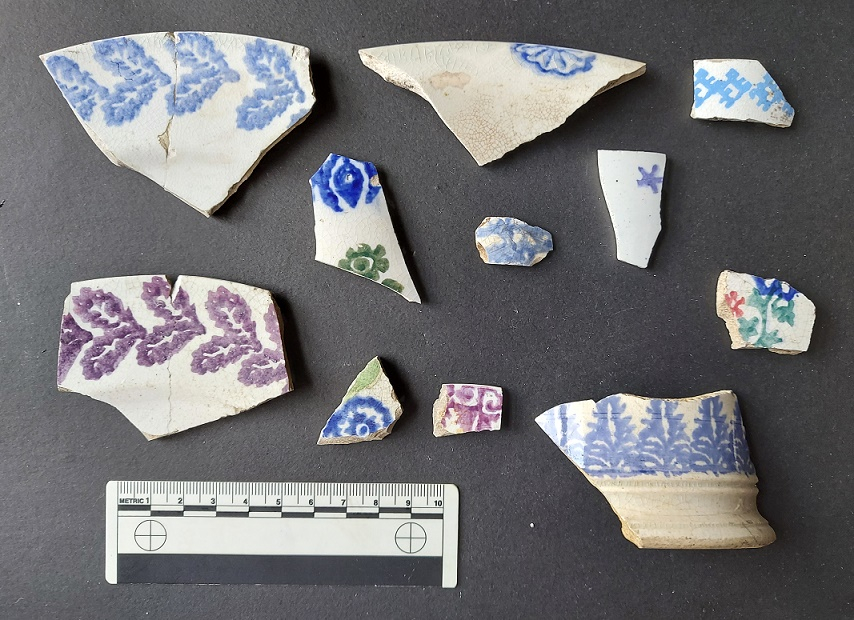
Wonderful, cheerful, simplistic, and yet incredibly attractive (not me, madam, but thank you). I have an almost childlike obsession with this pottery type, and it always makes me happy when I find some. Spongeware is characterised by shapes made with a natural sea sponge dipped into a coloured slip and dabbed onto a white background. The pot is then glazed and fired. The sponge is either applied all over, or it is cut into geometric shapes (diamonds, concentric circles, spirals, stars, zig-zags, swirls, etc.) or naturalistic forms (flowers, leaves, shamrocks, etc.), and dabbed in repeated patterns around the vessel.

20220211_141443
1. Spongeware. Lovely stuff, in pastel colours and very pleasing designs.

These patterns and shapes are fuzzy at the edges (the result of the sponge effect), are sometimes combined with hand-painted decoration (bands, blobs, leaves, etc.), with colours of a limited and pastel palette – light purple, blue, light green, yellow, pink, light red, etc.

2. In addition to the sponged designs, we can see here painted flourishes and designs.
3. The designs can be printed all over, rather than in discrete patterns. The grey painted sherd, bottom left, is an example of what is sometimes known in America as ‘Spatterware’.

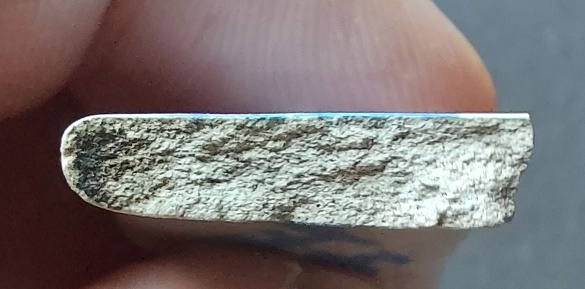
The pottery itself is normally of a fairly poor quality Pearlware (pre-1850) or Whiteware, with a earthernware fabric that is white or off-white.

4. Fabric – white or off-white bog standard earthernware. You can see the painted decoration in section here, overlaid by the glaze.

Sherds can sometimes be found broken with jagged rather than smooth edges, indicative of a low temperature firing and poor quality clay. Lovely though it is, it is Spongeware is not high quality, but it is the very essence of cheap and cheerful. 

5. The poor quality of the glaze is very clear here.
6. One of my favourite sherds, up close. You can see the way the decoration has been applied. You can also the jagged edges that indicate poor quality pottery, and the crazed glaze, possibly the result of heat, or more likely, a poor glaze.

Spongeware is often associated with Scotland where it was made in great quantities, but there were also manufacturing centres in Stoke on Trent and other parts of the Midlands. These vessels were mass produced – probably ‘sponged’ as piece work at home (and thus probably by women) – and supplied to a ready market that wanted a more colourful, and cheaper, pottery than the transfer printed material that dominated the market.    

American studies indicate there are broad chronological variations within the ware group. America and Canada were huge export markets for Spongeware, and given the relative newness of their country in terms of European material, a lot of research has been conducted on even the smallest and most common bits of pottery that would be overlooked here. The three variations within Spongeware are:
All-Over:
Densley packed, the natural random patterning of the sponge is used to cover the whole vessel, or dabbed in distinct areas – the upper part of bowls for example. Spatterware is the American name for this type of pottery, as it looks as though the paint has been spattered on randomly, occasionally in several colours one over another. Looking closely, it is possible to see the tell-tale repeated patterns of holes in the unshaped natural sponges (Photo 3 above). This type appears to have been most popular up to the 1860’s.   
Cut Sponge
Here the sponge was shaped into neat geometric and naturalistic forms, and the patterns repeated. Starts in the 1840’s, and is popular until the 1880’s. The addition of painted decoration to this form seems to appear in the latter part of the 19th century and last into the early 20th century (Photos 1 & 2 above).
Open Sponge
Similar to Cut Sponge, but the shapes are more natural and less regular, rigid and geometric. This type seems to have been most popular from c.1850 to c.1900 (the blue sherds in Photo 3 above).

This stated, there is a lot of overlap between styles, and I’m not convinced the chronology is as straightforward as that. Also, does the American market reflect what was happening here? As I say, it is a broad guide, use it as you will.

Spongeware, in it’s modern incarnation, is still a popular design for plates, and Hamnett Towers has a dinner service decorated with designs made using this very attractive style. I should invite you all for cocktails and a slap up feed, and you can have a look (black tie, of course… I have standards).

Right ho, that’s it for this week. I have a few, less pottery focused articles in the pipeline (what do you mean “praise be”? Honestly, some people.) which I’ll get on asap. My life is fairly jam packed with Glossop related archaeology and history at the moment, which is great, if a little scary! I am working with the good folk of Glossop Creates developing a walk that involves history and bits of pot… watch this space. I was also recently in the Glossop Chronicle (read it here – the edition is dated 3/2/2022, and it’s page 11), and the Glossop Creates blog, too. The organisation, based in the historic gasworks on Arundel Street, has some wonderful and big ideas for the town, and deserves to be lauded from the rooftops for their vision. So there!

More about this, and other exciting things, next time, but until then, look after yourselves and each other, and I remain.

Your humble servant,

RH

Archaeology · Pottery

What Larks, Pip!

What ho, Glossop!

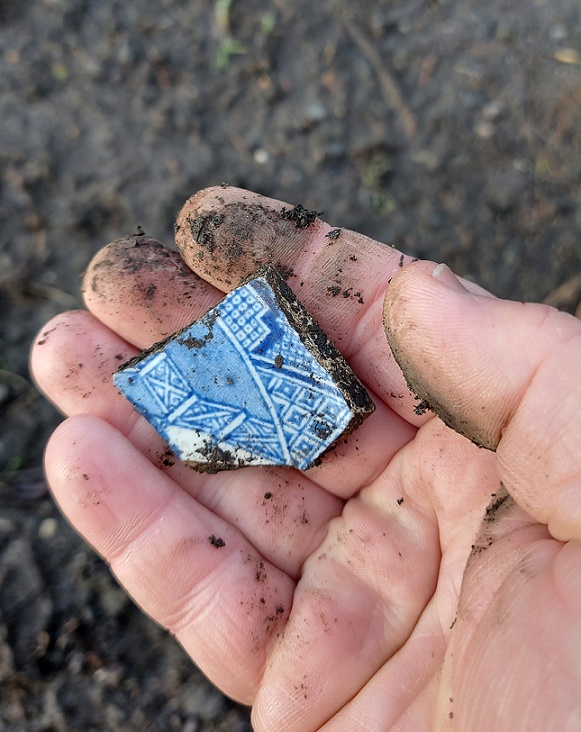
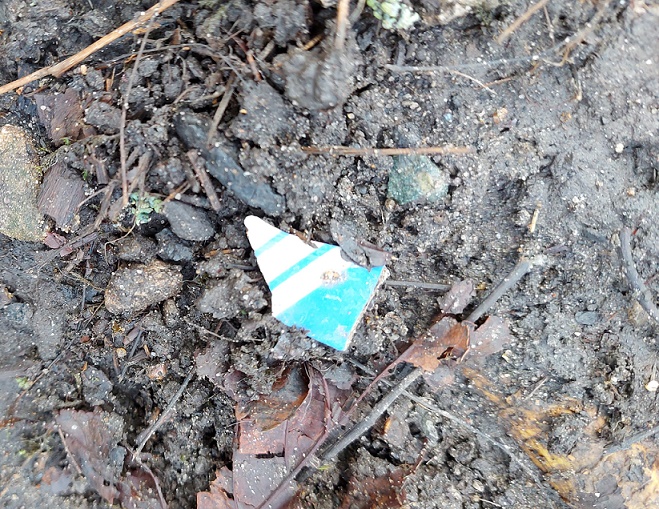
I was going to do another installment of the Pottery Guide, but one doesn’t want to over-egg the doodah, if you know what I mean… too much of a good thing can be a bad thing. So today’s quick post will be a visual record of a short mudlark I did at Harehills Park on the way to the shops the other day. A crisp and clear, but very cold, day, with a lovely winter sun for company, I noticed a piece of pottery gleaming white against the mud.

The sherd in its natural habitat. Shhhhh, don’t frighten it!

Hell-lo!” I thought, and dove in lightning fast in case someone else beat me to it. You know how people are for pottery round here, you have to be quick, I can tell you. I once nearly lost an eye in a tussle with an old lady over a piece of feather-edged ware… knitting needles are ferocious weapons when wielded by the highly trained and woolly hatted. But I won the day, the sherd was mine… and I still wear one of the bounder’s ears on a chain around my neck as a memento. But I digress…

So, ninja-like, I pounced on the pottery. Victory!

Lovely blue and white stripes.

Ooh nice, a sherd of Annular Ware. Probably late Victorian in date, or even early 20th century, this stuff looks almost modern thanks to TG Green’s Cornishware which continues the tradition of banded decoration in blue and white.

I looked ahead, and lo!

Classic mid – late Victorian annular ware, the brown stripes in particular give it away.

Some more Annular Ware, this time brown, blue and white, and very definitely mid-late Victorian. A rim sherd, so I can get a shape and size – almost vertical, and with a rim diameter of c.10cm, it was a mug or tankard like this one:

Rather lovely. The photograph is stolen from this antiques dealer’s website – here – and you can buy it for the snip of £380. A pity the Victorians never threw these things away whole.

Could there be more along the path edge?

On either side of the path, I could see sherds.

On I walked. The earth had opened, and I’d be a fool not to continue – “something… something… gift horses… something” as the saying goes. But indeed, something was happening, something I had not planned for, but which the fates had thrust upon me… and impromptu mudlark. I’d only popped out for a loaf of bread, a bottle of wine and an aubergine (which is an intimate, and possibly over-sharing snapshot of my life), and here I was… larking. What would the neighbours think? What would Mrs Hamnett think? Oh the shame! And yet on I went, pulled by the invisible force that binds the sherd to the nerd.

Another.

The white straight edges against the grey-brown earth is quite striking.
The moment of excitement… what’s on the other side? I’ve been doing this all my life – I would drive my parents to distraction finding bits like this – but it still gives a little thrill.
Willow pattern, part of the fence that forms the background to the main ‘story’. I like the colours in this photograph – the blue, pink and grey are visually pleasing.
The willow pattern plate – Blue and White Transfer Printed Pottery, technically. I’ve circled where the sherd came from in the spurious story that is portrayed on the plate – you can read all about it in a fascinating article here.

And another.

The unmistakeable colour of Derbyshire Stoneware (follow the link for more)
I wonder if I always have dirty hands when I go shopping?

Some glass, peeking, shimmering, calling.

A bottle. Broken, but still interesting.
Just the top, but enough.

The bottle top/neck (or ‘finish’) is one which is called an ‘applied finish’ – it’s a solution to a problem of how do you make a clean neat break on a bottle that is hand blown into a mould? The answer is to make the lip and neck separately, and then ‘weld’ them together whilst the glass is still soft and malleable. If you look closely, you can see the join.

The arrow indicates the slightly bulbous join and groove where the bottle top (left) was joined to the bottle body (right). Often the joins are very obvious, with drips and messy welds, this is quite a good quality join.

This dates the bottle to the Victorian or very early 20th century, as does its light bluey-green colour, and rectangular shape. It is small, so is probably a lemonade syrup bottle or something similar.

I walked on.

Beautiful, wonderful, pieces of archaeology, tiny fragments of history, of people, were throwing themselves at me. And who was I to argue?

Lurking amongst the mud and mulch, a lucky dip.
You can make out the pattern, but what is it?
A soup dish and a saucer. For once, it’s not my photography! The transfer print itself is blurred and poor quality. Yes, I know, I know, a bad archaeologist blames his sherds.

Eventually I reached the end of the path, and on I went to the shop, vowing to come back that way, and walk in the other direction to see what else I could find. But, such is the way of the world, I needed to be elsewhere in Glossop and other chores distracted me, and with such mundanities crowding out the treasure, I didn’t come home that way. Who knows what I missed? Who knows what tiny fragments from the past await discovery, waiting for a person such as yourself, gentle reader, to pluck it from the ground and marvel over it, celebrating its form and colour, and invoking the past and the people who once used it. But beware… if you see an angry old lady with one ear, run.

The above shown sherds cleaned up.

The willow pattern in particular was interesting in that once cleaned I could make out knife marks that had scratched into the glaze.

A hard sharp knife has made these marks in the poor quality glaze. They were likely made in a single sitting, as they are all going in broadly the same direction. Perhaps cutting a particularly tough piece of meat from a bone?

Who knows what conversations were had when those marks were made, or what the person was eating. Questions like that keep me doing archaeological things like this.

Sherds not featured above, but found at the same time.

Nothing hugely interesting here, but all a bit of history. Top row, left, is a piece of porcelain that has a transfer picture on it – possibly of a woman (they’re quite predictable pictures – the golden brown bit could be hair or a gown). Next to that is a fragment of a stoneware ink pot. I wish I could show you how I know that, but from a photograph and using words it is difficult to describe – pottery is so tactile, so alive, you need your senses to ‘get’ it. Let’s just say size, shape, glaze, and feel, is what makes it so. Tell you what, I’ll film myself talking about it and put it on the YouTube channel, you’ll be able to see what I mean then. And I’m ignoring whoever it is that’s muttering “cure for insomnia” and “medical coma inducing nightmare“… bloody cheek. Bottom row, left, is a piece of moulded lead, with possible spokes coming from the outer rim. I have no idea what it is, but any suggestions would be welcome. All the other bits are fairly standard Victorian or early 20th century pottery.

Harehills Park (aka the ‘Sandhole’, or ‘People’s Park’) was for a long time prior to the 1920’s a tip for the local houses, so it’s not surprising this stuff comes to the surface after a good rainfall. It’s always produced something for me, and I’ve blogged about it before (here), but have a good look next time you are passing through. And post whatever you find to me – I’ll put it up on the website.

Right, that’s your lot for this post! More soon, I promise. But until then look after yourselves and each other. And I remain, your humble servant.

RH

Archaeology · Pottery · Whitfield

… And Came Back

What ho! dear readers. I’ve just opened a bottle of fine Belgian pilsner, and am feeling quite effervescent, if that’s the word I’m fumbling for. I think it probably is.

Talking of fumbling, I went back to the place I found the lead came and had a fumble. Madam, please! This is a family blog. Honestly, some people! So there I was, fumbling, looking to see if anything else popped up, when I found what looks like window glass and some early pottery. Hmmmmmmm, let’s take a closer look.

Small and fairly unimpressive – I nearly ignored it. Shame on me!

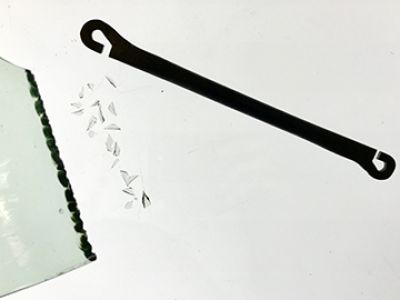
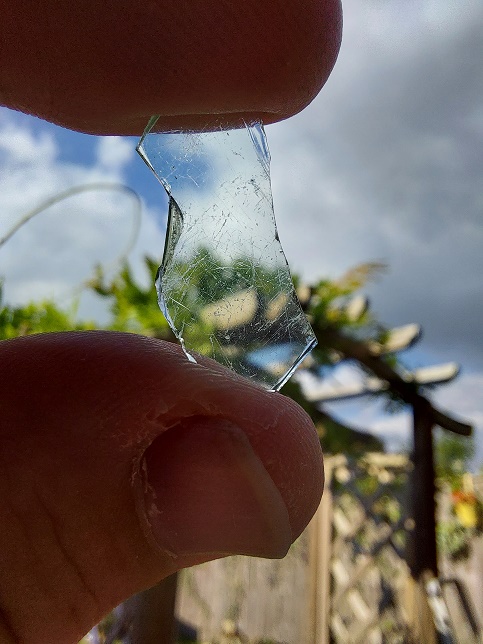
The glass is only a small fragment – just 2cm x 1cm – and very thin, being a shade over 1mm thick. It is also flat, which just about rules out its origin being a bottle. I terms of colour, it has that blue-green tinge that you associate with early glass, before they managed to perfect the process to remove all the impurities. Looking more closely at it, I noticed that two of the edges were flat, and pulling out my new toy – a usb computer microscope that also takes photographs – I was able to see – and show you – tiny teeth like nibbles that tell me that the glass had been cut and shaped.

I’ve had a lot of fun with the microscope!

Now, I know a lot of useless information – for example that glass is shaped by nibbling – but I’ll admit that even I had to look up how exactly this was done. With a ‘Grozing Iron’ it turns out (see, don’t say you don’t learn something by reading this blog, although I can’t see it coming up in a pub quiz anytime soon). The verb is ‘to groze’, and the above glass fragment has been ‘grozed’. It looks like this:

A grozing Iron, image courtesy of the York Glaziers Trust who have a fantastic illustrated glossary, if you are in any way interested in glass.

So, it was shaped… but to what shape? The two edges, if they were extrapolated, didn’t make a right angle, but instead, a diagonal. A diamond, even. Could it be I have a fragment of the glass that went into the lead came I found? Impossible to say for certain, but it is possible, even probable. In terms of date, it’s very difficult to say. Broadly speaking, the thinner the glass, the earlier it is, and combined with the colour could certainly put it in late 17th or early 18th, which matches the tentative date for the came. So that’s exciting, if you get excited about this sort of thing… and I do! Here it is situ:

I added the came for effect – perhaps reuniting them.

The date of 18th century also matches the date of two sherds of pottery I found with the glass.

Again, quite small and uninspiring.

They are both mottled manganese ware, and classically early 18th century in date – certainly not later than about 1760. Interestingly, they are not particularly worn, so it’s unlikely that they have been kicking around for 250 years or so – perhaps there is a dump nearby? They are also both open vessels – bowls, probably – and may belong to the same vessel, despite one being glazed on the inside only (quite often, the glaze on the exterior was confined to the top part only). Also, one sherd shows the characteristic manufacturing marks, that also doubled as decoration:

The horizontal lines visible in the clay, formed on the potter’s wheel. Also, if anyone want to donate to the ‘Robert Hamnett Needs a Manicure‘ fund, please feel free…

The next photo shows the make up of the sherd – the reddish slipped exterior (top), the rough orange-brown earthernware fabric with tiny bits of stone in it (middle), and the thin dark line of the glazed interior (below). I love this stuff.

Lovely stuff!

I’m going to put together a quick and easy guide to pottery, describing all the different ‘parts’ of a sherd, and some tips on identifying what shape and size, as I think it’s nice to now what it is you are holding. I’m also still putting together my quick and dirty guide to Post-Medieval pottery, as there is a serious gap in the market… probably for obvious reasons!

I’m going to end with a great photograph of the glass, and to pose the following questions: Who was the last person to look through that window before us? And what did they see?

Makes you think.

Until next time, take care of yourselves and each other. And I remain.

Your humble servant,

RH

Archaeology · Longdendale · Pottery

Valehouse Pot

What ho, kind and gentle folk of the blog reading world!

Sooooo, today is back to some sense of normality in that I am looking at pottery.
Woo-hoo!” I hear you cry.
Well alright, some of you cried “woo-hoo!“.
Well alright, not that many of you if I’m honest. Certainly not enough of you.
Well tough… it’s my blog, and I like pottery, so we’re doing pottery. Now pay attention, I may ask questions.

Actually, this stuff is interesting in two ways. Firstly, as bits of archaeology. And secondly, I didn’t find them! No, that dubious honour rests with my friend and fellow delver and obsessive, Charles Winford Lodge (actually not his real name, but then you are reading a blog written by a man who has been dead for well over 100 years, so it’s probably best not to start asking too many questions at this point). He goes by @2hrTV on Twitter, and usually has something interesting to say on the subject of the history of Glossop and area. Usually… I mean, I can’t promise.

Anyway, the conversation – pretty normal for us – went along the lines of:
Him – “Years ago I found some pottery at Valehouse Reservoir. I’ve just re-found it in the house… want to see it?
Me – “Absolutely, my good man… lead on.”

Out it comes (in a plastic doughnut box from Tesco – price £1.10 – bear in mind this is the man who once gave me some pottery in a camembert box, so doughnuts are a step up). Most of them are fairly standard Victorian sherds, but one or two made me sit up. Now, the sherds had not been washed (tut! tut!), and so I volunteered to take them, clean them, and blog about them. Which is how I ended up washing up someone else’s broken old rubbish. Please, no one tell Mrs Hamnett… it might not end well. For any of us.
However, I think the risk was worth it.

Valehouse is an interesting place; now just the name of a reservoir in the Longdendale Valley, below the Woodhead Road, it was once a village that in its prime, and prior to its flooding, had roughly 600 residents in 100 cottages with a number of shops, a school, and other amenities. Samuel Oldknow built the first mill here in 1775 – the first to harness the power of the Etherow – and it is after this point, and largely in the early 19th century, when the mills were substantially expanded, that the majority of houses were built to house the mill workers. The valley was flooded in 1869 to provide Manchester with water, and the mills and houses were all submerged. I also have a personal connection with the village in that my great great great grandfather, Benjamin Livesey, was born there in 1824.

Valehouse prior to the 1869 flooding. Note the large mill buildings, and the many houses.
Valehouse as it was in 1899, and indeed still. Note the large quantity of water and lack of houses.

So then, the pottery. It was recovered during a drought a few years ago, and from the area around the viewing platform on the north side of the reservoir. Having studied the sherds, it’s clear they can be split into two broad chronological groups – early 18th century and late 19th century – which probably represent two different origins. I’ll discuss the latest first, before looking at the oldest, and arguably more interesting.

Not, at first glance, particularly inspiring.

1 – A Victorian earthenware jar or jug, vertical ridged decoration, with a body diameter of 9cm, and glazed in a lovely cobalt blue colour. Nothing special, but quite fancy.

2 – Simple sherd of blue and white earthenware, with the bog standard transfer print.

3 – Thick base to a Late Victorian Codd Bottle. It has ‘TON-U-LYNE’ embossed on one side, and a little research gives us ‘R.A. Barrett & Co.’ of Ashton-Under-Lyne. They manufactured soft drinks and mineral water, and were particularly noted for their ginger beer. Their factory still stands in Dean Street, Ashton.

A complete Barrett & Co. Codd bottle, and the factory as it stands today. The bottle fragment above would have been made in this factory.

4 – Fragment of bottle, probably Victorian mineral water or beer.

5 – Another fragment of green glass – probably Victorian, as it is quite thin walled, but it does contain large numbers of bubbles, suggesting perhaps an earlier date.

6 – A large, thick walled, earthenware sherd, perhaps part of a lid to a very large “Brown Betty” teapot – it is certainly the right colour for this, and curves the right way. The surface colour is a mottled brown, and is a type that deliberately recalls the earlier, 18th century, manganese ware. Interestingly, you can see how this effect is achieved by looking at the break. Two colours of clay – one dark reddish brown and one a creamy buff – are loosely mixed, and the clay is shaped into the mould. It is first fired, then a clear or slightly yellow glaze applied, followed by a second higher temperature firing. Where the cream buff forms the surface, it is a yellow or golden brown, and where the reddish clay forms the surface, it produces a dark rich brown, together forming the mottled effect. I quite like it, but much prefer the original 17th century stuff.

The appetising looking Victorian mottled ware sherd. You can see how the different coloured clay affects the surface colour

Right, let’s move onto the arguably more interesting stuff.

This material dates from roughly the early 18th century – let’s say 1700 – 1750… ish.

1 – Large and chunky strap handle probably of Nottingham Stoneware, and probably from a large jug or flagon. It measures 4.5cm wide, and is typical of its type. Stoneware is fired to a very high temperature, melting – or vitrifying – the clay, making it into a very hard and almost metallic pottery. It has a dark grey fabric, with a brown glazed surface which is very shiny – the result of adding iron to the glaze. Interestingly, this is not as fine or well made as the earliest material here, and shows some similarities with the later Derbyshire Stoneware, so it might be the somewhere in late 18th century.

2 – Base to a stoneware jug or jar, with a diameter of 10cm. This too has characteristics of both earlier Nottingham Stoneware and the later Derbyshire type – the glaze for example, is less lustrous than early sherds, but it has the classic grooved decoration running around the base. The underside shows wear suggestive of use and re-use over time. On balance, I’m going to say it is early, safe in the knowledge that no one is going to double check (as he scurries away and hides it).

3 – Lovely Nottingham Stoneware bowl, with a rim diameter of 13cm, and a slightly flaring out-turned rim. It’s thin walled, with a grey uniform fabric that was slipped in white before glazing. The surface glaze is a lovely melted chocolate colour, very lustrous and almost metallic looking, and is very characteristic, as is the horizontal grooved decoration on the exterior, and glaze drip marks on the interior. I liked this so much that a drew it using the archaeological method – essentially looking at the whole vessel in profile, and removing a quarter to allow both the interior and exterior to be shown.

The profile of the sherd is shown on the left, coloured in black – this shows the shape of the pot. The interior of the pot is shown next, with the wavy lines where the glaze dripped. Then the exterior of the vessel is shown next to that. I might do a post about this type of drawing, as I’d like to do more. It’s been a while since I did this last, though.

4 – This is a bit of an odd one. Stoneware, but potentially quite early. Certainly it fits with the 18th century stuff, but the surface is off – it looks like orange peel, dimpled all over with a salt glaze, and reminds me of the earlier 18th and even 17th century German stonewares that were imported in huge quantities. Whatever it is, it’s a huge rounded or pot bellied vessel with a diameter of roughly 26cm, despite being very thin walled. It is also a closed vessel, being glazed on the exterior only, so perhaps some form of small barrel or large bottle?

5 – Nottingham Stoneware – flask or bottle type. The body, shoulder, and beginning of the neck only, it has a body diameter of 18cm, so quite large despite being very thin walled. It has a double band of horizontal incised decoration which is showing the under slip where the glaze is thinnest. Like No.3, the glaze is lustrous and a melted chocolate in colour.

6. Finally, we have the star of the show – a rim fragment of a Staffordshire Slipware platter or large plate. This stuff is very diagnostic, and gives a clear date of between 1650 and 1750, with this sherd from 1700ish.

Interesting stuff!

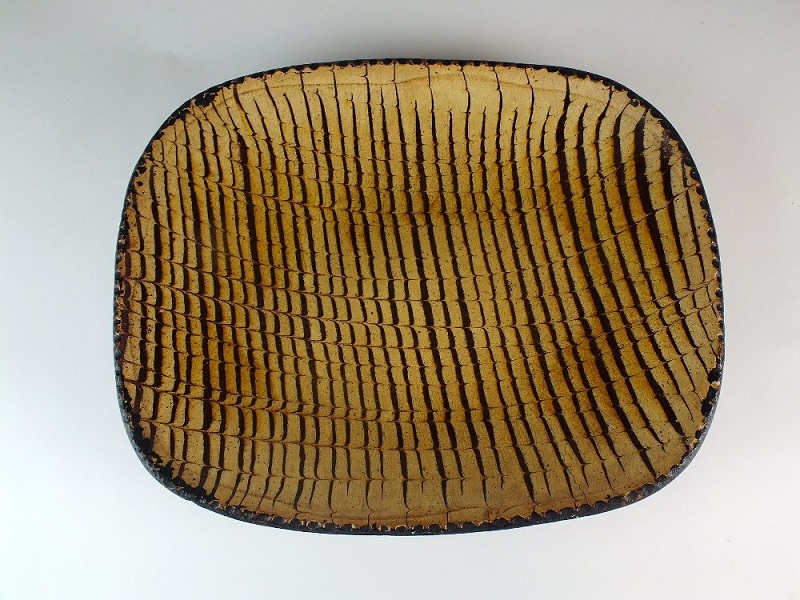
Slipware like this is quite good quality, and a step up from the wood or plain wares that the average man or woman would eat from – or rather take from, as this would be a communal dish that everyone would eat from. Often broadly rectangular (as this is, I think), they are shallow, and would be completely covered in this linear banded decoration of yellow and dark brown. It’s quite striking, and would be a blast of colour in a world that was otherwise quite drab, particularly in winter. I still can’t work out whether I love or hate this stuff! Here is a complete example:

A complete example of migraine inducing 18th century pottery.

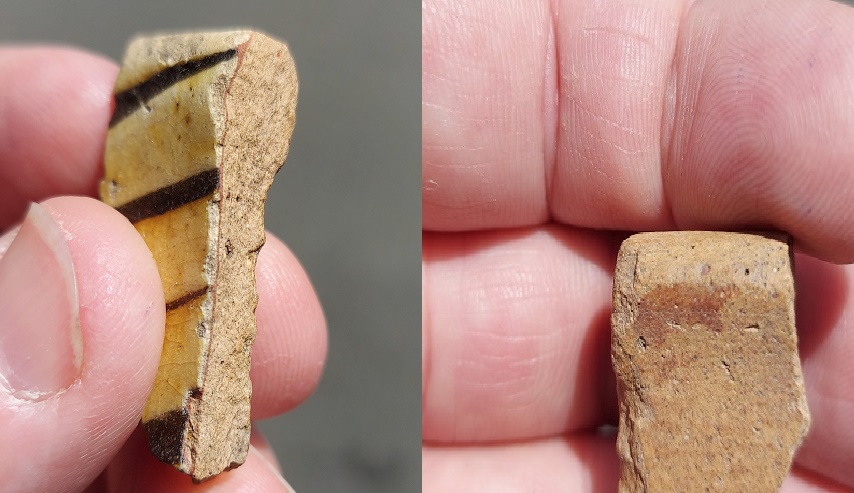
The process of decorating the pot went as follows: the pot is first moulded, then fired at a low temperature. The interior, and only the interior, is covered in a red slip, then overlaid with a white slip, and a tool is then dragged through this white slip, revealing the red underneath. The whole interior is then covered in a clear glaze and fired, transforming the colours to dark brown on the red, and honey yellow on the white. The whole process can be seen if we look at the break on the sherd:

Right – some of the red slip splashed on the exterior of the sherd, it remains red because it hasn’t reacted with the glaze. Left – all there elements can be seen in the break: the red and white slips, the tool that scraped away the white slip, and the glaze that overlays the lot.

So what does all this mean, then?

Because the valley was flooded to create Valehouse Reservoir, it gives us a cut off point (a terminus ante quem in archaeological terms – essentially the latest time an event could have happened) – any buildings and such there must have been built before this point. However, that is not strictly true with portable objects, especially those found near the edge of the water – the reservoir was almost immediately a picnic and pleasure spot, and plates get broken, bottles get launched into the water, etc. So we can suggest tentatively that although some of the material will likely be from the village before it was drowned, most of the Victorian material, and in particular the Codd Bottle, was deposited after the reservoir was filled.

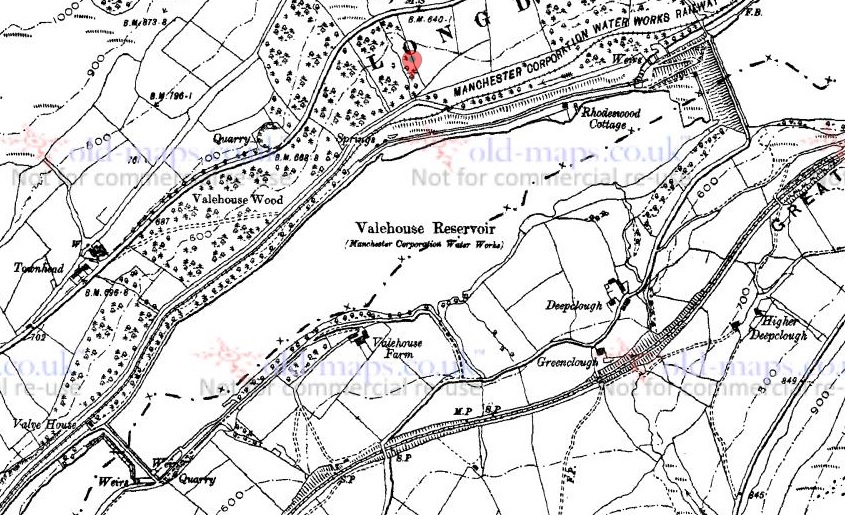
The same cannot be said for the earlier material, and therefore there was clearly some form of settlement here prior to the Victorian period, as no one in their right mind is going to carry around 150 year old pottery to throw in a reservoir. Alright, I might… but most people don’t. So this material has to be from an 18th century dump of some form… but from where. Studying a map of Vale House prior to flooding shows clearly the mill complex and all the houses.

I love playing around with Microsoft Paint!

Circled in red is the rough location of where the pottery was found. But here, in the green triangle, is an odd looking group of buildings. Set apart and in its own land, it looks like the standard farming hamlet for this area, made up of the farm building, outbuildings, and farm worker’s cottages. And in Bagshaw’s Directory for Cheshire dated 1850, we read of Joseph Roe, Farmer, Vale House Farm. Even the name ‘Vale House’ suggests a house of some importance. I wonder if, as so often happens, the local big house or manor house became less important over time and ended up as simply Vale House Farm. If so, then this might explain the 17th – 18th century pottery, and given that it’s made up of several different domestic vessels, suggests strongly that this is the midden, or rubbish dump, associated with the farmhouse. All we have to do now is wait for another drought and we can see what else is buried there.

Valehouse Reservoir today. Somewhere in the middle of that photograph, below the water, lies the remains of a 17th century farmhouse.

Hope you enjoyed this weeks romp around with pottery… let me know what you think, anything at all, even to tell me I’m wrong about the stoneware base (I’m not… it’s my site, and therefore I’m always right!). Also, if you have any pottery that you want me to look at… just don’t tell Mrs Hamnett.

Next month, we have a very interesting tale to tell… more of that later. For now, take care of yourselves and others, and until then, I remain.

Your humble servant,

RH

Archaeology · Pottery · Waterways of Glossop

A Bridge Over Troubled Water…

Blimey! January flew by, and so did February. Apologies for the lack of activity on the blog of late, I’ll be back to more regular posting from now on. What ho! Well here we are, once more in lockdown. I know its for the greater good, and you’d be a fool – and indeed a dangerous moron – not to follow the rules… but dash it all, it’s starting to be a bit of a bore! Right, once more with a glass of the stuff that cheers here we go.

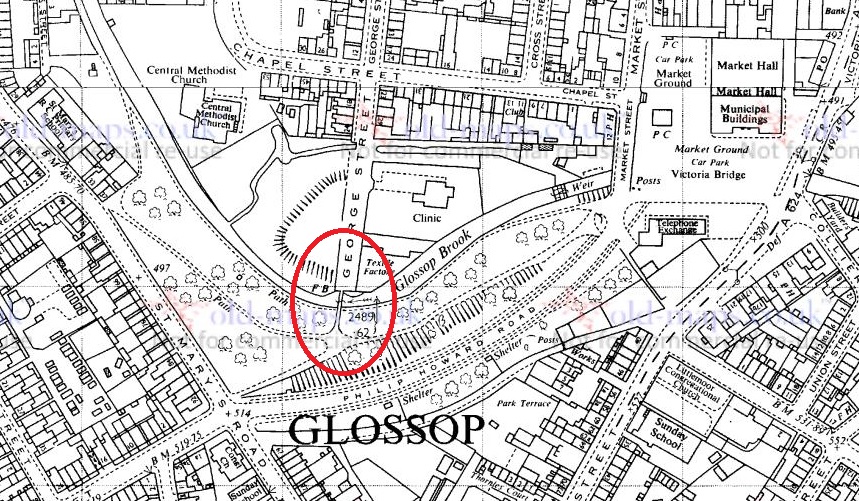
Whilst perusing the local history section of the library – during the heady days when such a thing was possible – I came upon an architectural drawing of the bridge over Glossop Brook at the end of George Street – officially known as ‘Coronation Bridge’. Now, those of you that know the bridge will also know that it isn’t the most lovely bridge in the world – it’s hidden away in the dark damp recesses of Harehills Park, covered in graffiti, and surrounded by the waste ground.

The location of the bridge is circled

But let’s look again, I say, as I think there is a hidden beauty here – a ‘rough diamond’ of sorts, only made of reinforced concrete. First, here is the architectural drawing:

It’s a very Art Deco style drawing, and quite fetching.

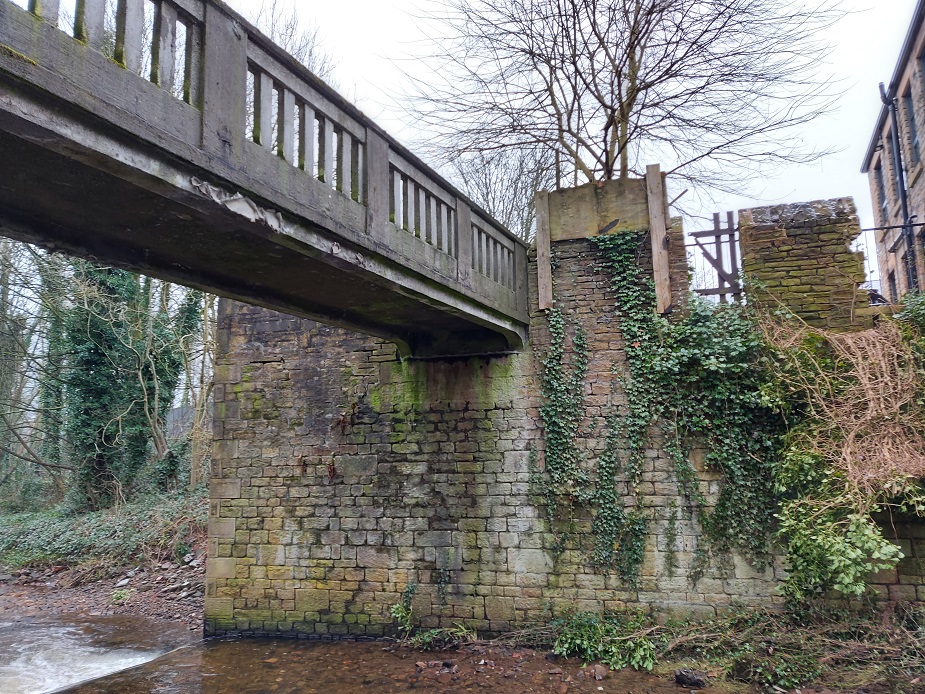
And here is the bridge as it is now:

Not the most attractive looking bridge, but I think it has a certain charm.

Comparing the plan with the actual bridge, they really did a good job. It is an understatement to say that I dislike concrete, but this has a certain Art Deco feel about it, and I honestly think it would look pretty good scrubbed up.

It is fairly forlorn, and could really do with a scrub up.
I like to imagine that the historical spirit of a place affects modern perceptions through things like graffiti: the foundry that once stood here would have been an extremely hot work environment – Hell Fire indeed.
Concrete, close up.
I particularly like the pink Mickey Mouse graffiti. What? It must be Mickey Mouse… look at the size of those ears.

The architectural drawing is dated 1928, so we might assume that it was built soon after that to replace the original Coronation Bridge, a railway footbridge that was presented to the town by Lord Howard in 1902 to celebrate the coronation of Edward VII. That bridge, notes the original Robert Hamnett, replaced other bridges that had been washed away numerous times by flooding. Now, far be it for me to question the original Mr Hamnett’s facts, but I can see no trace of these bridges on any of the earlier maps. For example, here is the area in 1880:

1880 1:500 scale. George Street is top centre, and you can see Shepley Mill and the George Street foundry.

Is it possible that he made a mistake?

Harehills Park is interesting in itself – I won’t go into too much detail, as the Glossop Heritage Trust has an excellent article on its history which you can read here. It has been known variously as Harehills Wood, Harehills, the People’s Park, the Sandhole, and Pinch Belly Park. These last two names are derived from the fact that during the ‘Cotton Famine‘ of the early 1860’s – a situation caused by the lack of imported cotton from America due to the ongoing Civil War there – men were employed there digging sand in order to provide work for them. In 1921 the park was given to the people of Glossop by Lord Howard in appreciation of the men of Glossop who served in the First World War, but also as a memorial to his son Philip Fitzalan Howard, a lieutenant in the Welsh Guards who died of wounds in France on 24th May 1918. The park was extensively remodelled and landscaped at this time, including the construction of the bridge, and was used as a recreation grounds and promenading area. Prior to this, the area was described as “hideously ugly; hen pens fenced with old fish boxes; old salmon tins, rhubarb roots, and a good quantity of other rubbish with plenty of muck and sludge thrown in”, and was known as a place for bare-knuckle prize fighting. It was also noted that “one part of it seemed to be nothing more than a vast tipping place”, and it is this part, one assumes, that keeps producing pottery. It has a been a particularly fruitful site to find pottery, to be honest – none of it too old, but its always there.

Prior to washing.

One assumes that the pottery has not travelled very far from the place of use, and so we might suggest that much of this rubbish came from the houses on St Mary’s Road, allowing us a peak into the lives of those living there. A more systematic approach and proper archaeological investigation could tell us a great deal – this is essentially what we, as archaeologists, do with pottery. Anyway, the sherds:

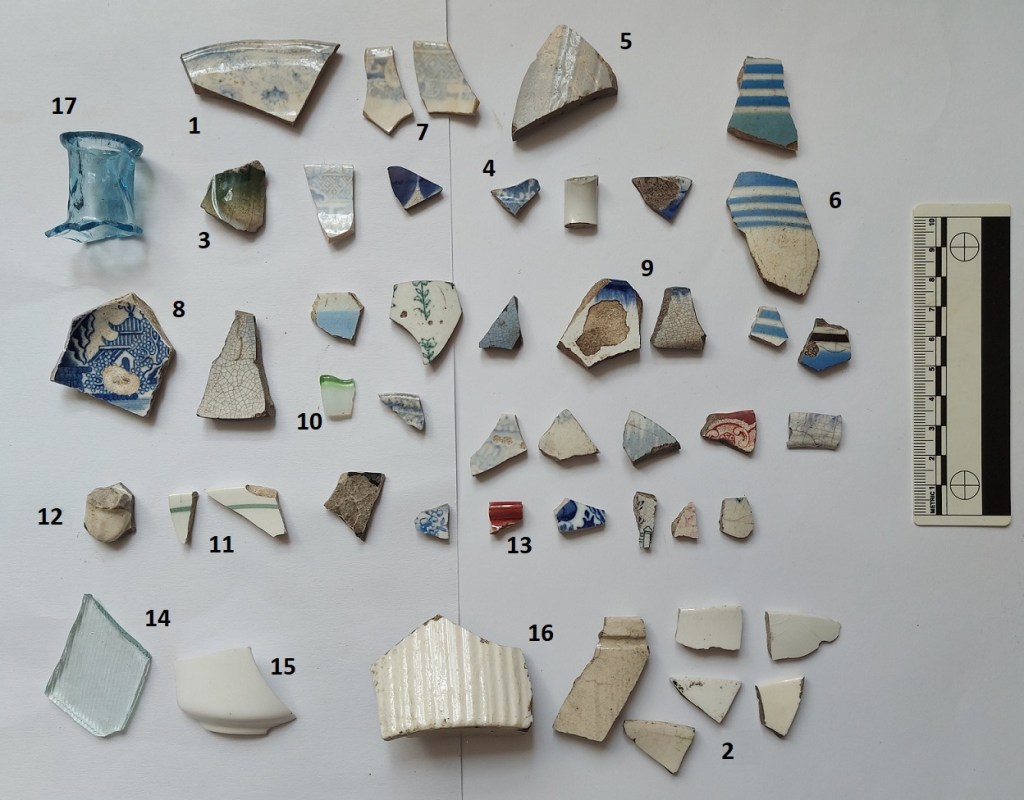
Fairly standard Late Victorian and Edwardian stuff, all from Harehills Park.

I’m not going to lie – a lot of it is pretty dull stuff, but there are some interesting bits and pieces, and this is a slice of domestic life in the Victorian and Edwardian periods.

  1. Plate or soup bow1 with an undulating rim of c.20cm, and a poor quality light blue transfer printed pattern – the transfer doesn’t match up at the join. Mid/Late Victorian
  2. 5 plain white rim sherds of 14, 8, 18, 16 and 16cm. Saucers, plates and cups. Victorian – 1920’s
  3. Fragment of a green glazed Majolica vessel, possibly vegetable-based. Utterly grotesque!
  4. Tiny fragment of a Sponge Ware decorated vessel. A rare occasion where I don’t know the shape – it has a carination in the body, so possibly an early mug or teacup. Victorian.
  5. Stone ware vessel, possibly a badly glazed marmalade pot – it has the grooves, but the surface is poor quality. C. 12cm diameter, so probably.
  6. 4 sherds of Annular Ware, Early to Late Victorian. This stuff starts much earlier than you expect (1780’s) and it looks almost modern.
  7. 2 sherds of a teacup rim, c.7cm rim diameter, and transfer printed on interior and exterior. Victorian.
  8. Base to a transfer printed willow pattern plate. Base diameter is 10cm, so the plate would be at least 10cm. The print shows a pagoda in the standard willow pattern style. Victorian.
  9. Rim sherds of 2 different Feather Edge bowls. Both date to between 1840 and 1890.
  10. A tiny fragment of green and white art glass bowl or cup, with an undulating rim. I quite like this.
  11. A saucer rim with a single green line below the edge. Refined, and quite nice. 12cm diameter.
  12. Handle to a whiteware cup. Quite fancy, and possibly Early Victorian. Or possibly not… this stuff is difficult to date properly.
  13. Red glazed rim to a jug or similar. Victorian.
  14. Flat glass shard with vertical (horizontal) grooves in, slight greenish tinge. Possibly the lens to a torch or car headlamp.
  15. Base and body of a porcelain teacup c.8cm in diameter, straight sided, 1920’s.
  16. Base and rim to 2 marmalade jars – base is 10cm diameter, rim is 11cm, Victorian to Edwardian.
  17. A beautifully coloured pale cobalt glass bottle. This is probably from a medicine bottle, and has what is called an ‘applied lip’, which means that the rim was made separately, and then melted onto the blown glass body. This is an inelegant solution to the problem of removing a blown glass bottle from the tube and leave a proper opening, and you can see the two parts twisted and melted together on the bit between the neck and shoulder in the next photo. You can read more about bottle finishings here:
Artful shot… shot, artfully.

What is also nice is that 3 sherds have maker’s marks on the bottom, allowing attribution and dates.

It’s not often I find maker’s marks. Nice.

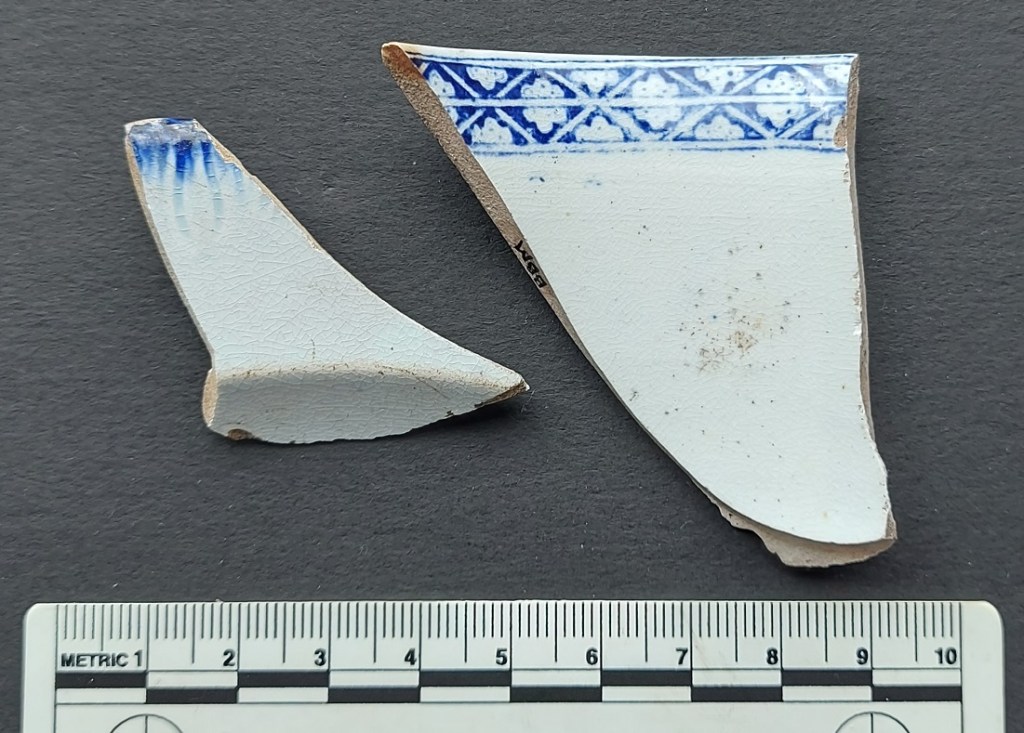
Top sherd is marked either ‘Stone China’ or ‘Ironstone China’ which is a type of pottery that contains crushed feldspar in order to make it very strong and hardwearing. It was developed from about 1800 onwards, and this sherd is probably mid-Victorian. Bottom left is ‘Tuscan China’ made by RH and SL Plant at the Tuscan Works, Staffordshire. The logo dates it to the 1920’s and 1930’s, and was presumably broken and thrown away anytime after that, although presumably before the landscaping of the park. The bottom right is marked ‘Melba Bone China – Guaranteed Made In England’, and was made by Mayer and Sherratt, based in Longton, Staffordshire, and who operated between 1906 and 1941. So there you go.

Do have a look at the bridge the next time you go over or near it, as I think it deserves a closer look than it currently gets, and I hope that in the near future more is made of the area. Until then, look for pottery in the soil around the bridge, and think about mudlarking the bank of Glossop Brook there – I’m sure you’ll find something, but make sure you let me know what.

That’s all for this time. Apologies again for the lack of activity – real life has an annoying way of getting in the way of what you really want to do, but I will be posting more frequently… promise. Also, please do get in contact, for what ever reason, and follow me on Twitter too – I am quite active there. I am also working on a YouTube channel, where I can put videos of walks, mudlarking, digging, history bits, finds, and other shenanigans – it’s in the early stages, but I think it could be fun, but also a way of getting you all involved. Anyway, more soon, but in the meantime please take care of yourselves and each other – even just a cheery smile at your neighbour can make all the difference in these troublesome times. Until the next time I remain.

Your humble servant,

RH

Archaeology · Pottery · Whitfield

Bits of Pot and Some Updates

Mrs Hamnett complains that going for a walk with me is difficult – apparently I’m like a dog, running about looking for things. We’ll be walking along, talking, and I’ll disappear into a hedgeback or ditch, pulling out a bit of pot or stone, and leaving her talking to herself. Master Hamnett has now adopted the custom, and he regularly finds bits of pottery that he hands to me, looking very pleased with himself. This leaves small piles of pottery around the place, which get cleaned and put into bags with the intention of sharing them with you, gentle reader. And as you know, intention and actually doing are two widely different things – I’m going to have “well, I was going to, but what happened was…” carved on my headstone.

Well, not today. Today I do! I am seizing the day, grasping the nettle, taking the bull by the horns, striking whilst the iron is hot, and a host of other tired cliches. Today is a pot  and other bits day… but first a cup of tea.

Right, that’s better! Off we go.

A few months ago I posted this, a toy soldier fund by Master Hamnett at the Spencer Masonic Hall/Sunday School at the top of Whitfield Avenue. Well, we went back recently, and blow me… we found some more.

Pot 2
Bizarre, and slightly creepy. I love these things.

Bizarre. I can only think that someone was using this as a place to play with their soldiers, and then lost them. As I said before, these were my childhood (I still have them). From right to left: a 1:32 scale Airfix British Commando (mid 1970’s to, well, now in date). Then we have a copy of a 1:32 scale Airfix British 8th Army Desert Rat; it says ‘Made in Hong Kong’ on the bottom, which dates it to pre-1997, when Hong Kong became Chinese. Then there is the lower half of Marvel’s Iron Man, which has the date 2005 on the base. I suppose these are technically ‘rubbish’, being deposited only in the last few years, but I reasoned that if I picked up a Victorian child’s marble, then why not these too. If you recognise them, and want them back, give me a message. Above the toys is a squashed thimble, again probably of relatively recent vintage.

Some other bits and pieces found in the grounds:

M17
Other bits and pieces from the grounds of the Masonic Hall

From the top down, then. Randomly, fragments of a clay pigeon – which begs more questions than it answers. This is definitely rubbish, and will be going straight in the bin, but I thought I’d post it in the interests of completion. Below that, a copper roofing nail – Victorian or early 20th Century, and clearly from the roof of the building, dropped during a re-roofing, perhaps – I love these things, and have blogged about them previously. Below that, an ‘L-Headed’ machine cut wrought iron nail – probably used for flooring, and perhaps Victorian.

Continuing the revisit of that post, here is some more pottery from the area:

M1
A small haul, and nothing too spectacular.

Some odds and ends. Top row, from left, then: the bottom of a jar of some sort – earthernware, and with the letters ‘A’ and ‘D’ impressed on the bottom. It’s possible this is ‘MARMALADE’, as it’s the right type of jar, but I don’t think it’s an ‘L’ before the letters.  ‘M[AD]E IN ENGLAND’, perhaps? Next a saucer, then a black glazed open vessel, and then the chunky handle of a jug or similar, but certainly not a tea cup, the handles of which were delicate in the Victorian period, which is when all of this pottery dates from. Bottom row from left: a creamware jug, and from the curve of the sherd, this the rim of the spout; early Victorian, at a guess. Next, the base of an open bowl, then the interior shoulder of soup bowl, the base of a plate (complete with knife mark scratched into the glaze), and then the shoulder and neck of a small saltglazed stoneware bottle. Originally, it looked like this one, probably an ink bottle, and which has roughly the same dimensions:

M2
A stoneware bottle which, incidentally, I found in a Victorian tip in Broadbottom.

Next up, we have some interesting new bits from below Lean Town, picked up whilst I was waiting for Master Hamnett to finish at the excellent Inside Out Forest School in Gnat Hole Woods, not too far from Nat Nutter, as it happens.

Lent
Some very nice bits here. Oi! You there! Not you, you! Stop sighing… I can hear you muttering under your breath you know, it is not a “pile of old crap”. Honestly, the nerve of some people.

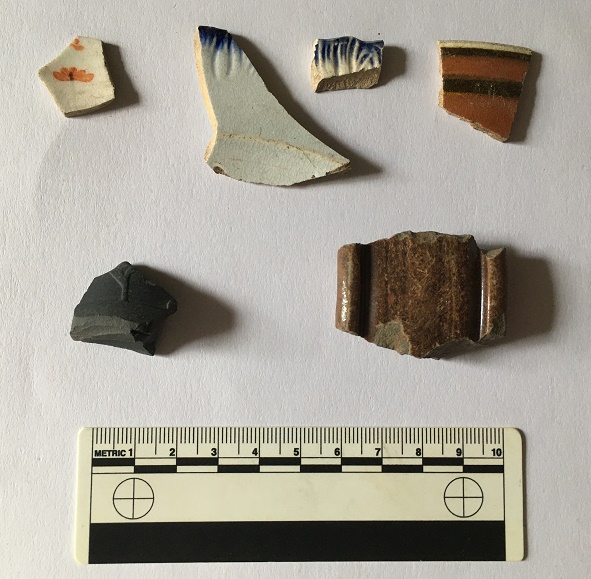
Top row: sherd of earthernware with painted orange flowers, which I thought looked nice. Then we have two different shell-edge ware vessels decorated a blue scalloped edge. The one on the right is the earlier, being made between 1780 and 1810, whilst the sherd on the left was made between 1800 and 1830. Then a sherd of annular or banded ware – the decoration looks very 1950’s to modern, but this stuff – usually in blue (there is an example below) – actually starts being made in the 1790’s. This one is Victorian. Second row on the left, a base sherd from a basalt stone ware bowl, roughly 1780-1830-ish, It’s a lovely example, very thin walled and with the bottom of an acanthus leaf or something coming up from the bottom. They were heavily influenced by Classical pottery, and it looks Roman orAncient Greek from a distance, but was in fact made by Josiah Wedgewood’s factory in Staffordshire. Then we have the handle to a monstrous stone ware jug or storage jar, and although it looks almost medieval, it probably came from a Victorian water jug or something. Following on from the mega post about Lean Town I’ll add this lot to the bag of bits, and I’m sure more will wash out over winter.

Moving on, we have a rim sherd of a pancheon and another sherd picked up from a path that leads from Bankswood Park in Hadfield to Mouselow.

Pann
Big chunky rim – I love these things.

The smaller sherd is a from a cup or bowl with blue horizontal stripes on a white background – more annular or banded ware from the Victorian period. The larger sherd is part of the rim from a large pancheon – essentially a large mixing bowl that most kitchens in the 18th and 19th centuries would have had (I talked about them here). What looks like a yellow glaze is actually a clear glaze over a white slip – you can just about see it on the edges. Below is what it would have looked like, although this example is later and much smaller, the rim sherd suggesting a vessel 70+ cm in diameter.

Pan
A Victorian pancheon yesterday.

The path crosses another track which originally ran from Cemetery Road to Shaw, along what would become Shaw Lane, before it was bisected by the building of the railway.

ShM
1898 1:2500 OS map, courtesy of old-maps.co.uk

The lane actually skirts the edge of the Iron Age hillfort, and parts of it are preserved in footpaths and tracks, but I don’t want to get into this here, as it is a topic of another post. However, here are some photos of Shaw Lane as it crosses Mouse Low – the above pot fragment was found at this junction with the footpath, marked in red on the map.

ShSW
Overgrown and unused, this was Shaw Lane looking South West. In case you can’t see it, it’s the sunken road bit to the left of the tree in the centre of the photo. Apologies for the darkness.
ShNE
Shaw Lane looking North East. I need to explore this track – it looks so appealing!

Next we have a small collection of bits from the bottom of Cross Cliffe, along the road edge and by the track there. Nothing earth shattering, but a good selection.

CroPo
A good selection of bits, and a clay pipe!

Top row, from the left: a fairly substantial transfer printed soup bowl roughly 20cm in diameter; the base to a ceramic marmalade or preserve jar of about 10cm in diameter; a stoneware sherd from a storage jar of about 16cm in diameter. The thing that looks like a mint is either a button or the end to a hat pin, and is made from alabaster. Next row: sherd from a large jug or similar, with large hand-painted flowers on the exterior; rim of a stone ware ginger ale or lemonade bottle, with the very characteristic brown salt glazed surface; a fragment of willow pattern transfer-printed plate, and a stem of a clay pipe with, alas, no maker’s name, but some nice paring marks.

Ok, so this is turning into a far larger post than I had anticipated, and I’m going to draw a line under it for now – nobody, not even you, you wonderful and attentive people, wants to read a wall of text. Expect Part II either next time, or sometime in the future

So, to end with, for now at least, two superb examples of Glossop bricks, a gift from our equally superb neighbours (hello Helen and Sarah).

Pot 3
I love these things – simple and mundane, and literally stamped with their place of origin.

I don’t know a great deal about these bricks, but a future blog post might delve deeper. The company was based at Mouselow, with the clay extracted from nearby. It seems to have been founded in the 1920’s by a John Greenwood, and continued until the 1980’s. Somewhere in the garden I also have Glossop brick with both Greenwood’s name and Glossop printed on it – perhaps this was an earlier brick? There is some information on this website, but I can definitely feel a blog post coming on.

Bricks are so mundane, and yet so fascinating, and useful archaeological dating material too. And once they begin stamping the maker’s name into the frog (the dipped bit in the middle) – sometime around the mid-Victorian period – they become individual, too. I stumbled across this website the other day – a gigantic collection of photographs of bricks with the names showing, and all alphabetised; this is what the internet excels at, the dissemination of knowledge that would otherwise be inaccessible, and it is truly magnificent. I look upon these bricks with envy, but silent and certain in the knowledge of one single fact: were I to start a ‘brick collection’ Mrs Hamnett would forcibly and violently eject me from the marital home. I would be a single and homeless (and brickless) man again before you could say “now wait, dash it all”. No, she puts up with quite enough as it is, so this injustice and pain is a weight I must bear with quiet resignation. However, if someone does have a spare shed, you can contact me in the usual way…

Right, that’s your lot! And it is a lot… too much, in fact! The question of “what am I going to with it all” never really occurs to me, and beyond the obvious “put it on the blog” I have no idea. I’m going to have a clearout soon, and get rid of the more boring bits and pieces – the plain white china, etc. and bury them somewhere for future archaeologists to ponder over. In fact, I was going to do it last week, but what happened was…

More soon, but until then, take care of yourselves and each other.

And I remain, as always, your humble servant.

RH

Archaeology · Pottery · Whitfield

A Possible Pair of Post-Medieval Paths, a Potential Pub, and Plenty of Pottery.

As I have said many times before, I do love alliteration. What ho! and all that. I trust you are all keeping well in these odd times? Well, now this is a monumental post – it is precisely three years to the day that I made the first post on this blog (you can read it here if you want). When I first started it I had no idea what it was going to be, other than I had some interesting bits and pieces that I wanted to share, and which I thought other people living in Glossop moght be interested in. The blog is still pretty much that in aim – bits and pieces – and I was right… there are lots of you out there who seem to enjoy the ramblings of a man who gets excited by bits of old rubbish. So thank you, you wonderful people, for reading, and here’s to many more blog posts. Now, on with the show. RH

During the lockdown, Master Hamnett and I have been taking a daily constitutional up and around what has become known as the “secret passageways”. Overgrown and wild in places, even for a man of modest size such as myself it is a mysterious place, but to a 4 year old it is indeed another world. Naturally, I have been keeping an eye open for bits and pieces of history, and I think I have a story to tell. Possibly. Well, I certainly have some pottery to show, so there’s that!

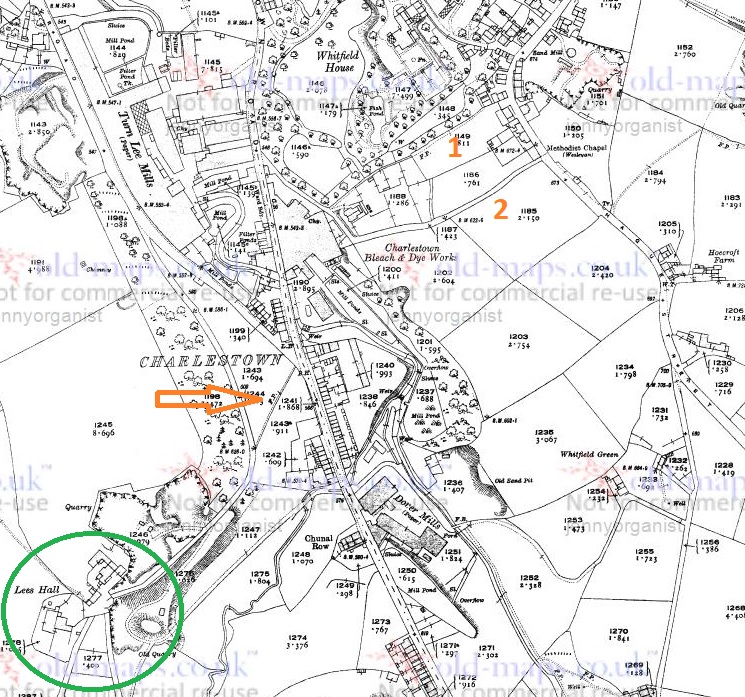
The route we walk is essentially along Hague Street, down one track to Charlestown Road, along, and then up another back to Hague Street. We often continue on and round if it’s not raining, but always walk these paths, which I have helpfully marked Tracks 1 and 2 on the map below:

M6
Tracks 1 & 2 at the top. Ignore the arrow and a circle for now… all will become clear!

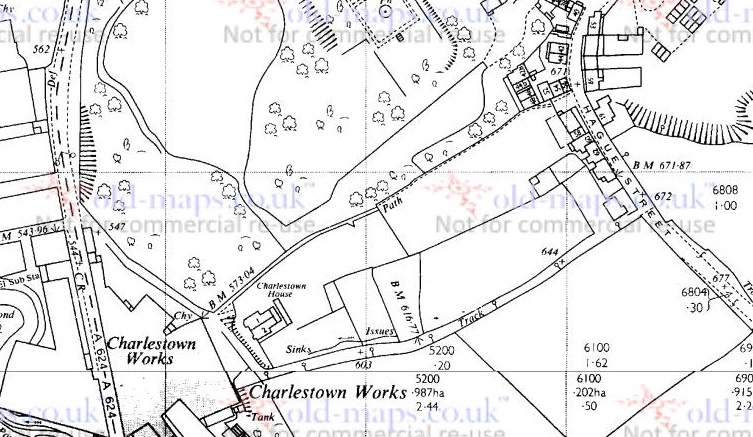
The tracks and immediate area are more clearly shown on the 1968 1:2500 map

m10
It’s a nice and short circular walk, if anyone fancies it.

The tracks are interesting in themselves in that they are once again an example of what I call the fossilisation of trackways – they are older tracks that no longer perform a function as such, but are preserved as footpaths. Certainly in this case as it makes no sense to have two tracks mere metres apart going between the same places. Instead, I think they are preserving the memory of a single older track, which I suggest below is Track 2, potentially the more interesting of the two. But I’m getting ahead of myself.

Track 1 runs down the side of this house, which was originally a pub called the Seven Stars (hence the sign on the door frame, although the sign above the door is a mystery… if you are reading this and own the house, could you tell us?).

M7
The one-time Seven Stars pub – I always feel a bit weird photographing people’s houses, but this is visible from the road, so it’s not as though I’m sneaking around gardens.

I know nothing about this establishment, but it was probably a beer house. As a reaction to the widespread and dangerous consumption of cheap gin – the so-called ‘Gin Craze’ of the late 18th century – the government encouraged more beer drinking (beer being considered relatively healthy) by allowing householders to open up their houses to brew and sell ale. These private houses became known as beer houses, and the individual paid a small fee to the local magistrates in return for an annual license allowing them to sell beer, but not the wines or spirits that the normal pub or inn could. If anyone has any information about the Seven Stars, please do get in contact.

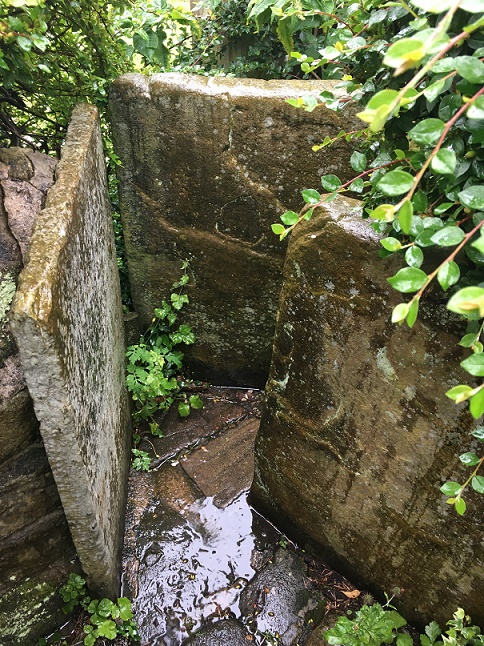
Just here is a series of upright stones presumably placed to stop horse riding or cycling. The gap between them is very thin; I might have put on a little weight during lockdown, but even I had to squeeze through.

M22
Breath in!

Carved onto one of these uprights are the intials ‘M.D.’ – I must have walked through these 100 times and never noticed the letters before, but the light and the rain were just right this time.

M23
And as you all know by now, I can’t resist carved graffiti.

Further down the footpath I noticed a reused quern or grind stone – possibly Victorian, but I suspect earlier – being used as a coping stone for the wall. And why not? It’s the perfect shape, and may well have been hanging around for centuries after being used to grind wheat into flour.

M9
The worn central hole is visible, and it’s possible the other half is around here somewhere.

About halfway down, you come face to face with more of those upright stones, although in this case I can only assume they were put there to stop a headless horseman! Honestly, they are quite unnerving.

M19
Not at all creepy and gravestone looking. Nope. Absolutely not.

The path continues:

M18
Master Hamnett on the final stretch down to Charlestown Road. At the end of the path, in spring, there is a truly spectacular spread of wild garlic.

Until we arrive at Charlestown House, and the Charlestown Works that were – now demolished and awaiting houses.

M30
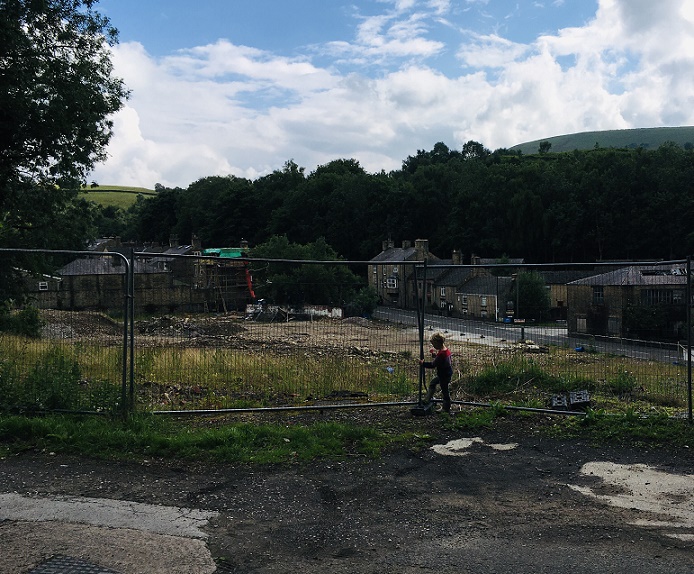
The site awaiting re-generation. The hairpin bend where Charlestown Road meets Turnlee Road is visible. Whitley Nab in the background right, Casa d’Italia left (very nice pizza, highly recommended). Dead ahead is Lees Hall, which is important… stick around!

So, here’s the pottery:

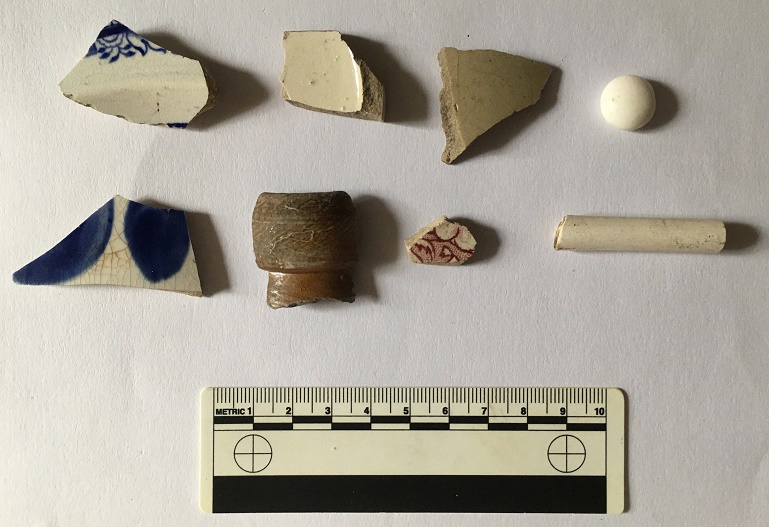
M3
A small assemblage of fairly typical Victorian bits, with a potentially earlier piece.

Top row, from the left: a base of a saucer or small plate; a huge chunky handle belonging to a large jug; a base of a glass jar or jug, or possibly from a tankard – it’s nice and decorative, but not expensive. Next is a fragment of a pedestal footed drinking cup, which is again fancy, but not especially expensive, it being just glazed earthernware. Then there is a rim to a large plate of some sort, being about 30cm in diameter.

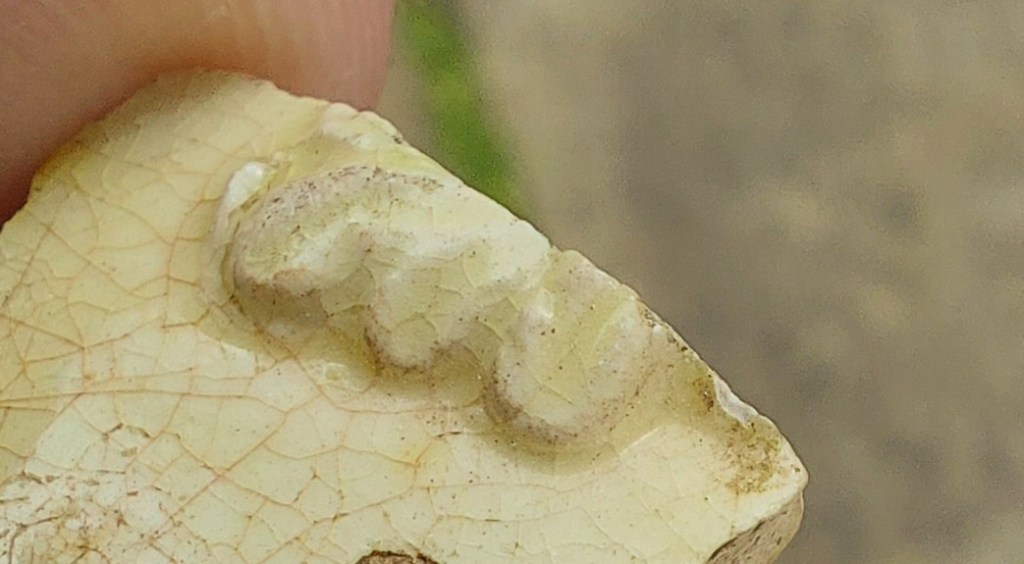
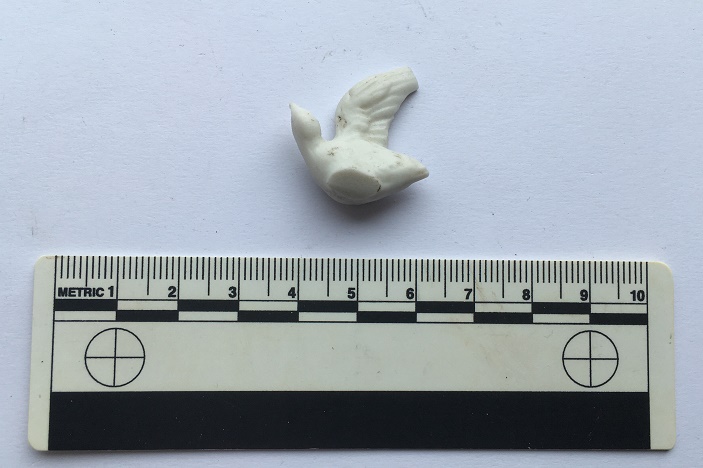
The lower row from the left: a fragment of a stoneware bottle, a chunk of a pancheon, and a fragment of a manganese glazed jug or similar thick walled vessel. Then we have two pieces of blue and white earthernware, and a base of a tea cup. There is nothing massively interesting, and it all seems to be Victorian in date, as we might expect… except for the manganese glazed jug! This is, I think, earlier – perhaps early 18th century. It’s quite characteristic, and although there was a revival of manganese glazed pottery in the Victorian period, this glaze is of relatively poor quality, and the fabric (the actual clay of the pot) is quite rough, both of which suggest an earlier date. Then there is this lovely bit of pot; it’s a china dove, shaped to fit onto what would have been a tasteless Victorian jug or bowl – you can see the flat bit where it was joined to the vessel it flew away from.

M4
Found lurking below some dandelions.

Then there was this:

m20
A bottle top

A screw bottle top, probably from a beer bottle or similar, and dating to the early 20th century. I love these things, and have blogged about them previously – here, for example. Unusually, this one doesn’t have the drink makers name or logo on the top, just the name of the bottler – R. Green of Leigh.

M21
Always nice to see.

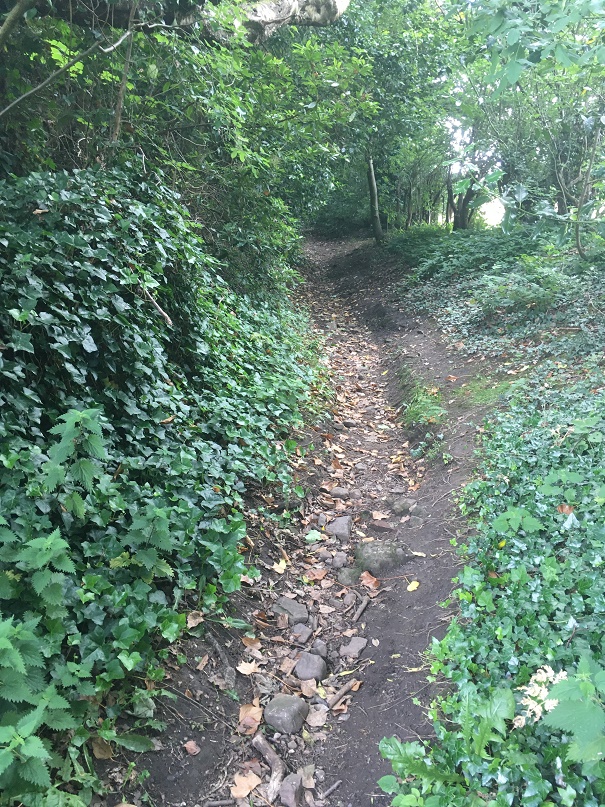
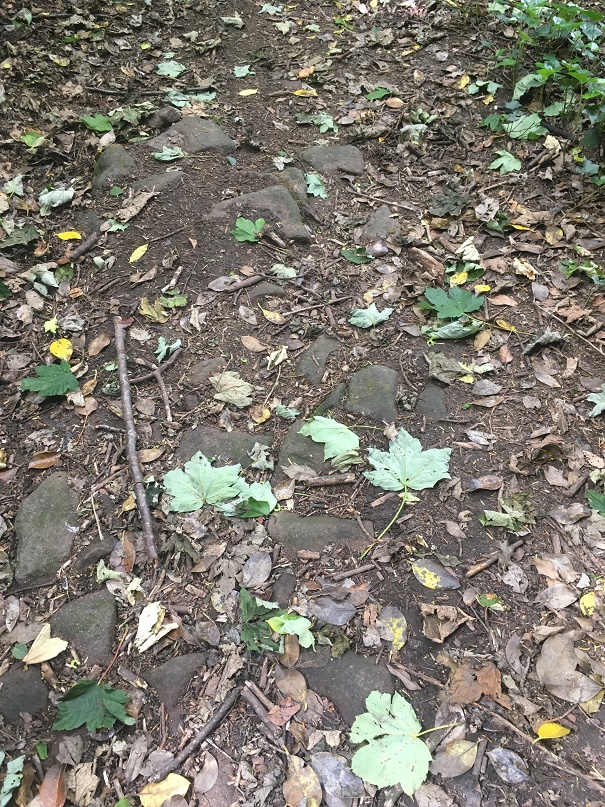
Moving on to Track 2, there is a noticeable difference between the two. This one is more of an actual track; it is certainly wide enough to drive a horse and cart down it, and it seems to have had a surface at some stage. It is also deeply worn in places, which can be suggestive of an older trackway.

M26
Possibly worn by traffic, the track is quite deep in places.

M27
It’s not much to look at, but this is the surface of the track.

I’d love to put a trench across this track to see how it was made up.

Further on, it has what seems to be a late 19th or probably early 20th century cast-iron streetlight, which is interesting and spookily out of place now, but suggests strongly that it was used as a ‘proper’ track until fairly recently.

m24
It has seen better days, but there it is, slowly being overtaken by nature.

m25
I can’t work out if it is gas or electric… further research is needed.

Right next to the streetlight is a gateway into a seemingly random field, and a benchmark on the gatepost – it’s been a while! This one – 616.77 above sea level – is a late addition as it is only marked on the 1968 1:2500 map. There was another benchmark marked on the opposite side of the track – 622.6ft above sea level – but it’s long gone (you can see it in the map above).

m13
The bench mark. This is what 616.77ft above sea level looks like.

The track continues until daylight is reached.

m32
I love this shot… artful (courtesy of the iphone filters, not talent on my part). Mrs and Master Hamnett providing the scale.

The top of the track, where it joins Hague Street again, is the site of the original Whitfield Methodist chapel – it is visible on the 1880 1:500 OS map:

M28
The chapel is clearly marked.

Built in 1813, it had seating for 200 worshippers, and at one time was the home of the pulpit from which John Wesley had preached in New Mills (as discussed in this post). There are more details about the chapel on the Glossop Heritage webpage.

It was demolished in 1885, and the site is now occupied by a private house, but there are some interesting re-used stones on the trackway which almost certainly came from the chapel. The one indicated by the arrow in particular seems to have been a window frame – originally it would have laid upright, and you can see where the wooden frame was bedded in, and possibly a cross bar set into the stone.

M29
I love Microsoft Paint!

A closer look reveals what might be a mason’s mark. Possibly… but then I really rather badly need glasses.

m31
Squinting, after two glasses of wine, and with the eye of faith…

So then, the pottery:

m14
Fairly standard stuff, but still nice.

Top row, left to right: a fragment of a large stoneware vessel with a cream glaze. I have photographed it showing the interior – it is roughly finished, and you can see wiping marks, and it probably came from a large cider flagon.

Next is an annular ware bowl or similar type, with the characteristic horizontal linear bands around the rim and below. Abrim from probably the same vessel is above it. Despite it looking 1950’s, this stuff ranges in date from the mid-18th century to the late Victorian; this is, I think, early 19th century. Next is a sherd of a cream ware jug, this being a part of the spout – you can tell by the twisted curve of the rim – again, early 19th century. Next is a stoneware flaring rim to a large jar, Victorian in date. Next we have a sherd of black glazed pottery which, I think, might be 18th century in date – the glaze seems to be lead based, which it isn’t in the Victorian period, and the fabric is very red, which is also common in Black Ware of the 18th century. I’ll post some more about this in the future – I’m actually trying to put together a crib sheet for pottery identification for this part of the country which some of you might be interested in (I know, I know, stop groaning… you don’t have to read this blog, you know. And I did say ‘some of you‘!). Beyond that is a fairly uninspiring selection of Victorian sherds at which even I pale!

Track 2 is odd – there’s summat rum about it. It has the air of a deserted roadway that was once of some importance, certainly important enough to have a substantial gateway and a streetlight on it. Looking at it, and thinking about the fossilisation I talked about above, I wonder if this was the line of an earlier track, perhaps even the medieval road that led from Whitfield to Lees Hall (which is circled in green in the first above – see, I told you it would all become apparent!). The hall, though 18th century in date now, stands on the site of a medieval manor house, possibly even the original manor house of Whitfield mentioned in the Domesday Book. It was certainly important in the medieval and early modern periods as the seat of the Manor of Glossop, where tax and tithe from Glossop and Whitfield was taken – first to the Earls of Shrewsbury, and then, from 1606 onwards, the Howards. The road from (Old) Glossop came through Cross Cliffe (discussed here), along what is now Cliffe Road through Whitfield, and from there down this track to Lees Hall. One less obvious part of it may be the footpath indicated by the orange arrow in the map above; I don’t think that it is the exact route the track would have taken, but it again ‘preserves’ the way in the landscape. I would suggest, then, that Track 2 is either this hugely important road fossilised into the landscape, or it broadly follows the line of that road which no longer exists. A point that may also support this is that on the 1968 OS map, also above, the track is marked by a series of ‘Boundary Mereing Symbols” (they look like lolipops – circles on sticks) which  apparently indicates that it is the boundary of a parish or parish council (here, for an explanation). Boundaries, or meres, often use ancient and established objects or features to lay out the area that is bounded – an old track is a very common and perfect example of this type of feature.

This part of Glossop – I suppose technically Whitfield – is very interesting.

Right, that’s your lot for today. As always, please feel free to comment – even if it’s simply to tell me I’m talking out of my hat. I have more that I am picking away at, but until then stay safe and look after each other. Oh, and happy anniversary.

And as always I remain, your humble servant,

RH

Archaeology · Graffiti · Pottery · Whitfield

Odd Bits and Pieces… and Cheese.

Well, this escalated quickly.

Apologies for the lack of posts recently, but things are a bit odd at the moment. Six weeks ago we were concerned about Covid19, but were still joking about it, and how it will amount to a fuss over nothing. Now, here I am in front of my computer in ‘lockdown’ for the foreseeable future, and a very real and sobering death count is still rising. It really is a strange time, and the country is a strange place; the start of it all reminds me of what my grandfather said of the ‘Phony War‘ – you knew something big was happening, but it wasn’t actually happening there and then. Well it is now.

Sadly, it also means that we have had to cancel all the tours and talks that I was involved in that were about to occur: in particular, the ‘By Seven Firs and Goldenstone‘ exploration of the legend and landscape of Alderley Edge, and the Objects Tell Stories evening of folklore and archaeology. Oh, and if you want to find out who I really am, you can watch me talking archaeology and ritual in the promo for that event here – I’m the one on the right.

More to the point, this has put something of a crimp in the Cabinet of Curiosities. Rest assured, though, I do have a backlog of posts that I have been trying to write that doesn’t involve me moving anywhere. And of course, there is now time to write… well there would be if Master Hamnett wasn’t being home schooled for the duration.

In the meantime let’s keep buggering on, as Churchill was fond of saying.

So I went for my state-mandated exercise the other day and found a few bits and pieces – random is the theme of today’s post. But first, a quiz. What’s this?

What
Ooooh, a mystery object!

I’ll give the answer at the end of the post… no peeking!

In the meantime, I spotted this sticking out of the ground:

What 2

Ooooh, thought I. The greenish colour of the glass gave it away as being older than mere litter, along with the thickness of the walls. Master Hamnett helped me hoik it out of the ground, and cleaned up it looks like this:

What 4
The lovely pale green colour is the result of impurities in the silicone, and dates it to the Victorian period or thereabouts.

You can just about make out the word ‘Glossop’ impressed in the glass. This was likely to have contained either carbonated water or beer, but a brief search of bottles reveals nothing similar. More research is definitely needed.

The small white object next to it is a fragment of a clay pipe, but interestingly, it has a some molded decoration on it. Here it is in close-up.

What 3

This is a fragment of stem, just at the point where it joins to the bowl. It is unclear what the completed decoration would look like – foliage perhaps? Dating clay pipe stems is always tricky, but the decorated types are usually late, so late Victorian is about right.

We later came across this stone with the letter ‘H’ carved on it, and being a connoisseur of such graffiti, I had to collect it.

What5
A Hague Street ‘H’

It’s nicely executed with a flourish of decoration in the form of drilled holes between the arms of the ‘H’ – I’d give it a 7/10.

Right. That mystery object… did you get it? I believe you, honestly!

Ok, well, it’s a cheese press. Yes, you read that correctly! A cheese press. A thing for squeezing the whey out of cheese curds. Well, technically, it’s half of a cheese press – it’s missing the right half.

The square hole on the left is to house an upright pole which, along with another on the right, now missing, held the pressing weight in place. The circle and lines carved into the surface allowed the whey to run off, leaving behind the solids which are then matured to make cheese. Cheese was home made, or at least farm made in small batches, until relatively recently, so the press must  have belonged to a farm nearby, as you aren’t going to shift that stone any great distance, when others, closer, would do to fill a hole.

What
The mystery object again.

Here’s a complete one in Bashall Eves in Lancashire:

What Lancashire_Cheese_Press_-_geograph.org.uk_-_431556
Cheese press in Lancashire, and used to make, well, Lancashire Cheese. Image shamelessly stolen from Wikipedia.

  And here is another one carved in the same manner as ours:

cheese-press
The cheese press in Draycott in the Moors churchyard. Photograph is courtesy of their local blog, and I hope they don’t mind me stealing it – please visit the blog here, it’s very good.

This one caused a bit of confusion, apparently – read all about it at this wonderful blog.

In terms of date… who knows? Certainly not hugely old – possibly Victorian, but equally possibly earlier. The only other one I have seen (which is how I know what it is) is propped up where I work at The Blackden Trust, and was in fact carved on the reverse of an old gravestone dated to the early 18th century, which at least gives us a date to work with. I’m going to write a little more about this soon, as it involves two of my greatest loves – archaeology and cheese… if we could just work in wine somehow, then it would be perfect.

Incidentally, the press is currently being used to fill a pot hole in a trackway, which I think is a shame. Sigh… I’ll add it to the list of historical objects things that need to be hoiked out and displayed properly (along with Whitfield Cross and the Whitfield Guide Stoop) – I think it would look great displayed at the wells. Seriously, I think we need to do something about reclaiming our heritage, as it is being slowly eroded. The guide stoop is currently under 3ft of soil, and looks like it will be left like that, So then, who’s with me?

Right. I’m off do some more gardening.

Please stay inside and stay safe, and take care of yourselves and each other.

More soon, I promise, but until then I remain,

Your humble servant,

RH