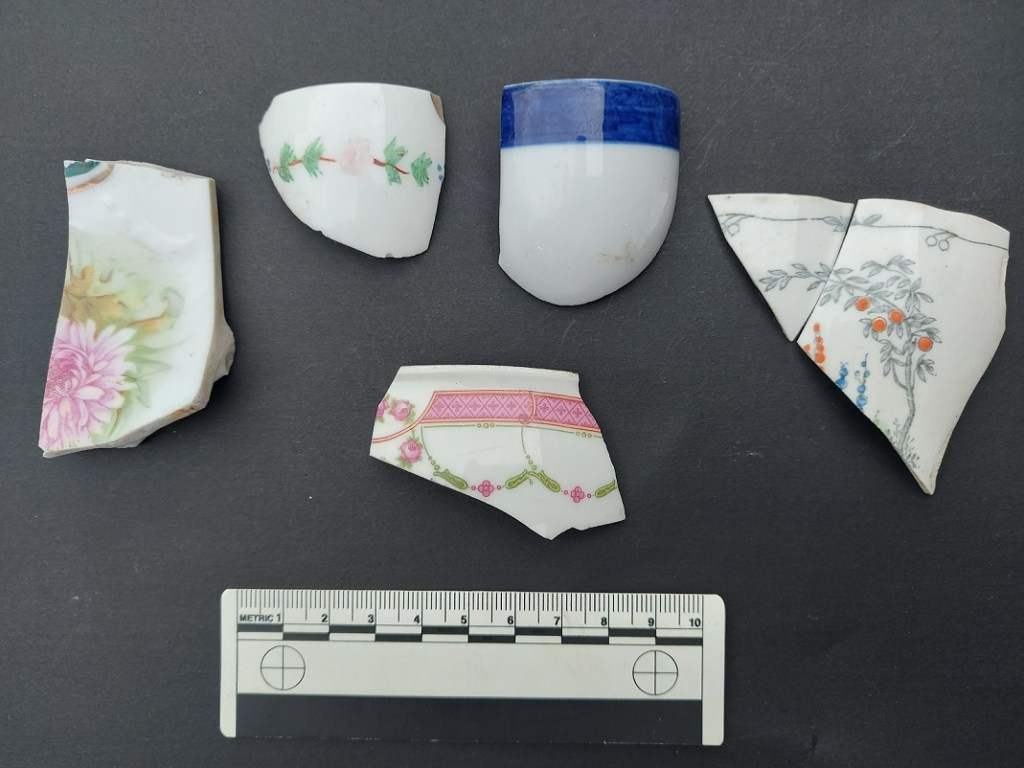
Archaeology · Pottery Guide

The Rough Guide to Pottery Pt.5 – Blue and White Bits.

Look, it’s no use yelling “for the love of Jove, not more bloody pottery!” No one is forcing you to be here. Honestly, I haven’t even started yet, and here you are, giving your two penn’orth.

What ho! Wonderful readers. Welcome, welcome, welcome.

A quick one today – Part 5 of my best-selling, most talked about book of the year, Booker Prize shortlisted Guide to Bits of Old Pot. I have a brace of posts almost ready to go, but to keep you going I thought I’d publish this. Enjoy.

TRANSFER PRINTED WARE (aka Willow Pattern, Blue & White)
DATE: 1800 – Now
DESCRIPTION: A cobalt blue pattern or image on a white background. Also, red, brown, black, or green.
SHAPES: Any and all vessel shapes – from delicate tea cups to whacking great soup tureens – literally everything.

Ah yes… Transfer Printed Ware. If you are going to find pottery, this is the stuff you’ll find, and in particular the ‘Willow Pattern’ pottery. It dominated the 19th century, and arguably a large portion of the 20th – it is everywhere. I have actually dreaded writing this part of the guide, probably because of the quantity of material, but also I’m worried that it might not appeal to all of you (*sigh, yes I know it doesn’t appeal to you. And look here, there’s no need to use language like that… there are ladies present, and calling me a “honking tallywacker” is hardly becoming of a gentleman.”). But it turns out that it’s exactly the sort of thing appeals to (most of) my readers.

As we have covered previously, 18th & 19th century potters were trying to find the perfect blue and white decoration on a perfect white background to match the desirable Porcelain being imported from China. Tin Glazed Pottery (or Delft) certainly filled that gap, but it really wasn’t perfect. An easier form of decoration was wanted, and the idea of transfer printing began to take shape in roughly 1750, being applied to Porcelain only at this point. It was in about 1785 that the process successfully began to be applied to earthernware, being perfected by that wizard of English pottery, Josiah Spode.

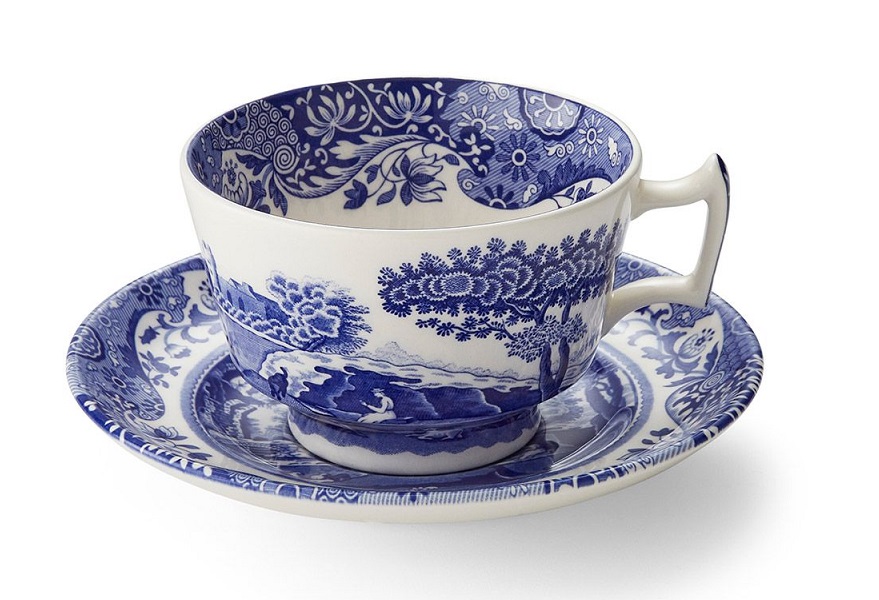
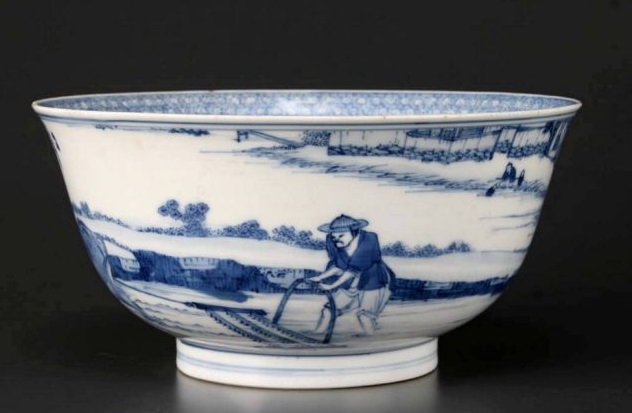
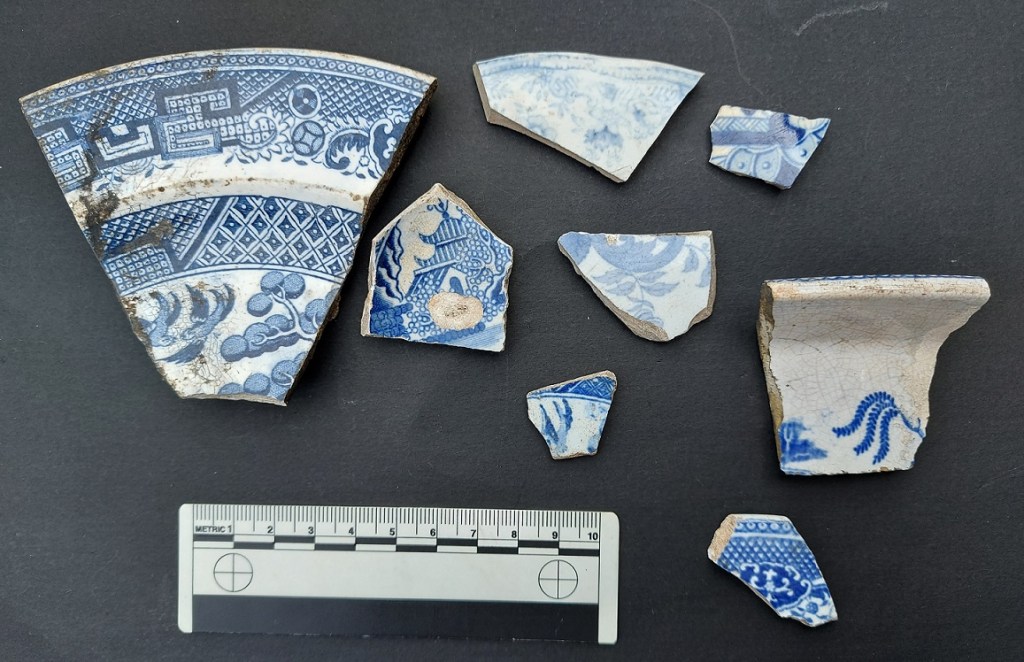
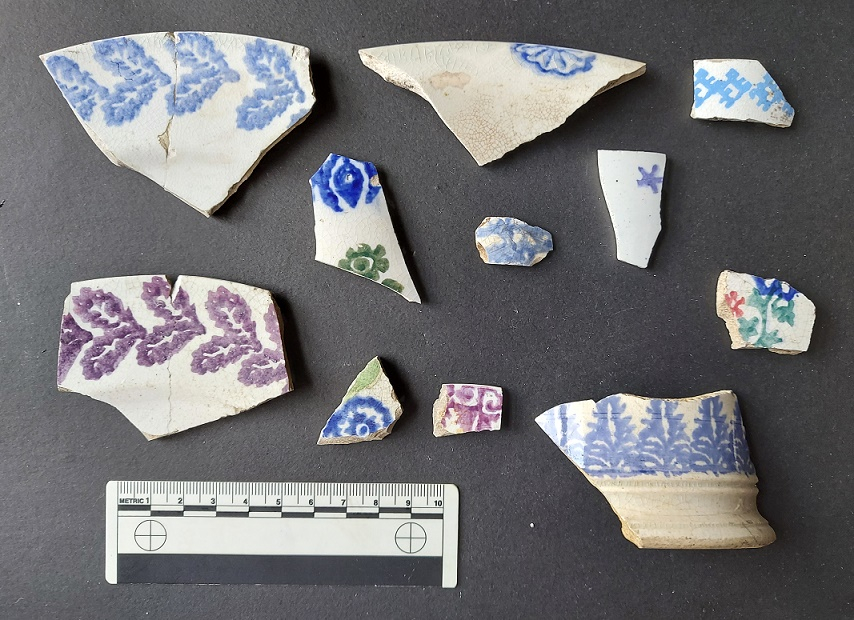
A random selection of Blue & White Transfer Printed pottery.

The process is relatively simple if a little convoluted. Firstly, an image was engraved in a copper plate, as was done for book illustrations at the time, and applied to an oiled tissue paper using a cobalt ink – this being the only colour at the time that would survive the firing process. This is the ‘transfer’. Next, a vessel is ‘biscuit’ fired – that is fired without glaze, and at a lower temperature, to make it hard and able to take the transfer print. The transfer paper is then pressed onto the surface of the vessel, with the ink absorbed in the fabric. The pot is then fired a second time to remove oils and fix the ink into the clay body. Next, a glaze is applied, and then it is fired a third and final time. Originally applied to Creamware, then Pearlware, it became a standard decoration for White Ware, and by 1820 TPW was everywhere, and being used for all sorts of images. A brown ink was developed in roughly 1835, a green chrome ink in 1850, and a red ink at about this time, too.

Various coloured Transfer Printed plates. And of varying quality.

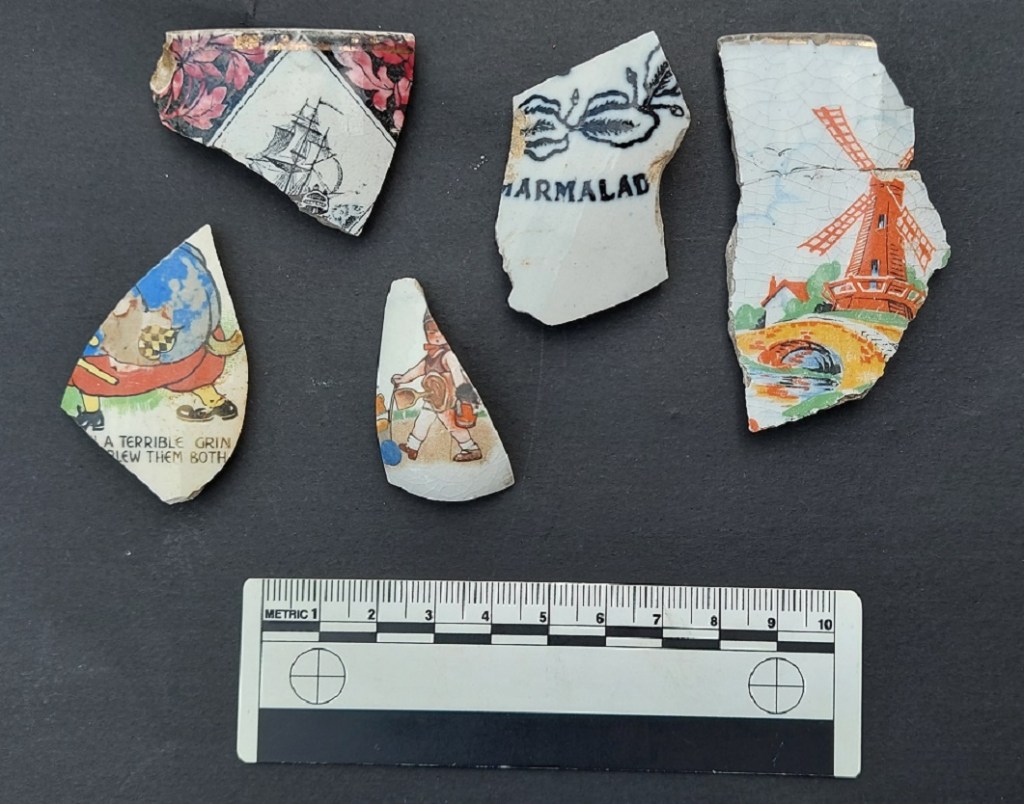
Eventually a technique for multi colour printing was developed by the pottery factory F.R. Pratt, allowing full images to be put onto vessels from late 19th century on.

Pratt’s development meant that anything could be printed in any colour. These date to very late Victorian and early 20th Century.

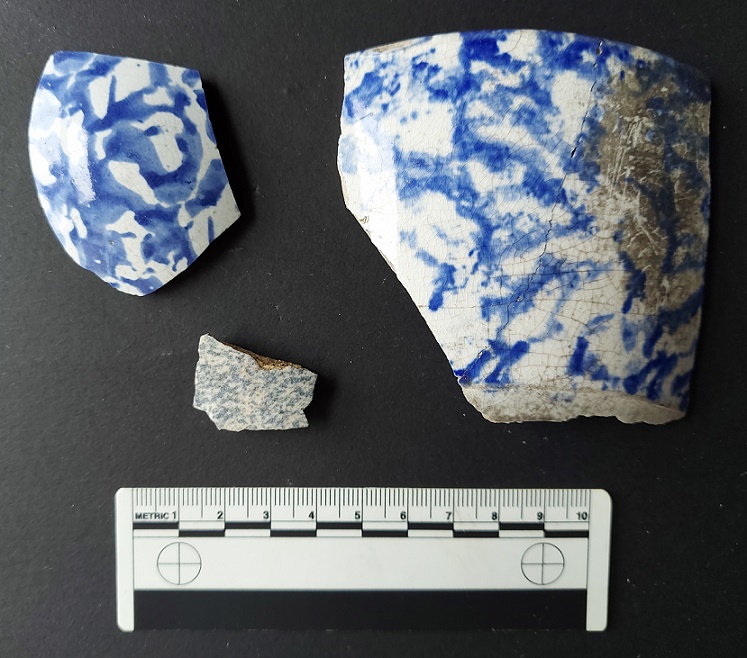
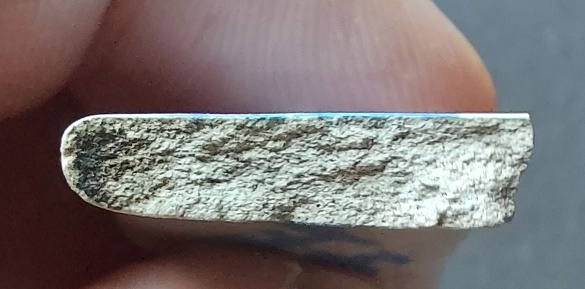
A technique called ‘Flow Blue’ was perfected around 1800, in which the cobalt blue transfer print was deliberately smudged or blurred. The pot is prepared as normal, but during the firing a ‘flow powder’ (a mixture of 22% salt, 40% white lead, 30% calcium carbonate, and 8% borax) was added into the kiln, giving off a chlorine gas which caused the cobalt to diffuse or blur into the glaze.

Flow Blue. For some reason, I just couldn’t take a good photograph of this. I must have spent 20 minutes getting more and more frustrated, taking endless shots of just this scene. To be honest, even looking at it now makes me angry.

Sometimes this changed into a more purple colour, termed ‘Mulberry’, occasionally it was highlighted with gold.

My only piece of Mulberry Flow Blue.

Flow Blue’s popularity peaked around mid-century, and as a style lasted until perhaps 1900. The more extreme blurred examples may have been sold as cheaply as ‘seconds’, and were thus popular with the poorer market. Indeed, for many years I just thought that Flow Blue style was just really badly made TPW, and only fairly recently did I discover that it was deliberate.

In terms of decoration, I don’t know where to begin; from classical scenes to commemorative plates, souvenirs from castles, to children’s rhymes – literally anything and everything was inked onto the vessels. You may get lucky and find a name or a date, or a maker’s mark from the underside of a plate. Or it may just be a pattern from the edge. The classic is of course the ‘Willow Pattern’, with its spurious story of lovers turned into birds. This was, and still is, reproduced in huge numbers: it is everywhere. In fact, so common was this pattern that it is used – incorrectly – as a short hand for all Blue & White pottery.

The actual Willow Pattern – image from Wikipedia.

Theoretically, though, given infinite time and patience, one could identify and date any sherd using the wealth of pattern books that were kept by the factories that made them, but even for a certified sherd nerd such as myself, that way madness lies!

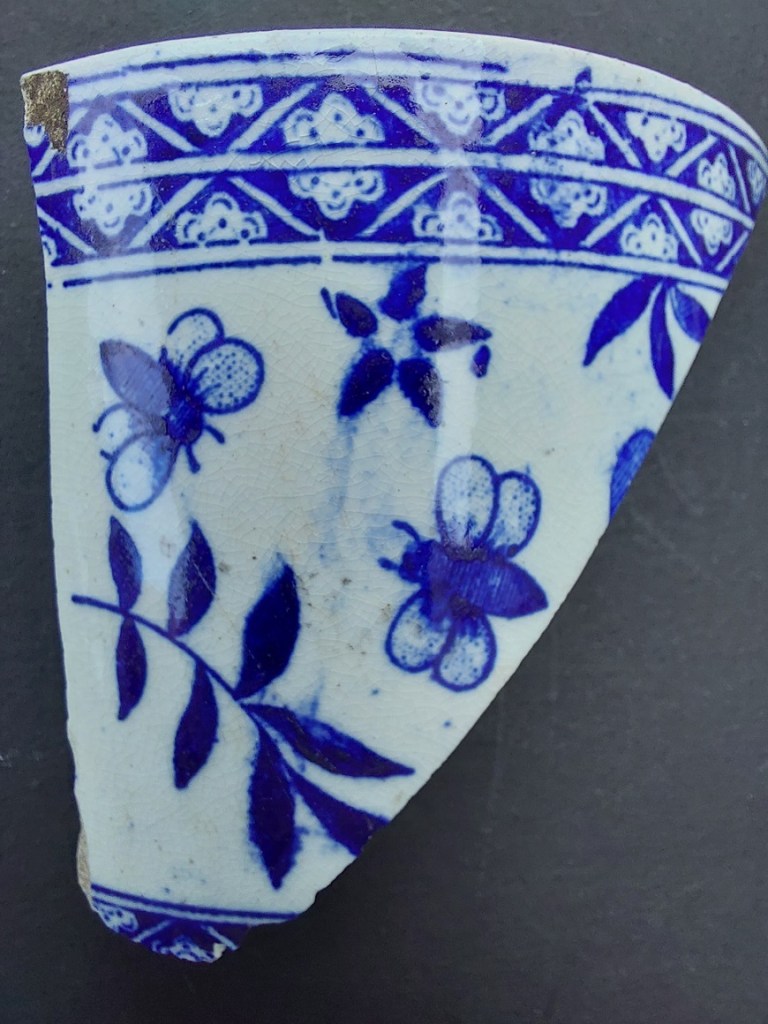
Transfer Printed Ware began life as a prestigious and very exclusive pottery type, with the early stuff being of incredibly high quality. Once it began to be mass produced, as always happens, the quality began slipping, until the lower end of the market was cheaply produced and sold for next to nothing. This produced some shoddy designs and duff workmanship; sometimes you can see where the transfer has slipped, where bits overlie each other or don’t join in the pattern as they should. I do like these mistakes – I think it adds a human touch.

At first glance, quite attractive – bees and flowers, what’s not to love. But look closely – it’s blurred, there are smudges, blobs, lines stop and start, patterns don’t meet. This is budget pottery of the lowest order. I love it!

Allied to Transfer Printed Ware, although not actually transfer printed, is this stuff:

SHELL EDGED WARE (aka Feather Edged/Edge)
DATE: 1780 – 1890
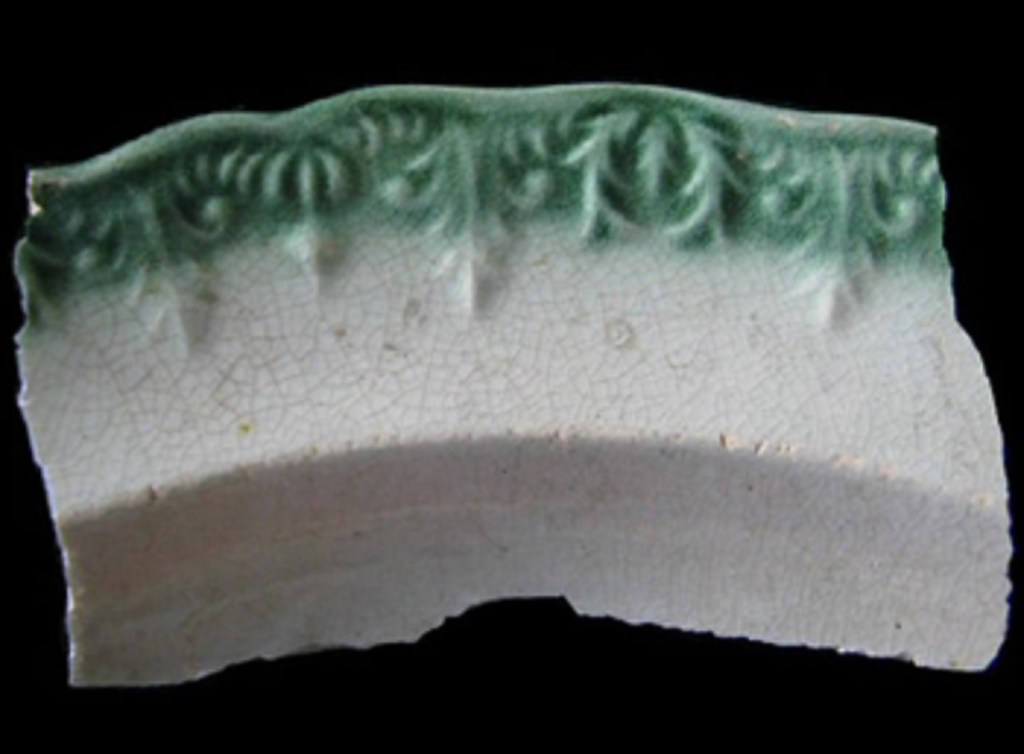
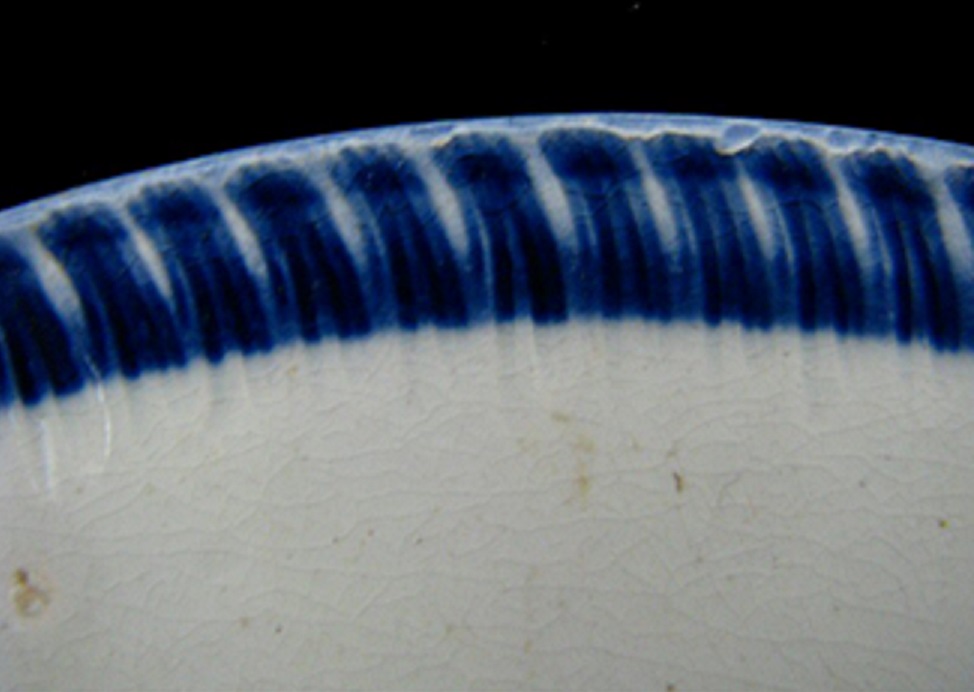
DESCRIPTION: Plain white bowl or plate rim decorated with crinkly ‘feathering’ and painted blue (occasionally green).
SHAPES: Plates, wide rimmed soup bowls, tureens.

This type of decoration is very distinct, and was fairly common in the late 18th and early-mid 19th centuries making it a frequent find. Once seen, it never forgotten.

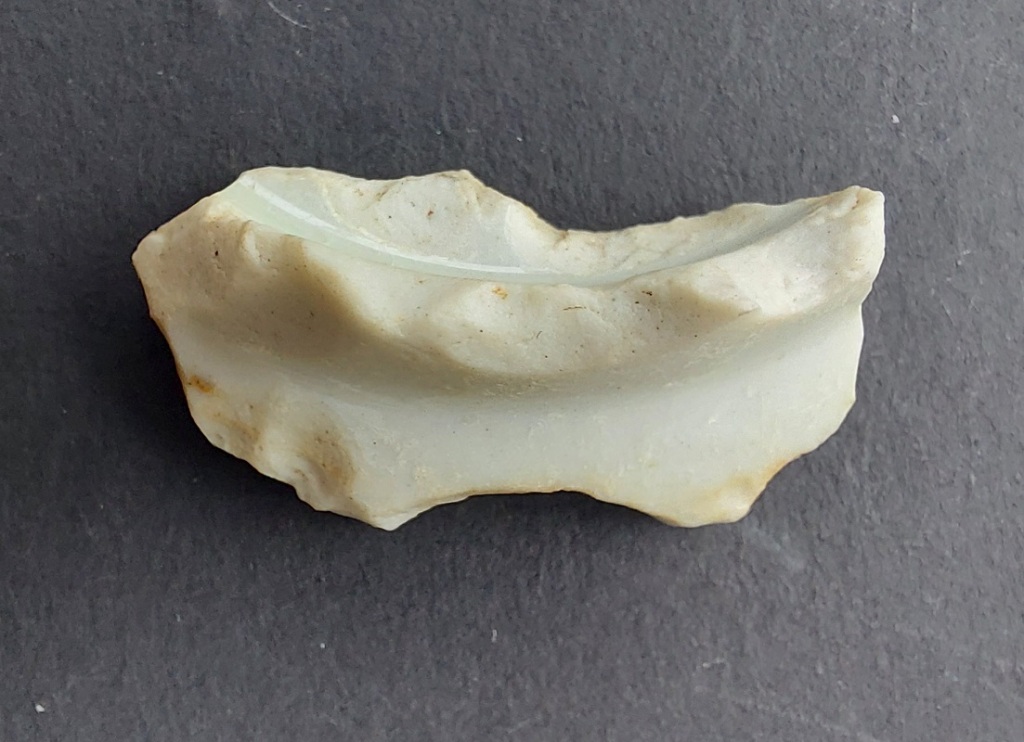
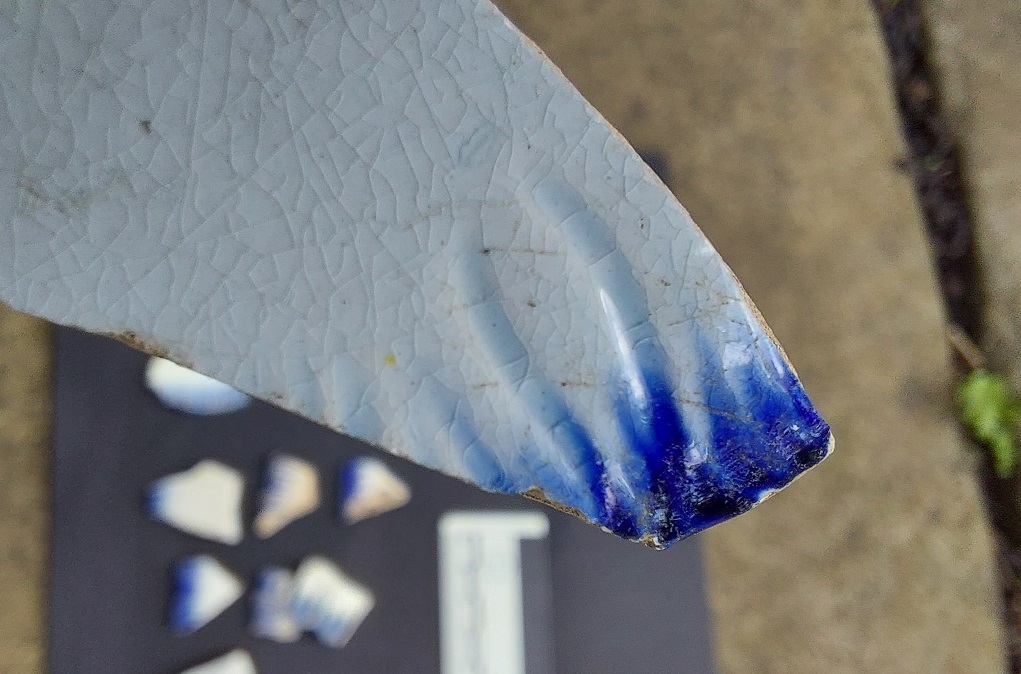
A varied selection of Shell Edged Ware. You can see the blue-tinged Pearlware of some of these sherds, dating them to roughly pre-1830. I also realised I don’t have any green edged sherds.

Essentially a plain white bowl or plate – Creamware, Pearlware, or Whiteware – is decorated on the rim edge with a feathered type decoration in cobalt blue or, less commonly, chrome green. The rim may or may not be undulating, and the feathering may or may not be impressed into the clay, but it is always painted to look feathered or shell-like. I seem to be a magnet for this stuff, but it’s always a welcome find.

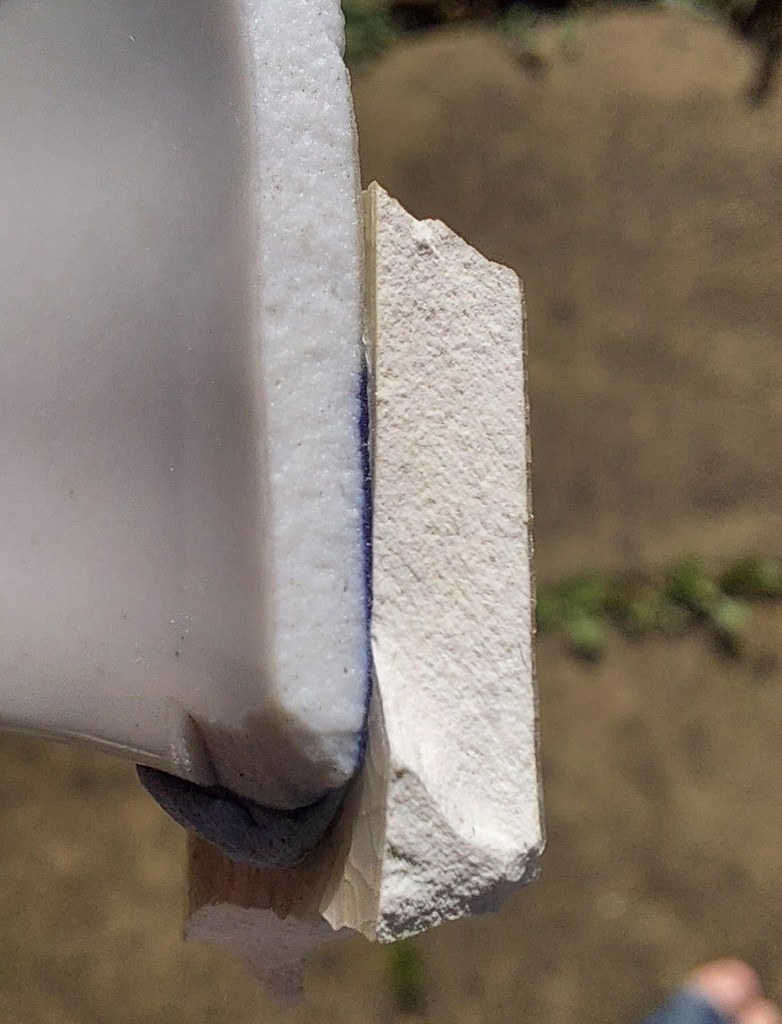
Lovely shot. You can see the cobalt blue edge, and impressed decorative ‘feathering’ that here has been filled with the blue tinged glaze that makes up Pearlware. I improved the shot by cropping out my gnarled bare feet that were visible at the bottom of the photo.

Interestingly, there seems to have been a development in the style, allowing a broad date to be given to some sherds. This is based on American data – much of this ware type was exported, and there was some serious work done on dating it – and I’m not sure how applicable it is in England. Chronologically then:

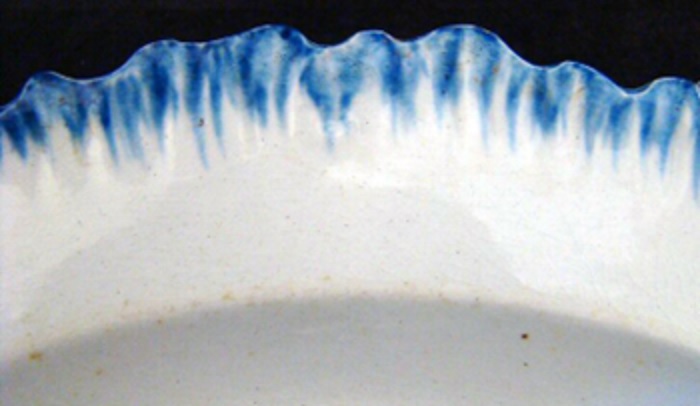
Type 1 (1775-1810)

Asymmetrical scalloped rim, impressed curved lines (not straight), blue/green edging (feathering).

Type 1. I must add that I don’t own the rights to this, or any of the following images, and cannot now recall from where I stole them, shamelessly as always. Apologies if it is your image.

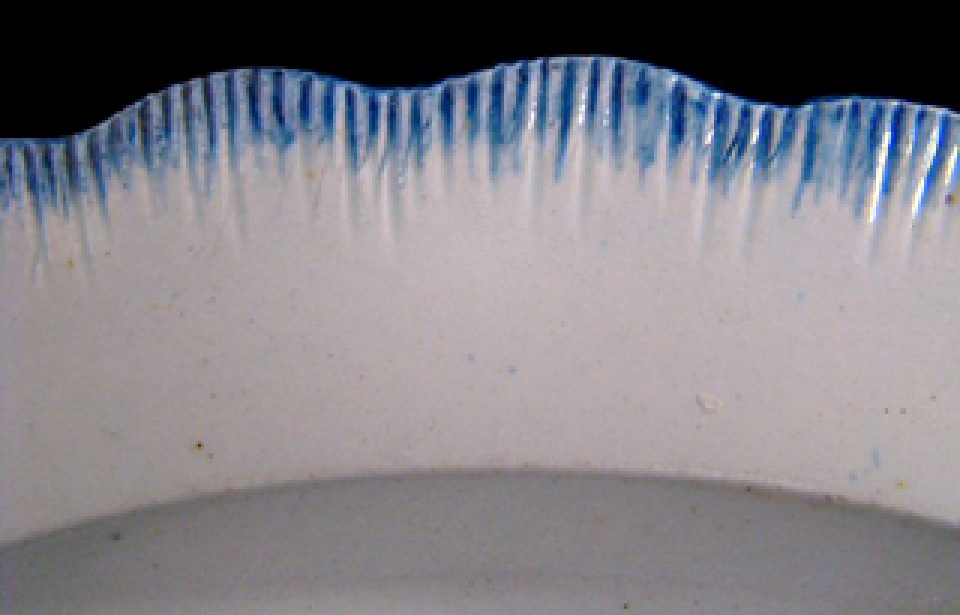
Type 2 (1800-1830’s)

Symmetrical scalloped rim, impressed curved or straight lines, blue/green edging.

Type 2

3) 1820’s-1830’s

Symmetrical scalloped rim, impressed curved or straight lines, embossed decoration below – garlands, flowers, wheat, feathers, etc. blue/green edging

Type 3

Type 4 (1840’s – 1860’s)

Unscalloped rim, impressed curved or straight lines, normally blue edging, not green.

Type 4

5) 1860’s – 1890’s

Scalloped rim, no impressed lines – the paint is applied to make it look like impressing. Blue edging.

Type 5

As I say, the academic rigour is there, but whether this is a ‘true’ chronology rather than reflecting deposition dates (that is the date which the pottery was manufactured, as opposed to the date ended up in the ground – which, given I still use my grandmother’s stoneware pie dish to cook with, could be as much as 100 years or more), I couldn’t possibly comment. And here we stray into the strange realm of archaeological pottery studies; I could talk it all day, but I fear some of you may become violent, and nothing takes the shine off a chap’s day like an angry mob.

Right, I think that’s all for today. I do have more pottery to publish, but I might save that for another time – I don’t want to over-egg the pudding, so to speak.

More soon, but until then look after yourselves and each other, and I remain.

Your humble servant,

RH

Archaeology · Graffiti · Stones of Glossop

Naked Ladies… and a Quarry

Well that got your attention! What ho, wonderful people! What ho!

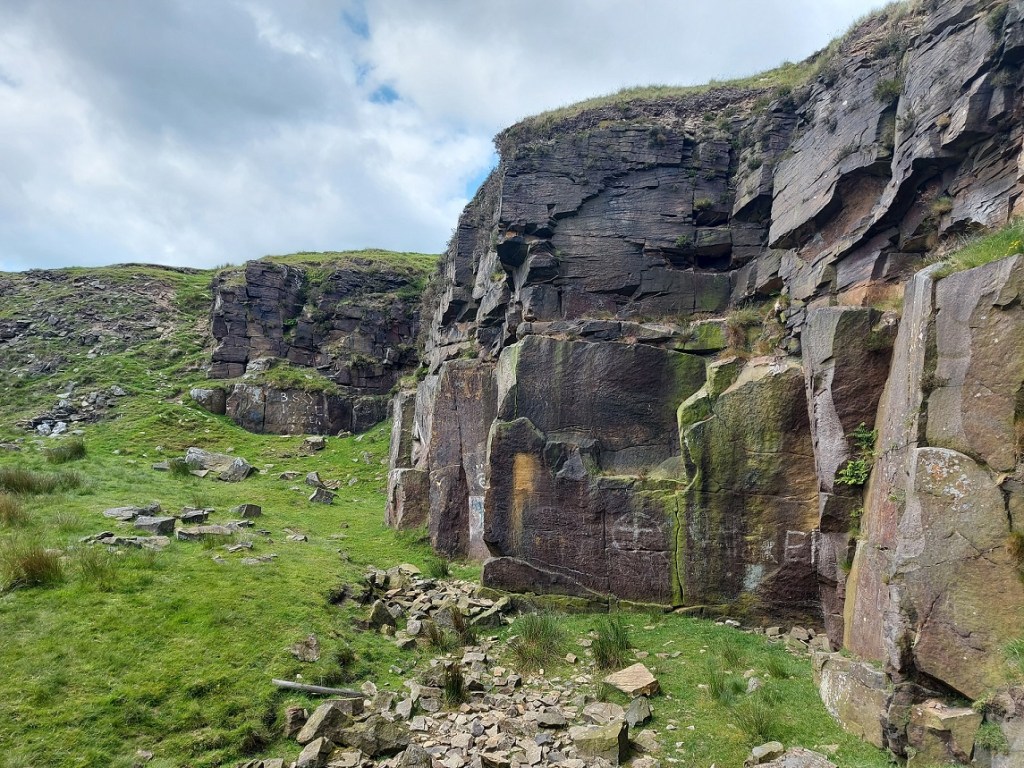
Up by Coombes Edge lies Cown Edge quarry. This quarry, long disused, contains a number of interesting, and oddly well executed, carvings on the walls. I have heard about this particular place – and its carvings – many times, and from many different people, but had never managed to get up there. No reason, simply that there are so many places to see, and so little RH. A few months ago, a friend (my thanks to Andy T) suggested a walk up that way and, well, I thought, let’s have a look.

What I like about this place is not just the ‘historical’ history, which is visible and tangible, but the ‘personal’ history which is similarly visible, but often better felt than seen. The quarry seems to be one of ‘those places‘; a destination, a space in the landscape that attracts; a shelter, an asylum, a place of freedom, and perhaps decadence. In particular, it’s place where ‘youths‘ go and be ‘youthful‘, frolicking, feeling, fumbling, and… well, you get the picture. I didn’t grow up in Glossop – I’m a ‘comer-inner‘, so to speak – but if I could take you to Cheadle Hulme where I did grow up, I could show you a few such places from my youth. Every town & village has them – and the similar stories they could tell of the first time drunk, illicit substances consumed, virginities lost, love discovered, best friendships forged, fights fought, and the always difficult transition from child to adult negotiated – often on the same evening. But perhaps most importantly, memories are made. To quote Wordsworth “Bliss it was in that dawn to be alive, but to be young was very heaven“. I have recently turned 47 (young for some of you, old for others… it’s all relative), and have been marvelling at the swift passage of time, so forgive the nostalgia. Now on with the show.

Cown Edge Quarry seems to have been started sometime in the early 19th Century, probably as a source of roofing stone. Geologically, the stone is Rough Rock – a type of sandstone of the Peak District and southern Pennines, and the most commonly occurring of the Millstone Grit group.

Incidentally, and as a rule of thumb, you can roughly date the buildings of Glossop by what the roof is made from. Prior to c.1850 roofs were made from stone taken from local quarries such as these. However, once the railway arrived (c.1850) Welsh slate could be imported on trains. Not only was slate cheaper, but it also weighed less so the roof could be constructed using less timber, and so roofs after 1850 tend to be made of this. A rule of thumb not an absolute guide, but useful nonetheless.

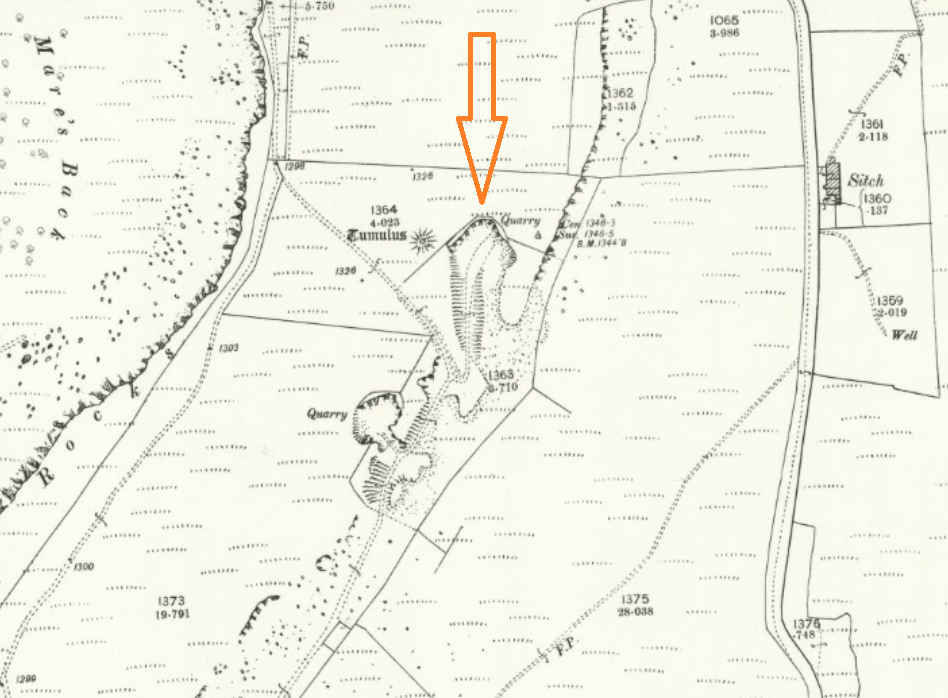
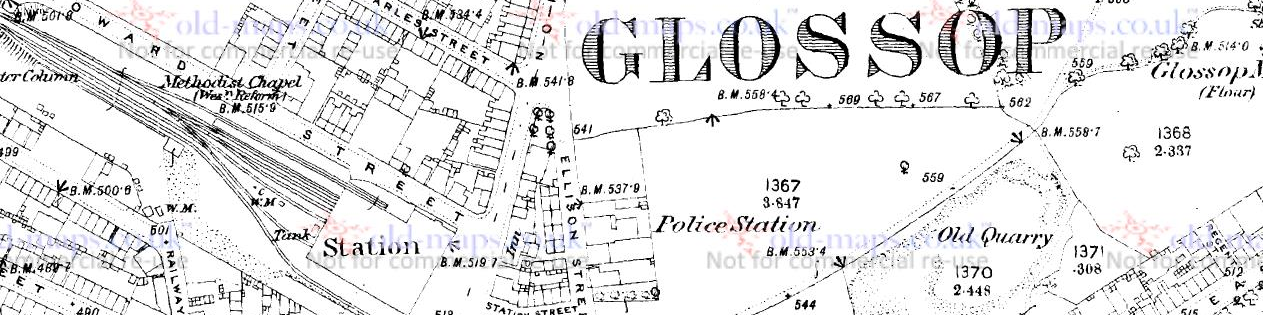
Anyway, the quarry is located here:

Thank you Google for the image.

And here it is in 1898:

And thanks to the National Libraries of Scotland for this image.

If you use the What Three Words app, the reference for the quarry entrance is: tribal.workers.crossword

Now, as subjects go, it isn’t perhaps the most interesting, but then as we know on this site more than most, ‘interesting’ is a veeery subjective word. However, it was deemed important enough to have its own Historic Environment Record – MDR10021. Largely overgrown now, and with none of the urgency and noise that would have marked it out as a place of work when it was operating, it is peaceful and still.

The view looking north from the quarry mouth
Looking west. Interesting, and a little odd, to think that the roof of my house, where I type these words, was almost certainly quarried from this place.

However, the walls are full of interesting graffiti, carved over the years since the place was abandoned. Some is more worthy than others, but all is a record of people, humans being, well… human. I have said elsewhere that there is something universal about the need to leave a mark on the environment, almost a way of achieving immortality, your name living on past you, perhaps. And hats off to those who did it before the invention of spray paint… if you wanted to put your name up in the past, you had to mean it – with a hammer and chisel. Here follows a sample of the carvings – mundane, as well as the more creative.

AKW 1942 – presumably there is no reason to lie about the date, so this is interesting… and asks further questions.
“Tim. Joey. Glossop”?
“.D” – quite modern, I suspect, and a worn hole.
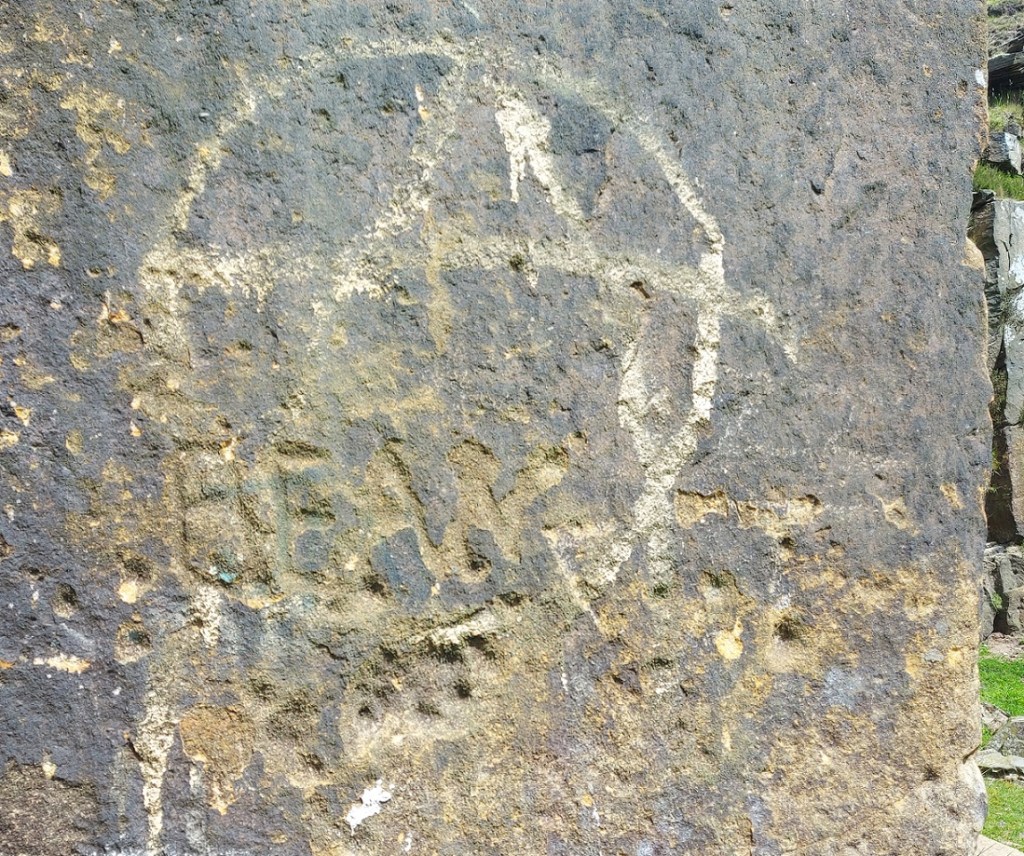
“BEAN”? and some pock marks. These overlay – and are later than – the painted anarchy sign.
“DUF, LEZ, ANT, GUS” 1994. “KEV” at the bottom is even probably even more modern.
“DAN”, “SID”, “LES”, “LYNN”, and some symbols. These seem to have been carved and re-carved.

Talking of symbols, there are what seems to me an unusual number of Christian crosses carved here:

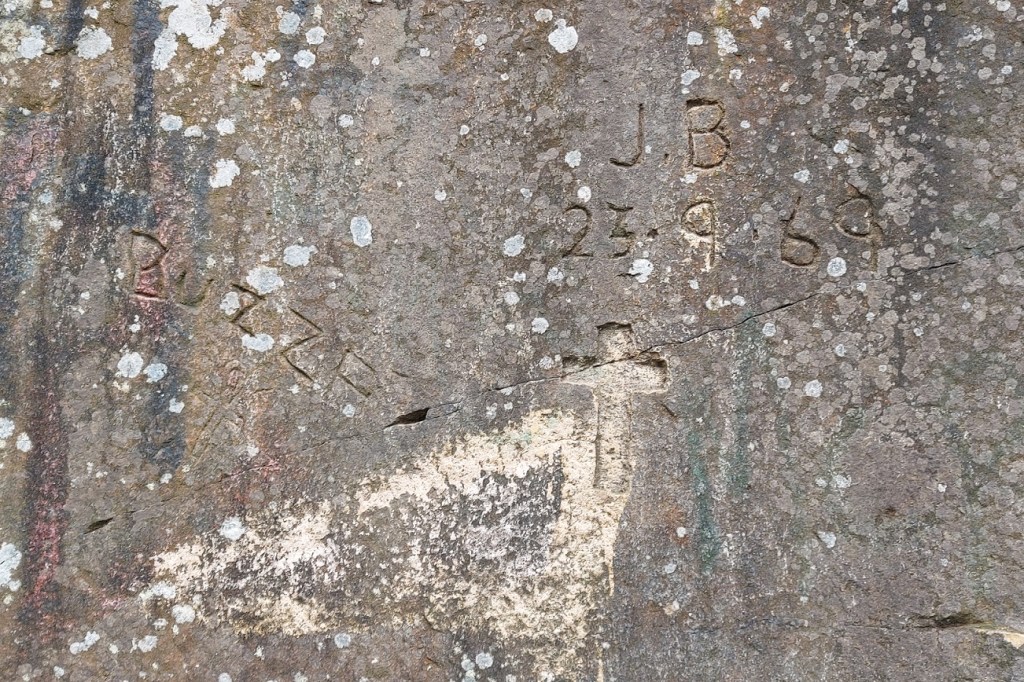
“BUZZB” and “JB 23.9.69” I love this one – the date is so specific. The cross is also very prominent.
An ancient Egyptian Ankh symbol – quite old (filled with slow-growing lichen), and odd to find on the rock face.
Another lichen-filled cross.

Perhaps it’s the crosses that give the quarry its reputation for Satanism and witchcraft? Anyway, the ‘religious’ iconography culminates in this, what the HER calls “a potential Calvary figure” – that is, Christ on the crucifix:

Well executed, and subsequently highlighted in paint.

This is a weird one – is it one figure, or two – a smaller, more feminine and naked, between the Christ-like figure’s legs? Or is it three? The more I look, the less I know. Is that the point? Is there a point? Even down to the almost-altar like outcrop of stone in front of the figure, this is very good.

It seems that this is a modern(ish) rendering, done by a known person – I have heard several different reasons and accounts – and people – but the story is not mine to tell, nor is it for me to name names. That I will save for the comments section, should anyone wish to do so.

However, it looks like it was the same hand that carved this naked lady, as well, so I’m not sure about any religious motivation as such:

It’s carved with skill, too.

There’s also this lower half of a person on their hands and knees.

Not sure what I can say about this… so I’ll say nothing!

Moving away from carvings, and back onto the safer territory of history and archaeology, there are traces of the original purpose to which the quarry was put here and there amongst the more modern intrusions.

The rough dressing is visible in the dark area of the quarry face.

Here we can see the rough dressing of the stone, done prior to it being broken out of the rock face. This provides it with a flat-ish surface before it is smoothed properly elsewhere. This was probably the last thing that was done in this quarry before it was shut down, as it is part of the quarrying process, but was never finished. I like that.

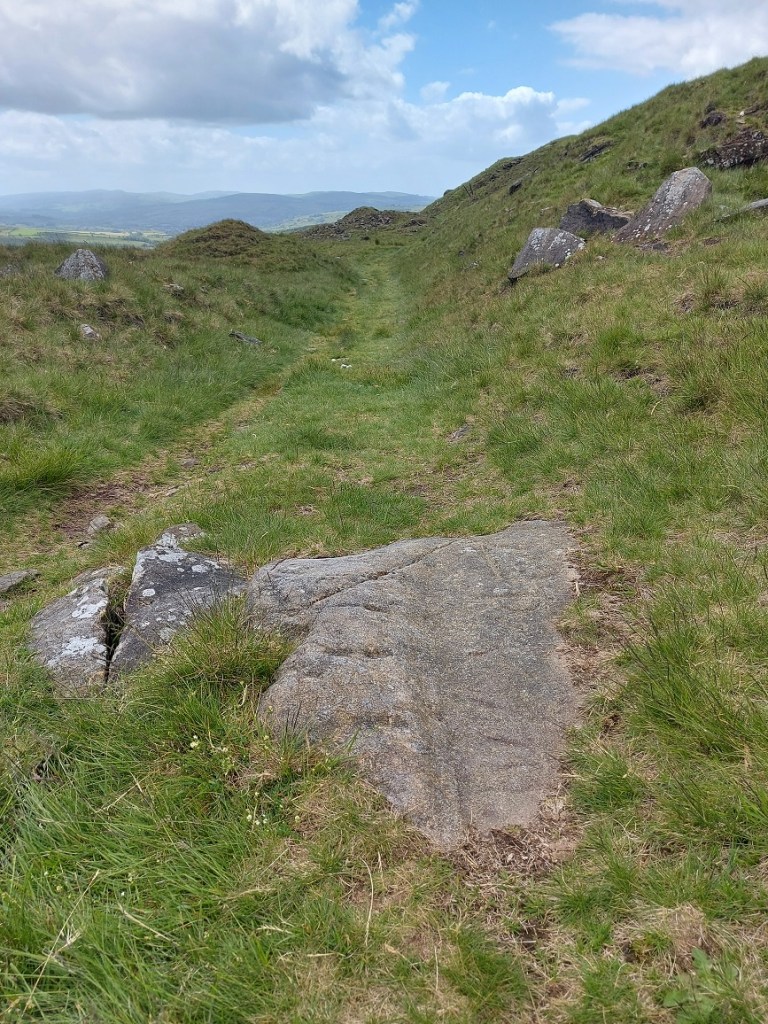
The quarry road, with spoil piles on the left.

The quarry road is very nicely preserved, but if you look closely at the stone at the bottom of the above photograph, you can see a groove worn into the rock there, running top to bottom. This is the track of a sledge repeatedly being drawn over the stone, day in, day out, for decades. A horse-drawn sledge is easier to use, more stable, and less likely to cause accidents, than a cart, and were often used in these remote quarries.

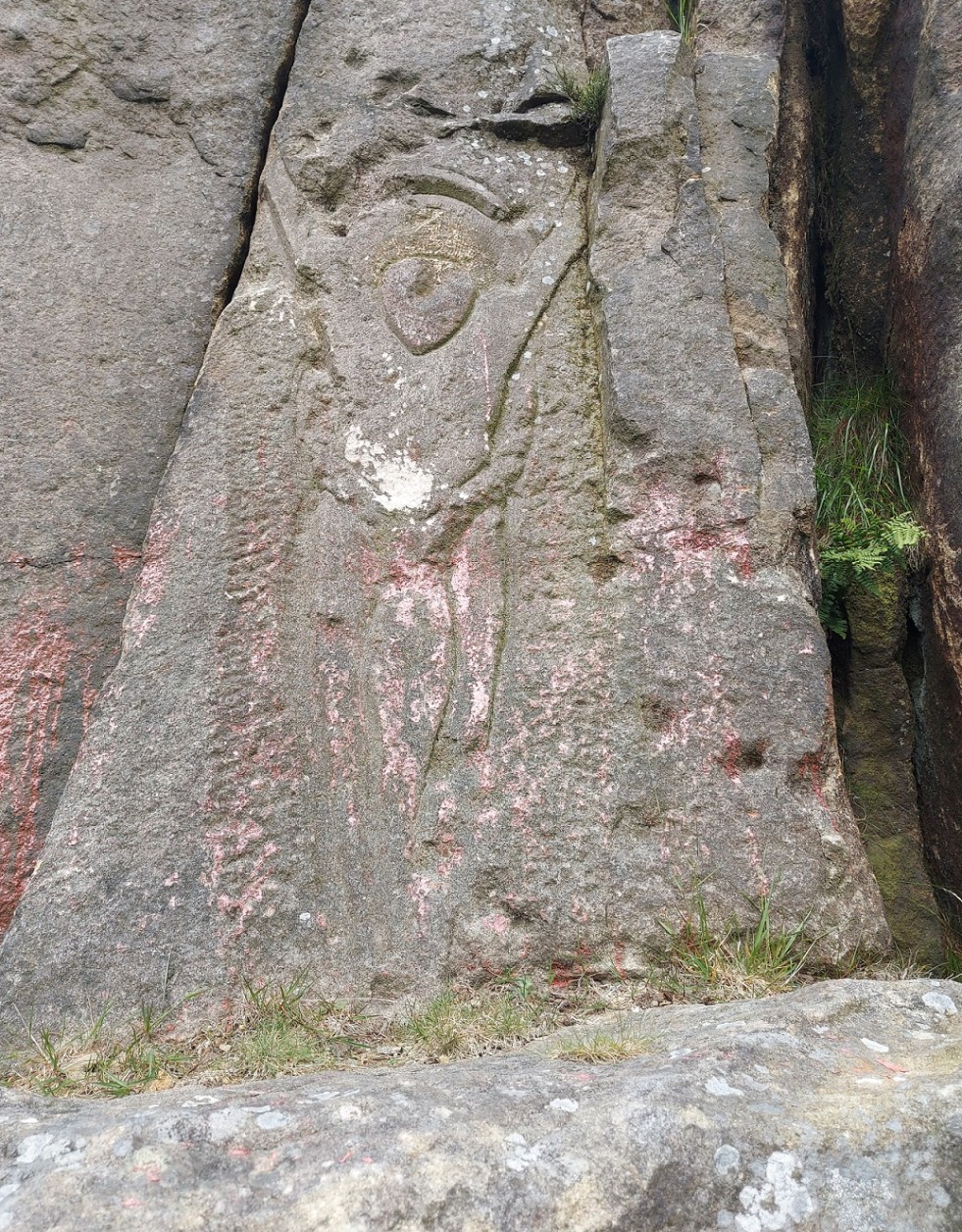
I also found also a concretion in the rock face of the quarry. Essentially, a concretion is a small boulder of one type of rock which is formed naturally, and which becomes trapped within the matrix of a surrounding rock when it was laid down as sediment millions of years ago.

I love that the concretion looks like an eye, the ‘eyelid’ accentuated by the red paint.

The concretion erodes at a different rate from the surrounding material, and so they stick out quite clearly. They’re fairly common in this type of Rough Rock, as indeed are plant fossils, apparently, but I didn’t see any of those… I need to go back.

Right, there you have it. More soon – including more pottery, you lucky, lucky, people. I’ve got so many ideas – walks, books, tours, blogs posts, pottery workshops, YouTube shenanigans, surveys, excavations, art, creativity, etc. – and so much I’d like to do. For now though, stay in touch and follow me here, or on Twitter (@roberthamnett), or even on Instagram (timcampbellgreen). Or just come up to me and say “What ho, Robert Hamnett!”.

But until next time, please look after yourselves and each other.

And I remain, your humble servant,

RH.

Archaeology · Pottery · Pottery Guide

The Rough Guide to Pottery Pt.4 – Creamware, Pearlware, & Whiteware.

What ho, dear and gentle readers, what ho!

How are we all? I hope everyone is well. Or, at the very least, not actively unwell. Well, all except you, that is. Yes you… you know who you are. The “all pottery is dull as dish soap” chap… Mr Shouty-Outy. I hope you stub your toe really hard.

Anyway, with such unpleasantness out of the way, we can move on to the subject of today’s article. Ladies and gentlefolk, may I introduce to you… Creamware, Pearlware, and Whiteware.

Now, even for a certifiable pottery nerd such as myself, this is far from a riveting subject. I mean, it’s less ‘edge of your seat’, and more slump down the back of the sofa in a fashion that causes people to enquire as to whether one is alright, and mutter concernedly about ‘strokes’ and ‘comas’. But before you agree with Mr Shouty-Outy, and start tying a noose, pause, crack open a bottle of the stuff that cheers, and have a read, as the above three pottery types will form a large part of any pottery you find, and is an important part of the development of British pottery.

The history of British pottery since roughly the mid 17th century can perhaps be characterised as the pursuit of white. Once imports of Chinese porcelain began, with their pure white fabrics and background, and blue painted patterns, we Brits fell in love with the design. But the problem was that it was very, very, expensive, and far out of the price-range of the developing aspirational middle classes, who were seeking to copy the upper classes. We copied the designs and colouring in beautiful Tin Glazed or Delft wares, and made some incredibly fine pottery in what is called Fine White Stoneware (you’ll be pleased to note that both of these will feature in future pottery guides; oh look, that woman over there is so excited about that, she is literally screaming with joy). But with the mid 18th century explosion in tea and coffee consumption, there was increasing demand for a cheaply produced white background upon which decoration might be painted or printed.

The following three types – Creamware, Pearlware, and Whiteware – were developed as these backgrounds. It is unlikely that you will come across them on their own (though not impossible), it is more likely you will say “What ho! I say, that looks like blue and white transfer printed decoration on a Pearlware background” which should, if you use the guide the right way, give a date for your sherd, and make you feel warm, fuzzy, and happy. And a little smug that you know things. Unfortunately, though, it will make other people angry and beg/threaten you to stop talking. No? Just me? Ahem… anyway.

CREAMWARE (aka Queen’s Ware)
DATE: 1760’s – 1820’s
DESCRIPTION: A pale cream colour ‘white’.
SHAPES: A huge number of shapes – from the plain bowl and plate, to wonderful pierced vases, decorative vessels, and truly strange designs.

Developed by, among others, Josiah Wedgewood – the great 18th century potter – in the 1760’s, and by the 1780’s was so popular that it essentially killed off both White Stoneware and Tin-Glazed pottery production. Wedgewood attained royal patronage by supplying a tea set to Queen Charlotte, wife of George III, who later commissioned a 925 piece dinner service; he renamed his Creamware ‘Queen’s Ware’ in her honour. Shape wise, it occurs in every conceivable pottery type – from regular plates and bowls, to rare and fancy shapes – pierced vases, delicate jugs, salt and sugar shakers, ice buckets, etc. Some of the vessels were also moulded with ornate naturalistic shapes – leaves, plants, etc.

Fancy pierced shapes. Courtesy of Salisbury Museum.

It is also very decorative. Commonly with a blue and white transfer print, but also hand painted with pictures, words, and designs.

A two-handed loving cup, hand painted. Courtesy of Wikipedia.
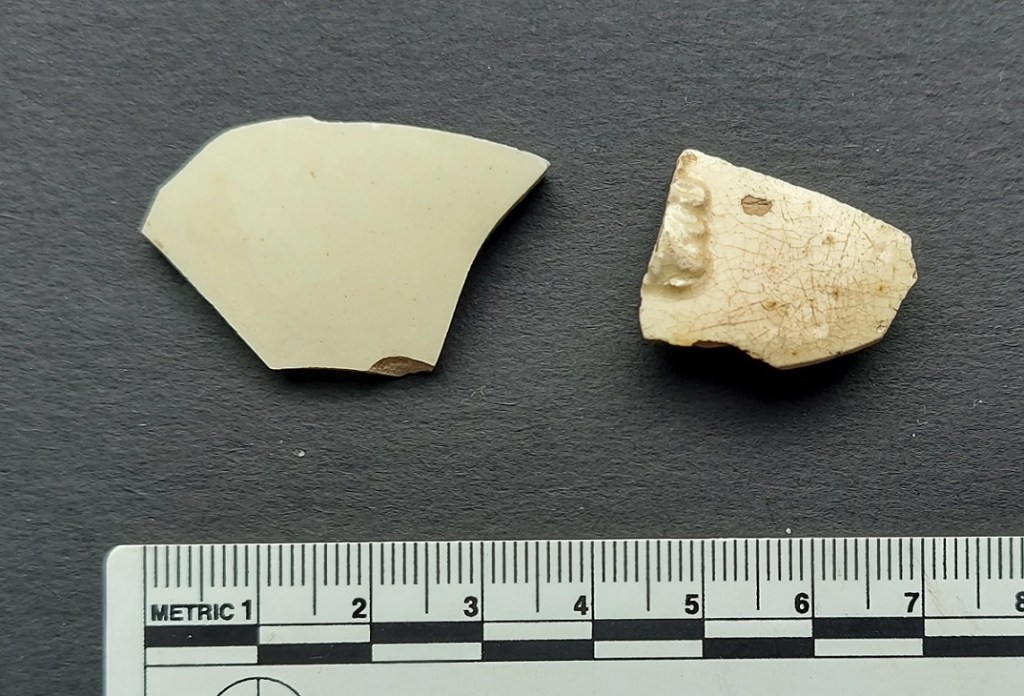
Two sherds of Creamware. The one on the right is particularly nice – a lid to a jug or similar with a moulded leaf design on the top.

Because the shape of the vessel is moulded, it means that it has very thin walls (the nice stuff does at least), but it also means that it can be very decorative, with all sorts of complex applied designs.

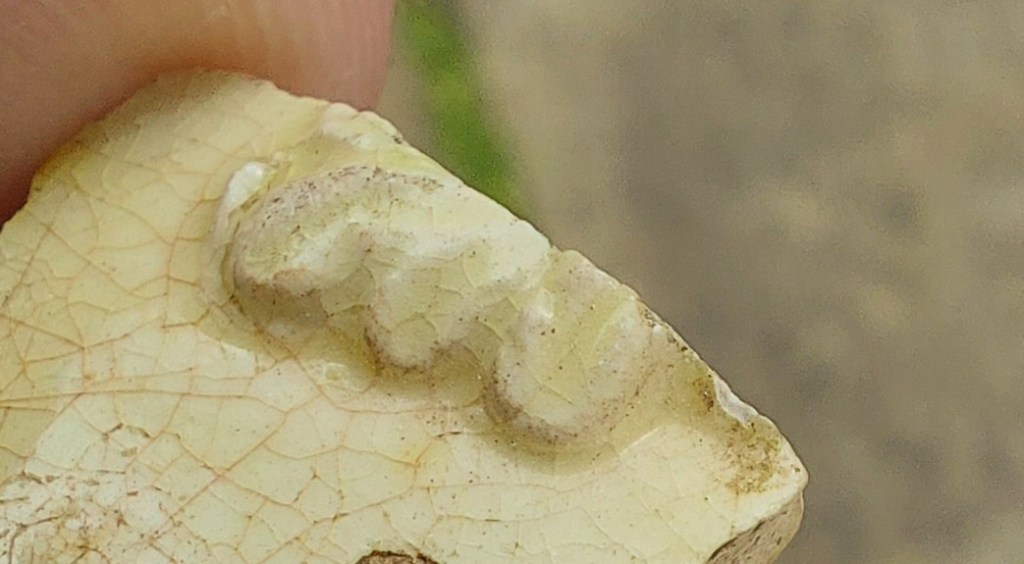
The fabric is a pale creamy white, achieved by mixing Kaolin, a very fine white clay, into the regular earthernware clay. This already pale clay base is then coated in a lead glaze mixed with copper, and fired producing the pale butter colour. Where the glaze has pooled whilst drying before being fired – usually on the base – you can sometimes see a greenish tint (the copper), which is a tell-tale sign of Creamware.

The greenish hue of the glaze can be seen where it has pooled in between the leaves.

It is also noticeably cream-coloured when compared with other white sherds. Creamware’s popularity waned after 1800, when it was overtaken by Pearlware, a cheaper, more pure white version of it.

PEARLWARE (aka Pearl White, or China Glaze)
DATE: 1780’s – 1820’s
DESCRIPTION: A blusish ‘white’.
SHAPES: Seemingly more utilitarian than the Creamware, but still a large range; so plates, bowls, dishes, jugs, cups, tankards, & goblets.

Pearlware is a refinement of Creamware, developed again by Wedgewood, in the 1780’s. It is almost like a less fussy, less fine, and more robust version, and there seems to be far fewer of the pierced vessels, ornateness, and incredibly detailed moulding. It does occur moulded, especially in tankards and Feather-Edged dishes, but it is less common than in Creamware. This may reflect the fashion of the time – a move toward simplicity – but equally it could be that Pearlware was conceived as more utilitarian.

The blueish tint of the glaze is obvious against the black background, and especially compared with the white clay.

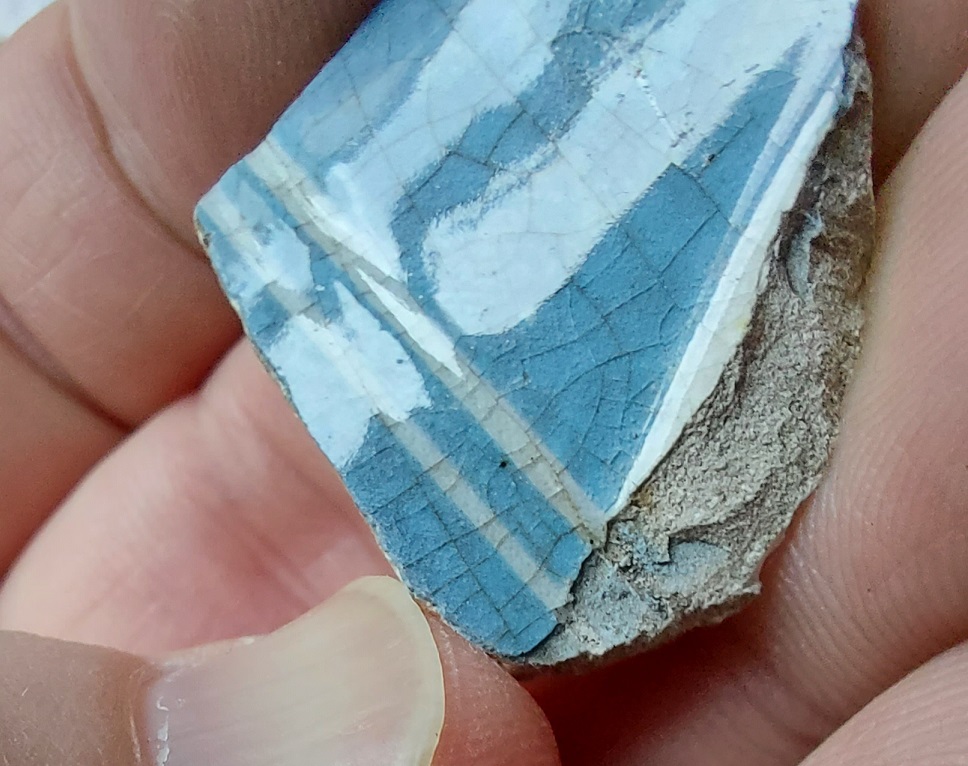
The whiteness in Pearlware was achieved by adding cobalt – a blue mineral – to the lead glaze, giving an almost blue glow to the pottery – a sort of trick of the eye. Again, the blueness is particularly noticeable where the glaze has pooled, often on the underside.

Here you can see the cobalt blue colouring to the glaze where it has pooled on the underside of this mug. This is a badly made mug, and the glaze has over-fired in places.

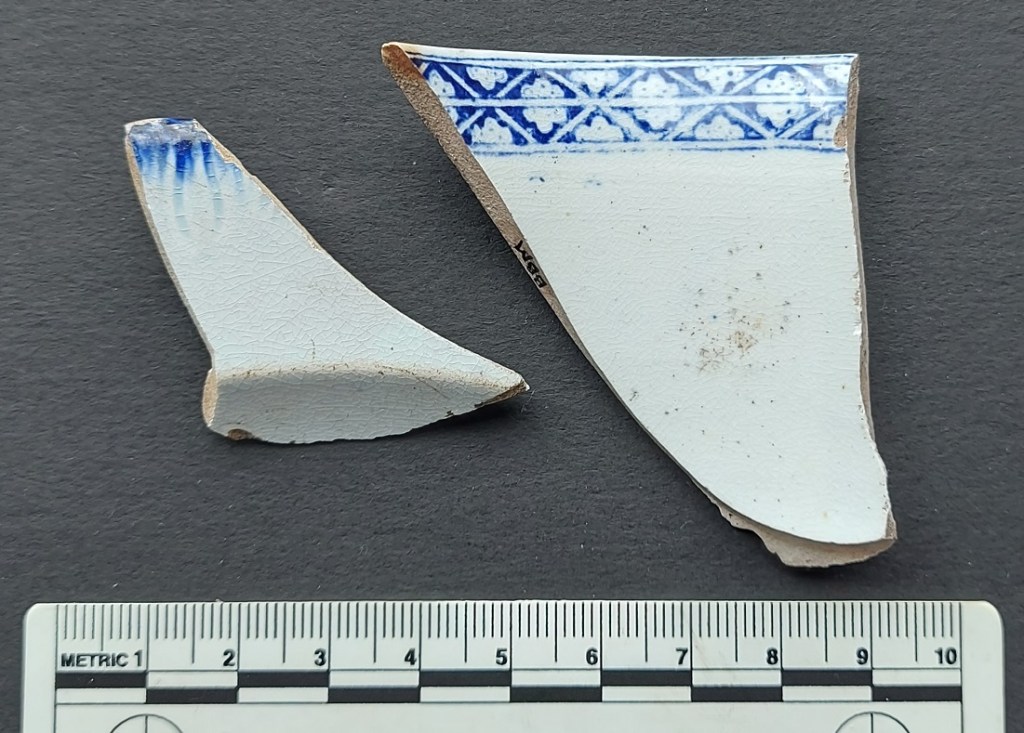
In terms of decoration, it could be hand painted – either as a pattern, or just the edges in Feather-Edged Ware (see the example in the photo above). However, it is more commonly encountered as a base for transfer printed decorative motifs – willow pattern and the like. It was also commonly used as a base for Industrial Slipwares (discussed here in Part 3 of the guide). Pearlware began to fall out of favour in the 1820’s, and was superseded by the development of Whiteware.

WHITEWARE
DATE: 1820’s – Now
DESCRIPTION: White fabric, with a white glaze.
SHAPES: Quite literally every shape.

Characterised by a very white fabric, with a white glaze, upon which all sorts of patterns and motifs were put; this is essentially the stuff that we eat from now. If you are uncertain, go into your kitchen, get a plate from Ikea, break it, and have a look at the break. That’s Whiteware.

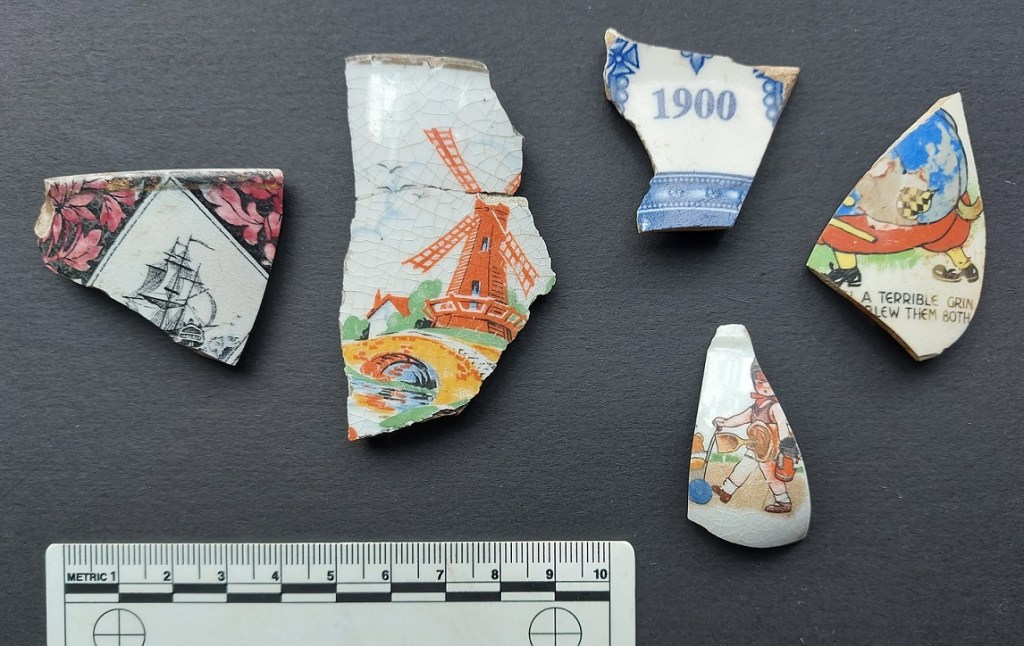
Cobalt use declined in the early 1800’s, perhaps due to difficulty and expense of obtaining it, but this coincided with the process of chemically refining the clay to produce a purer white becoming easier. And this, combined with better glazes, meant that a perfect white background colour could now be achieved. And not much has changed 200 years later. Well, apart from the fact the glaze now has less lead in it… which is nice. Decoration is, well, everything we can think of – painted, sponged, transfer printed – and is pictures, patterns, or words. This stuff is very, very, common, and largely boring even by my standards, but sometimes, precisely because it was used for all sorts of things, it throws up a gem or two.

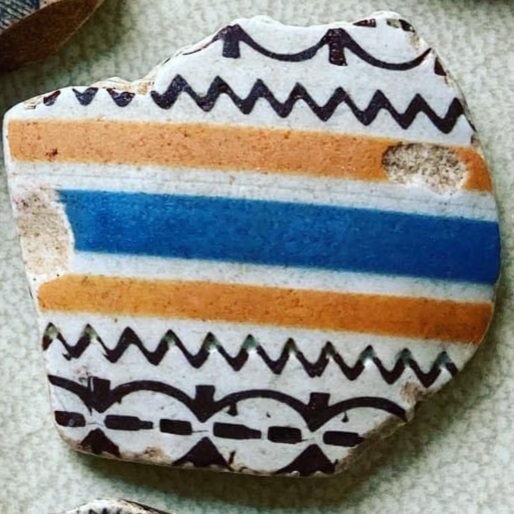
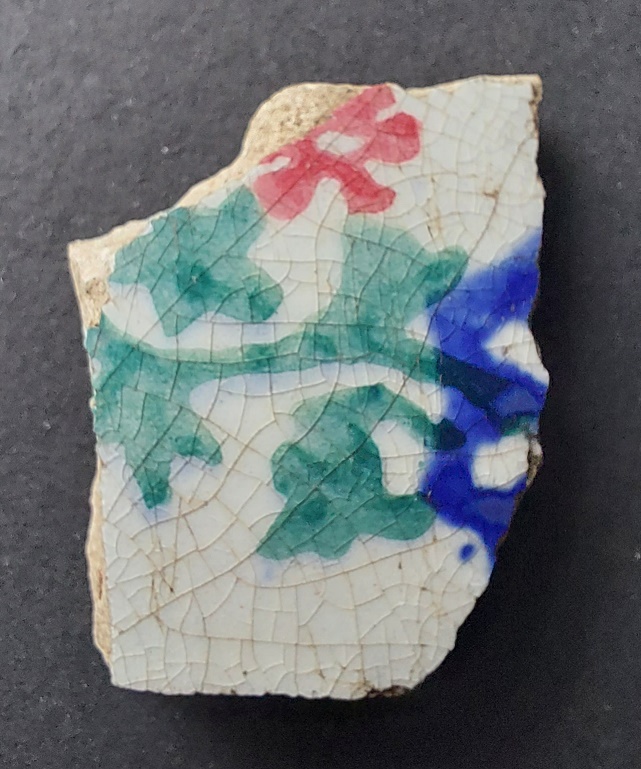
A selection of 19th and early 20th century printed sherds on Whiteware. This stuff is always a joy to find.

HOW TO TELL THEM APART.

Should you want to know which sherd is of what type, for whatever reason (and we don’t judge on this website), then it would be very helpful to put them on a plain white piece of paper under a bright light. In this environment, Creamware will appear pale cream coloured, Pearlware will appear blue-ish tinged, and Whiteware will simply blend in – like so:

The three types together: from left, Creamware, Pearlware, Whiteware.

So now you know.

Now, I admit that this wasn’t the most fascinating article (look it’s no use sobbing… I don’t force you to read the blog), but it is an important one in that it builds a more complete picture of post-medieval pottery, and means that you now know what I mean when I say Pearlware. I’ll leave it to you to decide whether that is a good thing or not.

That’s all for now. I have about another six half-finished articles which I will get around to completing very soon, including ‘magical protection‘, ‘quarries‘, ‘holed stones‘, ‘tracks‘, ‘updates‘, and your favourite and mine… some more pottery, but I’ll spare you that until later.

Right, until the next time, look after yourselves and each other, and I remain.

Your humble servant,

RH.

Archaeology · Pottery · Whitfield

A Green-Fingered Garden Grab*

*Ok, so I couldn’t think of a better title.

What ho, what ho, what ho!

So, right now, as we hurtle toward the solstice, is my favourite time of the year. Spring into summer – the days are long, my birthday is hoving into view (19th July, if anyone is interested… and a dark fruity red, if anyone is feeling flush). It also means time spent in the garden, planting and preparing the soil. Hamnett Towers is blessed with a small back garden (utterly destroyed by chickens… honestly, it looks like the Western Front), and a slightly larger front garden where the vegetables are planted. Both of these forces of nature – chicken and man – excavate all sorts of goodies. Predictably, I have kept everything I have found, and kept them separate; Hamnett Towers was at one point two separate ‘back-to-back’ terraced houses, so the archaeology of either side might tell a slightly different story (old archaeological habit). And so far, this year has produced some very interesting bits.

So, please join me in the garden. Ah, sorry, no shorts or baseball caps please – this is an English gentleman’s abode; t-shirts I can just about cope with, but I mean, a chap has to have standards dash it!

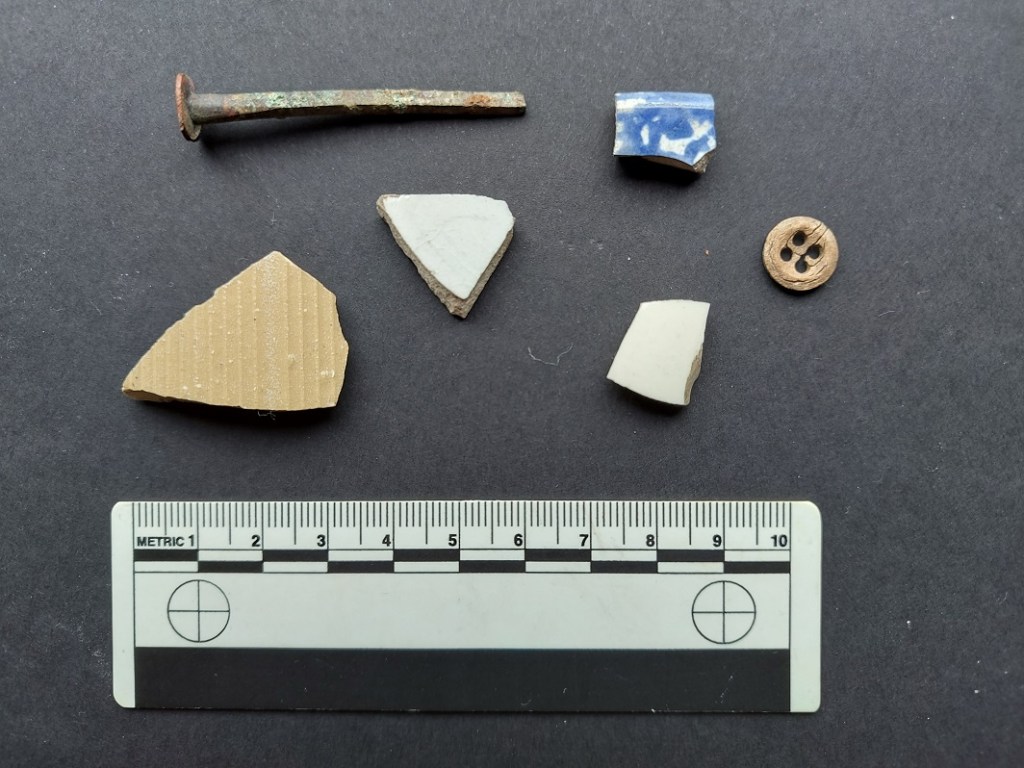
Here’s the day’s findings from the front garden:

A selection of the history of the land the garden has decided to show us this year… so far.

Let’s start with the nail – a Victorian, hand-made, copper roof nail, to be precise. I’m something of a magnet for these things, and they seem to find me wherever I go. They are truly mundane – the nail that holds on a roof tile – and yet are such lovely and tactile things (I’ve blogged about them before – here – FIVE years ago… blimey!). Copper was used as it is largely resistant to corrosion, and their square section is a dead giveaway of age.

Lovely green verdegris competes with rust (the result of it lying next to something iron based) on the surface.

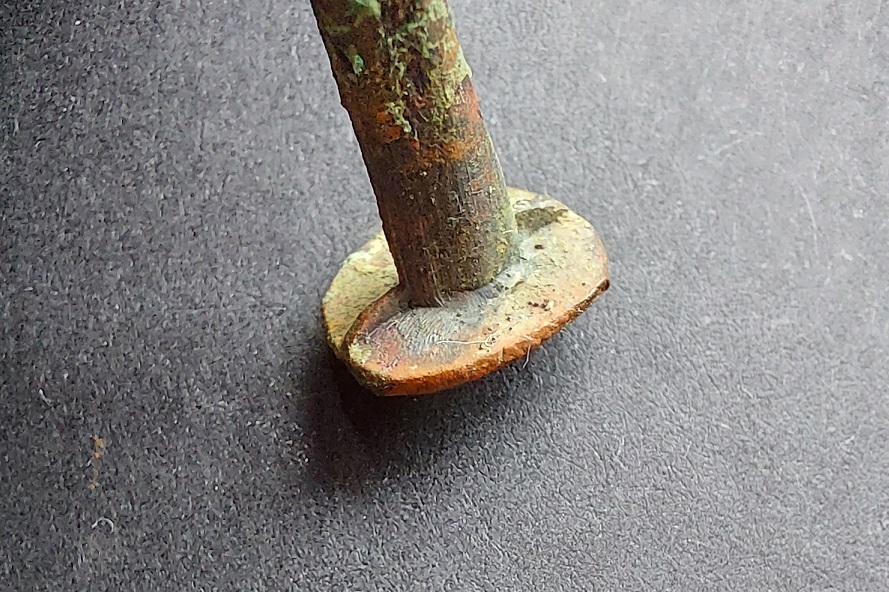
They are made relatively simply, but by hand. Each nail is cut via a press from a long flattened strip of copper (thus the square body of the nail). It is then placed into a small mold or former, point down, and the exposed top is hammered by hand until it flattens out, forming the nail head. Close-up you can see the two flashing strips formed as the soft copper is driven between the halves of the mold.

A close up of the underside of the nail head, clearly showing the copper flashing.

The nail may have come from my house roof, which is a great thought.

Next to the nail is a sherd of spongeware, probably from a large bowl or shallow dish. I find a lot of this particular vessel in the garden, and I might have to try and reconstruct it sometime (follow the link above, 3rd photograph down, on the right for more of the same bowl).

Next row, a sherd of marmalade/preserve jar (here, for more information), and then two thoroughly uninspiring sherds of white glazed pottery. Then, this beauty!

Super. An amazing chance find whilst whilst putting in some pea and bean plants… half of which were eaten on the first night by what can only be imagined as a biblical plague of famished slugs – honestly, I swear I could hear a very slow moving rumbling sound. If you’ll pardon the French… Bastards!

Wonderful! A small bone button, and almost certainly Victorian in date. Delicate, handmade, and slightly off-centre, it is lovely. Again, something so mundane – every item of clothing would have had a dozen of these; will people be cooing over the zips in our trousers in 100 years? And yet, here we are, admiring it’s beauty. Bone was such a common substance in the pre-20th century, and we tend to shy away from it as a material now – how many of us would brush our teeth with a bone toothbrush? Or use bone game pieces? I think we have become a little squeamish. Yet, it was a major resource in history – so many animals, so much bone. Bone preserves very well in the right conditions, and although this has cracked with age, I bet it could be sewn on and used again.

Right then, the image of the Somme, c.1916, that is the back garden. There’s always something that turns up here, not all of it interesting, but usually worth a look. And this year is no exception, with a couple of very nice finds.

A rather motley looking collection, I must admit.

So then… top left we have bonfire glass. Essentially glass that has been melted in a fire. This may have been accidental, or just the result of rubbish disposal. Often Victorian and later rubbish dumps were set on fire to keep the rat population down, and bonfire glass can be quite pretty. This one… not so much.

It’s quite a cool object, but not particularly pretty.

Ignore the next sherd for the moment, and move onto the cream coloured stoneware sherd, possibly from a flask or other oval shaped vessel. Then we have some glass – it is quite chunky, which indicates it is old, but isn’t that lovely green colour, nor full of bubbles, that would indicate a Victorian date. Probably Early 20th century, and likely from a small bottle – perhaps medicine or similar.

Ignoring the other reddish coloured sherds, again for the moment, we have this beauty:

You can see the striations caused by wiping the red under-glaze slip with a wet rag – the marks of the potter preserved for eternity in clay. Lovely stuff!

This is often called Pancheon Ware, after the large (50cm+) pancheon bowls that were extremely common from the 17th century to the early Victorian period. The correct term should be Post Medieval Redware, but that covers a multitude of pottery types and shapes from c.1550s to the Victorian period, of which this is just one.

Essentially a large mixing bowl, bread proving bowl, or vessel to allow cream to separate from milk. This is a lovely antique example, the image of which was stolen from this website which sold it for £195.

They often occur in huge chunks up to 2cm thick, and are usually glazed only on the interior to make it waterproof. I’ve talked about them before, but this is a nice example, showing the red slip on the surface, and then the dark brown glaze, made by adding iron oxide to a lead glaze, producing the deep shiny colour. The glaze on this, as with many, has been allowed to slop over the side and stop just below the rim, producing a messy natural decoration (the example above shows the glaze stopping on the rim, but you can see the effect they are going for).

Below and right of this sherd there are 4 sherds of standard Victorian to mid 20th century whitewares nothing inspiring, or even particularly worth writing about, although there is a rim of a bone china cup. Below and left is a single fragment of a clay pipe stem. Again, nothing exciting – the hole, or bore, through the middle of the stem is narrow which tells us that it is Victorian in date (broadly, a wide bore = 17th to early 18th century, a narrow bore = late 18th to 19th century). Still, it’s a bit of social history… I just wish I could find a bowl!

Then there was the treasure! Occasionally, certainly not often, I find something made of metal. And a few weeks ago, as those who follow me on twitter will know, I found a metal button.

Tiny, just 1cm in diameter, and very delicate. Amazing it survived, to be honest. And even more amazing it was seen.

Well, no… credit where credit’s due – I didn’t find it, Master Hamnett did, with his six year old eagle eyes. A lovely little 2 eye brass button, probably Victorian in date. It’s probably from a child’s dress, probably something like this:

A heavy linen dress for a child. It is beautifully decorated with hand-made edging.

And if you look closely using a decent magnifying glass, rather than the dodgy macro setting on my phone, you can see the remains of the original cloth that would have covered it:

Amazing that the cloth has been preserved, trapped between the two sides of the button’s lip.

It would have looked like this when new:

Small and delicate, and lovingly sewn on.

The thing I love about this is that the child must have lived and grown up exactly where Master Hamnett is now, and doing many of the same things. There is real sense of connection to the past through a single, small and dirty, seemingly uninspiring object. By the way, the story of the Victorian child’s dress (one of several, I hasten to add) is for another time, but it is from a probable apotropaic cache that was donated to me for safekeeping. One of two I now curate. I really don’t have enough time to write all this up, so if someone want to donate a stack of cash to allow me to write, please feel free!

And now this, the real treasure. Quite literally, for once.

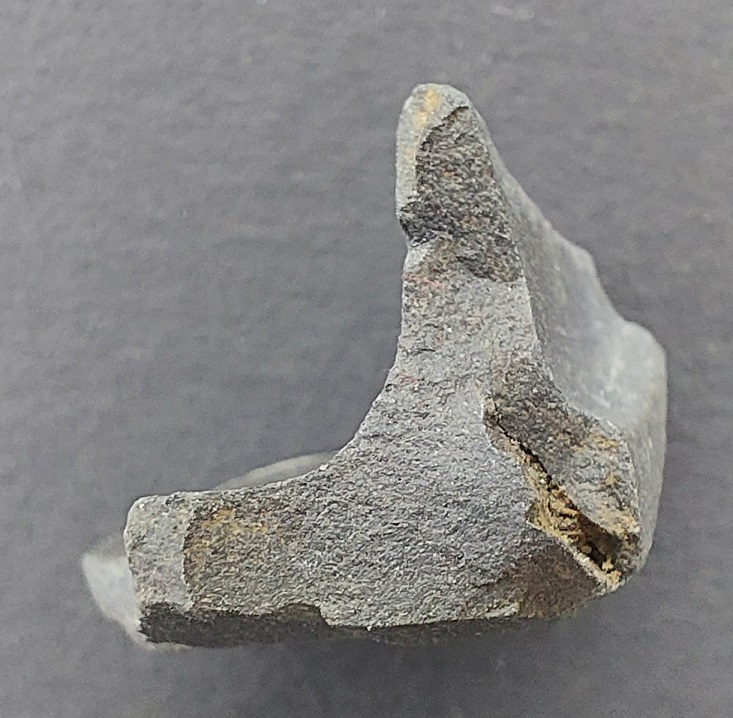
Gnarled is the word. I had no idea what it was when I picked it up.

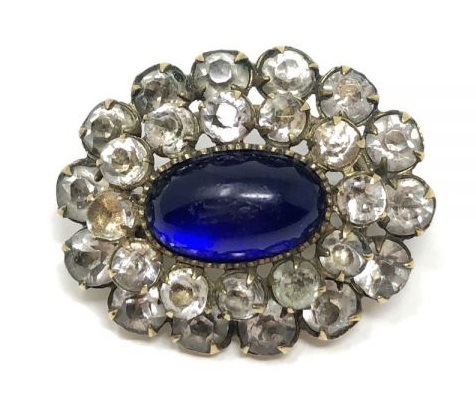
I know at first glance it looks like something has blown it up, but look beyond that, and it’s a wonderful, if completely knackered, piece Victorian costume jewellery brooch. It’s missing just about everything, including the central glass stone, but would have been very pretty – probably looking something like this:

Picture stolen from this website… the brooch is still there. Honest, guv.

I didn’t know what it was when I picked it up, but it was that greyish green that indicated a copper alloy (brass or bronze, for example), and is something I always pick up. It was only when cleaning it that I noticed the paste stones.

You can see the cut paste stone in it’s setting, and all the other setting missing theirs. There are three stones still on the brooch, and very little else.

Amazing, really. And this was just a small amount of time poking around, getting really close and personal with the soil in my garden. And my garden is not unique by any stretch, not even close. I guarantee, every garden in Glossop – no, the country – will produce some treasure – whether it’s early Victorian annular ware from a house near the station, a broken bottle rim from a former pub, a pipe stem from a current pub, or a piece of Victorian child’s plate from a modern garden in Simmondley (all examples from experience). Obviously, I realise that not everyone is lucky enough to have a garden, but we all can access some green space. As an experiment, this evening, pour yourself a drop of the stuff that cheers, and go and sit on what ever patch of earth is closest to you. This may be your garden, or it might be a park, or someone else’s garden, a playing field, or public footpath, or whatever. Now sit down and take a deep breath, listen to the sounds – birds or traffic – tune in, and simply look around you. If you can, dig about a bit, and don’t be frightened of getting your hands dirty, either. With enough time, something will turn up. And please, mail me the results.

Right, that’s about it I think. Next time more pottery – essentially a part 2 to this post, looking at the pottery I told you to ignore above. A competition! If you can get back to me and tell me what they are, and why they are not our type of thing, before I can post the next article, you can win those bits of pottery. Woohoo! (Now look here, Mr Shouty… some people like pottery, you know. And no, I’m not “having a laugh“).

More very soon, but until then, look after yourselves and each other.

And I remain, your humble servant,

RH

Archaeology · Pottery · Pottery Guide

The Rough Guide to Pottery Pt.3 – Industrial Slipware

What ho! What ho! And, if I may be so bold… What ho!

Well, as promised, here is the second post in the month of May. At this rate, I might make three posts… but let’s not tempt fate.

And also as promised, it’s a pottery one! Now, I know, I know… pottery is not to everyone’s taste (I say! Look here… calling me a “pottery obsessed hobbledehoy” says more about you than it does me), but it is important. And besides, it’s my blog!

Part 3 of the guide looks at ‘Industrial Slipwares’ – a broad group of commonly encountered Late Georgian and Victorian pottery (roughly 1780 to perhaps the 1850’s, and later). The term Industrial here refers both to the method used to make them – in factories, and often employing machines – but also in order to distinguish them from the earlier handmade 17th and early 18th century ‘Staffordshire’ type slipwares (which I’ll cover in a later post… you lucky folk, you). Originally called ‘Dipped’ wares, the process employed in making them involves dipping the formed clay vessel into a coloured slip – essentially a thin solution of clay suspended in water – and firing it. It is then glazed and fired for a second time to produce a hard-wearing pot. In terms of fabric, it is a fine earthernware with thin walls, in a clean white fabric – originally a Creamware or Pearlware, but later (1830’s onwards) a standard Whiteware.

Fabric. Ahhhhh… fabric. Creamware, Pearlware, and a plain Whiteware.

Originally very fashionable amongst the elite, by the early 19th Century Slipware begins to lose its social status, until eventually it becomes a utilitarian ware of the commoner, very much associated with pubs and taverns.

I have to say, some of this stuff looks decidedly modern – particularly the stripey stuff – and their bright colours and bold slick designs must have been a welcome antidote to the often drab creams and endless blue and white transfer printed stuff that dominated the period. The emphasis is on natural, earthy, almost pastel-coloured slips – brown, blue, green, orange, yellow, grey, and violet are favoured. I have to say, though, that some of this stuff is a tad on the garish side, and wouldn’t look out of place in a Wild West Bordello. Not that I would know what that would look like. Or indeed have any knowledge of such places. At all. In fact, I don’t know why I said that. Anyway… moving swiftly on.

Ahem… the pottery, then. Broadly speaking, there are 5 types that can be readily identified, although there is some crossover between them, as you’ll see.

  1. Multi-Coloured (aka Variegated) (1780 – 1820)

Patterns of slip are made from multiple colours and smudged (the correct term is Joggled), giving a psychedelic effect that you either love or hate. Common patterns are the Cat’s Eye, Earthworm, Fan, and a nightmare-fuelled, migraine inducing, all-over slip. The crucial identifier is the joggled coloured slip.

An ‘earthworm’ design on a Variegated bowl. You can see how the slip decoration was applied in three colours, and then ‘joggled’ to make the wormlike decoration. These sherds are courtesy of The Blackden Trust, where I work. An amazing place where history and creativity collide… well worth checking out.
The nightmarish ‘all over’ decoration.

2. Mocha (aka Dendritic) (1780 – 1890)

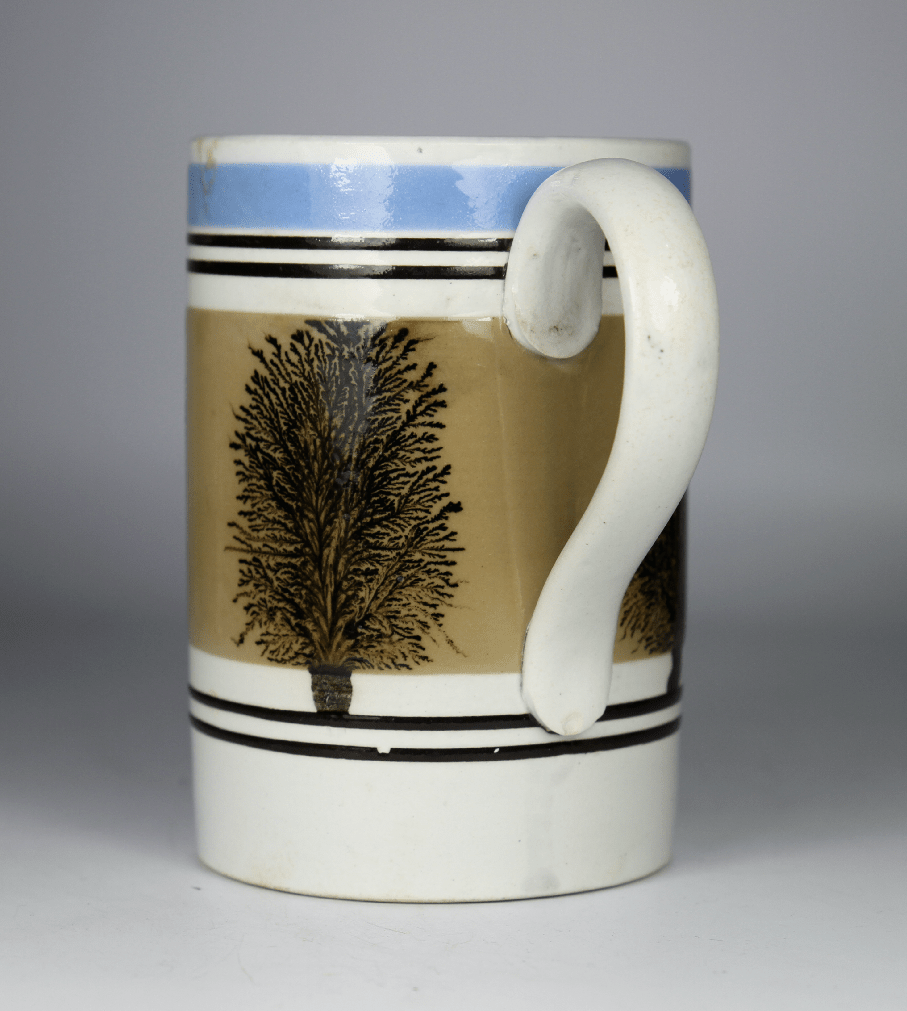
Here, the slip is applied, and a substance – boiled tobacco juice, or urine, for example – was applied whilst still wet. This diffused producing the characteristic treelike (dendritic) decoration in a dark blue or black colour. Commonly associated with banded decoration (Annular, below) and in a brown or cream slip. Popular, but largely of early to mid-19th century, and less common later in the century. 

Two sherds of Mocha or Dendritic pottery. It’s difficult to get an understanding of what the whole looks like, so here is a shamelessly stolen photo from ebay…
You can buy this tankard for a mere snip of £125 here. You can get an idea of how it looks, though.

3. Engine Turned (1790 – 1880)

This looks particularly 20th century. Here the slip is applied one over another, and the vessel is turned on a lathe, with the upper slip removed by machine, revealing the contrasting colour below. Vertical stripes, horizontal bands, and patterned geometric designs are all common. Painted designs were also applied using a machine, creating complex linear bands. Mainly early 19th century in date, and particularly associated with Pearlware, so is much less common later. 

Sherds of Engine Turned, showing the patterns created by machine – putting the ‘Industrial’ into industrial Slipware.
An excellent example of the complex painted and turned designs found on Engine Turned pottery. Sherd is not mine, alas. It belongs to a friend, Helen D.
Good close-up of a sherd showing where the slip removed to create the pattern.
Another close-up showing the grooves… groovy! Sorry, that was terrible – although I think I got away with it as no one seems to read these captions.

4. Banded (aka Annular) (1780 – 1890’s)

Simple horizontal bands of slip are painted on using a lathe in the manner of Engine Turned above, producing precise clean lines. Commonly contrasting blue and white, but also in browns, yellows, and creams. The banded decoration is also a large part of the decoration of the above three types, particularly Mocha, so there is considerable overlap. Also, the simple basic theme of bands continues into the 21st century, particularly in Cornishware pottery. 

A selection of Annular pottery. The stripes were applied using a lathe, rather than by hand, hence their precision and uniform nature. This photo also gives us a sample of the kinds of colours that Industrial Slipware used.
The distinctly modern looking blue striped pottery, a predecessor to the Cornishware type you can still buy.

Date wise, it’s difficult to distinguish. My feeling, based on some evidence, is that prior to about 1840 Banded Ware used the browns, yellows, blues, and greys seen above. After that date however, banded decoration was confined largely to blue banding. Now, this is not absolute; the date is flexible; date of deposition is different to date of manufacture; ‘absence of evidence’ is not a strong argument; and it may even depend on such variables as availability, and even personal taste. But as a rule of thumb, I think it stands.

5. All Over (1780 – 1890’s)

The vessel is slipped, inside and out, in a single colour of the earthy colours common in Industrial Slip Ware, and then fired, producing a surface that is uniform in colour and treatment. Common in the 19th century, but less so as the century went on.  

Lovely stuff! The plain, All Over pottery.
The rim of a delicate tankard or mug. Beautiful colour, fantastic detail – this would have been lovely.

In terms of shapes, Industrial Slip Ware is exclusively a tableware, and very much liquid focused, so elegant mugs & tankards are common, as are jugs, and more rarely bowls.

Right then, armed with this new found knowledge, go forth and find! Honestly, this stuff shows up everywhere, in particular the banded Annular ware (very common in blue and white). Don’t forget to email/tweet/post any examples you find. I’d actually like to start posting finds that other people have found – a community of sherd nerds, if you will! So please, get in touch.

Honestly though, my life of late has been very busy, and increasingly I have started to realise that I am very bad at multi-tasking – meaning I can focus on only one big thing at a time – hence the lack of blog activity. I recently lead a Wan.Der (a curated historical walk, in association with the Glossop Creates mob). I thoroughly enjoyed it (despite the public speaking terror), and it seemed to be successful, which is nice – watch this space for news of others coming up, both more of the same, and new ones, too.

I’ve also started to upload some video onto the Glossop Cabinet YouTube account – there isn’t a huge amount on it at the moment, but more is coming soon. You can check it out here.

Right, that’s all for now. More later… I’m on a roll! But until then, look after yourselves and each other, and as always, I remain,

Your humble servant.

RH

Dinting · Mason's Marks

Mason’s Marks at Dinting Arches

What ho, kind and gentle folk of the Glossop-based blog reading world!

Firstly, please accept my apologies for the lack of activity on the blog as of late. I have been surprisingly busy in both my work life and my actual life, and have somewhat neglected the blog, which is frankly not on. I will atone for my sins by posting twice this month – this post, and another part of the “Guide To Pottery”. (What’s that…? Hmm? Look, it’s no use shouting “Dear God, spare us the pottery“, and no, I won’t “curl my hair with it“, thank you very much. No one is forcing you to read the blog, you know. Honestly, the nerve of some people.)

There is all sorts of exciting blog related news, more about which soon, but for now on with the show, so to speak.

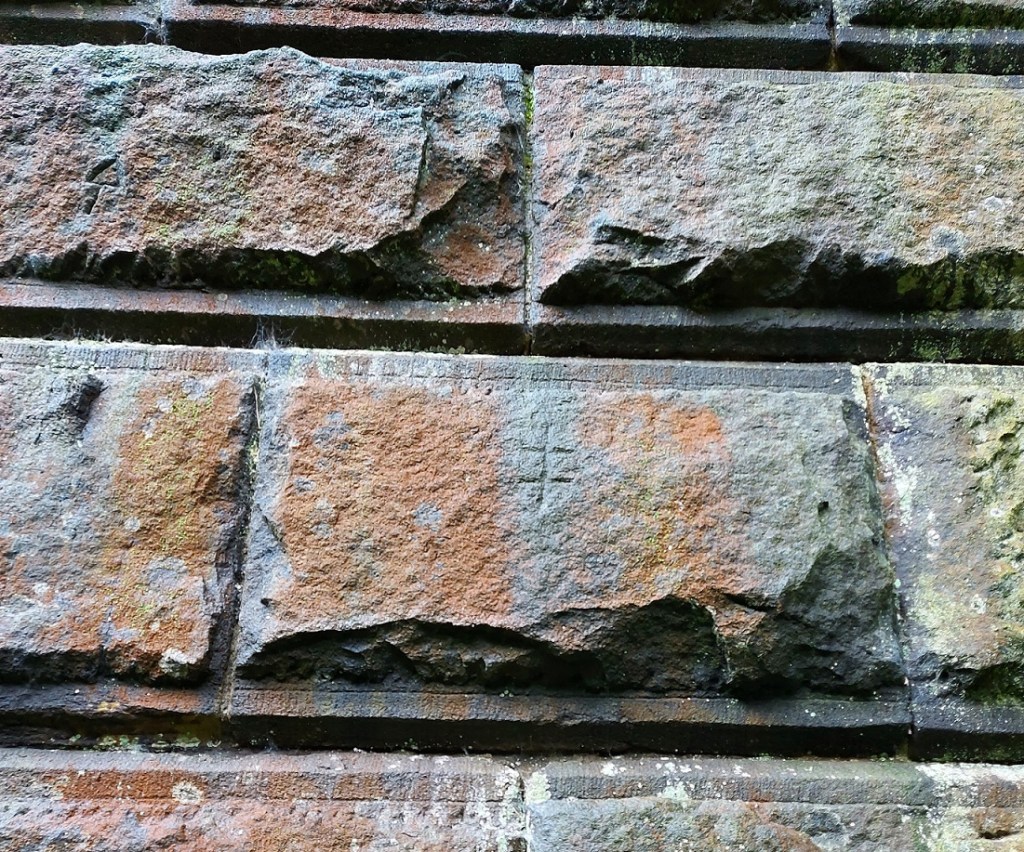
As regular readers will know I do love a good carved stone or two, and from graffiti to bench marks, I am always interested. However, one category of carving in particular holds a fascination for me, and that is the mason’s mark. I have blogged about them previously, and regularly post them on Twitter when I see them around and about, as there is something about them I find captivating.

Briefly, mason’s marks are the unique signature of an individual stonemason, made using a chisel onto the stone they had finished carving or shaping. The reason for this was ostensibly two-fold. Firstly, the stonemason was hired on a piecework basis – he was paid for each stone he finished, so it was important that ownership was established.

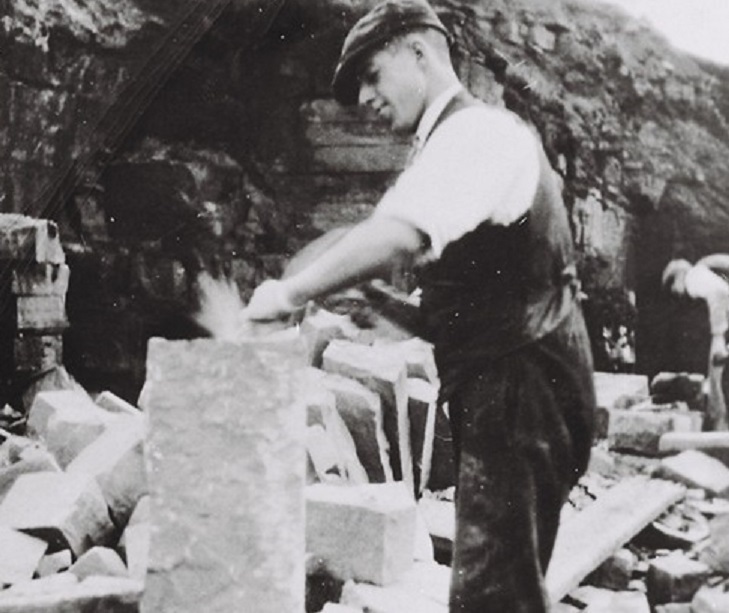
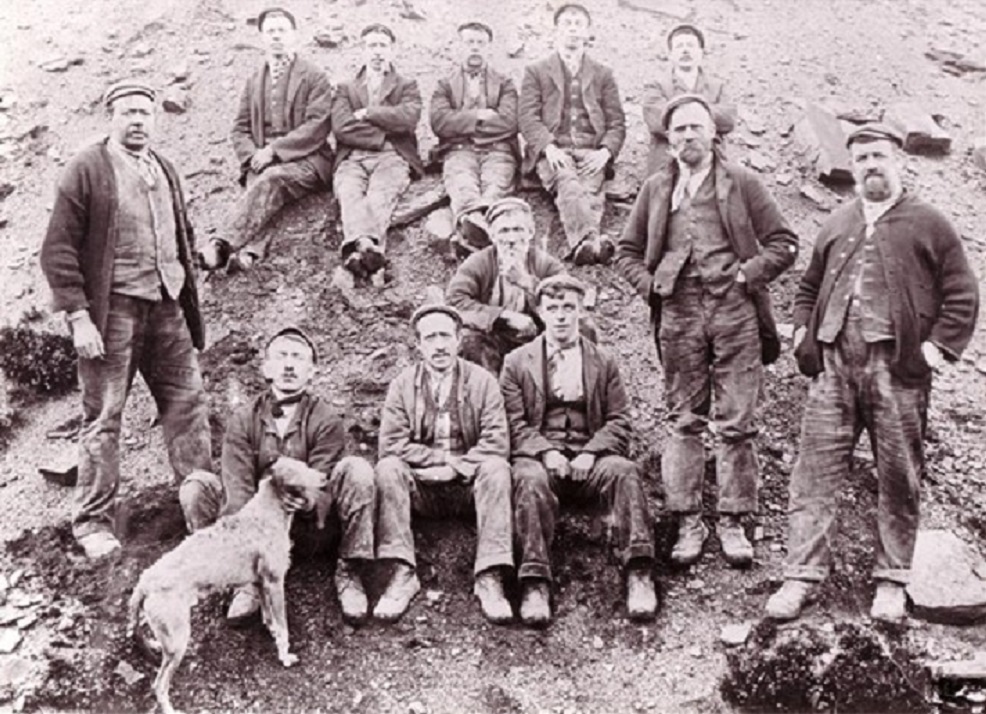
A quarryman of the Victorian period.
Some more Victorian quarrymen.

Secondly, it acted as a form of quality control; each stone was inspected and finished by the mason, with any flaws or issues noted, their reputation, and thus livelihood, being based on their work. It also meant that substandard work could be traced to an individual. But beyond this, I suspect also that making their mark was important to the masons themselves – a sense of pride in their work, to be able to stand back and say “I made that”, and being able to point it out to their children or grandchildren. It gave a sense of agency to the stonemason, allowing them ownership in both senses, and making them feel as an individual, rather than simply a cog in a much larger machine. This is a hugely important point, and the reason for my fascination with them: these are the personal signatures of the men who carved those stones, men who almost certainly couldn’t read, and most of whom couldn’t sign their name beyond an ‘X’. Indeed, it is entirely likely that, sub-contracted by a foreman, their names wouldn’t be recorded elsewhere either. Thus, these simple geometric shapes are all that remains of the men who built Dinting Arches, testament to their skill and backbreaking labour; this is them signing their work in the way an author does their book, or an artist does a painting. The silent stones speak for them.

Quarrymen in the Victorian period. Image taken from the very interesting Valley of Stone website that looks at the stone quarrying and masons of Rossendale – it tells a fascinating story of the men and their lives. Well worth a visit by following this link

Because I am that kind of person, I have a larger project in mind. Between 1841 and 1847 (ish) the line between Broadbottom and the Woodhead Tunnel, and including the branch line to Glossop, was completed. A massive undertaking, costing enormous amounts of money, and involving huge numbers of men, in that 6 year period, millions of tonnes of stone would have been blasted, shaped, finished, transported, and fitted into place. At some stage, most of the stone would have a mason’s mark put onto it. Not all survive – they might be placed with the mark facing inside the construction, or it might have been removed during the final finishing once the stone was in place. However, dotted around the railway lines – the bridges, underpasses, tunnels, retaining walls, as well as the two viaducts – some marks are still visible. I thought it might be a fun* – and worthy – thing to do to survey all the remaining railway stonework to see what is there, and to make a note of the mason’s marks before they disappear, and the lives of the men with them. We could also see how many match at different points along the track, indicating that the same men were working in different locations. I’d also like to see if any records exist of the men – quarrymen, rough shapers, or finishers – and see if it would be possible to put a name to a mark. Highly unlikely, I know, but you never know.

(* yes, I am painfully aware that ‘fun’ is a very subjective concept… as is Mrs Hamnett)

One has to start somewhere, and so I thought I’d give Dinting Viaduct a go.

An early image of Dinting Arches – taken before 1914 when the brick pillars were inserted. Interestingly, you can also see the track at Adderley Place that originally ran under the arches at the far end, but which is now filled in.

The technique is relatively simple; using eyes and binoculars, I surveyed all the stone I could see, taking a drawing of all the different marks I could make out, and taking photographs, where possible, of good examples of marks (I need to go back and highlight some in chalk). This is not rocket science, or indeed any kind of science, it’s a bloke with some binoculars and notebook. I compiled all the data, numbered each mark, uploaded the photographs, et voila… you are reading the result. Please enjoy. Or don’t, as you wish.

Some broad observations. By and large, the marks are placed centrally in the stone block, only occasionally toward the edges. It seems that only the more ‘natural’ looking blocks contain a mark, and particularly those on the lower courses. The other blocks seem to have been roughly dressed, a process which may have removed a mark, were one present. As expected, the marks are largely constructed from straight lines, with marks D1, D19, and D23 being the exceptions – straight edges are easy to carve, circles less so. The execution of the carving is often poor, with little precision shown – one wonders if they were done with speed before moving on to the next stone, after all, time is money for these men. It must also be remembered that, talented though they undoubtedly were, it is unlikely that these were the fine master-craftsmen who were carving scrollwork and lettering. Rather, they were focused on shaping the stone – accurately and with skill – so that it would fit.

So then, these are the marks, and in a sense these are the men. It is important to note that I have not included inverted example as separate – for example, mark D5 occurs both with 2 points up and with 1 point up, but as the mark was carved prior to it being installed, which way up it is depends entirely on which way up the stone was installed. Conversely, marks D1 and D19 might be the same stonemason’s mark, but the fact that D18 is off-centre in that the lines aren’t paralell to the rectangular edges as they are in D1, suggests they are two different men (unless he was carving it at an angle). It is also possible that some of the different marks noted here are actually the same mark which has been worn or damaged, leaving only the partial mark that I have transcribed – D6, D9, D13, and D15 for example.

So then, what did I see? A selection…

A type D1 carved into the stone.
Types D8 and D19 amongst others. This image makes me feel distinctly weird… I hate looking up under there.
D2 & D6
D15
The fantastically complex D14 – impressive! And another above it.

I could go on, but you get the picture. The whole of Dinting Arches are covered in mason’s marks, and it is well worth a trip down – it’s a fascinating bit of architecture, and of Glossop’s history. Below is the page of marks in my notebook, and I feel certain more are waiting to be discovered.

Here are the 25 marks so far identified. As I say, this is an ongoing project that will theoretically start at Broadbottom, and continue to Hadfield and along the Longdendale Trail to the Woodhead Tunnel.

I will move on to another section of the railway soon, and if anyone fancies joining me, drop me a line – many hands make light work! I’ll post the results, and see if we have any matches.

Right ho, another post soon… I promise. Until then, look after yourselves and each other, and I remain,

Your humble servant.

RH

Archaeology · Pottery · Pottery Guide

The Rough Guide to Pottery Pt.2 – Spongeware.

What ho, dear and gentle readers! Well, here we are again… pottery time! The second part of the Pottery Guide has hoved into view, and what a treat we have for you. I am going to go ahead and apologise in advance – it is heavy on pottery, but useful and fun, I hope. (Can anyone else hear that groaning and wailing… and gnashing of teeth. And no, no I don’t care about your “sainted aunt”, whoever is shouting).

SPONGEWARE
DATE: 1830’s – 1900’s
DESCRIPTION: Colourful repeated patterns printed with a sponge on a white background.
SHAPES: Bowls are very common, cups, mugs, tankards, small plates, larger plates, and jugs.

Wonderful, cheerful, simplistic, and yet incredibly attractive (not me, madam, but thank you). I have an almost childlike obsession with this pottery type, and it always makes me happy when I find some. Spongeware is characterised by shapes made with a natural sea sponge dipped into a coloured slip and dabbed onto a white background. The pot is then glazed and fired. The sponge is either applied all over, or it is cut into geometric shapes (diamonds, concentric circles, spirals, stars, zig-zags, swirls, etc.) or naturalistic forms (flowers, leaves, shamrocks, etc.), and dabbed in repeated patterns around the vessel.

20220211_141443
1. Spongeware. Lovely stuff, in pastel colours and very pleasing designs.

These patterns and shapes are fuzzy at the edges (the result of the sponge effect), are sometimes combined with hand-painted decoration (bands, blobs, leaves, etc.), with colours of a limited and pastel palette – light purple, blue, light green, yellow, pink, light red, etc.

2. In addition to the sponged designs, we can see here painted flourishes and designs.
3. The designs can be printed all over, rather than in discrete patterns. The grey painted sherd, bottom left, is an example of what is sometimes known in America as ‘Spatterware’.

The pottery itself is normally of a fairly poor quality Pearlware (pre-1850) or Whiteware, with a earthernware fabric that is white or off-white.

4. Fabric – white or off-white bog standard earthernware. You can see the painted decoration in section here, overlaid by the glaze.

Sherds can sometimes be found broken with jagged rather than smooth edges, indicative of a low temperature firing and poor quality clay. Lovely though it is, it is Spongeware is not high quality, but it is the very essence of cheap and cheerful. 

5. The poor quality of the glaze is very clear here.
6. One of my favourite sherds, up close. You can see the way the decoration has been applied. You can also the jagged edges that indicate poor quality pottery, and the crazed glaze, possibly the result of heat, or more likely, a poor glaze.

Spongeware is often associated with Scotland where it was made in great quantities, but there were also manufacturing centres in Stoke on Trent and other parts of the Midlands. These vessels were mass produced – probably ‘sponged’ as piece work at home (and thus probably by women) – and supplied to a ready market that wanted a more colourful, and cheaper, pottery than the transfer printed material that dominated the market.    

American studies indicate there are broad chronological variations within the ware group. America and Canada were huge export markets for Spongeware, and given the relative newness of their country in terms of European material, a lot of research has been conducted on even the smallest and most common bits of pottery that would be overlooked here. The three variations within Spongeware are:
All-Over:
Densley packed, the natural random patterning of the sponge is used to cover the whole vessel, or dabbed in distinct areas – the upper part of bowls for example. Spatterware is the American name for this type of pottery, as it looks as though the paint has been spattered on randomly, occasionally in several colours one over another. Looking closely, it is possible to see the tell-tale repeated patterns of holes in the unshaped natural sponges (Photo 3 above). This type appears to have been most popular up to the 1860’s.   
Cut Sponge
Here the sponge was shaped into neat geometric and naturalistic forms, and the patterns repeated. Starts in the 1840’s, and is popular until the 1880’s. The addition of painted decoration to this form seems to appear in the latter part of the 19th century and last into the early 20th century (Photos 1 & 2 above).
Open Sponge
Similar to Cut Sponge, but the shapes are more natural and less regular, rigid and geometric. This type seems to have been most popular from c.1850 to c.1900 (the blue sherds in Photo 3 above).

This stated, there is a lot of overlap between styles, and I’m not convinced the chronology is as straightforward as that. Also, does the American market reflect what was happening here? As I say, it is a broad guide, use it as you will.

Spongeware, in it’s modern incarnation, is still a popular design for plates, and Hamnett Towers has a dinner service decorated with designs made using this very attractive style. I should invite you all for cocktails and a slap up feed, and you can have a look (black tie, of course… I have standards).

Right ho, that’s it for this week. I have a few, less pottery focused articles in the pipeline (what do you mean “praise be”? Honestly, some people.) which I’ll get on asap. My life is fairly jam packed with Glossop related archaeology and history at the moment, which is great, if a little scary! I am working with the good folk of Glossop Creates developing a walk that involves history and bits of pot… watch this space. I was also recently in the Glossop Chronicle (read it here – the edition is dated 3/2/2022, and it’s page 11), and the Glossop Creates blog, too. The organisation, based in the historic gasworks on Arundel Street, has some wonderful and big ideas for the town, and deserves to be lauded from the rooftops for their vision. So there!

More about this, and other exciting things, next time, but until then, look after yourselves and each other, and I remain.

Your humble servant,

RH

Archaeology · Pottery

What Larks, Pip!

What ho, Glossop!

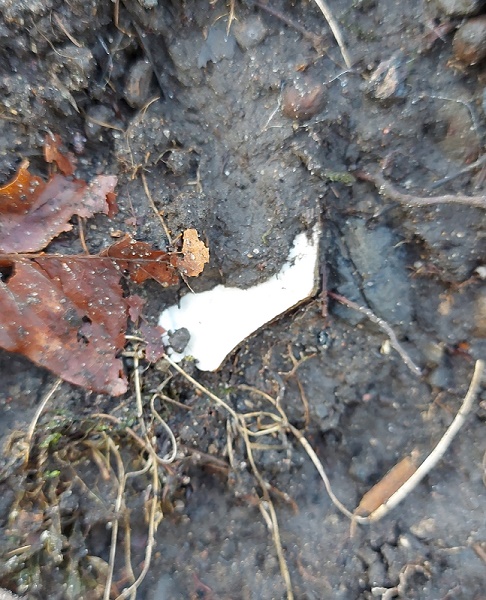
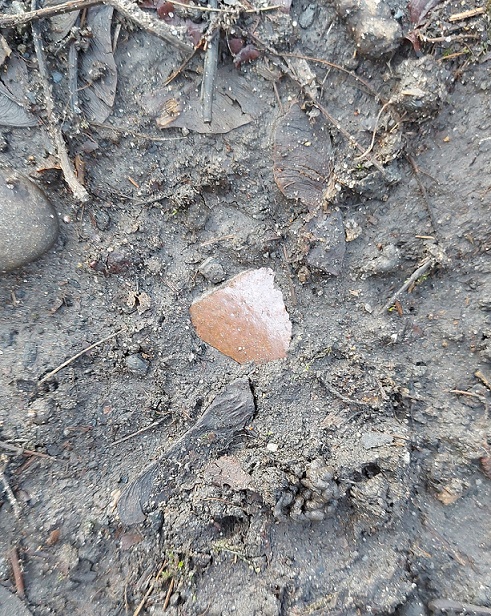
I was going to do another installment of the Pottery Guide, but one doesn’t want to over-egg the doodah, if you know what I mean… too much of a good thing can be a bad thing. So today’s quick post will be a visual record of a short mudlark I did at Harehills Park on the way to the shops the other day. A crisp and clear, but very cold, day, with a lovely winter sun for company, I noticed a piece of pottery gleaming white against the mud.

The sherd in its natural habitat. Shhhhh, don’t frighten it!

Hell-lo!” I thought, and dove in lightning fast in case someone else beat me to it. You know how people are for pottery round here, you have to be quick, I can tell you. I once nearly lost an eye in a tussle with an old lady over a piece of feather-edged ware… knitting needles are ferocious weapons when wielded by the highly trained and woolly hatted. But I won the day, the sherd was mine… and I still wear one of the bounder’s ears on a chain around my neck as a memento. But I digress…

So, ninja-like, I pounced on the pottery. Victory!

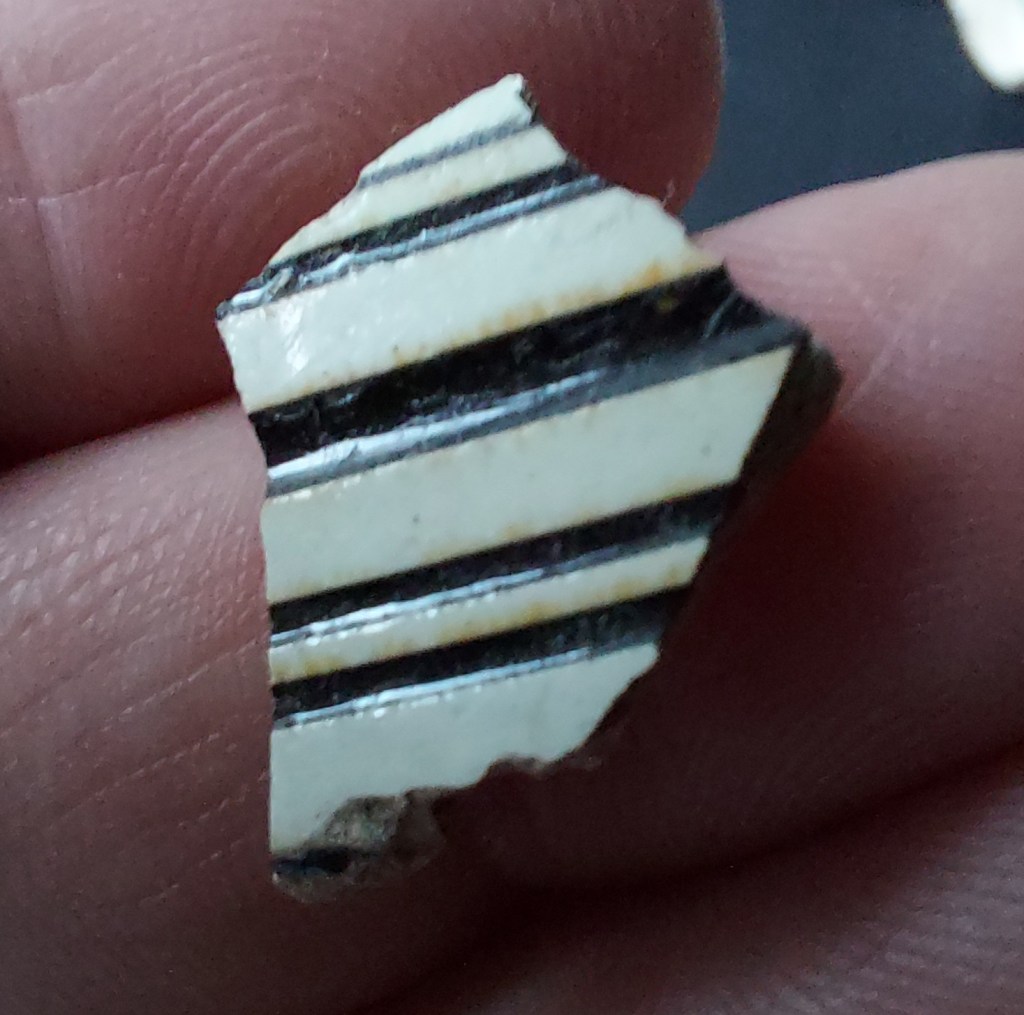
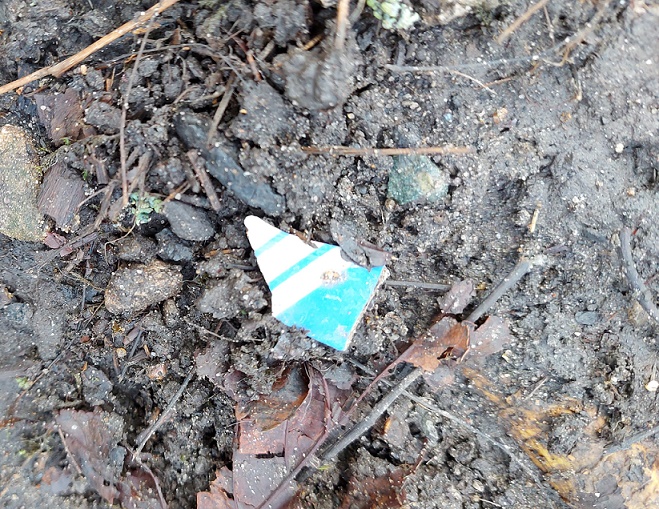
Lovely blue and white stripes.

Ooh nice, a sherd of Annular Ware. Probably late Victorian in date, or even early 20th century, this stuff looks almost modern thanks to TG Green’s Cornishware which continues the tradition of banded decoration in blue and white.

I looked ahead, and lo!

Classic mid – late Victorian annular ware, the brown stripes in particular give it away.

Some more Annular Ware, this time brown, blue and white, and very definitely mid-late Victorian. A rim sherd, so I can get a shape and size – almost vertical, and with a rim diameter of c.10cm, it was a mug or tankard like this one:

Rather lovely. The photograph is stolen from this antiques dealer’s website – here – and you can buy it for the snip of £380. A pity the Victorians never threw these things away whole.

Could there be more along the path edge?

On either side of the path, I could see sherds.

On I walked. The earth had opened, and I’d be a fool not to continue – “something… something… gift horses… something” as the saying goes. But indeed, something was happening, something I had not planned for, but which the fates had thrust upon me… and impromptu mudlark. I’d only popped out for a loaf of bread, a bottle of wine and an aubergine (which is an intimate, and possibly over-sharing snapshot of my life), and here I was… larking. What would the neighbours think? What would Mrs Hamnett think? Oh the shame! And yet on I went, pulled by the invisible force that binds the sherd to the nerd.

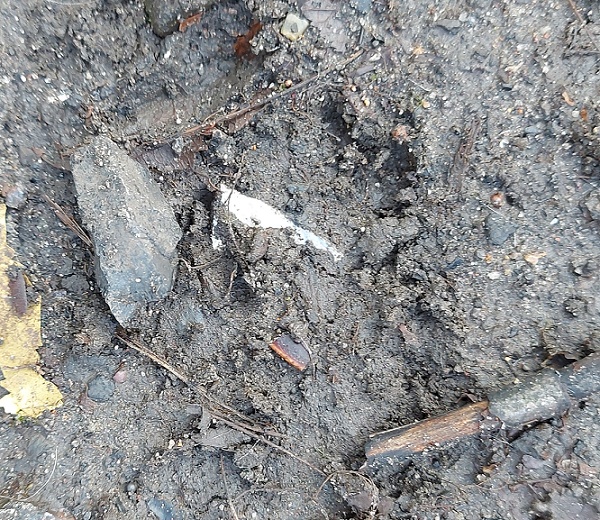
Another.

The white straight edges against the grey-brown earth is quite striking.
The moment of excitement… what’s on the other side? I’ve been doing this all my life – I would drive my parents to distraction finding bits like this – but it still gives a little thrill.
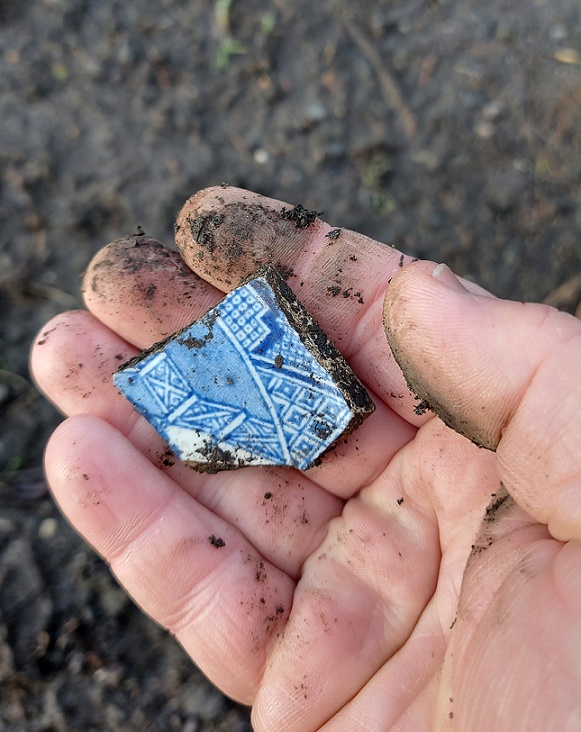
Willow pattern, part of the fence that forms the background to the main ‘story’. I like the colours in this photograph – the blue, pink and grey are visually pleasing.
The willow pattern plate – Blue and White Transfer Printed Pottery, technically. I’ve circled where the sherd came from in the spurious story that is portrayed on the plate – you can read all about it in a fascinating article here.

And another.

The unmistakeable colour of Derbyshire Stoneware (follow the link for more)
I wonder if I always have dirty hands when I go shopping?

Some glass, peeking, shimmering, calling.

A bottle. Broken, but still interesting.
Just the top, but enough.

The bottle top/neck (or ‘finish’) is one which is called an ‘applied finish’ – it’s a solution to a problem of how do you make a clean neat break on a bottle that is hand blown into a mould? The answer is to make the lip and neck separately, and then ‘weld’ them together whilst the glass is still soft and malleable. If you look closely, you can see the join.

The arrow indicates the slightly bulbous join and groove where the bottle top (left) was joined to the bottle body (right). Often the joins are very obvious, with drips and messy welds, this is quite a good quality join.

This dates the bottle to the Victorian or very early 20th century, as does its light bluey-green colour, and rectangular shape. It is small, so is probably a lemonade syrup bottle or something similar.

I walked on.

Beautiful, wonderful, pieces of archaeology, tiny fragments of history, of people, were throwing themselves at me. And who was I to argue?

Lurking amongst the mud and mulch, a lucky dip.
You can make out the pattern, but what is it?
A soup dish and a saucer. For once, it’s not my photography! The transfer print itself is blurred and poor quality. Yes, I know, I know, a bad archaeologist blames his sherds.

Eventually I reached the end of the path, and on I went to the shop, vowing to come back that way, and walk in the other direction to see what else I could find. But, such is the way of the world, I needed to be elsewhere in Glossop and other chores distracted me, and with such mundanities crowding out the treasure, I didn’t come home that way. Who knows what I missed? Who knows what tiny fragments from the past await discovery, waiting for a person such as yourself, gentle reader, to pluck it from the ground and marvel over it, celebrating its form and colour, and invoking the past and the people who once used it. But beware… if you see an angry old lady with one ear, run.

The above shown sherds cleaned up.

The willow pattern in particular was interesting in that once cleaned I could make out knife marks that had scratched into the glaze.

A hard sharp knife has made these marks in the poor quality glaze. They were likely made in a single sitting, as they are all going in broadly the same direction. Perhaps cutting a particularly tough piece of meat from a bone?

Who knows what conversations were had when those marks were made, or what the person was eating. Questions like that keep me doing archaeological things like this.

Sherds not featured above, but found at the same time.

Nothing hugely interesting here, but all a bit of history. Top row, left, is a piece of porcelain that has a transfer picture on it – possibly of a woman (they’re quite predictable pictures – the golden brown bit could be hair or a gown). Next to that is a fragment of a stoneware ink pot. I wish I could show you how I know that, but from a photograph and using words it is difficult to describe – pottery is so tactile, so alive, you need your senses to ‘get’ it. Let’s just say size, shape, glaze, and feel, is what makes it so. Tell you what, I’ll film myself talking about it and put it on the YouTube channel, you’ll be able to see what I mean then. And I’m ignoring whoever it is that’s muttering “cure for insomnia” and “medical coma inducing nightmare“… bloody cheek. Bottom row, left, is a piece of moulded lead, with possible spokes coming from the outer rim. I have no idea what it is, but any suggestions would be welcome. All the other bits are fairly standard Victorian or early 20th century pottery.

Harehills Park (aka the ‘Sandhole’, or ‘People’s Park’) was for a long time prior to the 1920’s a tip for the local houses, so it’s not surprising this stuff comes to the surface after a good rainfall. It’s always produced something for me, and I’ve blogged about it before (here), but have a good look next time you are passing through. And post whatever you find to me – I’ll put it up on the website.

Right, that’s your lot for this post! More soon, I promise. But until then look after yourselves and each other. And I remain, your humble servant.

RH

Archaeology · Pottery Guide

The Rough Guide to Pottery Pt.1 – Brown Stoneware & Marmalade Pots

What ho, Glossop!

Happy new year wonderful folk of the blog reading world. I hope you all had a safe and restful Christmas at the very least. Today’s blog post is the first part of the much talked about Pottery Guide. You lucky people, you.

Over the last few years I have been toying with the idea of putting together a sort of ‘spotter’s guide to bits of old pot‘. I get a few emails a month from people asking “what is this?” or “where can I find out more about the pottery?” (What? What’s that you say? No, I’m not “having a laugh“, thank you very much. And don’t think I can’t hear you making snoring noises, either… honestly). It seems that most people who read this blog also like dipping into brooks, fields, tracks, and gardens, and pulling out bits of old stuff and pondering. Which is great, because that’s precisely what the blog is about. However, there is no simple guide to identifying what it is you have in your hand. Either they’re very dry academic archaeology (and even then, they generally don’t look at Victorian or Georgian pottery – that’s the stuff we normally dig through to get to the good stuff!). Or they are aimed at collectors, and thus look at only whole pots that live in glass cases and are fawned over by incredibly dull people. In 27 years of being an archaeologist, I have never once found a whole pot. And I certainly haven’t seen one rolling down Shelf Brook in Manor Park. I have, however, seen many thousands of bits of pot doing just that. And here’s the rub: the whole pot is ‘nice’ to look at, but sherds are the meat and two veg of archaeology… if that’s the phrase I’m looking for. Anyway, sherds are the lifeblood of archaeology, and from where we can explore the past in a way that is open to everyone and is fun. But in order to do that, we need to know what you have in your hand. My background as an archaeologist is early bronze age Crete… which is about a far from Victorian Glossop as it is possible to get (2,500 miles, 5,500 years, give or take), so I must admit part of the reason for doing this guide is that I too could learn about what it is I am finding. To do this, I read just about everything I can get my hands on, ranging from academic reports… to “a bloke on the internet”. And now, I can pass that info onto you so that before long, you too can be thrilling people with your knowledge of bits of old pot… honestly, I’m quite a hit at parties.

Anyway, Let’s start with some of the most recognisable and common stuff.

  • MARMALADE JARS

DATE: 1870’s – 1920’s
DESCRIPTION: Grey stoneware with a creamy surface, and characteristic external vertical ribbing.
SHAPES: Well… Jars.

These are such a distinctive type, and are so commonly found, that I thought we’d start here. Commonly known as marmalade jars, but actually any and all preserved fruit were kept in them, with a paper label pasted on the outside, and a horizontal groove running below the rim to take the string that kept the wax paper or cloth lid in place.

The humble marmalade jar. You can see the groove below the rim to hold the string in place. This one I found broken, and glued it back together. It now holds pens and other assorted bits.

A very hard creamy-grey stoneware fabric, solid, but with small voids. A roughly applied clear salt glaze (drips are common) internally and externally, with a slightly orange-peel surface (although often the base isn’t glazed).

The fabric: left is a new break, and is paler. Right shows some staining, but is more creamy anyway. You can see how solid the fabric is, but also the tiny voids created by gas during the firing. You can also make out the external grooves.
The surface up close; you can see the rough glaze – slightly orange peel. Also, you can see tiny flecks of discolouration – it isn’t a uniform colour.

They are exclusively open-ended jars of varying heights and widths, usually c.15cm tall. Beyond the colour and surface, the most recognisable bit of this pottery type are the vertical stripes, which can be very close together – either continuously or broken up by larger grooves – or spaced far apart (see photographs).

Rim sherds from two different jars. Once you recognise them, you’ll start spotting them everywhere.

Sometimes the base is stamped with the preserve maker’s name – commonly the lighthouse and name of WP Hartley – a company still making jam as ‘Hartley’s’.

The lighthouse logo of WP Hartley. You can see how coarse the finish is on the base.

Chronologically, they are late Victorian to Edwardian in date – WP Hartley seems to have designed the distinctive jars in the 1870’s, moved the factory to Aintree in Liverpool in 1886, and opened a second factory in London in 1901, so whether the base stamp mentions Liverpool and London will give a rough date. I have no end date for their use, but it is likely in the 1920’s when most companies switched from stoneware to the cheaper glass bottles and jars. That stated, the jars are very useful (I keep pens in one) and they are very hard-wearing, so it is likely that some were in use long after they stopped being made.

  • BROWN STONEWARE

DATE: 1700 – 1920’s
DESCRIPTION: Grey fabric with a shiny brown all-over salt glaze, often with rouletted decoration.
SHAPES: Cups, bowls, jugs (Nottingham Stoneware). Storage Jars, colanders, starch pans, stock pots, stew pots, bowls, bread crocks, pans, etc. (Derbyshire Stoneware)

Ah, Brown Stoneware, how… brown you are. Characterised by a shiny brown all-over salt glaze and a light grey stoneware fabric, it is instantly recognizable. Perhaps because it is so distinctive, but also because it is a stoneware and thus virtually indestructible, this stuff appears everywhere. It is also difficult to date with any certainty. However, it can be broken down into two types of different dates (although there is overlap): the Nottingham and Derbyshire Stonewares.

Nottingham Stoneware (c.1700 – c.1800)
A shiny milk chocolate brown surface interior and exterior, caused by the salt glaze with added iron, and often more glassy or creamy than the Derbyshire type.

Nottingham Brown Stoneware. Chocolatey glaze, thin walls, and strap handles; this stuff is very nice.

It usually has a white slip underglaze visible in the break, between the classic grey stoneware fabric and brown surface.

The white-ish underglaze is visible beneath the brown iron-rich salt glaze, and is noticeable against the grey stoneware fabric. The surface also has the orange-peel look that characterises salt glazes.
A view of the grey stoneware fabric, note also the voids and the white underglaze on the exterior wall (right). I really am rather bad at taking photographs… I need to learn how to use my phone’s macro setting better.

It is often found in thin walled vessels – cups and bowls (tablewares). Also, noticeable are wide strap handles, with vertical ribbing and thumb impressions where they were attached to a jug body. Decoration consists of horizontal incised lines done on a lathe, often in multiples, and rarer impressed decorative patterns in between the lines – snakeskin, basketweave, zig-zags – often done with a roulette wheels. Out-turned rims and bases with multiple bands around them are also common.

Nottingham stoneware was popular in the 18th century, but by the end of the 18th century couldn’t compete with the more decorative styles then coming out of Staffordshire, and the style faded away. However, the tradition was continued by potters in Derbyshire, who began to specialise in utilitarian kitchenwares – storage and cookery – rather than tablewares they previously made.

Derbyshire Stoneware (c.1800 – c.1920)
A similar, but often a little darker, shiny brown surface, made by the same iron-rich salt glaze, but a little less glassy or chocolatey.

Wonderful stuff. The iron-rich glaze almost glows.
Again, it glows. The sherd on the left seems to have less iron its saltglaze, and has reverted to the almost classic saltglaze surface – speckled light brown and orange peel texture. I love the interplay of the undulating lines, coarsely rouletted into the body.

Also, whilst the majority of vessels have a brown interior and exterior, some have a cream, white, or olive coloured interior (I have a hunch these are later).

The creamy interior of a later vessel. The glaze is speckled in a similar manner to the marmalade pot above.

The fabric is the same classic grey stoneware, but normally with no white underglaze. Thick walled vessels are the norm, with the emphasis on cooking and storage – utilitarian rather than flashy serving and eating/drinking.

Light grey – classic stoneware fabric.

Impressed decoration consists of roughly made rouletted shapes – very small crude stars, circles, crescents, flowers, dots, etc., sometimes horizontal, sometimes in flowing wavy lines.

It could almost be Roman. Almost.
Very shiny, almost lustrous.

An interesting advert dating from about 1880 gives a good idea of the kinds of vessels and decoration available at that point and beyond:

I love this. These are some of the various vessels that you’ll encounter… in pieces, of course.

Here endeth today’s lecture. Now go forth and forage, good people! Seek and ye shall find. And please, let me know what you do find – I’d like to do a community thing, where you all send me images of the bits you find and some names, and I’ll put them on the blog. I don’t know why, but my mind keeps going to ‘The Gallery’ on Take Hart…

Anyway, more soon (not just pottery, honestly… I have some interesting stuff in the pipeline), but until then take care of yourselves and each other. And until then, I remain, your humble servant.

RH

Archaeology · History · Whitfield

Datestones

(And apologies to those of you who have ended up on this website expecting to find an informative article on the seed of the Phoenix dactylifera.)

What ho, magnificent readers! I trust you are all rude health as we stumble toward the season of goodwill and whatnot. I love this time of year, when the cold wind blows, and the… What’s that? What do you mean “get on with it!”. Honestly, the nerve of some people.

Righty ho. Datestones. Who doesn’t love a good datestone? I mean, what’s not to love? A little snapshot of the history of a building, a birth certificate if you will, recording both the date of birth, and, if we’re lucky, the parents too.

Normally, though not exclusively, located above the door, these carved stones preserve the date of construction and the initials of the person or family who paid for its construction. The are by and large the reserve of the aspirational ‘middle classes’ of society; the poor man doesn’t build his house, the rich man has a house that speaks for itself. Indeed, it is a statement to others: I have wealth enough to build this house. They seem to become popular in the 17th century, as the ‘yeoman farmer’ becomes a class of person, that is, a person who owns the land they farm. Indeed, it may be a result of that phenomena, a way of setting themselves apart from the simple tenant farmer, who doesn’t own the land he works. Glossop has several 17th century examples remaining, though many more will have been lost, sadly. They do show up, occasionally, as the one found by Glossop Brook at Harehills Park did, and which was saved and cemented into the brook wall. Interestingly, this example also shows that whilst datestones can be a boon to historians, they can also present problems if we are not careful. They can move easily, and be attached to other buildings giving a misleading date, as is the case there, and at Hall Fold Farm. Also, stones can be put in place to commemorate a rebuilding or alteration to an existing building, causing similar, if opposite, problems.

By the Victorian period it was common to put a date and/or name on a house you built, and a careful look at many rows of Victorian terraces around Glossop will reveal names and dates. With that in mind, I have restricted my research to those datestones that carry a date prior to Victoria’s reign, pre-1837. The following is a table of the ones I know about:

There are 28 datestones in the Glossop area (broadly defined), but there will be more lurking that I don’t know about, either attached to the building still, or lying in a garden. This blog post will concentrate on the examples from Whitfield, as it is turning into a much larger post than I had thought. Plus, in the interests of honesty and transparency… I haven’t got photographs of all of them yet!

Whitfield has some of the oldest buildings in the Glossop area, and although not really much of a ‘place’ now – essentially just a ‘suburb’ of Glossop – it was once hugely important, being built along the Chapel en le Frith to Glossop road. It gradually lost it’s importance with the rise of the mills based down in the valley, the economy here being agricultural. Whitfield’s one-time importance means that we find many old buildings and a number of datestones here. Indeed, Whitfield has more old buildings that Old Glossop, which with its Church and market, was the focus of the farmsteads and settlements of Glossodale. However, important places tend to be subject to more intense rebuilding over time, whereas more minor areas maintain their old buildings. I was going to do a distribution map of the old buildings, but changed my mind for that reason. Still, it’s worth noting that Whitfield underwent a bit of a building boom in the mid to late 18th century.

35 Whitfield Cross.

35 Whitfield Cross was built in 1773 as a farmhouse, and is a Grade II listed building – see here for more details. The narrow coursed stonework and stone mullioned windows are typical of the period.

61 Hague Street.

61 Hague Street was also built in 1773, but as a pair of weaver’s cottages, and is also a Grade II listed building. 1773 must have been busy year, and Whitfield was clearly a happening place in the late 18th century. The datestone records the initials R. J. and D. Now, presumably the ‘R’ is the surname (possibly Robinson – the family being quite prominent in Whitfield) with ‘J’ and ‘D’ being the husband and wife who are responsible for the building. I have no information regarding the people, sadly, and any information would be appreciated.

Hob Hill Cottage

Hob Hill Cottage is a remarkable building dating to 1638, making it the second oldest building with a datestone in the Glossop area (after the Bulls Head in Old Glossop, dated 1607). Also built as a farmhouse, and also a Grade II listed building (there’s a theme developing here!), I suspect it might be the source of the lead came and glass, as well as some of the 18th century pottery, I found nearby, although truthfully any one of a number of buildings – existing or long gone – might be the source.

Old School House, Hague Street.

Another Grade II listed building now – the Old School House. Joseph Hague was something of an important man – indeed, the road on which the school (now private residences) sits is named after him. Born in Chunal in 1695, he rose from poverty to amass a fortune selling yarn to weavers and buying back the cloth they produced, to sell on. However, here is not the place for a discussion of his life, or of the school (the Glossop Heritage Trust does that very well here). Let us instead look at the wonderful inscription

“This school was erected and endowed by JOSEPH HAGUE Esquire,
of Park Hall in this Parish as a testimony of Gratitude to
ALMIGHTY GOD for his favour and Blessings through a life of
years whereby he was enabled to accumulate an ample fortune
and make a plentiful Provision for his numerous Relations and
Dependents. Anno Domini 1779.”

I enjoy the slightly boastful “ample fortune“… well, if you have it, why not? The beautiful carved relief plaque of the beehive over the main door – symbol of productivity and hard work – gave inspiration for the name of the pub over the road. The Beehive pub itself is an 18th century building, with a 19th century front added, and another example of the building boom of the 18th century in Whitfield.

Old School House, Hague Street. The beehive carved in relief, surrounded by Sunflowers, and crawling with characterful bees. I love this.
62 Hague Street

Another Grade II listed building, one of several together, and originally built as a ‘laithhouse’, that is a building made up of a house, barn and byre/shippon in one. It is a late example of the type if the date is to be taken at face value, but there you go… this corner of Derbyshire wasn’t exactly at the forefront of architectural fashion. There is also a bit of confusion regarding 62 Hague Street. As it stands now, there is a simple date of ‘1751′ above the door. However, the listing for the Grade II building notes that “No.62 originally had datestone inscribed RMS 1757” (read the full listing here). The present datestone is fairly modern, carved perhaps to replace the missing stone, but it doesn’t explain the difference in date. I thought it worth mentioning for the sake of documentation and completion.

41 – 51 Cliffe Road

So who was Joel Bennett? Born 11 April 1791 to son of George Bennett and Martha Cooper, he came from a large and important local family. He may have been the same Joel Bennet who was excommunicated from Littlemoor Independent Chapel in 1828 for “disorderly walking and impenitency” (source is here). I’m unsure of what is meant here by “disorderly walking”, but given the hotbed of radical religion that was Littlemoor, one assumes it wasn’t the Georgian equivalent of Monty Python’s Ministry of Silly Walks. He may also have bought Kinder Lee Mill in Chisworth with his brother James in 1823.

House at the bottom of Cliffe Road (4 Cross Cliff?)

This house, set back from Cross Cliffe almost at the bottom, has a wonderful datestone: stars, wheatsheaves, and a Masonic compass, with the letters ‘R’ ‘R’ ‘O’ and ‘S’. Actually, is that an ‘O’? Or perhaps a flower? I have no information about the place, nor the letters (Robinson again?), and one cannot simply knock on a door and say “What-ho… tell me about your house”. One tends to get stared at, with vague mutterings about “setting the dogs on you”, and “lunatics disturbing the peace”. Alas. If anyone has any information about this house, or indeed any of the houses, drop me a line.

Also, and seriously, if anyone knows of any more datestones that aren’t in the above list, and which date from before 1837, then please let me know. I’ll credit you, too, so you can be famous… to all 11 of you who read the blog (including Juan in Venezuela).

Oh, and some news. I’ve been working on the Glossop Cabinet YouTube account recently, and hopefully will be producing videos of me finding bits and pieces, mudlarking, talking archaeology, exploring, playing with pottery, and much more (can anyone else hear that groaning noise every time I mention pottery?). So if you like the blog, then you’ll love this. I’ll post a link asap.

Also, I’ve recently set up a Ko-Fi account which allows you lucky folk to ‘virtually’ buy me a drink if you wish. There is no pressure to do so, obviously; I do the blog because I enjoy doing it, and am constantly amazed that other people enjoy reading it (which is reward enough, it really is). However, if you do fancy buying me a pint to say cheers, I’ll never say no – please click this link, and mine’s a red.

That’s all for now I think. I’ll post something else before Christmas, possibly pottery related, you lucky lucky people (there’s that noise again). But until then, I remain,

Your humble servant,

RH