What ho, dear and lovely people, what ho!
Firstly, let me offer my apologies for the distinct lack of activity following my last post two months ago. I try and post at least an article a month, and the intention is there, but sometimes life just stops me. And life in CG Towers has been somewhat tense and trying recently, for one reason or another. Health concerns – both mental and physical – have taken their toll, as has some serious repair/building work. Amidst all this I simply ran out of steam and disengaged from my ‘normal’ life to focus on matters far more important and urgent. Mercifully, the worst has passed, but I am struggling to recapture my previous vim, vigour, and verdigris… if that’s the word I’m fumbling for. So there we are, and here we are, and this post is the first one now that the corner has hopefully been turned. On, ever on… if sometimes a little slowly and shakily.
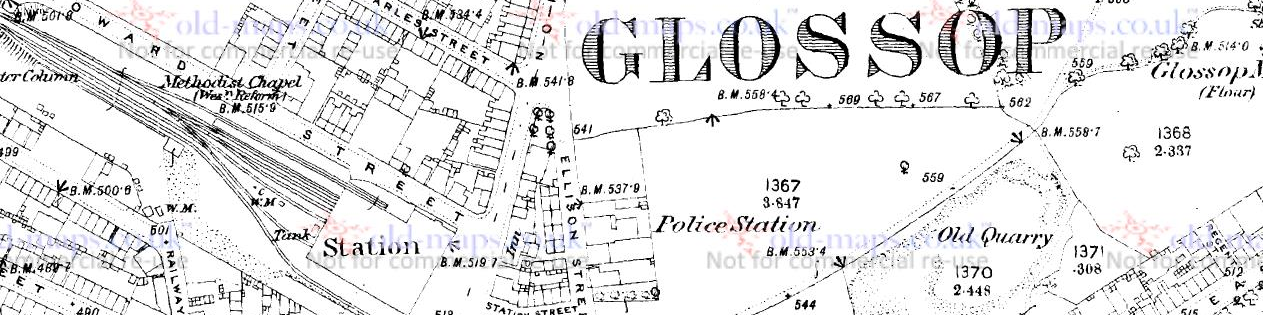
As I passed through Harehills the other day I felt that familiar tingle, the magnetic impulse that exists ‘twixt sherd and nerd. Glancing here and there my eyes picked out some blue amongst the greys, greens, and browns, and lo! ‘Twas a sherd, a thing of joy, a glimmer of hope, heart, and humour.
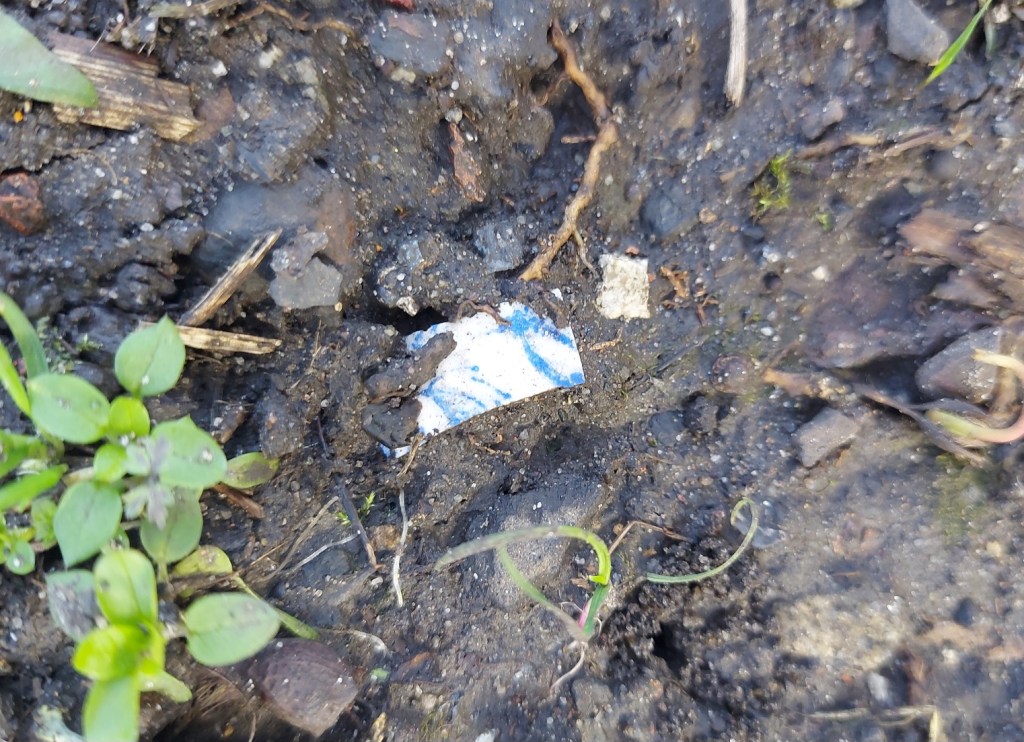
Stooping, I quickly photographed it, aware that a dog walker was slowly backing away from me in that way that people do. And then I picked it up. I love moments like this, and it’s why I do what I do. It’s not just the joy of finding a bit of treasure, a childhood pleasure that has never left me, but to hold in your hand a little piece of the past, a fragment of life long gone, with all the possibilities – that’s the key, and why I became an archaeologist… as if I ever wasn’t. I began to look at the sherd, to analyse and understand it. And then a thought: I’ll take you, gentle reader, on the journey of discovery with me, and we can unlock the secrets of the sherd together. This could be a bit of fun. Of course, “could” and “fun” in that sentence are used with caution, obviously.

Home it came, unwashed in my jacket pocket – for dramatic effect I resisted the urge to wipe it. What secrets would be revealed I wondered, as I ran it under the tap, and scrubbed it with an old toothbrush I keep for just such a purpose (of medium hardness, for those taking notes). First one side then the other, to expose the surface, and then each of the four edges, so that the important fabric is revealed. An interesting aside – sherds normally break into broadly geometrical shapes of 4 or 5 sides, but rarely more or less. This is one of the ways that you can spot a sherd from a distance, as nature rarely has 4 or 5 sided shapes, not does it often have straight-ish edges.

During the cleaning process, a number of things became apparent. Firstly, it came from a thin-walled vessel, which, coupled with having a diameter of roughly 10cm, suggests it is likely to have been part of a cup. Bigger vessels have thicker walls, and table wares – the pots from which you eat and especially drink (as opposed to preparing, cooking, or serving) tend to be more delicate and have thinner walls.
Secondly, both the exterior and interior surface was rough and dull. This is not how it would have been originally – it should have been smooth and shiny – but is the result of post-depositional activity… in this case, fire. Until the 1920’s, Harehills was used in part as a rubbish dump, and fires were often deliberately set in order to keep the smell down, and rats and flies away. They could start accidentally also, as people would clear out their coal fire which often contained smouldering cinders. Indeed, the 1928 Glossop ‘state of the union’ report tells us that one dump, “about 20ft in depth, had been on fire for many years“. The heat melts and bubbles the surface, causing the tiny holes and pitting you can just make out.


The pinkish staining on the interior is possibly a grease stain, or perhaps also the result of post-depositional activity, with the colour leaching out of some other piece of rubbish?
Looking at the break we can see the fabric, which in this case is a fairly poor quality greyish Bone China.

Now, given that the edges shows no sign of being burnt, unlike the surface, it seems that the sherd was broken off a larger piece after the fire damage had been done, suggesting that it has moved around a bit since it was first thrown away. This is also shown by the scratches you can see on the interior; they’re not like those made by a knife on a plate (and how hard do you have to stir a cup of tea to mark the glaze?), but have been made by close proximity to, and movement over, stones.
Moving onto the decoration. Obviously it’s blue and white, but the colour of the blue is odd, and it looks more like a spongeware pattern, with the blurred graininess you associate with the printing process, than the standard cobalt transfer printed whatnot. On balance, I’d say its a somewhat poor quality transfer which has a graininess to it. The image is something floral; I can see leaves, but not those found in the usual willow pattern pottery, but something more naturalistic, and which might suggests a later date for the cup.
The most obvious aspect of decoration is the fluting running vertically up the body of the cup (clearly visible in the fabric photograph above). This was quite a common decorative theme in the late Victorian and early 20th cemtury, with some even running diagonally up the body, spiralling around it.
So, putting it all together, and knowing what we know, we can work out what it might have looked like originally, and a short while later we go from inch long sherd to this…

So there we go – from muddy sherd to teacup in a few minutes. It’s amazing how much information can be retrieved from just a small fragment. But honestly though, all sherds have a similar story to tell, and each one can give us all the information, we just have to look and listen. Now, your turn! Go for a walk through Harehills, or Manor Park, or indeed anywhere else where there are herds of sherds, pick one up, and see if you can find the story. Let me know how you get on.
Right, that’s all for this time, and I hope you enjoyed it. I’d like to say I’ll make up for my absence by posting lots more soon, but I don’t want to set myself up to fail, and cause more pressure for myself. More is coming, though: I have a much bigger pottery post which is almost done, but I’ll wait a little while before posting it. Also, I have some big news in the pipeline. BIG news, to be honest… so watch this space.
In the meantime look after yourselves and each other. And remember that if someone says they’re “alright”, they might not be. We all need a little help from time to time.
Until next time, I remain,
Your humble servant.
TCG

 The Glossop Cabinet of Curiosities
All that information from a sherd so small.
LikeLiked by 1 person
Hope you move towards a full recovery soon & thanks for such a lovely story from a small sherd found in my nearest park in Glossop
LikeLike