What Ho!
Right… got to be quick! So much to do, so little time. Never mind the formalities… we’ll take them as read.
Family C-G went for a stroll the other day, around Shire Hill and Shelf Brook there. This gave me the opportunity for a little poke about… and O! What things I found!
I was poking about on the track that runs from the top of Shire Hill to the footbridge – here:
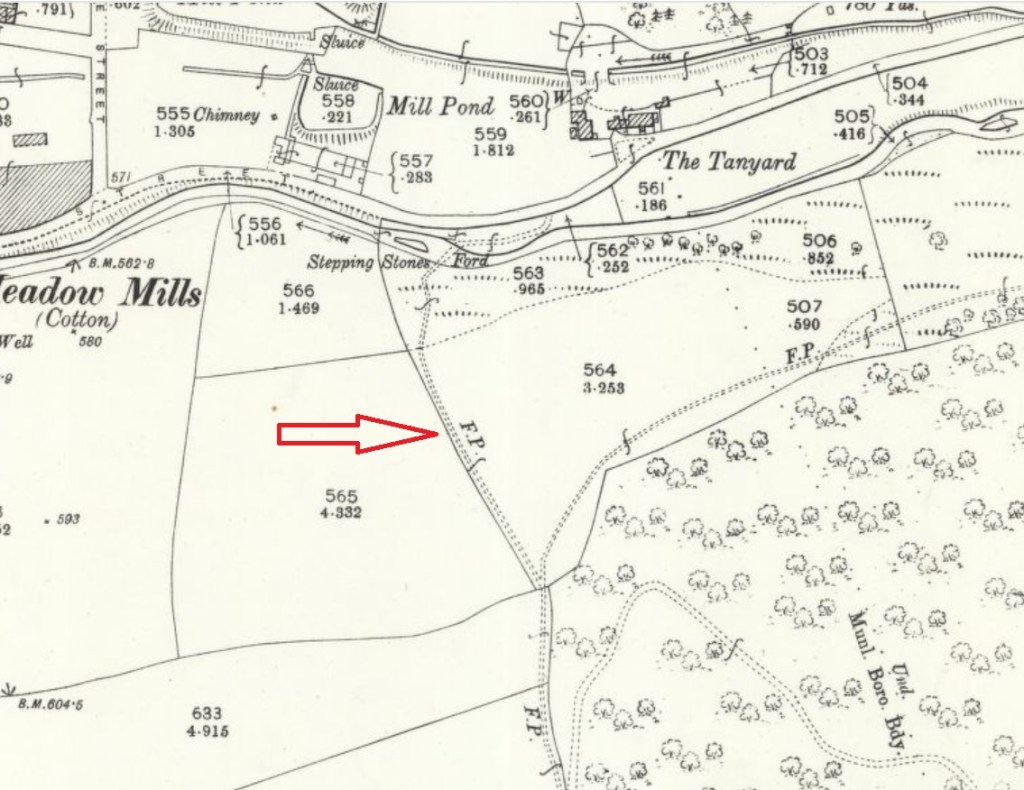
It’s an old track, coming from Pyegrove with its datestones of 1747 (although first recorded in 1631) where the track splits; left to (Old) Glossop, right – ours – up Shire Hill and down, linking it with Shepley Street/Doctor’s Gate. Interestingly, although it now curves to the right at the bottom by the brook, it’s obvious it originally went straight ahead and over the brook via a ford. The field on the left there preserves the original line of the track.
I know I bang on about these tracks a lot, but they really were the arteries of life in the medieval and post-medieval period, in fact right up until the late 1700’s and early 1800’s when our present road system was planned and laid out. These have a more organic feel about them; they grew out of necessity – rather than as drawn on a map and blasted into the landscape – and as a consequence they are often more direct, but also strangely quirky. And as everyone who moved through the landscape would have used these tracks, they can often be good places to poke around, to see what we can find. And lo! Here’s what I found.
Firstly, a selection of clay pipe stems:

Nothing too interesting here, to be honest. All have fairly narrow bores, and are thus probably all Victorian, and no maker’s marks. I have said before that these are essentially the Victorian equivalent of a cigarette butt – smoked a few times, then thrown away. Or perhaps dropped – the pipes are fragile, so they wouldn’t survive a fall. Always fun to find, though.
Next up fragments of what I think in the same pot.

Despite all being different thicknesses, they all seem to be from the same large stoneware open bowl or something, in what looks like a Bristol Glaze. The different thickness can be explained by where the sherd came from on the pot; vessel walls tend to get thicker as they move towards the base, and thinner the higher up they are towards the rim.
Next up, some more stoneware:

The sherd on the left is the top to a ‘blob top’ stoneware ginger beer bottle, something like this one:

At the right, there are a series of sherds from the same flat bottomed jug or jar or similar in a brown salt-glazed stoneware, possibly a late example of Nottinghamshire Stoneware, but difficult to tell.
The larger sherd in the middle is the shoulder of a bottle, perhaps similar to the ‘blob top’. On the inside, though, you can see the wiping marks created when the bottle was made by hand.

This is the human connection to the mass production of the Victorian period, the marks made by a person going about their working day.
Next up, we bounce into the 17th and early 18th century.
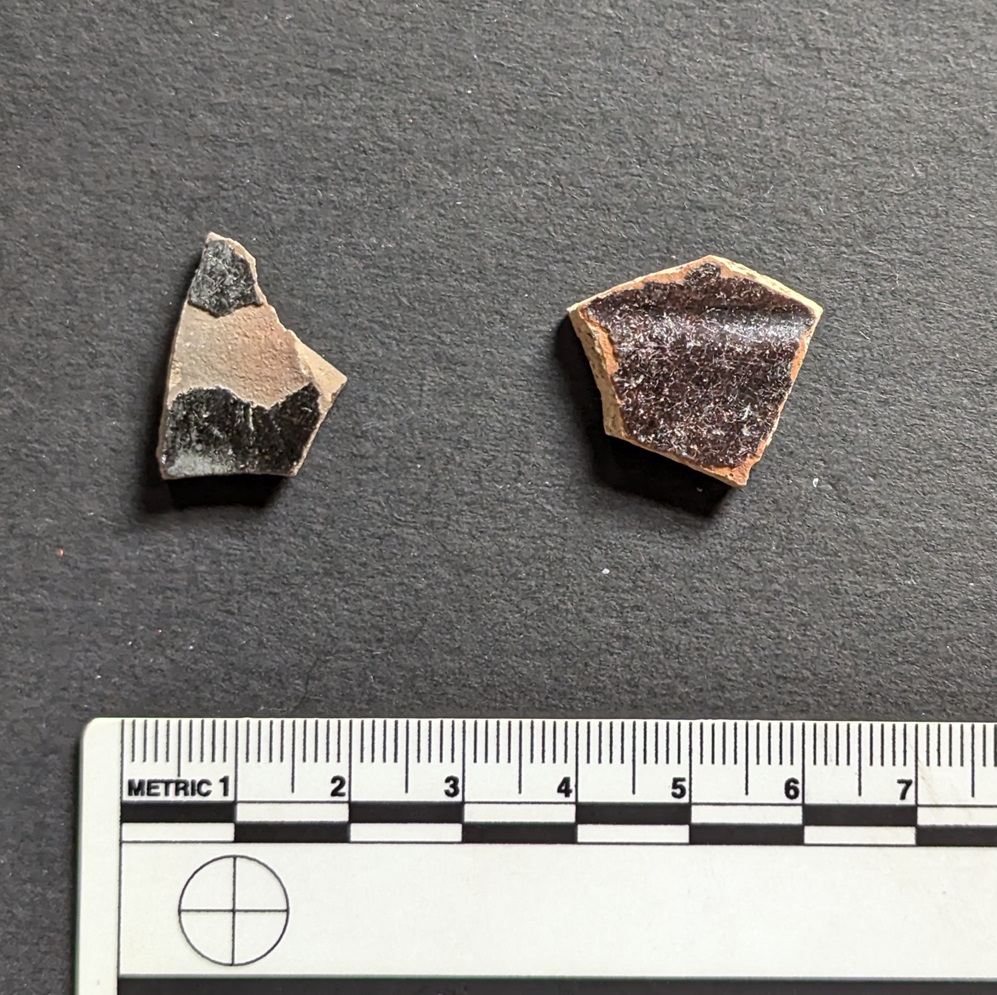
On the left, an open vessel in Slip Trailed Ware – probably a large, thin-walled bowl of some sort. On the right, is a Manganese Glazed cup or small bowl, with a carination in the body. ‘Carination’ is one of those terms archaeologists use that literally no one else uses, but it simply means a kink in the shape of the vessel that creates an angle, often at the shoulder. Both of these types are fully discussed in this article here.
Next, we have a large sherd of Manganese Glazed pottery, almost certainly from the lowest part of a large open bowl.

Again from the 17th/early 18th century, it is rather wonderful. Glazed on the interior only, the exterior is slipped:

You can see the red slip on the surface of the swirled cream/pink fabric – very typical of the period. You can also make out the wiping marks made during manufacture. This was a large bowl, and unusual.
Next up, we have this little lot, again of 17th or early 18th century date:

Left is another sherd of Manganese Glazed Ware. Centre is a sherd of Staffordshire Slipware, also covered in the above article. You can clearly make out the white under-glaze slip that gives it its characteristic yellow colour. At the right, however, is a sherd of Midlands Purple Ware… something that we’ve not encountered before. I have a ‘Rough Guide to Pottery’ post about this stuff almost written, so I’m not going to dwell on it here, but in short it is very hard pottery (fired at a high temperature) and slipped in a purple or reddish colour, and the surface/fabric has black and white – salt ‘n’ pepper – inclusions. It’s very distinctive… once you see/feel it, you’ll never forget it. It is an interesting type of pottery – it starts in the 15th century and continues until the early 18th century, and is associated with beer making, as well as butter and cream transportation.
Rather unusually, I also found this – a .303 rifle bullet, and probably fired from a Lee Enfield rifle.
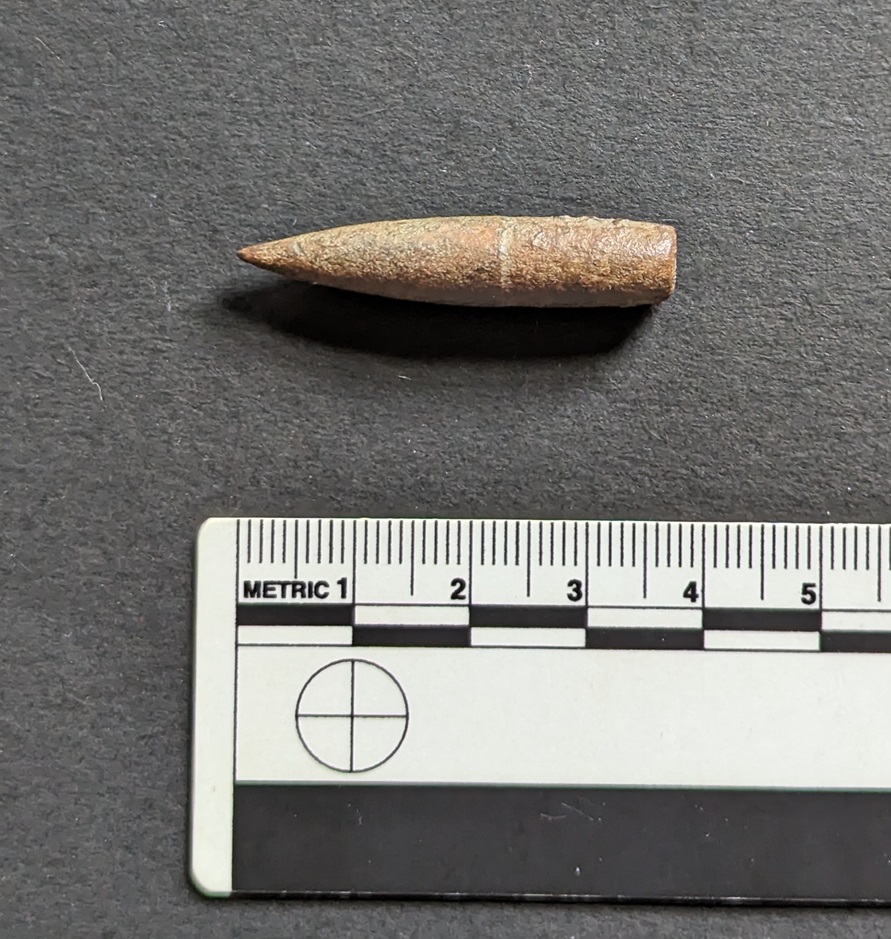
I’m not sure how it ended up there – it’s a military round, but they were used on the rifle range just up the way ( I blogged about that here) – so perhaps it was an overshoot… worrying, given that it was on the path!
And finally, whilst Master CG was snorkelling in the brook (I wish I was kidding), I went poking about looking for glacial erratics, and found this little beauty of non-local geology.
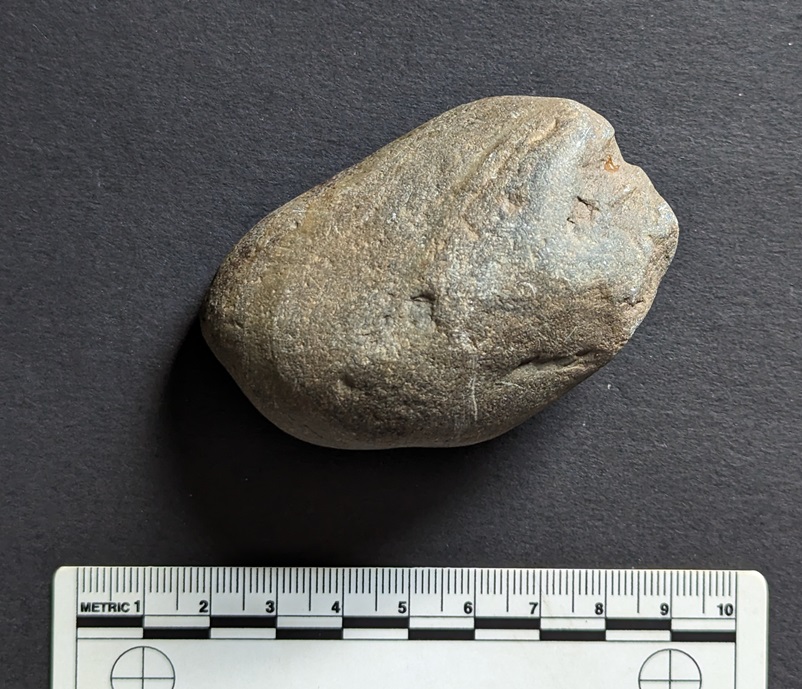
I think its gneiss, an igneous stone, but I am an archaeologist, not a geologist (or indeed an architect. Nor a palaeontologist, so no, I don’t know anything about fossils, dinosaurs. Or ancient aliens. It’s amazing what people think you are when you say you are an archaeologist). Here is a handy little guide to the rocks of Britain produced by the Natural History Museum. Whatever it is, it isn’t the Millstone Grit and local Rough Rock that makes up the geology of the area, so it’s a visitor, and probably one that hitch-hiked in a glacier from the north, as we discussed here.
Right, that’s all for now. Apologies for the lateness of this post, I have been super busy – with many talks and walks, and many more in the pipeline. I’ll advertise some here, so that I can bore as many of you as possible! I have also just sent off Where/When 3 to the printers, so by the time you read this it should be available to buy from usual sources. More about that in a few days, but for now, look after yourselves and each other, and I remain.
Your humble servant,
TCG

 The Glossop Cabinet of Curiosities
So I was once told the army used Shire Hill for training at one point during the war, although never seen any photos or other reference. That might explain the 303 round. Was also told there was an anti aircraft gun on the hill just above the bunker, bike likewise never seen any proof.
LikeLike
Hi Michael.
That’s great information, thanks. It makes sense – I know Lightside was used for training, so it makes sense that this whole area will be filled with bullets. I wonder what else is lurking in the ground?
As for the AA gun emplacement – it’s a perfect place for one. Very interesting.
LikeLike