Archaeology · Pottery · Whitfield

Whitfield Green Wondering

What ho! Fancy meeting you all here…

Happy summer everyone! I hope the season finds you in good form… or at least not in actively terrible form. Having recently celebrated a somewhat significant birthday with a trip to Naples area – Pompeii and Herculaneum included – I returned exhausted, and filled to the gunwales with pizza, wonderful wine, and archaeology, which pretty much sums up my life, to be fair. I can heartily recommend such a trip, although it was a tad expensive, and I can now only just about afford to camp in my own garden!

Whilst I was there, I actually wrote a blog post about a Wander to the beach I made, and that I thought you might enjoy; this was meant to be it. But I haven’t finished it yet, obviously, and so we have to remain close to home today. I mean, it’s not quite as glamorous as Pompeii or the Bay of Naples, but Whitfield is just as interesting. Kind of.

Anyway, I’ve often wondered about this place – Whitfield Green – a farm that is marked on older maps, but which is clearly no longer there.
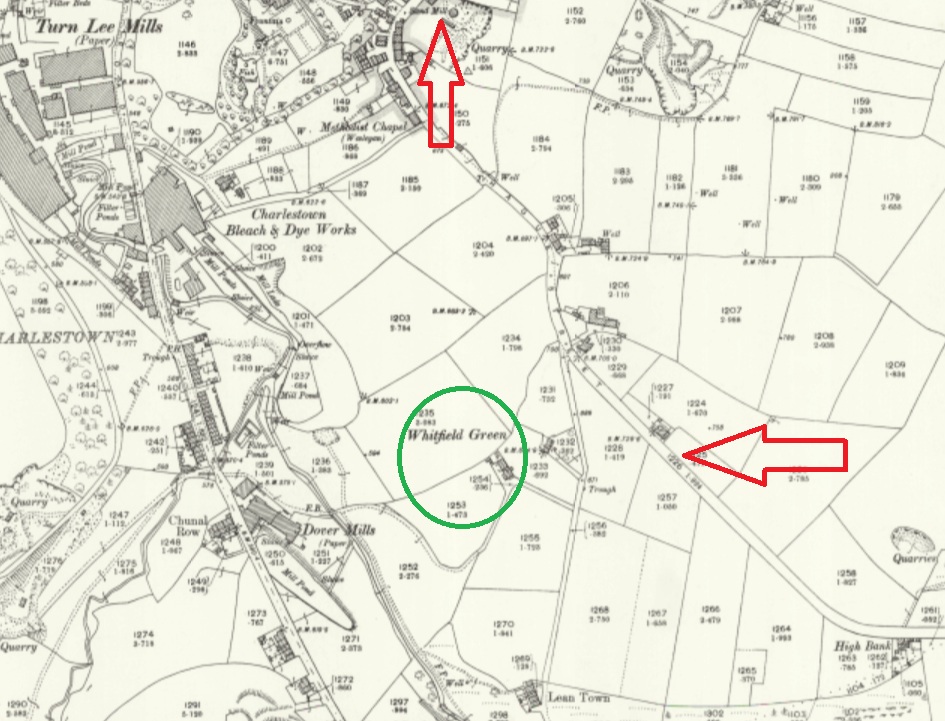
For the sake of orientation, Whitfield Green is in green, The Beehive is just off the map, but indicated by the top arrow, and Derbyshire Level is indicated by the other arrow.

I mean, the building is clearly old, and is clearly marked Whitfield Green, but I can find absolutely no information out about the place. So I went exploring…

Firstly, the roads. The whole area around Derbyshire Level and Lean Town has been monkeyed with following the Whitfield Enclosure of 1813, so it is sometimes difficult to see exactly what went where before that point. Map work and physical walking helps, and it seems the road originally went along the lines of the red line in the map below – it continuing straight at Lane Ends Farm, instead of kinking left as it does now, and continues to Whitfield Green, thus:

You can see a hollow where the field edge is now, and it is visible on LIDAR.
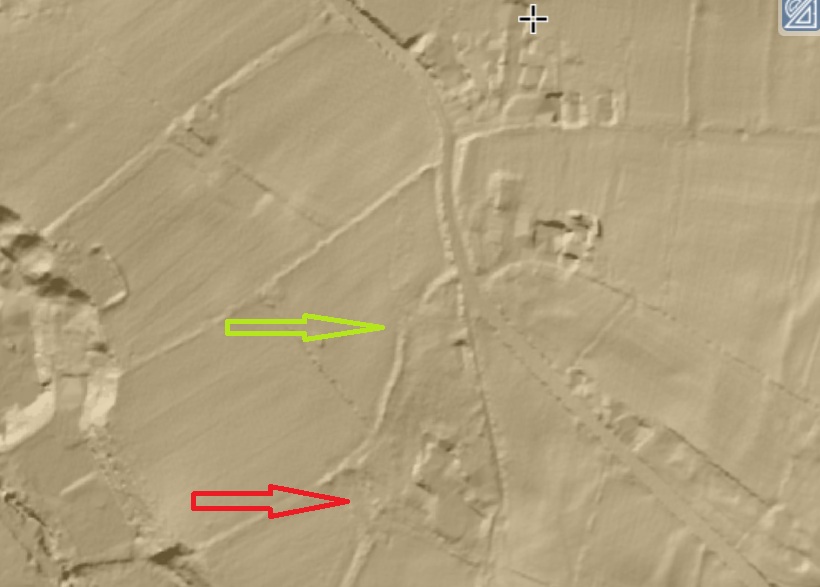
The site of Whitfield Green is indicated by the red arrow, and the hollow trackway – now a hedge and fence – is indicated by the green arrow.

From here (with numerous branches, and marked in red below), this track would go under Lean Town, and then onto Gnat Hole, and then to Chunal – unbelievably, it was once the main route from Glossop and Whitfield to the south – Buxton, Chapel en le Frith, etc.! However, when the Enclosures happened, one of the stipulations in the act of parliament was the building of wide solid roads – hence we have Derbyshire Level, which, whilst incorporating numerous existing routes, was a totally new road – no wonder when you look at state of the roads at that point. In fact, so bad were the roads that Glossop historian Ralph Bernard Robinson, writing in 1863, noted that

“Glossop, till a comparatively recent period, was a place difficult of approach, and, in some circumstances almost impassable, owing to the nature of the roads. They seem to have no roads but such as the Romans, ages before, had made for them.”

This paints a very different picture of this area of Whitfield, and makes it seem that Whitfield Green was more than simply a farm in the middle of nowhere. I wonder.

So it is at this point, with the radical shake up of the roads that followed the Enclosure Act, that many of the trackways with which I am obsessed become obsolete, and so it is with the red trackway, the access track to Whitfield Green – it simple ceases to be needed as the new road that goes down to Lean Town was made, and a new access track came off it. This is the footpath you now walk down in order to get to where Whitfield Green once stood (marked in green in the map above). Kidd Road was once known as Whitfield Green Road, and actually, I suspect that it once went across the field and that this ‘new’ access path is in fact the old route preserved, once the whole area had been monkeyed with (marked in blue, above).

Indeed, Derbyshire Level, and the spur around Moorfield, combined with the Turnpike Road (Charlestown Road) meant that there were now new solid roads along which to travel, and thus the old muddy route below Lean Town and through Gnat Hole was no longer used, and the whole became footpaths. It also meant that new farms could be built, and it is at this point that I think Whitfield Green Farm was built, just to the north of Whitfield Green (circled in yellow above). It is still there, but is very difficult to see without being arrested for “acting suspiciously near an innocent person’s house”… again. It has a stone roof (so making pre-1850ish), but there is nothing that points to it being older that the first half of the 19th century, and I suspect that once the new Lean Town road was made in 1820, someone took the opportunity to build a new farm there.

We know Whitfield Green was there in the 1920’s, but no longer appears on maps from the 1960’s onwards, so presumably it was demolished between those dates. A pity, but there you go, such is the nature of progress. Thus, the timeline seems to be:

1720 (ish – maybe before, maybe after) – Whitfield Green built on existing track (in red), and also accessed via another track (Kidd Road, in blue)

1806 – Lean Town built on the same (red) trackway

1810-13 – Whitfield Enclosure Act, and thus…

1820 – New roads made, including Lean Town road, and access to Whitfield Green comes from that now (albeit via an existing track).

1825 (ish) – Whitfield Green Farm (the new one) built (in yellow)

1950 (ish) – Whitfield Green demolished

That seems to tally with what we know, but if you think differently, let me know – click the ‘contact’ button at the top, or leave a comment… I’m always happy to hear from you.

So what did I find when I went to look at where Whitfield Green once stood, I hear you ask. Well, I’m glad you asked, because I found:
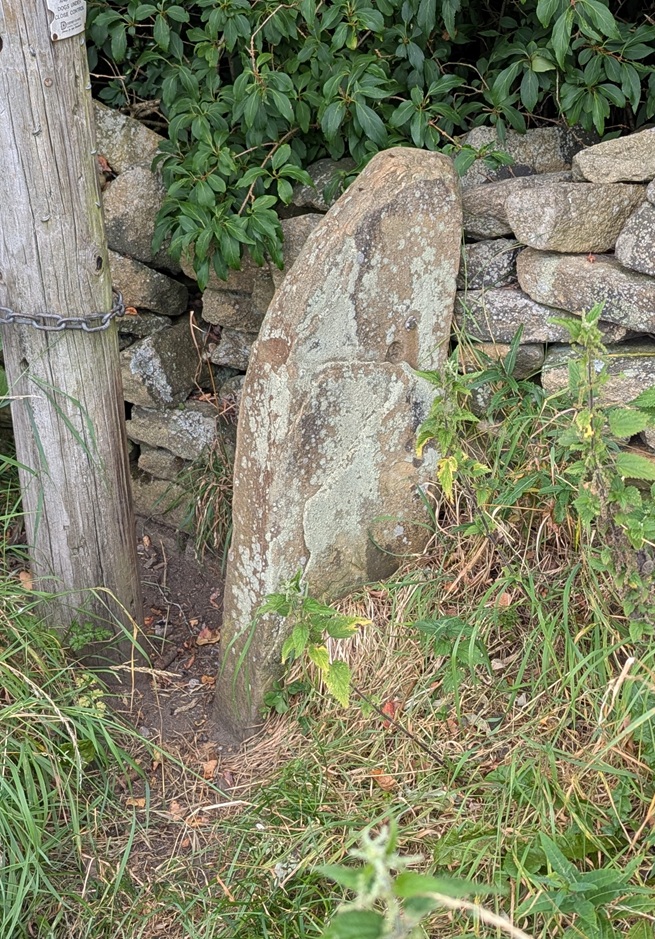
A stone stile. Lots of the paths around here have these, presumably to prevent anything other than foot traffic from using them. I wonder if they were put in when the newer – and toll paying – roads were created in order to stop packhorse trains using them. There are different types too, and I wonder if they were put in at different times.
Here’s where the Whitfield Green once stood, against this hedge line. Nowt there now.

However, look closer and…

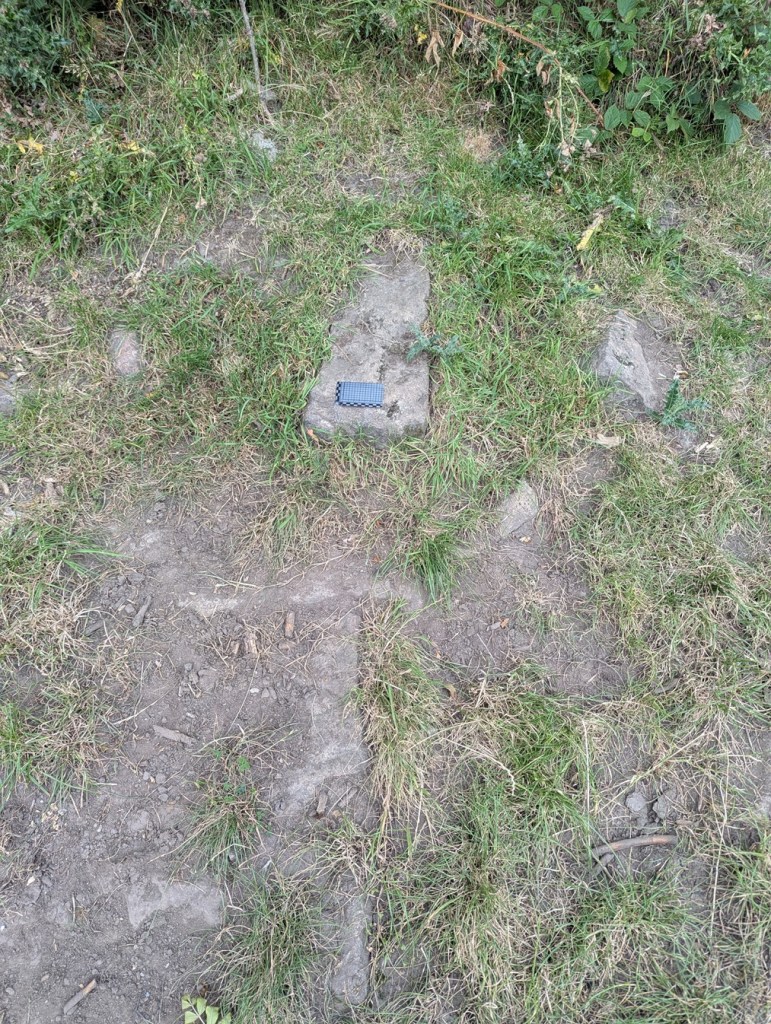
Shaped stones in-situ. These have not been moved into this position, this is where they were, and are the remains of the farmhouse… although what part is unclear.
And here is a stone-flagged floor. I wonder who – apart from the current farmer and their cows – stood on these last? They have to have been internal, so a part of the farmhouse proper, rather than the yard outside. Hmmm…
More stonework; in the world of archaeology, 3 stones in a row make a wall, so…
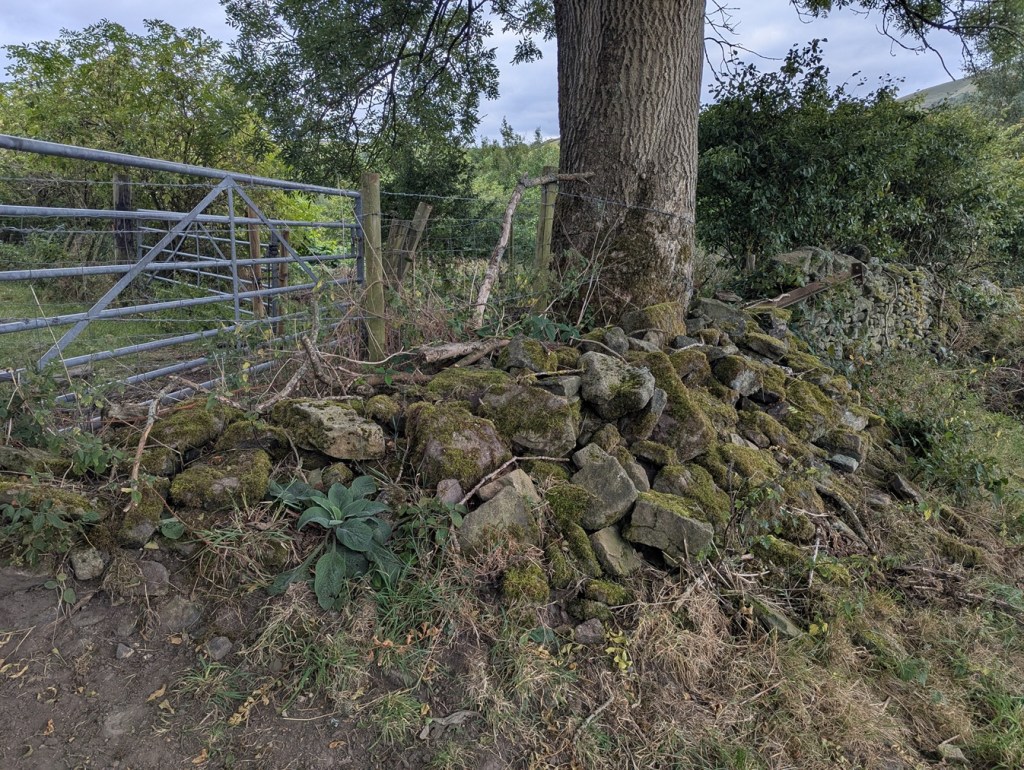
There’s also a huge pile of stone nearby, and whilst not a large farm’s worth of walling, I assume most of the rubble would have been re-used as drystone walling.
And a lot of it has been shaped, and rather than it being the product of a removed drystone wall… we are looking at the remains of a farmhouse.

It was the flagged floor that really brought it home that this was actually once a house; I love that moment when archaeology meets actual lived life; spooky, yet intimate, an odd feeling. It would be great to have a proper scrape around and uncover more of whatever remains.

And pray what, if anything, did you find there, you strange, pottery obsessed, person, you? Well, I’m glad you asked that, too:

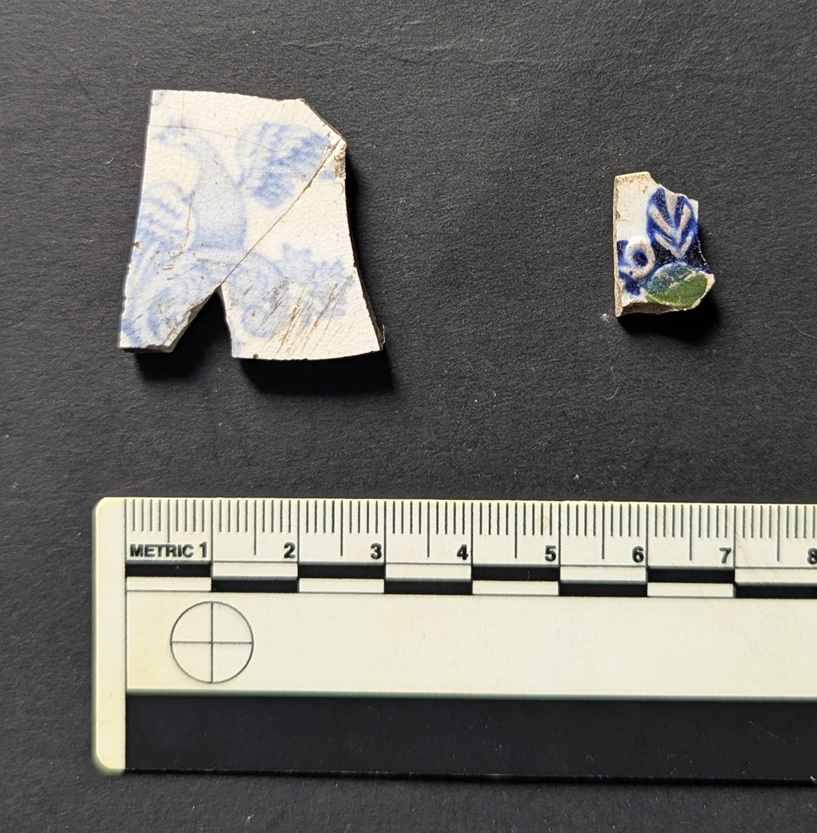
The expected ‘noise’ of Victorian pottery – Blue and White Transfer Printed, mainly (with some black printed), as well as one sherd of ‘Flow Blue’, and a possible sherd of Shell Edged.
Left is a wonderful bird; Victorian, and not at all rare, but the phoenix-like image is lovely. Right is an odd one – moulded, so the decoration in 3d, it is highlighted in both underglaze (blue) and over glaze (green). Again, not rare, but not commonly encountered… and nice.
Clay pipes… the cigarette butt of the Victorian period! I love them, but honestly… Stems and a bit of a bowl, nothing particularly interesting, although…
…the bowl has burn marks on the inside, evidence of the last drag!
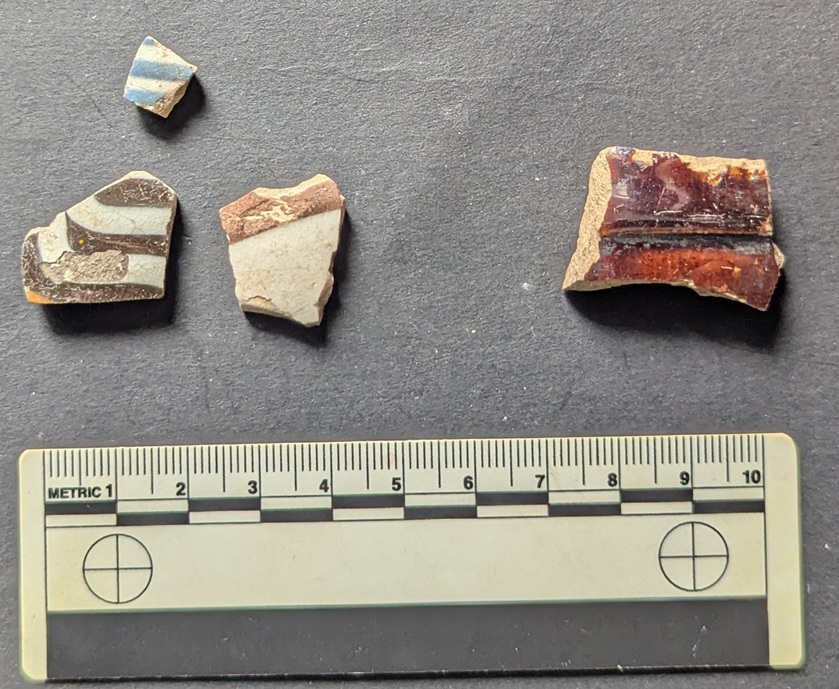
Left – 3 sherds of Industrial Slipware (1800-1900) – almost certainly bowls; right is a sherd of a Victorian ‘Brown Betty‘ teapot, still made if you feel the need (I do!).
Top from a Victorian blacking bottle.

So far, so Victorian. However, against this background there were several sherds of older pottery lying around:

Early 18th century Staffordshire Slipware platter – roughly 1700-1740. The underside shows a slight red slip, and a line made in the clay during manufacture, possibly the result of moving the leather hard pot – pre-fired – over a rough surface.

Then there is this lovely thing, and I am aware that ‘lovely’ is an entirely subjective concept.

Lovely… honestly!

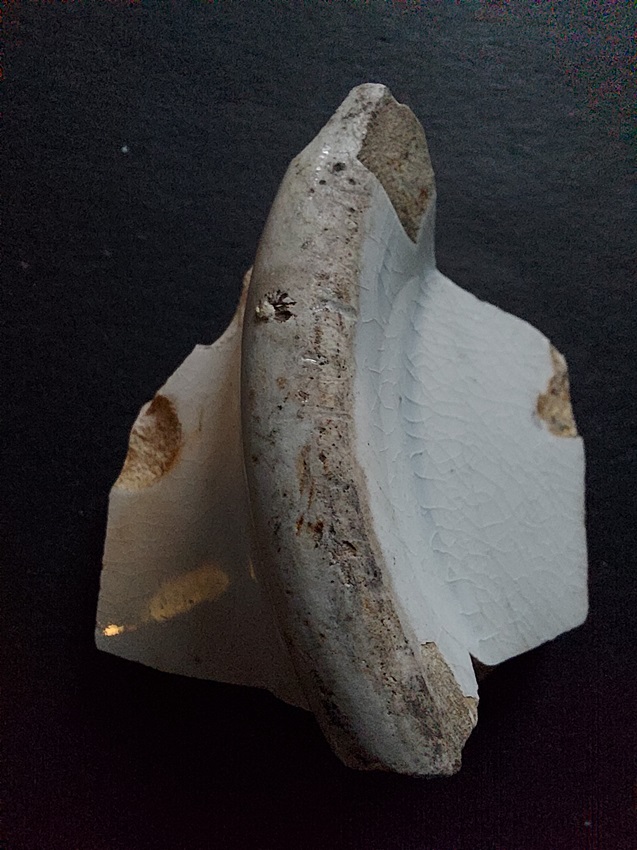
It’s the wide strap handle to a large cooking pot – this sort of thing:

Taken from here

The fabric is unusual, though – very hard, with a purple colour, and a black and white mixture of inclusions – it’s a sort of Midland Purpleware, almost Cistercian Ware, and not at all like the normal Black Glazed stuff that you associate with Pancheons. Lovely stuff.

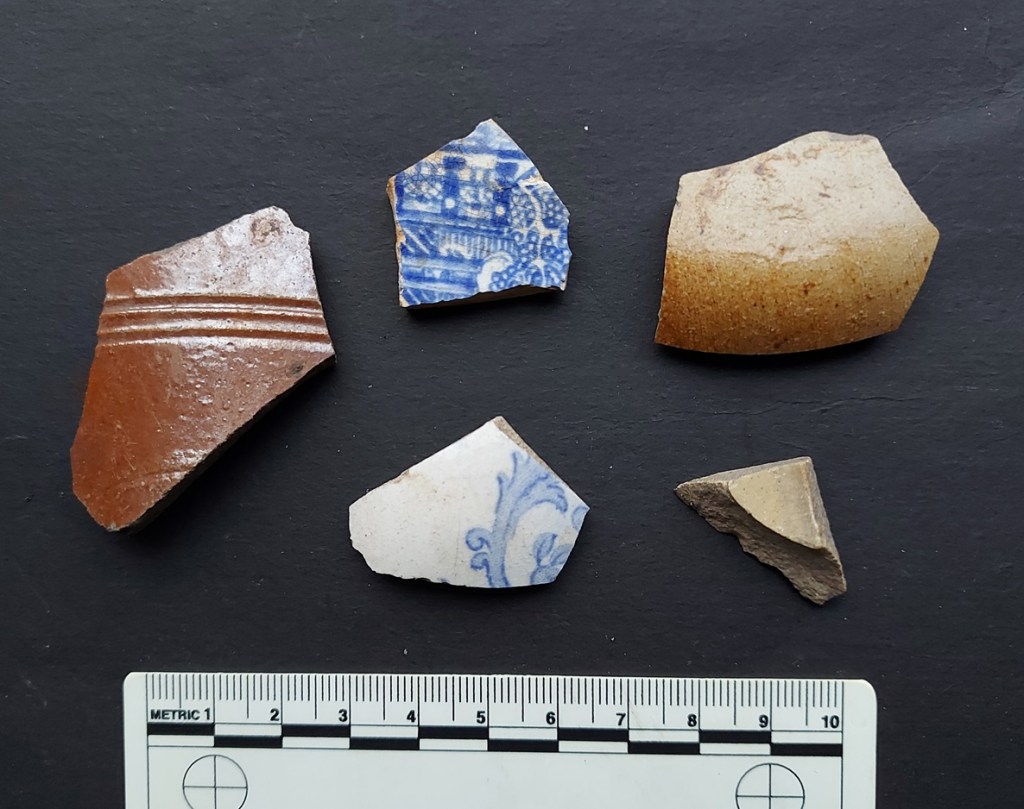
Also, there is the brown stoneware. Some Victorian Derbyshire Stoneware, but also early 18th century Nottingham Stoneware:

The two handle fragments at the top probably come from a tankard, again early-mid 18th century, and the bottom left bit I think comes from a bottle. The sherd in the centre come from a strange shaped lid… I think. It’s odd.

And finally, I found this:

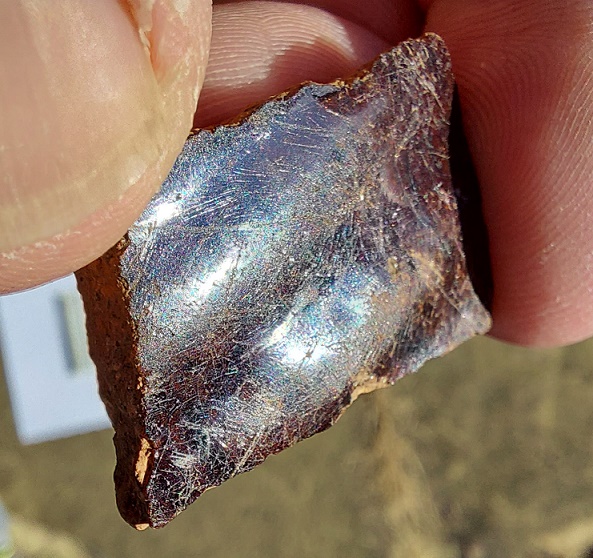
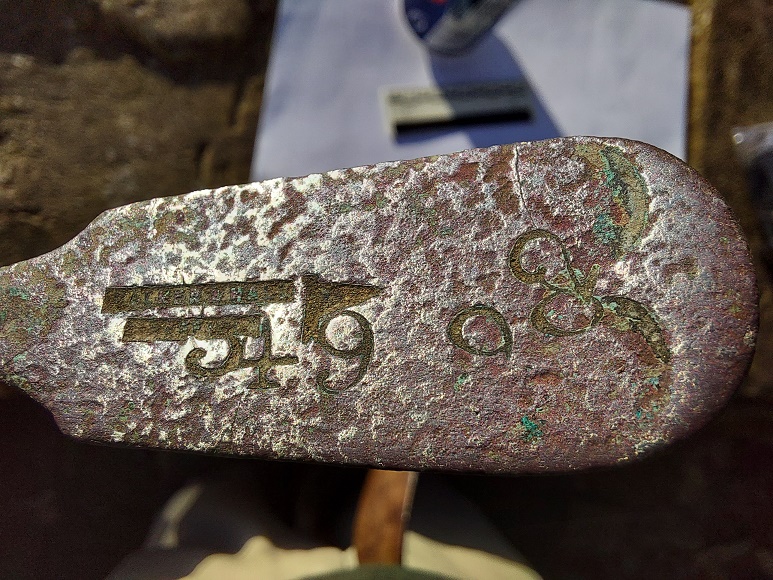
A ‘Tombac’ button; Tombac is an alloy that has a high copper content (80-95%) mixed with zinc.

Shiny (though sadly scratched), it still has the silver looking surface – which it was designed to do – and is a lovely thing to hold… that personal touch, again (you can see a better preserved example here). The back shows signs of it breaking down (the green bloom of copper), but also the reddish iron rust of where the loop that once held it in place was. This button is nothing special as such, it is plain, and of relatively poor quality, but it is dateable as Tombac plain buttons such as these were used from mid-18th century onwards (stopping perhaps late 19th). I love this thing… so intimate. Did it belong to someone who lived on the farm? Perhaps.

So there we have it… the farm. As to what it looked like – well I have found no photographs, but I would suggest it looks like this farmhouse on Hague Street; it’s about the right age, and has a similar layout/shape – although Whitfield Green is larger – and is also divided into two dwellings. Interestingly, they both face south-west. I hadn’t noticed before putting them on the page, but it makes sense as it maximises sunlight, and thus light in general.
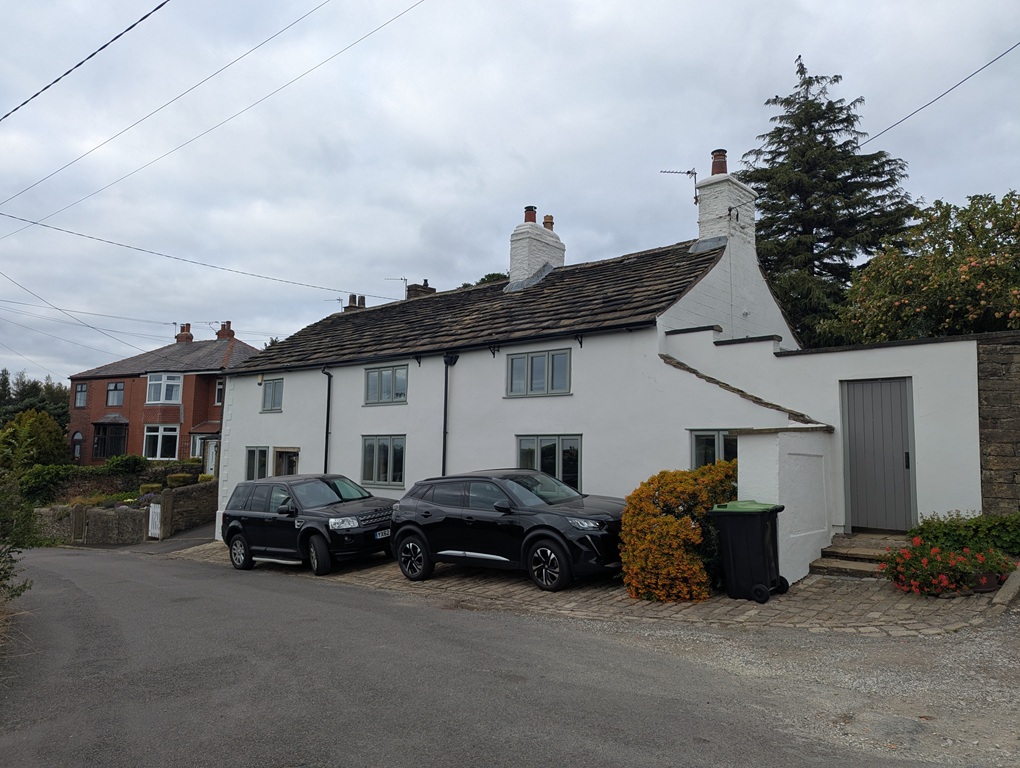
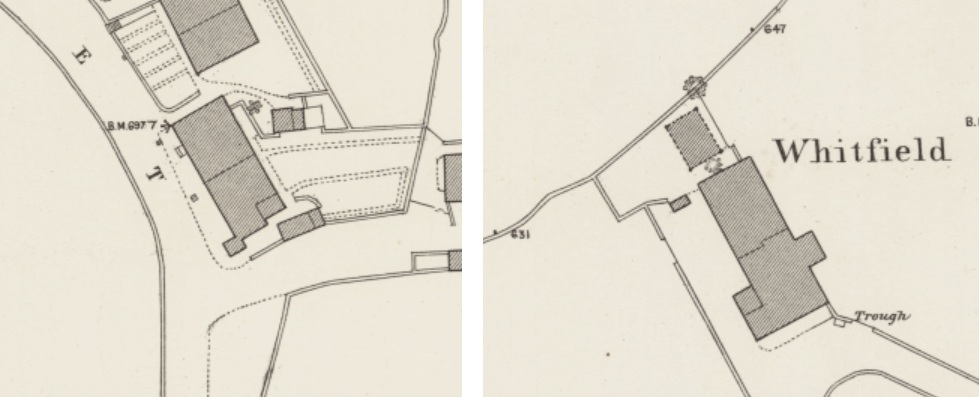
Left is the Hague Road farmhouse, right is Whitfield Green, from the 1:500 town map, and stolen shamelessly from the NLS website.

There is no information in any of the usual books, and there are only a few references to it online. According to the ever wonderful and always useful GJH website, a Robert Wood, born in 1713, is described as being of Whitfield Green, as indeed is his son. So we know that by 1740 or so? the farm is there, and it suggests that the name of the farm is simply Whitfield Green, and that the later building took the name Whitfield Green Farm to distinguish it. There are later references, but this seems to be the earliest, and thus we have the name of someone who may have walked on those flags, and who may even have worn the button.

Well, that’s your lot for this month. I’ll try and get round to posting another one if I can – more pottery, obviously (ignoring the groans).

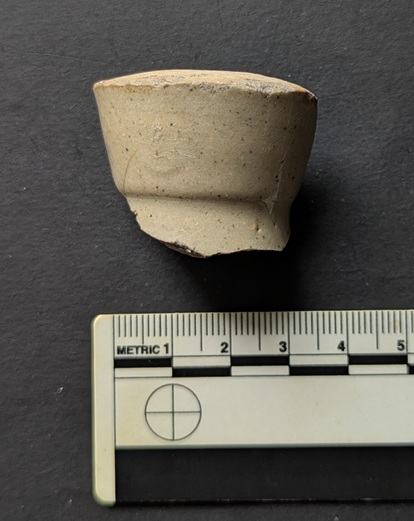
It was just lying on the surface of the track… a gift if you will.

Its from a cup or tankard, and dates to the last part of the 17th century or early 18th, so within the range of our building. Or perhaps we should revise the date back a bit? Certainly the late 17th century saw a lot of building work in the Glossop area, as a glance at the Datestone post will show you. Again, a little excavation (or a photograph!) would show us a bit more.

In other news, the new Where/When will be out soon – more info when it happens, but this one is a truly awesome Wander around Mellor – just over yonder! It has medieval field systems and farms, Victorian noise, Iron Age hill fort, medieval crosses, cracking views, a terrifying viaduct, bench marks, a trig point, wonderful gateposts, and it starts and finishes at a pub… what’s not to love? Here’s the cover to tempt you.

Righty ho, I’m off. I have housework to do before I’m allowed a glass of the stuff that cheers – Mrs CG’s rules, which I can’t help feel is unfair… into every life a drop of rain must fall, and all that.

More soon, I promise, but until then, look after yourselves and each other. I remain,

Your humble servant,

TCG

Archaeology · Pottery · Whitfield

Friends… and Neighbours

What ho you lovely people!

I trust you are all recovering from reading the mighty publishing phenomena that is Where/When Issue 1? Move aside JK Rowling… Harry Potter was good, but was it ‘Pottery’ enough? See what I did there? Pottery… Potter…

What? What do you mean “don’t give up the day job”? This is my day job! And you, sir, are frankly uncouth! Honestly, what do you mean there are “funnier types of fungal infection”?

If you haven’t bought a copy yet, go and grab one from Dark Peak Books, or from me, if you can track me down. Or even download a free copy (link above). A perfect stocking filler, even if I do say so myself. Oh, and plans for a second and third edition continue to form… watch this space. Or Twitter. Or Instagram. Or just get in contact!

Anyway, shameless self-promotion over with let’s get on with the show, so to speak.

So, I recently became aware of a group of wonderful people – The Friends of Whitfield Rec and Green Spaces (their Facebook page is here). They are a group of Whitfield residents who are helping with the day-to-day upkeep and improvement of Whitfield Recreation Ground and other green spaces (for example planters, and other bits of land that might otherwise be neglected). A wonderful idea; we who use it, help keep it usable rather than rely just on the council who, with the best will in the world, don’t always the time and resources, or the local connection, to do this. I’m a big and passionate believer in the phrase “be the change you want to see in the world” (a saying usually attributed to Ghandi), and this group is a great example of this in action.

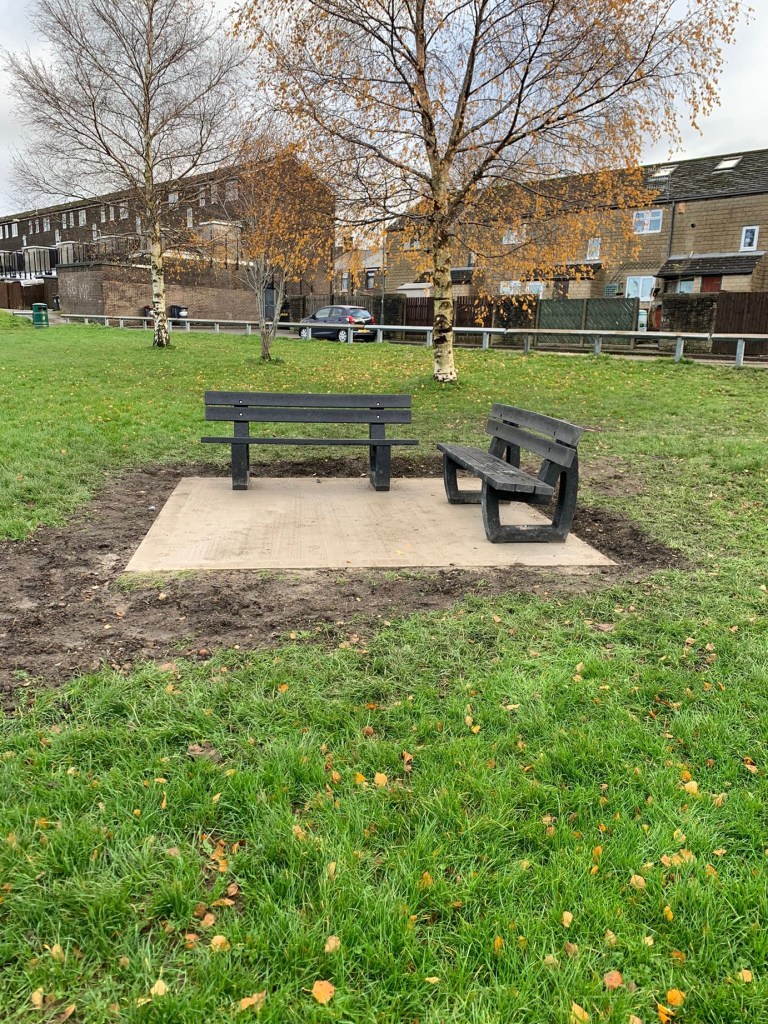
This summer they planted a pile of… er… plants in the grass around Whitfield Wells, improving the look of the area and adding a little wildness – an excellent example of what they do. And a few weeks ago they organised and installed some good looking new benches at the Rec. giving me somewhere new to sit and ponder the world… and my own navel whilst Master C-G and assorted other Herberts run riot.

The eventual idea is to landscape mounds and hedges around them, creating a wonderful usable social space. But back to the present, and the realisation that one cannot make benches without breaking soil – or something – and my spidey-sense began to tingle… do I smell pottery?

I did indeed.

A pile of pottery.

Most of the stuff I found was typical late Victorian and early 20th century tablewares. Not unexpected, and it is largely domestic rubbish, on wasteground, dating from a time when there was no rubbish disposal. Some of the more interesting bits in the above photo, then. Top row, second from right is a shallow bowl or plate with a rim diameter of c.18cm with a hand-painted red band running on the interior – a common motif in early 20th century pottery. Next to that is a fragment of a large rounded jar with a decorated out-turned rim (I should probably start explaining what I mean by all these terms… possibly). And next, a rolled rim from a brown stoneware cooking pot. Bottom row, second from left is a sherd of open pattern spongeware. Fourth from left is a sherd that has decoration hand-painted on the top of the glaze, and the two sherds on the far left are porcelain. As I say, fairly mundane.

However, some pieces were a bit more interesting.

First up, we have a fragment of a Pond’s Cream (or similar skin care product) jar.

Difficult to see in a photo.

It is made from milk glass – an opaque type of coloured glass – and is roughly square shape in plan, with rounded edges and large vertical grooves; it would have looked lovely when whole. It also has a screw top, which generally means it is early 20th century in date.

These three are quite nice, too.

Lovely stuff. And an ok photograph! I had so much trouble taking these – it was so dark even during the day that the pottery was showing out of focus.

Top left, a small plate of Shell Edged Ware, which my own guide suggests is mid Victorian. Bottom left is a hand painted tea cup of c.10cm diameter; it would have been quite lovely. Right is a sherd of Banded or Annular Industrial Slipware, with a rim diameter of c.10cm, and probably from a Late Victorian tankard (they are common in this design), and perhaps, we might speculate, from The Roebuck pub on Whitfield Cross.

These are very nice.

Left is a lovely sherd of Spongeware – a flower from a much larger design. Right is the neck from a Brown Stoneware bottle or jar of some sort. The incised decoration on this sherd is very sharp, indicating that it came from something potentially very fine. Both Early Victorian at a guess, so perhaps heirlooms when they were thrown away, or indicating that there is earlier material in the ground below the Rec. – which would be unsurprising.

I love this next sherd – a ring foot from a larger open bowl or serving platter.

Unassuming, and a little boring at first glance

It looks boring, but is almost certainly early Victorian, and has seen some heavy use, perhaps indicating it too was an heirloom when it was broken and disposed of.

Very diagnostic – wear and glaze.

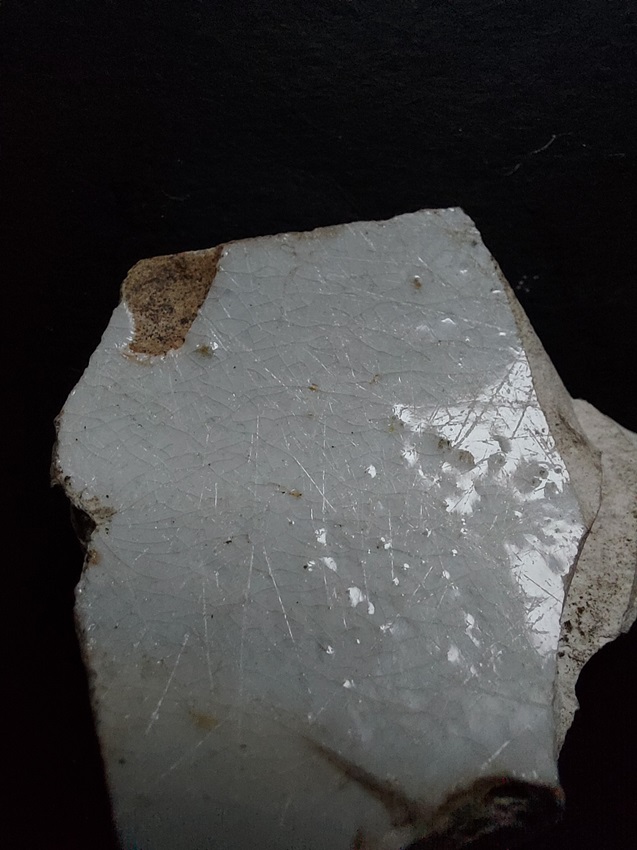
The wear on the ring foot is clearly visible – it has been moved about a lot – in and out of cast-iron ovens in particular – scraping off the glaze and wearing out the ceramic underneath. Also, note the blue tint to the pooled glaze, indicative of a Pearl Ware, and which was largely unused after about 1850. Knowing this sort of thing is the reason I’m a hit at so many parties… such is the burden of the sherd nerd!

Extreme close up!

Looking at the interior surface you can see many scratches – cut marks made by a knife, probably cutting up meat in the process of serving food. This vessel had seen lots of use before being tossed into what would become the Rec. I love it – the human touch.

Finally, there was this:

No, honest, it’s not just a stone!

It may not look impressive… and to be fair it isn’t. It’s a piece of spent coal – or cinder – and it’s what is left over when you have burnt coal. But it is a hugely significant in that every house would have produced lots of this material, and it should really be seen as a marker of domestic life in the late 19th and early 20th century. I love it for that… not enough to keep it mind, but it is a lovely, if very common, little piece of social history that I wanted to share with you.

So my sincere thanks then to the Friends of Whitfield Rec and Green Spaces for inadvertently sponsoring this month’s post!

Whitfield Recreational Ground has an interesting history – I’m not going to go into it too much as I’m not sure I could do it justice in this article, although it does need doing. Briefly though, Robert Hamnett (the historian) notes that Wood Street – and presumably the whole area – used to be an open field. He states:

“When I first remembered it there was a disused brick yard in the centre, with numerous depressions, which after heavy rain became dangerous to children playing there; in fact there have been cases of children drowning there”.

The whole area was improved and landscaped by George Ollerenshaw in the late 19th and early 20th century. He built the houses on Wood Street, and donated the library building that once stood at the southern end of the park (now the toddler park). His monogrammed initials and date of 1902 are on the Wood Street entrance to the park.

The ‘G’ and ‘O’ monogram of George Ollerenshaw.
1902 – the year the park was opened. I love these, and this entrance – a real faded glory.

Obviously, over the years I have picked up a few bits and pieces from the Rec:

A selection of fairly mundane and entirely expected Victorian pottery.

On the left is a sherd of nice and finely incised Brown Stoneware, probably from a bottle, and possibly early Victorian, as later types are less precise and do away with the incised bits. The middle sherds – one on top of another – are bog-standard Blue and White transfer Printed Ware. The two bits on the right are Salt-Glazed Stoneware, and probably from a ginger beer bottle. Lovely stuff this (and the subject of a future Rough Guide). I also think I can just about make out a smudged fingerprint on the exterior from where the pot was moved whilst the glaze was still wet. Possibly.

Excitingly, we have this:

A close up… perhaps too close?

A clay pipe bowl fragment, with rather lovely fluted decoration – flat panel of gadrooning (don’t say we don’t learn you nuffink on this website… and yes, I didn’t know either, I only learned it accidentally by researching this pipe!). However, nice though it looks, it is roughly made; the seam, where both parts of the mould come together, is coarse and untrimmed, and the clay has been poorly formed in mould. This is mass production in the Victorian period.

And finally, just like the cinder piece above, we have a very mundane but quite important object… a piece of roof slate.

I mean to say… it’s not much to look at.

It really is mundane, but is quite informative. Slate is not local: Wales is it’s origin, and until the railways enabled the movement of relatively heavy fragile material like this, that’s where it would have stayed. Once the railways were established (c.1840’s onwards), it quickly became the roof material of choice – just as strong as local stone, but 20 times the weight. indeed, you can usually date the houses of Glossop to roughly pre- and post-1850 by the roof material: stone vs slate. This slate has a flat smooth edge (at the top in the photo) where it has been shaped, but other than that, it is utterly unremarkable, and it simply exists as a remnant of the 1000’s of houses that once stood very close by but which were pulled down during the rebuild of this area during the 1960’s. Indeed, the roof of the public library that stood here was also slate, so it might be part of that as I found it not 10 feet from where it once stood (underneath the toddler play area).

None of these finds have a context – they are all simply rubbish dumped here mostly when it was an open field and before it was transformed into a park. It’s interesting to ponder that for a moment. The Victorians were awful when it came to litter; everywhere they went they left a trail of pottery, glass, metal, and bone – rubbish all over. Now arguably, these are organic, and are not largely made from toxic oil-based plastics as much of our litter is, so not as ‘bad’. Nonetheless, it is safe to say the Victorians were absolute scumbags, and although some of it will have been picked up, there is still lots to be found. If groups like the Friends of Whitfield Rec and Green Spaces have their way and remove all the litter from these places – and I hope that they/we/you achieve this – then are they doing a future me out of a blog post or two? There may be no rubbish to mudlark/fieldlark and blog about! Unfortunately, the massive amount of plastic rubbish that seems to crop up everywhere you look would indicate that this is not the case, and in 200 years no doubt some sad geeky bloke will be publishing a monthly article on a website, and enthusiastically waxing lyrical about this piece of rubbish or that bit of bottle. Imagine…

Get in contact with the Friends via their Facebook page; help them out, give them ideas, give them time, resources… even a cheer. They really do deserve it for everything they are doing, and attempting to do (read a bit more about them and what they do here). Also, do something simple: pick up a piece of rubbish from the street and put it in the bin – every bit we do, helps the bigger picture. And the future me won’t hold it against you, honestly.

That’s all for now, and it only remains for me to wish you a very merry Christmas whatever you end up doing. Personally, I shall be basking in the glow of a fire with family, some cheese and a large glass of the stuff that cheers. So here’s a health to you all, and I hope you enjoy my favourite ‘modern’ Christmas song.

And/or my favourite more traditional song:

I’ll be back in the new year, but until then, and especially at this time of year, please look after yourselves and each other, but until then, merry Christmas (and a merry solstice).

I remain, your humble servant.

TCG

Archaeology · Medieval · Roads · Roman · Simmondley · Whitfield

Field Work

What ho, dear and lovely people, what ho! I trust you are all enjoying the weather as it bounces, somewhat insanely, from parched desert in the midst of an African heatwave to “quick Mrs C-G, gather up two of every animal you can see, whilst I look up ‘How To Build an Ark‘ on YouTube” rainstorms. I mean, it keeps you on your toes, what!

So then, I have recently become obsessed with fields and their shapes, and what they can tell us about the history of Glossop. I know, I know, I really am quite the hit at parties! Indeed, I often hear the phrase “oh great, TCG has arrived!”… it’s nice to be appreciated. As an aside, 7-year-old Master C-G has recently taken to mocking me by asking a question about, for example, pottery, and then interrupting the answer with “wow dad, that’s soooo interesting…” and walking off, before falling down in fits of laughter. I mean to say, that’s a tad off, what? Where’s the blighter’s respect for dearest pater?

Anyway, where was I? Oh yes, field shapes and history. So, if you look at any OS map, you’ll see that it is criss-crossed with lines which mark out the boundaries of fields. On the ground and in real life these boundaries are made up of fences, hedges, or, in this part of the world, with drystone walling. It takes time and effort to build these walls, and more time and effort to take them down, which means it doesn’t happen very often. And unless the area has been significantly changed or has been built over completely, the field boundaries you see on the map and on the ground have been there since they were laid out. And here it gets interesting: the way fields were laid out changed over time – their shapes reflecting contemporary farming techniques – and it this which allows us to date them and their associated settlements.

Looking at local examples chronologically then, we start at the beginning. Quite literally. The first farmers – those neolithic & bronze age types who initially took the huge risk to cease the hunter-gatherer nomadic lifestyle, and instead adopt a sedentary one based around agriculture – created the first fields. Evidence from elsewhere suggests that these were not fields as such, more areas of land cleared of trees – a formidable task using only stone or at best bronze tools – and the area cleared of stones to enable to plough to pass. The larger stones are normally found rolled to the edges of the cleared areas, and there are often clearance cairns associated with them – piles of rocks, essentially. There are suggestions of bronze age systems in the area, but nothing even close to definite, and certainly nothing worth describing.

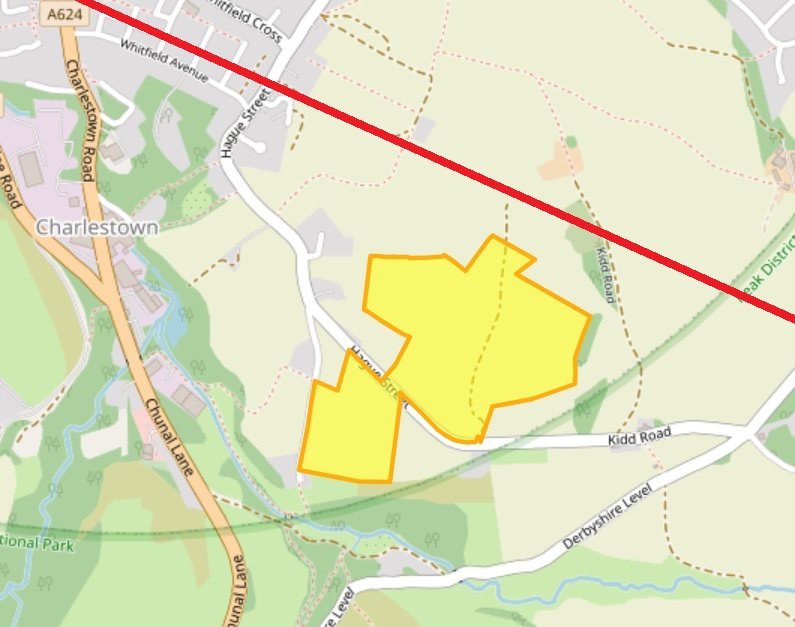
There is a similar situation with the Romano-British field systems, of which there is one possible example, in Whitfield, to the north and south of Kidd Road. These seem to comprise a series of lumps and bumps in the ground that might be the remains of field boundaries, or of terracing on which agriculture took place.

The potential field system is in yellow, the Roman road from Navio is in red. Image stolen and altered from the Derbyshire HER website.

As the Roman road from the fort at Brough (Navio) runs just by there, it would be a good place for a farmstead, and I’m sure more existed nearer Melandra. It’s not terribly inspiring, if I’m honest, but it is interesting, and if it is Romano-British in date (43AD – 410AD, perhaps a little later, too… or possibly a little earlier), then it is proof that people have lived and farmed in Whitfield for over 2000 years. You can read a bit more about it on the Derbyshire Historic Environment Record here, or, the Glossop & Longdendale Archaeological Society website, here.

However, our first definite and recognisable field systems occur in the medieval period.

By 1086, Longdendale and Glossop had been designated Royal Forest, a situation which brought with it all sorts of restrictions for the residents of the seven villages that made up the area at the time of the Domesday Survey: Chunal, Whitfield, Charlesworth, Hadfield, Padfield, Dinting, and Glossop (I’m convinced there was something at Simmondley and Gamesley at the time, but were overlooked or ignored as too small to tax). It was particularly particularly restrictive around land use; the existing villages were allowed to continue, but were not allowed to expand their size in anyway, as this would affect the king’s land, and take food from his deer. That didn’t stop them, though. What few records we have of medieval Glossop make mention of the crime of assarting, that is to cut down trees to enable the land to be used for growing crops or grazing – essentially increasing your land, illegally. For example, in 1285 we find the following:

“The wood of Shelf has been damaged in its underwood to a value of 15 shillings by the villagers of Gloshop, fined 4 shillings, they must answer for 60 oaks”.

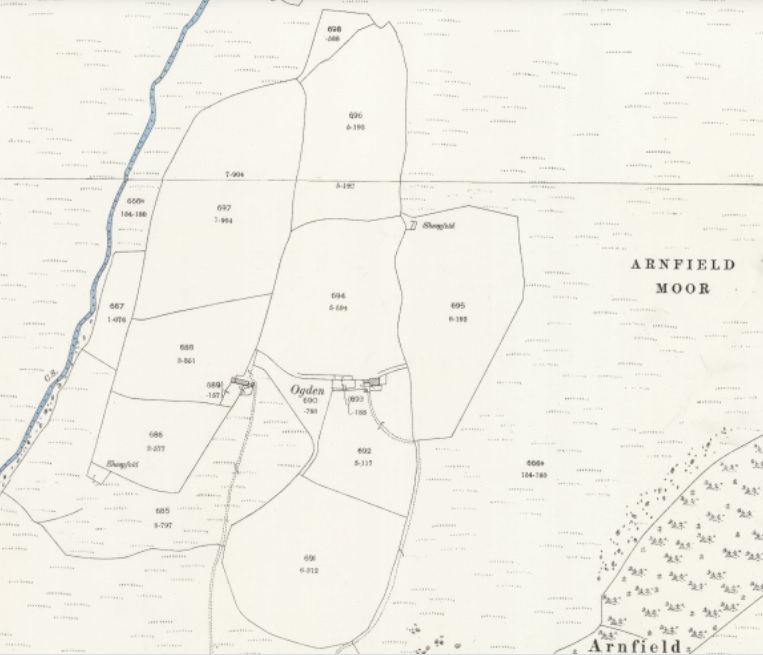
The process would have been gradual, and probably done sneakily, perhaps by bribing the forester to look the other way. Or equally, it may have been worth the fine if you can increase your farming lands significantly – an investment of sorts. Given the nature of assarting – essentially picking away a few trees at a time – it often leaves a distinctive field shape: rounded, rather than straight or uneven lines. There is a perfect example of this at Ogden, above Tintwistle:

The two farmsteads of Ogden, both now in ruins. I need to explore up there sometime.

And if we look over at Hargate Hill, between Charlesworth and Simmondley, I think we can see a similar process happening here:

Rounded edges, rather than the more usual straight.

The circular, almost organic growth of the fields can be seen, and it may be this that is referred to in 1285: “The wood of Coumbes (Coombs) has been damaged by the people of Chasseworth (Charlesworth), fined 2 shillings, they must respond for 18 oaks.” This whole area is full of interesting detail. The first mention of Hargate Hill I’m aware of is 1623 (the record of the burial of ‘Widow Robinson’ of Hargate on 10th July, to be precise), but there must have been something there before this date. There is a suspicion that stone from the quarry here was used to build Melandra Roman fort, although how true this is, is not clear, but the settlement is just off the main road between Glossop (via Simmondley) and Charlesworth, which is significant. Importantly, between the road and settlement, there is evidence for Ridge and Furrow ploughing, which is normally medieval in date. You can see it in this LIDAR image:

The ridge & furrow is running roughly north-south from High Lane.

Ridge and furrow is created by ploughing up and down a strip of land using a team of 8 oxen. Now, as you can imagine, 8 oxen are a nightmare to turn, and their size alone means that you have to start the turn very early on in your plough furrow in order to maximize the land use. This creates a distinctive reverse ‘S’ shape to the thin fields – or ‘selions’ – that make up the medieval farm landscape – the result of only being able to turn the oxen to the left (as the medieval farmer used a fixed blade plough share that was positioned on the right). These selions are side by side, with a dip in between (you can just about make out the dips in the above LIDAR image), and made up of rows and rows of ridge and furrow running the length of the selion. A selion normally measured a furlong in length (a ‘furrow long’: some 220 yards) and between 5 and 22 yards wide.

In Whitfield there are many great examples of this classic, and instantly recognisable, early medieval field shape.

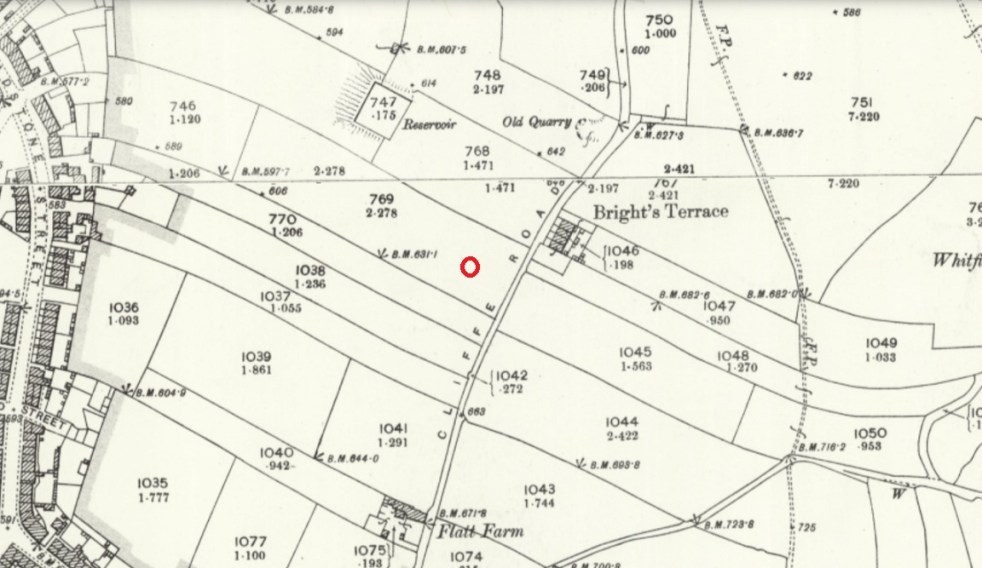
Clearly visible, running NW-SE, and on either side of Cliffe Road. There are dozens more in dotted about the area, too.

Hiding in plain sight, the medieval field systems of the 12th & 13th centuries. The fact that they run either side of Cliffe Road is significant: they ‘respect’ the road, which means that the road was there before the selions, as it is highly unlikely a road would be put through arable land. We know this anyway – it was the main road from Glossop to Chapel en le Frith – but it is good to have it confirmed.

What I find amazing me is the sense of continuity of use; the field marked with a red ring in the above map is exactly the field boundary of the Whitfield Allotments, and I wonder how many allotment holders realise their plot of land has been continuously farmed for nearly a millennium. It’s also fascinating to think that although the area has been largely built over, the boundaries of individual modern house plots have used these field boundaries as references, and so the field laid out by a medieval peasant farmer 800 or more years ago has a direct influence on life today. Looking at a tangible history in that way leaves one feeling quite dizzy.

Chunal, first mentioned in the Domesday Book, was an important medieval farmestead.

Chunal is even clearer in its agricultural history, and has evidence of both assarting and the use of Ridge and Furrow on both sides of the road, especially what is hidden beneath the surface now – compare the above map with the LIDAR survey of the same area… huge numbers of selions, all in the classic reverse ‘S’ shape.

The same area scanned with LIDAR. The selions not shown in the above map are very clear.

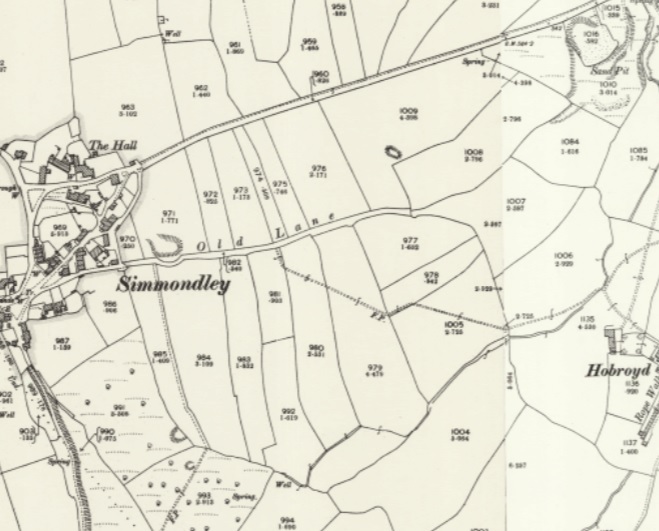
The quantity of field strips is testament to the relatively large-scale agriculture occurring in this area in the earlier medieval period. Simmondley, too, has a large number to the north and south of Old Lane, which was the original medieval track from Charlesworth via Simmondley to Glossop:

Notice the selions ‘respect’ the original track – Old Lane – they stop at the road, and don’t line up symmetrically on the other side. They are, however, overlain by the New Road which was built, I believe, in the 1860’s. Just as in Cliffe Road in Whitfield, Old Lane must have been there when the selions were laid out, or at the same time, giving us a date for the track.

During the 14th century, however, we see a shift in farming practice, and land use moves away from the ‘open field’ system of strips, and starts to become enclosed by walls. This is probably a result of two critical events. Firstly, the climate starts to get colder, which has a negative impact on the ability to grow crops, and which lead to a series of famines. The second was the emergence of the Black Death which killed off 1/3 of the population during 1348-49. And whilst the Peak District emerged seemingly relatively unscathed, no doubt there was a movement of the population to better arable land that had been abandoned, leading to a population decline. It had also become apparent by the mid century that sheep/wool farming was a lucrative market, and thus increasing amounts of land was blocked off to allow sheep to graze safely. These early enclosures are normally recognisable as non-symmetrical enclosures that have largely straight-ish lines, but aren’t a specific shape. We can see some probable examples to the north of Simmondley New Road, now covered by housing but preserved in the 1892 1:25 inch map:

Simmondley New Road running west-east(ish) replaced Old Lane… the clue is in the names!

If we look closely we can see these early enclosures are made by consolidating and expanding existing selions, as farming practice shifted from arable to livestock. The more you look, the more the medieval and early modern landscape comes to life.

We also encounter them at Gamesley, now also covered by housing, but perhaps originally associated with Lower Gamesley Farm which may have an early foundation date, even if the present building there dates from only the 17th century (only…!). The settlement is first mentioned in 1285, but actually Gamesley is a Saxon name meaning the ‘clearing (or assart) belonging to Gamall’.

Gamesley, to the south of Melandra.

Of course, people needed agricultural produce, and many strips continued to be farmed well into the post-medieval period. Indeed new fields were laid out, although later ridge and furrow is normally straight as, over time, smaller teams of larger oxen were used, and these were eventually replaced altogether by heavy horses.

Our final field type comes at the end of the 18th and early 19th centuries with the parliamentary enclosures. Briefly, open ‘common’ land – poor rough land, owned by the Lord of the Manor, but used by everyone to graze animals or to gather fuel – was parcelled off and sold in lots. On paper, this freed up lots of land and was a boon for farmers who could, with a little improvement, massively increase their lands. But it also meant that the common man lost access to land that his ancestors had legal rights to. Arguably, by the early 19th century there were very few people who would have used the land anyway; not many people had animals to graze, nor did many burn peat as a fuel. The rural way of life, especially in Glossop, was well and truly over and most people lived in stone terraces and worked in mills. But that really isn’t the point! The parcelling up of the land into lots was done drawing lines over maps using rulers… and it shows.

Moorfield is surrounded by fields that are the result of the 1813 Whitfield Enclosure Act.

And elsewhere:

The area to the north of Glossop

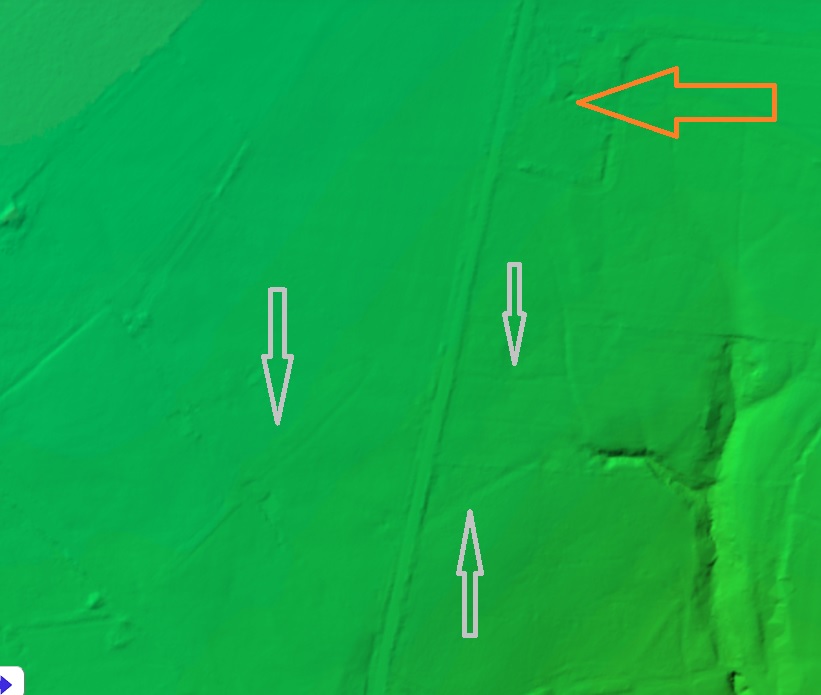
Around Lanehead farm, toward Padfield there are clear examples of 19th century enclosure… in fact they are all over Glossopdale – have a look at any map. They often mask earlier field systems and tracks which can be on a different alignment, and a quick scan of the Lidar for the same area reveals all sorts of lumps and bumps:

Lanehead Farm is shown by the orange arrow.

The grey arrows above show older field systems not shown on the map. In the middle of the arrows there is what might be ridge and furrow. A detailed study of the fields on the maps and on the ground, as well as a comparative reading of the lidar could give us huge amounts of information about the past use of the landscape, beyond the obvious parliamentary enclosures.

The lines of these fields are all very straight, and all the walls are of a standard form, and the whole parliamentary enclosure process was completed with characteristic Georgian and Victorian efficiency. But a part of me feels that it is almost an industrialisation of the landscape, a triumph of efficiency over nature. Prior to this, it was a difficult process to carve out a little patch of land to support your family, and it required blood, sweat, and tears. This human, organic, side is etched onto the land – assarting, the reverse ‘S’ shape, even the enclosures for sheep, they all have an element that is dictated to by the land, and all came with effort. To stand over a map with a pen and ruler dividing up the landscape is to have a complete disconnect from it, and is human imposing on it, rather than working within it, and that feels wrong somehow. Anyway, enough of the hippy!

It genuinely is amazing what you can see when you start to study maps, the unexpected can leap out at you. Keep looking, wonderful people, and please mail me with anything you find – I could even make you famous* by publishing it on the website.

*famous to all 11 people who read the website, that is.

Anyway, I hope you have enjoyed todays romp around the countryside. I’m planning a few more official Cabinet of Curiosities wanders over the summer, one of which is a jaunt down the medieval and early modern trackways of Whitfield and Glossop via 2 pubs and a pile of history and archaeology… what’s not to love? And all at a bargain price… a man has to eat, after all. Watch this space. Or Twitter. Or Instagram, if I can figure how to use it properly.

Until next time, keep looking down, but also look after yourselves and each other.

I remain, your humble servant,

TCG

Archaeology · Oddities · Whitfield

A Song of Sixpence

What ho! What ho! What ho!

The Christmas season is upon us once more, and my word it seems to have come round again very quickly… in my mind it’s only September! It’s also bloody cold at the moment, and despite the protestations of Mrs C-G, the heating is not going on… honestly woman, just put another jumper on! Anyway, kind and wonderful folk of the blog-reading variety, here’s a little offering to keep you warm.

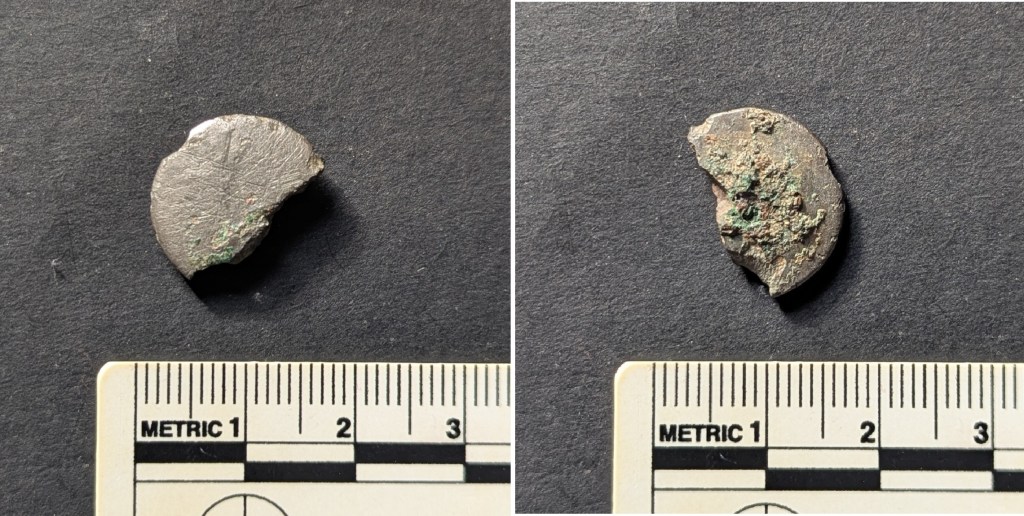
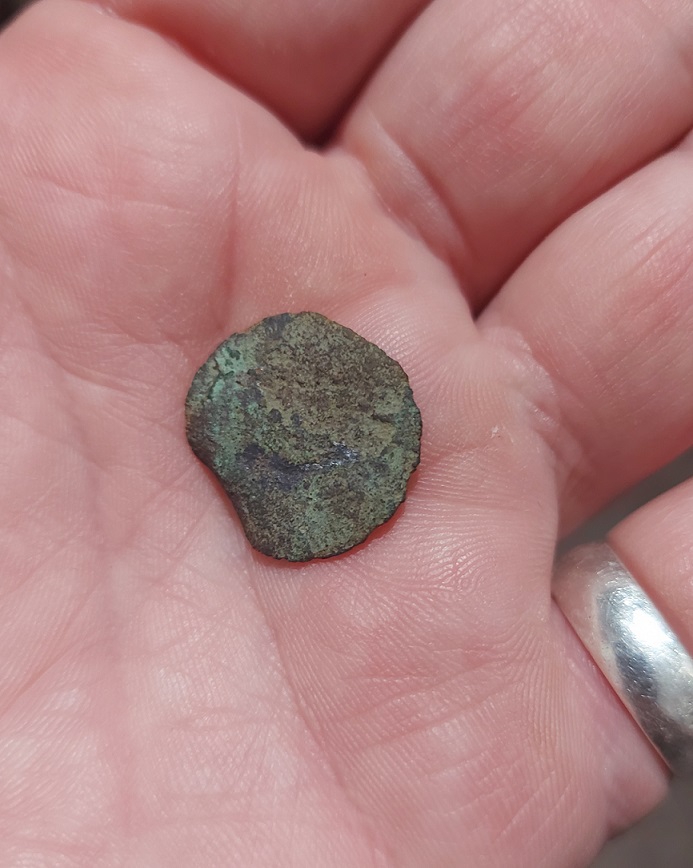
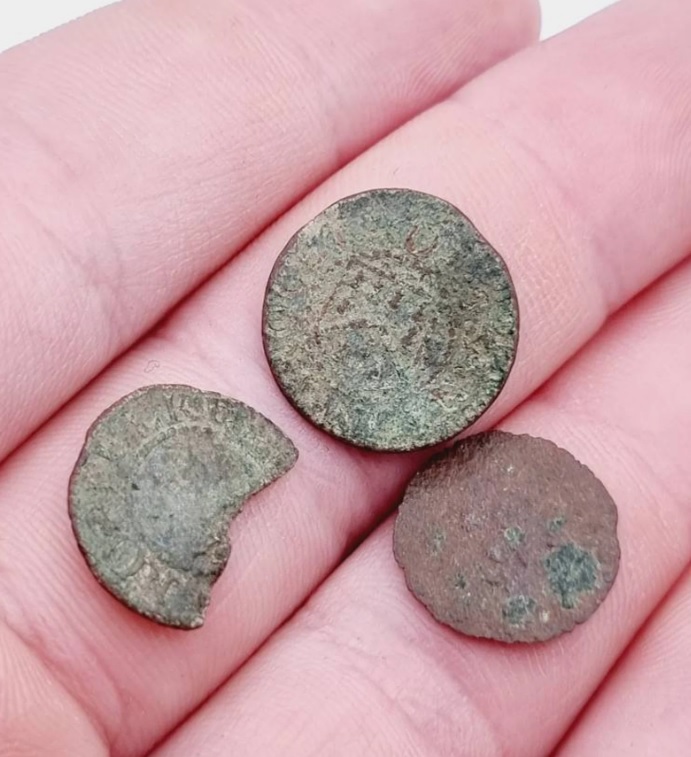
So, a number of years ago (22 July 2018 according to my records), I found this object on the footpath below Lean Town:

A metallic disc. And no, before you ask, I’m not deformed… I just have chunky and somewhat stubby fingers, Nor is it me holding the disc with my foot/toes either, as someone once ‘amusingly‘ commented.

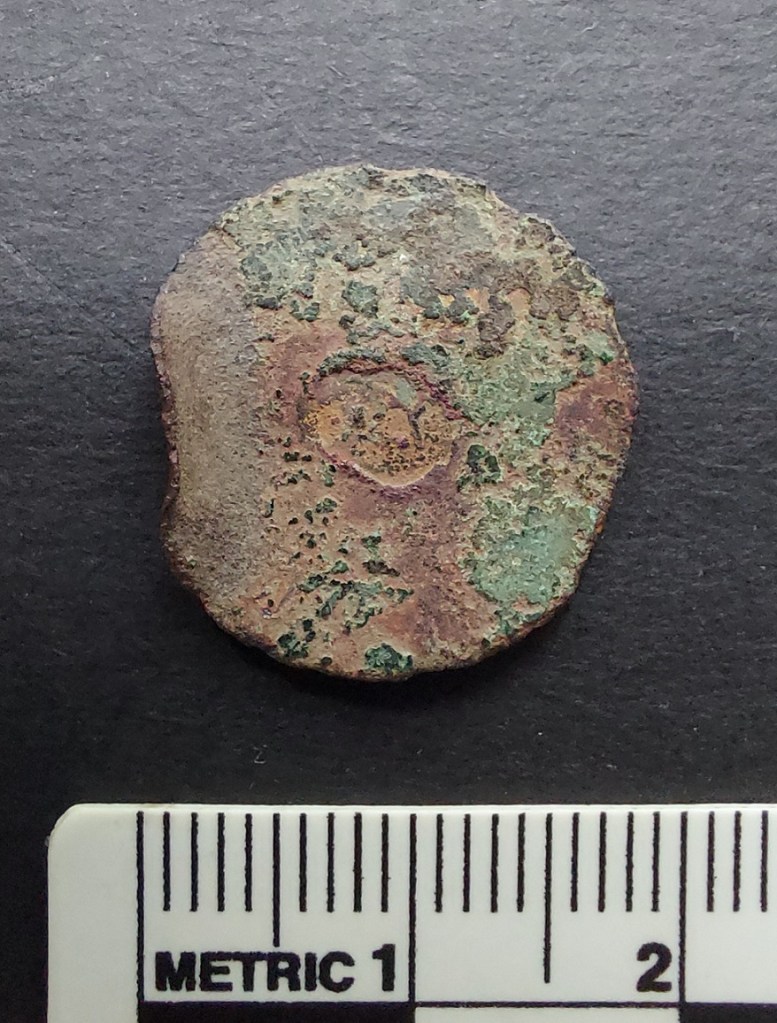
A coin” I thought, excitedly. And I still think it is. Well, a trade token, perhaps, but it has no discernible features that allow identification; it is completely effaced. A closer look reveals that some of the original surface has survived, revealing the dark green of oxidised bronze – so we know what it was made from. It is very thin, and seems to be relatively poor quality metal, so I err on the side of it being a trade token of some type, rather than a coin.

A close up. The central circular worn patch is the result of wear, and it looks as though the metal has delaminated. You can see the original surface – smooth green patches – above and to the right of the circular wear patch.
Another close up. This side seems more worn, although the original surface is visible in places.

A trade token, incidentally, was a privately minted token used as small change between people, or for a specific retailer or trader. They were common in the 17th century and later when small denomination coins were rare, and often come with the name of the trader, or other information. This one… alas!

Some trade tokens – not mine, but some for sale here.

However, for me, the most interesting thing about it is that it has been bent on the edge, and this wasn’t accidental:

The bend is clearly not accidental, but instead deliberate and thoughtful.

As damage goes, it seems to be very targeted, unlike the rest of the damage which is the result of acidic ground conditions. No, this is a deliberate bend, put there by human intention, and that, dear and gentle readers, neatly leads us into an obsession of mine: the bent coin.

As you might have noticed I have a tendency to be somewhat… focused, shall we say? Yes, I know other words are available, but I was being kind to myself! In my real life, I am honestly a shambles; a veritable clown-car at times, complete with wheels that regularly fall off and an enormous horn (madam, calm yourself please, this is not that sort of website). But by Jove, when it comes to archaeology, I can tell you the what, where, and when with almost surgical precision, complete with spreadsheets, plastic bags, labels, and typologies – with archaeology, then, I am mustard, tickety-boo and, I’d venture, oojah-cum-spiff. The ability to focus on single topics in such a way means that I sometimes fall down rabbit holes (literally, as it happens, as well as figuratively) and become obsessed with certain features, topics, and objects… and so it was here with bent coins.

A number of years ago, whilst sorting the small finds at the Blackden Trust, I came across a coin that had been bent into something of an ‘S’ shape. “Hmmmmm…” thought I, and off I wandered – and wondered… why would a coin be bent like that?

A survey of what little literature there is on the subject revealed that coins bent in this manner are a relatively common find by metal detectorists. Further research revealed a fascinating history of coin bending traditions that begin in the medieval period as an important, if not official, religious function, which later shifts to encompass such concerns as love, luck, and loss.

A silver sixpence of the 1690’s bent into an ‘S’ shape. It must have taken some effort to do. I mean, perhaps not lots, but it’s not the sort of thing you can do accidentally. You can often see teeth marks in the bends, which may answer the question of how it was done.

The first account we have of coins being bent in a deliberate manner comes from the 1160’s or 1170’s. A monk from Durham had injured his testicles in a riding accident (look, I’m not making this up, I promise. And there is absolutely nothing funny about a monk with knackered knackers. Nothing at all. Nope.) Anyway, in pain and desperation, the poor chap bent a coin and dedicated it to St. Cuthbert, asking for the saint’s help, and promising to go on a pilgrimage to the shrine of the saint on Lindisfarne to make an offering of the coin. Once there, the monk made the offering and immediately began to recover. Here, then, we are presented with the essentials of the medieval practice; the idea behind the bending of the coin being one of mutually beneficial exchange designed to strike a deal with the saint. A coin is held aloft and bent in honour of that particular saint, with the hope that they will intercede on your behalf. In return you’ll undertake a pilgrimage and deposit the same coin at the saint’s shrine in order to further promote their glory.

This was a common practice in the medieval period: we hear of a William Child, a constable from Peterborough, bending a coin over his ‘dead’ child in the name of Simon de Montfort and the child miraculously recovered. When, during a storm at sea, a man amongst the crew of a ship bent coin with the words “I vow myself and this penny to my lord St. Wulftan”, the storm passed with the miracle attributed to Wulfstan. A coin bent to St. Wulfstan calmed a woman “in the grip of insanity” when it was tied around her neck, and a coin bent over a still-born child and dedicated to St. Richard of Chichester effected an immediate cure. Following an injury, a certain Alice had a suppurating foot, and her father bent a coin to St. Thomas Cantilupe, afterwards making a pilgrimage to his shrine at Hereford. Ann Plott was run over by a cart in 1485 on the Isle of Sheppey, one of her neighbours bent a coin over her body and she recovered. A certain Katherine Bailey, blind in one eye, was told by a stranger to bend a coin to Henry VI; making a mental promise to do so, she found she could see with both eyes. Somewhat bizarrely, it helped with criminals as well as the innocent; in the early 1290’s, a William Cragh was hanged for arson and 13 counts of homicide. Taken from the gallows, a coin was bent over him, and miraculously he lived, apparently for another 15 years.

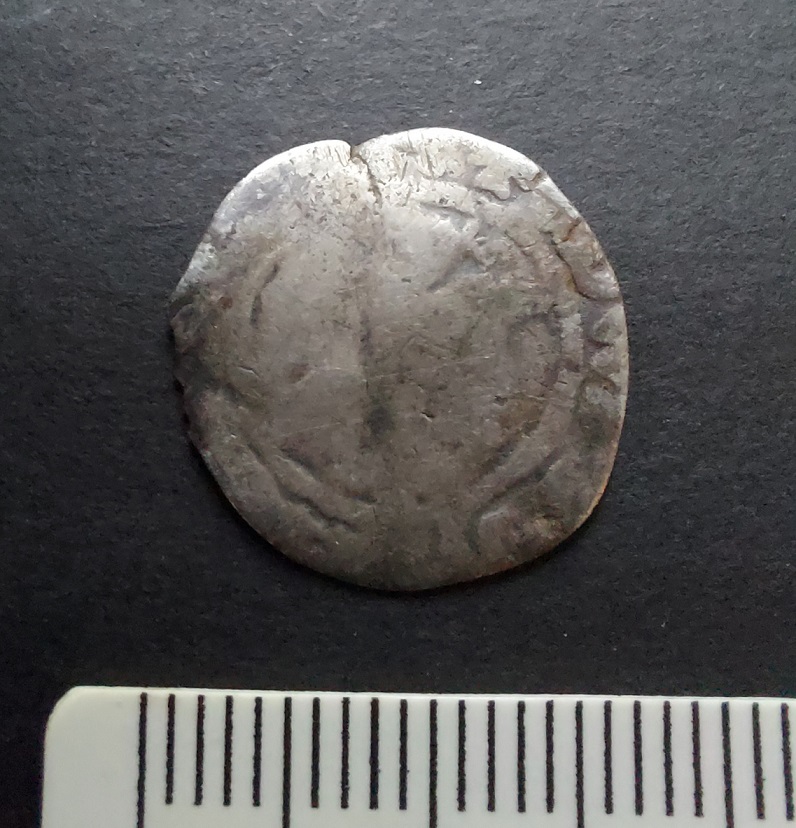
A half groat of Henry VII (1485 – 1509). The coin has been bent double at some stage in its life – you can see the crease running top to bottom.

A lot can be made of the symbolism of bending a coin, and even the shape can be open to interpretation. The coin itself may have been seen as a relic of the miracle it brought about, and worn round the neck it may have acted as a talisman. Medieval ‘popular religion’ (i.e. not officially allowed by the Church, but done anyway) and magical practice are interests of mine, but I won’t go into it here (never mind yelling “thank God“. And the person bending a 20p coin asking for help in getting me to stop talking about pottery is, frankly, just being rude). Buy me a drink sometime, though, and I’ll tell you allllllllll about it!

During the reign of Henry VIII, the religious upheaval of the Reformation meant the role of saints within the Church was very much downplayed, and the practice of bending a coin lost it religious meaning. However, coins continued to be bent, only now redefined as tokens of love or remembrance. The meaning is the same – faith, promise, and devotion – but the object of this faith and devotion shifted from a saint to a person, and from the sacred to the secular.

A sixpence of William III dated 1696.

Thus we read of Alice Benden, a protestant martyr, who in 1557 gave her brother a ‘bowed shilling’ as a keepsake on the occasion of her execution. In a letter dated 1790 we read the following: “I have a bent sixpence with a hole through it, which was given by my only brother as a keepsake”. More commonly, though, they were given as love tokens by one, or both, of the partners as a way of promising their faithfulness, and showing their devotion to one another, and references to this activity are found in literature. Indeed, the giving of a coin was a similar gesture to giving an engagement ring, and was often understood to be a statement of betrothal or marriage. In 1715, Lady Bridget Osbourne, eldest daughter of the 2nd Duke of Leeds, gave the Reverend William Williams half a gold coin “which she had almost bent double with her teeth” as a way of announcing her intention to marry him. The ensuing clandestine marriage produced a scandal that was played out in court, with the coin figuring quite prominently within the case. It is interesting that here the protagonists are educated middle and upper class individuals, suggesting that all elements of society understood the gesture.

A silver shilling of George III (1816) that has been bent into an ‘S’ shape. What is interesting about this coin is that it has obviously been kept for a long time – the coin is very worn along the bend. Was it a treasured possession and kept in the pocket?

Bent coins were also considered lucky, and people carried them on their watch chains, or around their necks, and were often referred to as ‘touch pieces’. George Eliot in Silas Marner writes “You’ve got the beauty, you see, and I’ve got the luck, so you must keep me by you for your crooked sixpence; you’ll never get along without me”. They were also used to protect against witchcraft; milk that wouldn’t churn properly had a bent coin dipped in it to reverse the spell that was assumed to be the cause of the problem. We also read about more direct action against alleged witches, animals believed to be the witch in disguise were shot with a bent coin to lift a curse.

As a practice, coin bending seems to have ceased by the early Victorian period, although examples are known from as late as 1860’s. After this period, and into the early 20th century, coins were still used as keepsakes and love tokens, but were inscribed with names, verse, dates, and pictures instead.

It’s quite a story from a little disc of metal I almost overlooked as it lay in the mud. Makes you wonder what else is there… And as you can see I have collected a number of bent coins over the years (actually, quite a number. In fact, I’m not going to lie to you, I have many. Just don’t tell Mrs C-G, she has no idea! Bloody rabbit holes). Some of this blog post was extracted from a dense academic paper I have written on the subject – complete with references and soooo much more information. If anyone is interested, I will happily send you a copy – drop me an email. In fact get in touch anyway, wonderful blog reading folk, even to tell me you want more pottery posts. What’s that? Of course you do!

In other news, I have written a story for the Glossop Winter Story Trail organised by the incredible people of Glossop Creates. The idea is 24 creative types (myself included) have written short stories that are displayed in shop windows dotted all over Glossop town centre – follow the trail to read them all and uncover a hidden poem. Mine, obviously, is the story of a sherd of pottery and can be read in the window of The Bureau on Henry Street, Norfolk Square. You can also listen to it being read here.

Right then, I’m off to clean some pottery in preparation for the next instalment (which may happen before the New Year). In the meantime, have a wonderful Christmas, and as always, take care of yourselves and each other. I remain, Your humble servant.

TCG

Archaeology · Pottery · Whitfield

A Green-Fingered Garden Grab*

*Ok, so I couldn’t think of a better title.

What ho, what ho, what ho!

So, right now, as we hurtle toward the solstice, is my favourite time of the year. Spring into summer – the days are long, my birthday is hoving into view (19th July, if anyone is interested… and a dark fruity red, if anyone is feeling flush). It also means time spent in the garden, planting and preparing the soil. Hamnett Towers is blessed with a small back garden (utterly destroyed by chickens… honestly, it looks like the Western Front), and a slightly larger front garden where the vegetables are planted. Both of these forces of nature – chicken and man – excavate all sorts of goodies. Predictably, I have kept everything I have found, and kept them separate; Hamnett Towers was at one point two separate ‘back-to-back’ terraced houses, so the archaeology of either side might tell a slightly different story (old archaeological habit). And so far, this year has produced some very interesting bits.

So, please join me in the garden. Ah, sorry, no shorts or baseball caps please – this is an English gentleman’s abode; t-shirts I can just about cope with, but I mean, a chap has to have standards dash it!

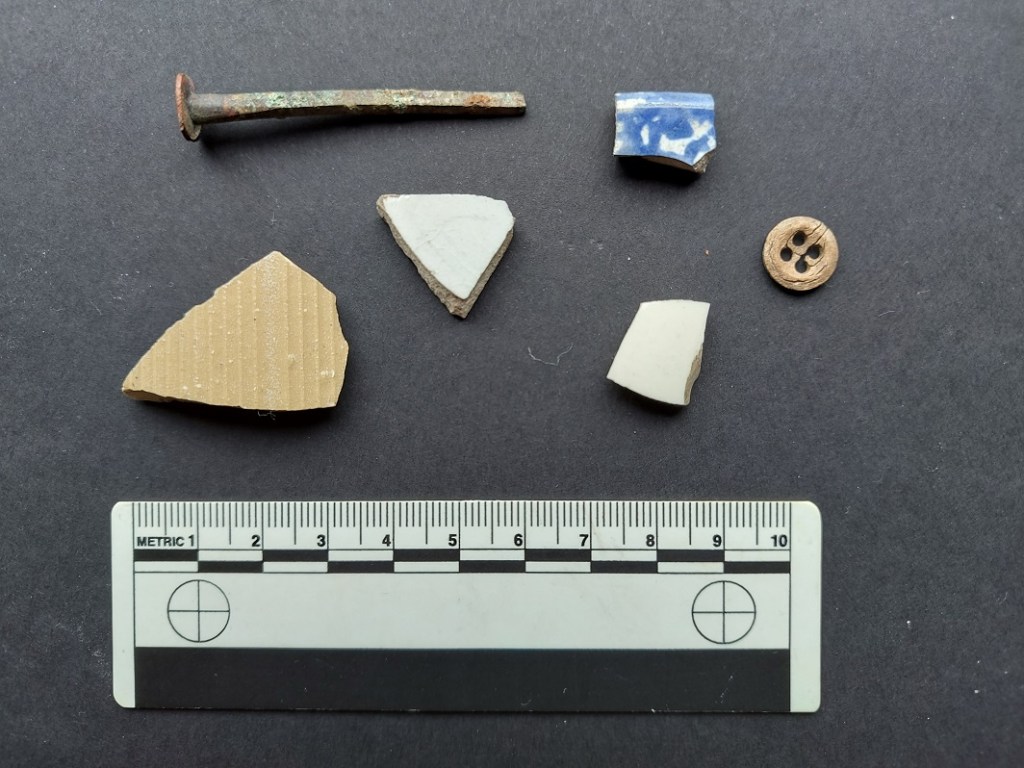
Here’s the day’s findings from the front garden:

A selection of the history of the land the garden has decided to show us this year… so far.

Let’s start with the nail – a Victorian, hand-made, copper roof nail, to be precise. I’m something of a magnet for these things, and they seem to find me wherever I go. They are truly mundane – the nail that holds on a roof tile – and yet are such lovely and tactile things (I’ve blogged about them before – here – FIVE years ago… blimey!). Copper was used as it is largely resistant to corrosion, and their square section is a dead giveaway of age.

Lovely green verdegris competes with rust (the result of it lying next to something iron based) on the surface.

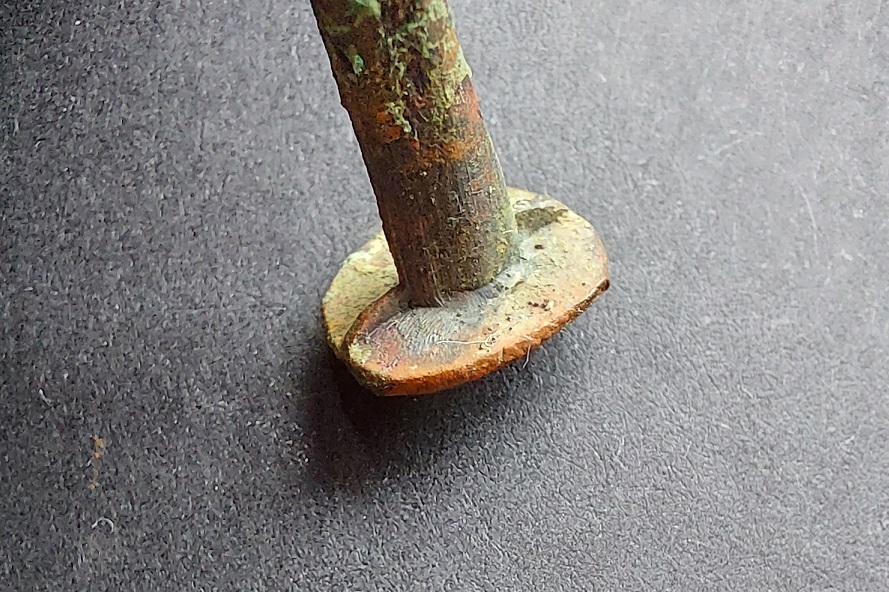
They are made relatively simply, but by hand. Each nail is cut via a press from a long flattened strip of copper (thus the square body of the nail). It is then placed into a small mold or former, point down, and the exposed top is hammered by hand until it flattens out, forming the nail head. Close-up you can see the two flashing strips formed as the soft copper is driven between the halves of the mold.

A close up of the underside of the nail head, clearly showing the copper flashing.

The nail may have come from my house roof, which is a great thought.

Next to the nail is a sherd of spongeware, probably from a large bowl or shallow dish. I find a lot of this particular vessel in the garden, and I might have to try and reconstruct it sometime (follow the link above, 3rd photograph down, on the right for more of the same bowl).

Next row, a sherd of marmalade/preserve jar (here, for more information), and then two thoroughly uninspiring sherds of white glazed pottery. Then, this beauty!

Super. An amazing chance find whilst whilst putting in some pea and bean plants… half of which were eaten on the first night by what can only be imagined as a biblical plague of famished slugs – honestly, I swear I could hear a very slow moving rumbling sound. If you’ll pardon the French… Bastards!

Wonderful! A small bone button, and almost certainly Victorian in date. Delicate, handmade, and slightly off-centre, it is lovely. Again, something so mundane – every item of clothing would have had a dozen of these; will people be cooing over the zips in our trousers in 100 years? And yet, here we are, admiring it’s beauty. Bone was such a common substance in the pre-20th century, and we tend to shy away from it as a material now – how many of us would brush our teeth with a bone toothbrush? Or use bone game pieces? I think we have become a little squeamish. Yet, it was a major resource in history – so many animals, so much bone. Bone preserves very well in the right conditions, and although this has cracked with age, I bet it could be sewn on and used again.

Right then, the image of the Somme, c.1916, that is the back garden. There’s always something that turns up here, not all of it interesting, but usually worth a look. And this year is no exception, with a couple of very nice finds.

A rather motley looking collection, I must admit.

So then… top left we have bonfire glass. Essentially glass that has been melted in a fire. This may have been accidental, or just the result of rubbish disposal. Often Victorian and later rubbish dumps were set on fire to keep the rat population down, and bonfire glass can be quite pretty. This one… not so much.

It’s quite a cool object, but not particularly pretty.

Ignore the next sherd for the moment, and move onto the cream coloured stoneware sherd, possibly from a flask or other oval shaped vessel. Then we have some glass – it is quite chunky, which indicates it is old, but isn’t that lovely green colour, nor full of bubbles, that would indicate a Victorian date. Probably Early 20th century, and likely from a small bottle – perhaps medicine or similar.

Ignoring the other reddish coloured sherds, again for the moment, we have this beauty:

You can see the striations caused by wiping the red under-glaze slip with a wet rag – the marks of the potter preserved for eternity in clay. Lovely stuff!

This is often called Pancheon Ware, after the large (50cm+) pancheon bowls that were extremely common from the 17th century to the early Victorian period. The correct term should be Post Medieval Redware, but that covers a multitude of pottery types and shapes from c.1550s to the Victorian period, of which this is just one.

Essentially a large mixing bowl, bread proving bowl, or vessel to allow cream to separate from milk. This is a lovely antique example, the image of which was stolen from this website which sold it for £195.

They often occur in huge chunks up to 2cm thick, and are usually glazed only on the interior to make it waterproof. I’ve talked about them before, but this is a nice example, showing the red slip on the surface, and then the dark brown glaze, made by adding iron oxide to a lead glaze, producing the deep shiny colour. The glaze on this, as with many, has been allowed to slop over the side and stop just below the rim, producing a messy natural decoration (the example above shows the glaze stopping on the rim, but you can see the effect they are going for).

Below and right of this sherd there are 4 sherds of standard Victorian to mid 20th century whitewares nothing inspiring, or even particularly worth writing about, although there is a rim of a bone china cup. Below and left is a single fragment of a clay pipe stem. Again, nothing exciting – the hole, or bore, through the middle of the stem is narrow which tells us that it is Victorian in date (broadly, a wide bore = 17th to early 18th century, a narrow bore = late 18th to 19th century). Still, it’s a bit of social history… I just wish I could find a bowl!

Then there was the treasure! Occasionally, certainly not often, I find something made of metal. And a few weeks ago, as those who follow me on twitter will know, I found a metal button.

Tiny, just 1cm in diameter, and very delicate. Amazing it survived, to be honest. And even more amazing it was seen.

Well, no… credit where credit’s due – I didn’t find it, Master Hamnett did, with his six year old eagle eyes. A lovely little 2 eye brass button, probably Victorian in date. It’s probably from a child’s dress, probably something like this:

A heavy linen dress for a child. It is beautifully decorated with hand-made edging.

And if you look closely using a decent magnifying glass, rather than the dodgy macro setting on my phone, you can see the remains of the original cloth that would have covered it:

Amazing that the cloth has been preserved, trapped between the two sides of the button’s lip.

It would have looked like this when new:

Small and delicate, and lovingly sewn on.

The thing I love about this is that the child must have lived and grown up exactly where Master Hamnett is now, and doing many of the same things. There is real sense of connection to the past through a single, small and dirty, seemingly uninspiring object. By the way, the story of the Victorian child’s dress (one of several, I hasten to add) is for another time, but it is from a probable apotropaic cache that was donated to me for safekeeping. One of two I now curate. I really don’t have enough time to write all this up, so if someone want to donate a stack of cash to allow me to write, please feel free!

And now this, the real treasure. Quite literally, for once.

Gnarled is the word. I had no idea what it was when I picked it up.

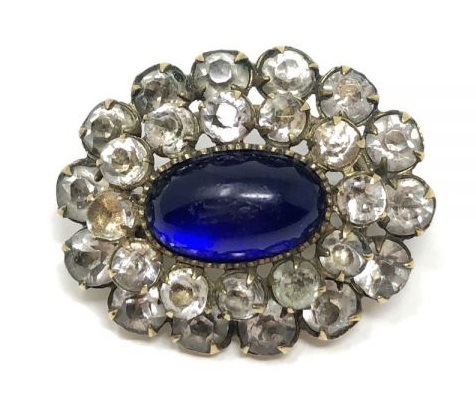
I know at first glance it looks like something has blown it up, but look beyond that, and it’s a wonderful, if completely knackered, piece Victorian costume jewellery brooch. It’s missing just about everything, including the central glass stone, but would have been very pretty – probably looking something like this:

Picture stolen from this website… the brooch is still there. Honest, guv.

I didn’t know what it was when I picked it up, but it was that greyish green that indicated a copper alloy (brass or bronze, for example), and is something I always pick up. It was only when cleaning it that I noticed the paste stones.

You can see the cut paste stone in it’s setting, and all the other setting missing theirs. There are three stones still on the brooch, and very little else.

Amazing, really. And this was just a small amount of time poking around, getting really close and personal with the soil in my garden. And my garden is not unique by any stretch, not even close. I guarantee, every garden in Glossop – no, the country – will produce some treasure – whether it’s early Victorian annular ware from a house near the station, a broken bottle rim from a former pub, a pipe stem from a current pub, or a piece of Victorian child’s plate from a modern garden in Simmondley (all examples from experience). Obviously, I realise that not everyone is lucky enough to have a garden, but we all can access some green space. As an experiment, this evening, pour yourself a drop of the stuff that cheers, and go and sit on what ever patch of earth is closest to you. This may be your garden, or it might be a park, or someone else’s garden, a playing field, or public footpath, or whatever. Now sit down and take a deep breath, listen to the sounds – birds or traffic – tune in, and simply look around you. If you can, dig about a bit, and don’t be frightened of getting your hands dirty, either. With enough time, something will turn up. And please, mail me the results.

Right, that’s about it I think. Next time more pottery – essentially a part 2 to this post, looking at the pottery I told you to ignore above. A competition! If you can get back to me and tell me what they are, and why they are not our type of thing, before I can post the next article, you can win those bits of pottery. Woohoo! (Now look here, Mr Shouty… some people like pottery, you know. And no, I’m not “having a laugh“).

More very soon, but until then, look after yourselves and each other.

And I remain, your humble servant,

RH

Archaeology · History · Whitfield

Datestones

(And apologies to those of you who have ended up on this website expecting to find an informative article on the seed of the Phoenix dactylifera.)

What ho, magnificent readers! I trust you are all rude health as we stumble toward the season of goodwill and whatnot. I love this time of year, when the cold wind blows, and the… What’s that? What do you mean “get on with it!”. Honestly, the nerve of some people.

Righty ho. Datestones. Who doesn’t love a good datestone? I mean, what’s not to love? A little snapshot of the history of a building, a birth certificate if you will, recording both the date of birth, and, if we’re lucky, the parents too.

Normally, though not exclusively, located above the door, these carved stones preserve the date of construction and the initials of the person or family who paid for its construction. The are by and large the reserve of the aspirational ‘middle classes’ of society; the poor man doesn’t build his house, the rich man has a house that speaks for itself. Indeed, it is a statement to others: I have wealth enough to build this house. They seem to become popular in the 17th century, as the ‘yeoman farmer’ becomes a class of person, that is, a person who owns the land they farm. Indeed, it may be a result of that phenomena, a way of setting themselves apart from the simple tenant farmer, who doesn’t own the land he works. Glossop has several 17th century examples remaining, though many more will have been lost, sadly. They do show up, occasionally, as the one found by Glossop Brook at Harehills Park did, and which was saved and cemented into the brook wall. Interestingly, this example also shows that whilst datestones can be a boon to historians, they can also present problems if we are not careful. They can move easily, and be attached to other buildings giving a misleading date, as is the case there, and at Hall Fold Farm. Also, stones can be put in place to commemorate a rebuilding or alteration to an existing building, causing similar, if opposite, problems.

By the Victorian period it was common to put a date and/or name on a house you built, and a careful look at many rows of Victorian terraces around Glossop will reveal names and dates. With that in mind, I have restricted my research to those datestones that carry a date prior to Victoria’s reign, pre-1837. The following is a table of the ones I know about:

There are 28 datestones in the Glossop area (broadly defined), but there will be more lurking that I don’t know about, either attached to the building still, or lying in a garden. This blog post will concentrate on the examples from Whitfield, as it is turning into a much larger post than I had thought. Plus, in the interests of honesty and transparency… I haven’t got photographs of all of them yet!

Whitfield has some of the oldest buildings in the Glossop area, and although not really much of a ‘place’ now – essentially just a ‘suburb’ of Glossop – it was once hugely important, being built along the Chapel en le Frith to Glossop road. It gradually lost it’s importance with the rise of the mills based down in the valley, the economy here being agricultural. Whitfield’s one-time importance means that we find many old buildings and a number of datestones here. Indeed, Whitfield has more old buildings that Old Glossop, which with its Church and market, was the focus of the farmsteads and settlements of Glossodale. However, important places tend to be subject to more intense rebuilding over time, whereas more minor areas maintain their old buildings. I was going to do a distribution map of the old buildings, but changed my mind for that reason. Still, it’s worth noting that Whitfield underwent a bit of a building boom in the mid to late 18th century.

35 Whitfield Cross.

35 Whitfield Cross was built in 1773 as a farmhouse, and is a Grade II listed building – see here for more details. The narrow coursed stonework and stone mullioned windows are typical of the period.

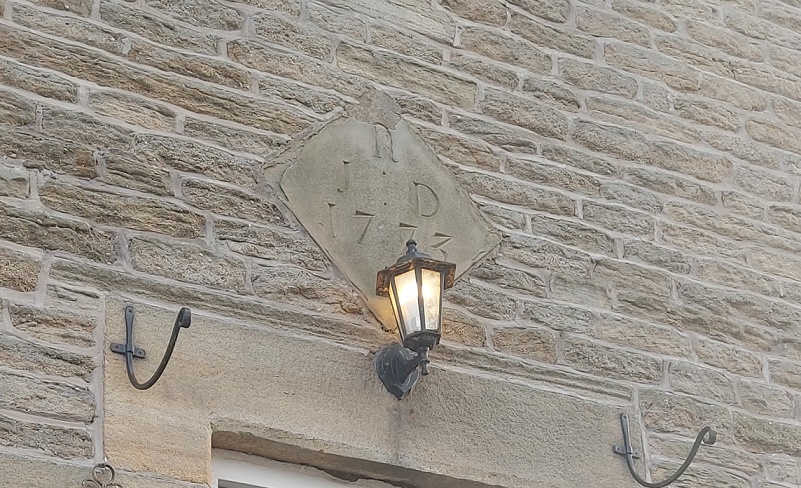
61 Hague Street.

61 Hague Street was also built in 1773, but as a pair of weaver’s cottages, and is also a Grade II listed building. 1773 must have been busy year, and Whitfield was clearly a happening place in the late 18th century. The datestone records the initials R. J. and D. Now, presumably the ‘R’ is the surname (possibly Robinson – the family being quite prominent in Whitfield) with ‘J’ and ‘D’ being the husband and wife who are responsible for the building. I have no information regarding the people, sadly, and any information would be appreciated.

Hob Hill Cottage

Hob Hill Cottage is a remarkable building dating to 1638, making it the second oldest building with a datestone in the Glossop area (after the Bulls Head in Old Glossop, dated 1607). Also built as a farmhouse, and also a Grade II listed building (there’s a theme developing here!), I suspect it might be the source of the lead came and glass, as well as some of the 18th century pottery, I found nearby, although truthfully any one of a number of buildings – existing or long gone – might be the source.

Old School House, Hague Street.

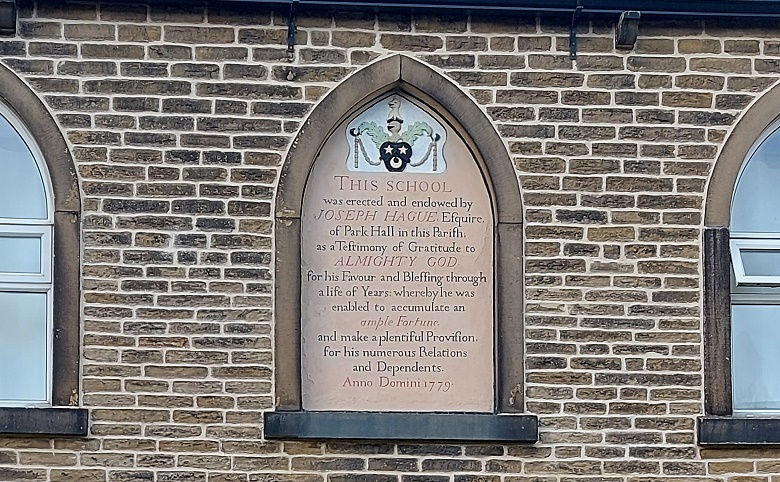
Another Grade II listed building now – the Old School House. Joseph Hague was something of an important man – indeed, the road on which the school (now private residences) sits is named after him. Born in Chunal in 1695, he rose from poverty to amass a fortune selling yarn to weavers and buying back the cloth they produced, to sell on. However, here is not the place for a discussion of his life, or of the school (the Glossop Heritage Trust does that very well here). Let us instead look at the wonderful inscription

“This school was erected and endowed by JOSEPH HAGUE Esquire,
of Park Hall in this Parish as a testimony of Gratitude to
ALMIGHTY GOD for his favour and Blessings through a life of
years whereby he was enabled to accumulate an ample fortune
and make a plentiful Provision for his numerous Relations and
Dependents. Anno Domini 1779.”

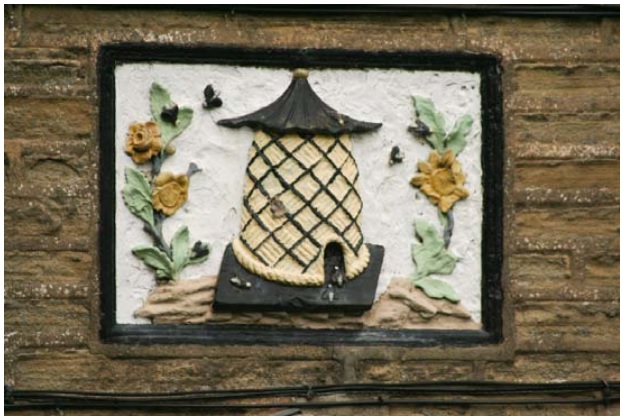
I enjoy the slightly boastful “ample fortune“… well, if you have it, why not? The beautiful carved relief plaque of the beehive over the main door – symbol of productivity and hard work – gave inspiration for the name of the pub over the road. The Beehive pub itself is an 18th century building, with a 19th century front added, and another example of the building boom of the 18th century in Whitfield.

Old School House, Hague Street. The beehive carved in relief, surrounded by Sunflowers, and crawling with characterful bees. I love this.
62 Hague Street

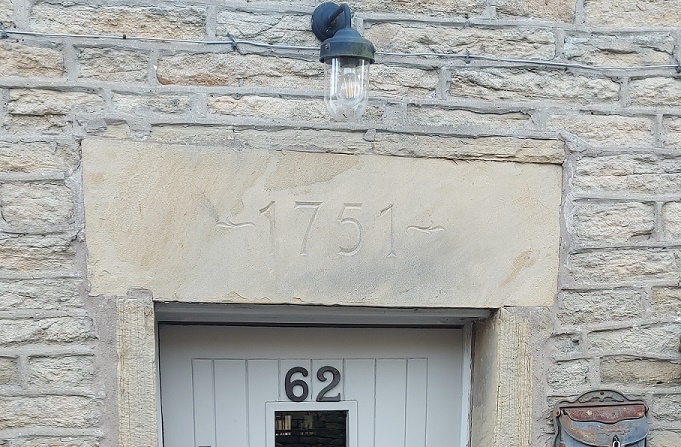
Another Grade II listed building, one of several together, and originally built as a ‘laithhouse’, that is a building made up of a house, barn and byre/shippon in one. It is a late example of the type if the date is to be taken at face value, but there you go… this corner of Derbyshire wasn’t exactly at the forefront of architectural fashion. There is also a bit of confusion regarding 62 Hague Street. As it stands now, there is a simple date of ‘1751′ above the door. However, the listing for the Grade II building notes that “No.62 originally had datestone inscribed RMS 1757” (read the full listing here). The present datestone is fairly modern, carved perhaps to replace the missing stone, but it doesn’t explain the difference in date. I thought it worth mentioning for the sake of documentation and completion.

41 – 51 Cliffe Road

So who was Joel Bennett? Born 11 April 1791 to son of George Bennett and Martha Cooper, he came from a large and important local family. He may have been the same Joel Bennet who was excommunicated from Littlemoor Independent Chapel in 1828 for “disorderly walking and impenitency” (source is here). I’m unsure of what is meant here by “disorderly walking”, but given the hotbed of radical religion that was Littlemoor, one assumes it wasn’t the Georgian equivalent of Monty Python’s Ministry of Silly Walks. He may also have bought Kinder Lee Mill in Chisworth with his brother James in 1823.

House at the bottom of Cliffe Road (4 Cross Cliff?)

This house, set back from Cross Cliffe almost at the bottom, has a wonderful datestone: stars, wheatsheaves, and a Masonic compass, with the letters ‘R’ ‘R’ ‘O’ and ‘S’. Actually, is that an ‘O’? Or perhaps a flower? I have no information about the place, nor the letters (Robinson again?), and one cannot simply knock on a door and say “What-ho… tell me about your house”. One tends to get stared at, with vague mutterings about “setting the dogs on you”, and “lunatics disturbing the peace”. Alas. If anyone has any information about this house, or indeed any of the houses, drop me a line.

Also, and seriously, if anyone knows of any more datestones that aren’t in the above list, and which date from before 1837, then please let me know. I’ll credit you, too, so you can be famous… to all 11 of you who read the blog (including Juan in Venezuela).

Oh, and some news. I’ve been working on the Glossop Cabinet YouTube account recently, and hopefully will be producing videos of me finding bits and pieces, mudlarking, talking archaeology, exploring, playing with pottery, and much more (can anyone else hear that groaning noise every time I mention pottery?). So if you like the blog, then you’ll love this. I’ll post a link asap.

Also, I’ve recently set up a Ko-Fi account which allows you lucky folk to ‘virtually’ buy me a drink if you wish. There is no pressure to do so, obviously; I do the blog because I enjoy doing it, and am constantly amazed that other people enjoy reading it (which is reward enough, it really is). However, if you do fancy buying me a pint to say cheers, I’ll never say no – please click this link, and mine’s a red.

That’s all for now I think. I’ll post something else before Christmas, possibly pottery related, you lucky lucky people (there’s that noise again). But until then, I remain,

Your humble servant,

RH

Archaeology · Pottery · Whitfield

… And Came Back

What ho! dear readers. I’ve just opened a bottle of fine Belgian pilsner, and am feeling quite effervescent, if that’s the word I’m fumbling for. I think it probably is.

Talking of fumbling, I went back to the place I found the lead came and had a fumble. Madam, please! This is a family blog. Honestly, some people! So there I was, fumbling, looking to see if anything else popped up, when I found what looks like window glass and some early pottery. Hmmmmmmm, let’s take a closer look.

Small and fairly unimpressive – I nearly ignored it. Shame on me!

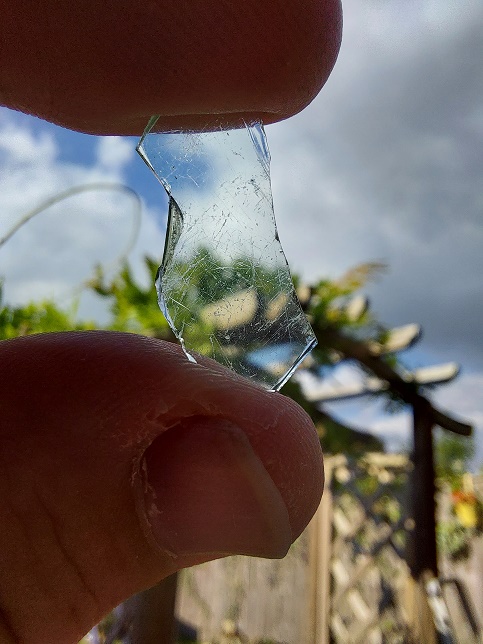
The glass is only a small fragment – just 2cm x 1cm – and very thin, being a shade over 1mm thick. It is also flat, which just about rules out its origin being a bottle. I terms of colour, it has that blue-green tinge that you associate with early glass, before they managed to perfect the process to remove all the impurities. Looking more closely at it, I noticed that two of the edges were flat, and pulling out my new toy – a usb computer microscope that also takes photographs – I was able to see – and show you – tiny teeth like nibbles that tell me that the glass had been cut and shaped.

I’ve had a lot of fun with the microscope!

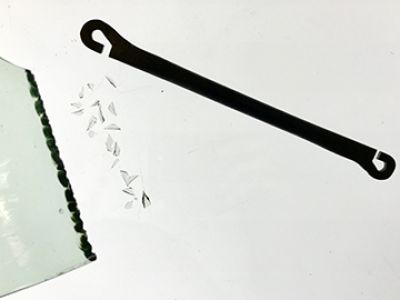
Now, I know a lot of useless information – for example that glass is shaped by nibbling – but I’ll admit that even I had to look up how exactly this was done. With a ‘Grozing Iron’ it turns out (see, don’t say you don’t learn something by reading this blog, although I can’t see it coming up in a pub quiz anytime soon). The verb is ‘to groze’, and the above glass fragment has been ‘grozed’. It looks like this:

A grozing Iron, image courtesy of the York Glaziers Trust who have a fantastic illustrated glossary, if you are in any way interested in glass.

So, it was shaped… but to what shape? The two edges, if they were extrapolated, didn’t make a right angle, but instead, a diagonal. A diamond, even. Could it be I have a fragment of the glass that went into the lead came I found? Impossible to say for certain, but it is possible, even probable. In terms of date, it’s very difficult to say. Broadly speaking, the thinner the glass, the earlier it is, and combined with the colour could certainly put it in late 17th or early 18th, which matches the tentative date for the came. So that’s exciting, if you get excited about this sort of thing… and I do! Here it is situ:

I added the came for effect – perhaps reuniting them.

The date of 18th century also matches the date of two sherds of pottery I found with the glass.

Again, quite small and uninspiring.

They are both mottled manganese ware, and classically early 18th century in date – certainly not later than about 1760. Interestingly, they are not particularly worn, so it’s unlikely that they have been kicking around for 250 years or so – perhaps there is a dump nearby? They are also both open vessels – bowls, probably – and may belong to the same vessel, despite one being glazed on the inside only (quite often, the glaze on the exterior was confined to the top part only). Also, one sherd shows the characteristic manufacturing marks, that also doubled as decoration:

The horizontal lines visible in the clay, formed on the potter’s wheel. Also, if anyone want to donate to the ‘Robert Hamnett Needs a Manicure‘ fund, please feel free…

The next photo shows the make up of the sherd – the reddish slipped exterior (top), the rough orange-brown earthernware fabric with tiny bits of stone in it (middle), and the thin dark line of the glazed interior (below). I love this stuff.

Lovely stuff!

I’m going to put together a quick and easy guide to pottery, describing all the different ‘parts’ of a sherd, and some tips on identifying what shape and size, as I think it’s nice to now what it is you are holding. I’m also still putting together my quick and dirty guide to Post-Medieval pottery, as there is a serious gap in the market… probably for obvious reasons!

I’m going to end with a great photograph of the glass, and to pose the following questions: Who was the last person to look through that window before us? And what did they see?

Makes you think.

Until next time, take care of yourselves and each other. And I remain.

Your humble servant,

RH

Archaeology · Whitfield

Summer Came… and Went

What ho! Hope you are enjoying the summer so far. A quick post today, but more very soon.

So, I know I promised you pottery this time, and I can tell you are wildly disappointed, but this is an interesting bit of history. Honestly. It really is. Don’t just look at the first picture and yawn… Philistines.

There are a number of places around Glossop that never fail to produce some bits and pieces – Lean Town, Harehills, etc. One such place is at the top of Whitfield Avenue. Never lots, but always a sherd or two, and this time a piece of lead. Window lead to be precise.

Lead is one of those substances that is instantly recognisable once you know what it looks like, and can be spotted from quite a distance. It doesn’t rust, or even really react beyond producing a white powder on the surface. It is soft, which means it can get damaged – in particular bent – easily, but it also means that it doesn’t break in the way that pottery or glass does, so it often survives. It is also worth remembering that it is highly toxic, so be careful when you handle it.

Don’t worry, I washed my hands afterwards.

So there it was, lying on the surface of the soil, a dull grey flash exposed after all the rain we have recently suffered. I would have picked it up anyway – I try and do that with lead, as it’s not great in the environment – but I knew at a glance what it was, and was excited as they can be interesting. I was not disappointed.

Window lead, or came as it is more properly known, has been with us for as long as there have been glass windows, and is essentially an elegant solution to a big problem – the fact that it is very difficult and expensive to produce glass in any large size. It is far easier to join together smaller pieces, and this was still the case until the 19th century, and why even early 20th century windows are made up smaller pieces separated by wooden mullions. But the multi-part aspect also allowed works of art to be created in the form of stained glass windows that adorned medieval churches and cathedrals, and is a fashion that continues down to today.

The came works by allowing separate pieces of glass to slot into its grooves, joining them together, with the whole being held in place by the window frame. In profile (that is, cut in half), came is broadly ‘H’ shaped:

A pretty awful drawing, but you get the idea… I hope.

So then, what can we say about this little piece of twisted metal? Well, a surprising amount, to be honest. Firstly, rather than being poured and shaped in a mould, the came has been milled – the lead was drawn through a former by a cog. This means that it is not medieval, but instead puts it into the archaeological ‘misc.’ tray that is ‘Post-Medieval‘ (roughly, after 1500). We can, however, narrow it down a bit; the cog used in the manufacturing process leaves characteristic tooth marks on the interior. As the process was refined and improved over time, these marks grew further apart, and broadly speaking, the closer the teeth, the earlier the date. On our piece of came, they are very close together, and thus an earlier date is suggested.

Teeth marks, where the cog has pulled the came through the former.

This is backed up by the slightly rounded profile, which is also associated with earlier examples. We might suggest a date of perhaps 1700 – 1800, possibly earlier, but unlikely to be later.

Left: the slightly rounded ‘H’ profile, also slightly squashed. Right: the clean cut edge, probably by a knife.

It seems to have been cut cleanly at either end, which means it is the original length, which is significant. It measures just under 6cm, or 2 1/4 inches, so not very long, but a perfect size for the diamond style windows that were common in the 17th and 18th centuries, when whole windows were made up of smaller pieces and joined by the came. Look closely, you can see the tin solder that would have joined it to another lead came piece.

The melted end, but also marks where it was pulled through the former.

Looking even more closely, you can see the putty that would have weather-proofed it still inside the groove.

White putty visible.

Here is a 17th century window:

Typical Tudor & Jacobean diamond pattern window.

And here is our piece of lead in a mocked up window, showing how it would have been used.

Another rather poor drawing, but one hopes you get the idea.

How this piece of lead came came to be lurking in the soil on that rainy day is not certain, but it is in the right place – some of the oldest houses in Whitfield are right there, including Hob Hill Cottage with its datestone of 1638. The came must have originated in one of these houses, and at some stage either window was repaired, or replaced entirely. Indeed, if we look closely, we can see two marks where the lead flange has been lifted away from the glass to remove it.

The lead flange has been peeled back from the glass.

At that point, the lead has been lost or thrown away. I’d love to be able to say for certain which house it came from, and the obvious choice would be Hob Hill Cottage as it is just opposite the find spot, but in reality who knows? I am amazed at how much information it is possible to glean from what is, at first glance, just a small piece of twisted metal. And see, I told you it would be interesting.

More soon. As always, look after yourselves and each other, and until next time, I remain.

Your humble servant,

RH

Archaeology · Oddities · Whitfield

What If…? Of Stone Heads and Stories.

What ho, you wonderful people, you.

So, despite having half a dozen half-written posts, piles of interesting objects and sherds to talk about, and a few adventures to recount, I want to try something a little different today. “Oh no!” I hear you cry. But fret ye not, gentle reader, for it is still archaeology, it is still Glossop based, and it is still interesting. But it is a little… quirky. You’ll see what I mean.

I have a friend who is a writer, and quite a good one at that. He has often mentioned that stories usually start with what he terms a “What If?” moment, where something – often an object – presents itself, and the question is posed “what if…?” From there the story grows, based on and around that one question. The answer that comes doesn’t have to be ‘real’, it is fiction after all, but it has to be possible. What if a house was haunted? And what if the house fell down? And what if a brick from the house was haunted too? And what if a dashing archaeologist took the brick home to write about it on his extremely popular and incredibly interesting blog? What if…?

Archaeology, I think, uses a similar technique. An object is excavated, and the interpretation – the story – begins. However, where we differ from writers is that we base our ‘what ifs…?’ on evidence and supposition grounded in data. The interpretation, in this sense, has to be ‘real‘, although it is only ‘real’ for as long as the data supports it. Sometimes though, It’s fun to play “what if…?” – and here we join today’s post.

A stone head displaying all the characteristic features, including almond eyes. This one was allegedly found on Mouselow, and now lives on a wall in Buxton Museum

Stone heads. A lot has been written about them. They are cursed and evil. Or they are warm and friendly. They are ‘Celtic’ (i.e. Iron Age or Romano-British) in date. Or they are medieval or early modern in date. Or a combination of both. They represent an unbroken pre-Christian tradition, and an aspect of the whispered ‘Old Ways‘. Or they are simply folk art, and just decorative. Or they are magically protective (that wonderful word, apotropaic, again). Or both. Or neither. A brief trawl of the internet gives a lot of different sites and opinions, ranging from the scholarly and the more open minded, to what can only be termed outright nonsense.

Whatever they are, carved stone heads are a feature of this part of the Pennines – from Longdendale, over the hills to West Yorkshire, and up to the Calder Valley. I actually have a serious project that is looking at them; cataloguing known examples from Glossop and Longdendale, and trying to place them geographically, as well as giving some sort of date to them. There are at least 23 examples from the Glossop area, with more doubtless waiting to be uncovered. But it’s an ongoing project, and not really ready to publish – here, or anywhere else for that matter – and I just keep chipping away at it. It was during the course of trying to map where they were found, that I noticed something very interesting.

Stone head in Old Glossop. Image stolen shamelessly from the Old Glossop website (follow this link – the website is very good)

Before we go any further, I should state that my personal belief is that most of the stone heads are medieval or post-medieval in date (indeed, there is a record of them being carved in the 19th Century). That’s not to say that Iron Age ‘Celtic’ examples don’t exist (one was found at Binchester Roman Fort, in County Durham in 2013), it’s just that it is very difficult to date them as they usually don’t come from any secure archaeological context, and basing a date on ‘style’ or method of carving, as has happened in the past, is notoriously dodgy. That stated, there is the possibility that I might be wrong. And this led to my ‘what if…?‘ moment.

Back to the find location, sadly the majority of the heads are simply “found in Glossop area“, and thus have no exact place. But from various sources, I was able to identify where some of the heads were found. The distribution map is below:

1:10,000 map of Glossop. The Find spots – where the heads were found – are marked in red.

They seem to be dotted all around the area: Mouselow, Manor Park Road, several in Old Glossop, etc. However, looking at the above map, I noticed there was a distinct grouping in Whitfield – four of them centred around Slatelands Road and Hollin Cross Lane. Hmmmmm… let’s have a closer look, then.

Here is the Whitfield group on the 1:2500 map.

Duke Street, Pikes Lane, St Mary’s Road, and Slatelands Road. Geographically, they are in the same tangle of roads in that area. But the heads more than likely pre-date the Victorian roads, so we need to strip them back. What was there then? Well fields, mainly, though the medieval track from Simmondley to Glossop ran through here (that blog post is coming, I promise!). And before that, the Roman road also ran through here, along Pikes Lane, before kinking over Long Clough Brook and onto the fort and settlement at Melandra.

And then, the “what if…?” hit me.

For the sake of a good story, what if these heads actually were Iron Age or Roman in date? What could this cluster mean?

Looking again at the area stripped of the Victorian houses, it’s very clearly a promontory, a high plateau that runs between two brooks – Glossop Brook to the north, and Long Clough Brook to the south. In the Iron Age, they liked their elevated places – Mouselow, which dominates the area, is a classic Iron Age hillfort, and others exist nearby, at Mellor and Mam Tor. One only has to look at St Mary’s Road from Harehills Park to see how steep those slopes are (try doing it pushing Master Hamnett in a pram with a load of shopping from Aldi). And on the other side, who hasn’t cursed Slatelands Road halfway up, gasping for breath. This is a very real landscape feature, completely masked by later development, but one which would have been very visible back then. This would have been particularly true where the peninsular narrows at the west, leading down to the junction of the two brooks. This too, is significant.

Throughout prehistory water was a sacred thing, and was considered ritually important. A spit of land, elevated, defined by water and ending in the confluence of two bodies of water, would have been hugely significant. Actually, a perfect place for an Iron Age temple or shrine, perhaps one devoted to the ‘Celtic head cult’ as suggested by scholars such as Dr Ann Ross (in her Pagan Celtic Britain)? Indeed, the North Derbyshire Archaeological Survey notes that the number of heads in the Glossop area “might suggest a cult centre” based in the town in the Romano-British period (Hart 1984:105). It has been suggested that the heads are sometimes associated with liminality and boundaries, and were protective. What if they were they placed facing down the peninsular, to mark out the sacred space, and to defend it?

The Roman road moves through this promontory, sticking to the high ground away from the valley floors and marshy terrain, as the Romans preferred (see map below). But what if the location of the possible shrine or temple influenced the choice of road location, ploughing through the sacred enclosure, perhaps to make a point about Roman dominance?

The location of the heads in relation to the landscape. The blue is the waters of Glossop Brook (north) and Long Clough Brook (south), forming the spit of land. The yellow line is the medieval trackway, and the green line is the course of the Roman road.

What if…?

Now, I’m not suggesting for a moment that that the above is absolutely true; this is a wild flight of fantasy, and pure fiction – a story. Indeed, doubts are being raised about the reality of the ‘Celtic head cult’ theory in general. But it is a possibility, at least: an archaeological what if…? However, if that isn’t the answer, there still remains the issue of why four stone heads were found in a cluster in this area. What is going on?

If we return to my original thought, that the heads are medieval or post-medieval in date, might they be related to the Simmondley – (Old) Glossop trackway in someway? If we look at the map above, we can see this track (marked in yellow) runs broadly along the line of Princess Street. And just to the east of the three of the heads run along the same alignment. Is this significant? What if people somehow, and for some reason, deposited these heads to the east of the track? But why? Well, I came across a possible reference to just such a practice in this area – Clarke states that “Oral tradition in the High Peak of Derbyshire suggests heads were buried as charms beneath newly-built roads, presumably to keep permanent watch over them” (1999:286). He cites no sources for this “oral tradition”, but this type of apotropaic function – preventing witchcraft and promoting good fortune – is associated with carved heads all over the United Kingdom (Billingsley 2016). Perhaps, then, we are seeing the ritual deposition of carved heads as part of the road building tradition.

What if…?

Heads
A pair of Whitfield Heads. These are at the end of Kershaw Street… and that is all I know about them. It’s on my ‘to do’ list, don’t worry.

No, it is a mystery, and ultimately we are left with questions for which there are no obvious answers. Three of the heads are in Manchester Museum, and the fourth presumably in the hands of the owner/finder. I will have to go and see them, as that might help in dating. As I say the project is ongoing, and any comments or help in the area would be greatly appreciated. Do you know of any stone heads? Do you have photographs of any? Or stories – they seem to attract folklore and superstition like nothing else! Please contact me in the usual way – email me, or through twitter ( @roberthamnett ). Or just come and find me in the street, as people are increasingly doing… so much for pseudonyms and anonymity!

I do hope you enjoyed the little flight of fantasy, but we’ll be back to business as usual next time – the sherds are mounting up! Until then, look after yourselves and each other.

And I remain, your humble servant

RH

References:

John Billingsley – Instances and Contexts of the Head Motif in Britain

David Clarke – The Head Cult: Tradition and Folklore Surrounding the Symbol of the Severed Human Head in the British Isles. (Unpublished PhD Thesis, accessed here)

Anne Ross – Pagan Celtic Britain: Studies in Iconography and Tradition

Archaeology · Whitfield

A Spoon.

What ho! A short one this time… well, relatively short. As I think I have mentioned previously, I normally have about 5 blog posts half written at any one time, and I pick away at them until one ends up finished. But how do I choose the subjects? Well, sometimes, they are obvious topics, and other times it is purely a coincidence, and fate picks it for me. Occasionally my own research throws up something that I think you, gentle readers, might be interested in. And then sometimes, as is the case with today’s entry, the subject simply throws itself at me and the blog almost writes itself.

As I think I have also mentioned previously, mine is not what you would describe as a normal life; I live and breath the stuff of this blog… to the point of obsession. But thankfully I am blessed with a wonderful and understanding wife (or ‘carer’ as she terms it, which is a bit off), and also a child who thinks growing up in a house filled with bits of pottery and odd bits of old tat is perfectly normal. But even I had a slightly discombobulating moment last week – the archaeological equivalent of the alcoholic hitting the fabled ‘rock bottom’.

“Oh no!” I hear you cry. But worry not, I’m not quitting… (and I’ll have another glass of red whilst you’re at it). No, this one was a case of opening my front door and being forced to confront an uncomfortable truth: it turns out I have now reached a point in my odd life whereby people leave bits of old pottery and other stuff in my garden, without so much as a by your leave. Clearly “it’s old and knackered, so give it to RH” is now a thing.

For there on my front wall, wonderful readers, was a spoon. An old spoon, granted, but a spoon nonetheless. “What ho!” said I, and leapt forward.

A random spoon on my wall. Yup… my life is totally normal.

Now the sight of such might have caused a lesser man to quiver and fall, but I’ve been around spoons before – I’m no mere amateur when it comes to them. Indeed, it’s certainly no idle boast when I say “I know spoons”.

But from whence did said spoon come? The physical location of Hamnett Towers suggested only a few possibilities, and not knowing Uri Geller, my suspicion fell immediately on our clearly insane neighbours Helen and Sarah who, when not camping in their garden (mere metres away from a perfectly good house) or self harming by cycling to Tideswell and back, are amazing.

Turns out I was right! Sarah had found it in a wall in Whitfield, somewhere near the Beehive, and thought, correctly as it turns out, “good old RH might want that”. I looked closer, and my interest – already piqued – began to tingle. Writing… and possible decoration. The spoon was a welcome gift, but jokingly came with one condition, that I write a blog post about it. Well, here we are! Let’s look closer…

A spoon, yesterday.
Honestly, it looks like Uri Geller has been here.
A close up – you can just about make out lettering and what looks like decoration.

The spoon is of a soup rather than serving type, and vaguely Victorian in shape. It was also very worn and covered in greenish verdigris – I really do get the best presents. I couldn’t read what it said where the maker’s mark normally is, nor make out the decoration so I took some very fine sandpaper to it, and removed what I could.

It becomes slightly more clear.
And even clearer.

You can just make out the lettering – if you squint, and use the eye of faith – that reads “Walker and Hall. Sheffield” and a pennant/flag logo containing the letters “W&H“. And, over that a series of numbers stamped roughly onto the surface.

Walker and Hall were a company of silversmiths based in Sheffield. They were founded in 1845, but began operating with that name from 1853 onwards, and continued until 1920. This website suggests that the pennant logo should be dated between the late 19th century (say 1880) and World War 1 – which looks about right from the style of the spoon. Sadly, it’s not silver, but silver plated, and seemingly carries no mark, in which case it might date to before 1884 when Walker and Hall started putting marks on their cutlery.

As for the numbers, I have no idea what they might mean. I can make out “5, 4, 9, 9, 3, 2” Conceivably they could be the model number for the spoon type – there are examples of this being done – but these are very large and untidy, and seem to have been stamped in a haphazard way, with no easy way of reading them. Perhaps they were done by the owner as a way of identifying the spoon, but this leads to the question “why?”. The only explanation that I can come up with is that it was a ‘communal’ spoon, perhaps one connected with a pub or similar – the idea being it can’t be stolen because it is very easily identified. This fits nicely with where it was found, near the Beehive pub. It also fits with the wear pattern, too; it has been bent and straightened several times, as public cutlery often is, but also the huge amount of wear on the bowl.

The asymmetrical wear pattern at the tip

This wear is very visible at the left hand tip, meaning it was used by a right handed person or people. I would argue that a personal spoon wouldn’t worn that much if it was used for at most a meal a day. However, at a busy pub serving good mutton stew, that spoon might be scraped around a bowl 20 times or more a day. Do we have an original Beehive spoon? Well, I’m almost convinced.

Why it was placed in a wall is, frankly, a mystery. People do strange things with objects that are deemed ‘public’ (I look sheepishly in the direction of a wine glass that mysteriously ended up in my house, but which originated in a certain drinking establishment in a certain town), but it may well be that the spoon was too knackered and was simply thrown away, ending up in the wall via child or bored adult.

So there we are – a spoon! From a wall, to my wall, via my neighbours, and finally to you.

Right, that’s all for now. More coming soon, including the much talked about roads and tracks post that I keep promising. In the meantime, I’m going to put a box outside – if anyone else has anything old they want to give me, pop it in as you pass… who knows what I could find in it.

Until next time take care of yourselves and each other. And I remain

Your humble servant

RH