Stones of Glossop

Multiple Milestones

Well, three to be precise.

What ho, what ho, what ho! So, I’m back from my summer holiday. Actually, I was only in France for two weeks (with lots of cheese and wine), and the rest of the time I have been busy with life… alas. I have loved the weather here for the last 10 weeks – a decent summer at long last, and the polar opposite of the spring we had. Bizarre.

So, missing out August completely, I’m back with a bang, and hopefully more than one post over the weekend, here we go.

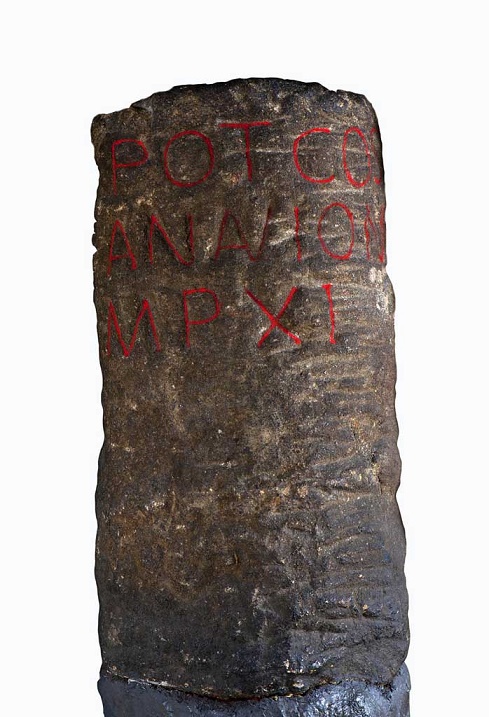
I love milestones. There is something so definite and so grounding about them, and the way in which they locate with reference to other places – you are X miles from Y – you know exactly where you are in the world. They have a long history – the Romans used them all the time, and in reality, they haven’t changed since. This one was found in Buxton, and is inscribed with the following: “TRIB POT COS II P P A NAVIONE M P XI”.

Roman Milestone
Buxton Roman Milestone, found in 1862 (and shamelessly stolen by me from the wonderful  ‘Wonders of the Peak‘ website). Honestly, it is well worth taking the time to look around the site.

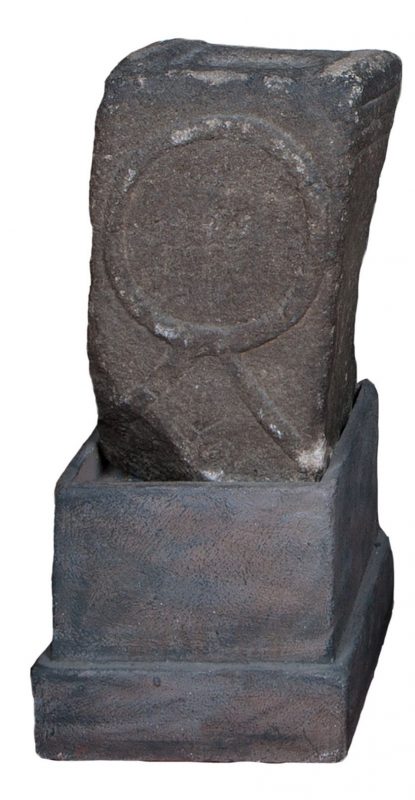
Which translates as “With tribunician power, twice consul, father of this country, from Navio, 11 miles”. The Roman fort of Navio is at Brough, near Castleton (information here). This is a great little fortlet, right on the river there, and well worth a trip out to see it. There’s not a great deal to see as such – rather like Melandra, it is lumps on the ground, requiring a bit of imagination – but it produced some fascinating archaeology. My favourite being an altar to the goddess Arnomecta – a local goddess, about whom we know nothing at all. She may be the same as the Goddess Arnemetiae who gave her name to Roman Buxton – Aquae Arnemetiae, but then again possibly not. Something about that both fascinates and frightens me – a lost Goddess.

DERSB-1979-1301-415x800
Altar dedicated to Arnomecta – stolen again from the wonderful Wonders of the Peak website (use the link in the text above it for more information on the stone).

But I digress… where were we?

Milestones. Mine are nothing like as old, but they are interesting. Honest.

The first is located on the Woodhead Road/B6105 by Allmans Heath Farm and B&B. It is carved into the side of a mounting block, used for getting onto horses, is/was painted white, and it simply states ‘Glossop 1 mile’ with an arrow pointing the direction.

MB1
The milestone is at the bottom, carved into a niche. The ring on the block would have held your horse in place whilst you climbed aboard.
MB2
Close up of the milestone: “Glossop 1 Mile”

Now, the mounting block is clearly old. They don’t make them anymore, for one, and the fact that the ring has been set in place using lead would certainly age it to the Victorian period, and potentially earlier. The carving is another matter altogether. I had assumed that the words would have been carved in the Victorian period, but on the way to take the photograph, I got speaking to the owner of the house there who informed me that they were only 10 years or so old – her ex-husband, being a stonemason, carved them. Well, why not? The fact that the mounting block sits next to a very old stone gatepost (on the right in the upper picture) suggests that the owners had moved the stone to the front wall in order to create a feature, which it does.

So, this one might not be of any great age, but the next two certainly are, even if they are slightly out of the area.

I went looking for the fabled White Stone of Roe Cross the other day.

I say fabled as there is very little information about it, and I was hoping to see it to put in my two penn’orth about what it is, why it is, and where it is. It is mentioned in Sharpe’s “Crosses of the Peak District” as potentially marking the junction of the boundaries of Matley, Hollingworth, and Mottram, so I thought it would be worth a look. Alas, I failed utterly to locate it, although I did get as near as White Stone Cottage, so I could’t be too far away. It has almost no presence online, either, besides a letter that was written to protest against the proposed Mottram bypass which mentions it in passing, and references to White Stone Cottage.

If anyone knows the location of the stone, please let me know, as I’d love to see it – and you all know how much I love a good stone.

Now, that same letter, also mentions a carved milestone in that area, and thinking it might be worth a look, young Master Hamnett and I set off down Dewsnap Lane to find it. Which we did in record time – standing alone in a right hand turn into the riding stables there (the location is shown by the red circle on the map below).

IMG-0810
The Lonely Milestone

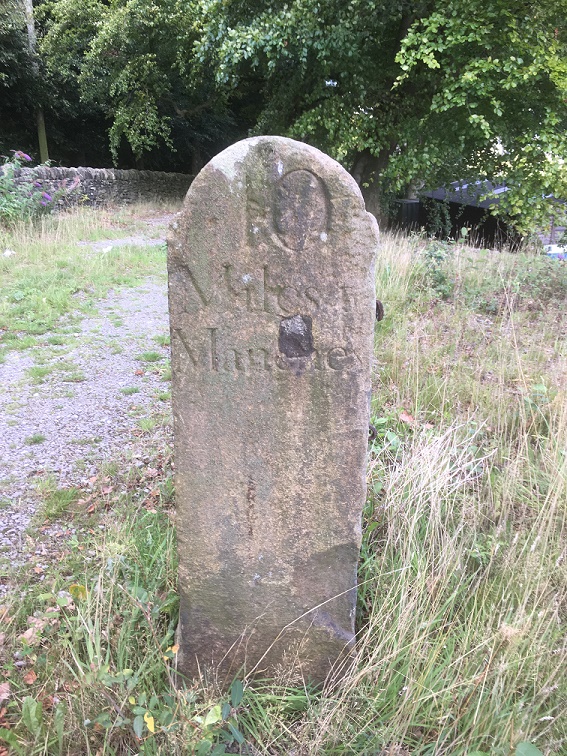
The stone states it is “10 Miles From Manchester” and I have no reason to doubt that. It has clearly been used as a gatepost at some stage, and you can see the hole where the hinge was mounted.

IMG-0811
Close up of the writing and hinge hole. 

As I turned around to leave the stables area I noticed another milestone, this one placed against the wall.

IMG-0808
Another milestone

This one proclaimed itself to be ’13 Miles From Manchester’.

“Hmmmmm”, thought I. “Ice cream” thought Master Hamnett.

IMG-0809
Close up of the carving.

Now, I know what you are thinking… that Roe Cross is a geographical anomaly, being simultaneously both 10 and 13 miles from Manchester; a quantum place, if you will.

The two stones are obviously carved by the same hand and at the same time – the rounded top and squared shoulders are the same in both instances, and the stone is the same – a coarse sandstone. The writing is also the same, and with the ‘long S‘ in the word ‘Manchester’, we can roughly date it to not later than the first half of the 19th Century, and possibly a little before. After this time it falls out of use, and people used the ‘short S’.

So what are they doing there? I don’t know for certain, but I have a possible/probable answer.

The ‘Deep Cutting’ between Mottram and Matley/Roe Cross was opened in 1826 as part of the Manchester to Saltersford turnpike road. Essentially, it allowed easy access between Yorkshire and the east of the country, and Manchester and the west. Prior to this, the roads were in a terrible state of repair, and the heavily laden packhorses that made that journey really had to struggle. The turnpike roads were privately financed and built, and in order to recoup costs they operated as toll roads, charging for their use (think M6 Toll road for a modern comparison).

The toll gate at Roe Cross, the place you had to pay for passage, was situated here:

Map - Roe Cross
The Roe Cross Toll Gate is marked on the map (indicated by the arrow). The circle shows where the milestones are now situated. This from the 1875 1:2,500 OS map.

Now, obviously, the milestones are not in their original location, and I would like to suggest that they were originally situated near to, or at, the toll gate, showing the distance to Manchester along the road. However, if that was the case, then why the difference in distance? Well, perhaps the ’10 Mile’ sign was put next to the new road, whilst the ’13 Mile’ sign was by the original, old, road. With both signs showing, most people would want to shave 3 miles off their journey, and travel along a new well surfaced road, rather than along a muddy track, pitted with animal and cart ruts – after all look how many people use the M6 Toll Road. The tentative date of the stones, too, fits with the construction of the road – the first quarter of 19th Century.

Of course, once the toll gate ceased to exist, the stones lost their usefulness, and particularly once new, more clear, signs began to be used on the roads. However, instead of being broken up, their size and shape is perfect for a gatepost, and so they were hauled a few hundred yards up the hill and given a new function.

Well worth a look of you get chance, and there is lots of good walking to be had up there. I am going to have good explore myself sometime soon, particularly up Gallowsclough, which, as a placename, can have only one meaning – ‘the valley where they hanged people’. Blimey!

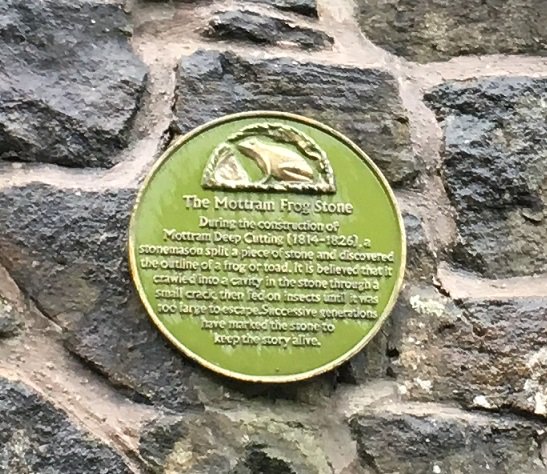
Incidentally, I love the Deep Cutting for the Mottram Frog Stone which is celebrated on the wall there, about half way down on the right (going from Mottram to Stalybridge). I couldn’t do this post and not mention it – I tweeted about it, but it is so good, that it needs to be celebrated on the blog, too.

The truth or plausibility of the story is much less important than the legend – no one criticises a fiction story for not being real, one just enjoys it!
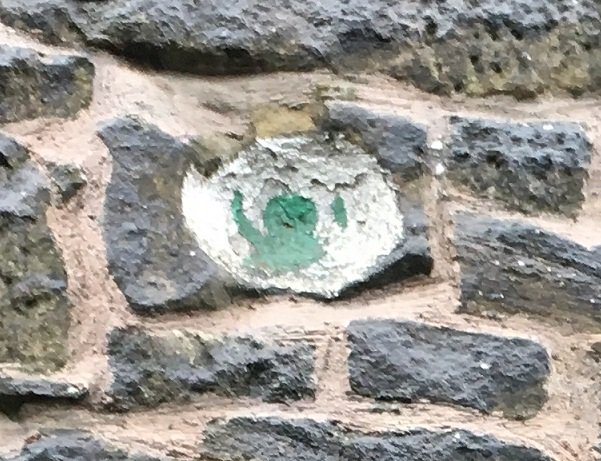
The stone itself, marked with a green frog. 

There may be more this weekend, if I can manage it, but I will try to get back to my one a week post target, so stick around. Thanks for reading, and please, as always, comments and corrections are always welcome.

RH

Oddities

More Mystery Stones

I love train journeys. Even the daily commute has something adventure-like about it. It’s also non-time, time spent sitting, waiting for the destination to arrive. My time to sit and think, read, and listen to music. And to write, of course. Gentle reader, I am writing this sitting on the 17.25 train from Piccadilly Station heading home to Glossop – the joys of having a new phone. We slow down as we approach Guide Bridge station, and there the post begins.

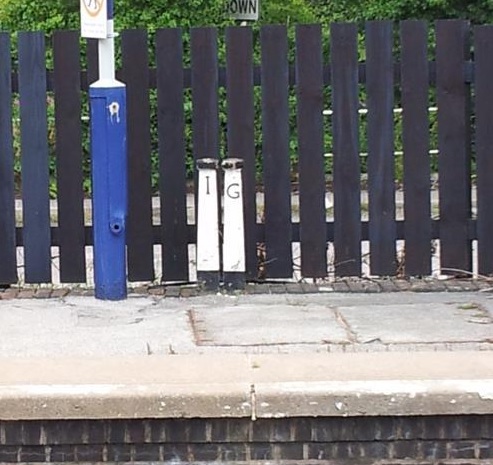
For the last umpteen years I have been commuting up and down this track, and I feel like I know every inch of it, in all seasons and in all weathers. But I have been utterly perplexed by two stones at the end of one of the platforms at Guide Bridge station (the one opposite the new ticket office, on which the train stops if you are going to Glossop from Manchester). These are the fellows:

Guide Bridge Posts 1
Not my photo, alas. I had several nice close-ups, but I cannot find them in any of my files. 

There they sit, painted and mysterious. I was so intrigued a few years ago, that I got off the train and had a closer look. They stand about a foot tall, and taper to a mushroom head. They are painted black and white, as you can see, and have the letters ‘I’ and ‘G’ carved into them. I am not certain what they are made from, either. It is is either concrete with very small pebbly bits added, or a coarse grained conglomerate stone. What I find intriguing is that the letters are done in a very old way – almost Georgian, or even earlier. Also, someone has taken the time to paint them with some degree of care – top, bottom, and letters are carefully marked out, and despite this being a busy, and recently modernised station. They must, in their present location, post-date the 1970’s updating of the station, but I feel certain they have been moved. The only mention of them I could find online is here, where the suggestion is that they represent “posts defining the area controlled by different District Engineers or suchlike”, with ‘G’ being Glossop, although the ‘I’ is still unexplained.

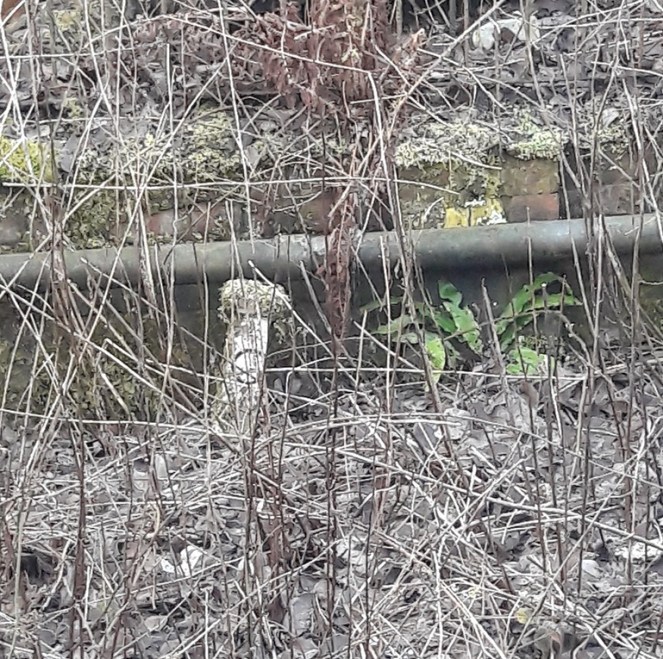
And there the matter ended… until last year. The train stopped just outside Guide Bridge to allow another train through, and I tiredly looked out of the window, blinked, and nearly yelled. Could it be? Yes, it was… another stone. Fumbling for my phone, all I could make out was the letter ‘G’, and then the train moved on before I could get a photograph. Bugger! Since then I have been trying to get the right set of circumstances to allow me that shot again. And a few months ago, I managed it!

Guide Bridge Posts 4
A map of the area. The original posts on the platform are marked 1, the new post is marked 2.

And here is the new stone:

Guide Bridge Posts 2
Difficult to spot, but it sits against the wall. 
Guide Bridge Posts 3
And in close-up, the carved ‘G’ is visible. 

It’s clearly the same thing – same shape, size, and even the antiquated way the letter have been carved is clear. And it too has been painted black and white, and in the same design, at some stage in the relatively recent past. It is no longer cared for in the same way, I suspect, as it is now overgrown and seemingly forgotten. I wonder too, if it was originally part of a pair, and the ‘I’ post has gone? Anyway, there the matter ended.

Or so I thought.

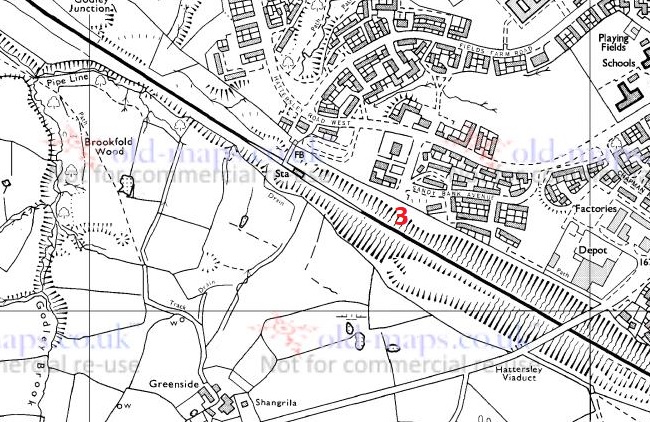
Pulling into Hatterseley station a few weeks ago, coming from Glossop, I was looking out of the right hand side of the train, and just after the big road bridge that carries the A560/Stockport Road, down, and tucked into a nook in the wall, I spotted two more of the things. They are situated where the end of the Hattersley Tunnel No.1 came out (long before Hattersley Station was built) – here on the map.

Guide Bridge Posts 5
New posts marked 3

I have no photo, as the train is always in motion at this point, though I might try and get a shot off with my new phone (snazzy camera, apparently). Two of them, mossy and overgrown, but the same shape, if a little shorter. No paint that I can see, but they might have been originally. The letters are ‘I’ and ‘G’ again, but they run the opposite way to those at Guide Bridge (‘G’ and ‘I’ as opposed to ‘I’ and ‘G’).

I am now intrigued to the point of obsession! So then, the question is. What are they? There must be someone out there who knows. Surely!

I know they are technically not Glossop related, but I thought as so many of my gentle and wonderful readers commute, and that everyone loves a good mystery, you would forgive the misuse of the blog. Anyway, if nothing else, it will give you a chance to play i-spy on your next train journey, trying to spot the posts (the Hattersley ones are hard – blink and you will miss them).

There will be more posts this weekend too, real Glossop history ones. With pottery and other goodies!

As always, answers and comments are most welcome.

RH

Bench Marks

Bench Marks… The Return

I’m on a roll!

I realised recently that I still have quite a few Whitfield bench marks that I have not yet found, and that despite me having a bench mark obsession, I haven’t posted any for a long while. So here we are…

BM mapz
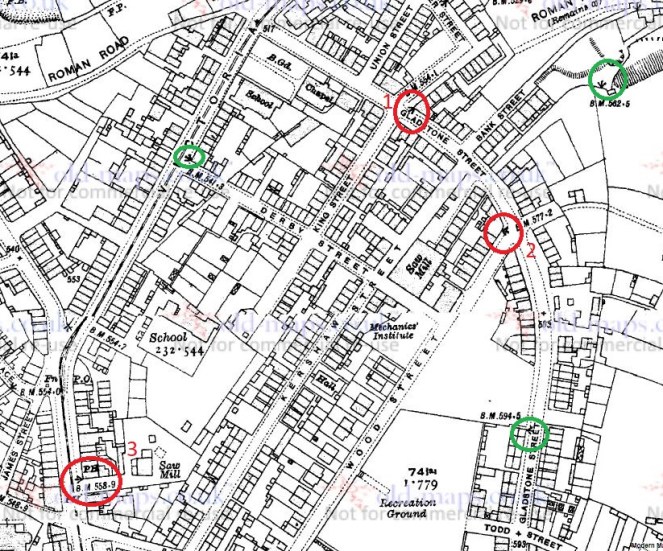
1921 1:2,500 OS map. The bench marks circled in red and numbered are photographed. Those circled in green are no longer there.

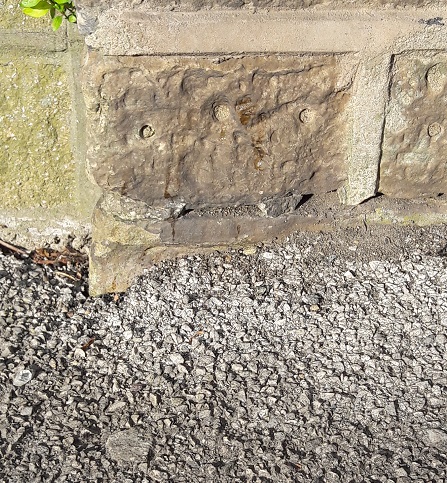
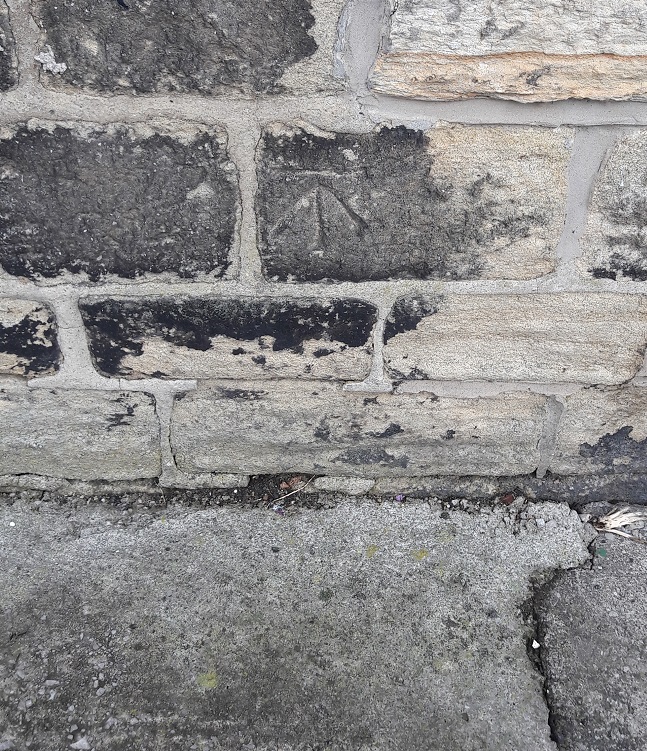
No 1 was extremely difficult to find at first – the building still stands, so it stands to reason that the mark would still be there. It is, but like the mark on the edge of Flatt Farm (No. 10, Here), the ground level had risen over the years – squint, and you can just about see the horizontal part of the mark. It took a while…

BM - King-Gladstone St
The mark is just about visible dead centre of the photo, just above the tarmac and just below the mortar. 554.1 ft above sea level.

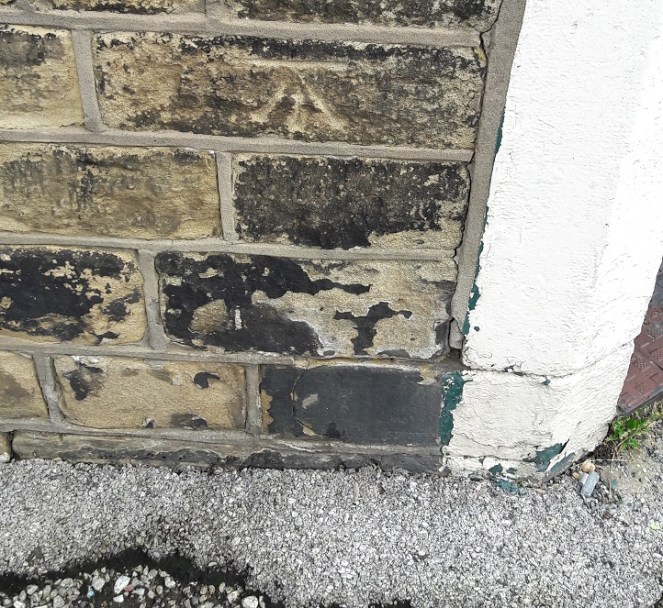
No 2 was fairly easy to spot:

BM - King-Gladstone - pub
On the corner of a building/house – 577.2 ft above sea level.

No. 3 is on the corner of the Surrey Arms on Charlestown Road. Bizarrely, this is a pub in which I have never actually set foot. I fully intend to rectify this outrageous omission at some stage in the near future – if anyone fancies joining me for a swift half or three, let me know. The Surrey Arms is an interesting place, and has strong local connections. According to the earlier incarnation of me, it was built just before 1846 by a James Robinson, who also owned the Naptha works near the Beehive pub.  This same James Robinson also built the Whitfield Brewery in 1849, and which was built on and used the waters from Whitfield Well. Hamnett then relates all the subsequent owners – Thomas Hampson in 1867, Samuel Clarkson in 1876, then later it became Walton’s Brewery with Adam Slater as the brewer who…

“made a special brew of ale for the late Lord Howard of Glossop to be consumed when the present Lord came of age. It was buried, and I have been told that when it was opened, it was stingo; only one pint for each person was allowed, and even that proved too much for some – it was true barley wine.”

Stingo (here and here) sounds like my kind of drink! The brewery eventually became a laundry, and was opened as such by Alderman B. Furniss in October 1895. Now that is a sad end.

BM - Surrey Arms
No. 3 – The Surrey Arms. 558.9 ft above sea level.

Comparing the 1921 map with the 1968 1:2.500 map reveals that the No. 1 bench mark above has moved – probably because of the shift in ground level. Thus we have No 4:

flinggg

It is now situated on the wall of a domestic house, but which was once The Sparrows pub, and more recently Flanagan’s. It stopped being a pub in about 2011, but I can find no more information about this pub, so would appreciate any thoughts.

BM - King Street - Pub
No.4 – the ex Sparrows pub, or more recently Flannagan’s Irish themed bar… begorrah. Anyway, it is 531.89 ft above Dublin… I mean, sea level.

Right, that’s almost it. There are one or two more in this area that need checking out (when I get time…), so watch this space. And anytime anyone fancies a quick walk to find these things, give me a yell.

RH

Archaeology · Oddities

A Puzzling Piece of Pottery

Evening all. The third blog post of June… see, I am trying.

Anyway, this one should (hopefully) provoke a bit of a response. I say hopefully because, dear and precious readers… I need a favour.

Some back story.

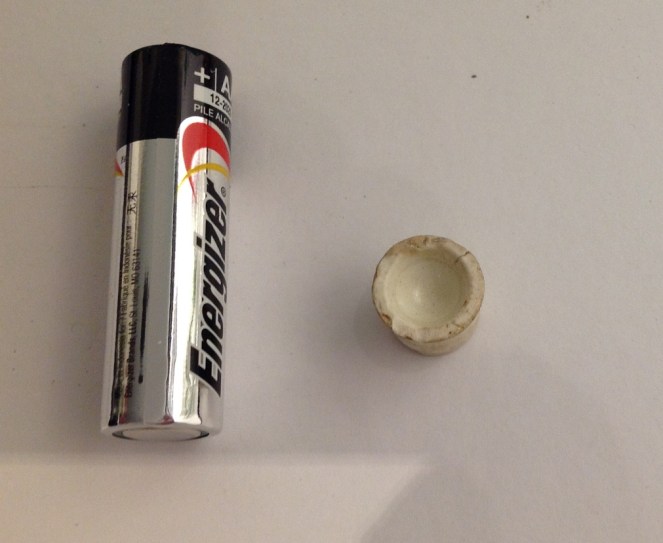
I received an email from the wonderful Sandra T. some months ago, asking whether I knew anything about this piece of pottery that she had found in Manor Park. She, like most of the people who read this blog, pick up random things they find interesting, which is to be commended (although, apparently, she keeps them in a clock… but let’s not judge).

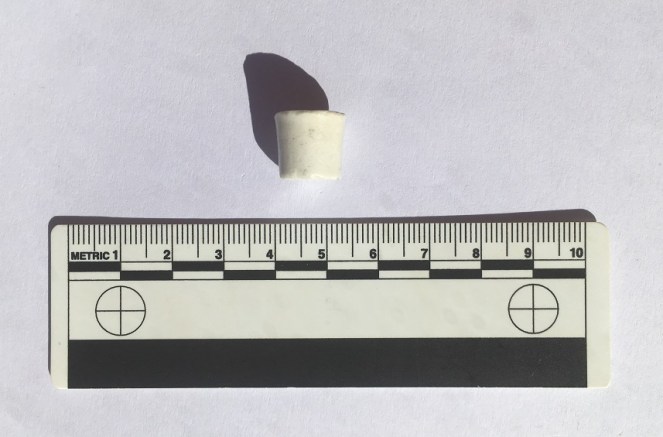
Pot Mystery 1
The mystery object – AA battery for scale. Copyright Sandra T.

Now, I had no idea what it was, but it rang a bell. a brief search through my ‘interesting things’ box, and lo!

Pot Mystery 2
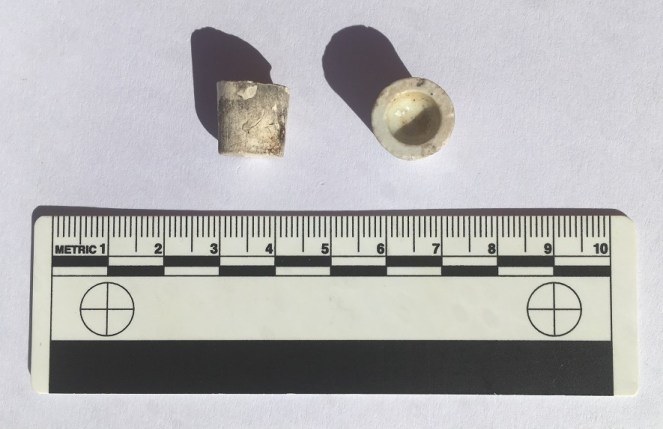
Two more of these mystery objects.

So now we have three of these mystery objects. I found mine in an old dump near Broadbottom, which at the latest was 1910’s, but was generally earlier – say 1890’s – which at least gives us a time period to look at.

Interesting. I thought I’d do this post eventually, as someone out there might know what , when, and why.

Last month my new neighbour (hello Simon A.) partly demolished and rebuilt a wall on our property line, and in the process discovered that the whole wall sits on a bed of pottery and other domestic waste. This mountain of material will be the subject of a future post, especially as it makes a fairly coherent deposit, thus can tell us interesting things. The wall can only have been built post 1850-ish, and definitely before 1860, which gives us a clear date, too. Amongst the bits and pieces was this:

Pot Mystery 3
Another one… what are they?

So now we have four of them.

They are roughly conical, tapering to the base,  measure between 10 and 12mm high, 13-14mm across the top, and roughly 11mm across the bottom. The bottom is flat, the top is hollow in a perfect hemisphere (I say top and bottom, but actually they might work either way up). Some are glazed all over, but one is only glazed on the interior of the hollow. This last point is important, and may hold the key to understanding what they are; it matters that only this bit is glazed, i.e. waterproof, not the rest of the object. Why? Also, they are clearly mass produced, and have a very specific role… but what?

I have two suggestions, both of which may work, but equally they are guesswork!

1) Kiln furniture. When you fire pots in a mass group, as they were being in the Victorian period, you need to keep the plates, etc. separate in the kiln, or the heat won’t circulate properly and you end up with poorly fired plates. These spacers were made in their millions, and were about the same size and shape. Though what they would be doing here in Glossop – not known for it pottery kilns – is anyone’s guess.

2) A way of selling medicine. The little hollow bit is glazed, but the exterior isn’t, so perhaps the medicine was stored in that bit, and scraped out when needed? Or it held a single pill that could be crushed in the hollow?

So over to you. Please, please comment and let me know what you think. The question is very simple. What on earth are they?

I’ll buy a drink for anyone who can tell me, with proof, what they are.

RH

Archaeology

Pipes, Lovely Pipes!

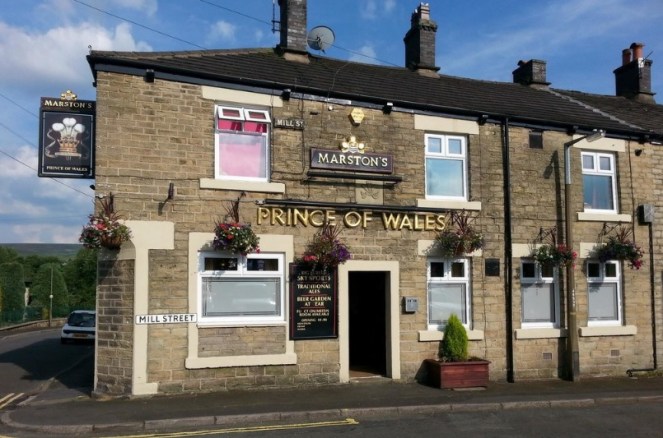
I went for a pint with my father in law a few weeks ago (hello Mr B!) in what has become a bit of a Wednesday evening post-work ritual for us. We popped to the Prince of Wales in Milltown which, I am reliably informed, was built in 1852. And an excellent pub it is too – good beer, and a great beer garden. It has a real sense of history about it, especially as the area is now being developed so heavily, and I would imagine that it would have been a bustling pub, rowdy and rough, in the 1800’s.

POW
I love the corner door, now bricked up – probably the entrance to the tap room – and the carved ‘Fleur de Lis’ (traditionally the symbol of the Prince of Wales) above the door is a nice feature. Also, note the Victorian street sign for Mill Street to the left of the Marston’s sign. Fascinating.

Sitting drinking my beer and chatting, I had a look around to see if I could see anything of interest, and lo! In the flower bed amongst some more modern glass and pottery, were these beauties:

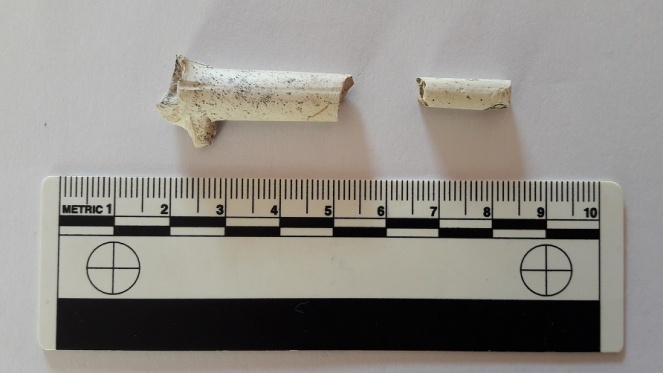
Clay Pipe
Clay pipes – the cigarette butt of the Victorian Period.

I love clay pipes, I really do. There is something so tactile about them, and so personal too. I joke about them being the cigarette butt of the Victorian period, and they are in a sense – smoke them and then throw them away – but they embody so much more. Believe it or not, they are the subject of many very detailed archaeological studies; they are mass produced, but they show features that shift over time, allowing a fairly precise date to be given to the pipe, and possibly then to the site/building/feature. Google “clay pipe chronologies” for examples. I’m not going to go into too much detail, as I really am no expert, but these two examples are very obviously Victorian. The bit on the right is part of the stem, and comes from near the mouth-piece, as the stem get thicker nearer the bowl. The piece on the left has the stem, spur (that little bit the points downwards), and the lower part of the bowl, where the tobacco itself sits, and which in this case shows signs of burning. Neither are particularly interesting, and they are certainly not rare, but nevertheless are integral to the human story of Glossop, and one wonders what conversations were happening in the pub whilst they were being smoked?

The history of The Prince of Wales, and all other pubs of Glossop, past and present, are detailed in the excellent book ‘History in a Pint Pot’ by David Field. Meticulously researched and fascinating, it is highly recommended to anyone with an interest in the history of Glossop, pubs, or beer – so that’s all boxes ticked for me. It is now out of print, sadly, but Glossop library has a copy. You could also check out the superb Glossop Victorian Architectural Heritage website, they have lots of information about pubs, and much more besides. Well worth a look.

Moing on, this next pipe is a bit more interesting.

I found it a while back on the edge of my favourite path – Bank Street, or the ‘Bonk‘ as it’s known locally. However, not being born in Glossop, I would feel a fraud calling it the ‘Bonk‘, so Bank Street it is.

I love dialect words and phrases – the way that the beauty of the English language is tied firmly and absolutely to the place it is spoken is truly remarkable. American friends of mine marvel at how many accents there are in such a small island. And yet if we go back 100 or so years to a period before mass media, it would have been possible to tell not only which town you came from, but which part of the town, and indeed which street you lived on. Now that we are bombarded with accents and the media is dominated with southern ‘Estuarine‘ English, we are slowly becoming linguistically homogeneous and eventually we may lose our accents altogether, which I think would be a shame. What is interesting about ‘Bonk‘ as a word is that it not only partly reflects the Glossop accent, but it is also almost certainly derived from the medieval French ‘Banque‘ meaning a steep wooded valley next to a stream. It crops up in Cheshire dialect as ‘Bongs’, and the nearest examples I can think of is Leebangs Rocks in Broadbottom (Leebangs = Le Banques), and The Bongs both in Handforth, and in Goostrey. It’s not often you encounter Norman French in Glossop!

But I digress! It was found not too far from the bottle top I blogged about here. I thought it nothing particularly special until I got home and cleaned it. Wow!

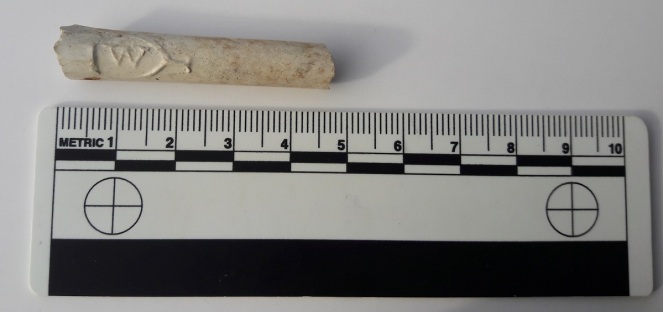
Clay Pipe 2
Side 1 – ‘W’ Cartouche
Clay Pipe 3
Side 2 – ‘T’ Cartouche

It’s the front part of a clay pipe, just at the point where the stem meets the bowl – you can see it thickening into the bowl. But on either side, imprinted into it, is a cartouche containing the letter ‘T’ and letter ‘W’. Presumably these are maker’s marks, but unfortunately, I cannot find any information out about who or what ‘W’ and ‘T’ were. Also there is the suspicion that they may actually not be maker’s marks as such, but were instead used by many different companies as a way of suggesting quality – it was perceived by the buying public that those letters were associated with a superior pipe (I read this somewhere, and now can’t find the reference… grrrrrrr). This would be similar to the Victorian belief that pipes from Ireland were the best, and thus many clay pipes have the words ‘Dublin’ or ‘Ireland’, or have a harp or shamrock imprinted on them somewhere… despite being made in Birmingham or similar. It is Victorian in date, and scrubbed up quite nicely!

I was originally going to blog about this in a larger post about the trip down Bank Street (which I will still write… honest!), but it seemed to fit in here better.

By the way, if the landlord of the Prince of Wales reads this and wants the pipes back, I’ll bring them round next Wednesday!

EDIT I found the reference to ‘TW’ – it was in the Clay Tobacco Pipes report by Dennis Gallagher, and from the High Morlaggan Project (the report is under excavation / reports / clay pipes). In it, it states that ‘TW’ pipes “were an extremely popular type and were produced by most makers. The meaning of the letters is unknown, although it may originally been used by the early 19th century Edinburgh maker, Thomas White, who was renowned for his high quality pipes“.

So there you go.

RH

Guide Stoop · Stones of Glossop

Glossop Guide Stoop – Another Update

So, once again, I am forced to apologise for the lack of activity here of late – I expressly didn’t want the blog to be like the diary you start on New Year’s Day, full of good intentions, only for the next entry to be Auntie Mabel’s birthday sometime in July. The same can be said for those of you who I have not yet replied to their emails. So by way of an apology to you all, have a series of posts, starting with this one on the Guide Stoop.

Following on from the revelation here that one of the destinations on the stoop is probably Hayfield, I came across another example of a triangular guide stoop – this one is in the care of Saddleworth Museum and is kept in their outside/garden area.

Stoop 1
The triangular guide stoop at Saddleworth Museum, similar in shape and style to our own.

It originally stood where the Standedge Road meets the A62 Huddersfield Road, and shows 6 destinations, two on each face, including Oldham, Manchester, and Huddersfield. Here’s how it would have originally looked:

Stoop 2
From Huddersfield Highways Down The Ages by W.B. Crump

So this is similar to how the Glossop guide stoop would have looked… which got me thinking! If its original location was the top of Whitfield Cross, I wonder if the stoop would once have stood on top of the cross shaft. I find it unlikely that the guide stoop makers and installers would have made a new shaft if there was one standing in the right place already. Especially, as we must remember, by this time (early 18th Century) it had already lost its cross head, and due to puritan and Methodist views of the local people, would have lost all of its symbolism as a ‘Christian’ thing. In fact, so much so had it fallen from grace, that less than 100 years later it would be nicked and moved as a prank. So why not bung it on top of this convenient shaft?

Now, there is no evidence for this, and certainly there is no indication that anything was fixed to the remaining portion of the shaft as it is now, but we don’t know what was removed, or has worn away in its intervening 200 years standing as a stile. Just a thought.

Graffiti

More Graffiti

Good day to you all.

Apologies for the lack of recent activity – the usual reasons apply here, annoyingly. I have been trying to keep active on twitter as a way of making it up to you, my valued readers… but I know, it’s not the same thing.

Anyway, here is a short entry to keep you going. I have bigger plans of more interesting things, and hopefully, given that it is a bank holiday, I might get it posted. In the meantime… graffiti!

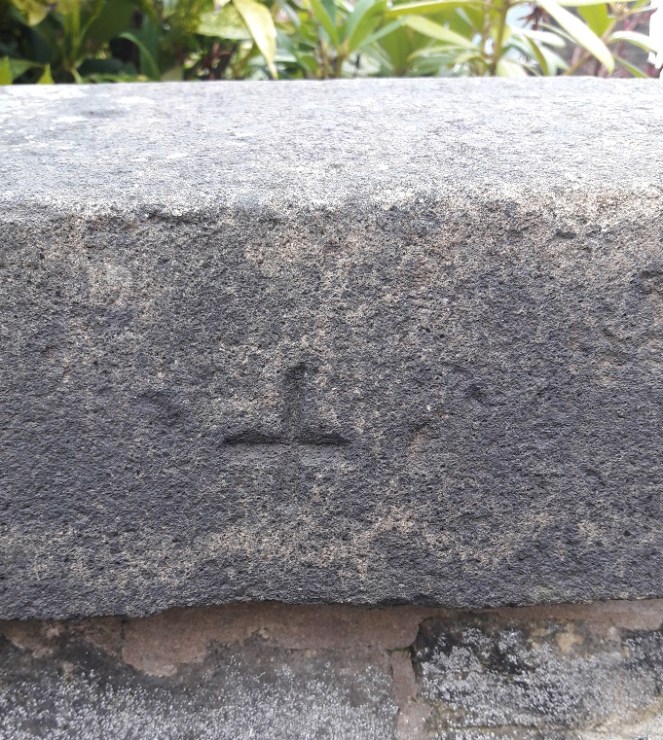
Firstly, this cross from the wall outside the vets on Gladstone Street.

Graf 1
A simple cross carved onto the wall coping by the gate on the Gladstone Street side. 

Simply executed, and part of me wonders if there is some connection between this and the other crosses that I have noticed around Whitfield – here and here. Just a thought.

Now back to Whitfield Recreation Ground. I know I keep threatening to do it, but I really do have a post in the making on the rec. A very interesting place indeed.

Anyway, these are all from the Wood Street side of the ground.

Graf 2
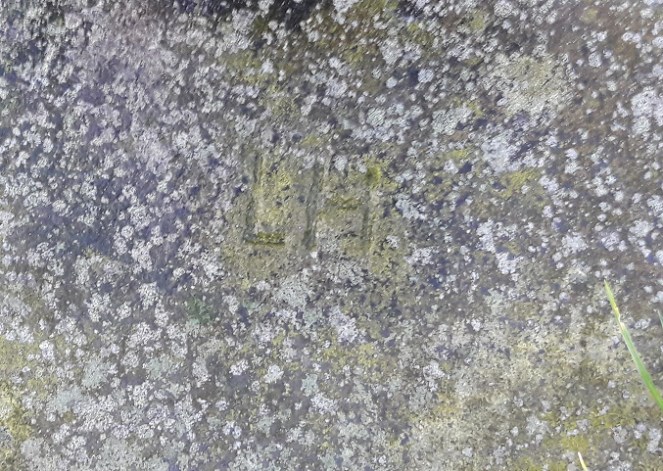
‘WFHS’ perhaps – very unclear.
Graf 3
Er… no idea! It is almost like some sort of occult symbol. Witchcraft and devil worship in Whitfield… I knew it! But then it also looks a little like this Pokemon character, so who knows! And don’t ask how I know that…
Graf 4
‘Jo’ – nice and simple. There is also the hint of something below and to the right – geometric designs? It is easier to see in the flesh, so to speak. 
Graf 5
‘LH’ – nicely carved.

And to end… this! How and why someone did this, I don’t know, but they did.

graf 6
Ladies and gentlemen… the alphabet!

It gets a little blurry in the middle, from ‘J’ onwards, but then picks up again from ‘W’. But it’s all there.

graf8
I used chalk to try and bring out the latter part. You can also make out ‘P’, ‘Q’, and ‘R’.

Truly weird and wonderful.

That’s all for now, but keep your eyes open, and send me photographs of any you find – I have a few from readers that I’ll publish next time. And I’ll try and post again before the bank holiday is over.

RH

Archaeology

A Garden Gift

A glorious weekend – I got all my vegetables planted, the garden was tidied, the lawn was mown… and wine was drunk in the sunset. A very succesful weekend indeed.

I was going to blog about some bits and pieces I had found recently, but two wonderful things happened over the last few days. The first of which will have to wait… it will take a bit of unpicking (and cleaning and researching). It is very exciting. And lots of it.

But for now, I present the second wonderful thing, a gift from my raised bed of onions and garlic!

Slate 1
You can see the marks where it has been shaped, though I don’t know how they were made.

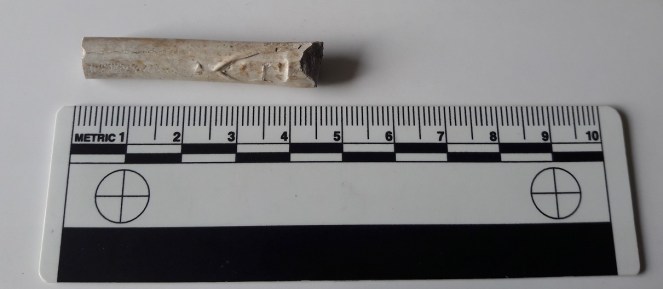
Ok, so I know it doesn’t look like much (so many of my blog posts start like that), but it’s the bottom end of a Victorian (or very early Edwardian) child’s slate pencil. Paper was a very expensive commodity in the Victorian period, and you certainly wouldn’t have given it to children to learn to write on. Instead, they practised their copperplate handwriting on slate writing tablets with slate pencils such as this.

Years ago, I found an old wooden pencil case in a junk store, and in it were two complete and several broken slate pencils – it’s nice to see a complete original one.

Slate 2
A complete version of a slate pencil – again, you can see the grinding marks where it was shaped.

Last year, I was poking around a Victorian rubbish tip with a friend (as you do…), and I came across this broken example of a writing slate.

Slate 3
Broken writing slate. You can see the lines used to guide the child learning copperplate script.

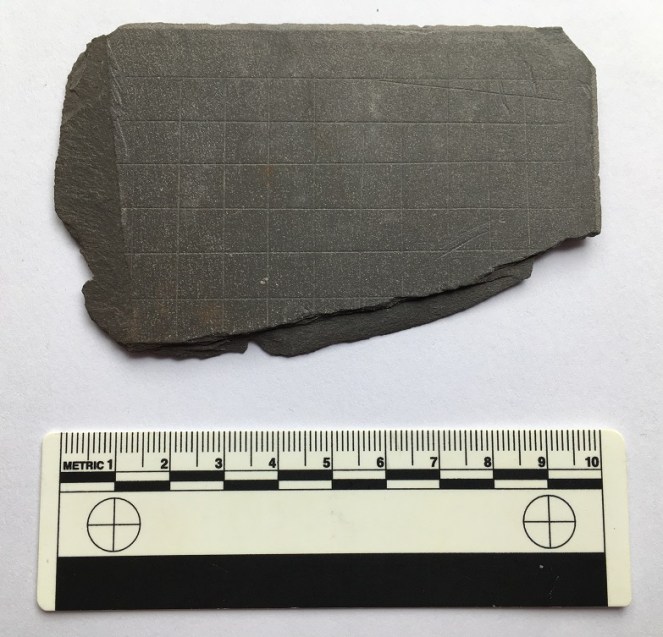
 The thing is wonderful. You can clearly see the engraved lines – thin, thick, thin, for the upper, middle, and lower part of each letter – to keep the child’s letter forms perfect and copperplate. But look at the edges too – they are shaped – it may be mass produced, but some care has gone into how it looks.

I turned it over, and found this on the reverse

Slate 4
More engraved lines.

Wonderful – squared paper for maths problems, and probably for art too. I love this object, and it is among my favourite things that I have found. Sadly, it wasn’t in the Glossop area, but in deepest, darkest, Lancashire, but I thought I’d share it anyway to illustrate my pencil… so to speak.

Here’s what it would have looked like when it was being used.

Slate Tab
Victorian writing slate, lifted from this website.

The question is, then, how did the slate pencil fragment end up in my garden?

We archaeologists are obsessed with object biographies:

“Not only do objects change through their existence, but they often have the capability of accumulating histories, so that the present significance of an object derives from the persons and events to which it is connected.”                                                                   

(Gosden C. and Y. Marshall. 1999. ‘The Cultural Biography of Objects’ p.170)

And this object has a fascinating biography. It starts with a pencil being dropped by a child and broken. It is then thrown away into the toilet with all the other rubbish, and taken away by the night soil man. Via the process of night soiling, it ended up spread onto a field. But not my field, yet. This is the interesting bit – the raised bed in which I found it was filled with soil that we bought from Lymefield Garden Centre in Broadbottom (highly recommended, by the way). The source for this soil is, I think, just behind the garden centre, but the original location for the pencil (i.e. the school) was probably Manchester, or perhaps Ashton Under Lyne (although, I suppose there is no reason to assume that it couldn’t have come from a school in Broadbottom).

The fact that the pencil may have started out being used in Manchester, and ended up in my onion patch in Glossop, via in a field in Broadbottom, is a cautionary tale for archaeological intepretation – we could have simply assumed that my house was once used as a school.

Anyway, slate pencils are not uncommon finds in fields and gardens – night soiling means they get around, and they stick around as, like pottery, they are virtually indestructible – Here, for example, is one on a blog run by a gardener who records the things she finds in the soil. And a brief glance around the internet produces a number of similar results. Still, it’s a nice little find, and a wonderful piece of social history.

As ever, comments and questions are most welcome.

More very soon.

RH

Guide Stoop · Stones of Glossop

Whitfield Guide Stoop – An Update

So, I had a fun afternoon.

James and I went for a bit of ramble, up the hill and along Carr House Lane. Despite it being a very short distance from my house, it still took the best part of an hour… toddler speed is, I think I have mentioned before, glacial. So as I was waiting for the passing of an ice age, and hoping the clouds would stay away (they did), I began to think whether it would be worthwhile to have another poke around at the guide stoop to see if I might be able to dislodge some more stones.

It was. And I did.

I felt the last letter – a lowercase ‘l’… I think. Hang on, no. Is that something attached to it? an ‘e’? Ok, what next… Another ‘l’? … LEL?

I scrabbled around and moved more stones, all the while hoping the whole lot wouldn’t shift and trap my hand; nobody wants to be the guy on ‘Casualty‘ at whom the entire audience is yelling “Don’t be a moron, take your hand out of the wall *crash* See!  Well you deserved that, idiot!”.

I could feel more letters, but I just couldn’t decipher them.

Then a series of thoughts… take a cast. James. Playdo!

So yes, 2 hours later, and armed with a two tubs of Playdo and a sheet of thin plastic, I returned, ready to make a ‘plaster’ cast of what I couldn’t see. I have to say, it was surprisingly effective! It took a lot of furtling and fettling, but I got about as much as I could. Enough at least. So then…

GS
Excuse the dayglow colours… blame James not me. The photo is reversed, so that it reads correctly, the original is back-to-front.

What do we have?

“…field

It is a little hazy here, so I turned it to Black and White, and played around with contrast, etc. Anyway, here is the other version – between them, I think you can see the word “…field“. I hope!

gs1
It works better in Black and White from this angle. I tried taking a photo of the wall interior, but my phone ran out of battery. To be honest, I’m not sure it would have worked anyway.

So then, the placename ends in “…field“. So not ‘Chapel (en le Frith)’, or ‘Chunal‘.

So where then? And therein lies the problem! There are multiple places that fit the bill. If we assume that it is in the opposite direction from Glossop, and that it originally stood at the top of Whitfield Cross (see here for discussion), then it could be Moorfield, Hayfield, or even Macclesfield. If it stood somewhere other than the top of Whitfield Cross, then we might have to consider Hadfield or Padfield. Sheffield? Or even Whitfield… the stone may have travelled far and wide.

I have solved one problem – it ain’t Chapel or Chunal, but replaced it with another – which ‘…field‘ is it? My own feeling is Hayfield, but that’s based on nothing in particular, just reasoning.

No, the stone needs to come out of the wall!

And please, please, give me your comments and thoughts – I genuinely want to know what you think… because I have no idea!

I’d also like to say hello and apologise to the two people who saw me fettling in the wall and came to enquire if I was “alright” (i.e. not some sort of pervert sneaking around the back of peoples houses, nor a murder victim dumped in the bushes”). Thanks, and see… honest, I was telling the truth, I am an archaeologist. It was nice to meet you both!

RH

Mason's Marks

Mason’s Marks and Apotropaia

I love that word… but more about it in a bit.

I went for a walk with some friends a few weeks ago, from Old Glossop to the New Lamp pub in Hadfield, via Valehouse Reservoir and the Longdendale Trail. It runs along the old Woodhead Line train track there from Hadfield Station to the Woodhead Tunnel entrance. All the way along it you can see evidence of its former existence – signal cable carriers, track equipment, assorted bits and pieces, and bridges.

As I passed under one bridge (the Padfield Main Road) I glanced up and saw this.

20180127_133345 (1)
Fantastic Victorian stonework on the Padfield Main Road bridge – 1840ish in date.

well, more specifically, this bit.

20180127_133345
Close-up, but rather awful quality… I need a decent camera with a zoom lens.

High up and hidden amongst the stonework were a number of mason’s marks. Awesome, thought I.

It’s here on the map.

Bridge map
Bottom red circle is Hadfield Station, the top red circle is where the mason’s marks are. This is from the 1968 1:2500 OS map, via old-maps.co.uk. Thanks, again!

Mason’s marks are a really fascinating aspect of stone masonry. Essentially, the stone masons were paid by the piece – the more they carved, the more they got paid, and in order to make sure they they got paid for the correct number of stones worked on, each mason signed their piece with their individual mark. It also acted as a form of quality control – if a piece of stone was not up to scratch, the master mason could see at a glance who carved it. This concept of signing your work had been going on since the Medieval period, and continues to this day. It’s not often you get to see them, as more often than not they are on the reverse of the stone, hidden within the fabric of the building. But here, for some reason, a group of masons (I count three different marks, but with perhaps another three possibles) decided to display their signs. Still, nice to see these out in the open.

Imagine my surprise, then, when we decided to go through an underpass, underneath the old track bed, and head down to the reservoir at this location, here:

Blimey!
Bottom red circle is the bridge with the mason’s marks, the top red circle is the underpass. This is the same map as above, just further down the track/footpath.

Wow… just wow. A grotto of mason’s marks. Quite literally, every stone was covered in mason’s marks, all of them. Outside and inside… amazing.

x1

x2

x3

x4

x5

x6

x8
This is the roof… honestly, every stone is marked.

x7

It is wonderful!

Now, I’m not sure why there is this cluster of marks on this specific underpass. Perhaps they were allowed to go wild and leave their marks in the open in this one place. Or perhaps, there was a competition between two rival gangs of stonemasons, each working to complete the stones fastest. I simply don’t know.

I have made a list of the mason’s marks.

Marks
These are the mason’s marks on the wall of the underpass.

The mark bottom right is probably a square and compass symbol – both tools are used by stone masons. It is also a symbol used in Freemasonry, which takes a lot of its signs and symbols from stonemasonry.

It would be interesting to compare them with others on the Longdendale line, to see where else these men were working here. Also, as they would be itinerant stone masons, travelling where the work is, we could compare them with others further afield. After all they are a signature, and whilst we may not know their names as such, they left their mark on our landscape. They don’t seem to match those on the bridge, though it’s difficult to make out. There have been attempts to create a database of masons marks, particularly those from the medieval period in the catherdrals. However, whilst at first glance this seems a great idea, there is flaw in the plan: there are a finite number of marks you can make with a chisel and using only straight lines. It was found that many marks were reused by different masons, sometimes separated by centuries. There is something deeply interesting about mason’s marks, though, and some are more interesting than others… Looking back at the bridge mark, I was struck immediately by the ‘M’ mark.

Apotropaia. From the Greek, apotropos, meaning literally ‘to turn away’, and more specifically in this case, to turn away or prevent evil.

People have always used signs and symbols to act as magic charms to stop bad things, and bad people, from affecting them. Apotropaic marks became very common in the 16th-18th centuries, and any domestic dwelling of the period would have had these marks carved literally into the frame of the house. At this time, the reality of evil was not questioned, and people intent on causing you damage and sickness – witches – were a real threat and believed in utterly. Indeed, the marks are sometimes referred to as “witch marks”, and have only recently begun to be researched. I can almost guarantee that any timber framed house from the period will contain at least a few. Often they are placed by windows, doors, and fireplaces – essentially, any opening, anywhere that a witch, ghost, devil, or other evil thing might gain access to the house. The marks take many different forms, but two of the most common are the ‘daisy wheel‘ mark – usually carved into stone or wood with a compass…

dw
The Daisy Wheel or Hexafoil mark – the idea is the evil/witch would get stuck in the wheel, and be trapped for eternity.

…and the ‘double V’ sign. This latter is very interesting; it is largely understood as standing for ‘Virgo Virginum’ – the Virgin of Virgins, or the Virgin Mary, and may be seen as a plea for her help.

SONY DSC
The double V mark, or Virgo Virginum. Photo taken from here. Thanks to another really interesting blog.

Now, given that the marks are occurring at a time when it was illegal and/or extremely dangerous to be a Catholic, it is unclear what is happening here. Either we are seeing an underground following of Roman Catholicism amongst the population, which is very unlikely. Or more probably, it represents a popular belief or superstition that, whilst nodding to the Virgin Mary, is just understood as a protective symbol, without the trappings of Catholicism that would mean you were burnt at the stake. Essentially, by the 1600’s, people no longer understood the more religious meaning of the symbol, but carried on the use of it as a form of protection.

As further evidence of this, it is often found inverted, as an ‘M’, not a ‘W’. The letters are not important, the shape of the lines is.

witches+symbols
W or M, the meaning is the same.

Which brings us back to the bridge mason’s mark

20180127_133345

Is the mason: a) A catholic, proclaiming his faith, and marking his work thus? b) Aware of the ‘good luck’ aspect of the sign, but has no idea of its origins? c) A mason who is using it solely as his mark, with no understanding of the meaning beyond its shape?

Personally, I’m going with b, but with a small dash of c.

There is so much more to be said about this subject, it is really a genuinely remarkable field of research (and one in which I am involved), and as it is just emerging as worth studying, I urge all of you to keep an eye out for any marks on buildings, especially internally, and particularly if they are built before 1850.

Right, I have a glass of wine waiting for me, so cheers. And next time, I think some more pottery is in order. Oh, and apologies for the long post, again.

RH