Well, so far I have managed to fail utterly in my New Year’s resolution in posting at least once a week. So my apologies. A lot of my spare time has recently been taken up with writing and preparing for a talk I am going to give on the subject of Whitfield Cross. Interestingly, the Whitfield Cross post (here) is by far and away the most popular on this blog. I know this because behind the scenes here, there are a whole pile of statistics that can be accessed that tells me how many people visit each day, what they look at, and even from where they come – yesterday, for example, I even had a visitor from South Africa! Now, I have no idea why the Whitfield Cross post is so popular, but when I was asked to give a talk on any subject, I though I’d go with that!
The talk is titled: Whitfield Cross – Glossop’s Saxon Heritage
To be given to the excellent folk of the Glossop and Longdendale Archaeological Society (website here) on Tuesday 3rd April at the Bluebell Wood pub, Glossop Road, Gamesley. Talk starts at 7.30, so get there a little earlier, and it’ll cost £2 on the door (although for £5, you can join GLAS and reap the benefits for the year).
The talk will draw on the blog post, but will include new research into Glossop’s only Anglo Saxon feature, and include a discussion of other examples of Mercian Round Shafts.
Plus, this is your chance to find out who Robert Hamnett actually is… and buy him (well, me) a drink!
In all seriousness though, come along – if you are interested in the blog, or Whitfield Cross, you’ll be interested in this.
Right, despite having another cold (courtesy of the ever ill James), I shall try and bash out another blog entry
The urge to leave a mark in the landscape – a part of you or a reminder that you were there, once, even long after you are gone – is undoubtedly a universal feeling, and one that has been with us since we humans first started ‘thinking’. The cave art seen in places like Lascaux and others are believed to be ritual and ‘Shamanic‘ in nature, as well as displaying entoptic traits, probably drawn under the influence of hallucinogenic substances, and again ritual in origin. However, I am also convinced that some of them are the Upper Palaeolithic equivalent of “Kilroy Woz ‘Ere”.
Graffiti can be an eyesore – scrawls and rude words for example. But it can also be rather beautiful; there is some amazing ‘street art’ out there, done by people with phenomenal talent. However, it must be stated that even the rude word variety has an impressive heritage – the Romans were famous for it! Even medieval churches were not immune to it – if eternal hellfire and damnation isn’t deterrent enough, an asbo certainly won’t cut the mustard.
But it is the humble name that is most often written; a cry in the wilderness of life, and wish to be remembered, to have left a mark, however small, so that some part of you is immortal. Now, I’m not about to post a bunch of photographs of random spraypainted words… no, no, no! This graffiti has some age to it.
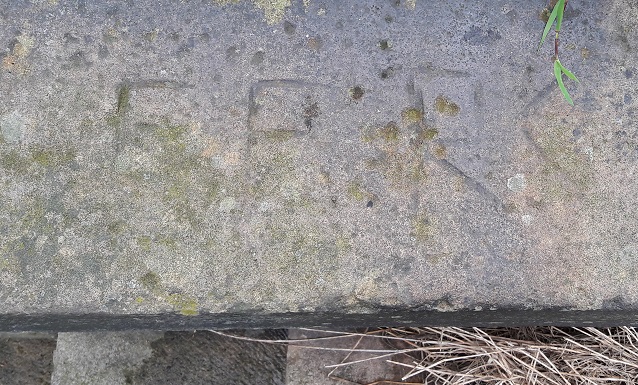
Nowadays, any moron can (and frequently does) use spraypaint, marker pen, emulsion, or any one a number of other ways to leave their mark. However, back in the Victorian period, if you wanted to write your name, you really had to mean it! Armed with a hammer and a heavy duty chisel, and a good few minutes whilst you etched your initials permanently into stone. It is surprisingly common to come across this sort of thing, but recently I have been photographing the ones I see in Glossop. I have more photographs somewhere, but for now, may I present ‘Gone, But No Longer Forgotten’.
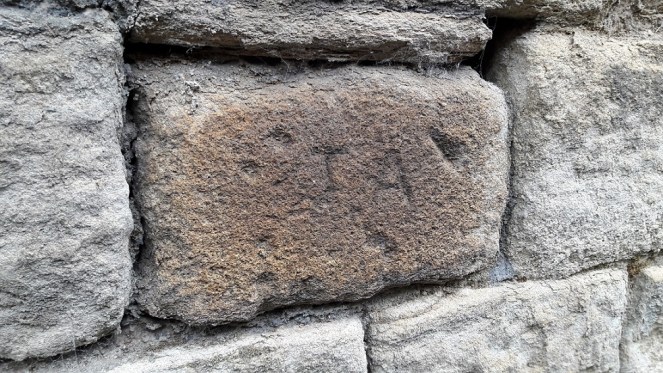
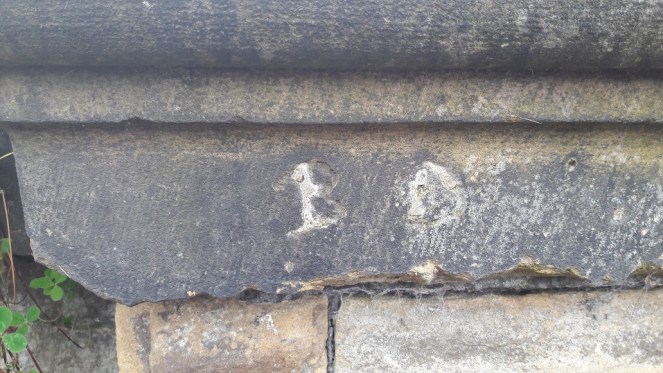
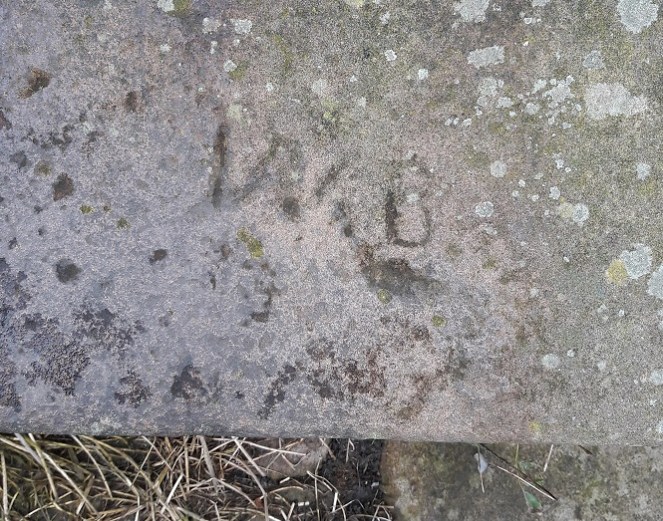
This is on Bank Street – my favourite path. Slightly haphazard initials – T.A. – carved into a stone that is oddly coloured. There are no other similarly coloured stones around it, and it looks like it has been burnt at some point before being used in this wall.This one is from Whitfield Recreational Ground, the Wood Street side. ‘B.D.’ carved into a capstone. It also looks like it has been filled in at some stage. Given that the park was opened properly in 1902, we have a firm date after which it must have been carved. It’s also nice to see the marks of the chisel that dressed the stone – all representing one person’s labour spent in shaping it.Whitfield Recreation Ground once again, this time the Wood Street stairs. ‘W.B.’ very messily carved – standards clearly slipping. There is possibly a ‘J’ carved below the W.This one is also on the Wood Street stairs. ‘F.F.R.C’? Unclear, and I think this is more modern than the others – there has been no attempt to carve the curves of each letter, and instead an unskilled hand has block carved the initials. Shocking!
As I say, I do have more somewhere, and I’ll post them when I find them. In the meantime, if anyone knows of any more, let me know. I have some on my garden wall that are particularly interesting, but I’m saving them for their own post.
Next blog post will involve pottery… probably.
Or Victoria Bridge.
Anyway, Happy New Year to you all, and as always, comments are welcome… especially if you know the identity of any of these miscreants!
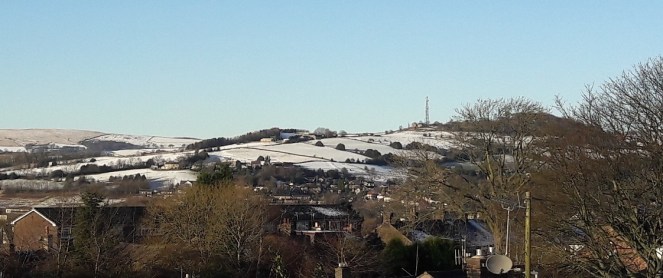
Wishing you all a very Merry Christmas, and here’s to a new Year filled with history and archaeology. To celebrate, enjoy a seasonal photograph of Mouselow taken from the SSE a few days ago.
Mouselow from the South South East. A closeup of the important bits. Apologies for rather poor photoograph… I really do need to invest in a decent camera.
Mouselow is an Iron Age hillfort, and a scheduled monument. It is also a hugely important part of Glossop’s history, and one that deserves a long post all to itself. This is just bit of Christmas fun.
In the photograph then. Just below and to the left of the antenna, you can see medieval ridge and furrow, a characteristic field mark derived from ploughing, highlighted in the snow. The snow, blowing in from one direction, sticks to one side of the ridge only, creating the stripes.
Also, just below that, it is possible to make out one of the massive ditches that would have surrounded the hillfort. Whether for defence, or for ritual reasons, to make the hill separate from the surrounding land, we don’t know. However, and whichever, Mouselow dominates the Glossop skyline.
A short, place-holder, blog entry today. Real life is preventing me from posting as often as I would like, but I have a series of shorter posts to keep it ticking along whilst I work on a larger post. James is finally asleep, which means I get a cup of tea and some time to write this up… hastily. There’s washing up, laundry, and tidying to be done: being a 21st century househusband is not easy, and I raise my (Homburg) hat to my mother who made it all look so effortless.
So, in keeping with the post of the junction of two brooks here, I thought I’d do something similar.
Long Clough Brook starts in the valley to the west of the Grouse inn (now a house) in Chunal, and wends its way down along the valley, taking in streams and brooks as it goes. Of these, the most notable is Bray Clough Brook, which it joins at Charlestown. This is important, because at that point it becomes the boundary between Whitfield Parish (eastern bank) and Simmondley (western bank).
From Turnlee, it weaves in and out of Primrose Lane, and plays merry havoc with the boundaries – for example, the upper part of Slatelands Road is Whitfield, the lower part in Simmondley. And so it goes all the way down to the roundabout at the junction of Primrose Lane and Dinting Vale/High Street West, where the Junction Pub (now offices) stands.
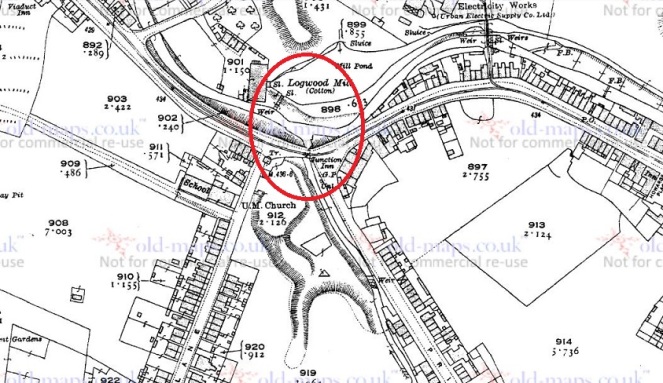
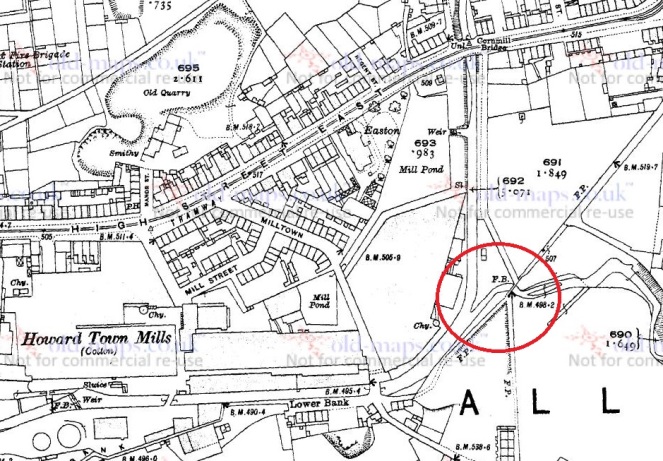
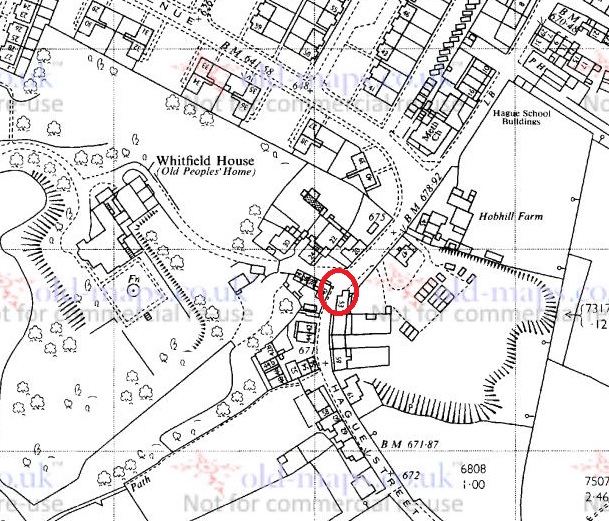
The confluence of Long Clough Brook (from the south) & Glossop Brook (running east-west at the top) is circled in red. High Street West is on the right, Primrose Lane and Simmondley Lane exit south out of the map. This is from the 1921 1:2500 OS map.
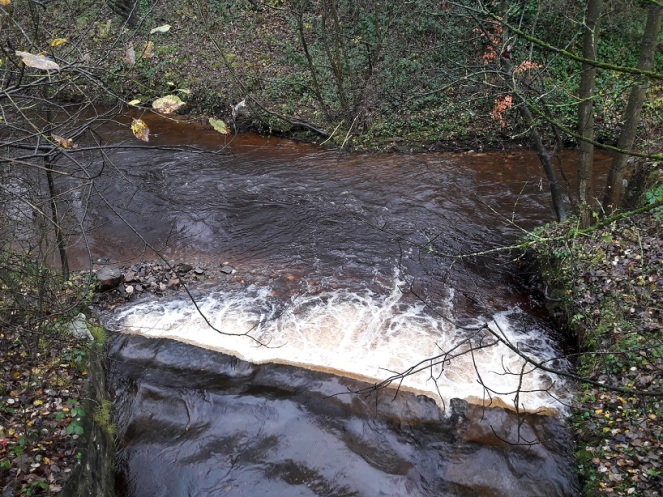
Here, on the other side of the road, it gushes out into Glossop Brook.
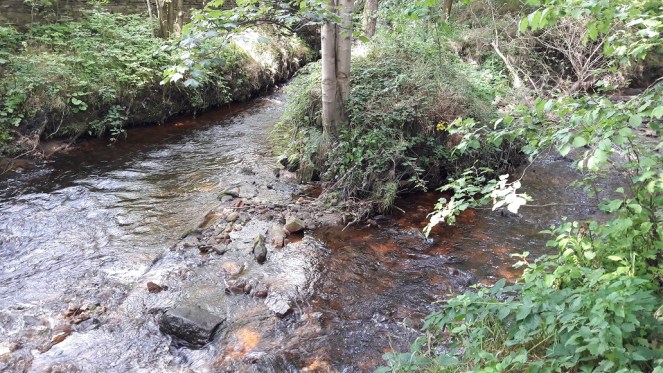
Glossop Brook, running east-west, is joined by Long Clough Brook from the south.
What is interesting about this is that the boundaries of three of the ‘villages’ that make up Glossop – Whitfield, Glossop, and Simmondley – are defined by this particular junction. In the photographs above, then, the land on the left is Simmondley, on the right is Whitfield, and the land beyond is Glossop. Oh, and the whole area is Dinting Vale, technically, just to add to the confusion.
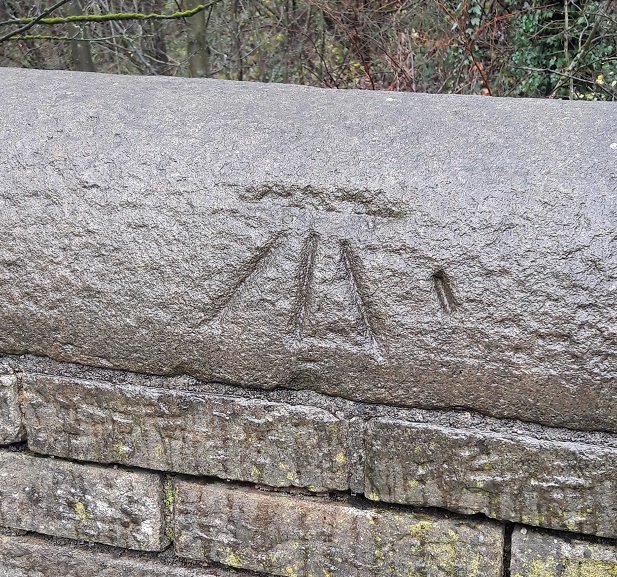
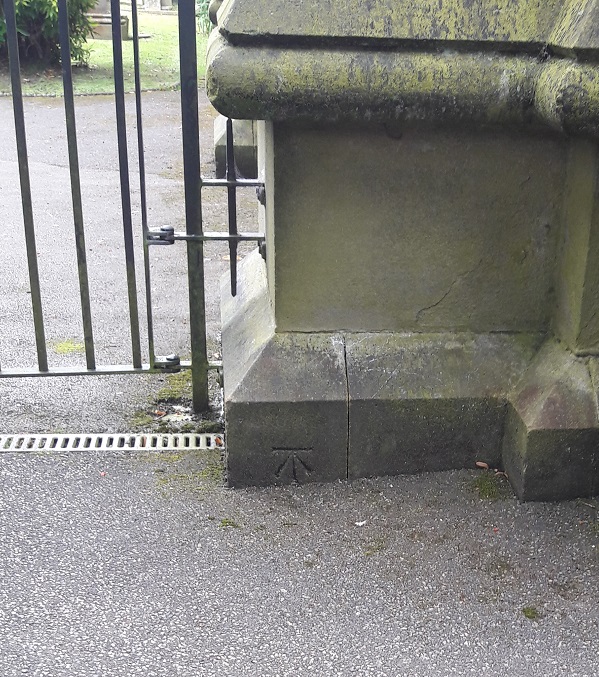
And of course, it wouldn’t be a post by me without a Bench Mark! This one on the wall just to the east of the confluence.
A mystery Bench Mark. Alright, so it’s not that mysterious.
Except, bizarrely, I can’t find it on the map. The only Bench Mark noted is on the old Junction Inn at 433.42ft above sea level, which annoyingly I forgot to photograph. This, is not to be found anywhere. It is also subtly different from the usual mark – the arrow doesn’t join the level, and there is another, probably associated, mark carved to the right. Nope, a bit of a mystery!
It is my intention to do a proper post on each of the brooks in the area eventually, detailing all the tributaries and confluences – a summer project I think, but stick around.
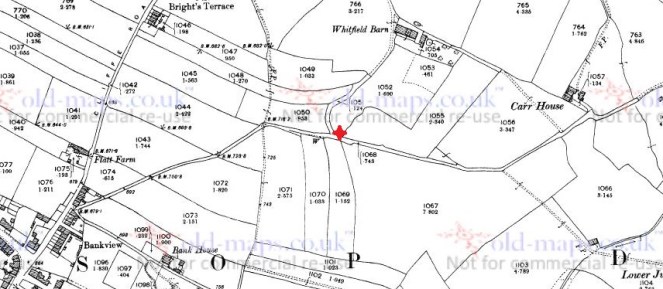
With all the talk of Carr House Lane and the guide stoop there (or lack thereof) the Whitfield Cross post generated (see comments here), I thought I’d go back and walk down Carr House Lane and do a post about the ‘Stone Cross’ there. Incidentally, I have a post about Carr House Lane archaeology that I will get to after this (lots of lovely Victorian pottery), but I want to concentrate on the ‘cross’ for now. The stone is situated here:
For orientation, bottom left is the top end of Whitfield Cross where it joins Cliffe Road. the red cross marks the… well, cross. Or whatever it is.
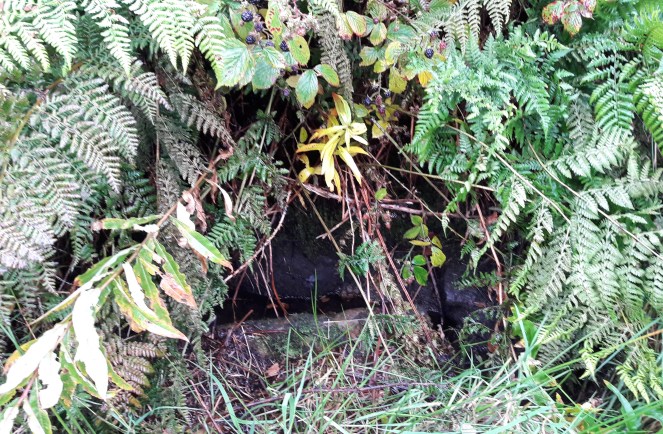
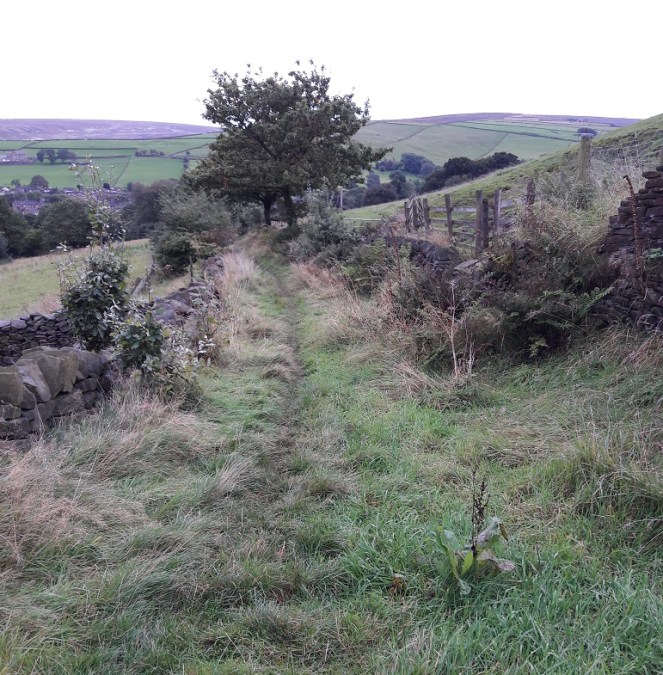
The sunken road from Cliffe Road becomes increasingly boggy the further you go down, not helped, after you turn east, by the stone built spring fed well on the right (marked ‘W’ on the map). This is entirely appropriate – the word ‘Carr’ is derived from the Old Norse ‘Kjarr’ meaning a low lying boggy area… they’re not kidding.
A terrible photograph of the stone trough of the well on the south side of Carr House Lane. I must wait for winter for better photographs.
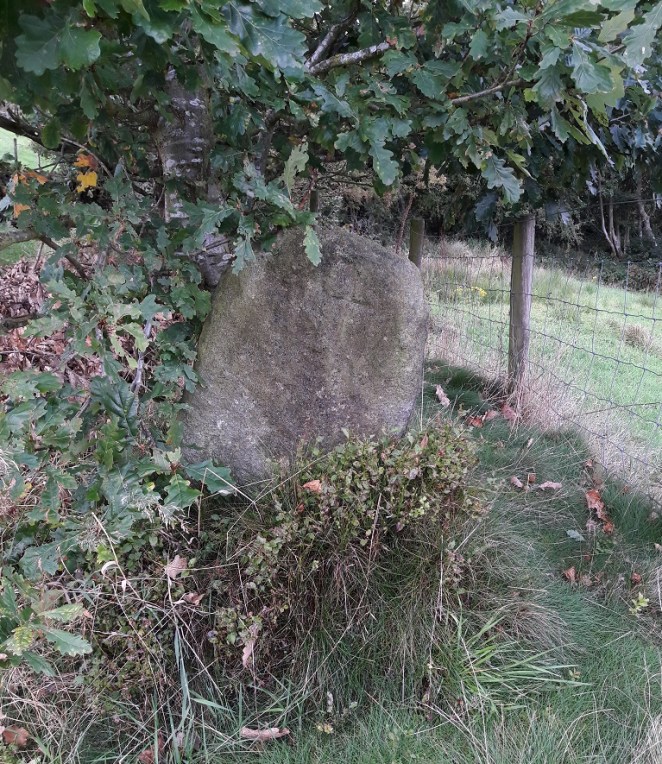
The stone, when you come upon it, is very easily seen, despite being tucked away and in the shelter of an oak tree.
Nestled in an Oak tree, the stone sits at a jaunty angle on the left hand side as you come down the track from the Whitfield end.
What is immediately obvious, more so on the ground than on the map, is that the stone marks the point where a track branches from Carr House Lane down to Whitfield Barn. Whitfield Barn is at least 18th Century in date, and probably earlier in origin, though without closer inspection is impossible to tell. The main track continues down to Carr House, a farm building of similar date, and which lends its name to the pathway.
This is significant, as it is exactly the sort of place one would expect to find a cross, marking a track junction (see here and here, and the comments for both, for discussion).
The track down from the Whitfield end of Carr House Lane.Carr House Lane as it continues down from Whitfield to Carr House itself.The branch that comes off Carr House Lane down to Whitfield Barn. The cross lies just out of shot to the right.
And yet it is not a true cross, not in the general sense anyway – it is simply a stone with a cross carved into it. I think it likely that the stone was there long before the the cross, and that it was originally a waymarker making sure the track down to Whitfield Barn wasn’t lost, particularly in the dark.
Now, it is just possible that it is a standing stone, by which I mean a prehistoric standing stone – there are several in the area. However, this interpretation is problematic. Firstly, a prehistoric standing stone is just that… a standing stone, erected in prehistory. However, a standing stone erected yesterday will look exactly the same. Thus, without any associated datable features (a barrow, a stone circle, a burial), we cannot state that the stone is prehistoric. Could be, but might not be. Secondly, its situation, at the junction of the tracks, suggests a connection with, and thus a product of and post-dating, them. It could be argued that the tracks are situated to take into account an already existing stone – that is, the track to Whitfield Barn could have been made anywhere along Carr House Lane, but it made sense to split it at the stone – but again that is impossible to prove.
What I will say is that the stone certainly isn’t a disused gatepost, nor is it naturally occurring in that upright position. Which means it has been placed, with purpose and meaning, by someone. Neville Sharpe, in his book ‘Crosses of the Peak District‘, states that it has been shaped, which is certainly the case, so it seems some thought and care has gone into what it looks like.
The cross carved into it is interesting, also. It has been suggested that some roadside crosses were placed as a gift of thanks for the completion of a safe journey, effectively a votive offering in payment for an answered prayer (i.e. help me get home in this awful weather, and I’ll set up a cross to say thank you). They might also function as a spiritual fortifier, reminding the traveller of God’s watchful eye and protective power over the faithful. It is easy, in these days of surfaced roads, street lights, and large settlements, to forget just how dark and treacherous travelling in the pre-modern era would have been – making your way from A to B in total darkness, along a muddy track, and with no map as such, and knowing that if you took a wrong turn somewhere, you were lost. And I find it difficult enough to find the bathroom at night!
That stated, there is something about the cross that suggests to me that it seems to have been more of an afterthought – the result of a sudden onset of piety perhaps, long after the stone was set in place.
Close up of the carved cross. I really need to go back and re-photograph it properly.
It is two simple chisel strokes, one vertical, one horizontal, and the job is done. Why go to the effort of raising and bedding a stone that weighs 1/4 tonne, perhaps more, and then just carve a simple cross into it? The cross is not particularly well executed, either – it is certainly not the effort of a stonemason or even someone familiar with stone. Sharpe (p.42) suggests that it was cut “a long time ago” as the cross would have been vertical when carved, and age has slumped the stone. Logically, this is a sound argument, but the fact that there is an Oak tree growing behind it and to the left (i.e. the direction from which it would push the stone) may suggest a more modern date. Whatever the case, I would suggest that the raising of the stone and the carving of the cross are two separate events that probably occurred many years apart.
What I do find intriguing is that the carved cross strongly resembles this mystery carved cross. Well, obviously… it’s a cross, one of the simplest and easiest designs you can carve onto a stone surface. But the cross design, two simple strokes, thin and unfussy, but seemingly not done by a professional, is similar. Moreover, it is something of a coincidence that two seemingly random stones, separated by roughly 700m, both have a very simple cross design carved into them, and probably as an afterthought. I wonder if someone in the area caught a little divine inspiration and went on a carving spree? And I wonder, if we keep our eyes open, will we find any more?
As always, thoughts, comments, and corrections are very welcome.
With an obvious predictability, I cannot resist having a poke around the brook whenever I’m in the neighbourhood – there is always something to find. Ok, so it’s not quite mudlarking on the Thames foreshore, but it is Glossop’s equivalent, and that makes it all the more important to us (if not quite as bountiful!). By the way, if anyone is interested in mudlarking, or the slightly haphazard and magpie approach to the past that this blog is following, then check out the book London in Fragments by Ted Sandling. I cannot recommend it enough – beautifully illustrated with fragments of pot, glass, pipe, stone, metal, etc. and each with a very interesting essay accompanying the item (be warned, the ‘Look Inside’ feature on Amazon misses out allof the photographs!). Just beautiful.
So then, the haul!
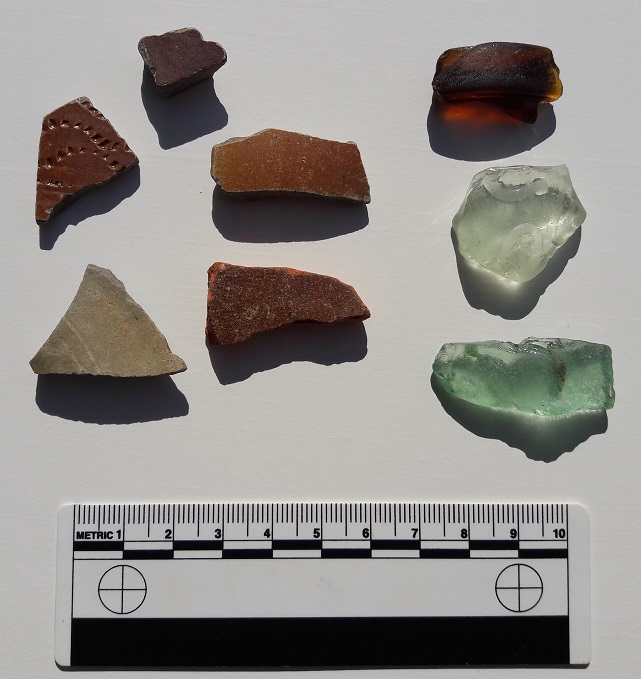
At first glance, not that inspiring… but bear with me!
As is becoming my habit, unless they were decorated, or a rim, a base, or a handle, I left the white glazed earthernware and china in the brook. As a rule of thumb, these are the four criteria archaeologists use to sort out the ‘feature sherds’, which are diagnostic (giving us information about date, type, function, etc.) from the ‘body sherds’, which normally make up the majority of a assemblage. It is a rule of thumb, though, and some body sherds can be equally important if they are of an unusual fabric, or are able tell us more information.
So what can we see?
Pottery first. Top sherd is a from a small-ish and closed salt-glazed stoneware vessel. We can tell it is from a closed vessel (i.e. like a bottle, not open like a bowl), by the fact that the interior surface is rougher and unfinished – why waste your time glazing it properly if no one is going to see it? Also, the salt glazing process involves literally throwing salt into the high temperature kiln where it vapourises forming the characteristic glaze; this vapour will not readily reach the interior of the vessel. This vessel was probably something like an ink pot or similar, but by the late 19th century, the date of this sherd, salt-glazed stoneware was mass produced on a literal industrial scale, so it is difficult to be certain.
Middle right. Another closed salt-glazed stoneware vessel, same date, but larger – possibly a milk or lemonade bottle bottle or similar. This sherd is thickening slightly at the left, and so is perhaps forming the shoulder of the bottle.
Middle left, is another salt-glazed stoneware vessel. This one appears to be open, and is decorated by using the rouletting method – a small wheel with teeth was run over the surface to produce the characteristic incised decoration. This one has a very common motif of undulating lines around the body of the pot. The sherd is mid to late 19th century, and probably from a storage jar or crock, and despite being relatively thin, is probably from a large vessel.
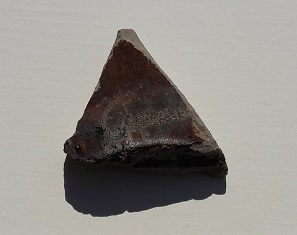
Bottom left is the base to a milk or lemonade bottle (it is flat, but lifting slightly toward the middle of the base, and you can see the concentric lines that characterise the base of these bottles). Stoneware again, but a more conventional glaze which gives it the characteristic cream colour. Interestingly, when I flipped it over, you can see a manufacturing flaw – the glaze has pooled against the interior wall, and instead of vitrifying uniformly, it has bubbled and produced a very messy surface.
Flawed glaze at the bottom.
However, it won’t be seen because it is a what? “A closed vessel, Mr Hamnett”, chorused everyone – good to see you are paying attention. It also illustrates why it was probably unwise to reuse these bottles – if it contained milk (raw and unpasteurised, of course), there is no way you could hope to get that clean enough, even with a steriliser.
Bottom right. An interesting sherd… honest. It is a slip-glazed earthernware vessel, and to judge from the colour of the fabric (the clay itself) and the colour of the glaze, as well as the way it flakes away, it is probably 18th Century. Of course, I could be wrong… but there is something about that sherd that gives it an early-ish date.
Glass! Top is from a corked beer bottle… probably. Certainly corked, not capped or screw threaded, and almost certainly beer. And likely Victorian, or early Edwardian.
Middle is probably a Victorian mineral water bottle. The glass is thick and has an embossed ‘&’ sign and some other marks visible, which would have been the name of the maker and their logo. Without doing a lot of serious research, it would be very difficult to say who made it, as a lot of companies were called ‘Something & Something‘. That stated, there were so many mineral water companies that the bottles tended not to travel far, so theoretically there can’t be that many in the area, so it might be worth a look.
Bottom is just a bottle fragment, again probably from a mineral water bottle. i include it here because a) it is a blueish colour, and so potentially earlier than the rest, and b) it has two air bubbles trapped in the glass. At first I thought that it might have been hand blown, but no, I think it is just a feature of the manufacture. What is fun, though, is the fact that within those bubbles lies a tiny amount of Victorian air, preserved for eternity. I wonder what the Victorian period smelled like? Actually, on second thoughts…
So, nothing truly award winning, but a little slice of Glossop history nonetheless.
Just as I was about to walk away, I turned over a stone, and found the other side was flat and dressed.
A lump of dressed sandstone!3
It is a sandstone, and not local to the area as far as I can tell, but then I am no geologist. The dressing can be more clearly seen in this photograph, with the low winter sun picking out the chisel marks.
The dressing clearly shown, with a possible mis-hit on the right.
Obviously it was once part of a building, but what part? Maybe a door or window lintel perhaps? I don’t think it is particularly old, and it is quite a coarse dressing, so perhaps it is from a worker’s cottage or similar. The bank in this area seems to have been shored up against erosion, and it probably building demolition rubble dumped here from nearby.
As always, comments are welcome.
I shall post more in a day or so… this time on the subject of Victoria Bridge. Probably!
Before we go any further into this blog entry, let me offer my apologies for the lack of activity here recently. Flu – the real, unpleasant, knocking at death’s door and asking for a priest to administer extreme unction type of flu – followed by the unwelcome intrusion of ‘real life‘ had curtailed my archaeological and historical musings of late. I have done a bit of research, identified a whole pile of fun things to blog about, done some poking about for more interesting sherds… but none of it is quite ready yet.
And so, I present to you, a bit of a cop out! A very short, and quite interesting cop out, but a cop out nonetheless.
As I may have mentioned before, I am obsessed with boundaries.
I love the idea of a start and an end to a physical place or space, and in particular I am fascinated by the ‘liminal‘ areas that make up the join between the two sides of any boundary. These are the ‘dangerous’ places, which are neither one thing nor the other, but somewhere in between, and it this space that has such significance in archaeology. This is where outcasts – the witch, the murderer, the suicide, the excommunicated – are buried, where dangerous activities take place, where the veil separating this world and the other is perceived to be the thinnest, and communication with the ‘beyond’ can be achieved.
One such liminal place is the junction of two rivers or streams, long held to be magical, and in some cultures believed to be a very powerful space.
Waterways themselves make great boundaries – they are by and large immobile, and they are very clear in their separation of the land (one does not overlook a stream, or one ends up with wet feet) – which is why, traditionally, they were used to define parishes and such. Indeed, it has been said that my own parish, Whitfield, is actually an island: it is completely surrounded – and thus defined – by streams.
Glossop Brook is the boundary between Whitfield and Glossop, and it is formed by the confluence of two brooks – Shelf Brook, which flows through Manor Park from Mossy Lea and beyond, and Hurst Brook which comes through the Shirebrook Estate from the Snake Pass and beyond. They join here, at the bottom of Bank Street just before the footbridge that takes you to Manor Park
The birth of Glossop Brook. The confluence of Shelf Brook (from the north) and Hurst Brook (from the east) is marked in red. The footbridge (FB) leads to Manor Park (now along Shirebrook Drive). This is from the 1921 1:2500 OS map.
So, a liminal boundary that is formed by the joining of two brooks. Anthropologically, this is a powerful place, and one wonders what, in the deep and distant past, occurred here, or at least what marked this place.
Where the streams meet – Shelf Brook at the top, Hurst Brook at the right… and Glossop Brook exiting left out of the photograph.
This is the first in a series of posts that I’d like to do about Glossop’s waterways. Through their use as power for mills, they are quite literally the foundation upon which the modern town was built, and yet they are sadly often overlooked.
I shall be more attentive to the blog in future, and keep up the posting. Thanks for reading, and if there is anything you’d like to share, any comments or corrections, please drop me a line.
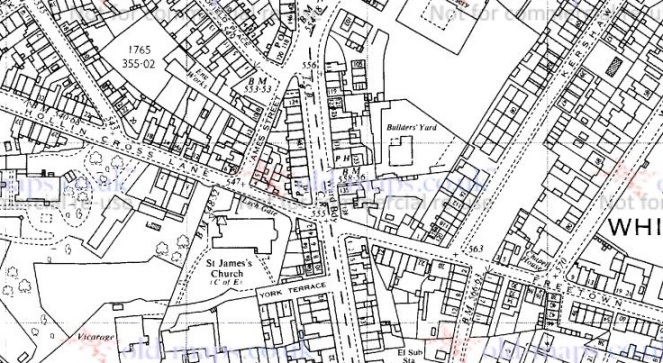
In his book ‘Crosses of the Peak District’, Sharpe (2002) lists Hollincross Lane, by St James’ church, Whitfield, as being the site of one of Glossop’s long lost crosses (p.110, paraphrasing Hamnett). When I had previously thought about Hollincross Lane, I had assumed that the name refers to the Whitfield Cross, and thus the road that runs down into Hollincross Lane via Freetown. But actually, a cross here would make sense as it would mark the junction of three trackways: north to Woodhead and beyond, east to Whitfield and thence to (Old) Glossop or Chunal via Gnat Hole, and west to Dinting and Simmondley. The way south, Charlestown Road, only came into existence with the construction of the turnpike road in the early 19th century – before that, the only way to Chunal was via Gnat Hole.
1969 1:2500 map showing routes north, east, and west. The hypothetical situation of the cross would probably have been at the church end of James Street
A cross marking this junction would have had its uses, then. Indeed, we can also play a speculation game (putting on my prehistorian’s hat for a moment) and suggest that the siting of St James’s Church (1840 or thereabouts – the foundation stone was laid on 27th September 1844, and it was consecrated almost 2 years later on 8 September 1846) was influenced by the existence (or memory) of a cross there indicating holy ground. Wild speculation, I know… but let’s pretend! Etymologically speaking ‘Hollincross’ may be understood as either ‘Holy Cross’, or ‘Holly Cross’ – a cross covered in or situated by some holly
Now obviously there is no cross there now, and Hamnett, writing in the late 19th century, could find no trace of a cross either – seemingly it’s location was lost to even the oldest residents of Whitfield. At some stage, then, our hypothetical cross has been removed. This could have happened for any number of reasons, ranging from pious iconoclasm (a stone cross is an object of adoration and thus ‘Popery’, or Roman Catholic veneration of things and people) to it simply being in the way of traffic. I know of one example, not local, of a 9th century Mercian Roundshaft that was rescued from a farmer who was in the process of rolling it down a hill and into a stream in order to plough his field. And this was in the 1960’s…
Crosses and bases were, then, broken up and re-used in walls, and as people don’t move stone further than they have to, especially in a stone rich area such as this, it sometimes pays to have a look around to see what you can see. With this in mind, and taking advantage of a lull in the rain, James and I went for a wander down to St James’ churchyard (via the park, obviously). He had a whale of time, helped no doubt by the drink of juice that the rector gave him! So, what did I find? Nothing definite, certainly, but just possibly, something.
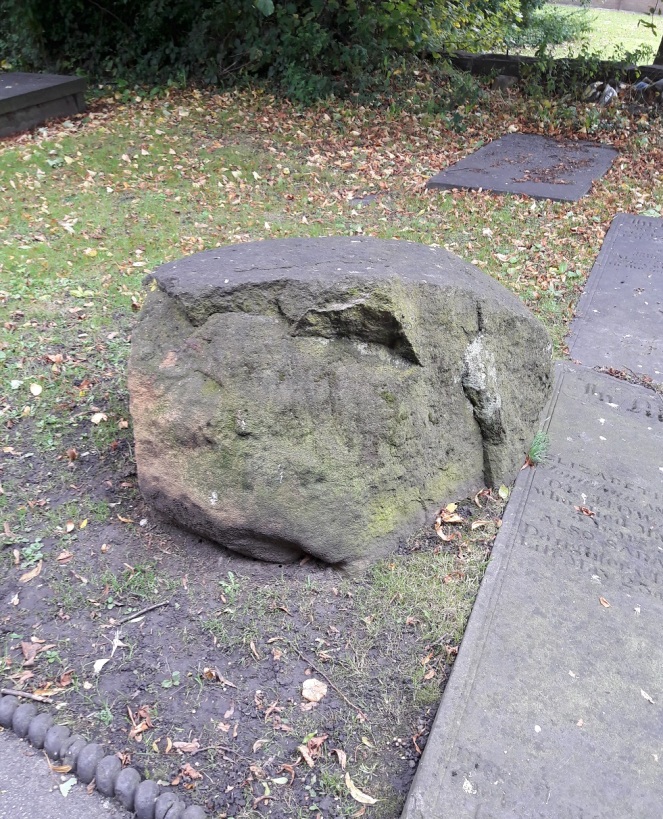
A stone amongst the stones. What is this lump?
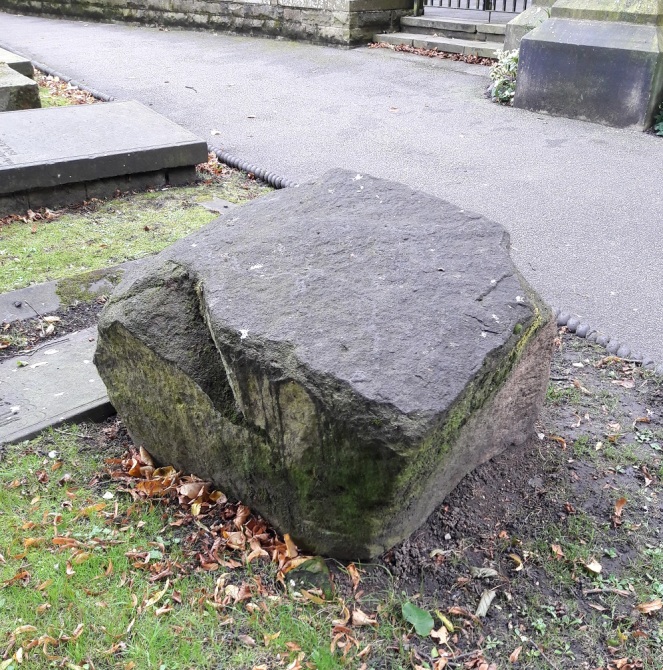
Just opposite the main entrance to the church, by the path and amidst the gravestone sits a large lump of stone. It is roughly 2′ square and 1′ high, has been knocked about a fair bit, and is now fairy shapeless. However, one side has clearly been shaped and worked, and with the eye of faith one can see chisel marks.
The side closest to the camera is flat and has been worked by tools. Is this the base of Hollin Cross?
Now, I am not sure what this is! It is not a glacial erratic as they are often rounded and smooth like a pebble, and I don’t think it is part of the church building, as it is the wrong type of stone. It might be the cross base, but there is no visible socket – the hole in which the cross shaft sits to make it secure. However, the socket may have been on the part that has been knocked off, or is perhaps underneath if the base had been up-ended. It is very uncertain, but we can be sure that the stone was not planned as such to be there – it makes no sense, and doesn’t even have an aesthetic value – rather it is a left-over from the land prior to the construction of the church.
I had a look around the walls for cross pieces, but could find nothing likely, and I think a winter trip around the churchyard is in order!
Of course, whilst I was there, I took the opportunity to photograph the bench mark on the church itself – how could I resist!
548.9 ft above sea level, to be precise. That’s a roughly 120 ft difference between here and the top end of Whitfield Cross.
So, James and I went back to Manor Park last week and had a paddle round to see what we could see. He threw rocks, I had a poke around some sherds and and found a number of interesting bits and pieces. Behold, the haul:
The haul of pottery!
Most of it is the usual type of white glazed stuff, the majority of which I left in situ… Mrs Hamnett can only cope with so many of these “valuable historical artefacts”/”bits of old pot” (delete as appropriate) stored in the house! The following are interesting (again, interesting is an objective term!) sherds:
Middle row, centre, is a clay pipe stem. These are quite literally the cigarette butt of the Victorian period, smoked and disposed of with gay abandon. I’m surprised there aren’t more of them in the brook, but then they are quite light and so are easily carried by the water. Date… from the stem alone, impossible to say – 16th to 20th Century! On balance though, almost certainly 19th Century, when tobacco had become an affordable luxury, and clay pipe smoking was normal for even the common man.
On either side of the pipe are pieces of glass. Rounded by being bashed against rocks, they resemble sea glass, and both come from bottles. The piece on the right is thin walled, and probably from a sauce bottle or similar.
Bottom row, from left to right is the rim of a thin and delicate shallow bowl of about 12cm in diameter. Thinking about it, it is probably a saucer, but from that fragment it is difficult to say, as is the date – 19th to 20th Century. Middle is a transfer printed handle from a tall upright vessel – possibly a tureen or similar. Date, as above! And on the right, the badly damaged base to a plate or bowl or similar large open vessel. The brown stripe across the middle is what remains of the ring base, which has come away. Date is almost certainly the same as above.
The best sherd I have saved for last, though. I thought it was an interesting rock when I pulled it out, and was quite excited when I recognised it for what it is.
Manganese Glazed Ware – 17th-18th Century in date.
It would appear to be a sherd from a manganese glazed vessel. “Wow!” I hear you cry collectively…
Well, wow indeed! I suspect that this sherd is 18th Century in date, and could be quite easily be 17th Century, considerably earlier than the majority of the material I’ve found so far.
The blue-ish purple colour of the glaze is very characteristic, and the fabric of the pot is early – a low firing temperature has produced a relatively soft body quite unlike the hard fired later vessels, and it is a coarse earthenware, not a china. It is a thick walled vessel, again quite common in earlier pots, particularly utilitarian vessels such as storage and serving pots, and is markedly different from the mass produced Victorian vessels. I can’t tell the type of vessel from which it comes – it is an open vessel (i.e. not a bottle or similar closed vessel), and has an internal diameter of c.14cm. – so perhaps a jug, or deep bowl?
The move toward finer pottery in the late 18th/early 19th centuries as ‘tableware’ is a response to fashion – the finer the vessel, the more expensive it is – with fine bone china was reserved for the wealthy only. Of course, as a result, everyone wanted some in order to keep up with their ‘betters’, and so the demand for fine pottery trickled down the social ranks, and new ways were found to mass produce finer pottery, though obviously of poorer quality.
That this early pottery is here is not surprising – it dates from a period before Glossop as we know it existed – before the mass explosion of the mills in the early 19th Century, and the subsequent expansion of housing to cope with the need for mill workers. At this time, the main settlement area was Old Glossop, clustered around the church, and with a few mills on the water there. And of course, Shelf Brook flows through Old Glossop. I may take a walk up there sometime this weekend!
Here’s a strange one, and one that may have a perfectly reasonable explanation, but it is a bit of a mystery.
First some context. I have always been intrigued by free-standing stones, and the multiple uses to which people put them. From glacial erratics to carved crosses, and from prehistoric standing stones marking a ritual space to boundary stones marking a modern urban district boundary, we rely on the natural material as a marker, as we have since we first found a need to mark place. There is something very human about a stone marker. A lot of my work in archaeology has been involved exploring space, and how we mark it, how we make it different from other space (specifically, in my case cemeteries and ritual places). I won’t get too bogged down in the detail here – I have a bigger post planned that explores some of these themes (you’ve been warned… and there will be questions afterwards), but for now, I present the first entry in a series entitled “The Stones of Glossop” that will explore the multitude of free-standing stones that populate the area.
And it is a bit of an odd one.
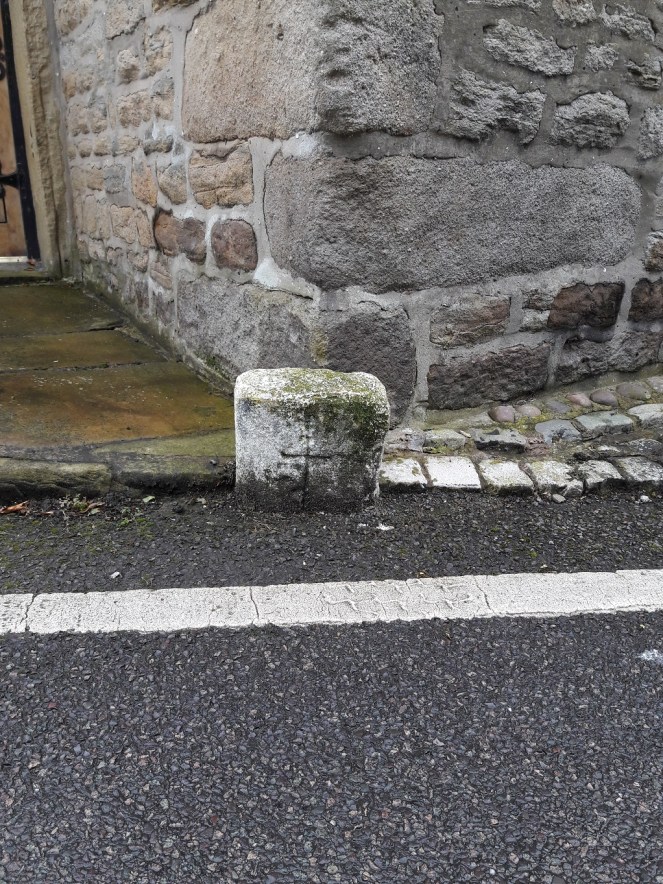
Walking on Hague Street, heading toward Derbyshire Level, and just past King Charles Court, the road bends to the left and passes very close to the 17th Century House there. Just on the corner of the house, and placed on the kerb, is a small stone.
Here!
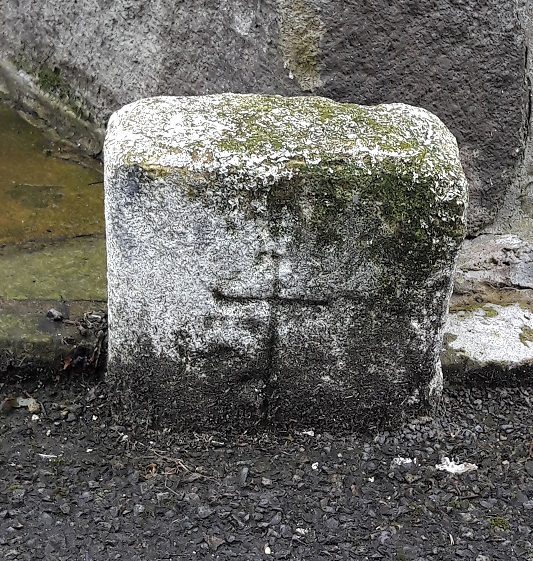
Less than a foot high, rectangular, and dirty, it was once painted white, making it very visible, one assumes, in darkness. What makes this stone particularly interesting is the neat cross carved on the front.
The stones of the 17th Century house are clearly visible behind, with what, I have just noticed, looks like a face carved into the uppermost stone in the photograph. Coincidence, obviously, but spooky nonetheless!
The cross is of the Christian variety, with an elongated vertical piece, and is very clearly intentional, with the grime of the road and many winters highlighting the effect. There may be other marks on the front surface, but it is difficult to tell if they are intentional or the result of wear and tear. It is worn, especially on the right hand side, but not as much as I would expect if it were particularly old, especially situated by a roadside, and the stone has largely maintained its rectangular shape. It has also been painted fairly recently; this may be the continuation of a tradition of painting roadside stones, or it might have been done for the first time two years ago.
Close up of the stone and the cross.
It may be modern – although that would be perhaps surprising – or it may be older – in which case, why does no one mention it in any of the texts? It could be a road marker, but there is a massive building behind it that marks the road in a much more clear way! And what is the purpose of the cross? I suppose in some way it should be considered a roadside cross, but if that is the case, I’m not sure how to interpret it. I quite literally know nothing about this oddity.








 The Glossop Cabinet of Curiosities