I found an interesting thing the other day. I was walking down Bank Street, down to Milltown on the way to the park. For those of you who don’t know it, it is a cobbled path (setts, actually!) that winds its way through demolished mill-scapes, and which allows access to High Street East. I nearly wrote ‘easy access’, but with a push-chair it is a nightmare! That said, I really like it. It has the air of a long forgotten path, Tolkein-esque, leading to who knows what adventure.
The path through Mirkwood, to the Lonely Mountain!
I want to do a longer post on Bank Street at some stage in the near future – it is interesting and full of history. It was originally believed to follow the path of a Roman road, although more recent research suggests, however, that this is in fact an early-modern (16th Century or so) track.
However, for now, I want to share my find.
The screw-thread can be seen winding around the base.
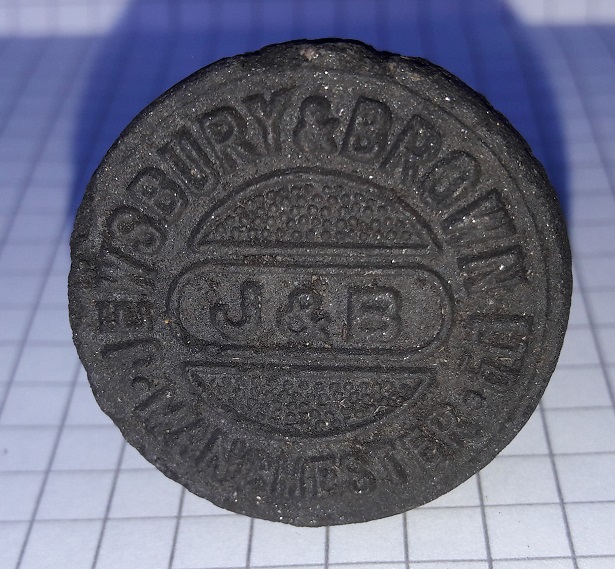
It is a bottle stop made from vulcanised rubber. It had eroded out of the side of the path from behind a partly ruined wall, and was just lying on top of a trickle of soil on the left hand side going up. The screw-thread winds into the neck of a thick-walled glass bottle containing a carbonated liquid – often a soft drink such as water, but also beer. Originally it would have had a soft rubber ring around the cap that would form a seal to keep the drink fresh until it was unscrewed. The design was patented in the early 1880’s by Henry Barrett, and immediately became very popular, with various design improvements ensuring the basic concept was in use for nearly 100 years. Generally speaking, though, the date of such a screw top is roughly 1890-1920, after which time the crimped rim top became popular. There is a really interesting website that details quite a bit about these bottle stops here.
More interestingly, and as was quite common, the top of the screw cap carried the logo of the company manufacturing the drink inside the bottle – in this instance, the company is Jewsbury and Brown Ltd, Manchester.
Jewsbury & Brown Ltd. Manchester. The preservation on the bottle top is wonderful.
Jewsbury and Brown were a large company founded in 1826 and based in Manchester, their premises being at 113 Market Street, and later Ardwick Green. They produced carbonated drinks that were sold in Lancashire and the north, and beyond, until they were bought out by Schweppes in 1964. A bit of internet research reveals that they specialised in non-alcoholic carbonated drinks, fizzy water, and toothpaste – but, disappointingly, never beer! Here is a bit of their history, but much more is available online with a little search.
I love this – not just a bit of archaeology that quite literally threw itself at me, but a real tangible insight into the lives of those of the past. There was nothing else associated with the screw-top, and one gets the impression that it was simply unscrewed from the bottle and thrown over the wall, the thrower determined to drink whatever was within the bottle in a single sitting. Let’s imagine them walking along that uneven path when they did it, clogs striking the setts, perhaps on a hot summer’s day, and at the end of a long shift in the mill, appreciating the fizzy drink playing on their tongue… 100+ years ago.
It’s a neat little thing, and one that will be added to the collection. It also makes me wonder what else is behind that wall, waiting to tumble out, so keep your eyes peeled!
Some years ago, whilst walking to the station for my daily commute, I passed down King Street in Whitfield. As I approached the middle of the street, I had to skirt around some scaffolding that was placed onto the front of a house, and projecting into the path. As I passed, I looked down and saw, scattered quite literally all over the the path, dozens of pieces of thin green metal. On closer inspection, I could see they were copper nails, and promptly pocketed all that I could see.
Fistfulls of copper nails!
The roof of one of the stone-built terraces on that street was being replaced and the copper nails were the fall out, having been removed during renovations. They had been used to pin the heavy stone roof tiles in place, each one carefully nailed into the timber through a hole drilled through the stone tiles, and now, no longer needed, they were simply tossed aside onto the street to be swept up. Now that is, I think you’ll agree, a shame; these little pieces of history deserve better! And besides, I can’t resist picking up interesting, and sometimes shiny, things!
The nail second from right has clearly hit a knot or some similar obstruction and folded. One wonders what expletive was uttered by the workman when he saw it bend… and then carried on hitting it in order to get the job completed as speedily as possible.
They are formed from copper, rather than iron, because copper doesn’t decay the same way iron does – it maintains its strength for far longer, resisting the elements and doesn’t turn to rust. Ship’s nails are made from copper for the same reason. Instead, it develops a thin green patina called verdigris, which makes them particularly beautiful to look at, especially when the verdigris is partly sanded off.
A very bad photograph to illustrate the sun shining off the copper, contrasting with the matt green of the verdigris. These things are difficult to photograph, but very pretty!
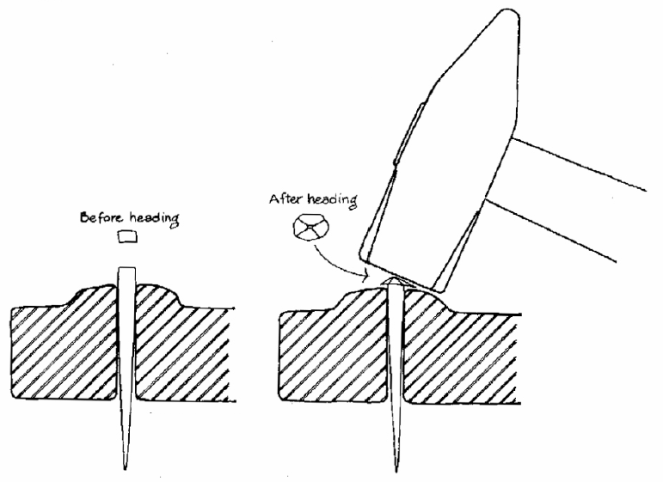
They are also hand made – each one cut via a press from a long flattened strip of copper, which accounts for the square body of the nail. It is then placed into a small mold or former, point down, and the exposed top is hammered by hand until it flattens out, forming the nail head, like this:
Illustration taken from ‘Nail Chronology’ by Lee H Nelson (American Association for State and Local History, 1968 )
This method accounts for the thin flattened strips on opposite sides of the nail, just below the head – the former is made of two adjustable halves to enable different size nails to be made, and when pressure is applied via the hammer, the copper is forced into the gap between the two halves of the former.
These nails date from the early to mid-19th century – I seem to remember reading somewhere that the houses in King Street were built in the 1860’s, and, one assumes, the nails are contemporary.
That said, my own house, which dates from the late 1840’s, originally had wooden oak pegs holding on the roof stones. When we replaced the loft insulation, we found dozens of them lying on the floor of the loft where they had been thrown down.
What I love about these is that you can see each the stroke of the knife that was used to form the pegs – in the photograph above the peg at the top was made using eight strokes, the middle using seven strokes, and the bottom peg using eight.
Whilst being fun and interesting artefacts in themselves, there is a sense of connection with the human in these objects; both have been formed by hand, and the mark of that hand is visible in both – the hammer and the knife. That for me is what makes archaeology so fascinating, connecting to past people through the objects they made and used, and the story they tell us.
Update.
Whilst taking advantage of the sunshine to do a little gardening, I came across this little piece amidst the great piles of stone that originally littered our garden – a stone roof tile. It is very small, and is presumably a broken fragment, which explains why it is no longer on our roof. What is fantastic about this is the fact that you can see the hole that would have originally taken one of the pegs illustrated above. I love things like that!
The peg hole is top right of this broken tile – you can clearly see the traces of the boring that created it – and it is a perfect size for the oak pegs shown above. The break in the middle is new, though – I think I may have trodden on it!
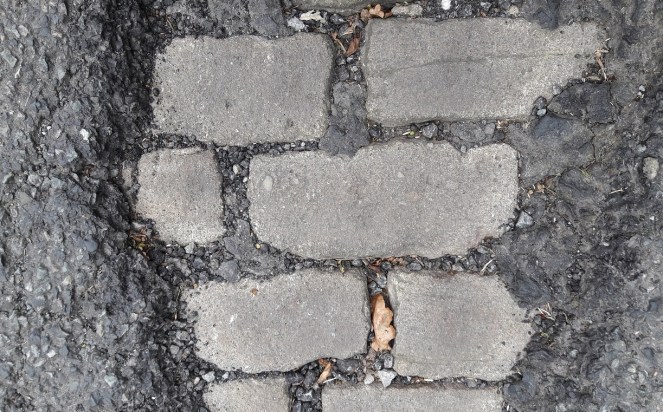
I walked down to Manor Park the other day, along Cliffe Road and through Milltown. I seem to do that a lot recently… the joys of having an 18 month old who is obsessed with swings. At the bottom of the hill, just before the road becomes Milltown, I noticed that the tarmac surface of the road had come away to reveal the original road surface underneath. Fantastic, and an opportunity for a new blog post. As an archaeologist, you find yourself, as a reflex and completely unconsciously, looking into any hole you see in the ground – like a moth to a light, we cannot help ourselves. I have often seen holes in and around Glossop that have broken through the original surface in order to access a sewer or some such, the stones piled up by the side of the spoil heap. But it is really nice to see the stones in situ, as they are here.
Technically, these are setts, not cobbles – these have been quarried and shaped by hand, whereas cobbles are naturally shaped and have simply been taken from a beach. So there you go.
I love the thought that not so long ago, people would have swarmed over these stones on their way to work in the mills, hob-nailed clogs striking the surface, chattering and joking. And that now, by chance we might be able to do the same. And with that thought in mind, I drove James’ push chair over the cobbles… and nearly pitched him out of it as the wheels jammed on the uneven ground!
No doubt the council will come along soon and fill it in, which is understandable and probably the right thing to do. But I can’t help be a little disappointed. Enjoy the sight of this little peek at history whilst you can.
The previous post about the date stone reminded me of something I read a few years ago. It took me a while to track it down, but here it is.
Melandra Roman Fort is one of theplaces that you have to visit in the area if you have an interest in the past. It is situated at the edge of a dreary housing estate, and has a slightly desolate air about it, particularly the car park. But turn your back to the 1960’s built houses, and face out, standing at the centre of the AD 60’s fort, you really understand why they built it there – you can see all along Longdendale, across Glossopdale, and on the promontory it reaches out almost to the bank of the Etherow, which it overlooks for a long way either way. Strategically, it is a perfect place – commanding the area, yet safe and secure.
The area was known as ‘Castle Yard’ since time immemorial, and when it was first described in 1775 by Reverend John Watson (in Archaeologia Vol 3) the area was untouched by the plough, and the full fort could be made out by standing walls. Incidentally, it is likely that Watson made up the name Melandra – there is no record of anyone ever calling the field by that name before 1775, and crucially, Melandra is Greek in origin. I’m not certain, but I think we can go out on a limb and suggest that no rural Derbyshire farmer spoke classical Greek in the 18th Century. It’s actual Roman name seems to have been Ardotalia, a word vaguely associated with the name of the river, Etherow.
Over the years, the local farmers used the walls as quarries, building houses, walls, sheds and the like with the dressed stone found there. Amongst them, inscibed stones were found – probably one inscription placed above each of the four entrances into the fort, with more, and an altar, inside. One farmer had even built an inscribed stone over his doorway. However, not everyone understood the value in these inscriptions… I’ll let my pseudonym tell the story:
“Previous to the reservoir belonging to the Manchester Corporation being made at the Hague on the Cheshire side, the river Etherow was undermining the bank, and it was found necessary to build a wall to prevent its encroachments. For this purpose the workmen took away all the stone then lying at Melandra, and amongst them was another inscribed stone. One of the men had no knowledge of its antiquarian value and built it in the interior of the wall, though a bystander remonstrated with him for doing so, using these words in the local dialect: “thart puttin summut in neaw ut ul be wanted sum day”. A few days afterward, Mr. Bennet Woodcroft, a gentleman visiting in the neighbourhood, hearing of the matter, went to the place and offered £5 if the workman would recover the stone, but the clerk of the work would not permit the wall to be taken down, as the exact spot it was could not be accurately located”
Hamnett, R. 1899. “Melandra Castle” in Derbyshire Archaelogical and Natural History Society 21: 10-19
Amazing to think that there, on the banks of the Etherow, lies an unknown Roman inscription, bricked up by some ignoramus who couldn’t recognise its value beyond being just a piece of stone. Which makes me even more thankful that history didn’t repeat itself on the banks of Glossop Brook.
EDIT: Just out of interest, I just ran a quick value equivalency programme – £5 in 1850 is today worth about £500 – a significant sum of money.
I was coming back from a visit to the supermarket the other day, and thought it would be a nice stroll, with James in the pram, to go along Glossop Brook and through Harehills Park up to the Market.
Now, if I may digress for a moment, despite the presence of a plaque, I steadfastly refuse to call this ‘The People’s Park’ which is an entirely new invention… and sounds absolutely awful. Even the name Harehills is of recent coinage, dating only from 1921 when the park was given to Glossop by Lord Howard to Glossop in memory of his son who was killed in the First Word War. Prior to that, the rough unused ground was known simply as the Sandhole – named, presumably, for the sand that was quarried here. Indeed, during the Cotton Famine (1861-65, caused by cotton no longer available from America due to the ongoing civil war there) Lord Howard employed the jobless mill workers in the area to dig sand – in essence giving them a paid ‘non-job’ so that they wouldn’t starve. He was alright, was that Lord Howard bloke! The area is still sandy, and indeed sand covers the footpath at one point along the way.
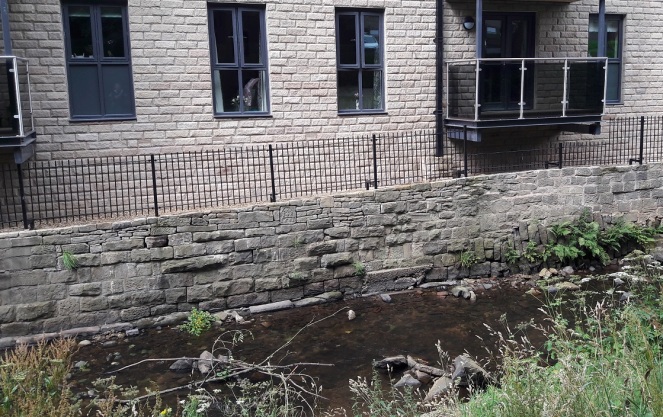
The location, on the brook, is lovely, and several developments have recently brightened up the area, including the redevelopment of the Old Glove Works on George Street (into flats, one assumes, but that is better than a derelict building). The new retirement flats just opposite the park itself went up surprisingly quickly, and look rather nice. However, if you poke your head over the side of the brook (carefully) you can see all sorts of history – dressed stone, drains, the old bridge, etc.
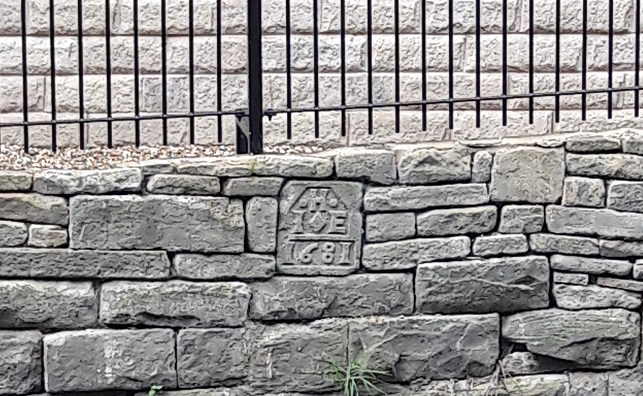
As I was pondering the detritus of history, I noticed a date stone had been cemented into the newly built wall adjoining the brook. Hmmm… I thought.
Difficult to see, but just there, on the upper course of stone, a bit to the left of centre.Close up. J and E H.
The date is 1681, refers to the date of the construction of the (now long gone) building to which the stone belonged, and the letters refer to the people who built it, usually a husband and wife. In this case, their initial would be, I assume, I (or J more likely) and E, and their surname began with H. This is important, as 1681 is a particularly early date for a building in Glossop – the Bulls Head pub in Old Glossop, usually reckoned to be the oldest building, has a date stone of 1607. I’m sure someone out three would be able to work out who they were and to what building the stone belonged, but it is beyond me I’m afraid. I am just glad that someone though enough about history to cement the stone the right way round in order to provide us with this little mystery.
As usual, any thoughts, comments, or general pointing and laughing, please drop me a line – email or comment below.
Following on from the original Bench Mark post (here), I thought I would have a look around and see if any others were nearby. And so, after a fun evening spent poring over old maps, making notes, glass of wine in hand, I thought I’d spend a few hours stomping around Whitfield trying to find the lost Bench Marks.
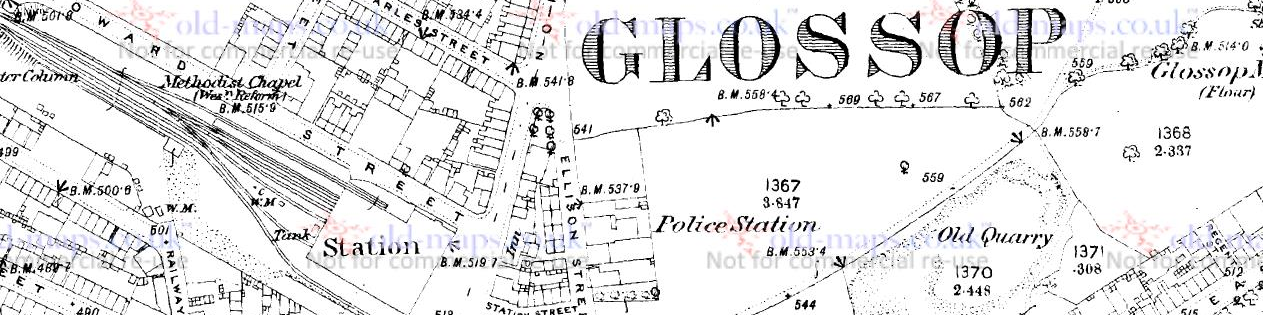
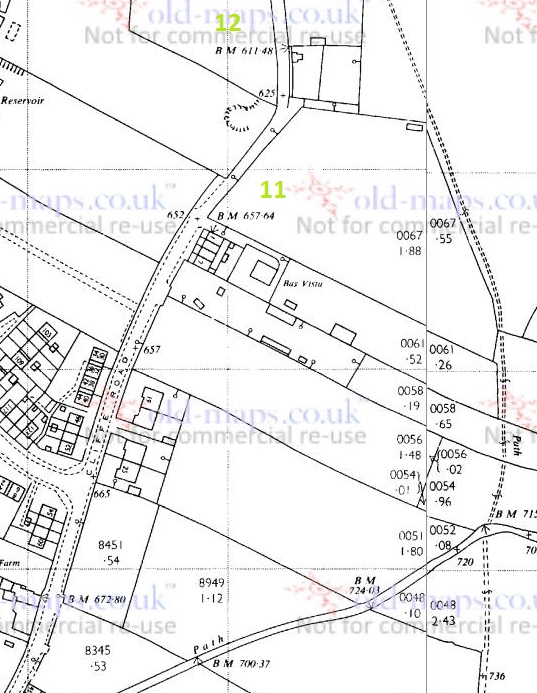
I have used the 1898 1:2500 and the 1969 1:2500 Ordnance Survey maps. There are differences; marks have clearly disappeared, to be replaced by others, buildings have gone, and land has become altered meaning that some marks are now on private property. Here are the maps with the Bench Marks numbered, the photos follow. There are more Bench Marks on the maps that I haven’t numbered yet – I will update the blog when I get round to looking for them!
The 1898 1:2500 OS Map. Cliffe Road runs SW-NE, Whitfield Cross is just off the bottom left, and The Beehive pub is down, Volcrepe and Old Glossop are Straight up. The numbers in red correspond to photographs and discussion below.
What follows are the photographs I took of the various remaining Bench Marks, their number corresponding to that on the map.
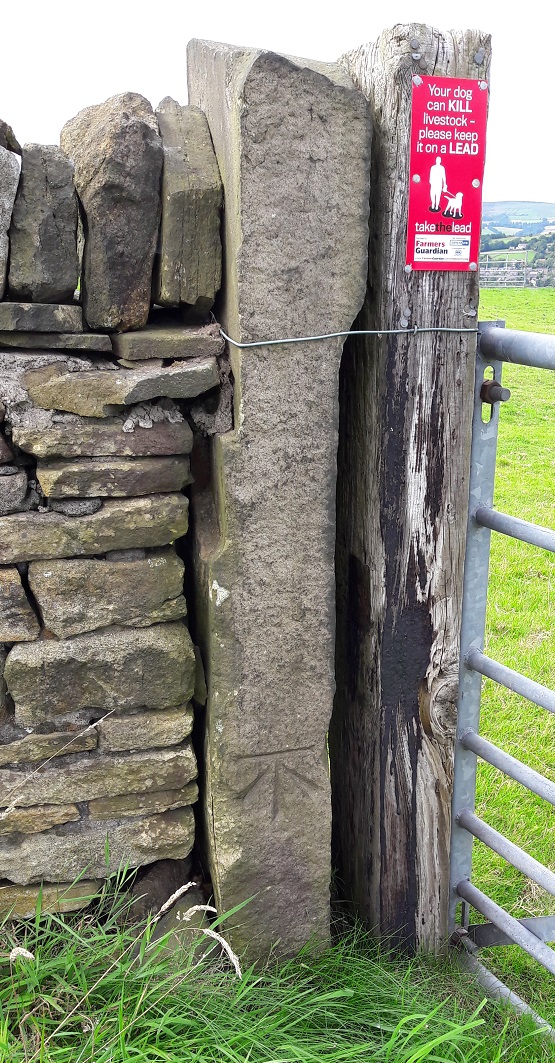
1 (679.1 ft above sea level) Tucked away at the side of the house, and quite worn. I wonder how many people living in these houses know they are there?2 (700.8 ft above sea level) Clear on a wall on the path.3 (728.8 ft above sea level) Marked on a gatepost
4 (698.8 ft above sea level)
Originally on a wall running down to Cliffe Road, and now on private land. It may well be still there, but I wasn’t able to see. It is not marked on the 1969 map.
5 (716.2 ft above sea level) Another gate post, and again very clear and fresh.
In between Marks 5 and 6 you pass through this stile.
Now, I will post more about this stile later on as I think there is a lot more going on here, really quite interesting things, and it deserves its own post.
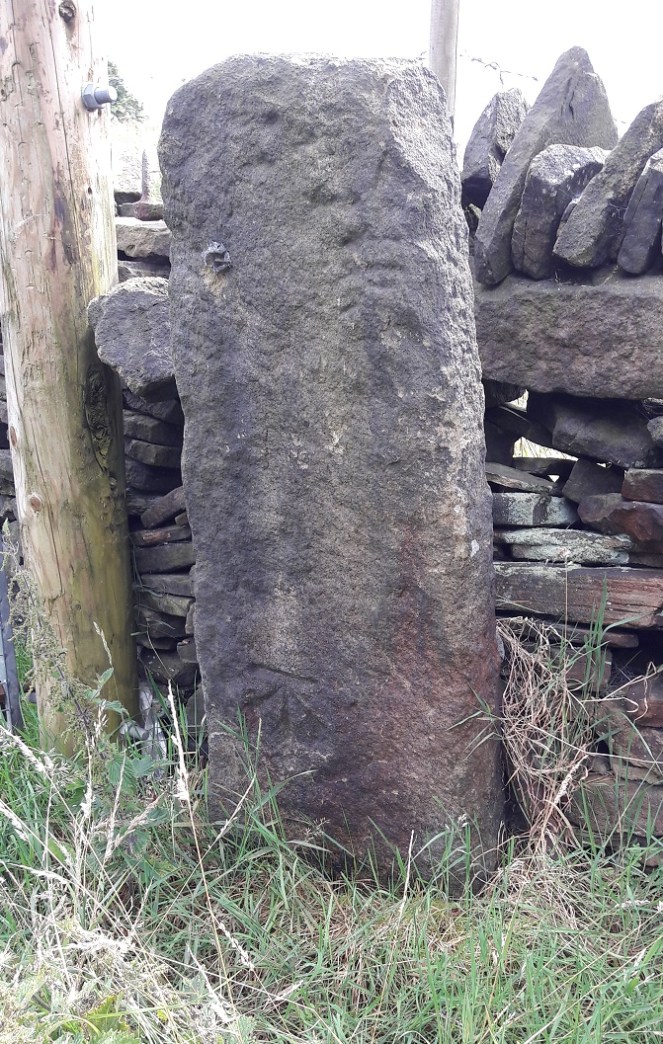
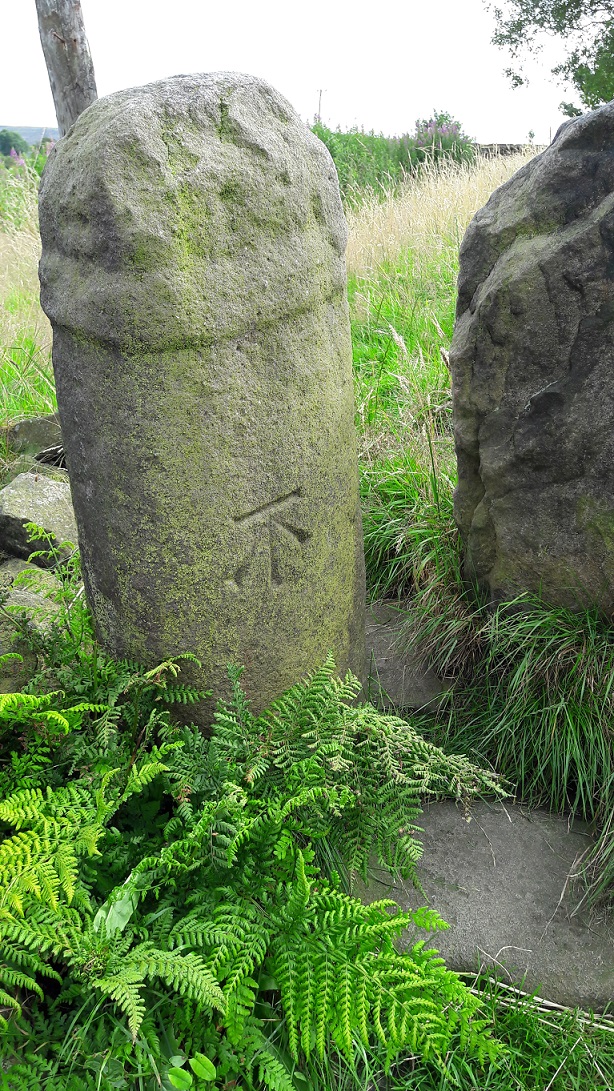
6 (682.0 ft above sea level) This is a particularly important bench mark as it has been placed on the actual Whitfield Cross. THE Whitfield Cross. The cross was moved from its original position at the top of Whitfield Cross (the road) in the 1790’s and ended up as a stile post in a field. The cross itself is Saxon in date (probably 9th Century) and is of a type known as a Mercian Round Shaft. You can see the band around the top that both dates it… and makes it look somewhat phallic! I will go into a lot more detail about the cross in a later post, as I think it is one of the most important pieces of history in the area, and one of the most overlooked, but for now, let’s move on
7 (682.6 ft above sea level)
Again, on a wall that is now on, I think, private land. I did have a quick look, but couldn’t see anything, so I left it and moved on. This Bench Mark is not marked on the 1969 map.
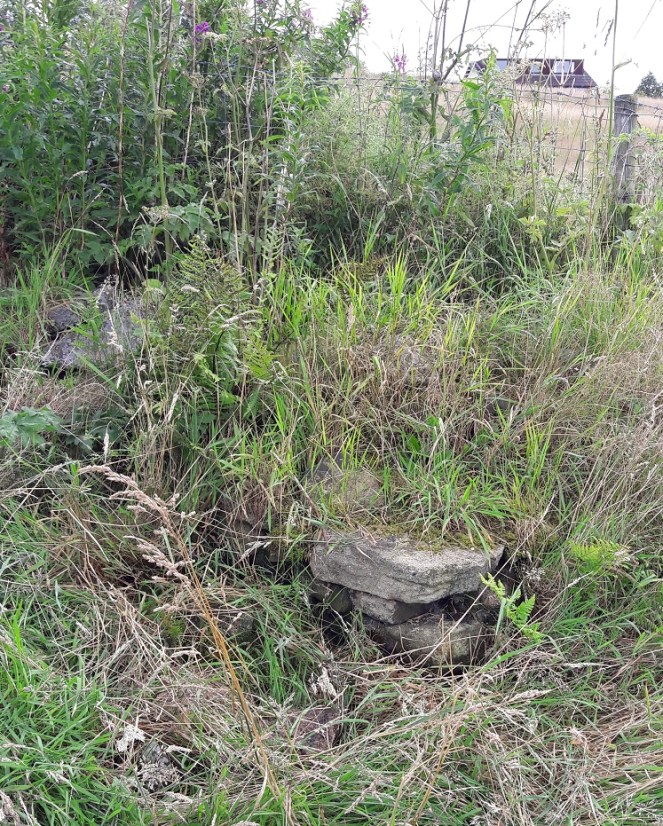
8 (636.7 ft above sea level) Originally on the corner of a retaining field wall. I searched high and low, even pulling over the stones that had fallen down hoping to find the mark, but to no avail. I suppose a full-scale excavation might uncover the stone, but I’m giving it up as a lost cause. It is not marked on the 1969 map.9 (627.3 ft above sea level) A similar story here, too. The stone has gone missing, perhaps one of the stones at the top that has collapsed down, although the wall itself looks like it has been rebuilt at some stage which may explain its absence.10 (671.8 ft above sea level) Flatt Farm, on the corner of the farm building, and very difficult to see. It took me a while, but the level of the pavement has risen in the last century or so, leaving the level just visible above the tarmac surface, the arrow now buried below.
Moving onto the 1969 map, there are two additions: 11 and 12. The Bench Marks that are not on the 1969 map have been noted above.
11 (657.64 ft above sea level) This one should be on the corner of the last house on Bright’s Terrace – the last row of houses on Cliffe Road. I found no sign of it, and it is probably hidden behind the flower bed.12 (611.48 ft above sea level) A little down the hill on the right, clear on a wall.
And so ends my brief sojourn – both geeky and fun. I have done a bit more Bench Mark walking, and I’m sure they will feature in future posts, but that’s it for now.
Incidentally, both maps are available for free from http://www.old-maps.co.uk a truly marvellous website that has old Ordnance Survey maps for the whole country dating back to the mid 19th Century, and all for free. Seriously, if you find any of this interesting in any way, hop over and have fun!
I was walking toward Manor Park the other day, down Crosse Cliffe and then along Milltown past the old Volcrepe buildings (well, the remaining one at least) and toward the Prince of Wales. This area is chock full of interesting historical bits and pieces, some of which I’ll share in later posts. But for now, I present an oddity and a mystery, both of which caught my eye, and which I’d like to share.
First, the oddity.
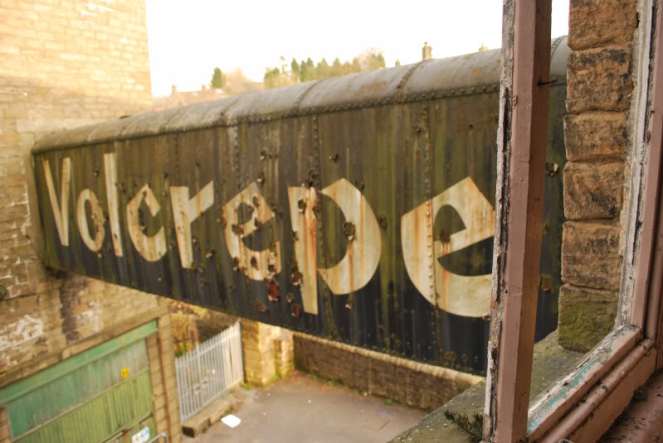
The derelict Volcrepe buildings, now partly demolished and missing its iron walkway, was a Glossop landmark. Huge and abandoned, they loomed large and formed a stone canyon down which one walked in order to get to the town centre from Cliffe Road. Spooky at night… and day, as it happens!
The ‘famous’ iron walkway between the two buildings, below which the Milltown road ran/still runs. This image is shamelessly stolen, with thanks, from the amazing ’28 Days Later’ urban exploration website (more Volcrepe here). Copyright ‘Oliver’ from that website.
It is now massively reduced in size, with only the eastern building remaining, the massive western side having made way for housing and Lidl. Alas… progress!
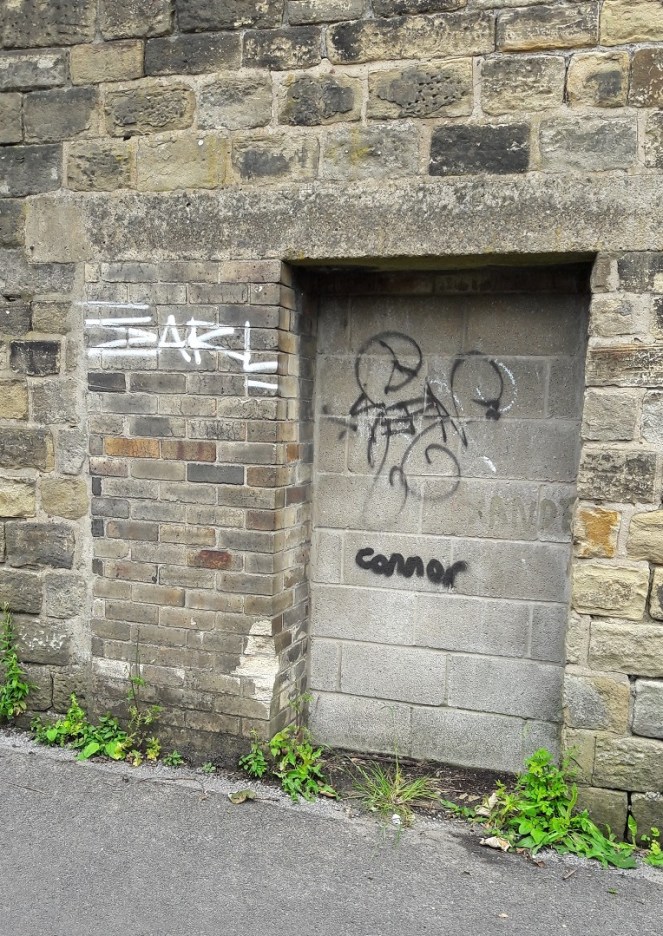
Walking along, pushing the pram, I noticed a bricked up doorway. Nothing wrong with that, the buildings are 150 years old, and doors and windows fall in and out of use. It was what it was bricked up with that puzzled me! London Stock Brick – the yellow brick that was favoured in London buildings during the 19th century and until the early 20th Century.
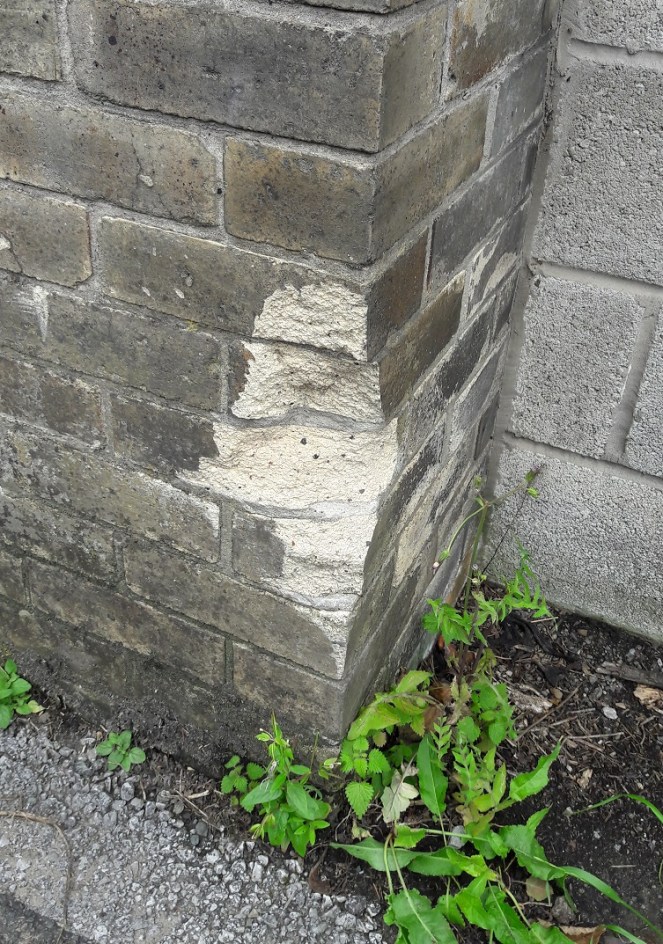
It is found all over the greater London area, but particularly in the East End, and is very distinctive – bright yellow, but quite soft – the product of the brickyards of Kent, Sussex, and the inner London areas. It is very recognisable, and a walk along Brick Lane – no pun intended – will show you just how common it is in that area (more details here, or search for photographic examples).
Unmistakeable – the yellow London Stock Brick, the place where someone has hit it with their car revealing the colour untarnished by coal pollution underneath.
How and why it ended up here, in Derbyshire, being used to block up a doorway, I have no clue. An oddity, as I say!
Now the mystery…
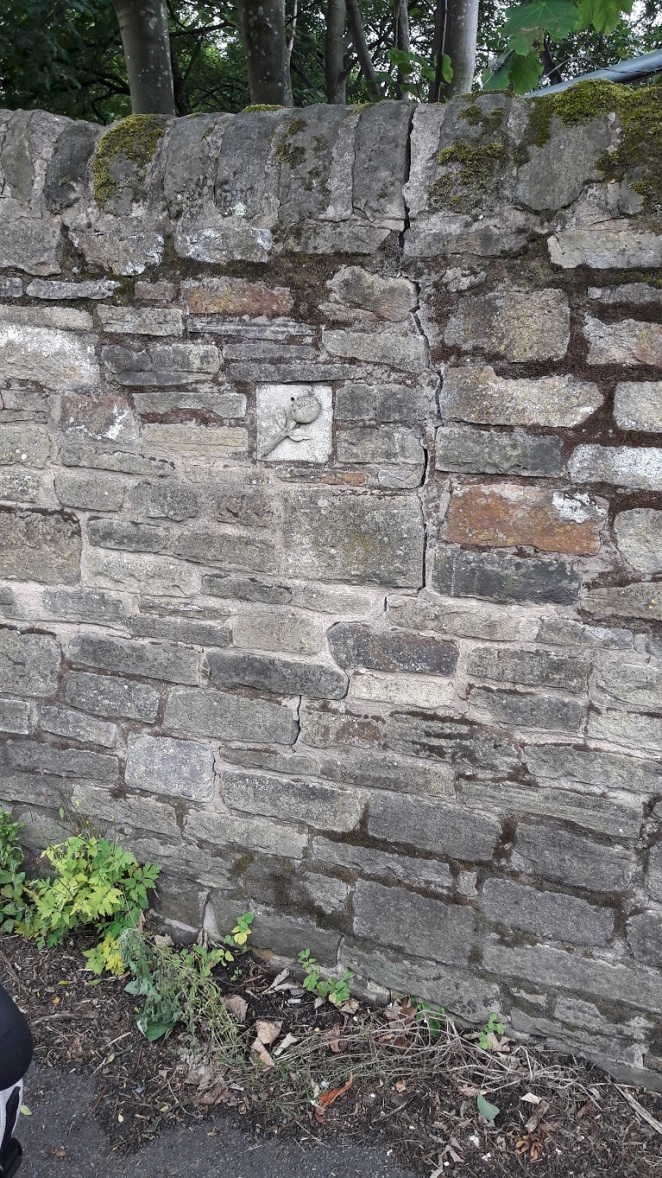
A little further along the road, and on the same side, toward the end of the wall of the Volcrepe factory, a square block caught my eye.
Distinct from the rest of the wall, I approached, and was amazed.
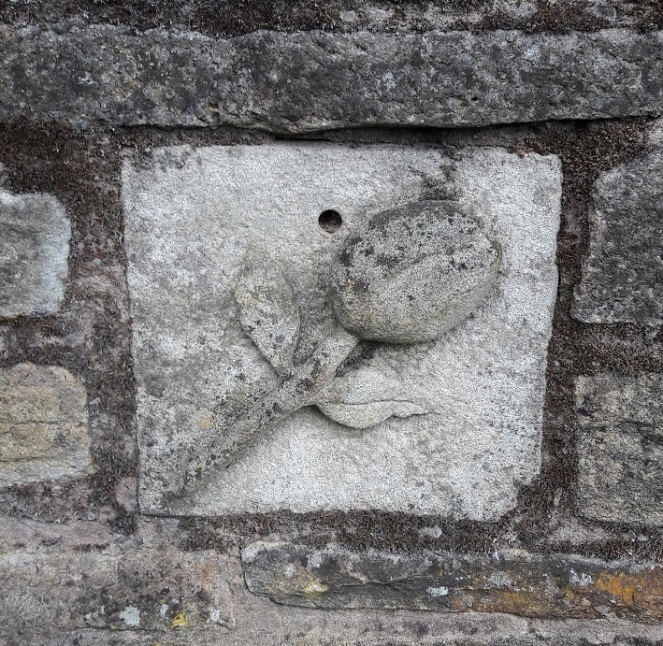
Behold… a tulip!
Delicately carved in stone, a carefully cemented into the wall, the flower sits. It was clearly placed into the wall when the wall was built, and is not a later intrusion – you can see that it fits perfectly and deliberately, and none of the stones are cut to allow it to fit in. I don’t think the wall is the same age as the rest of the building, as it seems a little too ramshackle when compared to the wall of the factory, and there are bricks included in the matrix. But it still raises the question of why was the stone placed there, and by whom. And what is the significance of the tulip? Also, it’s such an odd place to put it – not above or near a door, or next to a window or other feature, it’s almost like it was found and cemented in place. And what is the purpose of the surely deliberate hole placed centrally above the flower?
A mystery!
If anyone has any thoughts or comments, please drop me a line or leave a comment below as I would love to know what and why!
Bench marks are a bit of an oddity. Most people would never know they were there, and of the people that do notice them, most have no clue what they are. And yet, they are quite literally all over the United Kingdom, and once you have seen one, you will start to see them everywhere!
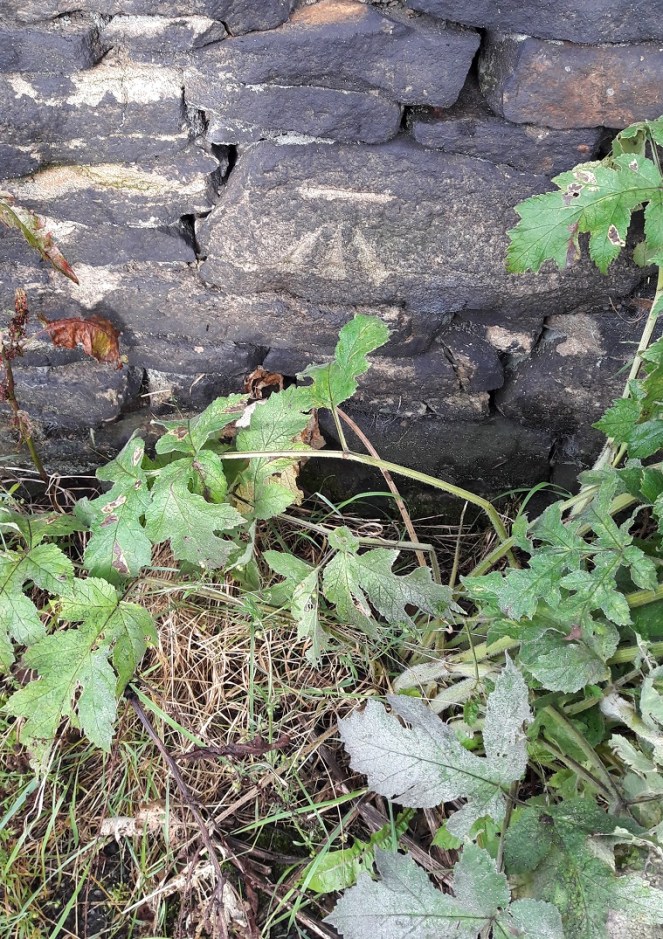
In short, when the original Ordnance Survey maps were being drawn up (1840’s or thereabouts, though work continued until the 1950’s), the surveyors needed to know the height above sea level at certain points in the landscape, so that they could work out hill heights, elevations, contour lines and such. These were marked on the map, but as translating the exact location on the map to that on the ground could leave room for mistakes, it was decided that a permanent and precise mark would be made on the place where the measurement was taken. This is the Bench Mark. They were carved very carefully by chisel onto stone that was either fixed, or very unlikely to be moved – churches, pubs, grand buildings, gate posts and the like. The symbol was usually paced at ground level, and was very simple, and very subtle – a single horizontal line (from where the measurement was taken), and underneath three lines forming a vertical arrow like this:
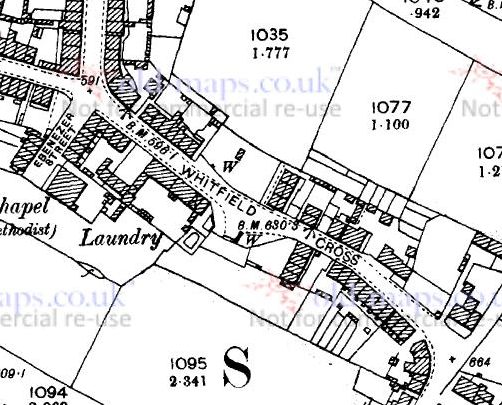
Over half a million of these marks existed at one time, and the entire network of marks (at least 1 per square mile in rural areas, a much greater density in urban areas) was maintained by the Ordnance Survey until 1972 when they abandoned it as too expensive. Whilst large numbers of the marks have disappeared (buildings are demolished or changed, stones are moved, etc.) the majority are still here, hidden, waiting to be found. Whilst looking at an old OS map of Whitfield Cross (1898 1:2500), I noticed there were two on the road. They are marked BM, followed by a number (the height, in feet, above sea level), and their location is shown by the arrow.
The first was at the bottom of Whitfield Cross, at the edge of the building that used to be The Roebuck pub.
It is very worn, but you can just make out the three lines that make up the arrow – now just hollows – and the level on top. This particular Bench Mark is 598.1 feet above sea level.
The other Bench Mark is on the edge of a pair of houses, and is much clearer and better preserved. It seems the surveyors used the flat top of the bottom course of stone as the spot height, which is exactly 630.3 feet above sea level.
That’s a difference of 32 feet, or thereabouts; Whitfield Cross is a steep hill.
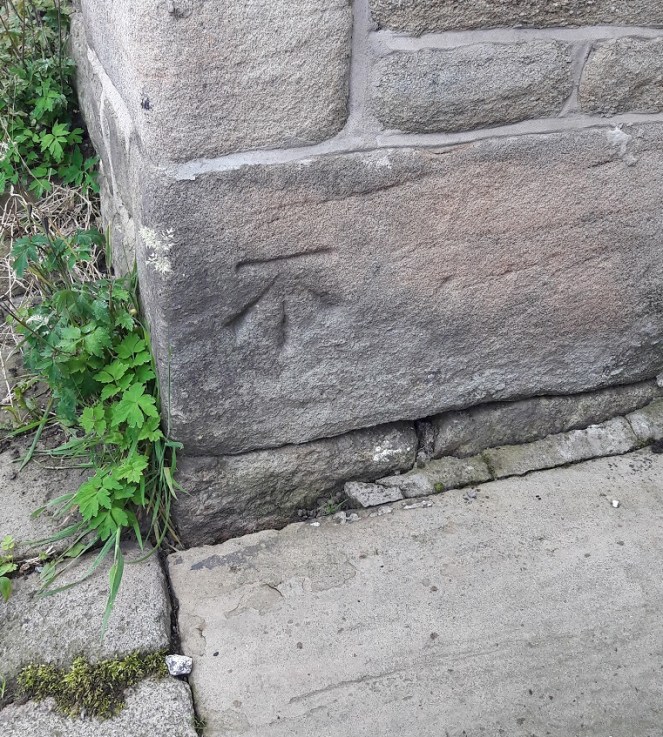
And for comparison, here is the Benchmark near the Beehive pub at the top of the hill
This is at 670.9 – 70 or so feet higher.
It is a bit geeky, but there is something about Bench Marks that really intrigues me – information hidden in plain sight, and a piece of forgotten history. There are even people who ‘collect’ them, ticking them off against the log that the OS had (see here), but that is, I fear, a step too far down Geek Avenue for even me!
Now that you know what they are, and where they are, keep your eyes peeled.
Welcome to the first post of the blog, and I thought I’d start with a subject (very, for me) close to home: Whitfield Well.
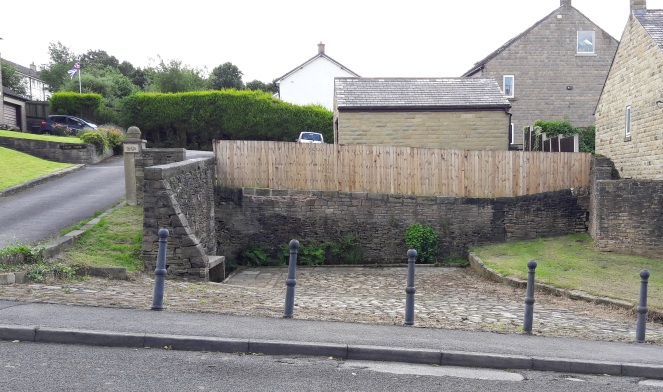
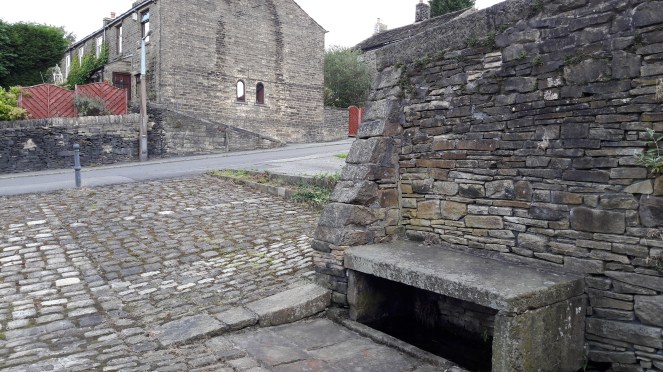
Situated on Whitfield Cross, halfway up on the right hand side, and set back from the road in a paved and ‘cobbled’ area. It is, I think, the overlooked star of the Whitfield Conservation Area. It is also a Grade II listed feature, and the description in the listing is far better and more concise than mine would be, so here it is:
Name: WHITFIELD WELL List entry Number: 1384307 Location: WHITFIELD WELL, WHITFIELD CROSS National Grid Reference: SK 03620 93405 County: Derbyshire District: High Peak Grade: II Date first listed: 27-Jan-1978
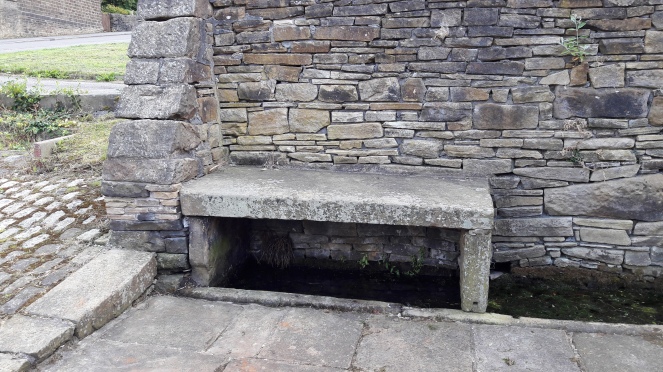
Summary of Building: Well. Mid C18, restored C20. Tooled slabs of gritstone. L-shaped series of rectangular troughs enclosing spring water along 2 sides, with moulded stone dams at intervals, and stone table above part of trough to east side. To rear of wells 2 sections of rubble walling with coping, that to north side partly rebuilt. East side has stone buttress. Third side bounded by stone wall of adjoining industrial yard.
So there you go. But there is a lot more to it that just that dry description.
It is a spring fed perpetual well, meaning that flows in even the most severe droughts. Indeed, its heavy flow once supplied the houses hereabouts with their drinking water, even after most other houses were plumbed into the mains. Because of its importance, it was, for a long time, the focus of a well dressing. Well dressings are justifiably famous and important aspects of the folk calendar of Derbyshire and parts of Staffordshire, and are probably a continuation, however distant, of the pagan veneration of the god or goddess of the water there. This same reverence of wells such this led to them being named, in the Christian period, after saints, though this too fell out of favour in the post-reformation period. We have no idea about the attribution of the well in either the pagan or Christian periods, but a well such as this would surely have had one.
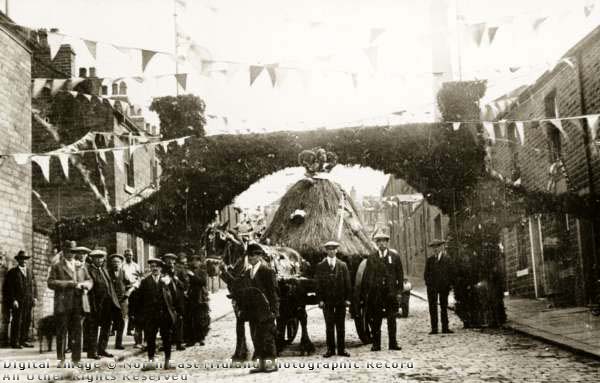
The well dressing at Whitfield was an important and rather grand affair, and seems to have coincided with the wakes week (early September), and the rush bearing ceremony at the Whitfield parish church, St James’. This involved a special blessing of the well by the vicar of St James’, and the creation of a rush cart to take the rushes to the church, where they would be used as flooring. The rush cart and celebratory archway and bunting can be seen in this (c.1920) photograph taken at the junction of Gladstone Street, and looking up Whitfield Cross.
The Well Dressing arch, with the rush cart underneath. Note the shadowy chimney visible in the sky behind the arch at the right.
The building at the extreme left of the photograph is the Roebuck Inn (now a private residence), where the Well Dressing Committee would meet to discuss that year’s celebrations. Apparently, this well was the only one in Derbyshire to be decorated with heather gathered from the surrounding moorland, though Hamnett (the actual historian, not my pseudonym) mentions it being “beautifully decorated with flowers and shrubs” Incidentally, Hamnett also believed that theWhitfield cross, the one that gave the name to the road, originally stood here at the well. More recent work has placed its original site at the top of the road, at the junction with Hague Street – which makes more sense. The cross will be the subject of a later blog post.
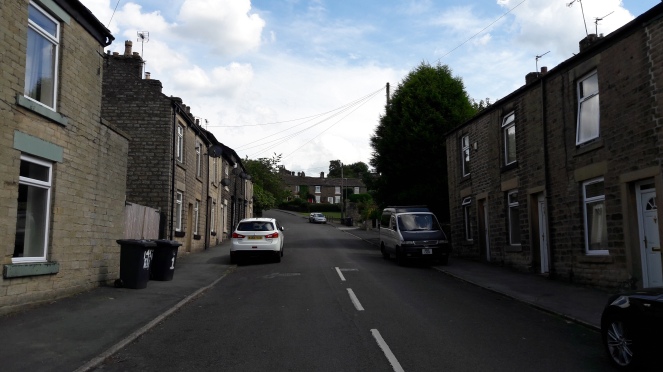
The same view today, some has changed, but it is still recognizable.
When the well dressing died out, and why, is not clear; there is online a photograph of the 1976 well dressing fancy dress competition winners, so it continued until at least then (click here). One suspects, though, that by then it had lost some of the wonderful Victorian seriousness that the committee would have brought to it.
The water from the well also supplied a Brewery for a time. This was a two-storied building adjacent to the wells, and built in 1849 by James Robinson (who also built the Surrey Arms on Victoria Street, as well as many other houses and building hereabouts). The Whitfield Brewing Company seems never to have been successful, and it changed hands numerous times, eventually ending up as a steam laundry at the end of the 19th Century, before being demolished in the late 40s or early 50s and the area used as a builder’s yard. Finally, houses were built on the site. The tall square chimney of the brewery can just about be seen in background of the photo above – it is also marked on the 1975 1:2500 Ordnance Survey map, although I can’t believe it stood that long. There is a good, if short, history of the brewery here. Incidentally, the 1968 OS map shows a phone box at the western end of the well area.
Here are some photographs.
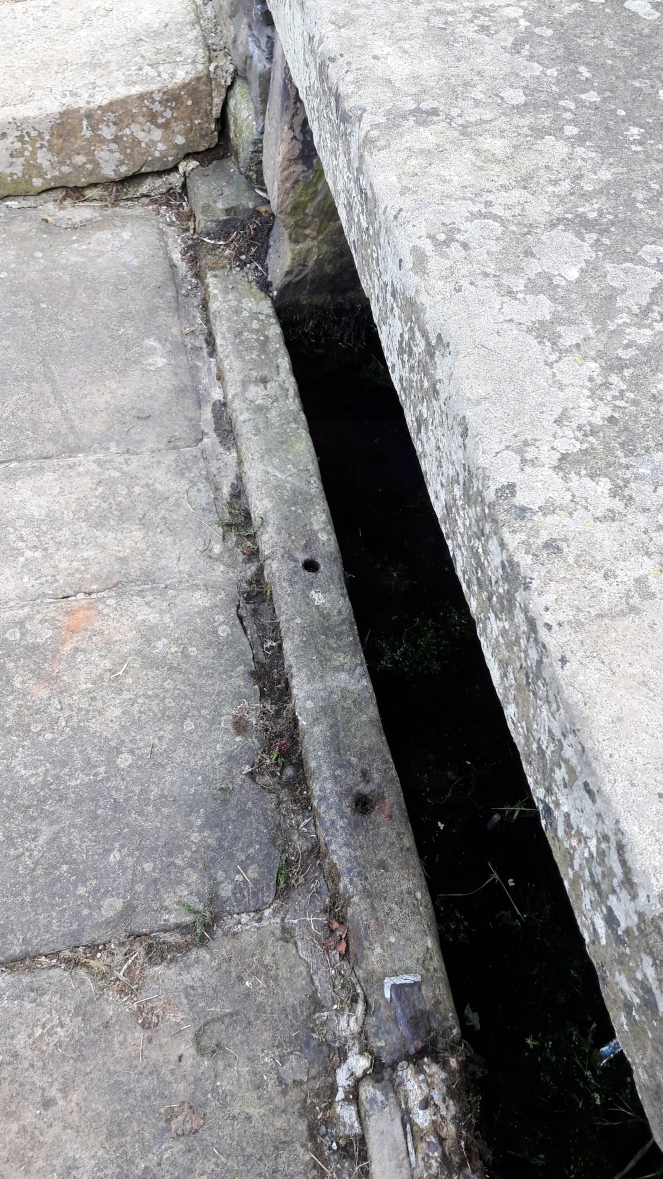
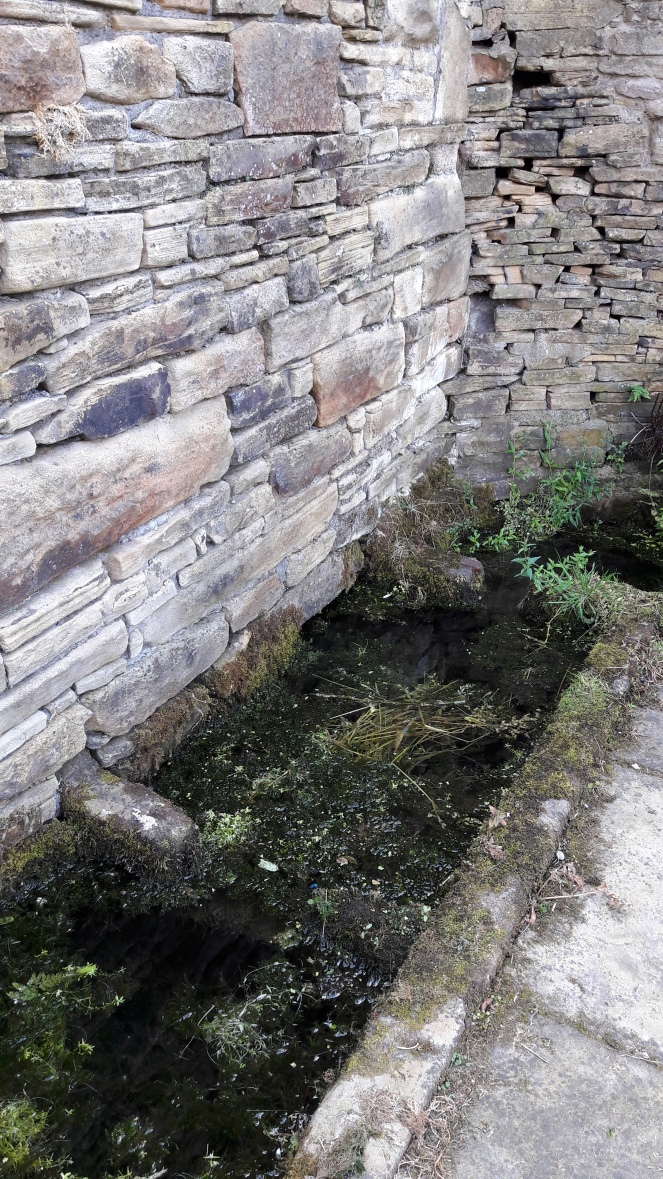
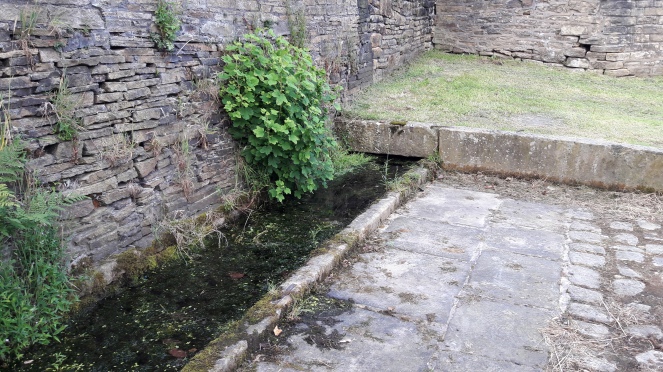
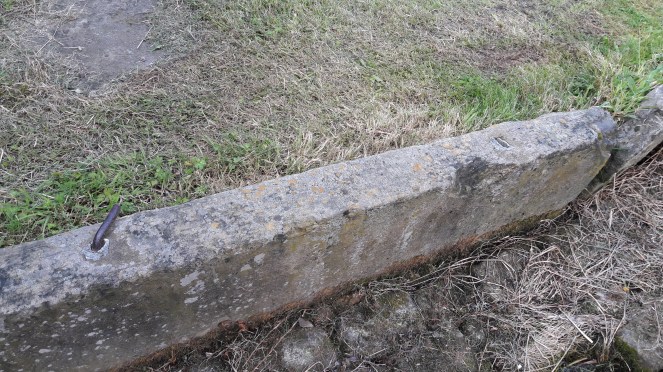
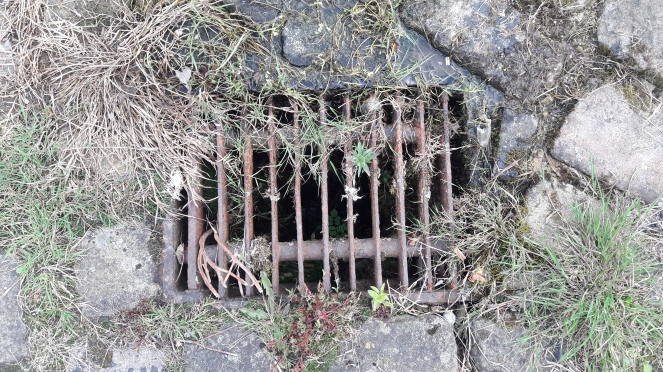
The well bench. Not sure what the original purpose of the bench was – perhaps a table for those using the well? The spring rises from below the bench and flows to the right along the troughs.There are two holes in the kerb below the bench a uniform distance apart – possibly the remains of a railing? The iron and lead affair at the bottom of the photo is a staple that joins two kerb stones together; there are several of them around the length of the well.The water troughs; the stone ‘dams’ are visible amongst the pond weed.The water disappears under the stone at the end, there, reemerging in a drain to the right.More evidence for railings – Victorian or earlier in date with the lead packing.The capped well that originally stood in the brewery yard.The drain, covered by a Victorian cast iron grid, where the Whitfield water ends up.The view from the well onto Whitfield Cross.
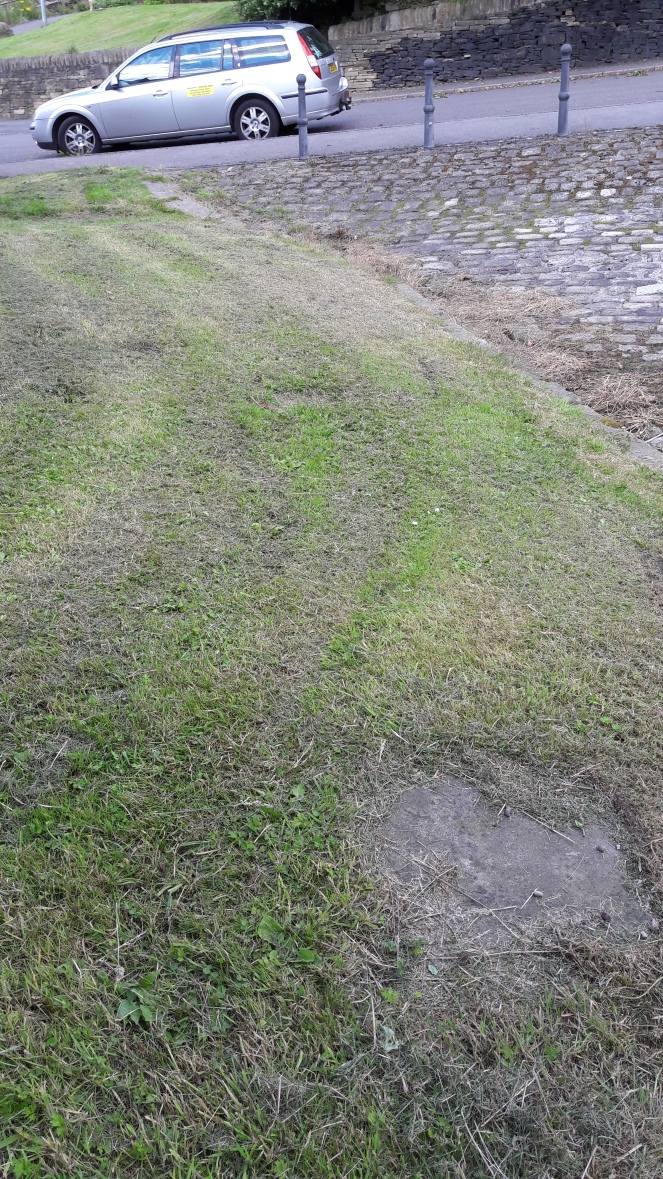
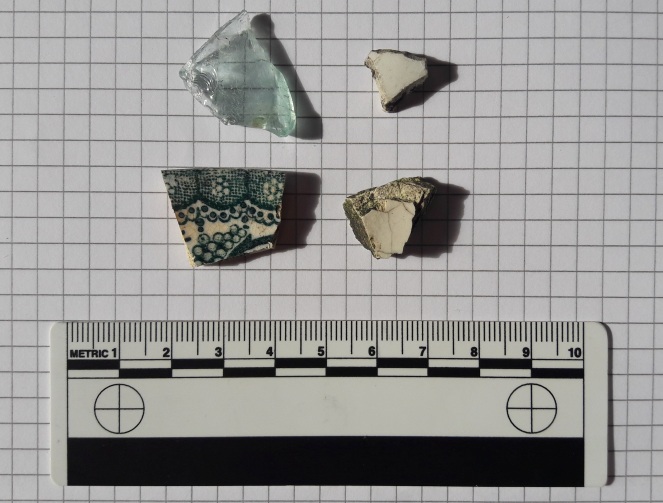
I went out last week and cleared the site up a bit. The well is a hangout for the local youth, and inevitably mess and litter accumulate (ranging from coke cans… to a scooter!). So I swept up and dredged the troughs for rubbish… my good deed for the week. Amongst the detritus were four interesting bits – three pottery sherds and a piece of glass.
I say interesting, but I realise that interesting is an entirely subjective word!
The two sherds on the right are white glazed fairly boring bits – bowls or plates probably, and late 19th or 20th century in date. One is a transfer-printed glazed rim of a plate roughly 12cm in diameter, and again late 19th or early 20th century in date. The glass fragment is from the neck of a bottle, possibly a mineral water bottle, or a beer bottle, perhaps. The bluey-green aquamarine tinge allows me to give it a date of… yep, you guessed it 19th or early 20th century. Many mass produced Victorian bottles are of this colour, the result of iron and other impurities in the sand used to make them, and it disappears in the early 20th century.
The pottery. Not quite Roman, but ‘interesting’ enough.
It would seem, then, that leaving litter at the well was a Victorian habit too. It is odd that they survived on the setts for so long, though. Perhaps they eroded out of the surrounding soil? And talking of Victorian habits, Neville Sharpe, in his book ‘Crosses of the Peak District’ notes that there was “an ancient practice in Whitfield township of local youths throwing strangers into the wells”.
If anyone has any information relating to the well, and especially if corrections are needed, please email me or you can drop a comment in the box below.
I should mention here that I am currently making plans to reinstate the tradition of well dressing at Whitfield Wells. I would be very keen to hear from anyone who wants to join in, who remembers them from when they were originally going, or who has any old photographs or other detail relating to the well dressing.
I have big plans, but can’t do it on my own! Drop me a line with anything you want to say, or leave a comment below.















 This is at 670.9 – 70 or so feet higher.