What ho! I’ll not beat about the old b, but instead get straight down to business. Pottery. Lovely pottery; sherds of delight, fragments of history, delightful detritus of… What? What’s that you’re yelling? Look here, no one is making you read the website, you know. And what’s that you keep calling me? A “boring pickhead“… I don’t even know what that means. Honestly, I mean to say… the cheek of some people.
Anyway, apologies for the rudeness of some people spoiling the fun.
Pottery. I always have some lying around (see, for example, the Fireplace Finds Frenzy), and it keeps getting added to. Any hole that is dug around here will find me like a moth to a flame, fettling around in the spoil heap, and at any point as I am walking along, I am constantly looking at the ground (my back is knackered, and I’m certain I’ll end up looking like Quasimodo). Now, as per my new policy, I only take bits that I find interesting, or that I think are worth putting on the website, and for today’s post I thought I’d share a few of these bits with you.
First up, we have some sherds from my own garden. Since moving in ten years ago, bits of pottery have been showing up in the soil any time we put a hole in the ground. Recently, We have had a pile of earth moved from the side of the house (literally against the side of the house, causing all kinds of damp issues). This produced quite a pile of pottery, all broadly contemporary with the house (1850-ish) – I’ll give you some of the highlights, rather than a whole dump (I can hear you sighing at the back, you know…).
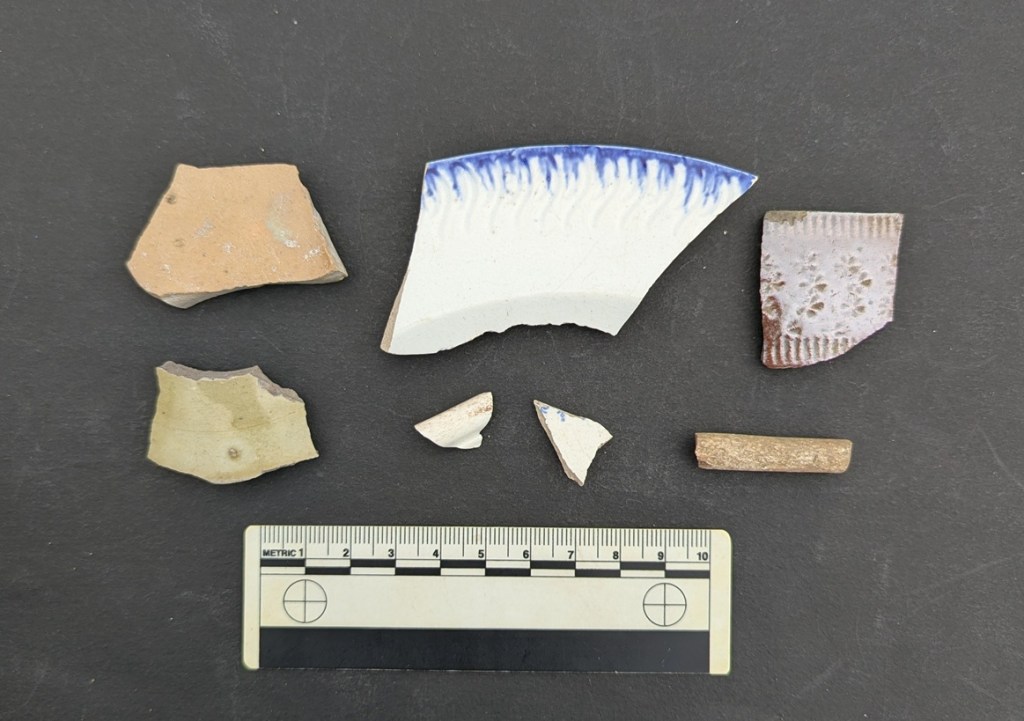
My favourite sherd in this lot is the fragment of Shell or Feather Edged ware; I love this stuff, and wrote about it here.
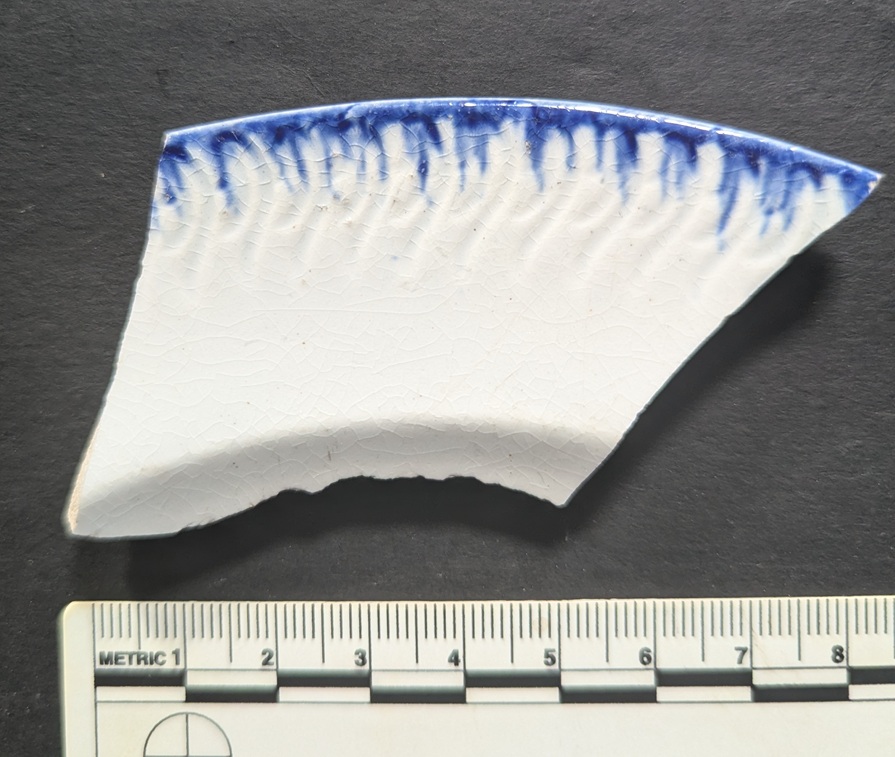
This sherd is from a small plate with the rim diameter of 22cm, and with the characteristic wide ledge, and impressed shell-like ripples. It is made in Pearlware, where cobalt blue was added to the lead glaze to make a clean blueish white – you can see the glaze pooling in between the shell ridges, where it shows the pale blue colour which gives it its ‘fake’ whiteness. If you are interested, I discussed it here. You can also see how the cobalt blue slip was applied to the edge to highlight he ridged decoration, and rather sloppily if you look at the edge itself – this was not expensive pottery, but rather fancy, cheaply produced, everyday ware:
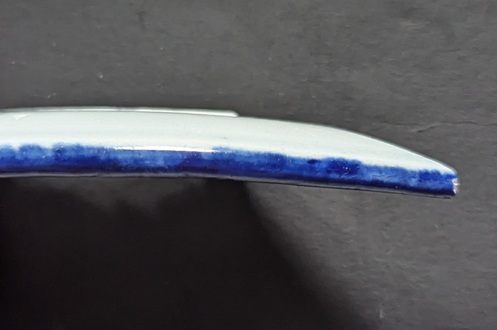
like ridged decoration – it looks so neat from the front!
As I say, I love this stuff.
But check out the brown Derbyshire Stoneware sherd to the right of it, probably a bit of an open bowl – a stew pot or similar, perhaps.
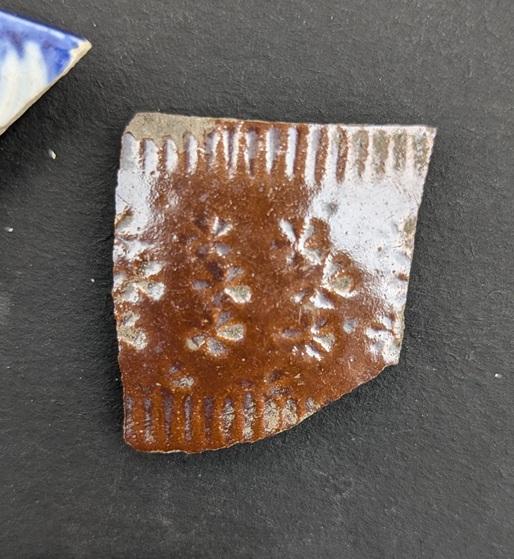
The decoration is lovely; a pair of vertical rouletted bands running horizontally around the bowl, created by running a cog-like wheel along the soft clay body prior to firing. Between these bands are groups of flowers, again pressed into the clay. Whilst this is not a great example – the flowers are not deep or crisp enough – and it’s a common decorative motif, it is wonderful to see, and the poet in me sees this as a reminder that spring is properly here, and that nature is once again blossoming.
The rest of the pottery is not particularly interesting – some stoneware bits, probably from a bottle, and some whiteware, although a clay pipe stem is always a welcome find.
Sticking with the Derbyshire Stoneware (although I think this might be a little earlier), is this sherd I found the other day in the Memorial Garden in Hebden Bridge:
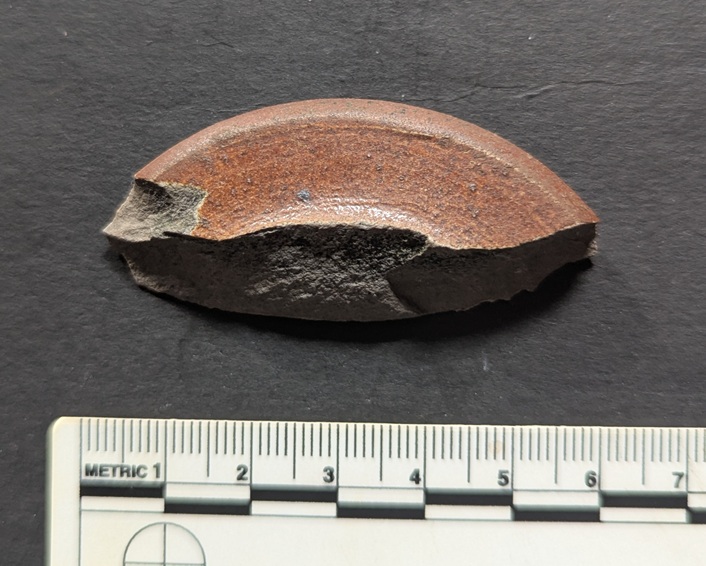
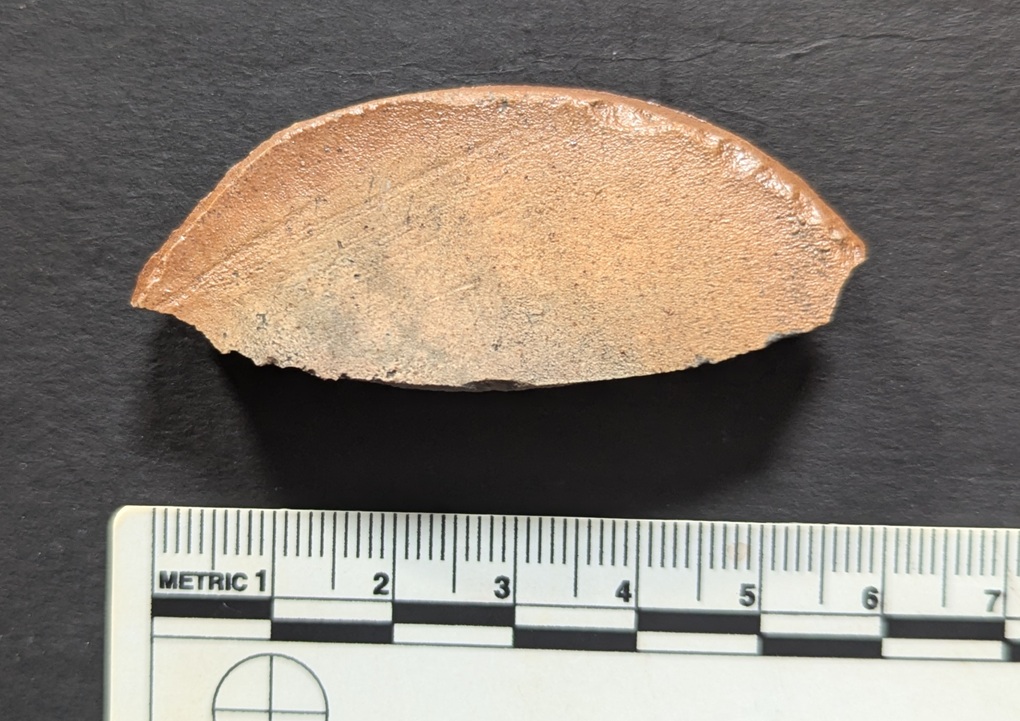
A circular fragment, and measuring just 7cm in diameter, I initially thought it might be a lid to something. But turning it over I saw that it was actually the base of a vessel; you can see the string marks (the lines) where it was cut from the potter’s wheel, as well as marks on the edge that are suggestive of the potter picking it up. Also, a lid would have been much more carefully formed, often with an internal rim to fit properly into an opening. Looking more carefully at the base, there is a lack of iron rich salt-glaze here – you can see how it fades from shiny and dark brown at the edge, to lighter and matt – unglazed – in the middle.
I don’t know for certain what the original pot was, but perhaps something like the ‘Covered Sugar Bowl’ circled in green in the image below, an advert showing the range of Derbyshire Stoneware vessels on sale in c.1880:
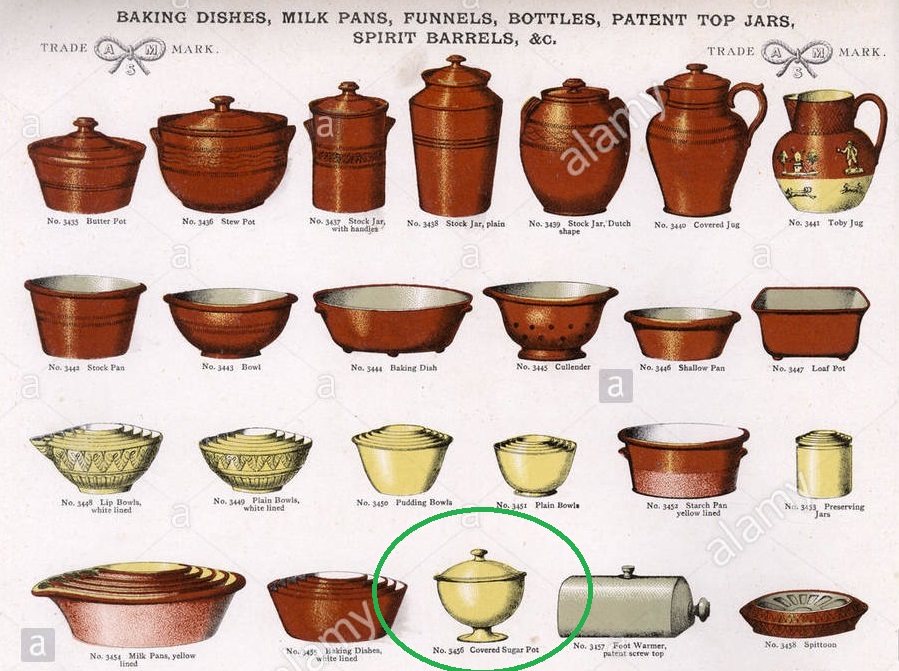
The bit we have is the flat part of the pedestal foot, curving up into the stem that supports the actual bowl. It’s a lovely sherd, despite appearances.
This next sherd cropped up in Glossop Brook, and what a sherd it is too – a fragment of a stoneware bottle marked with “J, SHE… GLO…”.
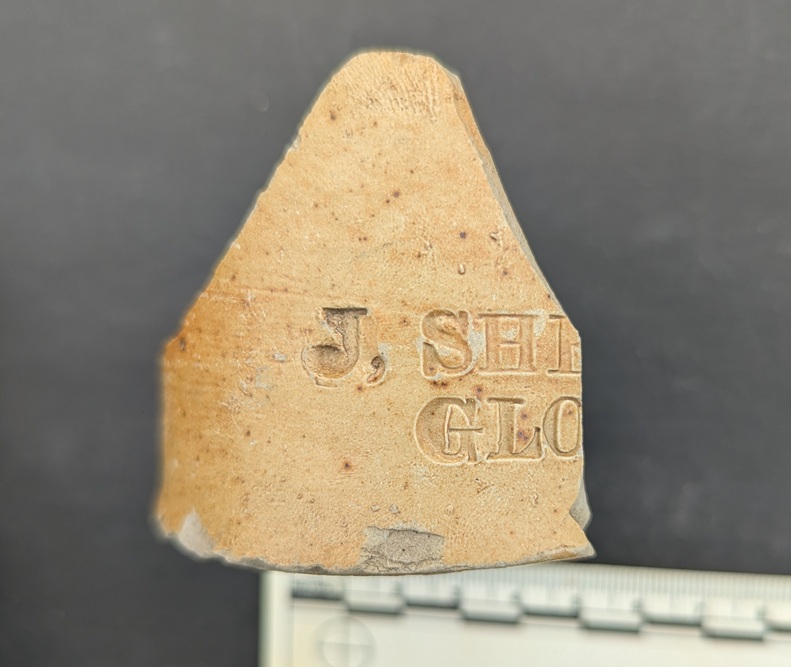
Having seen others like it, it should read “J. SHEPPARD. GLOSSOP” who were a soft drinks maker based here, but about who there seems to be frustratingly little information. Looking closely, you can see how it was manufactured, and also how quickly – this was Victorian mass production, and yet still hand made – finger marks and smudges in the saltglaze exterior, and if we look on the inside, you can see the spiral made by the potter’s finger as he pulled it up and formed it on the wheel.
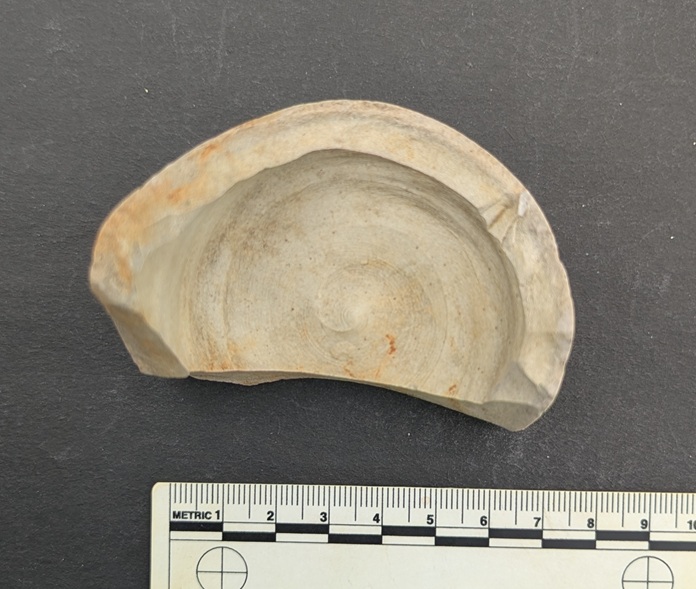
As I said elsewhere, there are records of potters being awarded special bottles commemorating their 1 millionth bottle made. Now, excusing my bad maths, assuming they work roughly 300 days a year (all days except Sundays and occasional holidays, for 50 years, would mean they would have to make over 650 bottles a day… which is bonkers.
The next bits were found underneath Lean Town, just off Derbyshire Level, and something of a favourite place to find pottery. There’s masses down there, but these 4 were chosen because they are a bit more interesting.
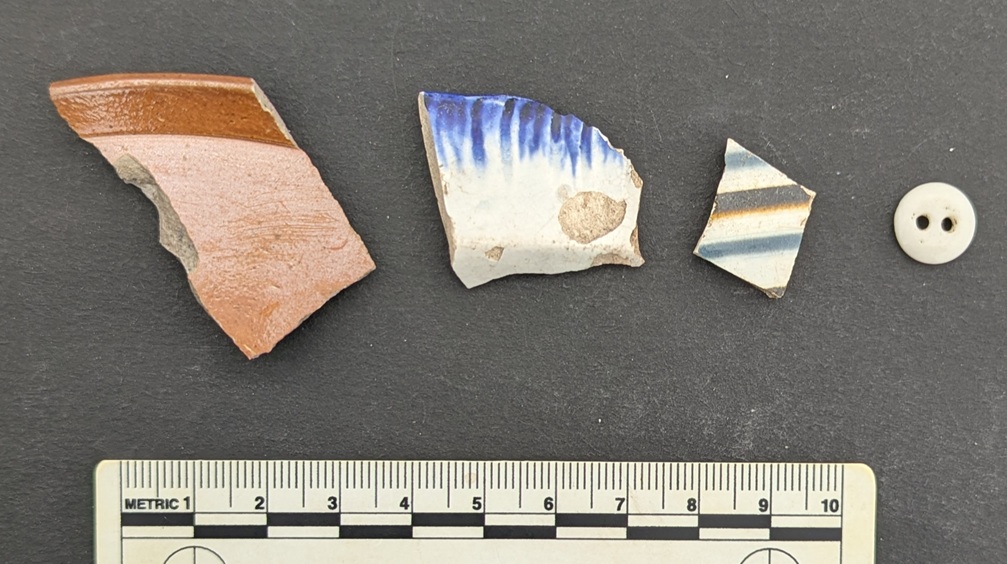
Starting at the left, we have a large open bowl in the familiar Derbyshire Stoneware, although this is a bit fancier – and therefore likely earlier – than the normal domestic stuff we find everywhere. It is a rim sherd, which allows us to find the rim diameter – 16cm in this case – and is from a quite fine bowl with a wide horizontal ledge rim, probably dating from the early 19th century – broadly contemporary with the houses there (1806). Which reminds me, I really should make a video or two about how to analyse pottery, and which tools, and even glue, to use, as it might be interesting to you fellow sherd nerds out there. And no, we know, Mr Shouty-Outy, not you.
Next to that is another sherd of Shell-Edged Ware, this one has an undulating rim, and is also of a similar age to the houses here, so earlier than the first Shell-Edged Ware sherd. Next to that is some annular Industrial Slipware, looking modern, but also – surprise surprise – is of a similar age to the houses! This sherd is probably from a bowl. And at the end is a small glass button, dating to the late 19th or early 20th century. It was right by the gate there, and one can well imagine a part of clothing being caught and the button pinging off into the undergrowth, to be discovered 100 years later as an artefact of a lovely summer’s day walk. Or something!
Down the underneath path toward Whitfield Green from Lean Town, we start to encounter early 18th and possibly 17th century material, which is nice!
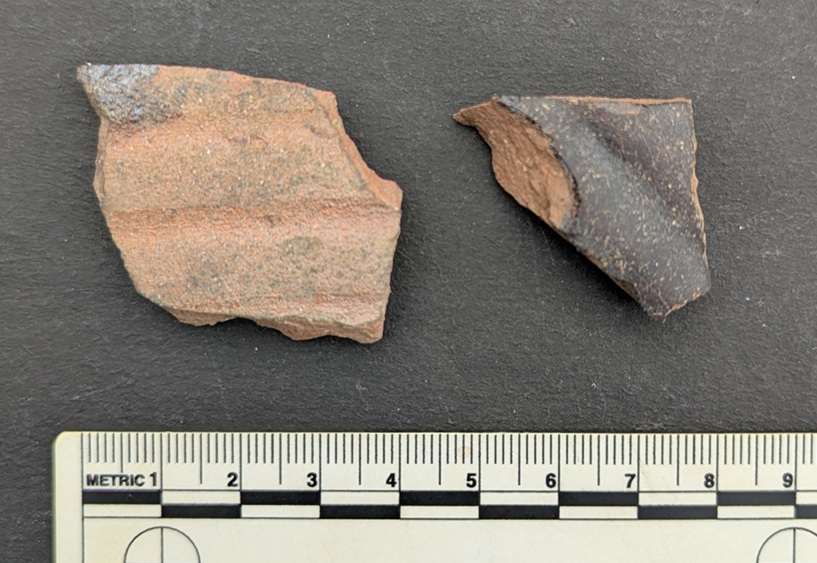
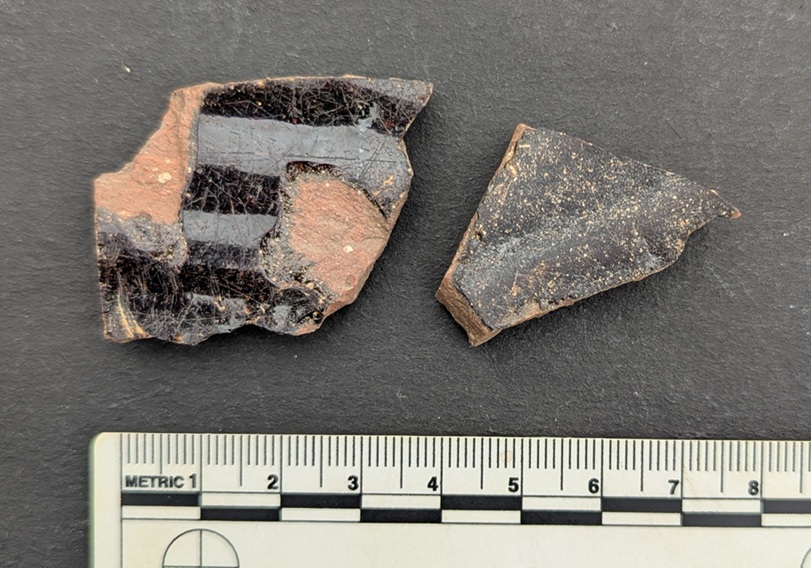
The sherd on the left is a bit of Coarse Blackware in a vaguely Midlands Purpleware fabric. Now, there really can’t be many people anywhere who care (and once again, Mr Shouty-Outy, we know), but this stuff is generally 17th century, and is associated with larger vessels such as jars. The sherd on the right is from a similar vessel, and likely of the same date. It all concurs with the date I believe Whitfield Green Farm was built – roughly late 17th century. This next sherd also lends credence this theory – a classic Staffordshire Slipware fragment of a plate or platter:
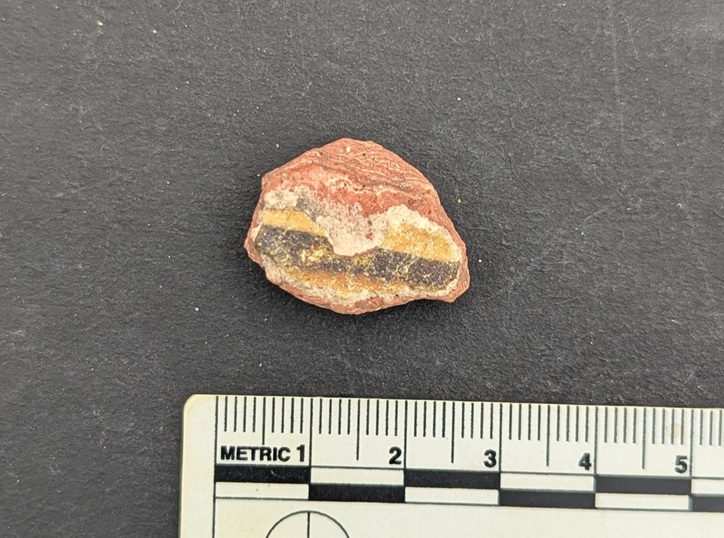
You can also see how it was made. The body is made from a mixture of light and dark coloured clay, as is usual, especially in earlier vessels (you can see the bands of different colours in the break), and the shape is formed in a mould. A light coloured slip is then applied over it all (showing white on the sherd above), onto this an iron rich red slip is applied in stripes, and then finally the whole is covered in a lead glaze, which, when fired, makes the ‘white’ background appear yellow, and the stripes a dark brown, almost black colour. Wonderful stuff, and again, late 17th or early 18th century in date.
There’s lots more pottery from this track to be published, but honestly, one doesn’t want to over-egg the pudding, so to speak, and with that in mind, let’s move away from pottery (don’t think I can’t hear you celebrating). This has been lurking around the house for while:
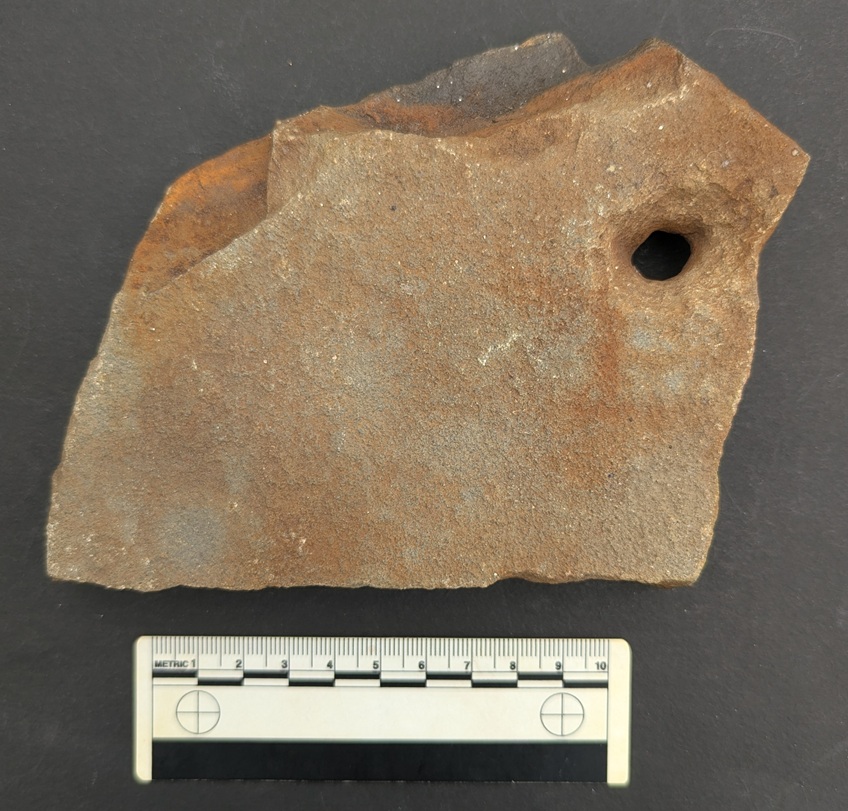
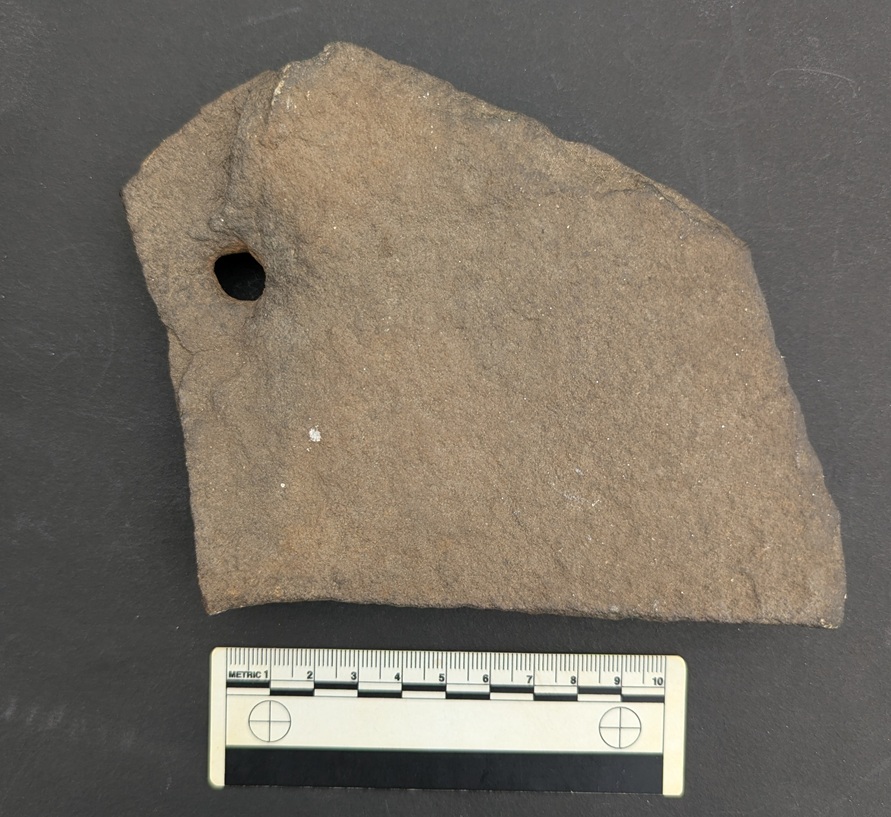
It might not look like much, but it’s a fragment of a stone roof tile that I found on the banks of Valehouse Reservoir when the water was very low a few years ago. I posted an article about some of the pottery here, but left this out for reasons I can’t explain… so here it is! I kept it because it has the peg hole that would have taken the oak peg that hung it on to the wooden batons – this sort of thing:
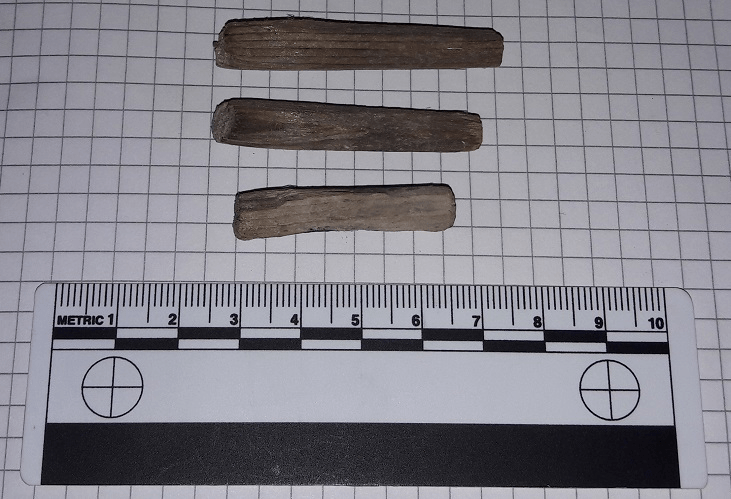
These were found in the floor of the loft of my own house, beneath old insulation, where they had been thrown down whilst it was being re-roofed (perhaps in the 1960’s?). The house was built in roughly 1840/50, and has stone tiles very much like this one. You can also see how it was made – chipped away from both sides, and finally breached with a single punch from a sharp metal tool. It’s a lovely thing, formed from local gritstone, and look at the skill with which it was shaped – it is exactly 1 inch thick (2.54 cm), and I’m certain they would all have been a uniform width, too.
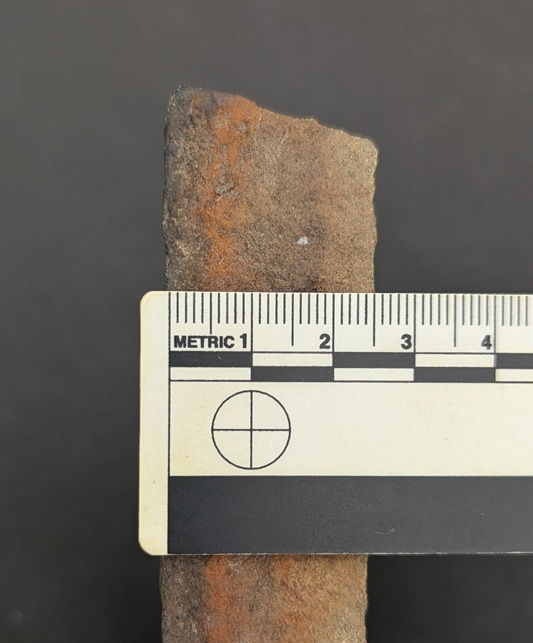
It’s probably a fragment of the roof of Valehouse Farm, destroyed when the valley was flooded in 1869, but which probably dated to the 17th or early 18th century. Looking at this, and tiles like this, I’m always amazed to think of everything that has happened beneath this stone: the conversations, the arguments, the dramas, the births… and indeed deaths, and the individual stories of real lives playing out underneath it. Wonderful.
Keeping with the theme of roofing, here is a copper nail I found a few days ago:
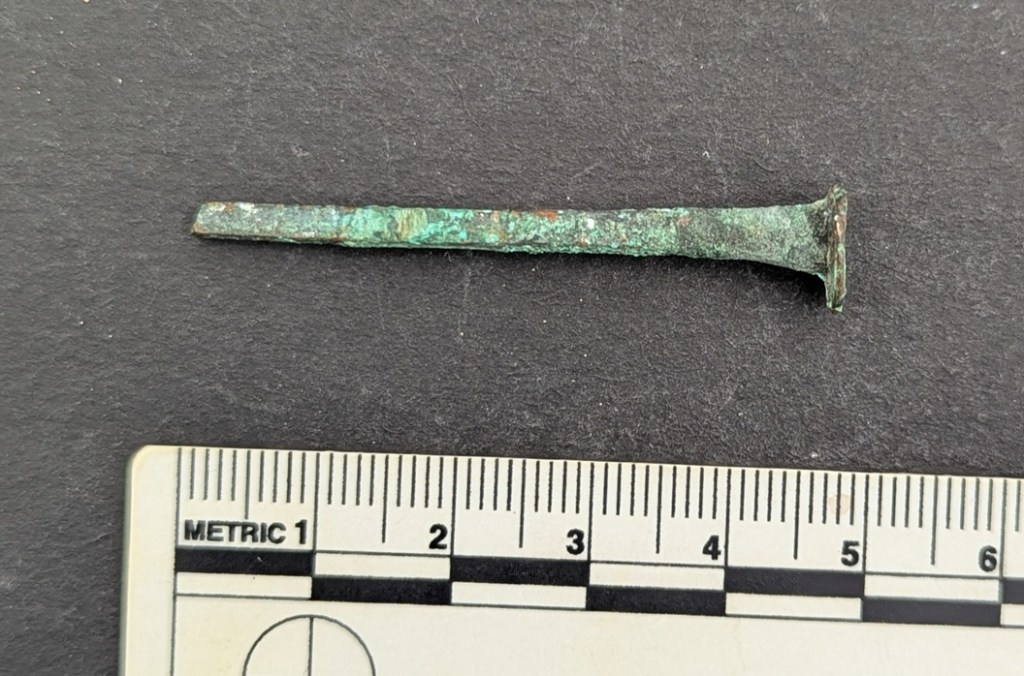
Square in section, tapering slightly, and with a thin flattened head, they are largely associated with Victorian slate roof tiles, rather than the heavier stone tile we looked at above, and I discuss them and how they were made a little here.
They seem to be shaken lose with heavy rain and/or strong winds – both of which we have had in spades recently – and end up one way or another on the pavement, and which is precisely where I found this one at the bottom end of Gladstone Street. Or at least that’s my theory. I seem to find them all the time – I have dozens of the blighters, lurking in a bag (each individually tagged, obviously… I’m not some sort of weirdo). Indeed, I find them to the point where I think I am cursed, or a kind of magnet for them (despite being non-ferrous). I honestly cannot resist them, they are so tactile, and whenever I see one on the ground, I take it.
And to end with… a final button:
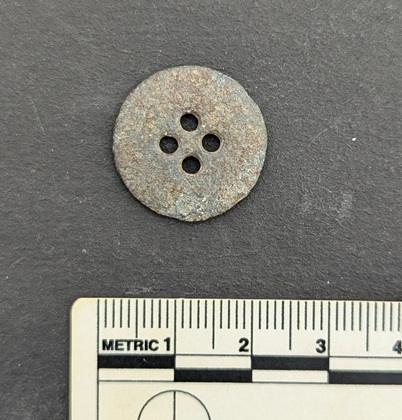
A copper alloy – bronze perhaps – it is small, but not tiny, and is strangely heavy – the result of a high lead content in the metal. There’s no great age to it – 19th or early 20th century I would assume – buttons before that had a shank on the back rather than the now familiar two or four holes, but I love it, and again it is so tactile. I found it on the track towards Lower Dinting from Dinting, just lying on the surface, where it had fallen off a coat.
There you go… some bits and pieces, fragments of history; it’s all around us, so keep an eye open, and keep in touch – let me know what you find.
More soon I promise, but until then, look after yourselves and each other.
But until then, I remain, your humble servant,
TCG


