Archaeology · Pottery Guide

The Rough Guide to Pottery Pt.9 – Stonewares.

What ho! Come in, come in. May I take your coat? Perhaps a glass of the stuff that cheers? Red? White? There is some fizz open, too. Now take a seat for Part 9 of the Rough Guide to Pottery. I know, I know, I can feel your excitement from this side of the screen.

So what, then, is today’s offering? Well, quite frankly… Stoneware.

This is a bit of an odd entry, to be honest, and truthfully this is a sort of catch-all grouping, rather than a coherent ware type as is the case with other entries in the series; essentially, it covers all stoneware vessels regardless of glaze type or decoration. We’ve covered stonewares before (Brown Stoneware and white stoneware and associated types), but this one looks at everything else (look, it’s no use screaming “for the love of Zeus, spare us” no one is asking you to read the site, you know).

So then what do we mean. Stoneware is regular earthernware that is fired to a higher temperature (roughly 1200-1250 degrees, as opposed to 600-1000 degrees with regular pottery). This means it vitrifies – or melts – and produces a very hard wearing and watertight pottery which is perfectly suited for all manner of uses, from cooking and storage, to serving and drinking.

Stoneware has a characteristic pale grey/creamy coloured fabric, which is extremely hard and often with tiny visible voids in it, produced by gases during the firing process.

It also produces a sort of metallic ‘tink’ when tapped with another sherd, as opposed to the duller ‘thunk’ of regular pottery (but the ‘tink’ is not as high as that made by porcelain… don’t look at me like that, I know what I mean).

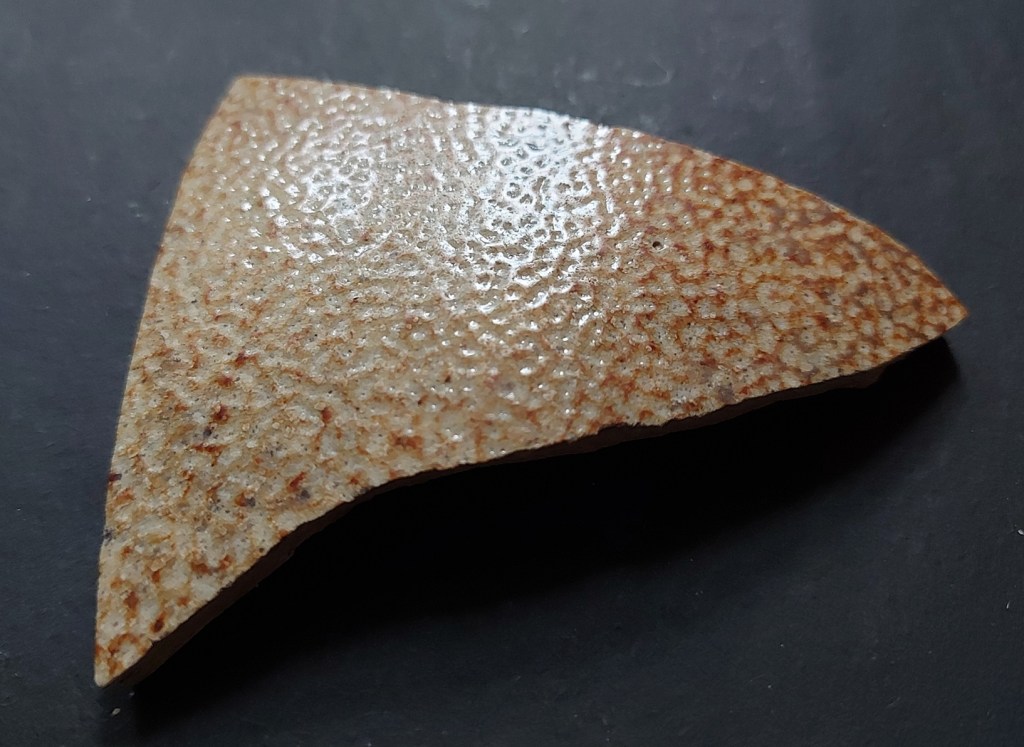
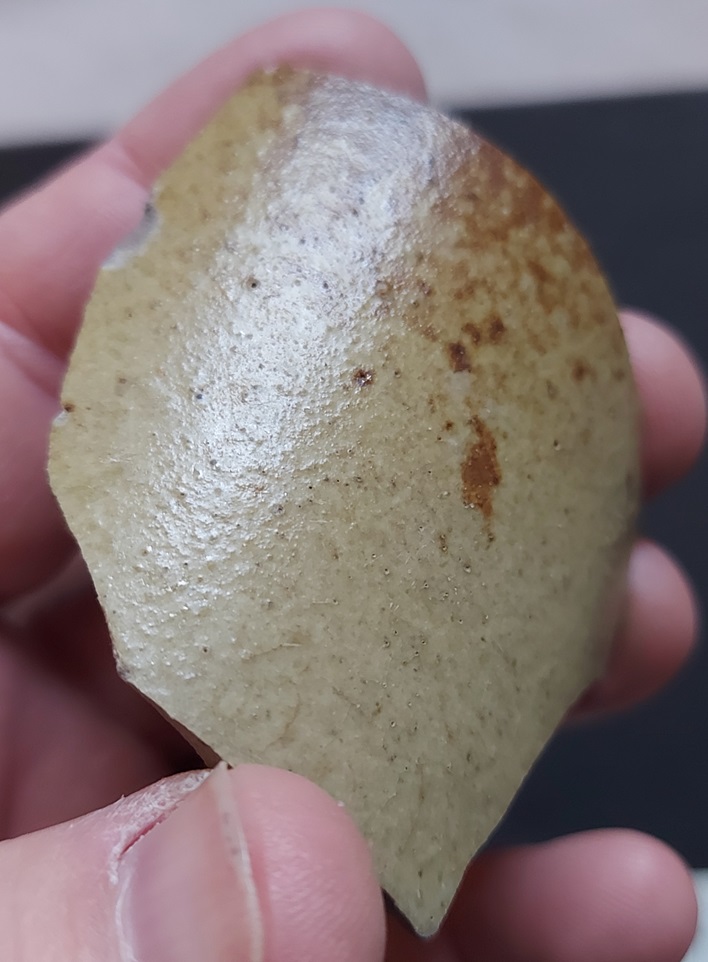
Now, although technically it doesn’t need a glaze, one is usually applied for decorative purposes, and to provide a smooth surface. However, most glazes wouldn’t survive the heat needed to produce stoneware, so early Stonewares used a salt based glaze. In this method salt is added to the kiln, which vaporises into the atmosphere inside coating the vessel. The sodium oxide in the salt reacts with the silica in the clay producing the characteristic ‘orange peel’ surface which is particularly associated with early forms of salt glaze pottery.

The salt glaze is naturally a creamy light brown colour – honey and mustard are words often used – although when other chemicals are added, this can change (the iron rich salt-glaze in the Nottingham/Derbyshire stonewares, to name an example we have seen before). Vessel forms associated with the earlier salt-glazed stonewares are bottles – some of which could be quite large – mugs, and jugs. Perhaps the most famous type is the Bartmann, or Bellarmine, jug:

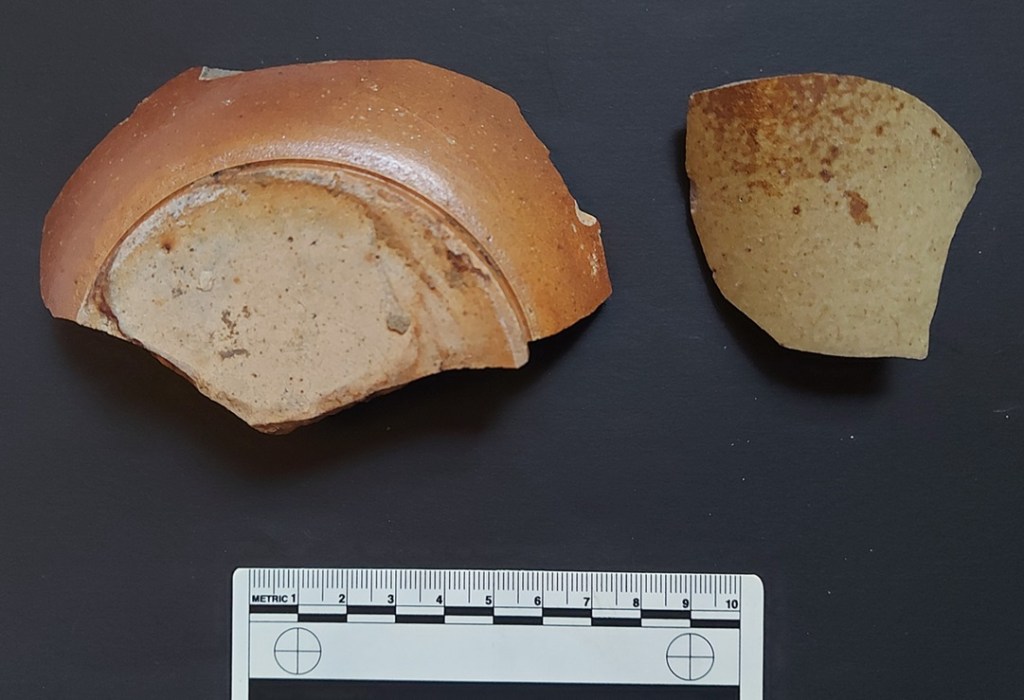
the Bartmann (German ‘Bearded Man’) was produced in the Colgne area of what is now Germany in the 16th – 18th centuries, and were exported all over Europe, containing wine and other liquids. They were imported into Britain in huge quantities, and are relatively common in the London/south area, but much rarer up north. Their characteristic bearded face give them a sort of human-like appearance – a man with a large belly – hence their other name of Bellarmine Jars, after the portly Cardinal Bellarmine. I am almost certain that my favourite sherd above comes from a Bartmann… or is that wishful thinking?

It is this human-like appearance that may account for their popularity as ‘witch bottles’ as a form of sympathetic counter-magical protection very popular in the 17th century (although examples exist of ‘witch bottles being made in the early 20th century). If you suspected that you were being cursed by a witch, you took one of these bottles – symbolically representing the witch, and in particular their bladder – and fill it with urine, nails, metal pieces, broken glass, hair, and other assorted unpleasant objects; stopper it, and then gently heat it in front of a fire. The idea being that this would cause the witch intense pain in the bladder, causing them stop cursing you. Depending on the need, the bottle could also be buried, particularly beneath the hearth, so that the pain continues. Unpleasantly, there is at least one instance on record of a death caused by the bottle exploding – a sort of stoneware hand grenade. As an aside, Magical household protection and counter magic in the Glossop area really needs its own article, as I have a whole pile of evidence for such practices. Hmmm… let me see what I can do.

By mid to late 18th century, and probably connected with the increased use of coal-fired kilns, the surface of salt-glazed stonewares begins to smooth out – a useful rough dating tool for sherds – the rougher the orange-peel, the earlier the bottle… or something like that.  

Around 1835 a new, no salt-based glaze was developed – the Bristol Glaze. My notes inform me that this is technically a “feldspathic glaze slip using zinc oxide“, and I for one am not going to argue with that. This produced a much smoother and more consistent surface, and was widely adopted. This is most characteristically found in a two-tone version, with the upper part of a bottle being a mustard colour, with the lower a pale grey or cream.

There is something aesthetically pleasing about these bottles, and they have a sort of gentle nostalgic feel about them, which is odd because they stopped being manufactured at the turn of the 20th century when glass bottles became the norm. Again, a useful dating method – not a hard rule, more of a gentle indication.

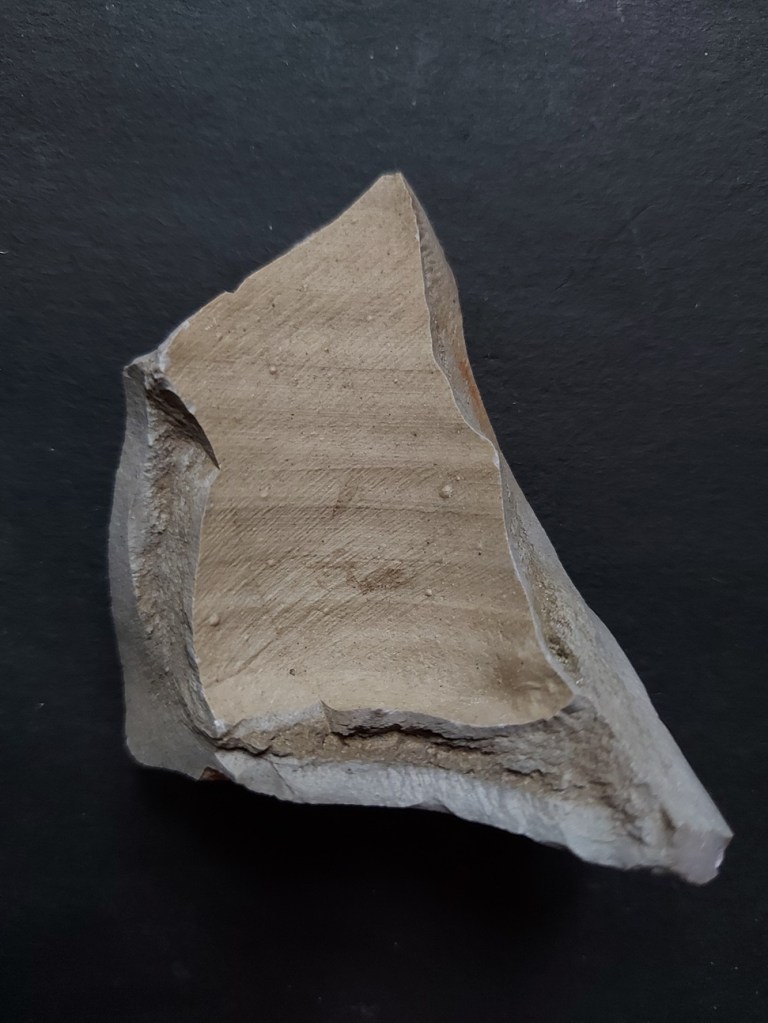
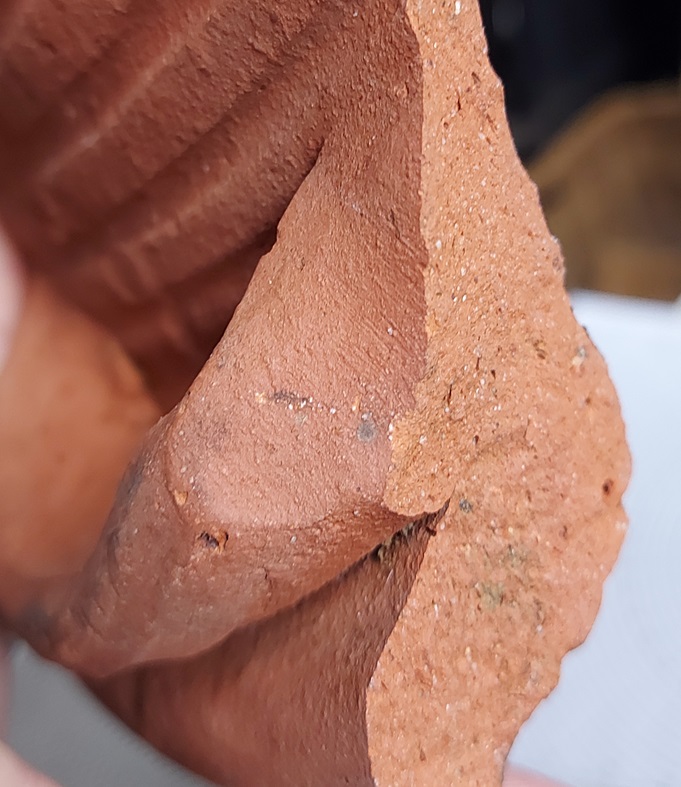
The Victorian period saw a huge explosion in the production of stoneware, and in particular bottles which were, remarkably, all hand made on a wheel. If you find a broken bottle, look carefully at the interior; you can normally find pulling marks, where the potter has formed it using their hands, and the base frequently has circular marks from when the finished bottle was cut from the wheel using a string whilst it was still turning.

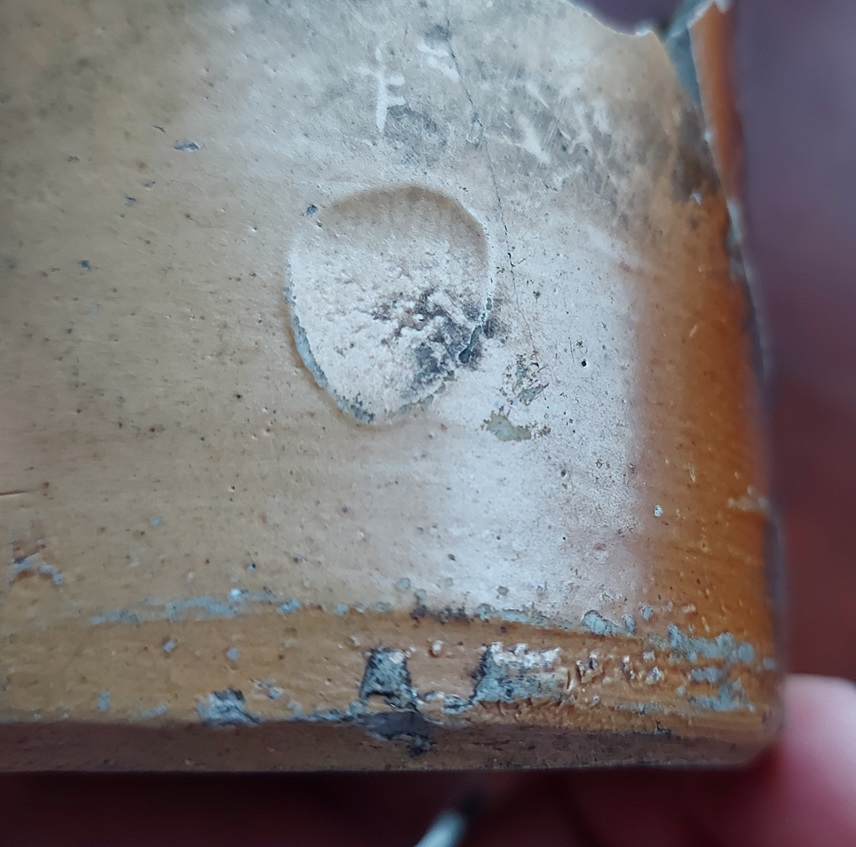
This photo of the bottle interior really illustrates how the bottle was made. Not only can you see the large horizontal ribs made by the potter’s fingers as he draws up the clay to form the shape, but you can see wiping marks running diagonally, formed as the potter used a cloth to smooth the interior. Once the bottle is finished, it was cut from the wheel using a string or wire, which usually leaves characteristic marks:

The wire is drawn toward the potter who would have been sat to the upper right in this photo – the ‘U’ shaped marks pointing toward them. But note also the slight wobble in the ‘U’ shape, produced because the wheel was still moving slightly; speed is of the essence here, as the potters would have been paid for the number of bottles made.

I love this, not only does it provide us a view of how the bottle was made, but it really gives a connection to a long dead human, a real person amidst the industrialised chaos. I read somewhere of celebratory bottles marking the occasion of a potter’s millionth bottle being made, which gives you an indication of the scale of the bottle making industry.  

On bottles, the name of the bottle manufacturer is often found impressed into the clay, usually near the base.

The name and logo of the company, as well as the contents, are much larger, and were originally impressed into the body.

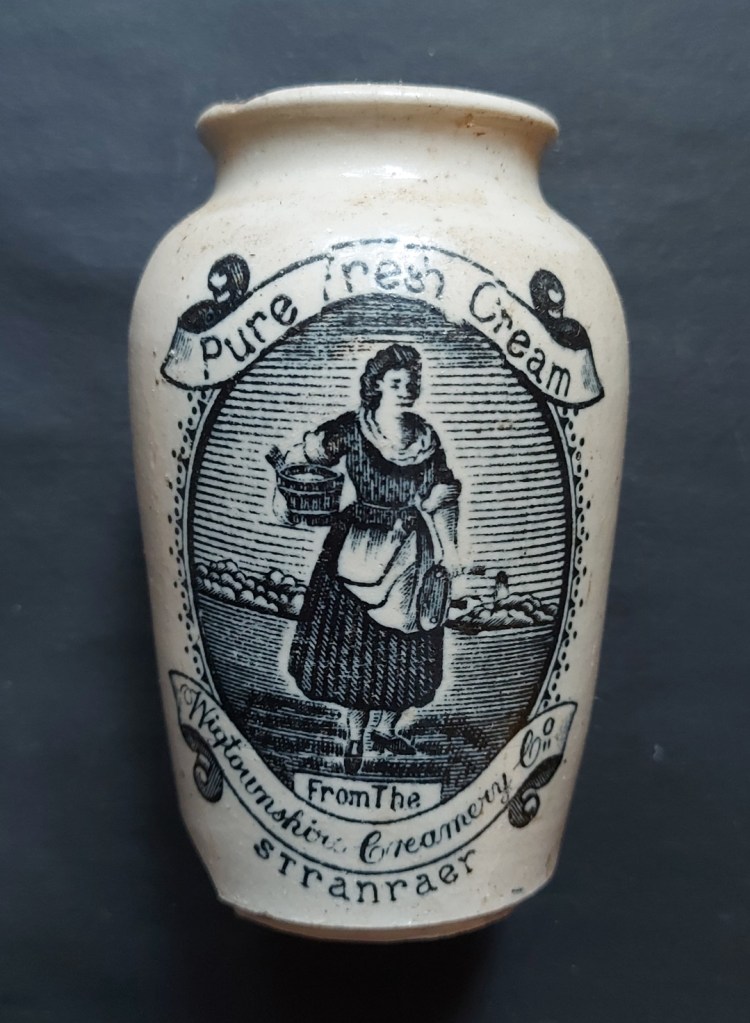
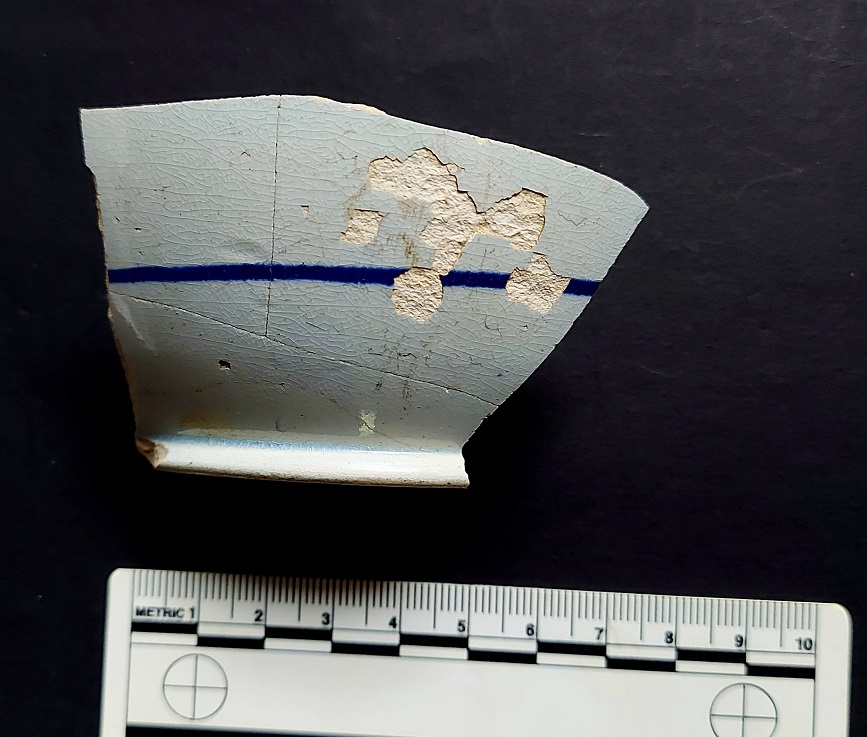
After about 1880 (ish), the development of high temperature resistant transfer printing meant that information and designs could be clearly printed on the side.

Common are ginger beer bottles (though truthfully, they contained all manner of drinks), blacking bottles, containing blacking for ovens, and which are, oddly enough, normally white in colour. Also cream pots, milk bottles, and large flagons of cider or chemicals.

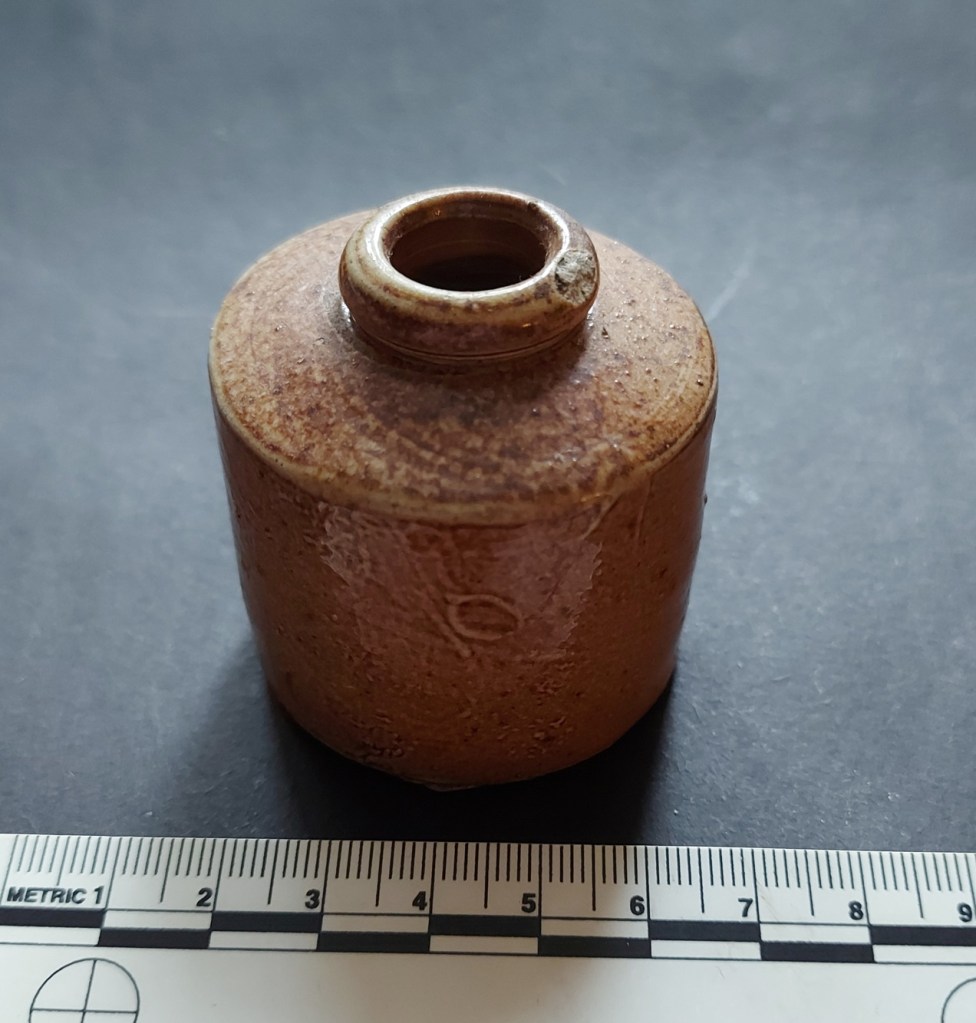
Ink bottles, too, and in particular the ‘penny ink’ bottles are common. Also known as pork pie inks, as they are the same shape and size of said savoury delicacy, and cost how much… that’s right, a penny.

Always check the exterior of any sherds you find, as often they have finger marks on the exterior, from where the wet glazed and pre-fired pot was put on a rack to dry. Often, soberingly, the finger marks are very small, an illustration of the child labour that underpinned the industrial boom of the Victorian period.

Right then, I think that’s all I have for Victorian Stonewares, and honestly that is about all we need – it’s very recognisable, but it’s good to have a little context. I know I’ve said it before, but I’d really like to try my hand at potting, perhaps reviving some of the older 17th and early 18th century shapes of cups, mugs, plates; I’ll add that to the list of retirement plans!

So then, other news.

I’m planning a new Wander, this one involving lots of medieval bits and pieces, and a merry jaunt from Whitfield to Old Glossop, and back. It will form the basis of two future issues of Where/When… when I get round to writing them up. But before that can happen, it needs a test-drive, so to speak. Keep an eye open here, on twitter, or simply “what ho!” me in the street. I’ll put it on Eventbrite, too, so I can keep an eye on the numbers. I’m excited about this one, so watch this space, and let me know if you fancy it.

The first issue of the Where/When ‘zine is still available, only £5 and available at Dark Peak Books, or seek me out. A free PDF is available, too – click on the tab at the top of the site.

I’ve got a lot of big ideas and collaborations that might come to fruition. Might. But again, watch this space. And do stay in touch… It’s nice to know that all 6 of you are ok! Expect another post soon, too… I’m aiming for two in February. Aiming…

So then, until next time, look after yourselves and each other, and I remain.

Your humble servant,

TCG

History · Nothing in particular! · Stones of Glossop

A House, A Hive, and a Trueman

(Will I make it before January 31st?.. that is the question)

What ho, wonderful people, what ho!

And my how I have missed you all. Well, most of you at least. Not you Mr Shouty-Outy, nope. But surprisingly today’s offering is pottery free, so you have no need to say anything at all.

So then, Christmas is over, and the New Year’s hoohah is done with… alas. Invariably at this time of year, a certain sombreness overtakes old TCG. Gone is the ‘devil may care’ attitude of yore, and instead a certain ‘not even the devil cares’ feeling overtakes one’s bean. There is a noticeable drooping of one’s shoulders, a subtle sadness of the ‘O the pain of life‘ variety, and a distinct lack in the old J de V. A funk, if you will, the like of which even the stuff that cheers – if taken in the correct dose – fails to cheer. Not that it stops one from trying, obviously.

And so, trying to raise my spirits, I found myself idly flicking through the wonderful History In a Pint Pot by David Field, which is a detailed history of all of Glossop’s pubs, past and present. Highly recommended, but sadly long out of print, athough the library has a copy if you want a read… and you should. I was looking at my local, The Beehive, when at the back of that particular entry was an old advert dated to sometime in the Victorian period that looked vaguely familiar.

Beers, wines, spirits, cigars, horses, stone… there’s not a lot that can’t be bought at the Beehive.

*Ping* went a synapse… a second passed… then *thunk* went a receptor (I may have slightly overdone the festivities this year, and the old noodle is functioning at approximately half normal speed). Where had I seen it before? And why was the advert significant? What? Where? When? And then it hit me… St Mary’s Road. Oh yes… something I should have blogged about before now.

Sooooo… a few years ago someone messaged me via, I think, Twitter, and asked if I had seen the name carved into the the gutter of some houses at the top of St Mary’s Road, and did I have any information.

Before we go any further, confession time. I am, as you might have realised, quite good at some things (*cough* pottery *cough*) and terrible at others (*cough* communication *cough*). I am also fairly disorganised in some areas (*cou… YES, alright, we get the picture… here, have a throat sweet). So it should come as no surprise to anyone that I cannot for the life of me recall who it was, nor can I seem to track down any record of the conversation. So if it was you, then please accept my humble apologies, and step forward to make yourself known and famous to all 7 of the people who read these posts (including Juan in Venezuela).

So then, had I seen them? No. And had I any information? Also no. And so it was I found myself walking down St Mary’s Road, muttering to myself as I am wont to do.

No’s 116 to 122 make a small terrace of four stone-built houses, typically mid-late Victorian in shape, and are much like all the others around them.

The corner of Duke Street and St Mary’s Road.

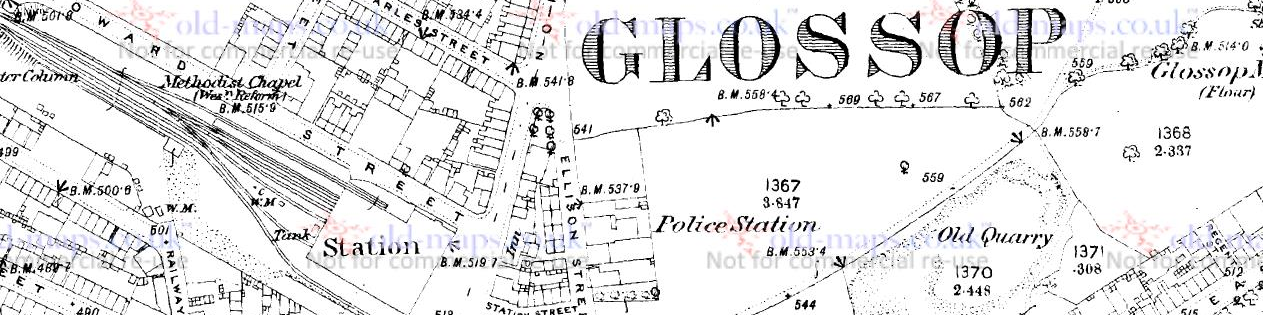
They don’t appear on the 1880 1:500 OS Town Plan

The lack of houses is circled in red, with St Mary’s running broadly NW-SE. Map stolen, as usual, without shame, from the enormously useful and always fascinating National Library of Scotland OS map database. Check it out here.

But they do appear on the 1898 25 inches to the mile OS map:

You can really see the map filling up, and a real sense that Glossop is still filling out to its Victorian and early 20th century maximum. Map stolen as per above!

Which gives us a date of between 1880 and 1898 for their construction.

So about the name, then. It took me a moment or two to see them, but at the end of each of the corbels that hold up the guttering, you can see a letter or character.

Apologies for the darkness of these photographs… I didn’t realise quite how murky they were until they

Wow! I love this, and I cursed myself for not noticing them before – serves me right for always having both eyes on the floor! It is difficult to photograph these without a telephoto lens, but also without attracting the ire of householders, who oddly don’t like it when you stand around taking photos of their houses, usually muttering threats of ‘setting the dogs on you’; people are strange. Anyway, the best I could do is the following stream of photographs; apologies in advance!

J O H N
+ T R U
E M A N .

So then, what do we have?

J O H N + T R U E M A N 0

Nice! A mystery. There is very little relevant online, but there was a reference to a John Trueman as the publican of the Beehive Inn in Whitfield, which was worth following up, and hence the History in a Pint Pot advert. The connection is not immediately obvious, but the fact that Trueman was mentioned as both wine and spirit merchant, and a stone dealer in the advert suggests that he built the houses, and probably using his own stone. It seems that the position of publican of The Beehive (or ‘Bee Hive’, as it was then) came with the rights to the quarries at the end of the track beside the pub, next to Fieldhead Farm there.

The Beehive is arrowed in red, but you can see the track leading to the quarries at the end.

William Miller, the landlord in 1857, is also described as a stone dealer. Our man John Trueman was landlord here between 1871 and 1894, which is also spot on for the date of the houses. I like the idea of him wheeling and dealing, serving pints and stone in equal measure. And if you build houses, then why not go ahead and sign them, particularly in a rather cool way. There seemed to be a lot of that around at the time, and as I was walking away from St Mary’s, I remembered another named building that I’d like to take a look at – Norfolk Buildings on Victoria Street:

Norfolk Buildings and The Surrey Arms

According to Robert Hamnett, The Surrey Arms and the three adjacent houses in the terrace were built in 1846 by James Robinson, who owned a large number of houses (and presumably having built them, too). You can see the uniform design and decoration of these three, especially in comparison with those buildings to the left, which are smaller and built to a different design. You can also see the ‘join’ between the two groups. It seems that these houses were constructed later that Norfolk Buildings, and presumably by a different person – again evidence of the piecemeal process that characterised Glossop’s Victorian building boom. The name/datestone is above the centre of the three houses:

I wonder if ‘archaeologist‘ would hold up in court as a defence against being accused of being a ‘peeping tom’. An academic question, obviously… purely theoretical.

‘J.R. NORFOLK BUILDINGS 1847’

The ‘J.R.’ is presumably James Robinson, and the buildings named after the Duke of Norfolk, whose investment in the town was arguably at it’s greatest in the mid-19th century. The date speaks for itself, though Hamnett notes that the lease for the pub dates from 28th March 1846, so this might be a lease connected with the land itself, or perhaps the proposed pub.

So there it is, this month’s offering… and I made it in January! There are so many Victorian datestones in the Glossop area, many recording details beyond just a date, and we find house names, builder’s names, area names, and the like. I’d like to do another survey of datestones or name plaques for the Victorian period, to accompany the one I did (and is still ongoing) for the pre-Victorian period. Or, you know, convince one of you to do it and publish it on the website (if you fancy the challenge, give me a message). Anyway, more again very soon.

In other news, the first issue of Where/When is back in stock. So, if you fancy a guided Wander from the Friendship Inn to The Oakwood, via Ashes, Dinting, Adderley Place, Pikes Lane and Harehills, and through the prehistoric, Roman, and medieval periods, then this is the publication for you… especially if you like what you read here!

You can download a free copy here, but there’s nowt like a physical paper copy: £5 from Dark Peak Books, on High Street West on Glossop (and I might be the one to serve you!), or you could just ask me, and I’ll bung one to you. For those that have been asking, Issue 2 is on the way… and honestly a fantastic one it’s going to be.

I’ve also got a few actual different Wanders planned, real actual physical walks led by yours truly, up hill and down dale, and through our amazing shared historical landscape. You can even throw stones at me when I start to bore you about pottery… and no, that doesn’t mean you can sign up for it just to lob rocks at me, Mr Shouty-Outy. Anyway, watch this space as I’ll advertise it her, and elsewhere.

So that’s about it for now. Hopefully I’ll get a couple written for February – I have so many half-finished articles it’s ridiculous, and I just need to get on with it (lots of pottery goodness!). But until then, look after yourselves and each other, and I remain.

Your humble servant,

TCG

Archaeology · Pottery · Whitfield

Friends… and Neighbours

What ho you lovely people!

I trust you are all recovering from reading the mighty publishing phenomena that is Where/When Issue 1? Move aside JK Rowling… Harry Potter was good, but was it ‘Pottery’ enough? See what I did there? Pottery… Potter…

What? What do you mean “don’t give up the day job”? This is my day job! And you, sir, are frankly uncouth! Honestly, what do you mean there are “funnier types of fungal infection”?

If you haven’t bought a copy yet, go and grab one from Dark Peak Books, or from me, if you can track me down. Or even download a free copy (link above). A perfect stocking filler, even if I do say so myself. Oh, and plans for a second and third edition continue to form… watch this space. Or Twitter. Or Instagram. Or just get in contact!

Anyway, shameless self-promotion over with let’s get on with the show, so to speak.

So, I recently became aware of a group of wonderful people – The Friends of Whitfield Rec and Green Spaces (their Facebook page is here). They are a group of Whitfield residents who are helping with the day-to-day upkeep and improvement of Whitfield Recreation Ground and other green spaces (for example planters, and other bits of land that might otherwise be neglected). A wonderful idea; we who use it, help keep it usable rather than rely just on the council who, with the best will in the world, don’t always the time and resources, or the local connection, to do this. I’m a big and passionate believer in the phrase “be the change you want to see in the world” (a saying usually attributed to Ghandi), and this group is a great example of this in action.

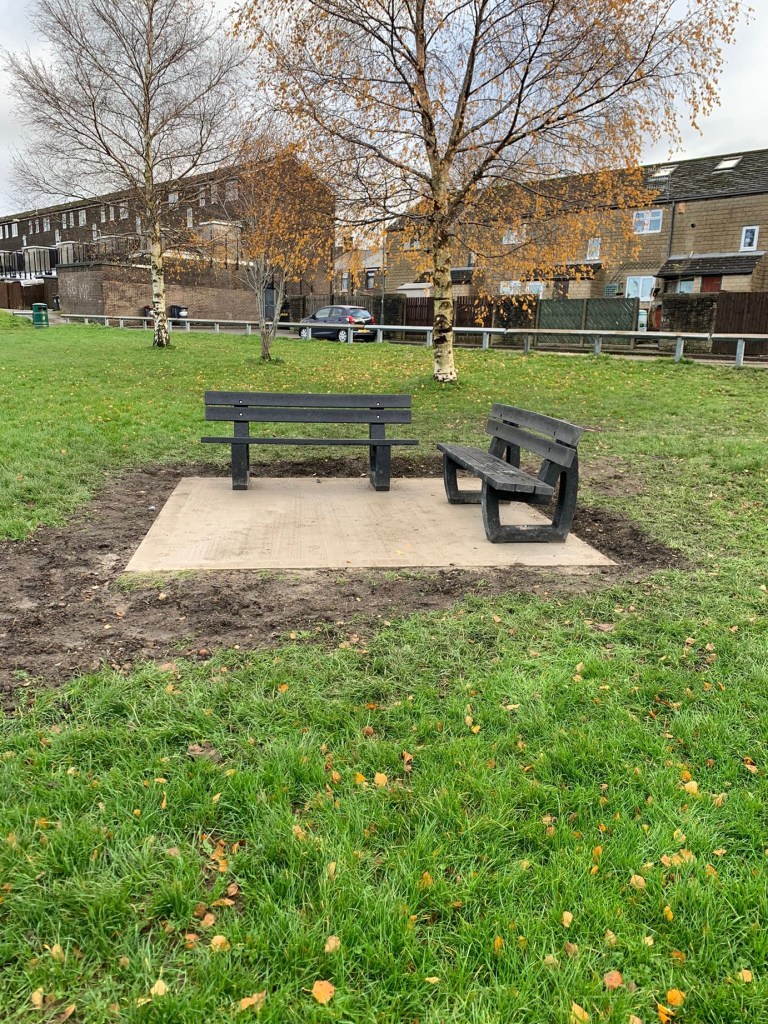
This summer they planted a pile of… er… plants in the grass around Whitfield Wells, improving the look of the area and adding a little wildness – an excellent example of what they do. And a few weeks ago they organised and installed some good looking new benches at the Rec. giving me somewhere new to sit and ponder the world… and my own navel whilst Master C-G and assorted other Herberts run riot.

The eventual idea is to landscape mounds and hedges around them, creating a wonderful usable social space. But back to the present, and the realisation that one cannot make benches without breaking soil – or something – and my spidey-sense began to tingle… do I smell pottery?

I did indeed.

A pile of pottery.

Most of the stuff I found was typical late Victorian and early 20th century tablewares. Not unexpected, and it is largely domestic rubbish, on wasteground, dating from a time when there was no rubbish disposal. Some of the more interesting bits in the above photo, then. Top row, second from right is a shallow bowl or plate with a rim diameter of c.18cm with a hand-painted red band running on the interior – a common motif in early 20th century pottery. Next to that is a fragment of a large rounded jar with a decorated out-turned rim (I should probably start explaining what I mean by all these terms… possibly). And next, a rolled rim from a brown stoneware cooking pot. Bottom row, second from left is a sherd of open pattern spongeware. Fourth from left is a sherd that has decoration hand-painted on the top of the glaze, and the two sherds on the far left are porcelain. As I say, fairly mundane.

However, some pieces were a bit more interesting.

First up, we have a fragment of a Pond’s Cream (or similar skin care product) jar.

Difficult to see in a photo.

It is made from milk glass – an opaque type of coloured glass – and is roughly square shape in plan, with rounded edges and large vertical grooves; it would have looked lovely when whole. It also has a screw top, which generally means it is early 20th century in date.

These three are quite nice, too.

Lovely stuff. And an ok photograph! I had so much trouble taking these – it was so dark even during the day that the pottery was showing out of focus.

Top left, a small plate of Shell Edged Ware, which my own guide suggests is mid Victorian. Bottom left is a hand painted tea cup of c.10cm diameter; it would have been quite lovely. Right is a sherd of Banded or Annular Industrial Slipware, with a rim diameter of c.10cm, and probably from a Late Victorian tankard (they are common in this design), and perhaps, we might speculate, from The Roebuck pub on Whitfield Cross.

These are very nice.

Left is a lovely sherd of Spongeware – a flower from a much larger design. Right is the neck from a Brown Stoneware bottle or jar of some sort. The incised decoration on this sherd is very sharp, indicating that it came from something potentially very fine. Both Early Victorian at a guess, so perhaps heirlooms when they were thrown away, or indicating that there is earlier material in the ground below the Rec. – which would be unsurprising.

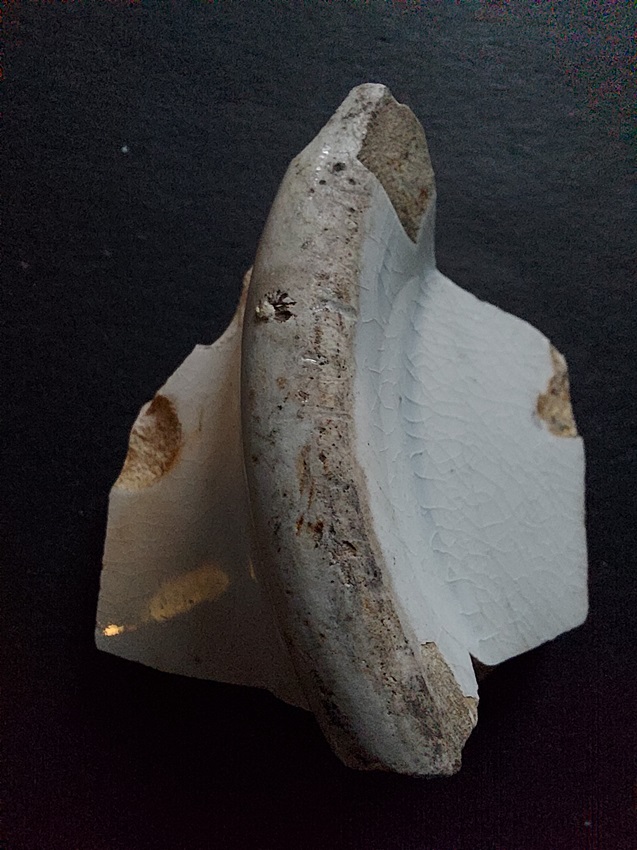
I love this next sherd – a ring foot from a larger open bowl or serving platter.

Unassuming, and a little boring at first glance

It looks boring, but is almost certainly early Victorian, and has seen some heavy use, perhaps indicating it too was an heirloom when it was broken and disposed of.

Very diagnostic – wear and glaze.

The wear on the ring foot is clearly visible – it has been moved about a lot – in and out of cast-iron ovens in particular – scraping off the glaze and wearing out the ceramic underneath. Also, note the blue tint to the pooled glaze, indicative of a Pearl Ware, and which was largely unused after about 1850. Knowing this sort of thing is the reason I’m a hit at so many parties… such is the burden of the sherd nerd!

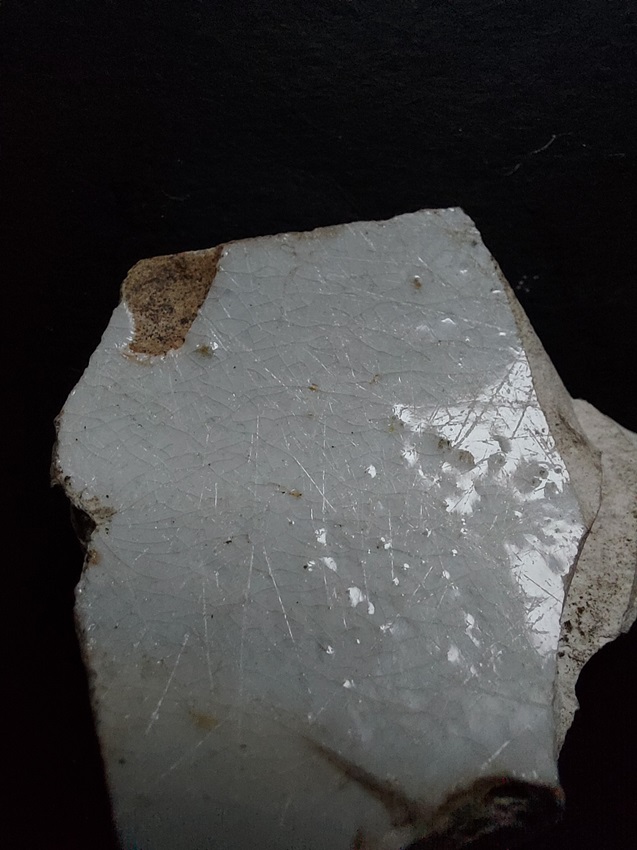
Extreme close up!

Looking at the interior surface you can see many scratches – cut marks made by a knife, probably cutting up meat in the process of serving food. This vessel had seen lots of use before being tossed into what would become the Rec. I love it – the human touch.

Finally, there was this:

No, honest, it’s not just a stone!

It may not look impressive… and to be fair it isn’t. It’s a piece of spent coal – or cinder – and it’s what is left over when you have burnt coal. But it is a hugely significant in that every house would have produced lots of this material, and it should really be seen as a marker of domestic life in the late 19th and early 20th century. I love it for that… not enough to keep it mind, but it is a lovely, if very common, little piece of social history that I wanted to share with you.

So my sincere thanks then to the Friends of Whitfield Rec and Green Spaces for inadvertently sponsoring this month’s post!

Whitfield Recreational Ground has an interesting history – I’m not going to go into it too much as I’m not sure I could do it justice in this article, although it does need doing. Briefly though, Robert Hamnett (the historian) notes that Wood Street – and presumably the whole area – used to be an open field. He states:

“When I first remembered it there was a disused brick yard in the centre, with numerous depressions, which after heavy rain became dangerous to children playing there; in fact there have been cases of children drowning there”.

The whole area was improved and landscaped by George Ollerenshaw in the late 19th and early 20th century. He built the houses on Wood Street, and donated the library building that once stood at the southern end of the park (now the toddler park). His monogrammed initials and date of 1902 are on the Wood Street entrance to the park.

The ‘G’ and ‘O’ monogram of George Ollerenshaw.
1902 – the year the park was opened. I love these, and this entrance – a real faded glory.

Obviously, over the years I have picked up a few bits and pieces from the Rec:

A selection of fairly mundane and entirely expected Victorian pottery.

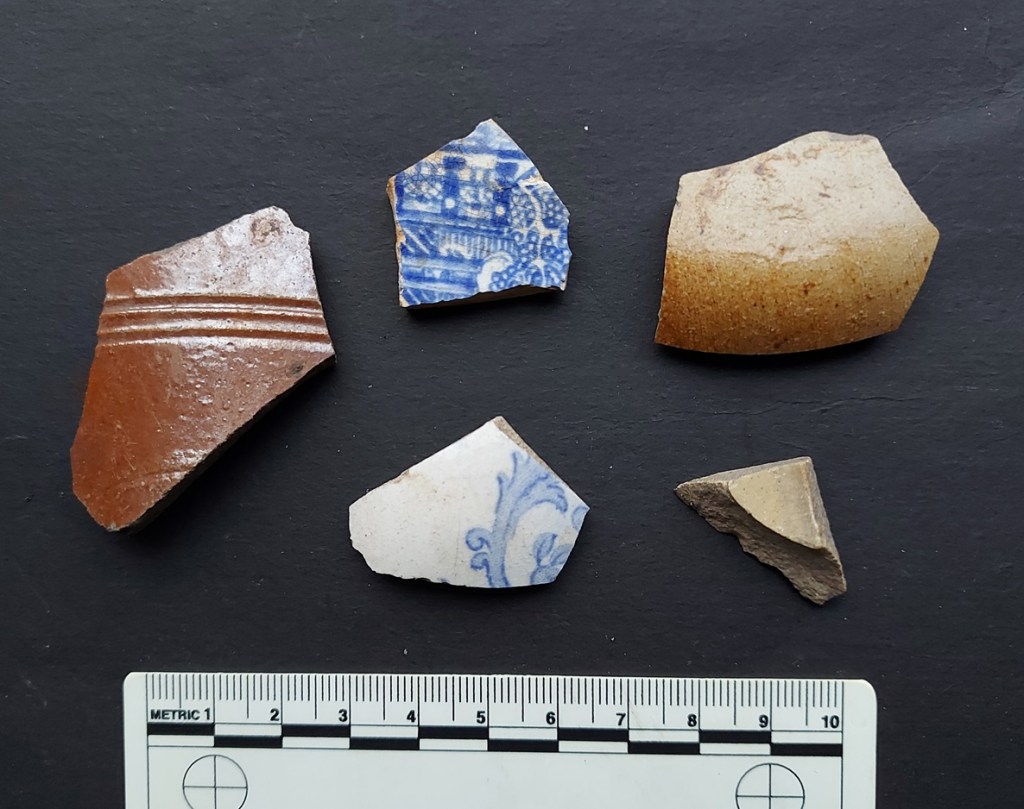
On the left is a sherd of nice and finely incised Brown Stoneware, probably from a bottle, and possibly early Victorian, as later types are less precise and do away with the incised bits. The middle sherds – one on top of another – are bog-standard Blue and White transfer Printed Ware. The two bits on the right are Salt-Glazed Stoneware, and probably from a ginger beer bottle. Lovely stuff this (and the subject of a future Rough Guide). I also think I can just about make out a smudged fingerprint on the exterior from where the pot was moved whilst the glaze was still wet. Possibly.

Excitingly, we have this:

A close up… perhaps too close?

A clay pipe bowl fragment, with rather lovely fluted decoration – flat panel of gadrooning (don’t say we don’t learn you nuffink on this website… and yes, I didn’t know either, I only learned it accidentally by researching this pipe!). However, nice though it looks, it is roughly made; the seam, where both parts of the mould come together, is coarse and untrimmed, and the clay has been poorly formed in mould. This is mass production in the Victorian period.

And finally, just like the cinder piece above, we have a very mundane but quite important object… a piece of roof slate.

I mean to say… it’s not much to look at.

It really is mundane, but is quite informative. Slate is not local: Wales is it’s origin, and until the railways enabled the movement of relatively heavy fragile material like this, that’s where it would have stayed. Once the railways were established (c.1840’s onwards), it quickly became the roof material of choice – just as strong as local stone, but 20 times the weight. indeed, you can usually date the houses of Glossop to roughly pre- and post-1850 by the roof material: stone vs slate. This slate has a flat smooth edge (at the top in the photo) where it has been shaped, but other than that, it is utterly unremarkable, and it simply exists as a remnant of the 1000’s of houses that once stood very close by but which were pulled down during the rebuild of this area during the 1960’s. Indeed, the roof of the public library that stood here was also slate, so it might be part of that as I found it not 10 feet from where it once stood (underneath the toddler play area).

None of these finds have a context – they are all simply rubbish dumped here mostly when it was an open field and before it was transformed into a park. It’s interesting to ponder that for a moment. The Victorians were awful when it came to litter; everywhere they went they left a trail of pottery, glass, metal, and bone – rubbish all over. Now arguably, these are organic, and are not largely made from toxic oil-based plastics as much of our litter is, so not as ‘bad’. Nonetheless, it is safe to say the Victorians were absolute scumbags, and although some of it will have been picked up, there is still lots to be found. If groups like the Friends of Whitfield Rec and Green Spaces have their way and remove all the litter from these places – and I hope that they/we/you achieve this – then are they doing a future me out of a blog post or two? There may be no rubbish to mudlark/fieldlark and blog about! Unfortunately, the massive amount of plastic rubbish that seems to crop up everywhere you look would indicate that this is not the case, and in 200 years no doubt some sad geeky bloke will be publishing a monthly article on a website, and enthusiastically waxing lyrical about this piece of rubbish or that bit of bottle. Imagine…

Get in contact with the Friends via their Facebook page; help them out, give them ideas, give them time, resources… even a cheer. They really do deserve it for everything they are doing, and attempting to do (read a bit more about them and what they do here). Also, do something simple: pick up a piece of rubbish from the street and put it in the bin – every bit we do, helps the bigger picture. And the future me won’t hold it against you, honestly.

That’s all for now, and it only remains for me to wish you a very merry Christmas whatever you end up doing. Personally, I shall be basking in the glow of a fire with family, some cheese and a large glass of the stuff that cheers. So here’s a health to you all, and I hope you enjoy my favourite ‘modern’ Christmas song.

And/or my favourite more traditional song:

I’ll be back in the new year, but until then, and especially at this time of year, please look after yourselves and each other, but until then, merry Christmas (and a merry solstice).

I remain, your humble servant.

TCG

Where / When

Where / When – The ‘Zine

What ho!

At long last… it’s here!

So, welcome to the official launch of the new Glossop Cabinet of Curiosities magazine:

WHERE/WHEN – The Journal of Archaeological Wanderings.

Whoopee“, I hear you cry! “Tell us all about it, TCG!” Well, the basic idea behind the ‘zine is to give a guided walk in the same irreverent, but academically sound, way the website does, but with added psychedelic and arty photographs and exploring weirder elements. This first edition – titled Ashes, Arches, and Harehills – is essentially a walk from Point A (The Friendship Inn) to Point B (The Oakwood), though some of the lesser known parts of Glossop (Ashes, Dinting Arches, Adderley Place, Roman and Medieval Roads, and a 1920’s bridge). Along the way, I add what I know about the history and archaeology of where we are walking, and filling out any hidden or overlooked bits and pieces. Simple, fun, and hopefully interesting.

This last word is important, as I want you to experience the place you are walking: to stop, look, and listen; to feel. To look at a track and ask “what’s down there?” Or pick up a piece of pottery or stone and ask “what is it?” Or better “why is it?”. Or to feel the past in a place, to experience it with your senses. Every part of Glossop has traces of the past on it – every building stone show multiple holes, carvings, fixings, splashes of paint, chips taken out, or repairs. And walls stop and start, or take odd angles for no reason; trackways bending to avoid something that is no longer there. Odd bits machinery or re-used stonework appear and disappear in the mist, and trees form shapes that may or may not be real. If we don’t stop to look, we miss them and we miss the experience.

I hope Where/When will get you walking and thinking, exploring and pondering… wandering. Which all sounds as though old TCG has lost his marbles, and that may well be the case, but our heritage is all around us, sometimes hidden, often vague or confusing: so let’s wander together and see if we can find it.

It is also most certainly the first in a series issues of Where/When, and I have already planned out several future editions, including No. 2 – Of Bulls and Bees, and No. 3 – Of Hives and Heads. These are a two part wander from The Bulls Head in Old Glossop to The Beehive in Whitfield, and back again, using only the preserved remains of medieval and post-medieval (17th century) trackways. I fully intend to offer an ‘event’ for this – let’s walk it together from pub to pub, and I’ll give a full rambling account. Well, perhaps not… don’t want to frighten the natives, what! But what’s not to love… a wander, some history, a pub, and the company of old TCG! Watch this space in the new year.

I also have an idea for some slightly more far flung editions (Alderley Edge for example, and possibly Chester), but let’s see how this first edition does. And I honestly have big ideas for this – it’s really quite exciting (drone flights? Podcasts, with old TCG’s dulcet tones accompanying you on the route? Guest spots?). Also, if any of you feel like you want to offer a wander to be published in Where/When, please drop me a line and we can talk it through.

The ‘zine is 40 full colour pages, filled with interesting words (in an order that broadly make sense) and some pretty awesome images – a perfect Christmas stocking filler for the Glossop people, or those in the greater Glossop diaspora! The price is £5.00 per copy, and it will be available from Dark Peak Book at 96 High Street West – the added bonus is that it might be me that serves you! Or you can also drop me an email and I can post one out to you, wherever you are. Or simply track me down, I’m not hard to find! Or you could even dig a hole in the ground and wait… like a moth to a light!

I have also added a download link to the Where/When section at the top of the website where you can download a free Pdf copy of the zine. It’s exactly the same zine, just in electronic form… and free! I’m also adding a ko-fi link next to the download button so you can buy me a glass of the stuff that cheers, should you wish to, but don’t feel obligated.

Where/When page here

Free Pdf here

Ko-Fi – Buy TCG a glass of the stuff that cheers here

There will be a regular post before Christmas, but I wanted to strike whilst the iron was hot and get this out there.

So until then, look after yourselves and each other – and happy wandering – and I remain, your humble servant.

TCG

Archaeology · Pottery

4000 Holes in Glossop, Derbyshire*

*well, one, actually… but it is rather an interesting one. And also, my apologies to The Beatles.

What ho! good folk of the blog reading sort, what ho!

Now, as you probably know (for the Bard says it so) some are born with pottery, some achieve pottery, and others have pottery thrust upon them… or something. I think I fall squarely into the latter camp, if by thrust you mean stumble across it, even if one isn’t looking for it.

And so it was the other day. I had dropped off young Master CG at a friend’s birthday party, and had taken the opportunity to saunter into town to pick up a few things (certainly nothing pottery related: lego, wine, and masking tape, I think it was… which gives yet another somewhat intimate peek into my life). I wandered down High Street, and wondered if it was too early for a glass of something cold and refreshing. Crossing the end of Market Street I looked left and idly noted that the road was closed… and then I noticed the ground had been dug up, with a good sized pile of spoil indicating that there was a hole.

Now, as an absolute rule, if an archaeologist sees a hole in the ground, they will peer into it. It’s so natural, so predictable, that it has become a sort of archaeological equivalent to the Masonic Handshake, and using it you can spot us a mile away. “I say! What’s that chap over there doing – peering into a hole?” they say. And comes the response “Oh that’s just old TCG, doing a spot of ‘hole peering’… he’s one of those archaeological types, don’t you know – curious fellows“. This is also why you never see large groups of archaeologists walking together; if they accidentally stumbled across some roadworks they could be there for hours, peering. From the outside it would look like a mass escape from some sort of specialised care home, the inmates muttering and stroking their beards, pointing at things that might, or might not, be there. And peering. People would get frightened, angry mobs would form, torches would be lit and pitchforks procured, the police would get involved… No, it’s safer we travel in ones and twos.

But I digress from the story.

Hmmm“, I muttered, and my thought process went something like this:

Oooh, a hole… I must have a peer.”

Looking down Market Street toward Philip Howard Road. The darker soil is the material dug out of the trench, the orangey stuff is to be put in the trench.

Are those setts? Nice!

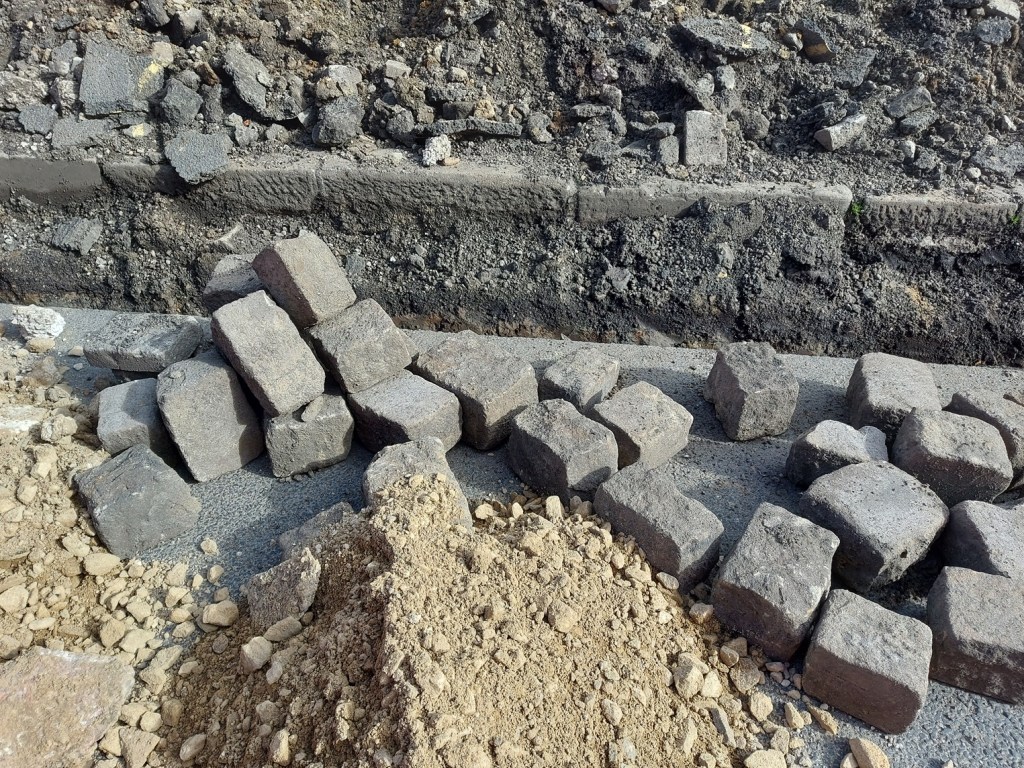
Setts: shaped stones set into the ground to provide a hard wearing surface of the Victorian Market Street, but later overlain by tarmac.

Wait, look in the soil… is there any pottery?

Lurking here and there… flashes of white and other colours. Tantalising, exciting, wonderful!
Sometimes disguised, sometimes in plain sight. If you see one, you can guarantee more are lurking, hidden, waiting.

And so I did the only sane and rational thing I could do… I wandered over and did a spot of peering! And my word, what wonders were therein contained… chock full of goodies, it was. And yes, I realise that ‘goodies’ as used here is an entirely subjective word!

Let’s start with the Brown Salt-Glazed Stonewares:

A nice selection.

At the top left, we have a bowl or cooking pot with a rolled rim and a pot belly with a rim diameter of c.14cm; if it wasn’t Stoneware, I’d be thinking that it was Roman! Next to that part of the base to a large cooking pot; you can see the wear on the base where it was put in and out of an oven many times over the years. Bottom left is a thin walled open vessel, and with a diameter of 10cm is probably a mug with a horizontal linear banded decoration. The shiny lead-based glaze is particularly noticeable here, as is the orange peel effect on the exterior, characteristic of a salt glaze. This is also clearly visible in this sherd (it took me a while to get the light right on this shot, so you’d better appreciate it!).

Lovely! The speckled salt glaze is very visible.
A brace of Brown Stonewares Sherds

The sherd on the right is probably from a jar or similar cylindrical shape. That on the left is the base of a cooking pot of some form. The foot is 8cm in diameter, but it is pot-bellied, so is actually quite large. It’s also quite coarsely made, being thrown quickly on the wheel, and looking at the base you can see detritus from previously made vessels, and which have been fired onto this pot. You can also see the wear on the edges of the base where it was pushed in and out of a metal oven. Interestingly, you can also just about make out the circular marks made by the wire cutting the wet clay bowl from the potter’s wheel – a snapshot of the manufacturing process.

Close-up of the left-hand pot.

Then we have some Industrial Slipwares:

Lovely Stuff

A selection of open vessels. Rims from two lovely bowls, both of 16cm in diameter, and probably from food bowl – soup or stew, perhaps. The one on the left has a striking spotted design, and on the right, a variegated type with a joggled earthworm decoration (see the Rough Guide to Pottery Part 3 for more on this). To the right we see some more sherds, these are probably from tankards (for example, the one top right with the dark brown band has a diameter of c.12cm, which is about right).

Blue and White Transfer Printed:

Ubiquitous is the word – the classic.

Surprisingly, there wasn’t much Blue and White Transfer Printed material here, but I only collected from the surface, with no digging (which makes me wonder what I missed… eek!). What there is is fairly standard, a few bits of Willow Pattern, including a small plate or saucer of c.16cm diameter, and other assorted bits. There is also a moulded rim from a Shell Edged plate or shallow bowl.

Some hand-painted Victorian sherds:

Surprisingly colourful, and quite garish.

Hand-painted pottery was quite popular, and can be quite attractive in an abstract way – the painting being done very quickly produces some wonderful designs. I have a feeling both of these come from larger jugs, or possibly vases, although the one on the right reminds me of some of the hand-painted designs you get on Spongeware vessels (see here). This stuff is the subject of a future Rough Guide, although there really isn’t much more to say than colourful designs on a refined white clay and glazed.

Here we have some Black Glazed sherds.

Big and clunky, I love this stuff.

This stuff is interesting, and is going to get its own entry in the Rough Guide, too – perhaps next time (can anyone else hear screaming?) – so I’m not going to go into too much detail here. However, I will say these sherds come mainly from large thick-walled vessels, and specifically pancheons – huge deep bowls traditionally used for separating cream or proving bread. They are very coarsely slipped and glazed usually on the inside only, and typically have grooves on the interior, made by fingers during the shaping process. As I was peering I pulled out a sherd which has since proved to be my favourite ever example of this type – look at this beauty!

Massively chunky rim sherd from a large pancheon.

A rim sherd of a large pancheon measuring roughly 56cm in diameter – a monster! It has a lovely black glazed interior, with great drips running where it was splashed and placed upside down to empty and dry before firing. The exterior is something to behold, too:

Unusual decoration.

Wonderful grooves running horizontally around the body, made with a comb of some sort and which left some of the flashing. And look at that handle! For some reason it rare to find handles (there’s usually two of them), but this one is perfect – you can even see the potter’s thumb mark where he has pressed it onto the body of the vessel.

The human touch – it’s easy to forget sometimes that every one of these vessels was made by a person.

And look at the profile, held up at the correct angle to allow us to see how steep the vessel would have been, and showing the thick heavy rim.

I love how monstrous this thing is… it’s truly fantastic! I’ll be waxing lyrical about this pot some more when we get to the Rough Guide.

And finally, this last one is a mystery sherd, by which I mean I don’t know what it is, exactly.

Tiny fragment of…

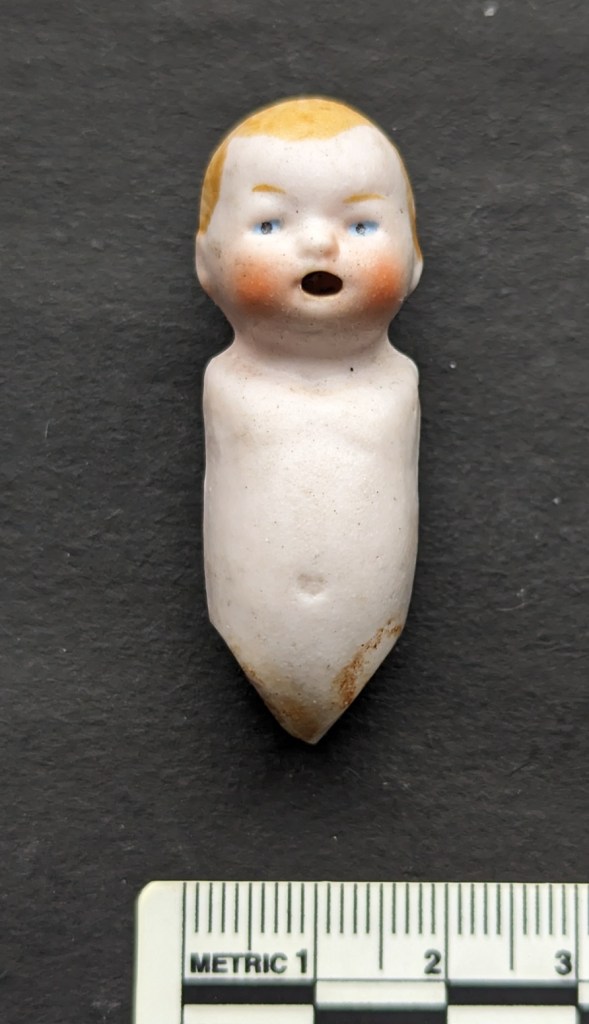
It’s shaped in a way that suggests it was a statuette, rather than a cup or bowl, and if I was a betting man (which I’m not), I’d say it was one of those pottery dogs the Victorians loved so much. Or did they? And here I’m going to share with you a passage from one of my all-time favourite books – Three Men in a Boat by Jerome K. Jerome:

That china dog that ornaments the bedroom of my furnished lodgings. It is a white dog. Its eyes blue.  Its nose is a delicate red, with spots. Its head is painfully erect, its expression is amiability carried to the verge of imbecility. I do not admire it myself. Considered as a work of art, I may say it irritates me.  Thoughtless friends jeer at it, and even my landlady herself has no admiration for it, and excuses its presence by the circumstance that her aunt gave it to her.

But in 200 years’ time it is more than probable that that dog will be dug up from somewhere or other, minus its legs, and with its tail broken, and will be sold for old china, and put in a glass cabinet. And people will pass it round, and admire it. They will be struck by the wonderful depth of the colour on the nose, and speculate as to how beautiful the bit of the tail that is lost no doubt was.”

I suspect that this is a fragment of that tail!

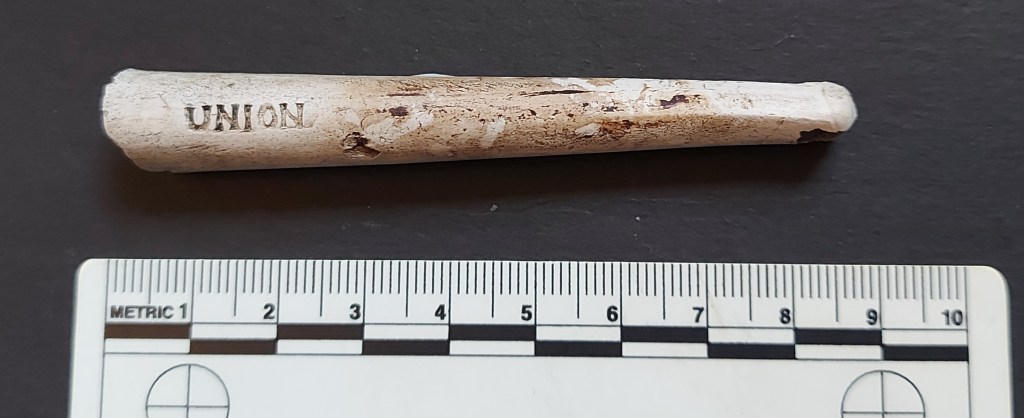
Finally, we have a fragment of a clay pipe bowl and a piece of stem.

Neither is particularly interesting as such, and I sometimes refer to clay pipes as the cigarette butt of the Victorian period – they were mass produced, smoked and thrown away – but they are always a joy to find. The slightly tatty looking organic object on the left of the photo is the remains of an oyster shell. These are quite a common find from the Victorian period, though perhaps less common away from the coast for obvious reasons. In fact, oysters were an important food source for many, sold pickled in vinegar and spices, or made into pie, and certainly by the time of the railways, they could be moved around the country in huge quantities to feed the hungry lower classes cheaply.

In terms of dating, the construction of the market hall and grounds, and subsequently Market Street, provides us with a lovely and quite solid Terminus Ante Quem – the latest point at which an event could have happened. Put simply, the pottery came from soil underneath the road surface of setts laid down when the road was put in – 1844 or thereabouts. It couldn’t have been deposited any later than that (the road surface prevents it) therefore all the pottery must date to 1844 or earlier. And from a sherd nerd’s perspective, I would agree with the archaeological method; there is nothing here that needs to be later that 1840. You can see the original sett covered road surface in this photo, with a few setts still in-situ. You can also make out the buried surface and the natural soil underneath.

There is a rough stratigraphy visible here…

To make it a bit clearer, let’s look at it side on – in section.

I mean… it’s not perfect, but it get’s the job done. Hope you can understand it.

If you look at the photo above, you can make out the tarmac layer on top of the stone setts left in-situ – this was what you drove on the last time you drove down Market Street, laid down probably in the 1960’s, and many times since. The stone setts are the original Victorian road surface. Below these, in a reddish brown in the diagram above, is the disturbed original ground surface, and it is from this that the pottery was taken. Below that (only not as clear cut and obvious in the photo) is the original undisturbed natural clayey soil laid down during the last ice age or so.

The origin of this material, and why it ended up there, cannot be proven, but we might hazard a guess. From 1838 onwards, the town hall was constructed, designed from the outset to incorporate shops and businesses into the complex. One of these was a pub – The Market Vaults – that stood on the corner of (what was to become) Market Street and High Street West (it later became The Newmarket, and is currently Boots Opticians).

The Market Vaults as it once was, and possibly the source of our pottery.

Well, technically, this front part was a grocery store, it was the back, facing into the market place that was the pub. And it was right next to this building that our hole was dug. It’s not in the realms of fantasy that broken pottery and rubbish would be thrown out of the back door of the pub onto the muddy wasteland – the area would have been a building site between roughly 1838 and 1844.

The original back door of the pub is flush with the larger pub building, hidden behind the later building work. Interestingly, I can see at least 4 phases of building at the rear of the pub – the large extension is not original, and belongs to the last building phase, also seemingly Victorian.

There are three things that reinforce this theory. Firstly, the pottery contains a large proportion of Industrial Slipware, a ware type particularly associated with pubs. Secondly, the oyster shell is a classic bar snack of the Victorian and earlier periods, cheap and cheerful (then, at least – now they are, well, bloody expensive and, quite frankly, inedible). Lastly, the condition of the pottery; it all has sharp edges and clean breaks, which tells me that it has not spent any time kicking around the soil, being trodden on, or moved around at all: it was simply dumped and never touched again until being paved over. And although in ‘History in a Pint Pot‘ (the history of Glossop’s pubs), David Field notes that the first mention of a pub here is in a newspaper of 1865, I think it highly likely that the grocery was open all year, and that the enterprising owner – Mr Edward Sykes – would sell beer round the back on market days.

Fast forward 180 years, and some dashing heroic archaeological type wanders over to a hole, has a peer and, well, here we all are. And here, we must turn once again to Three Men in a Boat. Later in the same page as above, J notes:

“The blue-and-white mugs of the present-day roadside inn will be hunted up, all cracked and chipped, and sold for their weight in gold, and rich people will use them for claret cups.

If only he knew! And if only I could find one complete enough from which to drink claret!

So remember, always have a look into a hole… you honestly never know what you might find. But be quick and be bold, as before you know it all is returned to normal and the opportunity to explore a little of the past is gone…

Almost as if it never happened. One wonders what lies beneath our feet as we walk or drive here.

EDIT

I have just come across this rather wonderful article, written by the truly amazing Graham Hadfield, about the history of Market Street. The whole of Graham’s website – GJH.me.uk – is an absolute mine of Glossop history, and he really puts in the effort to investigate the history of the place. I don’t bang on enough about the other people who are unravelling the history of here, as I’m not the only one, but let me recommend this site.

Incidentally, as I was peering I heard shouting behind me, and bounding into view came my lovely neighbours (hello H & S!). Apparently, their conversation prior to this had gone along the lines of “look at that weirdo poking around that hole, what’s he doing? Oh, hang on… that’s TCG!”. It’s nice to be known… I think.

Righty-ho, I think that’s the lot for today. I’ve got places to go and things to do (mainly housework, to be honest, but there you go, such is the life of the dashing explorer). In all the recent rain, it is well worth keeping an eye on the ground to see what the pottery fairy has sprinkled about – let me know if it is anything good. Also, big news is coming… I think, but until then, look after yourselves and each other. And I remain.

Your humble servant,

TCG

Archaeology · Pottery Guide

The Rough Guide to Pottery Pt.8 – Tin Glazed & White Stonewares.

What Ho! What Ho! And if I may be so bold… What Ho!

How are we all? Bearing up under the circumstances? Summer, such as it was, has gone, and Autumn is upon us. A time of harvesting, of blackberrying, of apples… and pottery, obviously. And just like that, without further ado (and ignoring the groaning and wailing and gnashing of teeth), we tiptoe into Part 8 of the fabled (and seemingly never-ending) Rough Guide to Pottery; let’s have a look at some rather splendid sherds.

So then, today we are looking at some rarer types of pottery – well, perhaps not rare as such, just not as commonly encountered as some of the other stuff I’ve previously talked about.

Originally tin-glazed pottery was imported from Italy, Spain and the Low Countries, but UK production began in Norwich in late 16th Century. Its heyday was roughly 1700 to say 1800… roughly. It remained popular until it was gradually replaced by White Salt-Glazed Stoneware by the mid 18th Century, which was more robust and much lighter, and cheaper to make. Tin-glazed pottery was another attempt at reproducing porcelain type pottery, and part of the quest to find a pure white background that seems to have dominated pottery making in the 17th and 18th centuries.

The process of manufacture was as follows. The vessel was turned by hand and using a former, and then biscuit fired (that is, it was fired undecorated and without a glaze). The pot is then dipped in the glaze and allowed to air dry. Once dry, the pot is then decorated by hand – quickly as the glaze is very absorbent. It is then once again fired, which fuses the glaze and fixes the decoration. 

In terms of fabric, it’s an earthenware, a pale colour – white-ish or cream colour, with later examples being almost pure white. It has occasional tiny pink, reddish or darker inclusions, and is a soft to medium hardness.

Fabric. It is stained slightly to a creamy colour, but you can see the paler white where there is a new break. You can also make out some reddish inclusions in the fresh break… if you squint hard enough.

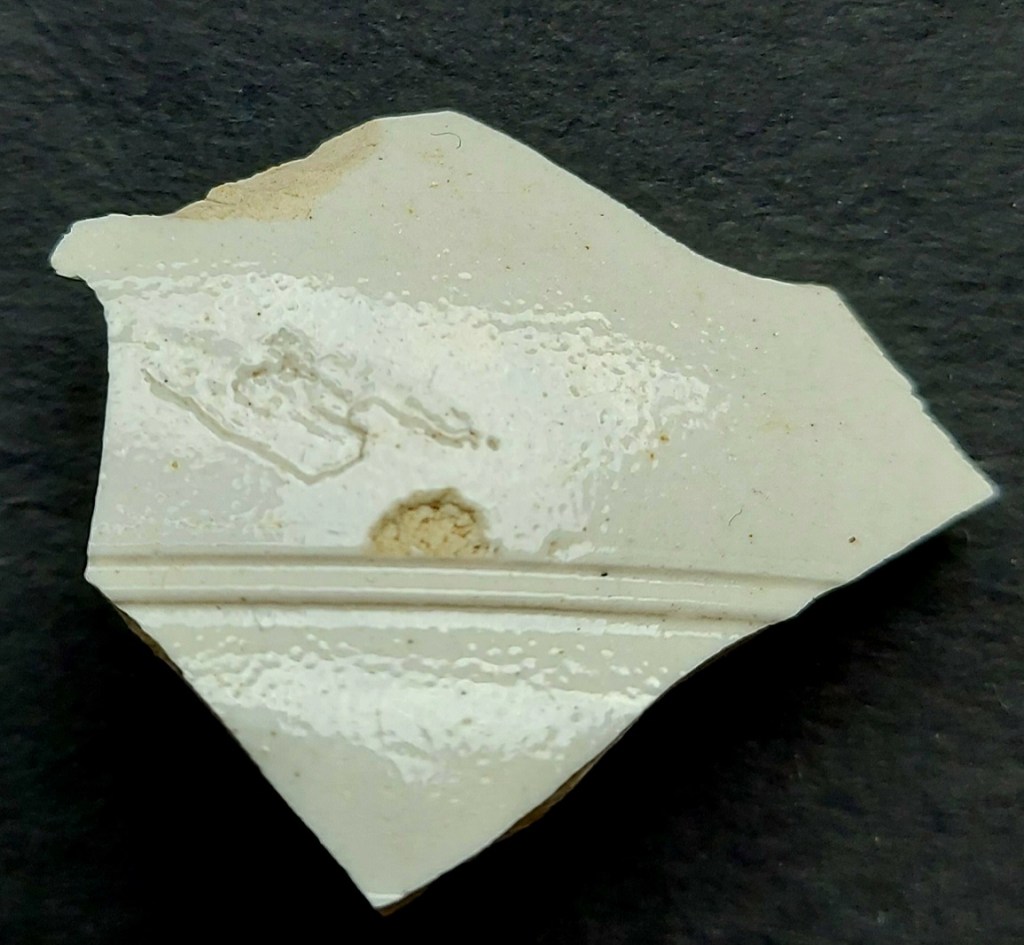
It uses a lead oxide glaze mixed with tin, which gives it a blueish white or pale cream colour, but is more blue where it pools – in particular around the ring base, where the pot was dried upside down.

The pooled glaze is very blue here. There is also a maker’s mark on the bottom – alas, that’s all I have of this pot, otherewise we might have been able to identify the potter.

The glaze has an almost luminescent quality and has a consistent smooth, dense feel to it – the product of the lead – but can occasionally have tiny imperfections or dimples in it. The glaze can also be thickish in places, but it is fragile and can flake off in patches, exposing the fabric below – most obviously at the edges of sherds. The surface occasionally shows the marks of the trivets that separated the vessels in the kiln.

Flaky! This was what was in my bag after I emptied it… bits. You can also clearly see the glaze has crazed and flaked off in patches.

It’s the decoration that really makes this stuff special, though. It’s all hand-painted, and because the dried but unfired glaze is super absorbent, it has to be done with speed: the brush strokes are wide or thin, and it’s done in a fluid and moving motion, quick and rough, impressionistic, and almost living, and certainly not fixed like transfer-printed wares.

There’s no mistaking this is hand drawn – each line is human made. A beautiful if naive image of a house, surrounded by trees that seem to have been made with sponges.
Simple but wonderfully effective decoration – a single line hand drawn around the vessel – probably a tea bowl or similar shape. You can also see the flaked glaze surface.
Delicate handle for a jug or similar.

There is no way to erase the decoration once applied, which accounts for occasional errors, and which I think only adds to the attraction. The colour is almost universally a wonderful cobalt blue, but occasionally purple or orange is found. The subjects are largely naturalistic – foliage in particular – but there are also scenes with animals, people, and buildings. As well as actual pots, tin-glazed pottery was very much favoured for tiles among the wealthy, and some stunning examples exist.

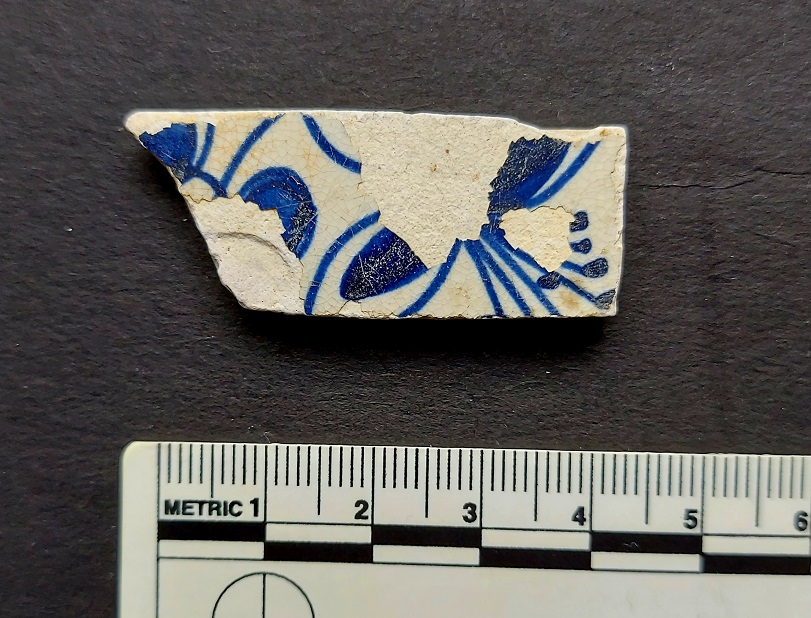
Stunning dragonfly tile dating to 1670ish – from this website, and only £216!
Tile fragment found by me – the colour on this tile are simply stunning. Showing a stylised flower (thanks Julian)… I wish I could find the rest of it.

I honestly love this stuff, there is something wonderful about it – the colours in particular – and although I don’t have a lot of it, it’s always a joy to find.

The next lot of pottery type occupies a similar space in time – broadly the 18th century – and indeed, overtook Tin-Glazed pottery in terms of popularity…

A selection of sherds, all mid 1700’s in date.

A later development than Tin-Glazed, it was first made in the later 17th century, but only began to be produced commercially from the 1720’s onwards.

The fabric is a typical stoneware, in this instance with added calcined (burnt) flint to produce a pale cream, almost white colour. It is then fired at a very high temperature and salt glazed, to produce a fine, strong, pottery that I find really quite beautiful.

Close up of the fabric. Very pale grey-ish to white, with visible voids created by gases formed by the high temperature it is fired at. There are also occasional brown and dark grey inclusions visible both in the break and the surface.

Vessels are formed one of two ways: either by being turned on a lathe when leather dry but before firing, which produces very sharp edges and fine horizontal banding; or by pressing thin sheets of clay into a mould, which allows the fine relief decoration to be made.

In this latter case, often the inside of the clay is wiped with a cloth to ensure the clay presses into every corner of the mould, which leaves very clear wiping marks, especially on closed vessels (jugs, for example) where the inside wouldn’t be seen.

Wiping marks on the interior of a jug. The black writing is an excavation code – BGW (upside down in this photo) – which stands for Back Garden Wall… I found these sherds underneath my garden wall!

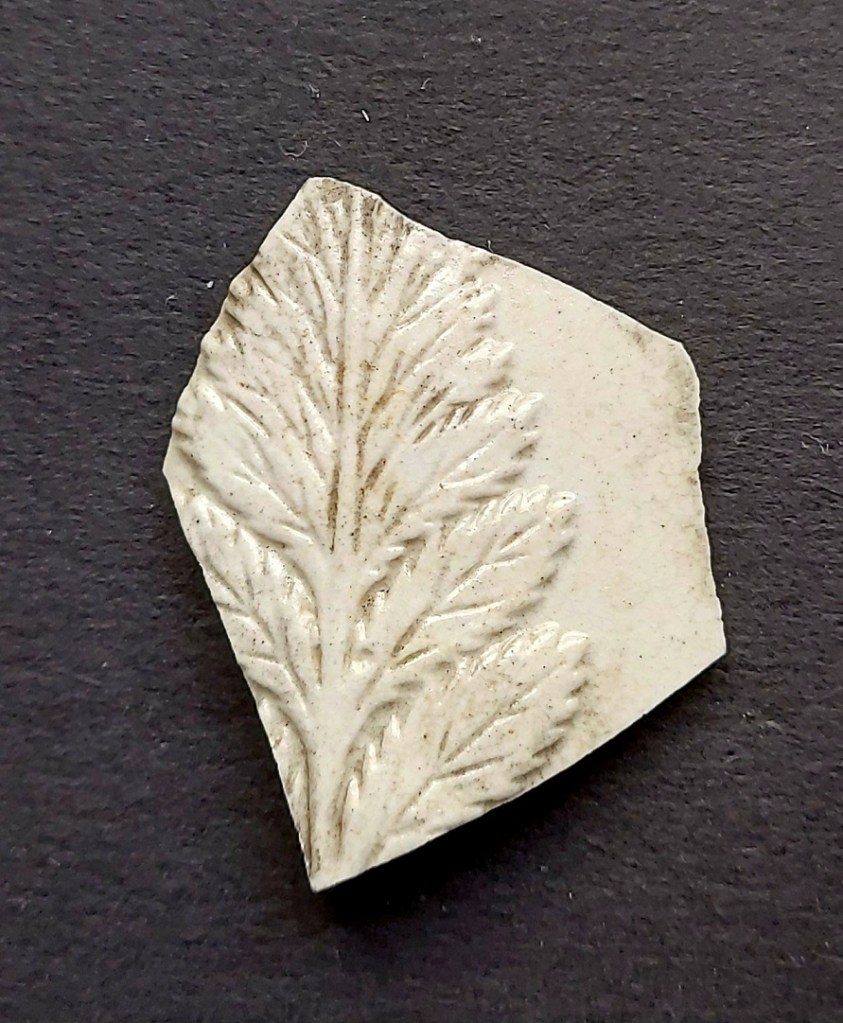
External decoration, beginning c.1730, includes basket work patterns, leaves and other foliate designs, although simple incised horizontal lines are commonly encountered on earlier pieces.

Close up of that beautiful foliate decoration – the result of being formed in a mould.

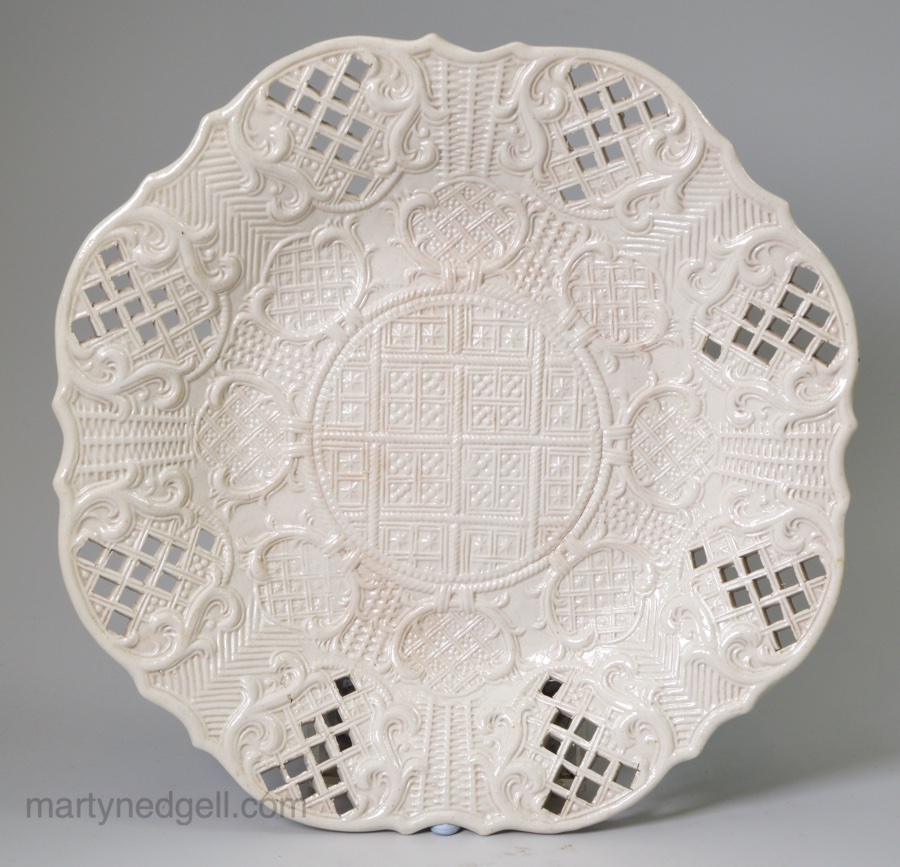
Occasionally, the walls are pierced, though this seems largely confined to high-end expensive dinner services.

Alas, not found beneath my garden wall! Lovely plate with pierced decoration and impressed motifs. Image is stolen without shame from this website here. A snip at £450! Do check out the website, though, as there are more examples of White Stoneware.

There are also rare examples of transfer-printing on stoneware:

A truly terrible photograph, but you get the idea! This is dated from the period where potters are experimenting with transfer-printing – later 1700’s.

The exterior is salt-glazed, meaning that at a point during the firing process salt is added to the kiln, which vaporises and coats the vessels in a clear glaze. Although solid and even, it often leaves an orange-peel, slightly melted roughened type effect on the surface, as it does on the Brown Salt-Glazed Stonewares discussed here.

The ‘orange peel’ salt-glaze is very obvious on this sherd. The horizontal band is very neat and tight, carved using a tool on a lathe. You can also see some sort of damage underneath the glaze (above the chip).
Wonderful coffee pot of c.1760-ish, and a snip at £1250! It is lovely, though. Same website.

White Stoneware gradually overtook Tin-Glazed pottery in popularity, and began to dominate the fineware market from the 1740’s onwards – it is a lot lighter than the earthenware, and crucially it is much more hardwearing, with the surface unlikely to flake off or crack. It also appealed to the middle classes; its fine white background mimicking the desirable but very expensive imported Chinese porcelain, a crucial part of the tea and coffee drinking craze that had gripped Britain at this point. It remained popular until eventually overtaken by the development of Creamware and other earthenware types in the late 18th century.

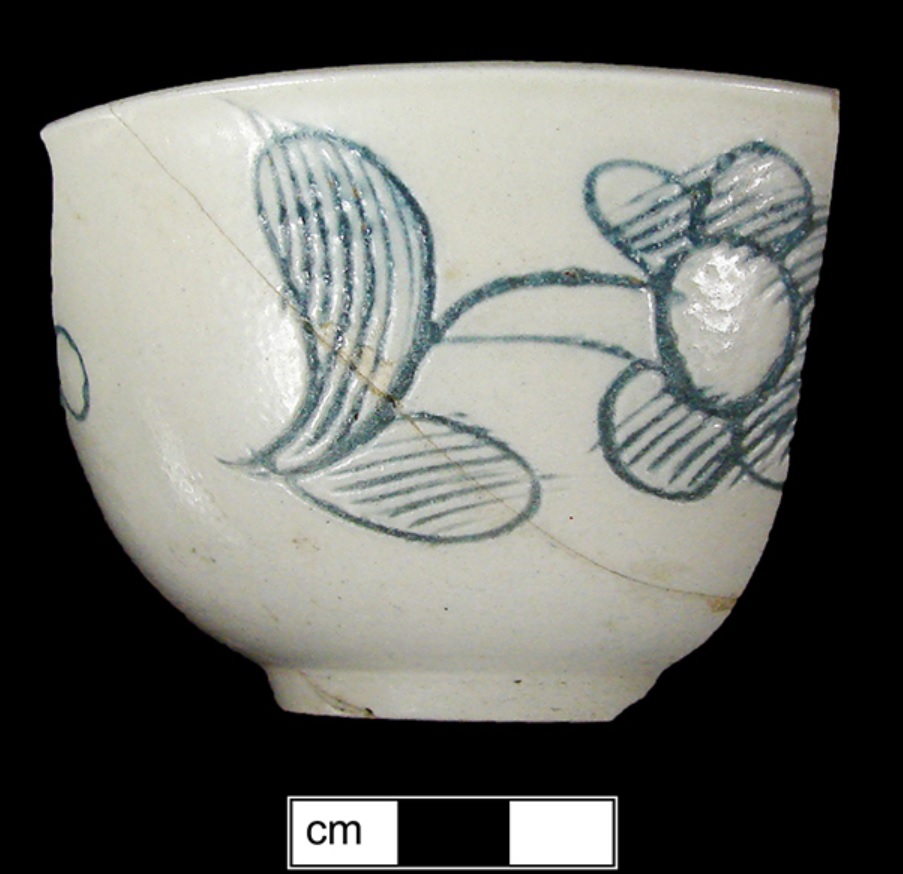
Broadly speaking, Scratch Blue is decorated Pale/Grey/White Salt-Glazed Stoneware – it has the same fabric and glaze. Essentially, this was a UK answer to the lovely looking Westerwald stoneware pottery being made in Germany (see below) and imported in large quantities – the English potters wanted a piece of the action, and produced a cut price version. It reproduces the essentials of Westerwald – incised decoration and stunning cobalt blue highlights on a pale stoneware (white-ish or pale creamy grey) background, but overall it tends to be more sloppy. The incised decoration is less careful, often looking as though it was done quickly, and the cobalt slip often overruns and splashes.

Wonderful chamber pot, with a King George medallion (probably George II)

Actually, I think this ‘messiness’ was deliberate, a way of ‘jazzing up’ the decoration, and it’s certainly effective. That’s not to say that there aren’t some very careful and precise examples, though, and in fact American archaeology seems to divide Scratch Blue into two types – Scratch Blue, which is very finely decorated, and ‘Debased’ Scratch Blue, which is the messier variety. I’m not sure that the distinction is particularly useful, or indeed ‘real’ as such, but there you go – my twopenn’orth.

A jug.

In terms of decoration, there are incised flowers and leaves and multiple horizontal turned bands at the top and bottom, all highlighted in cobalt blue and occasionally manganese brown. Also, there are applied medallions, sometimes containing the royal arms and cipher of King George II/III.

A tea bowl with a lovely flower incised on it. All these images are stolen from the hugely invaluable Colonial Ceramics website of Maryland – well worth checking out their huge database of pottery.

I have a single, very small, sherd of Scratch Blue pottery, and this stuff is by no means common, especially up North.

That’s it, a single 2cm sherd of Scratch Blue is all I have. There must be more out there…

It seems to be from the base or top of a tankard, something like this:

Possibly something like this, from roughly 1780. From Colonial Williamsburg’s website.

This seems appropriate as it was found on the footpath outside an 18th century one-time pub, the Seven Stars off Hague Street, Whitfield.

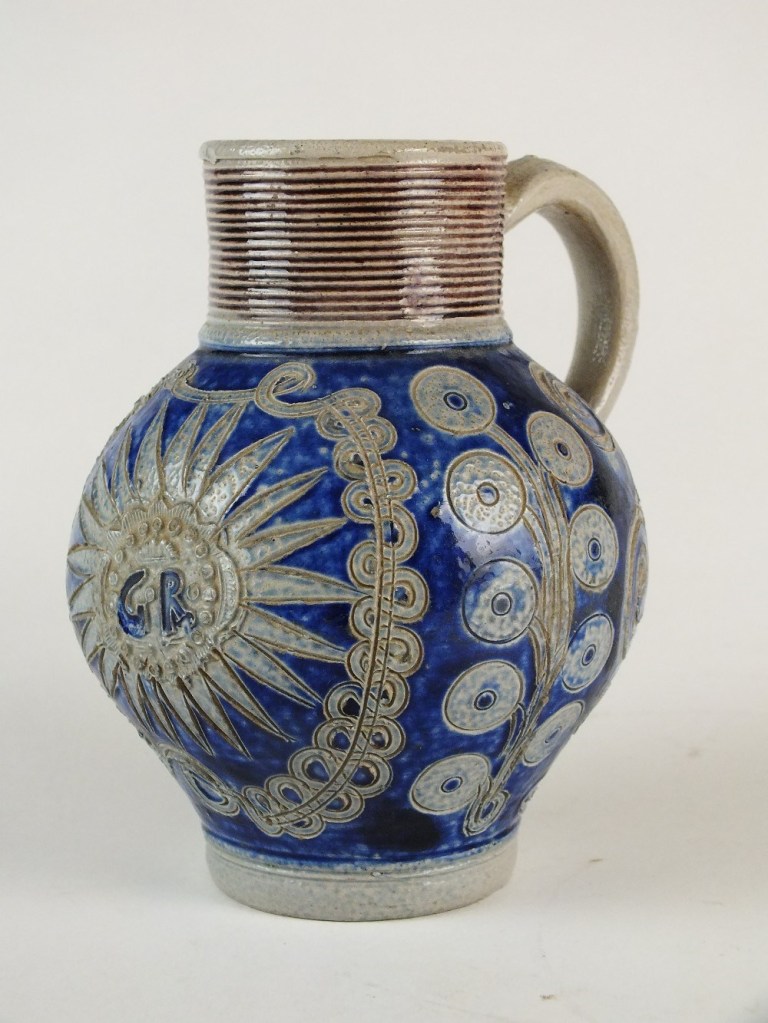
Unusually, I don’t actually have a sherd of this to show you! It wasn’t particularly common up in the North – London being the big importer and consumer of this ware type. As I said above, Scratch Blue is the indigenous British potter’s response to this German imported pottery, and as you can see it is very similar:

Lovely jug of Westerwald from this website – it sold at auction for a surprisingly cheap £150

Incised decoration, cobalt blue highlights, applied medallions and other decoration, it is often difficult to tell apart. However, Westerwald seems to be bigger somehow, less delicate… and at the risk of offending our German cousins, more Teutonic. There also seems to be a greater use of cobalt decoration, and the background stoneware is darker in many circumstances.

Another jug – from this website.

And there the matter shall have to rest until I can find some Westerwald sherds to discuss at greater length (I might have to get a mudlarks license and head down to London and poke about on the Thames foreshore).

Right, I think that’s enough pottery for now – next time we’ll look at some fine earthernwares… you lucky folk.

Now, someone recently asked me if I could put links to all the previous Pottery Guides at the bottom of the post, so they can use it quickly to find out what they have… well here you are:

Part 1 – Marmalade Jars and Brown Stoneware (Nottingham and Derbyshire)

Part 2 – Spongeware

Part 3 – Industrial Slipwares

Part 4 – Creamware, Pearlware, and Whiteware

Part 5 – Blue and White Transfer-Printed, Flow Blue, and Shell-Edged

Part 6 – Porcelain, Bone China, Black Basalt Ware

Part 7 – 17th Century Slipwares, Manganese Glazed, and Yellow Ware

Enjoy, or not, as you wish.

Right, that’s all for now.

In other news, the Glossop Big Dig results are forthcoming… slowly. If any of you have any bags that need handing in, please do so, and I’ll get the results up asap.

Other other news is the ‘zine – Where/WhenThe Journal of Archaeological Wanderings – which is just about ready to go off to the printers. You will soon be able to buy a physical copy of a guided walk I did a while back, filled with historical musings and observations (and a sprinkling of pottery, obviously). It’s an experiment of sorts – we’ll see how it sells and whether I can make my costs back, but I’ve got about 6 more walks ready to go, and I’d like each one to be in the ‘zine. It will be full colour, 40 pages, fully illustrated, and should be retailing for £6, but watch this space.

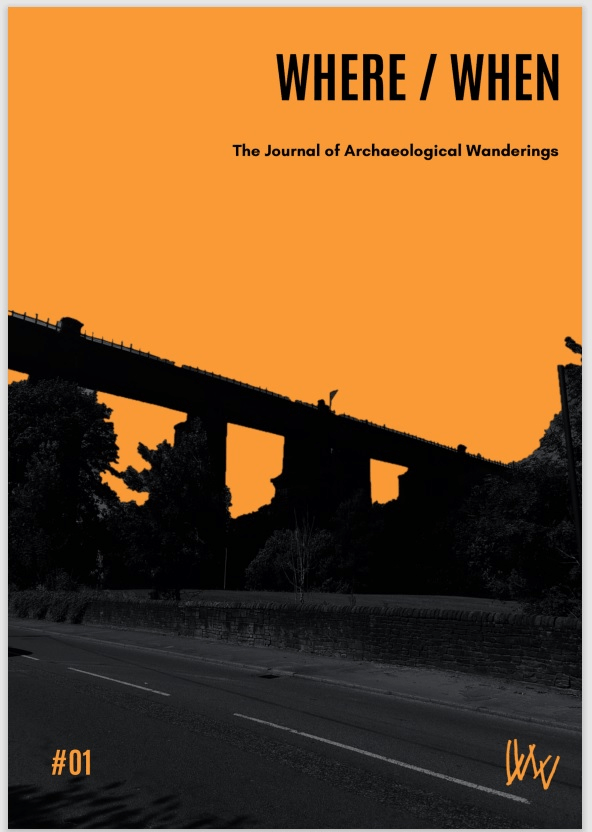
The front cover of the first edition – hopefully ready within a week or two, and available to order via the Where / When button at the top.

If any of you out there have either suggestions for walks, or would like to publish one yourself, do get in contact. More news on this soon.

Until then, look after yourselves and each other, and I remain.

Your humble servant,

TCG

Domesday Book · History · Medieval · Placenames

Glossop: Places and Dates.

What ho, you wonderful people, you!

I’ll not beat about the bush, let’s get straight to business! Over the past few months, when I had time, I spent some entertaining hours poring over any and all parish and other records relating to Glossop. Not just that, but estate records, royal tax records, and wills too… anything with a place and a date, essentially. I have been trying to establish the first mention of the farms and places that make up what we know as Glossop in order to get a feel for the place in the 16th, 17th, and 18th centuries. Why yes, yes I am that interesting.

Parish records were first introduced by law on 5th September 1538. From that point on the details of any event that took place within the church had to be recorded, and thus anyone baptised, married, or buried (hatched, matched, or despatched) were entered into a ledger (here is a good introduction to the subject). The details depended on the event, but it usually included a name, a date, and, crucially for us, a place: e.g. 14th June 1620, Jonah Wagstaffe, son of Charles and Elizabeth of Glossop, was buried.

What follows is an alphabetised list of the locations mentioned in the parish records for Glossop All Saints parish church in Old Glossop. I primarily used the North West Derbyshire Sources site, run by the seemingly unstoppable Marjorie Ward. The website is an absolute goldmine of data for this area, so please do check it out. Also, all credit, and huge thanks, goes to the people who originally transcribed the parish records; it wasn’t me, and all I did was read them and extract some information – I merely stood on the shoulders of giants, to quote Newton (and others).

Glossop’s records don’t go back as far as 1538, sadly, but instead start in 1620. Why this should be is unclear, but it is not the only example from around the country; opposition to the process, a lack of direction, and simple laziness may all have played a part. Because of this, I also looked at any other forms of official records I could find – tax records, wills, land deeds, and what not, to see if I could push some dates back further. I will be adding to these data in future, especially as I come across earlier references to places, so think of this as a work in progress. I have used the modern spelling for the places, but have made a note of different spellings when they appear. Until relatively recently, there was no standardised spelling of words, and placenames in particular were spelled how they sounded, often reflecting the accent of the people, as is the case here (see Coombes and The Heath for good examples of a local accent preserved in the records).

Note that this is simply the first mention of these places, not the date they were founded. This may seem obvious, but it is important to state that many of these places will have been settled for hundreds of years prior to their mention in the Parish Records. This is underlined by looking at how many of the entries have a date of within 20 years of the 1620 commencement of the parish records – it is clear that they didn’t all just pop into existence at that point, and that the first mention of them here is just that. A big boom in the settlement of the area would have commenced in the 1530’s after Glossodale was taken from Basingwerke Abbey and given to the Talbot family – it would be in their interests to get as many rent paying farmers on the land as possible. That stated, the abbey was pretty good at making money and would certainly have encouraged the foundation of farmsteads, thus we can perhaps characterise the period following the relaxation of the forest laws as one of continual expansion.

A note on the sources: PR – Parish Records. Domesday Book – is fairly self explanatory. 1381 Poll Tax – information taken from the book ‘The Poll Taxes of 1377, 1379, and 1381’ by Carolyn Fennick (Glossop only features in the 1381 Poll Tax, oddly). Wills – from the North West Derbyshire Resources website. Kirkpapers of the Kirk family of Glossop and Chapel-en-le-Frith. Datestone – the datestone on the house. EPNS – any of the numerous records used in ‘The Place-Names of Derbyshire Vol. 1’ published by the EPNS. EPNS – Ch – is ‘The Place-Names of Cheshire Vol.1‘. Derbyshire Subsidy Roll 1327-8 (DAJ) – Another poll tax, published in the Derbyshire Archaeological Journal of 1908 (read it here, if you like). Roll of Fines – a list of people fined for offences against the forest, and dated to the 13th year of Edward I (1285), you can read it here (it’s the same source as the Forest Rolls (EPNS), but I have mined some more information that the EPNS left out). Shepherd’s Society – the list of members of that society that met in Glossop and Longdendale (read it here). Shrewsbury Papers – the public record office collection of the Earls of Shrewsbury’s papers (the Talbot family archive, essentially) – here.

PlaceDatePerson NamedNotes & Alternate SpellingsSource
Almans Heath1650 (22/7)Burial of Elizabeth Timplie, widow“Almens Heath”PR
Ashes1674 (12/11)Marriage of William Newton & Mary Newton PR
Bank1668 Bank Farm on ‘The Bonk’Unpublished Ryland’s Charters (EPNS)
Bankwood1717 Hadfield. “The Bankwood” (Gate) (Bankswood)Rylands Charters (EPNS)
Bettenhill1637 (24/3)Burial of Elizabeth Robinson, wife of Robert“Betterside Hill” “Betterside the Hill” “Bettinside Hill”PR
Blackshaw1600Will of Ottiwell Beard of Kynder (John Dande of Blackshaw is witness) Wills. Also the burial of Anna Dande, wife of John 1621 (PR)
Bridgend1598Will of William Barber of The Heath (Robert Bramhall of Bridgend is witness)“Bridgent”Wills. Also, Burial of Ann Brammall 1654 (PR)
Brown Hill1285 “Brunhill”Forest Rolls (EPNS). I’m not convinced, to be honest – Brownhill is a common name, & the physical evidence does not support 1285. Reference to “Sarah Hollinworth alias Brownehill” in 1624 might be this place. Definitely, though, Thomas Garside in 1807 in SS
Castle Hill1692 (2/2)Burial of Edward Hadfield (snr) PR
Charlesworth1086 “Cheuenwrde”Domesday Book
Chunal1086 “Ceolhal”Domesday Book
Cold Harbour1627 (23/5)Marriage of Otwell Clayton & Margaret Downes PR
Coombes1285 “Chiselwrthecumbes” (1285), “Cowmbes”Forest Rolls (EPNS). Also baptism of Anna Bridge, daughter of John 1644 (PR)
Coombes Edge1700Burial of Elizabeth Booth“Colmes Edge” Same as Cown Edge below?PR
Cow Brook1643 (24/3)Baptism of Joshua Dewsnap PR
Cown Edge?1702Baptism of Sarah Booth“Cold Edge” “Coln Edge” PR
Crosscliffe1555Edmund Bower of Whitfield Lease in DRO (D5236/5/27) Also 1608 Calendar Rolls (EPNS)
Deep Clough1285 “Depecloxe” “Dupecloh”Forest Rolls (EPNS). Also baptism of Nicholas Brammall  1620 (PR)
Dinting1086 “Dentinc” (1086), “Dintinge”Domesday Book.
Fieldhead1804Will of George Roberts (mentioned land at ‘Field Heads’ – presumably the same)The position of Fieldhead Farm is literally that, at the head of the ploughed selions, now simply fields. Wills. Also will of Jacob Hollingworth 1845
Gamesley1285 “Gameleslegh”Forest Rolls (EPNS). Also Tax of Jurdan de Gamesley Derbyshire Subsidy Roll 1327-8 (DAJ)
Glossop1086  Domesday Book
Hadfield1086  Domesday Book
Hargate Hill1623 (10/7)Burial of Widow Robinson“Hargatt Hill” “Hargett Hill” “Hardgate Hill (1654)” “Hardgate” might refer to a ‘Hard Road’, i.e. not muddy track. Roman? The road does pass by here.PR
Heath1285John del HeathAlso as “Teathe” (3/11/1658) (PR)Roll of Fines. Also Robert del Heth, Derbyshire Subsidy Roll 1327-8 (DAJ)
Herod Farm1703Datestone
Hilltop1679 (27/7)Burial of John HadfieldCaution… there is also a Hill Top in Chisworth (EPNS).PR
Hobroyd1327Wills de Holberode“Hob Road” “Hobrod” – road rather than royd?Derbyshire Subsidy Roll 1327-8 (DAJ)
Hollinworth Head1546 Hollingworth Head FarmUnpublished documents in the Middleton Collection (EPNS). Also burial of Emmot Taylor, wife of Ralph 1623 (PR)
Hurst1550 “Whitfield Hurst”Feet of Fines (EPNS). Also baptism of Robert Hagh in 1621 (PR)
Hurstnook Farm1772Datestone
Jumble1640 (1/4)Burial of Grace Turner, wife of Reginald“Jomble”PR
Lamyclough1629 (8/12)Burial of William Newton, son of Hugo“Lammanclough” & “Lammeclough” – Charlesworth wayPR
Lane Ends1623 (14/12)Burial of John RobinsonWhitfieldPR
Laneside1625 (14/9)Burial of John Bramall PR
Lee Head1706 (12/1)Burial of Thomas HarrisonCharlesworthPR
Lees Hall1285Jo. de Legh (of Whitfield) (John de Legh) Also Ricardus del Lees 1381 Poll Tax
Little Padfield1711 (5/1)Baptism of Elizabeth Creswick PR
Long Lane1696 (24/6)Burial of ‘Old Widow’ BoedonCharlesworthPR
Long Lee1621 (17/9)Burial of George Hyde PR
Mill Town1643 (27/6)Burial of Margaret Mellor, wife of Ralph PR
Monk’s Road1290 “le Cauce” (The Causeway)Calendar of Charter Rolls (EPNS)
Moorside1616Will of Thomas Hollingworth of Moorside.This may be Moorside in Chisworth, confusingly.Wills. Also burial of Widow Hollinworth 1623 (PR)
Moregate1655 (2/4)Baptism of Helena HadfieldHadfieldPR
Mossy Lea1623 (5/1)Burial of Ellina Hollinworth“Mosseley” & “Moselee”PR
Mouselow1628 (16/11)Baptism of William Newton PR
Over Deep Clough1709 (19/1)Burial of Henry Hadfield PR
Padfield1086 PadefeldDomesday Book
Pike’s Farm1780  Datestone
Priest’s Pastures1616Petition to the King by a “Nicholas Hatfielde”“Prist Pasters” – Padfield somewhere.Shrewsbury Papers, Folio 147 (no date, but the recipient, Gilbert, died in 1616, so before then). Also 1640 (20/2) – Baptism of Anna Hadfield (PR)
Pyegrove1631 (15/1)Burial of Anna Booth, daughter of Ralph & Anna“Pigreave” “Pyegreave”PR
Reaps Farm1631Burial of William Hadfield, son of William & Helen“Reape”PR
Ringstones1623 (13/5)Baptism of Thomas Roobotham PR
Rowarth1285Roger le Ragged de Roworth“Rouworth”Roll of Fines. Also Burial of Elizabeth Goddard, wife of Robert 1626 (PR)
Shaw1285Mathew del Shawe Roll of Fines. Also Henricus del Schawe 1381 Poll Tax
Shelf1285 Possible location of Monastic Grange?Forest Rolls (EPNS).
Shire Hill1285 “Shyrhull”Forest Rolls (EPNS).
Simmondley1285Alward de Symondesly“Symondlee”Roll of Fines. Also Burial of Joanna Beelee, w. of William 1620 (PR)
Spire Hollin1700“Spire Hollin estates” mentioned for sale in D513/M/E/374 with others. Kirk Estate Papers #374. Also 1734 Poll of Derbyshire (EPNS)
Storth1578Harry Booth of Storth Farm, SimmondleyHe had dispute with Lord Talbot & went to London to see Queen Elizabeth I.Historical record. Also Baptism of Joseph Botham, son of Henry & Mary, 1638 (PR)
Top of the Hill1698 (17/6)Baptism of Robert WagstaffeBy RedgatesPR
Torside1621 (16/7)Baptism of Alycia Hadfield“Thorsett”PR
Waterside1710 (19/5)Burial of Ann AlsoppeHadfieldPR
Whitfield1086 “Witfeld”Domesday Book
Whitfield Barn1657Datestone
Whitfield Hough1690Robert Dewsnop of Whitfield Hough Title deed in Dro (D6368/1)
Wimberry Hill1807John Winterbottom“Bilberry Hill”SS
Windy Harbour1683 (11/12)Burial of Thomas Harison“Winde Harbar”PR
Woodcock Road1249 “Wodecokessich” (1249) “Wood Cockrode”, “Cockroode”, & “Cock-Crowd”Calendar of Inquisitions Miscellaneous (EPNS). Also baptism of Joseph Bramall 1628 (PR)
Woodhead1424  Cholmondley Deeds (EPNS – Ch). Also baptism of Anna Bostocke 1629 (PR)
Woodshead1654 (13/9)Baptism of Elizabeth Heawart“Woodsheds” in CharlesworthPR
Wooley (Bridge)1286  Court Rolls (EPNS – Ch)

And there we have it. Obviously buildings within these areas will have separate dates, but overall we can begin to picture Glossop as it was in the medieval and post medieval period.

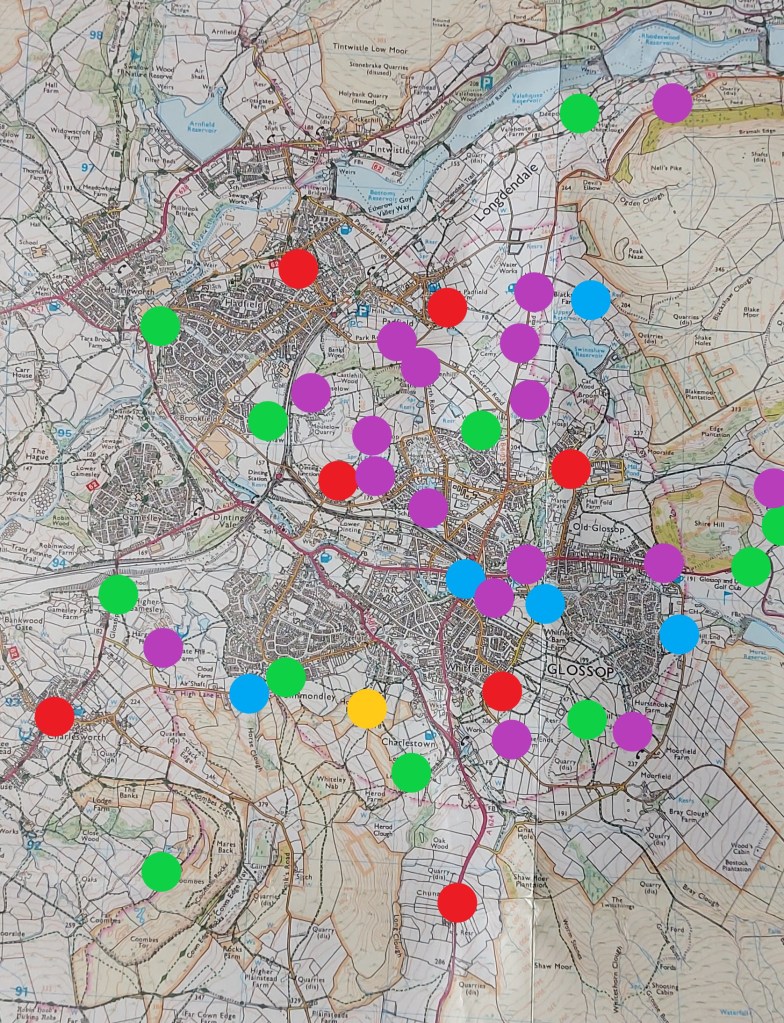
Visually then, it looks like this:

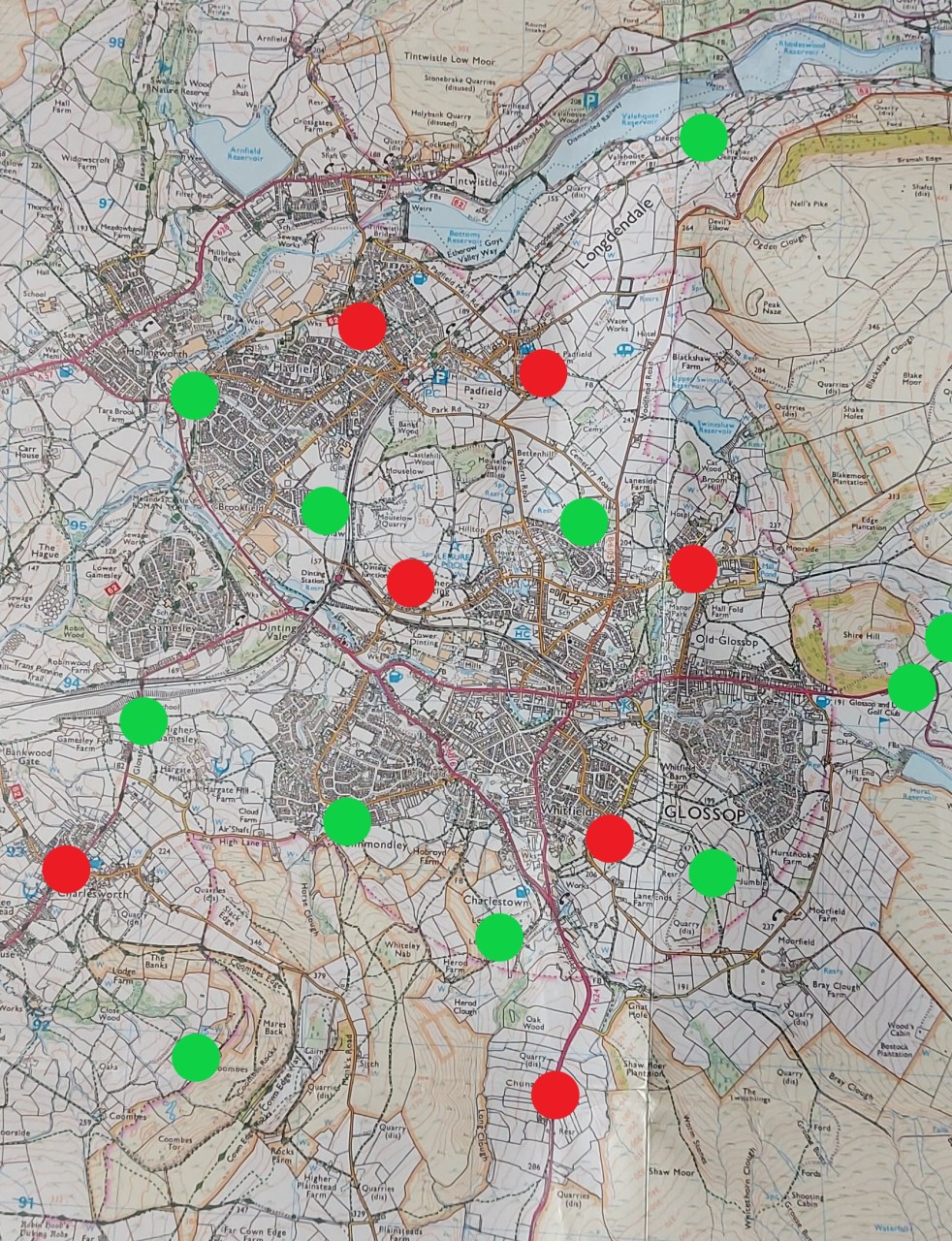
This is the situation at Domesday – 1086 – with all the names villages marked in red.

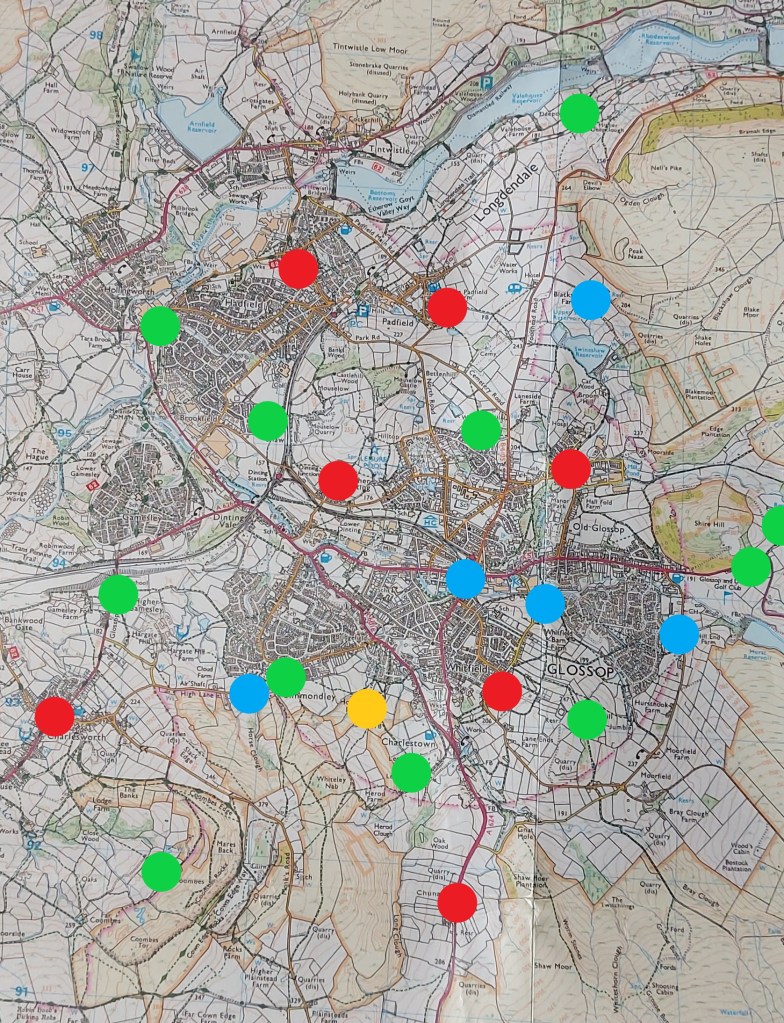
By 1285, Glossop looked like this:

The monks of Basingwerk have it, renting it to the Talbot family who are encouraging people to farm, making money for themselves in rent and produce.

By 1450, very little has changed:

Just Hobroyd Farm has been added.

Following the Dissolution of the Monasteries from 1538 onwards, the land becomes the sole property of the Talbots who continue to encourage the founding of farms. Here is the situation by 1620:

The area is becoming filled in.

100 years later, the land is full of smaller farms, all paying rent to the landords, now the Howard family. The explosion in farms may be connected to the Howards drawing up longer rental leases, allowing people to invest in buildings and land not just for themselves, but for their children and grandchildren. Here is the situation in 1720:

Obviously, this is a very broad study – I just want to get the information out there. There is an awful lot more that could be done here, not least of which could be some form of more formal survey of the land deeds. It should also be pointed out that many farms will have disappeared over time, forgotten about or subsumed by larger farms, and what we have here is not a 100% accurate reflection of Glossop, merely a snapshot.

More research is needed indeed… but for now, I’m going to have a snifter of the stuff that cheers.

Right-ho, that’s your lot for this time. Next time I promise more pottery… I know how much you’ve missed it. Until then, take care of yourselves and each other.

And I remain, your humble servant.

TCG

Archaeology · Pottery

A Pulchritudinous* Pile of Pottery

*Guess who got a thesaurus in his Christmas stocking? Also, as an interesting aside, this question also shows you how long I have been working on this post – it made sense and was relevant when I wrote it in early January.

What ho, wonderful blog reading folk, what ho!

The search for pottery and other bits of archaeology never really stops, does it? I’m sure you all know what I mean (I meant for the rest of us, not you… we know you don’t like it!). I seem to spend my life looking down and around, especially in places I might encounter the stuff. Never digging, but simply looking… and finding. Honestly, it’s something that I’ve done all my life, and I am pleased to say that Master C-G has also caught the bug. As, also, have some of his school friends, who regularly seek me out in the playground with joyful looks on their faces to show me the ‘wonderful’ things they have found over the weekend (hello RR, RB & NB). These are distinctly unlike the looks on their parent’s faces who are not as impressed with the search for bits of old plates interrupting their Sunday walks, and then humping bags of the stuff around. Awfully sorry chaps.

I’ve recently found some nice bits and pieces (not just pottery – flint, metal work, and a potentially very interesting whetstone… which is a phrase not many people will have uttered) that I need to a) blog about, and b) inform the Finds Liaison Officer about, and not necessarily in that order. All joking aside for the moment, it is really important to inform the FLO if you find anything ‘interesting’. It might not be interesting in the end, but if it is then at least someone knows about it, and that can fill out the archaeology and history of an area, changing it significantly in some cases. Also, you might get something into the Portable Antiquities Scheme – the British Museum programme that records all finds made (currently containing 1,623,055 objects, and going up on a daily basis) – and end up on the website (it’s searchable, with hundreds of thousands of photos, and more information that you can shake a sherd at – honestly, if you have a spare minute or three, give it a search here… and whole hours of your life will simply disappear!).

Anyway, onto the pottery…

I’ve tried to choose the more interesting bits today – older sherds for example – rather than the plain white or Willow Pattern. As an aside, I have recently come to realise that I have entirely too much pottery. I know, I know… can such a state exist? is it possible? A few years ago, I would have said no, but as I cast a weary gaze around the splendour of CG Towers, my normally steely nerve begins to falter; a deep sense of foreboding swells inside me, a certain something-or-other happens to my voice, and a tremor appears in my hands. At this point I normally go for a lie down, or depending on the location of sun in relation to the yardarm, a snifter of the stuff that cheers. But I cannot escape the niggling thought that I have whole boxes filled with, well, quite frankly, boring bits of pottery… and if I’m saying it’s boring, you know it to be true! I might start returning it to where I found it, or adding it to Shelf Brook in Manor Park to give mudlarks there more things to find. Hmmmmm? What’s that you say? No… No thank you, Mr Shouty-Outy. I won’t be “sticking” it there, thank you very much.

Anyway, moving swiftly on from such unpleasantries… the first of the pottery.

This first batch comes from the same place I found the lead came (this article, here) at the top of Whitfield Avenue, and the pottery dates from largely the same date – early – mid 1700’s, give or take.

Now, even I have to admit that this is not the mosr inspiring collection of pottery, and it’s chief inportance lies in its age. No.7 is a sherd of a Manganese Glazed bowl or larger cup, and No.6 is a fragment of a black iron-rich glazed cup. The other sherds are similarly glazed, and from larger vessels – bowls or pancheons (No.2 in particular). No.4 is interesting, and is probably a little newer – perhaps 1800? The grey fabric is unusual, and it seems to come from a pedestal footed bowl, perhaps a sugar bowl?

The next group of bits is of a similar age and type – early-mid 18th century, and possibly a little earlier in two cases – and comes from the bottom of one of the tracks that run from Hague Street to Charlestown Road, the southernmost of the two.

No.7 is a fragment of a Nottingham Stoneware grooved handle from a tankard or similar – something like this, perhaps:

Not quite as fancy as this one, but along these lines, and you can see the grooved strap handle. Stolen, as usual without shame, from John Howard’s rather useful website.

No.5 is a truly wonderful flat base fragment of a Manganese Mottled Ware cup/mug type. Dating to roughly 1680-1710, the pale buff coloured clay tells me it was made in Staffordshire, and the base diameter of 6cm tells me it was a mug or similar small-ish vessel. It is very typical of it’s time, with a thick brownish manganese glaze somewhat slapdash-ly applied, and a chamfered base. Wonderful stuff.

Lovely chamfered edge – you can see where the potter has cut away the wet clay – the human element.

The original would have looked something like this:

I honestly love these things, and the glaze is lovely, the manganese melting in the heat of the kiln providing the streaking that is so attractive.

The above photographs are courtesy of the Chipstone Foundation, and their wonderful website which published pottery from the Talbot Hotel midden in Tetbury, Gloucestershire. It was full of pottery of this date (broadly 1670 – 1720), and is an invaluable resource – a snapshot of provincial utilitarian pottery of the time; nothing fancy, nice but basic, and exactly the sort of thing we would expect among the bourgeoning middle class of Glossop. The website is honestly well worth looking at, here.

Other bits include No.3, the base to a large black-glazed pancheon or open bowl with a base diameter of 15cm, give or take. No. 2 is a manganese glazed bowl, but interestingly the glaze has some away from the slipped surface underneath, allowing us a peek into how it was made. No. 4 is a similar sherd, but the glaze was applied in a slapdash manner, giving a drip effect decoration, and showing the slip underneath after it was fired, now a purple-ish colour. No.1 is obviously a sherd of 17th or early 18th century Staffordshire Slip Ware. It’s quite thick, so would be from a plate or platter, and it’s very nice.

The big question here is what is it doing there? The trackway seems to have been a later ‘version’ of the older one just to the north, perhaps replacing it when it became worn out, or when the Methodist chapel was built on Hague Street at the top in 1813 (certainly it remained a thoroughfare for some time, as it has a streetlight halfway down and a cast iron drain cover). But I wonder if the trackway is not related to the pottery, and it simply cuts through a midden or dump of a nearby house that no longer exists. To judge from the wills and deeds, Whitfield at the turn of the 18th century was thriving, so there must be plenty of houses here that we don’t know about, those that didn’t survive the ravages of time. Now, as people tend not to move rubbish very far, this suggests that this house was nearby, and whilst the two houses that sit at the end of the track now are Victorian in date, did they perhaps replace an earlier house? Whatever the answer is, I think this is a spot I’ll return to! Who’s with me?

Moving on

As I walk around, I always try and discover new paths and passageways to explore – the talk I gave recently in Chester (The Gold in Your Back Yard) was the result of just that – asking the question “what’s down there?”. In terms of psychogeography this is called a derive: a wander with no intention other than seeking situations, encounters, environments, finds, and exploration. This is a concept that I love. I may be a sturdy chap, and as tough as old nails Englishman (notwithstanding the ridiculous moustache), but there lies within me a somewhat far-out hippy (within certain clearly defined parameters – obviously I draw the line at naturism; an Englishman needs his trousers, by Jove! And besides, Glossop’s too bloody cold… one might die of indecent exposure). So when this next small group of material popped quite unexpectedly out of a disturbed patch of earth in the previously untrodden (by me) tiny path that runs between the western end of Kershaw Street and Wood Street (next to what was the Labour Club), I gave a quick “what ho!” and dove in.

My phone’s camera has recently decided to get blurry at the edges, which is extremely helpful when photographing small objects. Please accept my apologies.

There is nothing particularly exciting here, to be honest. Top sherd is a fragment of the ‘Willow Pattern’ blue and white transfer printed ware – pretty standard stuff, part of the edging around the main scene. Below that is a pearlware pedestal base to something small (the rim diameter is 6cm – a little large for an eggcup, so perhaps a sugar bowl?). And then there are the clay pipe stems – neither are especially interesting, but they illustrate a useful nugget of information. Compare them side by side:

I really need a manicure and some moisturiser.

Look at the holes – the bore size is different: the smaller has a diameter of 2mm, the larger bore on the right, 3mm (and whoever shouted out “you’re the biggest bore” – only you finds that sort of thing funny, you know… honestly, I don’t know why I bother sometimes). Earlier pipes normally have a larger bore size, but as the process of making clay pipes was refined, a smaller size wire was used. It is also often the case that the earlier pipes are thicker, too, for similar reasons, but caution should be urged here as it depends on where in the pipe stem you measure, as they often taper. it’s safer to use the bore size as a rough guide – the smaller here is 19th century, the larger is probably Georgian/18th century.

The next group I picked up in the field that contains Whitfield Cross – random molehills and on the path, and probably the result of nightsoiling.

That is truly an awful photograph. If anyone would like to donate a decent digital camera – or some time to teach me the art of photography – please do!

Again, nothing earth shattering: a Victorian clay pipe stem (a 2mm bore) which shows signs of having been next to something iron, the rust staining the white clay. A sherd of Industrial Slip decorated pottery, early Victorian in date, but looks older. And a tiny fragment of a decorated clay pipe bowl.

Knackered, but it looks interesting.

Impossible to make out what the decoration is, especially from that photograph! There are pellets around the bottom, and perhaps legs? So maybe figures, rather than a pattern. Who knows. And yes, I am the sort of person who glues tiny bits of pottery back together, thank you for noticing. I recommend UHU Yellow (the sherd nerd’s glue of choice); it’s quick setting, but not as strong as the much harsher superglue, which means it can be undone and re-set if needed. It also cleans up well at the join.

This next collection was found during a quick impromptu mudlark in Hurst Clough. It’s from a site above the dump that periodically washes out into the brook, so probably represents something else – farm rubbish from nearby Lower Jumble, perhaps.

Again, nothing particularly special (a theme is developing!), but a good selection of Victorian stuff.

Top row: A very nice whiteware pedestalled footed bowl, with very sharply defined edges lines (which might mean it was made on a lathe). It has vertical fluted decoration and a band of wavy lines, and was probably once very fancy, although it is now very grubby – the peat in the water staining it brown. Next we have 2 sherds of annular Industrial Slip Ware. The blue and white is a rounded bowl with a diameter of c.16cm. The brown one is likely to be Dendritic (the tree-like design), and probably early 19th century. Then we have a thin-walled sherd of brown stoneware – a bowl or similar. Bottom row: There is a large blue and white transfer printed Willow Pattern plate- part of a mountain and a bit of fence. Next to that is another sherd of a different Willow Pattern plate, this one has a slightly wonky looking and misaligned tree from the garden. Next, a rim from a large bowl (diameter c.18cm) of something hand painted, possibly a spongeware. Finally, there is a cobalt blue glass fragment. It’s thin walled and an irregular shape, so probably not a bottle, and more likely some sort of decorative vase. I’d like to melt it down and make my own spun glass beads at some stage, and in fact have been collecting random bits of coloured glass fragments for just such craft activities. It’s doable, but I need practice… like so many other things I’d like to try.

And to end with, a small selection from Manor Park – some bits and pieces from Shelf Brook and around the skate ramp area. The whole area of Manor Park seems to have been radically landscaped sometime in the 1930’s, and a lot of rubbish was used to fill in parts of it. As a consequence, there are lots of places dotted around where you can find all sorts of interesting late Victorian/early 20th century stuff. I know some of you also like to have a poke around here, so if you find anything interesting, let me know.

To start with, another clay pipe fragment:

A tiny fragment, but decorated.

Initially, I struggled to work out what the decoration might be, then it hit me – an “S” surrounded by a rope… Staffordshire’ and the knot. A quick google led me to this :

Wonderful clay pipe.

A Victorian (late) clay pipe decorated with the Staffordshire knot and letters ‘S’ & ‘K’ (Staffordshire Knot, perhaps?). It’s nice to see the whole thing, and who doesn’t love a clay pipe?

Beads!, people, beads!

Wonderful beads.

I love beads so much but I never find the blighters – I seem to be bead-blind. Pottery I never miss – I can’t look around without seeing mountains of the stuff falling out of the ground, literally throwing itself at me even when I’m not looking. Beads? Nope, nary a sniff, and both of these were found by Mrs C-G who has the eyes of a hawk (you might say she is… beady-eyed! What? Never mind “badum-tish‘, that was comedy gold). Anyway, moving on… The white one on the left is a simple paste bead, the one on the right is a wound glass bead with a strange and lovely incandescent colouring.

A pair of marbles

I love marbles even more, though. So tactile, so wonderful, but also a real link to the human, to the person who owned them, and a path between the past and the present. Both are made of clay, and both are perfect, unlike this next one…

A small selection of bits.

Bottom left – the sad remains of what was once a large clay marble. I gave a yell when I saw the poking through the mud “a dobber!” but alas, upon excavation, what I could see through the mud was all that there was left.

Also in the photograph, the tip of a slate pencil. I often find these, and the other day was idly wondering why it is that I only ever find the tips, never the stems. Then I realised – it’s a single stick of slate – if it gets broken, the end can be sharpened, and voila… a new pencil.

Top left is a lovely piece of hand painted pottery – a very fine and delicate abstract shape, with the decoration on the interior, meaning it was an open shape – a bowl or similar. Bottom middle is another tiny sherd of worm decorated Industrial Slip Ware. Bottom right is a sherd of White Stoneware, with a leaf moulded decoration, and dating to probably 1800 or so. This stuff is very fine and lovely, and I have a whole chapter of the Rough Guide to Pottery on this subject almost ready to go – I’ll finish it off and post it next time (can anyone else hear that groaning sound?).

Sticking with pottery, are these bits:

I like it when there is a picture or words.

Left is the top part of a flag, probably from a royal celebration cup or something similar, and right shows a 17th century style manor house or small hall. No idea about the actual subject, but it could be decorative or possibly as souvenir. The middle is the name of the maker and, helpfully, the pattern number. A quick Google search reveals that it belongs to something like this:

Behold… a big plate!

A J & G Meakin ‘Sunshine’ pattern plate, dating from around 1920 or 30. So there we go.

And staying with identifying marks from Manor Park:

‘alf a cup, cheers.

A Tams Ware ‘Greystone’ pattern coffee cup, like this one:

Actually, these are quite nice!

Very Art Deco 1920’s style, and surprisingly not too tacky. I like the hand-painted ‘T’ on the base of the above sherd, put there by the painter – a little human touch.

These next three were a mystery for a long time; ceramic, tubular, and smooth, they seemed a little too big to be beads. Very strange, and quite common.

Then I watched a YouTube mudlarking video – Northern Mudlarks I think it was – and they mentioned that they are in fact old electrical insulators. I dug a little deeper, and the answer is the “knob and tube” wiring system… obviously. Now, ignoring the schoolboy humour (I may be just the right side of 50, but I’ll admit that raised a smile), this was a system of allowing houses to be wired with electricity from roughly the 1880’s to perhaps the 1930’s. Using these insulators, it ensured the poorly insulated wires didn’t come into contact with combustible material (like, for example, your floorboards!), and were held in place. Go ahead and follow the link to the Wikipedia page above, but honestly, looking at this, it’s amazing that we’re all still here. They are rather neat and natty little porcelain objects, and I’m glad I now know what they were for.

Onto some more pottery… of course. These bits were found on a footpath near Carr House Farm, Whitfield (now in the Shirebrook estate). Probably farm waste, but they are interesting.

Some bits and pieces.

Top row, left, is a fragment of window glass, thin and bluish, it’s perhaps quite early (18th century?). Next to it is a sherd of willow pattern, from the border of the design. Bottom row, right is a sherd of Engine Turned Industrial Slipware dating to c.1790-1880… ish (here is my article on this stuff). In the middle is a shard of very dark, almost black, glass, probably from a bottle. The dark colour normally indicates it is early – the darker, the earlier – as a rule of thumb – 18th century gin or wine bottle, perhaps? Far left, though, is my favourite sherd. This is the tiny, almost non-functional, handle from a 17th century manganese-glazed tyg. Yep, you read that right, a tyg – a multi-handled drinking cup of the 17th-18th century. The handles are tiny, perhaps only 1.5″ in diameter, but allow a hot cup to be passed from person to person without scalding. A complete version looked sort of like this:

Image stolen, shamelessly, from the Victoria and Albert Museum – explore it here.

Absolutely wonderful… I love this sort of thing.

Next up we have a pair of vulcanised rubber bottle stoppers.

Early 20th century in date, I honestly love these things – very tactile, and usually have a maker or company name on top, as is the case here:

Lovely stuff.

Wilson & Bate of Glossop are very well known local company. Founded in 1869 they made mineral water, as well as cordials and beers. The bottles – stone ware and glass – are quite commonly found, too, and fragments have featured on the blog previously. Andrew & Atkinson of Hyde are similarly well known – founded in 1890, their bottles and tops are another common find – there is a great deal of information about them on the always interesting Hydonian blog. Do check it out, it’s very good.

And now… some money.

I do like the colour of verdigris corrosion

A pair of old One Penny coins – one dated 1929, the other corroded beyond all help (apparently, there are things I can do to remove the corrosion, but, frankly, and between you and me, I can’t be arsed). Both were found on the grass/mud by the children’s play area, perhaps fallen out of the pocket of a child.

Next up, is this lovely thing – a ceramic Reeves paint pan, designed to take a tablet of watercolour (orange, judging from the bit still inside the pan).

Apparently, they are quite common finds on dump sites and what-not, but this is the only one I’ve ever found.

It says on the bottom “Reeves’ School Quality. Made in England”, and you can’t argue with that. It would originally have been one of many in a paint box, and designed to be bought as refills as they run out. The whole doodad would have looked like this:

You can buy similar Reeves’ paintboxes on ebay – here, for example

Right, that’s all for now. Apologies for the long-winded ramble that this blog post seems to have become, but I hope you enjoyed it. And apologies also for the delay in posting the article… all I can say is a combination of exciting news and personal issues have conspired against me… sorry. Now, for those of you who are interested, I have just discovered a wonderful article on Industrial Slip Wares that is waaaaaay more comprehensive than mine – so if you have an interest in this type of pottery, then give it a read. It also has some beautiful photograph of the pottery, as well as how it is made. It really is quite comprehensive – check it out here.

Also, the YouTube channel I mentioned, the Northern Mudlarks, is well worth checking out. They put up a new video each week of them finding exactly the sort of things you have just read about, and explore all kinds of interesting places and things, as well as craft-y type stuff. So if you like this blog, then Check them out, here.

So then, that’s all for now. I have exciting news for the near future, and there’s lots going on at the moment. So watch this space, or Twitter (or whatever it calls itself these days).

Until next time, look after yourselves and each other, and I remain, your humble servant.

TCG

Archaeology · Medieval · Roads · Roman · Simmondley · Whitfield

Field Work

What ho, dear and lovely people, what ho! I trust you are all enjoying the weather as it bounces, somewhat insanely, from parched desert in the midst of an African heatwave to “quick Mrs C-G, gather up two of every animal you can see, whilst I look up ‘How To Build an Ark‘ on YouTube” rainstorms. I mean, it keeps you on your toes, what!

So then, I have recently become obsessed with fields and their shapes, and what they can tell us about the history of Glossop. I know, I know, I really am quite the hit at parties! Indeed, I often hear the phrase “oh great, TCG has arrived!”… it’s nice to be appreciated. As an aside, 7-year-old Master C-G has recently taken to mocking me by asking a question about, for example, pottery, and then interrupting the answer with “wow dad, that’s soooo interesting…” and walking off, before falling down in fits of laughter. I mean to say, that’s a tad off, what? Where’s the blighter’s respect for dearest pater?
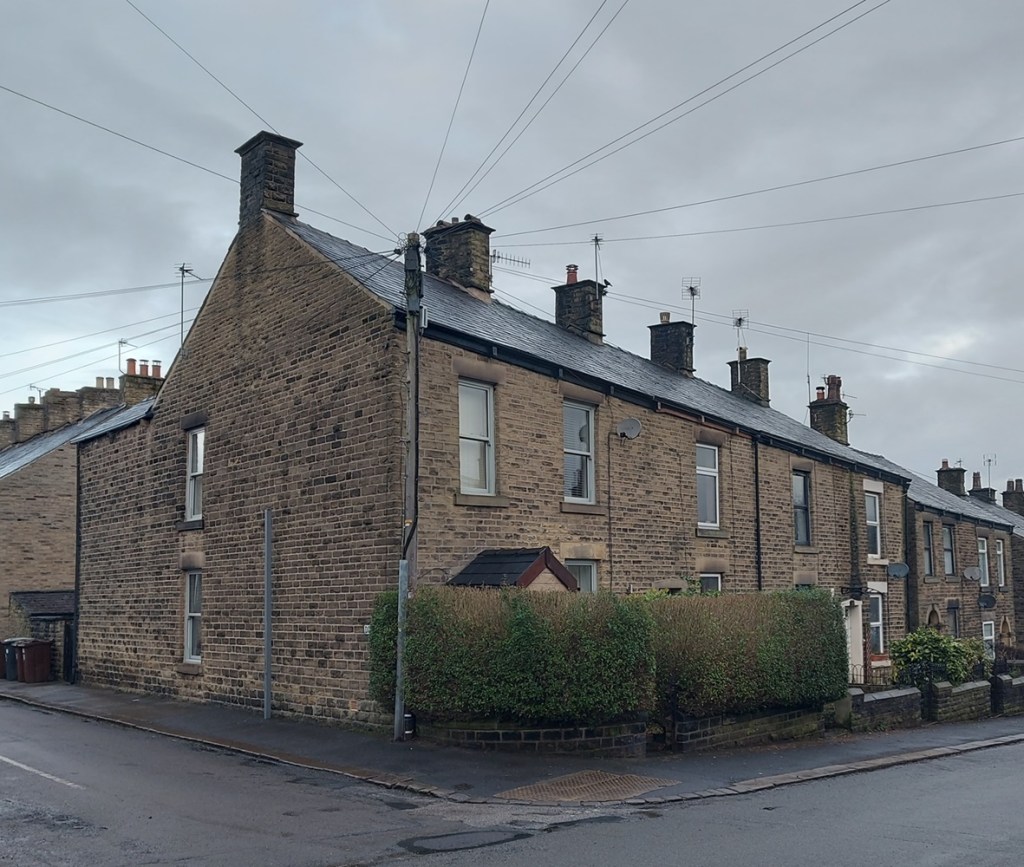
Anyway, where was I? Oh yes, field shapes and history. So, if you look at any OS map, you’ll see that it is criss-crossed with lines which mark out the boundaries of fields. On the ground and in real life these boundaries are made up of fences, hedges, or, in this part of the world, with drystone walling. It takes time and effort to build these walls, and more time and effort to take them down, which means it doesn’t happen very often. And unless the area has been significantly changed or has been built over completely, the field boundaries you see on the map and on the ground have been there since they were laid out. And here it gets interesting: the way fields were laid out changed over time – their shapes reflecting contemporary farming techniques – and it this which allows us to date them and their associated settlements.

Looking at local examples chronologically then, we start at the beginning. Quite literally. The first farmers – those neolithic & bronze age types who initially took the huge risk to cease the hunter-gatherer nomadic lifestyle, and instead adopt a sedentary one based around agriculture – created the first fields. Evidence from elsewhere suggests that these were not fields as such, more areas of land cleared of trees – a formidable task using only stone or at best bronze tools – and the area cleared of stones to enable to plough to pass. The larger stones are normally found rolled to the edges of the cleared areas, and there are often clearance cairns associated with them – piles of rocks, essentially. There are suggestions of bronze age systems in the area, but nothing even close to definite, and certainly nothing worth describing.

There is a similar situation with the Romano-British field systems, of which there is one possible example, in Whitfield, to the north and south of Kidd Road. These seem to comprise a series of lumps and bumps in the ground that might be the remains of field boundaries, or of terracing on which agriculture took place.

The potential field system is in yellow, the Roman road from Navio is in red. Image stolen and altered from the Derbyshire HER website.

As the Roman road from the fort at Brough (Navio) runs just by there, it would be a good place for a farmstead, and I’m sure more existed nearer Melandra. It’s not terribly inspiring, if I’m honest, but it is interesting, and if it is Romano-British in date (43AD – 410AD, perhaps a little later, too… or possibly a little earlier), then it is proof that people have lived and farmed in Whitfield for over 2000 years. You can read a bit more about it on the Derbyshire Historic Environment Record here, or, the Glossop & Longdendale Archaeological Society website, here.

However, our first definite and recognisable field systems occur in the medieval period.

By 1086, Longdendale and Glossop had been designated Royal Forest, a situation which brought with it all sorts of restrictions for the residents of the seven villages that made up the area at the time of the Domesday Survey: Chunal, Whitfield, Charlesworth, Hadfield, Padfield, Dinting, and Glossop (I’m convinced there was something at Simmondley and Gamesley at the time, but were overlooked or ignored as too small to tax). It was particularly particularly restrictive around land use; the existing villages were allowed to continue, but were not allowed to expand their size in anyway, as this would affect the king’s land, and take food from his deer. That didn’t stop them, though. What few records we have of medieval Glossop make mention of the crime of assarting, that is to cut down trees to enable the land to be used for growing crops or grazing – essentially increasing your land, illegally. For example, in 1285 we find the following:

“The wood of Shelf has been damaged in its underwood to a value of 15 shillings by the villagers of Gloshop, fined 4 shillings, they must answer for 60 oaks”.

The process would have been gradual, and probably done sneakily, perhaps by bribing the forester to look the other way. Or equally, it may have been worth the fine if you can increase your farming lands significantly – an investment of sorts. Given the nature of assarting – essentially picking away a few trees at a time – it often leaves a distinctive field shape: rounded, rather than straight or uneven lines. There is a perfect example of this at Ogden, above Tintwistle:

The two farmsteads of Ogden, both now in ruins. I need to explore up there sometime.

And if we look over at Hargate Hill, between Charlesworth and Simmondley, I think we can see a similar process happening here:

Rounded edges, rather than the more usual straight.

The circular, almost organic growth of the fields can be seen, and it may be this that is referred to in 1285: “The wood of Coumbes (Coombs) has been damaged by the people of Chasseworth (Charlesworth), fined 2 shillings, they must respond for 18 oaks.” This whole area is full of interesting detail. The first mention of Hargate Hill I’m aware of is 1623 (the record of the burial of ‘Widow Robinson’ of Hargate on 10th July, to be precise), but there must have been something there before this date. There is a suspicion that stone from the quarry here was used to build Melandra Roman fort, although how true this is, is not clear, but the settlement is just off the main road between Glossop (via Simmondley) and Charlesworth, which is significant. Importantly, between the road and settlement, there is evidence for Ridge and Furrow ploughing, which is normally medieval in date. You can see it in this LIDAR image:

The ridge & furrow is running roughly north-south from High Lane.

Ridge and furrow is created by ploughing up and down a strip of land using a team of 8 oxen. Now, as you can imagine, 8 oxen are a nightmare to turn, and their size alone means that you have to start the turn very early on in your plough furrow in order to maximize the land use. This creates a distinctive reverse ‘S’ shape to the thin fields – or ‘selions’ – that make up the medieval farm landscape – the result of only being able to turn the oxen to the left (as the medieval farmer used a fixed blade plough share that was positioned on the right). These selions are side by side, with a dip in between (you can just about make out the dips in the above LIDAR image), and made up of rows and rows of ridge and furrow running the length of the selion. A selion normally measured a furlong in length (a ‘furrow long’: some 220 yards) and between 5 and 22 yards wide.

In Whitfield there are many great examples of this classic, and instantly recognisable, early medieval field shape.

Clearly visible, running NW-SE, and on either side of Cliffe Road. There are dozens more in dotted about the area, too.

Hiding in plain sight, the medieval field systems of the 12th & 13th centuries. The fact that they run either side of Cliffe Road is significant: they ‘respect’ the road, which means that the road was there before the selions, as it is highly unlikely a road would be put through arable land. We know this anyway – it was the main road from Glossop to Chapel en le Frith – but it is good to have it confirmed.

What I find amazing me is the sense of continuity of use; the field marked with a red ring in the above map is exactly the field boundary of the Whitfield Allotments, and I wonder how many allotment holders realise their plot of land has been continuously farmed for nearly a millennium. It’s also fascinating to think that although the area has been largely built over, the boundaries of individual modern house plots have used these field boundaries as references, and so the field laid out by a medieval peasant farmer 800 or more years ago has a direct influence on life today. Looking at a tangible history in that way leaves one feeling quite dizzy.

Chunal, first mentioned in the Domesday Book, was an important medieval farmestead.

Chunal is even clearer in its agricultural history, and has evidence of both assarting and the use of Ridge and Furrow on both sides of the road, especially what is hidden beneath the surface now – compare the above map with the LIDAR survey of the same area… huge numbers of selions, all in the classic reverse ‘S’ shape.

The same area scanned with LIDAR. The selions not shown in the above map are very clear.

The quantity of field strips is testament to the relatively large-scale agriculture occurring in this area in the earlier medieval period. Simmondley, too, has a large number to the north and south of Old Lane, which was the original medieval track from Charlesworth via Simmondley to Glossop:

Notice the selions ‘respect’ the original track – Old Lane – they stop at the road, and don’t line up symmetrically on the other side. They are, however, overlain by the New Road which was built, I believe, in the 1860’s. Just as in Cliffe Road in Whitfield, Old Lane must have been there when the selions were laid out, or at the same time, giving us a date for the track.

During the 14th century, however, we see a shift in farming practice, and land use moves away from the ‘open field’ system of strips, and starts to become enclosed by walls. This is probably a result of two critical events. Firstly, the climate starts to get colder, which has a negative impact on the ability to grow crops, and which lead to a series of famines. The second was the emergence of the Black Death which killed off 1/3 of the population during 1348-49. And whilst the Peak District emerged seemingly relatively unscathed, no doubt there was a movement of the population to better arable land that had been abandoned, leading to a population decline. It had also become apparent by the mid century that sheep/wool farming was a lucrative market, and thus increasing amounts of land was blocked off to allow sheep to graze safely. These early enclosures are normally recognisable as non-symmetrical enclosures that have largely straight-ish lines, but aren’t a specific shape. We can see some probable examples to the north of Simmondley New Road, now covered by housing but preserved in the 1892 1:25 inch map:

Simmondley New Road running west-east(ish) replaced Old Lane… the clue is in the names!

If we look closely we can see these early enclosures are made by consolidating and expanding existing selions, as farming practice shifted from arable to livestock. The more you look, the more the medieval and early modern landscape comes to life.

We also encounter them at Gamesley, now also covered by housing, but perhaps originally associated with Lower Gamesley Farm which may have an early foundation date, even if the present building there dates from only the 17th century (only…!). The settlement is first mentioned in 1285, but actually Gamesley is a Saxon name meaning the ‘clearing (or assart) belonging to Gamall’.

Gamesley, to the south of Melandra.

Of course, people needed agricultural produce, and many strips continued to be farmed well into the post-medieval period. Indeed new fields were laid out, although later ridge and furrow is normally straight as, over time, smaller teams of larger oxen were used, and these were eventually replaced altogether by heavy horses.

Our final field type comes at the end of the 18th and early 19th centuries with the parliamentary enclosures. Briefly, open ‘common’ land – poor rough land, owned by the Lord of the Manor, but used by everyone to graze animals or to gather fuel – was parcelled off and sold in lots. On paper, this freed up lots of land and was a boon for farmers who could, with a little improvement, massively increase their lands. But it also meant that the common man lost access to land that his ancestors had legal rights to. Arguably, by the early 19th century there were very few people who would have used the land anyway; not many people had animals to graze, nor did many burn peat as a fuel. The rural way of life, especially in Glossop, was well and truly over and most people lived in stone terraces and worked in mills. But that really isn’t the point! The parcelling up of the land into lots was done drawing lines over maps using rulers… and it shows.

Moorfield is surrounded by fields that are the result of the 1813 Whitfield Enclosure Act.

And elsewhere:

The area to the north of Glossop

Around Lanehead farm, toward Padfield there are clear examples of 19th century enclosure… in fact they are all over Glossopdale – have a look at any map. They often mask earlier field systems and tracks which can be on a different alignment, and a quick scan of the Lidar for the same area reveals all sorts of lumps and bumps:

Lanehead Farm is shown by the orange arrow.

The grey arrows above show older field systems not shown on the map. In the middle of the arrows there is what might be ridge and furrow. A detailed study of the fields on the maps and on the ground, as well as a comparative reading of the lidar could give us huge amounts of information about the past use of the landscape, beyond the obvious parliamentary enclosures.

The lines of these fields are all very straight, and all the walls are of a standard form, and the whole parliamentary enclosure process was completed with characteristic Georgian and Victorian efficiency. But a part of me feels that it is almost an industrialisation of the landscape, a triumph of efficiency over nature. Prior to this, it was a difficult process to carve out a little patch of land to support your family, and it required blood, sweat, and tears. This human, organic, side is etched onto the land – assarting, the reverse ‘S’ shape, even the enclosures for sheep, they all have an element that is dictated to by the land, and all came with effort. To stand over a map with a pen and ruler dividing up the landscape is to have a complete disconnect from it, and is human imposing on it, rather than working within it, and that feels wrong somehow. Anyway, enough of the hippy!

It genuinely is amazing what you can see when you start to study maps, the unexpected can leap out at you. Keep looking, wonderful people, and please mail me with anything you find – I could even make you famous* by publishing it on the website.

*famous to all 11 people who read the website, that is.

Anyway, I hope you have enjoyed todays romp around the countryside. I’m planning a few more official Cabinet of Curiosities wanders over the summer, one of which is a jaunt down the medieval and early modern trackways of Whitfield and Glossop via 2 pubs and a pile of history and archaeology… what’s not to love? And all at a bargain price… a man has to eat, after all. Watch this space. Or Twitter. Or Instagram, if I can figure how to use it properly.

Until next time, keep looking down, but also look after yourselves and each other.

I remain, your humble servant,

TCG
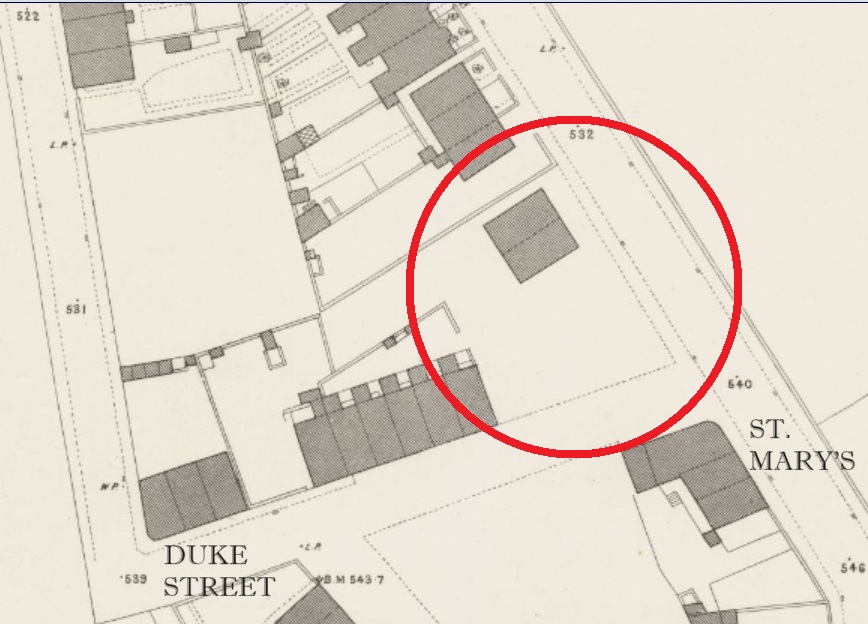
History · Placenames · Simmondley

The One Glossop… and the Many Glossops

What ho, wonderful folk! Summer is almost upon us, and we enter the finest time of year. Now don’t get me wrong, I’m fond of spring, and autumn is good. Even winter with it’s cold and dark can be lightened and warmed with a good fire and a glass of the stuff that cheers (if taken in the right dosage, as I am often reminded by the good Mrs C-G). But no, ask old TC-G which season he likes most, and the answer will always be… summer. This time of year fills me with a particular joy; it puts a spring in my step, a smile on the old fizzog, and a stirring in the loins (although that’s possibly the onion soup I had for lunch). Summer is indeed ‘icumen in’.

And indeed, it’s the stuff that cheers that leads us to today’s blog post – something a bit different, but fret not dear and gentle readers, for when have I ever steered you wrong?

I wonder then have you ever found yourself, glass in hand and perhaps swaying slightly, in a place to which you never set out to journey? I certainly have (and no, not that Turkish bordello… for the last time, I was only in there to ask for directions to the post office). No, a chance encounter with a place, perhaps exotic, otherworldy, strange and alien, like no other place on earth, and yet familiar? A few months ago I found myself, quite by accident, in The Globe pub quiz (and good evening JS!). It was a difficult quiz, and involved much mashing of the old B, and a distinct straining of the dashed M… if you catch one’s meaning.

But one question in particular flummoxed me: “How many Glossops are there?”.

I mean, there’s an existential crisis… what? Why surely there is only one? The singular, unique, one-of-a-kind place that we call home. This royal throne of kings, this scepter’d isle. This earth of majesty, this seat of Mars, this other Eden, demi-paradise. This fortress built by Nature for herself against infection and the hand of war. This blessed plot, this earth, this realm. This Glossop. (ok, I might have had a bit of help with the words there… my thanks to William what’s-his-face).

But no… apparently there are three. Who knew? Well, the quizmaster did. And several of the other teams did, apparently. But I bloody well didn’t. Not that I’m bitter or anything. And besides, none of the other teams could answer any of the questions in the ‘Pottery Identification’ round (alas, if only such a wondrous beast existed… one can but dream). 

So then, two other Glossops… blimey, there’s a thought. What wonders could these places offer us, what unearthly delights akin to the Globe quiz? Well, dear and gentle reader, let’s find out.

Introducing Glossop Number 2

Where the red pin is, lies another Glossop, on the other side of the world.

Glossop, South Australia. A town roughly 250 miles north east of Adelaide (and just a mile or so north of the splendidly named township of ‘Winkie’). It’s a small place, with a population in 2016 of just 984 (compared with our Glossop’s 33,340 in 2021), mainly rural, and surrounded on all sides by vineyards – it’s right in the wine growing region, lucky people! (and presumably then the weather would be a tad warmer than that found in our corner of North Derbyshire!).

I am in awe of its triangular shape!

It was founded in 1921 as a settlement for returning soldiers, and is named after the equally splendidly named Vice Admiral John Collings Taswell Glossop (if anyone knows their Jeeves and Wooster, this could be Tuppy Glossop’s uncle). Vice Admiral Glossop was in command of HMAS Australia during the First World War, and was very active in the Royal Navy’s Australian wing.  

A little different from High Street West, this is Campbell Street, Glossop.

There looks to be some great camping and hiking to be done in the area, and there are several national parks based around the Murray River there. That stated, there’s not a lot more to say about the place, to be honest, but do feel free to have an explore on the internet, or in real life (oooooh, a tour of the wine country could be fun!). If you live in Glossop, Australia, and have stumbled upon this site, then please let yourself be known – we’d love to hear from you. 

But wait, there’s more!

In New South Wales, Australia, there is a Glossop Reservoir. Situated near to the village of Linden, 40 miles NW of Sydney, it’s located at the end of Glossop Road, and absolutely smack dab in the middle of nowhere.

Glossop reservoir is the round thing at the end of Glossop Road.

I wonder why they have the name Glossop? Perhaps also connected to our man Vice Admiral Glossop? There is no more information I can find out about this place at all, so any information you have would be gratefully received.

And now for Glossop Number 3.

Will this Glossop be a throbbing metropolis? A mecca of marvelousness? A seething mass of humanity? A place of culture and wonder, or a modern-day Sodom and Gomorrah? Well, not exactly…

Ladies and gentlemen, welcome to Glossop, Manitoba, Canada.

What wonders await under that red pin?

Well, what can we say about Glossop, Manitoba.

Well, no matter how you feel about Glossop, Derbyshire, it has something going for it. And as small as Glossop, South Australia, is, it has life… in that people actually live there. Glossop, Manitoba is… well… a road, next to a rail track. With some grain elevators on it.

Glossop, Manitoba… what can I say?

There must be something nearby… surely. Let’s look down the road:

Nope, nothing this way, let’s look behind us…
Nope, nothing.

What we can say is that it is situated 604m (1982ft) above sea level, is on the trans-Canadian Yellowhead highway, and is broadly equidistant between the settlements of Newdale and Strathclair… both of which seem to be quite nice, if on the small size (population “perhaps 200” and 709 respectively). What we can’t say, however, is why this place has the name Glossop, although presumably it’s named after someone with that surname.

However, a little more digging and… it turns out the grain silos are interesting.

Copyright Steve Boyko, and borrowed from this website.

Well… ok, let’s be honest for a moment, anyone who has ever read anything on this website knows that the word ‘interesting’ is very flexible (and honestly, we have stretched that word to the limit on this site), and I’m painfully aware that my particular niche interest doesn’t ring everyone’s bell. But even by our own relaxed standards, these grain elevators aren’t exactly riveting. However, this is exactly the sort of thing the internet was invented for – people with niche and minority interests meeting each other and sharing information – after all I’m here writing this, and all six of you (including Pablo in Puerto Rico… hola Pablo!) are out there reading it. The website ‘Grain Elevators of Canada’ has a whole page dedicated to those at Glossop, Manitoba, but I’m not going to steal their thunder, instead please do go and have a look at it.

But wait, there’s more…

Some 350 miles north east of Glossop, Manitoba, is Glossop Lake.

Even by Canadian standards, this place is in the middle of nowhere: 40 miles NE of the nearest settlement (Pikwitonei, population 55), and 150 miles east of Thompson, the ‘capital’ of northern Manitoba (population “fewer than 15,000”). You could only get to this place by hiking for several days, or possibly by boat. It is truly remote.

Which makes it particularly baffling that the only information about Glossop Lake available on the internet are from a Wikipedia page written in Cebuano, a language spoken almost exclusively in the Southern Phillipines… and with no obvious connection with an obscure lake in the frozen north of the Canadian wilds! Bizarre!

So what can we say about Lake Glossop. Well, it’s a shallow lake, situated 200m above sea level, and covers an area of 1.35km2. It is mostly pine covered, and the average temperature for the area is -5… so you’ll probably not want to go skinny dipping any time soon. There is neither a photograph, nor an explanation as to why it is called Glossop Lake, though presumably again named after a person.

So there we have it – the many Glossops of the world. I’d like to do a roadtrip to find these places, but honestly… that seems like a lot of hard work for very little reward! However, if anyone is going to any of the places mentioned, please let me know.

And whilst this post is not overtly archaeological, it does have some relevance. Gamesley, Simmondley, and even Glossop itself are all named after people, and all were imposed on the landscape by Anglo-Saxon settlers. What the native British (the ‘Celtic’ Romano British) called the area, if it had one, is lost to us (Dinting being the exception). This habit of naming after people or features in your own language can also be very helpful in identifying settlement patterns, ages, and the origins of the people doing the naming. And here it does get interesting. Simmondley means “the clearing” (or ley) belonging to someone called either Sigemund or Sigmundr. The former is a Saxon name, but the latter, however, is a Norse (Viking) name, and that might be important. I have a pet theory… we know that a small group of Scandinavians were allowed to settle in the hills to the east of Manchester, and there are a cluster of possible/probable Scandinavian names in the Simmondly area: sitch, storth, gate, nab, and possibly others. It makes me wonder if Simmondley’s origins are more Viking than Saxon. Just a thought, but it does illustrate the importance of names in a landscape. I’ll expand on this another time.

But for now, take care of yourselves and each other.

And I remain, your humble servant

TCG