Archaeology · History

A Box o’ Bits

What ho, you wonderful people you, what ho!

Well, I have an interesting offering for you this time, and one that doesn’t involve pottery, sadly. I know, I know! I can hear your yells of pain and misery from here… and my how they sound like whoops of joy and celebration. Joy and pain are two sides of the same coin I suppose – the Yin to the whatsit, and all that. Although, I have to say the chap who appears to be doing a buck and wing clog dance whilst singing ‘Happy Days Are Here Again does seem to be hiding his sadness a little too well… Hmmmm.

Anyway, I digress…

So, I have a friend who bakes cakes, she’s something of a connoisseur as it happens, and people are always giving her cakes as presents. Practically throwing them at her. I have another friend who takes his music very seriously, and people are always giving him records and cds with the words “I thought you might like this“. I have yet another friend who likes his beer, and scarcely a week goes by without someone bunging cans and bottles his way, saying things like “I was in Harvey Leonards the other day and I saw this and thought of you” – almost drenched in the stuff he is… and permanently inebriated.

So, I like old things… and especially pottery.

Now, I was once at a dinner party, glass of the old stuff that cheers in hand, swaying slightly, and conversing with a chum, when another chum bounded over and said “What ho, TCG! Oooooh, I say old bean, I have a gift for you” and off he scurried. He returned moments later clutching a plastic bag which he handed over to me. What could it be? It was like Christmas! Excitedly, I opened the bag…

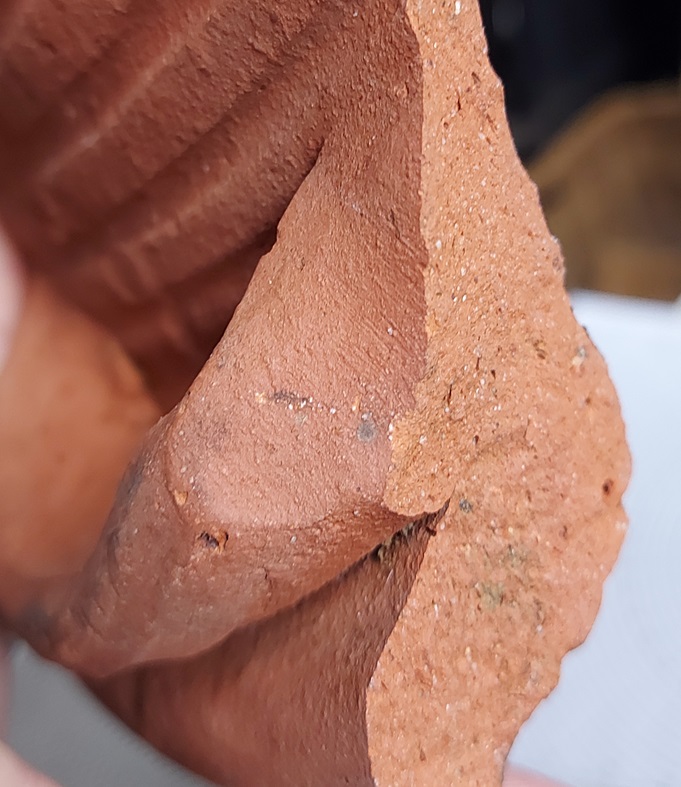
What it was was a half a muddy brick. A perfectly normal 19th century house brick, broken in half, and still damp. They thought it might be old and presumed I’d want it.

Well, I mean to say, of course one doesn’t look a gift thing in the old whatsit, but… well… You know. And this sort of thing happens surprisingly – worryingly – often. So you can appreciate then why the words “I’ve got something for you” can sometimes sound a note of concern.

Don’t get me wrong, I very much appreciate the thought, it’s kind and most welcome. Honestly, little packages clinking with pottery fill me with a warm fuzzy feeling, and truthfully I’m never happier than when I’m rifling through shopping bags of finds, furtively handed to me in the park, looking shiftily around, like some sort of Soviet-era spy game. Indeed, being able to answer people’s questions of ‘what is it?‘, ‘how old is it?’, and the often asked ‘what’s wrong with you?‘ is the reason I write this website… and why all seven of you read it.

But for the record I also like beer and music. And money… a shiny shilling or two wouldn’t go amiss, either. And did I mention the stuff that cheers? I like that a lot!

Other times, however, gifts clasped tightly in hands can be amazing. I have had some genuinely wonderful, alarmingly, breathtakingly beautiful, and truly interesting things given to me to look at: pottery, bricks, flint… spoons!

And so it was the other day that I was skilfully tracked down by the always wonderful S.T. who thrust at me a cardboard box, tattered at the edges, and yet so full of promise (the box that is, not S.T… good old S.T. looked radiant as ever).

What wonders lie within?

And that is the start of this episode. The objects contained within – on loan in a distinctly non-permanent way – were all found in the fill of an old mill pond, the exact whereabout of which are shrouded in mystery (but which I’ll happily disclose for the price of a glass of something nice… I never said I had scruples, nor that I wasn’t cheaply bought).

So come, let’s explore the box together.

Honestly, who can’t be excited by this.

The box itself is interesting – an armorial device with the initials DSC and a motif of crossed razors… a quick Google search tells me the Dollar Shave Club. Now, given that I have water from the holy well at Walsingham Priory safely contained in a medical urine sample pot, it’s not my place to pass comment. The box is, however, different from their normal home, which is apparently an old clock. Mind you, this is the same S.T. who uses an egg as a scale in her photographs… so nothing should surprise us.

So what was in the box o’ bits? First up, a clay pipe stem.

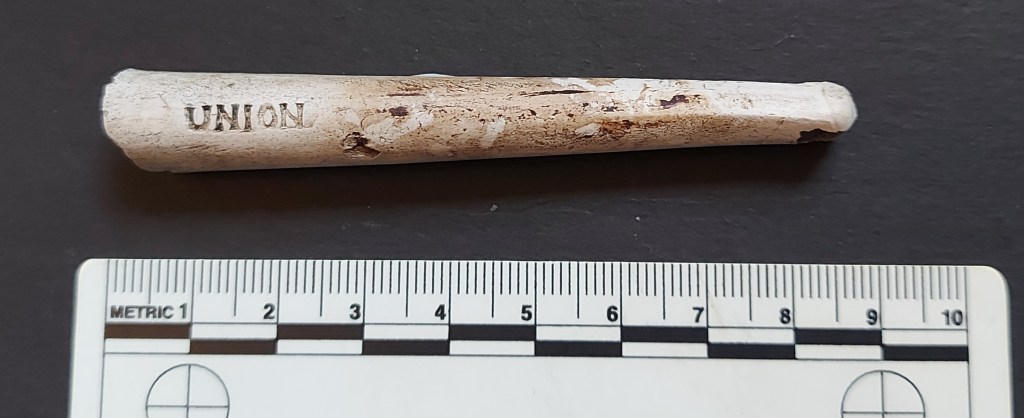
Interesting stuff, and a good example.

Plain apart from the words “UNION” and “PIPE” stamped on the sides. I browsed my sources for information about this, but came up with nothing, alas. It is probably an example of a political pipe, that is those that carried slogans and allusions to important political ideas and events of the day. No doubt this one was connected with the idea the Northern Irish union with the United Kingdom. The Unionists demanded to remain part of the UK in the face of an increasingly independent Republic of Ireland, which itself was demanding that Ulster be a part of it. It’s an interesting history, and one that obviously resonates still to this day. Given that a lot of clay pipes were aimed at a target market of Irish immigrant workers in Britain, it’s unsurprising that many of them contained words and phrases that reflected politics back home. Indeed, such was the market that many clay pipe manufacturers even gave their address as Dublin on the pipe bowl, despite being made in Birmingham or similar. It also plays on the belief held at the time that somehow Irish clay pipes were superior in quality.

The mouth piece is interesting, and shows the manufacturing process clearly. Formed in a two-part mould, the pipe often has mould lines along it length that can be quite thick and sharp, especially if the mould is old and worn and doesn’t close properly. The answer is to pare away the flashing with a knife, which you can see happened here.

I think I can make out some tooth marks on the mouth piece. The dark staining is the result of it lying next to something metal and rusty.

Date wise, the shape (straight, and quite chunky) would put it sometime in the early 20th century – let’s say 1910? It looks similar to the shape of the McLardy pipe here, and it would also fit with the political message.

Next up… a boot!

A tiny boot!
Yep… it’s a boot.

The detail of this thing is amazing; it’s old – probably Victorian in style – and one of those boots with an elasticated side (I actually have a pair, and very dapper I look in them too). It’s made from pewter or similar – lead-based, certainly. I have no idea what it actually is, but it’s possibly some sort of charm – if you look closely at the front you can see the remains of a small ring which would have been used to hang it from something… a pocket watch perhaps. Or, it might have been a pin cushion, with a material filling the hollow allowing pins to be pushed in.

However, whilst looking closely at it, I noticed something.

These photographs are shocking, even by my standards. I have a new phone with a camera that is truly disappointing – it doesn’t even have a macro setting. I’m not necessarily blaming the phone – my photos have always been bad – it’s just that it doesn’t help.

You can just make out a pair of tiny mice, one on each side, crawling up the boot.

The Mouse in detail – you can make out the tail and back leg. Also, you can the attention to detail in the boot – the heel is worn.

A mouse in a boot or shoe was a common theme in the Victorian period apparently, and the Northampton Museums website seems to provide an answer why:

Shoes can be thrown at weddings to wish the couple a good, long and useful life. The shoe was also a sign of fertility and many years ago a boot was often buried in the home of the newly wed couple. Inside the boot was placed a grain of corn, which it hoped would attract mice to nest and breed. From this came the idea that the wife would bear lots of children, who would look after her and her husband. Many Victorian miniature shoes show a mouse playing in the shoe.

So there we go – vermin in your footwear can lead to many children. Who knew?

Next we have some toys, and to start with, a wonderful hollow cast tin soldier.

The large bearskin hat suggests he is a guardsman of the Grenadier or Coldstream Guards of the British Army.

Remarkably, he still has his head, which is normally missing from found soldiers. The paint is in good condition, to0 – blue trousers and a red tunic. To make these Victorian to early 20th century figures, a mould is made into which a molten tin alloy is poured. This cools immediately on contact with the exterior, and which allows the still molten interior to be poured out, thus saving on tin. They were hand painted, probably using some very nasty heavy metal based paint – so don’t chew any you happen to find.

Really good condition.

When new, he would have originally looked something like this:

Modern versions, stolen from here

This example is certainly better than the one I found… very jealous!

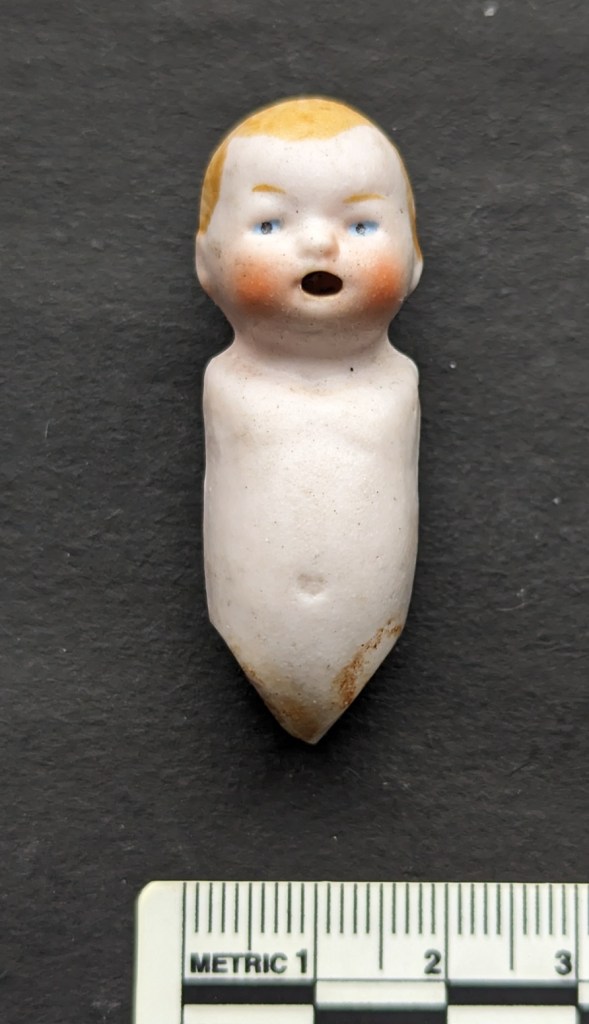
Next up we have… well, let’s not beat around the bush. We have nightmare fuel. The kind of thing that haunts my dreams.

I mean… honestly!

I’m not fond of dolls, they honestly give me the creeps. But I think it is quite common for humans to be unnerved by things that look quite like us, but which aren’t us; the ‘Uncanny Valley‘ is the term for such feelings. It’s not an outright phobia, more a dislike or a sense of unease. Although I have to say, I do like the expression it has – a sort of open-mouthed surprised look… not unlike my own expression when I unwrapped this wonderful, if creepy, item. So then, here we have an remarkably complete Victorian bisque – or unglazed porcelain – doll. It’s tiny, and only the body remains – the arms and legs would have been a material, or perhaps porcelain with a single rivet joining them so that they were movable. The whole would have been clothed, or wrapped in a blanket, but this has long since rotted. The incredible detail in the colouring of the eyes, hair, and face would indicate that it was a relatively expensive one, and it would have looked something like this when ‘alive’.

Stolen, with my usual lack of shame, from this website.

On the back is impressed the word ‘Germany’, which is where the doll was made, Germany being world renowned as the centre of doll manufacturing. There is also the number ’61’ just visible on the left shoulder, which is presumably the mould number.

A ‘raking light’ shows the impressed maker’s mark.

Sadly I can’t find any more information about this doll in particular, but at one point this was a prized toy belonging to a little girl, and at some stage the doll was lost or thrown away. A melancholy thought.

Next up is… yep, more nightmares made solid! Thanks for this, ST.

Less or more creepy?

Another bisque doll, and whilst it is complete, it’s just the head and shoulders, which would have been sown into a cloth body. It would have been sold very cheaply as there is no painted features, but would nonetheless have been a much loved toy. You can see how it was made – cast in a mould, and hollow:

You can see the marks of the liquid porcelain as it was poured into the mould.

Creepy, but a wonderful

Whenever I find toys or marbles, I always feel slightly sad that they were lost or discarded. I don’t like the idea that somehow the things that matter to us as children shouldn’t matter to us as adults, and that there should be a clear and clean break with our childhood. Luckily though, I’m the adult now, and I get to decide what being ‘an adult‘ means… hence I have display cabinets filled with Star Wars and Action Force toys – and Airfix toy soldiers – from the 1980’s in our spare room. My childish things are very much still with me… but I digress. Again

After those last two I need a snifter of something that cheers.

Well, we started with a pipe, so let’s end with a pipe. Truly, I would love to smoke one. There is something wonderful about a pipe, something calming; the chap who takes charge in a crisis smokes a pipe. As does the dashing hero, or the bookish academic, or the romantic lead. Sadly, it’s that damned cancer that puts me off (that, and Mrs CG threatening divorce).

So here we have here a fairly standard, but always welcome, Late Victorian clay pipe.

In very good condition, and missing only the mouthpiece.

I actually have a whole article on clay pipes almost written, so I won’t go into too much detail here, but it’s the shape and size that tells us the date (briefly, if it has a bulbous bowl and slanted rim, it’s Georgian or earlier. But if it has an upright bowl and horizontal rim, then it’s Victorian. Also, a smaller bowl is earlier, whilst a larger bowl indicates it is later.

There is some lovely, if very common decoration on this pipe:

I love this.

The rouletting around the rim is very typical of the type, as is the stitching on the front and back, which hides the flashing caused by the joining of the two sides of the mould. There is no maker’s mark, not even a ‘Made in Dublin’, or similar Irish theme, alas. And as I say, certainly not uncommon, but always great to find one in good condition.

And with that final pipe extinguished, the journey is over: the ‘box o’ bits’ has been explored, and we may all go back to whatever it was we were doing before I interrupted. My sincere thanks to ST for allowing me to share this with all seven of you, and for following and supporting me for so long here at the Cabinet of Curiosities.

In other news, I’m currently putting together the next edition of Where/When – this one covers a walk from the Bull’s Head in Old Glossop to The Beehive in Whitfield along ancient trackways, and taking in some interesting archaeology. As usual, you will be able to buy a physical copy, as well as download a digital version. I’m also going to do it as a guided walk, so you’ll get a chance to Wander the route with me – which may or may not be a bonus, depending on how much you like pottery! Watch this space.

Talking of which, more pottery next time. But until then, look after yourselves and each other.

And I remain, your humble servant.

TCG

Archaeology · Pottery · Whitfield

Friends… and Neighbours

What ho you lovely people!

I trust you are all recovering from reading the mighty publishing phenomena that is Where/When Issue 1? Move aside JK Rowling… Harry Potter was good, but was it ‘Pottery’ enough? See what I did there? Pottery… Potter…

What? What do you mean “don’t give up the day job”? This is my day job! And you, sir, are frankly uncouth! Honestly, what do you mean there are “funnier types of fungal infection”?

If you haven’t bought a copy yet, go and grab one from Dark Peak Books, or from me, if you can track me down. Or even download a free copy (link above). A perfect stocking filler, even if I do say so myself. Oh, and plans for a second and third edition continue to form… watch this space. Or Twitter. Or Instagram. Or just get in contact!

Anyway, shameless self-promotion over with let’s get on with the show, so to speak.

So, I recently became aware of a group of wonderful people – The Friends of Whitfield Rec and Green Spaces (their Facebook page is here). They are a group of Whitfield residents who are helping with the day-to-day upkeep and improvement of Whitfield Recreation Ground and other green spaces (for example planters, and other bits of land that might otherwise be neglected). A wonderful idea; we who use it, help keep it usable rather than rely just on the council who, with the best will in the world, don’t always the time and resources, or the local connection, to do this. I’m a big and passionate believer in the phrase “be the change you want to see in the world” (a saying usually attributed to Ghandi), and this group is a great example of this in action.

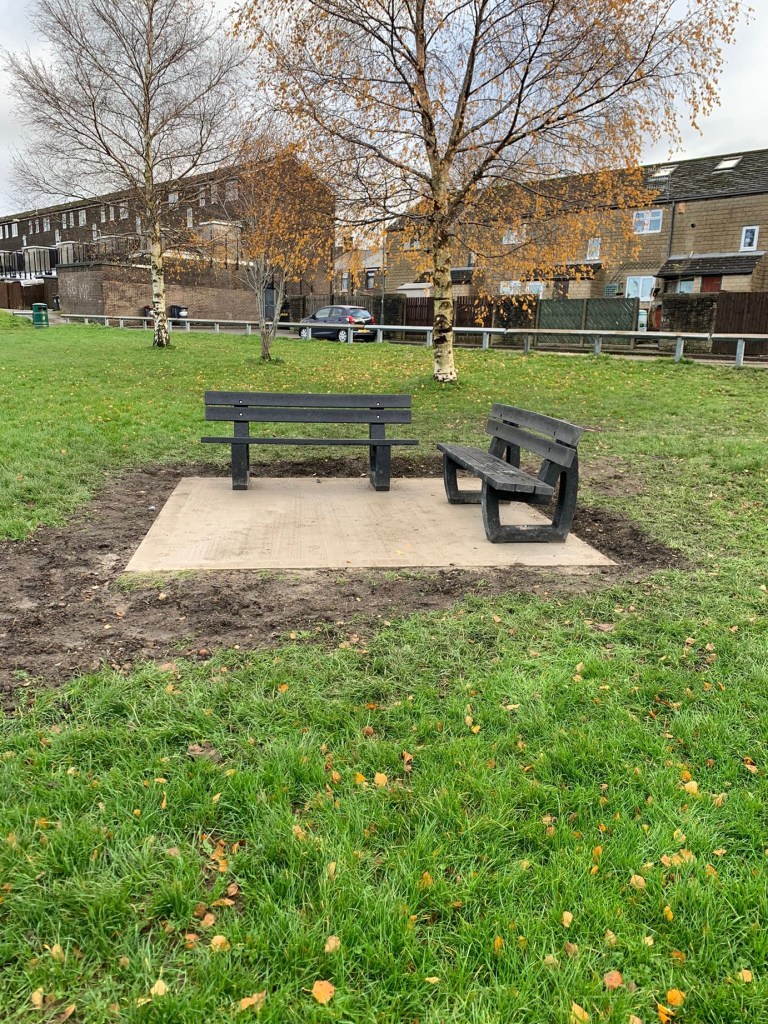
This summer they planted a pile of… er… plants in the grass around Whitfield Wells, improving the look of the area and adding a little wildness – an excellent example of what they do. And a few weeks ago they organised and installed some good looking new benches at the Rec. giving me somewhere new to sit and ponder the world… and my own navel whilst Master C-G and assorted other Herberts run riot.

The eventual idea is to landscape mounds and hedges around them, creating a wonderful usable social space. But back to the present, and the realisation that one cannot make benches without breaking soil – or something – and my spidey-sense began to tingle… do I smell pottery?

I did indeed.

A pile of pottery.

Most of the stuff I found was typical late Victorian and early 20th century tablewares. Not unexpected, and it is largely domestic rubbish, on wasteground, dating from a time when there was no rubbish disposal. Some of the more interesting bits in the above photo, then. Top row, second from right is a shallow bowl or plate with a rim diameter of c.18cm with a hand-painted red band running on the interior – a common motif in early 20th century pottery. Next to that is a fragment of a large rounded jar with a decorated out-turned rim (I should probably start explaining what I mean by all these terms… possibly). And next, a rolled rim from a brown stoneware cooking pot. Bottom row, second from left is a sherd of open pattern spongeware. Fourth from left is a sherd that has decoration hand-painted on the top of the glaze, and the two sherds on the far left are porcelain. As I say, fairly mundane.

However, some pieces were a bit more interesting.

First up, we have a fragment of a Pond’s Cream (or similar skin care product) jar.

Difficult to see in a photo.

It is made from milk glass – an opaque type of coloured glass – and is roughly square shape in plan, with rounded edges and large vertical grooves; it would have looked lovely when whole. It also has a screw top, which generally means it is early 20th century in date.

These three are quite nice, too.

Lovely stuff. And an ok photograph! I had so much trouble taking these – it was so dark even during the day that the pottery was showing out of focus.

Top left, a small plate of Shell Edged Ware, which my own guide suggests is mid Victorian. Bottom left is a hand painted tea cup of c.10cm diameter; it would have been quite lovely. Right is a sherd of Banded or Annular Industrial Slipware, with a rim diameter of c.10cm, and probably from a Late Victorian tankard (they are common in this design), and perhaps, we might speculate, from The Roebuck pub on Whitfield Cross.

These are very nice.

Left is a lovely sherd of Spongeware – a flower from a much larger design. Right is the neck from a Brown Stoneware bottle or jar of some sort. The incised decoration on this sherd is very sharp, indicating that it came from something potentially very fine. Both Early Victorian at a guess, so perhaps heirlooms when they were thrown away, or indicating that there is earlier material in the ground below the Rec. – which would be unsurprising.

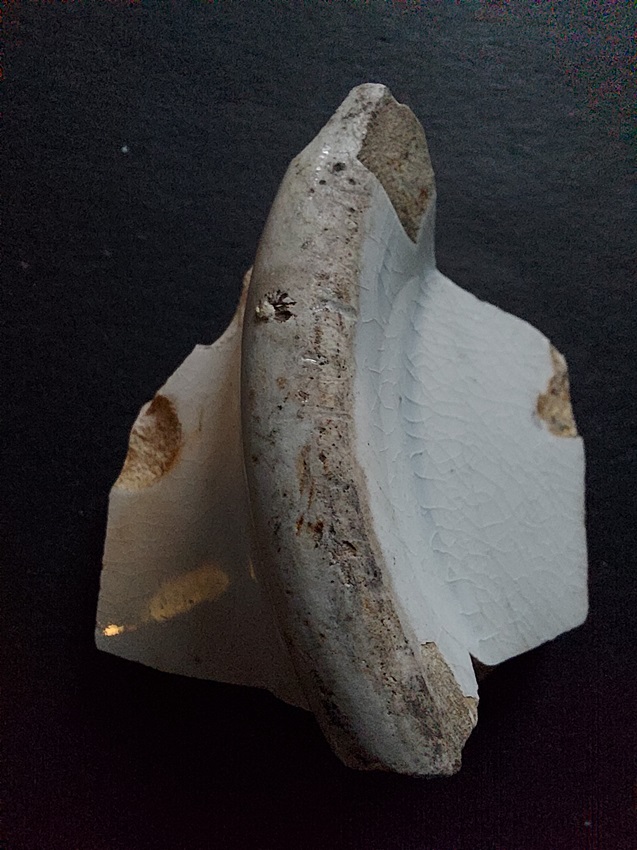
I love this next sherd – a ring foot from a larger open bowl or serving platter.

Unassuming, and a little boring at first glance

It looks boring, but is almost certainly early Victorian, and has seen some heavy use, perhaps indicating it too was an heirloom when it was broken and disposed of.

Very diagnostic – wear and glaze.

The wear on the ring foot is clearly visible – it has been moved about a lot – in and out of cast-iron ovens in particular – scraping off the glaze and wearing out the ceramic underneath. Also, note the blue tint to the pooled glaze, indicative of a Pearl Ware, and which was largely unused after about 1850. Knowing this sort of thing is the reason I’m a hit at so many parties… such is the burden of the sherd nerd!

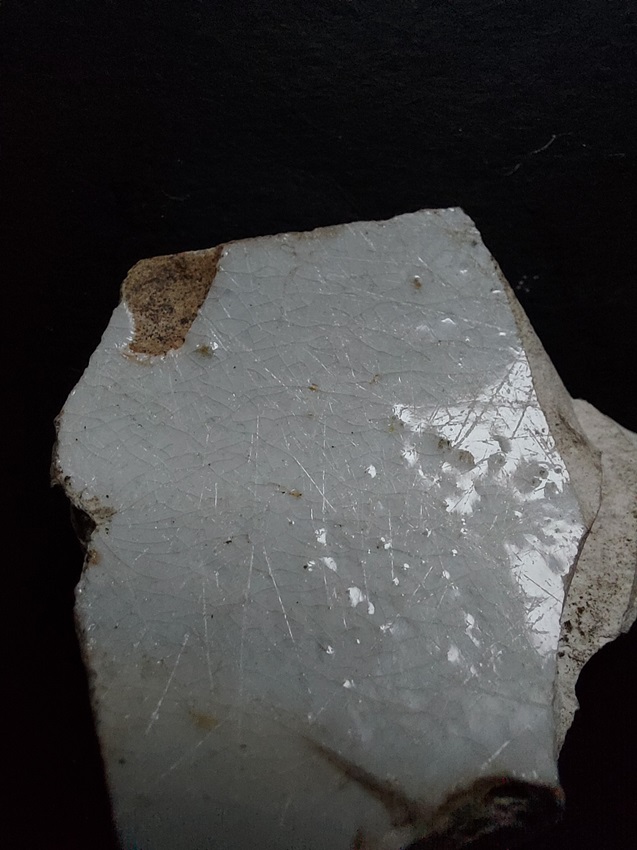
Extreme close up!

Looking at the interior surface you can see many scratches – cut marks made by a knife, probably cutting up meat in the process of serving food. This vessel had seen lots of use before being tossed into what would become the Rec. I love it – the human touch.

Finally, there was this:

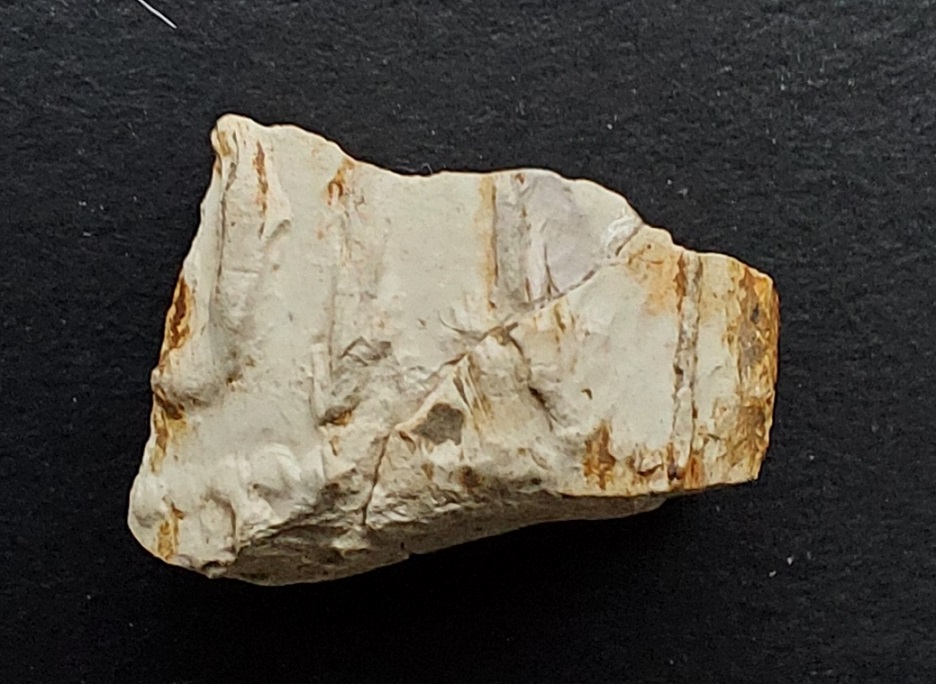
No, honest, it’s not just a stone!

It may not look impressive… and to be fair it isn’t. It’s a piece of spent coal – or cinder – and it’s what is left over when you have burnt coal. But it is a hugely significant in that every house would have produced lots of this material, and it should really be seen as a marker of domestic life in the late 19th and early 20th century. I love it for that… not enough to keep it mind, but it is a lovely, if very common, little piece of social history that I wanted to share with you.

So my sincere thanks then to the Friends of Whitfield Rec and Green Spaces for inadvertently sponsoring this month’s post!

Whitfield Recreational Ground has an interesting history – I’m not going to go into it too much as I’m not sure I could do it justice in this article, although it does need doing. Briefly though, Robert Hamnett (the historian) notes that Wood Street – and presumably the whole area – used to be an open field. He states:

“When I first remembered it there was a disused brick yard in the centre, with numerous depressions, which after heavy rain became dangerous to children playing there; in fact there have been cases of children drowning there”.

The whole area was improved and landscaped by George Ollerenshaw in the late 19th and early 20th century. He built the houses on Wood Street, and donated the library building that once stood at the southern end of the park (now the toddler park). His monogrammed initials and date of 1902 are on the Wood Street entrance to the park.

The ‘G’ and ‘O’ monogram of George Ollerenshaw.
1902 – the year the park was opened. I love these, and this entrance – a real faded glory.

Obviously, over the years I have picked up a few bits and pieces from the Rec:

A selection of fairly mundane and entirely expected Victorian pottery.

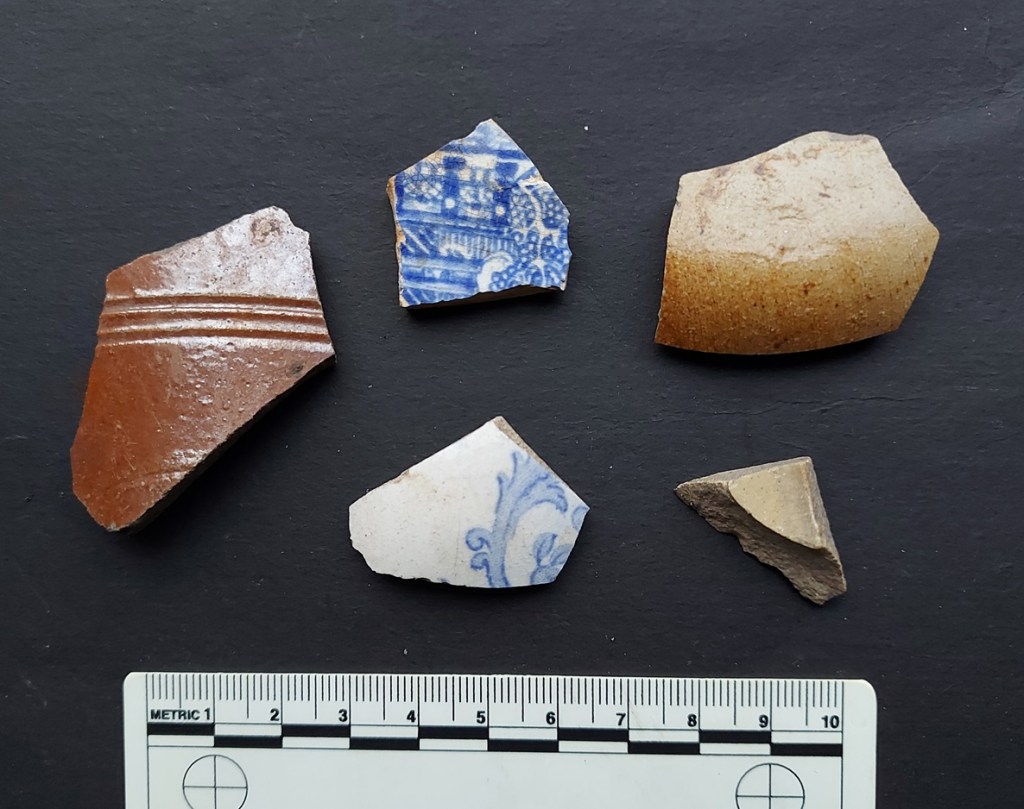
On the left is a sherd of nice and finely incised Brown Stoneware, probably from a bottle, and possibly early Victorian, as later types are less precise and do away with the incised bits. The middle sherds – one on top of another – are bog-standard Blue and White transfer Printed Ware. The two bits on the right are Salt-Glazed Stoneware, and probably from a ginger beer bottle. Lovely stuff this (and the subject of a future Rough Guide). I also think I can just about make out a smudged fingerprint on the exterior from where the pot was moved whilst the glaze was still wet. Possibly.

Excitingly, we have this:

A close up… perhaps too close?

A clay pipe bowl fragment, with rather lovely fluted decoration – flat panel of gadrooning (don’t say we don’t learn you nuffink on this website… and yes, I didn’t know either, I only learned it accidentally by researching this pipe!). However, nice though it looks, it is roughly made; the seam, where both parts of the mould come together, is coarse and untrimmed, and the clay has been poorly formed in mould. This is mass production in the Victorian period.

And finally, just like the cinder piece above, we have a very mundane but quite important object… a piece of roof slate.

I mean to say… it’s not much to look at.

It really is mundane, but is quite informative. Slate is not local: Wales is it’s origin, and until the railways enabled the movement of relatively heavy fragile material like this, that’s where it would have stayed. Once the railways were established (c.1840’s onwards), it quickly became the roof material of choice – just as strong as local stone, but 20 times the weight. indeed, you can usually date the houses of Glossop to roughly pre- and post-1850 by the roof material: stone vs slate. This slate has a flat smooth edge (at the top in the photo) where it has been shaped, but other than that, it is utterly unremarkable, and it simply exists as a remnant of the 1000’s of houses that once stood very close by but which were pulled down during the rebuild of this area during the 1960’s. Indeed, the roof of the public library that stood here was also slate, so it might be part of that as I found it not 10 feet from where it once stood (underneath the toddler play area).

None of these finds have a context – they are all simply rubbish dumped here mostly when it was an open field and before it was transformed into a park. It’s interesting to ponder that for a moment. The Victorians were awful when it came to litter; everywhere they went they left a trail of pottery, glass, metal, and bone – rubbish all over. Now arguably, these are organic, and are not largely made from toxic oil-based plastics as much of our litter is, so not as ‘bad’. Nonetheless, it is safe to say the Victorians were absolute scumbags, and although some of it will have been picked up, there is still lots to be found. If groups like the Friends of Whitfield Rec and Green Spaces have their way and remove all the litter from these places – and I hope that they/we/you achieve this – then are they doing a future me out of a blog post or two? There may be no rubbish to mudlark/fieldlark and blog about! Unfortunately, the massive amount of plastic rubbish that seems to crop up everywhere you look would indicate that this is not the case, and in 200 years no doubt some sad geeky bloke will be publishing a monthly article on a website, and enthusiastically waxing lyrical about this piece of rubbish or that bit of bottle. Imagine…

Get in contact with the Friends via their Facebook page; help them out, give them ideas, give them time, resources… even a cheer. They really do deserve it for everything they are doing, and attempting to do (read a bit more about them and what they do here). Also, do something simple: pick up a piece of rubbish from the street and put it in the bin – every bit we do, helps the bigger picture. And the future me won’t hold it against you, honestly.

That’s all for now, and it only remains for me to wish you a very merry Christmas whatever you end up doing. Personally, I shall be basking in the glow of a fire with family, some cheese and a large glass of the stuff that cheers. So here’s a health to you all, and I hope you enjoy my favourite ‘modern’ Christmas song.

And/or my favourite more traditional song:

I’ll be back in the new year, but until then, and especially at this time of year, please look after yourselves and each other, but until then, merry Christmas (and a merry solstice).

I remain, your humble servant.

TCG

Archaeology · Pottery

4000 Holes in Glossop, Derbyshire*

*well, one, actually… but it is rather an interesting one. And also, my apologies to The Beatles.

What ho! good folk of the blog reading sort, what ho!

Now, as you probably know (for the Bard says it so) some are born with pottery, some achieve pottery, and others have pottery thrust upon them… or something. I think I fall squarely into the latter camp, if by thrust you mean stumble across it, even if one isn’t looking for it.

And so it was the other day. I had dropped off young Master CG at a friend’s birthday party, and had taken the opportunity to saunter into town to pick up a few things (certainly nothing pottery related: lego, wine, and masking tape, I think it was… which gives yet another somewhat intimate peek into my life). I wandered down High Street, and wondered if it was too early for a glass of something cold and refreshing. Crossing the end of Market Street I looked left and idly noted that the road was closed… and then I noticed the ground had been dug up, with a good sized pile of spoil indicating that there was a hole.

Now, as an absolute rule, if an archaeologist sees a hole in the ground, they will peer into it. It’s so natural, so predictable, that it has become a sort of archaeological equivalent to the Masonic Handshake, and using it you can spot us a mile away. “I say! What’s that chap over there doing – peering into a hole?” they say. And comes the response “Oh that’s just old TCG, doing a spot of ‘hole peering’… he’s one of those archaeological types, don’t you know – curious fellows“. This is also why you never see large groups of archaeologists walking together; if they accidentally stumbled across some roadworks they could be there for hours, peering. From the outside it would look like a mass escape from some sort of specialised care home, the inmates muttering and stroking their beards, pointing at things that might, or might not, be there. And peering. People would get frightened, angry mobs would form, torches would be lit and pitchforks procured, the police would get involved… No, it’s safer we travel in ones and twos.

But I digress from the story.

Hmmm“, I muttered, and my thought process went something like this:

Oooh, a hole… I must have a peer.”

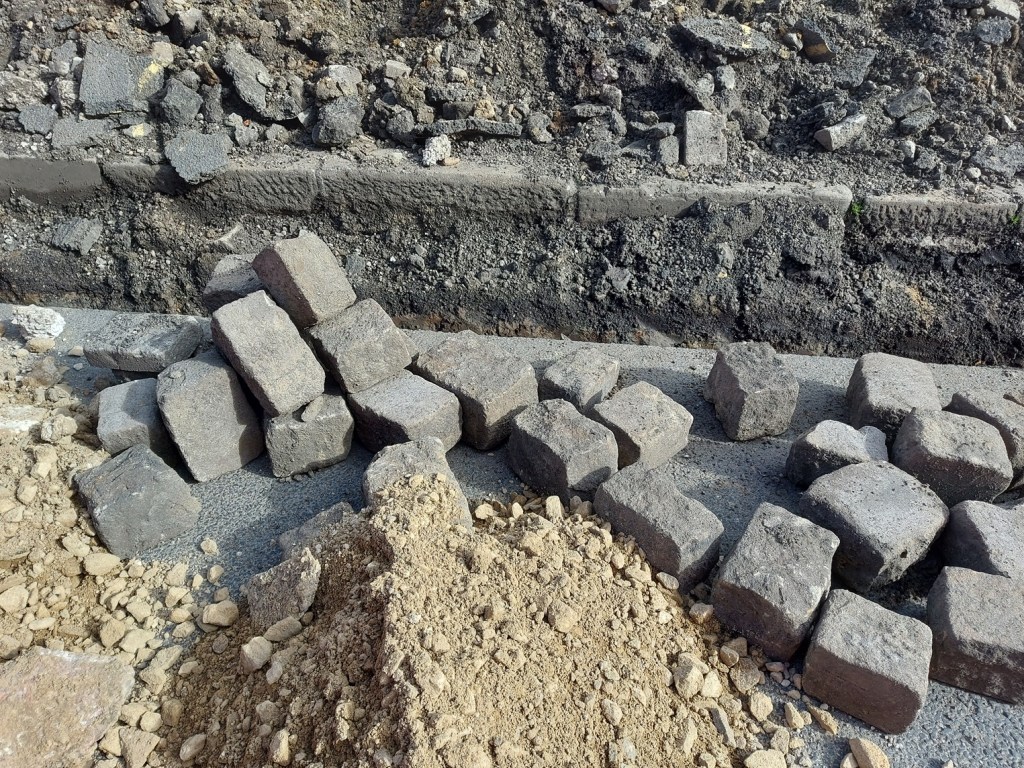
Looking down Market Street toward Philip Howard Road. The darker soil is the material dug out of the trench, the orangey stuff is to be put in the trench.

Are those setts? Nice!

Setts: shaped stones set into the ground to provide a hard wearing surface of the Victorian Market Street, but later overlain by tarmac.

Wait, look in the soil… is there any pottery?

Lurking here and there… flashes of white and other colours. Tantalising, exciting, wonderful!
Sometimes disguised, sometimes in plain sight. If you see one, you can guarantee more are lurking, hidden, waiting.

And so I did the only sane and rational thing I could do… I wandered over and did a spot of peering! And my word, what wonders were therein contained… chock full of goodies, it was. And yes, I realise that ‘goodies’ as used here is an entirely subjective word!

Let’s start with the Brown Salt-Glazed Stonewares:

A nice selection.

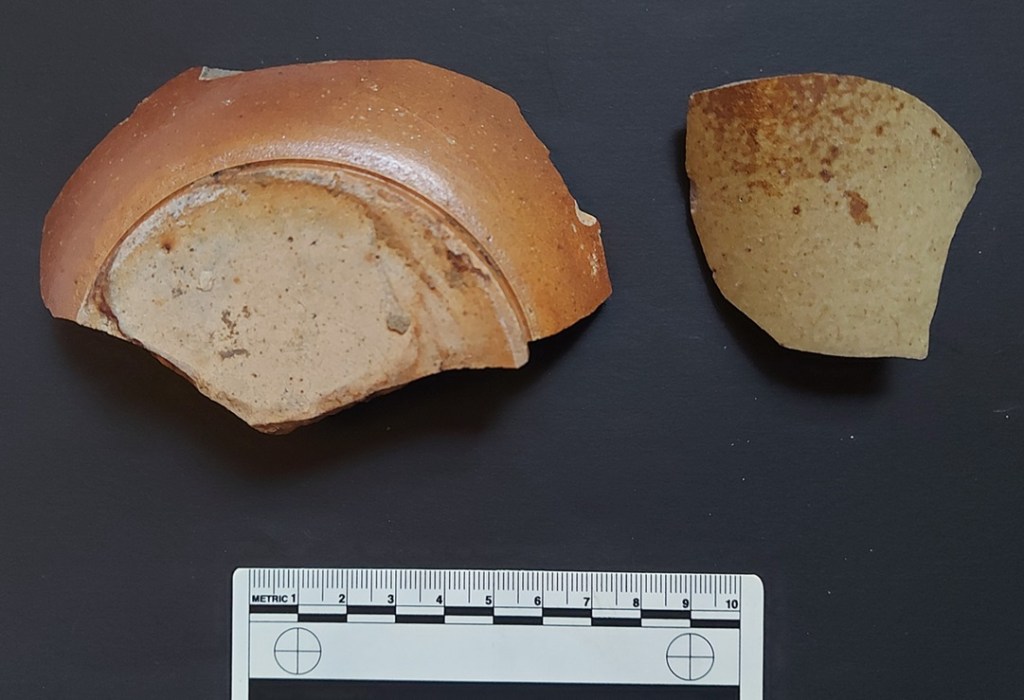
At the top left, we have a bowl or cooking pot with a rolled rim and a pot belly with a rim diameter of c.14cm; if it wasn’t Stoneware, I’d be thinking that it was Roman! Next to that part of the base to a large cooking pot; you can see the wear on the base where it was put in and out of an oven many times over the years. Bottom left is a thin walled open vessel, and with a diameter of 10cm is probably a mug with a horizontal linear banded decoration. The shiny lead-based glaze is particularly noticeable here, as is the orange peel effect on the exterior, characteristic of a salt glaze. This is also clearly visible in this sherd (it took me a while to get the light right on this shot, so you’d better appreciate it!).

Lovely! The speckled salt glaze is very visible.
A brace of Brown Stonewares Sherds

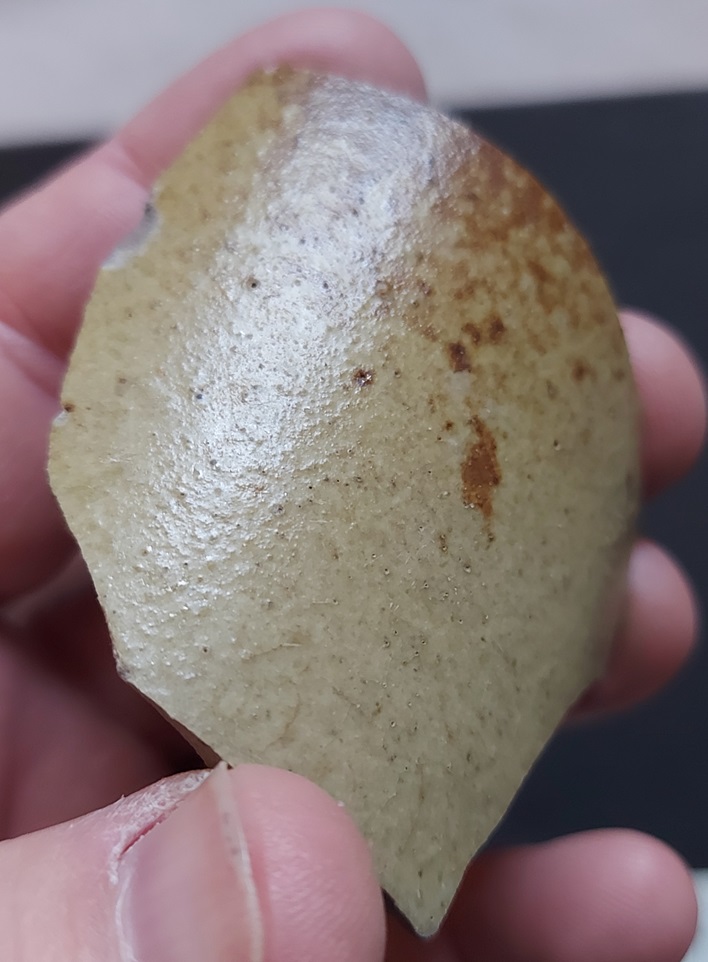
The sherd on the right is probably from a jar or similar cylindrical shape. That on the left is the base of a cooking pot of some form. The foot is 8cm in diameter, but it is pot-bellied, so is actually quite large. It’s also quite coarsely made, being thrown quickly on the wheel, and looking at the base you can see detritus from previously made vessels, and which have been fired onto this pot. You can also see the wear on the edges of the base where it was pushed in and out of a metal oven. Interestingly, you can also just about make out the circular marks made by the wire cutting the wet clay bowl from the potter’s wheel – a snapshot of the manufacturing process.

Close-up of the left-hand pot.

Then we have some Industrial Slipwares:

Lovely Stuff

A selection of open vessels. Rims from two lovely bowls, both of 16cm in diameter, and probably from food bowl – soup or stew, perhaps. The one on the left has a striking spotted design, and on the right, a variegated type with a joggled earthworm decoration (see the Rough Guide to Pottery Part 3 for more on this). To the right we see some more sherds, these are probably from tankards (for example, the one top right with the dark brown band has a diameter of c.12cm, which is about right).

Blue and White Transfer Printed:

Ubiquitous is the word – the classic.

Surprisingly, there wasn’t much Blue and White Transfer Printed material here, but I only collected from the surface, with no digging (which makes me wonder what I missed… eek!). What there is is fairly standard, a few bits of Willow Pattern, including a small plate or saucer of c.16cm diameter, and other assorted bits. There is also a moulded rim from a Shell Edged plate or shallow bowl.

Some hand-painted Victorian sherds:

Surprisingly colourful, and quite garish.

Hand-painted pottery was quite popular, and can be quite attractive in an abstract way – the painting being done very quickly produces some wonderful designs. I have a feeling both of these come from larger jugs, or possibly vases, although the one on the right reminds me of some of the hand-painted designs you get on Spongeware vessels (see here). This stuff is the subject of a future Rough Guide, although there really isn’t much more to say than colourful designs on a refined white clay and glazed.

Here we have some Black Glazed sherds.

Big and clunky, I love this stuff.

This stuff is interesting, and is going to get its own entry in the Rough Guide, too – perhaps next time (can anyone else hear screaming?) – so I’m not going to go into too much detail here. However, I will say these sherds come mainly from large thick-walled vessels, and specifically pancheons – huge deep bowls traditionally used for separating cream or proving bread. They are very coarsely slipped and glazed usually on the inside only, and typically have grooves on the interior, made by fingers during the shaping process. As I was peering I pulled out a sherd which has since proved to be my favourite ever example of this type – look at this beauty!

Massively chunky rim sherd from a large pancheon.

A rim sherd of a large pancheon measuring roughly 56cm in diameter – a monster! It has a lovely black glazed interior, with great drips running where it was splashed and placed upside down to empty and dry before firing. The exterior is something to behold, too:

Unusual decoration.

Wonderful grooves running horizontally around the body, made with a comb of some sort and which left some of the flashing. And look at that handle! For some reason it rare to find handles (there’s usually two of them), but this one is perfect – you can even see the potter’s thumb mark where he has pressed it onto the body of the vessel.

The human touch – it’s easy to forget sometimes that every one of these vessels was made by a person.

And look at the profile, held up at the correct angle to allow us to see how steep the vessel would have been, and showing the thick heavy rim.

I love how monstrous this thing is… it’s truly fantastic! I’ll be waxing lyrical about this pot some more when we get to the Rough Guide.

And finally, this last one is a mystery sherd, by which I mean I don’t know what it is, exactly.

Tiny fragment of…

It’s shaped in a way that suggests it was a statuette, rather than a cup or bowl, and if I was a betting man (which I’m not), I’d say it was one of those pottery dogs the Victorians loved so much. Or did they? And here I’m going to share with you a passage from one of my all-time favourite books – Three Men in a Boat by Jerome K. Jerome:

That china dog that ornaments the bedroom of my furnished lodgings. It is a white dog. Its eyes blue.  Its nose is a delicate red, with spots. Its head is painfully erect, its expression is amiability carried to the verge of imbecility. I do not admire it myself. Considered as a work of art, I may say it irritates me.  Thoughtless friends jeer at it, and even my landlady herself has no admiration for it, and excuses its presence by the circumstance that her aunt gave it to her.

But in 200 years’ time it is more than probable that that dog will be dug up from somewhere or other, minus its legs, and with its tail broken, and will be sold for old china, and put in a glass cabinet. And people will pass it round, and admire it. They will be struck by the wonderful depth of the colour on the nose, and speculate as to how beautiful the bit of the tail that is lost no doubt was.”

I suspect that this is a fragment of that tail!

Finally, we have a fragment of a clay pipe bowl and a piece of stem.

Neither is particularly interesting as such, and I sometimes refer to clay pipes as the cigarette butt of the Victorian period – they were mass produced, smoked and thrown away – but they are always a joy to find. The slightly tatty looking organic object on the left of the photo is the remains of an oyster shell. These are quite a common find from the Victorian period, though perhaps less common away from the coast for obvious reasons. In fact, oysters were an important food source for many, sold pickled in vinegar and spices, or made into pie, and certainly by the time of the railways, they could be moved around the country in huge quantities to feed the hungry lower classes cheaply.

In terms of dating, the construction of the market hall and grounds, and subsequently Market Street, provides us with a lovely and quite solid Terminus Ante Quem – the latest point at which an event could have happened. Put simply, the pottery came from soil underneath the road surface of setts laid down when the road was put in – 1844 or thereabouts. It couldn’t have been deposited any later than that (the road surface prevents it) therefore all the pottery must date to 1844 or earlier. And from a sherd nerd’s perspective, I would agree with the archaeological method; there is nothing here that needs to be later that 1840. You can see the original sett covered road surface in this photo, with a few setts still in-situ. You can also make out the buried surface and the natural soil underneath.

There is a rough stratigraphy visible here…

To make it a bit clearer, let’s look at it side on – in section.

I mean… it’s not perfect, but it get’s the job done. Hope you can understand it.

If you look at the photo above, you can make out the tarmac layer on top of the stone setts left in-situ – this was what you drove on the last time you drove down Market Street, laid down probably in the 1960’s, and many times since. The stone setts are the original Victorian road surface. Below these, in a reddish brown in the diagram above, is the disturbed original ground surface, and it is from this that the pottery was taken. Below that (only not as clear cut and obvious in the photo) is the original undisturbed natural clayey soil laid down during the last ice age or so.

The origin of this material, and why it ended up there, cannot be proven, but we might hazard a guess. From 1838 onwards, the town hall was constructed, designed from the outset to incorporate shops and businesses into the complex. One of these was a pub – The Market Vaults – that stood on the corner of (what was to become) Market Street and High Street West (it later became The Newmarket, and is currently Boots Opticians).

The Market Vaults as it once was, and possibly the source of our pottery.

Well, technically, this front part was a grocery store, it was the back, facing into the market place that was the pub. And it was right next to this building that our hole was dug. It’s not in the realms of fantasy that broken pottery and rubbish would be thrown out of the back door of the pub onto the muddy wasteland – the area would have been a building site between roughly 1838 and 1844.

The original back door of the pub is flush with the larger pub building, hidden behind the later building work. Interestingly, I can see at least 4 phases of building at the rear of the pub – the large extension is not original, and belongs to the last building phase, also seemingly Victorian.

There are three things that reinforce this theory. Firstly, the pottery contains a large proportion of Industrial Slipware, a ware type particularly associated with pubs. Secondly, the oyster shell is a classic bar snack of the Victorian and earlier periods, cheap and cheerful (then, at least – now they are, well, bloody expensive and, quite frankly, inedible). Lastly, the condition of the pottery; it all has sharp edges and clean breaks, which tells me that it has not spent any time kicking around the soil, being trodden on, or moved around at all: it was simply dumped and never touched again until being paved over. And although in ‘History in a Pint Pot‘ (the history of Glossop’s pubs), David Field notes that the first mention of a pub here is in a newspaper of 1865, I think it highly likely that the grocery was open all year, and that the enterprising owner – Mr Edward Sykes – would sell beer round the back on market days.

Fast forward 180 years, and some dashing heroic archaeological type wanders over to a hole, has a peer and, well, here we all are. And here, we must turn once again to Three Men in a Boat. Later in the same page as above, J notes:

“The blue-and-white mugs of the present-day roadside inn will be hunted up, all cracked and chipped, and sold for their weight in gold, and rich people will use them for claret cups.

If only he knew! And if only I could find one complete enough from which to drink claret!

So remember, always have a look into a hole… you honestly never know what you might find. But be quick and be bold, as before you know it all is returned to normal and the opportunity to explore a little of the past is gone…

Almost as if it never happened. One wonders what lies beneath our feet as we walk or drive here.

EDIT

I have just come across this rather wonderful article, written by the truly amazing Graham Hadfield, about the history of Market Street. The whole of Graham’s website – GJH.me.uk – is an absolute mine of Glossop history, and he really puts in the effort to investigate the history of the place. I don’t bang on enough about the other people who are unravelling the history of here, as I’m not the only one, but let me recommend this site.

Incidentally, as I was peering I heard shouting behind me, and bounding into view came my lovely neighbours (hello H & S!). Apparently, their conversation prior to this had gone along the lines of “look at that weirdo poking around that hole, what’s he doing? Oh, hang on… that’s TCG!”. It’s nice to be known… I think.
Righty-ho, I think that’s the lot for today. I’ve got places to go and things to do (mainly housework, to be honest, but there you go, such is the life of the dashing explorer). In all the recent rain, it is well worth keeping an eye on the ground to see what the pottery fairy has sprinkled about – let me know if it is anything good. Also, big news is coming… I think, but until then, look after yourselves and each other. And I remain.

Your humble servant,

TCG

Archaeology · Pottery Guide

The Rough Guide to Pottery Pt.8 – Tin Glazed & White Stonewares.

What Ho! What Ho! And if I may be so bold… What Ho!

How are we all? Bearing up under the circumstances? Summer, such as it was, has gone, and Autumn is upon us. A time of harvesting, of blackberrying, of apples… and pottery, obviously. And just like that, without further ado (and ignoring the groaning and wailing and gnashing of teeth), we tiptoe into Part 8 of the fabled (and seemingly never-ending) Rough Guide to Pottery; let’s have a look at some rather splendid sherds.

So then, today we are looking at some rarer types of pottery – well, perhaps not rare as such, just not as commonly encountered as some of the other stuff I’ve previously talked about.

Originally tin-glazed pottery was imported from Italy, Spain and the Low Countries, but UK production began in Norwich in late 16th Century. Its heyday was roughly 1700 to say 1800… roughly. It remained popular until it was gradually replaced by White Salt-Glazed Stoneware by the mid 18th Century, which was more robust and much lighter, and cheaper to make. Tin-glazed pottery was another attempt at reproducing porcelain type pottery, and part of the quest to find a pure white background that seems to have dominated pottery making in the 17th and 18th centuries.

The process of manufacture was as follows. The vessel was turned by hand and using a former, and then biscuit fired (that is, it was fired undecorated and without a glaze). The pot is then dipped in the glaze and allowed to air dry. Once dry, the pot is then decorated by hand – quickly as the glaze is very absorbent. It is then once again fired, which fuses the glaze and fixes the decoration. 

In terms of fabric, it’s an earthenware, a pale colour – white-ish or cream colour, with later examples being almost pure white. It has occasional tiny pink, reddish or darker inclusions, and is a soft to medium hardness.

Fabric. It is stained slightly to a creamy colour, but you can see the paler white where there is a new break. You can also make out some reddish inclusions in the fresh break… if you squint hard enough.

It uses a lead oxide glaze mixed with tin, which gives it a blueish white or pale cream colour, but is more blue where it pools – in particular around the ring base, where the pot was dried upside down.

The pooled glaze is very blue here. There is also a maker’s mark on the bottom – alas, that’s all I have of this pot, otherewise we might have been able to identify the potter.

The glaze has an almost luminescent quality and has a consistent smooth, dense feel to it – the product of the lead – but can occasionally have tiny imperfections or dimples in it. The glaze can also be thickish in places, but it is fragile and can flake off in patches, exposing the fabric below – most obviously at the edges of sherds. The surface occasionally shows the marks of the trivets that separated the vessels in the kiln.

Flaky! This was what was in my bag after I emptied it… bits. You can also clearly see the glaze has crazed and flaked off in patches.

It’s the decoration that really makes this stuff special, though. It’s all hand-painted, and because the dried but unfired glaze is super absorbent, it has to be done with speed: the brush strokes are wide or thin, and it’s done in a fluid and moving motion, quick and rough, impressionistic, and almost living, and certainly not fixed like transfer-printed wares.

There’s no mistaking this is hand drawn – each line is human made. A beautiful if naive image of a house, surrounded by trees that seem to have been made with sponges.
Simple but wonderfully effective decoration – a single line hand drawn around the vessel – probably a tea bowl or similar shape. You can also see the flaked glaze surface.
Delicate handle for a jug or similar.

There is no way to erase the decoration once applied, which accounts for occasional errors, and which I think only adds to the attraction. The colour is almost universally a wonderful cobalt blue, but occasionally purple or orange is found. The subjects are largely naturalistic – foliage in particular – but there are also scenes with animals, people, and buildings. As well as actual pots, tin-glazed pottery was very much favoured for tiles among the wealthy, and some stunning examples exist.

Stunning dragonfly tile dating to 1670ish – from this website, and only £216!
Tile fragment found by me – the colour on this tile are simply stunning. Showing a stylised flower (thanks Julian)… I wish I could find the rest of it.

I honestly love this stuff, there is something wonderful about it – the colours in particular – and although I don’t have a lot of it, it’s always a joy to find.

The next lot of pottery type occupies a similar space in time – broadly the 18th century – and indeed, overtook Tin-Glazed pottery in terms of popularity…

A selection of sherds, all mid 1700’s in date.

A later development than Tin-Glazed, it was first made in the later 17th century, but only began to be produced commercially from the 1720’s onwards.

The fabric is a typical stoneware, in this instance with added calcined (burnt) flint to produce a pale cream, almost white colour. It is then fired at a very high temperature and salt glazed, to produce a fine, strong, pottery that I find really quite beautiful.

Close up of the fabric. Very pale grey-ish to white, with visible voids created by gases formed by the high temperature it is fired at. There are also occasional brown and dark grey inclusions visible both in the break and the surface.

Vessels are formed one of two ways: either by being turned on a lathe when leather dry but before firing, which produces very sharp edges and fine horizontal banding; or by pressing thin sheets of clay into a mould, which allows the fine relief decoration to be made.

In this latter case, often the inside of the clay is wiped with a cloth to ensure the clay presses into every corner of the mould, which leaves very clear wiping marks, especially on closed vessels (jugs, for example) where the inside wouldn’t be seen.

Wiping marks on the interior of a jug. The black writing is an excavation code – BGW (upside down in this photo) – which stands for Back Garden Wall… I found these sherds underneath my garden wall!

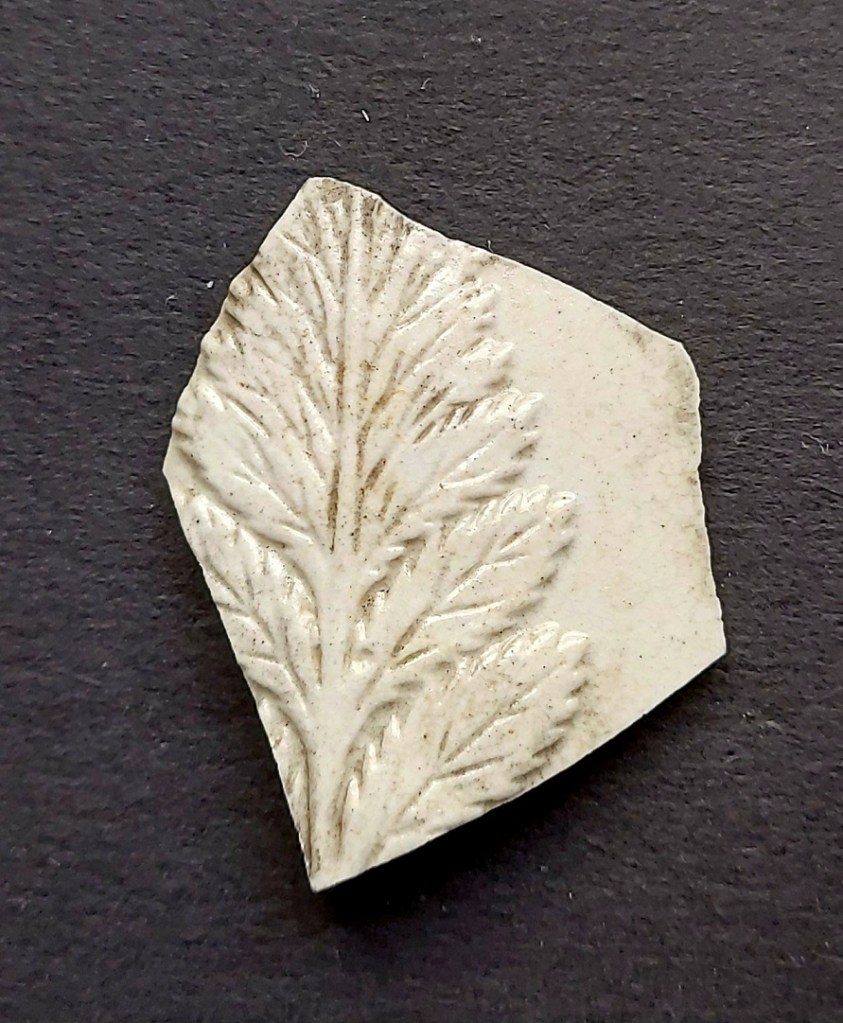
External decoration, beginning c.1730, includes basket work patterns, leaves and other foliate designs, although simple incised horizontal lines are commonly encountered on earlier pieces.

Close up of that beautiful foliate decoration – the result of being formed in a mould.

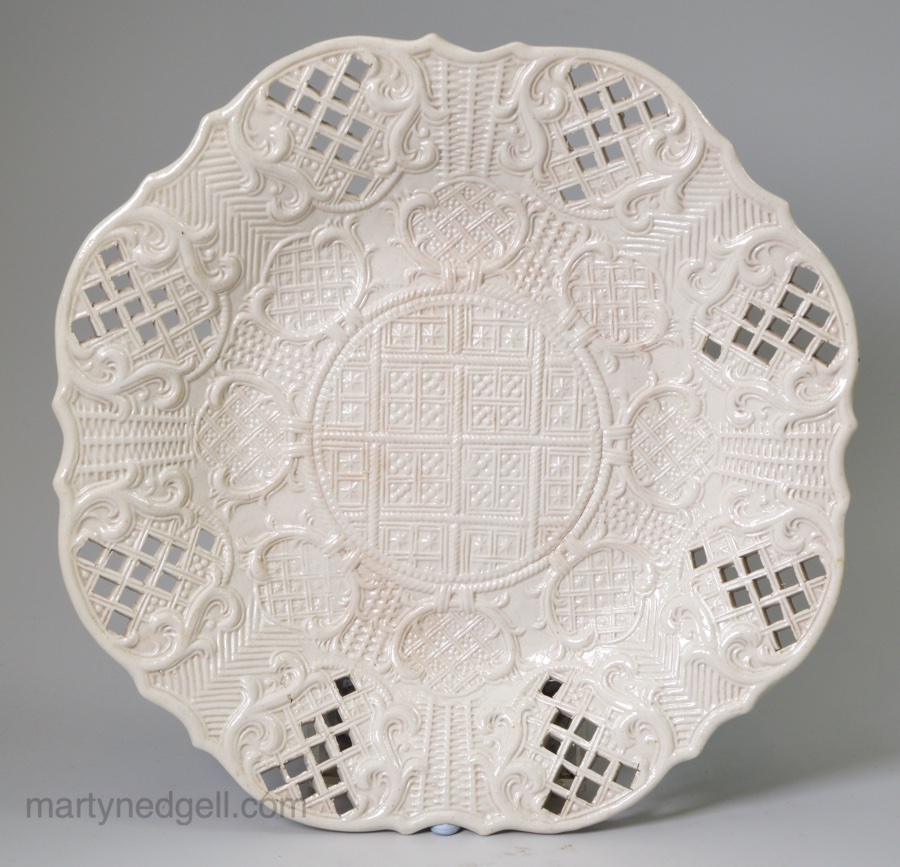
Occasionally, the walls are pierced, though this seems largely confined to high-end expensive dinner services.

Alas, not found beneath my garden wall! Lovely plate with pierced decoration and impressed motifs. Image is stolen without shame from this website here. A snip at £450! Do check out the website, though, as there are more examples of White Stoneware.

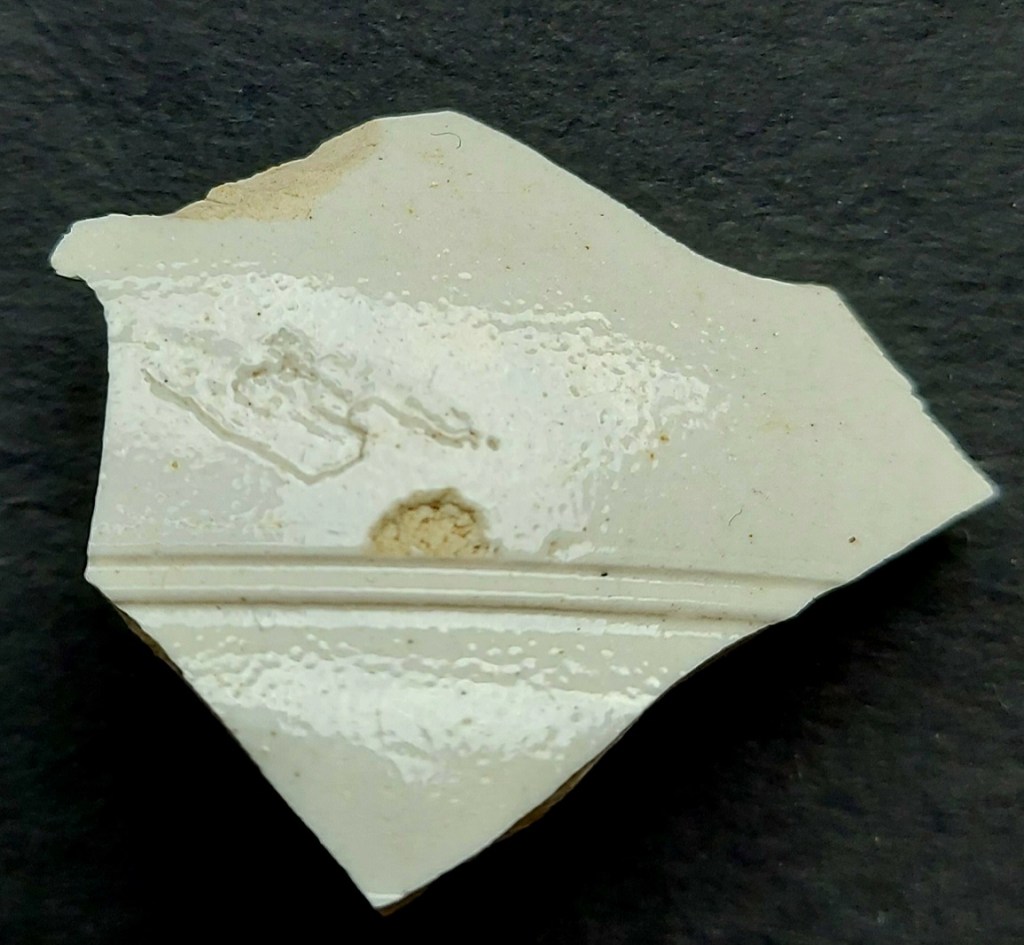
There are also rare examples of transfer-printing on stoneware:

A truly terrible photograph, but you get the idea! This is dated from the period where potters are experimenting with transfer-printing – later 1700’s.

The exterior is salt-glazed, meaning that at a point during the firing process salt is added to the kiln, which vaporises and coats the vessels in a clear glaze. Although solid and even, it often leaves an orange-peel, slightly melted roughened type effect on the surface, as it does on the Brown Salt-Glazed Stonewares discussed here.

The ‘orange peel’ salt-glaze is very obvious on this sherd. The horizontal band is very neat and tight, carved using a tool on a lathe. You can also see some sort of damage underneath the glaze (above the chip).
Wonderful coffee pot of c.1760-ish, and a snip at £1250! It is lovely, though. Same website.

White Stoneware gradually overtook Tin-Glazed pottery in popularity, and began to dominate the fineware market from the 1740’s onwards – it is a lot lighter than the earthenware, and crucially it is much more hardwearing, with the surface unlikely to flake off or crack. It also appealed to the middle classes; its fine white background mimicking the desirable but very expensive imported Chinese porcelain, a crucial part of the tea and coffee drinking craze that had gripped Britain at this point. It remained popular until eventually overtaken by the development of Creamware and other earthenware types in the late 18th century.

Broadly speaking, Scratch Blue is decorated Pale/Grey/White Salt-Glazed Stoneware – it has the same fabric and glaze. Essentially, this was a UK answer to the lovely looking Westerwald stoneware pottery being made in Germany (see below) and imported in large quantities – the English potters wanted a piece of the action, and produced a cut price version. It reproduces the essentials of Westerwald – incised decoration and stunning cobalt blue highlights on a pale stoneware (white-ish or pale creamy grey) background, but overall it tends to be more sloppy. The incised decoration is less careful, often looking as though it was done quickly, and the cobalt slip often overruns and splashes.

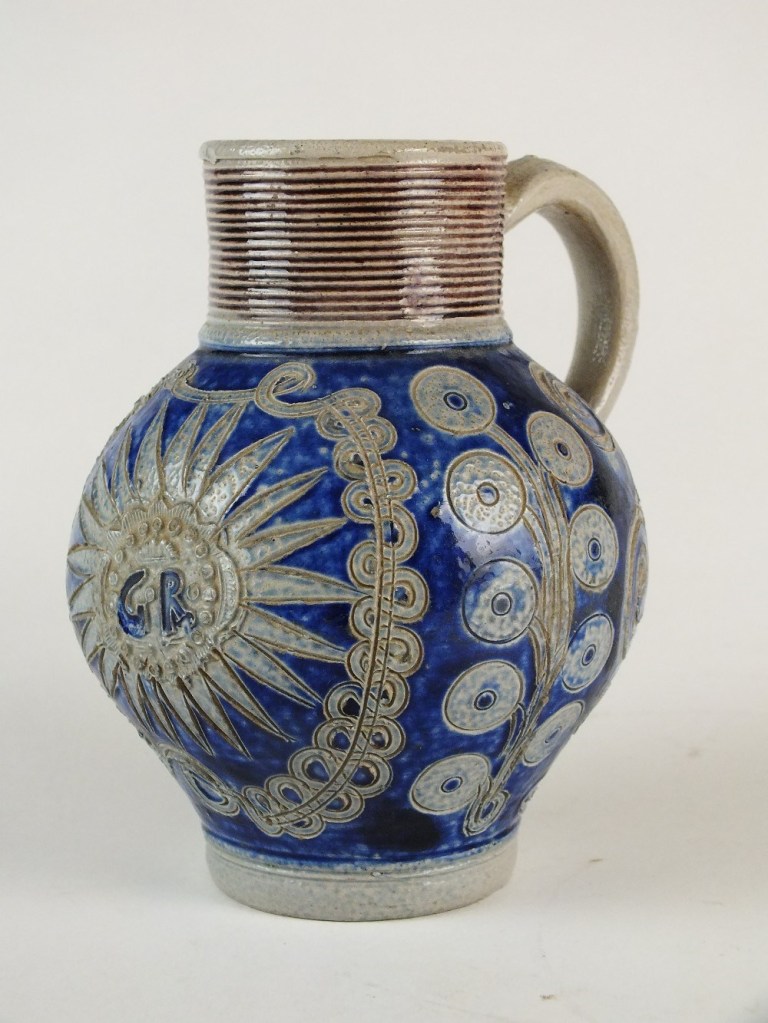
Wonderful chamber pot, with a King George medallion (probably George II)

Actually, I think this ‘messiness’ was deliberate, a way of ‘jazzing up’ the decoration, and it’s certainly effective. That’s not to say that there aren’t some very careful and precise examples, though, and in fact American archaeology seems to divide Scratch Blue into two types – Scratch Blue, which is very finely decorated, and ‘Debased’ Scratch Blue, which is the messier variety. I’m not sure that the distinction is particularly useful, or indeed ‘real’ as such, but there you go – my twopenn’orth.

A jug.

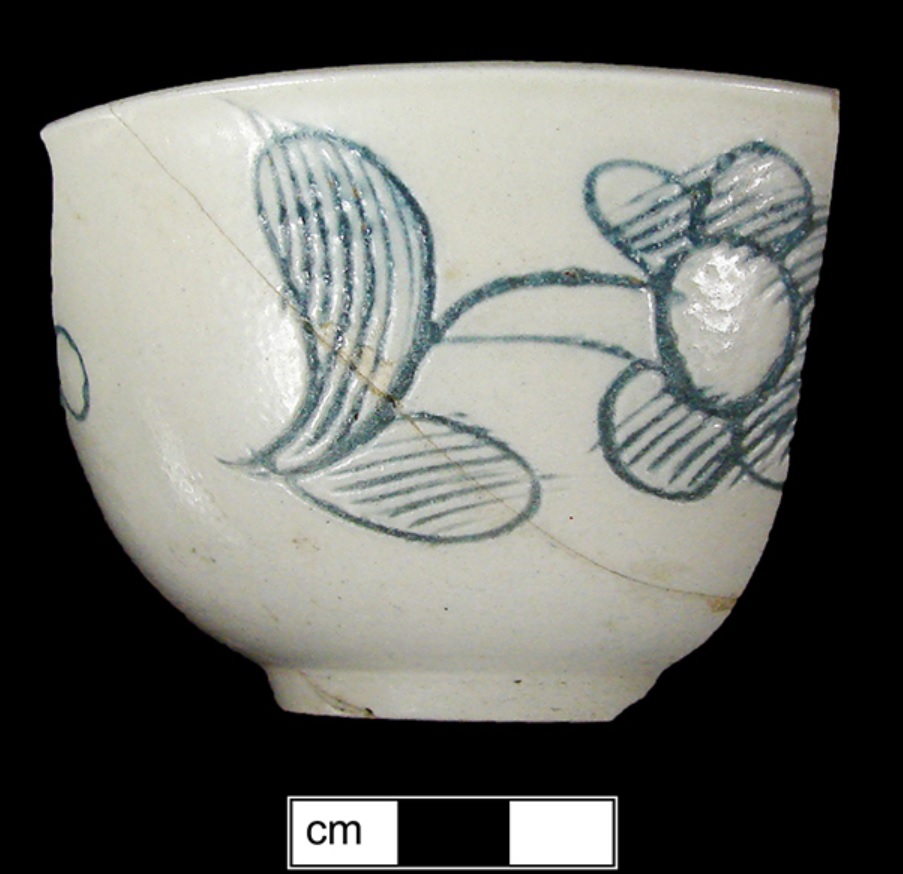
In terms of decoration, there are incised flowers and leaves and multiple horizontal turned bands at the top and bottom, all highlighted in cobalt blue and occasionally manganese brown. Also, there are applied medallions, sometimes containing the royal arms and cipher of King George II/III.

A tea bowl with a lovely flower incised on it. All these images are stolen from the hugely invaluable Colonial Ceramics website of Maryland – well worth checking out their huge database of pottery.

I have a single, very small, sherd of Scratch Blue pottery, and this stuff is by no means common, especially up North.

That’s it, a single 2cm sherd of Scratch Blue is all I have. There must be more out there…

It seems to be from the base or top of a tankard, something like this:

Possibly something like this, from roughly 1780. From Colonial Williamsburg’s website.

This seems appropriate as it was found on the footpath outside an 18th century one-time pub, the Seven Stars off Hague Street, Whitfield.

Unusually, I don’t actually have a sherd of this to show you! It wasn’t particularly common up in the North – London being the big importer and consumer of this ware type. As I said above, Scratch Blue is the indigenous British potter’s response to this German imported pottery, and as you can see it is very similar:

Lovely jug of Westerwald from this website – it sold at auction for a surprisingly cheap £150

Incised decoration, cobalt blue highlights, applied medallions and other decoration, it is often difficult to tell apart. However, Westerwald seems to be bigger somehow, less delicate… and at the risk of offending our German cousins, more Teutonic. There also seems to be a greater use of cobalt decoration, and the background stoneware is darker in many circumstances.

Another jug – from this website.

And there the matter shall have to rest until I can find some Westerwald sherds to discuss at greater length (I might have to get a mudlarks license and head down to London and poke about on the Thames foreshore).

Right, I think that’s enough pottery for now – next time we’ll look at some fine earthernwares… you lucky folk.

Now, someone recently asked me if I could put links to all the previous Pottery Guides at the bottom of the post, so they can use it quickly to find out what they have… well here you are:

Part 1 – Marmalade Jars and Brown Stoneware (Nottingham and Derbyshire)

Part 2 – Spongeware

Part 3 – Industrial Slipwares

Part 4 – Creamware, Pearlware, and Whiteware

Part 5 – Blue and White Transfer-Printed, Flow Blue, and Shell-Edged

Part 6 – Porcelain, Bone China, Black Basalt Ware

Part 7 – 17th Century Slipwares, Manganese Glazed, and Yellow Ware

Enjoy, or not, as you wish.

Right, that’s all for now.

In other news, the Glossop Big Dig results are forthcoming… slowly. If any of you have any bags that need handing in, please do so, and I’ll get the results up asap.

Other other news is the ‘zine – Where/WhenThe Journal of Archaeological Wanderings – which is just about ready to go off to the printers. You will soon be able to buy a physical copy of a guided walk I did a while back, filled with historical musings and observations (and a sprinkling of pottery, obviously). It’s an experiment of sorts – we’ll see how it sells and whether I can make my costs back, but I’ve got about 6 more walks ready to go, and I’d like each one to be in the ‘zine. It will be full colour, 40 pages, fully illustrated, and should be retailing for £6, but watch this space.

The front cover of the first edition – hopefully ready within a week or two, and available to order via the Where / When button at the top.

If any of you out there have either suggestions for walks, or would like to publish one yourself, do get in contact. More news on this soon.

Until then, look after yourselves and each other, and I remain.

Your humble servant,

TCG

Archaeology · Pottery

A Pulchritudinous* Pile of Pottery

*Guess who got a thesaurus in his Christmas stocking? Also, as an interesting aside, this question also shows you how long I have been working on this post – it made sense and was relevant when I wrote it in early January.

What ho, wonderful blog reading folk, what ho!

The search for pottery and other bits of archaeology never really stops, does it? I’m sure you all know what I mean (I meant for the rest of us, not you… we know you don’t like it!). I seem to spend my life looking down and around, especially in places I might encounter the stuff. Never digging, but simply looking… and finding. Honestly, it’s something that I’ve done all my life, and I am pleased to say that Master C-G has also caught the bug. As, also, have some of his school friends, who regularly seek me out in the playground with joyful looks on their faces to show me the ‘wonderful’ things they have found over the weekend (hello RR, RB & NB). These are distinctly unlike the looks on their parent’s faces who are not as impressed with the search for bits of old plates interrupting their Sunday walks, and then humping bags of the stuff around. Awfully sorry chaps.

I’ve recently found some nice bits and pieces (not just pottery – flint, metal work, and a potentially very interesting whetstone… which is a phrase not many people will have uttered) that I need to a) blog about, and b) inform the Finds Liaison Officer about, and not necessarily in that order. All joking aside for the moment, it is really important to inform the FLO if you find anything ‘interesting’. It might not be interesting in the end, but if it is then at least someone knows about it, and that can fill out the archaeology and history of an area, changing it significantly in some cases. Also, you might get something into the Portable Antiquities Scheme – the British Museum programme that records all finds made (currently containing 1,623,055 objects, and going up on a daily basis) – and end up on the website (it’s searchable, with hundreds of thousands of photos, and more information that you can shake a sherd at – honestly, if you have a spare minute or three, give it a search here… and whole hours of your life will simply disappear!).

Anyway, onto the pottery…

I’ve tried to choose the more interesting bits today – older sherds for example – rather than the plain white or Willow Pattern. As an aside, I have recently come to realise that I have entirely too much pottery. I know, I know… can such a state exist? is it possible? A few years ago, I would have said no, but as I cast a weary gaze around the splendour of CG Towers, my normally steely nerve begins to falter; a deep sense of foreboding swells inside me, a certain something-or-other happens to my voice, and a tremor appears in my hands. At this point I normally go for a lie down, or depending on the location of sun in relation to the yardarm, a snifter of the stuff that cheers. But I cannot escape the niggling thought that I have whole boxes filled with, well, quite frankly, boring bits of pottery… and if I’m saying it’s boring, you know it to be true! I might start returning it to where I found it, or adding it to Shelf Brook in Manor Park to give mudlarks there more things to find. Hmmmmm? What’s that you say? No… No thank you, Mr Shouty-Outy. I won’t be “sticking” it there, thank you very much.

Anyway, moving swiftly on from such unpleasantries… the first of the pottery.

This first batch comes from the same place I found the lead came (this article, here) at the top of Whitfield Avenue, and the pottery dates from largely the same date – early – mid 1700’s, give or take.

Now, even I have to admit that this is not the mosr inspiring collection of pottery, and it’s chief inportance lies in its age. No.7 is a sherd of a Manganese Glazed bowl or larger cup, and No.6 is a fragment of a black iron-rich glazed cup. The other sherds are similarly glazed, and from larger vessels – bowls or pancheons (No.2 in particular). No.4 is interesting, and is probably a little newer – perhaps 1800? The grey fabric is unusual, and it seems to come from a pedestal footed bowl, perhaps a sugar bowl?

The next group of bits is of a similar age and type – early-mid 18th century, and possibly a little earlier in two cases – and comes from the bottom of one of the tracks that run from Hague Street to Charlestown Road, the southernmost of the two.

No.7 is a fragment of a Nottingham Stoneware grooved handle from a tankard or similar – something like this, perhaps:

Not quite as fancy as this one, but along these lines, and you can see the grooved strap handle. Stolen, as usual without shame, from John Howard’s rather useful website.

No.5 is a truly wonderful flat base fragment of a Manganese Mottled Ware cup/mug type. Dating to roughly 1680-1710, the pale buff coloured clay tells me it was made in Staffordshire, and the base diameter of 6cm tells me it was a mug or similar small-ish vessel. It is very typical of it’s time, with a thick brownish manganese glaze somewhat slapdash-ly applied, and a chamfered base. Wonderful stuff.

Lovely chamfered edge – you can see where the potter has cut away the wet clay – the human element.

The original would have looked something like this:

I honestly love these things, and the glaze is lovely, the manganese melting in the heat of the kiln providing the streaking that is so attractive.

The above photographs are courtesy of the Chipstone Foundation, and their wonderful website which published pottery from the Talbot Hotel midden in Tetbury, Gloucestershire. It was full of pottery of this date (broadly 1670 – 1720), and is an invaluable resource – a snapshot of provincial utilitarian pottery of the time; nothing fancy, nice but basic, and exactly the sort of thing we would expect among the bourgeoning middle class of Glossop. The website is honestly well worth looking at, here.

Other bits include No.3, the base to a large black-glazed pancheon or open bowl with a base diameter of 15cm, give or take. No. 2 is a manganese glazed bowl, but interestingly the glaze has some away from the slipped surface underneath, allowing us a peek into how it was made. No. 4 is a similar sherd, but the glaze was applied in a slapdash manner, giving a drip effect decoration, and showing the slip underneath after it was fired, now a purple-ish colour. No.1 is obviously a sherd of 17th or early 18th century Staffordshire Slip Ware. It’s quite thick, so would be from a plate or platter, and it’s very nice.

The big question here is what is it doing there? The trackway seems to have been a later ‘version’ of the older one just to the north, perhaps replacing it when it became worn out, or when the Methodist chapel was built on Hague Street at the top in 1813 (certainly it remained a thoroughfare for some time, as it has a streetlight halfway down and a cast iron drain cover). But I wonder if the trackway is not related to the pottery, and it simply cuts through a midden or dump of a nearby house that no longer exists. To judge from the wills and deeds, Whitfield at the turn of the 18th century was thriving, so there must be plenty of houses here that we don’t know about, those that didn’t survive the ravages of time. Now, as people tend not to move rubbish very far, this suggests that this house was nearby, and whilst the two houses that sit at the end of the track now are Victorian in date, did they perhaps replace an earlier house? Whatever the answer is, I think this is a spot I’ll return to! Who’s with me?

Moving on

As I walk around, I always try and discover new paths and passageways to explore – the talk I gave recently in Chester (The Gold in Your Back Yard) was the result of just that – asking the question “what’s down there?”. In terms of psychogeography this is called a derive: a wander with no intention other than seeking situations, encounters, environments, finds, and exploration. This is a concept that I love. I may be a sturdy chap, and as tough as old nails Englishman (notwithstanding the ridiculous moustache), but there lies within me a somewhat far-out hippy (within certain clearly defined parameters – obviously I draw the line at naturism; an Englishman needs his trousers, by Jove! And besides, Glossop’s too bloody cold… one might die of indecent exposure). So when this next small group of material popped quite unexpectedly out of a disturbed patch of earth in the previously untrodden (by me) tiny path that runs between the western end of Kershaw Street and Wood Street (next to what was the Labour Club), I gave a quick “what ho!” and dove in.

My phone’s camera has recently decided to get blurry at the edges, which is extremely helpful when photographing small objects. Please accept my apologies.

There is nothing particularly exciting here, to be honest. Top sherd is a fragment of the ‘Willow Pattern’ blue and white transfer printed ware – pretty standard stuff, part of the edging around the main scene. Below that is a pearlware pedestal base to something small (the rim diameter is 6cm – a little large for an eggcup, so perhaps a sugar bowl?). And then there are the clay pipe stems – neither are especially interesting, but they illustrate a useful nugget of information. Compare them side by side:

I really need a manicure and some moisturiser.

Look at the holes – the bore size is different: the smaller has a diameter of 2mm, the larger bore on the right, 3mm (and whoever shouted out “you’re the biggest bore” – only you finds that sort of thing funny, you know… honestly, I don’t know why I bother sometimes). Earlier pipes normally have a larger bore size, but as the process of making clay pipes was refined, a smaller size wire was used. It is also often the case that the earlier pipes are thicker, too, for similar reasons, but caution should be urged here as it depends on where in the pipe stem you measure, as they often taper. it’s safer to use the bore size as a rough guide – the smaller here is 19th century, the larger is probably Georgian/18th century.

The next group I picked up in the field that contains Whitfield Cross – random molehills and on the path, and probably the result of nightsoiling.

That is truly an awful photograph. If anyone would like to donate a decent digital camera – or some time to teach me the art of photography – please do!

Again, nothing earth shattering: a Victorian clay pipe stem (a 2mm bore) which shows signs of having been next to something iron, the rust staining the white clay. A sherd of Industrial Slip decorated pottery, early Victorian in date, but looks older. And a tiny fragment of a decorated clay pipe bowl.

Knackered, but it looks interesting.

Impossible to make out what the decoration is, especially from that photograph! There are pellets around the bottom, and perhaps legs? So maybe figures, rather than a pattern. Who knows. And yes, I am the sort of person who glues tiny bits of pottery back together, thank you for noticing. I recommend UHU Yellow (the sherd nerd’s glue of choice); it’s quick setting, but not as strong as the much harsher superglue, which means it can be undone and re-set if needed. It also cleans up well at the join.

This next collection was found during a quick impromptu mudlark in Hurst Clough. It’s from a site above the dump that periodically washes out into the brook, so probably represents something else – farm rubbish from nearby Lower Jumble, perhaps.

Again, nothing particularly special (a theme is developing!), but a good selection of Victorian stuff.

Top row: A very nice whiteware pedestalled footed bowl, with very sharply defined edges lines (which might mean it was made on a lathe). It has vertical fluted decoration and a band of wavy lines, and was probably once very fancy, although it is now very grubby – the peat in the water staining it brown. Next we have 2 sherds of annular Industrial Slip Ware. The blue and white is a rounded bowl with a diameter of c.16cm. The brown one is likely to be Dendritic (the tree-like design), and probably early 19th century. Then we have a thin-walled sherd of brown stoneware – a bowl or similar. Bottom row: There is a large blue and white transfer printed Willow Pattern plate- part of a mountain and a bit of fence. Next to that is another sherd of a different Willow Pattern plate, this one has a slightly wonky looking and misaligned tree from the garden. Next, a rim from a large bowl (diameter c.18cm) of something hand painted, possibly a spongeware. Finally, there is a cobalt blue glass fragment. It’s thin walled and an irregular shape, so probably not a bottle, and more likely some sort of decorative vase. I’d like to melt it down and make my own spun glass beads at some stage, and in fact have been collecting random bits of coloured glass fragments for just such craft activities. It’s doable, but I need practice… like so many other things I’d like to try.

And to end with, a small selection from Manor Park – some bits and pieces from Shelf Brook and around the skate ramp area. The whole area of Manor Park seems to have been radically landscaped sometime in the 1930’s, and a lot of rubbish was used to fill in parts of it. As a consequence, there are lots of places dotted around where you can find all sorts of interesting late Victorian/early 20th century stuff. I know some of you also like to have a poke around here, so if you find anything interesting, let me know.

To start with, another clay pipe fragment:

A tiny fragment, but decorated.

Initially, I struggled to work out what the decoration might be, then it hit me – an “S” surrounded by a rope… Staffordshire’ and the knot. A quick google led me to this :

Wonderful clay pipe.

A Victorian (late) clay pipe decorated with the Staffordshire knot and letters ‘S’ & ‘K’ (Staffordshire Knot, perhaps?). It’s nice to see the whole thing, and who doesn’t love a clay pipe?

Beads!, people, beads!

Wonderful beads.

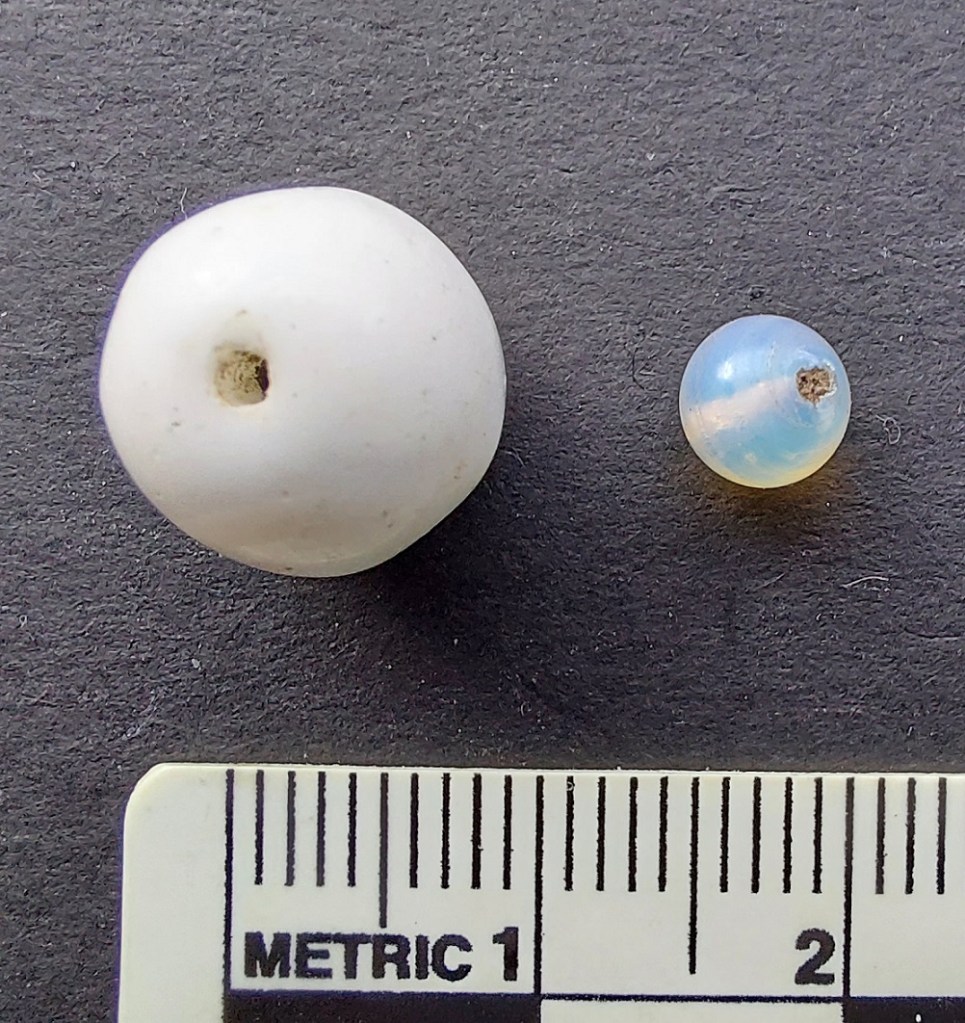
I love beads so much but I never find the blighters – I seem to be bead-blind. Pottery I never miss – I can’t look around without seeing mountains of the stuff falling out of the ground, literally throwing itself at me even when I’m not looking. Beads? Nope, nary a sniff, and both of these were found by Mrs C-G who has the eyes of a hawk (you might say she is… beady-eyed! What? Never mind “badum-tish‘, that was comedy gold). Anyway, moving on… The white one on the left is a simple paste bead, the one on the right is a wound glass bead with a strange and lovely incandescent colouring.

A pair of marbles

I love marbles even more, though. So tactile, so wonderful, but also a real link to the human, to the person who owned them, and a path between the past and the present. Both are made of clay, and both are perfect, unlike this next one…

A small selection of bits.

Bottom left – the sad remains of what was once a large clay marble. I gave a yell when I saw the poking through the mud “a dobber!” but alas, upon excavation, what I could see through the mud was all that there was left.

Also in the photograph, the tip of a slate pencil. I often find these, and the other day was idly wondering why it is that I only ever find the tips, never the stems. Then I realised – it’s a single stick of slate – if it gets broken, the end can be sharpened, and voila… a new pencil.

Top left is a lovely piece of hand painted pottery – a very fine and delicate abstract shape, with the decoration on the interior, meaning it was an open shape – a bowl or similar. Bottom middle is another tiny sherd of worm decorated Industrial Slip Ware. Bottom right is a sherd of White Stoneware, with a leaf moulded decoration, and dating to probably 1800 or so. This stuff is very fine and lovely, and I have a whole chapter of the Rough Guide to Pottery on this subject almost ready to go – I’ll finish it off and post it next time (can anyone else hear that groaning sound?).

Sticking with pottery, are these bits:

I like it when there is a picture or words.

Left is the top part of a flag, probably from a royal celebration cup or something similar, and right shows a 17th century style manor house or small hall. No idea about the actual subject, but it could be decorative or possibly as souvenir. The middle is the name of the maker and, helpfully, the pattern number. A quick Google search reveals that it belongs to something like this:

Behold… a big plate!

A J & G Meakin ‘Sunshine’ pattern plate, dating from around 1920 or 30. So there we go.

And staying with identifying marks from Manor Park:

‘alf a cup, cheers.

A Tams Ware ‘Greystone’ pattern coffee cup, like this one:

Actually, these are quite nice!

Very Art Deco 1920’s style, and surprisingly not too tacky. I like the hand-painted ‘T’ on the base of the above sherd, put there by the painter – a little human touch.

These next three were a mystery for a long time; ceramic, tubular, and smooth, they seemed a little too big to be beads. Very strange, and quite common.

Then I watched a YouTube mudlarking video – Northern Mudlarks I think it was – and they mentioned that they are in fact old electrical insulators. I dug a little deeper, and the answer is the “knob and tube” wiring system… obviously. Now, ignoring the schoolboy humour (I may be just the right side of 50, but I’ll admit that raised a smile), this was a system of allowing houses to be wired with electricity from roughly the 1880’s to perhaps the 1930’s. Using these insulators, it ensured the poorly insulated wires didn’t come into contact with combustible material (like, for example, your floorboards!), and were held in place. Go ahead and follow the link to the Wikipedia page above, but honestly, looking at this, it’s amazing that we’re all still here. They are rather neat and natty little porcelain objects, and I’m glad I now know what they were for.

Onto some more pottery… of course. These bits were found on a footpath near Carr House Farm, Whitfield (now in the Shirebrook estate). Probably farm waste, but they are interesting.

Some bits and pieces.

Top row, left, is a fragment of window glass, thin and bluish, it’s perhaps quite early (18th century?). Next to it is a sherd of willow pattern, from the border of the design. Bottom row, right is a sherd of Engine Turned Industrial Slipware dating to c.1790-1880… ish (here is my article on this stuff). In the middle is a shard of very dark, almost black, glass, probably from a bottle. The dark colour normally indicates it is early – the darker, the earlier – as a rule of thumb – 18th century gin or wine bottle, perhaps? Far left, though, is my favourite sherd. This is the tiny, almost non-functional, handle from a 17th century manganese-glazed tyg. Yep, you read that right, a tyg – a multi-handled drinking cup of the 17th-18th century. The handles are tiny, perhaps only 1.5″ in diameter, but allow a hot cup to be passed from person to person without scalding. A complete version looked sort of like this:

Image stolen, shamelessly, from the Victoria and Albert Museum – explore it here.

Absolutely wonderful… I love this sort of thing.

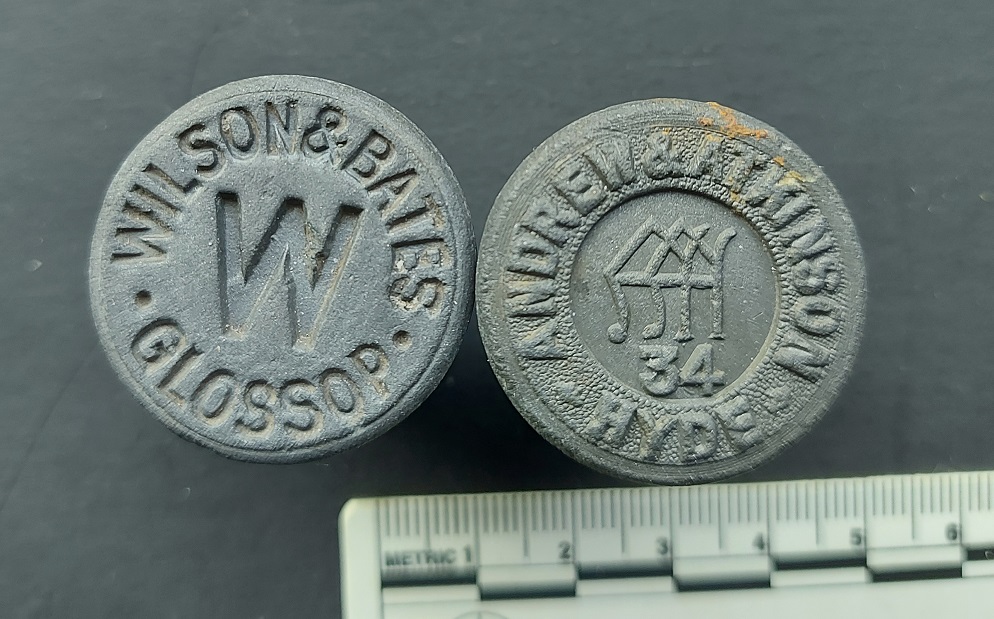
Next up we have a pair of vulcanised rubber bottle stoppers.

Early 20th century in date, I honestly love these things – very tactile, and usually have a maker or company name on top, as is the case here:

Lovely stuff.

Wilson & Bate of Glossop are very well known local company. Founded in 1869 they made mineral water, as well as cordials and beers. The bottles – stone ware and glass – are quite commonly found, too, and fragments have featured on the blog previously. Andrew & Atkinson of Hyde are similarly well known – founded in 1890, their bottles and tops are another common find – there is a great deal of information about them on the always interesting Hydonian blog. Do check it out, it’s very good.

And now… some money.

I do like the colour of verdigris corrosion

A pair of old One Penny coins – one dated 1929, the other corroded beyond all help (apparently, there are things I can do to remove the corrosion, but, frankly, and between you and me, I can’t be arsed). Both were found on the grass/mud by the children’s play area, perhaps fallen out of the pocket of a child.

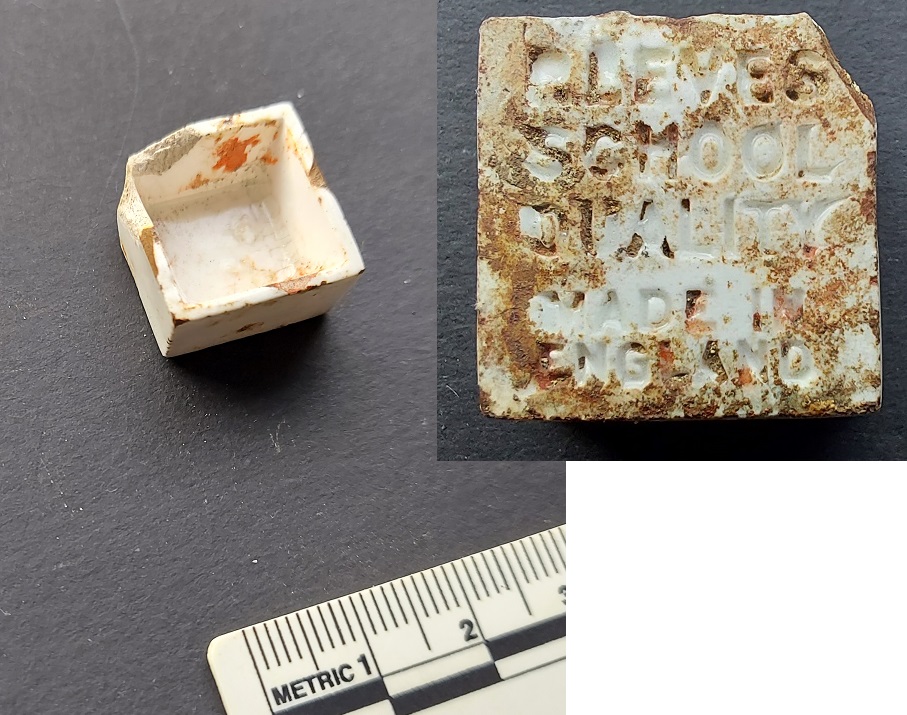
Next up, is this lovely thing – a ceramic Reeves paint pan, designed to take a tablet of watercolour (orange, judging from the bit still inside the pan).

Apparently, they are quite common finds on dump sites and what-not, but this is the only one I’ve ever found.

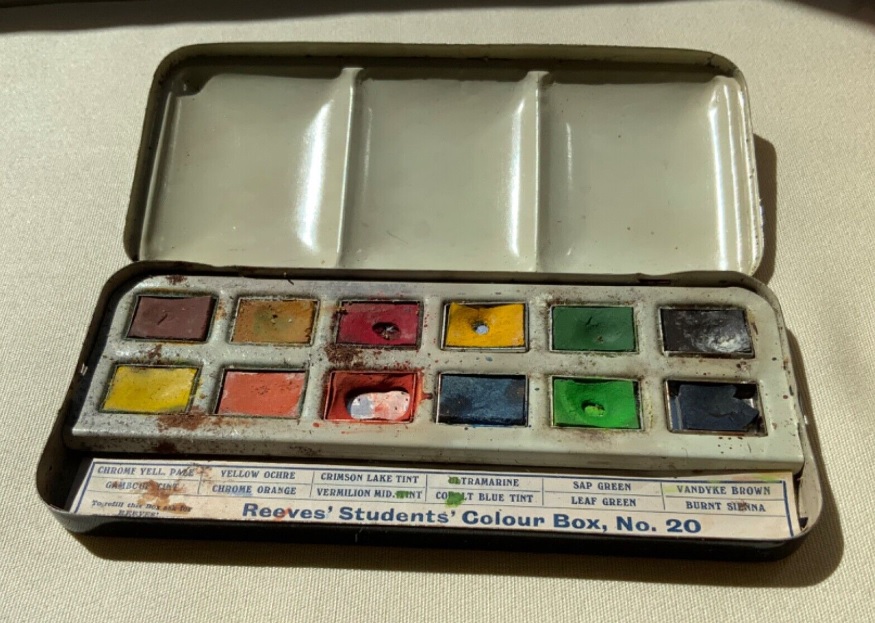
It says on the bottom “Reeves’ School Quality. Made in England”, and you can’t argue with that. It would originally have been one of many in a paint box, and designed to be bought as refills as they run out. The whole doodad would have looked like this:

You can buy similar Reeves’ paintboxes on ebay – here, for example

Right, that’s all for now. Apologies for the long-winded ramble that this blog post seems to have become, but I hope you enjoyed it. And apologies also for the delay in posting the article… all I can say is a combination of exciting news and personal issues have conspired against me… sorry. Now, for those of you who are interested, I have just discovered a wonderful article on Industrial Slip Wares that is waaaaaay more comprehensive than mine – so if you have an interest in this type of pottery, then give it a read. It also has some beautiful photograph of the pottery, as well as how it is made. It really is quite comprehensive – check it out here.

Also, the YouTube channel I mentioned, the Northern Mudlarks, is well worth checking out. They put up a new video each week of them finding exactly the sort of things you have just read about, and explore all kinds of interesting places and things, as well as craft-y type stuff. So if you like this blog, then Check them out, here.

So then, that’s all for now. I have exciting news for the near future, and there’s lots going on at the moment. So watch this space, or Twitter (or whatever it calls itself these days).

Until next time, look after yourselves and each other, and I remain, your humble servant.

TCG

Archaeology · Pottery Guide

The Rough Guide to Pottery Pt.7 – The 17th Century (Slipwares & Manganese Glazed)

What ho wonderful people, what ho!

The pottery guide is back… I know, I know, I can feel your excitement from here!

Well, let’s get straight down to it… no point in beating about the old ‘b’, is there.

Influenced by the first finds from Glossop’s Big Dig (courtesy of my wonderful neighbours, Helen and Sarah), I have devoted this post to the 17th and early 18th century pottery types, and in particular Slipwares.

Two pieces of lovely late 17th or early 18th century pottery – left is a sherd of a Staffordshire Slipware plate or platter, right is a cup in Slip Trailed Ware. And a Victorian marble. Not bad for the first finds of Glossop’s Big Dig!

Ah, slipware… wonderful slipware! I love this stuff. This is the stuff that keeps me feeling warm and fuzzy at night (nobody tell Mrs C-G). And wine, if I’m honest. If only there was some way of combining both… Anyway, I digress. Slipware! We met it’s younger cousin, Industrial Slipware, in a previous episode of the guide (Pt.3, here). However, regular Slipware dates from much earlier (roughly 1630- 1750 say), and whilst there is a similar process involved (essentially slip and pottery), this is very different; simple and less precise, it’s rough and oddly much more human. In a philosophical way, this is what the Arts & Crafts movement, in it’s deliberate rejection of industrialisation and mass production, was trying to get back to. And I think it’s why I like it so much. Bold colours, somewhat messy, and very tactile, it is a celebration of creativity, and is tremendous fun. What I like about this, too, is that whilst it’s of its time, you can see the medieval influence in the pottery, and in a way it looks back to its roots. But it also looks forward, to the Industrial Revolution that would completely and permanantly change Glossop. It straddles both these periods, linking them, Whilst it’s not common, you can find this stuff fairly regularly in the Glossop area – testament to the growing size and importance of the town in the early 18th century.

Slipware is all made using broadly the same techniques, and truthfully, the first two categories Slip Trailed Ware and Staffordshire Slipware are in essence the same type of pottery, made and decorated using the same methods, but with different decorative motifs… you’ll see what I mean.

SLIP TRAILED WARE
DATE: 1650-1740
DESCRIPTION: Yellow or cream decoration on a dark (often reddish, brown, black, sometimes yellow) background.
SHAPES: Table wares only, no cooking or storage – plates, platters, bowls, jugs, cups, tankards.

The process of manufacture is relatively simple. The vessel is shaped on the wheel (although flat shapes – platters and plates, for example – were shaped in a mould), and left to dry. When leather hard (that is not fully dry, but hard enough to maintain the shape), the vessels were covered in a reddish brown slip (that is, a solution of clay and water) and decorated using more slip of a different colour. A glaze is applied over the top, which, when fired, changes the colour to a much darker tone. The slip was poured from a bottle or jug, using a hollow quill as a nib enabling designs to be drawn. The background colours are earthy tones, and are often dark – browns, blacks, and reds are common – although it can be yellow. The decoration is in a contrasting colour (rarely more than one) and is piped on. Often abstract patterns – spirals, lines, circles, wavy lines, and feathers – but also words, names, and dates, as well as sometimes bizarre looking animals or people, the result of the difficulty in getting finer details whilst piping the slip out of what is essentially an icing bag.

The finest of this type were made by a potter called Thomas Toft (d.1698), who made very complex, if by our standards naïve, images.

The work of Thomas Toft. King Charles I hiding in an oak tree.

It’s unlikely we’ll find something like that (and good luck if you do – they are worth an absolute fortune!), and the more commonly encountered examples of this pottery are much simpler, comprising geometric designs, such as wavy lines on the flat rim of bowls, and lines and pellets on cups.

Not all vessels were decorated though, and one often encounters vessels simply slipped and glazed – these are often referred to as ‘Slip-Coated’ in the archaeological literature. The pottery is not particularly hard-wearing, and the slip and glaze is often found to have flaked off.

Where the glaze/slip has flaked off (bottom right), you can see how it was made. The natural clay colour – a sandy buff – is overlaid by the red slip, which turns black when the lead glaze is applied over it.

The fabric is not particularly hard-fired, and is normally pinkish buff, creamy, or pale yellow, with reddish-brown and white inclusions (archaeology talk for ‘bits added to the clay’ in this case, stone and bits of crushed pottery known as grog).

Fabric goodness! The grog is the larger lumps, made from crushed pottery.

Darker buff, grey, and reddish fabrics also exist reflecting the fact that there are several places of manufacture for this type of pottery besides Staffordshire (the potters would use their own local clay sources, so the fabric will be slightly different in each case). Ticknall, Derbyshire; Buckley, North Wales; and Wakefield, West Yorkshire all had large active potteries, and given the location of Glossop in relation to these places, it is likely that any could be a source. We also can’t discount very local pottery manufacture.

Three very different fabrics for the same type of pottery, probably representing three different manufacturing centres.

Shapes are commonly plates and bowls, jugs, salt pigs, and mugs/cups. The plates and bowls are often quite thick by today’s standards – up to 1/2 inch. These normally have a ‘pie crust’ rim, and sometimes clearly visible knife marks where the edges were shaped. Flat shaped vessels (plates, platters, etc.) were only slipped and glazed on the interior, with the base/exterior left clear, or with only a slipped surface.

Wonderful stuff.

Conversely the cups are thin walled, with rounded or angular foot rims. The underside and foot of the cups/jugs are not normally slipped or glazed, creating a sort of messy, slap-dash, finish to the whole. The interior can be slipped in the same colour as the background, or sometimes in a yellow. 

This is Helen & Sarah’s cup fragment. The scar of the strap handle is centre of the sherd, and top right there is just a tiny bit of yellow decoration visible. You can also see the red slip, and the difference in colour that the glaze makes when laid over it. This is a cup just like that above, and dates to about 1700.

Next up, we have the remarkably similar…

STAFFORDSHIRE SLIP WARE
DATE: 1650-1740
DESCRIPTION: Black or dark brown decoration on a yellow background, often feathered.
SHAPES: Table wares only, no cooking or storage – plates, platters, bowls, jugs, cups, tankards.

By and large, the same as Slip Trailed Ware above. Certainly, the manufacturing methods, fabric types, and shapes, are all the same. However, a distinction (perhaps a false one) is made in terms of decoration. The vessel is slipped in a pale cream, with a red slipped decoration applied (the opposite of Slip Trailed Ware), and the whole is glazed and fired. The glaze contains lead, which darkens the colours when fired, creating the bright yellow and dark brown/black decorative motifs that characterise this ware group.

This is actually wonderful!

In terms of decoration, we find broad stripes splashed across plates and bowls, and again lines and pellets, especially on cups.

The most common, though, is the ‘feathered’ decoration that really is quite eye-catching / eye-watering / migraine inducing (delete as appropriate). This characteristic decoration was achieved by dragging a comb or some other implement through the still wet slip, pulling the dark colour through the light, and producing a ‘feathered’ effect.

I love the shape, but not sure about the colour!
The interior of a pair of Staffordshire Slipware cups.

Occasionally, the slips are ‘joggled’, that is swirled together to produce a psychedelic pattern. Sometimes there is an impressed decoration or even words or dates below the slip. A less commonly encountered decoration is the ‘sgraffito’ style, in which the slip is scratched away to reveal the clay underneath, allowing quite detailed drawings to be made.

Impressed decoration under the glaze.

The shapes are the same as those in Slip Trailed Ware – plates and bowls, jugs, salt pigs, and mugs/cups.

The ‘pie crust’ rim on the sherd on the left is quite a common finish to large flat plates.
The other side of the above sherds, showing the lack of slip and glaze.

From an artistic point of view, I genuinely still don’t know whether I love or hate this stuff, but archaeologically it’s wonderful – instantly recognisable, and drops out of use in the early decades of the 18th century, giving us a great date.

Next up we have…

MANGANESE GLAZED (aka Manganese Mottled or simply Mottled Ware)
DATE: 1690-1750
DESCRIPTION: A brown mottled and/or streaked glazed surface.
SHAPES: Largely table wares – commonly mugs and tankards, plates, bowls, jugs.

Another relatively commonly encountered ware type. Here, the vessel is shaped – usually on a wheel – and then, instead of an underglaze slip being applied, it has a manganese glaze applied directly to the vessel interior and most of the exterior (with the exception of the underside of bases, and the lower part of the exterior of mugs/cups/tankards). When fired this creates the distinctive brown mottled and/or streaked effect.

A selection of Manganese Mottled sherds
Close up of the mottled surface
Another close up.

Broadly speaking, a darker glaze colour is usually seen as an earlier trait, with later examples tending to be lighter. Although, as is usual with such things, this is an overall tendency rather than an absolute rule, and there is often variation within the surface of a single vessel.

In terms of fabric, it is often the same as the Slip Wares described above – commonly pale buff or pink, with few red or dark brown inclusions – and it seems to have been made in the same potteries. And of course there are variations here, too, reflecting these different manufacturing centres.

Fabric types.

In terms of shapes, there is very much a focus on cups, mugs, and tankards, with them being used extensively in taverns of the time. Plates and bowls are less common. Decoration is limited (the glaze itself seems to be the main decorative motif), but includes multiple horizontal rings around the drinking vessels.

This leads us neatly to today’s barely pronounceable word of archaeological jargon – skeuomorph. A skeuomorph is something, made from one substance, but which is made to look like it’s made out of a different substance. In this case a tankard made from clay designed to look like it’s a more traditional one made from wood. Don’t say you don’t learn anything from this website!

A wooden staved tankard recovered from a shipwreck dated 1758. Earlier examples are also known. From this website, here.

This can’t be a coincidence – even the manganese glaze streaks look like wood – and I wonder if it is simply a case of “that’s how tankards are meant to look”.

Wonderful cup, squared foot with bad glazing.

This last photo (and the one above the wooden tankard) are taken from a truly remarkable website – the Chipstone Foundation – who have published, amongst other wonders, the contents of a pit excavated behind the Talbot Hotel in Tetbury, Wiltshire. All the material dates from between 1680 and 1720, giving a 40 year window into pottery use in a public house, and wow… if you like the stuff you see here, you’ll love the rest of the material. Honestly, it really is a hugely important site as it allows us to see what was used when, and how. I keep going back to the website just to gawp at the pottery! Check it out.

It is worth noting that there is a revival of manganese glaze in Victorian period, when it was used extensively on ‘Brown Betty’ teapots, in what was known as a ‘Rockingham glaze’. There shouldn’t be a problem in identifying these, though, as the glaze is not particularly mottled and is much better quality, and the all important fabric is very different, being a refined red in the proper versions, and a white or pale cream in knock-offs.

Finally then, we have this stuff.

MIDLANDS YELLOW WARE (aka Yellow Ware)
DATE: 1630-1720
DESCRIPTION: As the name suggests, a pale to bright yellow surface.
SHAPES: Table wares only, no cooking or storage – plates, platters, bowls, jugs, cups, tankards.

A small and uncommonly encountered ware type, Midland Yellow Ware does crop up from time to time in the Glossop area so I thought I’d include it.

Lovely stuff. Not common, but it’s out there.

Characterised by a dullish pale yellow colour, it is not normally slipped, but instead the lead glaze is applied directly to the vessel, enhancing the pale fabric. The glaze is not particularly good quality – there are usually brown spots (iron oxide reacting with the glaze) visible on the surface, it is roughly applied, and is often crazed with bits flaked off. Decoration is limited to incised lines and sharpish carination on more elegant cups.

Weird light makes it seem more yellow than it it… it’s a lot paler in real life.

The fabric is a pale pinkish buff, not particularly hard-fired, with red and dark brown/black inclusions and lots of voids. But it’s very similar to the Slip Wares described above which may point to a common origin for the pottery.

You can see the lead glaze where it has pooled.

Shape wise, it’s all tableware – serving and consumption – so bowls, plates, jugs, but commonly cups and mugs in the same styles as the Slip Wares described above. Often roughly made, with thin walls and finger marks showing, they have an almost organic feel.

Yellow Ware bowl
Yellow Ware cup

These last two images are taken from the another remarkable website/resource – the Bingham Heritage Trails Association website. They undertook a series of fieldwalking projects in the fields around the village in Nottinghamshire, and published the huge amounts of pottery they found online (follow the above link to explore – the different periods and types of finds are in the menu at the left). It is truly a remarkable resource, filled with photographs, descriptions, and drawings – just the sort of things sherd nerds and associated odd folk love – hugely recommended. Indeed, the whole project is one that I’m like to try and reproduce in Glossop. Ahhh, plans…

Right, that’s all for this time folks. I hope you are all beavering away, eyes down, in the Glossop Big Dig. Early results are looking great, and straight away we have material much earlier than the Victorian that is quite common. Keep looking, and who knows where we might end up – after all, we’re surrounded by 9000 years of history!

Until next time, look after yourselves and each other.

I remain, your humble servant,

TCG

Glossop Big Dig

Glossop’s Big Dig

What ho you wonderful people, you! But before we go on, some words…

MUDLARKING (verb)

The activity of searching the mud (= soft, wet ground) near rivers trying to find valuable or interesting objects.

POKE (verb)

To push a finger or other pointed object quickly into someone or something (Cambridge Dictionary)

A short one today (a lengthier one is in the pipeline), to announce the big news…. Glossop’s first Big Dig event. As some of you might know, I have been commissioned by Glossop Creates to develop a campaign involving their wonderful ‘Living Room‘ digital community archive (more about this soon). As a resident paired creative type (and Glossop’s premier sherd-botherer) I came up with a plan to get you all involved in what is shaping up to be an exciting project – The Big Dig.

So what is it?

Most of you who read this blog will already know that wherever you walk in Glossop – parks, footpaths, gardens, streams and brooks, allotments, etc. – there are bits of pottery and glass leaping like spring salmon out at you. This is the legacy of the Victorians and others, with them nightsoiling, dumping, or simply being littering oiks. However, what this stuff does is tell a story, as I like to show on the blog – each sherd was once part of a bigger vessel, and usually we can find a date and form for it. But each sherd is also a piece of social history, belonging to a person and a life, and is a part of the heritage of Glossop. And now I want you to all get involved in finding and understanding our shared history. Here’s how:

Well, firstly, don’t worry… it doesn’t involve any digging as such (so put down the shovels, mattocks, pickaxes, hoes, trowels, etc…. you look like a medieval angry mob. And you madam, step away from the JCB). It’s more a mudlark, a gentle poke about if you will (the phrase Glossop’s Gentle Pokeabout just didn’t have the same ‘zing’ as the ‘Big Dig’). I have prepared Big Dig packs that can be picked up from a number of places around the town, and which contain, amongst other objects, a wooden dessert spoon (for poking about) and a plastic zip lock bag (for the finds). So then…

  1. Find a spot to mudlark. Think places like: your back garden, the allotment, a footpath, a hedgerow, an old quarry, a molehill, walking up a hill, walking down a hill, paddling in Glossop Brook, skateboarding at Manor Park. But don’t stray onto private land, and please stay away from protected archaeology – it is very illegal and not at all helpful to dig anywhere near Melandra Roman fort, for example – remember, we’re poking about, not excavating!
  2. Poke about, using your spoon. A very useful tool is a spoon, and I carry one with me for just such occasions. Remember, no digging as such, just moving soil, turning over stones and twigs, shuffling spiders out of the way, poking at bits of pottery, stirring your tea, etc.
  3. Place your finds into the supplied plastic bag – finds might include pottery (very common), stone, glass, wood, beads, bottles, metal, bone, leather, gold, The Holy Grail (less common), the Ark of the Covenant, and possibly Shergar. Importantly, write where you found the material on the outside of the bag. This bit is very important.
  4. Hand the bag back to where you got it, and it’ll find its way to me, and then to the wider world.

The idea is that we’ll look at the material, give it a date and analyse it, and then enter the photographs and details onto the interactive map on the Living Room website here. Essentially, it’s the blog, but made larger, and involving you. You’ll be able to access the map and descriptions, and see the past come alive in the coming weeks and months. Please also enter your thoughts, feeling, stories, experiences, photographs and film about the Big Dig onto the website, too – I want this to be a truly community based experience. Also use the Twitter hashtag #GBD23 to get involved, we want to see your photographs of dirty hands and wonderful pottery bits.

There are, however, some things to be aware of:

  1. Exercise common sense, and be aware of others around you. Be safe, especially around water, and remember pottery, and particularly glass, can have sharp edges.
  2. Respect private property; your neighbour’s garden may have a Roman vase in it, but sadly unless you have their permission, it’s theirs. But you might have something better in yours.
  3. It is especially important to stay away from Scheduled Ancient Monuments – Melandra Roman Fort, for example.

And a final message. If you fall in Glossop Brook, tear your trousers, get the whole family muddy, scratch your hands on blackberry bushes, and end up with half an old plate to show for it… good! That’s exactly what Glossop’s Big Dig is all about.

All joking aside, whilst a lot of this pottery will be fairly mundane, if interesting, Victorian bits and pieces, 17th and 18th century pottery is also quite common in the area, and that has the potential to change what we know about Glossop’s past, and at the very least suggest places for further research. This is the first step in a process that might lead… well, who knows where, but I have big plans. The kits will be available form Glossop Library from Tuesday 25th April (the first 50 bags will have exclusive ‘Glossop’s Big Dig‘ badges in them, courtesy of of the amazing people at Kin.Der). Come down and see us on the day, or pick one up from a number of other places in town. The Big Dig will be running for as long as people want to do it – the process begins immediately, but we will continue to upload material to the website, with periodical updates on the blog.

So then, it is with great honour and pomp that I invite you to become members of that most auspicious, exclusive, and frankly alarming, club – the ‘Sherd Herd‘ (badges and t-shirts forthcoming). And as chief Sherd Nerd, I implore you all to go forth, forage, and find, record where you find it, and get involved.

My thanks to the truly wonderful Glossop Creates for allowing this opportunity – they have some great plans for our town, and want to involve everyone. So let’s do this.

Until the next time, look after yourselves and each other. And go find things – #GBD23

I remain, your humble servant

TCG.

Archaeology · Pottery

A Chance Encounter

What ho, dear and lovely people, what ho!

Firstly, let me offer my apologies for the distinct lack of activity following my last post two months ago. I try and post at least an article a month, and the intention is there, but sometimes life just stops me. And life in CG Towers has been somewhat tense and trying recently, for one reason or another. Health concerns – both mental and physical – have taken their toll, as has some serious repair/building work. Amidst all this I simply ran out of steam and disengaged from my ‘normal’ life to focus on matters far more important and urgent. Mercifully, the worst has passed, but I am struggling to recapture my previous vim, vigour, and verdigris… if that’s the word I’m fumbling for. So there we are, and here we are, and this post is the first one now that the corner has hopefully been turned. On, ever on… if sometimes a little slowly and shakily.

As I passed through Harehills the other day I felt that familiar tingle, the magnetic impulse that exists ‘twixt sherd and nerd. Glancing here and there my eyes picked out some blue amongst the greys, greens, and browns, and lo! ‘Twas a sherd, a thing of joy, a glimmer of hope, heart, and humour.

Small, dirty, forgotten… but full of promise.

Stooping, I quickly photographed it, aware that a dog walker was slowly backing away from me in that way that people do. And then I picked it up. I love moments like this, and it’s why I do what I do. It’s not just the joy of finding a bit of treasure, a childhood pleasure that has never left me, but to hold in your hand a little piece of the past, a fragment of life long gone, with all the possibilities – that’s the key, and why I became an archaeologist… as if I ever wasn’t. I began to look at the sherd, to analyse and understand it. And then a thought: I’ll take you, gentle reader, on the journey of discovery with me, and we can unlock the secrets of the sherd together. This could be a bit of fun. Of course, “could” and “fun” in that sentence are used with caution, obviously.

The unwashed sherd, still full of promise.

Home it came, unwashed in my jacket pocket – for dramatic effect I resisted the urge to wipe it. What secrets would be revealed I wondered, as I ran it under the tap, and scrubbed it with an old toothbrush I keep for just such a purpose (of medium hardness, for those taking notes). First one side then the other, to expose the surface, and then each of the four edges, so that the important fabric is revealed. An interesting aside – sherds normally break into broadly geometrical shapes of 4 or 5 sides, but rarely more or less. This is one of the ways that you can spot a sherd from a distance, as nature rarely has 4 or 5 sided shapes, not does it often have straight-ish edges.

The cleaned sherd. It’s quite a pretty blue, not the normal cobalt blue of the Willow Pattern.

During the cleaning process, a number of things became apparent. Firstly, it came from a thin-walled vessel, which, coupled with having a diameter of roughly 10cm, suggests it is likely to have been part of a cup. Bigger vessels have thicker walls, and table wares – the pots from which you eat and especially drink (as opposed to preparing, cooking, or serving) tend to be more delicate and have thinner walls.

Secondly, both the exterior and interior surface was rough and dull. This is not how it would have been originally – it should have been smooth and shiny – but is the result of post-depositional activity… in this case, fire. Until the 1920’s, Harehills was used in part as a rubbish dump, and fires were often deliberately set in order to keep the smell down, and rats and flies away. They could start accidentally also, as people would clear out their coal fire which often contained smouldering cinders. Indeed, the 1928 Glossop ‘state of the union’ report tells us that one dump, “about 20ft in depth, had been on fire for many years“. The heat melts and bubbles the surface, causing the tiny holes and pitting you can just make out.

Exterior, close up.
The interior, too, has the pitting

The pinkish staining on the interior is possibly a grease stain, or perhaps also the result of post-depositional activity, with the colour leaching out of some other piece of rubbish?

Looking at the break we can see the fabric, which in this case is a fairly poor quality greyish Bone China.

You can also see the surfaces in section – the thin white line on either edge.

Now, given that the edges shows no sign of being burnt, unlike the surface, it seems that the sherd was broken off a larger piece after the fire damage had been done, suggesting that it has moved around a bit since it was first thrown away. This is also shown by the scratches you can see on the interior; they’re not like those made by a knife on a plate (and how hard do you have to stir a cup of tea to mark the glaze?), but have been made by close proximity to, and movement over, stones.

Moving onto the decoration. Obviously it’s blue and white, but the colour of the blue is odd, and it looks more like a spongeware pattern, with the blurred graininess you associate with the printing process, than the standard cobalt transfer printed whatnot. On balance, I’d say its a somewhat poor quality transfer which has a graininess to it. The image is something floral; I can see leaves, but not those found in the usual willow pattern pottery, but something more naturalistic, and which might suggests a later date for the cup.

The most obvious aspect of decoration is the fluting running vertically up the body of the cup (clearly visible in the fabric photograph above). This was quite a common decorative theme in the late Victorian and early 20th cemtury, with some even running diagonally up the body, spiralling around it.

So, putting it all together, and knowing what we know, we can work out what it might have looked like originally, and a short while later we go from inch long sherd to this…

Not this 100% precisely, but near as dammit. Image nicked from this website here.

So there we go – from muddy sherd to teacup in a few minutes. It’s amazing how much information can be retrieved from just a small fragment. But honestly though, all sherds have a similar story to tell, and each one can give us all the information, we just have to look and listen. Now, your turn! Go for a walk through Harehills, or Manor Park, or indeed anywhere else where there are herds of sherds, pick one up, and see if you can find the story. Let me know how you get on.

Right, that’s all for this time, and I hope you enjoyed it. I’d like to say I’ll make up for my absence by posting lots more soon, but I don’t want to set myself up to fail, and cause more pressure for myself. More is coming, though: I have a much bigger pottery post which is almost done, but I’ll wait a little while before posting it. Also, I have some big news in the pipeline. BIG news, to be honest… so watch this space.

In the meantime look after yourselves and each other. And remember that if someone says they’re “alright”, they might not be. We all need a little help from time to time.

Until next time, I remain,

Your humble servant.

TCG

Archaeology · Oddities · Whitfield

A Song of Sixpence

What ho! What ho! What ho!

The Christmas season is upon us once more, and my word it seems to have come round again very quickly… in my mind it’s only September! It’s also bloody cold at the moment, and despite the protestations of Mrs C-G, the heating is not going on… honestly woman, just put another jumper on! Anyway, kind and wonderful folk of the blog-reading variety, here’s a little offering to keep you warm.

So, a number of years ago (22 July 2018 according to my records), I found this object on the footpath below Lean Town:

A metallic disc. And no, before you ask, I’m not deformed… I just have chunky and somewhat stubby fingers, Nor is it me holding the disc with my foot/toes either, as someone once ‘amusingly‘ commented.

A coin” I thought, excitedly. And I still think it is. Well, a trade token, perhaps, but it has no discernible features that allow identification; it is completely effaced. A closer look reveals that some of the original surface has survived, revealing the dark green of oxidised bronze – so we know what it was made from. It is very thin, and seems to be relatively poor quality metal, so I err on the side of it being a trade token of some type, rather than a coin.

A close up. The central circular worn patch is the result of wear, and it looks as though the metal has delaminated. You can see the original surface – smooth green patches – above and to the right of the circular wear patch.
Another close up. This side seems more worn, although the original surface is visible in places.

A trade token, incidentally, was a privately minted token used as small change between people, or for a specific retailer or trader. They were common in the 17th century and later when small denomination coins were rare, and often come with the name of the trader, or other information. This one… alas!

Some trade tokens – not mine, but some for sale here.

However, for me, the most interesting thing about it is that it has been bent on the edge, and this wasn’t accidental:

The bend is clearly not accidental, but instead deliberate and thoughtful.

As damage goes, it seems to be very targeted, unlike the rest of the damage which is the result of acidic ground conditions. No, this is a deliberate bend, put there by human intention, and that, dear and gentle readers, neatly leads us into an obsession of mine: the bent coin.

As you might have noticed I have a tendency to be somewhat… focused, shall we say? Yes, I know other words are available, but I was being kind to myself! In my real life, I am honestly a shambles; a veritable clown-car at times, complete with wheels that regularly fall off and an enormous horn (madam, calm yourself please, this is not that sort of website). But by Jove, when it comes to archaeology, I can tell you the what, where, and when with almost surgical precision, complete with spreadsheets, plastic bags, labels, and typologies – with archaeology, then, I am mustard, tickety-boo and, I’d venture, oojah-cum-spiff. The ability to focus on single topics in such a way means that I sometimes fall down rabbit holes (literally, as it happens, as well as figuratively) and become obsessed with certain features, topics, and objects… and so it was here with bent coins.

A number of years ago, whilst sorting the small finds at the Blackden Trust, I came across a coin that had been bent into something of an ‘S’ shape. “Hmmmmm…” thought I, and off I wandered – and wondered… why would a coin be bent like that?

A survey of what little literature there is on the subject revealed that coins bent in this manner are a relatively common find by metal detectorists. Further research revealed a fascinating history of coin bending traditions that begin in the medieval period as an important, if not official, religious function, which later shifts to encompass such concerns as love, luck, and loss.

A silver sixpence of the 1690’s bent into an ‘S’ shape. It must have taken some effort to do. I mean, perhaps not lots, but it’s not the sort of thing you can do accidentally. You can often see teeth marks in the bends, which may answer the question of how it was done.

The first account we have of coins being bent in a deliberate manner comes from the 1160’s or 1170’s. A monk from Durham had injured his testicles in a riding accident (look, I’m not making this up, I promise. And there is absolutely nothing funny about a monk with knackered knackers. Nothing at all. Nope.) Anyway, in pain and desperation, the poor chap bent a coin and dedicated it to St. Cuthbert, asking for the saint’s help, and promising to go on a pilgrimage to the shrine of the saint on Lindisfarne to make an offering of the coin. Once there, the monk made the offering and immediately began to recover. Here, then, we are presented with the essentials of the medieval practice; the idea behind the bending of the coin being one of mutually beneficial exchange designed to strike a deal with the saint. A coin is held aloft and bent in honour of that particular saint, with the hope that they will intercede on your behalf. In return you’ll undertake a pilgrimage and deposit the same coin at the saint’s shrine in order to further promote their glory.

This was a common practice in the medieval period: we hear of a William Child, a constable from Peterborough, bending a coin over his ‘dead’ child in the name of Simon de Montfort and the child miraculously recovered. When, during a storm at sea, a man amongst the crew of a ship bent coin with the words “I vow myself and this penny to my lord St. Wulftan”, the storm passed with the miracle attributed to Wulfstan. A coin bent to St. Wulfstan calmed a woman “in the grip of insanity” when it was tied around her neck, and a coin bent over a still-born child and dedicated to St. Richard of Chichester effected an immediate cure. Following an injury, a certain Alice had a suppurating foot, and her father bent a coin to St. Thomas Cantilupe, afterwards making a pilgrimage to his shrine at Hereford. Ann Plott was run over by a cart in 1485 on the Isle of Sheppey, one of her neighbours bent a coin over her body and she recovered. A certain Katherine Bailey, blind in one eye, was told by a stranger to bend a coin to Henry VI; making a mental promise to do so, she found she could see with both eyes. Somewhat bizarrely, it helped with criminals as well as the innocent; in the early 1290’s, a William Cragh was hanged for arson and 13 counts of homicide. Taken from the gallows, a coin was bent over him, and miraculously he lived, apparently for another 15 years.

A half groat of Henry VII (1485 – 1509). The coin has been bent double at some stage in its life – you can see the crease running top to bottom.

A lot can be made of the symbolism of bending a coin, and even the shape can be open to interpretation. The coin itself may have been seen as a relic of the miracle it brought about, and worn round the neck it may have acted as a talisman. Medieval ‘popular religion’ (i.e. not officially allowed by the Church, but done anyway) and magical practice are interests of mine, but I won’t go into it here (never mind yelling “thank God“. And the person bending a 20p coin asking for help in getting me to stop talking about pottery is, frankly, just being rude). Buy me a drink sometime, though, and I’ll tell you allllllllll about it!

During the reign of Henry VIII, the religious upheaval of the Reformation meant the role of saints within the Church was very much downplayed, and the practice of bending a coin lost it religious meaning. However, coins continued to be bent, only now redefined as tokens of love or remembrance. The meaning is the same – faith, promise, and devotion – but the object of this faith and devotion shifted from a saint to a person, and from the sacred to the secular.

A sixpence of William III dated 1696.

Thus we read of Alice Benden, a protestant martyr, who in 1557 gave her brother a ‘bowed shilling’ as a keepsake on the occasion of her execution. In a letter dated 1790 we read the following: “I have a bent sixpence with a hole through it, which was given by my only brother as a keepsake”. More commonly, though, they were given as love tokens by one, or both, of the partners as a way of promising their faithfulness, and showing their devotion to one another, and references to this activity are found in literature. Indeed, the giving of a coin was a similar gesture to giving an engagement ring, and was often understood to be a statement of betrothal or marriage. In 1715, Lady Bridget Osbourne, eldest daughter of the 2nd Duke of Leeds, gave the Reverend William Williams half a gold coin “which she had almost bent double with her teeth” as a way of announcing her intention to marry him. The ensuing clandestine marriage produced a scandal that was played out in court, with the coin figuring quite prominently within the case. It is interesting that here the protagonists are educated middle and upper class individuals, suggesting that all elements of society understood the gesture.

A silver shilling of George III (1816) that has been bent into an ‘S’ shape. What is interesting about this coin is that it has obviously been kept for a long time – the coin is very worn along the bend. Was it a treasured possession and kept in the pocket?

Bent coins were also considered lucky, and people carried them on their watch chains, or around their necks, and were often referred to as ‘touch pieces’. George Eliot in Silas Marner writes “You’ve got the beauty, you see, and I’ve got the luck, so you must keep me by you for your crooked sixpence; you’ll never get along without me”. They were also used to protect against witchcraft; milk that wouldn’t churn properly had a bent coin dipped in it to reverse the spell that was assumed to be the cause of the problem. We also read about more direct action against alleged witches, animals believed to be the witch in disguise were shot with a bent coin to lift a curse.

As a practice, coin bending seems to have ceased by the early Victorian period, although examples are known from as late as 1860’s. After this period, and into the early 20th century, coins were still used as keepsakes and love tokens, but were inscribed with names, verse, dates, and pictures instead.

It’s quite a story from a little disc of metal I almost overlooked as it lay in the mud. Makes you wonder what else is there… And as you can see I have collected a number of bent coins over the years (actually, quite a number. In fact, I’m not going to lie to you, I have many. Just don’t tell Mrs C-G, she has no idea! Bloody rabbit holes). Some of this blog post was extracted from a dense academic paper I have written on the subject – complete with references and soooo much more information. If anyone is interested, I will happily send you a copy – drop me an email. In fact get in touch anyway, wonderful blog reading folk, even to tell me you want more pottery posts. What’s that? Of course you do!

In other news, I have written a story for the Glossop Winter Story Trail organised by the incredible people of Glossop Creates. The idea is 24 creative types (myself included) have written short stories that are displayed in shop windows dotted all over Glossop town centre – follow the trail to read them all and uncover a hidden poem. Mine, obviously, is the story of a sherd of pottery and can be read in the window of The Bureau on Henry Street, Norfolk Square. You can also listen to it being read here.

Right then, I’m off to clean some pottery in preparation for the next instalment (which may happen before the New Year). In the meantime, have a wonderful Christmas, and as always, take care of yourselves and each other. I remain, Your humble servant.

TCG

Archaeology · Pottery Guide

The Rough Guide to Pottery Pt.5 – Blue and White Bits.

Look, it’s no use yelling “for the love of Jove, not more bloody pottery!” No one is forcing you to be here. Honestly, I haven’t even started yet, and here you are, giving your two penn’orth.

What ho! Wonderful readers. Welcome, welcome, welcome.

A quick one today – Part 5 of my best-selling, most talked about book of the year, Booker Prize shortlisted Guide to Bits of Old Pot. I have a brace of posts almost ready to go, but to keep you going I thought I’d publish this. Enjoy.

TRANSFER PRINTED WARE (aka Willow Pattern, Blue & White)
DATE: 1800 – Now
DESCRIPTION: A cobalt blue pattern or image on a white background. Also, red, brown, black, or green.
SHAPES: Any and all vessel shapes – from delicate tea cups to whacking great soup tureens – literally everything.

Ah yes… Transfer Printed Ware. If you are going to find pottery, this is the stuff you’ll find, and in particular the ‘Willow Pattern’ pottery. It dominated the 19th century, and arguably a large portion of the 20th – it is everywhere. I have actually dreaded writing this part of the guide, probably because of the quantity of material, but also I’m worried that it might not appeal to all of you (*sigh, yes I know it doesn’t appeal to you. And look here, there’s no need to use language like that… there are ladies present, and calling me a “honking tallywacker” is hardly becoming of a gentleman.”). But it turns out that it’s exactly the sort of thing appeals to (most of) my readers.

As we have covered previously, 18th & 19th century potters were trying to find the perfect blue and white decoration on a perfect white background to match the desirable Porcelain being imported from China. Tin Glazed Pottery (or Delft) certainly filled that gap, but it really wasn’t perfect. An easier form of decoration was wanted, and the idea of transfer printing began to take shape in roughly 1750, being applied to Porcelain only at this point. It was in about 1785 that the process successfully began to be applied to earthernware, being perfected by that wizard of English pottery, Josiah Spode.

A random selection of Blue & White Transfer Printed pottery.

The process is relatively simple if a little convoluted. Firstly, an image was engraved in a copper plate, as was done for book illustrations at the time, and applied to an oiled tissue paper using a cobalt ink – this being the only colour at the time that would survive the firing process. This is the ‘transfer’. Next, a vessel is ‘biscuit’ fired – that is fired without glaze, and at a lower temperature, to make it hard and able to take the transfer print. The transfer paper is then pressed onto the surface of the vessel, with the ink absorbed in the fabric. The pot is then fired a second time to remove oils and fix the ink into the clay body. Next, a glaze is applied, and then it is fired a third and final time. Originally applied to Creamware, then Pearlware, it became a standard decoration for White Ware, and by 1820 TPW was everywhere, and being used for all sorts of images. A brown ink was developed in roughly 1835, a green chrome ink in 1850, and a red ink at about this time, too.

Various coloured Transfer Printed plates. And of varying quality.

Eventually a technique for multi colour printing was developed by the pottery factory F.R. Pratt, allowing full images to be put onto vessels from late 19th century on.

Pratt’s development meant that anything could be printed in any colour. These date to very late Victorian and early 20th Century.

A technique called ‘Flow Blue’ was perfected around 1800, in which the cobalt blue transfer print was deliberately smudged or blurred. The pot is prepared as normal, but during the firing a ‘flow powder’ (a mixture of 22% salt, 40% white lead, 30% calcium carbonate, and 8% borax) was added into the kiln, giving off a chlorine gas which caused the cobalt to diffuse or blur into the glaze.

Flow Blue. For some reason, I just couldn’t take a good photograph of this. I must have spent 20 minutes getting more and more frustrated, taking endless shots of just this scene. To be honest, even looking at it now makes me angry.

Sometimes this changed into a more purple colour, termed ‘Mulberry’, occasionally it was highlighted with gold.

My only piece of Mulberry Flow Blue.

Flow Blue’s popularity peaked around mid-century, and as a style lasted until perhaps 1900. The more extreme blurred examples may have been sold as cheaply as ‘seconds’, and were thus popular with the poorer market. Indeed, for many years I just thought that Flow Blue style was just really badly made TPW, and only fairly recently did I discover that it was deliberate.

In terms of decoration, I don’t know where to begin; from classical scenes to commemorative plates, souvenirs from castles, to children’s rhymes – literally anything and everything was inked onto the vessels. You may get lucky and find a name or a date, or a maker’s mark from the underside of a plate. Or it may just be a pattern from the edge. The classic is of course the ‘Willow Pattern’, with its spurious story of lovers turned into birds. This was, and still is, reproduced in huge numbers: it is everywhere. In fact, so common was this pattern that it is used – incorrectly – as a short hand for all Blue & White pottery.

The actual Willow Pattern – image from Wikipedia.

Theoretically, though, given infinite time and patience, one could identify and date any sherd using the wealth of pattern books that were kept by the factories that made them, but even for a certified sherd nerd such as myself, that way madness lies!

Transfer Printed Ware began life as a prestigious and very exclusive pottery type, with the early stuff being of incredibly high quality. Once it began to be mass produced, as always happens, the quality began slipping, until the lower end of the market was cheaply produced and sold for next to nothing. This produced some shoddy designs and duff workmanship; sometimes you can see where the transfer has slipped, where bits overlie each other or don’t join in the pattern as they should. I do like these mistakes – I think it adds a human touch.

At first glance, quite attractive – bees and flowers, what’s not to love. But look closely – it’s blurred, there are smudges, blobs, lines stop and start, patterns don’t meet. This is budget pottery of the lowest order. I love it!

Allied to Transfer Printed Ware, although not actually transfer printed, is this stuff:

SHELL EDGED WARE (aka Feather Edged/Edge)
DATE: 1780 – 1890
DESCRIPTION: Plain white bowl or plate rim decorated with crinkly ‘feathering’ and painted blue (occasionally green).
SHAPES: Plates, wide rimmed soup bowls, tureens.

This type of decoration is very distinct, and was fairly common in the late 18th and early-mid 19th centuries making it a frequent find. Once seen, it never forgotten.

A varied selection of Shell Edged Ware. You can see the blue-tinged Pearlware of some of these sherds, dating them to roughly pre-1830. I also realised I don’t have any green edged sherds.

Essentially a plain white bowl or plate – Creamware, Pearlware, or Whiteware – is decorated on the rim edge with a feathered type decoration in cobalt blue or, less commonly, chrome green. The rim may or may not be undulating, and the feathering may or may not be impressed into the clay, but it is always painted to look feathered or shell-like. I seem to be a magnet for this stuff, but it’s always a welcome find.

Lovely shot. You can see the cobalt blue edge, and impressed decorative ‘feathering’ that here has been filled with the blue tinged glaze that makes up Pearlware. I improved the shot by cropping out my gnarled bare feet that were visible at the bottom of the photo.

Interestingly, there seems to have been a development in the style, allowing a broad date to be given to some sherds. This is based on American data – much of this ware type was exported, and there was some serious work done on dating it – and I’m not sure how applicable it is in England. Chronologically then:

Type 1 (1775-1810)

Asymmetrical scalloped rim, impressed curved lines (not straight), blue/green edging (feathering).

Type 1. I must add that I don’t own the rights to this, or any of the following images, and cannot now recall from where I stole them, shamelessly as always. Apologies if it is your image.

Type 2 (1800-1830’s)

Symmetrical scalloped rim, impressed curved or straight lines, blue/green edging.

Type 2

3) 1820’s-1830’s

Symmetrical scalloped rim, impressed curved or straight lines, embossed decoration below – garlands, flowers, wheat, feathers, etc. blue/green edging

Type 3

Type 4 (1840’s – 1860’s)

Unscalloped rim, impressed curved or straight lines, normally blue edging, not green.

Type 4

5) 1860’s – 1890’s

Scalloped rim, no impressed lines – the paint is applied to make it look like impressing. Blue edging.

Type 5

As I say, the academic rigour is there, but whether this is a ‘true’ chronology rather than reflecting deposition dates (that is the date which the pottery was manufactured, as opposed to the date ended up in the ground – which, given I still use my grandmother’s stoneware pie dish to cook with, could be as much as 100 years or more), I couldn’t possibly comment. And here we stray into the strange realm of archaeological pottery studies; I could talk it all day, but I fear some of you may become violent, and nothing takes the shine off a chap’s day like an angry mob.

Right, I think that’s all for today. I do have more pottery to publish, but I might save that for another time – I don’t want to over-egg the pudding, so to speak.

More soon, but until then look after yourselves and each other, and I remain.

Your humble servant,

RH