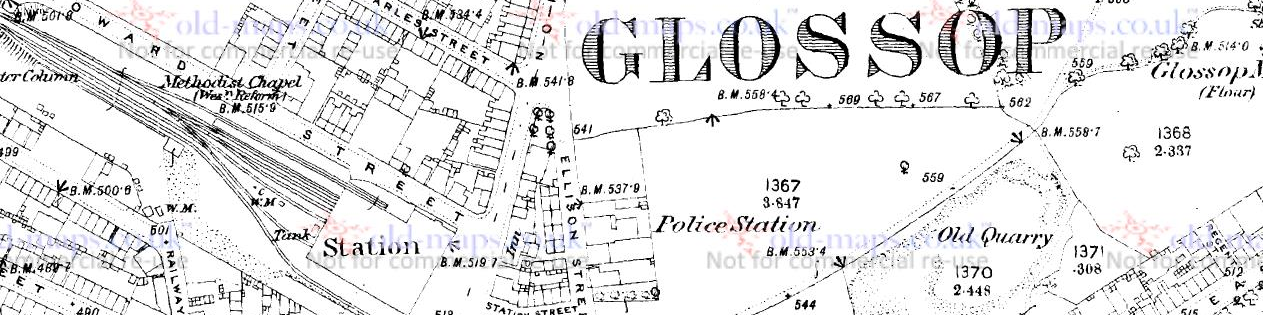
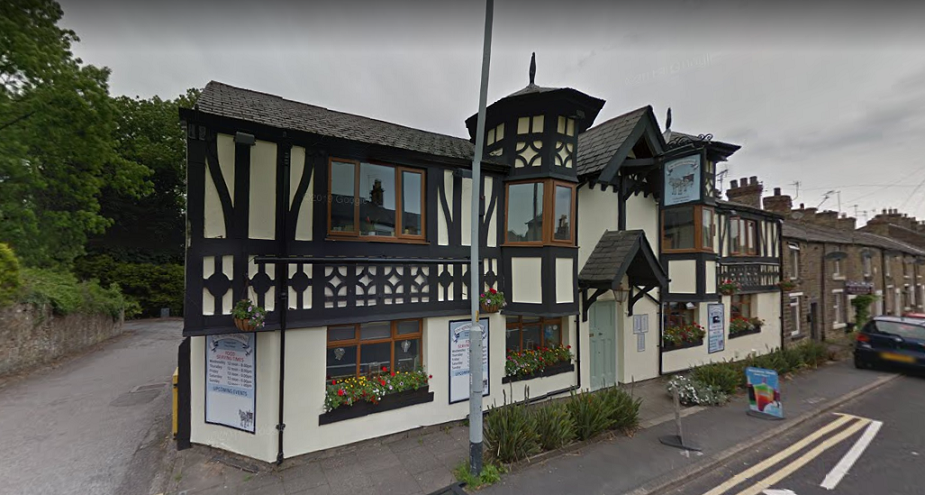
What ho, delightful historical types (hysterical types?)! Welcome to a new article… don’t worry too much, it’s not pottery (I’m saving that for next time). Nope. This one looks at an interesting feature of Glossop’s personality. Buckle up!
So, some posts I can polish off in an evening (glass of stuff that cheers in hand, obviously). Others takes weeks to brew, and the process can be painfully slow. This one, though, is very different. I started writing it in August 2017… and it’s taken just under 8 years to publish it! No reason as such, it’s just I paused writing it, and moved onto something else, then I went back to it, and then did the same, and so on, and never quite finishing it. In fact, it’s so old, that it was written using an older version of WordPress (the platform I use for my website) which wasn’t really useable any more, and I had to paste the entire thing onto the newer version. Well, here we go.
It’s often said that Glossop is a town of different areas, and with different character. When I first moved here, I realised that a lot of these areas were named ‘town’ – Howard Town, for example. On a simple level, ‘town‘ here refers to a collection of houses in an area rather than the traditional meaning of a large urban conurbation. I wonder of this is a local dialect, or perhaps more likely, Howard Town was named as such, and then the others followed suit, possibly ironically (Roughtown), or perhaps as a way of keeping in fashion (Milltown? Anway, this and is a which got me thinking… how many of these towns are there? And where are they all?
Well, in answer to these questions, may I present…
MILLTOWN
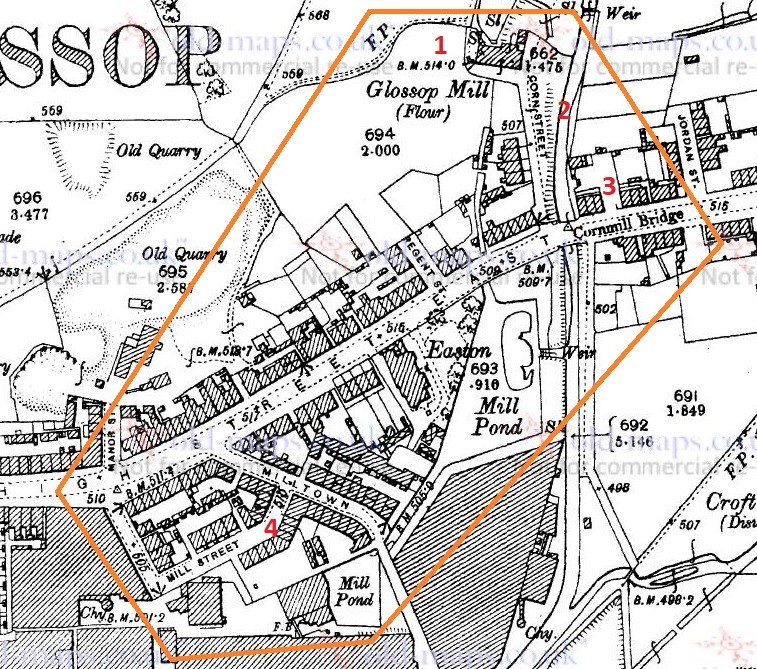
Despite its location, and seemingly obvious derivation, Milltown as an area has nothing to do with the Victorian mills, but instead it is so named because of its proximity to the medieval corn mill. Situated on what is now Corn Street, the mill was owned by the Lord of the Manor, and the people of the area paid to have their corn ground there – and nowhere else. It was, to all intents and purposes, a bit of a racket, but one that was universal throughout the land at the time. As you can see from the map below (and from photographs), there was a flour mill here in 1898, an 18th century building replacing an earlier one. It was demolished in the 1920’s, but you can still see the mill leat running alongside Corn Street. Also, the bridge over Shelf Brook as called Cornmill Bridge, which I did not know until just before I wrote these words… I love that!
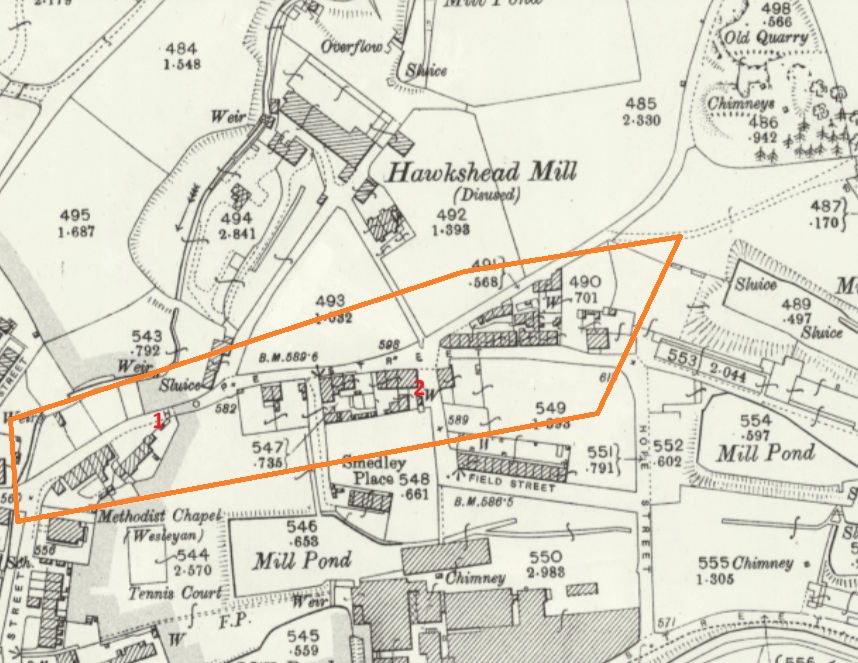
Milltown marked in orange, to include the Corn Mill. In reality, Milltown is now just the area to the south of High Street East. On the map above, you can see the Corn Mill (1), Corn Street (2), and Cornmill Bridge (3). Milltown as a present day place is that to the south of High Street East, and comprising Milltown (the street) and Mill Street (4). The area has changed massively, but one constant is the Prince of Wales pub on the corner of those streets (I blogged about it here); pubs are often the only thing left after whole streets are demolished, as indeed is the case here.
LEAN TOWN
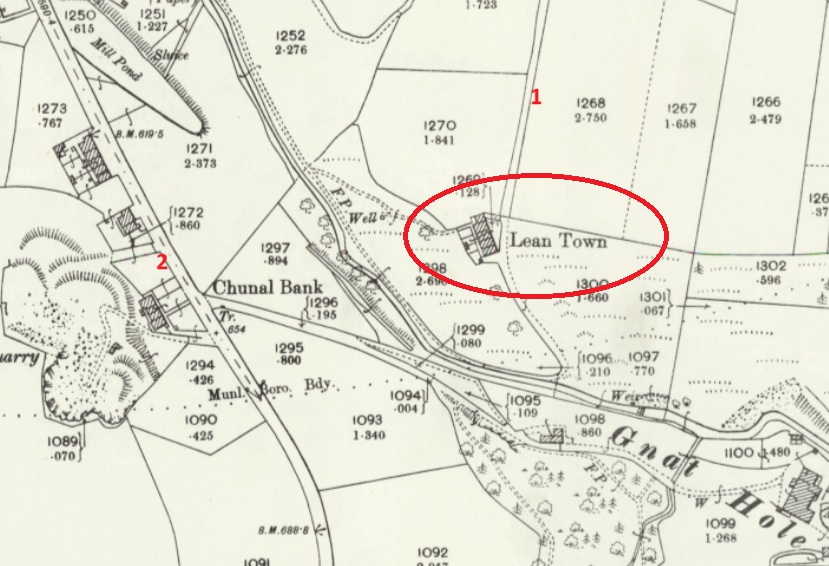
Lean Town is the name given to a group of four houses at the bottom of an apparently unnamed lane that runs from Hague Road to Gnat Hole. I can’t believe it is unnamed, but there you go… no map or document has so far given me a name! As you come from The Beehive toward Derbyshire Level, you pass a right hand downward track – follow this and eventually you hit Lean town. I wrote about Lean Town, here.
Lean Town. 1 is the track down from Derbyshire Level, 2 is Chunal.
The origin of the name ‘Lean Town’ is unclear; it might mean lean, as in not very rich, or poor for growing crops, or might be derived from ‘ling’, meaning the plant ‘heather‘ that grows around here.
CHARLESTOWN
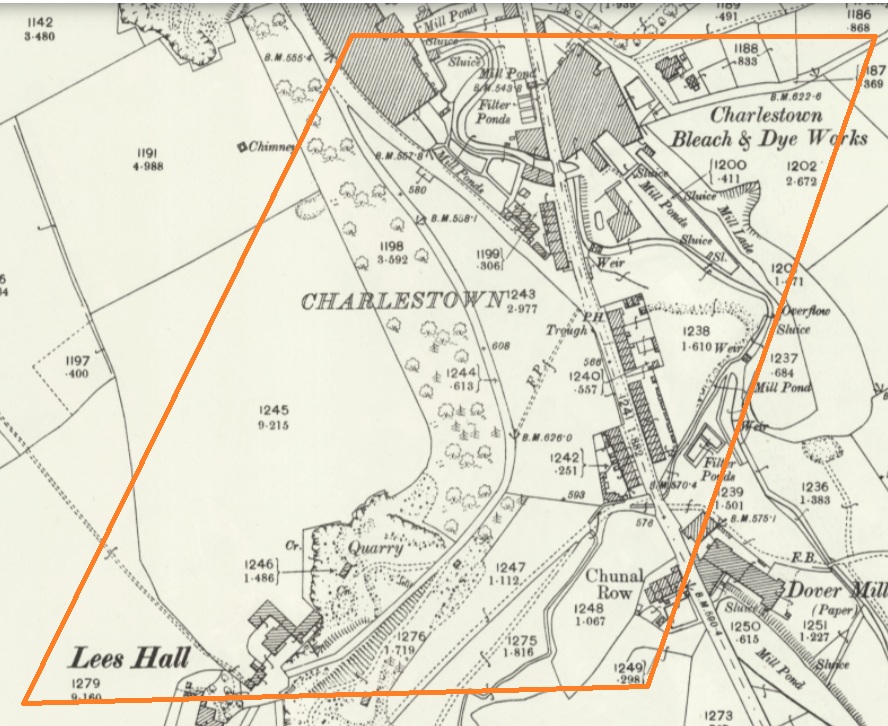
Once an area in its own right, it is now largely remembered in the name of Charlestown Road (and Charlestown Motors who I can heartily recommend, as it happens). It was named after Charles Hadfield who lived in Lees Hall in the late 18th century, and built the mill in Charlestown (now flats and houses).
Sort of this area, give or take. Charlestown Road runs from top down, and the PH (Public House) marked on the map is now Steak Land (replacing a firm favourite of mine, Casa d’Italia, although the word on the street is the Steak Land is amazing, so there’s that!)
ROUGHTOWN
Hope Street in Old Glossop was known as Roughtown, seemingly referring to the uncouth behaviour of its inhabitants, largely quarrymen from the nearby Glossop Low Quarries just up the road.
1 – Hope Street, 2 – The Greyhound pub, a factor in Roughtown’s reputation.
Apparently Roughtown was used as a semi-official name, with it appearing on census returns and trade directories of the time. Sticking with Old Glossop, we have…
TOP O’ TH’ TOWN
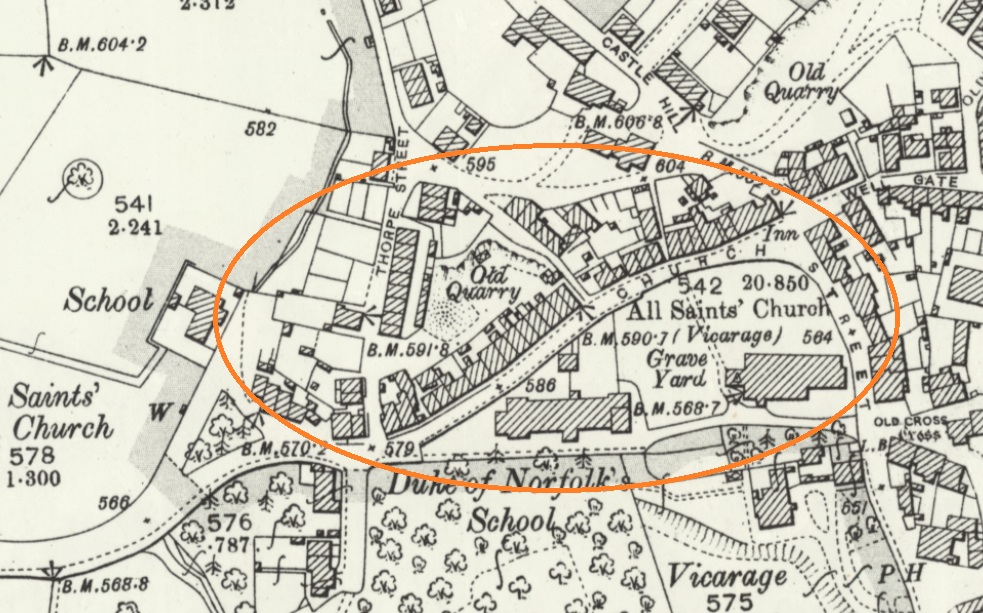
The area between Thorp Street and Church Street in Old Glossop. It is, I suppose, quite literally the top of the town.
And the area at the end of Top o’ th’ Town is known as ‘Town End‘, which make sense. Over in Whitfield, however, we have…
FREETOWN
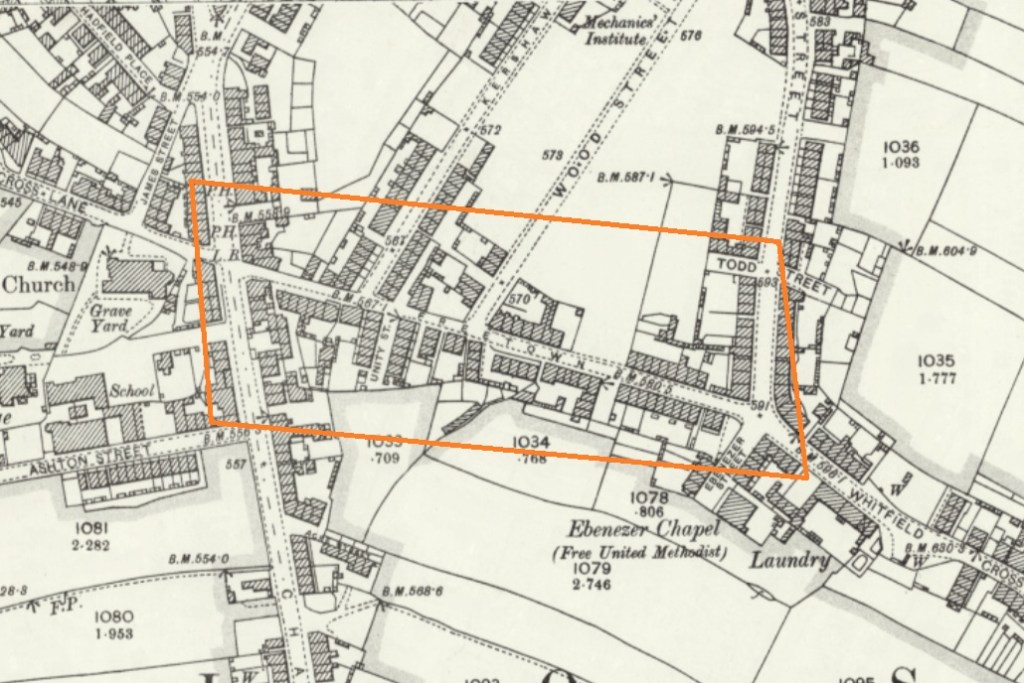
Stretches from the bottom of Whitfield Cross to the junction with Charlestown Road.
This sort of area, here. and particularly the road called Freetown.
Technically, and originally, Freetown was the name given to this area of Whitfield, with the name being derived from the fact that the land in this area, and subsequent houses built here, were freehold, as indeed it is still the case (my own house here included).
HOWARD TOWN
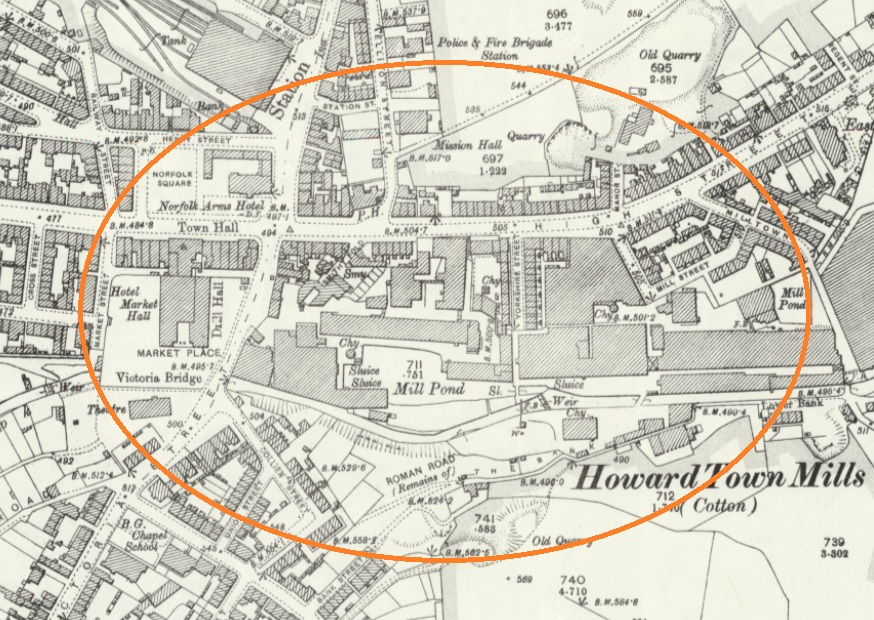
Essentially, what we understand as Glossop – the railway, Norfolk Square, the crossroads, and the whole area around the market and Wetherspoons.
Named after Bernard Edward Howard, 12th Duke of Norfolk (1765-1842) who invested heavily in Glossop – money and time. He built roads, the town hall, remodelled the whole area, and changed the focus of Glossop from what we now know as Old Glossop to what we now know as Glossop, but was originally Howard Town. This may have been the start of the ‘town’ naming process, as others followed suit, whether by flattery or through satire.
JERRYTOWN
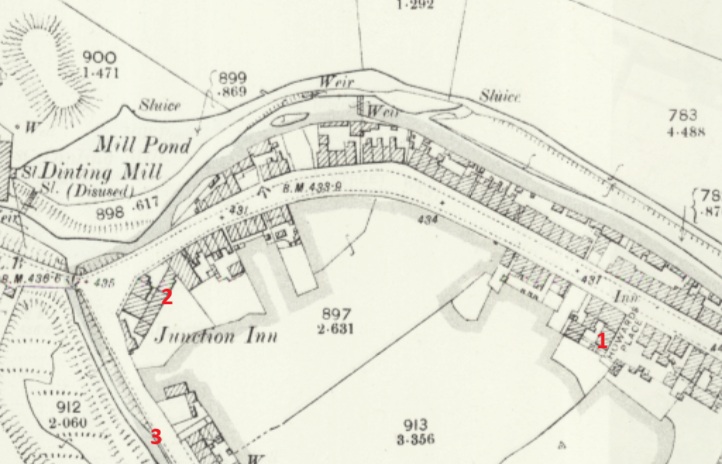
A bit of an obscure one this – it’s mentioned by Hamnett as stretching along High Street West, from roughly The Grapes inn to the former Junction Inn and around.
1 – The Grapes, 2 – The former Junction Inn (now Simple Lettings), 3 – Primrose Lane.
Apparently named after a Jerry Sykes (1779 – 1856) who built a number of houses in this area in the 1820’s.
And there we have it! The many towns of Glossop town. I can already feel several of you desperate to tell me that I’ve got something wrong, or that I’ve missed a ‘town’ out. Please feel free to do so. Honestly, please let me know if I’ve messed up – I’d rather the information was correct.
I do have pottery for next time, and I owe you a new Rough Guide To Pottery – Part 11 unless I’m mistaken, you lucky people, you.
In other news, I’m doing a guided walk at the end of the month… which should be amazing.
Now that spring is coming I’m going to be walking the route of the Where/Whens so far published, and trying out some other new routes. Tickets for these will be available after the above walk has been done, and will be at the weekend, so everyone can take part – come and join us! Watch this space.
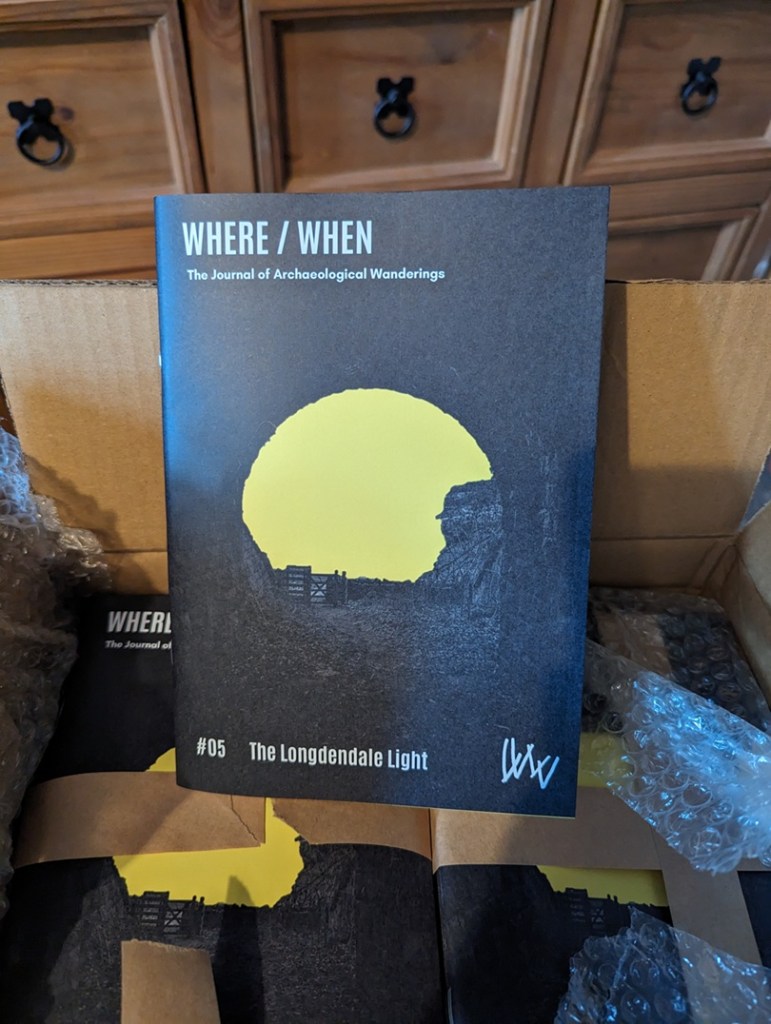
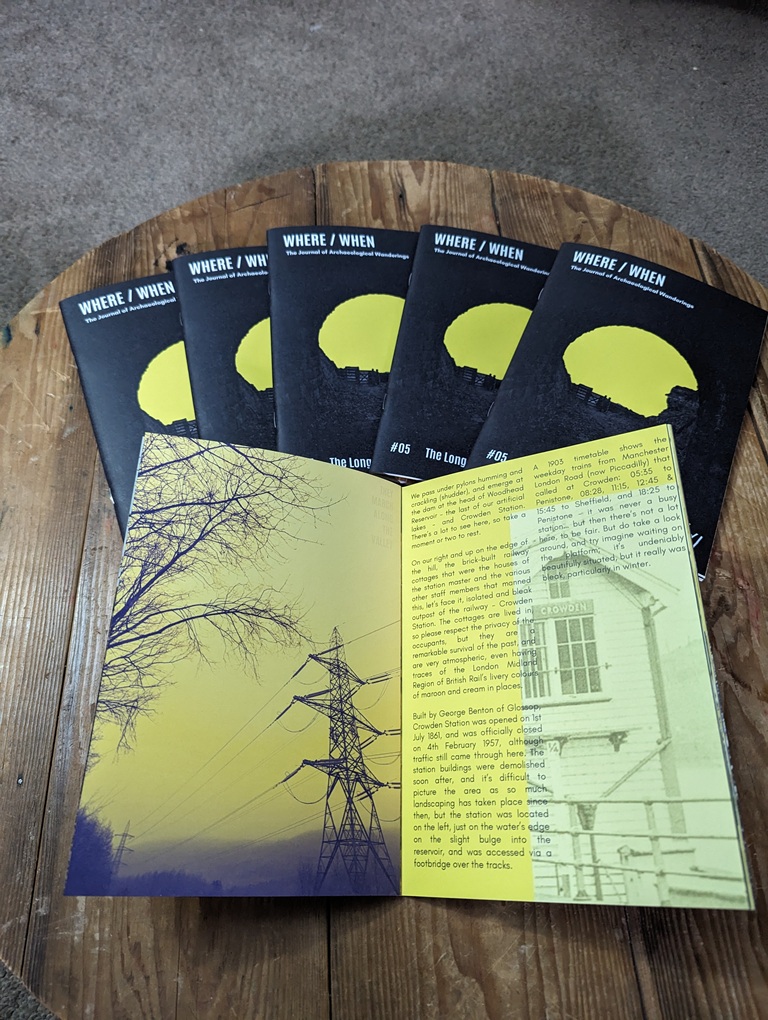
Talking of Where/When, No.5 has just been released.
An exploration of the history and archaeology of the Longdendale Trail, from the start at Hadfield to the tunnel entrances. Honestly, there is so much to see.
It’s available to buy from the usual places – Dark Peak Books, 96 High Street West, Glossop; the website’s store; or you can track me down and buy one.
I’m busy! Too busy, but it’s happening! I’ll post again soon, but until then, please look after yourselves, and each other, and I remain.
What ho, you wonderful and slightly strange bunch, you.
A quick one today… I have had almost no spare time to do much more. I have just finished the new edition of Where/When (No.4, The Melandra Meander) – which has taken all my time – and I’ve just started a new job! Busy busy busy! But the Cabinet of Curiosities is a priority, and you, kind and gentle readers, are very important. Plus, if I don’t publish something on the website, angry crowds start to gather outside my house, chanting and making threats – I mean to say, one has to think of the neighbours.
So here we are – a second part to the Datestone post I wrote 3 years ago (three years? Where has the time gone?). I’ll spare the introduction as the original covers that, and just dive in to say that all of the datestones are pre-Victorian (before 1837) – I’d like to do a survey of the datestones of the Victorian and later periods, but there are so many that it would be a big task. If anyone fancies giving me a hand, though, give me a shout.
So then, first up is a correction. Hurstnook Farm has a stone that I drew through a pair of binoculars, as I couldn’t get close enough to photograph it. Well, they’ve been doing some work there recently, and me being me, I wandered over and asked if I could take a snap, and Lo! The result is below.
F.S.M.W, and the date of 1772. Lovely detailing, too – this is an expensive looking stone.
And a wonderful datestone it is, too. Different from my interpretation of it, and I still have no idea of the names; W is probably the family name – possibly a Wagstaff? I’m sure looking through some deeds would produce a name, though. Any thoughts, anyone? There is another datestone on the extension next door that reads 2010, but is designed to copy the original one, to fit in with the building.
Next up is #13 Padfield Main Road, Hadfield.
J.H.A 1826. Simple and effective.
A simple datestone, but I honestly love this one. And the colouring is effective.
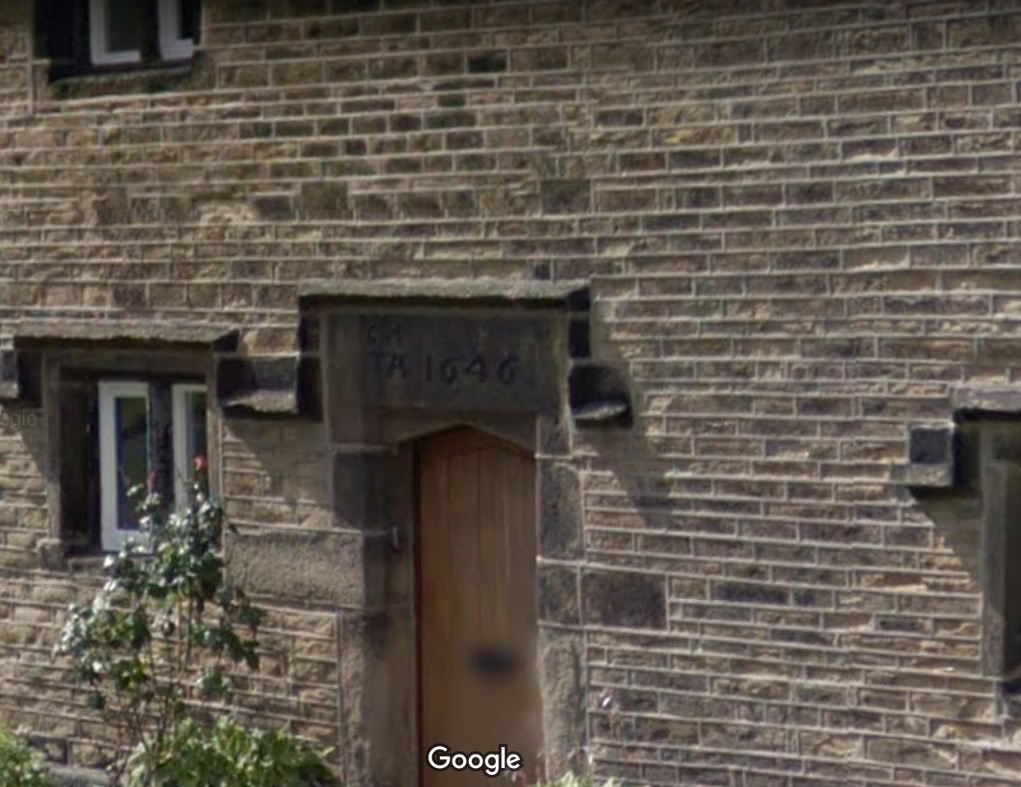
Next up, Hadfield Hall – a truly wonderful building. I could study this place for hours, and often find myself marvelling at the structure, and all the phases of construction. Now is not the time for a detailed look at the hall – a future post, perhaps. Still, it has a cracking datestone above the door.
I(J).H. T.A. 1646
Lovely stuff. Hadfield family? I’d love to know more – any thoughts?
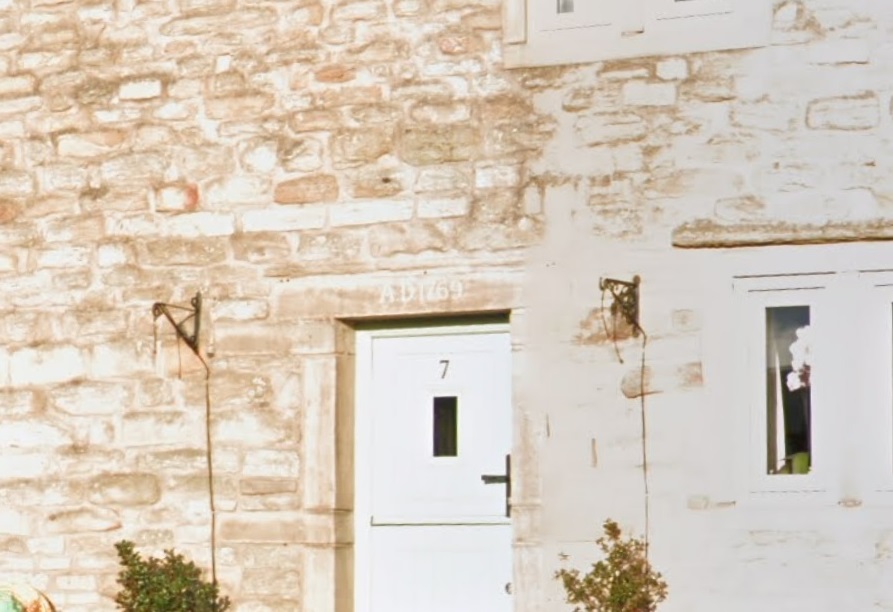
Just opposite Hadfield Hall is 7 Old Hall Square:
AD 1769
A simple date, rather than a chance at immortality.
Next we have 2 from Shaw, the farmstead that is first mentioned in 1285. It forms one of a number of such places dotted around Mouselow, and is a fascinating place. I suspect there is a lot of history here, and would love to have a poke around some of the properties there. If anyone reading this in Shaw fancies letting a slightly odd bloke have a rummage, so to speak, shout out!
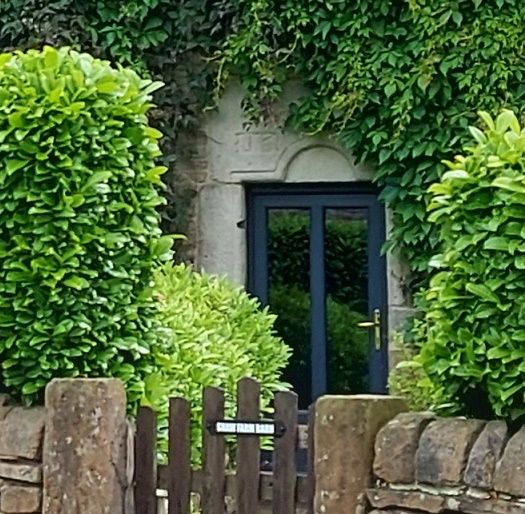
First is Shaw Farm Barn
G.B. (D) M.B. (B), 1694
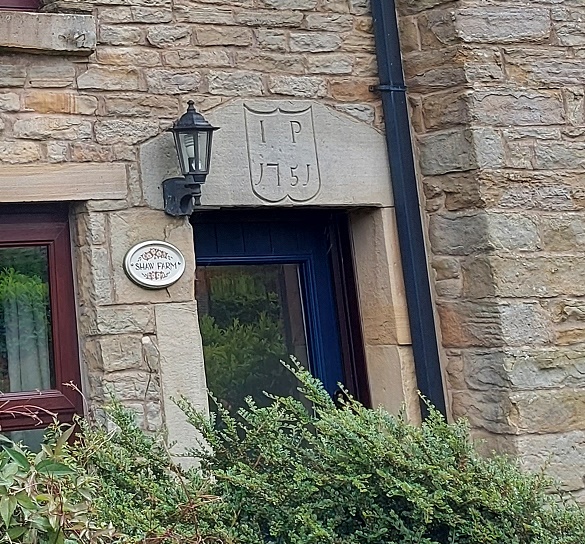
Not a great photo, but the inscription is correct. It’s on a whacking great lintel, which is very suggestive of an earlier, perhaps Tudor, door lintel that’s been re-used. Makes you think… And then, next door, is Shaw Farm:
I (or more properly J).P. 1751, in a rather fetching shield motif.
The names here again escape me – J.P. (the ‘J’ is rendered as an ‘I’ as was the custom).
Next up, the Hare and Hounds, Simmondley.
G.B.P. 1784
I actually know the meaning of those initials – George and Peggy Booth. Also in Simmondley, we have Dingle Cottage which sits on the old trackway from the farms over Whitley Nab way.
M.L.R. 1706
A truly fascinating building, and again, one in which I wish I could have a poke around!
Next is Hall Fold Farm, Old Glossop.
J.S.J.G. 1806
The datestone was apparently found buried whilst the farmhouse was being renovated. The image is not mine, but was taken from the always interesting (and essential if you like Glossop’s history) Old Glossop History Trail website. I want to take one of my own, but oddly people view Herberts taking photographs of their houses with a bit of suspicion!
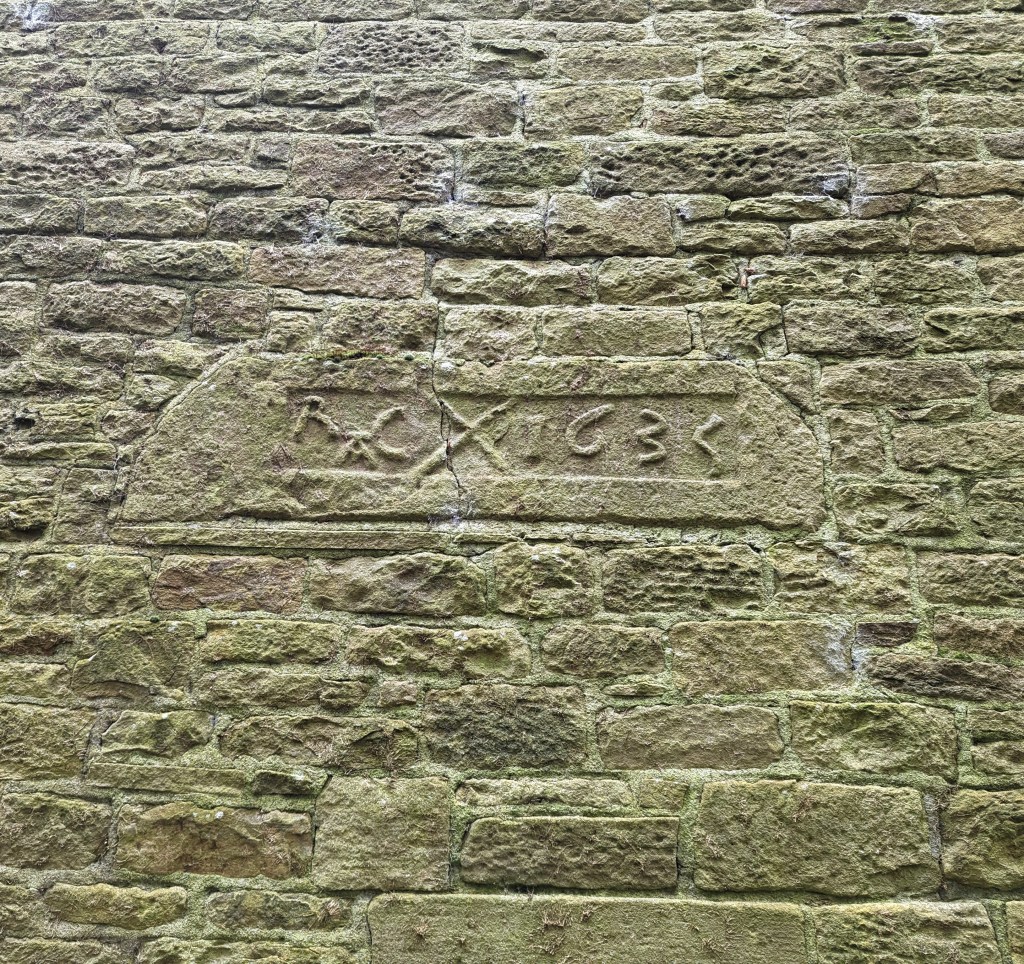
Another Old Glossop datestone is unusual – this is built into the side of Hillside Cottage, down by Laneside Farm:
R.A.C. 1635, with a decorative saltire.
A few things to say about this one. Firstly, it is the second oldest datestone in the Glossop area, pushing Hob Hill Cottage in Whitfield into third place. Secondly, the decorative saltire might also function as a protective motif, as the shape is a fairly commonly found apotropaic mark. But the important thing is that it is not in its original position, above a doorway, and in fact the house it is built into is late Georgian or early Victorian. I can only assume that it replaced an earlier building, and rather than throw the lintel away, the builders thought they might as well build it into the fabric of the house as decoration. As for the initials – I have no idea.
Next up, and finally: Flax Cottage, Wesley Street, Old Glossop.
S.W.E. 1783, and a little flower motif.
The flower motif in Flax Cottage is very similar to that at Hurstnook Farm – possibly the same stonemason carved it 11 years later?
Ok, so that’s it for datestones. There are others in the area – a few in Charlesworth, Herod Farm, Hobroyd Farm, etc. – but I don’t have photographs yet. If anyone does, or if anyone knows of any others that I don’t know about, then please give me a shout.
In other news. As I say, Where/When No.4 is about to be printed – I sent it yesterday, so it will be here next week, fingers crossed. I’m super excited about this one, and it might be the best yet. I’ll post more soon, and with other news too. But until then, look after yourselves, and each other, and I remain.
What ho, you wonderful – and slightly odd – folk who are reading this. You are here either because you have an interest in Glossop/Pottery/Old Things/The Ramblings of a Sherd-Nerd… or you’re lost. Either way, you might need some help. And either way, pour yourself a glass of the stuff that cheers, sit back and relax.
So then, we have a mixed bag today – some updates and some new stuff, and first up we have placenames.
WHITFIELD: THE PLACENAME
I originally published this post listing all the places in the Glossop area with their first appearance. Whitfield first appears in the Domesday Book of 1086 under the name Witfelt, which is normally understood to mean “White Field”, meaning an open (figuratively ‘white’) land or field, presumably to differentiate it from the surrounding moorland. However, I recently read an interesting article in Nomina: the journal of the Society for Name Studies in Britain and Ireland… as one does. The article is titled “Onomastic Uses of the Term “White“” by Carole Hough (read it here). Briefly, it suggests that amongst all the other possible meanings for the word ‘hwit‘ (White), one that is often overlooked is that relating to dairy foods and milk – literally ‘White Meat‘ – for which there is a lot of evidence, particularly when used in conjunction with a farm or land place name element. If we consider this in relation to Whitfield, we might understand it as the field where diary produce is made, and hence the Cheese Town of the title. We can’t say for certain, but it’s certainly a possibility that should be considered, for as we know cheesemaking was taking place here in the 18th century and earlier… so why not? Whitfield, land of cheese! Marvellous!
MASONS MARKS ON LONGDENDALE TRAIL
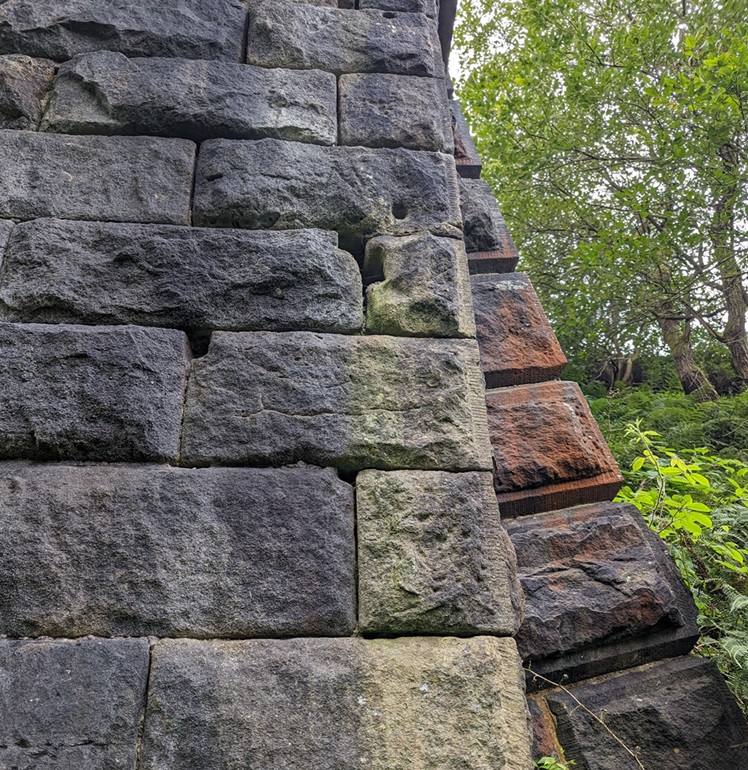
Back when I was a younger man (April 24th 2018, according to my records… 6 1/2 years ago!) I published an article on Mason’s Marks and Apotropaia on the stone infrastructure on the Longdendale Trail (read it here). Master CG was only just 2 years old then… and a lot can change in 6 1/2 years! Having recently got into riding his bike (!), off we went to the Longdendale Trail, giving me the opportunity to look for more marks… and Lo!
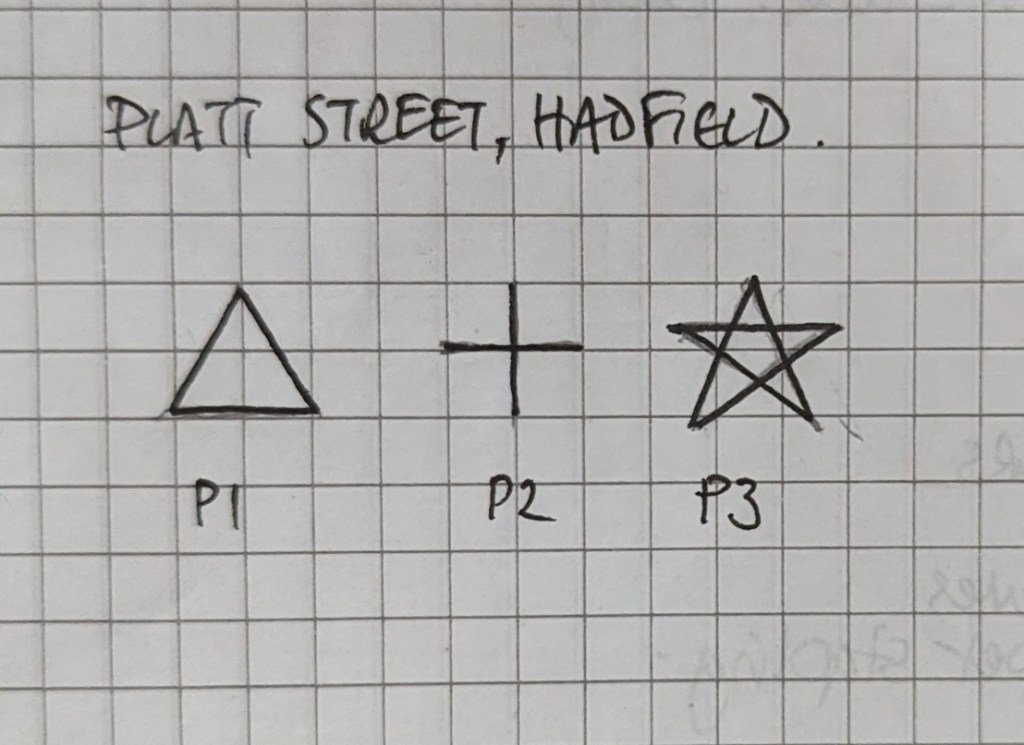
Here are the marks so far identified, to add to the corpus of mason’s marks along the line. The first are from Platt Street, the road bridge at the very start of the Longdendale Trail (What3Words is fortified.bracing.wage).
Photographed from my notebook… I just realised I should have rubbed out the pencil!
The second lot are from under a bridge that carries an apparently unnamed road leading from Padfield Main Road to Valehouse Farm (What3Words is leader.operated.courts).
V8 is also shown in the Platt Street marks. Some of these show up at other places along the line. Ooooh, I can’t wait to collate and analyse… I’m such a geek!
As you can see, some of these marks show up elsewhere on the track, suggesting that the same workers were shaping stone all the way from Broadbottom to Woodhead, which makes sense. Truly though, I need to survey the line properly, collecting the forms and locations, etc. I know I’ve said it before, but I honestly think a wonderful project could be made from these marks; recording and comparing them all along the line, researching who they might belong to, raising the profile of the men who physically built the line (not just those who financed it), as well as approaching it from an arts perspective. There’s lots to pick away at here, in fact… if anyone fancies joining me (or indeed, if anyone fancies funding/sponsoring me).
MYSTERY STONES ON THE GLOSSOP – MANCHESTER LINE
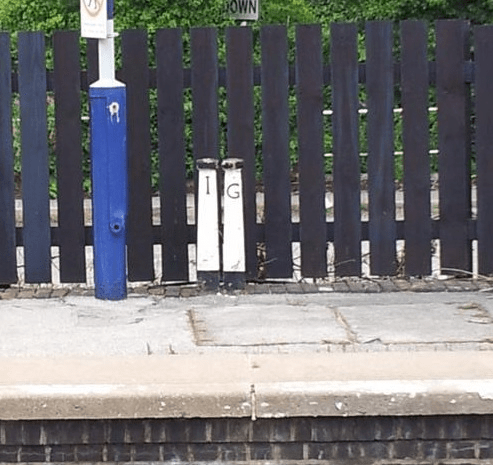
Talking of stones, a few years ago I published an article that looked at some odd stones I had noticed during the commute between Glossop and Manchester. Please read the article for more in-depth information, but essentially, 2 pairs of stones and a single example, all exactly the same shape and design, and all with the same single letter designs – ‘I’ and ‘G’. One pair on the platform at Guide Bridge station, and the single example just beyond the station, against a wall, and both of which I had photographs. And another pair just before one pulls into Hattersley station (coming from Glossop, on the right), which was in a ‘blink and you miss it’ position, and consequently of which I had no photograph.
The pair at Guide BridgeThe single post (possibly originally one of a pair) a little further on from Guide Bridge
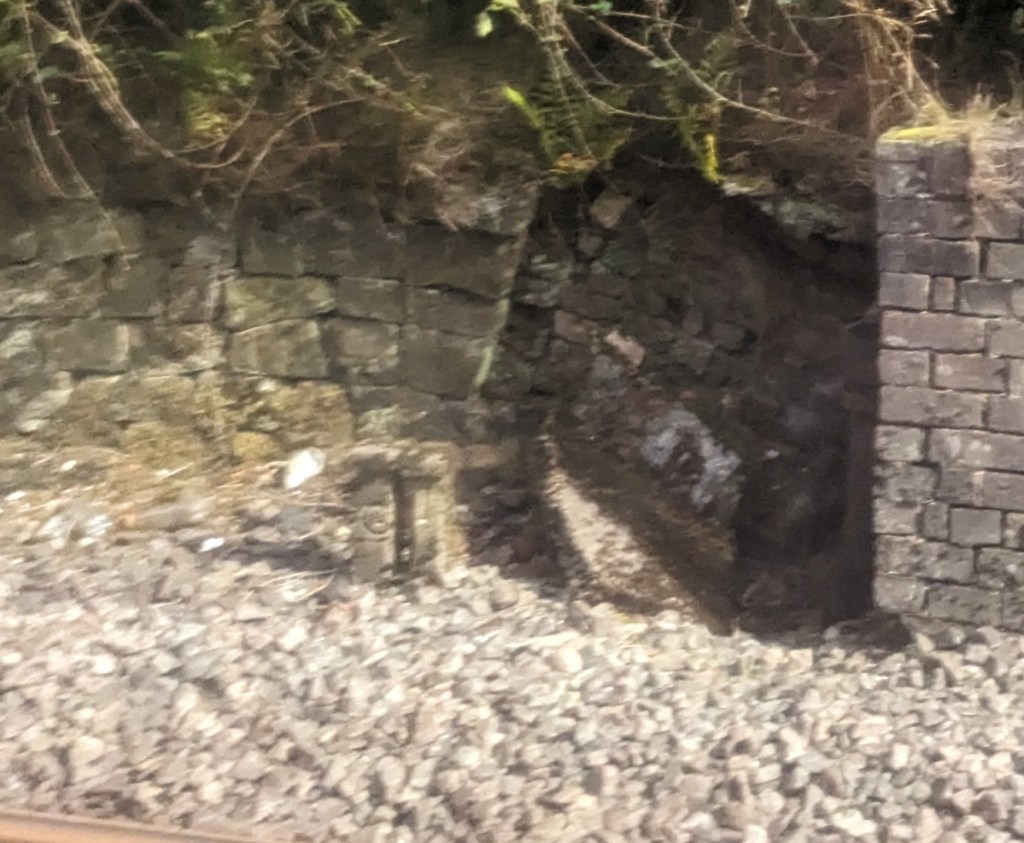
And there the matter lay until the other day! Heading into Manchester, I noticed we seemed to be slowing down earlier than usual on the approach to Hattersley station, and having my phone in my hand, I tried to get a shot of the stones… and succeeded. Well, sort of… in a cruel twist of fate, young Master CG decided it would be an ‘hilarious’ jape to put sellotape over the cameral lens, and as a consequence the photograph looks like it was taken using a potato. Still, the jokes on him… I subsequently enrolled him in a special after-school long-distance running and extreme maths challenge club. That’ll teach him to mess with old TCG! Anyway, here’s the photograph:
Apologies for the poor quality, but the general area can be discerned.The ‘G’ and ‘I’ can just be made out through the sellotape haze. I will keep trying to get a decent photograph.
So now we have photographic evidence of all of these mystery stones, which is great… but we still don’t know what they are! So, please, if anyone can suggest a meaning or purpose behind these “monogrammed mushrooms” as I have named them (patent pending), then in the name of great Jove, please let me know.
OOOOH… FLINT!
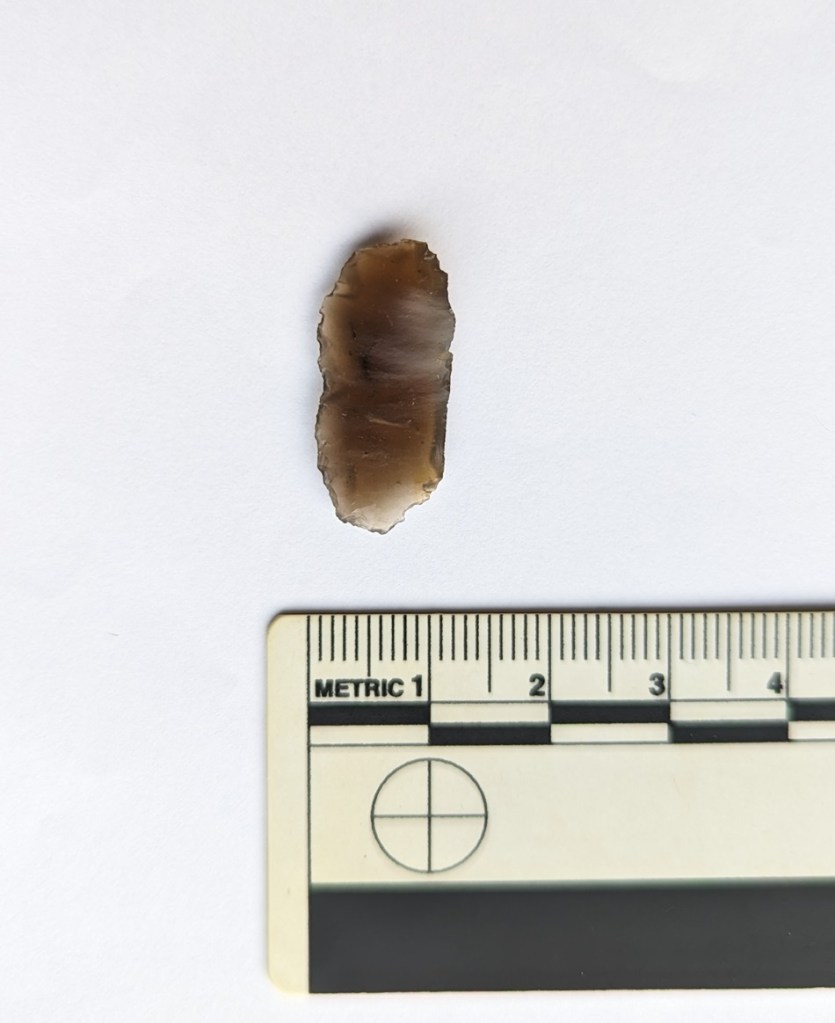
More stone… this a little older, though. Over the course of a number of years, I have picked up a few odds and ends of prehistoric flint from the Glossop area. The hills all around are full of these tiny fragments of a distant past – largely Mesolithic (Middle Stone Age, roughly 8000 – 4000 BC), with some that might be Bronze Age (roughly 2500 – 750 BC). But these three examples I have found much closer to Glossop itself, and always quite by accident. It is worth remembering that Glossop, the Peak District, and indeed most of the North West is not a flint area, and any flint found hereabouts has arrived either by glacial action, or it has been brought here by a human; so any flint you see pick it up! Honestly, flint and chert (a local, poorer quality, flint-like quartz) are both very distinctive against the local gritstone, and once you get your eye in, they stand out from some distance. I’m not a stone man, and whilst I can usually recognise flint that has been shaped deliberately, the finer points of dating I leave to people who know what they’re talking about. Here are the bits I have found:
This first came from a path just below Shire Hill, so might be Bronze Age.
Lovely stuff – a blade made from a chip of flint. You can see the ‘bulb of percussion’ – the bulbous bit at the top – where the blow was struck to break this chip off. When hit, flint acts as though it was liquid, and you can see the ‘waves’ made by the strike. You can also see the nibbling at the edges that suggest this blade was ‘retouched’, or sharpened after being used. Flint is very sharp (I have literal scars to prove it), but it is a fragile edge that needs work to maintain it. The back side of the above flint piece – you can see where other pieces have been struck from this one, each creating a scar as the force travels along the core. It’s a fascinating subject flint knapping, and one that is not easily put into words… it has to be seen, and especially felt.
The next flake came from where the allotments are now at Dinting, sitting on a mole hill. A chip off the old nodule! It’s been worked, but I’m not sure it was ever a tool. Again, a crappy photo of a lovely flint tool. This time, a fragment of a thumbnail scraper – also here. Honestly, flint is better touched and seen in person, that’s why we archaeological types use drawing to illustrate flint… a photograph does not show what we want to see.
Whilst we know people were here in prehistory, its always nice to see the things they used in their everyday lives. I actually need to report these to the Find Liaison Officer (FLO) as this is prehistoric, and any information from this period, no matter how small, can potentially change our whole understanding of the history of the area. The FLO is the person to report anything interesting and potentially important you find (feel free to tell me as well, but honestly they are more important) – very helpful and genuinely the font of much knowledge.
POTTERY: SOME BITS AND PIECES
Never missing an opportunity to spread a little ceramic-based joy, I present to you a small selection of recently found pottery. Following my own newly introduced rules, I am only taking sherds that interest me, or which are good examples of the ware type. This means that there is more left for you wonderful folk to find, and more space in chez CG… much to the relief of Mrs CG.
First up, two very similar sherds.
Left has heavily crazed glaze, and I suspect it was burnt at some stage… that’s not normal ‘wear and tear’, even after being in the ground for 200 years or so.
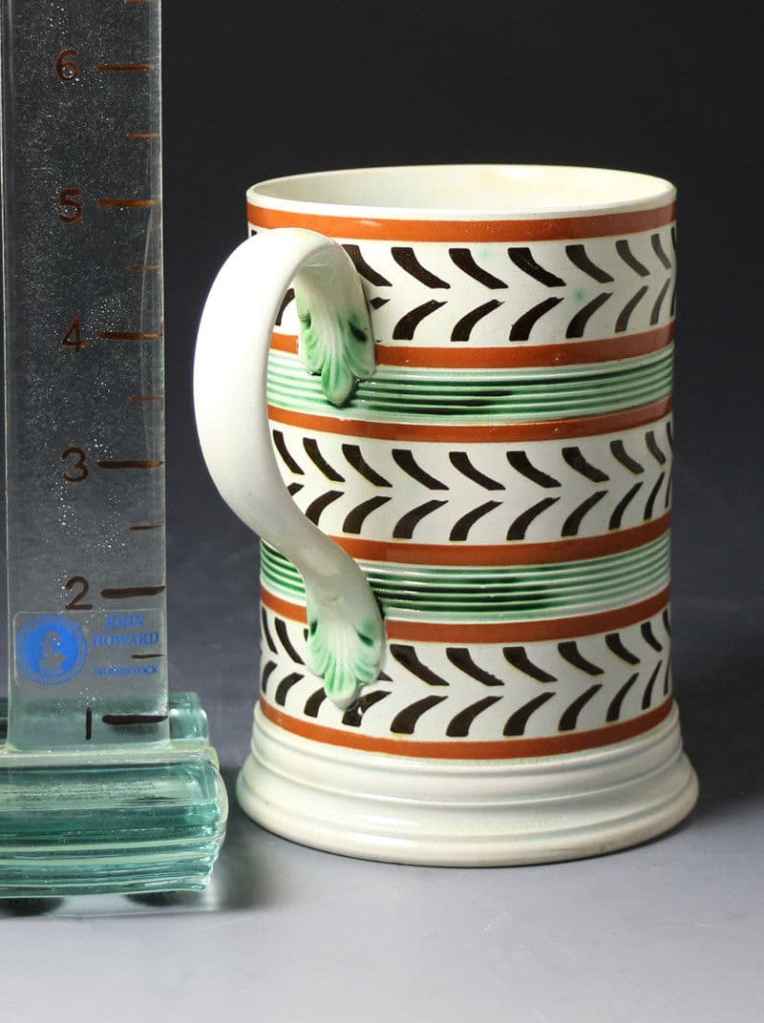
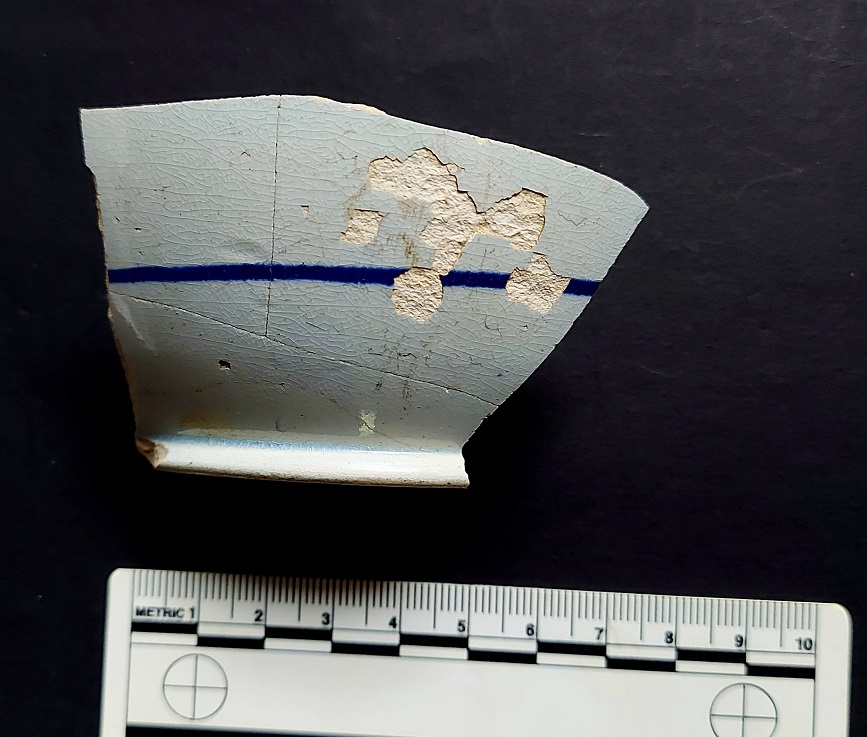
Left is from High Lea Park in New Mills, and is the base to a mug or tankard some 8cm in diameter. The right was found on the track below Lean Town, and is the same in shape and dimension, although this is from the body somewhere, not the base. I got very excited both times I found these – they look like Scratch Blue stoneware, which would be very exciting. Alas, on closer inspection it’s clearly earthernware, and thus less exciting. Having said that, they are both from Industrial Slipware vessels, and both early 19th century in date – which is a bit rarer than the usual Late Victorian – and come from something like this:
Stolen, as always, without shame, from this website. Honestly, it’s a fascinating website filled with all sorts of historical pottery information from a collector’s perspective. I genuinely enjoy this site… which might be warning to some of you!
Sometimes, coming back from school with Master CG, we like to shake up what is in essence a somewhat linear journey from A to B by taking different routes; exploring, Wandering, and just seeing what we encounter along the way; blackberries, elastic bands, the occasional copper nail, a penny, holes in the ground to peer into, and if we are lucky a skip. There’s always something in either of those two latter.
Plain, but is still quite cool. I know, I know… but I can’t resist!
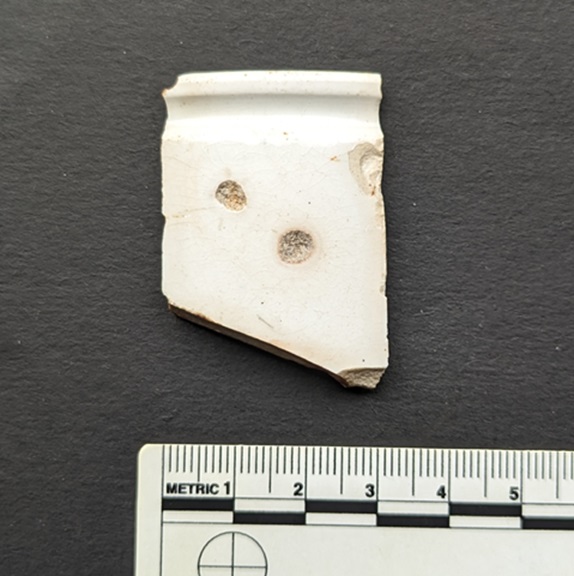
This was from a skip on Hadfield Place. Always, and I mean ALWAYS, look in a skip that has soil piled in it: Glossop’s history almost guarantees that there will be at least some Victorian sherds in that soil. Here we have a rim sherd from a late Victorian/early 20th century marmalade pot – something like this:
Stolen from this website… and you can buy it for £55.
The groove running around the pot, just below the rim, is to enable a piece of string to be tied around to keep the cloth lid in place… very characteristic.
Skips and holes… always have a look in both. This next sherd was from a utilities pipe trench on St Mary’s Road:
Lovely stuff. I think this might be fairly early
A lovely sherd of Industrial Slipware, again, this time of a Banded or Annular Ware type. It looks very modern as it is still made, particularly as Cornishware, but it is genuinely early to mid-Victorian in date, and probably from a large bowl or jug. Looking and feeling it again again, I think jug.
This last sherd is another Industrial Slipware – a tiny fragment of Variegated Ware, this one being in the ‘earthworm’ design:
Truly awful photograph. I know a bad workman blames his whassnames, but my new phone has no macro setting, so my up close photos are not great.
Probably from a jug or bowl, similar to the one in the above article, and dates to about 1800-1820. Interestingly, this one was found in a quarry that was used during the construction of Bottoms Reservoir, and was later used as a tip. Bottoms Reservoir was opened in 1877, and thus the tip can only have been used from, say, 1880 onwards, and actually, judging from what is found there, I think perhaps from 1900 onwards. This means that this sherd – and the pot it came from – was as much as 100 years old when it was broken and thrown away. This makes sense – I still have my great grandmother’s 1920’s salt-glazed stoneware pie dish (I use it to make a really nice tomato and white bean bake with a feta topping, if anyone fancies…) – and is a cautionary tale about using pottery to precisely date certain contexts. People in the past also had heirlooms, and all objects have a biography.
AND FINALLY… WHERE/WHEN 3
Well, Where/When no.3 is now on sale… and selling well. You good folk seem to like a walk, some history, and a pint… who knew? Well, I think we all did to be honest. You can get it in Dark Peak Books (93 High Street West in Glossop), or via the Cabinet of Curiosities shop (here). Or you could track me down and snag a copy.
For those of you who are unaware, Where/When is a quarterly journal of Archaeological Wanderings. Essentially, a walk in the Glossop area, with yours truly chiming in about the archaeology and history of where you are wandering; think a pinch of pottery, a hint of psychogeography, some groovy photographs, a dash of discovery, a toe stub of psychedelia, and a splash of the usual Glossop Curiosities shenanigans. No.3 Takes us on a walk from The Beehive in Whitfield to The Bulls Head in Old Glossop via medieval trackways, a Saxon stone cross, 18th century buildings, and a 10,000 year old glacial erratic boulder. Marvellous stuff!
A sneak preview of Where/When 4 – The Melandra Meander.
And Where/When No. 4 is in preparation; titled “The Melandra Meander“, it will detail a circular walk from Melandra Roman Fort to Mottram Church on the hill above – via Hague and medieval trackways – and then back again, and is full to the brim with the kinds of historical and archaeological goodies that you have come to expect. It’ll be in stores in December, just in time for Christmas.
I have a whole pile of ideas for Where/When, and the Cabinet of Curiosities in general… all kinds of stuff: t-shirts, anyone? Art prints? The Rough Guide to Pottery in booklet form? And in particular I’d like to start a series of monthly guided Wanders – where you and me can Wander together. Let me know what you think about this. Or indeed anything about the website, or what I have written. It’s nice to know I’m not just shouting into the void!
Right then, apologies for the late post of this article, and for generally being behind in most things – there’s often a lot less of old TCG to go around than I believe, so I end up dropping some of the things I’m juggling. More soon, I promise.
Until then, though, please do look after yourselves and each other, and remember – a person might look ok on the outside, but can be struggling inside. We all matter.
What ho, you wonderful people, you! Well, here we all are. Make yourselves at home. Canape? Glass of something cheering? I can heartily recommend the red… cheeky, but hexagonal in the correct places, if you know what I mean. Right, take a seat and I’ll begin.
Today’s offering concerns a subject very dear to my heart. No, not pottery… I’m not completely one dimensional, you know. Nope, this article concerns pubs. And alcohol. And in particular the effects derived from the consumption of the latter. “What’s this?” I hear you cry… “a post about drunkenness? By a man with the sober reputation of good old TCG?” Hmmm… let’s move on.
So, I was reading through the diary of George Booth (discussed further here) the other day, and came across this absolute gem:
Thursday July 25th (1833) Last sunday afternoon [21st July] I went with Harriet Hough, our Mary, James & George Booth to Glossop Church. After service we went to Joshua Shepley’s at the Royal Oak and then returned by way of Bridge End Juncksion, Simondly and we did not forget to call at each place and to my own shame I was quite drunk. fell and broke Miss Hough`s Umbrella and tore my Trowsers.
I say!
So, what are we to make of that startling confession? We could judge Mr Booth harshly, but let’s face it, we’ve all been there (though I don’t recall ever having broken someone’s umbrella). Two things leap out of this entry. Firstly, there are the post-church snifters – seemingly many of them – in what was, for all intents and purposes, a pub crawl of Glossop that starts in the Royal Oak and ends at Bridge End (appropriately enough, where Wetherspoons is now). The amusement here is, I think, the result of a sincere and honest Georgian/Victorian gentleman, getting sozzled after church, staggering home, breaking an umbrella, and ripping his trousers. Quite how this happened I’d love to know (the ripping, not the drunkenness… I’m very aware of how that happens!), but the diary entry is somewhat lacking in details.
Secondly, there is the comment that they returned via “Bridge End Juncksion [junction]”, implying the meeting of a number of roads. My sherdy-sense tingled, and the question was asked: “is there a blog post here?” Well… here we are!
Ok then, let’s examine the route our man and his party took, firstly from the church to the Royal Oak. There are two ways he could have walked. Firstly, down Manor Park Road (then called Hall Street) and left down what was then Cowbrook Lane, but is now the A57/Sheffield Road, and along to the Royal Oak. This would have had a decent road surface on it now – the turnpike road – the Snake Pass – had been open for some 12 years at this point. But this would mean they would have to double back on themselves to get home. No, I think it would make sense to take the more direct, and almost certainly original, route, along the track from Hall Fold (passing the Glacial Erratic) and via Pyegrove, finally popping out at the pub on the road there. This was an established track, rather than the simple footpath it is now, and for many hundreds of years was used by man and beast to get from (Old) Glossop to Hurst, Jumble, and ultimately Whitfield – a not insignificant trackway to be honest. There was also a spur from this track to Mossy Lea farm, and joining Doctor’s Gate.
All Saint’s Church, Glossop circled in green at the top. The Royal Oak is circled in blue at the bottom. Hall Street (now Manor Park Road) is in orange, The Pyegrove track is in red, and continues beyond the Royal Oak to Hurst, etc. In pink, we see the spur – Woodcock Road – that goes to Mossy Lea and Doctor’s Gate.
The Royal Oak was constructed in or just before 1818 as a purpose built alehouse by the Joshua Shepley mentioned in the diary. It sits on the then new Snake Pass, and had stables and a blacksmith, as well as water trough. Shepley clearly knew he had a captive market – the first watering hole you come to after the Snake Pass, and the last as you leave Glossop for the road, meaning a last chance to water or shoe a horse, as well as a pint, too. As a building, it’s a wonderful example of the neo-classical late Georgia/Early Victorian ‘symmetrical with a central doorway’ style that was very common amongst purpose built pubs of the time. Actually, it’s a little off perfect symmetry, as indeed they all are, presumably to accommodate a larger room and a smaller one – here the larger is on the right – but let’s call them symmetrical. The porch covering the front door is a later addition.
I love this view – it really shows the looming presence of Shire Hill in the background. And honestly, Shire Hill looms… I actually find it quite an intimidating place. Another view, the track from (Old) Glossop via Pyegrove comes out on the left The trough at the front… full! The last time I saw this, it was bone dry. I always find it odd, and perhaps a little mystifying how the water table fills up, and how quickly following a decent amount of rain.
I feel that if Booth purposefully went there to see the place, and the man, he would certainly had more than a single drink; at least two is my guess, although potentially more. We’ll say two to be on the safe side.
DRINKS CONSUMED: 2
So then, from here they would have wandered down Cowbrook Lane, and come across what would become the Commercial Inn on the corner there. But whilst the building – or an earlier incarnation – was standing there (a lease for the building was granted in 1828), it didn’t have an alehouse license at this point (that only came about in 1839). However, it might have had a simpler beerhouse license, as almost anyone could obtain a license to sell beer brewed on the premises if they paid a 2 guinea fee. One can imagine the sort of clientele this sort of establishment could attract – cheap and cheerful beer a plenty. I’m not 100% convinced our man Booth would have frequented a beer house, but I could be wrong – especially if he’s on the razz! So, benefit of the doubt, he bent his elbow at the Commercial, or what was there at the time.
The Sheffield Road side of The Commercial Inn, blocked up doorway visible front and centre. This is the door that George Booth and party would have entered on that fateful evening. Close-up of the doorway. A dark and rainy view of the Manor Park Road side of the pub, now the only way to get into the building. Again, the symmetry is obvious.I’m not certain, but these two houses share all the same features – windows and doors, and symmetrical shape – as the pub they are joined to… they have to have been built at the same time, or at least soon after (actually, the stone size and shape is slightly different – look left where the join in the roof is. I wish I’d taken a closer photo now. But I’d still bet money that they were built by the same person, and within a year or two.
The current building is also of the ‘symmetrical’ style, although this example has the central doorway on both the turnpike road and on Manor Park Road (then Hall Street), which make good commercial sense, although the Sheffield Road doorway has been bricked up. I’ve said it before: objects (in this case a building) acquire a biography, and throughout their ‘lives’, like ours, they constantly change, and often carry the scars of their history. A bricked up doorway prompts so many questions, some of which are easily answered, others not so much. Was this an entrance to a separate room? The Smoking Room? Taproom? Lounge? Vault? Or was it an entrance to the private quarters?
DRINKS CONSUMED: 3
Onwards and upwards. From here, the next establishment he might have come across is the Mechanic’s Arms at 99 High Street East. Built in 1831 by Jordan Hampson, who is listed as a beer seller in the 1841 census, and who would have been the landlord in 1833. The building ceased to be a pub in 1933 because of its “structural unsuitability”, and the building was demolished in 1971. Regency Court now stands in its place.
Not a lot to say here! Somewhere in the middle of this photo stood the Mechanic’s Arms.
So we might assume an eyeball straightener here, then.
DRINKS CONSUMED: 4
Next up and a little further down we have The Peartree Inn. Built in 1818, it was originally known as the Kings Arms.
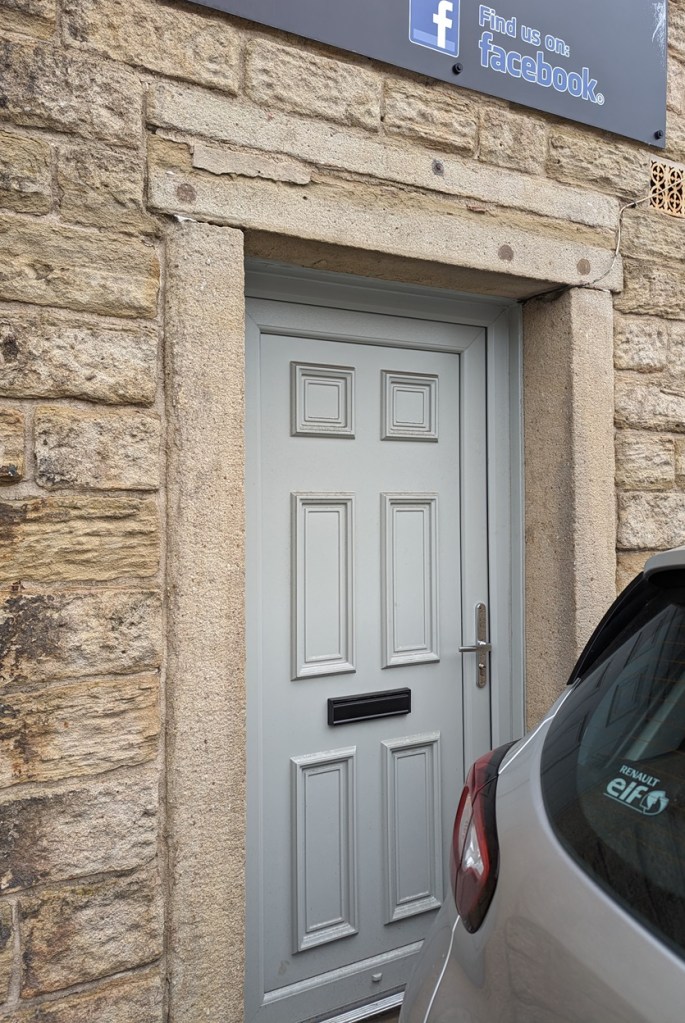
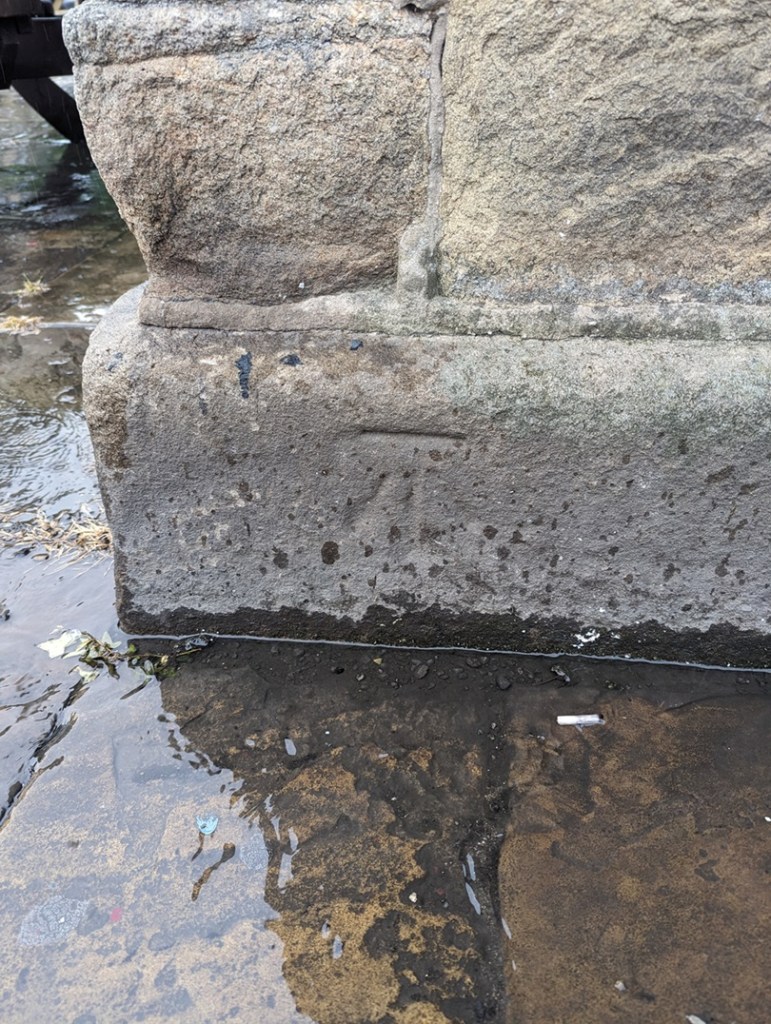
Once you notice it, you can clearly see it was once a pub – symmetrical windows with a central door. Although, there is another bricked up door on the left, again perhaps the entrance to a separate room.The bricked up doorway up close. What was originally – I presume – the main entrance to the pub, and through George Booth and his party would have passed.And, o’ happy day, a bench mark! For those of you who don’t know, these were carved onto buildings to mark a specific measure height above sea level in the 1840’s and onwards. I love these things – the horizontal line marks the exact point, and the arrow below shows you where. This is exactly 504ft 7″ above sea level. Man, I love a bench mark! Check out this blog article, and many more like it in the archive.
It was here that in 1830 that the officers of a detachment of the 10th Hussars and 4th Regiment of Foot were stationed, being given the task of putting down a potential riot of spinners who were demonstrating in favour of a standard rate of pay. In 1832 it would have been owned by a John Woolley, himself an old soldier. We might safely assume they took one drink in the Peartree, although the chance of a chat with an old soldier… let’s say 2. It is a Grade ii listed building, with the official listing thus:
House, now offices and attached wall. Early C19 with late C19 and C20 additions. Coursed millstone grit with tooled dressings and stone slate roof. 2 stone end stacks. EXTERIOR: 2 storey and attic. Street front rendered. Almost symmetrical 2 window range. Off-centre doorway with C20 door in flush ashlar surround flanked by single plain sashes, above 2 plain sashes, all in flush ashlar surrounds. Left return has blocked tall opening at first floor level and above single plain sash. Right return has ground floor with elongated C20 window opening. Rear has C19 parallel extension with end stack. INTERIOR: not inspected. SUBSIDIARY FEATURES: adjoining wall to left has doorway in flush ashlar surround with plank door.
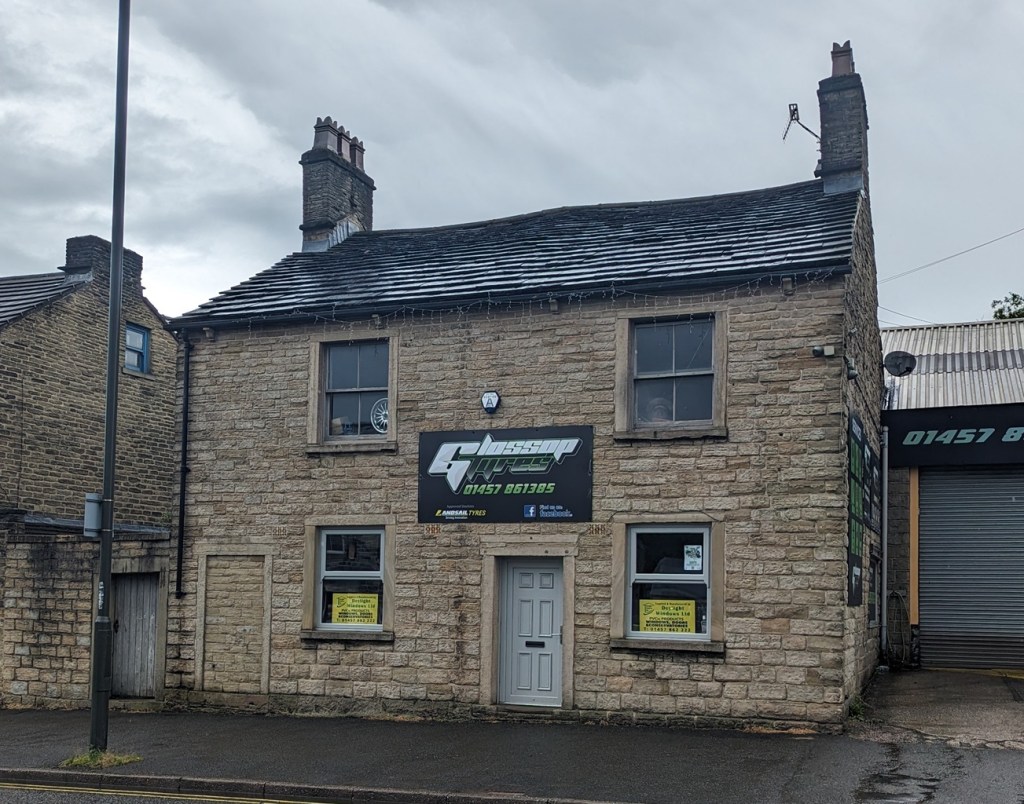
The Peartree ceased being a pub in 1926, and is now the offices of Glossop Tyres – make sure you check out the building the next time you are getting new tyres.
DRINKS CONSUMED: 6
Swaying slightly (we’ve all been there) they would have set off – it’s thirsty work, all this walking… Next up, the Howard Arms, for at least one.
Howard Arms, Ellison Street in the foreground. Again, like the Peartree, it was originally symmetrical, with the door central between the two ground floor windows. It was bricked up when the pub expanded into the building next door sometime after the 1930’s. That is the one George Booth and party would have used. A view of the Howard Arms in 1904, central door still in situ. The person in the doorway is likely to be the wife of John Green Hudson, landlord at that time. Image from the always excellent Glossop Victorian Architectural History site – HERE. Well worth a browse as it is full of old images, and catalogues our extensive and important Victorian heritage…. it really is an important website.As it is now, and after the windows were widened – still 3 light, only wider.
Named after the Howard family, the Dukes of Norfolk, it was built in 1800. It is superbly situated for passing trade, being at the crossroads of the old Woodhead Road (now Ellison Street) and the turnpike road running east-west, later expanded into the Snake Pass. Indeed, the trustees of this road building committee held their first planning meeting here, on 4 June 1818, and celebrated its opening four years later with a slap-up meal in the pub. A very nice establishment (possibly), I feel certain that more than one was consumed here. For one, he was already 6 drinks into this adventure, and at this point, the genie is hard to push back into the bottle, and trouser-ripping and umbrella-breaking are all but inevitable. But I also get the impression that he is having a good time, despite the shame he felt the next day, and the diary makes it very clear “we did not forget to call at each place“.
DRINKS CONSUMED: 8
From here, the party would have headed further down, and into the Norfolk Arms. Built in 1823, there is quite a bit that can be said about the pub, but I feel here is not the place – this is Mr Booth’s time to shine – so I’ll keep it brief. Built in 1823 as part of the monumental shakeup of this area, and the creation of Howard Town, The Norfolk Arms has been much altered and expanded over the years, especially in the late 19th century, but at its core it is another example of that neo-classical ‘symmetrical with a central door’ that define so many purpose built pubs of the late Georgian/Early Victorian period (the front porch is a later addition).
Apologies – this shot is taken from Google Maps’ Streetview. I took several photos of the building, from several different angles… but for some reason, none of them came out ok. Odd, but there you go. I’ll update the photos later, but for now I just want to get the article out there! You can see the central, ‘symmetrical’ building, with the later wings added. Oddly, this is the only photograph that worked properly! The bench mark on the south-eastern corner of the building marking 497ft, 1″ above sea level.
It is also slightly grander than many of the other examples – larger and more formal, it was also used as the town’s post office in the 19th century, as well as the coaching inn, where stage coaches between Sheffield and Manchester would stop. The Norfolk Arms is a Grade ii listed building, with the official listing reading thus:
Coaching Inn, now public house. 1823, altered late C19 and C20. Coursed millstone grit with ashlar dressings and hipped Welsh slate roofs. 4 ridge stacks and 3 wall stone stacks plus 2 louvred vents to left. PLAN: double-depth. EXTERIOR: 2 storey. High Street front has 7 windows arranged 2:3:2. Slightly projecting 3 window centre has central stone, flat roofed single storey porch with blocking course, plain square columns and C20 margin light glazing. Flanked by single plain horned sashes, above 3 similar windows. Wings have 2 similar sashes to each floor. All windows have painted ashlar lintels and sills. Left return has doorway in flush ashlar surround with overlight and to left single small then 2 large casement windows, above 3 plain horned sashes. Right return to Norfolk Street has central doorway under single storey flat roof porch with dentilled cornice supported on square Tuscan Doric columns, moulded round arches with moulded imposts and stressed keystones. To left single plain horned sash and to right large former shop window with former doorway to left and 3 round headed lights to right within plain pilaster surround with moulded fascia board. Above 3 plain horned sashes and small inserted casement window.
And it’s difficult to argue with that! The landlord in 1833 was a Joseph Oates, and I think they had single drink in here, as they decide to call it a night and head home.
DRINKS CONSUMED: 9
The diary states that they went via “Bridge End“, which means they would have crossed what was then a new bridge, but not yet Victoria Bridge. This whole area was in flux at that time, with new road layouts and buildings going up, and it may well have resembled a building site. However, there was one shining beacon on this dark and lonely road out of Glossop, one place of refuge and light. And beer; The Albion Hotel (also known as The Trap, The Last Orders, and now The Brook Tavern), which in 1833 was brand new, being built the previous year. Maybe just one more…
The Brook Tavern as it is now, originally The Albion. The porch is a later addition, but would have originally been like our other pubs so far, symmetrical with a central door.
Set back from the modern road now because it sat on the original line of the road and bridge (and lines up with Smithy Fold and Ellison Street), it would have been a magnet for the party – to celebrate crossing the bridge, and one for the road. The last. No more… “Ah, go on then, let’s have another…” The landlord at the time would have been a Charles Calvert, who by this point would probably have been glad to see them go!
The original line of the road can be seen by looking along the shop fronts here – they pinpoint the site of the original bridge, and Ellison Street beyond. The new road curves more to the west, over Victoria Bridge.
TOTALDRINKS CONSUMED: 11
And so, singing hymns – and other, less saintly songs – our party staggers into the night, and into infamy. Blimey… 11 drinks! Not bad for a Sunday session, and certainly more than I could do anymore. The ‘pub crawl’ is a brilliant piece of social history, a glimpse into the personal life of a person whose public life was probably very different, possibly very austere and proper – so the idea of him getting squiffy on a Sunday is amazing if, as he notes, shameful, as the sobering up starts, and he fits back into his public persona.
Now, here is also something of a question mark. His diary records that they went via “Bridge End Juncksion, Simondly“, but that is an odd way of putting it. Bridge End is Victoria Bridge, but it is not in Simmondley. Whitfield or Glossop, depending on which side you are standing (I get the feeling Bridge End proper is on the Glossop side of the brook), certainly, but not Simmondley – that’s over the water of Long Clough Brook. There is Bridge Field, which is just in Simmondley, but it is much further away. No, I suspect he may simply be confused: a bridge over water from Glossop… that’s Simmondley. Plus, he’s a Chisworth/Charlesworth man out of his territory, he may not have understood the finer points of local geography. And let’s not forget he was also somewhat impaired, mentally, by the time he arrived there!
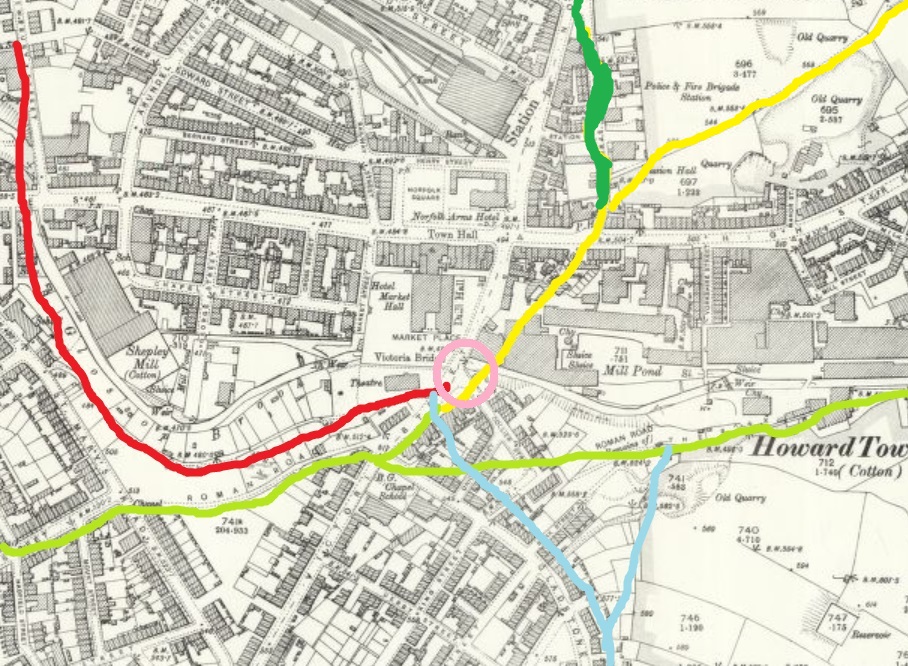
So then, the ‘Juncksion’? A junction, or a meeting of roads. But from where? This is where Glossop’s history gets murky… and interesting. It is a dispersed settlement, with farmsteads all over, all of which feed into the centre – Old Glossop. Because of this, trackways spread spiderweb-like all over, connecting all of these places and people. A crossing point like Victoria Bridge – or rather the bridges that were there before – were naturally targets, focal points attracting all the tracks, as ways to cross Glossop Brook, would not have been common. Here on the map is shown the tracks. It should be stated that not all would have been in use simultaneously, they would have been introduced as needed; a new farmhouse built, perhaps means new tracks are made – but all heading for the single focus of the crossing point, the bridge.
The tracks that meet at Victoria Bridge. Pink: Victoria Bridge, Red: from Ashes, Green: from Simmondley (the main Simmondley to Glossop track, and which becomes Bank Street [The Bonk], Blue: from Whitfield, Yellow: the track to (Old) Glossop, Dark Green: the track to The Heath, and on to Padfield, but also Woodhead, and ultimately Yorkshire. A Juncksion indeed.
This article owes a huge debt to the book History in a Pint pot by David Field – a brilliantly detailed look at all of Glossop’s pubs, past and present, now sadly out of print and ridiculously difficult to get hold of. The library has a copy, so go there and read it. I’d also like to thank George Booth, especially as this is the second article inspired by his diary. I also feel slightly bad about lampooning him, however good natured it might be; after all, the shame he felt at being drunk was real enough to write about it in his personal diary. By way of an apology, I might raise a glass of the stuff that cheers his way tonight… although I’m not sure he’d approve.
However, I’m genuinely half tempted to recreate this monumental pub crawl – starting at the Royal Oak, and finishing in the Brook Tavern… and celebrate the end by tearing a pair of trousers and breaking an umbrella? Who’s with me? 21st of July this year is, coincidentally, a Sunday, but I feel that we live in less civilised times, and those of us who work will not appreciate waking up Monday morning. We could do it the day before – Saturday 20th. Just a thought… let me know what you think.
In other news, Where / When issue 2 is selling like hot cakes, which is great as it means that I can publish Where / When 3 relatively quickly. I also have some archaeological/historical walks planned for the summer – essentially me doing a Where / When live, with a bunch of you, if you fancy. And perhaps incorporating the inaugural George Booth Historical Stagger? But honestly, watch this space as lots is being planned…
Until the next time then, good people of Glossop – and beyond – please look after yourselves and each other.
What Ho! What Ho! And if I may be so bold… What Ho!
How are we all? Bearing up under the circumstances? Summer, such as it was, has gone, and Autumn is upon us. A time of harvesting, of blackberrying, of apples… and pottery, obviously. And just like that, without further ado (and ignoring the groaning and wailing and gnashing of teeth), we tiptoe into Part 8 of the fabled (and seemingly never-ending) Rough Guide to Pottery; let’s have a look at some rather splendid sherds.
So then, today we are looking at some rarer types of pottery – well, perhaps not rare as such, just not as commonly encountered as some of the other stuff I’ve previously talked about.
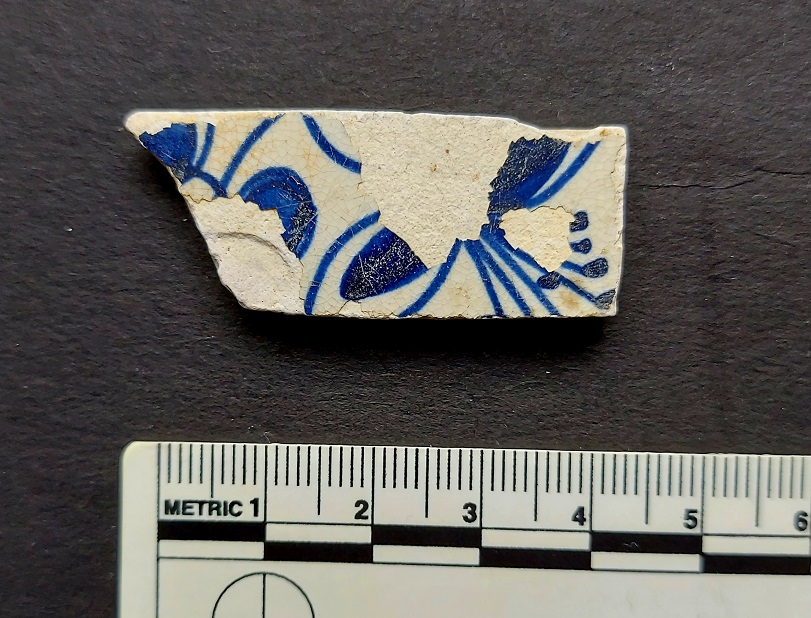
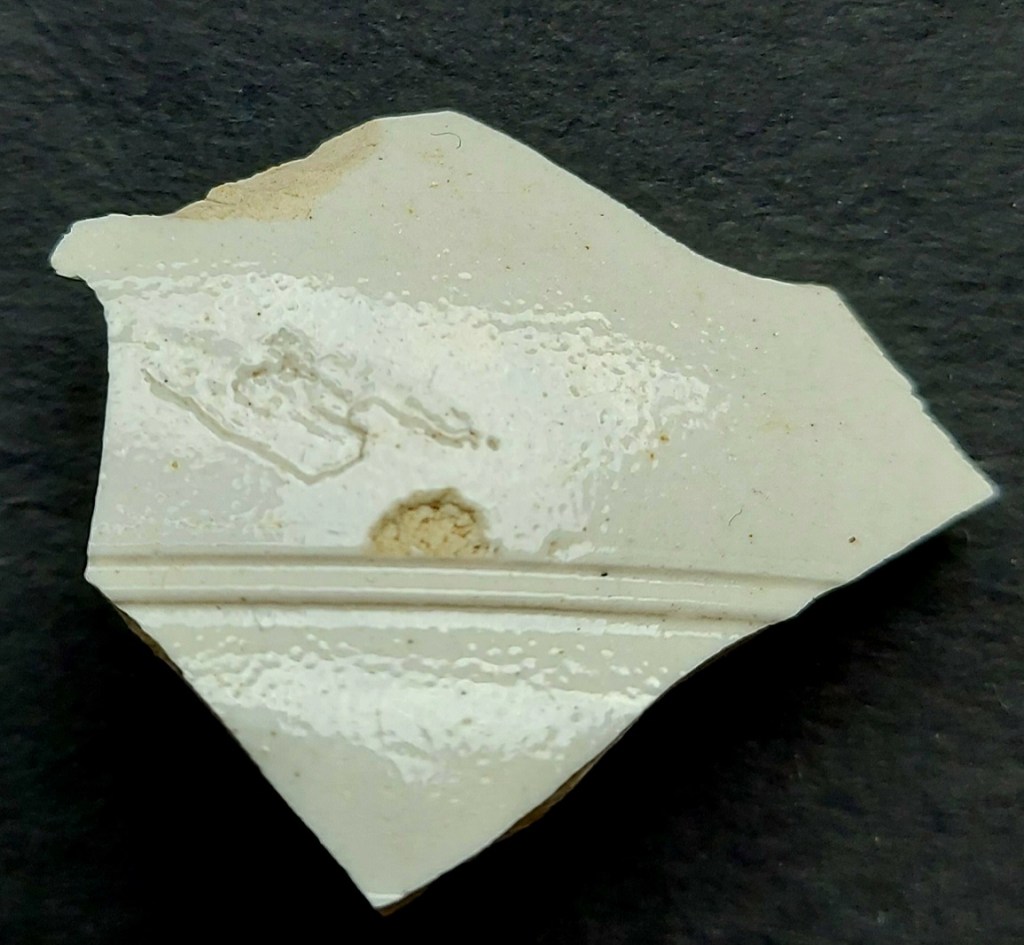
TIN-GLAZED EARTHENWARE (aka Delft) DATE: 1650-1770 DESCRIPTION: Hand painted glazed blued decoration on a whitish/blueish background SHAPES: Cups, saucers, bowls, plates, small jugs, tankards, chargers with prominent ring foot. fine and delicate, with thin walls. Decorative tiles were also common in wealthy houses.
Originally tin-glazed pottery was imported from Italy, Spain and the Low Countries, but UK production began in Norwich in late 16th Century. Its heyday was roughly 1700 to say 1800… roughly. It remained popular until it was gradually replaced by White Salt-Glazed Stoneware by the mid 18th Century, which was more robust and much lighter, and cheaper to make. Tin-glazed pottery was another attempt at reproducing porcelain type pottery, and part of the quest to find a pure white background that seems to have dominated pottery making in the 17th and 18th centuries.
The process of manufacture was as follows. The vessel was turned by hand and using a former, and then biscuit fired (that is, it was fired undecorated and without a glaze). The pot is then dipped in the glaze and allowed to air dry. Once dry, the pot is then decorated by hand – quickly as the glaze is very absorbent. It is then once again fired, which fuses the glaze and fixes the decoration.
In terms of fabric, it’s an earthenware, a pale colour – white-ish or cream colour, with later examples being almost pure white. It has occasional tiny pink, reddish or darker inclusions, and is a soft to medium hardness.
Fabric. It is stained slightly to a creamy colour, but you can see the paler white where there is a new break. You can also make out some reddish inclusions in the fresh break… if you squint hard enough.
It uses a lead oxide glaze mixed with tin, which gives it a blueish white or pale cream colour, but is more blue where it pools – in particular around the ring base, where the pot was dried upside down.
The pooled glaze is very blue here. There is also a maker’s mark on the bottom – alas, that’s all I have of this pot, otherewise we might have been able to identify the potter.
The glaze has an almost luminescent quality and has a consistent smooth, dense feel to it – the product of the lead – but can occasionally have tiny imperfections or dimples in it. The glaze can also be thickish in places, but it is fragile and can flake off in patches, exposing the fabric below – most obviously at the edges of sherds. The surface occasionally shows the marks of the trivets that separated the vessels in the kiln.
Flaky! This was what was in my bag after I emptied it… bits. You can also clearly see the glaze has crazed and flaked off in patches.
It’s the decoration that really makes this stuff special, though. It’s all hand-painted, and because the dried but unfired glaze is super absorbent, it has to be done with speed: the brush strokes are wide or thin, and it’s done in a fluid and moving motion, quick and rough, impressionistic, and almost living, and certainly not fixed like transfer-printed wares.
There’s no mistaking this is hand drawn – each line is human made. A beautiful if naive image of a house, surrounded by trees that seem to have been made with sponges.Simple but wonderfully effective decoration – a single line hand drawn around the vessel – probably a tea bowl or similar shape. You can also see the flaked glaze surface.
Delicate handle for a jug or similar.
There is no way to erase the decoration once applied, which accounts for occasional errors, and which I think only adds to the attraction. The colour is almost universally a wonderful cobalt blue, but occasionally purple or orange is found. The subjects are largely naturalistic – foliage in particular – but there are also scenes with animals, people, and buildings. As well as actual pots, tin-glazed pottery was very much favoured for tiles among the wealthy, and some stunning examples exist.
Stunning dragonfly tile dating to 1670ish – from this website, and only £216!Tile fragment found by me – the colour on this tile are simply stunning. Showing a stylised flower (thanks Julian)… I wish I could find the rest of it.
I honestly love this stuff, there is something wonderful about it – the colours in particular – and although I don’t have a lot of it, it’s always a joy to find.
The next lot of pottery type occupies a similar space in time – broadly the 18th century – and indeed, overtook Tin-Glazed pottery in terms of popularity…
WHITE SALT-GLAZED STONEWARE (aka Fine White Stoneware) DATE: c.1720-1770 DESCRIPTION: Thin walled, white glazed, impressed decoration, hard stoneware. SHAPES: All sorts of tablewares (i.e. not cooking or storage), common are cups and bowls, but plates, platters, jugs, salt shakers, sugar bowls, etc.
A selection of sherds, all mid 1700’s in date.
A later development than Tin-Glazed, it was first made in the later 17th century, but only began to be produced commercially from the 1720’s onwards.
The fabric is a typical stoneware, in this instance with added calcined (burnt) flint to produce a pale cream, almost white colour. It is then fired at a very high temperature and salt glazed, to produce a fine, strong, pottery that I find really quite beautiful.
Close up of the fabric. Very pale grey-ish to white, with visible voids created by gases formed by the high temperature it is fired at. There are also occasional brown and dark grey inclusions visible both in the break and the surface.
Vessels are formed one of two ways: either by being turned on a lathe when leather dry but before firing, which produces very sharp edges and fine horizontal banding; or by pressing thin sheets of clay into a mould, which allows the fine relief decoration to be made.
In this latter case, often the inside of the clay is wiped with a cloth to ensure the clay presses into every corner of the mould, which leaves very clear wiping marks, especially on closed vessels (jugs, for example) where the inside wouldn’t be seen.
Wiping marks on the interior of a jug. The black writing is an excavation code – BGW (upside down in this photo) – which stands for Back Garden Wall… I found these sherds underneath my garden wall!
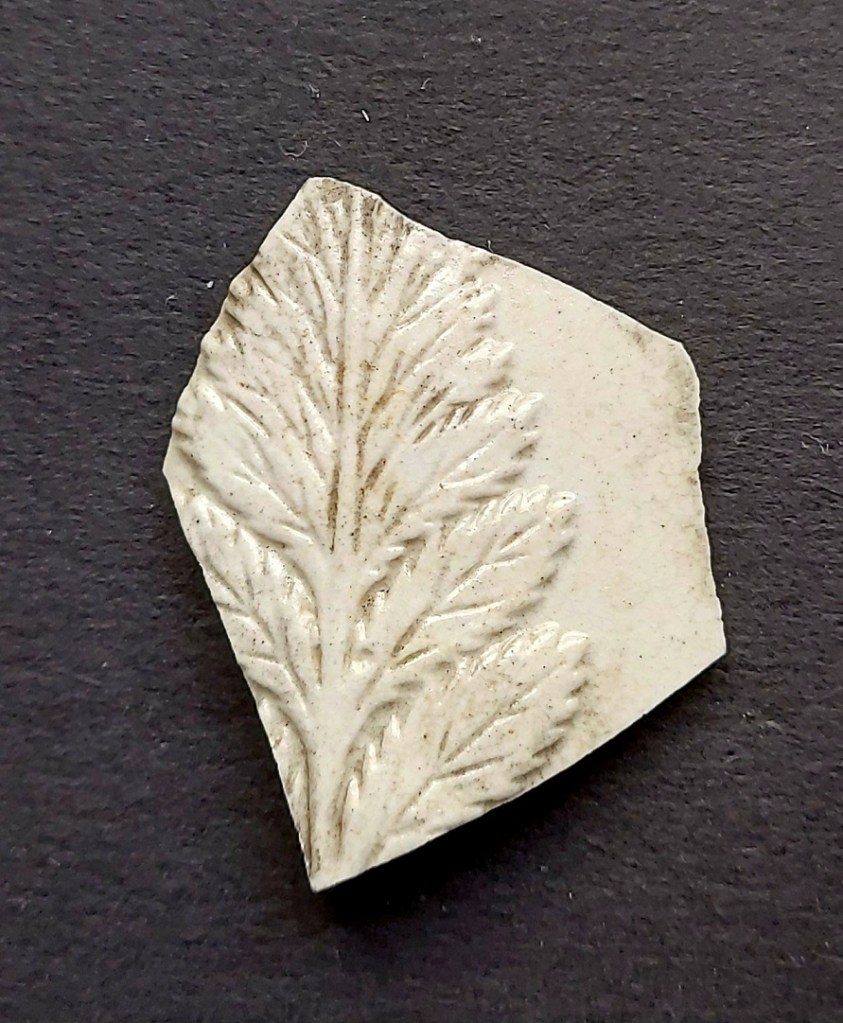
External decoration, beginning c.1730, includes basket work patterns, leaves and other foliate designs, although simple incised horizontal lines are commonly encountered on earlier pieces.
Close up of that beautiful foliate decoration – the result of being formed in a mould.
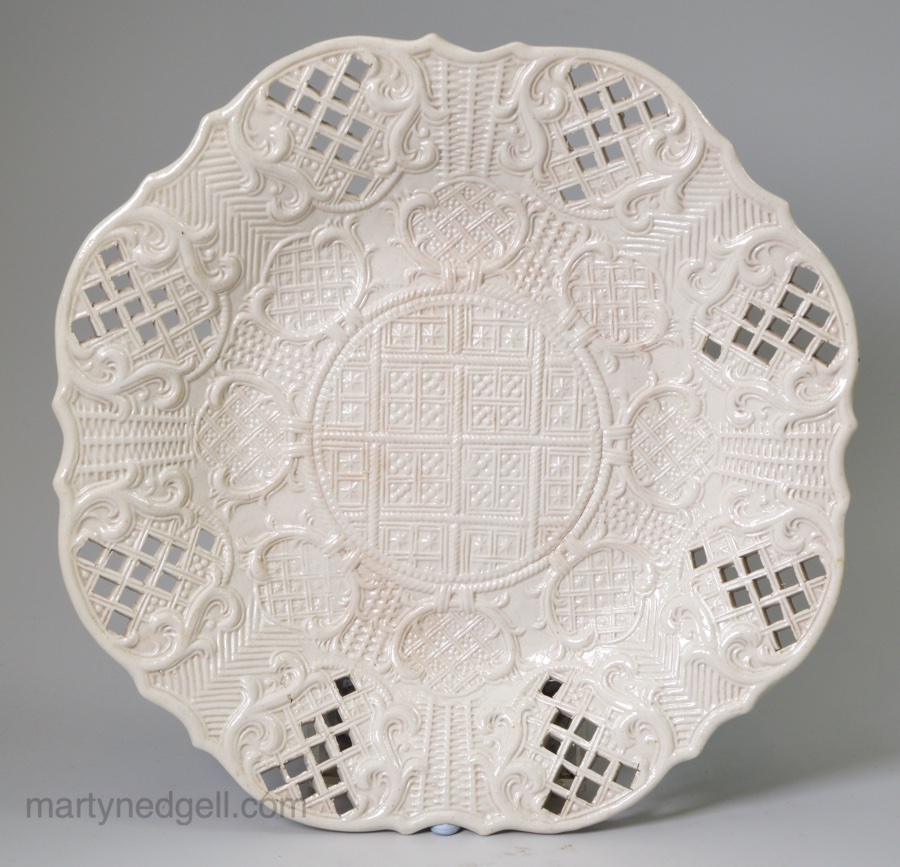
Occasionally, the walls are pierced, though this seems largely confined to high-end expensive dinner services.
Alas, not found beneath my garden wall! Lovely plate with pierced decoration and impressed motifs. Image is stolen without shame from this website here. A snip at £450! Do check out the website, though, as there are more examples of White Stoneware.
There are also rare examples of transfer-printing on stoneware:
A truly terrible photograph, but you get the idea! This is dated from the period where potters are experimenting with transfer-printing – later 1700’s.
The exterior is salt-glazed, meaning that at a point during the firing process salt is added to the kiln, which vaporises and coats the vessels in a clear glaze. Although solid and even, it often leaves an orange-peel, slightly melted roughened type effect on the surface, as it does on the Brown Salt-Glazed Stonewares discussed here.
The ‘orange peel’ salt-glaze is very obvious on this sherd. The horizontal band is very neat and tight, carved using a tool on a lathe. You can also see some sort of damage underneath the glaze (above the chip).Wonderful coffee pot of c.1760-ish, and a snip at £1250! It is lovely, though. Same website.
White Stoneware gradually overtook Tin-Glazed pottery in popularity, and began to dominate the fineware market from the 1740’s onwards – it is a lot lighter than the earthenware, and crucially it is much more hardwearing, with the surface unlikely to flake off or crack. It also appealed to the middle classes; its fine white background mimicking the desirable but very expensive imported Chinese porcelain, a crucial part of the tea and coffee drinking craze that had gripped Britain at this point. It remained popular until eventually overtaken by the development of Creamware and other earthenware types in the late 18th century.
SCRATCH BLUE DATE: c.1740-1780 DESCRIPTION: Pale stoneware, incised decoration highlighted in messy cobalt blue SHAPES: Mugs, Tankards, Jugs, Chamber Pots.
Broadly speaking, Scratch Blue is decorated Pale/Grey/White Salt-Glazed Stoneware – it has the same fabric and glaze. Essentially, this was a UK answer to the lovely looking Westerwald stoneware pottery being made in Germany (see below) and imported in large quantities – the English potters wanted a piece of the action, and produced a cut price version. It reproduces the essentials of Westerwald – incised decoration and stunning cobalt blue highlights on a pale stoneware (white-ish or pale creamy grey) background, but overall it tends to be more sloppy. The incised decoration is less careful, often looking as though it was done quickly, and the cobalt slip often overruns and splashes.
Wonderful chamber pot, with a King George medallion (probably George II)
Actually, I think this ‘messiness’ was deliberate, a way of ‘jazzing up’ the decoration, and it’s certainly effective. That’s not to say that there aren’t some very careful and precise examples, though, and in fact American archaeology seems to divide Scratch Blue into two types – Scratch Blue, which is very finely decorated, and ‘Debased’ Scratch Blue, which is the messier variety. I’m not sure that the distinction is particularly useful, or indeed ‘real’ as such, but there you go – my twopenn’orth.
A jug.
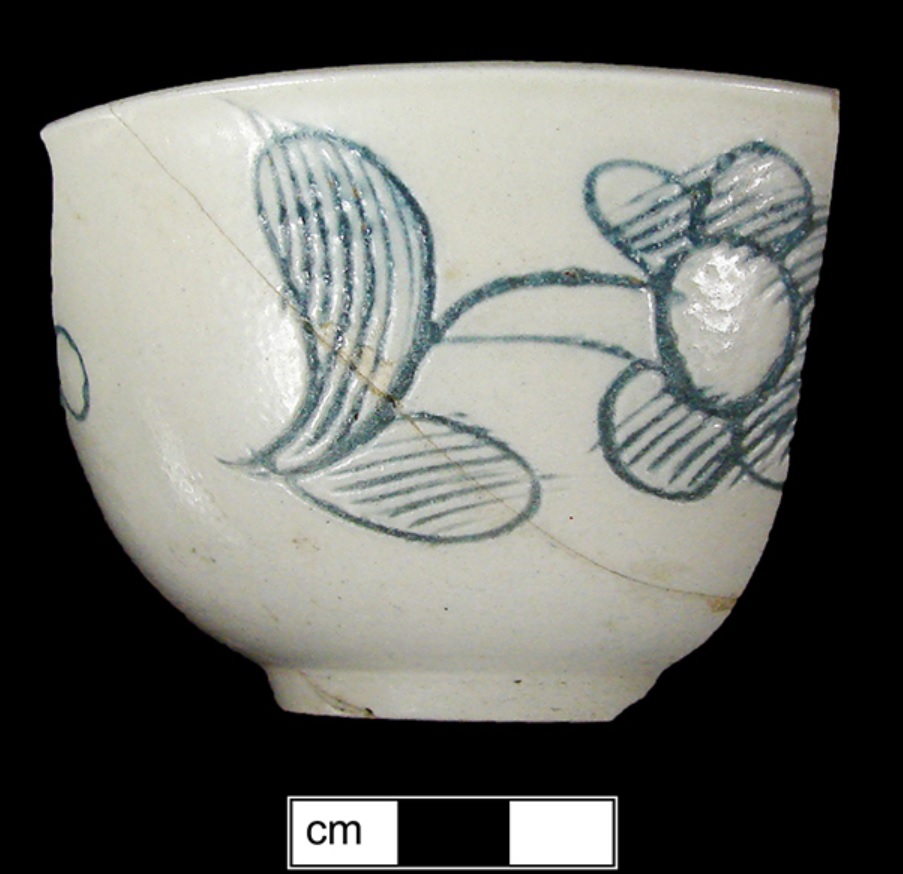
In terms of decoration, there are incised flowers and leaves and multiple horizontal turned bands at the top and bottom, all highlighted in cobalt blue and occasionally manganese brown. Also, there are applied medallions, sometimes containing the royal arms and cipher of King George II/III.
A tea bowl with a lovely flower incised on it. All these images are stolen from the hugely invaluable Colonial Ceramics website of Maryland – well worth checking out their huge database of pottery.
I have a single, very small, sherd of Scratch Blue pottery, and this stuff is by no means common, especially up North.
That’s it, a single 2cm sherd of Scratch Blue is all I have. There must be more out there…
It seems to be from the base or top of a tankard, something like this:
Possibly something like this, from roughly 1780. From Colonial Williamsburg’s website.
This seems appropriate as it was found on the footpath outside an 18th century one-time pub, the Seven Stars off Hague Street, Whitfield.
WESTERWALD (aka Rhenish Ware) DATE: c.1650-1780 DESCRIPTION: Pale or grey Stoneware, incised decoration highlighted in cobalt blue SHAPES: Mugs, Tankards, Jugs.
Unusually, I don’t actually have a sherd of this to show you! It wasn’t particularly common up in the North – London being the big importer and consumer of this ware type. As I said above, Scratch Blue is the indigenous British potter’s response to this German imported pottery, and as you can see it is very similar:
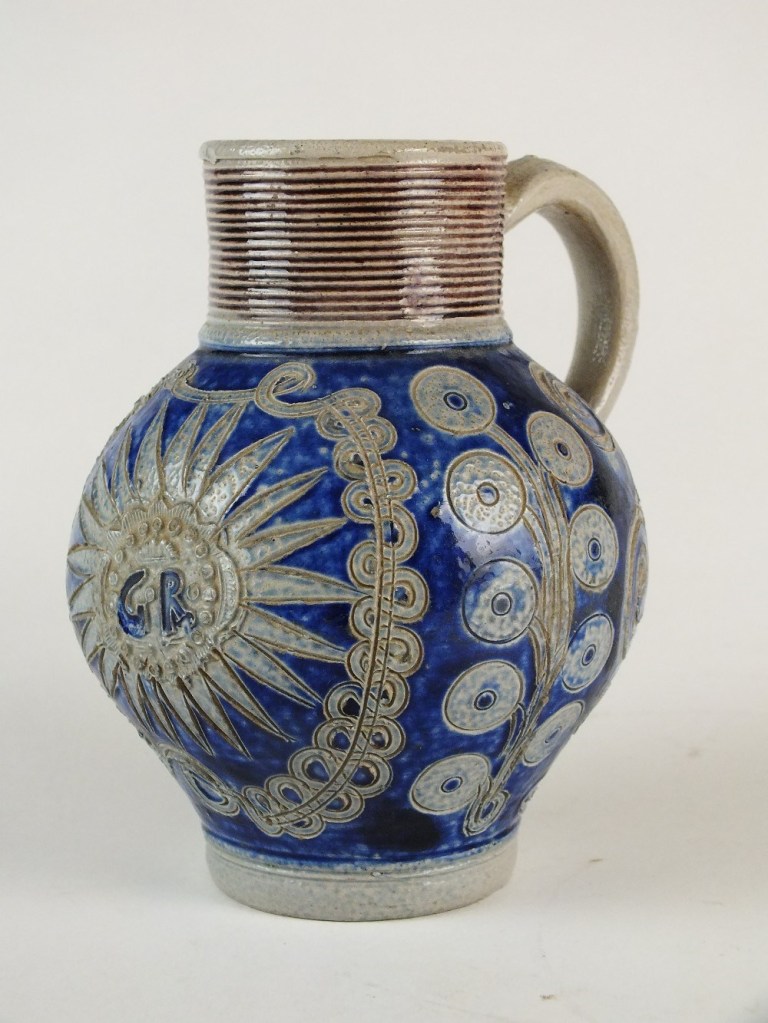
Lovely jug of Westerwald from this website – it sold at auction for a surprisingly cheap £150
Incised decoration, cobalt blue highlights, applied medallions and other decoration, it is often difficult to tell apart. However, Westerwald seems to be bigger somehow, less delicate… and at the risk of offending our German cousins, more Teutonic. There also seems to be a greater use of cobalt decoration, and the background stoneware is darker in many circumstances.
And there the matter shall have to rest until I can find some Westerwald sherds to discuss at greater length (I might have to get a mudlarks license and head down to London and poke about on the Thames foreshore).
Right, I think that’s enough pottery for now – next time we’ll look at some fine earthernwares… you lucky folk.
Now, someone recently asked me if I could put links to all the previous Pottery Guides at the bottom of the post, so they can use it quickly to find out what they have… well here you are:
Part 1 – Marmalade Jars and Brown Stoneware (Nottingham and Derbyshire)
Part 7 – 17th Century Slipwares, Manganese Glazed, and Yellow Ware
Enjoy, or not, as you wish.
Right, that’s all for now.
In other news, the Glossop Big Dig results are forthcoming… slowly. If any of you have any bags that need handing in, please do so, and I’ll get the results up asap.
Other other news is the ‘zine – Where/When – The Journal of Archaeological Wanderings – which is just about ready to go off to the printers. You will soon be able to buy a physical copy of a guided walk I did a while back, filled with historical musings and observations (and a sprinkling of pottery, obviously). It’s an experiment of sorts – we’ll see how it sells and whether I can make my costs back, but I’ve got about 6 more walks ready to go, and I’d like each one to be in the ‘zine. It will be full colour, 40 pages, fully illustrated, and should be retailing for £6, but watch this space.
The front cover of the first edition – hopefully ready within a week or two, and available to order via the Where / When button at the top.
If any of you out there have either suggestions for walks, or would like to publish one yourself, do get in contact. More news on this soon.
Until then, look after yourselves and each other, and I remain.
What ho, gentle readers! I trust you are all well in these trying times?
I’ve been wanting to make this post for a while, but I’ve only recently got round to doing the research. And my, it is a fascinating story of a turbulent period of history, and of a person who is much less well known than he ought to be – Glossop’s own almost saint, the Blessed Nicholas Garlick. Why I say ‘almostsaint‘ will become apparent, but here is a man who died a martyr, is venerated as such within the Roman Catholic Church, and yet – outside of St Mary’s Roman Catholic church here – he is little known about in Glossop. So, exactly 433 years to the day after his brutal death, read on.
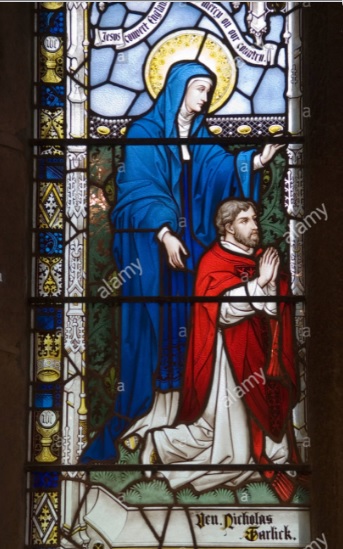
The Blessed Nicholas Garlick. This stained glass window is in the Lady Chapel of St Mary’s RC Church, in Derby.
Nicholas Garlick was born in about 1555 in Dinting, specifically in the hamlet now known as Higher Dinting, here:
The hamlet of Dinting as it was, one of the original settlements that made up Glossop.
Dinting is one of the oldest parts of Glossop. It is mentioned in the Domesday Book (I discussed it in a previous post – here), and I find it fascinating that somebody has lived on this very spot for at least 1000 years. The original Robert Hamnett notes that the Garlicks are an old family in the area, and the isolated hamlet was their home until relatively recently. Indeed, it is still quite a common surname in the Glossop area, and would seem to be chiefly associated with this part of the world.
The hamlet of Dinting, nestled into Mouselow.
Dinting closer up. Surviving 17th and 18th century buildings cluster round this distinct place, far removed from what think of as Dinting – essentially the arches and the railway station.
Garlick was clearly an intelligent man and went to Oxford University, entering Gloucester Hall (now Worcester College) in January 1575. However, he lasted only 6 months at Oxford, and never graduated. Given what we know of his later actions, it is likely that he refused to take the Oath of Supremacy – something as a student he would be required to do – and was therefore dismissed. The Oath of Supremacy meant swearing acknowledgment that the monarch (Elizabeth I at the time) was Supreme Governor of the Church of England – something that a devout Roman Catholic simply couldn’t do, as he would have recognised only the Pope as the head of the Church. And here is the rub; Nicholas was a Roman Catholic in a time when Roman Catholics were mercilessly persecuted.
From 1533 onwards, Henry VIII’s ministers, led by the king himself, systematically dismantled the Roman Catholic faith in Britain, and replaced it with Protestant Christianity in the form of Anglicanism, and the Church of England. This was forced on the people, often against their will and under great duress, and much of what they had believed in prior to this was now declared ‘wrong’. I think it is difficult to overstate the effect that this would have on people, as the fundamentals of their religious world, that shaped their lives and structured their year, were upturned. Even simple things such as Mass now being celebrated in English, not Latin, or that praying for souls in purgatory, often loved ones, was pointless because there was no longer a purgatory. What was the simple man or woman to make of that? By the time Nicholas was born it was theoretically possible to be a practicing Roman Catholic, although you were known as a ‘recusant’ (somebody who refuses, in this case refuses to attend Anglican services), and were subject to heavy fines and social stigmatisation. However, the celebration of Mass in Roman Catholicism requires a priest, and both were expressly forbidden under pain of death.
After leaving Oxford he moved to Tideswell, near Buxton, and became a school master at the Bishop Robert Pursglove’s Grammar School for a number of years (the school was founded in 1560, and the later 18th century incarnation of the building still stands).
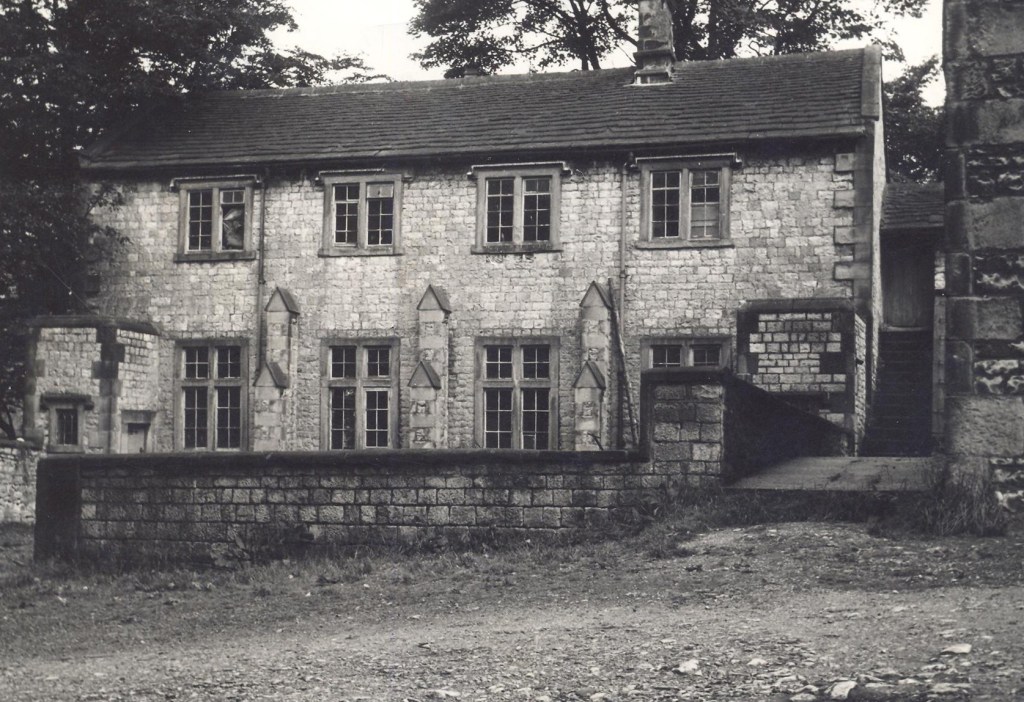
Tideswell Grammar School as it is now – a later 18th century building replacing the 1560 Elizabethan one.
His Catholic faith was clearly strong at this time, as three of his pupils later became priests, and one, Christopher Buxton, was himself executed for his faith.
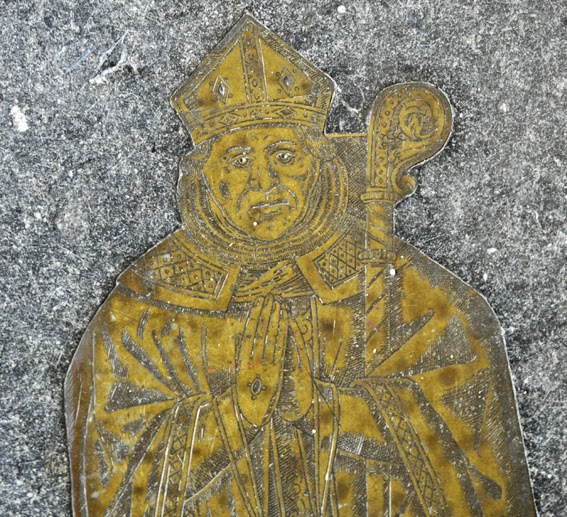
This is odd, though. Teaching of even a hint of Roman Catholic doctrine was expressly illegal, and could have landed Garlick a death sentence. So what’s going on? I dug around a bit, and it seems that Bishop Robert Pursglove who founded the school, and who employed Garlick, was an interesting character. A native of Tideswell, he was born in 1504, and later became a priest, then prior, then bishop. He seems to have swayed with the to-ing and fro-ing of the Reformation from Catholic to Protestant, and back again… and again. But, a little further research shows that he too refused to take the Oath of Supremacy on multiple occasions (something noted as highly suspect at the time), and an official Queen’s Council report of him records that he is “stiff in Papistry”, essentially he was clinging to the old religion, rather than embracing the new. He also enthusiastically embraced Queen Mary’s reintroduction of Roman Catholicism, becoming prebend of Southwell Minster, Nottinghamshire, during her reign. In addition, his memorial brass in Tideswell Church shows him in Roman Catholic Bishop’s dress, something that was also expressly forbidden by Elizabeth I.
Bishop Pursglove as a Roman Catholic bishop. The image is stolen from Distant Thoughts blog – written by a chap called Pursglove, and is an interesting read. Check out his mystery plate post, too. I’m dying to know more…
Pursglove also had strong connection with many recusant families in the area, some of whom were friends and relatives. North Derbyshire was known at the time as an area of strong recusancy, in particular in the area around Tideswell, and focussed on several local families – the Pegges, the Eyres, the Hunlokes, the Poles, and perhaps most important of all, the FitzHerberts. It seems, then, that the good Bishop played a significant role in that, even allowing distinctly Catholic teaching in his school. All this is speculative, of course, but the evidence does add up – Pursglove was probably a recusant Catholic. The fact that he was never investigated, arrested, or even publicly chastised, despite playing fast and lose with the rules, suggests he enjoyed a measure of protection, but I really don’t understand how. This too might explain Garlick’s next move. Bishop Pursglove died in May 1580, and on 22nd June 1581, Garlick enters the English College at Rheims in France. We might speculate that the death of Pursglove, and the loss of the protection he gave, forced Garlick to leave Tideswell, and probably hastily.
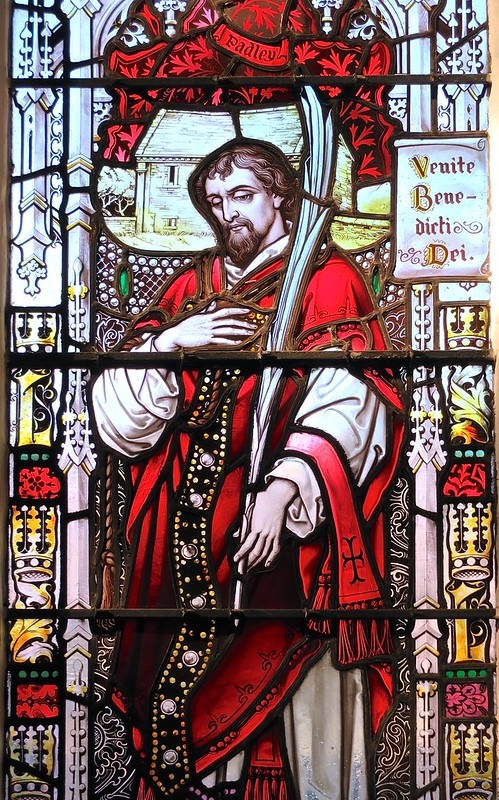
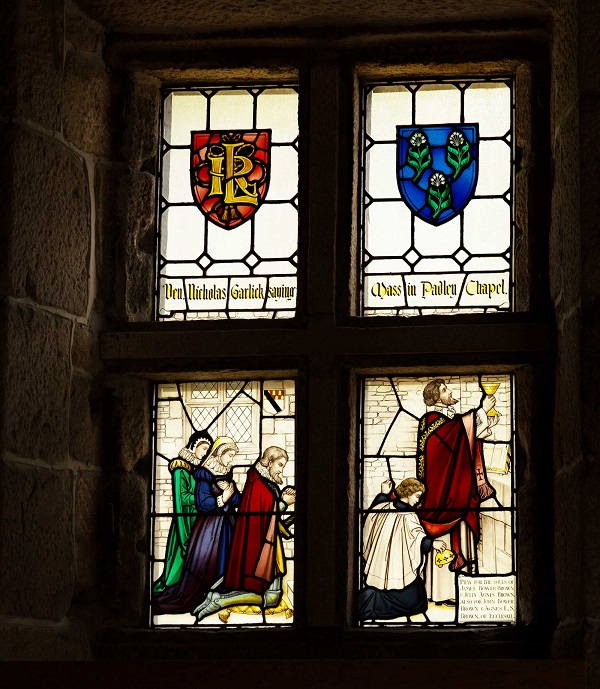
Garlick at prayer, Padley Chapel.
The English College was founded by exiled English Roman Catholic priests with the purpose of allowing English priests in training to continue their studies. But it also produced missionary priests who were to enter England covertly, minister to existing Catholics and attempt re-conversion of the country. This was what Nicholas trained to do, and he was ordained as a priest in March 1582, leaving for England as a missionary on 25th January 1583.
We know very little of his whereabouts until 1585 when he is caught, arrested, and banished, with the knowledge that if he is caught again he will be executed, as ministering as a priest was at the time a treasonable offence. The reason for this was simple – priests swear an oath of fealty to the Pope as head of the Church, and the papacy was at the time actively supporting France and Spain in their aggressions against England, and was actively seeking the conversion of the country back to Catholicism (indeed, Pope Sixtus V gave his blessing to the Spanish Armada as a crusade against the English). Garlick arrived back in Rheims on 17th October 1585, and two days later he headed back to England.
Once again his whereabouts are unclear, but a spy’s report of 16th September 1586 notes that he “laboureth with diligence in Hampshire and Dorsetshire”, and he crops up in Derbyshire in a government list of recusants in March 1588. He is clearly doing his duty, and is ministering to the needs of recusant Catholics in the area, and it this that is his undoing.
We have to remember that this is the time of Priest’s Holes: priests come to the houses of recusant Catholics and stay for periods of time, acting as a priest to the family and others nearby. However, there are significant networks of spies on the lookout for just such activity, so it all has to be done in secret, and if the officials come knocking, the priest has to be hidden in a Priest’s Hole. If they are caught the whole family would suffer, and the priest would be executed. Horrifically.
On the 12th July 1588 Garlick, and another priest was staying with the Catholic FitzHerbert family in Padley Hall, Padley, about 8 miles from Tideswell. The FitzHerberts were a well known and powerful recusant Catholic family, and whilst they carefully towed the legal line, they steadfastly refused to give up their faith, and this made them a huge target on the hit list of the authorities.
And the worst happened.
Garlick saying mass at the private chapel in Padley Hall. From the stained glass of Padley Chapel.
The sequence of events was actually set in motion by two individuals: Richard Topcliffe, and Thomas FitzHerbert, the son of John FitzHerbert of Padley Hall. Topcliffe was a Catholic catcher par excellence, who liked nothing more than to arrest, torture, and brutalise recusant Catholics and priests – he was, quite simply, a psychopath who enjoyed his work, and was allowed to do so by the authorities. He also had a personal vendetta against the FitzHerbert family. Thomas FitzHerbert on the other hand was seemingly an ambitious, cold-blooded, and immature moron who could think of nothing more than his inheritance. Between them, they came up with a plan that FitzHerbert would pay Topcliffe £3000 if he prosecuted to death his father (John), uncle (Sir Thomas), and cousin (William Basset) in order that Thomas would inherit the estate of Sir Thomas.
It was Thomas’s tip off that sent George Talbot, Earl of Shrewsbury, to arrest his father, and it was Nicholas Garlick’s bad luck to be at Padley Hall when he arrived. The priests, along with John FitzHerbert, his son Anthony, three of his daughters – Jane, Maud, and Mary – and ten servants were all arrested, and the whole party was transferred to jail in Derby. Another Glossop connection here is that George Talbot, Earl of Shrewsbury, was also the lord of Glossop – hence Talbot Road, Talbot Street, and Shrewsbury Street.
The arrest of Nicholas Garlick – from the stained glass of Padley Chapel.
On the 23rd July 1588, the priests were tried for High Treason, and for coming into the kingdom and “seducing” the Queen’s subjects. Garlick’s response was “I have not come to seduce, but to induce men to the Catholic faith. For this end have I come to the country, and for this will I work as long as I live“. Not the best defence, and he was inevitably found guilty. Garlick, along with Ludlam, and another priest, Richard Simpson, was sentenced to be hanged, drawn and quartered:
“That you and each of you be carried to the place from whence you came, and from thence be drawn on a hurdle to the place of execution, and be there severally hanged, but cut down while you are alive; that your privy members be cut off; that your bowels be taken out and burnt before your faces; that your heads be severed from your bodies; that your bodies be divided into four-quarters, and that your quarters be at the Queen’s disposal; and the Lord have mercy on your souls.”.
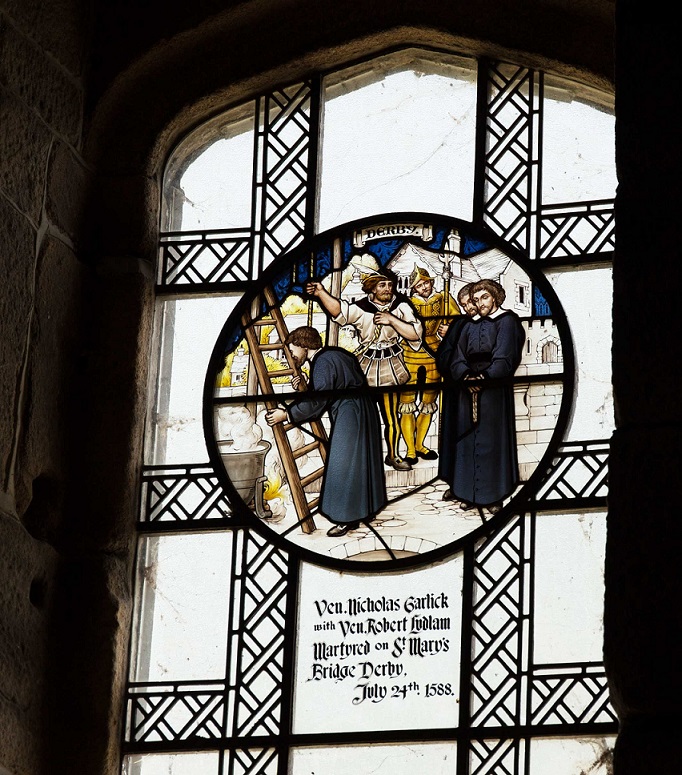
The sentence was carried out the next day, 24th July 1588. The three priests were taken to St Mary’s Bridge in Derby, with Garlick joking and making merry as they went, even reminiscing with a passer-by about the days they went shooting together, remarking that he was about to “shoot off such a shot as I never shot in all my life“. However, it seems that the local authorities were not well versed in this sort of execution, and the cauldron to be used for the burning of the condemned’s entrails was not hot enough, so there was a delay. Garlick, ever the priest, used this delay to deliver a final sermon, ending by throwing into the crowd religious texts extolling the virtue of the Roman Catholic faith; tradition states that everyone who read the texts were converted. At last, the time came. Simpson was to be executed first, but Garlick moved to the ladder ahead of him, and kissing it, calmly went to that most brutal of deaths. A further calamity occurred – he was hanged for a short time, but as he was taken down from the gallows to be disemboweled, it was noticed that he was still wearing his doublet, and by the time it was removed he was fully conscious and awake, alert to what was happening to him.
Garlick kissing the ladders to the execution platform. Again, from the stained glass of Padley Chapel.
The sentence duly carried out, the heads and quartered body parts of the three priests were put on spikes and displayed on the bridge and elsewhere around Derby, and then tarred and distributed.
Chapel of St Mary on the Bridge, Derby – here he was executed, and his head spiked on the bridge, the remains of which can be seen underneath and attached to the chapel. From here.
It is entirely likely that, given his birth and familial connection with Glossop, one part or another of his worldly remains would have been displayed here, and probably at the market cross in Old Glossop. A sobering thought. Another local legend records that the body parts were removed, and that Garlick’s head was buried at Tideswell church.
An anonymous poem written probably by someone who was a witness to the horrific scene runs thus:
When Garlick did the ladder kiss, And Sympson after hie, Methought that there St. Andrew was Desirous for to die.
When Ludlam lookèd smilingly, And joyful did remain, It seemed St. Stephen was standing by, For to be stoned again.
And what if Sympson seemed to yield, For doubt and dread to die; He rose again, and won the field And died most constantly.
His watching, fasting, shirt of hair; His speech, his death, and all, Do record give, do witness bear, He wailed his former fall.
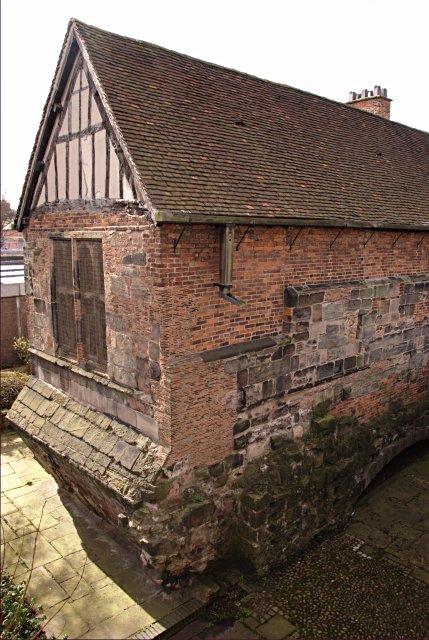
In 1888, the two Padley Martyrs, as they became known, were given the title ‘Venerable’ by the church – this means they have been declared a ‘servant of God‘, and that they had ‘heroic virtue‘ – essentially the recognition of one’s life work, as well as one’s death. This led to the creation of an annual pilgrimage to Padley Chapel – the converted former gatehouse of the now ruined Padley Hall.
Commemorative card and medal printed and minted following the 1888 declaration of the title ‘Venerable’.
There would have been a private chapel in the hall, and it is suggested that this was in the upper part of the gatehouse. In 1934 the original 16th century altar stone was discovered buried in the garden where it had been hidden by the FitzHerberts prior to their arrest, and would have been the original one that Nichols would have used to celebrate Mass; it now forms the altar in the chapel there.
The altar at Padley Chapel, complete with original stone.
Then, on 22nd November 1987, Nicholas Garlick was Beatified by Pope John Paul II. This is a significant event, and is one of the necessary steps on the road to being declared a saint; if the Church confirms a miracle through his intercession, then he will officially be declared Saint Nicholas of Dinting. Whatever your personal beliefs, it is quite a journey from Dinting to the right hand of God.
Family Hamnett recently visited the chapel and ruined hall – it’s remarkable what is still standing and can be seen, and it’s a wonderful romantic ruin, set in lovely walking country, and with an astonishing, if grim, history:
Padley Chapel, originally the gatehouse to Padley Hall. And a standing stone, too – probably a track marker rather than a prehistoric stone.
The north western range, containing the great hall. There are three doors in front of us – left into the great hall with the huge fireplace behind, right into an ante-room, and middle up a spiral staircase, the base of which can be seen. Look how worn the door steps are.
Close up of the spiral staircase base. Fanstastic!
Master Hamnett exploring the ruined fireplace. It’s huge!
There are lots of medieval tracery and carved bits lying around – some have been incorporated into a wall, but others can be seen.
I also found a Victorian John Smith’s of Tadcaster beer bottle in a wall, which was a nice bonus!
A photograph of a reconstruction of Padley Hall, shamelessly taken from the Time Travellers’ website – they seem to be a good bunch of archaeological types, so go check them out, especially if you live near Sheffield.
The whole place is amazing, and well worth a visit.
If you are interested in this period of history, I cannot recommend highly enough The Stripping Of The Altars by Eamon Duffy – it studies both the state of Catholic religion in England prior to the Reformation, as well as the sweeping and catastrophic changes that occur during and after. Have a look on Amazon, but please make sure you buy it at Bay Tree Books on High Street West in Glossop. An added bonus is that it might be me that sells it to you.
Another view of Nicholas Garlick. Here he is pictured holding a knife in the traditional style of portraying saints holding the method of their martyrdom. This one from the Lady Chapel of St Mary’s Church, Derby (via this website)
I hope you enjoyed this slightly longer than usual post, and unusual subject matter. More pottery next time. What do you mean, “no, please no, spare us the pottery“? I can hear you, you know. Honestly, the nerve of some people. More soon, but until then look after yourselves and each other, and as always, I remain.
Welcome, welcome, one and all. I hope you are all well, and that in these uncertain times you are staying safe as we stumble towards something approaching real life. Today’s post does something I try not to do very often: it strays from Glossopdale and Longdendale. Don’t panic however, we’re still in Derbyshire. Marple Bridge to be specific. And there may be a link to Mottram, so there’s that. And quite frankly this story is just too good to miss.
I was looking through some online sources a while back, specifically the ones posted on the North West Derbyshire Sources website. There’s all kinds of interesting primary historical sources published there – censuses, trade catalogues, personal recollections, etc. and all of them are for this area – Glossop, Charlesworth, Hadfield, Hayfield – it’s well worth checking out, a truly award-winning website. One of the sources for Charlesworth is the diary of a certain George Booth, dated between 1832 and 1834. The diary is not perhaps what you would describe as the most riveting record of life in a small village; typical entries are very short, personal, and along the lines of “Today and yesterday I have been building a wall as a spur against the weir” (April 11th 1832) and “Daniel Thorneley’s wife died today” (April 28 1832), but these are recorded history, and for this it is invaluable. Certainly, the wall against the weir isn’t important in the grand scheme of history, but it provides us with the date and a personal record of who built it, and why – and these are surely the aims of all historical and archaeological inquiry? And it is these little snapshots – who built what wall, who moved house where, crimes committed, the price of pork, and tales of fire, flood, and cholera – that escape the archaeological record, making the diary an invaluable source. Here, read it for yourself, you won’t regret it.
And of course, although it is Charlesworth/Chisworth based, Mr Booth wanders all over the area, to Glossop, Gamesley, Chinley, Marple Bridge, Broadbottom, and beyond. It was one of these entries that caught my eye:
3rd May 1832
A Stone to commemorate Matlock’s Leap was fastened in the wall by the river side a little above Marple Bridge on the Derbyshire side, on this occasion there was a Mare [Mayor] chosen (I suppose the first Mare there ever was at Marple Bridge of this sort) and a regular Mare’s Walk consisting of the Mare (John Kirk) and a great many of the neighbouring Gentlemen after the walk the partook of a good Dinner at one of the Inns. which was paid for out of a subscription raised for that purpose this took place last Easter Monday.
So what was Matlock’s Leap? And why was it so important that it required a stone and a slap up meal to celebrate it, and particularly on a bank holiday Easter Monday (it would have been held on 23rd April 1832), and at the same time as choosing a mayor? Clearly it was so familiar to George Booth that it required no further explanation – it is almost a throwaway comment. And yet, the phrase “Matlock’s Leap” typed into Google provides just one relevant hit. It turns out that whilst the mystery was relatively easily solved, it is nonetheless quite a tale, and there may be yet more to be uncovered.
The single reference to the ‘leap’ is in ‘Cheshire Notes and Queries‘. This Victorian weekly periodical allowed readers to post questions of a historical or literary nature, and others to answer these questions, or to post some historical research they had undertaken. They are an absolute mine of folklore, history, archaeology, gossip, rumour, and all round fascinating stuff, and the Cheshire version is published online by the archive.org project – you can read it by following the link above (alas, the ‘Derbyshire and Nottinghamshire’ volumes have not yet been digitised). Here’s what was printed:
30th March 1889
About fifty years ago I recollect seeing a tablet in the wall, about twenty yards from the bridge, on the Derbyshire side, with the words Matlock’s Leap, and I think the date was upon it. I recollect being told at the time that it had been placed there by the landlord, Mr James Boulton, who, at that time kept the Norfolk Arms Inn, to commemorate a miraculous escape that a man named Matlock had one dark night. This man was in the Norfolk Arms, and he was suspected of having committed some depredation, and he was told the constable was at hand, when he immediately ran out of the house, ran across the road, and jumped over the wall down into the river, which I should think is here about forty feet perpendicular. I was told the man was not hurt. His friends got a ladder and got him up again all right. I have noticed that the tablet referred to has been removed from the wall where it was fixed. I shall be glad if any of your readers can tell me why and where it has gone.
Ashton-under-Lyne. I. W. B.
Now this was interesting.
Firstly, Matlock’s Leap was a thing… which is a relief. So Matlock was a person, and the leap was one over a wall and 40ft into the river Goyt… and he lived. Blimey! But also here is a wealth of detail. The tablet commemorating the event had evidently disappeared by 1889, but at least we know where it was – about here, to be exact:
About 20 yards down from the Norfolk Arms. No sign of the “stone” or “tablet”, alas.
I looked, and could see no sign of where the stone would have been fixed, and looking along, it seems to me that the whole of the wall has been replaced at some stage post-1832 – it looks Victorian, rather than Georgian, and it may have been then that the stone was removed.
The wonderful Norfolk Arms.The view of the Norfolk Arms from the place where Matlock jumped into the Goyt.This photo, taken from the bridge, shows the place where the leap took place – roughly 20 yards from the Norfolk Arms – is just about where the kink in the wall is. That’s 40ft if it’s an inch. I am certain, though, that the wall has been rebuilt since the 1830’s, and it may be that the riverbed has altered. Even so, that’s a hell of a jump!The same stretch of the river viewed directly down from the bank. Here is where Matlock landed in the river. I would love to doubt this, but all the evidence points to it being a real event.
Presumably, given the Norfolk Arms was the location of the leap, and that the landlord had put the tablet up, the pub was also the location of the slap up meal mentioned by George Booth. I was also intrigued by the ‘depredation‘ of which Matlock was accused.
DEPREDATION. noun. The act or an instance of plundering; robbery; pillage
That’s an oddly specific word… what did he do?
Two weeks after the above query was published, a comprehensive answer was given, one which reveals the whole story – it’s easier to reproduce the whole thing:
13th April 1889
MATLOCK’S LEAP.
In reply to your correspondent who asks about Matlock’s Leap, I may say that I do not profess to give anything I know personally, but I recently accidentally met a friend who lived at Marple when a youth, now he is over 70 years of age, and he told me a few matters he remembers about it. His first recollection of Matlock was before the “leap” had taken place, but he had often heard of “burkers,” “body snatchers,” and “resurrection men,” and was no little alarmed when he was told that these men stole dead bodies from churchyards for the doctors, and that the doctors made physic out of them which caused physic to taste “so bad.” One day, quite 60 years ago, my friend went to the Horse Shoe Inn for his father, who was indulging rather unduly to the neglect of his business. When he got there he found his parent in conversation with a man, and the father wishing to let the lad know who he was, contrived to whisper to him, and said, “that is Matlock; he is a burker, fetches dead people out of church yards at nights.” This was so strongly impressed on his youthful mind that he remembers it yet quite distinctly.
With regard to the stone that formerly marked the place of Matlock’s leap, my friend informed me that a present alderman of Stockport told him on one day that he last saw it in Compstall Gardens when they were kept by Mr Calab Warhurst.
The wide-awake “burker” had received a commission from a local practitioner, who, to tell the truth, was a most successful doctor, to supply him with a subject to operate on. And one night when the doctor was very busy in his surgery with patients, in walked Matlock with a bag on his back. The wily doctor did not wish to enter into any conversation or explanation with the “burker,” or seem negligent with his patients by leaving them to attend to him, so he simply gave him a well understood motion to go on through the surgery, which he did, and shortly returned, the doctor giving him five shillings, with which instalment he left the place. But, lo! when the doctor went to examine his bargain, he found that his hitherto trusty agent had hoaxed him, for instead of a corpse the bag was filled with lumber. So much my informant can vouch for, to which rumour adds – and, with a knowing nod, my friend says it was so – that the doctor was not only very clever in his medical profession, but also of much more robust build, and more capable of self-defence than was his tricky agent; and that when he next met with the ”burker” he give him a sufficient fisticuff chastisement. After this reconciliation and better understanding was entered into between then, and their friendship and business engagements were resumed from time to time as it suited their various purposes.
A short account that I have had from another source about the immediate cause of the leap, may be of interest to some of your readers. On the day I read your last issue and saw the account of Matlock’s leap, I met with a person who resides not far from the place, so, in a jocular manner, I said to him, “Do you know anything about Matlock’s leap and the resurrectioning case?” He replied “Yes,” and added, “and you will be surprised when I tell you whose body it was. Then he told me that the grave had been watched fop seven nights for fear that some one should come and snatch a body which he said was that of a large stout man that had been buried in Mellor Churchyard, in the year 1831, and after watching the grave for so long, the family and friends thought there would not then be any attempt made to take the body, but on the eight night it was ‘snatched’ or taken away, and a week after the coffin was found in a lime hole in the neighbourhood” and, he continued, “I have a cousin now living at Hazel Grove who was one of the watchers, and the body was that of my father.” The informant was only six weeks old when this occurred, so of course only knows what he has been told, perhaps chiefly by his own family.
I will conclude with a short account of the leap as it has been told to me by my elder informant who was living on the spot at the time. One night a number of men of the village were at the Norfolk Arms, and were bent on having a lark. It had been agreed that there should be a tap-room trial of Matlock for the ” snatching ” of this body. A judge was appointed, a jury was empanneled, and Matlock was on his trial; when matters were at their height, one, Dick (Richard) Middleton, a plumber and glazier, went into the room and said to Matlock “the constable is after you d_____l “. Now, just what was expected, happened. Matlock was startled, and rushed out of the house; it had been planned that a number of men should be outside – on the right side of the house, and a like number on the left side – so that whichever way he went they were to pretend to try and catch him. He first ran up the bridge and was met, and a scuffle took place, from which he was permitted to escape, and ran to try the other way; here again he was met by another gang and again there was a scuffle, without any serious attempt to secure him, for that, too early accomplished, would have spoiled their sport ; but he saw the two crowds meeting together, and himself hemmed in between them and in such close quarters, and having only time to think of the judge and jury in the house, the crowd on the right hand and the crowd on the left, in a sort of despair, he took the terrible leap into the river, as stated by your correspondent. This is correct in the main. If any little error of detail is seen by anyone who may be better informed, perhaps they will be kind enough to correct it.
H.H. Stockport.
Well, there we have the full story… Matlock was a bodysnatcher. Blimey!
Prior to 1832 only the bodies of people executed could be cut up and examined anatomically, it was actually a part of their punishment. There was, then, a serious shortage of cadavers with which to teach anatomy, which in turn meant that doctors, and in particular surgeons, often had little experience in the reality of the human body and how it worked. In order to address this, an illegal trade in corpses was started, in which criminals – ‘resurrectionists’ – dug up the newly buried, and removed them to be sold to doctors, surgeons, and medical schools. Seemingly few questions were asked, and from a rational and medical perspective, this made sense – the dead are dead, but they can in turn help the living. Ethically and morally, however, the trade left a little to be desired, and the public at large, as well as grieving widows and parents in particular, were outraged. As the ‘trade’ reached fever pitch in the 1820’s and 30’s, watch groups were set up to keep a watch over newly buried bodies to ensure they got their eternal rest.
Matlock must have been connected to a certain Captain Seller and his gang of ressurectionists based in Cocker Hill, Stalybridge; their fascinating story is told on the Cocker Hill website here and in this Facebook post here (well worth a read). It seems the gang were active in the Hollingworth area as well, so Marple and Mellor are but a cart ride away. Bodies were dug up by the gang and spirited away to Stalybridge, where they were transported via canal to Manchester. However, the Peak Forest Canal actually passes through Marple Bridge on the Cheshire side, so the journey from Mellor church (mentioned in H. H.‘s answer above) would be easier to make.
Might we suggest, then, that he was also connected to the taking of bodies from Mottram Church? Famously the churchyard of Mottram St. Michael and All Angels is the home of the empty grave of 15 year old Lewis Brierley, whose corpse was stolen in 1827. His grieving father displayed the empty coffin at the Crown Pole at Mottram, opposite what was once the White Hart pub (now being converted to houses), giving the eulogy that was later inscribed on the gravestone above the empty grave:
Tho’ once beneath the ground his corpse was laid For use of surgeons it was thence convey’d. Vain was the scheme to hide the impious theft The body taken, shroud and coffin left. Ye wretches who pursue this barb’rous trade Your corpses in turn may be convey’d Like his to some unfeeling surgeons room Nor can they justly meet a better doom.
In memory of Lewis, son of James and Mary Brierley of Valley Mill, who died October 3rd 1827 in the 15th year of his age
The father apparently kept the coffin and was eventually himself buried in it. The gravestone, complete with inscription, is to be found to the north of the church.
The gravestone. My thanks to the wonderful Sandra Teasdale who took this photo and sent it to me after I failed to find it despite stumbling around the graveyard for an afternoon. Not that I’m bitter.
The proximity of Mottram to Stalybridge, and the fact that it is unlikely that there was more than one group active in the area, suggests strongly that Matlock was indeed connected. I’d like to return to this subject at some stage in the future, as I find it fascinating, if a little grim.
In 1832 parliament passed the Anatomy Act, which effectively ended the trade by allowing any unclaimed body to be anatomised, and from then on poorhouses in particular supplied the surgeons with their dissection corpses in great numbers.
So where is the stone now? The above letter by ‘H.H.’ of Stockport suggests it was last seen in Compstall Gardens sometime prior to 1889 (when they were kept by a Calab Warhurst). I presume that this refers to the pub once known as The Compstall Gardens Inn and the “private recreation and dancing grounds” that were attached to the pub – here, for example. These are still attached to the pub, which is now known as The Spring Gardens, and are shown here on the 1898 OS map.
Compstall Gardens, now The Spring Gardens. The pub is marked PH, and the formal gardens are visible. For orientation, the Windsor Castle pub (PH) and Glossop Road are at the bottomThe Spring Gardens on Compstall Road. A photograph taken from Google streetview, because it is so much better than the photograph I took.
And here the matter must rest, alas… the trail went cold. I emailed the Spring Gardens asking if they had any information about the stone’s whereabouts, but sadly to date I have not heard anything back. I will pop in for a pint (or two) when lockdown ends and make an enquiries then, but I am not holding out hope. Even the wonderful Marple Local History Society people had no information about it (my thanks to Hilary Atkinson for her help). It was most likely lost or made into part of a patio, which is a shame as this little slice of history is no longer widely known about.
So there we have it, a tale of improbable escapes and graverobbing. If I find anything more about the stone or the graverobbing, I’ll let you all know. In the meantime, stay safe and look after yourselves and each other, and until then I remain,