Bench Marks · Stones of Glossop · Towns of Glossop

A Bevy of Boundary Stones

Ho! Ho! And if I might dare, What Ho! A shortish one today, and actually one that is something of a relief, if I’m honest. Like the last post, this one has been years in the making, but this time for all the wrong reasons… all will become clear in a moment, but for now let’s crack on.

As the title suggests boundaries are today’s topic, apt as we hurtle to the Winter Solstice and the shortest day – that anciently observed boundary between the old year and the new. Boundaries such as these are often held to be dangerous places as they are a liminal space – neither one thing nor another, but somewhere in between. However, boundary stones in particular I find fascinating and strangely appealing objects; there is something very grounding about them in that they mark in a clear, permanent, and fixed way, an imaginary line. On one side ‘X’ and on the other ‘Y’, and there is no argument – the somewhat liminal boundary is made visible and real, and so it is the case with our stones today – three stones placed on bridges over various waterways delineating the townships that make up Glossop

All three, it seems, were carved and installed at the same time, and all are quite old – early Victorian. The first of the stones is the easiest found – Victoria Bridge in the centre of Glossop.

Bount
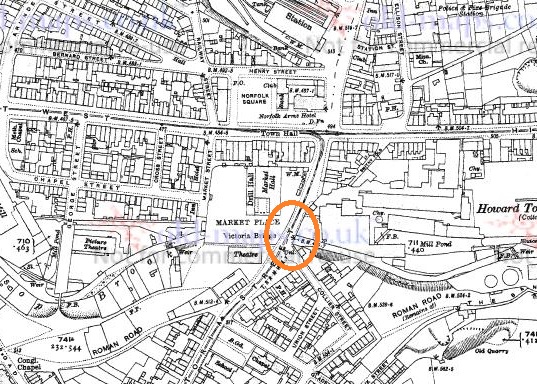
Station at the top, above the High Street crossroads. The bridge over Glossop Brook, and the stone, is circled in orange. Glossop is north of the Brook, Whitfield is south. 

And here it is in real life.

Boundary St
Victoria Bridge. Wetherspoons is in the background, and Glossop Brook runs beneath.

The bridge, and the stone, stand over Glossop Brook, which disappears under the market place and carpark, and the line carved between the words Glossop and Whitfield is the centre line of the brook below. Victoria Bridge was built in 1837, the year Queen Victoria ascended the throne, hence the name. This new bridge replaced an old and narrow hump-backed pack-saddle one. Indeed, the original line of the road that led over the bridge, down Smithy Fold, and along Ellison Street is traceable, and is preserved particularly in the buildings of the Brook Tavern, Cafeteria, Glossop Pizza, Balti Palace (all built in 1832). I have a blog post almost finished that looks at this area in more detail, so I won’t go into it here.

Looking closely, the inscription “Victoria Bridge” and the date “1837” are in a different font and slightly larger than the other lettering on the stone, and are more cramped, and it seems they were added at a later date. Indeed, compare this stone to the one below, and you can see they both once looked the same. 

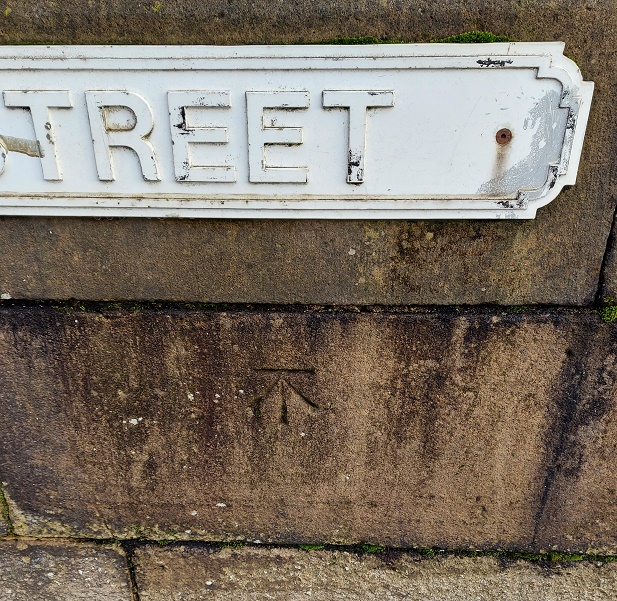
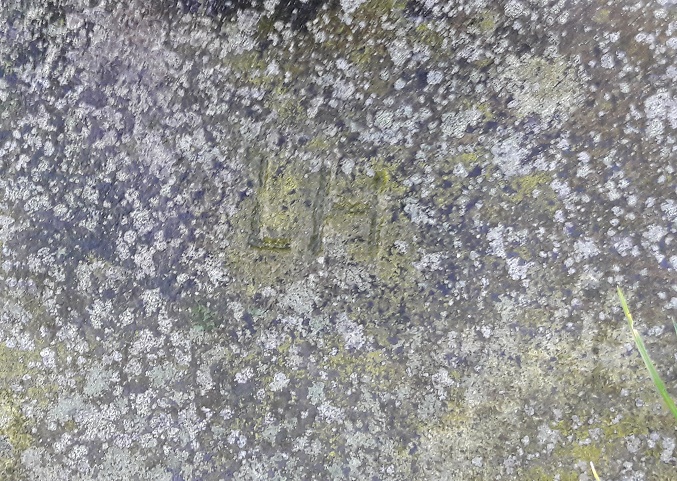
And of course, it wouldn’t be the Glossop Cabinet of Curiosities without a bench mark, this one on the bridge and just to the left of the boundary stone. 

Victoria Bridge
This is what 495.7 ft above sea level looks like.

The next stone is to be found on Charlestown Road, on a bridge over Long Clough Brook – it’s very much a blink and you’ll miss it kind of affair, even if you are walking. 

Bounty
Turnlee and Charlestown Roads join at the top, with the boundary stone circled in orange.
bound3
Here is the bridge over Long Clough Brook on Charlestown Road. The stone is visible.
bound1
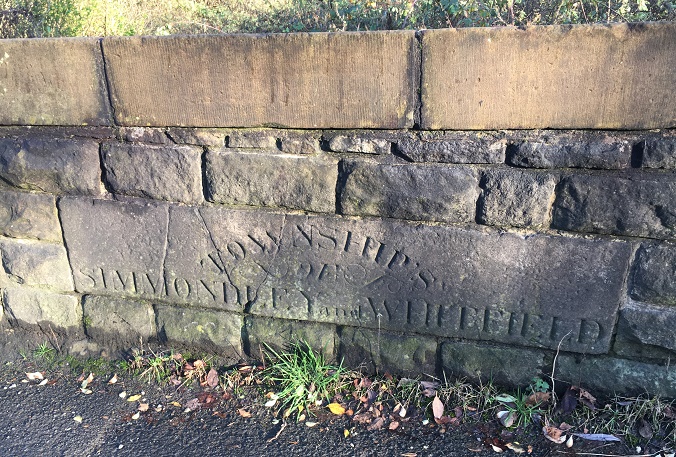
Here it is in close-up. Can you spot a mistake?

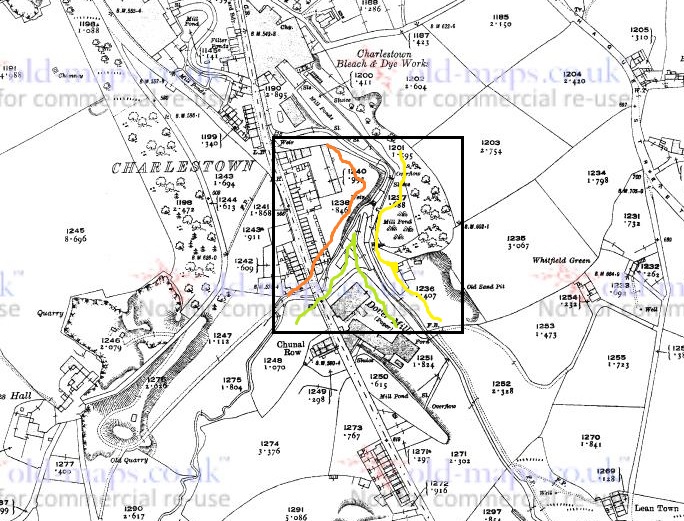
This stone follows the same formula as the Victoria Bridge stone, but is slightly rougher in execution. It seems to have been reset into a rebuilt stone wall at some stage, as it doesn’t really match the coarse  surface of the stone around it, and this resetting might explain the cracking. It also has an inexcusable mistake… there’s a bloody apostrophe after ‘township’! It should read ‘TOWNSHIPS’, the plural of township, but instead it reads that ‘Township’ owns something called an ‘of Simmondley and Whitfield’! Also, although it states that this is the boundary between Simmondley and Whitfield, it technically isn’t. This is the border between Chunal and Simmondley, but it seems that for administrative purposes, Chunal and Whitfield were often lumped together. The confluence of Bray Clough (from Gnat Hole) and Long Clough Brook (just east of the boundary bridge) is actually the meeting of the three townships of Chunal, Simmondley, and Whitfield, here:  

bounty2
The three townships illustrated at the junction of Bray Clough Brook and Long Clough Brook. Chunal in green, Simmondley in red, and Whitfield in yellow.

So far, so good.

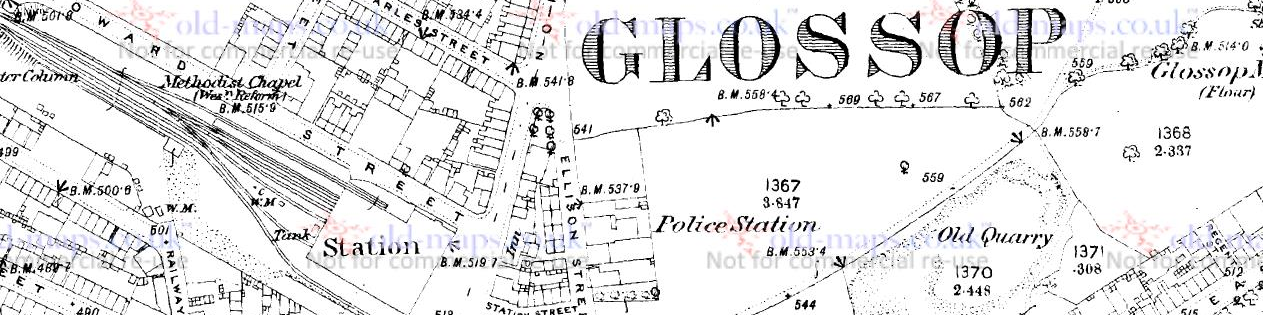
Now, the third and final stone was a bit more of a mystery. According to Neville Sharp (Glossop Remembered p.184 – a great book, by the way, well worth seeking out – here for example, but order it from Bay Tree Books on the High Street, of course), a stone similar to the one on Victoria Bridge stood on the bridge over Hurst Brook which forms the north eastern boundary between Glossop and Whitfield. That is until it was washed away in a flash flood.

Bound4
High Street East at the top, with Derbyshire Level running from the Royal Oak off the map at the bottom. The word stone on the bridge over Hurst Brook is circled.

Then, whilst doing some research, I came across a reference to the stone and made a note in my notebook that until at least 1977 the stone stood next to the entrance to Golf Course. Annoyingly, I didn’t take down the reference and it’s taken me 3 years to track down the source of the information. Three years! Such is the level of detail and dedication I devote to this blog in order that you, gentle reader, can revel in such a fascinating subject as “bits of old plate” as it was once described by the person who runs the ‘Official Glossop‘ twitter account. Honestly, the nerve of some people…

So I re-found the source – this website – and blow me if it didn’t have a link to photographs of the stone taken in 1977:

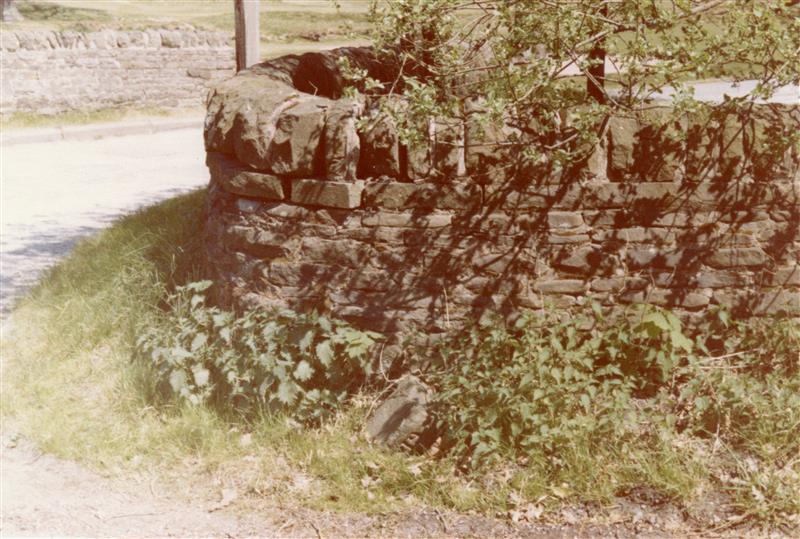
Boundary Stone 1 (1977)
Entrance to the golf course on Derbyshire Level, the boundary stone bottom centre, in the glorious sunshine of the summer of 1977


Boundary Stone 2 (1977)
Close up of the boundary stone with part of the word ‘Glossop’ visible. Please note that I don’t have the copyright to these photographs, and make no claim to such, they are merely ‘borrowed’ from the above site.

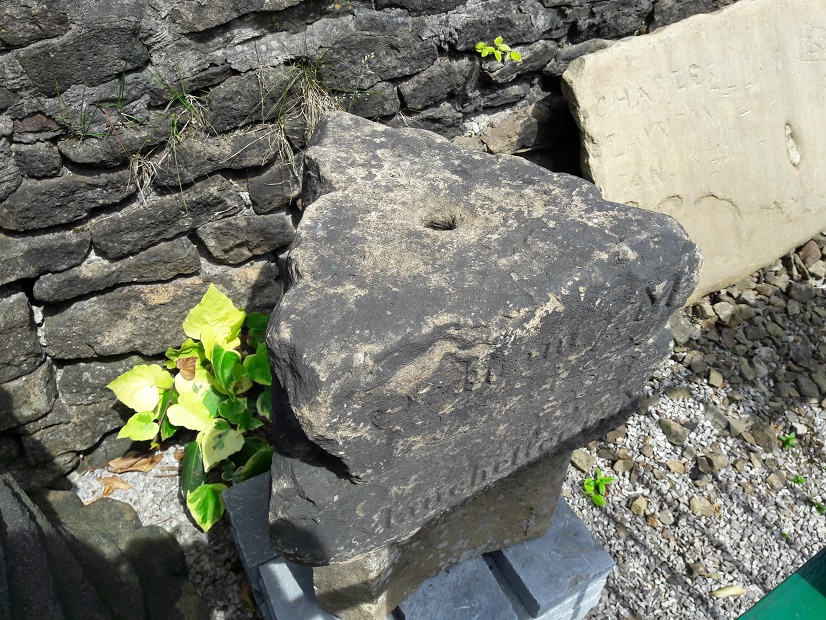
The stone was presumably recovered, in its broken state, and set up on the side of the Golf Club entrance, and whilst it doesn’t look like there is a lot left I went to have a look.

Boundary St1
The same view as the first photograph above, missing the important piece.

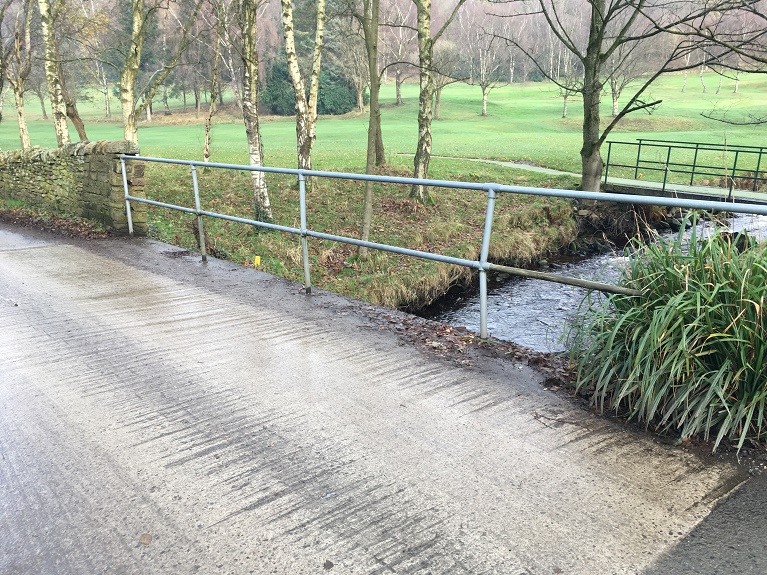
Alas… the stone is no longer there. I had a good look around at all the stones that might be a possibility, but to no avail. I suspect that someone has taken it – it was a nice piece of stone after all, but it is a shame. All is not negative, though, and from the 1977 photograph we might suggest where it originally stood; the fact that the fragmentary word ‘Glossop’ is visible at the left hand end of the stone means that it could only have stood at the eastern side of the bridge, closest the golf course, for it to make geographic sense – Glossop is north, Whitfield is south at this point. Here, in fact:

bound2
Here. You can see the modern(ish) bridge that must have replaced the one that was washed away. Here, Hurst Brook separates Whitfield (right) from Glossop (left).

Its fragmentary nature also suggests that more of it lies in the stream bed – I had a look, but couldn’t see any likely stones, but perhaps next summer I’ll have a poke around. 

Right ho, that’s all for this time. Hope you enjoyed a ramble around the boundaries, and in fact I am writing a blog post that actually covers the boundaries of medieval Glossopdale based on a 13th century perambulation. I’d also like to do another that looks at the boundaries of all 10 townships of Glossop as they are in the Domesday Book, which could be a bit of fun. ‘Could‘ being the operative word here. And ‘fun‘ being an entirely subjective concept, I realise. But you, kind and gentle people, know what I mean… after all, you’re reading this. Please drop me any thoughts or hints, even to point out my mistakes, or the fact that I need a haircut. Take care of yourselves and each other, have a very merry Christmas, and until next time, I remain.

Your humble servant, 

RH

Archaeology · Pottery · Whitfield

Bits of Pot and Some Updates

Mrs Hamnett complains that going for a walk with me is difficult – apparently I’m like a dog, running about looking for things. We’ll be walking along, talking, and I’ll disappear into a hedgeback or ditch, pulling out a bit of pot or stone, and leaving her talking to herself. Master Hamnett has now adopted the custom, and he regularly finds bits of pottery that he hands to me, looking very pleased with himself. This leaves small piles of pottery around the place, which get cleaned and put into bags with the intention of sharing them with you, gentle reader. And as you know, intention and actually doing are two widely different things – I’m going to have “well, I was going to, but what happened was…” carved on my headstone.

Well, not today. Today I do! I am seizing the day, grasping the nettle, taking the bull by the horns, striking whilst the iron is hot, and a host of other tired cliches. Today is a pot  and other bits day… but first a cup of tea.

Right, that’s better! Off we go.

A few months ago I posted this, a toy soldier fund by Master Hamnett at the Spencer Masonic Hall/Sunday School at the top of Whitfield Avenue. Well, we went back recently, and blow me… we found some more.

Pot 2
Bizarre, and slightly creepy. I love these things.

Bizarre. I can only think that someone was using this as a place to play with their soldiers, and then lost them. As I said before, these were my childhood (I still have them). From right to left: a 1:32 scale Airfix British Commando (mid 1970’s to, well, now in date). Then we have a copy of a 1:32 scale Airfix British 8th Army Desert Rat; it says ‘Made in Hong Kong’ on the bottom, which dates it to pre-1997, when Hong Kong became Chinese. Then there is the lower half of Marvel’s Iron Man, which has the date 2005 on the base. I suppose these are technically ‘rubbish’, being deposited only in the last few years, but I reasoned that if I picked up a Victorian child’s marble, then why not these too. If you recognise them, and want them back, give me a message. Above the toys is a squashed thimble, again probably of relatively recent vintage.

Some other bits and pieces found in the grounds:

M17
Other bits and pieces from the grounds of the Masonic Hall

From the top down, then. Randomly, fragments of a clay pigeon – which begs more questions than it answers. This is definitely rubbish, and will be going straight in the bin, but I thought I’d post it in the interests of completion. Below that, a copper roofing nail – Victorian or early 20th Century, and clearly from the roof of the building, dropped during a re-roofing, perhaps – I love these things, and have blogged about them previously. Below that, an ‘L-Headed’ machine cut wrought iron nail – probably used for flooring, and perhaps Victorian.

Continuing the revisit of that post, here is some more pottery from the area:

M1
A small haul, and nothing too spectacular.

Some odds and ends. Top row, from left, then: the bottom of a jar of some sort – earthernware, and with the letters ‘A’ and ‘D’ impressed on the bottom. It’s possible this is ‘MARMALADE’, as it’s the right type of jar, but I don’t think it’s an ‘L’ before the letters.  ‘M[AD]E IN ENGLAND’, perhaps? Next a saucer, then a black glazed open vessel, and then the chunky handle of a jug or similar, but certainly not a tea cup, the handles of which were delicate in the Victorian period, which is when all of this pottery dates from. Bottom row from left: a creamware jug, and from the curve of the sherd, this the rim of the spout; early Victorian, at a guess. Next, the base of an open bowl, then the interior shoulder of soup bowl, the base of a plate (complete with knife mark scratched into the glaze), and then the shoulder and neck of a small saltglazed stoneware bottle. Originally, it looked like this one, probably an ink bottle, and which has roughly the same dimensions:

M2
A stoneware bottle which, incidentally, I found in a Victorian tip in Broadbottom.

Next up, we have some interesting new bits from below Lean Town, picked up whilst I was waiting for Master Hamnett to finish at the excellent Inside Out Forest School in Gnat Hole Woods, not too far from Nat Nutter, as it happens.

Lent
Some very nice bits here. Oi! You there! Not you, you! Stop sighing… I can hear you muttering under your breath you know, it is not a “pile of old crap”. Honestly, the nerve of some people.

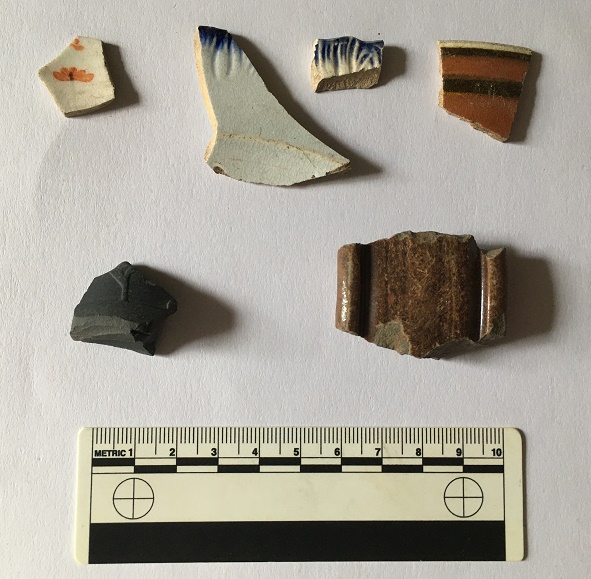
Top row: sherd of earthernware with painted orange flowers, which I thought looked nice. Then we have two different shell-edge ware vessels decorated a blue scalloped edge. The one on the right is the earlier, being made between 1780 and 1810, whilst the sherd on the left was made between 1800 and 1830. Then a sherd of annular or banded ware – the decoration looks very 1950’s to modern, but this stuff – usually in blue (there is an example below) – actually starts being made in the 1790’s. This one is Victorian. Second row on the left, a base sherd from a basalt stone ware bowl, roughly 1780-1830-ish, It’s a lovely example, very thin walled and with the bottom of an acanthus leaf or something coming up from the bottom. They were heavily influenced by Classical pottery, and it looks Roman orAncient Greek from a distance, but was in fact made by Josiah Wedgewood’s factory in Staffordshire. Then we have the handle to a monstrous stone ware jug or storage jar, and although it looks almost medieval, it probably came from a Victorian water jug or something. Following on from the mega post about Lean Town I’ll add this lot to the bag of bits, and I’m sure more will wash out over winter.

Moving on, we have a rim sherd of a pancheon and another sherd picked up from a path that leads from Bankswood Park in Hadfield to Mouselow.

Pann
Big chunky rim – I love these things.

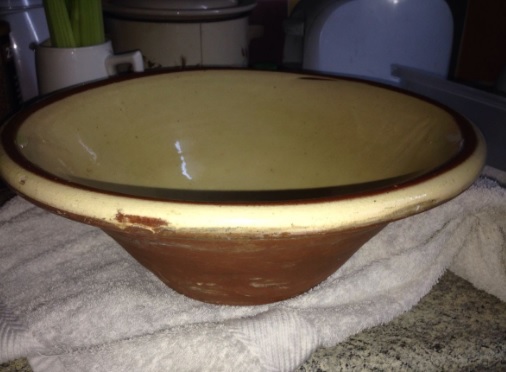
The smaller sherd is a from a cup or bowl with blue horizontal stripes on a white background – more annular or banded ware from the Victorian period. The larger sherd is part of the rim from a large pancheon – essentially a large mixing bowl that most kitchens in the 18th and 19th centuries would have had (I talked about them here). What looks like a yellow glaze is actually a clear glaze over a white slip – you can just about see it on the edges. Below is what it would have looked like, although this example is later and much smaller, the rim sherd suggesting a vessel 70+ cm in diameter.

Pan
A Victorian pancheon yesterday.

The path crosses another track which originally ran from Cemetery Road to Shaw, along what would become Shaw Lane, before it was bisected by the building of the railway.

ShM
1898 1:2500 OS map, courtesy of old-maps.co.uk

The lane actually skirts the edge of the Iron Age hillfort, and parts of it are preserved in footpaths and tracks, but I don’t want to get into this here, as it is a topic of another post. However, here are some photos of Shaw Lane as it crosses Mouse Low – the above pot fragment was found at this junction with the footpath, marked in red on the map.

ShSW
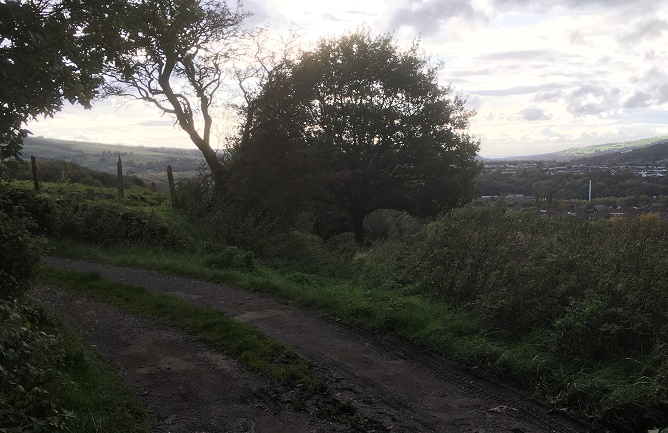
Overgrown and unused, this was Shaw Lane looking South West. In case you can’t see it, it’s the sunken road bit to the left of the tree in the centre of the photo. Apologies for the darkness.
ShNE
Shaw Lane looking North East. I need to explore this track – it looks so appealing!

Next we have a small collection of bits from the bottom of Cross Cliffe, along the road edge and by the track there. Nothing earth shattering, but a good selection.

CroPo
A good selection of bits, and a clay pipe!

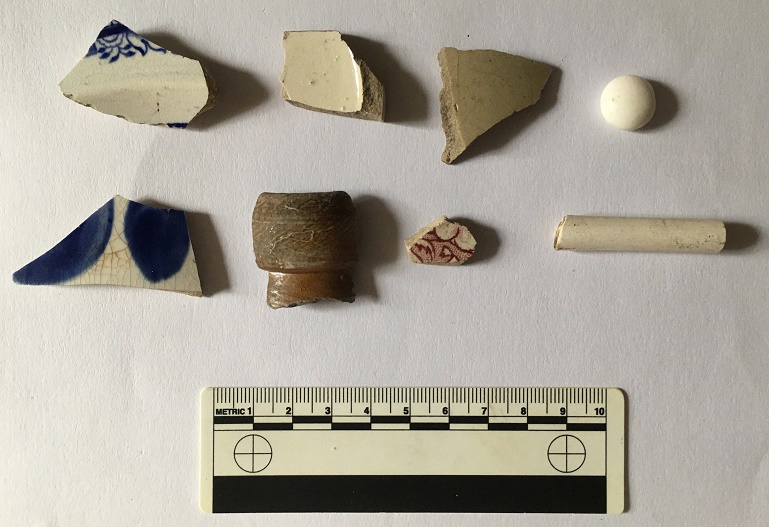
Top row, from the left: a fairly substantial transfer printed soup bowl roughly 20cm in diameter; the base to a ceramic marmalade or preserve jar of about 10cm in diameter; a stoneware sherd from a storage jar of about 16cm in diameter. The thing that looks like a mint is either a button or the end to a hat pin, and is made from alabaster. Next row: sherd from a large jug or similar, with large hand-painted flowers on the exterior; rim of a stone ware ginger ale or lemonade bottle, with the very characteristic brown salt glazed surface; a fragment of willow pattern transfer-printed plate, and a stem of a clay pipe with, alas, no maker’s name, but some nice paring marks.

Ok, so this is turning into a far larger post than I had anticipated, and I’m going to draw a line under it for now – nobody, not even you, you wonderful and attentive people, wants to read a wall of text. Expect Part II either next time, or sometime in the future

So, to end with, for now at least, two superb examples of Glossop bricks, a gift from our equally superb neighbours (hello Helen and Sarah).

Pot 3
I love these things – simple and mundane, and literally stamped with their place of origin.

I don’t know a great deal about these bricks, but a future blog post might delve deeper. The company was based at Mouselow, with the clay extracted from nearby. It seems to have been founded in the 1920’s by a John Greenwood, and continued until the 1980’s. Somewhere in the garden I also have Glossop brick with both Greenwood’s name and Glossop printed on it – perhaps this was an earlier brick? There is some information on this website, but I can definitely feel a blog post coming on.

Bricks are so mundane, and yet so fascinating, and useful archaeological dating material too. And once they begin stamping the maker’s name into the frog (the dipped bit in the middle) – sometime around the mid-Victorian period – they become individual, too. I stumbled across this website the other day – a gigantic collection of photographs of bricks with the names showing, and all alphabetised; this is what the internet excels at, the dissemination of knowledge that would otherwise be inaccessible, and it is truly magnificent. I look upon these bricks with envy, but silent and certain in the knowledge of one single fact: were I to start a ‘brick collection’ Mrs Hamnett would forcibly and violently eject me from the marital home. I would be a single and homeless (and brickless) man again before you could say “now wait, dash it all”. No, she puts up with quite enough as it is, so this injustice and pain is a weight I must bear with quiet resignation. However, if someone does have a spare shed, you can contact me in the usual way…

Right, that’s your lot! And it is a lot… too much, in fact! The question of “what am I going to with it all” never really occurs to me, and beyond the obvious “put it on the blog” I have no idea. I’m going to have a clearout soon, and get rid of the more boring bits and pieces – the plain white china, etc. and bury them somewhere for future archaeologists to ponder over. In fact, I was going to do it last week, but what happened was…

More soon, but until then, take care of yourselves and each other.

And I remain, as always, your humble servant.

RH

Domesday Book · Placenames · Towns of Glossop

What’s In A Name?

The thought occurred to me after publishing the previous blog post – what do the names of each of the manors of Longdendale mean? And I thought you, gentle reader, might also be interested.

I find placenames endlessly fascinating, and there is something magical about the origin of a name, whether traced back in the prehistoric period (‘Celtic’ placenames) or of a more recent coinage (Victoria Street, for example, named after Victoria Wood, of course…). Moreover, once you name a place it becomes familiar, and less scary, allowing you to find your place within, and manoeuvre your way through, the landscape. It is also a fundamental aspect of human behaviour: by naming the land, you are taming the land.

We have a huge number of influences in placenames in this area: Celtic, Saxon, Norse (Viking), Norman French, vernacular and slang English, and Welsh, to name a few. All of which mix together to create the landscape, and the places within, we know so well.

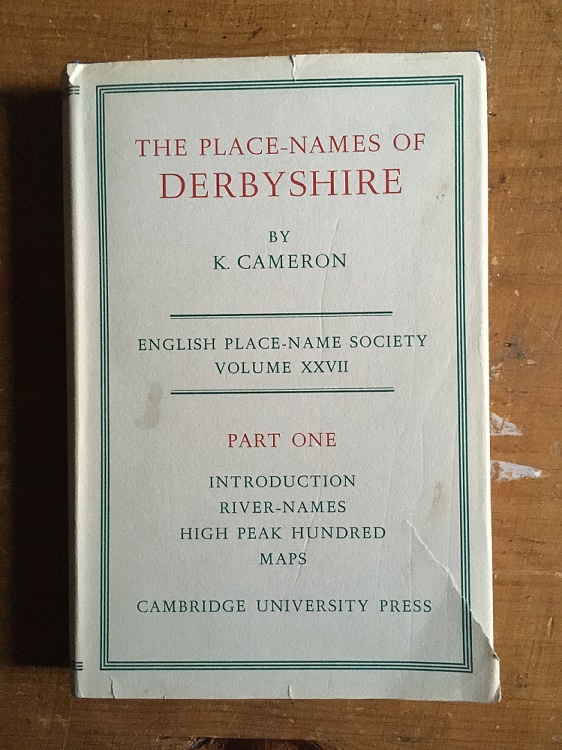
So then, using the 3 volume set of The Place-Names of Derbyshire by Kenneth Cameron, and some other sources, I set about finding out.

Names2
It may not appeal to everyone, but honestly this is absolutely fascinating book, if flawed due to the large number of placenames, field names, brook names, etc. that have been omitted.  

  • Longdendale

First mentioned in Domesday Book of 1086 as Langedenedele, then Langdundale (1158), and Langdaladala (1161). This is a classic example of a tautology, caused by the naming of a place by someone who didn’t understand the original name. The origin is Lang Denu, ‘the long valley’, to which at some stage someone added the unnecessary ‘Dael‘, meaning ‘valley’ – thus Longdendale means ‘the long valley valley’.

  • Glossop

First mentioned in Domesday as ‘Glosop’. The Book of Fees of 1219 records it as ‘Glotsop’, and in 1285 it is given as Glosshope. Cameron gives the etymology as Glott’s Hop – Glott’s Valley – The valley (Hop – think Hope, as in Hope Valley) belonging to a man named Glott. Relatively straightforward then. Probably. Other theories are available. Mike Harding, the folk singer, thinks Glott should be read as ‘Gloat’, in which case it is the ‘Valley of the Gloater or Starer’, a reference to the numerous carved stone heads that were, and still are, relatively commonly found in the area (a subject of much debate, and a future blog post). This seems a little too convenient and smacks of mystical wishful thinking, but is still worth considering. It is also a possibility that ‘Glos’ is a derivation of the Welsh ‘Glwys’, meaning silver or grey, in which case it would mean ‘Valley of the Stream called Glwys”, which presumably would be Glossop Brook. Ultimately, I am going to go for Cameron’s ‘Glott’s Valley’ as I think it makes more sense.

  • Charlesworth

First recorded in 1086 in the Domesday Book as Cheuenwrde, then as Chavelesworth (1285), Chasseworth (1285), and Challesworth (1552). The meaning is either ‘Ceafl’s enclosure‘, the enclosure (worth) belonging to a person called Ceafl, or ‘Ceafl enclosure‘, which would mean ‘the enclosure near the ravine (ceafl)’. This might conceivably refer to the valley of the Etherow, particularly as it nears Broadbottom, but it is unclear. On balance, I prefer the simple ‘the enclosure (worth) belonging to a person called Ceafl’.

  • Chisworth

First recorded in 1086 in the Domesday Book as Chiswerde, then as Chisteworthe (1285), Chesseworth (1285), and Chesworth (1634). The meaning is simple – ‘Cissa’s enclosure’, the enclosure (worth) belonging to a person called Cissa.

  • Hayfield

First recorded in 1086 in the Domesday Book as Hedfelt (the same as that at Hadfield below), then Heyfeld (1285), Heathfeld (1577), and Magna Heyfeld (1584 – as opposed to Little Hayfield). Cameron discusses the possibility that there is some confusion regarding this name. In the Domesday Book the meaning is ‘Haed Feld’ – ‘heathy open land’, but the later, Middle English, forms seem to suggest ‘the field where hay is obtained’. Actually, I would suggest that two aren’t incompatible as land use may have changed over the course of 300 years – it is no longer heathy, and instead is more, well, hay-y.

  • Chunal

First recorded in 1086 in the Domesday Book as Ceohal, then as Chelhala in 1185, and Cholhal in 1309. The origin is Ceola Halh, which means either the ‘the neck of land belonging to a person called Ceola’ or ‘the neck of land by the ravine’. I personally favour the latter, with the ravine here being Long Clough Brook.

  • Whitfield

First recorded in 1086 in the Domesday Book at Witfelt, then as Wytfeld (1282), Whitefeld (1283) and Whytfelde (1294) in various Inquiries Post Mortem. It is also recorded as Qwytfeld in a land deed of 1424 pertaining to one John del Boure (Bower) of Qwytfeld. The meaning is ‘Hwit Feld‘ – open (figuratively ‘white’) land or field, presumably to differentiate it from the surrounding moorland.

  • Hadfield

Relatively straightforward, this one. First recorded in 1086 as Hetfelt, and later as Haddefeld (in 1185), Hadesfeld (in 1263), and Hettefeld (in 1331), it is derived from ‘Haed Feld’, meaning ‘heathy open land’ – literally, a heath field.

  • Padfield

Also relatively straightforward. It is first recorded in the Domesday book of 1086 as Padefeld, and in 1185 as Paddefeld. It means either the ‘open land (feld) belonging to a person called Padda‘, or an ‘open land where the toads live’, from the Old English ‘Padda‘ meaning toad. I like toads and frogs so I’m going with that, but you decide as you see fit.

  • Dinting

This one is more difficult. First recorded in the Domesday Book of 1086 as Dentinc, and then Dintyng in 1226, and Dontyng in 1285. It is also almost certainly the Dontingclought (Dinting Clough or Dinting Vale, as we now know it) mentioned in the Forest Proceedings of 1285. However, the meaning of this name is difficult to uncover. Cameron suggests that the first part of the word “Dint” is Celtic in origin, but can offer no meaning for the word. The second part ‘ing‘ is commonly encountered, but is complicated as it has many possibilities in its meaning. Here, it either means the ‘place of the Dint‘ (whatever Dint means), or it denotes an association of a person to the place or feature, so here it would be ‘Person X’s Dint‘ (again, whatever Dint means). The other (original… real) Robert Hamnett suggests that the name is made up of two elements – the Celtic word ‘Din‘ meaning ‘camp’, and the Norse ‘Ding‘, meaning ‘council’, thus it means the ‘council camp’, or a place where people meet to discuss law and other matters. Perhaps then we have our meaning – ‘the camp belonging to person x‘, or the ‘place of the camp‘. This latter may well be more likely, given that Dinting as we know it is at the foot of Mouselow Iron Age hillfort.

  • Kinder

This one is similarly difficult to pin down. First recorded as Chendre in the Domesday Book, then Kunder in 1299, Kynder and Kyndyr variously in the 13th and 14th centuries, and Chynder in 1555. Cameron suggests the name is “pre-English”, that is pre-Saxon and thus probably Celtic. He offer no explanation for its origin, as the “material is not adequate for any certain etymology”, alas. Still, the fact that the name is essentially Iron Age in origin is quite important.

  • Thornsett

First recorded in 1086 in the Domesday Book as Tornesete, then as Thorneshete (1285), Tharset (1577) and Thorsett (1695). The meaning is very straightforward – Thorn Tree Pasture.

  • Ludworth

First recorded in 1086 in the Domesday Book as Lodeuorth, then as Ludeworda (1185), Loddeworth (1285), and Luddeworthe (1330). The meaning is very simple – Luda’s Enclosure, the enclosure (worth) belonging to a person called Luda.

That concludes the 12 manors of Longdendale. However, I thought I’d also include Simmondley – even though it’s not one of the original 12, it is one of the towns that make up Glossop as we now know it. Plus, I know people who live there and don’t want them to feel left out.

  • Simmondley

First mentioned in the Forest Proceedings of 1285 as ‘Simundesleg‘, and then later as Simondeslee, the origin of the name is “the clearing (or ley/legh) in the forest belonging to a man named Sigemund or Sigmundr (an Old English or Scandinavian [Viking] name) – Sigemund’s Legh = Simmondley.

And there you have it.

Names1
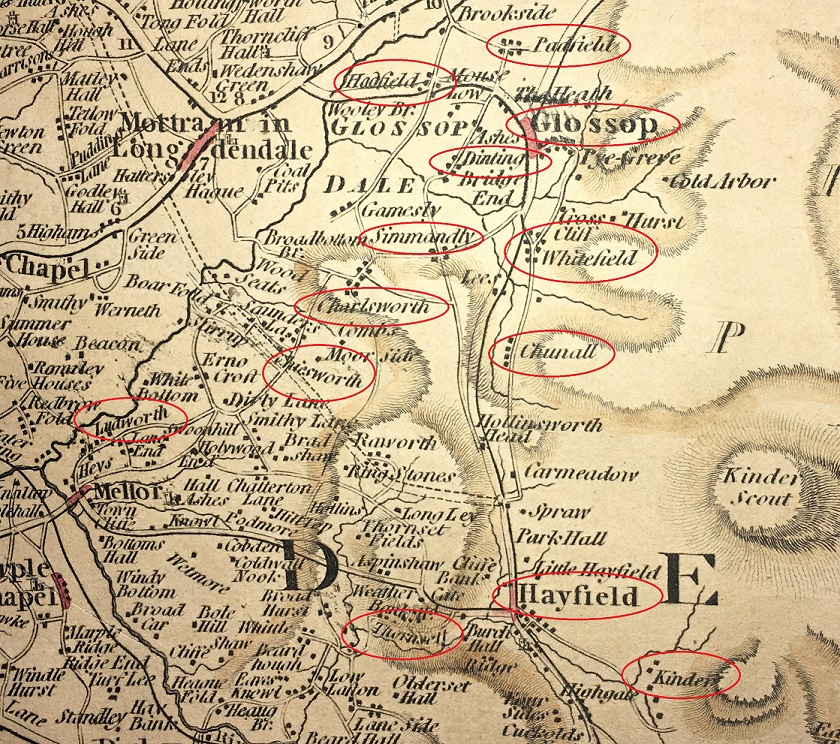
Here are the 13 (+1) placenames discussed above, illustrated here on a 1794 map.

Well that was fun! I’d like to do some more exploring of names the area; we have a rich tapestry of placenames in England, brought to us from hundreds of different sources, and recorded in countless documents, maps, letters, deeds, books, and memories, and this area seems to be richer than others. So if you enjoyed this, then watch this space. As always comments, questions, offers to buy me a drink, are all welcome.

And as always, I remain,

Your humble servant,

RH

Whitfield Cross

Whitfield Cross – Sort of Update

A brief blog today…

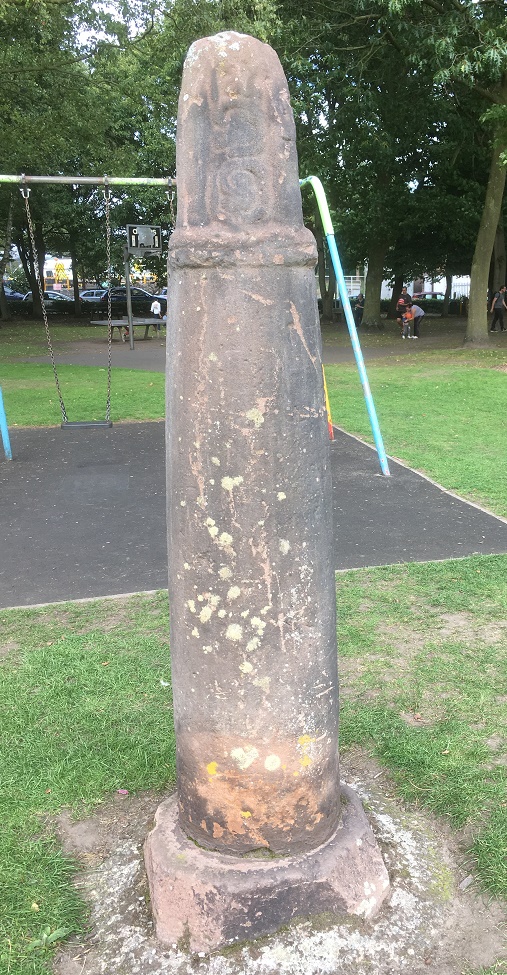
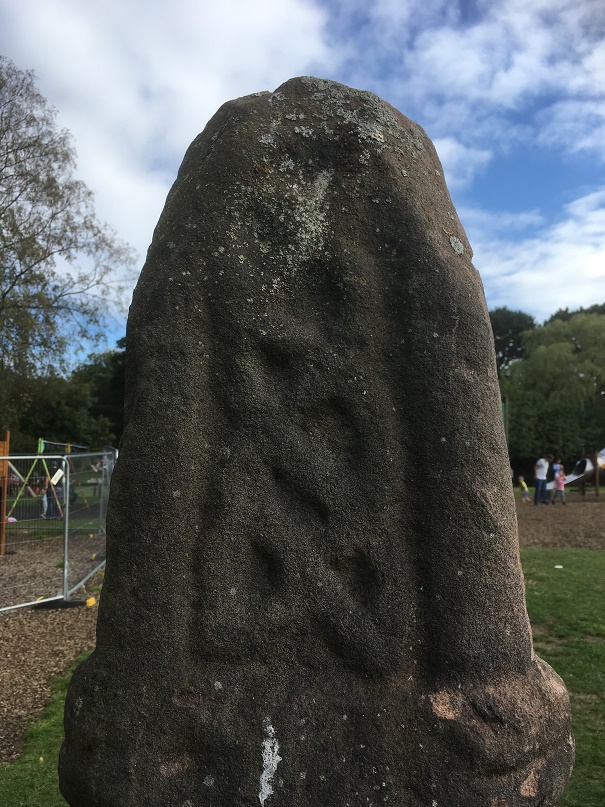
Mrs Hamnett, Master Hamnett, and myself found ourselves passing through Macclesfield a few weeks ago. So I took the opportunity to visit the three splendid Mercian Round Shaft crosses that were erected in West Park there. I had tentatively suggested that one of them was a dead ringer for Whitfield Cross, and in a slightly better state of preservation. Definitely worth a closer look, and, of course, Master Hamnett was pleased as it means he got to go to the park.

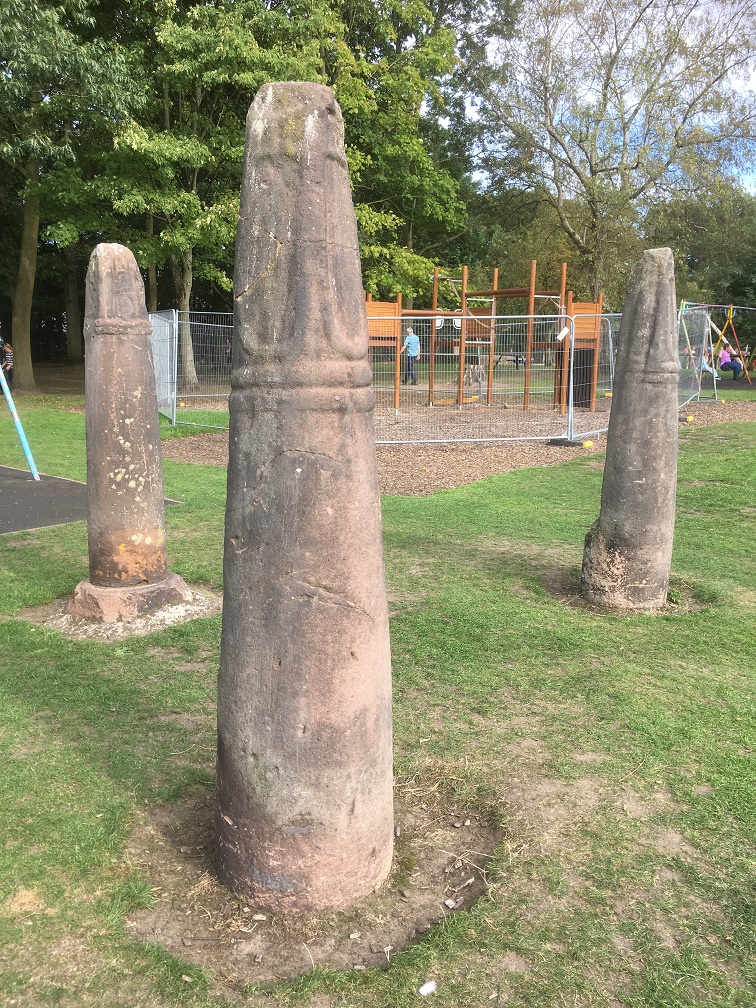
The three cross shafts are located in the middle of the play area, and impossible to miss.

macc 1
The Macclesfield Crosses, situated in the excellent West Park in town centre.

They were originally sited together at Ridge Hall Farm in Sutton (about a mile south of Macclesfield – here). Two of them were being used as gateposts, with iron and lead fixings carved into the stone, and the third was in a pile of rubbish. Their importance recognised, they were promptly moved to West Park, arriving there on 7th January 1858. Interestingly, Ridge Hall Farm was originally a moated farmhouse of medieval date – the remains of the moat can be seen in the aerial photograph above, circling the farm at the south and west.

Now, although the crosses were ‘found’ together, I don’t think that the farm was their original site, and it is likely that they had been moved there from points unknown. The probability of their movement is given evidence by the fact that the farmer had two cross shafts on his land, exactly the right width and in exactly the right location to form a useful gate. And by the fact that one of the crosses was “in a pile of rubbish” – such wording suggests it had been moved and discarded, perhaps awaiting employment as a fence or gate post. Also, whilst they occur in pairs (and the gatepost pair may well be an example of this), we know of no other examples of three crosses occurring together. However, caution should perhaps be urged here; with so few examples of this cross type surviving, we don’t have a huge body of evidence from which to draw comparisons or to make bold statements, and as the old archaeological dictum runs, absence of evidence in not evidence of absence. But in this instance, and on balance, I think it is likely they had been moved. Given that Ridge Hall Farm is not near any parish boundary, nor is close to a church, we might tentatively suggest that they originally marked the junction of tracks, as Whitfield Cross once did.

But I digress.

The one that resembles Whitfield Cross is on the left of the three in the above picture. In the Cheshire and Lancashire volume of Corpus of Anglo-Saxon Sculpture (website here)  it is listed as Sutton (Ridge Hall Farm) 1, and dates it to 10th or 11th Century.  Here is a close up.

macc 2
The south-west side of the cross.

Although it is made of a similar stone, it is unclear if the cross base is original to the cross. I have to say, it looks like it might be, and if it is the case then we might suggest that this cross was in its original position on the farm. The other two crosses don’t have their bases, and it seems doubtful that the farmer would go to all the trouble of digging up the cross base, when he could just sink a hole and place the shaft that way. Also, if the other two had their bases, then the 19th Century antiquarians who were responsible for their movement would have taken them too.

The collar is of a very similar style to Whitfield – sloppily executed with a rough groove drawn around the neck, rather than two distinct bands.

macc 3
The Macclesfield cross – note the collar.

Picture18
Whitfield Cross – detail of the neck band. Similar in style to the Macclesfield Cross above.

I also suggest that the decoration which is missing from Whitfield would be of a similar nature to the Macclesfield example. Here is a closeup of the decoration. You can see what remains of decoration on the Whitfield example above and below.

Picture20
The decoration is, with the eye of faith, just about visible. Compare with those below.

macc 4
South west side, described in the Corpus as a “simple scroll, its three offshoots terminating in a triple round scooped leaves”. That looks about right.

macc 5
North east side, described in the Corpus as “crossing two-strand interlace terminating in a Stafford knot with pointed terminals”.

macc 6
South-east side – described in the Corpus as simply a “meander pattern”.

macc 7
North-west side, described in the Corpus as “two-strand encircled twist, with two loose and inward-turning ends at the bottom of the composition”

So there you are. This is what I think a little better preserved Whitfield Cross would have looked like had the puritans and drunken louts of the 18th Century not got hold of it. Having said that, I recently read about people digging up roadside crosses because they believed treasure was buried beneath them, which is another reason these crosses are so rare. Bloody barbarians!

Anyway, I know this is a long way from Glossop, but I think it is important that the comparison with Whitfield Cross is made and explored… who knows, the same craftsman or woman may have carved the crosses. And it’s interesting nonetheless.

Next time, I’ll be a lot more local… very local indeed.

As always, any comments and questions are welcome. There really is quite a thriving community of people out there, and it’s great to hear from you all.

Your humble servant,

RH

Guide Stoop · Stones of Glossop

Glossop Guide Stoop – Another Update

So, once again, I am forced to apologise for the lack of activity here of late – I expressly didn’t want the blog to be like the diary you start on New Year’s Day, full of good intentions, only for the next entry to be Auntie Mabel’s birthday sometime in July. The same can be said for those of you who I have not yet replied to their emails. So by way of an apology to you all, have a series of posts, starting with this one on the Guide Stoop.

Following on from the revelation here that one of the destinations on the stoop is probably Hayfield, I came across another example of a triangular guide stoop – this one is in the care of Saddleworth Museum and is kept in their outside/garden area.

Stoop 1
The triangular guide stoop at Saddleworth Museum, similar in shape and style to our own.

It originally stood where the Standedge Road meets the A62 Huddersfield Road, and shows 6 destinations, two on each face, including Oldham, Manchester, and Huddersfield. Here’s how it would have originally looked:

Stoop 2
From Huddersfield Highways Down The Ages by W.B. Crump

So this is similar to how the Glossop guide stoop would have looked… which got me thinking! If its original location was the top of Whitfield Cross, I wonder if the stoop would once have stood on top of the cross shaft. I find it unlikely that the guide stoop makers and installers would have made a new shaft if there was one standing in the right place already. Especially, as we must remember, by this time (early 18th Century) it had already lost its cross head, and due to puritan and Methodist views of the local people, would have lost all of its symbolism as a ‘Christian’ thing. In fact, so much so had it fallen from grace, that less than 100 years later it would be nicked and moved as a prank. So why not bung it on top of this convenient shaft?

Now, there is no evidence for this, and certainly there is no indication that anything was fixed to the remaining portion of the shaft as it is now, but we don’t know what was removed, or has worn away in its intervening 200 years standing as a stile. Just a thought.

Graffiti

More Graffiti

Good day to you all.

Apologies for the lack of recent activity – the usual reasons apply here, annoyingly. I have been trying to keep active on twitter as a way of making it up to you, my valued readers… but I know, it’s not the same thing.

Anyway, here is a short entry to keep you going. I have bigger plans of more interesting things, and hopefully, given that it is a bank holiday, I might get it posted. In the meantime… graffiti!

Firstly, this cross from the wall outside the vets on Gladstone Street.

Graf 1
A simple cross carved onto the wall coping by the gate on the Gladstone Street side. 

Simply executed, and part of me wonders if there is some connection between this and the other crosses that I have noticed around Whitfield – here and here. Just a thought.

Now back to Whitfield Recreation Ground. I know I keep threatening to do it, but I really do have a post in the making on the rec. A very interesting place indeed.

Anyway, these are all from the Wood Street side of the ground.

Graf 2
‘WFHS’ perhaps – very unclear.

Graf 3
Er… no idea! It is almost like some sort of occult symbol. Witchcraft and devil worship in Whitfield… I knew it! But then it also looks a little like this Pokemon character, so who knows! And don’t ask how I know that…

Graf 4
‘Jo’ – nice and simple. There is also the hint of something below and to the right – geometric designs? It is easier to see in the flesh, so to speak. 

Graf 5
‘LH’ – nicely carved.

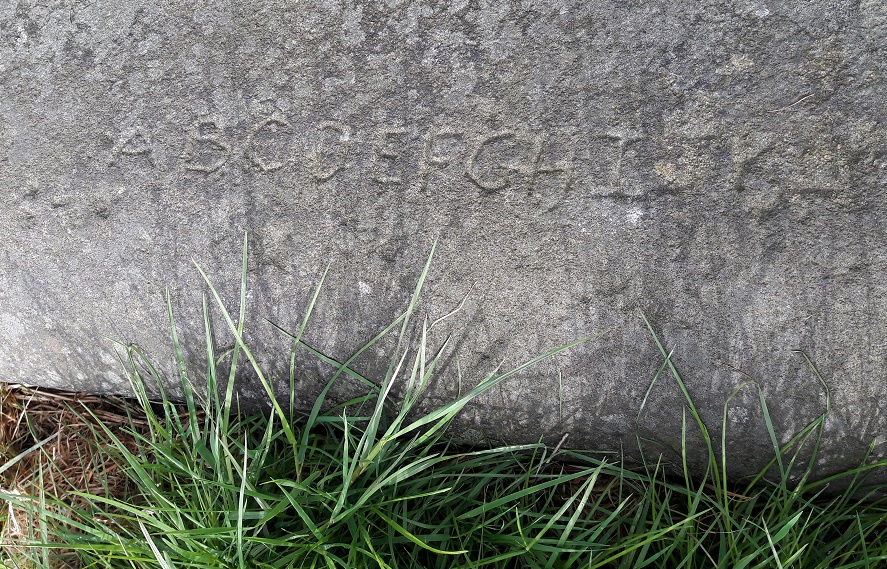
And to end… this! How and why someone did this, I don’t know, but they did.

graf 6
Ladies and gentlemen… the alphabet!

It gets a little blurry in the middle, from ‘J’ onwards, but then picks up again from ‘W’. But it’s all there.

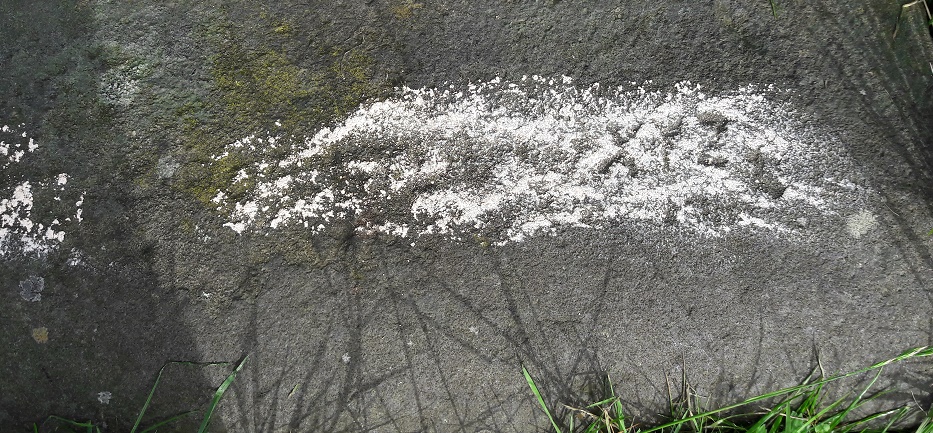
graf8
I used chalk to try and bring out the latter part. You can also make out ‘P’, ‘Q’, and ‘R’.

Truly weird and wonderful.

That’s all for now, but keep your eyes open, and send me photographs of any you find – I have a few from readers that I’ll publish next time. And I’ll try and post again before the bank holiday is over.

RH

Guide Stoop · Stones of Glossop

Whitfield Guide Stoop – An Update

So, I had a fun afternoon.

James and I went for a bit of ramble, up the hill and along Carr House Lane. Despite it being a very short distance from my house, it still took the best part of an hour… toddler speed is, I think I have mentioned before, glacial. So as I was waiting for the passing of an ice age, and hoping the clouds would stay away (they did), I began to think whether it would be worthwhile to have another poke around at the guide stoop to see if I might be able to dislodge some more stones.

It was. And I did.

I felt the last letter – a lowercase ‘l’… I think. Hang on, no. Is that something attached to it? an ‘e’? Ok, what next… Another ‘l’? … LEL?

I scrabbled around and moved more stones, all the while hoping the whole lot wouldn’t shift and trap my hand; nobody wants to be the guy on ‘Casualty‘ at whom the entire audience is yelling “Don’t be a moron, take your hand out of the wall *crash* See!  Well you deserved that, idiot!”.

I could feel more letters, but I just couldn’t decipher them.

Then a series of thoughts… take a cast. James. Playdo!

So yes, 2 hours later, and armed with a two tubs of Playdo and a sheet of thin plastic, I returned, ready to make a ‘plaster’ cast of what I couldn’t see. I have to say, it was surprisingly effective! It took a lot of furtling and fettling, but I got about as much as I could. Enough at least. So then…

GS
Excuse the dayglow colours… blame James not me. The photo is reversed, so that it reads correctly, the original is back-to-front.

What do we have?

“…field

It is a little hazy here, so I turned it to Black and White, and played around with contrast, etc. Anyway, here is the other version – between them, I think you can see the word “…field“. I hope!

gs1
It works better in Black and White from this angle. I tried taking a photo of the wall interior, but my phone ran out of battery. To be honest, I’m not sure it would have worked anyway.

So then, the placename ends in “…field“. So not ‘Chapel (en le Frith)’, or ‘Chunal‘.

So where then? And therein lies the problem! There are multiple places that fit the bill. If we assume that it is in the opposite direction from Glossop, and that it originally stood at the top of Whitfield Cross (see here for discussion), then it could be Moorfield, Hayfield, or even Macclesfield. If it stood somewhere other than the top of Whitfield Cross, then we might have to consider Hadfield or Padfield. Sheffield? Or even Whitfield… the stone may have travelled far and wide.

I have solved one problem – it ain’t Chapel or Chunal, but replaced it with another – which ‘…field‘ is it? My own feeling is Hayfield, but that’s based on nothing in particular, just reasoning.

No, the stone needs to come out of the wall!

And please, please, give me your comments and thoughts – I genuinely want to know what you think… because I have no idea!

I’d also like to say hello and apologise to the two people who saw me fettling in the wall and came to enquire if I was “alright” (i.e. not some sort of pervert sneaking around the back of peoples houses, nor a murder victim dumped in the bushes”). Thanks, and see… honest, I was telling the truth, I am an archaeologist. It was nice to meet you both!

RH

Stones of Glossop · Whitfield Cross

Whitfield Guide Stoop

Found it!

James, Mrs Hamnett, and myself went for a walk yesterday, taking advantage of the beautiful weather in the afternoon. Not a long hike – 2 year olds really don’t have a lot of stamina, and walk at a glacial pace, stopping to inspect stones, sticks, grass, puddles, clouds, etc. As we passed down the start of Carr House Lane, I looked to the left to see if I could see the guide stoop that I had been looking for since I first read ‘Glossop Remembered‘ by Neville Sharpe (highly recommended, by the way). A guide stoop is an early form of carved stone signpost,  situated at road junctions, that tells you where each road goes; to use them, simply face the name of the location you want, and take the road to the right. They became common in the late 17th Century after a 1697 act of parliament, intended to improve road conditions, suggested that guide stoops were erected at junctions (There is a brilliant website about Derbyshire guide stoops here). In the book, there is a photo of a flat stone with the words ‘To Glossop’ inscribed rather ornately on the facing side. Stylistically, the date of the carving would be, I would suggest, sometime in the early 18th century.

Now, despite Sharpe telling us where it is, I have so far been unable to find it, despite trying dozens of times and in different seasons. I had begun to think that either it was firmly and permanently buried behind thick bramble and dog rose, or worse, that it had been removed and was now lost to us forever.

That is, until yesterday! Someone had attacked the bramble with secateurs, and lo and behold – the guide stoop was there!

To Glossop
On the left hand side, just as you enter Carr House Lane from Cliffe Road. Originally, it would have stood on a stone plinth.

This was great news as it meant that we might have a chance to work out what the other three sides say, and thus where it was originally placed. There was some debate about location elsewhere on this site (in the comments, at the bottom here), but I was excited to be able to try and solve the problem. In short, we have a 4-sided guide stoop, with ‘To Glossop’ on one side, and, according to Sharpe, ‘To Dinting’ on another. It’s possible that Dinting is on the opposite side, but there is nowhere near that Dinting is in the opposite direction to Glossop. Plus, if we place Dinting somewhere else on the four sides, where are the other two locations mentioned? Chapel (en le Frith)? Sheffield? No, it is a bit of a mystery… until now!

I felt along the right hand side, and with my fingers I traced an upper case ‘T’. Obviously, the start of ‘To’, but without dismantling the wall, there is no way of knowing to where. Tentatively, I removed some loose stones on the left hand side, hoping to push my hand in and be able to find the last letters of whatever place was written on that side of the square… and was shocked. It went back squarely for a few inches, and then turned abrubtly at 45 degrees. the stone was a triangle! Only three sides, and only three locations. I scrabbled my fingers along and traced a lower case ‘L’, but no more… The stone was too jammed in, and I couldn’t wriggle past it.

Triangle
You can see the side turning 45 degrees to form a right-angled triangle.

I might try again at a later date, but in any case, I think we now have enough to hazard a guess as to where the places are, and to where it was originally placed.

Glossop is obvious. Dinting is likely – we have no reason to doubt Sharpe, although I don’t know how he knew that. The last… well, we know it ends in an ‘L’, so it is probably Chapel (en le Frith) – although Mrs Hamnett suggests, not unreasonably, Chunal.

This is my reconstruction of the guide stoop’s inscriptions and shape.

Guide Stoop 3
A right-angled triangle, in this configuration. Probably!

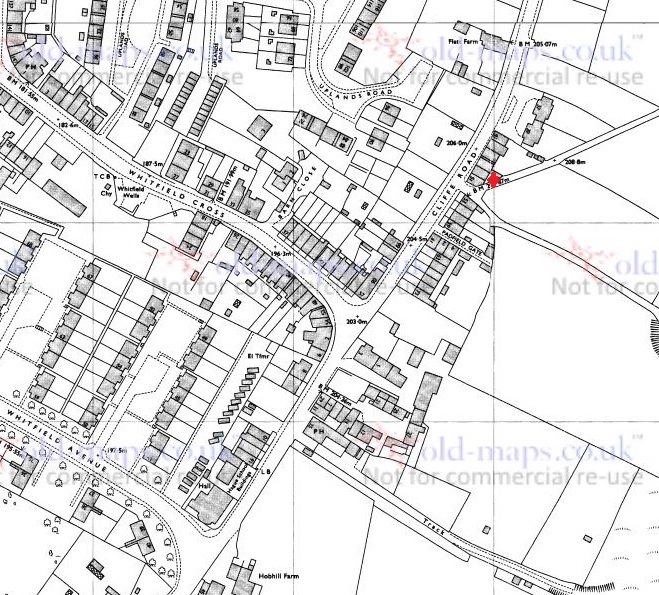
So where, if this is the configuration, did it stand? Well, simply and almost certainly, at the top end of Whitfield Cross, where it meets Hague Street/Cliffe Road.

Map
The three-way junction at the top of Whitfield Cross works perfectly in the above configuration. Incidentally, the red blob marks the location of the guide stoop, on the left hand side going up Carr House Lane.

If this is the case, the ‘Glossop’ side would be facing south east, indicating Glossop is down Cliffe Road. Dinting is north east, accessed via Whitfield Cross, Freetown, and then Hollin Cross Lane (the old Roman road). Chapel (or Chunal) is facing south west, and accessed via the road down to Gnat Hole and then onto Chunal, Hayfield, and beyond.

The only way we would know for certain is to demolish the wall… and that would be a massive undertaking.

Just as with the Whitfield Cross, I would love to see the guide stoop restored to its place of origin – I think it would look amazing at the junction, perhaps on the pavement at the left. We really could turn Whitfield into a heritage hotspot.

As an amazing bonus, on the way back, and just by Whitfield Cross, I found this.

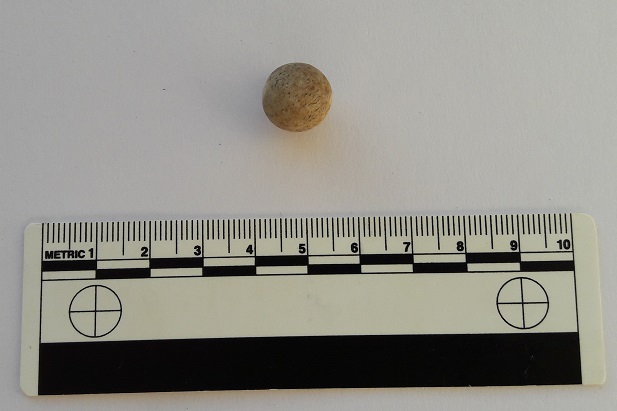
Marble A
A marble. A literal marble.

Just peeking out of the soil, I thought it was a stone at first – it’s perfectly spherical and very tactile; a child’s toy marble. It’s stone – marble or alabaster I think, but certainly not clay as most of the Victorian marbles are, and because of this, it clearly belonged to a well off child. I wonder if it was lost on the path, or if it was lost in the city and ended up in the field as part of the process of night soiling?

Either way, it’s a hell of a find. It’s so personal and intimate – and this is why I love doing what I do.

Please feel free to comment, correct, or just chat. All is welcome.

RH

Whitfield Well

Whitfield Well Dressing – An Update

Sorry once again to have missed the ‘one a week’ post target – I have a post in the making, which I am currently writing, but it will need a day or so more to do. My excuse this time was preparing for a job interview… which, incidentally, I got. Hurrah! I wont say what as that would give the game away as to who I am, but suffice to say I am gainfully employed in the services of a local museum, at least on a part-time basis. This allows me to continue working with the Blackden Trust, as well as spending time with my wonderful, if exhausting, son.

So, all is good in Hamnett-shire!

No, the main reason for this post is that the ever wonderful Glossop Heritage people have posted some amazing images of the Whitfield Well Dressing – see them here. These are truly amazing, and really show the size of the event as it once was.

I am really quite serious about restarting the well dressing as a new tradition – it has been stopped and restarted on a number of occasions previously, so this is nothing new. I would love to get that number of people involved, with maybe music, dancing, entertainments, food, stalls, etc. a real carnival atmosphere – although, ideally, without the traditional bull baiting, cock fighting, and prize bare-knuckle boxing.

I took a photograph this evening of roughly the same scene as the middle right or bottom left of the lower set of photographs. The original photograph must have been taken from on high, perhaps an upstairs window or something, which means it can’t be replicated properly – but it gives the impression.

20180323_164813
Compare and imagine… Let’s do this!

I have more information to add about the well dressing, but all in good time. Anyway, enjoy this until I can get something else published.
RH

Archaeology · Crosses of Glossop · Whitfield Cross

Whitfield Cross – The Talk (of The Town)

Greetings to you all.

Well, so far I have managed to fail utterly in my New Year’s resolution in posting at least once a week. So my apologies. A lot of my spare time has recently been taken up with writing and preparing for a talk I am going to give on the subject of Whitfield Cross. Interestingly, the Whitfield Cross post (here) is by far and away the most popular on this blog. I know this because behind the scenes here, there are a whole pile of statistics that can be accessed that tells me how many people visit each day, what they look at, and even from where they come – yesterday, for example, I even had a visitor from South Africa! Now, I have no idea why the Whitfield Cross post is so popular, but when I was asked to give a talk on any subject, I though I’d go with that!

The talk is titled: Whitfield Cross – Glossop’s Saxon Heritage

To be given to the excellent folk of the Glossop and Longdendale Archaeological Society (website here) on Tuesday 3rd April at the Bluebell Wood pub, Glossop Road, Gamesley. Talk starts at 7.30, so get there a little earlier, and it’ll cost £2 on the door (although for £5, you can join GLAS and reap the benefits for the year).

The talk will draw on the blog post, but will include new research into Glossop’s only Anglo Saxon feature, and include a discussion of other examples of Mercian Round Shafts.

Plus, this is your chance to find out who Robert Hamnett actually is… and buy him (well, me) a drink!

In all seriousness though, come along – if you are interested in the blog, or Whitfield Cross, you’ll be interested in this.

Right, despite having another cold (courtesy of the ever ill James), I shall try and bash out another blog entry