What ho! dear readers. I’ve just opened a bottle of fine Belgian pilsner, and am feeling quite effervescent, if that’s the word I’m fumbling for. I think it probably is.
Talking of fumbling, I went back to the place I found the lead came and had a fumble. Madam, please! This is a family blog. Honestly, some people! So there I was, fumbling, looking to see if anything else popped up, when I found what looks like window glass and some early pottery. Hmmmmmmm, let’s take a closer look.

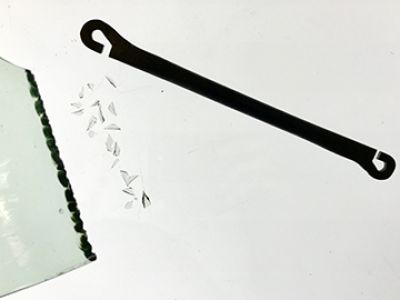
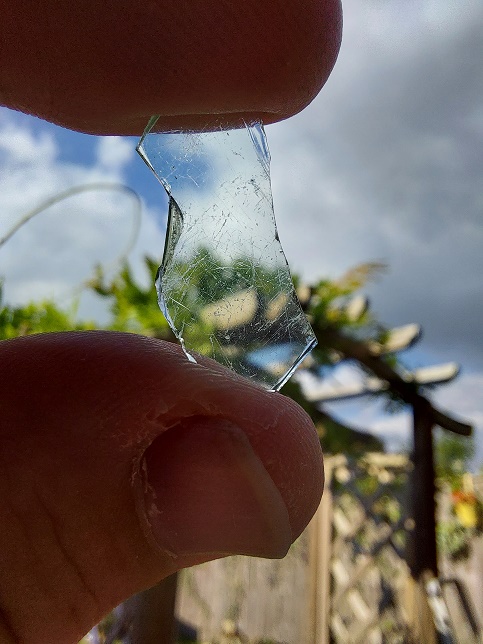
The glass is only a small fragment – just 2cm x 1cm – and very thin, being a shade over 1mm thick. It is also flat, which just about rules out its origin being a bottle. I terms of colour, it has that blue-green tinge that you associate with early glass, before they managed to perfect the process to remove all the impurities. Looking more closely at it, I noticed that two of the edges were flat, and pulling out my new toy – a usb computer microscope that also takes photographs – I was able to see – and show you – tiny teeth like nibbles that tell me that the glass had been cut and shaped.

Now, I know a lot of useless information – for example that glass is shaped by nibbling – but I’ll admit that even I had to look up how exactly this was done. With a ‘Grozing Iron’ it turns out (see, don’t say you don’t learn something by reading this blog, although I can’t see it coming up in a pub quiz anytime soon). The verb is ‘to groze’, and the above glass fragment has been ‘grozed’. It looks like this:
So, it was shaped… but to what shape? The two edges, if they were extrapolated, didn’t make a right angle, but instead, a diagonal. A diamond, even. Could it be I have a fragment of the glass that went into the lead came I found? Impossible to say for certain, but it is possible, even probable. In terms of date, it’s very difficult to say. Broadly speaking, the thinner the glass, the earlier it is, and combined with the colour could certainly put it in late 17th or early 18th, which matches the tentative date for the came. So that’s exciting, if you get excited about this sort of thing… and I do! Here it is situ:

The date of 18th century also matches the date of two sherds of pottery I found with the glass.

They are both mottled manganese ware, and classically early 18th century in date – certainly not later than about 1760. Interestingly, they are not particularly worn, so it’s unlikely that they have been kicking around for 250 years or so – perhaps there is a dump nearby? They are also both open vessels – bowls, probably – and may belong to the same vessel, despite one being glazed on the inside only (quite often, the glaze on the exterior was confined to the top part only). Also, one sherd shows the characteristic manufacturing marks, that also doubled as decoration:
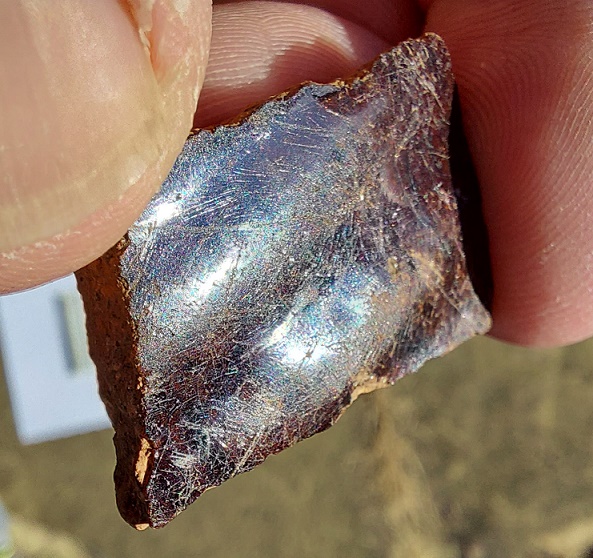
The next photo shows the make up of the sherd – the reddish slipped exterior (top), the rough orange-brown earthernware fabric with tiny bits of stone in it (middle), and the thin dark line of the glazed interior (below). I love this stuff.

I’m going to put together a quick and easy guide to pottery, describing all the different ‘parts’ of a sherd, and some tips on identifying what shape and size, as I think it’s nice to now what it is you are holding. I’m also still putting together my quick and dirty guide to Post-Medieval pottery, as there is a serious gap in the market… probably for obvious reasons!
I’m going to end with a great photograph of the glass, and to pose the following questions: Who was the last person to look through that window before us? And what did they see?
Until next time, take care of yourselves and each other. And I remain.
Your humble servant,
RH

 The Glossop Cabinet of Curiosities
As a ex glossop boy still young as 71 I just your posts
LikeLike