(And apologies to those of you who have ended up on this website expecting to find an informative article on the seed of the Phoenix dactylifera.)
What ho, magnificent readers! I trust you are all rude health as we stumble toward the season of goodwill and whatnot. I love this time of year, when the cold wind blows, and the… What’s that? What do you mean “get on with it!”. Honestly, the nerve of some people.
Righty ho. Datestones. Who doesn’t love a good datestone? I mean, what’s not to love? A little snapshot of the history of a building, a birth certificate if you will, recording both the date of birth, and, if we’re lucky, the parents too.
Normally, though not exclusively, located above the door, these carved stones preserve the date of construction and the initials of the person or family who paid for its construction. The are by and large the reserve of the aspirational ‘middle classes’ of society; the poor man doesn’t build his house, the rich man has a house that speaks for itself. Indeed, it is a statement to others: I have wealth enough to build this house. They seem to become popular in the 17th century, as the ‘yeoman farmer’ becomes a class of person, that is, a person who owns the land they farm. Indeed, it may be a result of that phenomena, a way of setting themselves apart from the simple tenant farmer, who doesn’t own the land he works. Glossop has several 17th century examples remaining, though many more will have been lost, sadly. They do show up, occasionally, as the one found by Glossop Brook at Harehills Park did, and which was saved and cemented into the brook wall. Interestingly, this example also shows that whilst datestones can be a boon to historians, they can also present problems if we are not careful. They can move easily, and be attached to other buildings giving a misleading date, as is the case there, and at Hall Fold Farm. Also, stones can be put in place to commemorate a rebuilding or alteration to an existing building, causing similar, if opposite, problems.
By the Victorian period it was common to put a date and/or name on a house you built, and a careful look at many rows of Victorian terraces around Glossop will reveal names and dates. With that in mind, I have restricted my research to those datestones that carry a date prior to Victoria’s reign, pre-1837. The following is a table of the ones I know about:

There are 28 datestones in the Glossop area (broadly defined), but there will be more lurking that I don’t know about, either attached to the building still, or lying in a garden. This blog post will concentrate on the examples from Whitfield, as it is turning into a much larger post than I had thought. Plus, in the interests of honesty and transparency… I haven’t got photographs of all of them yet!
Whitfield has some of the oldest buildings in the Glossop area, and although not really much of a ‘place’ now – essentially just a ‘suburb’ of Glossop – it was once hugely important, being built along the Chapel en le Frith to Glossop road. It gradually lost it’s importance with the rise of the mills based down in the valley, the economy here being agricultural. Whitfield’s one-time importance means that we find many old buildings and a number of datestones here. Indeed, Whitfield has more old buildings that Old Glossop, which with its Church and market, was the focus of the farmsteads and settlements of Glossodale. However, important places tend to be subject to more intense rebuilding over time, whereas more minor areas maintain their old buildings. I was going to do a distribution map of the old buildings, but changed my mind for that reason. Still, it’s worth noting that Whitfield underwent a bit of a building boom in the mid to late 18th century.

35 Whitfield Cross was built in 1773 as a farmhouse, and is a Grade II listed building – see here for more details. The narrow coursed stonework and stone mullioned windows are typical of the period.
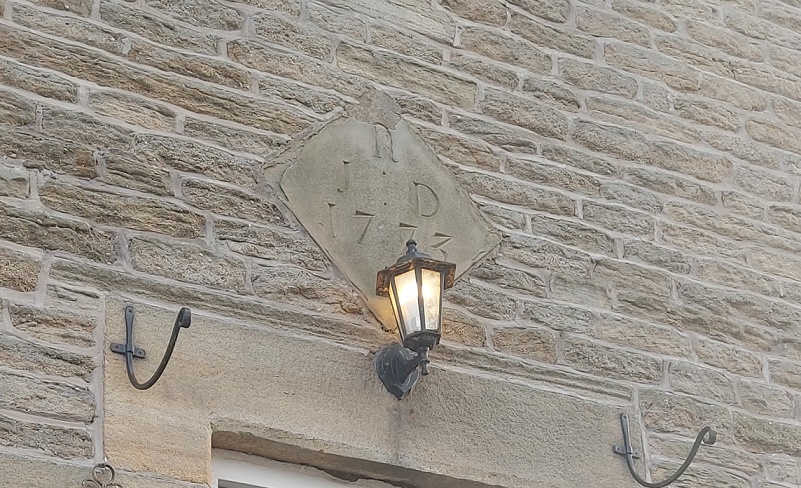
31 Hague Street was also built in 1773, but as a pair of weaver’s cottages, and is also a Grade II listed building. 1773 must have been busy year, and Whitfield was clearly a happening place in the late 18th century. The datestone records the initials R. J. and D. Now, presumably the ‘R’ is the surname (possibly Robinson – the family being quite prominent in Whitfield) with ‘J’ and ‘D’ being the husband and wife who are responsible for the building. I have no information regarding the people, sadly, and any information would be appreciated.

Hob Hill Cottage is a remarkable building dating to 1638, making it the second oldest building with a datestone in the Glossop area (after the Bulls Head in Old Glossop, dated 1607). Also built as a farmhouse, and also a Grade II listed building (there’s a theme developing here!), I suspect it might be the source of the lead came and glass, as well as some of the 18th century pottery, I found nearby, although truthfully any one of a number of buildings – existing or long gone – might be the source.
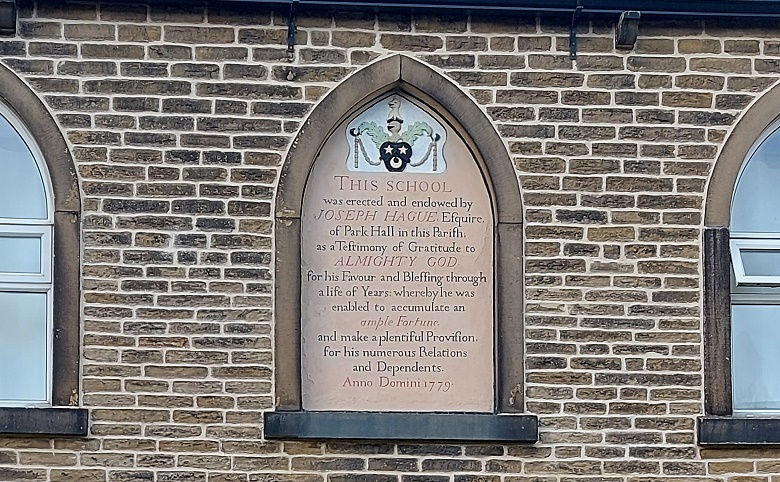
Another Grade II listed building now – the Old School House. Joseph Hague was something of an important man – indeed, the road on which the school (now private residences) sits is named after him. Born in Chunal in 1695, he rose from poverty to amass a fortune selling yarn to weavers and buying back the cloth they produced, to sell on. However, here is not the place for a discussion of his life, or of the school (the Glossop Heritage Trust does that very well here). Let us instead look at the wonderful inscription
“This school was erected and endowed by JOSEPH HAGUE Esquire,
of Park Hall in this Parish as a testimony of Gratitude to
ALMIGHTY GOD for his favour and Blessings through a life of
years whereby he was enabled to accumulate an ample fortune
and make a plentiful Provision for his numerous Relations and
Dependents. Anno Domini 1779.”
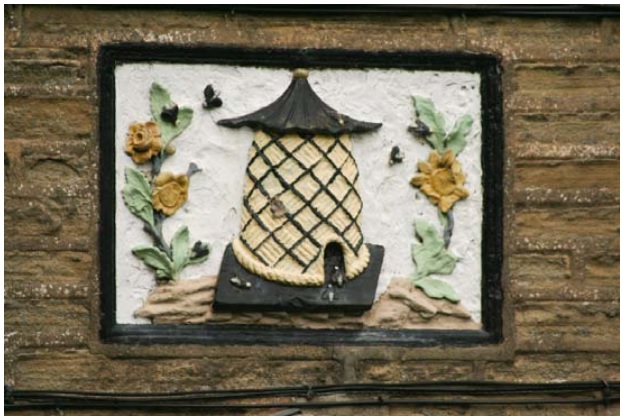
I enjoy the slightly boastful “ample fortune“… well, if you have it, why not? The beautiful carved relief plaque of the beehive over the main door – symbol of productivity and hard work – gave inspiration for the name of the pub over the road. The Beehive pub itself is an 18th century building, with a 19th century front added, and another example of the building boom of the 18th century in Whitfield.
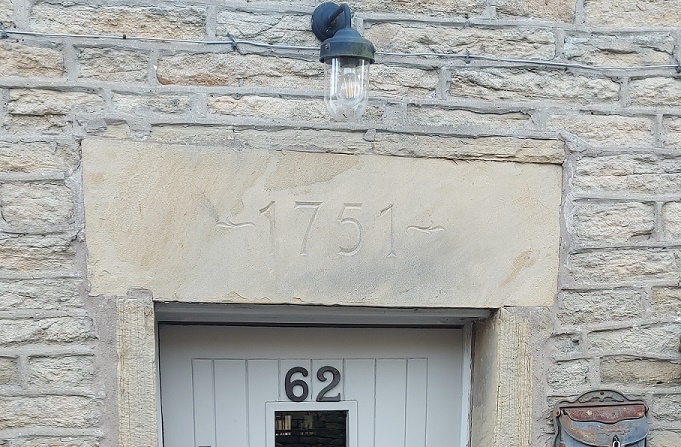
Another Grade II listed building, one of several together, and originally built as a ‘laithhouse’, that is a building made up of a house, barn and byre/shippon in one. It is a late example of the type if the date is to be taken at face value, but there you go… this corner of Derbyshire wasn’t exactly at the forefront of architectural fashion. There is also a bit of confusion regarding 62 Hague Street. As it stands now, there is a simple date of ‘1751′ above the door. However, the listing for the Grade II building notes that “No.62 originally had datestone inscribed RMS 1757” (read the full listing here). The present datestone is fairly modern, carved perhaps to replace the missing stone, but it doesn’t explain the difference in date. I thought it worth mentioning for the sake of documentation and completion.

So who was Joel Bennett? Born 11 April 1791 to son of George Bennett and Martha Cooper, he came from a large and important local family. He may have been the same Joel Bennet who was excommunicated from Littlemoor Independent Chapel in 1828 for “disorderly walking and impenitency” (source is here). I’m unsure of what is meant here by “disorderly walking”, but given the hotbed of radical religion that was Littlemoor, one assumes it wasn’t the Georgian equivalent of Monty Python’s Ministry of Silly Walks. He may also have bought Kinder Lee Mill in Chisworth with his brother James in 1823.

This house, set back from Cross Cliffe almost at the bottom, has a wonderful datestone: stars, wheatsheaves, and a Masonic compass, with the letters ‘R’ ‘R’ ‘O’ and ‘S’. Actually, is that an ‘O’? Or perhaps a flower? I have no information about the place, nor the letters (Robinson again?), and one cannot simply knock on a door and say “What-ho… tell me about your house”. One tends to get stared at, with vague mutterings about “setting the dogs on you”, and “lunatics disturbing the peace”. Alas. If anyone has any information about this house, or indeed any of the houses, drop me a line.
Also, and seriously, if anyone knows of any more datestones that aren’t in the above list, and which date from before 1837, then please let me know. I’ll credit you, too, so you can be famous… to all 11 of you who read the blog (including Juan in Venezuela).
Oh, and some news. I’ve been working on the Glossop Cabinet YouTube account recently, and hopefully will be producing videos of me finding bits and pieces, mudlarking, talking archaeology, exploring, playing with pottery, and much more (can anyone else hear that groaning noise every time I mention pottery?). So if you like the blog, then you’ll love this. I’ll post a link asap.
Also, I’ve recently set up a Ko-Fi account which allows you lucky folk to ‘virtually’ buy me a drink if you wish. There is no pressure to do so, obviously; I do the blog because I enjoy doing it, and am constantly amazed that other people enjoy reading it (which is reward enough, it really is). However, if you do fancy buying me a pint to say cheers, I’ll never say no – please click this link, and mine’s a red.
That’s all for now I think. I’ll post something else before Christmas, possibly pottery related, you lucky lucky people (there’s that noise again). But until then, I remain,
Your humble servant,
RH


what about the date stone over the door of Pikes farm at the bottom of Pikes lane as a youngster living on Spring St I was always fascinated by how old this building was
LikeLike
Excellent! Thanks for the tip off – I had no idea Pikes Farm had a datestone. The building looks 18th century, but we’ll see. I also think it sits on both a medieval/post-medieval trackway between Simmondley and Ashes, and the Roman road to Melandra. Pikes Farm is hugely interesting… *scurries off to furtle around*
LikeLike
Thanks for your reply as a boy living Glossop until I married in 1972 and moved to geecross I’ve always had a fascination with history please keep up with the great work you are doing. Pete M
LikeLike