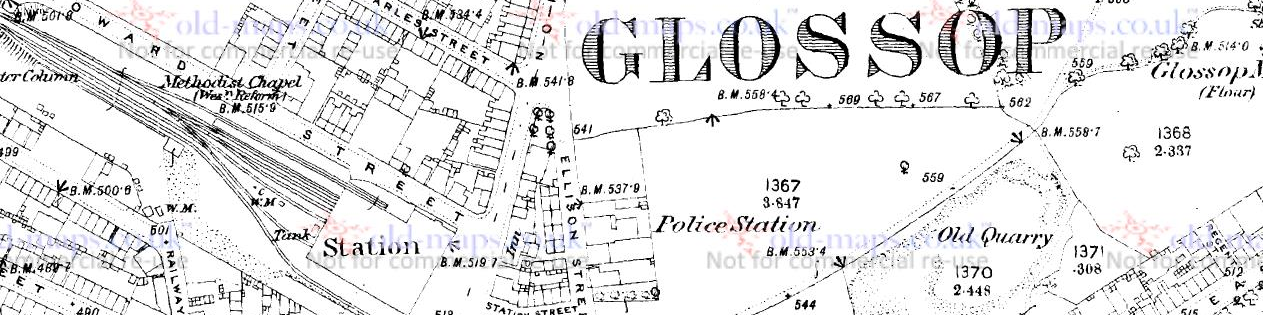
What ho, Glossop!
Happy new year wonderful folk of the blog reading world. I hope you all had a safe and restful Christmas at the very least. Today’s blog post is the first part of the much talked about Pottery Guide. You lucky people, you.
Over the last few years I have been toying with the idea of putting together a sort of ‘spotter’s guide to bits of old pot‘. I get a few emails a month from people asking “what is this?” or “where can I find out more about the pottery?” (What? What’s that you say? No, I’m not “having a laugh“, thank you very much. And don’t think I can’t hear you making snoring noises, either… honestly). It seems that most people who read this blog also like dipping into brooks, fields, tracks, and gardens, and pulling out bits of old stuff and pondering. Which is great, because that’s precisely what the blog is about. However, there is no simple guide to identifying what it is you have in your hand. Either they’re very dry academic archaeology (and even then, they generally don’t look at Victorian or Georgian pottery – that’s the stuff we normally dig through to get to the good stuff!). Or they are aimed at collectors, and thus look at only whole pots that live in glass cases and are fawned over by incredibly dull people. In 27 years of being an archaeologist, I have never once found a whole pot. And I certainly haven’t seen one rolling down Shelf Brook in Manor Park. I have, however, seen many thousands of bits of pot doing just that. And here’s the rub: the whole pot is ‘nice’ to look at, but sherds are the meat and two veg of archaeology… if that’s the phrase I’m looking for. Anyway, sherds are the lifeblood of archaeology, and from where we can explore the past in a way that is open to everyone and is fun. But in order to do that, we need to know what you have in your hand. My background as an archaeologist is early bronze age Crete… which is about a far from Victorian Glossop as it is possible to get (2,500 miles, 5,500 years, give or take), so I must admit part of the reason for doing this guide is that I too could learn about what it is I am finding. To do this, I read just about everything I can get my hands on, ranging from academic reports… to “a bloke on the internet”. And now, I can pass that info onto you so that before long, you too can be thrilling people with your knowledge of bits of old pot… honestly, I’m quite a hit at parties.
Anyway, Let’s start with some of the most recognisable and common stuff.
- MARMALADE JARS
DATE: 1870’s – 1920’s
DESCRIPTION: Grey stoneware with a creamy surface, and characteristic external vertical ribbing.
SHAPES: Well… Jars.
These are such a distinctive type, and are so commonly found, that I thought we’d start here. Commonly known as marmalade jars, but actually any and all preserved fruit were kept in them, with a paper label pasted on the outside, and a horizontal groove running below the rim to take the string that kept the wax paper or cloth lid in place.
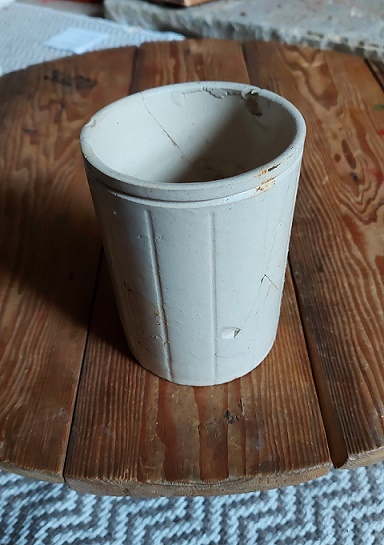
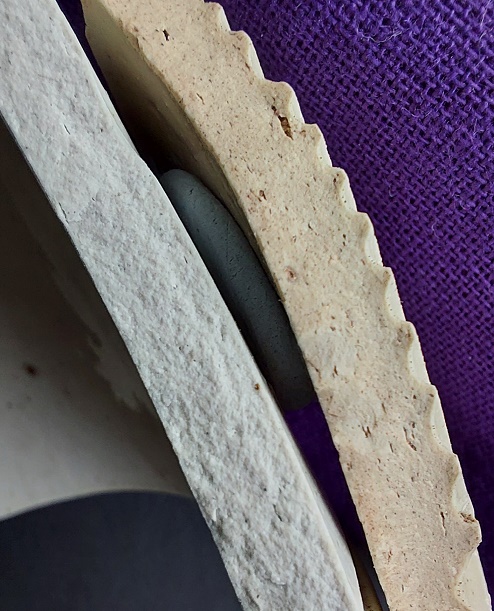
A very hard creamy-grey stoneware fabric, solid, but with small voids. A roughly applied clear salt glaze (drips are common) internally and externally, with a slightly orange-peel surface (although often the base isn’t glazed).

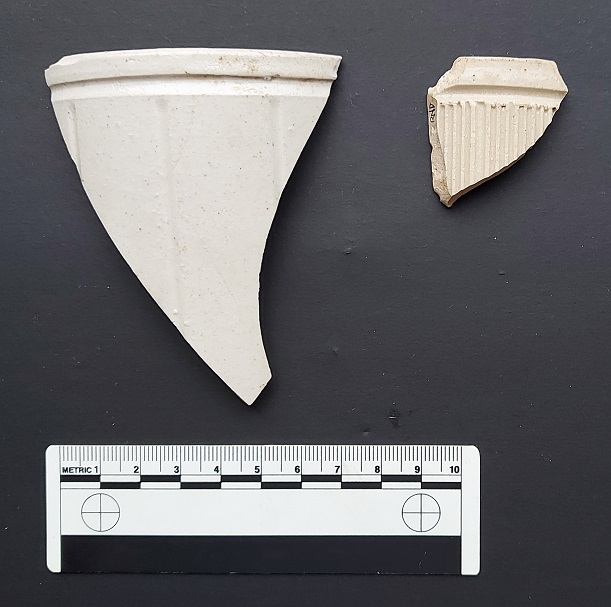
They are exclusively open-ended jars of varying heights and widths, usually c.15cm tall. Beyond the colour and surface, the most recognisable bit of this pottery type are the vertical stripes, which can be very close together – either continuously or broken up by larger grooves – or spaced far apart (see photographs).
Sometimes the base is stamped with the preserve maker’s name – commonly the lighthouse and name of WP Hartley – a company still making jam as ‘Hartley’s’.

Chronologically, they are late Victorian to Edwardian in date – WP Hartley seems to have designed the distinctive jars in the 1870’s, moved the factory to Aintree in Liverpool in 1886, and opened a second factory in London in 1901, so whether the base stamp mentions Liverpool and London will give a rough date. I have no end date for their use, but it is likely in the 1920’s when most companies switched from stoneware to the cheaper glass bottles and jars. That stated, the jars are very useful (I keep pens in one) and they are very hard-wearing, so it is likely that some were in use long after they stopped being made.
- BROWN STONEWARE
DATE: 1700 – 1920’s
DESCRIPTION: Grey fabric with a shiny brown all-over salt glaze, often with rouletted decoration.
SHAPES: Cups, bowls, jugs (Nottingham Stoneware). Storage Jars, colanders, starch pans, stock pots, stew pots, bowls, bread crocks, pans, etc. (Derbyshire Stoneware)
Ah, Brown Stoneware, how… brown you are. Characterised by a shiny brown all-over salt glaze and a light grey stoneware fabric, it is instantly recognizable. Perhaps because it is so distinctive, but also because it is a stoneware and thus virtually indestructible, this stuff appears everywhere. It is also difficult to date with any certainty. However, it can be broken down into two types of different dates (although there is overlap): the Nottingham and Derbyshire Stonewares.
Nottingham Stoneware (c.1700 – c.1800)
A shiny milk chocolate brown surface interior and exterior, caused by the salt glaze with added iron, and often more glassy or creamy than the Derbyshire type.
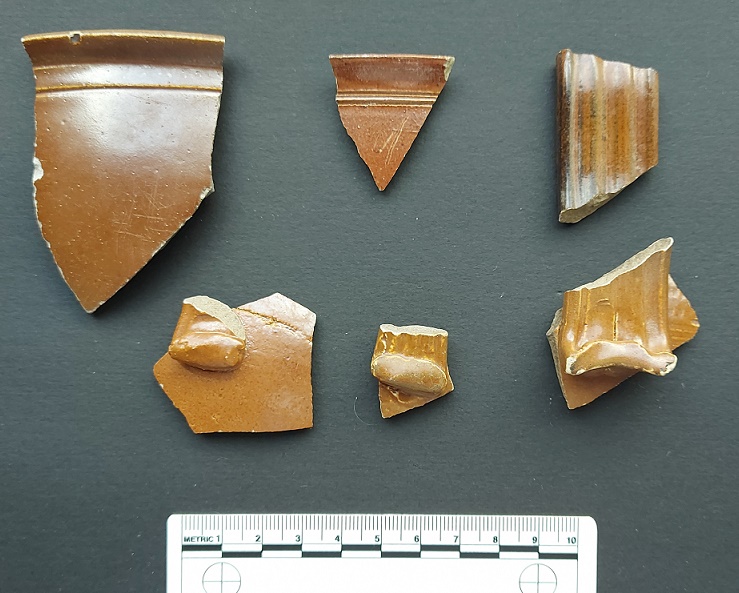
It usually has a white slip underglaze visible in the break, between the classic grey stoneware fabric and brown surface.


It is often found in thin walled vessels – cups and bowls (tablewares). Also, noticeable are wide strap handles, with vertical ribbing and thumb impressions where they were attached to a jug body. Decoration consists of horizontal incised lines done on a lathe, often in multiples, and rarer impressed decorative patterns in between the lines – snakeskin, basketweave, zig-zags – often done with a roulette wheels. Out-turned rims and bases with multiple bands around them are also common.
Nottingham stoneware was popular in the 18th century, but by the end of the 18th century couldn’t compete with the more decorative styles then coming out of Staffordshire, and the style faded away. However, the tradition was continued by potters in Derbyshire, who began to specialise in utilitarian kitchenwares – storage and cookery – rather than tablewares they previously made.
Derbyshire Stoneware (c.1800 – c.1920)
A similar, but often a little darker, shiny brown surface, made by the same iron-rich salt glaze, but a little less glassy or chocolatey.


Also, whilst the majority of vessels have a brown interior and exterior, some have a cream, white, or olive coloured interior (I have a hunch these are later).
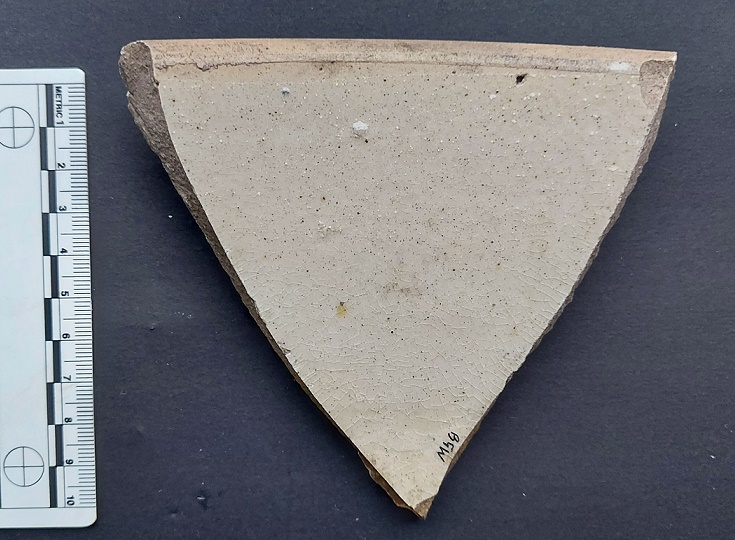
The fabric is the same classic grey stoneware, but normally with no white underglaze. Thick walled vessels are the norm, with the emphasis on cooking and storage – utilitarian rather than flashy serving and eating/drinking.

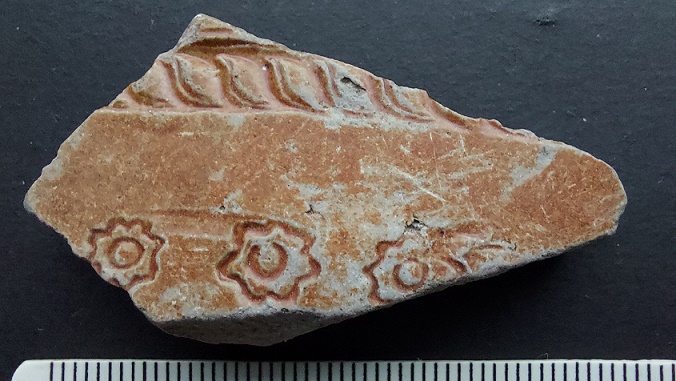
Impressed decoration consists of roughly made rouletted shapes – very small crude stars, circles, crescents, flowers, dots, etc., sometimes horizontal, sometimes in flowing wavy lines.

An interesting advert dating from about 1880 gives a good idea of the kinds of vessels and decoration available at that point and beyond:

Here endeth today’s lecture. Now go forth and forage, good people! Seek and ye shall find. And please, let me know what you do find – I’d like to do a community thing, where you all send me images of the bits you find and some names, and I’ll put them on the blog. I don’t know why, but my mind keeps going to ‘The Gallery’ on Take Hart…
Anyway, more soon (not just pottery, honestly… I have some interesting stuff in the pipeline), but until then take care of yourselves and each other. And until then, I remain, your humble servant.
RH


Thank you for an enlightening post, always enjoy your archeological and amusing posts.
LikeLike
Very informative. Looking forward to Pt’s 2,3,4,5……..?
LikeLike
Dear Tim, While clearing a ditch in front of my property on Friday I found a Hartley’s jam pot. An internet search revealed your posts. The jar is complete and in excellent condition. There is no mention of London or Liverpool on the base. The inscription reads “NOT Genuine Unless Bearing WmP Hartley’s Label” followed by a logo made of two Fs and an M. The Fs being back to back either side of the M. I e-mailed Hartley’s but got an unhelpful answer. Are you able to assist me to date the this artefact? Do you know at what point the logo on the bottom of the pot changed etc? The vertical scores up the side of the jar are 7/16 inch apart (11mm). I understand that it has no value to speak of but it is an interesting curiosity. Thank you in advance for any assistance you may be able to give.
Cheers, Steve.
LikeLike