Archaeology · Pottery · Towns of Glossop

Lean Town Part 2 – The Finds

Welcome back to Part 2.

I love Lean Town – it’s a good walk from my house (even Master Hamnett can do it with the minimum of fuss… mostly), and yet feels oddly distant. The houses are beautiful, and I sometimes feel a tiny pang of jealousy as I pass, so it’s nice to finally do this blog post that has honestly been years in the making. Part 2 is the finds.

LT2
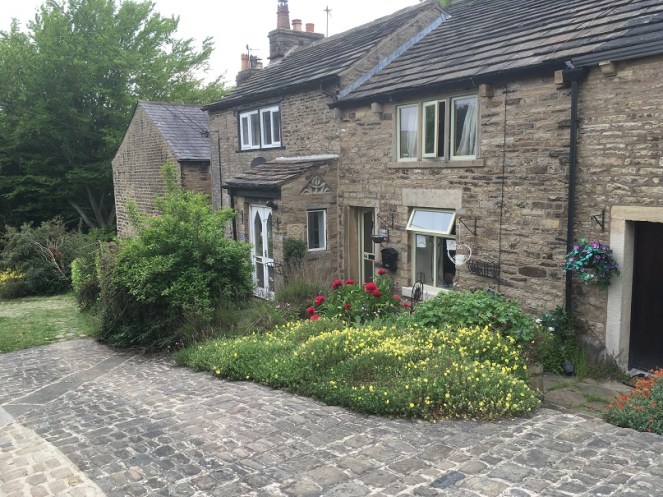
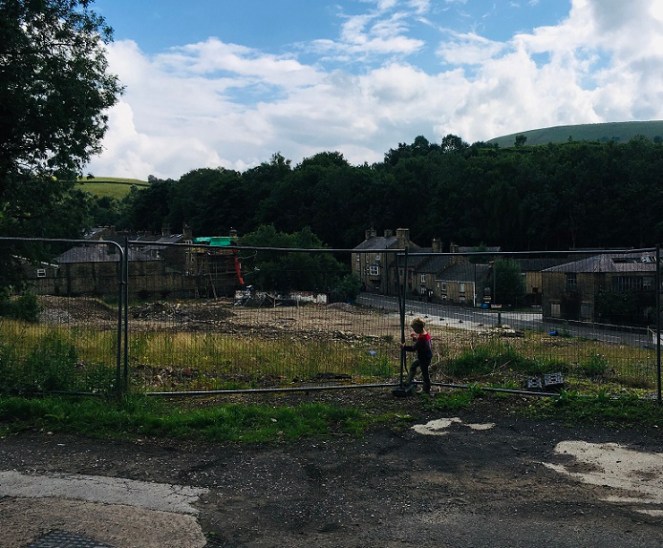
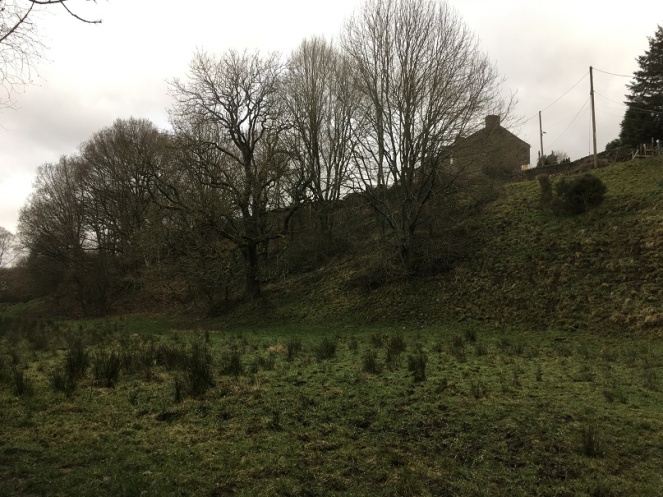
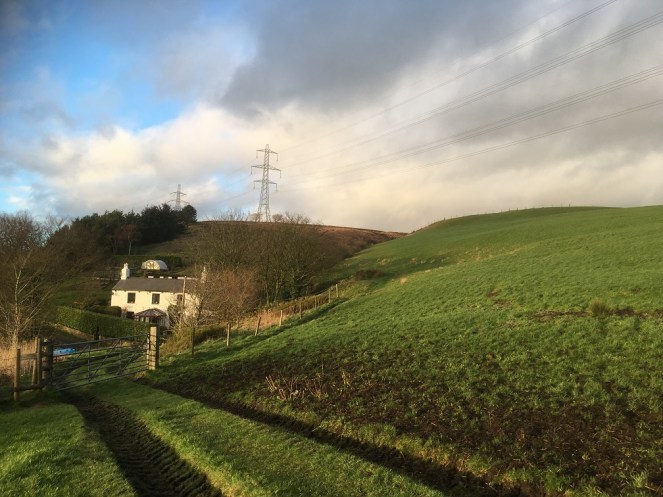
Lean Town from the bottom.

As you can see from the above photograph, the houses are perched on the edge of a steep slope. Now, in the Victorian period, there was no rubbish collection – all household waste that couldn’t be fed to livestock, burned in the fire, reused, repaired, sold for scrap, or spread on the food crops, had to be disposed of by the individual. Now, I’ve probably mentioned this before, but humans are essentially lazy creatures. Almost as a rule, they will take only two considerations into account when disposing of rubbish: 1) can I see it? 2) can I smell it?

With this in mind, you can usually tell where a waste dump – or midden – will be by studying the area and asking a simple question: where would I put the it to get it out of my sight and smell, but with the minimum amount of hassle? Houses, situated on a steep slope, hmmm… there’s only one place they would chuck it. Any thoughts?

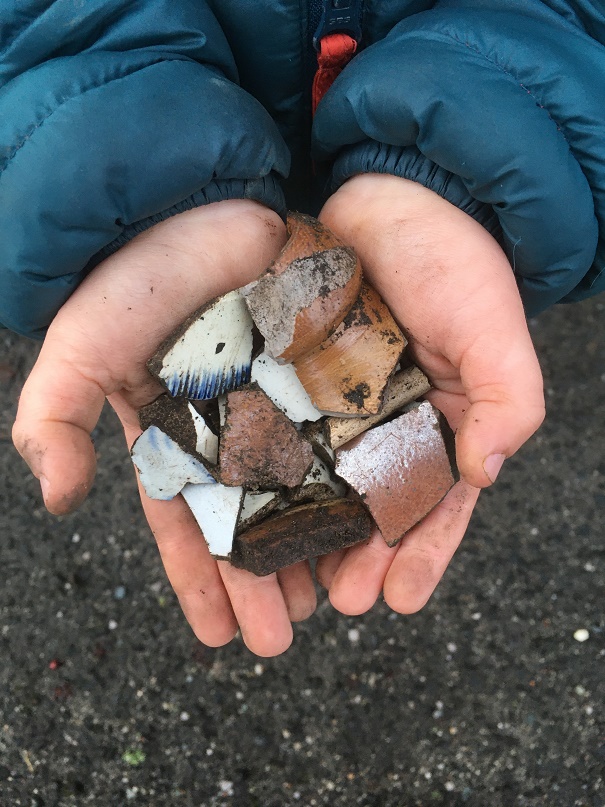
That’s right, well done, you guessed correctly and win a sherd of pottery (please email me with an address if you want it… I have many!). Over the back wall went the rubbish, and on the footpath below that wall went I. And by Jove, what a trove! This was all lying on the surface on the footpath that would have originally led from the houses to the well. Between myself and Master Hamnett we cleared out all we could see, but wait for the next rainfall, and more will pop up.

LT - p
A proud parent! Master Hamnett was so excited to be picking the pottery up, stuffing it into his pocket, and walking along holding some in his hand. Like father like son…

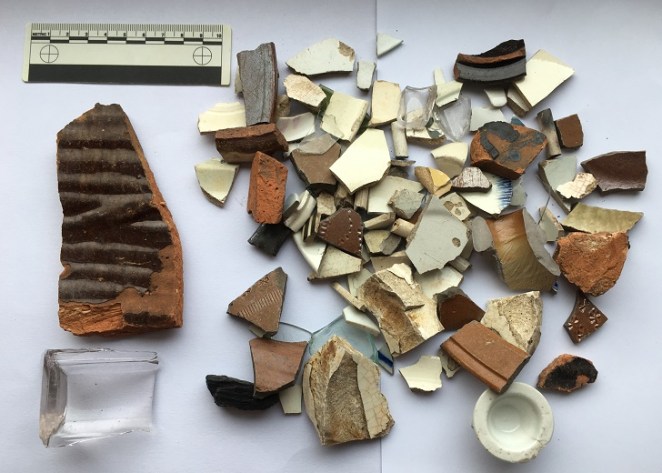
So, what did we get? The short answer is masses of early Victorian to Edwardian bits and pieces – woo hoo! I divided the slope area into two sections: one directly below the back wall of the houses, and one a little further west along the slope.

LTP1
The assemblage from below the houses. Very impressive, and with some interesting bits in it.
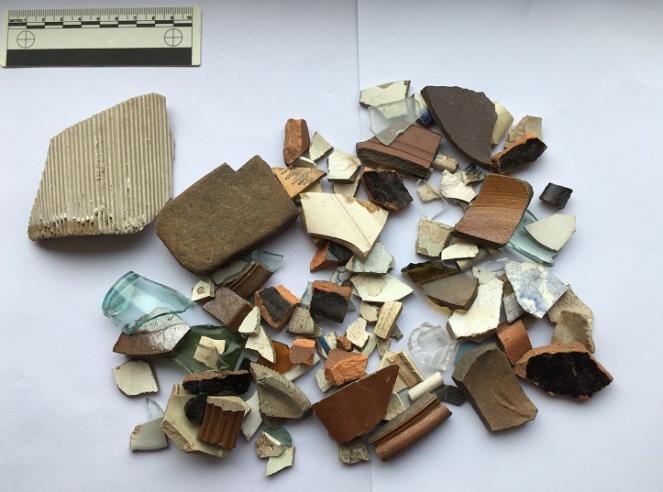
LTP2
The assemblage from further west, also impressive.

Truthfully, they are both rubbish dump areas from the same set of houses, but old archaeological habits die hard, and it is easier to keep them separate than it is to re-separate them if I needed to after joining the groups. In pottery analysis we call this “splitting” as opposed to “lumping” – once lumped, pottery is almost impossible to split.

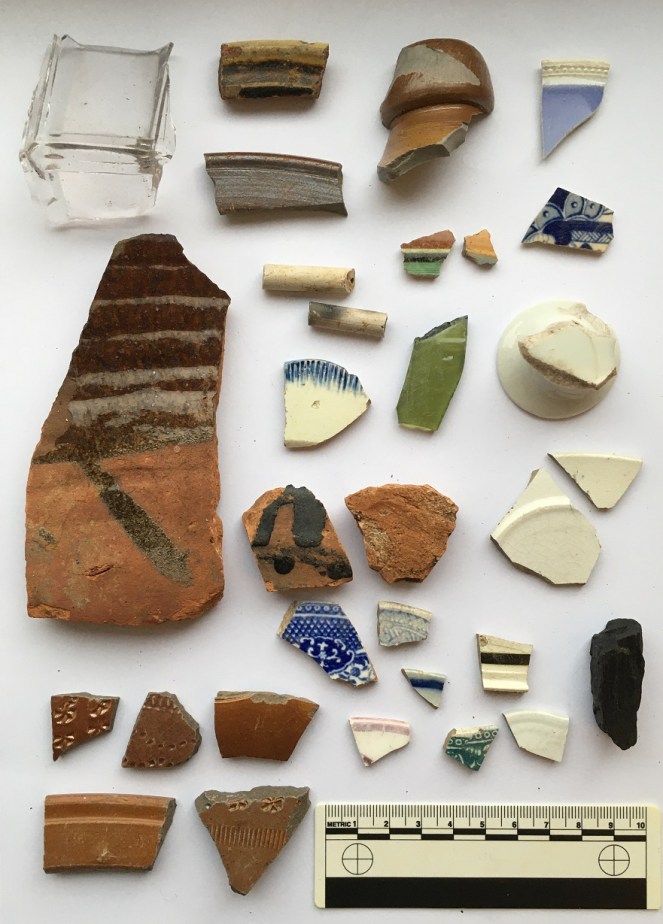
I’m only going to discuss the ‘interesting’ sherds here – there is a lot of it (see pictures above), and life is too short. As a pottery specialist, I have a system that I follow when studying pottery, the short version of which is that I look at only ‘feature’ sherds (bases, rims, handles, and decorated sherds), and discount the rest (there is also a very much longer version, believe me… I can talk for hours about it).

So then, here we are with the interesting bits. First up, below the houses:

LTP3
The interesting bits from directly below the houses.

Top row: glass side to a square sauce bottle – possibly HP sauce, but certainly very common in the Late Victorian period; one can’t help but think their food was quite bland. Upper rim is from an open bowl, possibly a cooking pot. It measures 20cm in diameter, and is glazed in what appears to be a slip-ware glaze, which puts it late 18th early 19th century. Lower rim is from a stoneware open bowl with a flat lip, measuring 24cm in diameter – probably a mixing or serving bowl, and mid-19th Century in date. Next to that, the top to a stoneware ink or beer bottle, mid to late 19th Century – I love this, aesthetically, it just so pleasing. Next to that a very fine impressed mug or tankard, 10cm in diameter, with purple glazed body. This is very delicate and fine, and the impressed pattern is lovely, it’s possibly Wedgwood, but if not it would nonetheless have been expensive – which makes me think.

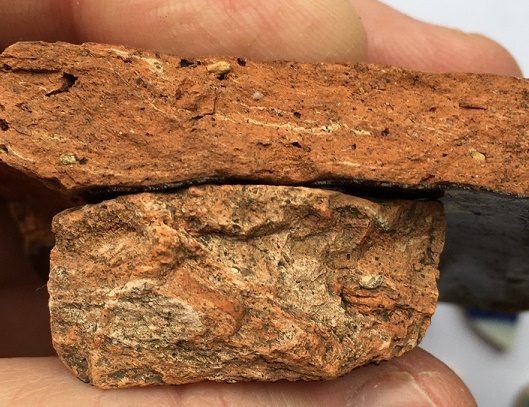
On the left we have a large sherd from a pancheon (a large milk or mixing bowl), with the interior, rim, and upper exterior surface glazed. Here we can see the upper exterior, with the classic dripped surface, which, rather than it being the result of a mistake, is a deliberate decoration. This example is very interesting, as it has been given a manganese ‘mottled ware’ glaze, rather than the usual black, which makes me think this is an early example – mid to late 18th Century, I would say. You can see a more common black example next to it, complete with external drips. Sherds from pancheons are quite common, due in part to most people having one, but also to the fact that they are large (larger examples can be 60-70cm across), which means they produce many sherds when broken. The clay they are made from is always reddish-orange, with pale yellow or grey folds badly mixed into it – don’t ask me why, but it is always so.

LTP6
Greyish yellow folds within the clay. Is it odd that I find that quite appetising? Actually, perhaps a more important question is should I have shared that information with you, gentle readers?

Above the black pancheon sherd is a sherd of our old friend the feather edged ware bowl. It is another rather nice pearlware vessel, measuring perhaps 20cm in diameter, and was probably a shallow bowl with a flat edge. I have recently done some research on this type, and suggest a date of 1800-1830 for when this was made, which fits perfectly. A quick archaeological aside: when made, and when thrown away are two very different things – I have some of my grandmother’s crockery which I still use, and which must be at least 70 years old. Heirlooms like this do crop up in archaeology, and can cause problems, but generally, I would suggest that 10 years is probably a good innings for an average plate or bowl, especially when you remember there were few carpets and a lot of stone flagged floors.

The green glass fragment has the letter ‘F’ impressed on it, and is late Victorian or later. Next to that is a base to a delicate pearlware eggcup, measuring 4cm. Again, this is quite nice, as is the pearlware base and rim next to it (rim diameter of 18cm so a small plate or soup bowl). There are some spongeware sherds, and some blue and white transfer printed bits, including a green example which quite frankly shows how crappy some of these mass produced pots are – if you look closely, this one has a broken transfer roughly fitted together before being glazed. Above this, there is a moulded base to another very fine 18th Century tankard or mug. Below that, there is a creamware moulded bowl rim, probably quite early (1790-1800?), and again probably quite expensive. Finally, we have a group of stoneware vessels – bowls, storage jars, and the like. These are fairly standard, with impressed decoration (flowers, rouletting, and undulating lines), and date to, well, the Victorian period – made continuously, they were very utilitarian and common.

Next…

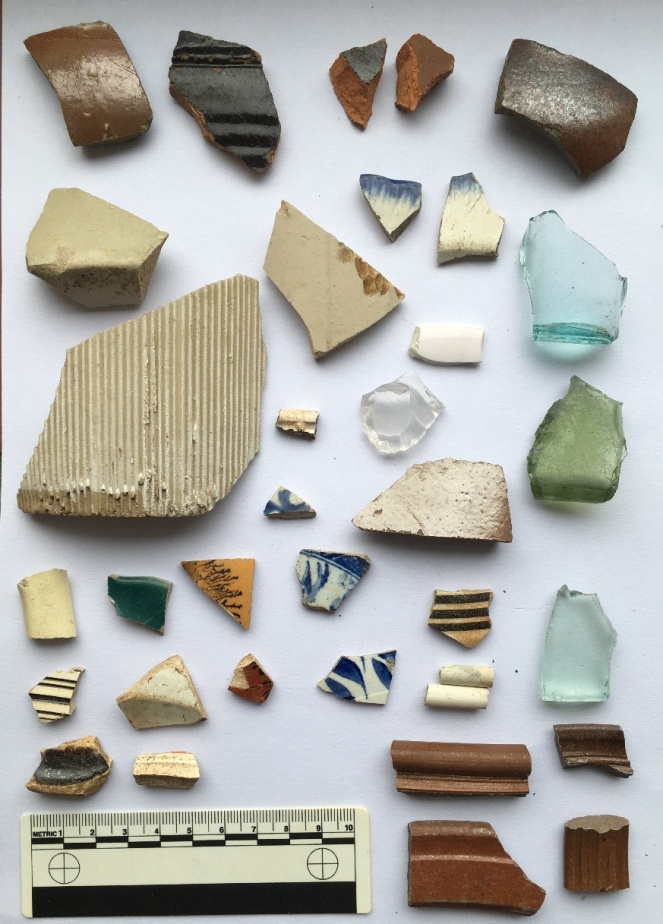
LTP4
The interesting bits from further west.

Top left, is a large, rounded stoneware bottle or closed shape of some sort – beer, perhaps? Certainly Victorian in date. Next to it is a black ware sherd, with an inscibed decorative band on the exterior, and dating to the late-18th and early 19th centuries. The shiny glaze is the result of lead being added. Far right on the top row is a salt-glazed stoneware sherd, again from bottle, and you can just make out where it forms into the neck. This is interesting, as it looks like it is a continental stoneware – imported gin, perhaps? Below that is a base fragment from a small sauce or syrup bottle – the glass is early, judging by the colour, so perhaps mid-Victorian, but do continue into the 1920’s. These are normally hand blown into a mould, and have a rough rim where it is cracked off the mouth piece – check out a good example here. Actually, the whole website What The Victorians Threw Away is an amazing resource – essentially run by another lunatic like me, if you like this blog, you will love that whole project… it’s basically what I would like to do if I had the time and money (donations always gratefully recieved!).

To the left of that is a pair of feather edge fragments, both on a pearl ware background, and both of the same age as the above example. Below these is a clear glass cup with a handle; it’s moulded not cut glass, but is nonetheless quite nice and fancy.  Below and left of this is a sponge ware sherd, possibly from a plate, and probably dating to the 1850’s. Above that (ignoring the tiny sherd) is a large fragment of a stoneware jam jar, and to the left of that is a large stoneware storage jar. The base diameter of this is 20cm, which makes it a monster – possibly a cider flagon, or similar. What is interesting is that it has a lot of wear on the bottom, meaning that it has been taken off and on a shelf or floor many times, and suggesting that it was refilled.

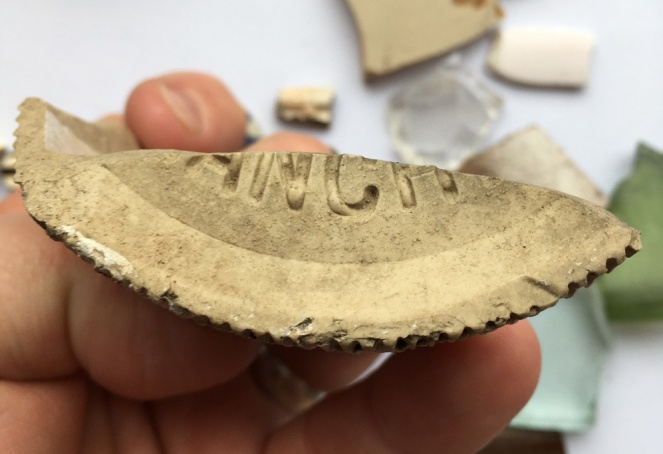
Below that is a large, roughly made, sherd from a large (2lb) stoneware jam jar, with the characteristic vertical fluting – once recognised, always seen! This has part of the base intact, with the words “ANCH” impressed into it.

LTP9
I love it when I come across words. You can see clearly the stoneware fabric, and the glaze peeking through from the sides of the jar

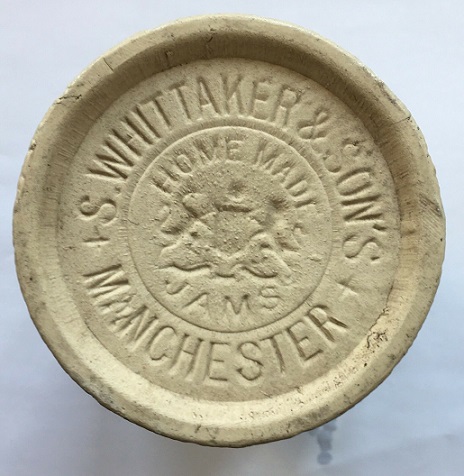
Unless it was ‘ANCHOVIES’, this could only be “MANCHESTER”, and thus it has to be a Whittaker & Son’s jar, the base of which would have originally looked like this:

LTP7
You can buy this one on ebay.

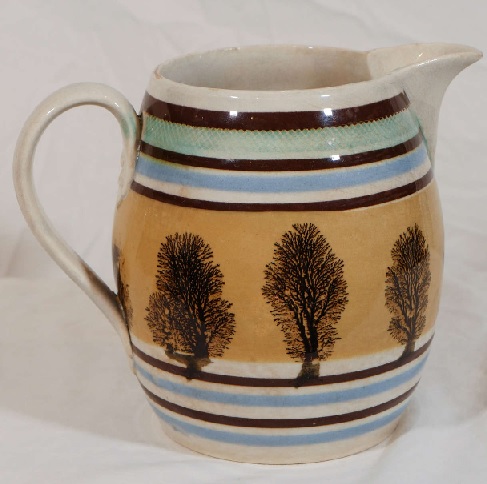
Love it! Moving on, below this, there are some random sherds, including four interesting ones. Top right, with the black tree on a brown background, is actually from a Mocha Ware pot, and would have originally looked something like this:

LTP10
Mocha Ware. I can’t make up my mind whether it is truly hideous or whether I like it?

The tree like effect is created by applying, amongst other things, tobacco juice to the slip, where it spreads to create the effect you can see. In terms of date, it begins to be made in the late 18th century, but this is probably early Victorian. There are other Mocha Ware sherds throughout the pile I found in Lean Town (for example, the sherd immediately below this one, or the two sherds below the bottle top in the first photograph), so it seems to have been quite popular here.

In the middle of the group is a base to a pearl ware bowl – quite fine, again, and small, with a base diameter of 6cm. Bottom left is an open bowl of mid-late 18th century date, in a slip-ware glaze. Right of that is another very fine tankard with a moulded base, and dating again to the late 18th century. To the right of the group, there is a delicate blue painted porcelain fragment, again thin and very fine, and quite expensive. To the right, we have some clay pipes – nothing interesting there, I just like them! Below them there is some more of the brown glazed stoneware – bowls and jars, and including a handle from a hefty jug, which in my mind was filled with frothy home-made ale (but then, to be fair, most thing in my mind are).

That’s the end of the pottery, but now for the other material. In archaeology we make a distinction between what we call ‘bulk finds’, that is, material (usually pottery) that occurs in large quantities, and ‘small finds’, which are individual items, unique to the site or objects that can tell us more about the site than the bulk finds. Often there is overlap – a piece of pottery with an inscription, for example – and usually the small finds are what most people would call ‘the goodies’! And so it is here:

LTP5
The small finds.

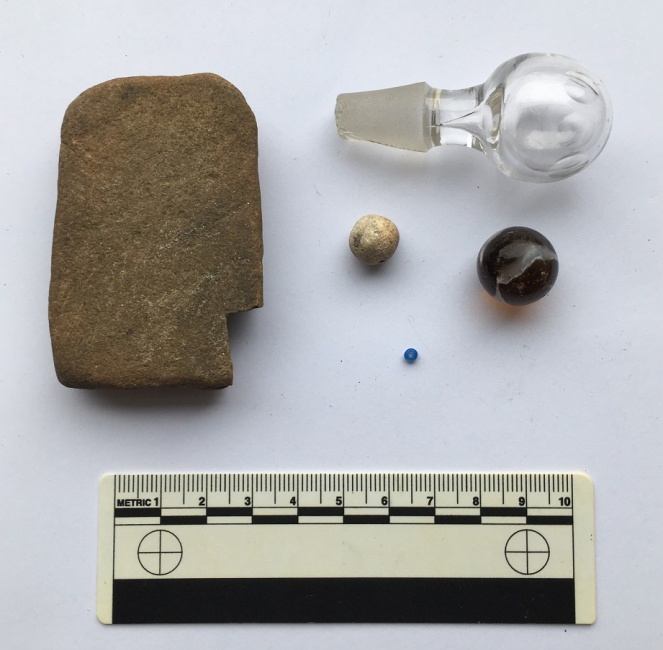
The stone on the left is, I think, a whetstone, used for sharpening knives. It is flat on both sides, worn on the surface and edges, and is the perfect shape, size, and stone type. It was probably discarded after being dropped and broken. Top is a glass stopper from a rather nice serving jar or wine carafe. It’s very delicate and beautiful – hand blown and hollow, with delicate cuts to give it a texture and grip around the top. Below this are a pair of marbles – right is brown glass with a white ribbon running through it – it’s worn, well loved, and certainly late Victorian. Left is a small, roughly made, ceramic marble, partly glazed and misshapen. Possibly early Victorian in date. Bottom is a tiny (2mm) glass bead, possibly from a decorated bag or similar. It’s lovely, and one assumes it was lost in the house, swept up, and thrown away with the rubbish. Don’t ask me how I spotted it… it just stood out against the soil.

So there we have it, Lean Town via the rubbish it once threw away, but what can we say? Firstly, the date. A lot of the material dates to the late 18th and early-mid 19th century, that is to the first decades of people living in the houses here. This is interesting, and suggests perhaps that in the late Victorian period, they buried most of their rubbish elsewhere. The second thing that stands out is the quality of the material – it better than you would expect from a simple worker’s household – some of it is very fine and tasteful, and it seems to have been expensive. Certainly the fine tankards, and the possible Wedgwood cup were, but also things like the glass stopper, the porcelain, and the pearl ware – not what I would expect from a humble mill worker’s house. I would suggest that after building it, Elizabeth Hampson lived here, or if not her, then someone like her – someone fairly well-to-do with taste. A little more research might reveal much more.

*

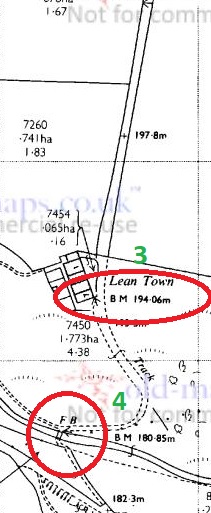
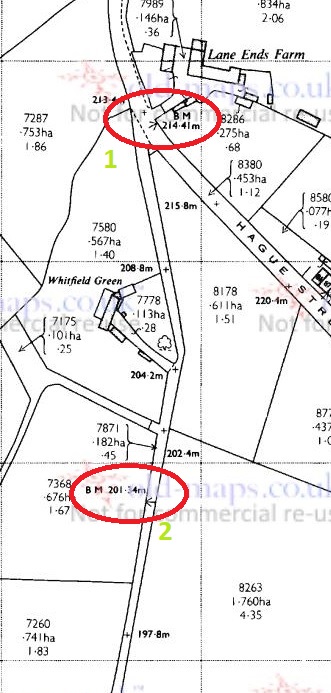
And finally, of course, what’s a blog post without a brace or two of benchmarks? There were several marked on the map:

Lean BM1
The upper part of the lane and…
Lean BM2
The lower part of the lane, including Lean Town itself and the footbridge.

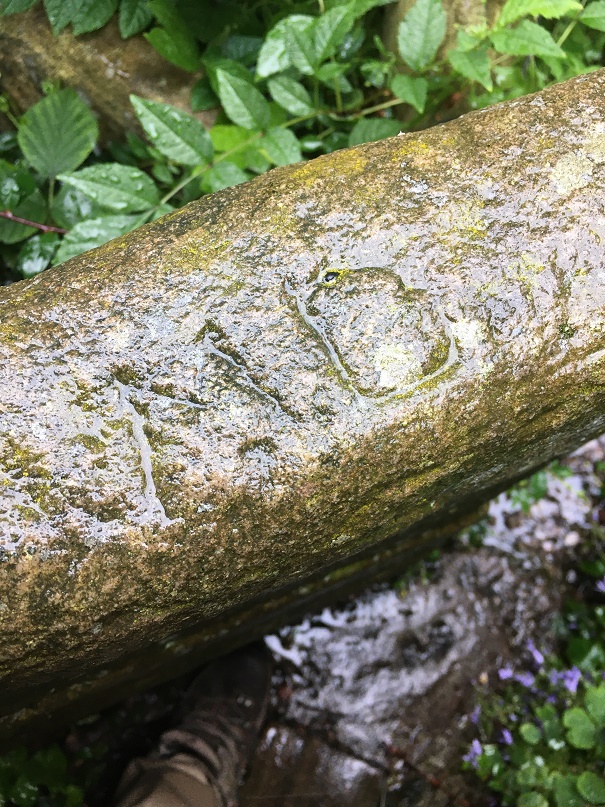
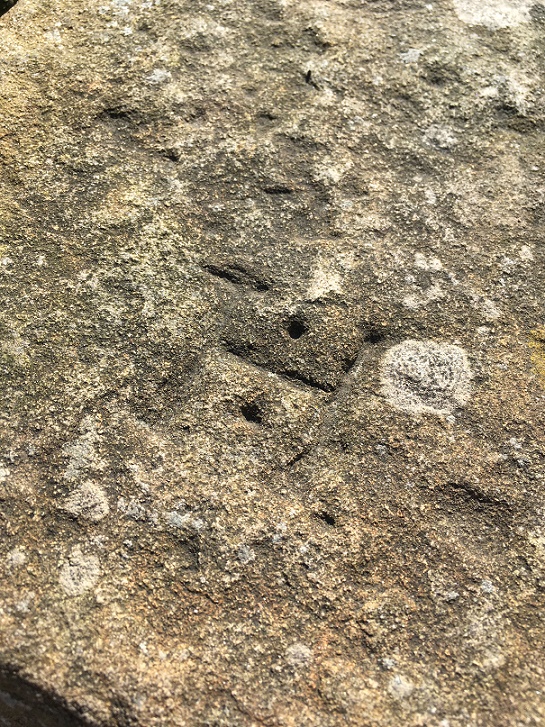
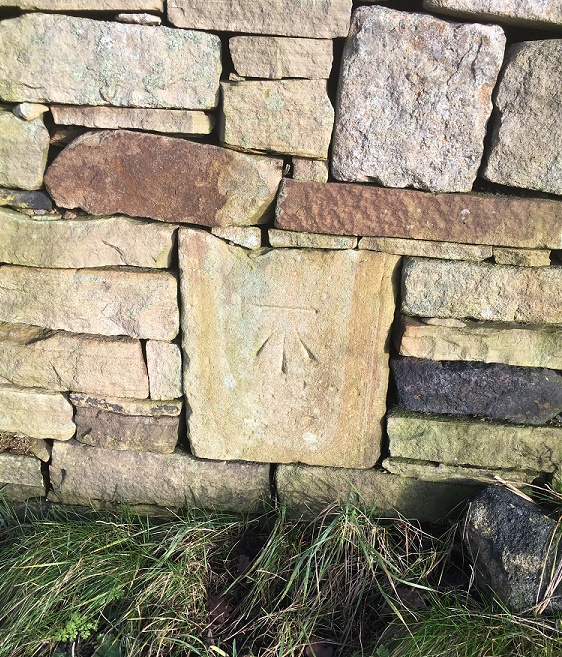
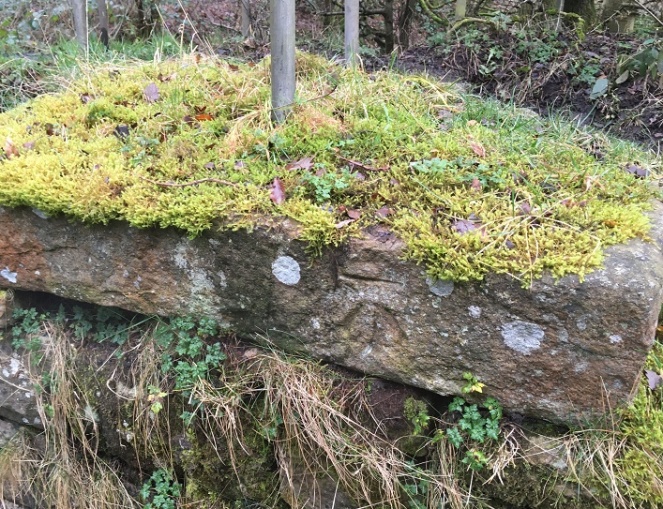
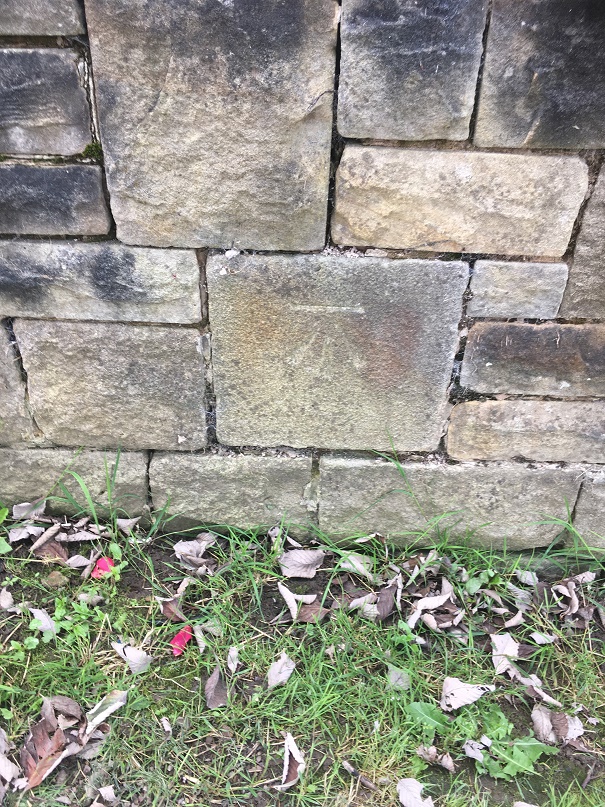
Number 1 was easy to spot, although I suspect that the wall has been rebuilt, so it might not be in exactly the correct spot. Nonetheless, excellent work by whoever rebuilt the wall to include the benchmark – very conscientious! Here it is in all its glory.

LTBM1
This is what 705ft above see level looks like. Probably. I love the veining on the rock its carved on – each line representing a splashing wave laying down sand on a beach millions of years ago. Wow, that got deep!

Number 2 was also an easy spot, on the wall leading down.

LTBM2
This one is a bit worn, and seems to have been made sometime in the 1950’s or 60’s, as it doesn’t show on the earlier OS maps, so we have to go metric for this spot height – 201.34m above sea level (which Google informs me is 660.5ft in old money)

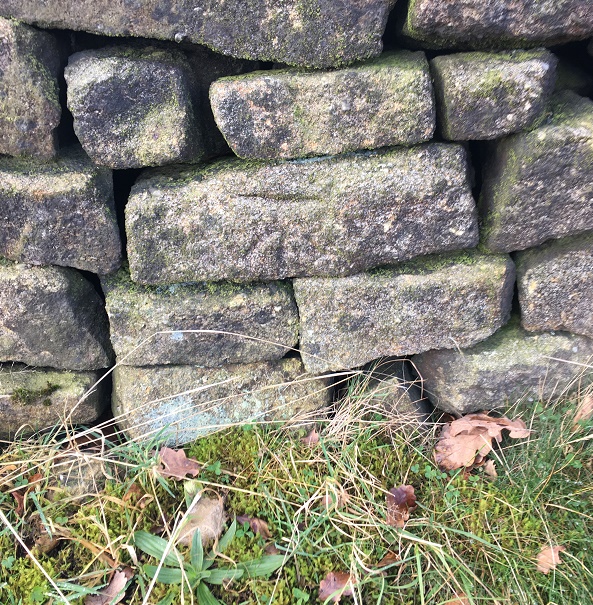
Number 3 should have been on the south east corner of the row of houses – I looked and couldn’t see anything (I didn’t look closely – nobody wants to be ‘that man who peered over our gate’, that’s how rumours start). According to this bench mark spotter’s website, the mark is definitely still there, but alas, I have no photo to show you.

Number 4, however, was there, on the stone base to the bridge across Bray Clough Brook.

LTBM4
The bridge has never struck me as being particularly old, and the bench mark doesn’t show on maps until the 1960’s, so I presume this is contemporary with Number 2 above. Anyway, here we are at 180.85m above sea level.

Bray Clough Brook joins Long Clough Brook a little farther upstream, and in turn it joins Glossop Brook at the bottom of Primrose Lane – I blogged about the confluence here.

Right then, I think that’s about it (I can hear you, you know, breathing a sigh of relief). I will try and be a bit more frequent in my posting… and try to tackle smaller subjects! When I started to write this, I really had no idea how large a post it would become! But there you go. Please, any comments and ideas are always welcome. More soon, I promise.

But until then, I remain.

Your humble servant,

RH

Archaeology · Bench Marks · Pottery

Whitfield Avenue

A brief one today. Taking advantage of the lull in the rain coupled with a bit of a breeze, Master Hamnett and I went to fly a kite in the fields off Hague Street. On the way back, I found some bits of pottery which spurred me into doing the blog post that I have been thinking of doing for some time.

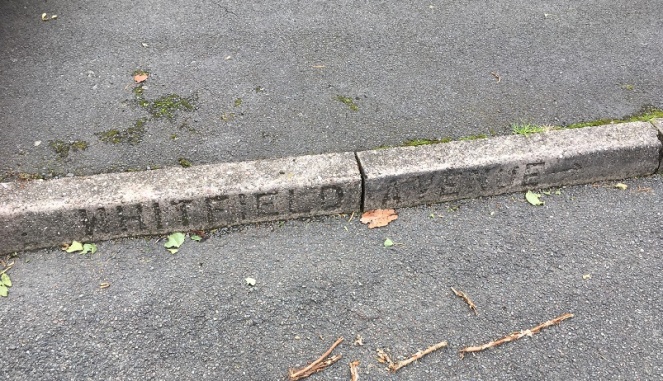
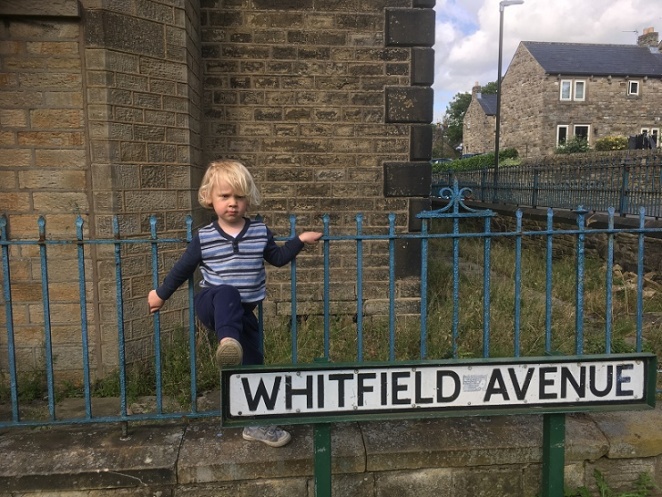
WA2
Just in case you get lost. Actually, it’s a nice touch, and I wonder where else the impressed concrete road names were placed.

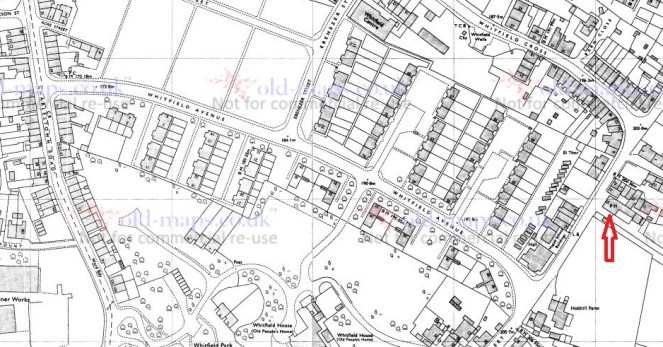
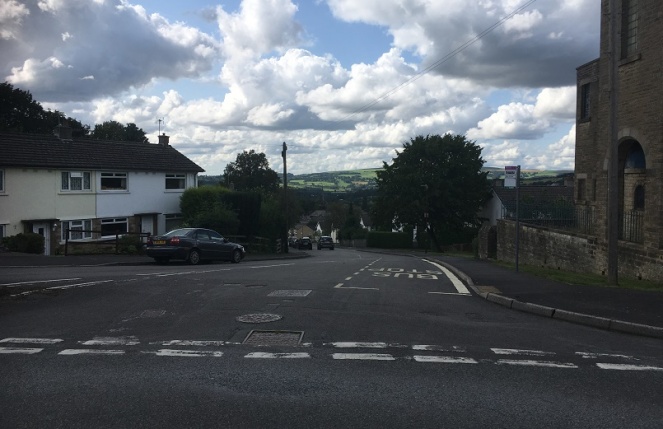
Whitfield Avenue runs downhill in a broadly NW – SE bearing from Hague Street to meet with Charlestown Road, and is parallel to Whitfield Cross.

WA4
Whitfield Avenue runs north-west – south-east. For orientation, The Beehive pub is indicated by the arrow. (1974 OS map)

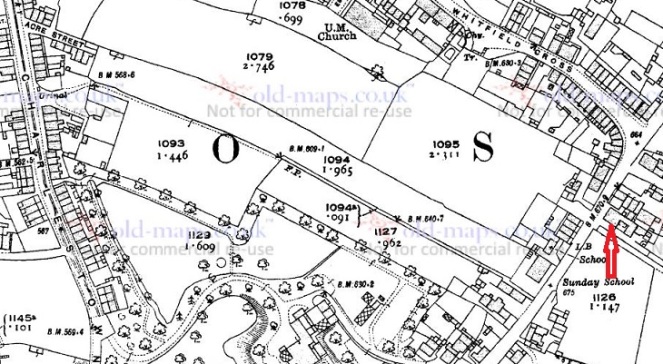
At first glance, it is not a particularly interesting road. The product of the 1960’s demolition and rebuild of the Whitfield area, the road didn’t exist prior to this, as you can see from the map below.

WA5
This is the 1921 OS map, and again, The Beehive is indicated.

What is there is a footpath, walled for most of its length, along the long thin fields that characterise the fields of Whitfield – possibly a survival of the medieval ‘croft and toft‘ field system, or more likely a result of the enclosure of the land there in the early 19th Century. This is interesting, as we shall see, but it also probably explains why the council chose there as the location of the road – using an already existing path.

wa22
Whitfield Avenue from Hague Street looking down to St James’s Church and Charlestown Road. On the ridge line in the distance, on either side of the left hand tree, is All Saints Mottram (left) and the Deep Cutting at Roe Cross (right).

Historically, then, it is interesting, but not exactly earth-shattering. That is, until you peel back the modern, and take a closer look.

Hague Street was the original packhorse road from Chapel en le Frith to Glossop (now, Old Glossop) – there is some discussion about the road, here, and there is the Glossop Guide Stoop, too (and more here). It was an important route, and the village of Whitfield grew around it – this is the oldest part of the area. Dating for this road is tricky – we know it was there in the 10th Century, as the Whitfield Cross was placed at the junction of Hague Street and Whitfield Cross (the road), and presumably some form of settlement – perhaps just a farmhouse – was there at the time. Beyond this, however, we have no evidence. However…

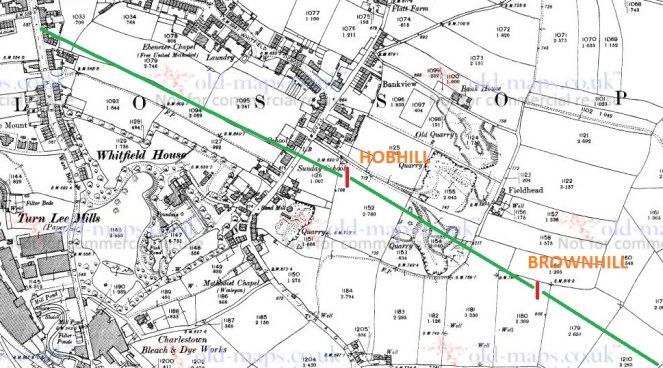
In the early 1970’s a series of excavations were carried out by two archaeologists – Peter Wroe and Peter Mellor – in order to establish the line of the Roman roads to and from Melandra Fort. Although this thorny and difficult subject has been much debated (and only recently – possibly – put to rest), they made great leaps. One of the roads, that coming from Navio Fort (Brough, near Castleton) passes through Brownhill, and comes through Hob Hill Meadows, and continues down the line of what is now Whitfield Avenue. From there it travels down the road that are now known as Hollincross Lane and Pikes Lane, and over into the fort.

Yes, you read that correctly, Hollincross Lane/Pikes Lane, especially its latter part toward Pikes Farm, is a Roman road.

WA6
The line of the Roman road is shown in green, leading down what will become Whitfield Avenue and onto Hollincross Lane and Pikes Lane, and then to Melandra Fort.

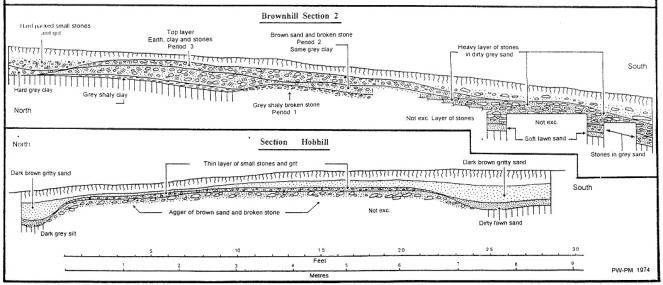
The excavations not only revealed the broad line of the road, but also how the road was built. The next picture shows what is called an archaeological section drawing – essentially a slice of the road was taken out, and the side of the slice was drawn showing the layers that made up the road. And all this is just 1ft below the ground, which is quite remarkable.

WA7
The upper section shows what is marked ‘Brownhill’ on the above map, the lower shows ‘Hobhill’. The road is very clear, and very large, too.

Interestingly, and as an aside, Hob Hill as a placename means ‘Devil’s Hill’ – I have said it before, I love it when folklore and history meet.

The ‘original’ footpath on the first map pretty much follows the line of the Roman Road. This is interesting, and suggests that the path used the surface of the Roman road, or a later incarnation of it; there is no point in making a new path if you can use an existing one, especially if that one has a good surface. What I like about this is that a road built 2000 years ago, directly dictated to the council the course of a road built in the 1960’s. History affects us in the present in many ways.

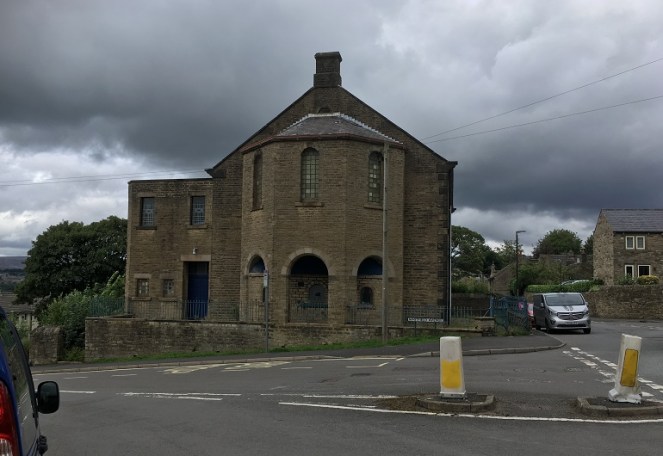
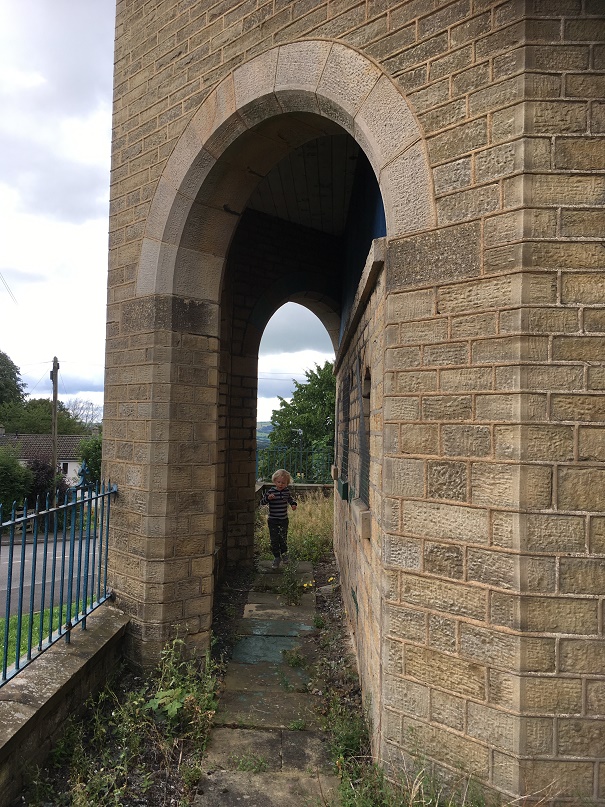
At the top of the road stands this wonderful, forlorn, and if I’m a little honest, slightly terrifying, building – the former Chapel/Sunday School.

WA9
I can’t be the only one who gets weird Amityville vibes from this building, can I? It is the ‘house on the hill’ after all.

I have always been intrigued by this building, and so taking advantage of the open gate, I had a look around.

WA13
Master Hamnett having a look around.

It’s really quite a lovely, if very Victorian, building, full of nice touches.

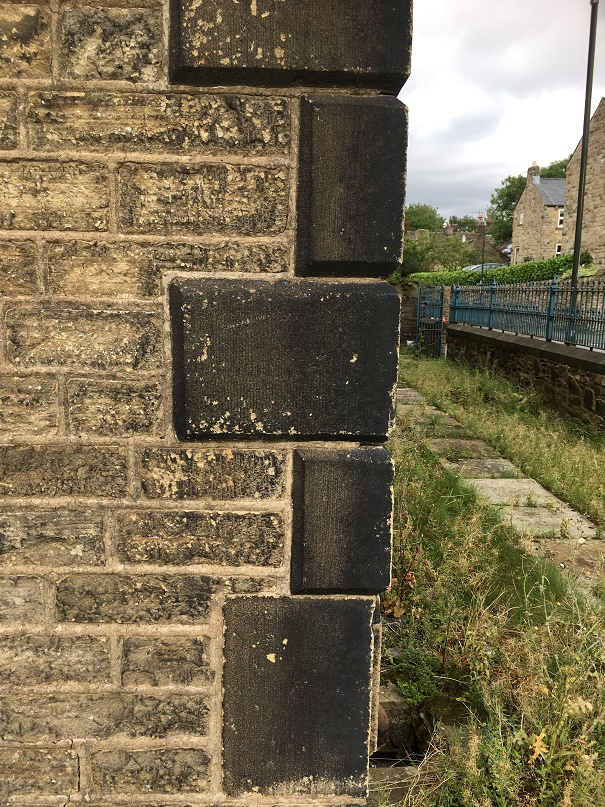
WA17
The quoins give it a rather grand air, with some nice masonry.
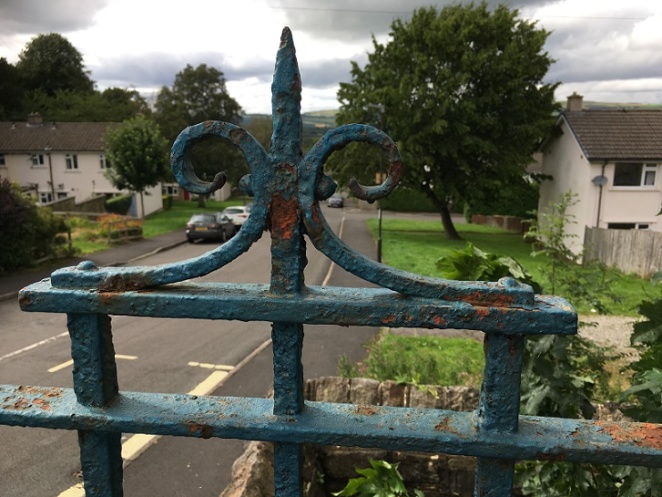
WA16
Ornamental ironwork, sadly in disrepair, and in need of painting. An artful shot looking down Whitfield Avenue – very unlike me!

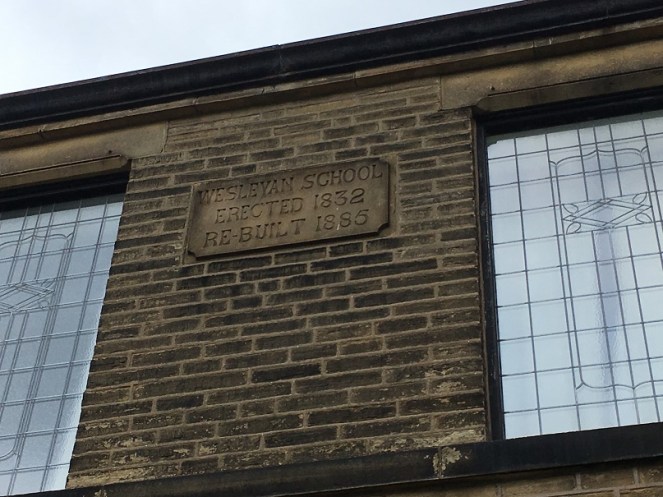
There is also a datestone, helpfully recording the dates of the original construction, the rebuild, and what its function was.

WA11
I do love the Victorian literal approach to recording things – it really helps us historical types.

Actually, it was also altered a third time in 1931 to incorporate the chapel further up Hague Street which by then had fallen into disuse. This Methodist chapel (itself rebuilt from the original 1813 version), had once contained the pulpit from which John Wesley had preached, and which in 2010 was returned to its rightful home in New Mills (see here for information and photograph).

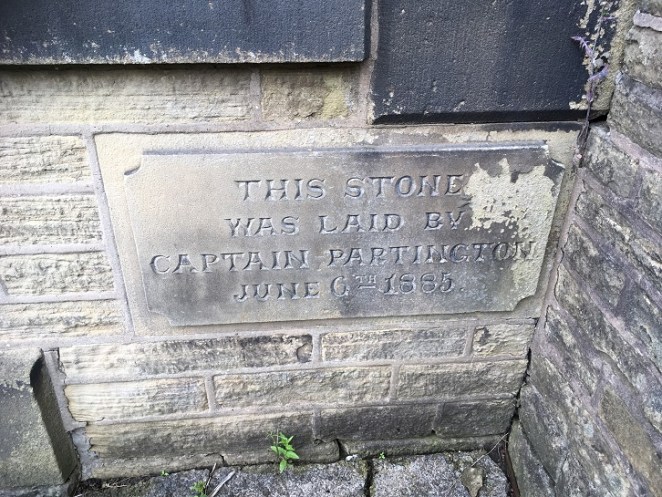
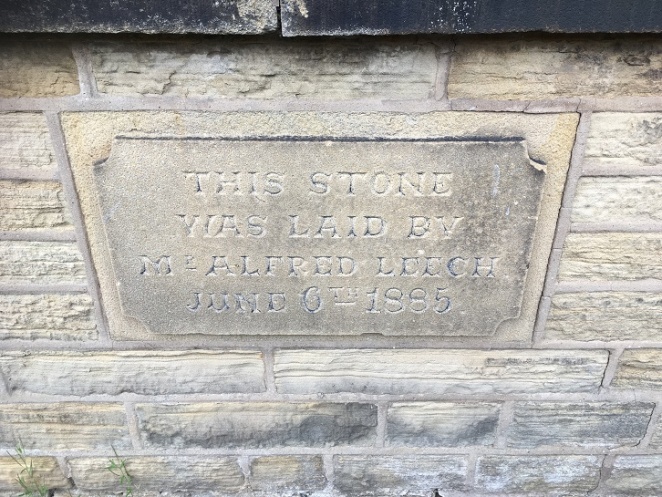
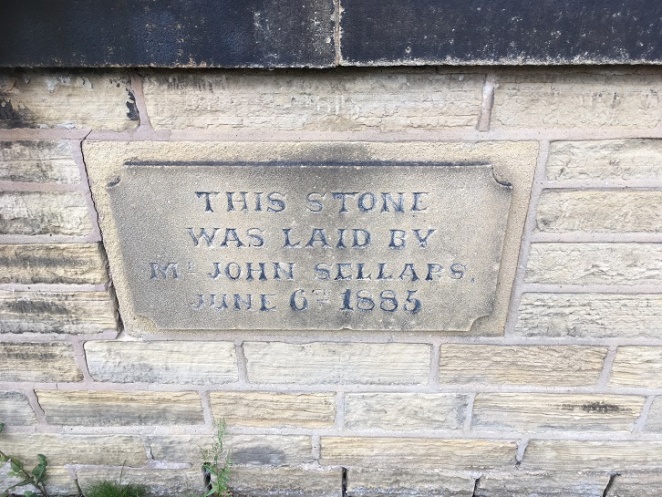
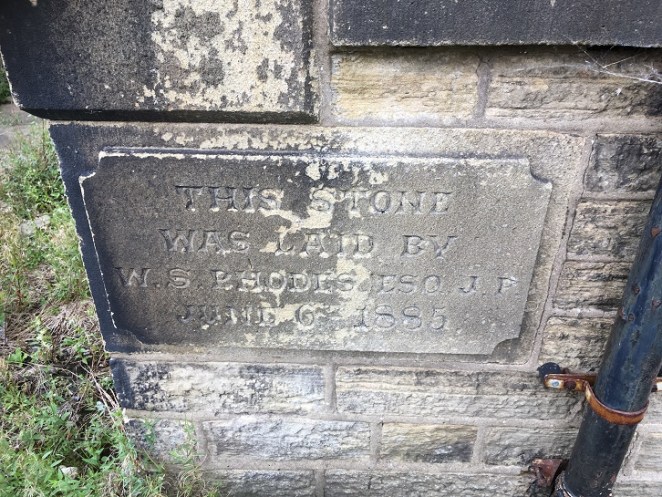
The 1885 rebuild had four cornerstones embedded into it, recording the local worthies who attended the ceremony, and which allow us a peek into Late Victorian Glossop life. Here they are:

WA18
“This stone was laid by Captain Partington. June 6th 1885”
WA19
“This stone was laid by Mr Alfred Leech. June 6th 1885”
WA20
“This stone was laid by Mr John Sellars. June 6th 1885”
WA21
“This stone was laid by W.S. Rhodes esq. J.P. June 6th 1885”

So these are the stones, but who are these people?

Captain Edward Partington: Partington was a very important person in Glossop’s Victorian history – his biography is impressive, but in summary he was born in 1836, and moved to Glossop in 1873, buying up all sorts of mill concerns, and ending up Rt. Hon. Edward Baron DoverdaleRt. Hon. Edward Baron Doverdale, dying in 1925. He did a huge amount of philanthropic work around the town (funding the library, for example), and served as Captain in the 3rd Derbyshire (Volunteers) Rifle Corps. Oh, and was a mean rugby player, by all accounts.

Alfred Leech: There is very little information about Mr Leech that I can find. He crops up in a number of interesting places associated with Glossop society, and he is mentioned in the London Gazette as being elected as a land tax commissioner. His address is given as Cowbrook Cottage, Sheffield Road, Glossop. More research is clearly needed!

John Sellars: He is even harder to pin down. He might be the Methodist lay preacher mentioned in “Echoes in Glossop Dale: The Rise and Spread of Methodism in the Glossop Circuit” by Samuel Taylor of Tintwistle (1873). Or then again, he might not.

W. S. Rhodes: William Shepley Rhodes was a councillor, alderman and mayor for varying amounts of time. The Rhodes family were involved in various mill concerns in the aream and are well known. William was also known as a strong athlete and a good sportsman, being the president of the Glossop Cricket Club for a while.

So there you are – the more you know… or less, in some cases.

The chapel/Sunday school continued in use until Easter Sunday 1968 when it had its last service. It is now known as the Spencer Masonic Hall, and is where, from 1973 onward, the Freemasons Lodge of Hadfield 3584 have met on the first Thursday of each month. And at some stage it was up for sale – the sales brochure can be seen here (complete with interior view!). It’s a lovely building, but very neglected and tatty on the outside, and it’s a bit of shame that something more isn’t made of it.

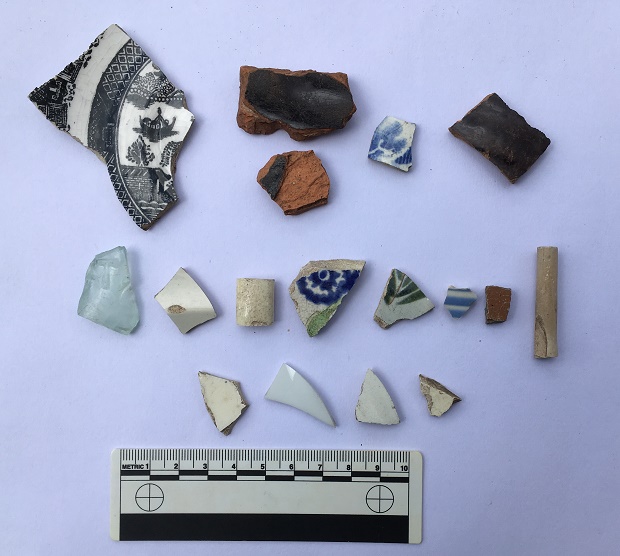
The pottery, then. Obviously it would be nice to find something Roman, but sadly no such luck. Instead, we have a selection of Victorian material, which might be the remains of household rubbish from the houses that once stood there (see above map), but equally might result from the process of nightsoiling. On balance, it is probably the former – there is no arable land in the area where I found the pottery, and the edges of the sherds are still sharp in some examples, and when pottery sherds are ploughed, the edges become rounded. There is nothing too exciting, but nice to see.

WA14
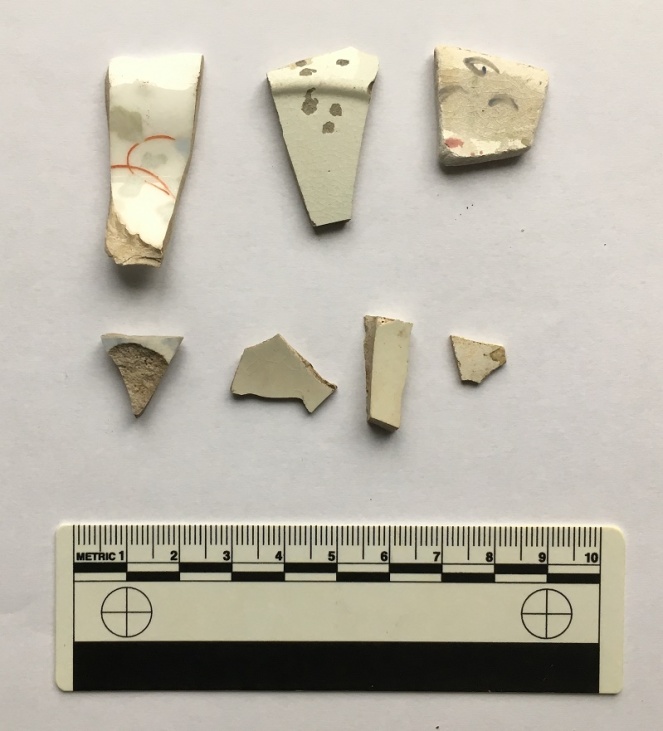
A modest selection of Victorian bits.

Top row, left to right: A shallow dish or saucer, transfer printed, and probably late Victorian, but difficult to date. Next to that are two sherds of a large Victorian cooking pot, very characteristic with thick walls, a black glazed interior, and a plain glazed reddish-orange exterior. They are made that way so that the heat can transfer through the unglazed side easily, but the glazed interior means that it is waterproof, and so holds the liquid well; quite clever really! Next is a willow pattern plate – very boring, but is patterned on both sides, so is from an open bowl type of vessel. Next, a glazed earthernware pot with grooved exterior – it’s probably a storage jar or something similar.

Middle row: Victorian glass fragment (the greenish/bluish tinge gives away its date), with a raised letter ‘T’ – clearly a company name or similar. Next, a plain sherd from a flaring rim from a soup bowl or similar; possibly early Victorian, as it has a slightly creamy opalescent glaze. Next, a handle from something – cup or bowl. Next, an early Victorian sponge ware sherd – the blue pattern actually printed, potato-like, on a sea sponge. This is the base to a bowl of some sort (base diameter is 12cm, so not huge), and judging from the wear on the ring foot, was a much used and loved bowl before it was broken. Next, a sherd from a large cup or similar (c.15cm diameter), with transfer printed decoration. After that is a blue and white striped fragment, probably from a cup or similar. Next is a stoneware fragment from a storage jar or similar, fairly bog standard (there is some discussion of the type and the method here). End, is a clay pipe stem (from toward the bowl), and has a some nice paring marks on the body, but is fairly boring stuff (although I do love them).

Bottom row: All featureless white body sherds.

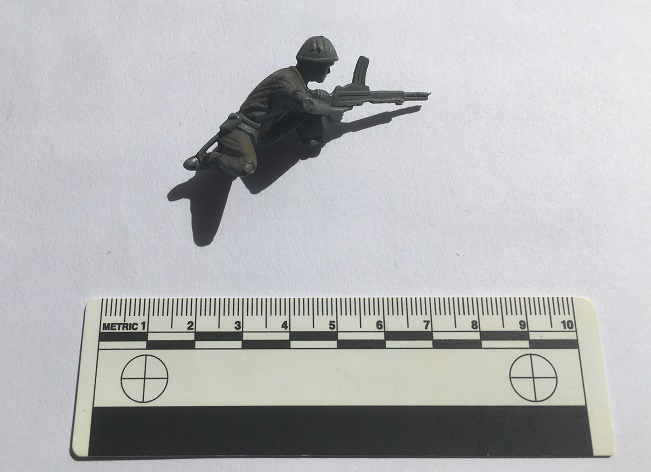
As I said, overall a fairly standard, if uninspiring, collection of Victorian pottery, and almost exactly as one would expect to find (although I do like the spongeware!). The best find, however, was found by Master Hamnett amongst the rubble and rubbish outside the Masonic Hall.

WA12hgfdjklgg
C.1980 vintage plastic soldier, courtesy of eagle-eyed Master Hamnett.

This was pretty much my childhood – plastic soldiers at a 1:32 scale. Whilst this one is not Airfix, it is still a good quality World War 2 figure – possibly Polish or Russian to judge from the helmet and gun. He’s lost his foot, and his stand, but to his credit he’s still fighting. Interestingly, he was also painted at some stage, too, and not professionally, so I think he was a much loved toy (if anyone recognises it, I’ll happily post it to them… I still mourn the loss of some of my soldiers!).

Of course, it wouldn’t be a decent post without a benchmark. On the original path there are three on the line of the track – from the top, a third of the way down (640.7 ft above sea level), one half way down (609.1), and one at the bottom (568.6).

The 1969 map (post Whitfield Avenue construction) has three benchmarks, but are of different heights (641.5, 601.5, & 564.9), and with this last on a now no longer existing ‘public convenience’ at the bottom of the road. Presumably they were re-surveyed and marked when the road was built, as the evidence of the carving seems to indicate. The only one that is still extant is the middle of the three, the others seem to have disappeared, alas.

WA10
An old stone block, rebuilt into the 1960’s wall, and with a new benchmark carved into it. 195.5 metres above sea level (641.4 ft in old money)

So, a lot of history and archaeology of a single road were explored on a single afternoon

WA15
Master Hamnett looking like he owns the place.

And, of course, we flew a kite, which was the best bit!

WA1
A successful day for Master Hamnett, too.

Well, that turned into a much larger post than I anticipated… who knew a 1960’s built street could be so interesting? Comments, as always, very welcome.

More soon, but until then, I remain.

Your humble servant,

RH

Archaeology · Wells

Some Lost Mottram Wells – An Update

A while ago I posted a blog entry about some named wells in the Mottram area.
Read the post here to refresh your memory, it’ll help with what follows.

We were facing a slight conundrum. The issue was that there was the two wells in the one field – neither of which was really visible on the ground – coupled with the fact that one of them was called Boulder Well, a very specific place-name, despite there being no associated boulder. Oh, and there was a boulder in a different field, but with no associated well. Well, I think I have found out what it all means. Probably.

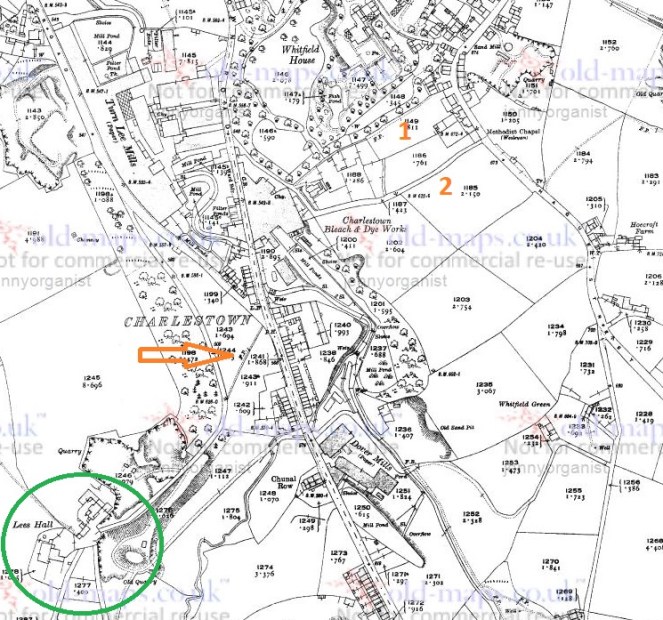
The map, first of all.

Well 1
The two named wells are in the bottom circle, marked with a ‘2’. The boulder in the original blog post is in the upper circle, roughly where the tree is on field boundary. 

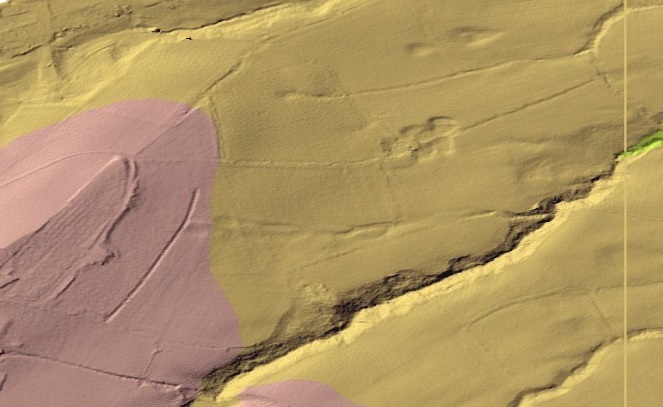
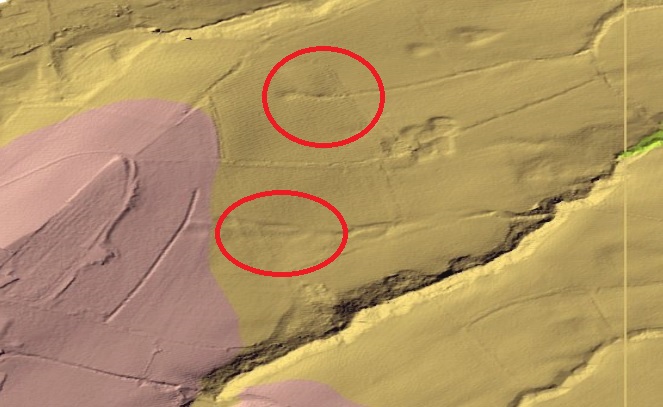
I was looking over some Lidar images of the area, and noticed something interesting. For those of you who don’t know, Lidar is a method of using light (laser) to map the ground surface, allowing for a greater contouring of the ground, and revealing every single bump and dip on the surface. Quite literally, everything – it simply strips away trees and vegetation. It’s application as an archaeological tool is enormous, and it allows us to not just identify, but to map, record, and categorise all sorts of things that are invisible on the ground.

Like old wells, for example.

So, using the government’s Lidar website (highly recommended, by the way),  this is what I saw.

Lidar 1
Despite being a mass of lumps and bumps, this is broadly the same area as the map above.

To help you identify the area better, here is the same image with the red circles on it.

Lidar 2
The upper circle is where the boulder is, the lower is where the two wells are on the map. 

What the image shows is that where the two wells are recorded on the map – Grave Well and Boulder Well – there is only the remains of a single feature. You can see the line of the waterway moving from left to right, passing through the lower circle, and eventually draining into the small valley there. Single feature, a single well. Not the two wells recorded on the map.

Now look again at the upper circle. The field boundary where the boulder is can just be made out, but to the right, precisely where there is a ‘trough’ marked on the map, is a spring head, and you can see the drain, running east and again emptying into a small valley. There IS a well there, it’s just that you can’t see it on the ground.

Looking again at the map, we can see only one well place or structure in the lower circle. This, I humbly submit, is Grave Well, not Boulder Well – its location right next to the graveyard is the clue. Boulder Well is situated in the upper circle, next to… yup, you guessed correctly, the boulder, and the trough marked the place where the spring issued forth. This makes sense.

I am convinced, then, I have rediscovered the location of Boulder Well.

All this is clear on the Lidar, but as I say, cannot be seen on the ground. It also means that the OS people made a small mistake in naming the wells – but then if a local says “yes, Boulder Well is just above Grave Well”, how literally are you to take them?

I need to go back and take some more photographs.

So there you have it. As Bertie Wooster was fond of saying “The lark’s on the wing, the snail’s on the thorn, God’s in His heaven. All’s right with the world!”.

Comments and discussions, even arguments against the newly rediscovered well will all be gratefully received. Also, I have a few more blog posts that are about to be published, so keep your eye open.

As always, I remain your humble servant.

RH

Archaeology · Pottery · Whitfield Well

The Walk Part 3: A Wall and Its Secrets

Welcome back for the third and final instalment… it was a very productive walk indeed! The first two are here and here.

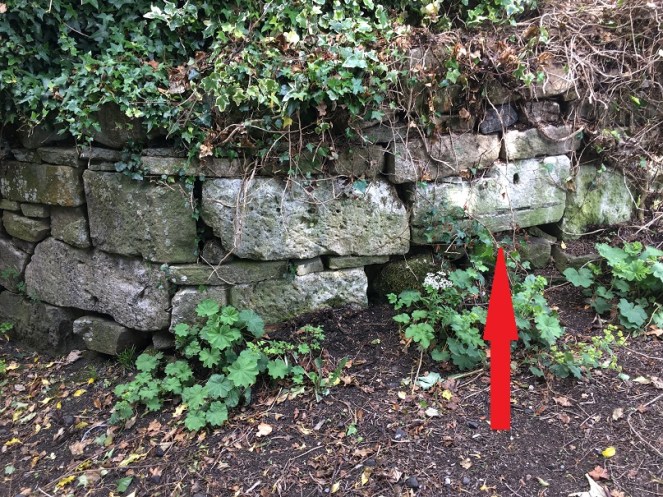
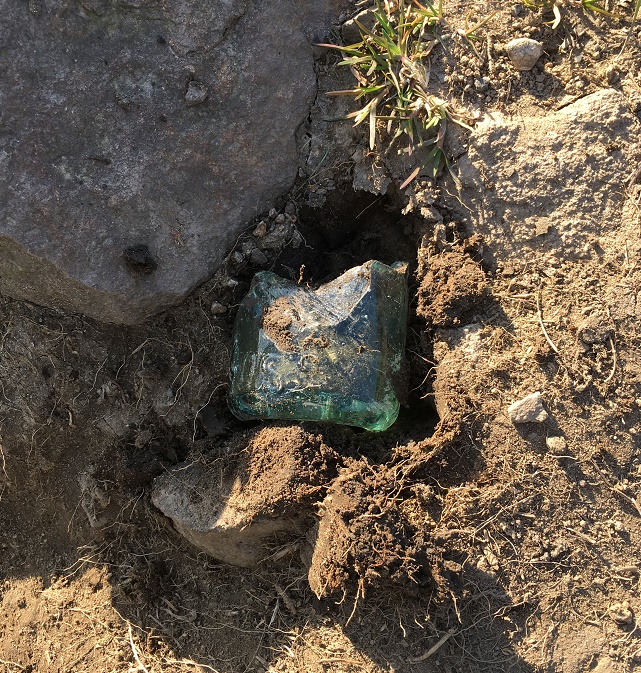
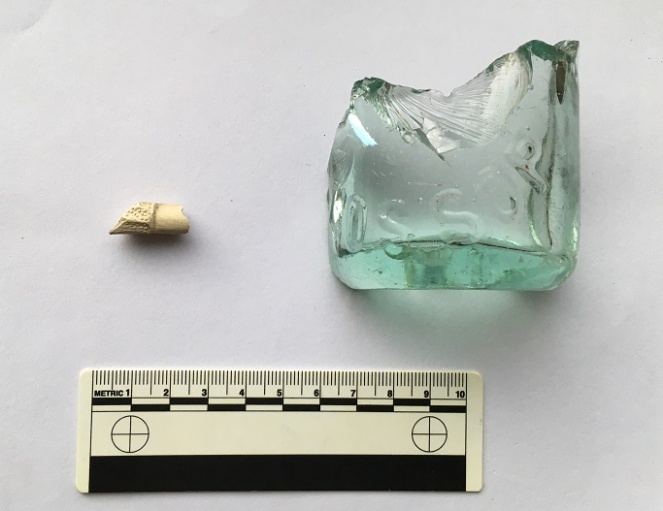
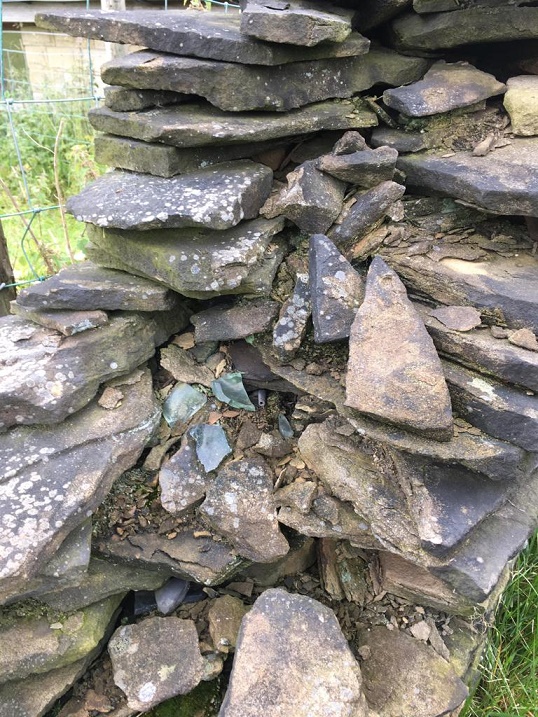
As we continued along the track, we came down, toward the place where it joins Cliffe Road, near where the Guide Stoop is. Here, the wall on the left has been removed, and replaced by a fence, but at the bottom of the track, there is a stump of the wall left, ruined. And spilling out of the wall’s innards, so to speak, I noticed some glass, some pottery and a black tubular object. Well, I could hardly leave them there, could I?

Wall 1
As you can see, the wall is not in great condition, and the bits spilled out.

So then, what do we have?

Firstly, fragments of a Codd Bottle.

Wall - Codd 1
The fragment on the right is from the neck going into the rim.

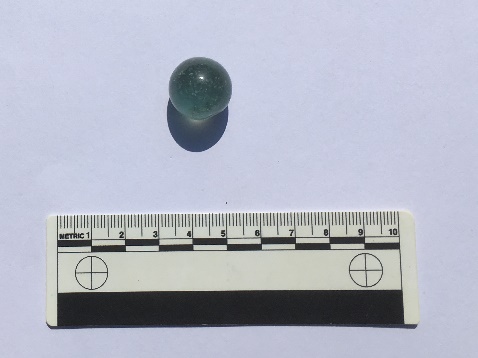
Invented by Hiram Codd (great name!), he patented the famous design in 1872, and began manufacturing them on a large scale in 1877, or thereabouts. This groundbreaking design was a way of keeping fizzy drinks carbonated using a glass ‘marble’ inside the bottle, with the gas keeping the marble pushed firmly against a rubber seal.  When empty, they were often broken open by children to retrieve the marble; here is one I found in my garden a few months ago.

Wall Codd Ball
Hand made in two halves (you can just about make out the seam), it contains many small air bubbles. It’s quite a pretty, if utilitarian, thing. I really should blog about my garden finds sometime.

The bottle was broken before it went into the wall, and you can see that different fragments had different amounts of soot and air exposure, causing the variation in colour. I spent a happy 5 minutes gluing this together – superglue really is a marvel! Anyway, here is a complete Codd Bottle, showing its very distinctive ‘pinched’ shoulder/neck, very thick glass, and you can just make out the marble in the neck.

Wall - Codd
A lemonade Codd bottle from this great website here. Worth an explore.

It remained in use until perhaps the 1910’s, when other, more simple, designs – mainly the screw stopper – replaced it as a way of keeping drinks carbonated. Here is an excellent website that talks a bit about them – it is well worth an explore.

Next is a piece of green glass bottle dating from the 1870’s on, and which probably held mineral water or beer.

Wall gree
A moulded bottle – probably a beer bottle. You can see the shield border on the left.

This one was moulded, not blown, and has the remains of an embossed decorative shield that would have shown the manufacturer. Each company would have its own design, and usually they were locally made, so it might be a Glossop bottle. Here is a whole example of a bottle showing what I mean.

Wall - Green Bottle
One green bottle…

There is a fascinating website here that discusses coloured glass from a historical archaeological approach, and despite being American in focus, it is very useful, and well worth an explore – it is one I return to time and again for facts and identification help.

Another bottle fragment, this time a concave base, and with an moulded number ’13’ on the bottom.

wall - bott
You can see the number ’13’ clearly at the bottom.

It has a base diameter of 8cm, is made of thick glass, and judging from the wear marks on the base rim, the bottle was used over a period of time, or possibly used and re-used. Late Victorian is a guess in terms of date (thick glass & greenish hue).

Then there is this…

wall - gla
Nope… not a clue!

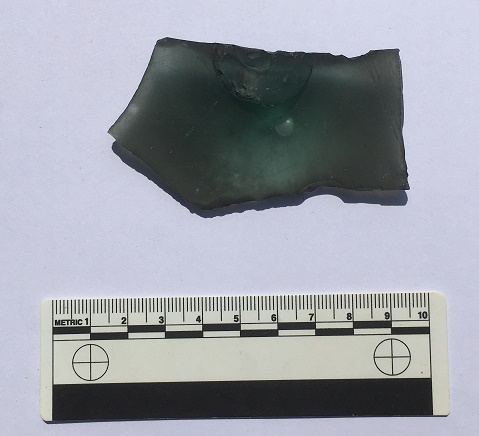
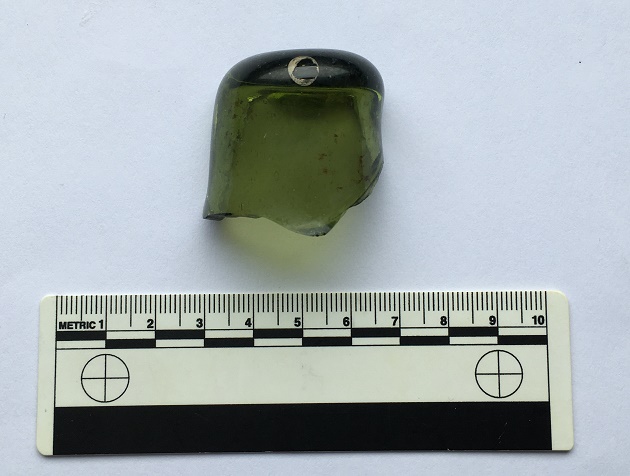
It is glass, broken, and has a raised bump on one side, centred over a feature on the other side. This feature – visible in the above photograph – is circular, tube-like and hollow, and has an impressed mark in the centre, made when the glass was still soft. The only other features are a pair of parallel lines running diagonally to the right of this central feature, and scored onto the object when the glass was cold. The glass itself is thick, full of air bubbles, and has a greenish tint, all of which suggests that it is old (Victorian or earlier)

I have literally no idea what this is. None whatsoever.  Answers on a postcard, please.

The black object is interesting; on closer inspection, it turns out that it is a pipe stem.

Wall pi pe
Hollow throughout, the left side is flattening to the mouthpiece.

Made from Ebonite (also known as Vulcanite), a type of hardened rubber, it is the bit that fits into the mouth, and through which the smoke is drawn. It is made as a separate part, fitting into the bowl via a metal ferrule – you can see the rounded end in the photograph. The other end, though broken, is of the ‘fish tail’ type stem, flat and wide, and would have originally had a lip at the end. Ebonite is still used for making pipe stems, but was first created by Charles Goodyear in 1839, with the process of making it patented in England by a Thomas Hancock in 1843. It was immediately put to all sorts of uses as a cheap durable alternative to Ebony wood, and from the 1850’s on, it was used in the making of pipe stems (another interesting website here).

Wall - Pipe
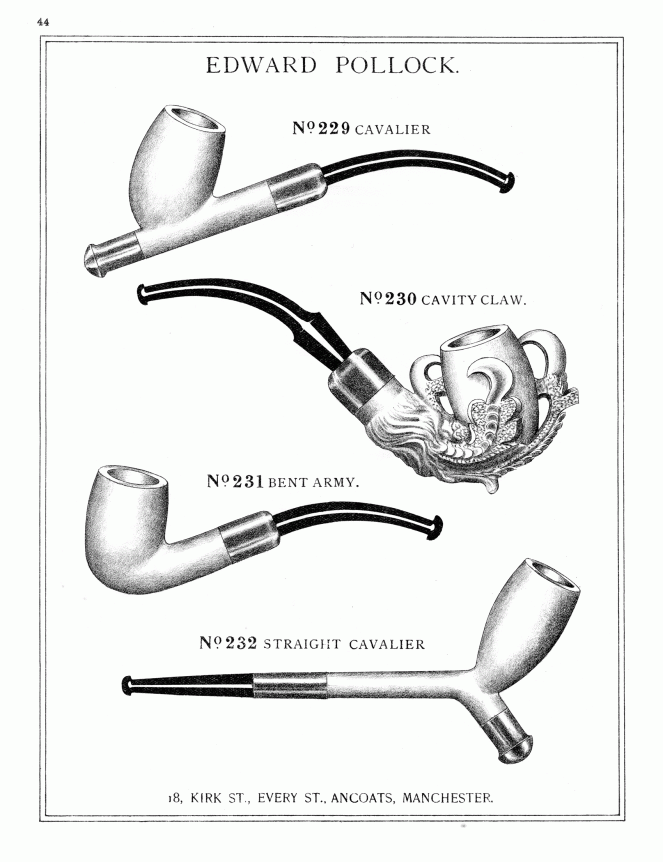
You can see the way it was used in this Late Victorian trade catalogue – the wall example even has the slight curve.


So far, so Late Victorian. So what, then, is this doing in the mix?

Wall MP2
Midlands Purple Ware dating from roughly the early 18th Century.

This is Midlands Purple Ware, a type of coarse stoneware. It is hard (fired at a high temperature), purple (though can be more orange or red), and has a large number of black and white inclusions (they look like salt and pepper). It’s very characteristic, and once you know it, you can spot it a mile away. Midlands Purple was made in huge quantities between about 1600 and 1750 (although some sources state its production started earlier, I go with this date for the classic Midlands Purple), although I think this example is late (early to mid 18th century). What is interesting is that this pot was found mixed with the Victorian material – in the top photo, you can see the pipe stem lying underneath one of the Purple Ware sherds. I’ll return to this below.

These fragments (mended) come from the base of a pot, and using the internal wiping marks at the start of the upturn of the vessel wall, I would suggest a base diameter of 25cm, and it probably comes from a large storage vessel, such as this beer container. Most houses and farms would have brewed their own beer as it was cleaner than the water at the time.

wall - mid
The bunghole at the bottom is for draining the home brewed beer, leaving the grain on the base of the vessel.
Wall - MP Wipe
Close up showing the internal wiping marks (where the potter had run a rag around inside the vessels when it was still wet) and the start of the vessel wall. From these marks I was able to extrapolate a base diameter of 25cm.


So what does all this mean?

Well, we know that the wall is much earlier than the Victorian glass – it is here on the 1857 Poor Law map of Whitfield, for example – and almost certainly dates from the initial enclosure of the fields and moors in 1813.

Wall - poor law
1857 Poor Law map. The wall is running NW-SE between two large quarries.

The Late Victorian material probably represents a rebuilding episode. The wall itself is still in bad repair, and I think I can detect at least three phases of construction too.

Wall Wall
The wall showing multiple rebuilds and repairs.

The Midlands Purple Ware is clearly much older than the wall, and is something of a conundrum – what is it doing here? It might represent residual rubbish incorporated into the wall. However, it is perhaps more likely the pot was still in use 100 years after it was made, but broke as the wall was being built in 1813, and ended up used as filler. Possibly. And it was then reincorporated into the wall as it was being repaired in the 1890’s.    Again, possibly.

Now here is where it gets interesting.

Why would the repairer of a field wall place a Codd bottle, a beer bottle, and a pipe stem in the wall? Pottery and rubbish is often used as a foundation bedding for a wall at this period (I have a pile from my garden that I need to blog about), but these are high up in the wall. But it does seem that the obvious answer is rubbish disposal. In this scenario, the builder has a break, smokes his pipe, but then accidentally breaks it. He finishes his bottle of fizzy water, and another of beer, then accidentally breaks them both. He curses, then places some, but not all, of the fragments in the wall, along with some other bits and pieces, and carries on building. 100 years later I find it, and here we are.

This interpretation seems fair enough. But it seems a little too convenient – a discrete, neat, bundle, carefully walled up. And the fact that only fragments were placed, not the whole thing. It would also have taken effort to do this, too, when surely it would have been easier to simply have thrown them into the field.

“Hmmm…” I say.

However, there might be another reason.

I have recently been doing research into the tradition of hidden objects within the fabric of buildings (here is a great website that deals with the subject). Shoes, famously, have been found in the roof and around the fireplace of 1000’s of buildings up and down the country, as well as in colonial America and Australia (I have one from the Glossop area that needs to be blogged about). But it is not just shoes, these caches contain all sort of clothes, and indeed all sorts of objects – including bottles, pottery, and pipes – and all dating from c.1600 to 1900.

9-e7d12363f2
A deposit of various objects from a farmhouse in Suffolk. Taken from an article by Timothy Easton (the copyright is all his, and I have stolen the photograph for illustrative purposes only). And no, that’s not me in the photo.

The term used to describe these caches is a ‘Spiritual Midden’, with the idea being that each of the objects is placed in the cache at the end of its useful life, and is then sealed away and hidden from view in a midden. The study of this tradition is relatively new – bundles of rags and objects when discovered are usually thrown away – and it is little understood beyond a general consensus that they are broadly connected with concepts of ‘luck’ and ‘protection’ from evil or witchcraft. They are believed to be ‘apotropaic’ (that is, they ‘turn away’ evil – I blogged about the subject here and will return to it again, as I find it fascinating). Briefly, spiritual middens seemed to have functioned by making the deposit of clothing and objects the target of bad luck or witchcraft, rather than the people within the house. In a real sense the cache stands for, or personifies, the individuals within, and acts as a lightning rod for any negative energy, safely diffusing it.

The ‘meaning’ of the individual items within the midden is unclear. The shoes, gloves, trousers, and other garments are the most obvious – they are very personal items, and are usually deposited worn out, meaning they have, in a sense, moulded to the individual, and have been imbued with their essence. The bottles are less clear; perhaps connected with ‘witch bottles‘. Bones may relate in some sense to food, and pipes have been suggested as connected with fire, or more specifically fire prevention. This is all speculation, of course, but something is going on with deposits of objects from the early 17th century on, and which lasts until the end of the Victorian period. Perhaps, then, we are seeing a decayed form of this deposition ritual in the objects hidden during the wall rebuild in the 1890’s. Of course, by this time the ‘meaning’ of the caches, whatever it was, would likely have been lost, and the ritual of hiding certain objects was carried out as a ‘tradition’ or ‘thing we do’, or simply ‘for luck’, with none of the belief that drove and informed earlier caches.

This interpretation is made all the more plausible by the fact that the location of the ‘cache’, if such it is, is at the very end of the wall. Thus, it represents either the very first part of the wall begun, or it forms the last section made; either way, the deposition of objects there seems appropriate. There is also the tantalising possibility that the Midland Purple Ware pot base also represents the remains of a similar, earlier, cache. A small cache of objects deposited for luck, to help the wall stay upright, and the land and its owner prosper.

But then again, of course, it could just be rubbish!

If you are interested in Spiritual Middens and hidden objects, there is an excellent paper here which discusses the contents and their meaning. It’s written for the general reader, so it’s not too theory heavy, and it contains links to other papers on the subject. Also, you can email me for more information, as it is a special interest of mine, and one that is only now receiving attention.

As always, comments are welcomed… even encouraged. More soon, I promise, but until then, I remain,

Your humble servant.

RH

Archaeology · Folk Tales · Oddities

Gallowsclough

There’s no mistaking some etymologies.

Placenames in the past were given because of what was there, not aspirational or deliberately flowery. They were practical. Descriptive. Truthful. There was no Laurel View if there was no view of laurels. Gnat Hole was not named ironically. And Shittern Clough was… well, you get the picture.

For me, Gallowsclough has always stood out in the map of the area – the clough, or narrow valley, where the gallows were. There is something of the macabre about the name, and I was also aware of a folktale from the area which really made an impression on me (more of that in a bit). So I decided to do some exploring, to see if I could add to the placename, and see if I could work out where the gallows were… as Mrs Hamnett put it “lucky me, you take me to the loveliest places”.

I’ve blogged about this area before (White Stone of Roe Cross), but the area is effectively the Deep Cutting between Mottram and Stalybridge. Gallowsclough is highlighted (the clough itself, or small deep valley, running towards the Dog and Partridge).

Gallows 1b
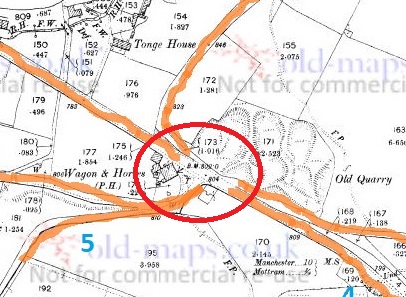
Gallowsclough and area. This from the 1898 1:2500 OS map (via the awesome oldmaps.co.uk). The main road to Stalybridge from Mottram runs diagonally through the map, with the deep cutting starting at the Wagon and horses.

So then, the gallows.

The last person to be hanged in public was in 1868, after which time, and until capital punishment was abolished in 1965, executions took place within the prison, away from the public eye. But before 1868 it was a public spectacle, to the point that the hangings at Tyburn were turned into a public holiday. Often associated with the public hangings of the 17th and 18th centuries was the punishment of gibbeting, in which the hanged criminal was enclosed in a tight fitting cage or chains, and effectively left to rot. The body was  covered in tar in order to protect it against the elements, and hung there as a warning to others until it finally fell to pieces.

Each area, feudal estate, or manor had a gallows/gibbet, and certainly until the later Tudor period or even the early modern period, capital punishment was the responsibility of the lord or equivalent. It seems that the victims were buried underneath, or nearby, the gallows, but certainly not on consecrated ground. To be executed was to be condemned to eternal restlessness, to never know peace, and to wander the Earth an unhappy spirit.

In order to achieve maximum visual impact, the gallows were normally set up at prominent places – central open spaces, or more normally, crossroads. And so it was here, in Roe Cross. The body swinging, both at execution, and in a gibbet, could be seen  easily by both locals, and by travellers moving along the various roads – a physical reminder to obey the laws, or suffer the consequence. Interestingly, this tradition of both execution and burial at a crossroads has given rise to the concept that a crossroads is an odd, supernatural, place. If you want to sell your soul to the devil, where do you do it? Where do you bury witches? Or suicides? Or criminals? At the crossroads, that’s where.

So where were the gallows at Gallowsclough? It is very doubtful that they would have placed them further up the clough – difficult to get to, in arable land, and there are no crossroads. No, I think they erected the gallows at the point Gallowsclough – the clough, or deep valley, upon which the gallows are placed – crosses the road. At almost exactly the point seven – count them – seven tracks join. This is no crossroads… this is a crossroads and a half. Here is a map showing the tracks (numbered).

Gallows 1
The seven tracks shown on the map existed before both the turnpike road and the ‘Deep Cutting’ were made. Walking them, you can see why the turnpike was created. It is still perfectly possible to travel to and from places on these tracks, but perhaps don’t if you don’t have a 4×4.

This is the area close up – you can see the tracks meeting.

Gallows 1 - closeup
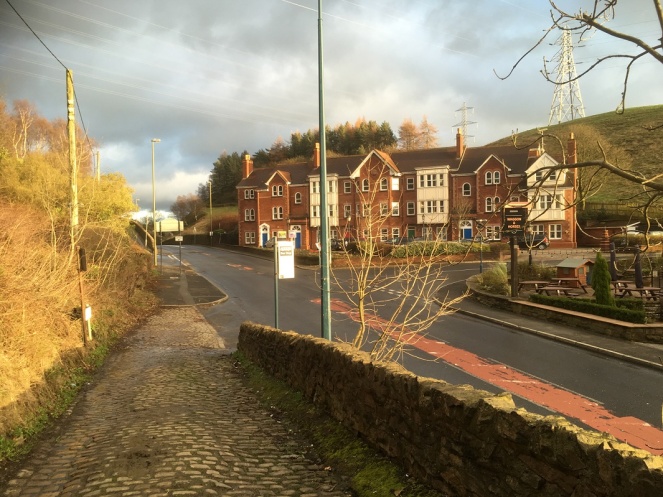
Right by the Wagon and Horses… enjoy your pint!
Crossroad Blues
This is the site. You can see the roads meeting, and here at the bottom of Gallowsclough Road, you can see the setts of the original track, laid to give horses some traction at the start of the hill.

The roads are as follows (the numbers are faint in blue in the map above):

  1. Gallowsclough Road – From Saddleworth, via Millbrook (avoiding Stalybridge). This is the Roman Road between Castleshaw Roman fort and Melandra (thanks Paul B.)
  2. From… well, the middle of nowhere – local traffic from farms
  3. From Hollingworth.
  4. From Mottram via the old road.
  5. From Hattersley, via Harrop Edge.
  6. From Newton.
  7. From Stalybridge, via the old road.

A perfect situation for an execution and gibbet. It was said that it was to these gallows that Ralph de Ashton (1421 – 1486) sent the unfortunate tenant farmers who couldn’t pay the fines for allowing Corn Marigold to grow amongst their crops. The death of the hated Ralph is the origin of the Riding the Black Lad custom and the Black Knight Pageant in Ashton Under Lyne, a tradition sadly no longer undertaken. Naturally, the area is said to be haunted, with the locals avoiding the place, even in daytime. Although, as is so often the case, there are no references, only suggestions.

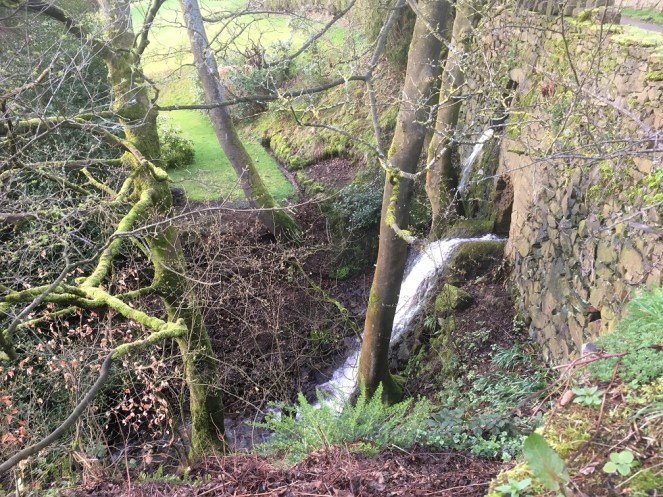
This is the clough

GH
The brook flows under Gallowsclough Farm.
hg
Gallowsclough in the background, behind Gallows Clough Farm. The electricity pylons completely ruin the area, unfortunately.

Of course, whilst I was stomping around, I happened upon a bunch of mole hills…

RC1

Evidence of nightsoiling (as I’m sure you all know, having read previous posts about this). The top row right: a medium bone china plate (c.18cm in diameter), hand painted flowers and abstract floral designs in pastel colours. This is quite nice, and is probably early Victorian in date. Middle is a plain white glazed plate, thin, and again about 18cm in base diameter (you can see the ring of the base in the photo), which makes it perhaps 24cm or more in ‘real’ diameter. Left is more difficult – it has an undulating rim, with a curled decorative motif – which means that I can’t tell you how big it is. Over 25cm in diameter, I suspect. It is a shallow dish, or deep plate, and is deocrated with abstract floral designs. Date wise? Late Victorian? Looks more modern than that, though… Edwardian? The bottom four are fairly boring body sherds, though the sherd on the left is a blurred willow pattern, so potentially quite early?

RC2
Contents of a Molehill, pt. II

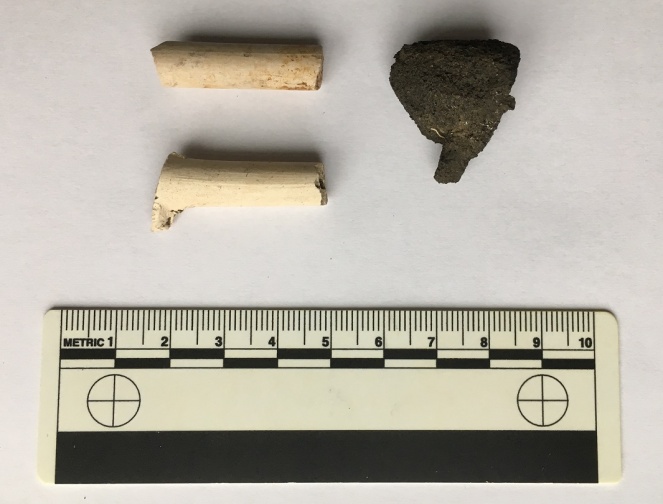
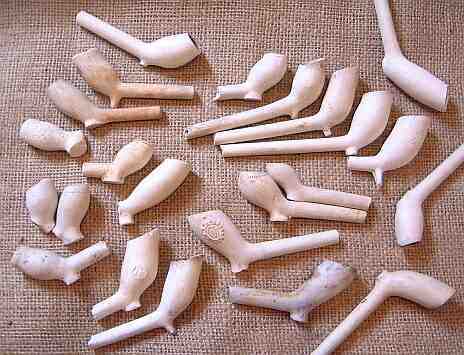
The ubiquitous lump of coal/coke to the right, and the ubiquitous clay pipe to the left. The lower of the pipes is nice as it still has the spur that juts out and forms the base of the bowl, which you can see just emerging. It’s probably early to mid-Victorian in date. -Check out this wonderful website for more information.

pipe
The spurred type of pipe is middle right.

And finally, to end on, this lovely thing.

RC3
Ding dong, the Mesolithic calling.

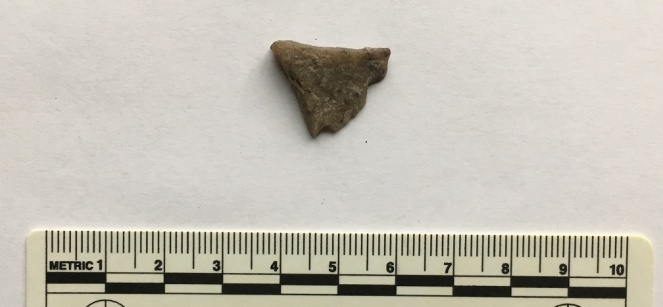
A flake of quartzite that has been struck in prehistory, during the course of making a tool. Flint doesn’t occur naturally in this area, so all sorts of stones were used in the making of stone tools in prehistory. Quartz, though a poor cousin of flint, still keeps enough of an edge to be useful, and this piece carries all of the hallmarks of a bit chipped off a larger tool or weapon – the striking platform (top), and the bulb of percussion (facing, half way down). I suspect that this is Mesolithic in date, so c.6000 – 4000 bc, or thereabouts. I’ll post some more flint/chert/quartzite when I get a chance, as it’s fascinating stuff, and the area is not exactly lacking in it.

*

Interestingly, there is a brewery marked on the map (top left, numbered 8). This is the Matley Spring Brewery, which brewed beer here, using the local spring for water, and presumably selling it in the Dog and Partridge, at the end of the wonderfuly named Blundering Lane. I was going to write a little about it, but came across this site with some information and photographs. Actually, the whole blog is a good read, filled with fascinating titbits relating to the area, so go forth and explore.

*

And finally, as promised, I’ll end with the folk story of Gallowsclough. This is taken from Thomas Middleton’s Legends of Longdendale (the book is a mine of local legends and folktales, as well as some good photographs, and is well worth seeking out – or reading in the pdf format at the link below)

Follow this link for The Legend of Gallow’s Clough.

It’s very Victorian in its telling, but the story is as black and evil as any I have read; there is something about it that disturbs and lingers in the mind – the imagery, and particularly the witch walking away at the end. No, I like a good dark folktale, but this is just on the border of being a little too dark for my tastes. Enjoy at night, and you have been warned…

So there you go. There’s plenty more in the pipeline, so watch this space. As always, comments are very welcome, and all will be published.

And I remain, your humble servant,

RH
Archaeology · Roman

Melandra Roman Fort

Greetings all

So then… Melandra.

No, this is not going to be a long essay on the much overlooked site, so don’t worry. In fact, you might say quite the opposite when I present a wonderful piece of archaeology… you’ll see.

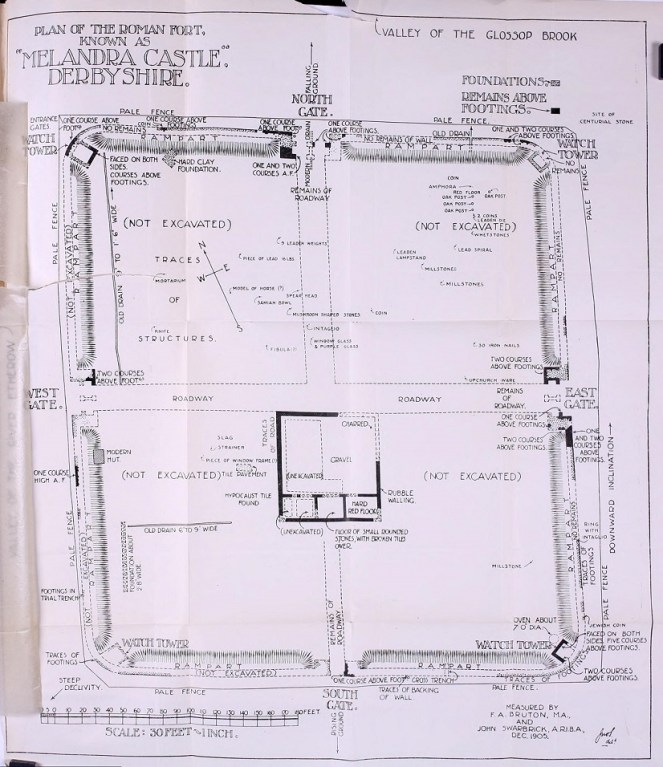
scan plan
Plan taken from RS Conway’s ‘Melandra’ shows the layout of the fort, as well as the find spots of interesting bits and pieces. Most of these are now in Buxton Museum, which is well worth a look.

I was there a few months ago with the family Hamnett, and following Mike Brown and Roger Hargreave’s talk at the Glossop and Longdendale Archaeology Society. Both have been heavily involved in trying to get some sort of archaeological project resurrected for the site, as there is still so much not known, and both are great ambassadors for the fort. Sadly, there is nothing major in the pipeline, but their talk prodded me to go and look again at the overgrown site, windswept and slightly out of place against the backdrop of a 1960’s council estate. Face the other way, though, and it is the wilds of Longdendale that confront you. What a difference between this landscape and that in which the soldiers who built it grew up: The First Cohort of Frisiavones, originally from Belgium/Netherlands area, and assisted by men from the 3rd Cohort of Bracara Augustani, who were originally from Portugal.

long
Longdendale Valley, brooding. From Melandra.

It an amazing site, but one that is very neglected, and what could be a huge source of pride for the people of not just Longdendale, but of Derbyshire too, is all too easily passed by, overgrown and forlorn. So go and visit it, people. Read Mike Brown’s excellent booklet on it (couldn’t find a link, but it crops up all over). R.S. Conway’s 1906 academic book is out of print, but you can still get it relatively cheaply.

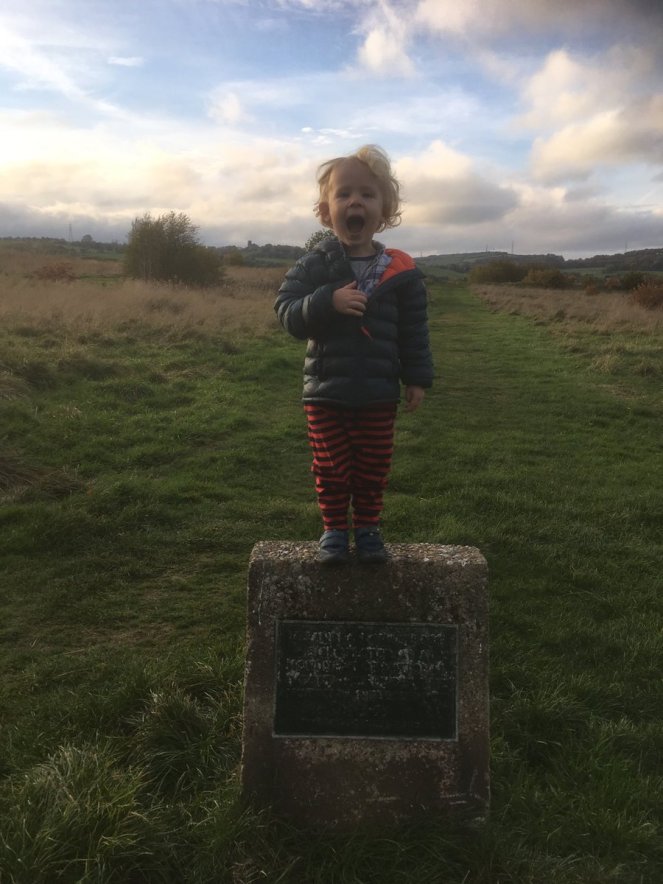
master ham
The young Master Hamnett at the north gate. Behind him, to the left, is St Michael’s, Mottram, and to the right, the ‘Deep Cutting’ at Roe Cross (and the White Stone).

Before we go on, though, a digression about the name Melandra.

According to the Ravenna Cosmography (a 7th Century list of Roman towns and forts), its actual name, was Ardotalia, not Melandra (see no.108 in the above link).

It is likely that Melandra is a name made up by the Reverend John Watson, the Rector of St Mary’s in Stockport, who first described the site following a visit in 1772. Seemingly, he wanted to give it a ‘classical’ air. Indeed, there is no record of the name Melandra existing prior to Watson’s  and at that time of his ‘discovery’, as Watson himself notes, the area of the fort was known as the ‘Castle-Yard‘, and the eleven fields adjoining it are named ‘Castle Carrs‘ in various land deeds (1). Where, then, did Melandra originate? According to Anderson “The word Melandra has a curiously Greek appearance” (2), and is alleged to be a “Roman name derived from the Greek Melaxdryon, which signifies ‘the heart of oak‘ or ‘the heart in the oak“, perhaps a reference to the trees of Longdendale” (3). However, it is very unlikely that the Roman name remained unchanged for 1600 years. And, it is equally unlikely that the local population of late 18th century Glossopdale and Longdendale spoke classical Greek. No, they would simply have called it Castle Hill or similar, which is exactly what they did! However, an Oxford educated academic and clergyman would almost certainly have spoken several classical languages, and be at least proficient enough to invent a name. So thank you Reverend Watson, because of you, the name Melandra Castle has become common usage, and so we continue to call it thus.

Right, the find!

The fort is a scheduled ancient monument, so it is illegal to take anything out of the ground here. Even stuff off the molehills, which is where I found this:

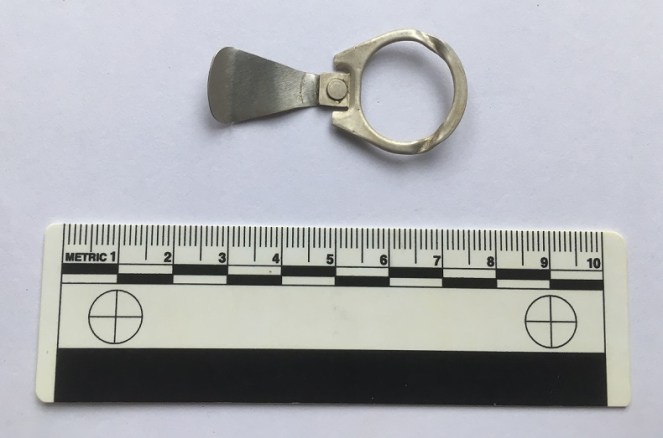
can
Ring pull from a 1980’s drinks can. No idea what type, but I’m sure someone, somewhere, will know!

Don’t worry, I’m not about to feel the long arm of the law, it is quite literally rubbish, and of a 1970’s-80’s vintage. Anyone who watched the TV show Detectorists will immediately chuckle (very highly recommended, by the way, even if I don’t always see eye to eye with metal detectorists and their hobby).

According to this website, ring pulls like this stopped being used in the UK in around 1989/1990. So there you go. I was so taken aback by nostalgia, that I immediately thought “I need to blog this!” Also, I surely can’t be the only one who used to detach the seal bit, insert the larger end into the slot on the ring, and using the natural sprung tension, ‘ping’ it off in a frisbee fashion. You could get some distance on these things. Am I the only one?

Anyway, a bit of fun. I have a few more serious posts to finish off, so expect those relatively soon (after the weekend?)

And as always, I remain,

Your humble servant,

RH
  1. Watson, J. 1775. “An Account of an Undescribed Roman Station in Derbyshire” Archaeologia 3: 236-238
  2. Anderson, W.B. 1906 “The Roman Place-Names of Derbyshire” in Conway, S (ed.) 1906 “Melandra”.
  3. Middleton, T. 1906 “The Legends of Longdendale”

Archaeology

Pottery… and more.

Evening all

It suddenly occurred to me that I hadn’t published any pottery or other bits and pieces for a while. Of course, whilst I may not have written anything, it doesn’t mean that I have stopped picking things up… nope, I have literal bags of the stuff, much to Mrs Hamnett’s annoyance.

So here goes with some interesting bits and pieces from all over Glossop.

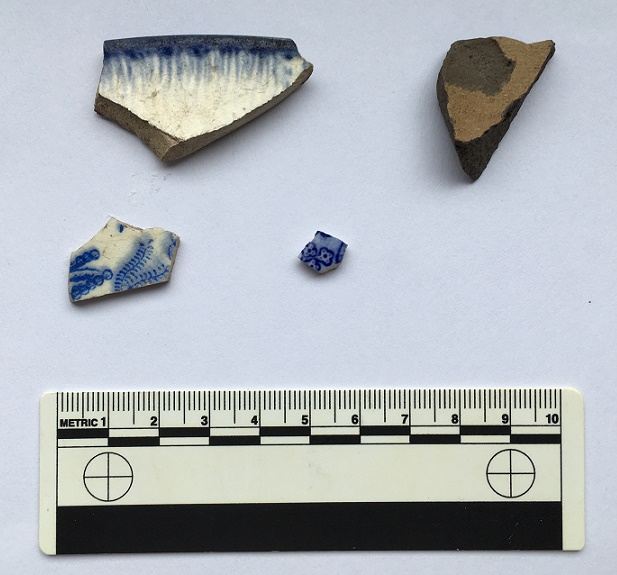
These first sherds of pottery are from the back garden of the Prince of Wales pub, Milltown, Glossop. I have already blogged about the clay pipes from here in this post, but this is the pottery that goes with them.

PoW
Treasure from the Prince of Wales pub. I’m happy to return them, if they want them.

The same age, unsurprisingly, Mid to late Victorian, possibly early 20th Century. The stoneware (top right) is fairly bog standard, and probably comes from a ginger beer bottle or similar (which makes sense, given where we are). The blue on white pottery is difficult to date from small fragments, but it starts in the 1790’s, and carries on until… well, now! This wouldn’t be early stuff, and it’s been kicking around for a while in the soil, so Mid – Late Victorian it is. The top left is from a featheredge decorated dinner plate, measuring 24cm in circumference. Here is a good example of the type with some discussion. This style of pottery also starts 1790ish, but the type we see here is the same date as the others. It is commonly found with a ‘shell edge’, but this one has the impressions on the surface, but not the undulations. All very common, and very in keeping with the place being a pub in the busy Milltown area. I want to know what was being served on the plate – good hearty pub food of meat and veg, one assumes.

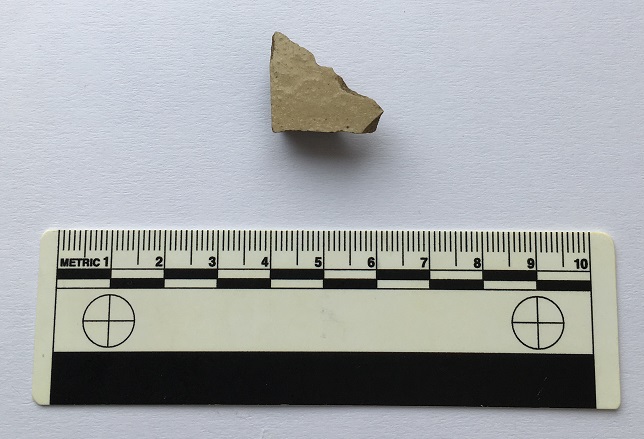
This next sherd is from Whitfield Recreation Ground. I found it a few years ago, after some heavy rain, just underneath the bench by the swings.

Wrec
Unexpected find from Whitfield Rec.

Cream coloured stone ware, hard fired, and virtually indestructible, as I have mentioned elsewhere. This sherd is glazed inside and out, and comes from the bit that the joins the base to the side. This type of pottery was only normally used for ginger beer or milk in the late 19th and very early 20th Centuries, so we may assume that as the date. It’s a possible rare survival from a time before the recreation Ground was there (it opened in January 1903). I intend to do a future blog post about the ground, as it has a fascinating history.

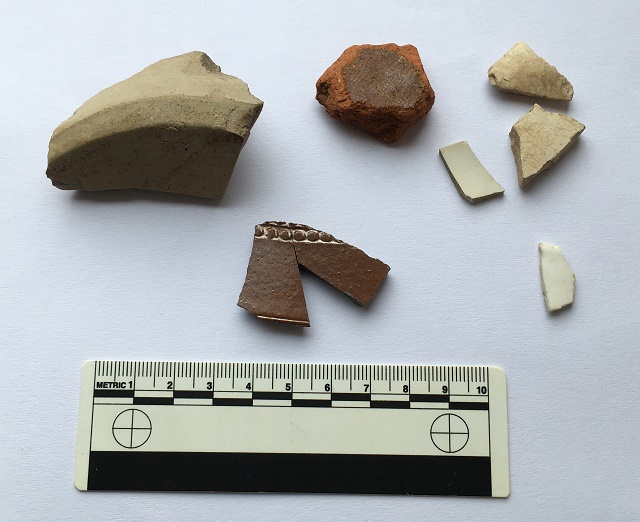
This next lot is from Old Lane in Simmondley. This was the original road between Charlesworth and Glossop, and joined in the meeting of several roads at St James’s church, Whitfield (I have blogged about that meeting place before). I did a bit of a walk along the path as far as it goes (here, on my Twitter feed – and the next few photographs on from it), and it eventually fizzles out into fields. But along the way I picked up a few sherds.

IMG-1046
Simmondly, Old Lane – the original road.

Top right is three sherds of cream ware, without decoration, and eminently undatable – probably Victorian, but ultimately these are destined for the midden in my garden. Top middle is a piece of thick slip glazed earthenware. This, I think, is 18th Century, so relatively early, and certainly earlier than the other sherds. It is glazed on the interior surface only, with the outer surface being washed with a red slip, so I think it is probably a cooking pot of some sort. Top left is a large stoneware storage jar of some form, or possibly a flagon like this. It is salt glazed on the inside, measures 14cm in diameter, has a chamfered edge around the base, and is almost certainly mid to late Victorian. Bottom right is a fine china open vessel – a saucer possibly – it is undecorated, and not enough remains to get a diameter. Bottom left is a broken fragment of a stoneware storage jar. It is salt glazed, and has an impressed decoration of a border of round blobs, which is a very common motif for this type of pottery.

Now, the good stuff!

There is a place, if you know where to look, in Manor Park, that produces all sorts of goodies. I think it is a late Victorian – Edwardian rubbish dump, or at least was one before being redeposited. Over the last few years, I have pulled some very interesting bits and pieces out of the soil, and I suspect there is plenty more, too.

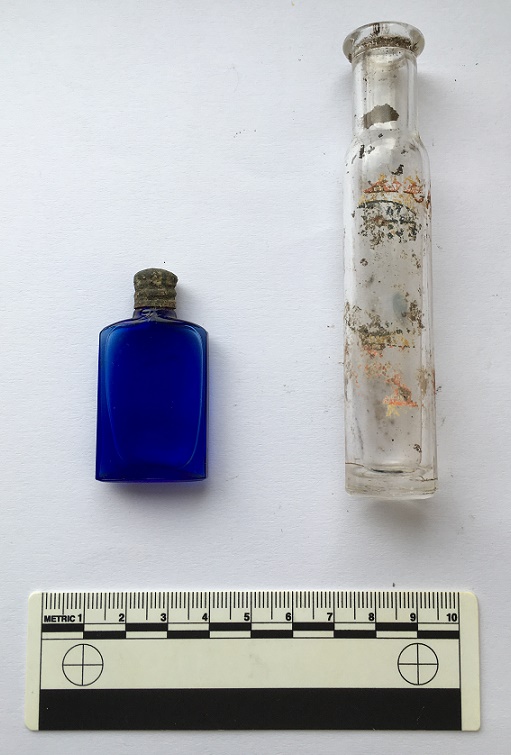
First up, these two.

bot
Unbroken glass bottles – something of a rarity.

The one on the right probably contained a hair oil or something (I don’t known why I know that, or even if it’s true, but I seem to recall reading it somewhere). Not that impressive, other than the fact that it still has the original label on it… except I can’t read the bloody thing! Frustrating.

The blue one on the left is lovely, though. Not a mark on it, and when I cleaned it off, I realised two things – firstly, there was a thick liquid inside it, and secondly, the seal was still good. I cleaned it really well, and gently opened up the bottle, and despite Mrs Hamnett daring me to taste it, I instead smelled it – faintly floral and clean. I think it’s rose scented oil for ladies to wear. A wonderful find.

The next two are really quite nice, too.

bot2
A taste of childhood – I love the personal side to archaeology.

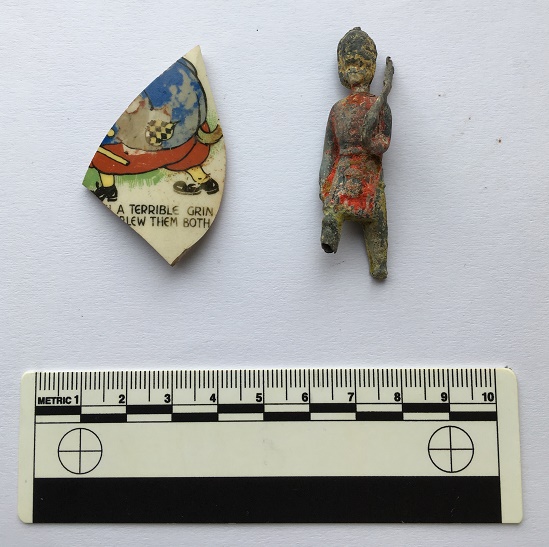
On the left, a fragment of a child’s cup, presumably with a nursery rhyme round it. I have looked up the phrases “a terrible grin” and “blew them both”, but nothing pops up the internet. If anyone has an idea, please let me know, as I’d love to find out. The fat figure also seems to have a tail – a dog or wolf? I was thinking the Three Pigs as a possibility, with the wolf blowing down the houses, but I don’t remember him blowing two houses down…

On the right, one of my favourite finds. A hollow-cast toy soldier, a child’s prized possession, perhaps. A member of the Grenadier Guards, he has his rifle shouldered, and is marching, albeit with no feet, but at least he has the dignity of having paint. I love toy soldiers, and my own childhood was filled with Airfix plastic ones (I still have them… they await Master Hamnett’s sticky claws!). They were cheaply produced in their thousands, and are not uncommon in rubbish dumps, but I absolutely adore this figure. I have looked online, and although there are thousands like him, I can’t quite place him.

Amazing stuff, and if you buy me a drink, I’ll tell you where to look!

And to end with, a little foreign fun. During my France trip this summer, I found this crumbling out of a soil bank in a vineyard, on the road to the walled city of Carcassonne.

Punt
A surprise find, although not unexpected given where we were!

It’s the dimple from the bottom of a wine bottle – technically called a ‘punt’. This one is blown glass, which ages it – you can make out the tiny air bubbles when you hold it up to the light. I’m no expert, but I would say it is certainly 19th Century – and apparently the deeper the punt, the earlier the bottle – so perhaps earlier? Anyway, given where we were, I couldn’t very well leave it there, could I?

Hope you have enjoyed the pottery, and as always comments and questions are most welcome.

Your humble servant,

RH
Archaeology · Stones of Glossop

Milestone Update

Greetings all

After my last post on milestones, I received a message from the always interesting Roger Hargreaves (see comments below the above article). Now, Roger is something of an expert in these matters, and has done some considerable research into the road system of the area through the ages – Roman to 19th Century in fact – and he helpfully offered some information, and some photographs, too.

So then, the milestones…

Following an act of parliament in 1770, the milestones were erected every mile (hence the name) along the 1730’s turnpike from Manchester to Saltersbrook by the surveyor James Brown jr. Later sections of turnpike were built from Saltersbrook to t’other side o’ Pennines – there’s a great website, with lots of pictures, dealing with that section, here. This road from Roe Cross follows broadly the route of what is now A628 / Woodhead Pass, itself a turnpike from the early 19th Century, and which overlays the original road.

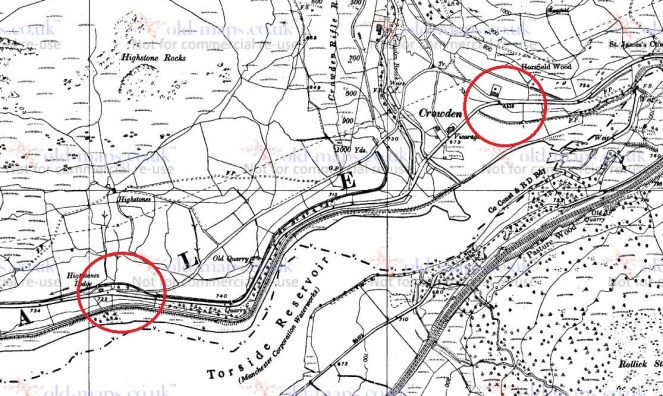
However, in places, this 1730 turnpike is still visible where the 19th Century road deviates, perhaps taking an easier route, and so sections can be walked, and it is along these that milestones, where they survive, can be seen.

Turnpike 1
Here is a section of the original 1730’s turnpike. It leaves the Woodhead pass at the first circle, and rejoins past Crowden, at the second circle.
Turnpike 2
The 1730’s turnpike as seen on Google Streetview. The road originally went up to the left – you can see the path, and can walk along it for a large portion.

Now, because milestones are placed exactly one mile from each other, it is possible to work out where they should be. Of course, in some places where we would expect to find them, however, the newer road has obliterated all traces of the older road, and presumably the milestones would have been broken up and used as hardcore, although not necessarily, and it might be worth a further investigation – they are perfect for gateposts, after all.

So, starting from Roe Cross, then

IMG-0810
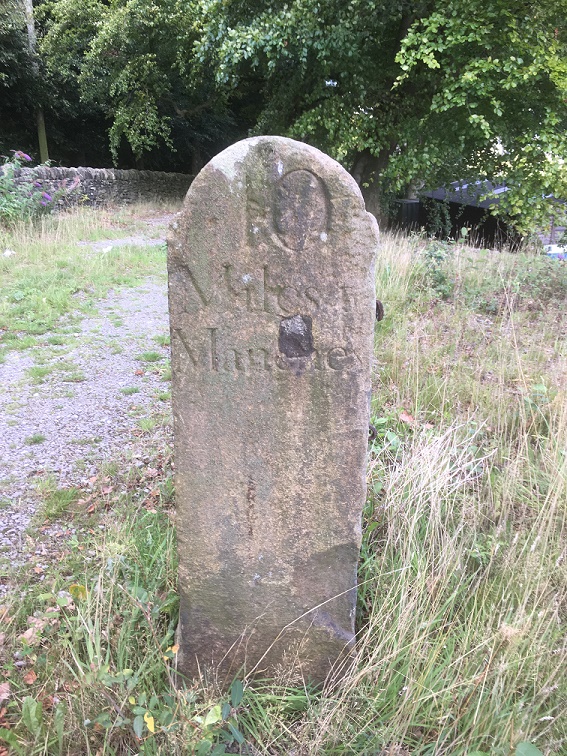
10 Miles from Manchester – this would have stood at the Toll House at Roe Cross

11 Miles (somewhere on Mottram Moor) and 12 Miles (far side of Hollingworth) are missing – the area has been built up, although they may well still be in a hedgeback somewhere.

IMG-0808
13 Miles to Manchester – this would have originally stood somewhere in Tintwistle – annoyingly, the mileage doesn’t work with it being situated at the toll gate there, which stood at the far end of the village, west of Townhead Farm.

14 miles is missing, but would presumably have stood east of Townhead Farm – again, worth a look in hedgebacks and walls.

Milestone at Rhodeswood
15 Miles to Manchester. Just by Rhodeswood Reservoir. Photograph by Roger Hargreaves. And a damn fine one it is too!

16 Miles would be just below Highstones, where the track still exists, and so would be a strong contender for a survival in the walls and hedgebacks.

17 Miles and 18 Miles are in places where the 19th Century road overlies the 18th Century, and thus are likely to be lost. Although, again, maybe worth a look.

Milestone at Higher Woodhead
19 Miles to Manchester – mutilated and forlorn in a wall at Higher Wooodhead. Photograph by Roger Hargreaves. I love this photograph.

20 and 21 Miles to Manchester are beyond this, and although there is a survival of the road in these areas, there are no walls in which the stones may be hiding. It is likely that they are simply buried in the peat in that area, waiting to be discovered. A walking trip with a steel pole, anyone?

This takes us to Saltersbrook, and the other side of the turnpike system there. Here is a map of the road from Saltersford into Yorkshire.

Ding Dong
The Yorkshire side of the turnpike road, from Saltersford to Wortley. There are plenty of milestones and other interesting goodies along this route, but they are truly beyond the scope of this blog. Check them out in this really amazing website.

So after the journey, let’s end on a song – a particular favourite of mine, from a particularly good album, and whose title is very apt.

I also want to thank Roger Hargreaves for allowing me to use his photographs, and for the additional information.

As always, comments or questions are always welcome.

Your humble servant.

RH
Archaeology · Stones of Glossop

Some Questions Solved

Greetings all

So, I received a pair of emails recently, and both of them answered an outstanding question that has been bugging me for some time.

Answers people, we actually have answers! I asked, you listened, and by Great Zeus (or Arnomecta, perhaps) you answered.

So, drum roll please…

THE STONE IN ST JAMES’S CHURCHYARD, WHITFIELD.

I mused here on the possibility that a large, out of place, stone in the churchyard St James’s, Whitfield, might be part of the base of the Hollin Cross that almost certainly stood at the junction there, on Hollincross Lane.

Hollincross 1
Here is the stone in St James’s – not a cross base!

I was wrong. And how!

I got an email from Louise Seville which states:

“My father-in-law Neal Seville had some connection with the church (Sunday school??), I think in the 1970s. He was giving a talk based on the parable of the wise man and the foolish man. He and his friend Bert Taylor from Chunal, brought the stone from Bert’s own small quarry at the back of his house on Chunal. The stone was moved on a truck – Bert had a haulage company. The stone was used in church to illustrate the story and was abandoned in the churchyard afterwards as it proved to be too difficult to move. Neal said that in the future people would wonder how the stone got there and come to all sorts of conclusions! “

And how right he was!

So there we have it folks. I genuinely think that it was bonkers to use a stone that size to illustrate the parable, no matter how factually correct! But apparently that was about right for Neal, who got up to all sorts of capers. Here is the parable, for those of you that slept through Sunday School.

So my thanks to Louise and Eddie Seville for solving the mystery. And, of course, thanks to the late Neal Seville for providing one in the first place.

Now, the next one has bugged me for years, so I am truly grateful for its solution.

THE ODDLY SHAPED CERAMIC OBJECTS

I asked for ideas about these bits of pottery that Sandra T. and I had found. They were so oddly shaped, and so similar in production, that they must have had a single, very specialised, purpose. But what purpose, that was the question.

Pot Mystery 2
The puzzling pieces of pottery

Well, bam! An email from the wonderful Eddie Picton arrived in my inbox the other day.

May I suggest that they are “creel peg pivots” as used in textile machinery. A roving bobbin had sliver wound on it, this was then put upon a creel peg and then put in following machine creel. The lower end then would be free to rotate on the ceramic with minimal friction. I worked in the last spinning mill in Oldham, the last of this type of creel was scrapped in the early 1990s, the mill finally closing 2002.

The connection between the object and the place – both connected with weaving and spinning – made this very likely, and it is not an interpretation I had thought of before. I did a bit of research, and began to understand how they would have worked. Yes, it seemed to fit.

Last night, Eddie was at the Glossop and Longdendale Archaeological Society talk on ‘Melandra – Past and Future’ given by Mike Brown and Roger Hargreaves (and very good it was too). He gave me this drawing of how the creel peg pivot would have worked and where it sat in the machine.

Creel
Great drawing Eddie, thanks.

Our pottery pieces are those marked ‘Pot’ in the picture, with the bobbin/creel peg sitting in the hollow, glazed, part of the mystery object. They are tapered slightly so that they can fit into the holes in the frame.

IMG_0977
These are those, in situ, in Styal Mill. The photo is Eddie’s.

So that’s that solved! Thanks for that, Eddie, you’re a star. And it seems I owe you a drink… I’m as good as my word. See you on the first Tuesday of November.

I have another blog almost ready to go, so fingers crossed you’ll get a bumper crop of posts by the weekend.

As always, comments and questions are very welcome.

RH
Archaeology · Oddities

A Puzzling Piece of Pottery

Evening all. The third blog post of June… see, I am trying.

Anyway, this one should (hopefully) provoke a bit of a response. I say hopefully because, dear and precious readers… I need a favour.

Some back story.

I received an email from the wonderful Sandra T. some months ago, asking whether I knew anything about this piece of pottery that she had found in Manor Park. She, like most of the people who read this blog, pick up random things they find interesting, which is to be commended (although, apparently, she keeps them in a clock… but let’s not judge).

Pot Mystery 1
The mystery object – AA battery for scale. Copyright Sandra T.

Now, I had no idea what it was, but it rang a bell. a brief search through my ‘interesting things’ box, and lo!

Pot Mystery 2
Two more of these mystery objects.

So now we have three of these mystery objects. I found mine in an old dump near Broadbottom, which at the latest was 1910’s, but was generally earlier – say 1890’s – which at least gives us a time period to look at.

Interesting. I thought I’d do this post eventually, as someone out there might know what , when, and why.

Last month my new neighbour (hello Simon A.) partly demolished and rebuilt a wall on our property line, and in the process discovered that the whole wall sits on a bed of pottery and other domestic waste. This mountain of material will be the subject of a future post, especially as it makes a fairly coherent deposit, thus can tell us interesting things. The wall can only have been built post 1850-ish, and definitely before 1860, which gives us a clear date, too. Amongst the bits and pieces was this:

Pot Mystery 3
Another one… what are they?

So now we have four of them.

They are roughly conical, tapering to the base,  measure between 10 and 12mm high, 13-14mm across the top, and roughly 11mm across the bottom. The bottom is flat, the top is hollow in a perfect hemisphere (I say top and bottom, but actually they might work either way up). Some are glazed all over, but one is only glazed on the interior of the hollow. This last point is important, and may hold the key to understanding what they are; it matters that only this bit is glazed, i.e. waterproof, not the rest of the object. Why? Also, they are clearly mass produced, and have a very specific role… but what?

I have two suggestions, both of which may work, but equally they are guesswork!

1) Kiln furniture. When you fire pots in a mass group, as they were being in the Victorian period, you need to keep the plates, etc. separate in the kiln, or the heat won’t circulate properly and you end up with poorly fired plates. These spacers were made in their millions, and were about the same size and shape. Though what they would be doing here in Glossop – not known for it pottery kilns – is anyone’s guess.

2) A way of selling medicine. The little hollow bit is glazed, but the exterior isn’t, so perhaps the medicine was stored in that bit, and scraped out when needed? Or it held a single pill that could be crushed in the hollow?

So over to you. Please, please comment and let me know what you think. The question is very simple. What on earth are they?

I’ll buy a drink for anyone who can tell me, with proof, what they are.

RH