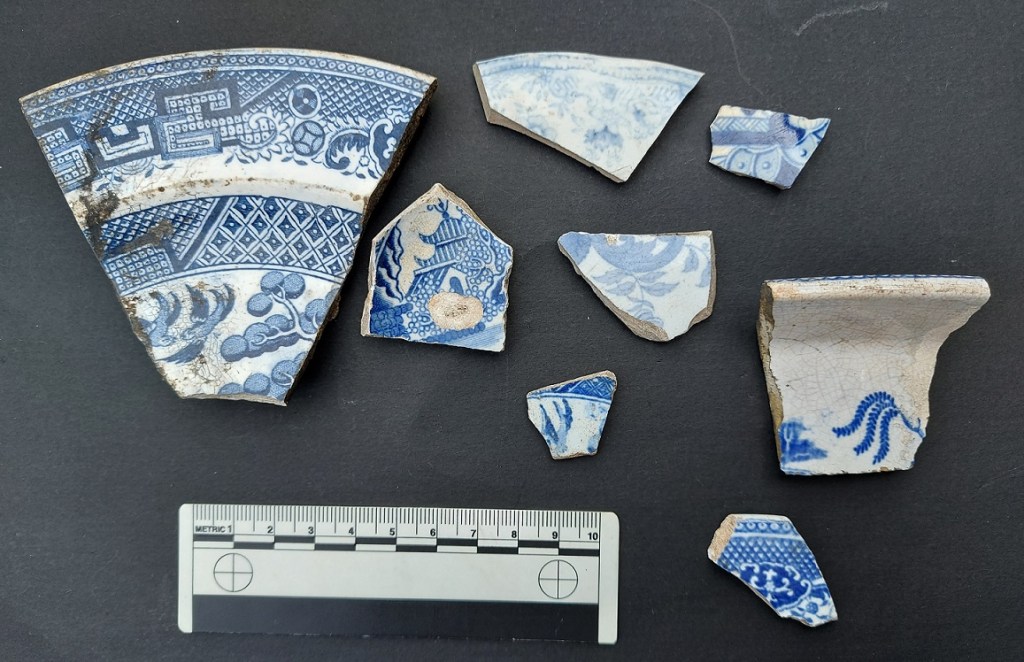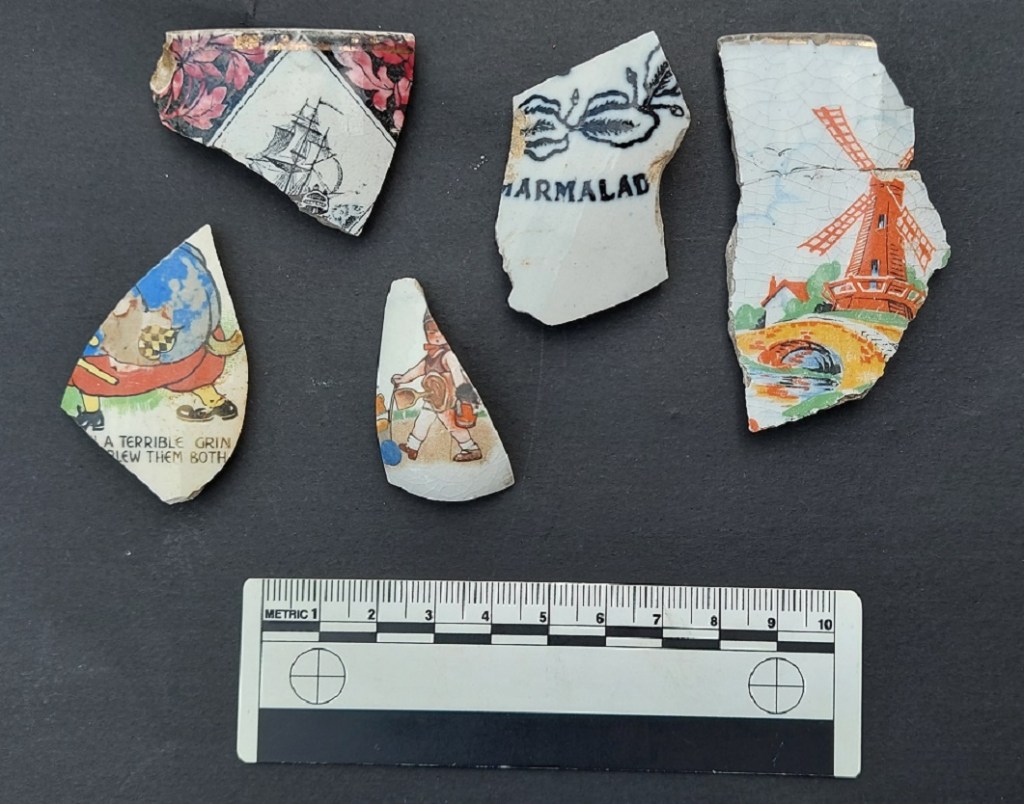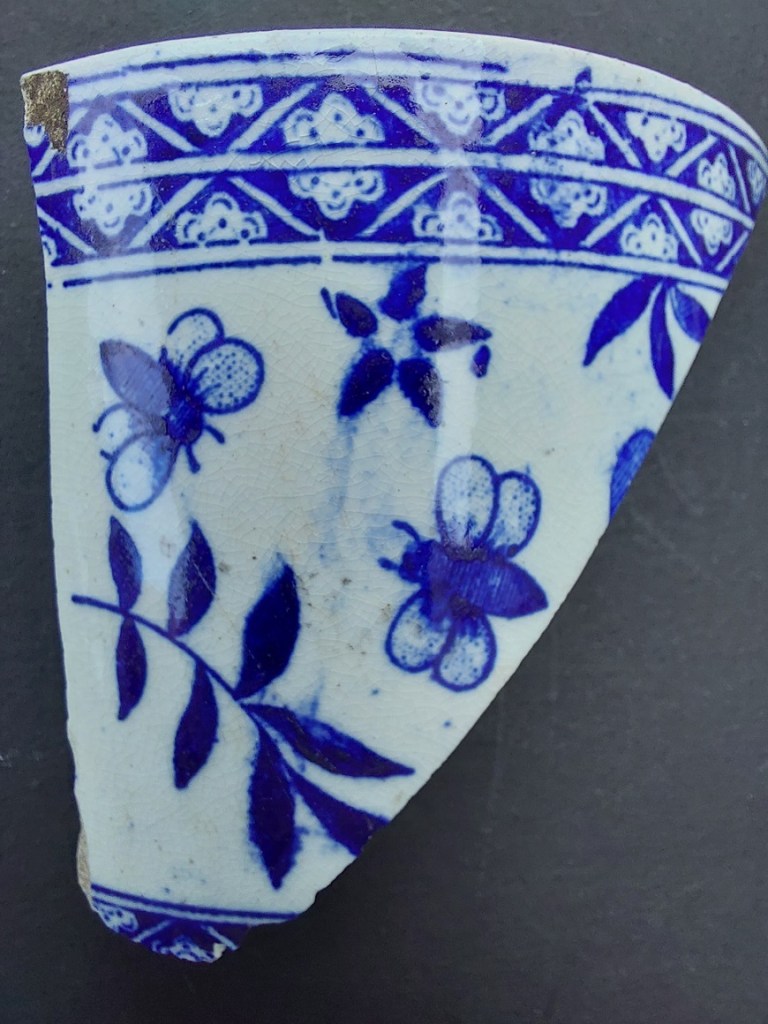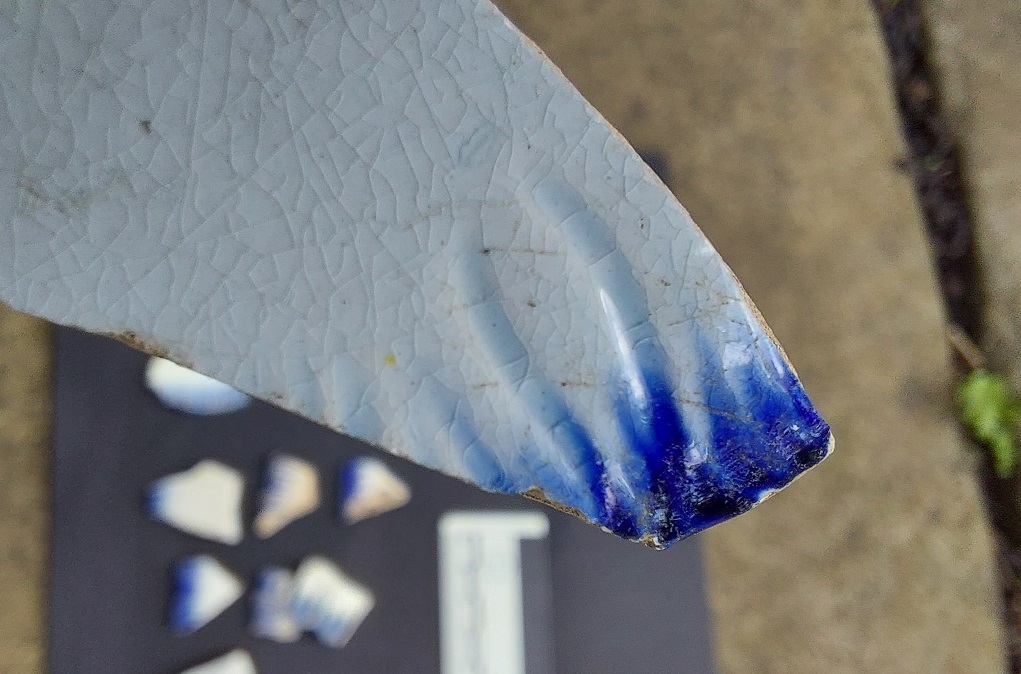
Archaeology · Pottery · Whitfield

A Green-Fingered Garden Grab*

*Ok, so I couldn’t think of a better title.

What ho, what ho, what ho!

So, right now, as we hurtle toward the solstice, is my favourite time of the year. Spring into summer – the days are long, my birthday is hoving into view (19th July, if anyone is interested… and a dark fruity red, if anyone is feeling flush). It also means time spent in the garden, planting and preparing the soil. Hamnett Towers is blessed with a small back garden (utterly destroyed by chickens… honestly, it looks like the Western Front), and a slightly larger front garden where the vegetables are planted. Both of these forces of nature – chicken and man – excavate all sorts of goodies. Predictably, I have kept everything I have found, and kept them separate; Hamnett Towers was at one point two separate ‘back-to-back’ terraced houses, so the archaeology of either side might tell a slightly different story (old archaeological habit). And so far, this year has produced some very interesting bits.

So, please join me in the garden. Ah, sorry, no shorts or baseball caps please – this is an English gentleman’s abode; t-shirts I can just about cope with, but I mean, a chap has to have standards dash it!

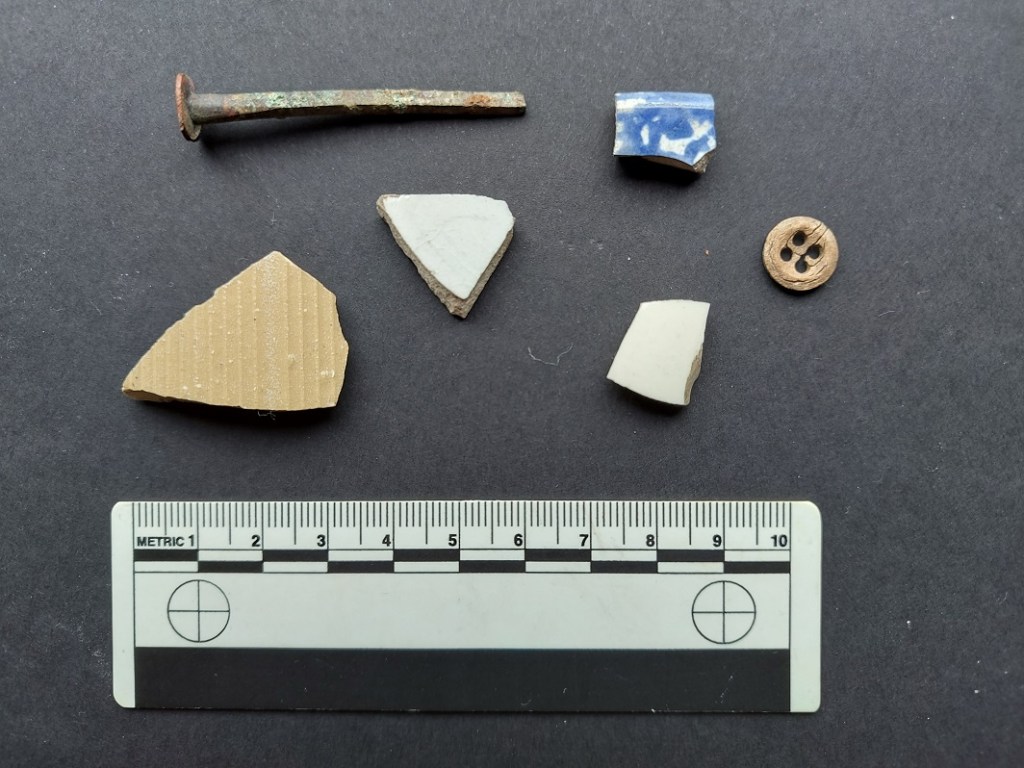
Here’s the day’s findings from the front garden:

A selection of the history of the land the garden has decided to show us this year… so far.

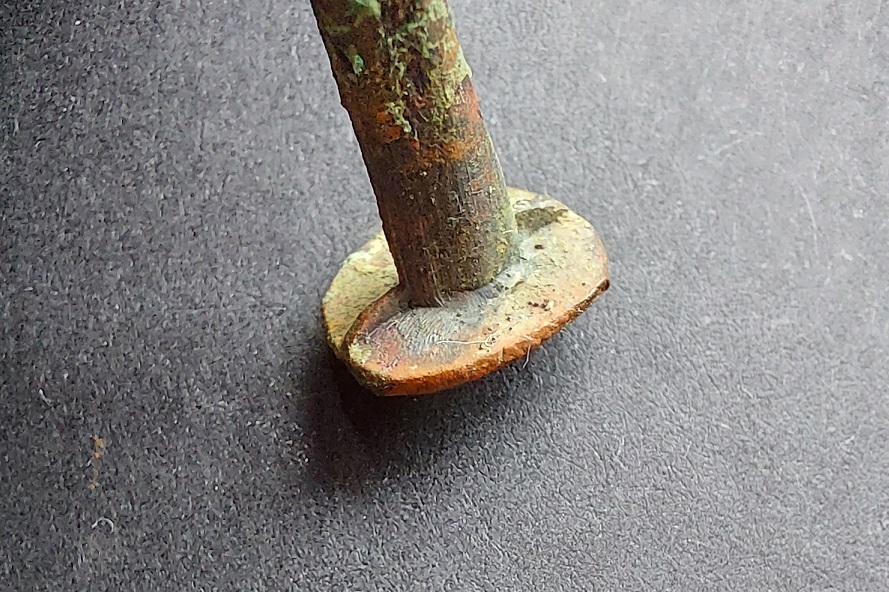
Let’s start with the nail – a Victorian, hand-made, copper roof nail, to be precise. I’m something of a magnet for these things, and they seem to find me wherever I go. They are truly mundane – the nail that holds on a roof tile – and yet are such lovely and tactile things (I’ve blogged about them before – here – FIVE years ago… blimey!). Copper was used as it is largely resistant to corrosion, and their square section is a dead giveaway of age.

Lovely green verdegris competes with rust (the result of it lying next to something iron based) on the surface.

They are made relatively simply, but by hand. Each nail is cut via a press from a long flattened strip of copper (thus the square body of the nail). It is then placed into a small mold or former, point down, and the exposed top is hammered by hand until it flattens out, forming the nail head. Close-up you can see the two flashing strips formed as the soft copper is driven between the halves of the mold.

A close up of the underside of the nail head, clearly showing the copper flashing.

The nail may have come from my house roof, which is a great thought.

Next to the nail is a sherd of spongeware, probably from a large bowl or shallow dish. I find a lot of this particular vessel in the garden, and I might have to try and reconstruct it sometime (follow the link above, 3rd photograph down, on the right for more of the same bowl).

Next row, a sherd of marmalade/preserve jar (here, for more information), and then two thoroughly uninspiring sherds of white glazed pottery. Then, this beauty!

Super. An amazing chance find whilst whilst putting in some pea and bean plants… half of which were eaten on the first night by what can only be imagined as a biblical plague of famished slugs – honestly, I swear I could hear a very slow moving rumbling sound. If you’ll pardon the French… Bastards!

Wonderful! A small bone button, and almost certainly Victorian in date. Delicate, handmade, and slightly off-centre, it is lovely. Again, something so mundane – every item of clothing would have had a dozen of these; will people be cooing over the zips in our trousers in 100 years? And yet, here we are, admiring it’s beauty. Bone was such a common substance in the pre-20th century, and we tend to shy away from it as a material now – how many of us would brush our teeth with a bone toothbrush? Or use bone game pieces? I think we have become a little squeamish. Yet, it was a major resource in history – so many animals, so much bone. Bone preserves very well in the right conditions, and although this has cracked with age, I bet it could be sewn on and used again.

Right then, the image of the Somme, c.1916, that is the back garden. There’s always something that turns up here, not all of it interesting, but usually worth a look. And this year is no exception, with a couple of very nice finds.

A rather motley looking collection, I must admit.

So then… top left we have bonfire glass. Essentially glass that has been melted in a fire. This may have been accidental, or just the result of rubbish disposal. Often Victorian and later rubbish dumps were set on fire to keep the rat population down, and bonfire glass can be quite pretty. This one… not so much.

It’s quite a cool object, but not particularly pretty.

Ignore the next sherd for the moment, and move onto the cream coloured stoneware sherd, possibly from a flask or other oval shaped vessel. Then we have some glass – it is quite chunky, which indicates it is old, but isn’t that lovely green colour, nor full of bubbles, that would indicate a Victorian date. Probably Early 20th century, and likely from a small bottle – perhaps medicine or similar.

Ignoring the other reddish coloured sherds, again for the moment, we have this beauty:

You can see the striations caused by wiping the red under-glaze slip with a wet rag – the marks of the potter preserved for eternity in clay. Lovely stuff!

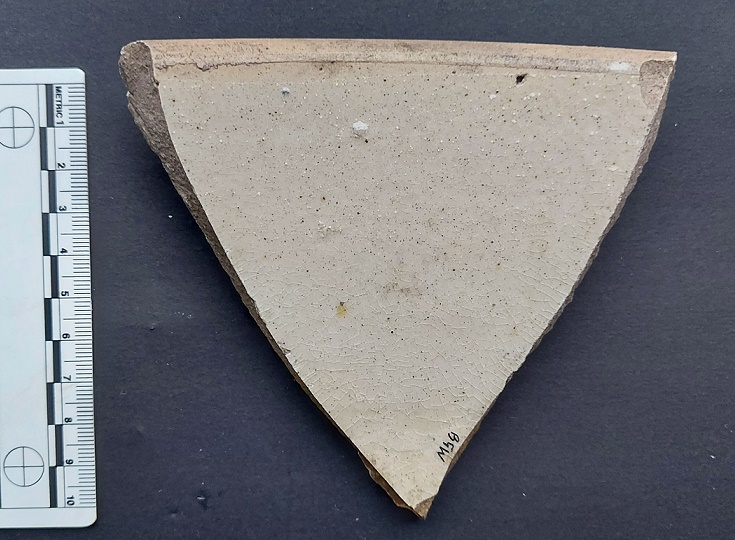
This is often called Pancheon Ware, after the large (50cm+) pancheon bowls that were extremely common from the 17th century to the early Victorian period. The correct term should be Post Medieval Redware, but that covers a multitude of pottery types and shapes from c.1550s to the Victorian period, of which this is just one.

Essentially a large mixing bowl, bread proving bowl, or vessel to allow cream to separate from milk. This is a lovely antique example, the image of which was stolen from this website which sold it for £195.

They often occur in huge chunks up to 2cm thick, and are usually glazed only on the interior to make it waterproof. I’ve talked about them before, but this is a nice example, showing the red slip on the surface, and then the dark brown glaze, made by adding iron oxide to a lead glaze, producing the deep shiny colour. The glaze on this, as with many, has been allowed to slop over the side and stop just below the rim, producing a messy natural decoration (the example above shows the glaze stopping on the rim, but you can see the effect they are going for).

Below and right of this sherd there are 4 sherds of standard Victorian to mid 20th century whitewares nothing inspiring, or even particularly worth writing about, although there is a rim of a bone china cup. Below and left is a single fragment of a clay pipe stem. Again, nothing exciting – the hole, or bore, through the middle of the stem is narrow which tells us that it is Victorian in date (broadly, a wide bore = 17th to early 18th century, a narrow bore = late 18th to 19th century). Still, it’s a bit of social history… I just wish I could find a bowl!

Then there was the treasure! Occasionally, certainly not often, I find something made of metal. And a few weeks ago, as those who follow me on twitter will know, I found a metal button.

Tiny, just 1cm in diameter, and very delicate. Amazing it survived, to be honest. And even more amazing it was seen.

Well, no… credit where credit’s due – I didn’t find it, Master Hamnett did, with his six year old eagle eyes. A lovely little 2 eye brass button, probably Victorian in date. It’s probably from a child’s dress, probably something like this:

A heavy linen dress for a child. It is beautifully decorated with hand-made edging.

And if you look closely using a decent magnifying glass, rather than the dodgy macro setting on my phone, you can see the remains of the original cloth that would have covered it:

Amazing that the cloth has been preserved, trapped between the two sides of the button’s lip.

It would have looked like this when new:

Small and delicate, and lovingly sewn on.

The thing I love about this is that the child must have lived and grown up exactly where Master Hamnett is now, and doing many of the same things. There is real sense of connection to the past through a single, small and dirty, seemingly uninspiring object. By the way, the story of the Victorian child’s dress (one of several, I hasten to add) is for another time, but it is from a probable apotropaic cache that was donated to me for safekeeping. One of two I now curate. I really don’t have enough time to write all this up, so if someone want to donate a stack of cash to allow me to write, please feel free!

And now this, the real treasure. Quite literally, for once.

Gnarled is the word. I had no idea what it was when I picked it up.

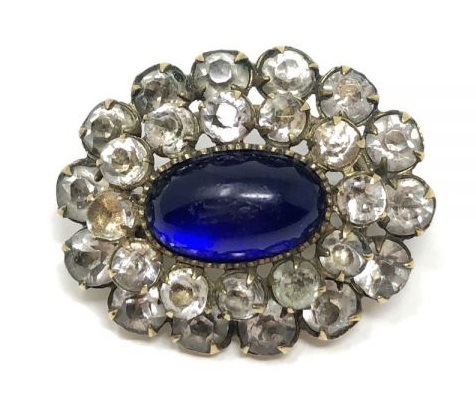
I know at first glance it looks like something has blown it up, but look beyond that, and it’s a wonderful, if completely knackered, piece Victorian costume jewellery brooch. It’s missing just about everything, including the central glass stone, but would have been very pretty – probably looking something like this:

Picture stolen from this website… the brooch is still there. Honest, guv.

I didn’t know what it was when I picked it up, but it was that greyish green that indicated a copper alloy (brass or bronze, for example), and is something I always pick up. It was only when cleaning it that I noticed the paste stones.

You can see the cut paste stone in it’s setting, and all the other setting missing theirs. There are three stones still on the brooch, and very little else.

Amazing, really. And this was just a small amount of time poking around, getting really close and personal with the soil in my garden. And my garden is not unique by any stretch, not even close. I guarantee, every garden in Glossop – no, the country – will produce some treasure – whether it’s early Victorian annular ware from a house near the station, a broken bottle rim from a former pub, a pipe stem from a current pub, or a piece of Victorian child’s plate from a modern garden in Simmondley (all examples from experience). Obviously, I realise that not everyone is lucky enough to have a garden, but we all can access some green space. As an experiment, this evening, pour yourself a drop of the stuff that cheers, and go and sit on what ever patch of earth is closest to you. This may be your garden, or it might be a park, or someone else’s garden, a playing field, or public footpath, or whatever. Now sit down and take a deep breath, listen to the sounds – birds or traffic – tune in, and simply look around you. If you can, dig about a bit, and don’t be frightened of getting your hands dirty, either. With enough time, something will turn up. And please, mail me the results.

Right, that’s about it I think. Next time more pottery – essentially a part 2 to this post, looking at the pottery I told you to ignore above. A competition! If you can get back to me and tell me what they are, and why they are not our type of thing, before I can post the next article, you can win those bits of pottery. Woohoo! (Now look here, Mr Shouty… some people like pottery, you know. And no, I’m not “having a laugh“).

More very soon, but until then, look after yourselves and each other.

And I remain, your humble servant,

RH

Archaeology · Pottery · Pottery Guide

The Rough Guide to Pottery Pt.3 – Industrial Slipware

What ho! What ho! And, if I may be so bold… What ho!

Well, as promised, here is the second post in the month of May. At this rate, I might make three posts… but let’s not tempt fate.

And also as promised, it’s a pottery one! Now, I know, I know… pottery is not to everyone’s taste (I say! Look here… calling me a “pottery obsessed hobbledehoy” says more about you than it does me), but it is important. And besides, it’s my blog!

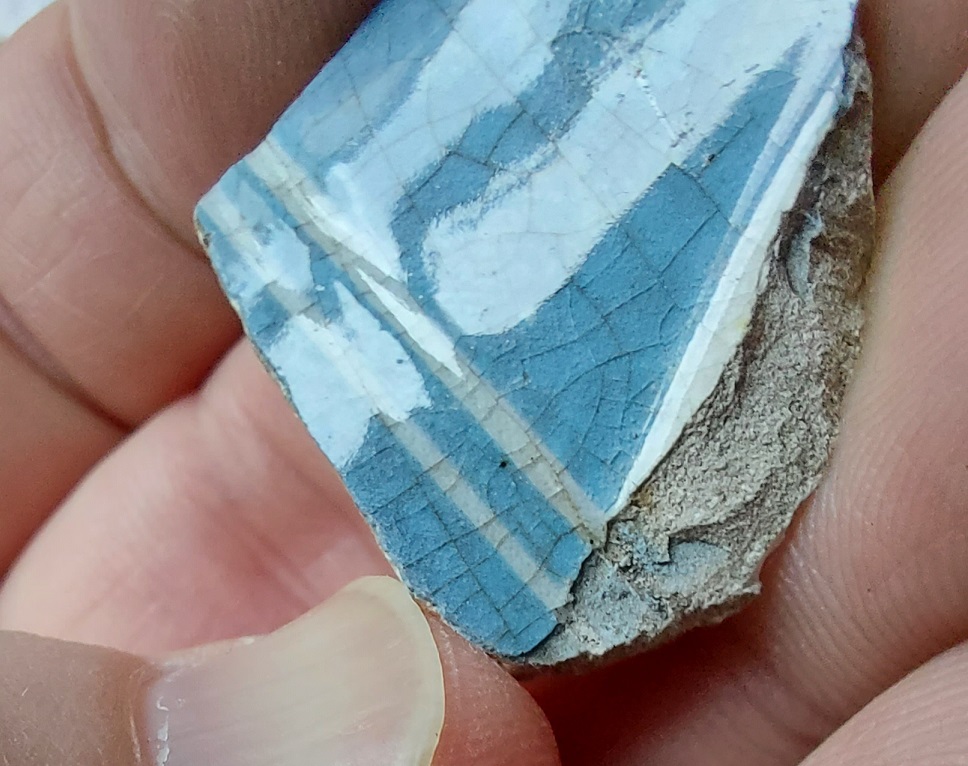
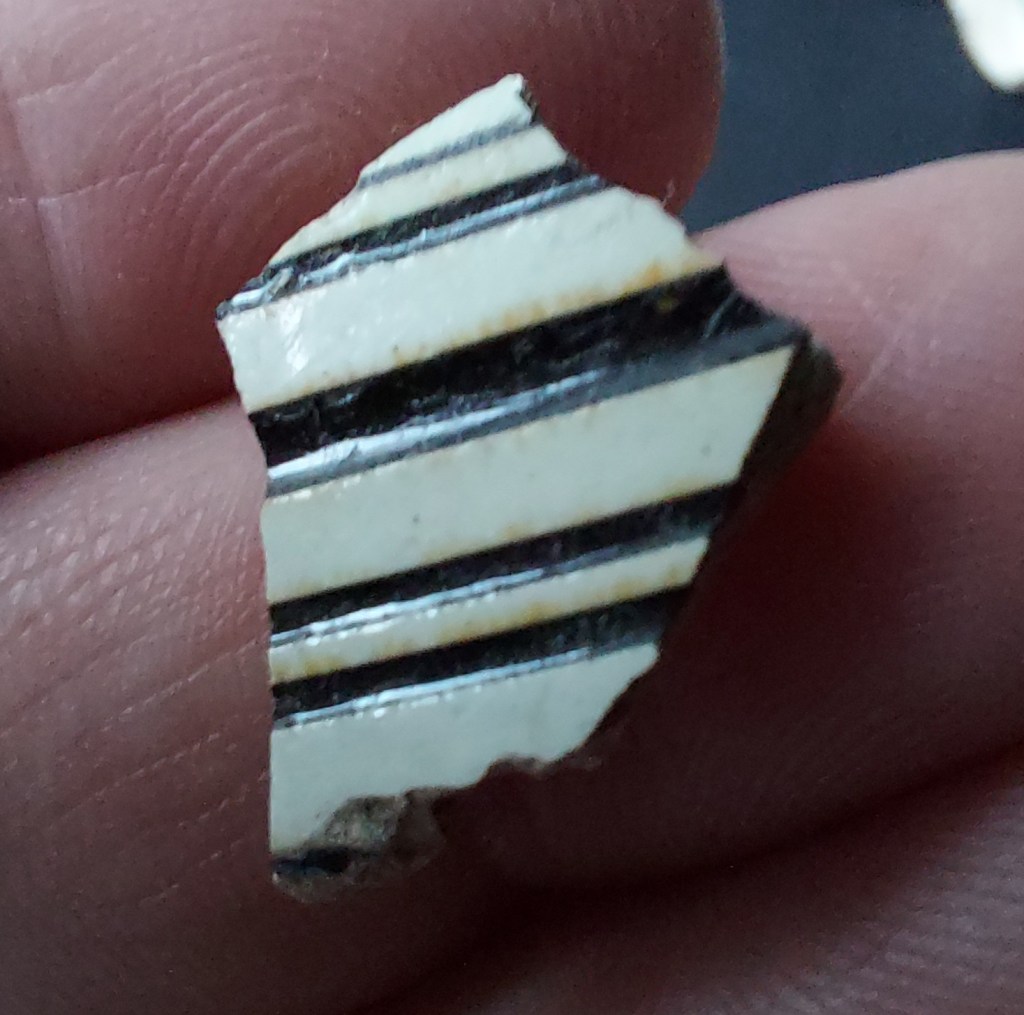
Part 3 of the guide looks at ‘Industrial Slipwares’ – a broad group of commonly encountered Late Georgian and Victorian pottery (roughly 1780 to perhaps the 1850’s, and later). The term Industrial here refers both to the method used to make them – in factories, and often employing machines – but also in order to distinguish them from the earlier handmade 17th and early 18th century ‘Staffordshire’ type slipwares (which I’ll cover in a later post… you lucky folk, you). Originally called ‘Dipped’ wares, the process employed in making them involves dipping the formed clay vessel into a coloured slip – essentially a thin solution of clay suspended in water – and firing it. It is then glazed and fired for a second time to produce a hard-wearing pot. In terms of fabric, it is a fine earthernware with thin walls, in a clean white fabric – originally a Creamware or Pearlware, but later (1830’s onwards) a standard Whiteware.

Fabric. Ahhhhh… fabric. Creamware, Pearlware, and a plain Whiteware.

Originally very fashionable amongst the elite, by the early 19th Century Slipware begins to lose its social status, until eventually it becomes a utilitarian ware of the commoner, very much associated with pubs and taverns.

I have to say, some of this stuff looks decidedly modern – particularly the stripey stuff – and their bright colours and bold slick designs must have been a welcome antidote to the often drab creams and endless blue and white transfer printed stuff that dominated the period. The emphasis is on natural, earthy, almost pastel-coloured slips – brown, blue, green, orange, yellow, grey, and violet are favoured. I have to say, though, that some of this stuff is a tad on the garish side, and wouldn’t look out of place in a Wild West Bordello. Not that I would know what that would look like. Or indeed have any knowledge of such places. At all. In fact, I don’t know why I said that. Anyway… moving swiftly on.

Ahem… the pottery, then. Broadly speaking, there are 5 types that can be readily identified, although there is some crossover between them, as you’ll see.

  1. Multi-Coloured (aka Variegated) (1780 – 1820)

Patterns of slip are made from multiple colours and smudged (the correct term is Joggled), giving a psychedelic effect that you either love or hate. Common patterns are the Cat’s Eye, Earthworm, Fan, and a nightmare-fuelled, migraine inducing, all-over slip. The crucial identifier is the joggled coloured slip.

An ‘earthworm’ design on a Variegated bowl. You can see how the slip decoration was applied in three colours, and then ‘joggled’ to make the wormlike decoration. These sherds are courtesy of The Blackden Trust, where I work. An amazing place where history and creativity collide… well worth checking out.
The nightmarish ‘all over’ decoration.

2. Mocha (aka Dendritic) (1780 – 1890)

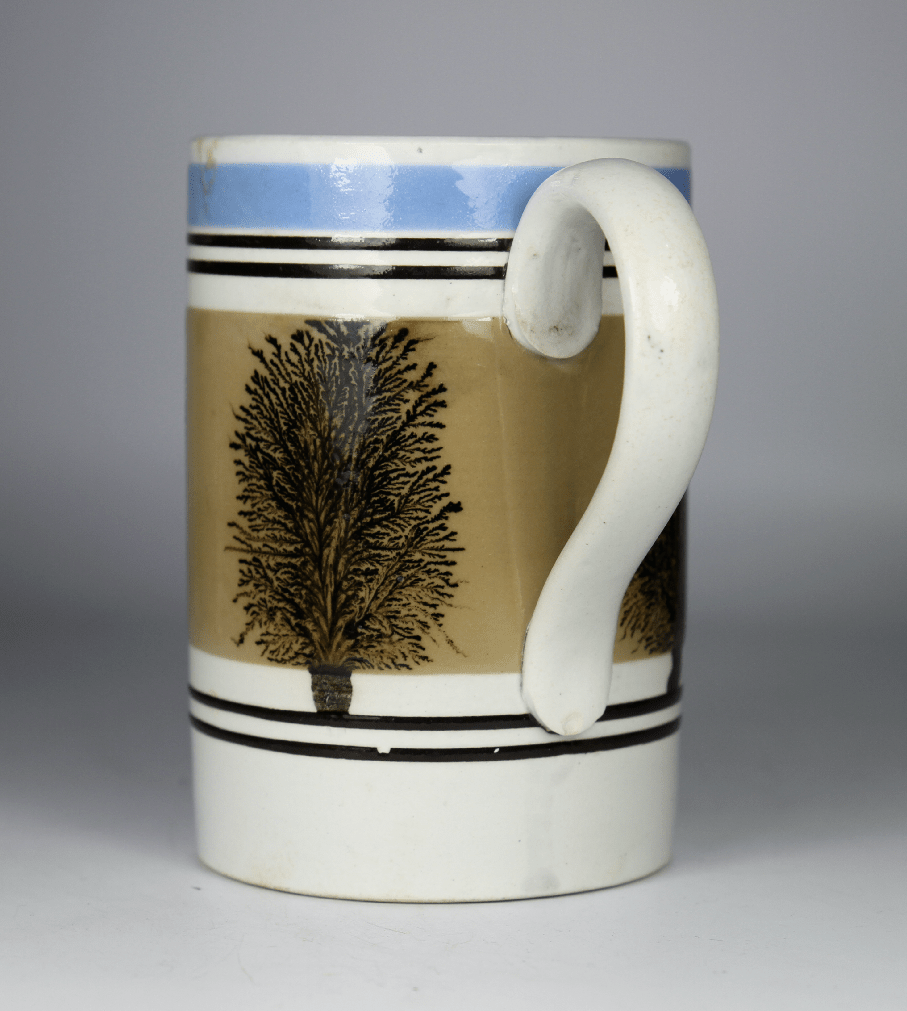
Here, the slip is applied, and a substance – boiled tobacco juice, or urine, for example – was applied whilst still wet. This diffused producing the characteristic treelike (dendritic) decoration in a dark blue or black colour. Commonly associated with banded decoration (Annular, below) and in a brown or cream slip. Popular, but largely of early to mid-19th century, and less common later in the century. 

Two sherds of Mocha or Dendritic pottery. It’s difficult to get an understanding of what the whole looks like, so here is a shamelessly stolen photo from ebay…
You can buy this tankard for a mere snip of £125 here. You can get an idea of how it looks, though.

3. Engine Turned (1790 – 1880)

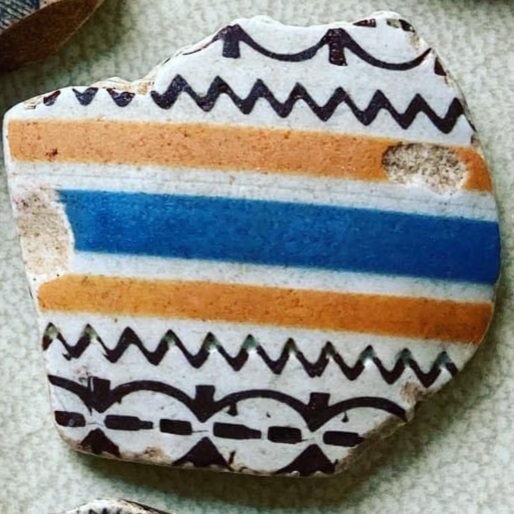
This looks particularly 20th century. Here the slip is applied one over another, and the vessel is turned on a lathe, with the upper slip removed by machine, revealing the contrasting colour below. Vertical stripes, horizontal bands, and patterned geometric designs are all common. Painted designs were also applied using a machine, creating complex linear bands. Mainly early 19th century in date, and particularly associated with Pearlware, so is much less common later. 

Sherds of Engine Turned, showing the patterns created by machine – putting the ‘Industrial’ into industrial Slipware.
An excellent example of the complex painted and turned designs found on Engine Turned pottery. Sherd is not mine, alas. It belongs to a friend, Helen D.
Good close-up of a sherd showing where the slip removed to create the pattern.
Another close-up showing the grooves… groovy! Sorry, that was terrible – although I think I got away with it as no one seems to read these captions.

4. Banded (aka Annular) (1780 – 1890’s)

Simple horizontal bands of slip are painted on using a lathe in the manner of Engine Turned above, producing precise clean lines. Commonly contrasting blue and white, but also in browns, yellows, and creams. The banded decoration is also a large part of the decoration of the above three types, particularly Mocha, so there is considerable overlap. Also, the simple basic theme of bands continues into the 21st century, particularly in Cornishware pottery. 

A selection of Annular pottery. The stripes were applied using a lathe, rather than by hand, hence their precision and uniform nature. This photo also gives us a sample of the kinds of colours that Industrial Slipware used.
The distinctly modern looking blue striped pottery, a predecessor to the Cornishware type you can still buy.

Date wise, it’s difficult to distinguish. My feeling, based on some evidence, is that prior to about 1840 Banded Ware used the browns, yellows, blues, and greys seen above. After that date however, banded decoration was confined largely to blue banding. Now, this is not absolute; the date is flexible; date of deposition is different to date of manufacture; ‘absence of evidence’ is not a strong argument; and it may even depend on such variables as availability, and even personal taste. But as a rule of thumb, I think it stands.

5. All Over (1780 – 1890’s)

The vessel is slipped, inside and out, in a single colour of the earthy colours common in Industrial Slip Ware, and then fired, producing a surface that is uniform in colour and treatment. Common in the 19th century, but less so as the century went on.  

Lovely stuff! The plain, All Over pottery.
The rim of a delicate tankard or mug. Beautiful colour, fantastic detail – this would have been lovely.

In terms of shapes, Industrial Slip Ware is exclusively a tableware, and very much liquid focused, so elegant mugs & tankards are common, as are jugs, and more rarely bowls.

Right then, armed with this new found knowledge, go forth and find! Honestly, this stuff shows up everywhere, in particular the banded Annular ware (very common in blue and white). Don’t forget to email/tweet/post any examples you find. I’d actually like to start posting finds that other people have found – a community of sherd nerds, if you will! So please, get in touch.

Honestly though, my life of late has been very busy, and increasingly I have started to realise that I am very bad at multi-tasking – meaning I can focus on only one big thing at a time – hence the lack of blog activity. I recently lead a Wan.Der (a curated historical walk, in association with the Glossop Creates mob). I thoroughly enjoyed it (despite the public speaking terror), and it seemed to be successful, which is nice – watch this space for news of others coming up, both more of the same, and new ones, too.

I’ve also started to upload some video onto the Glossop Cabinet YouTube account – there isn’t a huge amount on it at the moment, but more is coming soon. You can check it out here.

Right, that’s all for now. More later… I’m on a roll! But until then, look after yourselves and each other, and as always, I remain,

Your humble servant.

RH

Archaeology · Pottery Guide

The Rough Guide to Pottery Pt.1 – Brown Stoneware & Marmalade Pots

What ho, Glossop!

Happy new year wonderful folk of the blog reading world. I hope you all had a safe and restful Christmas at the very least. Today’s blog post is the first part of the much talked about Pottery Guide. You lucky people, you.

Over the last few years I have been toying with the idea of putting together a sort of ‘spotter’s guide to bits of old pot‘. I get a few emails a month from people asking “what is this?” or “where can I find out more about the pottery?” (What? What’s that you say? No, I’m not “having a laugh“, thank you very much. And don’t think I can’t hear you making snoring noises, either… honestly). It seems that most people who read this blog also like dipping into brooks, fields, tracks, and gardens, and pulling out bits of old stuff and pondering. Which is great, because that’s precisely what the blog is about. However, there is no simple guide to identifying what it is you have in your hand. Either they’re very dry academic archaeology (and even then, they generally don’t look at Victorian or Georgian pottery – that’s the stuff we normally dig through to get to the good stuff!). Or they are aimed at collectors, and thus look at only whole pots that live in glass cases and are fawned over by incredibly dull people. In 27 years of being an archaeologist, I have never once found a whole pot. And I certainly haven’t seen one rolling down Shelf Brook in Manor Park. I have, however, seen many thousands of bits of pot doing just that. And here’s the rub: the whole pot is ‘nice’ to look at, but sherds are the meat and two veg of archaeology… if that’s the phrase I’m looking for. Anyway, sherds are the lifeblood of archaeology, and from where we can explore the past in a way that is open to everyone and is fun. But in order to do that, we need to know what you have in your hand. My background as an archaeologist is early bronze age Crete… which is about a far from Victorian Glossop as it is possible to get (2,500 miles, 5,500 years, give or take), so I must admit part of the reason for doing this guide is that I too could learn about what it is I am finding. To do this, I read just about everything I can get my hands on, ranging from academic reports… to “a bloke on the internet”. And now, I can pass that info onto you so that before long, you too can be thrilling people with your knowledge of bits of old pot… honestly, I’m quite a hit at parties.

Anyway, Let’s start with some of the most recognisable and common stuff.

  • MARMALADE JARS

DATE: 1870’s – 1920’s
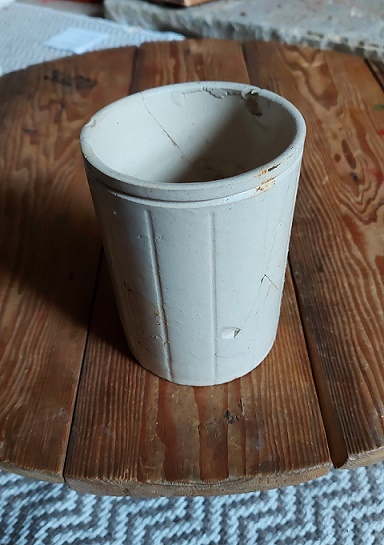
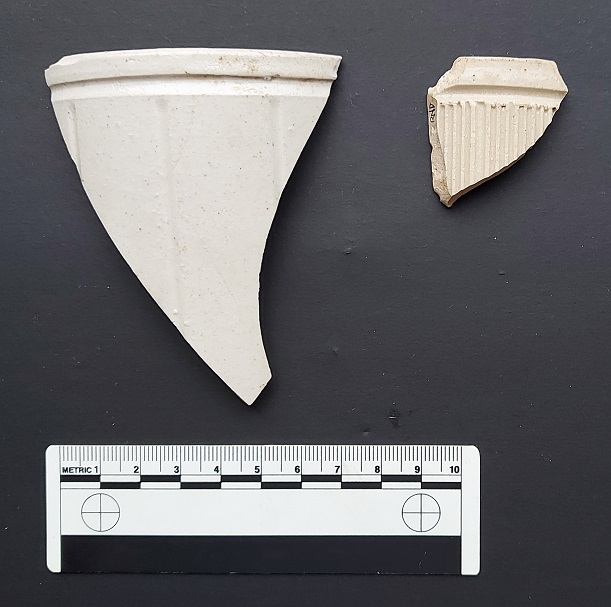
DESCRIPTION: Grey stoneware with a creamy surface, and characteristic external vertical ribbing.
SHAPES: Well… Jars.

These are such a distinctive type, and are so commonly found, that I thought we’d start here. Commonly known as marmalade jars, but actually any and all preserved fruit were kept in them, with a paper label pasted on the outside, and a horizontal groove running below the rim to take the string that kept the wax paper or cloth lid in place.

The humble marmalade jar. You can see the groove below the rim to hold the string in place. This one I found broken, and glued it back together. It now holds pens and other assorted bits.

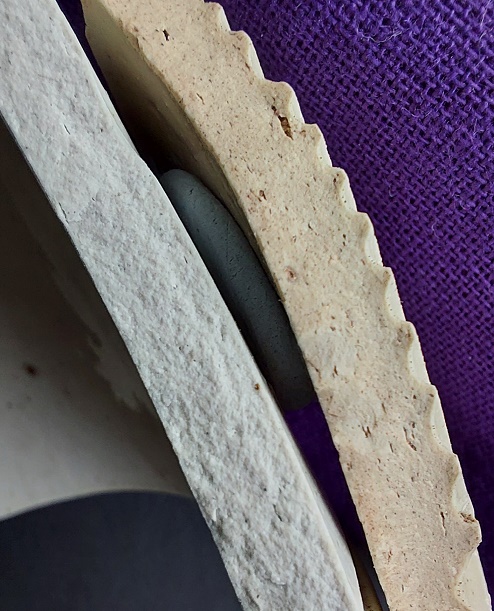
A very hard creamy-grey stoneware fabric, solid, but with small voids. A roughly applied clear salt glaze (drips are common) internally and externally, with a slightly orange-peel surface (although often the base isn’t glazed).

The fabric: left is a new break, and is paler. Right shows some staining, but is more creamy anyway. You can see how solid the fabric is, but also the tiny voids created by gas during the firing. You can also make out the external grooves.
The surface up close; you can see the rough glaze – slightly orange peel. Also, you can see tiny flecks of discolouration – it isn’t a uniform colour.

They are exclusively open-ended jars of varying heights and widths, usually c.15cm tall. Beyond the colour and surface, the most recognisable bit of this pottery type are the vertical stripes, which can be very close together – either continuously or broken up by larger grooves – or spaced far apart (see photographs).

Rim sherds from two different jars. Once you recognise them, you’ll start spotting them everywhere.

Sometimes the base is stamped with the preserve maker’s name – commonly the lighthouse and name of WP Hartley – a company still making jam as ‘Hartley’s’.

The lighthouse logo of WP Hartley. You can see how coarse the finish is on the base.

Chronologically, they are late Victorian to Edwardian in date – WP Hartley seems to have designed the distinctive jars in the 1870’s, moved the factory to Aintree in Liverpool in 1886, and opened a second factory in London in 1901, so whether the base stamp mentions Liverpool and London will give a rough date. I have no end date for their use, but it is likely in the 1920’s when most companies switched from stoneware to the cheaper glass bottles and jars. That stated, the jars are very useful (I keep pens in one) and they are very hard-wearing, so it is likely that some were in use long after they stopped being made.

  • BROWN STONEWARE

DATE: 1700 – 1920’s
DESCRIPTION: Grey fabric with a shiny brown all-over salt glaze, often with rouletted decoration.
SHAPES: Cups, bowls, jugs (Nottingham Stoneware). Storage Jars, colanders, starch pans, stock pots, stew pots, bowls, bread crocks, pans, etc. (Derbyshire Stoneware)

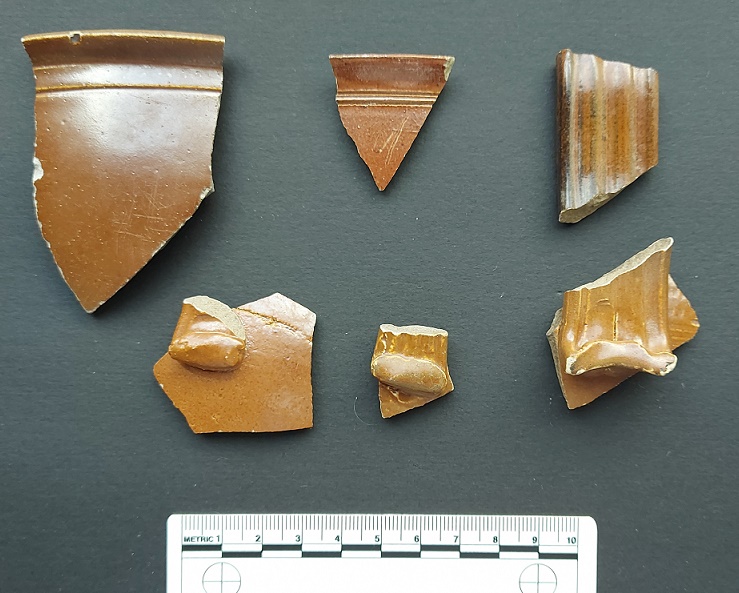
Ah, Brown Stoneware, how… brown you are. Characterised by a shiny brown all-over salt glaze and a light grey stoneware fabric, it is instantly recognizable. Perhaps because it is so distinctive, but also because it is a stoneware and thus virtually indestructible, this stuff appears everywhere. It is also difficult to date with any certainty. However, it can be broken down into two types of different dates (although there is overlap): the Nottingham and Derbyshire Stonewares.

Nottingham Stoneware (c.1700 – c.1800)
A shiny milk chocolate brown surface interior and exterior, caused by the salt glaze with added iron, and often more glassy or creamy than the Derbyshire type.

Nottingham Brown Stoneware. Chocolatey glaze, thin walls, and strap handles; this stuff is very nice.

It usually has a white slip underglaze visible in the break, between the classic grey stoneware fabric and brown surface.

The white-ish underglaze is visible beneath the brown iron-rich salt glaze, and is noticeable against the grey stoneware fabric. The surface also has the orange-peel look that characterises salt glazes.
A view of the grey stoneware fabric, note also the voids and the white underglaze on the exterior wall (right). I really am rather bad at taking photographs… I need to learn how to use my phone’s macro setting better.

It is often found in thin walled vessels – cups and bowls (tablewares). Also, noticeable are wide strap handles, with vertical ribbing and thumb impressions where they were attached to a jug body. Decoration consists of horizontal incised lines done on a lathe, often in multiples, and rarer impressed decorative patterns in between the lines – snakeskin, basketweave, zig-zags – often done with a roulette wheels. Out-turned rims and bases with multiple bands around them are also common.

Nottingham stoneware was popular in the 18th century, but by the end of the 18th century couldn’t compete with the more decorative styles then coming out of Staffordshire, and the style faded away. However, the tradition was continued by potters in Derbyshire, who began to specialise in utilitarian kitchenwares – storage and cookery – rather than tablewares they previously made.

Derbyshire Stoneware (c.1800 – c.1920)
A similar, but often a little darker, shiny brown surface, made by the same iron-rich salt glaze, but a little less glassy or chocolatey.

Wonderful stuff. The iron-rich glaze almost glows.
Again, it glows. The sherd on the left seems to have less iron its saltglaze, and has reverted to the almost classic saltglaze surface – speckled light brown and orange peel texture. I love the interplay of the undulating lines, coarsely rouletted into the body.

Also, whilst the majority of vessels have a brown interior and exterior, some have a cream, white, or olive coloured interior (I have a hunch these are later).

The creamy interior of a later vessel. The glaze is speckled in a similar manner to the marmalade pot above.

The fabric is the same classic grey stoneware, but normally with no white underglaze. Thick walled vessels are the norm, with the emphasis on cooking and storage – utilitarian rather than flashy serving and eating/drinking.

Light grey – classic stoneware fabric.

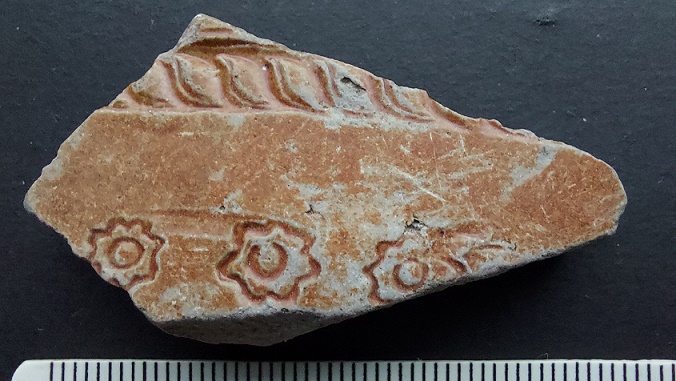
Impressed decoration consists of roughly made rouletted shapes – very small crude stars, circles, crescents, flowers, dots, etc., sometimes horizontal, sometimes in flowing wavy lines.

It could almost be Roman. Almost.
Very shiny, almost lustrous.

An interesting advert dating from about 1880 gives a good idea of the kinds of vessels and decoration available at that point and beyond:

I love this. These are some of the various vessels that you’ll encounter… in pieces, of course.

Here endeth today’s lecture. Now go forth and forage, good people! Seek and ye shall find. And please, let me know what you do find – I’d like to do a community thing, where you all send me images of the bits you find and some names, and I’ll put them on the blog. I don’t know why, but my mind keeps going to ‘The Gallery’ on Take Hart…

Anyway, more soon (not just pottery, honestly… I have some interesting stuff in the pipeline), but until then take care of yourselves and each other. And until then, I remain, your humble servant.

RH

Archaeology

Home On The Range

What ho, wonderful blog reading folk! I trust the Autumn is going well for you all? And hopefully, now that restrictions have eased, we will be able to do a bit more.

A fascinating one this time – well I think so. There’s a place, if you know where to look… Oh, go on then, I’ll tell you.

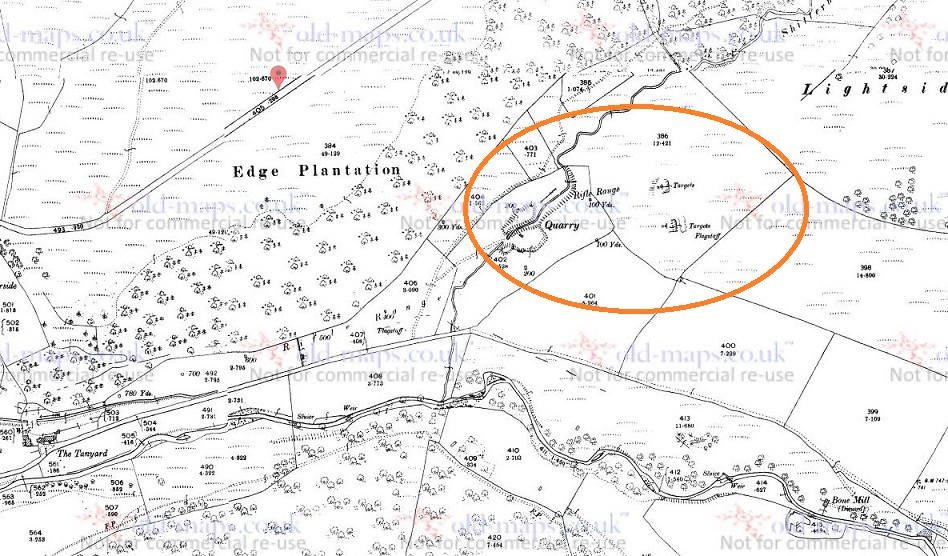
At Mossy Lea, to the north west of Shire Hill, there is a Victorian rifle range marked on the map. “Hmm” thought I, “I wonder what is there?” It turns out that it is a thoroughly interesting place, chock full of history. Here it is on the map:

Circled in orange. I meant the circle to be red, but for some reason I clicked the wrong button and couldn’t be fussed re-doing it. I don’t know why I shared that, it’s not like it’s important. To be honest, I’m not sure anyone reads these bits anyway.

But why was it there? Well, following the Crimean War (1853-56), and amid rumblings in Europe, particularly between France and Austria, it became clear Britain needed a larger, more efficient, armed force. In 1859 the decision was taken to boost home defence and operational forces with the creation of the volunteer rifle corps. The forerunner to our Territorial Army, these ‘part-time’ soldiers could be called upon to fight should the need arise.

It was desired that Glossop should have its own corps, and so in this way, on June 14th 1875, 23rd Derbyshire Rifle Volunteers was formed, with the first inspection of the corps taking place July 29th, 1876, at Stockport. They were drilled frequently, just like the regular army, with a parade ground off Shepley Street in Old Glossop, and a drill hall in the market hall – the entrance nearest to the post office.

Here is the Corps pictured in 1914 outside the Drill Hall. Image stolen shamelessly from the Glossop Heritage Page which gives a fantastic history of the Glossop Corps – read it here. Incidentally, the chap bottom row 3rd from left with the flat cap on – I am certain I’ve seen him drinking in the Beehive.

And of course they trained frequently on the rifle range. The original rifle range was at Chunal – probably around what was once The Grouse pub (now a private house). Hamnett notes that it was “most inconvenient” as the men had to shoot over the highway when shooting at long range, which was causing delays. Yes, you read that correctly… now let it sink in a moment.

Shooting. Actual bullets. Over a public road.

So “for the safety of the public it was removed to Mossy Lea“. You don’t say. Shooting here commenced on 6th June 1877, and it is then that we join it. The original line of the range was shooting at targets against Shire Hill, as seen in this 1880 map:

The range as it appeared in 1880. Targets (arrowed in orange) against Shire Hill, with the shooting platforms progressing up the hill in 50 yard increments up to 1000 yards – well over half a mile. A shorter range, up to 300 yards is south east of the first. Marked in green are the flagstaffs that would show a red flag warning that live firing was taking place.

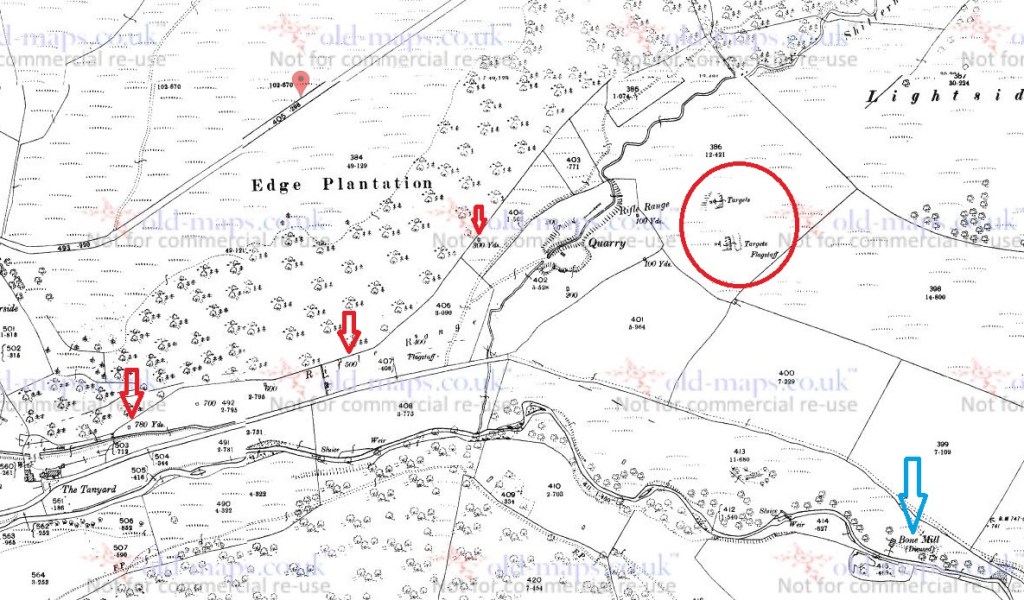
By the time the 1898 map was drawn, the targets had moved to Lightside, with shooting platforms along Shepley Street, here:

The range in 1898. Two targets on the hill, circled in red. The northern is the short range, again up to 300 yards, whilst the southern target is the long range, starting at 780 yards.

However, whichever direction you shot, it seemed to have been hard work, as Hamnett notes “It is a most difficult range… owing to the various strengths of the winds we get all blowing at the same time”. Anyone who has walked along Shepley Street and Doctor’s Gate will know what he is talking about.

So me being me, I decided to have a look around to see what, if anything could be seen on the ground. As it happens, it turns out quite a lot.

Quite an arty shot. The targets are clear against the skyline when viewed from below.
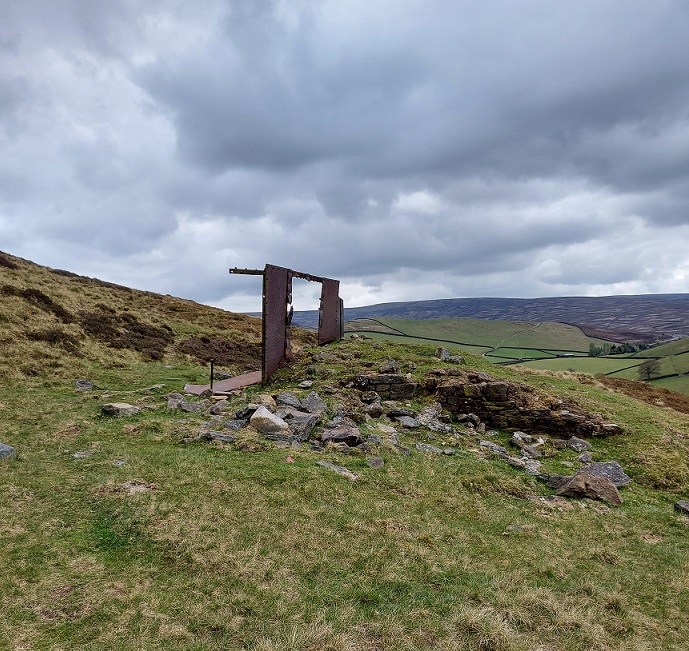
Closer up you can see the metal targets sitting on top of man made platforms – the shooting butts – held by drystone walling. Another arty shot.

Both targets are visible on the ground, and are essentially huge pieces of metal sitting on top of platform. Closer inspection shows it is very interesting.

Close up of the target face showing dents caused by rifle fire.
From behind the target, looking through the dents that have rusted through in the last 150 years of harsh Lightside weather.

Walking around the back of the target, I noticed some writing… ooooh, says I.

The rear of the targets

Now, with the eye of faith and if you squint after a snifter or three, I can just make out the following words:

“WOODS’ UNIVERSAL – unclear – TARGET. WOODS COCKSEDGE & CO. STOWMARKET. 1876”

Honestly, it does. Have another glass, and look again.

Nice! And it even gives a date, which is unusual in archaeology to say the least. There is a little bit about Woods, Cocksedge & Company here (and no sniggering… honestly! Don’t think I can’t hear you. I’ll have you know this is a serious blog), with more dotted about the internet. They seem to have been a standard iron foundry, founded in 1812 in Stowmarket, Suffolk, and which continues in one form or another until the early 20th century, perhaps even beyond. Research on the internet produced this advert, stolen as always, shamelessly, from this website.

A great advert, and one that gives us all sorts of additional information, including how to stand in a relaxed manner whilst being shot at by your own men.

The targets in the picture are clearly the same as the ones on the hillside – they have the same attachments, and you can see how they were fitted and braced when in use.

The advert is full of additional details – such as the fact that these were made from hematite iron (rather than wrought iron) (is the missing word on the target “hematite”?), and that Woods, Cocksedge & co. were supplying the government with their targets. I note also that they were supplying “nearly every foreign power”. I’m sure it was comforting for our soldiers to know that, as the bullets pinged around them, the reason that the foreign soldiers trying to kill them were so accurate in their shooting is that they were trained on the same targets as them.

It also states that the targets are “indestructible”, and they seemingly pretty much are – 150 years later, and I’m certain they would withstand modern rifle shot. Probably.

There were also some small finds – unsurprisingly, a number of bullets.

Left to right: Martini-Henry, Lee-Metford, Lee-Metford copper jacket, Lee Enfield.

What is interesting, though, is that these plot the history of British Army issued rifles from 1877 onwards. The militia were originally issued Snider-Enfield rifles, but these were used only on the original Chunal range, so we have no bullets from these. We know that in 1877, they were using the Martini-Henry rifles, and our earliest evidence is, then, on the left, the large lead slug of a Martini-Henry rifle – you’d know about it if one of those hit you. These bullets are interesting from a design point of view – they have a slightly hollow base that expands with the explosion of gunpowder behind it, connects with the grooves inside the rifle which, combined with its solid weight, makes it more accurate and very powerful.

Next, the Lee-Metford copper jacketed .303 round, which the company were issued on 18th September 1897, and which was responsible for these targets being installed. As Hamnett puts it “the greater velocity of the bullet of the new rifle made the old iron targets unsafe”, and they were replaced by the Woods’ Universal Hematite targets. So we have a date for their installation – sometime after September 1897, and I assume at this point the targets were moved from against Shire Hill to where we find them today.  Next to the bullet is the copper jacketing which is formed around the lead bullet – you can see how it has peeled away, and imagine the effect that the peeling and tiny razor sharp fragments would have if you were shot. It’s sometimes easy to forget that these small interesting lumps of metal were designed and made with just one purpose in mind – to create a large hole inside another human being.

Next to that is a standard early 20th century Lee-Enfield .303 round, and probably owes its occurrence at the range due to live-fire exercises carried out hereabouts in 1943 by a unit of commandoes. Neville Sharpe in Glossop Remembered (p.154) recalls the commandoes showing the local boys how to extract the cordite explosive inside cartridges to make fireworks… with predictable results. I also like the continuation of use, as though the land once used in a particular way somehow lends itself to that particular activity. The area is now home to the Old Glossop Clay Shooting Ground, and the hills once more ring with the sound of gunfire. They claim that the area was in use for shooting from the Second World War onwards, but we now know differently.

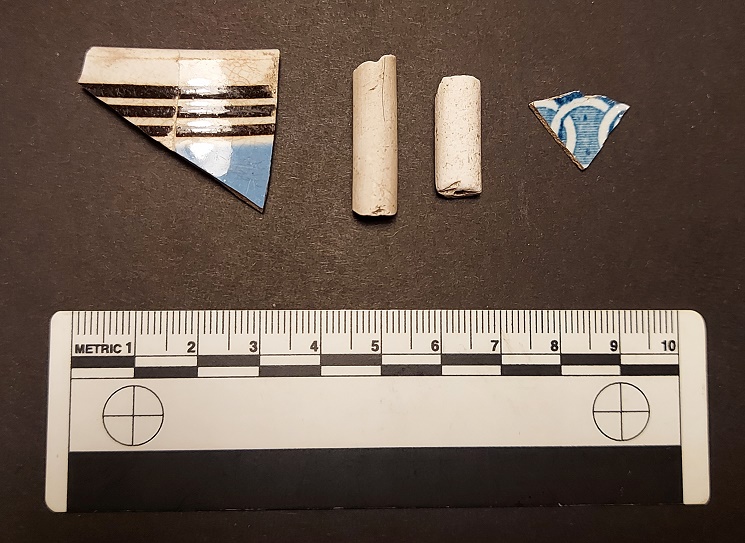
The path up to the targets also produced a few pieces of pottery:

Some fairly worn sherds. I’m also trying out a black background to these photographs – what do you think?

From the left, then: An Annular or Banded Ware rim sherd of a smallish jug (the diameter is 8cm, but curves inwardly slightly). Date wise, it’s probably late 19th century, so about the right date; I love this stuff. Two pipe stems, also of a similar date (I like to imagine them being smoked by bored soldiers wending their way up to the targets). And finally, a sherd of Transfer Printed pottery, which could date from anytime after 1840, but is probably the same date as everything else.

Hope you have enjoyed this jaunt down the military history of Glossop – the story of the militia is told in Hamnett’s History of Glossop, a copy of which is in the library, and it highly recommended. The range itself is on public access land, and right by a footpath, so go ahead and have a look (it’s a great place to fly a kite). But please don’t go digging around there – not only is lead highly toxic, without the landowner’s permission it is illegal. Plus, all you’ll find is lumps of twisted metal. The finds I made were lying on the surface.

My thanks for the company of Andy T on this particular jaunt – he’s a good bloke, mostly, and can be found on Twitter @Thorny61.

Please feel free to email me with comments and questions, even to point out that I am wrong about something. Until next time then, look after yourselves and each other.

Until then, I remain.

Your humble servant.

RH.

Archaeology · Pottery · Whitfield

… And Came Back

What ho! dear readers. I’ve just opened a bottle of fine Belgian pilsner, and am feeling quite effervescent, if that’s the word I’m fumbling for. I think it probably is.

Talking of fumbling, I went back to the place I found the lead came and had a fumble. Madam, please! This is a family blog. Honestly, some people! So there I was, fumbling, looking to see if anything else popped up, when I found what looks like window glass and some early pottery. Hmmmmmmm, let’s take a closer look.

Small and fairly unimpressive – I nearly ignored it. Shame on me!

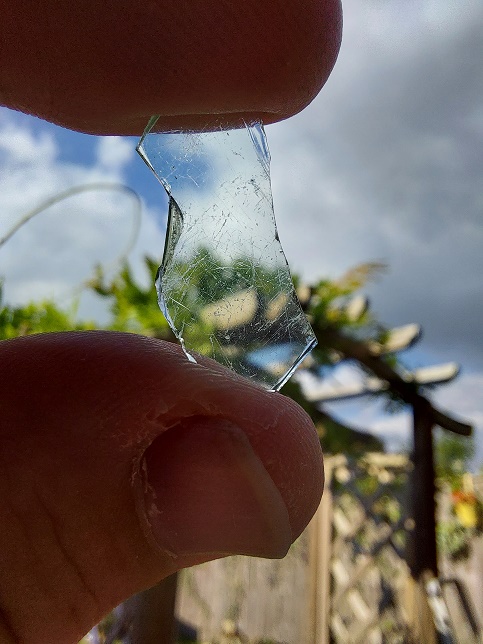
The glass is only a small fragment – just 2cm x 1cm – and very thin, being a shade over 1mm thick. It is also flat, which just about rules out its origin being a bottle. I terms of colour, it has that blue-green tinge that you associate with early glass, before they managed to perfect the process to remove all the impurities. Looking more closely at it, I noticed that two of the edges were flat, and pulling out my new toy – a usb computer microscope that also takes photographs – I was able to see – and show you – tiny teeth like nibbles that tell me that the glass had been cut and shaped.

I’ve had a lot of fun with the microscope!

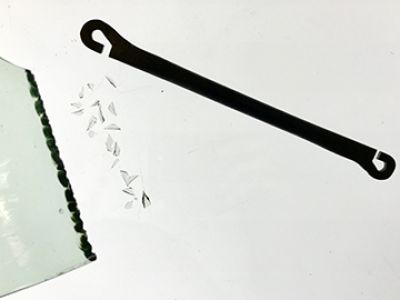
Now, I know a lot of useless information – for example that glass is shaped by nibbling – but I’ll admit that even I had to look up how exactly this was done. With a ‘Grozing Iron’ it turns out (see, don’t say you don’t learn something by reading this blog, although I can’t see it coming up in a pub quiz anytime soon). The verb is ‘to groze’, and the above glass fragment has been ‘grozed’. It looks like this:

A grozing Iron, image courtesy of the York Glaziers Trust who have a fantastic illustrated glossary, if you are in any way interested in glass.

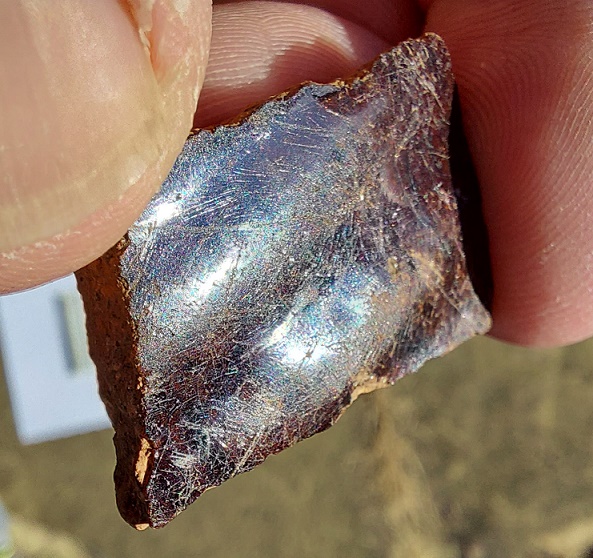
So, it was shaped… but to what shape? The two edges, if they were extrapolated, didn’t make a right angle, but instead, a diagonal. A diamond, even. Could it be I have a fragment of the glass that went into the lead came I found? Impossible to say for certain, but it is possible, even probable. In terms of date, it’s very difficult to say. Broadly speaking, the thinner the glass, the earlier it is, and combined with the colour could certainly put it in late 17th or early 18th, which matches the tentative date for the came. So that’s exciting, if you get excited about this sort of thing… and I do! Here it is situ:

I added the came for effect – perhaps reuniting them.

The date of 18th century also matches the date of two sherds of pottery I found with the glass.

Again, quite small and uninspiring.

They are both mottled manganese ware, and classically early 18th century in date – certainly not later than about 1760. Interestingly, they are not particularly worn, so it’s unlikely that they have been kicking around for 250 years or so – perhaps there is a dump nearby? They are also both open vessels – bowls, probably – and may belong to the same vessel, despite one being glazed on the inside only (quite often, the glaze on the exterior was confined to the top part only). Also, one sherd shows the characteristic manufacturing marks, that also doubled as decoration:

The horizontal lines visible in the clay, formed on the potter’s wheel. Also, if anyone want to donate to the ‘Robert Hamnett Needs a Manicure‘ fund, please feel free…

The next photo shows the make up of the sherd – the reddish slipped exterior (top), the rough orange-brown earthernware fabric with tiny bits of stone in it (middle), and the thin dark line of the glazed interior (below). I love this stuff.

Lovely stuff!

I’m going to put together a quick and easy guide to pottery, describing all the different ‘parts’ of a sherd, and some tips on identifying what shape and size, as I think it’s nice to now what it is you are holding. I’m also still putting together my quick and dirty guide to Post-Medieval pottery, as there is a serious gap in the market… probably for obvious reasons!

I’m going to end with a great photograph of the glass, and to pose the following questions: Who was the last person to look through that window before us? And what did they see?

Makes you think.

Until next time, take care of yourselves and each other. And I remain.

Your humble servant,

RH
Archaeology · Whitfield

Summer Came… and Went

What ho! Hope you are enjoying the summer so far. A quick post today, but more very soon.

So, I know I promised you pottery this time, and I can tell you are wildly disappointed, but this is an interesting bit of history. Honestly. It really is. Don’t just look at the first picture and yawn… Philistines.

There are a number of places around Glossop that never fail to produce some bits and pieces – Lean Town, Harehills, etc. One such place is at the top of Whitfield Avenue. Never lots, but always a sherd or two, and this time a piece of lead. Window lead to be precise.

Lead is one of those substances that is instantly recognisable once you know what it looks like, and can be spotted from quite a distance. It doesn’t rust, or even really react beyond producing a white powder on the surface. It is soft, which means it can get damaged – in particular bent – easily, but it also means that it doesn’t break in the way that pottery or glass does, so it often survives. It is also worth remembering that it is highly toxic, so be careful when you handle it.

Don’t worry, I washed my hands afterwards.

So there it was, lying on the surface of the soil, a dull grey flash exposed after all the rain we have recently suffered. I would have picked it up anyway – I try and do that with lead, as it’s not great in the environment – but I knew at a glance what it was, and was excited as they can be interesting. I was not disappointed.

Window lead, or came as it is more properly known, has been with us for as long as there have been glass windows, and is essentially an elegant solution to a big problem – the fact that it is very difficult and expensive to produce glass in any large size. It is far easier to join together smaller pieces, and this was still the case until the 19th century, and why even early 20th century windows are made up smaller pieces separated by wooden mullions. But the multi-part aspect also allowed works of art to be created in the form of stained glass windows that adorned medieval churches and cathedrals, and is a fashion that continues down to today.

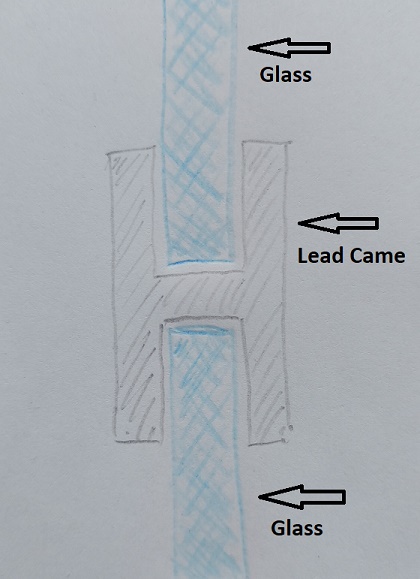
The came works by allowing separate pieces of glass to slot into its grooves, joining them together, with the whole being held in place by the window frame. In profile (that is, cut in half), came is broadly ‘H’ shaped:

A pretty awful drawing, but you get the idea… I hope.

So then, what can we say about this little piece of twisted metal? Well, a surprising amount, to be honest. Firstly, rather than being poured and shaped in a mould, the came has been milled – the lead was drawn through a former by a cog. This means that it is not medieval, but instead puts it into the archaeological ‘misc.’ tray that is ‘Post-Medieval‘ (roughly, after 1500). We can, however, narrow it down a bit; the cog used in the manufacturing process leaves characteristic tooth marks on the interior. As the process was refined and improved over time, these marks grew further apart, and broadly speaking, the closer the teeth, the earlier the date. On our piece of came, they are very close together, and thus an earlier date is suggested.

Teeth marks, where the cog has pulled the came through the former.

This is backed up by the slightly rounded profile, which is also associated with earlier examples. We might suggest a date of perhaps 1700 – 1800, possibly earlier, but unlikely to be later.

Left: the slightly rounded ‘H’ profile, also slightly squashed. Right: the clean cut edge, probably by a knife.

It seems to have been cut cleanly at either end, which means it is the original length, which is significant. It measures just under 6cm, or 2 1/4 inches, so not very long, but a perfect size for the diamond style windows that were common in the 17th and 18th centuries, when whole windows were made up of smaller pieces and joined by the came. Look closely, you can see the tin solder that would have joined it to another lead came piece.

The melted end, but also marks where it was pulled through the former.

Looking even more closely, you can see the putty that would have weather-proofed it still inside the groove.

White putty visible.

Here is a 17th century window:

Typical Tudor & Jacobean diamond pattern window.

And here is our piece of lead in a mocked up window, showing how it would have been used.

Another rather poor drawing, but one hopes you get the idea.

How this piece of lead came came to be lurking in the soil on that rainy day is not certain, but it is in the right place – some of the oldest houses in Whitfield are right there, including Hob Hill Cottage with its datestone of 1638. The came must have originated in one of these houses, and at some stage either window was repaired, or replaced entirely. Indeed, if we look closely, we can see two marks where the lead flange has been lifted away from the glass to remove it.

The lead flange has been peeled back from the glass.

At that point, the lead has been lost or thrown away. I’d love to be able to say for certain which house it came from, and the obvious choice would be Hob Hill Cottage as it is just opposite the find spot, but in reality who knows? I am amazed at how much information it is possible to glean from what is, at first glance, just a small piece of twisted metal. And see, I told you it would be interesting.

More soon. As always, look after yourselves and each other, and until next time, I remain.

Your humble servant,

RH

Archaeology · Longdendale · Pottery

Valehouse Pot

What ho, kind and gentle folk of the blog reading world!

Sooooo, today is back to some sense of normality in that I am looking at pottery.
Woo-hoo!” I hear you cry.
Well alright, some of you cried “woo-hoo!“.
Well alright, not that many of you if I’m honest. Certainly not enough of you.
Well tough… it’s my blog, and I like pottery, so we’re doing pottery. Now pay attention, I may ask questions.

Actually, this stuff is interesting in two ways. Firstly, as bits of archaeology. And secondly, I didn’t find them! No, that dubious honour rests with my friend and fellow delver and obsessive, Charles Winford Lodge (actually not his real name, but then you are reading a blog written by a man who has been dead for well over 100 years, so it’s probably best not to start asking too many questions at this point). He goes by @2hrTV on Twitter, and usually has something interesting to say on the subject of the history of Glossop and area. Usually… I mean, I can’t promise.

Anyway, the conversation – pretty normal for us – went along the lines of:
Him – “Years ago I found some pottery at Valehouse Reservoir. I’ve just re-found it in the house… want to see it?
Me – “Absolutely, my good man… lead on.”

Out it comes (in a plastic doughnut box from Tesco – price £1.10 – bear in mind this is the man who once gave me some pottery in a camembert box, so doughnuts are a step up). Most of them are fairly standard Victorian sherds, but one or two made me sit up. Now, the sherds had not been washed (tut! tut!), and so I volunteered to take them, clean them, and blog about them. Which is how I ended up washing up someone else’s broken old rubbish. Please, no one tell Mrs Hamnett… it might not end well. For any of us.
However, I think the risk was worth it.

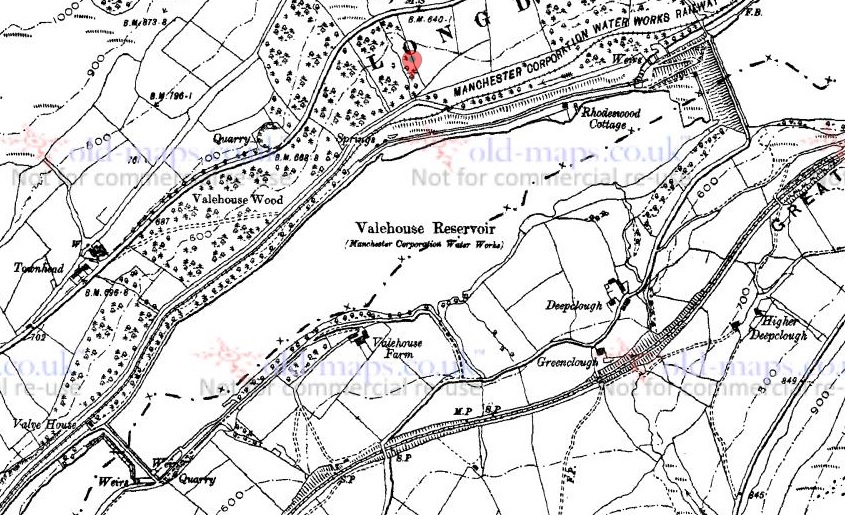
Valehouse is an interesting place; now just the name of a reservoir in the Longdendale Valley, below the Woodhead Road, it was once a village that in its prime, and prior to its flooding, had roughly 600 residents in 100 cottages with a number of shops, a school, and other amenities. Samuel Oldknow built the first mill here in 1775 – the first to harness the power of the Etherow – and it is after this point, and largely in the early 19th century, when the mills were substantially expanded, that the majority of houses were built to house the mill workers. The valley was flooded in 1869 to provide Manchester with water, and the mills and houses were all submerged. I also have a personal connection with the village in that my great great great grandfather, Benjamin Livesey, was born there in 1824.

Valehouse prior to the 1869 flooding. Note the large mill buildings, and the many houses.
Valehouse as it was in 1899, and indeed still. Note the large quantity of water and lack of houses.

So then, the pottery. It was recovered during a drought a few years ago, and from the area around the viewing platform on the north side of the reservoir. Having studied the sherds, it’s clear they can be split into two broad chronological groups – early 18th century and late 19th century – which probably represent two different origins. I’ll discuss the latest first, before looking at the oldest, and arguably more interesting.

Not, at first glance, particularly inspiring.

1 – A Victorian earthenware jar or jug, vertical ridged decoration, with a body diameter of 9cm, and glazed in a lovely cobalt blue colour. Nothing special, but quite fancy.

2 – Simple sherd of blue and white earthenware, with the bog standard transfer print.

3 – Thick base to a Late Victorian Codd Bottle. It has ‘TON-U-LYNE’ embossed on one side, and a little research gives us ‘R.A. Barrett & Co.’ of Ashton-Under-Lyne. They manufactured soft drinks and mineral water, and were particularly noted for their ginger beer. Their factory still stands in Dean Street, Ashton.

A complete Barrett & Co. Codd bottle, and the factory as it stands today. The bottle fragment above would have been made in this factory.

4 – Fragment of bottle, probably Victorian mineral water or beer.

5 – Another fragment of green glass – probably Victorian, as it is quite thin walled, but it does contain large numbers of bubbles, suggesting perhaps an earlier date.

6 – A large, thick walled, earthenware sherd, perhaps part of a lid to a very large “Brown Betty” teapot – it is certainly the right colour for this, and curves the right way. The surface colour is a mottled brown, and is a type that deliberately recalls the earlier, 18th century, manganese ware. Interestingly, you can see how this effect is achieved by looking at the break. Two colours of clay – one dark reddish brown and one a creamy buff – are loosely mixed, and the clay is shaped into the mould. It is first fired, then a clear or slightly yellow glaze applied, followed by a second higher temperature firing. Where the cream buff forms the surface, it is a yellow or golden brown, and where the reddish clay forms the surface, it produces a dark rich brown, together forming the mottled effect. I quite like it, but much prefer the original 17th century stuff.

The appetising looking Victorian mottled ware sherd. You can see how the different coloured clay affects the surface colour

Right, let’s move onto the arguably more interesting stuff.

This material dates from roughly the early 18th century – let’s say 1700 – 1750… ish.

1 – Large and chunky strap handle probably of Nottingham Stoneware, and probably from a large jug or flagon. It measures 4.5cm wide, and is typical of its type. Stoneware is fired to a very high temperature, melting – or vitrifying – the clay, making it into a very hard and almost metallic pottery. It has a dark grey fabric, with a brown glazed surface which is very shiny – the result of adding iron to the glaze. Interestingly, this is not as fine or well made as the earliest material here, and shows some similarities with the later Derbyshire Stoneware, so it might be the somewhere in late 18th century.

2 – Base to a stoneware jug or jar, with a diameter of 10cm. This too has characteristics of both earlier Nottingham Stoneware and the later Derbyshire type – the glaze for example, is less lustrous than early sherds, but it has the classic grooved decoration running around the base. The underside shows wear suggestive of use and re-use over time. On balance, I’m going to say it is early, safe in the knowledge that no one is going to double check (as he scurries away and hides it).

3 – Lovely Nottingham Stoneware bowl, with a rim diameter of 13cm, and a slightly flaring out-turned rim. It’s thin walled, with a grey uniform fabric that was slipped in white before glazing. The surface glaze is a lovely melted chocolate colour, very lustrous and almost metallic looking, and is very characteristic, as is the horizontal grooved decoration on the exterior, and glaze drip marks on the interior. I liked this so much that a drew it using the archaeological method – essentially looking at the whole vessel in profile, and removing a quarter to allow both the interior and exterior to be shown.

The profile of the sherd is shown on the left, coloured in black – this shows the shape of the pot. The interior of the pot is shown next, with the wavy lines where the glaze dripped. Then the exterior of the vessel is shown next to that. I might do a post about this type of drawing, as I’d like to do more. It’s been a while since I did this last, though.

4 – This is a bit of an odd one. Stoneware, but potentially quite early. Certainly it fits with the 18th century stuff, but the surface is off – it looks like orange peel, dimpled all over with a salt glaze, and reminds me of the earlier 18th and even 17th century German stonewares that were imported in huge quantities. Whatever it is, it’s a huge rounded or pot bellied vessel with a diameter of roughly 26cm, despite being very thin walled. It is also a closed vessel, being glazed on the exterior only, so perhaps some form of small barrel or large bottle?

5 – Nottingham Stoneware – flask or bottle type. The body, shoulder, and beginning of the neck only, it has a body diameter of 18cm, so quite large despite being very thin walled. It has a double band of horizontal incised decoration which is showing the under slip where the glaze is thinnest. Like No.3, the glaze is lustrous and a melted chocolate in colour.

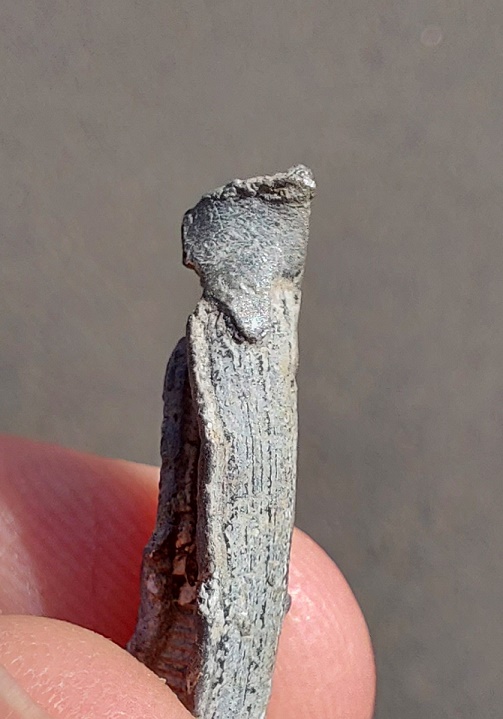
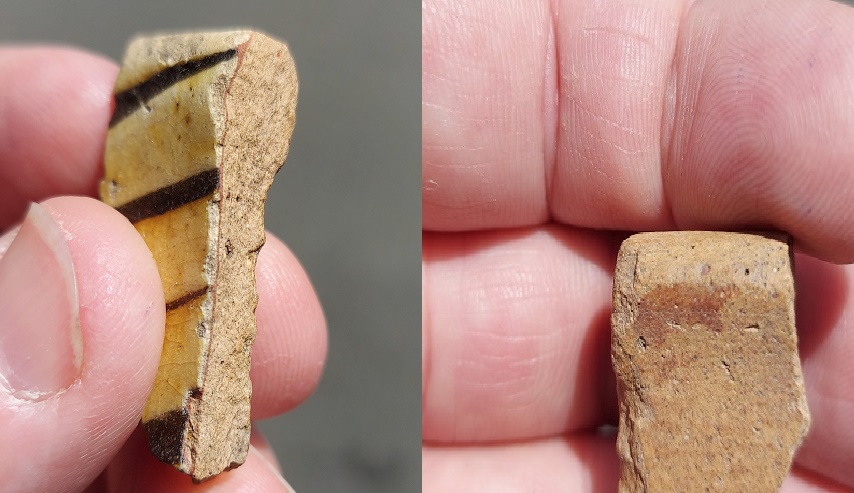
6. Finally, we have the star of the show – a rim fragment of a Staffordshire Slipware platter or large plate. This stuff is very diagnostic, and gives a clear date of between 1650 and 1750, with this sherd from 1700ish.

Interesting stuff!

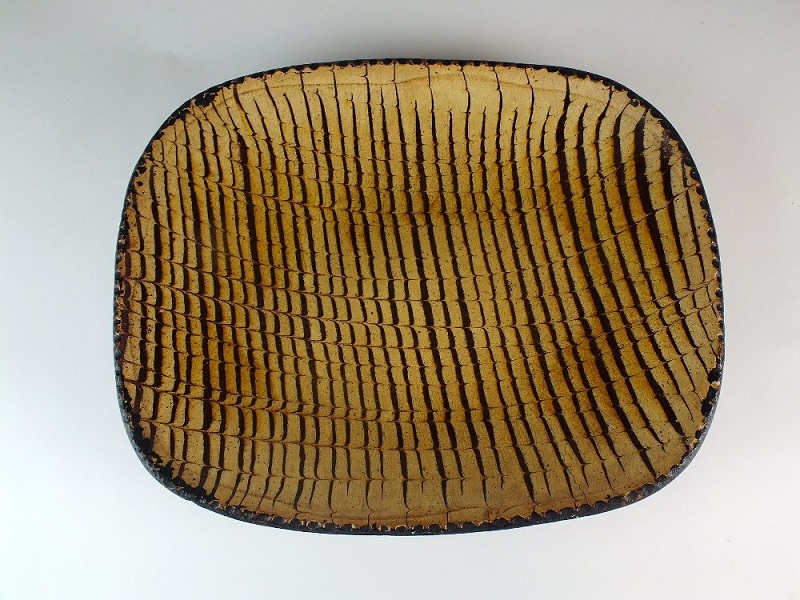
Slipware like this is quite good quality, and a step up from the wood or plain wares that the average man or woman would eat from – or rather take from, as this would be a communal dish that everyone would eat from. Often broadly rectangular (as this is, I think), they are shallow, and would be completely covered in this linear banded decoration of yellow and dark brown. It’s quite striking, and would be a blast of colour in a world that was otherwise quite drab, particularly in winter. I still can’t work out whether I love or hate this stuff! Here is a complete example:

A complete example of migraine inducing 18th century pottery.

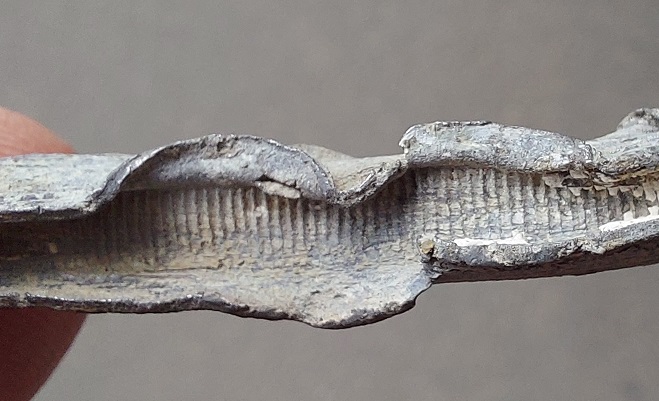
The process of decorating the pot went as follows: the pot is first moulded, then fired at a low temperature. The interior, and only the interior, is covered in a red slip, then overlaid with a white slip, and a tool is then dragged through this white slip, revealing the red underneath. The whole interior is then covered in a clear glaze and fired, transforming the colours to dark brown on the red, and honey yellow on the white. The whole process can be seen if we look at the break on the sherd:

Right – some of the red slip splashed on the exterior of the sherd, it remains red because it hasn’t reacted with the glaze. Left – all there elements can be seen in the break: the red and white slips, the tool that scraped away the white slip, and the glaze that overlays the lot.

So what does all this mean, then?

Because the valley was flooded to create Valehouse Reservoir, it gives us a cut off point (a terminus ante quem in archaeological terms – essentially the latest time an event could have happened) – any buildings and such there must have been built before this point. However, that is not strictly true with portable objects, especially those found near the edge of the water – the reservoir was almost immediately a picnic and pleasure spot, and plates get broken, bottles get launched into the water, etc. So we can suggest tentatively that although some of the material will likely be from the village before it was drowned, most of the Victorian material, and in particular the Codd Bottle, was deposited after the reservoir was filled.

The same cannot be said for the earlier material, and therefore there was clearly some form of settlement here prior to the Victorian period, as no one in their right mind is going to carry around 150 year old pottery to throw in a reservoir. Alright, I might… but most people don’t. So this material has to be from an 18th century dump of some form… but from where. Studying a map of Vale House prior to flooding shows clearly the mill complex and all the houses.

I love playing around with Microsoft Paint!

Circled in red is the rough location of where the pottery was found. But here, in the green triangle, is an odd looking group of buildings. Set apart and in its own land, it looks like the standard farming hamlet for this area, made up of the farm building, outbuildings, and farm worker’s cottages. And in Bagshaw’s Directory for Cheshire dated 1850, we read of Joseph Roe, Farmer, Vale House Farm. Even the name ‘Vale House’ suggests a house of some importance. I wonder if, as so often happens, the local big house or manor house became less important over time and ended up as simply Vale House Farm. If so, then this might explain the 17th – 18th century pottery, and given that it’s made up of several different domestic vessels, suggests strongly that this is the midden, or rubbish dump, associated with the farmhouse. All we have to do now is wait for another drought and we can see what else is buried there.

Valehouse Reservoir today. Somewhere in the middle of that photograph, below the water, lies the remains of a 17th century farmhouse.

Hope you enjoyed this weeks romp around with pottery… let me know what you think, anything at all, even to tell me I’m wrong about the stoneware base (I’m not… it’s my site, and therefore I’m always right!). Also, if you have any pottery that you want me to look at… just don’t tell Mrs Hamnett.

Next month, we have a very interesting tale to tell… more of that later. For now, take care of yourselves and others, and until then, I remain.

Your humble servant,

RH

Archaeology · Oddities · Whitfield

What If…? Of Stone Heads and Stories.

What ho, you wonderful people, you.

So, despite having half a dozen half-written posts, piles of interesting objects and sherds to talk about, and a few adventures to recount, I want to try something a little different today. “Oh no!” I hear you cry. But fret ye not, gentle reader, for it is still archaeology, it is still Glossop based, and it is still interesting. But it is a little… quirky. You’ll see what I mean.

I have a friend who is a writer, and quite a good one at that. He has often mentioned that stories usually start with what he terms a “What If?” moment, where something – often an object – presents itself, and the question is posed “what if…?” From there the story grows, based on and around that one question. The answer that comes doesn’t have to be ‘real’, it is fiction after all, but it has to be possible. What if a house was haunted? And what if the house fell down? And what if a brick from the house was haunted too? And what if a dashing archaeologist took the brick home to write about it on his extremely popular and incredibly interesting blog? What if…?

Archaeology, I think, uses a similar technique. An object is excavated, and the interpretation – the story – begins. However, where we differ from writers is that we base our ‘what ifs…?’ on evidence and supposition grounded in data. The interpretation, in this sense, has to be ‘real‘, although it is only ‘real’ for as long as the data supports it. Sometimes though, It’s fun to play “what if…?” – and here we join today’s post.

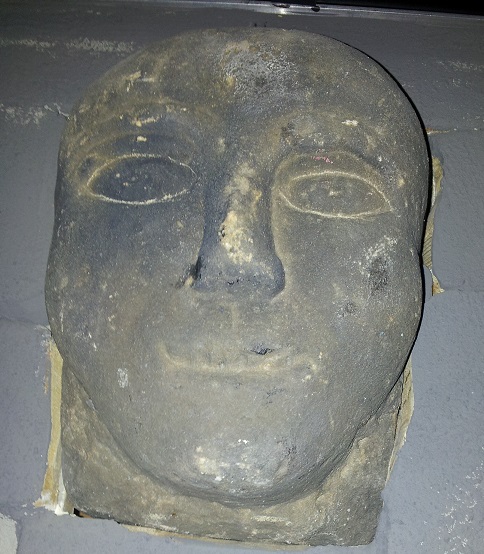
A stone head displaying all the characteristic features, including almond eyes. This one was allegedly found on Mouselow, and now lives on a wall in Buxton Museum

Stone heads. A lot has been written about them. They are cursed and evil. Or they are warm and friendly. They are ‘Celtic’ (i.e. Iron Age or Romano-British) in date. Or they are medieval or early modern in date. Or a combination of both. They represent an unbroken pre-Christian tradition, and an aspect of the whispered ‘Old Ways‘. Or they are simply folk art, and just decorative. Or they are magically protective (that wonderful word, apotropaic, again). Or both. Or neither. A brief trawl of the internet gives a lot of different sites and opinions, ranging from the scholarly and the more open minded, to what can only be termed outright nonsense.

Whatever they are, carved stone heads are a feature of this part of the Pennines – from Longdendale, over the hills to West Yorkshire, and up to the Calder Valley. I actually have a serious project that is looking at them; cataloguing known examples from Glossop and Longdendale, and trying to place them geographically, as well as giving some sort of date to them. There are at least 23 examples from the Glossop area, with more doubtless waiting to be uncovered. But it’s an ongoing project, and not really ready to publish – here, or anywhere else for that matter – and I just keep chipping away at it. It was during the course of trying to map where they were found, that I noticed something very interesting.

Stone head in Old Glossop. Image stolen shamelessly from the Old Glossop website (follow this link – the website is very good)

Before we go any further, I should state that my personal belief is that most of the stone heads are medieval or post-medieval in date (indeed, there is a record of them being carved in the 19th Century). That’s not to say that Iron Age ‘Celtic’ examples don’t exist (one was found at Binchester Roman Fort, in County Durham in 2013), it’s just that it is very difficult to date them as they usually don’t come from any secure archaeological context, and basing a date on ‘style’ or method of carving, as has happened in the past, is notoriously dodgy. That stated, there is the possibility that I might be wrong. And this led to my ‘what if…?‘ moment.

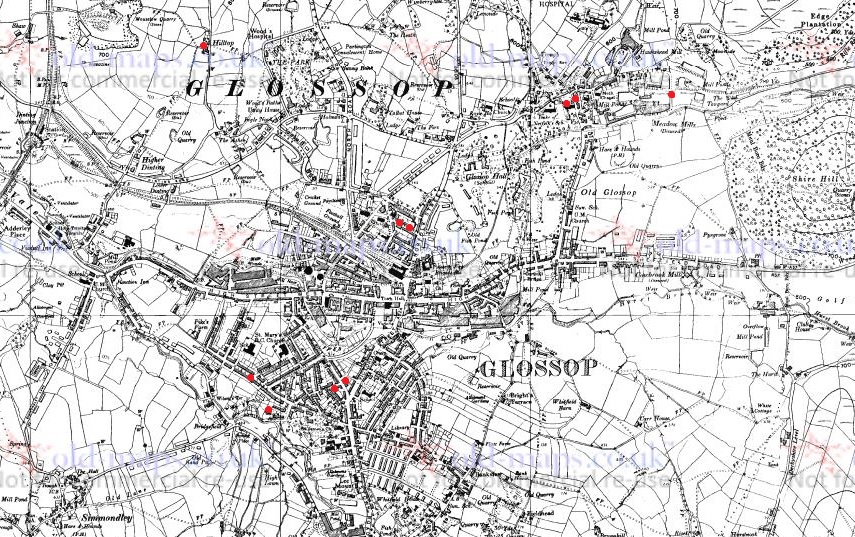
Back to the find location, sadly the majority of the heads are simply “found in Glossop area“, and thus have no exact place. But from various sources, I was able to identify where some of the heads were found. The distribution map is below:

1:10,000 map of Glossop. The Find spots – where the heads were found – are marked in red.

They seem to be dotted all around the area: Mouselow, Manor Park Road, several in Old Glossop, etc. However, looking at the above map, I noticed there was a distinct grouping in Whitfield – four of them centred around Slatelands Road and Hollin Cross Lane. Hmmmmm… let’s have a closer look, then.

Here is the Whitfield group on the 1:2500 map.

Duke Street, Pikes Lane, St Mary’s Road, and Slatelands Road. Geographically, they are in the same tangle of roads in that area. But the heads more than likely pre-date the Victorian roads, so we need to strip them back. What was there then? Well fields, mainly, though the medieval track from Simmondley to Glossop ran through here (that blog post is coming, I promise!). And before that, the Roman road also ran through here, along Pikes Lane, before kinking over Long Clough Brook and onto the fort and settlement at Melandra.

And then, the “what if…?” hit me.

For the sake of a good story, what if these heads actually were Iron Age or Roman in date? What could this cluster mean?

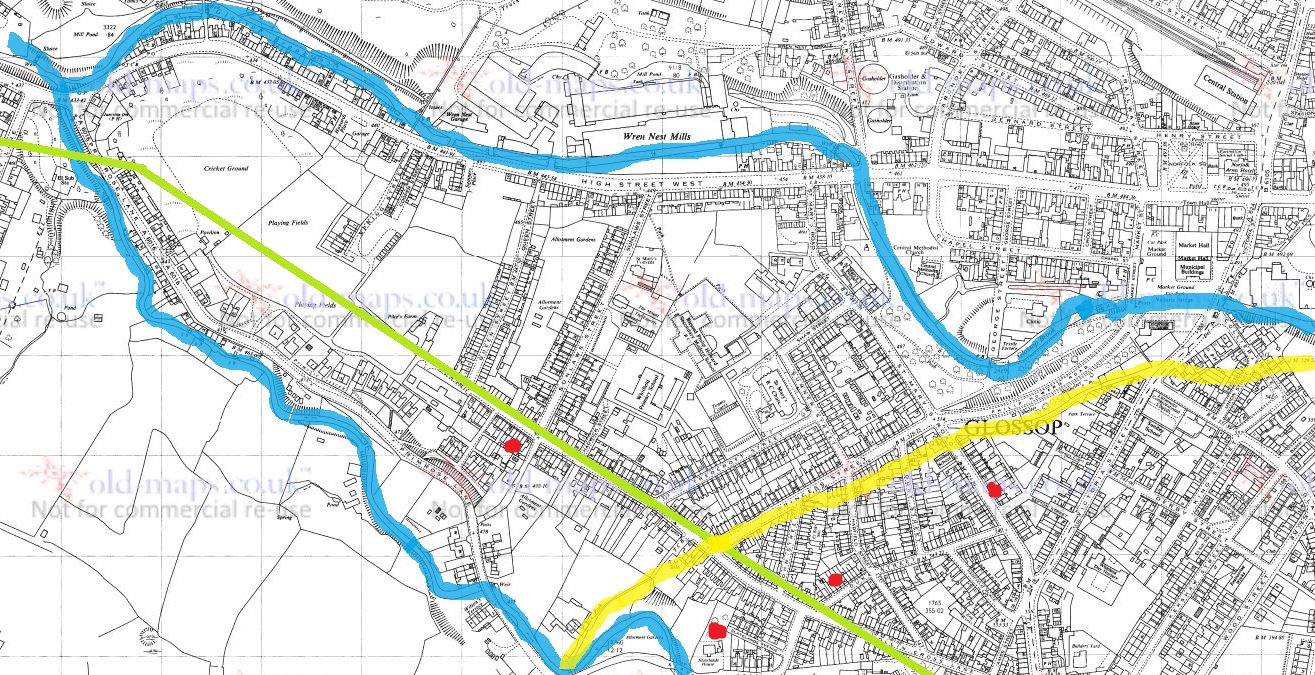
Looking again at the area stripped of the Victorian houses, it’s very clearly a promontory, a high plateau that runs between two brooks – Glossop Brook to the north, and Long Clough Brook to the south. In the Iron Age, they liked their elevated places – Mouselow, which dominates the area, is a classic Iron Age hillfort, and others exist nearby, at Mellor and Mam Tor. One only has to look at St Mary’s Road from Harehills Park to see how steep those slopes are (try doing it pushing Master Hamnett in a pram with a load of shopping from Aldi). And on the other side, who hasn’t cursed Slatelands Road halfway up, gasping for breath. This is a very real landscape feature, completely masked by later development, but one which would have been very visible back then. This would have been particularly true where the peninsular narrows at the west, leading down to the junction of the two brooks. This too, is significant.

Throughout prehistory water was a sacred thing, and was considered ritually important. A spit of land, elevated, defined by water and ending in the confluence of two bodies of water, would have been hugely significant. Actually, a perfect place for an Iron Age temple or shrine, perhaps one devoted to the ‘Celtic head cult’ as suggested by scholars such as Dr Ann Ross (in her Pagan Celtic Britain)? Indeed, the North Derbyshire Archaeological Survey notes that the number of heads in the Glossop area “might suggest a cult centre” based in the town in the Romano-British period (Hart 1984:105). It has been suggested that the heads are sometimes associated with liminality and boundaries, and were protective. What if they were they placed facing down the peninsular, to mark out the sacred space, and to defend it?

The Roman road moves through this promontory, sticking to the high ground away from the valley floors and marshy terrain, as the Romans preferred (see map below). But what if the location of the possible shrine or temple influenced the choice of road location, ploughing through the sacred enclosure, perhaps to make a point about Roman dominance?

The location of the heads in relation to the landscape. The blue is the waters of Glossop Brook (north) and Long Clough Brook (south), forming the spit of land. The yellow line is the medieval trackway, and the green line is the course of the Roman road.

What if…?

Now, I’m not suggesting for a moment that that the above is absolutely true; this is a wild flight of fantasy, and pure fiction – a story. Indeed, doubts are being raised about the reality of the ‘Celtic head cult’ theory in general. But it is a possibility, at least: an archaeological what if…? However, if that isn’t the answer, there still remains the issue of why four stone heads were found in a cluster in this area. What is going on?

If we return to my original thought, that the heads are medieval or post-medieval in date, might they be related to the Simmondley – (Old) Glossop trackway in someway? If we look at the map above, we can see this track (marked in yellow) runs broadly along the line of Princess Street. And just to the east of the three of the heads run along the same alignment. Is this significant? What if people somehow, and for some reason, deposited these heads to the east of the track? But why? Well, I came across a possible reference to just such a practice in this area – Clarke states that “Oral tradition in the High Peak of Derbyshire suggests heads were buried as charms beneath newly-built roads, presumably to keep permanent watch over them” (1999:286). He cites no sources for this “oral tradition”, but this type of apotropaic function – preventing witchcraft and promoting good fortune – is associated with carved heads all over the United Kingdom (Billingsley 2016). Perhaps, then, we are seeing the ritual deposition of carved heads as part of the road building tradition.

What if…?

Heads
A pair of Whitfield Heads. These are at the end of Kershaw Street… and that is all I know about them. It’s on my ‘to do’ list, don’t worry.

No, it is a mystery, and ultimately we are left with questions for which there are no obvious answers. Three of the heads are in Manchester Museum, and the fourth presumably in the hands of the owner/finder. I will have to go and see them, as that might help in dating. As I say the project is ongoing, and any comments or help in the area would be greatly appreciated. Do you know of any stone heads? Do you have photographs of any? Or stories – they seem to attract folklore and superstition like nothing else! Please contact me in the usual way – email me, or through twitter ( @roberthamnett ). Or just come and find me in the street, as people are increasingly doing… so much for pseudonyms and anonymity!

I do hope you enjoyed the little flight of fantasy, but we’ll be back to business as usual next time – the sherds are mounting up! Until then, look after yourselves and each other.

And I remain, your humble servant

RH

References:

John Billingsley – Instances and Contexts of the Head Motif in Britain

David Clarke – The Head Cult: Tradition and Folklore Surrounding the Symbol of the Severed Human Head in the British Isles. (Unpublished PhD Thesis, accessed here)

Anne Ross – Pagan Celtic Britain: Studies in Iconography and Tradition

Archaeology · Whitfield

A Spoon.

What ho! A short one this time… well, relatively short. As I think I have mentioned previously, I normally have about 5 blog posts half written at any one time, and I pick away at them until one ends up finished. But how do I choose the subjects? Well, sometimes, they are obvious topics, and other times it is purely a coincidence, and fate picks it for me. Occasionally my own research throws up something that I think you, gentle readers, might be interested in. And then sometimes, as is the case with today’s entry, the subject simply throws itself at me and the blog almost writes itself.

As I think I have also mentioned previously, mine is not what you would describe as a normal life; I live and breath the stuff of this blog… to the point of obsession. But thankfully I am blessed with a wonderful and understanding wife (or ‘carer’ as she terms it, which is a bit off), and also a child who thinks growing up in a house filled with bits of pottery and odd bits of old tat is perfectly normal. But even I had a slightly discombobulating moment last week – the archaeological equivalent of the alcoholic hitting the fabled ‘rock bottom’.

“Oh no!” I hear you cry. But worry not, I’m not quitting… (and I’ll have another glass of red whilst you’re at it). No, this one was a case of opening my front door and being forced to confront an uncomfortable truth: it turns out I have now reached a point in my odd life whereby people leave bits of old pottery and other stuff in my garden, without so much as a by your leave. Clearly “it’s old and knackered, so give it to RH” is now a thing.

For there on my front wall, wonderful readers, was a spoon. An old spoon, granted, but a spoon nonetheless. “What ho!” said I, and leapt forward.

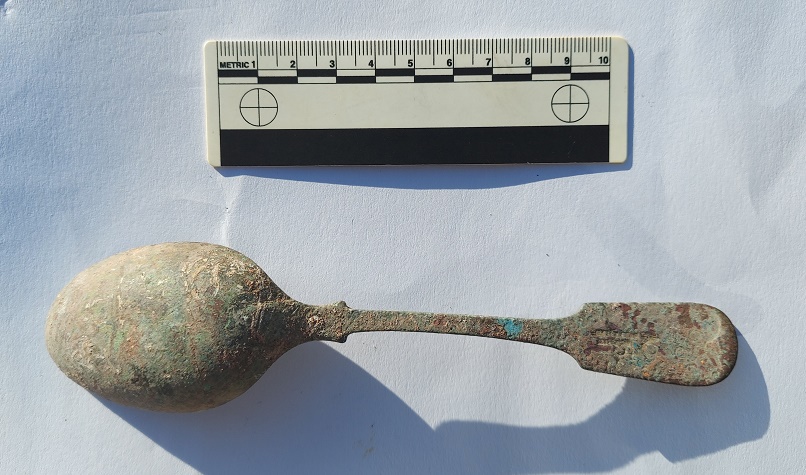
A random spoon on my wall. Yup… my life is totally normal.

Now the sight of such might have caused a lesser man to quiver and fall, but I’ve been around spoons before – I’m no mere amateur when it comes to them. Indeed, it’s certainly no idle boast when I say “I know spoons”.

But from whence did said spoon come? The physical location of Hamnett Towers suggested only a few possibilities, and not knowing Uri Geller, my suspicion fell immediately on our clearly insane neighbours Helen and Sarah who, when not camping in their garden (mere metres away from a perfectly good house) or self harming by cycling to Tideswell and back, are amazing.

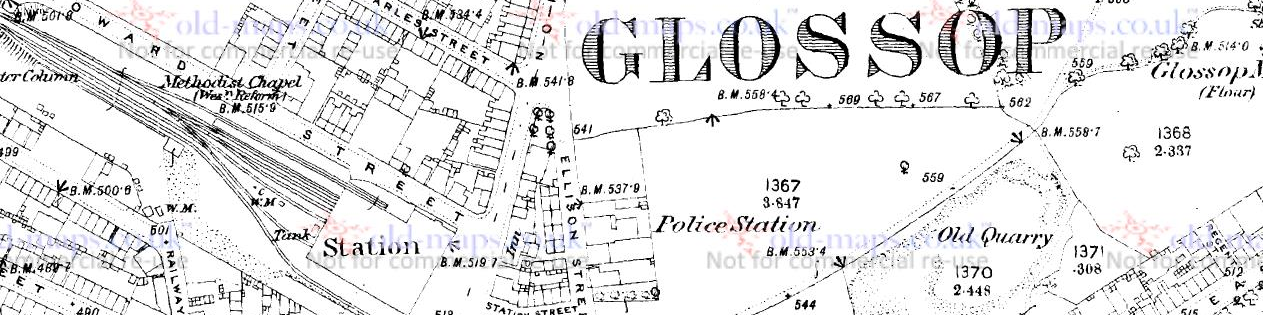
Turns out I was right! Sarah had found it in a wall in Whitfield, somewhere near the Beehive, and thought, correctly as it turns out, “good old RH might want that”. I looked closer, and my interest – already piqued – began to tingle. Writing… and possible decoration. The spoon was a welcome gift, but jokingly came with one condition, that I write a blog post about it. Well, here we are! Let’s look closer…

A spoon, yesterday.
Honestly, it looks like Uri Geller has been here.
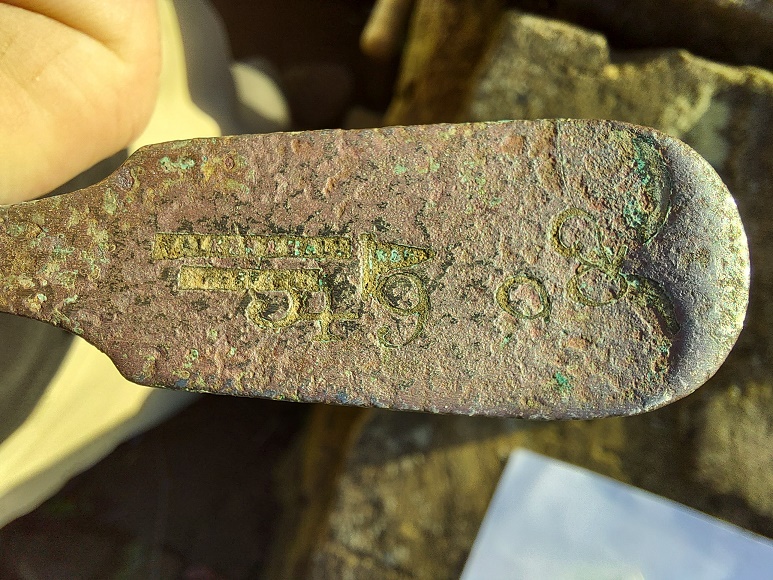
A close up – you can just about make out lettering and what looks like decoration.

The spoon is of a soup rather than serving type, and vaguely Victorian in shape. It was also very worn and covered in greenish verdigris – I really do get the best presents. I couldn’t read what it said where the maker’s mark normally is, nor make out the decoration so I took some very fine sandpaper to it, and removed what I could.

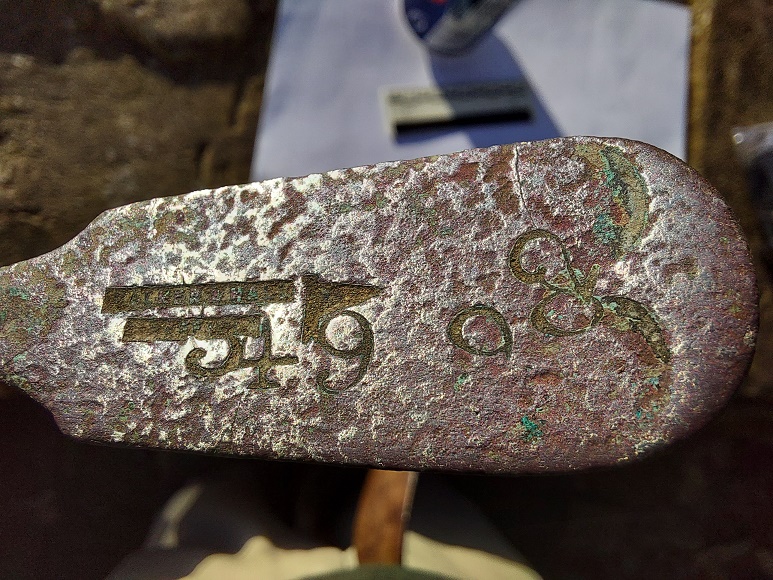
It becomes slightly more clear.
And even clearer.

You can just make out the lettering – if you squint, and use the eye of faith – that reads “Walker and Hall. Sheffield” and a pennant/flag logo containing the letters “W&H“. And, over that a series of numbers stamped roughly onto the surface.

Walker and Hall were a company of silversmiths based in Sheffield. They were founded in 1845, but began operating with that name from 1853 onwards, and continued until 1920. This website suggests that the pennant logo should be dated between the late 19th century (say 1880) and World War 1 – which looks about right from the style of the spoon. Sadly, it’s not silver, but silver plated, and seemingly carries no mark, in which case it might date to before 1884 when Walker and Hall started putting marks on their cutlery.

As for the numbers, I have no idea what they might mean. I can make out “5, 4, 9, 9, 3, 2” Conceivably they could be the model number for the spoon type – there are examples of this being done – but these are very large and untidy, and seem to have been stamped in a haphazard way, with no easy way of reading them. Perhaps they were done by the owner as a way of identifying the spoon, but this leads to the question “why?”. The only explanation that I can come up with is that it was a ‘communal’ spoon, perhaps one connected with a pub or similar – the idea being it can’t be stolen because it is very easily identified. This fits nicely with where it was found, near the Beehive pub. It also fits with the wear pattern, too; it has been bent and straightened several times, as public cutlery often is, but also the huge amount of wear on the bowl.

The asymmetrical wear pattern at the tip

This wear is very visible at the left hand tip, meaning it was used by a right handed person or people. I would argue that a personal spoon wouldn’t worn that much if it was used for at most a meal a day. However, at a busy pub serving good mutton stew, that spoon might be scraped around a bowl 20 times or more a day. Do we have an original Beehive spoon? Well, I’m almost convinced.

Why it was placed in a wall is, frankly, a mystery. People do strange things with objects that are deemed ‘public’ (I look sheepishly in the direction of a wine glass that mysteriously ended up in my house, but which originated in a certain drinking establishment in a certain town), but it may well be that the spoon was too knackered and was simply thrown away, ending up in the wall via child or bored adult.

So there we are – a spoon! From a wall, to my wall, via my neighbours, and finally to you.

Right, that’s all for now. More coming soon, including the much talked about roads and tracks post that I keep promising. In the meantime, I’m going to put a box outside – if anyone else has anything old they want to give me, pop it in as you pass… who knows what I could find in it.

Until next time take care of yourselves and each other. And I remain

Your humble servant

RH

Archaeology · Whitfield

Pressing Matters – Of Cheese and Wills

Good evening gentle readers. I say good evening, for this is when I am writing, but it could be anytime you are reading this. And indeed anyplace… which worries me slightly. Anyway, moving swiftly on.

Recently, I posted a hotch-potch, pickle-type post, that looked at the cheese press I found that was being used to fill up a hole in a trackway. Well, some interesting developments have, well… er… developed.

Firstly, it seems that the whole cheese press is present, which is excellent news. But alas it is broken into two pieces, which isn’t such excellent news. Still, the fact that it survives at all is pretty impressive. Secondly, and even more impressive, I think I might have identified to whom it belonged, which is amazing if true. Please note the use of the phrases “I think” and “if true“… I’ll leave it to you to decide.

Firstly, then, the press.

It’s complete, as in it’s all there, although as you can see it is sadly broken across the middle. It measures 94 x 43 cm, and about 10cm deep, so it’s not huge – and these things do come in huge sizes. I had a poke around mini excavation, just to reveal the edges, and to assess how much was there, but I didn’t want to dig too far – it is filling a large hole in a track after all.

Press1
Nice to see the whole thing – you can just make out the corresponding beam hole on the right.

Master Hamnett helped reveal the press, of course… any excuse to get dirty.

Press2
Master Hamnett ‘helping’ with the excavation and the photographs

It’s fantastic, and I honestly think that this needs to be removed from the road and put on display somewhere; it is a wonderful piece of evidence for life in 18th century rural Whitfield that deserves to be treated better than it currently is.

Right then, so who owned it? Well, I was reading through a collection of Glossop-based 17th and 18th Century wills the other evening.

Before we move on, perhaps we should examine that statement. I have just read it back, and the thought occurs to me… mine is perhaps not what you might call a ‘normal’ life. I mean, here I am, on a Friday night, reading 300 year old wills, and getting excited over some new bits of pottery I found yesterday. Sometimes it’s good to take stock of one’s life… and other times it’s good to simply leave one’s livestock alone.

Anyway, back to the wills. They have been digitised as part of the North West Derbyshire Sources project which is a truly remarkable source for local history and genealogy in this area, and filled with all kinds of information – if you don’t know the website, please do have look. The will that caught my eye was that of John Cowper (Cooper) of Whitfield, and dated 1750. The actual will is fairly bog standard, but is genuinely fascinating as it contains, in a nutshell, the contents of an average well-to-do household. Cooper was someone who we would now perceive as comfortably middle-class, but was then known as a yeoman farmer; someone who owns a small amount of land freehold (paying no rent), and who earns his living from it. I won’t reproduce the full preamble here as it is a wall of text – but it well worth a read (the full transcription is to be found here – it’s alphabetised, so look for John Cooper of 1749/50). However, the contents of the house is as follows:

Item Value (£ s d)
Imp/ Purse & Apparell 7    0    0
A large Bible & Clock 3    0    0
Two cows 6    0    0
A cupboard & table 0  15    0
Two coach chairs 15s 12 chairs 10s 1    5    0
One Fire Iron tongs, 3 bread Irons Fire Shovel & Brigg 0  15    0
One little Fire Iron, smoothing Iron Clever two Hand hooks & Spittle one frying pan 0    3    0
One Warming Pan a skellet a brass pan a brass pott & saucepan one Lead, Lead weight & Mustard Ball 0  15    0
8 Pewter Dishes one Tankard 1 Cup 4 porringers, Spoons 0  14    0
Books & Linnen Meal Cheese & Bacon 4  17    0
One Bedsted & Bedding & a little Cupboard ith Parlour 1    8    0
One Bedsted & bedding in the long Chamber 2  10    0
One Press 1  10    0
A Long table & one little oval table ith parlor Chamber 0  17    0
One bed & bedding ith Chamber over House 1    5    0
One meal ark 8s one Chest 10s one little chest 6s one Desk 5s one Box 1s ith same Chamber 1  10    0
One Cheese Tubb 5s one kimlin 2s Cheese fatts & other wooden ware 5s & one cheese press 3s 0  15    0
One little Ark in the Porch 1s 2 Iron potts 2s a Glass case two fall tables 2s a kneading trough 1s 0    6    0
One Shovel Mattock & Bill & Dock fork & Ax 0    3    0
One Stock of Bees at Thomas Cowpers 0  10    0
Huslement 0    5    0
46    3    0
In Bills 88    2    0
134  5    0

The items listed, then, are those that are considered of value in the mid 18th century, and if you look, it’s largely the things that we would take for granted. Imagine someone doing this to your house – have a look around. Would they mention your pots and pans? Or your fire irons (assuming you have a fire – everyone in the 18th century certainly would have). Or your bed linen? Or your cheese and bacon? It’s bizarre, yet it also makes sense. There were not many frivolities then; would bacon count as a frivolity if you had raised the pig, killed it, salted it and stored it? No, it would be a resource that you had earned. Your iPad would be listed, but Cowper had a clock (along with a large Bible, valued at £3 [£350 in modern money]. Your car would be listed, but Cowper had two cows and a hive of bees valued at £6s10 (£758.35 in modern money). Your all-singing, all-dancing, ride-on, lawn mower might be listed, but Cowper had “One Shovel Mattock & Bill & Dock fork & Ax” valued at three shillings (£17.50).

Some of the items listed needed a little further exploration. For example, the ‘Mustard Ball‘ valued with the rest of the pots and pans from the kitchen threw me. But it turns out that they were literally balls of powdered mustard.

tewkesbury-mustard-balls
Traditional mustard balls. Image stolen from the Tewkesbury Mustard Company website – there is a link to the site below… fascinating stuff.

The seeds were powdered, and mixed with some form of binder – wine, vinegar, honey or raisins, for example – and when needed, slices were taken and soaked in a liquid to soften them (in vinegar, or verjuice, for example – the sour juice of crab apples), and added to food. They are still made, as they were 700 years ago, by a company in Tewkesbury (the Tewkesbury Mustard Company) who make the best, apparently (and I have no reason to doubt that). Thanks also to this fascinating blog about historical food for the information.

The above mentioned “Dock Fork” was also not something I had encountered before; a little research brought forth this:

Dock Fork
Dock fork, from the easyliveauction.com website – this one sold for £25… a bit more than the £17.50 it was valued at, with other implement, in 1750.

As anyone who has ever weeded a garden will know that docks are difficult buggers to remove, and yet are brittle, breaking and leaving root fragments that will flourish into full bushes of weeds in weeks. A problem to which the answer is a dock fork, that allows you to lift the whole plant without breaking it. Obviously.

The important bit for our purposes here are those items listed that are used in cheese making, and specifically the cheese press. As you have seen, it’s not a small item, nor is it something that everyone would own – it’s a specialist implement used on much more than a domestic scale. It, and the other cheesemaking equipment mentioned in the inventory, indicate the relatively large-scale making of cheese to be sold, and perhaps supplying everyone in the local area. As perhaps only a single farm in each area would have one, I would suggest that the one mentioned in John Cowper’s will is the one I discovered a while back, and which is now filling a hole in the track. I realise that it is impossible to prove, after all the stone has no provenance, nor do we have an address for John Cowper other than Whitfield. But Whitfield as a settlement was concentrated along Cliffe Road and Hague Street – the old road from Hayfield to (Old) Glossop, and largely around The Beehive (it arguably still is) – then it is likely that Cooper lived in this area too, and thus his cheese press has not moved far. Anyway, I’m convinced. The big question is… are you?

Whit
Whitfield – the medieval and post-medieval heart of the settlement along the main road from Hayfield to (Old) Glossop. For orientation, The Beehive is marked by the large orange arrow. The oldest building in Whitfield, Hob Hill Farm – which has a datestone of 1638 and associated 18th century buildings – is marked by the green arrow.

However, although we might not be able to pinpoint his house, we do have a way of working out the type of house Cowper lived in. Essentially, the people who were assessing the worldly goods of the testator went from room to room, recording what was in each, and thus the inventory provides us with a sort of snapshot that allows layout to be reconstructed. So, on the ground floor we have the Kitchen/Living Room. This was where the main fire was, and all the cooking and eating equipment was, including “One Warming Pan, a skellet, a brass pan, a brass pott, & saucepan” and “8 Pewter Dishes, one Tankard, 1 Cup, 4 porringers, Spoons“.

Porr
A 17th century pewter porringer – a bowl with a handle used for stews. They were incredibly popular in pottery as well as pewter until the 19th century, when meals became less ‘wet’ and plates became more popular.

This was a large long room – it contained “A cupboard & table“, as well as “Two coach chairs, 12 chairs” (which may be a mistake, as that seems a lot) – and had the fire at one end, and the door somewhere, possible in the middle of the long wall. There also seems to have been a pantry – probably just a built in cupboard – which contained “Books & Linnen, Meal, Cheese, & Bacon“.  Next to this is what is termed the ‘Parlour‘ in which there is a “One Bedsted & Bedding & a little Cupboard“. Moving up the stairs to the first floor, we have the Master Bedroom, termed here the ‘Long Parlour‘, and which was presumably over the Kitchen/Living Room, and containing “bedsted & bedding” and a “press“. Next door is the ‘Parlour Chamber‘, literally the bed chamber over the Parlour, which contained “a long table & one little oval table“. The next floor up, the attic room, was over the whole upper floor and is named the “Chamber Over House“. It containing “One bed & bedding” and “One meal ark, one Chest, one little chest, one Desk, one Box“. The ‘meal ark’ mentioned here, and the ‘meal’ in the Kitchen is oatmeal, used for bread or making oakcakes, and traditionally kept in a wooden box.

Meal
A 17th Century meal ark.

So then, five rooms in total, centred around the hearth and kitchen, and with three bedrooms. This layout is a classic of its kind – very simple, very basic, but very functional. And I have to say, quite cosy. There may have been outbuildings, perhaps containing the cheese making equipment, and certainly a ‘Porch‘ is mentioned, containing “One little Ark, 2 Iron potts, a Glass case, two fall tables” and “a kneading trough” for making bread.

Kne
A kneading trough, in which dough was kneaded and left to prove.

This type of house is described as a “Two Unit” type – essentially one large room divided into two rooms, one large and one small. The Handbook of Vernacular Architecture by R. W. Brunskill has a dozen different configurations of this type of building, and Cowper’s house could fit any one of them. Vernacular architecture refers to buildings on a domestic scale that use local building traditions, and local materials, rather than ‘fashionable’ architectural designs such as the grand halls and houses of the wealthy.

Will
The basic Two-Unit house plan. Cowper’s house was probably along the lines of ‘h’, although any could fit to be honest.

It’s just a pity that we can’t identify the actual house.

So there we are, cheese presses and wills… hope you enjoyed it. As always comments are very welcome, and I would be glad to hear from you. Please look after yourselves and each other, and until the next time, I remain

Your humble servant,

RH