Archaeology · Bench Marks · Mason's Marks · Where / When

Marking Time

What ho, wonderful, and slightly odd, folk of the blog reading sort. I hope you are all as well as can be expected, and as we move into autumn, you get out an about as much as you can – always keeping an eye open for pottery and other interesting things.

Which sort of leads me to today’s offering. It’s a mixture, to be honest, some updates, some new stuff, but all interesting. I have said before that I always have multiple half-written articles on the go, all moving at different speeds – but for one reason or another, none leapt out at me asking to be finished. So here we are… Marking Time!

I’ve always been obsessed with the idea of humans marking their surroundings, and the notions of permanence, even immortality, that accompany this; from palaeolithic cave art to bronze age cup and ring markings, to 17th century building datestones, to Victorian carved graffiti, to modern tags – and I’m looking here at you, Boof, whose name is everywhere around Glossop at the moment – it all amounts to broadly the same thing: marking time.

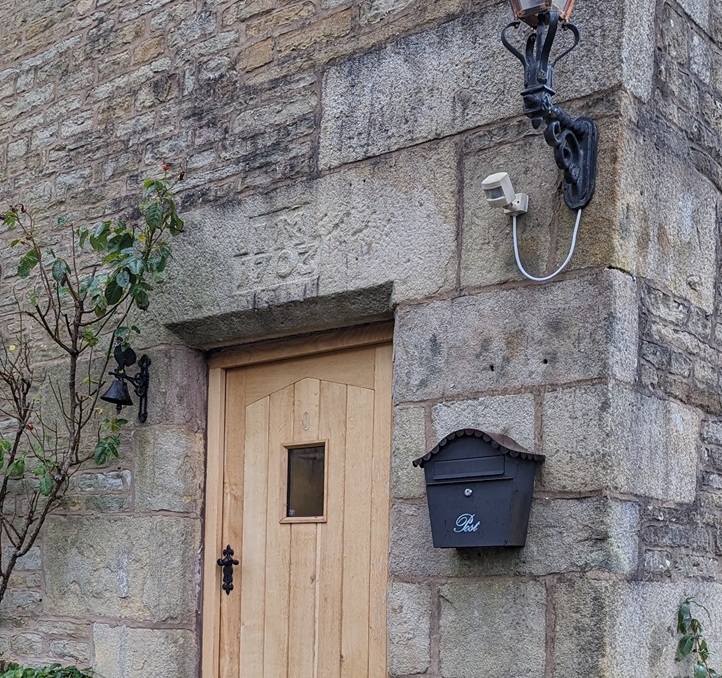
Datestones update: As always, I am on the lookout for more datestones of a pre Victorian date (pre-1837). I recently bagged this:

Herod Farm, Whitley Nab

Wonderful – ‘I.M. 1703’ – to the point, although I have no idea who I (or more likely J) M is. I have a whole article about Herod Farm and the surrounding area in progress, but wanted to share the datestone with you.

The always knowledgeable Roger Hargreaves emailed me a comment he tried to post on the site – technical issues prevented it, but here it is:

So there we have it – John Morton, and a teaser about the Lees Hall – a fascinating place, with a long history, and possibly a moat! Well worth an article and more. Thanks Roger, your input is always much appreciated.

Update to the Gatepost article: We recently bought a campervan, a mobile home with beds and a stove, and all that. It’s marvellous, and is unmissably yellow, or more truthfully YELLOW! (give a shout and wave if you see it around). Our first adventure camping was to Peak Forest, near Buxton, and coming home we decided to take an odd route for the sake of exploration – a vehicular Wander, if you will. Coming through Wheston, south-east of Chapel-en-le-Frith, we came across lots of gateposts, modern and made of concrete, but each marked with initials and dates:

I have no idea who CTH is – presumably the farmer who is replacing gateposts – but I salute your attention to detail – initials and date – and respect your devotion to tradition; earlier, 19th century, examples of dated gateposts can be found here. It might be concrete, but the idea is exactly the same, and I want to buy you, CTH, a glass of the stuff that cheers. Wonderful.

Next we have things seen on pavements… Glossop seems to have inherited the whole street paving slabs second-hand from somewhere. I seem to remember a whole hoo-ha about these stones, and others, occurring maybe 20 years ago – their origin and how much was paid for them… or something. Whatever, but what is certain is that they have some interesting markings on them, and all of these were seen between Costa Coffee and the Norfolk Arms – almost certainly more await discovery, so look down people:

A simple cross, formed of two chisel strokes.
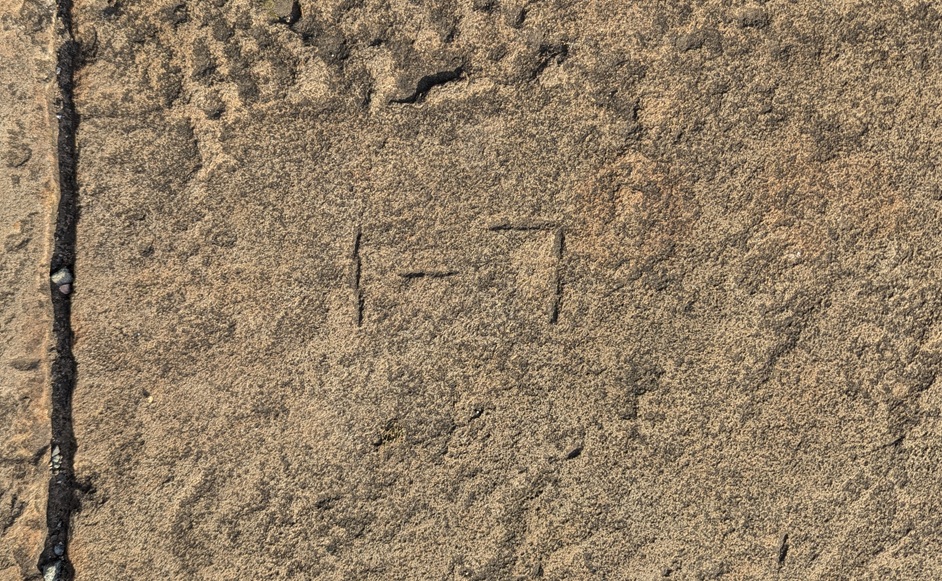
‘1 – 7’ with the ‘1’ formed apparently by three chisel strokes, the ‘seven ‘7’ by three down and two across. No idea of the meaning.
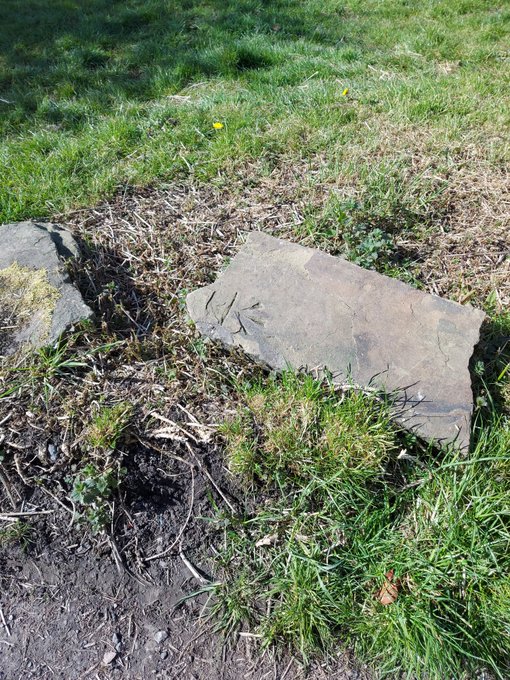
A cross, and a hole filled with a lead plug. It’s difficult to imagine what this large flat stone would need a hole with a lead fixing for – it’s not like it was used for a gatepost or similar. I genuinely cant imagine what or why!

Finally we have this beauty:

Where to start?

So, we have a name in the bottom left, clumsily written – ‘Joseph’ something or other… D? B? Can anyone make out this? The second letter could be an ‘E’. Possibly. But then we have what might be a landscape – the top right looks like a fat sun, drawn by a child, to me. And in the centre, at the bottom, possibly a house (I think I can see the roof and walls, with perhaps a person in it). This is really an enigma – a name, and a piece of art, undatable, and probably from a place far from Glossop… but imagine if we could put a person to it. And all this, lying under our feet.

Other bits and pieces under our feet include markings on kerbs:

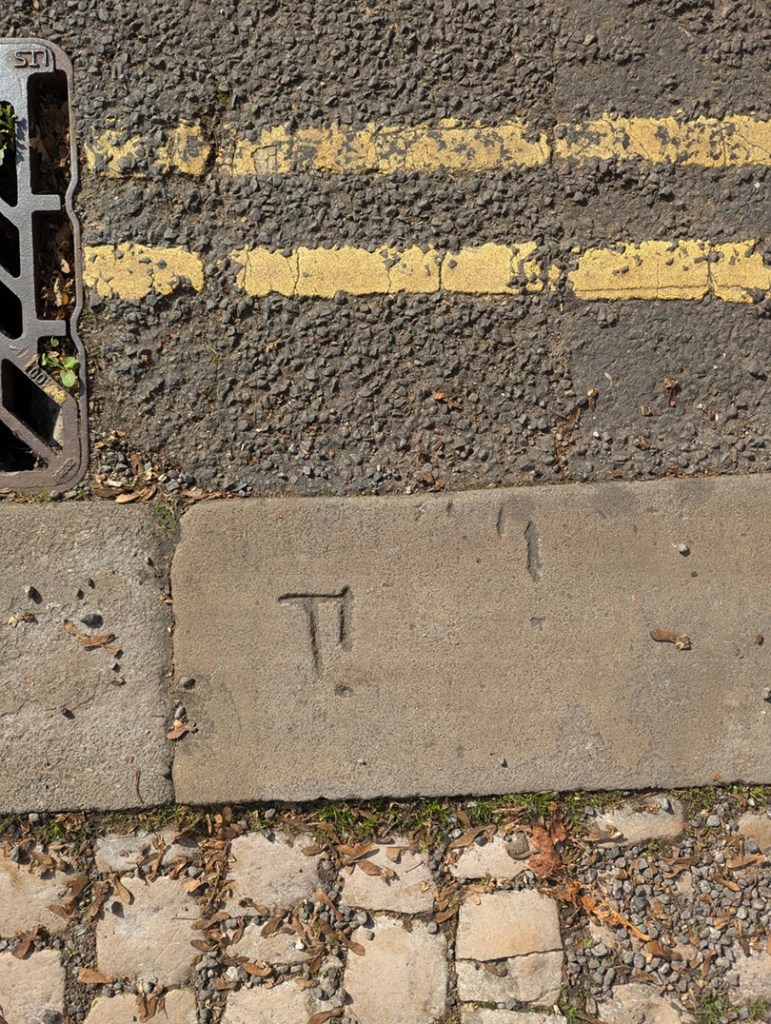
A simple ‘T’, probably referring to Telephone, and marking where the cable came into a property.

This is also sometimes marked by ‘GPO’ on kerbs, standing for General Post Office who were originally (from 1880’s until 1981) responsible for telephone communications. I once found an example on a kerb on Howard Street, but had not been able to find it since, until I came back from a blood test at the clinic there, and this was picked out of the dark by street lights:

Wonderfully carved, this was, I assume, where the telephones for the train station entered the buildings.
Another ‘T’, but this one in Old Glossop seems to have an errant exclamation mark after it!
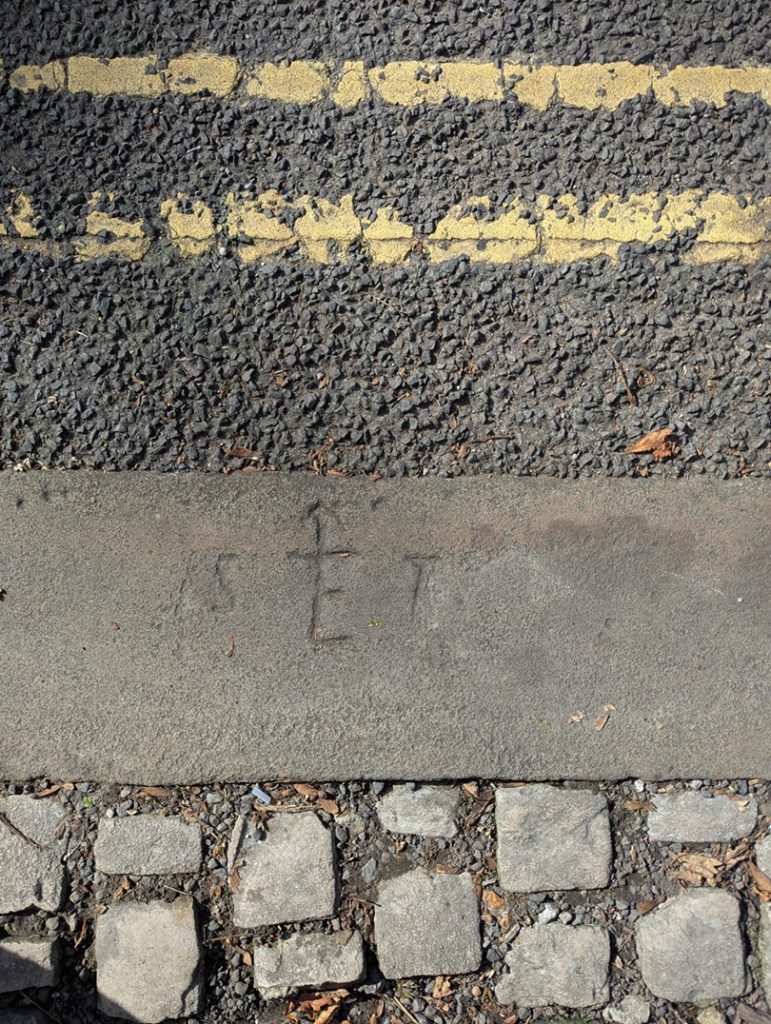
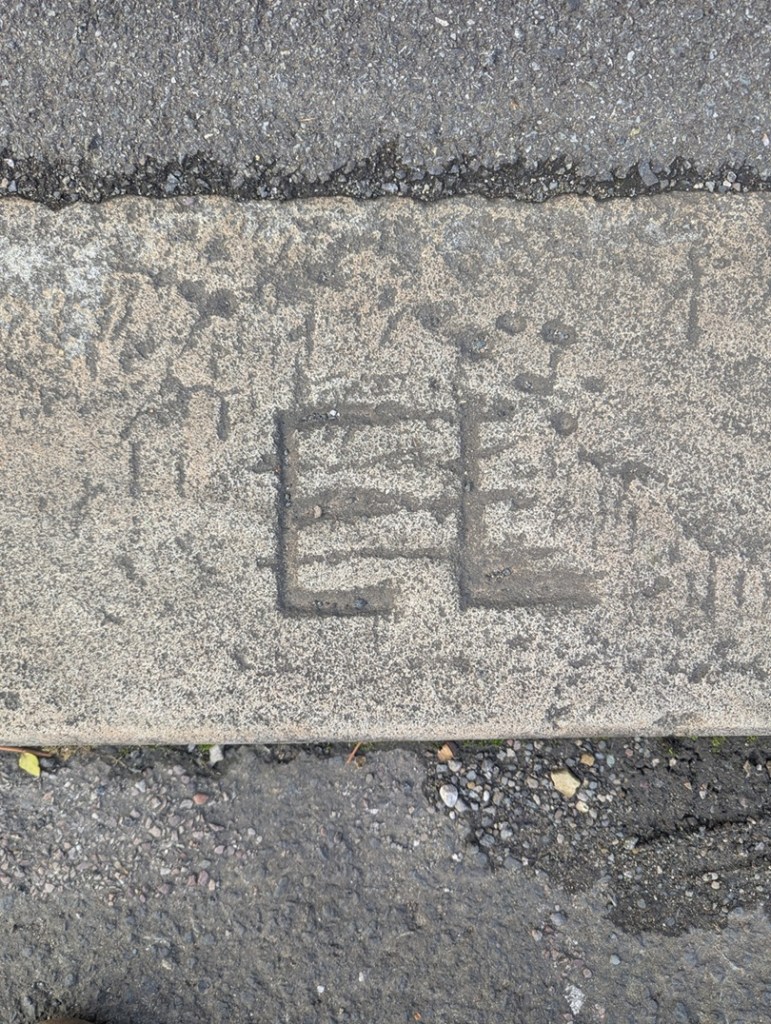
Another slightly odd kerbside marking – an ‘E’, which is believe marks the place where electricity cables enter a property. It is quite common, although in this case it is accompanied by an ‘S’ and a ‘T’, the meaning of which I have no idea.

I also saw this on Princess Street – another marker showing where electricity enters a property – this is also quite a commonly found one.

A no frills, very clear and functional, EL!

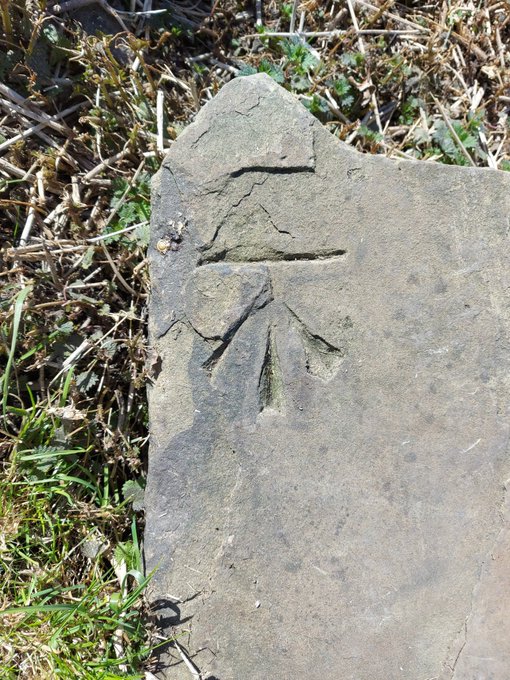
Here’s another mark that is commonly seen: a simple arrow, but not like the Ordnance Survey benchmark arrow, this is normally crudely carved, thin, and without the horizontal line above it… thus:

Literally an arrow, pointing.

This is another of those that points to a service – gas, possibly, or electricity – entering a building, although I truthfully don’t know… any help would be welcome.

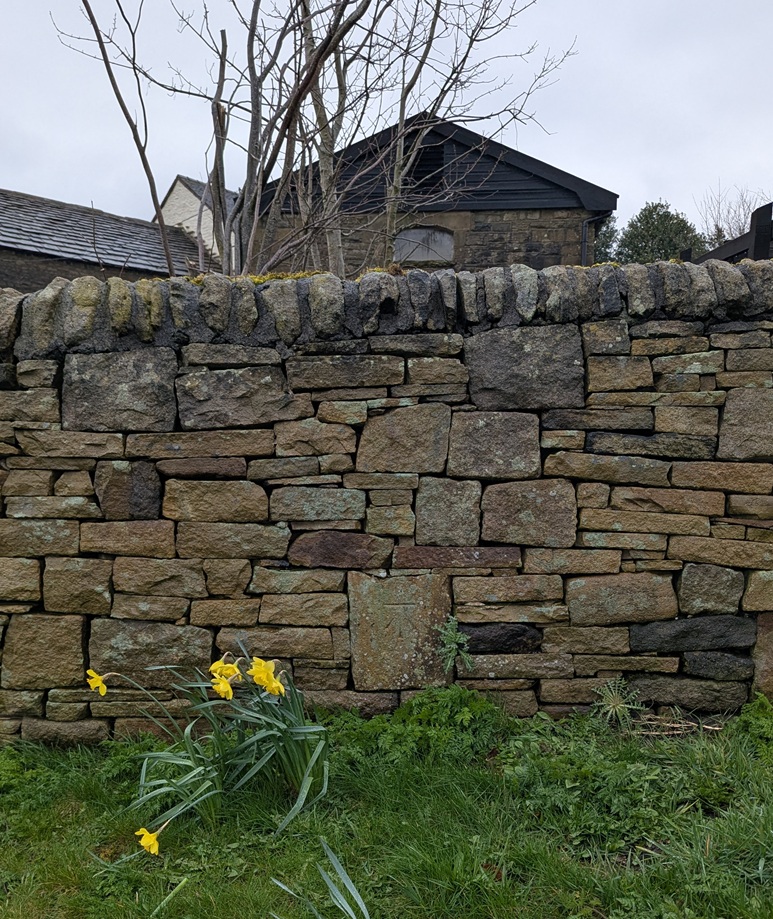
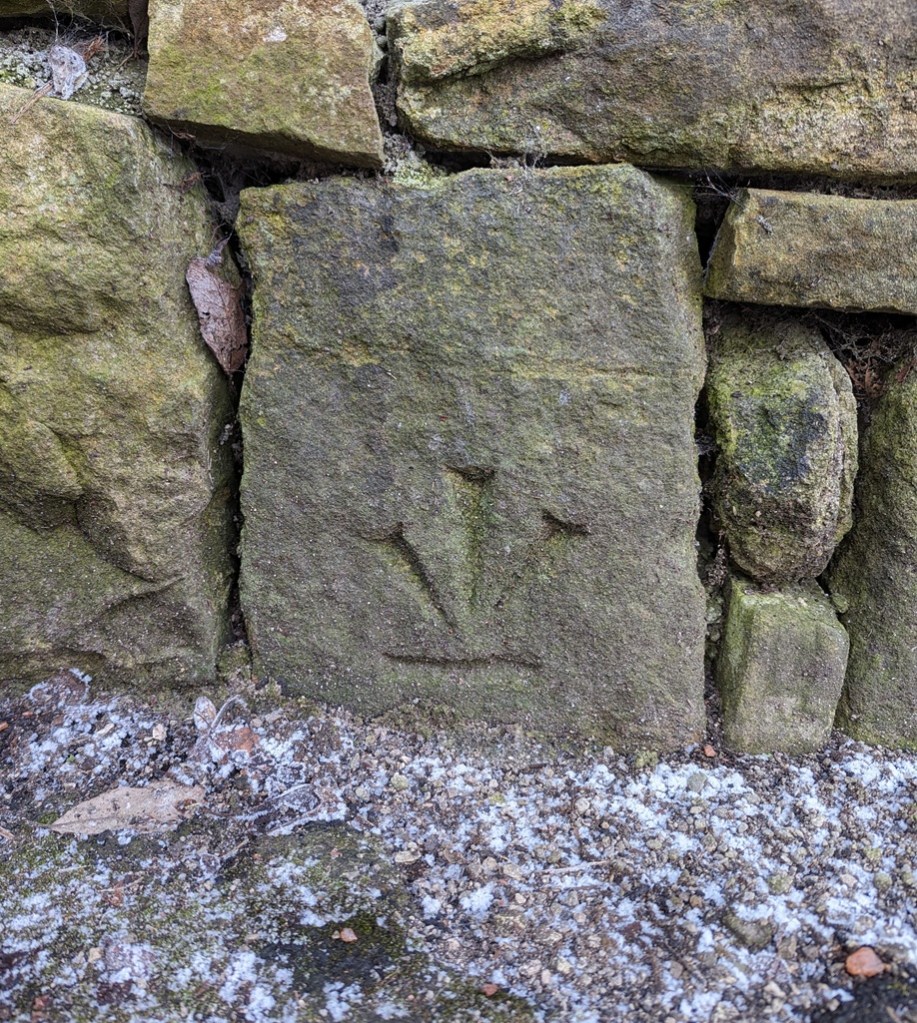
However, here is a Benchmark, newly found by me, under the railway bridge on Arundel Street, and which marks 501ft 8″ above sea level:

Worn, and almost camouflaged, there it is.

Also on the bridge are these single holes, often found in the upper part of the stone:

And here…

These small, shallow, holes were made in order to use a pincer, or external, Lewis and frame in order to move the blocks. A genius invention, it’s a simple iron tool that, via a chain, uses the weight of the block itself to hold it fast whilst it is moved, and enables even a single person to shift a huge piece of stone. But it requires a shallow hole in order to provide a point that gives a good grip. I love these, as they allow us to view how the bridge was built.

Another example of us viewing the method by which these wonderful Victorian structures were built is this:

Very characteristic.

Often occurring in pairs, these are drill marks made by quarrymen, into the rock face, which allow them to insert a splitter to pry away the stone from the quarry face. Once seen, they are very recognisable, and are the scars that show how, with a little physics and a lot of brute force, rock can be shifted.

Howard Street, which meets the Arundel Street bridge, has a few, sporadic, mason’s marks along the stretch of railway walling here:

A cross.
A ‘T’.

Low key, and not very common, these nonetheless represent the ‘signatures‘ of the men who shaped these stones. The cross is a common mark carved on stones – it is literally two strokes with a chisel – so it cannot be definitively linked to those masons who built Dinting Arches, but you never know.

Other mason’s marks can be found around…

A ‘B’, upended.

This is found on a lump of masonry from Wood’s Mill, and now stands where Wood’s Mill once stood, now Glossop Brook View, and by the houses there. Post-1842 in date, although possibly early, the mark was hidden until the mill was demolished – the rough dressing of the block indicates that it was never meant to be seen. I wonder who ‘B’ was.

Another, difficult to see.

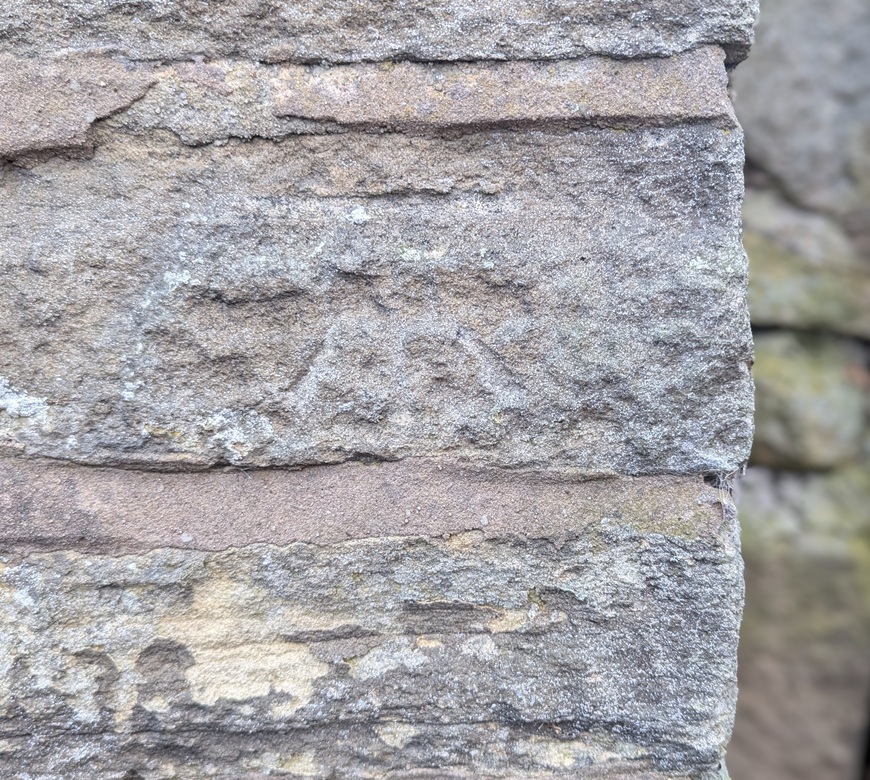
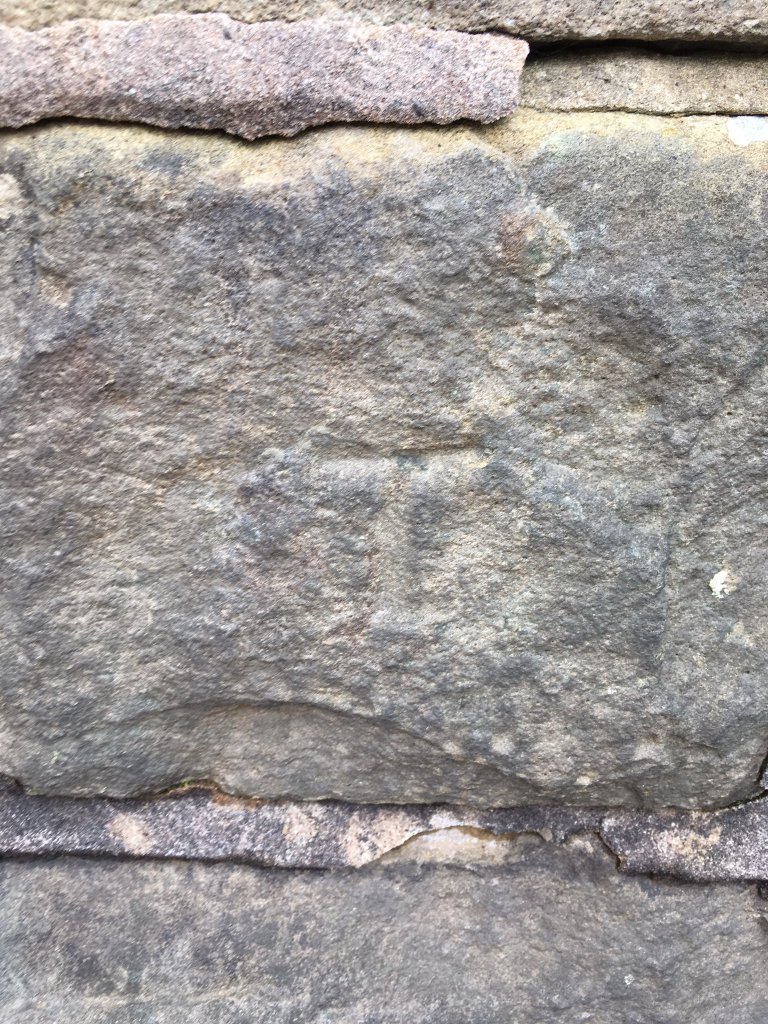
This last one is on the gatepost of the Crown Inn, Victoria Street (although the gates are on Hollincross Lane); very faint – and difficult to photograph – they are in the angular shape of a fish.

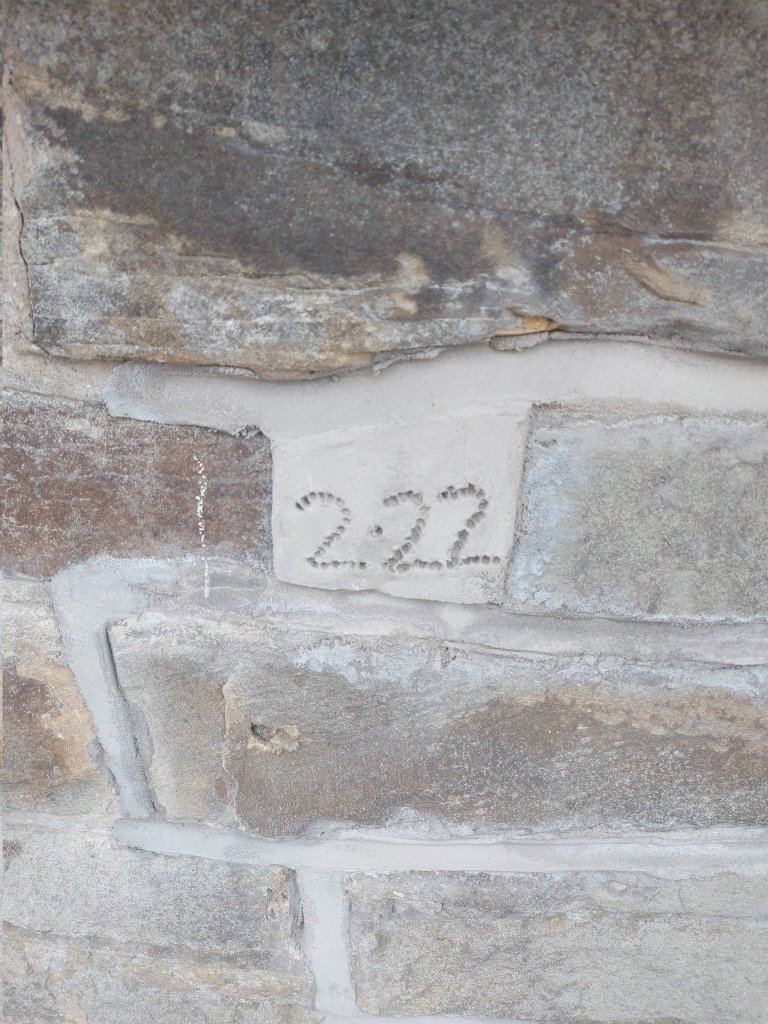
I also spotted this on Howard Street:

February 2022.

A dated piece of cement. This is either dated proof of work done – a modern form of mason’s mark – or possibly a dated repair that allows Network Rail to observe cracks forming and assess integrity. Either way, it’s kind of cool!

Finally, some bits of carved graffiti, a particular favourite of mine.

A single ‘J’ on the wall of Heath Barn, Heath.
‘S’ ‘H’ on the wall of Glossop Church.
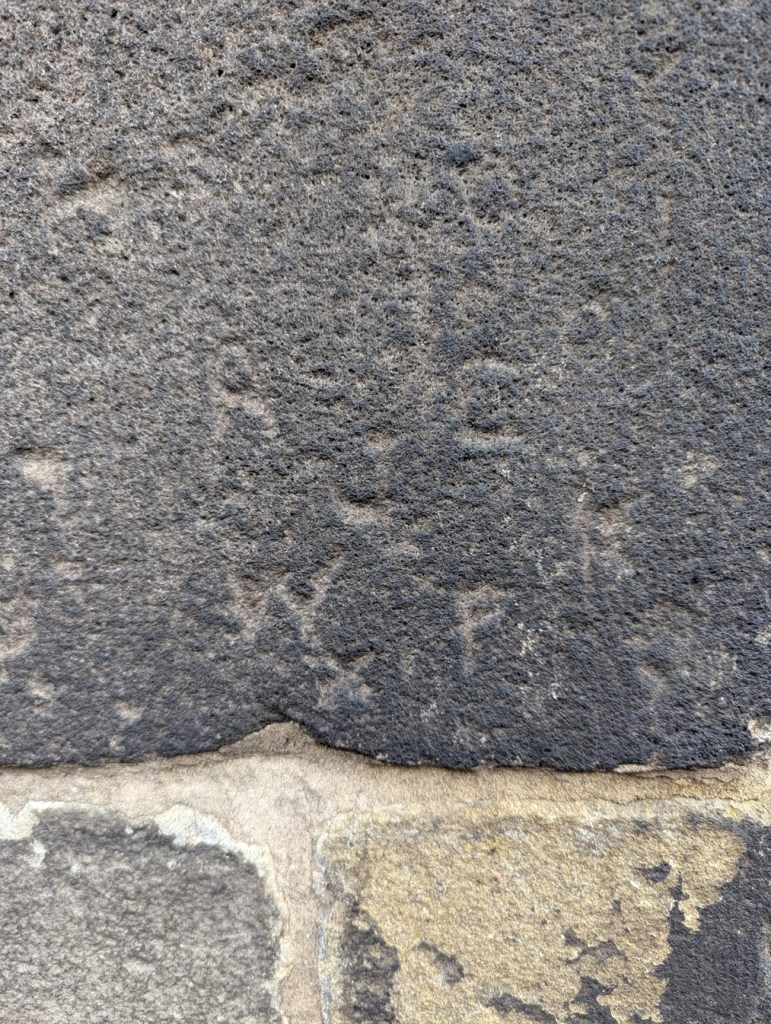
Also on the north wall of Glossop churchyard, on Church Street – initials – R C J W P. The arrangement is odd, and I wonder if they were 4 members of a single family, with the surname ‘J’. That could surely be traced if it was the case!
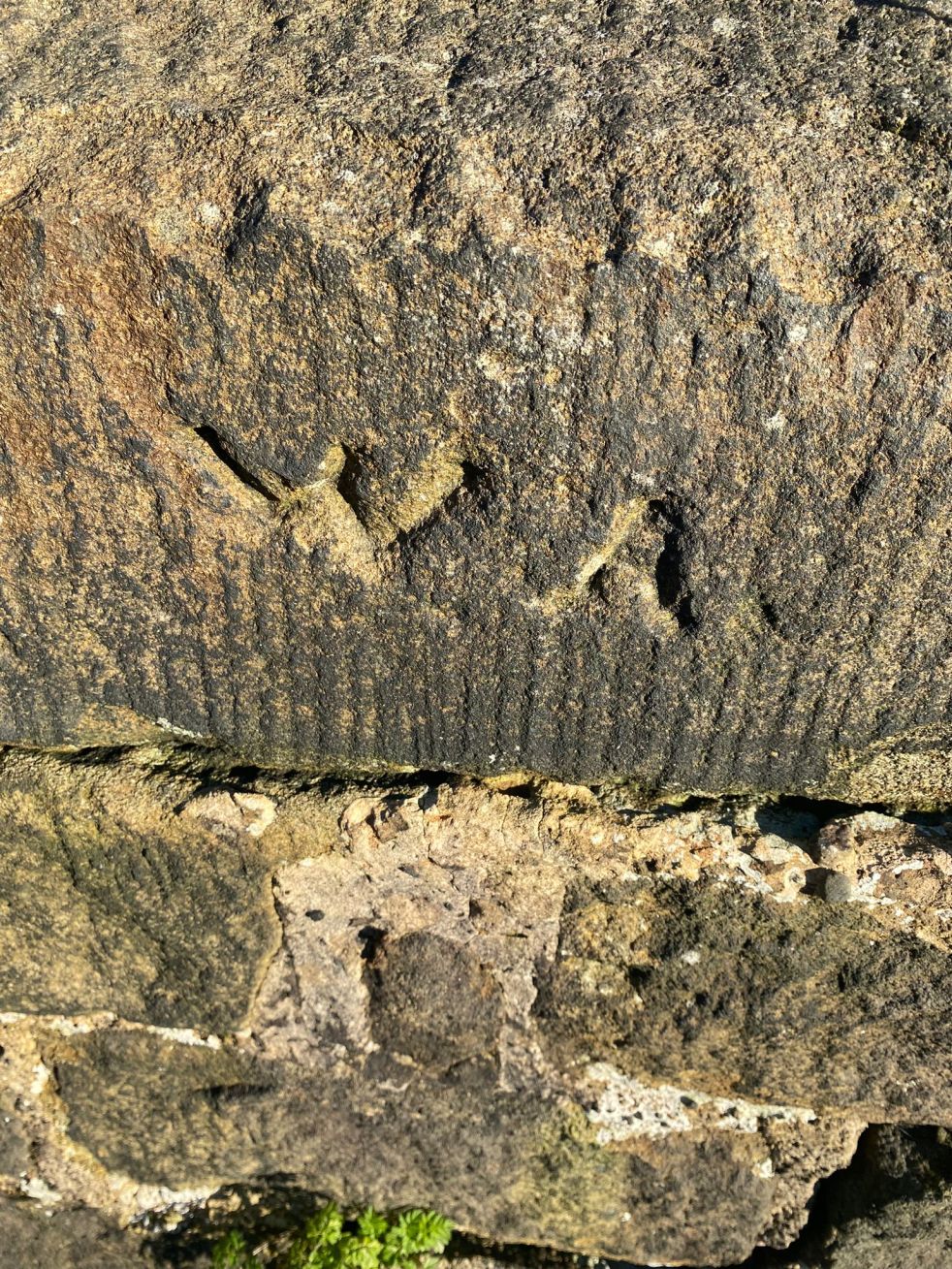
‘W’ ‘A’ (photo from Suze Hill)
‘W’ ‘G’ (photo from Suze Hill)

These last two were from the bridge over the Longdendale Trail on Padfield Main Road. The whole bridge has a lot of graffiti carved on it, including this wonderful example:

Old and the new. I love this photograph, and am very proud of it!

Here we have Victorian carved graffiti – ‘J.H’, possibly, along with some more letters, undecipherable under the frost, over an early incarnation of the now famous (infamous) BOOF graffiti tag made with a spraycan. I find it interesting that we would condemn one, but praise the other as historical and interesting. When does vandalism become history and worthy of study? A bigger discussion, and one I find fascinating (akin to when does something become archaeology?). I know graffiti, as in modern graffiti – put it down to a misspent youth and a love (despite appearances to the contrary) of Hip Hop – and I have followed BOOF’s career with a certain interest.

So here I shall leave it. Making marks, and marking time – it’s all about trying to achieve immortality, to leave your mark long after you are gone, and making people remember you, even if they don’t know who you are. I think that’s all any of us, myself included, can hope for. There are so many examples of this phenomena in the Glossop area, and I have an idea to produce a book looking at precisely this sort of thing – watch this space.

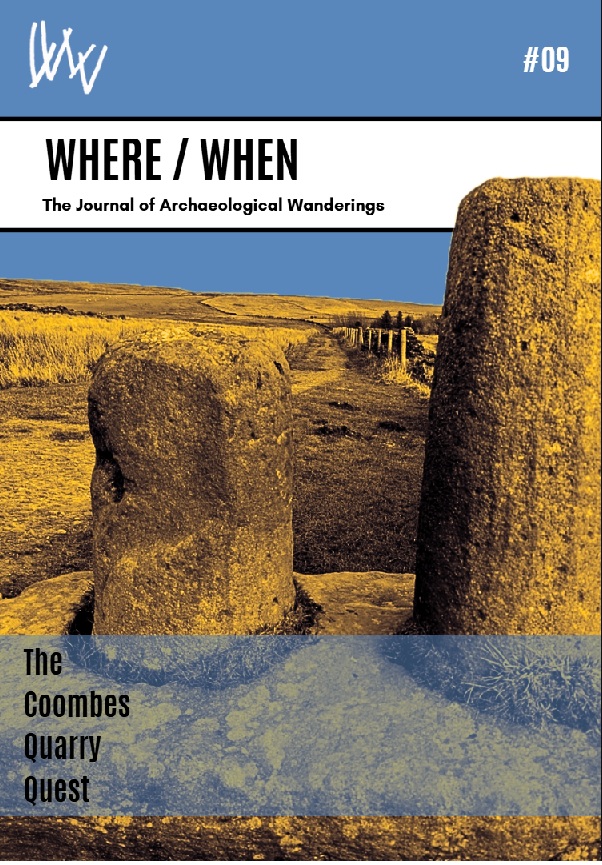
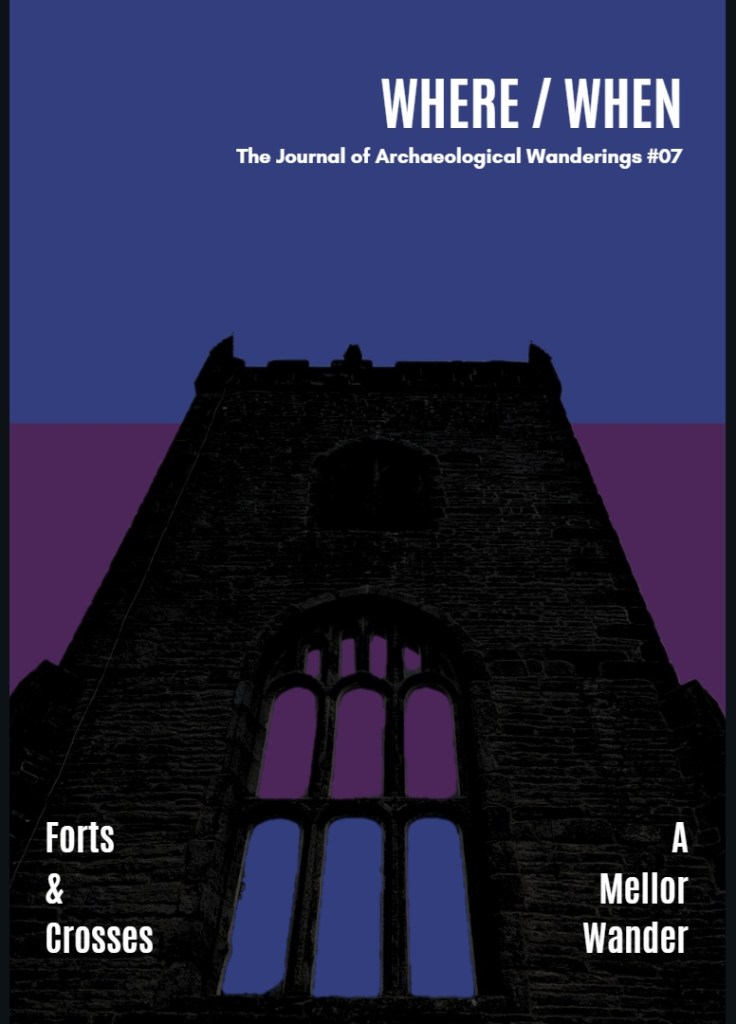
Talking of books, please check out Where/When Number 7 – Forts and Crosses: A Mellor Wander.

This one is a truly awesome Wander around Mellor – just over yonder! It has medieval field systems and farms, Victorian noise, an Iron Age hill fort, medieval crosses, cracking views, a terrifying viaduct, bench marks, a trig point, wonderful gateposts, and it starts and finishes at a pub… what’s not to love? Here’s the cover to tempt you.

Available from the shop, link above, or from Dark Peak Books and Gifts, High Street West, Glossop. Or, you know, just track me down and throw money at me.

Talking of which… if you enjoyed this, and fancy buying me a glass of the stuff that cheers, then please do so via this link to my Ko-Fi page. I do what I do here because I love doing it, and I feel it’s important we explore our shared heritage… but I’ll never say no to a pint in thanks!

So much more news to share, and so many things planned. Watch this space, wonderful people, as big things are coming.

But on a serious level, how are you doing? Genuine question. Personally, I’m a little down at the mo… the devastating loss of my brother (cheers Stephen, I’ll miss you), coupled with a dose of Covid, and the general malaise that accompanies the move from summer into autumn and winter, has meant a lull in the festivities here at CG Towers. Still, the wheel turns, the seasons they change, and life will inevitably continue, and on we go. But as I always say, look after yourselves and each other, you really are important, and too often we say “I’m aright” when we actually mean “I’m not alright, please help” – it’s ok to not be ok.

So then, more coming, but until next time, I remain.

Your humble servant,

TCG
Archaeology · Bench Marks · Graffiti · Standing Stones

Gateposts

What ho, lovely people of the blog world. I hope you are all well as we hurtle headlong into summer, each of us fearing what terrible weather will mar an otherwise splendid season. Nevermind, this too shall pass and all that, and indeed we must grasp the nettle by the horns, or something, and make H whilst the S shines…

Today’s post is one of those brought about by happy coincidence, where a series of events conspire, almost waving at you, until you finally notice and say, loudly, “what ho… a blog post!” Or, in this case, a Gate Post. The first event was posting a few photographs on Twitter and Instagram (@roberthamnett on Twitter, and @timcampbellgreen on Instagram, for those of you who might fancy checking it out). Turns out I’m not the only one who likes a good gatepost or two. And then the next event was my seeing a tiny piece of metal in the soil whilst doing a recce for a Where/When (No.7, to be precise… Of Forts and Crosses: A Mellor Wander). All will become clear, honestly.

For years now I have been obsessed with gateposts. Mundane, utilitarian, and always overlooked, a good gatepost can be as interesting as a prehistoric standing stone to me, and truthfully, there is often very little difference: both made of stone, both standing upright, both important in the past, and also in the present. And if anything, gateposts have more interesting features! I mean, obviously prehistoric is fascinating, but they don’t really give us much to go on, whereas the later gateposts… well, read on.

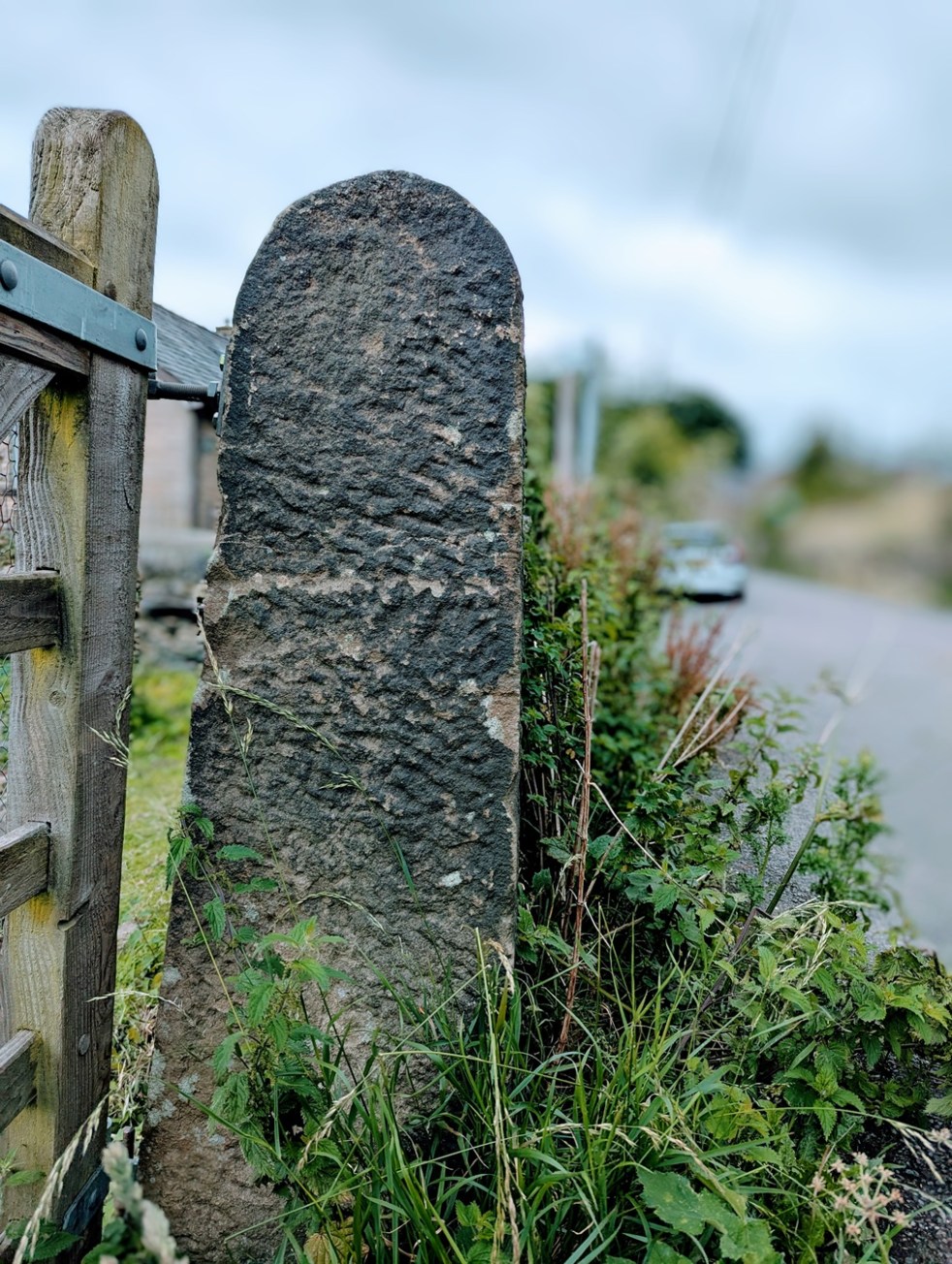
They can be decorated – often just roughly dressed.

A simple rough dressing, to shape it in a uniform manner.

But sometimes some thought has gone into them, to create a pleasant design – which for a utilitarian functional object seemingly goes beyond what is needed.

A simple cross, surrounded by a border. I say simple… it takes some doing.

I mean, the only time you see the gateposts is when you are opening a gate to let sheep or cattle in and out, and it’s probably not something you’d see everyday. And even if you did, it’s only for a moment or two, it frankly doesn’t matter if it looks good, and I doubt farmers are wandering around making snarky comments about the plain decoration of another farmer’s gateposts. So why? What is the purpose behind them? I don’t mean they had some sort of secret meaning behind the decoration, rather they simply represent someone’s choices, but why those choices I wonder? Possibly it’s probably more to do with pride in the work taken by the stonemason who shaped it, perhaps a form of identifier: we know it’s person X who shaped it, as he always decorated it with a cross. But then there are those that go beyond simple decoration, and instead turn it into a work of art.

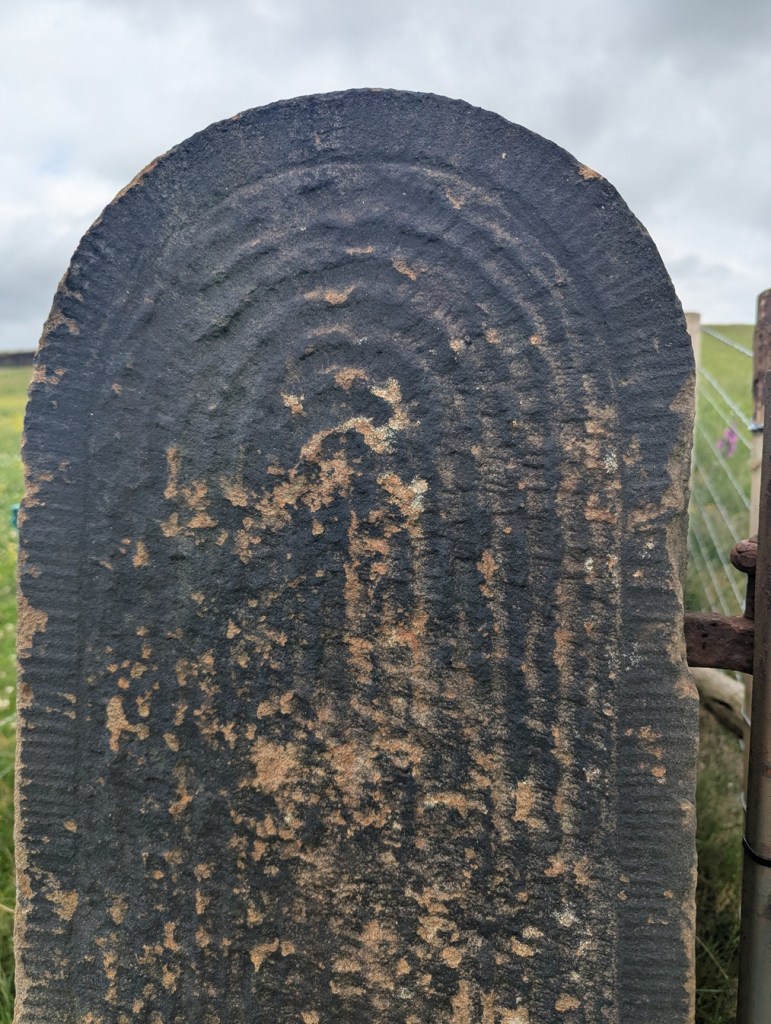
This is wonderful! The way it shifts from the upper band with a circular motif, to the lower aspect with the herringbone pattern is amazing. A lot of effort went into this.
This too, is truly wonderful. The circular motif, with a border, is just amazing. This post seems to be in the reddish Cheshire sandstone, which makes sense given that it, and the last gatepost was found in the Mellor area, rather than Glossop.

Other times, we find words and dates on gateposts. Often these are faded and barely legible, the weather and environment are not kind to these solid sentinels, and they have no shelter.

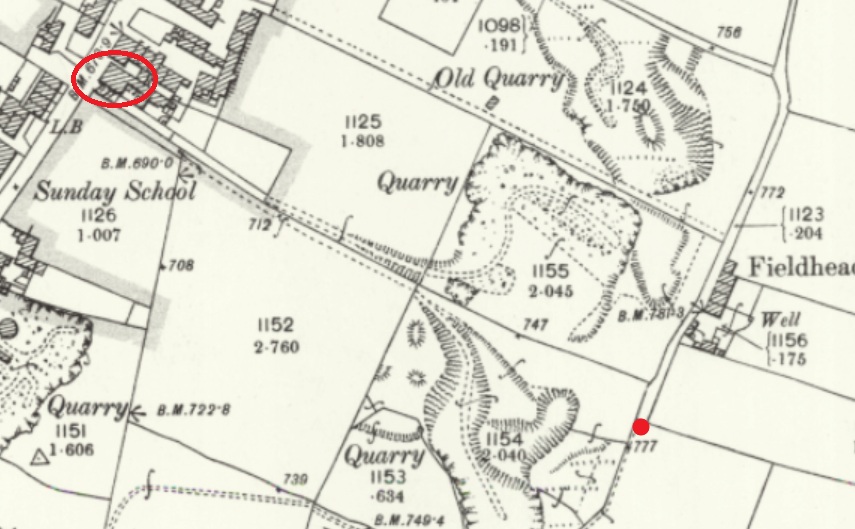
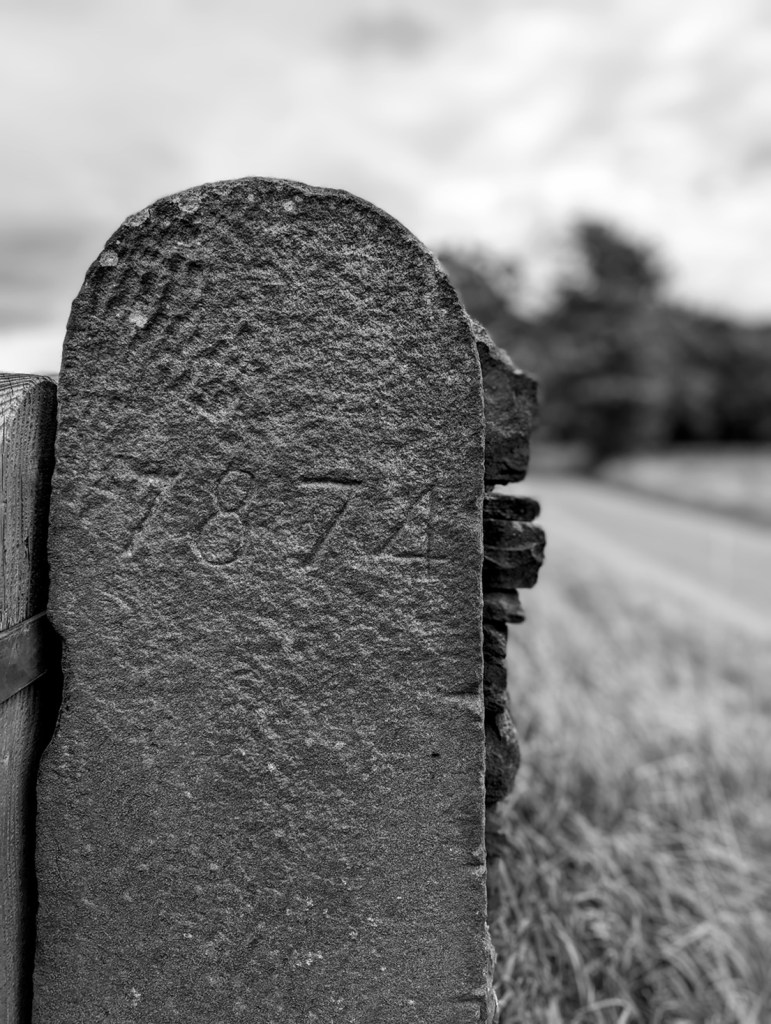
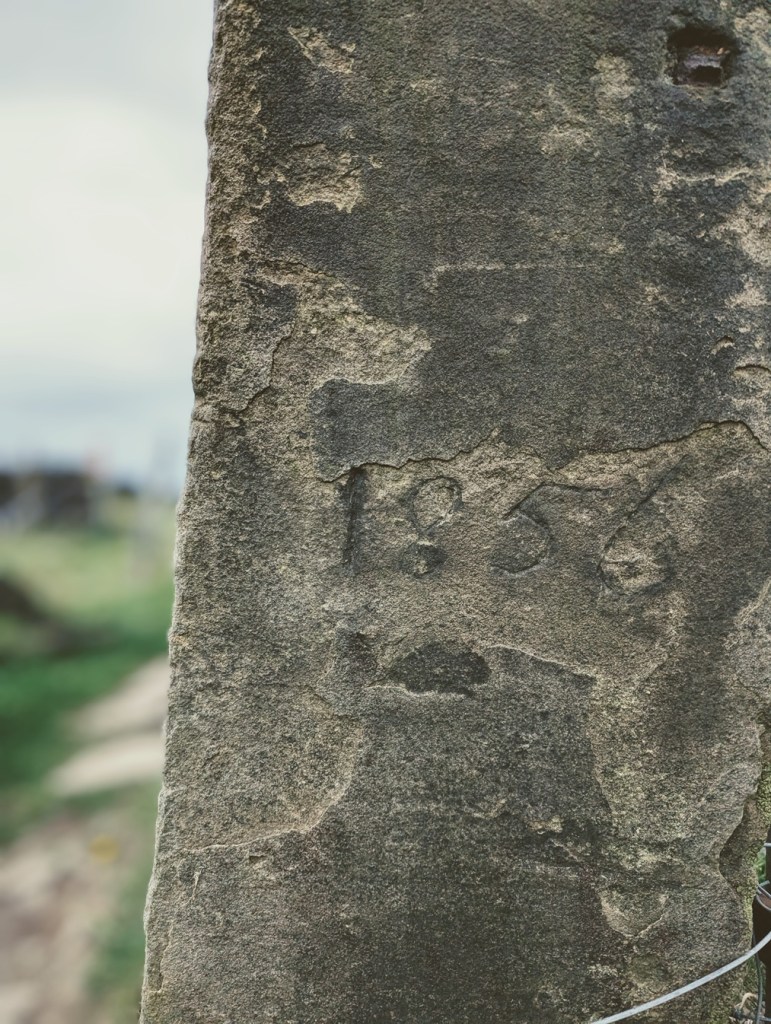
‘1856’, on the track from Fieldhead Farm to Whitfield Cross.
I went all arty with this shot… I’m quite proud of it! ‘1874’ in a very similar hand to that of the above gatepost – I wonder if it was the same person? This is on Kidd Road, just before its junction with Derbyshire Level.
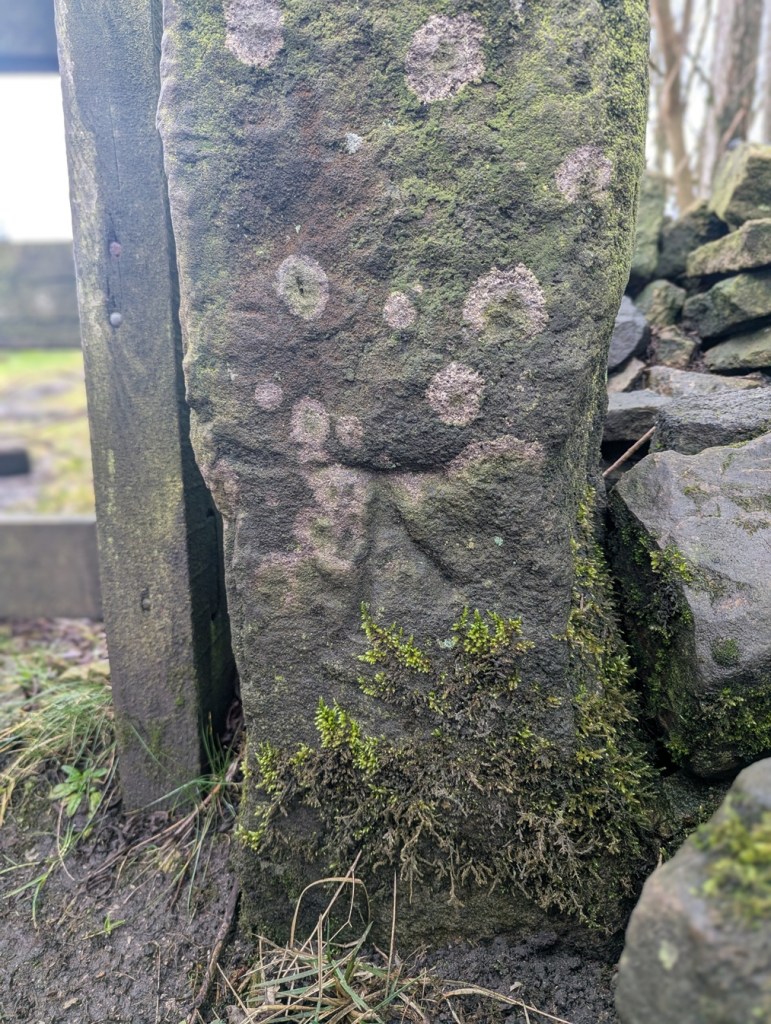
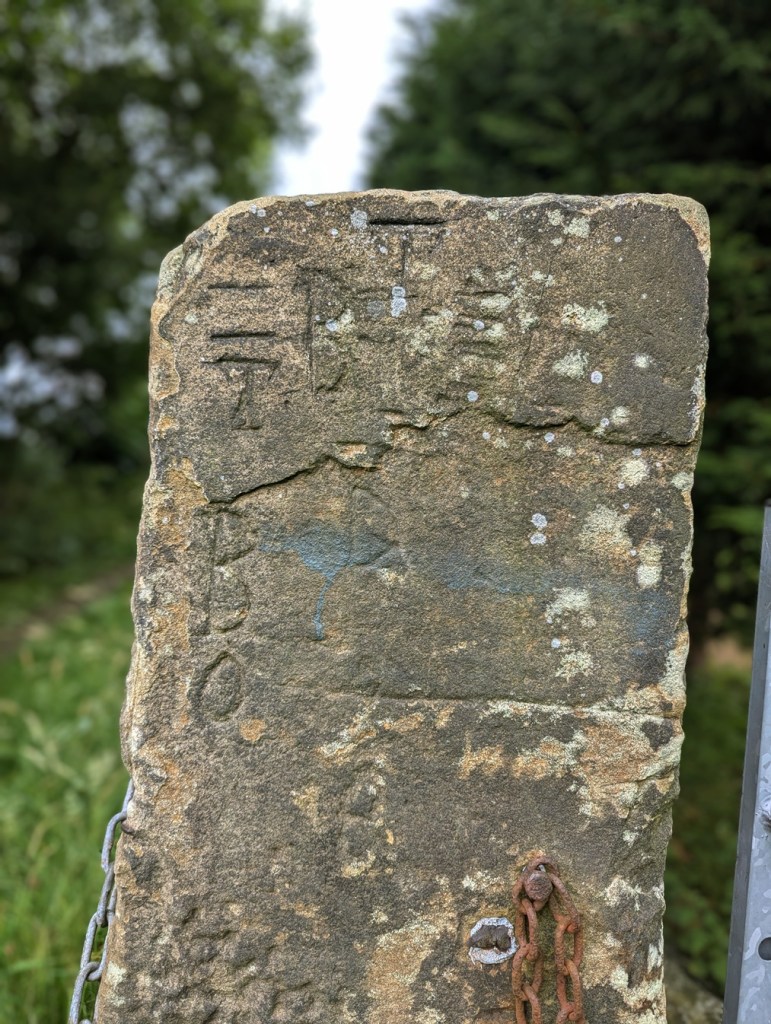
Multiple ‘B’, ‘D’, and ‘O’ – from a post just by Fieldhead Farm.

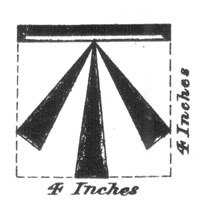
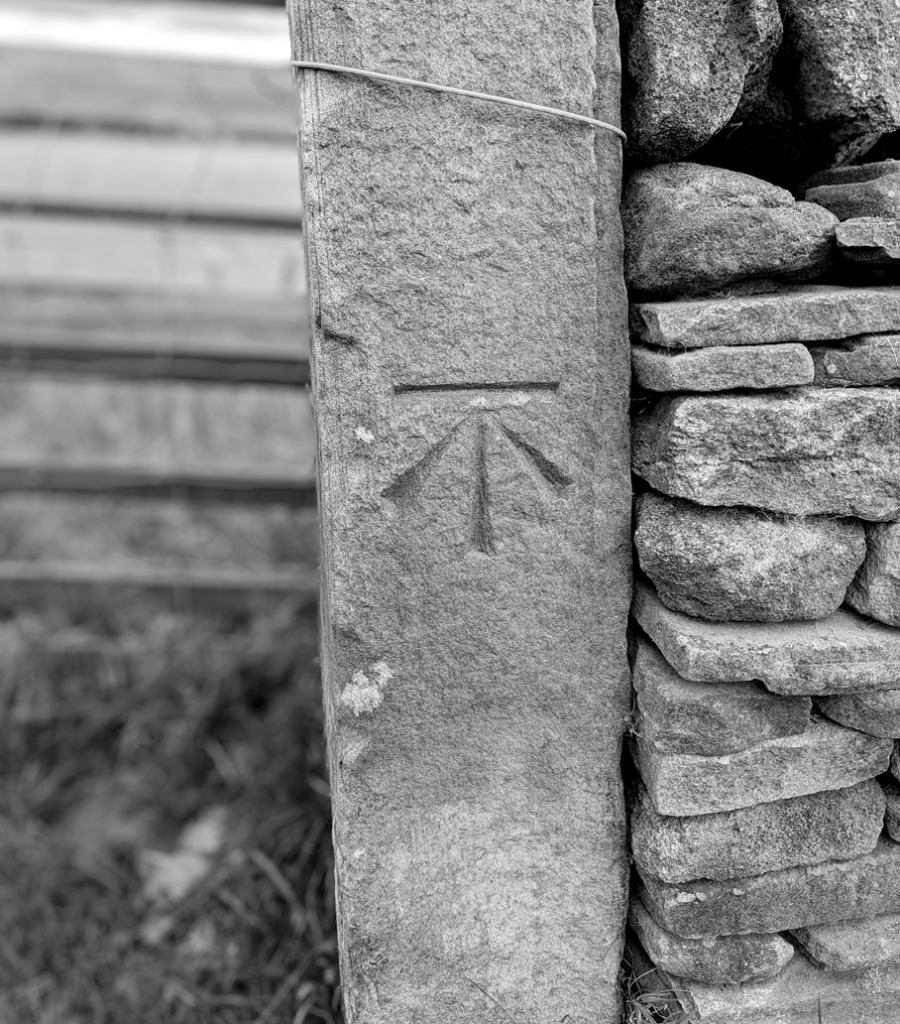
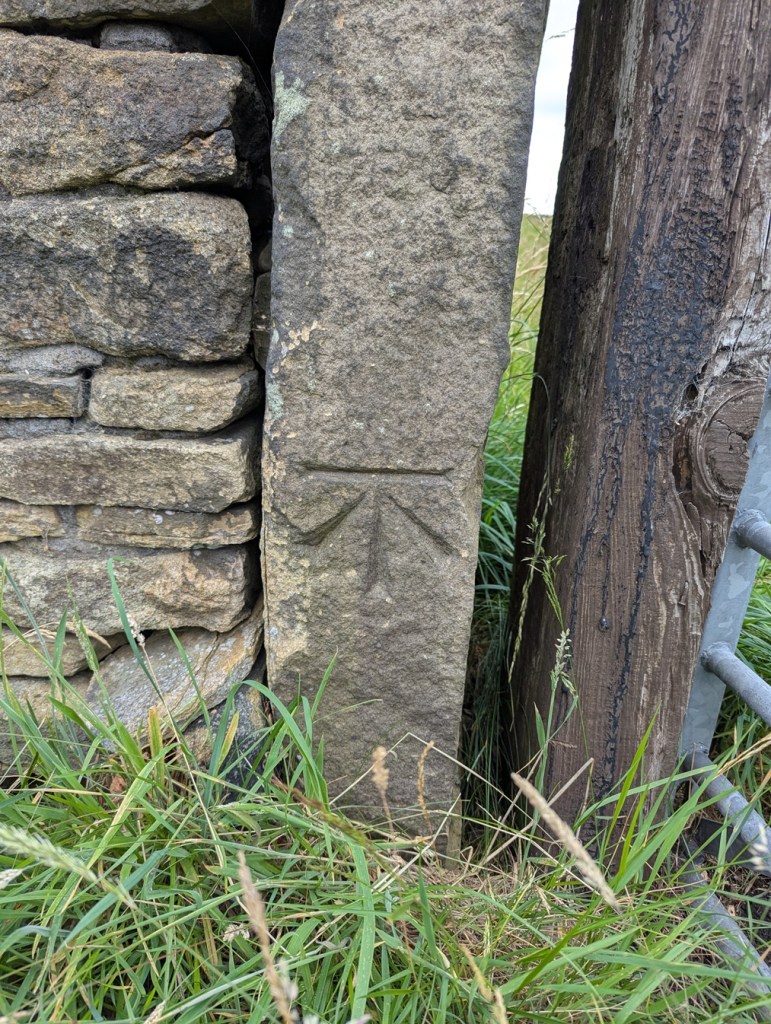
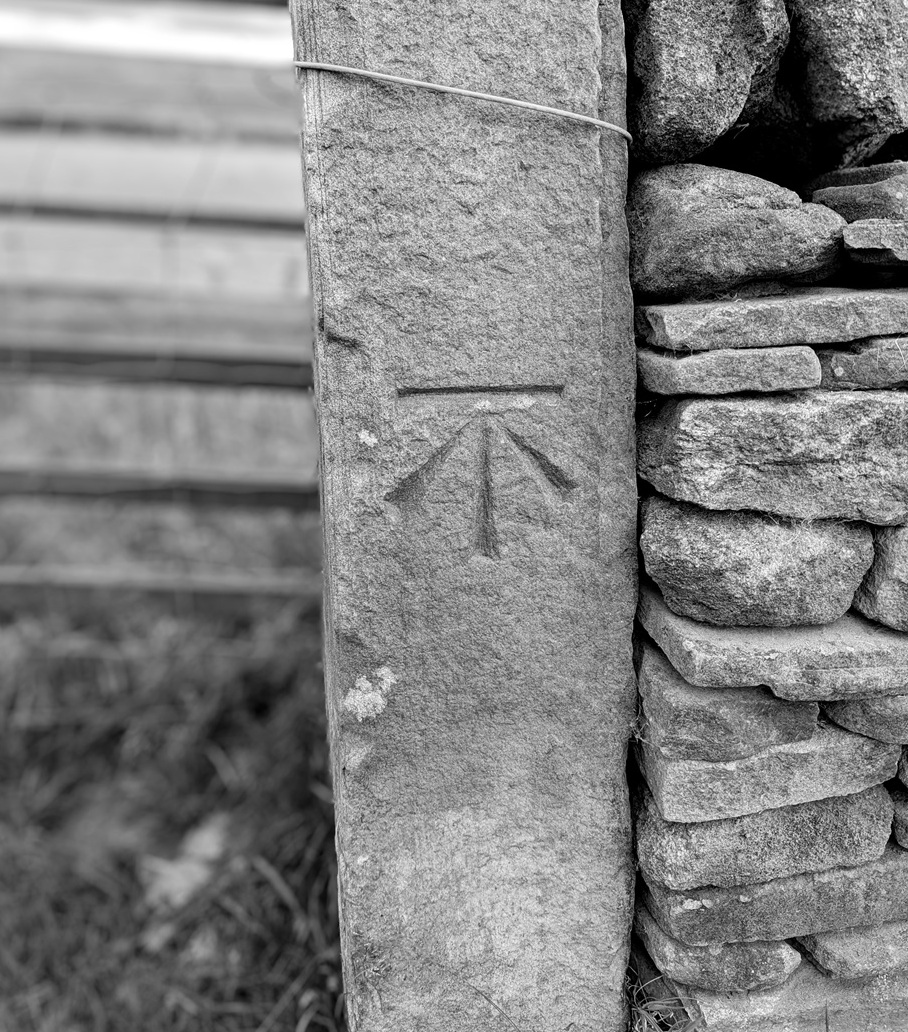
The Ordnance Survey often use them to carry benchmarks – after all they’re not likely to be moved, and so are a safe and permanent marker for heights above sea level.

The line above the arrow is 682 ft above sea level, precisely.
This one is 716ft 2″ above sea level.
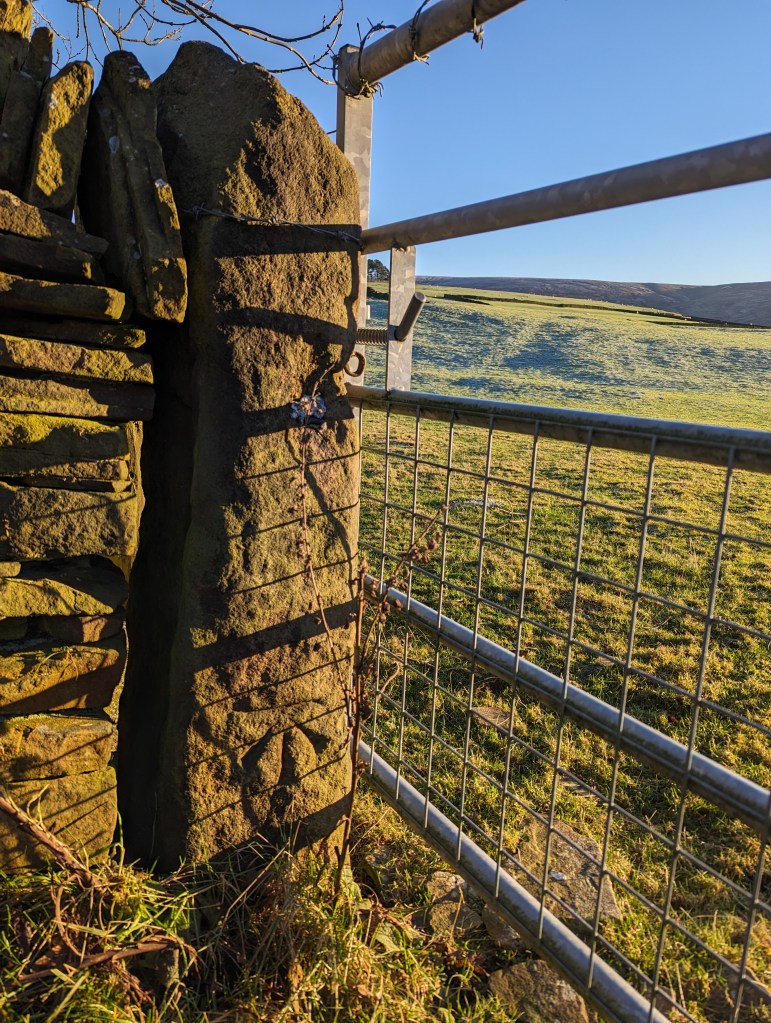
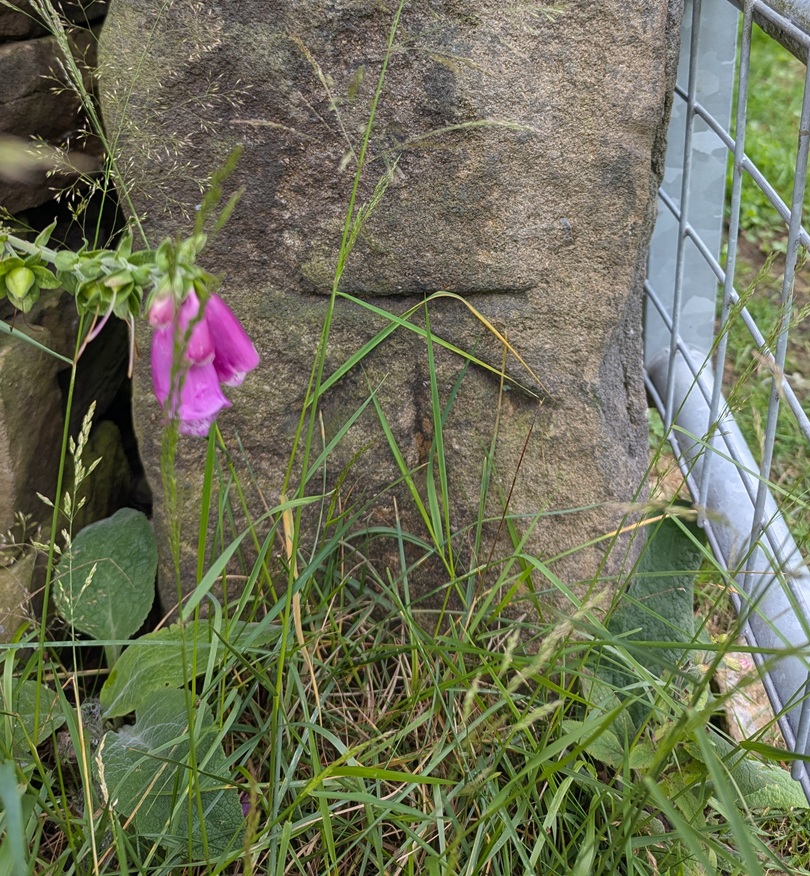
I love this photo… the grass almost mirrors the benchmark. Oddly, I don’t have a height for this mark – for some reason, no OS map I have come across shows its existence. Strange.

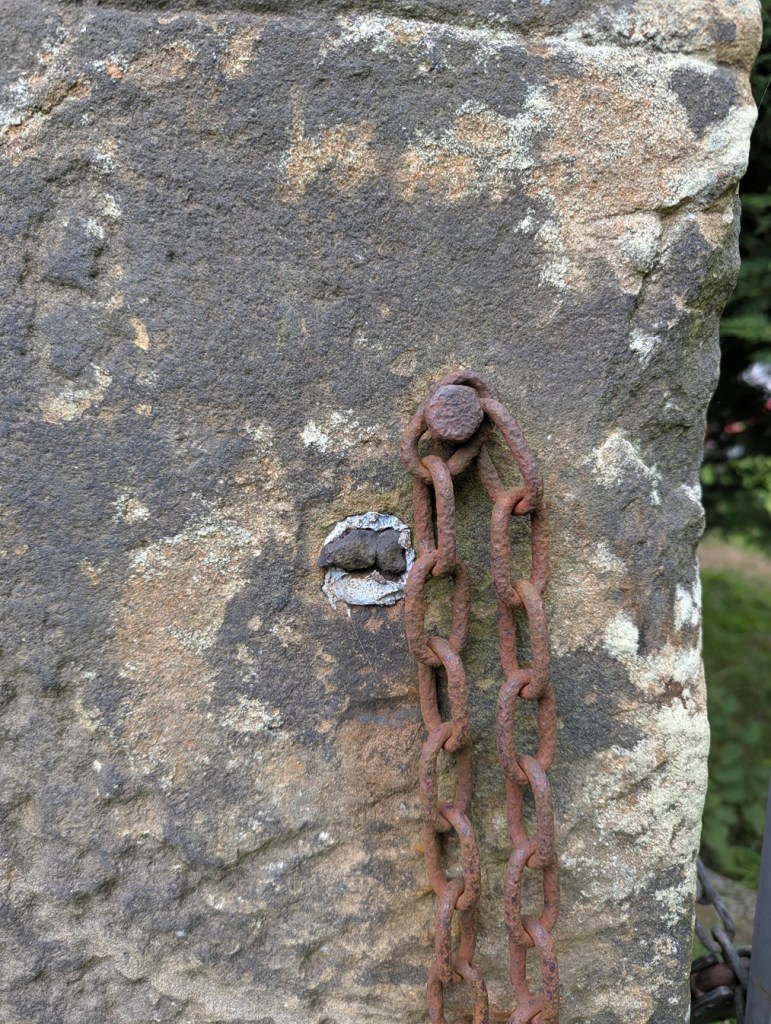
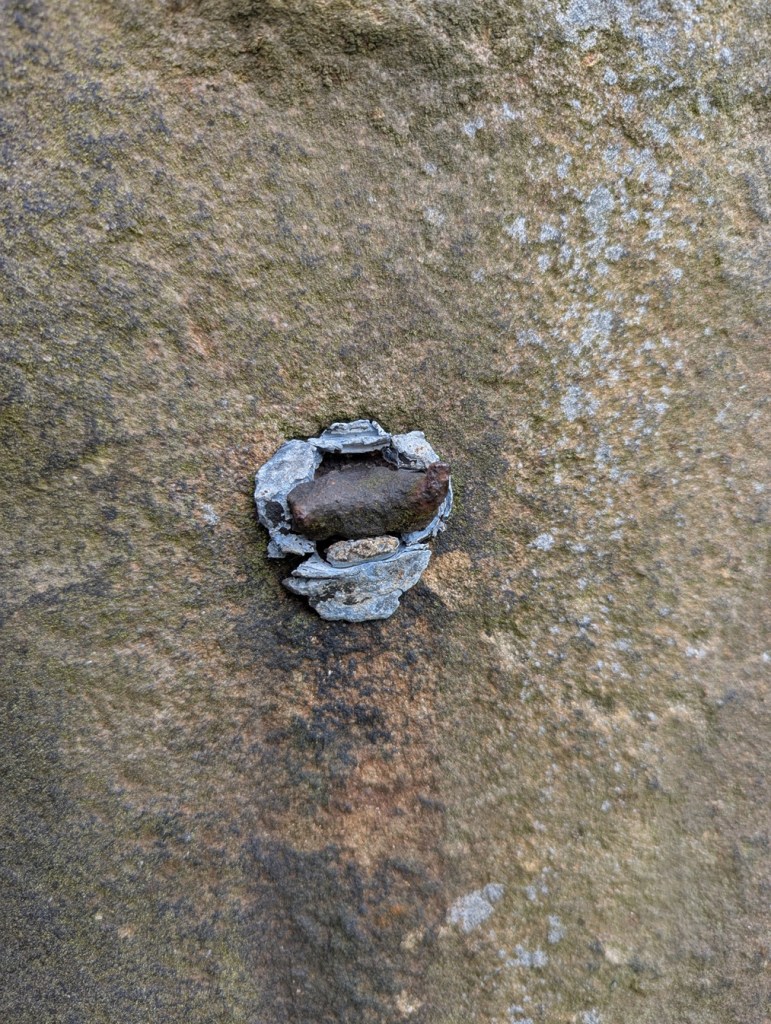
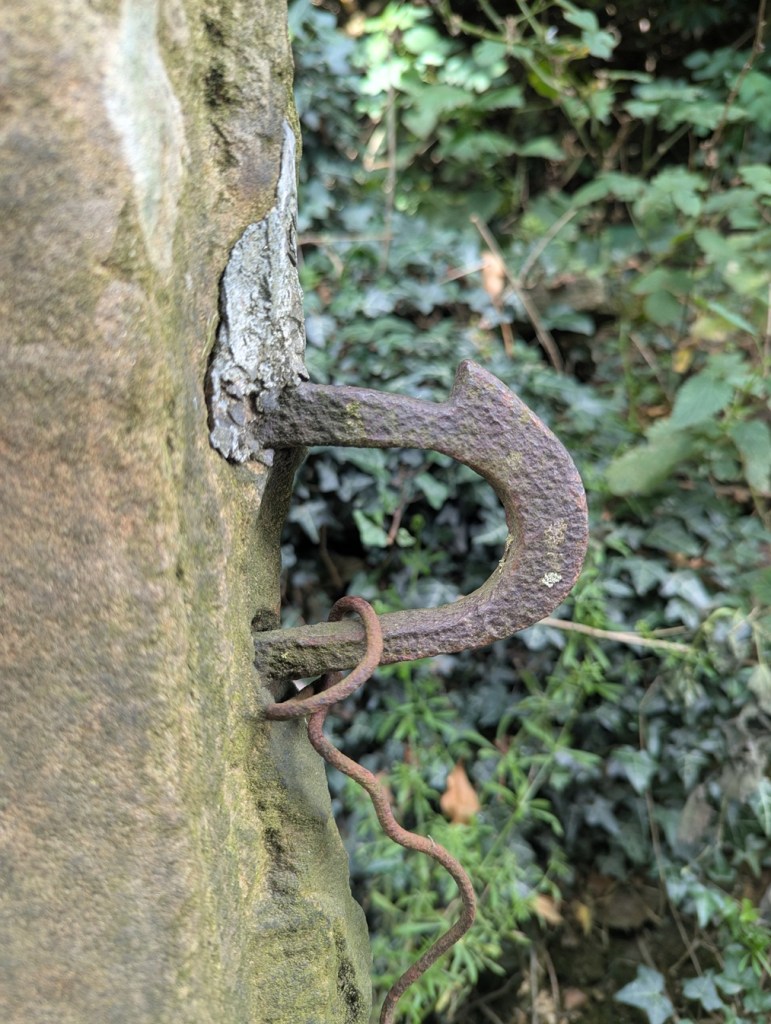
The fixtures and fittings of gateposts always fascinate me, too. Cast iron hoops and hooks, held in place by the tell tale grey/blue of lead. Sometimes you can only see the lead, the actual latch or pintle missing, it’s function no longer having purpose – it is just now a standing stone.

A now missing something or other, the metals eroding, staining the stone. It can get so bad that it actually kills the moss and lichen.
More something or other, now missing, but once important. The lead fixing is a tell-tale sign that the iron whatjamacallit is missing. I honestly love this, it really does show my theory of objects having a biography.
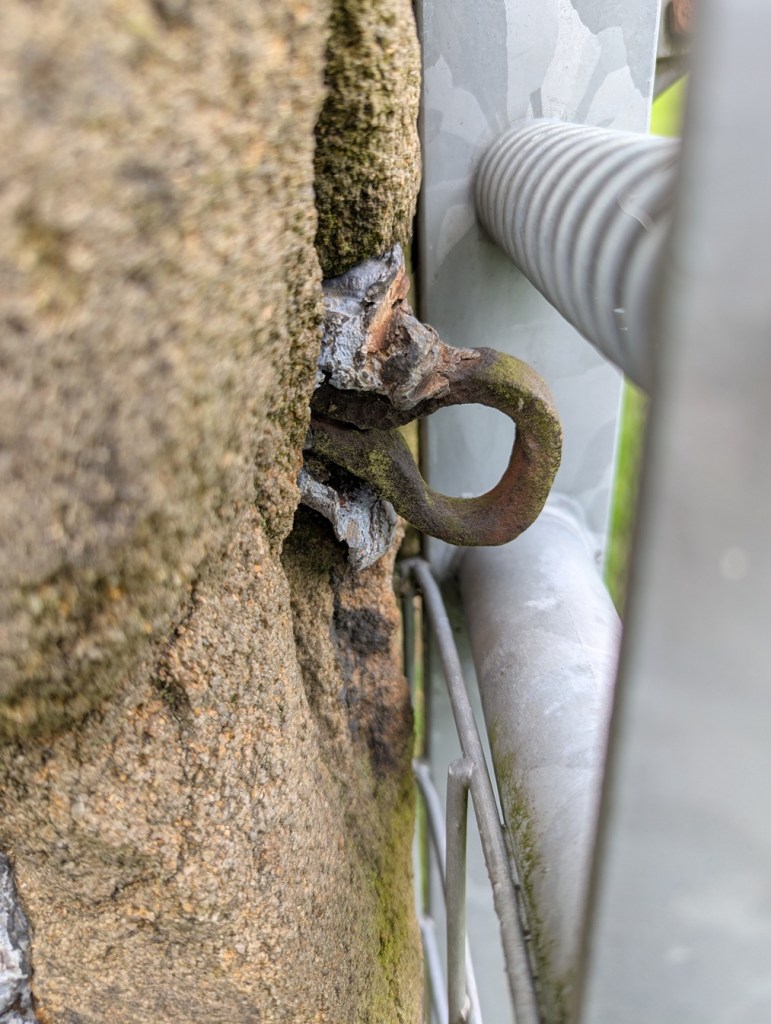
This is lovely… beautiful cast iron eyelet, twisted and shaped whilst red hot, and then held in place with lead. Although no longer needed to make the gatepost function – the modern steel gate does that (leaving it’s own scars on the stone) – it remains a part of its history.
Multiple phases of use, each leaving a mark.
Again, scars, but once meaning, purpose.
Hand made, and truly wonderful.

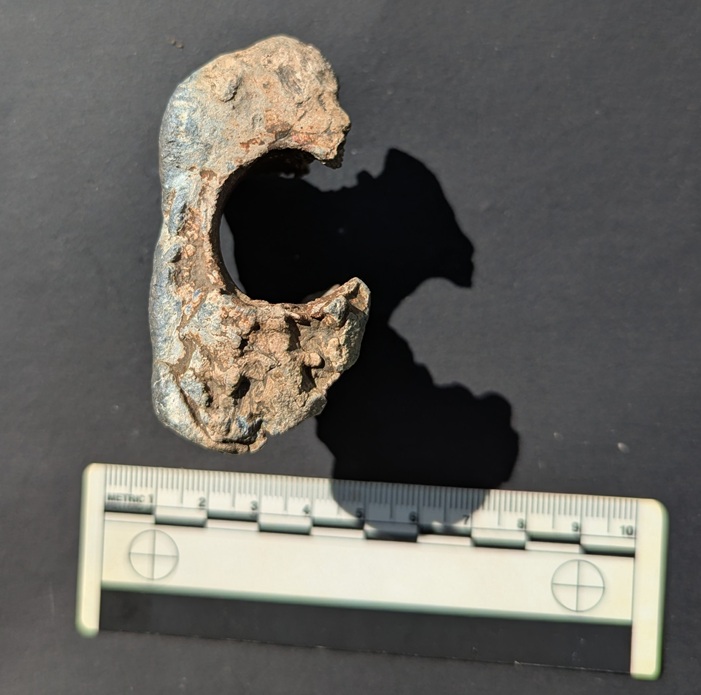
It was actually one of the lead fixings that I found that partly inspired this post. I saw what was obviously lead sticking out of the ground, and bending to remove it as I always do – it’s really not good for the environment – I realised it was bigger than I expected. I studied it for a moment trying to work out what it was, when suddenly: “aha” I thought “that’s a fixing“.

You can see rust on the inside, where the iron whatsit was held in place.

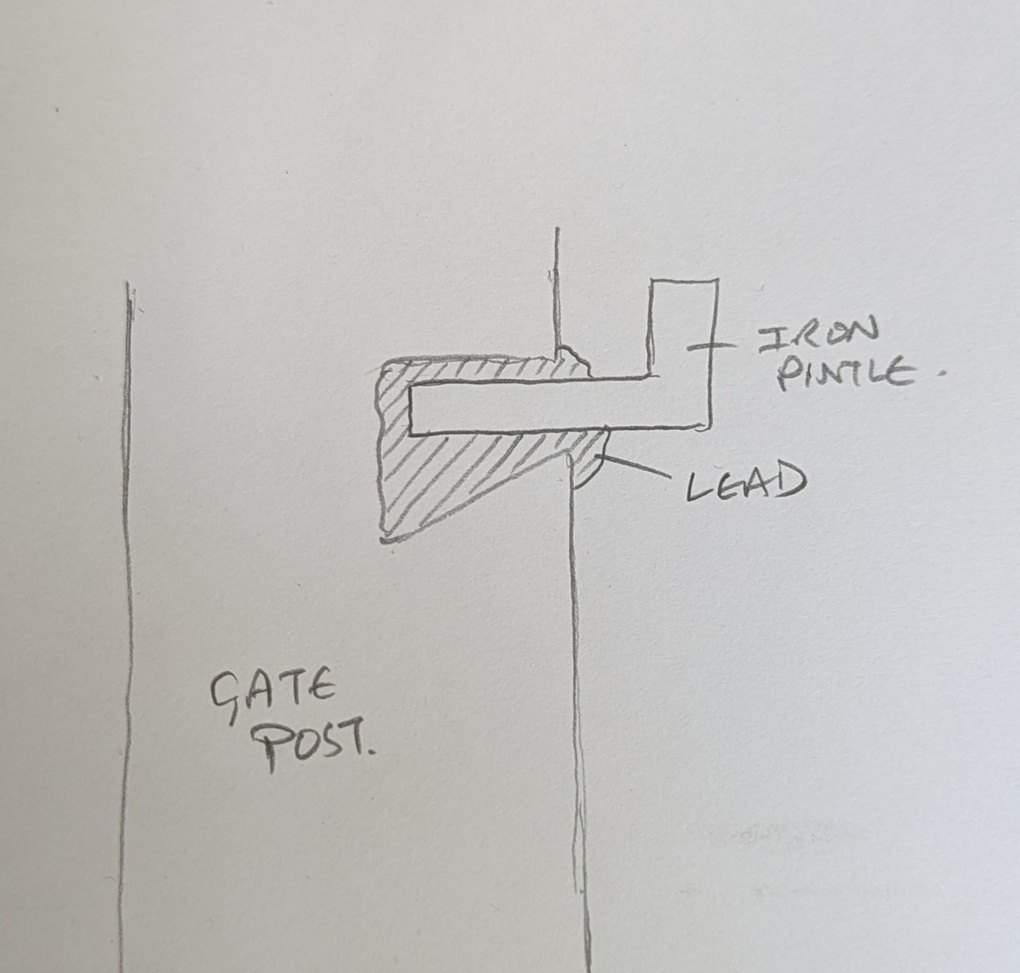
Looking at this lump, and using a small diagram, you can see what it is and how it worked. The long hollow through the middle once held the iron fixture – a pintle or latch, perhaps.

The iron whatsit was circular in section.

The shape of the lead piece is also a clue to how it actually held this in place. A hole is made into the side of the gatepost that needs the ironwork on it, with the lower part of the hole made deeper. The ironwork is placed in the hole, and the molten lead poured in using a funnel to hold it within the stone and around the iron whilst it cools.

If this makes sense.

When hardened, it forms a plug that is very difficult to move, keeping the iron work in place; clever, and elegantly simple. It’s also nice to see the ‘inside’ of the gatepost, or rather a cast of the inside, and one wonders why the lead has come away so intact from its original home – one can only imagine that the post itself was broken, freeing this fixing, which then found itself at my feet in the wilds of Derbyshire years later.

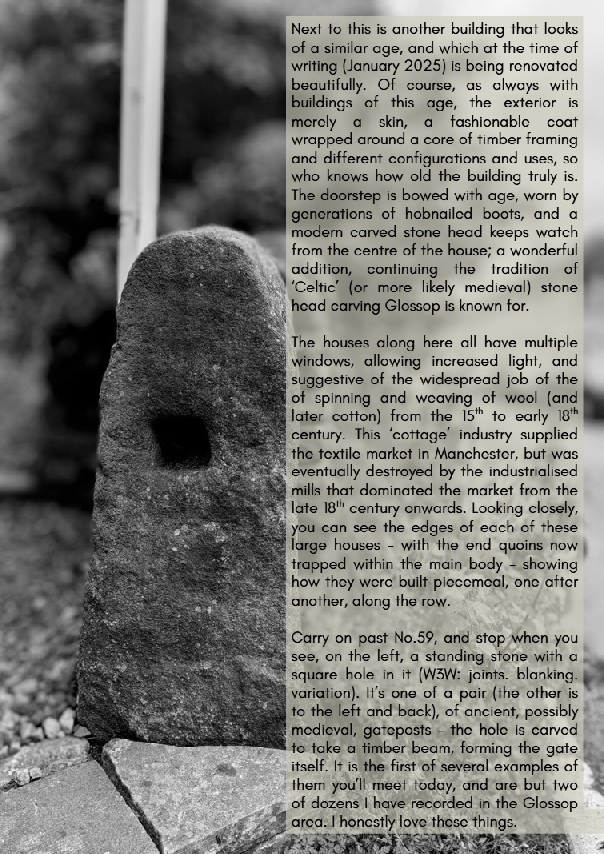
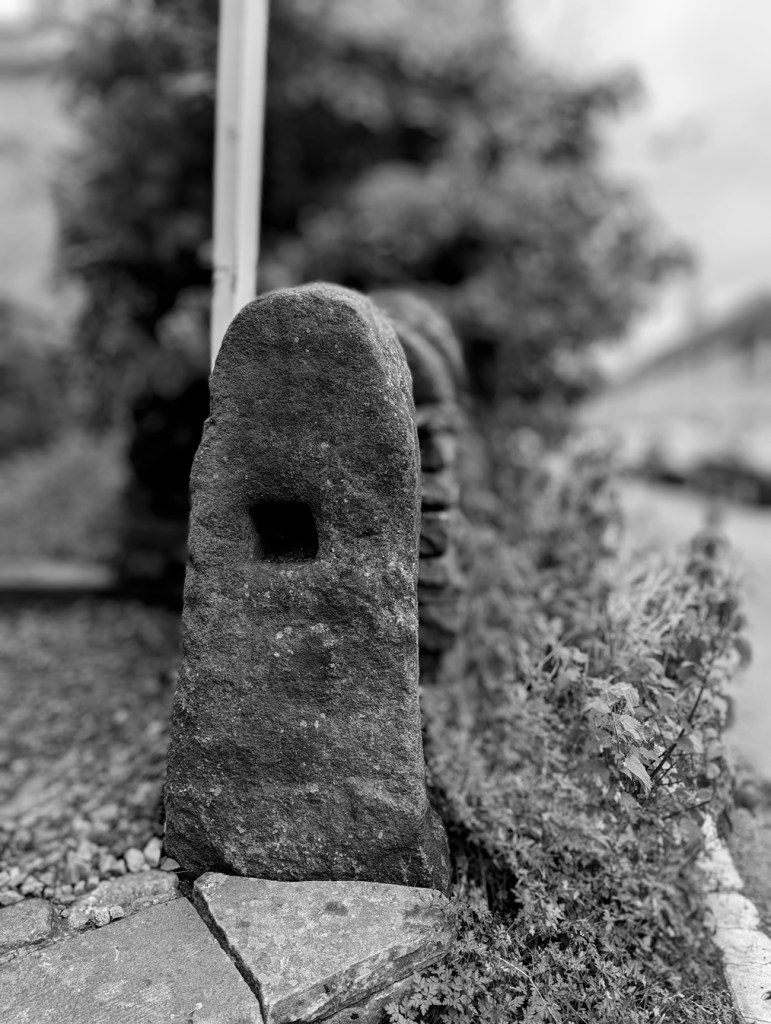
In terms of dates for these gateposts – well, it’s not clear. I think the more uniform stones, with a rounded head, are Georgian and Victorian – later 18th and 19th century. However, there are some that I think are significantly older – 17th, 16th, even 15th century, possibly. These are generally less formally worked, are shorter, and importantly are characterised by having a single straight hole through the stone a few feet above the ground.

Another arty shot, this one of the ancient gatepost on Hague Street.
Carrhouse Lane, Whitfield. And no, I didn’t stick my hand in the hole…

I was, until fairly recently, convinced that these were marker stones for trackways, the square hole perhaps taking a wooden pointer. However, I started to notice that this didn’t always fit the pattern, and despite multiple blog articles, twitter posts, and it even published in Where/When, I began to doubt this explanation. I then received an email that pretty much confirmed it for me (thank you PB, you amazing man!). In it, the author quoted a John Farey, whose 1815 book – General View of the Agriculture and Minerals of Derbyshire: With Observations on the Means of Their Improvement. Drawn Up for the Consideration of the Board of Agrigulture [sic] and Internal Improvement – gave the following quote:

Anciently, the Gates in the Peak Hundreds were formed and hung without any iron-work, even nails, as I have been told; and some yet remain in Birchover and other places, where no iron-work is used in the hanging: a large mortise-hole is made thro’ the hanging-post, perpendicular to the plane of the Gate, at about four feet and a half high, into which a stout piece of wood is firmly wedged, and projects about twelve inches before the Post; and in this piece of wood, two augur holes are made, to receive the two ends of a tough piece of green Ash or Sallow, which loosely embraces the top of the head of the Gate (formed to a round), in the bow so formed : the bottom of the head of the Gate is formed to a blunt point, which works in a hole made in a stone, set fast in the ground, close to the face of the Post. It is easy to see, by the mortise-holes in all old Gate-Stoops, that this mode of hanging Gates was once general.

Of course, it made sense, despite me banging on about them being marker stones. So, please accept my apologies for this; I am not always correct, and my knowledge is always growing. And thank you PB, who brought this to my attention – this is your discovery, not mine (you can read the book here – P.92 is the quote. There are about 20 of these gatepost types I know of, with many more awaiting discovery. And I actually think these are quite significant, as if we plot their location on a map, we might get a better grip on land use in the pre-industrial period. Marvellous.

I am obsessed with gateposts, and I want you to be, too. Everytime I pass one, I check it out, and often I am rewarded with some nugget of information, graffiti, decoration, or just a blast of the past. Let me know what you find via the contact page, and let’s keep an eye out for those holed ancient stones.

Right, I think that’s all for this month, and lucky you the next post will, I suspect, be a pottery post! Woohoo! I have found lots of cool stuff recently, and it all needs writing about. As always, I have about 30 projects ongoing, not all of which is coming to fruition anytime soon, but some will emerge relatively rapidly – watch this space. In the meantime, do please check out the Etsy store, or the Ko-Fi page – and feel free to buy me a beer coffee, or yourself a copy of Where/When, or even a t-shirt!

But until next time, please do look after yourselves and each other. I know I always say that, but you all matter, and we all need to take better care of each other… the world can be scary place at times, so lets band together and help each other.

And as always, I remain.

Your humble servant,

TCG

Etsy Shop · Where / When

Where/When No.4 (The Melandra Meander) and More

What ho, historical types, what ho!

So, the new Where/When ‘zine has just arrived, and just in time for Christmas! How has a year passed since I nervously unpacked Issue No.1, hoping that someone might buy it? I now have t-shirts available… but more about that in a moment. So then, Issue No.4: the lurid green cover was suggested by Master CG, so blame him for the migraines.

This one is subtitled The Melandra Meander, and, as you might have guessed, has a brief furtle around that most neglected of all Roman forts, Melandra. The Wander starts there, and then wends its probably weary way up the hill to The Hague, then up to St Michael and All Angel’s church, Mottram, and then down various trackways to Broadbottom, the viaduct, and on to Gamesleys old and new, and eventually back to the fort.

It does give a brief overview of the fort, but I think that really should be the subject of a Where/When special, as it is a hugely important site. It’s also slightly longer than previous Wanders, but it isn’t particularly difficult… although be warned it is incredibly muddy in places. You have been warned! It contains all the usual website shenanigans – history, a carefully planned wander, archaeology, psychedelically tinged photographs, bad jokes, pottery, a sense of ‘something or other’ and the obligatory snifter of the stuff that cheers… I mean, what’s not to love?

All four of the Where/Whens are now available to buy – I reordered some more of the long out of print No.1, as people have asked for it.

The price is £5 each – a mere snip to have my words droning on and on about old things ready at hand, any time day or night! They are available from the wonderful Dark Peak Books, High Street West, Glossop, or from this website (click here, you won’t regret it). Or simply drop me a line in the contact page, and I’ll get them to you ASAP. Or you could track me down, and make vague threats to me in order to get me to sign it – you won’t be the first (madness, I tell you!).

I’m also in the Glossop Chronicle, which is bizarre to say the least! Check it out here: https://online.flippingbook.com/view/781848889/10/

In other matters… I have set up an Etsy shop! This gives me a platform to sell my wares, which is amazing. At the moment it largely features A4 art prints taken from Where/When, on really good quality paper stock, perfect for framing and brightening up even the darkest of rooms (yes, Mr Shouty-Outy, I’m sure it would look good in your downstairs toilet… as always, I thank you for your input).

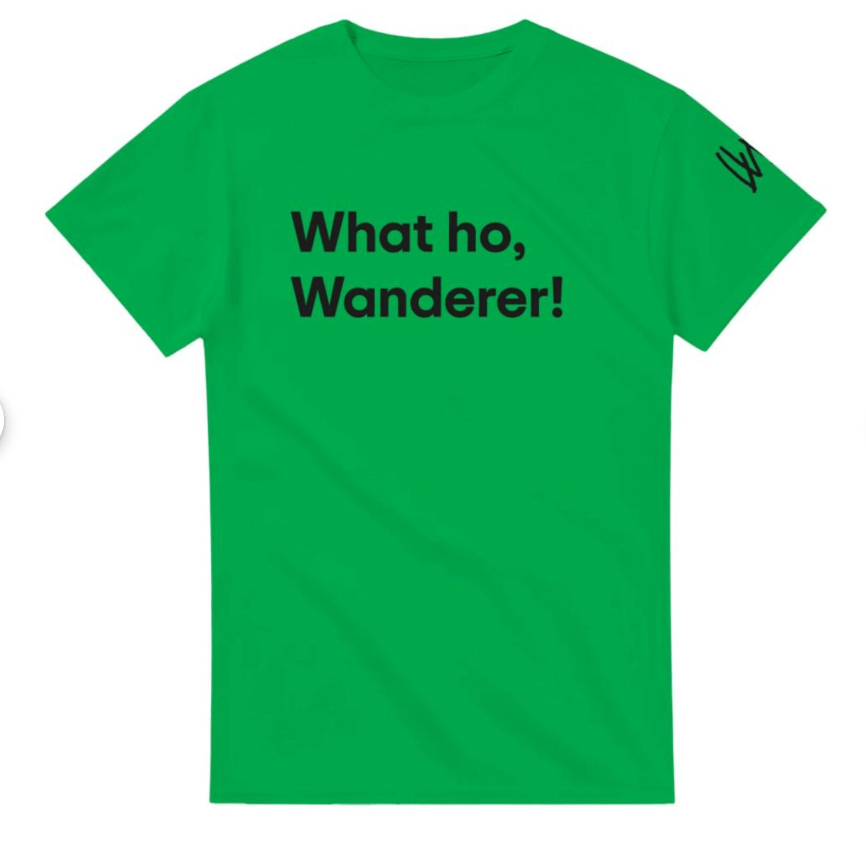
But also, crucially, we have some merchandise! If you fancy buying a 100% cotton t-shirt for Christmas, please feel free – I certainly won’t stop you! Now you too can recognise fellow Wanderers without having to resort to those tattoos that some of you have got. And now you too can look somewhat snazzy as you slither down a muddy bank whilst looking for pottery, or indeed simply spiffing as you tumble A over T down a ‘medieval trackway’ cursing me as you go (again, you won’t be the first).

Four slogans are available, and in a variety of colours:

‘What ho, Wanderer’

‘Wandering Where? Wandering When?’

Not Walking… Wandering’

Wander Definition

There’s also hoodies, and mugs! What’s not to love? And, of course, the ‘zine itself. And with much more in the pipeline.

Check the shop out here – DrTCG’s – you won’t regret it, and you’ll be helping me, too!

Righty, shameless self-promotion over with – I’ll have a proper December post ready in time for Christmas (probably involving pottery!). Until then, look after yourselves, and, as always, each other. And I remain, your humble servant,

TCG

History · Placenames · Simmondley

The One Glossop… and the Many Glossops

What ho, wonderful folk! Summer is almost upon us, and we enter the finest time of year. Now don’t get me wrong, I’m fond of spring, and autumn is good. Even winter with it’s cold and dark can be lightened and warmed with a good fire and a glass of the stuff that cheers (if taken in the right dosage, as I am often reminded by the good Mrs C-G). But no, ask old TC-G which season he likes most, and the answer will always be… summer. This time of year fills me with a particular joy; it puts a spring in my step, a smile on the old fizzog, and a stirring in the loins (although that’s possibly the onion soup I had for lunch). Summer is indeed ‘icumen in’.

And indeed, it’s the stuff that cheers that leads us to today’s blog post – something a bit different, but fret not dear and gentle readers, for when have I ever steered you wrong?

I wonder then have you ever found yourself, glass in hand and perhaps swaying slightly, in a place to which you never set out to journey? I certainly have (and no, not that Turkish bordello… for the last time, I was only in there to ask for directions to the post office). No, a chance encounter with a place, perhaps exotic, otherworldy, strange and alien, like no other place on earth, and yet familiar? A few months ago I found myself, quite by accident, in The Globe pub quiz (and good evening JS!). It was a difficult quiz, and involved much mashing of the old B, and a distinct straining of the dashed M… if you catch one’s meaning.

But one question in particular flummoxed me: “How many Glossops are there?”.

I mean, there’s an existential crisis… what? Why surely there is only one? The singular, unique, one-of-a-kind place that we call home. This royal throne of kings, this scepter’d isle. This earth of majesty, this seat of Mars, this other Eden, demi-paradise. This fortress built by Nature for herself against infection and the hand of war. This blessed plot, this earth, this realm. This Glossop. (ok, I might have had a bit of help with the words there… my thanks to William what’s-his-face).

But no… apparently there are three. Who knew? Well, the quizmaster did. And several of the other teams did, apparently. But I bloody well didn’t. Not that I’m bitter or anything. And besides, none of the other teams could answer any of the questions in the ‘Pottery Identification’ round (alas, if only such a wondrous beast existed… one can but dream). 

So then, two other Glossops… blimey, there’s a thought. What wonders could these places offer us, what unearthly delights akin to the Globe quiz? Well, dear and gentle reader, let’s find out.

Introducing Glossop Number 2

Where the red pin is, lies another Glossop, on the other side of the world.

Glossop, South Australia. A town roughly 250 miles north east of Adelaide (and just a mile or so north of the splendidly named township of ‘Winkie’). It’s a small place, with a population in 2016 of just 984 (compared with our Glossop’s 33,340 in 2021), mainly rural, and surrounded on all sides by vineyards – it’s right in the wine growing region, lucky people! (and presumably then the weather would be a tad warmer than that found in our corner of North Derbyshire!).

I am in awe of its triangular shape!

It was founded in 1921 as a settlement for returning soldiers, and is named after the equally splendidly named Vice Admiral John Collings Taswell Glossop (if anyone knows their Jeeves and Wooster, this could be Tuppy Glossop’s uncle). Vice Admiral Glossop was in command of HMAS Australia during the First World War, and was very active in the Royal Navy’s Australian wing.  

A little different from High Street West, this is Campbell Street, Glossop.

There looks to be some great camping and hiking to be done in the area, and there are several national parks based around the Murray River there. That stated, there’s not a lot more to say about the place, to be honest, but do feel free to have an explore on the internet, or in real life (oooooh, a tour of the wine country could be fun!). If you live in Glossop, Australia, and have stumbled upon this site, then please let yourself be known – we’d love to hear from you. 

But wait, there’s more!

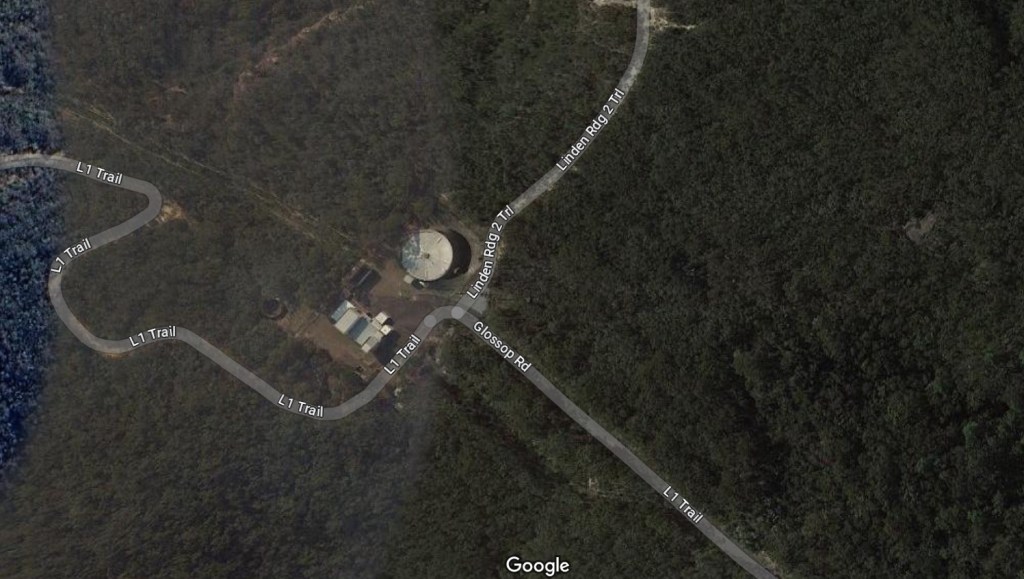
In New South Wales, Australia, there is a Glossop Reservoir. Situated near to the village of Linden, 40 miles NW of Sydney, it’s located at the end of Glossop Road, and absolutely smack dab in the middle of nowhere.

Glossop reservoir is the round thing at the end of Glossop Road.

I wonder why they have the name Glossop? Perhaps also connected to our man Vice Admiral Glossop? There is no more information I can find out about this place at all, so any information you have would be gratefully received.

And now for Glossop Number 3.

Will this Glossop be a throbbing metropolis? A mecca of marvelousness? A seething mass of humanity? A place of culture and wonder, or a modern-day Sodom and Gomorrah? Well, not exactly…

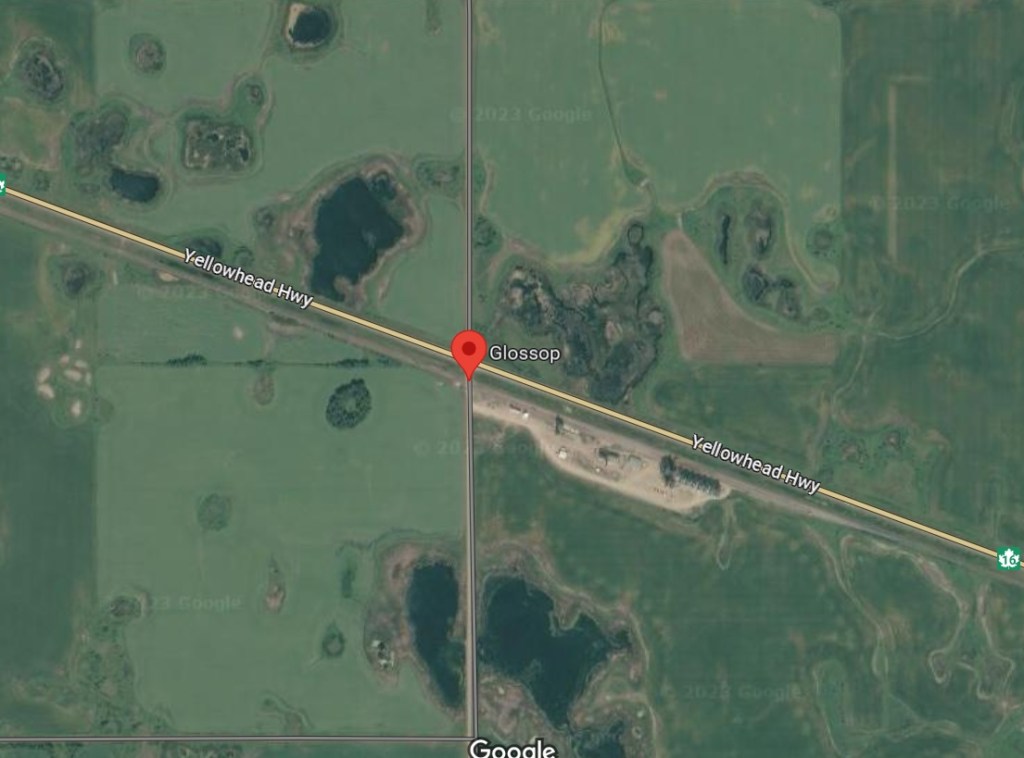
Ladies and gentlemen, welcome to Glossop, Manitoba, Canada.

What wonders await under that red pin?

Well, what can we say about Glossop, Manitoba.

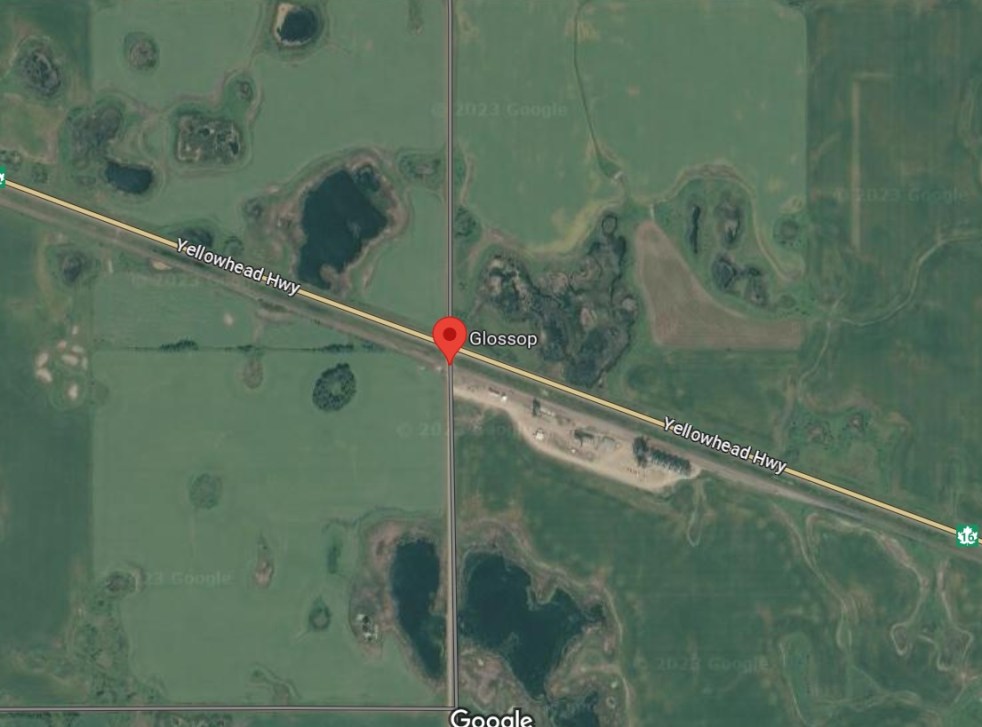
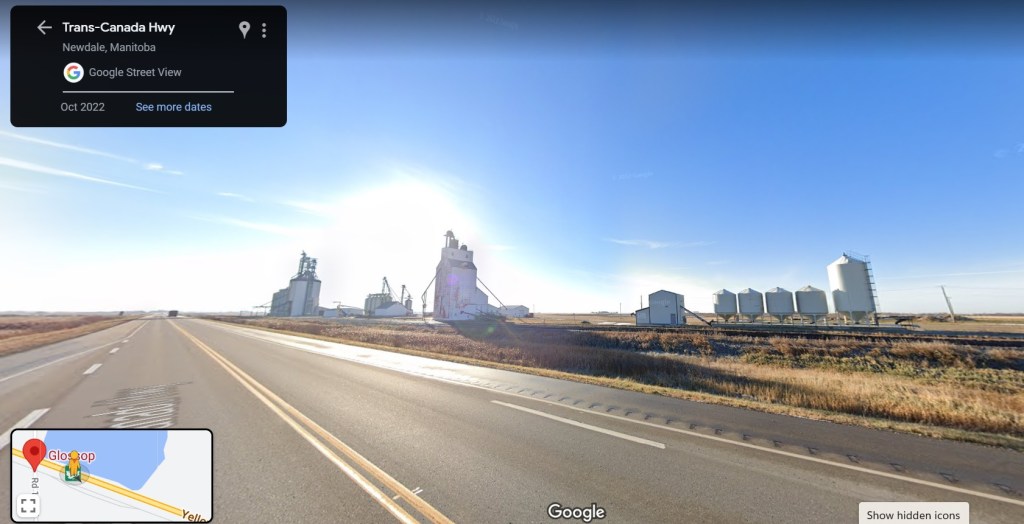
Well, no matter how you feel about Glossop, Derbyshire, it has something going for it. And as small as Glossop, South Australia, is, it has life… in that people actually live there. Glossop, Manitoba is… well… a road, next to a rail track. With some grain elevators on it.

Glossop, Manitoba… what can I say?

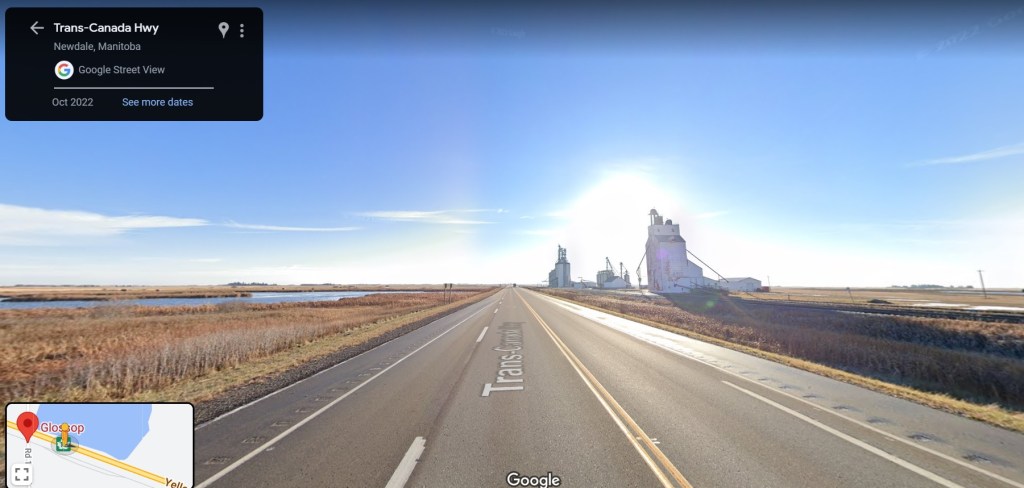
There must be something nearby… surely. Let’s look down the road:

Nope, nothing this way, let’s look behind us…
Nope, nothing.

What we can say is that it is situated 604m (1982ft) above sea level, is on the trans-Canadian Yellowhead highway, and is broadly equidistant between the settlements of Newdale and Strathclair… both of which seem to be quite nice, if on the small size (population “perhaps 200” and 709 respectively). What we can’t say, however, is why this place has the name Glossop, although presumably it’s named after someone with that surname.

However, a little more digging and… it turns out the grain silos are interesting.

Copyright Steve Boyko, and borrowed from this website.

Well… ok, let’s be honest for a moment, anyone who has ever read anything on this website knows that the word ‘interesting’ is very flexible (and honestly, we have stretched that word to the limit on this site), and I’m painfully aware that my particular niche interest doesn’t ring everyone’s bell. But even by our own relaxed standards, these grain elevators aren’t exactly riveting. However, this is exactly the sort of thing the internet was invented for – people with niche and minority interests meeting each other and sharing information – after all I’m here writing this, and all six of you (including Pablo in Puerto Rico… hola Pablo!) are out there reading it. The website ‘Grain Elevators of Canada’ has a whole page dedicated to those at Glossop, Manitoba, but I’m not going to steal their thunder, instead please do go and have a look at it.

But wait, there’s more…

Some 350 miles north east of Glossop, Manitoba, is Glossop Lake.

Even by Canadian standards, this place is in the middle of nowhere: 40 miles NE of the nearest settlement (Pikwitonei, population 55), and 150 miles east of Thompson, the ‘capital’ of northern Manitoba (population “fewer than 15,000”). You could only get to this place by hiking for several days, or possibly by boat. It is truly remote.

Which makes it particularly baffling that the only information about Glossop Lake available on the internet are from a Wikipedia page written in Cebuano, a language spoken almost exclusively in the Southern Phillipines… and with no obvious connection with an obscure lake in the frozen north of the Canadian wilds! Bizarre!

So what can we say about Lake Glossop. Well, it’s a shallow lake, situated 200m above sea level, and covers an area of 1.35km2. It is mostly pine covered, and the average temperature for the area is -5… so you’ll probably not want to go skinny dipping any time soon. There is neither a photograph, nor an explanation as to why it is called Glossop Lake, though presumably again named after a person.

So there we have it – the many Glossops of the world. I’d like to do a roadtrip to find these places, but honestly… that seems like a lot of hard work for very little reward! However, if anyone is going to any of the places mentioned, please let me know.

And whilst this post is not overtly archaeological, it does have some relevance. Gamesley, Simmondley, and even Glossop itself are all named after people, and all were imposed on the landscape by Anglo-Saxon settlers. What the native British (the ‘Celtic’ Romano British) called the area, if it had one, is lost to us (Dinting being the exception). This habit of naming after people or features in your own language can also be very helpful in identifying settlement patterns, ages, and the origins of the people doing the naming. And here it does get interesting. Simmondley means “the clearing” (or ley) belonging to someone called either Sigemund or Sigmundr. The former is a Saxon name, but the latter, however, is a Norse (Viking) name, and that might be important. I have a pet theory… we know that a small group of Scandinavians were allowed to settle in the hills to the east of Manchester, and there are a cluster of possible/probable Scandinavian names in the Simmondly area: sitch, storth, gate, nab, and possibly others. It makes me wonder if Simmondley’s origins are more Viking than Saxon. Just a thought, but it does illustrate the importance of names in a landscape. I’ll expand on this another time.

But for now, take care of yourselves and each other.

And I remain, your humble servant

TCG
Archaeology · Oddities · Whitfield

What If…? Of Stone Heads and Stories.

What ho, you wonderful people, you.

So, despite having half a dozen half-written posts, piles of interesting objects and sherds to talk about, and a few adventures to recount, I want to try something a little different today. “Oh no!” I hear you cry. But fret ye not, gentle reader, for it is still archaeology, it is still Glossop based, and it is still interesting. But it is a little… quirky. You’ll see what I mean.

I have a friend who is a writer, and quite a good one at that. He has often mentioned that stories usually start with what he terms a “What If?” moment, where something – often an object – presents itself, and the question is posed “what if…?” From there the story grows, based on and around that one question. The answer that comes doesn’t have to be ‘real’, it is fiction after all, but it has to be possible. What if a house was haunted? And what if the house fell down? And what if a brick from the house was haunted too? And what if a dashing archaeologist took the brick home to write about it on his extremely popular and incredibly interesting blog? What if…?

Archaeology, I think, uses a similar technique. An object is excavated, and the interpretation – the story – begins. However, where we differ from writers is that we base our ‘what ifs…?’ on evidence and supposition grounded in data. The interpretation, in this sense, has to be ‘real‘, although it is only ‘real’ for as long as the data supports it. Sometimes though, It’s fun to play “what if…?” – and here we join today’s post.

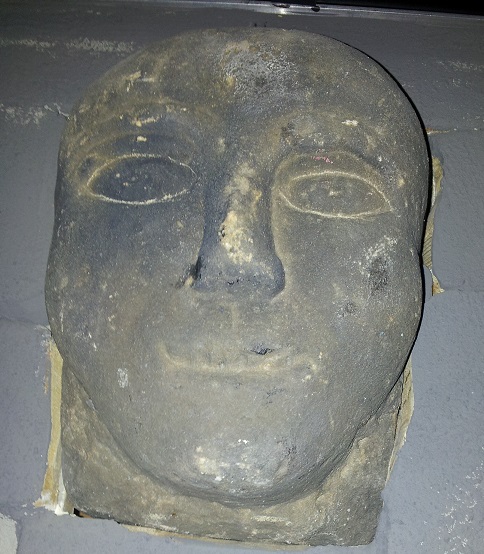
A stone head displaying all the characteristic features, including almond eyes. This one was allegedly found on Mouselow, and now lives on a wall in Buxton Museum

Stone heads. A lot has been written about them. They are cursed and evil. Or they are warm and friendly. They are ‘Celtic’ (i.e. Iron Age or Romano-British) in date. Or they are medieval or early modern in date. Or a combination of both. They represent an unbroken pre-Christian tradition, and an aspect of the whispered ‘Old Ways‘. Or they are simply folk art, and just decorative. Or they are magically protective (that wonderful word, apotropaic, again). Or both. Or neither. A brief trawl of the internet gives a lot of different sites and opinions, ranging from the scholarly and the more open minded, to what can only be termed outright nonsense.

Whatever they are, carved stone heads are a feature of this part of the Pennines – from Longdendale, over the hills to West Yorkshire, and up to the Calder Valley. I actually have a serious project that is looking at them; cataloguing known examples from Glossop and Longdendale, and trying to place them geographically, as well as giving some sort of date to them. There are at least 23 examples from the Glossop area, with more doubtless waiting to be uncovered. But it’s an ongoing project, and not really ready to publish – here, or anywhere else for that matter – and I just keep chipping away at it. It was during the course of trying to map where they were found, that I noticed something very interesting.

Stone head in Old Glossop. Image stolen shamelessly from the Old Glossop website (follow this link – the website is very good)

Before we go any further, I should state that my personal belief is that most of the stone heads are medieval or post-medieval in date (indeed, there is a record of them being carved in the 19th Century). That’s not to say that Iron Age ‘Celtic’ examples don’t exist (one was found at Binchester Roman Fort, in County Durham in 2013), it’s just that it is very difficult to date them as they usually don’t come from any secure archaeological context, and basing a date on ‘style’ or method of carving, as has happened in the past, is notoriously dodgy. That stated, there is the possibility that I might be wrong. And this led to my ‘what if…?‘ moment.

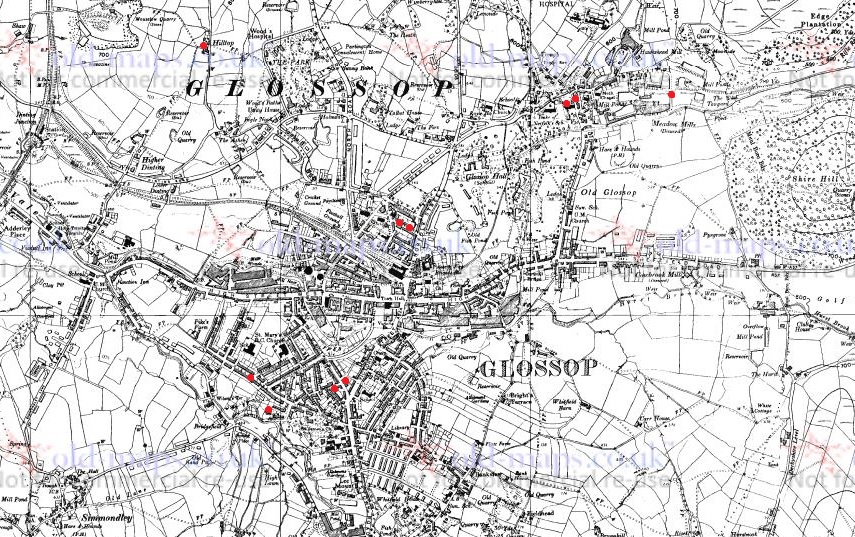
Back to the find location, sadly the majority of the heads are simply “found in Glossop area“, and thus have no exact place. But from various sources, I was able to identify where some of the heads were found. The distribution map is below:

1:10,000 map of Glossop. The Find spots – where the heads were found – are marked in red.

They seem to be dotted all around the area: Mouselow, Manor Park Road, several in Old Glossop, etc. However, looking at the above map, I noticed there was a distinct grouping in Whitfield – four of them centred around Slatelands Road and Hollin Cross Lane. Hmmmmm… let’s have a closer look, then.

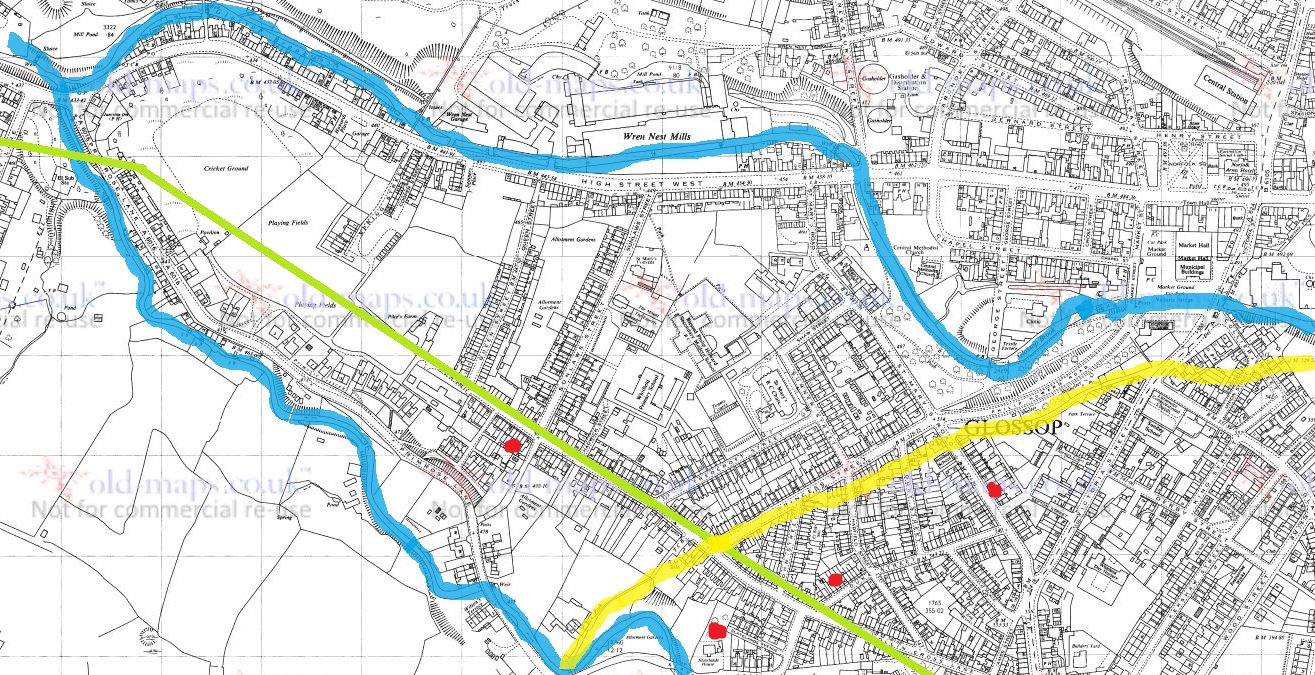
Here is the Whitfield group on the 1:2500 map.

Duke Street, Pikes Lane, St Mary’s Road, and Slatelands Road. Geographically, they are in the same tangle of roads in that area. But the heads more than likely pre-date the Victorian roads, so we need to strip them back. What was there then? Well fields, mainly, though the medieval track from Simmondley to Glossop ran through here (that blog post is coming, I promise!). And before that, the Roman road also ran through here, along Pikes Lane, before kinking over Long Clough Brook and onto the fort and settlement at Melandra.

And then, the “what if…?” hit me.

For the sake of a good story, what if these heads actually were Iron Age or Roman in date? What could this cluster mean?

Looking again at the area stripped of the Victorian houses, it’s very clearly a promontory, a high plateau that runs between two brooks – Glossop Brook to the north, and Long Clough Brook to the south. In the Iron Age, they liked their elevated places – Mouselow, which dominates the area, is a classic Iron Age hillfort, and others exist nearby, at Mellor and Mam Tor. One only has to look at St Mary’s Road from Harehills Park to see how steep those slopes are (try doing it pushing Master Hamnett in a pram with a load of shopping from Aldi). And on the other side, who hasn’t cursed Slatelands Road halfway up, gasping for breath. This is a very real landscape feature, completely masked by later development, but one which would have been very visible back then. This would have been particularly true where the peninsular narrows at the west, leading down to the junction of the two brooks. This too, is significant.

Throughout prehistory water was a sacred thing, and was considered ritually important. A spit of land, elevated, defined by water and ending in the confluence of two bodies of water, would have been hugely significant. Actually, a perfect place for an Iron Age temple or shrine, perhaps one devoted to the ‘Celtic head cult’ as suggested by scholars such as Dr Ann Ross (in her Pagan Celtic Britain)? Indeed, the North Derbyshire Archaeological Survey notes that the number of heads in the Glossop area “might suggest a cult centre” based in the town in the Romano-British period (Hart 1984:105). It has been suggested that the heads are sometimes associated with liminality and boundaries, and were protective. What if they were they placed facing down the peninsular, to mark out the sacred space, and to defend it?

The Roman road moves through this promontory, sticking to the high ground away from the valley floors and marshy terrain, as the Romans preferred (see map below). But what if the location of the possible shrine or temple influenced the choice of road location, ploughing through the sacred enclosure, perhaps to make a point about Roman dominance?

The location of the heads in relation to the landscape. The blue is the waters of Glossop Brook (north) and Long Clough Brook (south), forming the spit of land. The yellow line is the medieval trackway, and the green line is the course of the Roman road.

What if…?

Now, I’m not suggesting for a moment that that the above is absolutely true; this is a wild flight of fantasy, and pure fiction – a story. Indeed, doubts are being raised about the reality of the ‘Celtic head cult’ theory in general. But it is a possibility, at least: an archaeological what if…? However, if that isn’t the answer, there still remains the issue of why four stone heads were found in a cluster in this area. What is going on?

If we return to my original thought, that the heads are medieval or post-medieval in date, might they be related to the Simmondley – (Old) Glossop trackway in someway? If we look at the map above, we can see this track (marked in yellow) runs broadly along the line of Princess Street. And just to the east of the three of the heads run along the same alignment. Is this significant? What if people somehow, and for some reason, deposited these heads to the east of the track? But why? Well, I came across a possible reference to just such a practice in this area – Clarke states that “Oral tradition in the High Peak of Derbyshire suggests heads were buried as charms beneath newly-built roads, presumably to keep permanent watch over them” (1999:286). He cites no sources for this “oral tradition”, but this type of apotropaic function – preventing witchcraft and promoting good fortune – is associated with carved heads all over the United Kingdom (Billingsley 2016). Perhaps, then, we are seeing the ritual deposition of carved heads as part of the road building tradition.

What if…?

Heads
A pair of Whitfield Heads. These are at the end of Kershaw Street… and that is all I know about them. It’s on my ‘to do’ list, don’t worry.

No, it is a mystery, and ultimately we are left with questions for which there are no obvious answers. Three of the heads are in Manchester Museum, and the fourth presumably in the hands of the owner/finder. I will have to go and see them, as that might help in dating. As I say the project is ongoing, and any comments or help in the area would be greatly appreciated. Do you know of any stone heads? Do you have photographs of any? Or stories – they seem to attract folklore and superstition like nothing else! Please contact me in the usual way – email me, or through twitter ( @roberthamnett ). Or just come and find me in the street, as people are increasingly doing… so much for pseudonyms and anonymity!

I do hope you enjoyed the little flight of fantasy, but we’ll be back to business as usual next time – the sherds are mounting up! Until then, look after yourselves and each other.

And I remain, your humble servant

RH

References:

John Billingsley – Instances and Contexts of the Head Motif in Britain

David Clarke – The Head Cult: Tradition and Folklore Surrounding the Symbol of the Severed Human Head in the British Isles. (Unpublished PhD Thesis, accessed here)

Anne Ross – Pagan Celtic Britain: Studies in Iconography and Tradition

Archaeology · Whitfield

A Spoon.

What ho! A short one this time… well, relatively short. As I think I have mentioned previously, I normally have about 5 blog posts half written at any one time, and I pick away at them until one ends up finished. But how do I choose the subjects? Well, sometimes, they are obvious topics, and other times it is purely a coincidence, and fate picks it for me. Occasionally my own research throws up something that I think you, gentle readers, might be interested in. And then sometimes, as is the case with today’s entry, the subject simply throws itself at me and the blog almost writes itself.

As I think I have also mentioned previously, mine is not what you would describe as a normal life; I live and breath the stuff of this blog… to the point of obsession. But thankfully I am blessed with a wonderful and understanding wife (or ‘carer’ as she terms it, which is a bit off), and also a child who thinks growing up in a house filled with bits of pottery and odd bits of old tat is perfectly normal. But even I had a slightly discombobulating moment last week – the archaeological equivalent of the alcoholic hitting the fabled ‘rock bottom’.

“Oh no!” I hear you cry. But worry not, I’m not quitting… (and I’ll have another glass of red whilst you’re at it). No, this one was a case of opening my front door and being forced to confront an uncomfortable truth: it turns out I have now reached a point in my odd life whereby people leave bits of old pottery and other stuff in my garden, without so much as a by your leave. Clearly “it’s old and knackered, so give it to RH” is now a thing.

For there on my front wall, wonderful readers, was a spoon. An old spoon, granted, but a spoon nonetheless. “What ho!” said I, and leapt forward.

A random spoon on my wall. Yup… my life is totally normal.

Now the sight of such might have caused a lesser man to quiver and fall, but I’ve been around spoons before – I’m no mere amateur when it comes to them. Indeed, it’s certainly no idle boast when I say “I know spoons”.

But from whence did said spoon come? The physical location of Hamnett Towers suggested only a few possibilities, and not knowing Uri Geller, my suspicion fell immediately on our clearly insane neighbours Helen and Sarah who, when not camping in their garden (mere metres away from a perfectly good house) or self harming by cycling to Tideswell and back, are amazing.

Turns out I was right! Sarah had found it in a wall in Whitfield, somewhere near the Beehive, and thought, correctly as it turns out, “good old RH might want that”. I looked closer, and my interest – already piqued – began to tingle. Writing… and possible decoration. The spoon was a welcome gift, but jokingly came with one condition, that I write a blog post about it. Well, here we are! Let’s look closer…

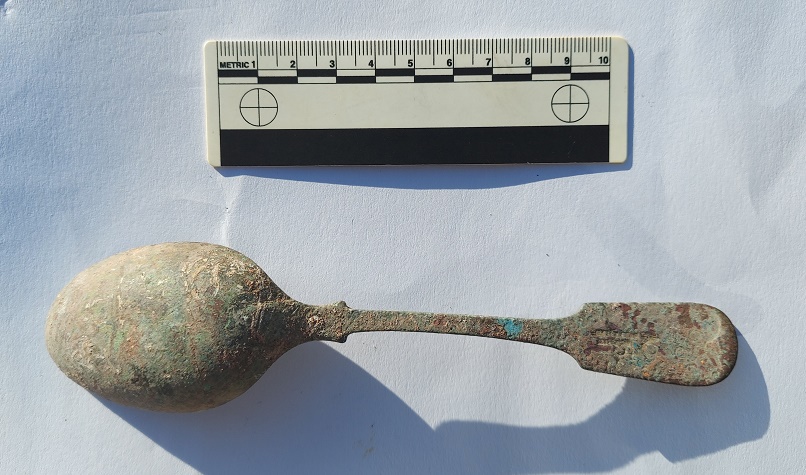
A spoon, yesterday.
Honestly, it looks like Uri Geller has been here.
A close up – you can just about make out lettering and what looks like decoration.

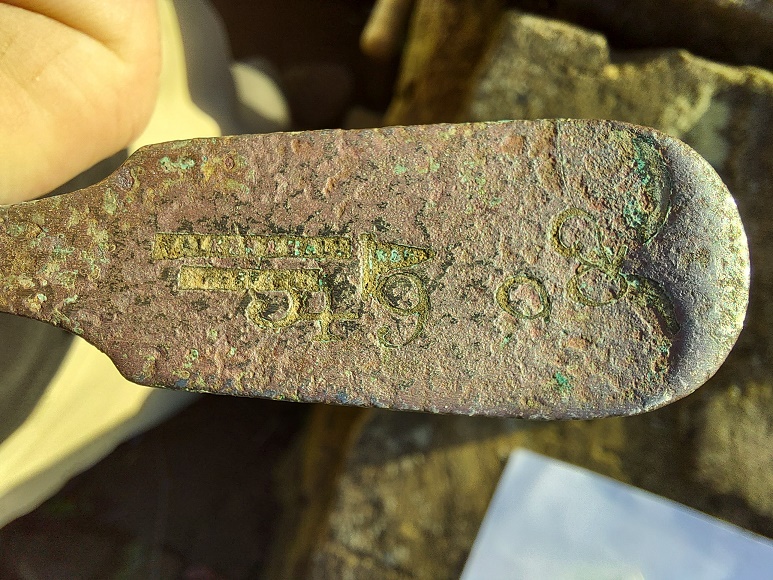
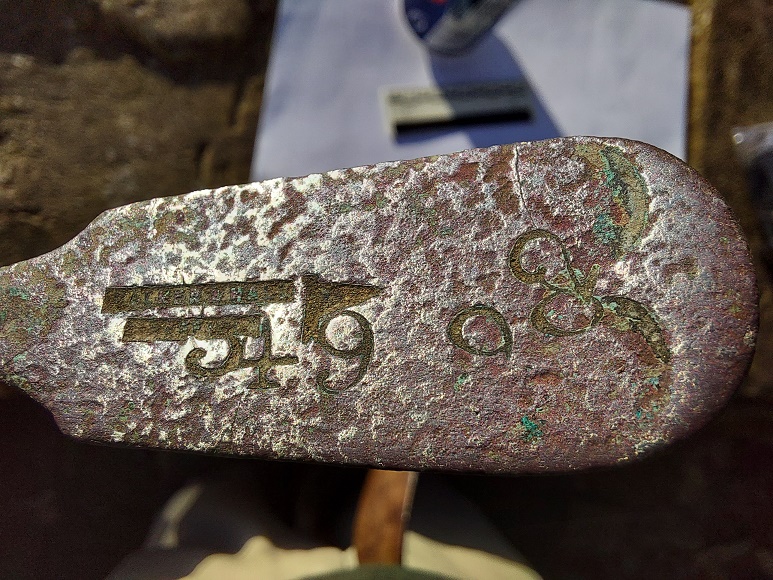
The spoon is of a soup rather than serving type, and vaguely Victorian in shape. It was also very worn and covered in greenish verdigris – I really do get the best presents. I couldn’t read what it said where the maker’s mark normally is, nor make out the decoration so I took some very fine sandpaper to it, and removed what I could.

It becomes slightly more clear.
And even clearer.

You can just make out the lettering – if you squint, and use the eye of faith – that reads “Walker and Hall. Sheffield” and a pennant/flag logo containing the letters “W&H“. And, over that a series of numbers stamped roughly onto the surface.

Walker and Hall were a company of silversmiths based in Sheffield. They were founded in 1845, but began operating with that name from 1853 onwards, and continued until 1920. This website suggests that the pennant logo should be dated between the late 19th century (say 1880) and World War 1 – which looks about right from the style of the spoon. Sadly, it’s not silver, but silver plated, and seemingly carries no mark, in which case it might date to before 1884 when Walker and Hall started putting marks on their cutlery.

As for the numbers, I have no idea what they might mean. I can make out “5, 4, 9, 9, 3, 2” Conceivably they could be the model number for the spoon type – there are examples of this being done – but these are very large and untidy, and seem to have been stamped in a haphazard way, with no easy way of reading them. Perhaps they were done by the owner as a way of identifying the spoon, but this leads to the question “why?”. The only explanation that I can come up with is that it was a ‘communal’ spoon, perhaps one connected with a pub or similar – the idea being it can’t be stolen because it is very easily identified. This fits nicely with where it was found, near the Beehive pub. It also fits with the wear pattern, too; it has been bent and straightened several times, as public cutlery often is, but also the huge amount of wear on the bowl.

The asymmetrical wear pattern at the tip

This wear is very visible at the left hand tip, meaning it was used by a right handed person or people. I would argue that a personal spoon wouldn’t worn that much if it was used for at most a meal a day. However, at a busy pub serving good mutton stew, that spoon might be scraped around a bowl 20 times or more a day. Do we have an original Beehive spoon? Well, I’m almost convinced.

Why it was placed in a wall is, frankly, a mystery. People do strange things with objects that are deemed ‘public’ (I look sheepishly in the direction of a wine glass that mysteriously ended up in my house, but which originated in a certain drinking establishment in a certain town), but it may well be that the spoon was too knackered and was simply thrown away, ending up in the wall via child or bored adult.

So there we are – a spoon! From a wall, to my wall, via my neighbours, and finally to you.

Right, that’s all for now. More coming soon, including the much talked about roads and tracks post that I keep promising. In the meantime, I’m going to put a box outside – if anyone else has anything old they want to give me, pop it in as you pass… who knows what I could find in it.

Until next time take care of yourselves and each other. And I remain

Your humble servant

RH

Archaeology · Whitfield

Pressing Matters – Of Cheese and Wills

Good evening gentle readers. I say good evening, for this is when I am writing, but it could be anytime you are reading this. And indeed anyplace… which worries me slightly. Anyway, moving swiftly on.

Recently, I posted a hotch-potch, pickle-type post, that looked at the cheese press I found that was being used to fill up a hole in a trackway. Well, some interesting developments have, well… er… developed.

Firstly, it seems that the whole cheese press is present, which is excellent news. But alas it is broken into two pieces, which isn’t such excellent news. Still, the fact that it survives at all is pretty impressive. Secondly, and even more impressive, I think I might have identified to whom it belonged, which is amazing if true. Please note the use of the phrases “I think” and “if true“… I’ll leave it to you to decide.

Firstly, then, the press.

It’s complete, as in it’s all there, although as you can see it is sadly broken across the middle. It measures 94 x 43 cm, and about 10cm deep, so it’s not huge – and these things do come in huge sizes. I had a poke around mini excavation, just to reveal the edges, and to assess how much was there, but I didn’t want to dig too far – it is filling a large hole in a track after all.

Press1
Nice to see the whole thing – you can just make out the corresponding beam hole on the right.

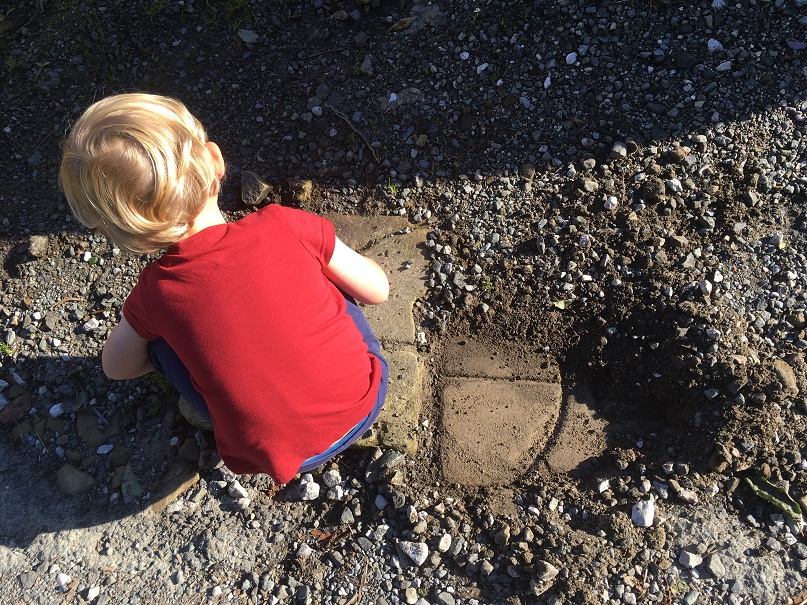
Master Hamnett helped reveal the press, of course… any excuse to get dirty.

Press2
Master Hamnett ‘helping’ with the excavation and the photographs

It’s fantastic, and I honestly think that this needs to be removed from the road and put on display somewhere; it is a wonderful piece of evidence for life in 18th century rural Whitfield that deserves to be treated better than it currently is.

Right then, so who owned it? Well, I was reading through a collection of Glossop-based 17th and 18th Century wills the other evening.

Before we move on, perhaps we should examine that statement. I have just read it back, and the thought occurs to me… mine is perhaps not what you might call a ‘normal’ life. I mean, here I am, on a Friday night, reading 300 year old wills, and getting excited over some new bits of pottery I found yesterday. Sometimes it’s good to take stock of one’s life… and other times it’s good to simply leave one’s livestock alone.

Anyway, back to the wills. They have been digitised as part of the North West Derbyshire Sources project which is a truly remarkable source for local history and genealogy in this area, and filled with all kinds of information – if you don’t know the website, please do have look. The will that caught my eye was that of John Cowper (Cooper) of Whitfield, and dated 1750. The actual will is fairly bog standard, but is genuinely fascinating as it contains, in a nutshell, the contents of an average well-to-do household. Cooper was someone who we would now perceive as comfortably middle-class, but was then known as a yeoman farmer; someone who owns a small amount of land freehold (paying no rent), and who earns his living from it. I won’t reproduce the full preamble here as it is a wall of text – but it well worth a read (the full transcription is to be found here – it’s alphabetised, so look for John Cooper of 1749/50). However, the contents of the house is as follows:

Item Value (£ s d)
Imp/ Purse & Apparell 7    0    0
A large Bible & Clock 3    0    0
Two cows 6    0    0
A cupboard & table 0  15    0
Two coach chairs 15s 12 chairs 10s 1    5    0
One Fire Iron tongs, 3 bread Irons Fire Shovel & Brigg 0  15    0
One little Fire Iron, smoothing Iron Clever two Hand hooks & Spittle one frying pan 0    3    0
One Warming Pan a skellet a brass pan a brass pott & saucepan one Lead, Lead weight & Mustard Ball 0  15    0
8 Pewter Dishes one Tankard 1 Cup 4 porringers, Spoons 0  14    0
Books & Linnen Meal Cheese & Bacon 4  17    0
One Bedsted & Bedding & a little Cupboard ith Parlour 1    8    0
One Bedsted & bedding in the long Chamber 2  10    0
One Press 1  10    0
A Long table & one little oval table ith parlor Chamber 0  17    0
One bed & bedding ith Chamber over House 1    5    0
One meal ark 8s one Chest 10s one little chest 6s one Desk 5s one Box 1s ith same Chamber 1  10    0
One Cheese Tubb 5s one kimlin 2s Cheese fatts & other wooden ware 5s & one cheese press 3s 0  15    0
One little Ark in the Porch 1s 2 Iron potts 2s a Glass case two fall tables 2s a kneading trough 1s 0    6    0
One Shovel Mattock & Bill & Dock fork & Ax 0    3    0
One Stock of Bees at Thomas Cowpers 0  10    0
Huslement 0    5    0
46    3    0
In Bills 88    2    0
134  5    0

The items listed, then, are those that are considered of value in the mid 18th century, and if you look, it’s largely the things that we would take for granted. Imagine someone doing this to your house – have a look around. Would they mention your pots and pans? Or your fire irons (assuming you have a fire – everyone in the 18th century certainly would have). Or your bed linen? Or your cheese and bacon? It’s bizarre, yet it also makes sense. There were not many frivolities then; would bacon count as a frivolity if you had raised the pig, killed it, salted it and stored it? No, it would be a resource that you had earned. Your iPad would be listed, but Cowper had a clock (along with a large Bible, valued at £3 [£350 in modern money]. Your car would be listed, but Cowper had two cows and a hive of bees valued at £6s10 (£758.35 in modern money). Your all-singing, all-dancing, ride-on, lawn mower might be listed, but Cowper had “One Shovel Mattock & Bill & Dock fork & Ax” valued at three shillings (£17.50).

Some of the items listed needed a little further exploration. For example, the ‘Mustard Ball‘ valued with the rest of the pots and pans from the kitchen threw me. But it turns out that they were literally balls of powdered mustard.

tewkesbury-mustard-balls
Traditional mustard balls. Image stolen from the Tewkesbury Mustard Company website – there is a link to the site below… fascinating stuff.

The seeds were powdered, and mixed with some form of binder – wine, vinegar, honey or raisins, for example – and when needed, slices were taken and soaked in a liquid to soften them (in vinegar, or verjuice, for example – the sour juice of crab apples), and added to food. They are still made, as they were 700 years ago, by a company in Tewkesbury (the Tewkesbury Mustard Company) who make the best, apparently (and I have no reason to doubt that). Thanks also to this fascinating blog about historical food for the information.

The above mentioned “Dock Fork” was also not something I had encountered before; a little research brought forth this:

Dock Fork
Dock fork, from the easyliveauction.com website – this one sold for £25… a bit more than the £17.50 it was valued at, with other implement, in 1750.

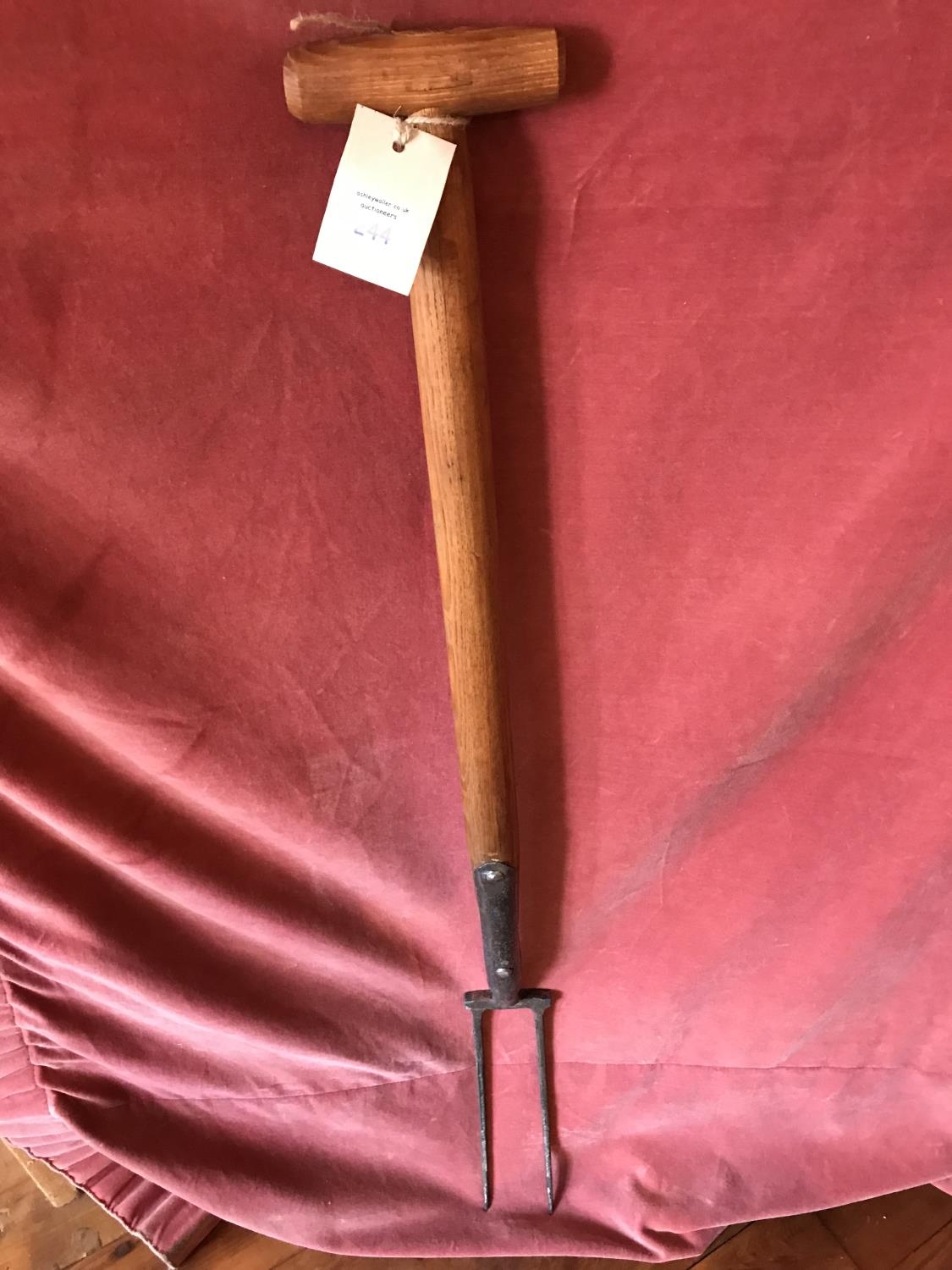
As anyone who has ever weeded a garden will know that docks are difficult buggers to remove, and yet are brittle, breaking and leaving root fragments that will flourish into full bushes of weeds in weeks. A problem to which the answer is a dock fork, that allows you to lift the whole plant without breaking it. Obviously.

The important bit for our purposes here are those items listed that are used in cheese making, and specifically the cheese press. As you have seen, it’s not a small item, nor is it something that everyone would own – it’s a specialist implement used on much more than a domestic scale. It, and the other cheesemaking equipment mentioned in the inventory, indicate the relatively large-scale making of cheese to be sold, and perhaps supplying everyone in the local area. As perhaps only a single farm in each area would have one, I would suggest that the one mentioned in John Cowper’s will is the one I discovered a while back, and which is now filling a hole in the track. I realise that it is impossible to prove, after all the stone has no provenance, nor do we have an address for John Cowper other than Whitfield. But Whitfield as a settlement was concentrated along Cliffe Road and Hague Street – the old road from Hayfield to (Old) Glossop, and largely around The Beehive (it arguably still is) – then it is likely that Cooper lived in this area too, and thus his cheese press has not moved far. Anyway, I’m convinced. The big question is… are you?

Whit
Whitfield – the medieval and post-medieval heart of the settlement along the main road from Hayfield to (Old) Glossop. For orientation, The Beehive is marked by the large orange arrow. The oldest building in Whitfield, Hob Hill Farm – which has a datestone of 1638 and associated 18th century buildings – is marked by the green arrow.

However, although we might not be able to pinpoint his house, we do have a way of working out the type of house Cowper lived in. Essentially, the people who were assessing the worldly goods of the testator went from room to room, recording what was in each, and thus the inventory provides us with a sort of snapshot that allows layout to be reconstructed. So, on the ground floor we have the Kitchen/Living Room. This was where the main fire was, and all the cooking and eating equipment was, including “One Warming Pan, a skellet, a brass pan, a brass pott, & saucepan” and “8 Pewter Dishes, one Tankard, 1 Cup, 4 porringers, Spoons“.

Porr
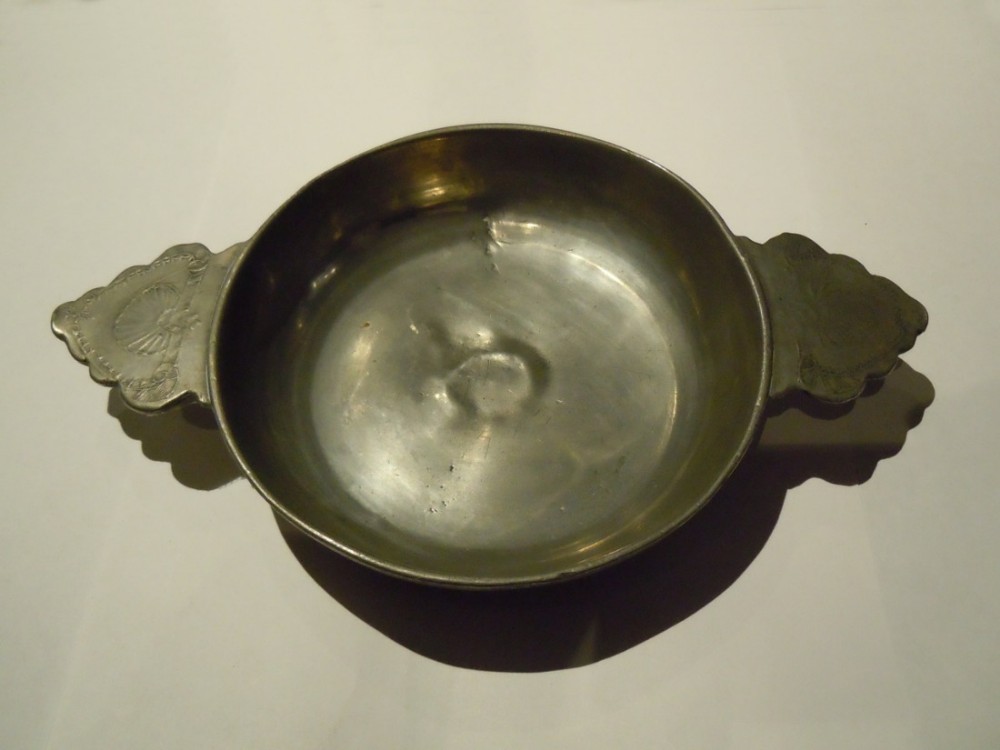
A 17th century pewter porringer – a bowl with a handle used for stews. They were incredibly popular in pottery as well as pewter until the 19th century, when meals became less ‘wet’ and plates became more popular.

This was a large long room – it contained “A cupboard & table“, as well as “Two coach chairs, 12 chairs” (which may be a mistake, as that seems a lot) – and had the fire at one end, and the door somewhere, possible in the middle of the long wall. There also seems to have been a pantry – probably just a built in cupboard – which contained “Books & Linnen, Meal, Cheese, & Bacon“.  Next to this is what is termed the ‘Parlour‘ in which there is a “One Bedsted & Bedding & a little Cupboard“. Moving up the stairs to the first floor, we have the Master Bedroom, termed here the ‘Long Parlour‘, and which was presumably over the Kitchen/Living Room, and containing “bedsted & bedding” and a “press“. Next door is the ‘Parlour Chamber‘, literally the bed chamber over the Parlour, which contained “a long table & one little oval table“. The next floor up, the attic room, was over the whole upper floor and is named the “Chamber Over House“. It containing “One bed & bedding” and “One meal ark, one Chest, one little chest, one Desk, one Box“. The ‘meal ark’ mentioned here, and the ‘meal’ in the Kitchen is oatmeal, used for bread or making oakcakes, and traditionally kept in a wooden box.

Meal
A 17th Century meal ark.

So then, five rooms in total, centred around the hearth and kitchen, and with three bedrooms. This layout is a classic of its kind – very simple, very basic, but very functional. And I have to say, quite cosy. There may have been outbuildings, perhaps containing the cheese making equipment, and certainly a ‘Porch‘ is mentioned, containing “One little Ark, 2 Iron potts, a Glass case, two fall tables” and “a kneading trough” for making bread.

Kne
A kneading trough, in which dough was kneaded and left to prove.

This type of house is described as a “Two Unit” type – essentially one large room divided into two rooms, one large and one small. The Handbook of Vernacular Architecture by R. W. Brunskill has a dozen different configurations of this type of building, and Cowper’s house could fit any one of them. Vernacular architecture refers to buildings on a domestic scale that use local building traditions, and local materials, rather than ‘fashionable’ architectural designs such as the grand halls and houses of the wealthy.

Will
The basic Two-Unit house plan. Cowper’s house was probably along the lines of ‘h’, although any could fit to be honest.

It’s just a pity that we can’t identify the actual house.

So there we are, cheese presses and wills… hope you enjoyed it. As always comments are very welcome, and I would be glad to hear from you. Please look after yourselves and each other, and until the next time, I remain

Your humble servant,

RH

Folk Tales · Oddities · Waterways of Glossop

Nat Nutter: Glossop’s Very Own Witch

Greetings all.

An interesting title, and a tantalising tale, today. I was originally going to post today’s topic at the end of the Lean Town posts (here and here), but after they became too large I thought I’d do it as a separate post.

Reading through Hamnett the other day, I came across this:

“The Gnat Hole Wood is very pleasant in the Summer time when there are no gnats about. The small stream of water that runs through the wood at one place forms a small pool; this was known as Old Nat Nutter’s Porridge Kettle. She had the reputation of being a witch and fortune teller and used this pool for unholy practices and incantations. She was a bogey to children.”

Interesting… I do love a good folk story, and one with tantalising clues, too.

So off I buggered (in those happy-go-lucky pre-covid times, when one could just bugger off into the woods) to look for the Porridge Kettle, and any signs of Nat Nutter.

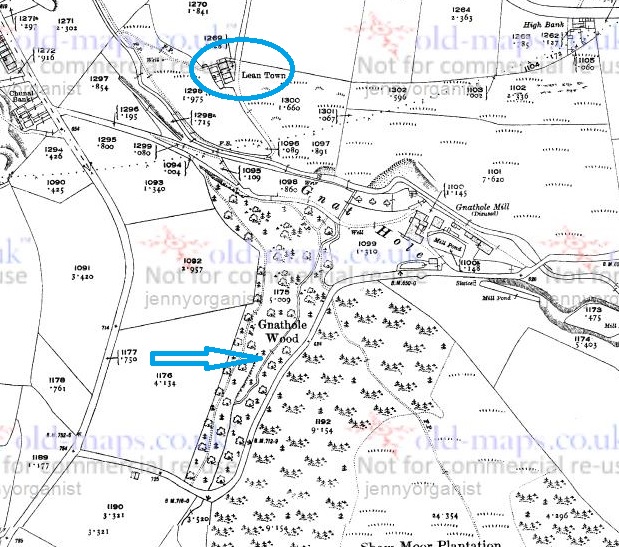
The stream referred to is, presumably, the one pointed to by the large blue arrow in the map below, as it is the only one to run through Gnat Hole Wood (or Gnat Hole Plantation, as the earlier maps name it).

Nat Map
The map of the area. For reference, Lean Town is circled in blue.

As far as I can tell, it is unnamed. I’m sure it had a name at some stage in its history, as watercourses are one of those landscape features that no matter how small – and this one is less than a mile long – are given a name, even if only a local one. However, we must remember that the surveyors who actually drew the maps, whilst superhuman, were not invincible – they might have had an off day, or it might have been raining and they didn’t fancy getting wet, or there was no one around to ask the name of that particular stream, or… you get the idea. Moreover, the fact that Hamnett himself didn’t know the name, particularly given his uncanny ability to “know things”, seems to indicate that the name was lost by 1910 (when the article was written), and probably a good deal earlier. The brook itself begins on, and is formed largely from the water run off from, Shaw Moor (perhaps we should call it Shaw Moor Brook) and it joins Bray Clough Brook between Gnat Hole Mill and Lean Town.

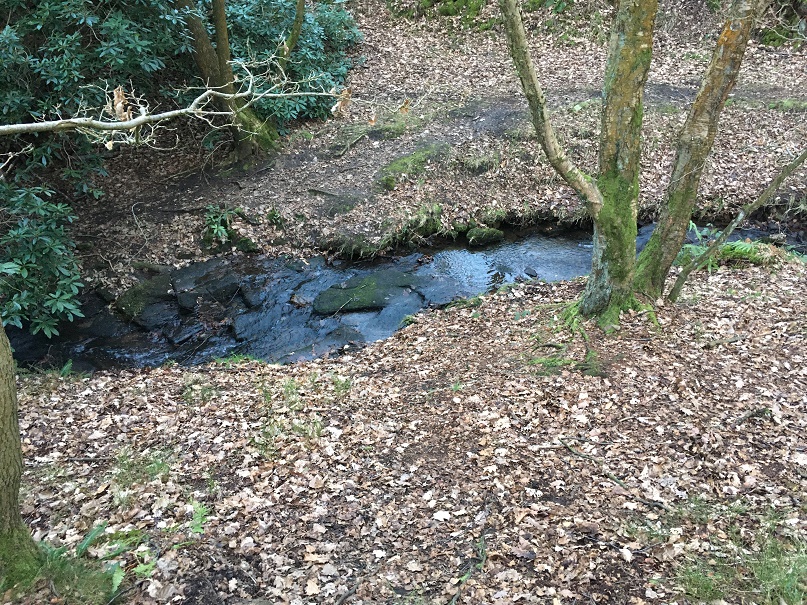
I travelled through the woods here, looking for a “pool”, or something that might match the description:

Nat 3
This is the upper part, with Bray Clough Brook below.

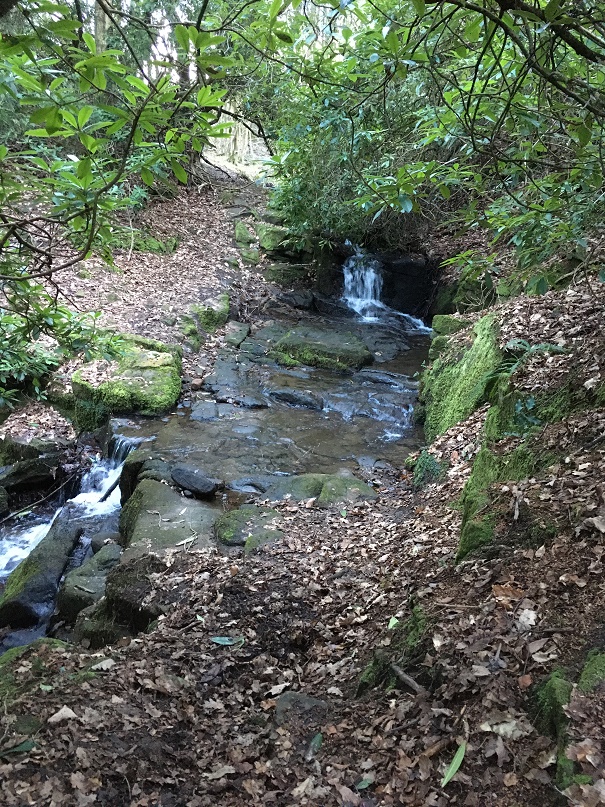
Nat 2
Here it drops into a series of waterfalls, in a steep secluded glade. Atmospheric to be sure, and perhaps a perfect place for witchcraft.

Nat 1
Lower down, and more open, but still steep sided

Alas, I found nothing that would definitely be called a pool as such, nor anything that could be connected to Nat Nutter. The area must have changed a huge amount since 1910, and even more so since the ‘witch’ was supposedly living there (early 19th century, perhaps earlier?), so it’s not surprising. Disappointing, but there you go.

So who was this Nat Nutter? Well, the description of her as “a witch and fortune teller” suggests that she was what is known as a ‘wise woman’ or ‘cunning woman‘ – a sort of combination of healer, folk magician, and someone who divines for fortune or lost objects. A particularly important function they performed was the production of spells and magically protective charms, as well as being a first port of call for medical matters, especially those involving pregnancy and abortion. They were common from the medieval period until the early part of the 20th century.

Whoever she was in reality, she was still remembered by 1910. Her name, though. Well, her name is suspicious, and is perhaps a construction – Nat Nutter, living in Gnat Hole Wood? Hmmmm. Also, the Nutter part recalls Alice Nutter, the Pendle Witch executed in 1612. It all seems a little too good to be true! But perhaps this was deliberate, the name adding to the mysterious otherness of the scary woman who lived in the woods by a stream that she used as a witch’s cauldron.

Nat 4
The old ways are not too dead – this tree is overlooking the brook.

Marvellous stuff.

Please feel free to comment, even if just to tell me that you are related to Nat Nutter, and that I have libelled her.

Stay safe, and look after yourselves and each other. More to follow soon(ish).

Until then I remain, your humble servant,

RH

Folk Tales · Postcards

Haunted House Update

Happy New Year, dear and gentle readers. The first post of a new decade is just a quick one to fill in the gap whilst I finish a much longer post on the subject of Lean Town… all will be revealed soon.

So, a few months back I blogged about some postcards I bought on Ebay, and one in particular really caught my attention. The blog post is here, if you want to refresh your memories, and this is the postcard that piqued my interest, and made me buy them from a chap in America:

Post11
Top oth’ Nab, Glossop, October 21st 1907.

I love a good ghost story – one of my absolute pleasures is reading MR James stories by the fire – so the writing on the card that read “this is the haunted house” sealed the deal of me buying the cards. In the original post I though that the hunted house might be Herod Farm.

Roll on New Year’s Day 2020, and slightly bleary eyed and thick-headedly (courtesy of the Goosefields – thanks again!), Clans Hamnett and Bowes ascended Whitley Nab from The Hare and Hounds. It blew the cobwebs away (and if I’m honest, knackered me out – new year’s resolution is to get fitter), but we made it – and this is the site that greeted me.

Haunted
Top oth’ Nab, Glossop, January 1st 2020.

It looked familiar. And then it hit me… the ridgeline of Coombes Edge, and the skyline… this was the haunted house photograph. The haunted house was, in fact, Herod Edge Farm, just off Monk’s Road – visible, just, in the trees, middle ground. Here’s a map.

Haunted 2
Herod Edge Farm is circled in red, my photograph was taken from the area of the green arrow, the original photograph was taken from the blue arrow, or thereabouts.

Compare the two photographs, and although it’s taken from a slightly different angle, there are so many features in common that I can say with certainty that this is the place. Herod Edge Farm is haunted… apparently. I wonder if they know? And more importantly, does anyone know the story of the haunting? I wonder if it is tied up with alleged ghostly Roman soldiers in the area? Someone must know – as I say, I love a good ghost story.

I should add that, since that post, a whole pile of information has been uncovered, largely by the ever helpful Charles Wynford Lodge (who is on twitter as @2hrTV, check him out). I will do a full re-write including all his information, as well as corrections and addenda on other previous posts, too. See, I do listen… honest!

In the meantime, I’m off to drink some of the stuff that nourishes and try and finish some other exciting work (oddly, involving a parrot and the High Medieval period… no, it’s not a set up for a joke). Oh, and the Lean Town post will be up and running very soon (it’s a two-parter!).

Until then, I remain.

Your humble servant,

RH

Archaeology · Folk Tales · Oddities

Gallowsclough

There’s no mistaking some etymologies.

Placenames in the past were given because of what was there, not aspirational or deliberately flowery. They were practical. Descriptive. Truthful. There was no Laurel View if there was no view of laurels. Gnat Hole was not named ironically. And Shittern Clough was… well, you get the picture.

For me, Gallowsclough has always stood out in the map of the area – the clough, or narrow valley, where the gallows were. There is something of the macabre about the name, and I was also aware of a folktale from the area which really made an impression on me (more of that in a bit). So I decided to do some exploring, to see if I could add to the placename, and see if I could work out where the gallows were… as Mrs Hamnett put it “lucky me, you take me to the loveliest places”.

I’ve blogged about this area before (White Stone of Roe Cross), but the area is effectively the Deep Cutting between Mottram and Stalybridge. Gallowsclough is highlighted (the clough itself, or small deep valley, running towards the Dog and Partridge).

Gallows 1b
Gallowsclough and area. This from the 1898 1:2500 OS map (via the awesome oldmaps.co.uk). The main road to Stalybridge from Mottram runs diagonally through the map, with the deep cutting starting at the Wagon and horses.

So then, the gallows.

The last person to be hanged in public was in 1868, after which time, and until capital punishment was abolished in 1965, executions took place within the prison, away from the public eye. But before 1868 it was a public spectacle, to the point that the hangings at Tyburn were turned into a public holiday. Often associated with the public hangings of the 17th and 18th centuries was the punishment of gibbeting, in which the hanged criminal was enclosed in a tight fitting cage or chains, and effectively left to rot. The body was  covered in tar in order to protect it against the elements, and hung there as a warning to others until it finally fell to pieces.

Each area, feudal estate, or manor had a gallows/gibbet, and certainly until the later Tudor period or even the early modern period, capital punishment was the responsibility of the lord or equivalent. It seems that the victims were buried underneath, or nearby, the gallows, but certainly not on consecrated ground. To be executed was to be condemned to eternal restlessness, to never know peace, and to wander the Earth an unhappy spirit.

In order to achieve maximum visual impact, the gallows were normally set up at prominent places – central open spaces, or more normally, crossroads. And so it was here, in Roe Cross. The body swinging, both at execution, and in a gibbet, could be seen  easily by both locals, and by travellers moving along the various roads – a physical reminder to obey the laws, or suffer the consequence. Interestingly, this tradition of both execution and burial at a crossroads has given rise to the concept that a crossroads is an odd, supernatural, place. If you want to sell your soul to the devil, where do you do it? Where do you bury witches? Or suicides? Or criminals? At the crossroads, that’s where.

So where were the gallows at Gallowsclough? It is very doubtful that they would have placed them further up the clough – difficult to get to, in arable land, and there are no crossroads. No, I think they erected the gallows at the point Gallowsclough – the clough, or deep valley, upon which the gallows are placed – crosses the road. At almost exactly the point seven – count them – seven tracks join. This is no crossroads… this is a crossroads and a half. Here is a map showing the tracks (numbered).

Gallows 1
The seven tracks shown on the map existed before both the turnpike road and the ‘Deep Cutting’ were made. Walking them, you can see why the turnpike was created. It is still perfectly possible to travel to and from places on these tracks, but perhaps don’t if you don’t have a 4×4.

This is the area close up – you can see the tracks meeting.

Gallows 1 - closeup
Right by the Wagon and Horses… enjoy your pint!

Crossroad Blues
This is the site. You can see the roads meeting, and here at the bottom of Gallowsclough Road, you can see the setts of the original track, laid to give horses some traction at the start of the hill.

The roads are as follows (the numbers are faint in blue in the map above):

  1. Gallowsclough Road – From Saddleworth, via Millbrook (avoiding Stalybridge). This is the Roman Road between Castleshaw Roman fort and Melandra (thanks Paul B.)
  2. From… well, the middle of nowhere – local traffic from farms
  3. From Hollingworth.
  4. From Mottram via the old road.
  5. From Hattersley, via Harrop Edge.
  6. From Newton.
  7. From Stalybridge, via the old road.

A perfect situation for an execution and gibbet. It was said that it was to these gallows that Ralph de Ashton (1421 – 1486) sent the unfortunate tenant farmers who couldn’t pay the fines for allowing Corn Marigold to grow amongst their crops. The death of the hated Ralph is the origin of the Riding the Black Lad custom and the Black Knight Pageant in Ashton Under Lyne, a tradition sadly no longer undertaken. Naturally, the area is said to be haunted, with the locals avoiding the place, even in daytime. Although, as is so often the case, there are no references, only suggestions.

This is the clough

GH
The brook flows under Gallowsclough Farm.

hg
Gallowsclough in the background, behind Gallows Clough Farm. The electricity pylons completely ruin the area, unfortunately.

Of course, whilst I was stomping around, I happened upon a bunch of mole hills…

RC1

Evidence of nightsoiling (as I’m sure you all know, having read previous posts about this). The top row right: a medium bone china plate (c.18cm in diameter), hand painted flowers and abstract floral designs in pastel colours. This is quite nice, and is probably early Victorian in date. Middle is a plain white glazed plate, thin, and again about 18cm in base diameter (you can see the ring of the base in the photo), which makes it perhaps 24cm or more in ‘real’ diameter. Left is more difficult – it has an undulating rim, with a curled decorative motif – which means that I can’t tell you how big it is. Over 25cm in diameter, I suspect. It is a shallow dish, or deep plate, and is deocrated with abstract floral designs. Date wise? Late Victorian? Looks more modern than that, though… Edwardian? The bottom four are fairly boring body sherds, though the sherd on the left is a blurred willow pattern, so potentially quite early?

RC2
Contents of a Molehill, pt. II

The ubiquitous lump of coal/coke to the right, and the ubiquitous clay pipe to the left. The lower of the pipes is nice as it still has the spur that juts out and forms the base of the bowl, which you can see just emerging. It’s probably early to mid-Victorian in date. -Check out this wonderful website for more information.

pipe
The spurred type of pipe is middle right.

And finally, to end on, this lovely thing.

RC3
Ding dong, the Mesolithic calling.

A flake of quartzite that has been struck in prehistory, during the course of making a tool. Flint doesn’t occur naturally in this area, so all sorts of stones were used in the making of stone tools in prehistory. Quartz, though a poor cousin of flint, still keeps enough of an edge to be useful, and this piece carries all of the hallmarks of a bit chipped off a larger tool or weapon – the striking platform (top), and the bulb of percussion (facing, half way down). I suspect that this is Mesolithic in date, so c.6000 – 4000 bc, or thereabouts. I’ll post some more flint/chert/quartzite when I get a chance, as it’s fascinating stuff, and the area is not exactly lacking in it.

*

Interestingly, there is a brewery marked on the map (top left, numbered 8). This is the Matley Spring Brewery, which brewed beer here, using the local spring for water, and presumably selling it in the Dog and Partridge, at the end of the wonderfuly named Blundering Lane. I was going to write a little about it, but came across this site with some information and photographs. Actually, the whole blog is a good read, filled with fascinating titbits relating to the area, so go forth and explore.

*

And finally, as promised, I’ll end with the folk story of Gallowsclough. This is taken from Thomas Middleton’s Legends of Longdendale (the book is a mine of local legends and folktales, as well as some good photographs, and is well worth seeking out – or reading in the pdf format at the link below)

Follow this link for The Legend of Gallow’s Clough.

It’s very Victorian in its telling, but the story is as black and evil as any I have read; there is something about it that disturbs and lingers in the mind – the imagery, and particularly the witch walking away at the end. No, I like a good dark folktale, but this is just on the border of being a little too dark for my tastes. Enjoy at night, and you have been warned…

So there you go. There’s plenty more in the pipeline, so watch this space. As always, comments are very welcome, and all will be published.

And I remain, your humble servant,

RH