Archaeology

Home On The Range

What ho, wonderful blog reading folk! I trust the Autumn is going well for you all? And hopefully, now that restrictions have eased, we will be able to do a bit more.

A fascinating one this time – well I think so. There’s a place, if you know where to look… Oh, go on then, I’ll tell you.

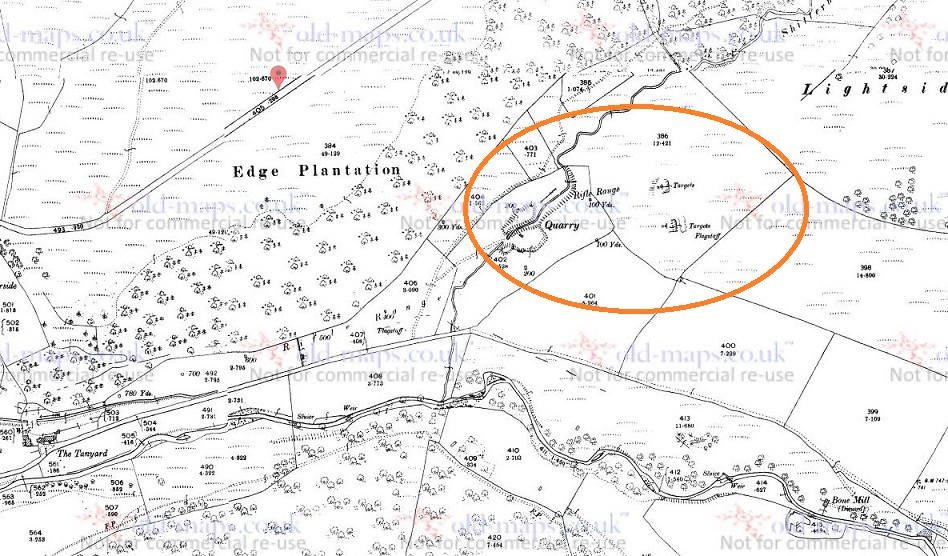
At Mossy Lea, to the north west of Shire Hill, there is a Victorian rifle range marked on the map. “Hmm” thought I, “I wonder what is there?” It turns out that it is a thoroughly interesting place, chock full of history. Here it is on the map:

Circled in orange. I meant the circle to be red, but for some reason I clicked the wrong button and couldn’t be fussed re-doing it. I don’t know why I shared that, it’s not like it’s important. To be honest, I’m not sure anyone reads these bits anyway.

But why was it there? Well, following the Crimean War (1853-56), and amid rumblings in Europe, particularly between France and Austria, it became clear Britain needed a larger, more efficient, armed force. In 1859 the decision was taken to boost home defence and operational forces with the creation of the volunteer rifle corps. The forerunner to our Territorial Army, these ‘part-time’ soldiers could be called upon to fight should the need arise.

It was desired that Glossop should have its own corps, and so in this way, on June 14th 1875, 23rd Derbyshire Rifle Volunteers was formed, with the first inspection of the corps taking place July 29th, 1876, at Stockport. They were drilled frequently, just like the regular army, with a parade ground off Shepley Street in Old Glossop, and a drill hall in the market hall – the entrance nearest to the post office.

Here is the Corps pictured in 1914 outside the Drill Hall. Image stolen shamelessly from the Glossop Heritage Page which gives a fantastic history of the Glossop Corps – read it here. Incidentally, the chap bottom row 3rd from left with the flat cap on – I am certain I’ve seen him drinking in the Beehive.

And of course they trained frequently on the rifle range. The original rifle range was at Chunal – probably around what was once The Grouse pub (now a private house). Hamnett notes that it was “most inconvenient” as the men had to shoot over the highway when shooting at long range, which was causing delays. Yes, you read that correctly… now let it sink in a moment.

Shooting. Actual bullets. Over a public road.

So “for the safety of the public it was removed to Mossy Lea“. You don’t say. Shooting here commenced on 6th June 1877, and it is then that we join it. The original line of the range was shooting at targets against Shire Hill, as seen in this 1880 map:

The range as it appeared in 1880. Targets (arrowed in orange) against Shire Hill, with the shooting platforms progressing up the hill in 50 yard increments up to 1000 yards – well over half a mile. A shorter range, up to 300 yards is south east of the first. Marked in green are the flagstaffs that would show a red flag warning that live firing was taking place.

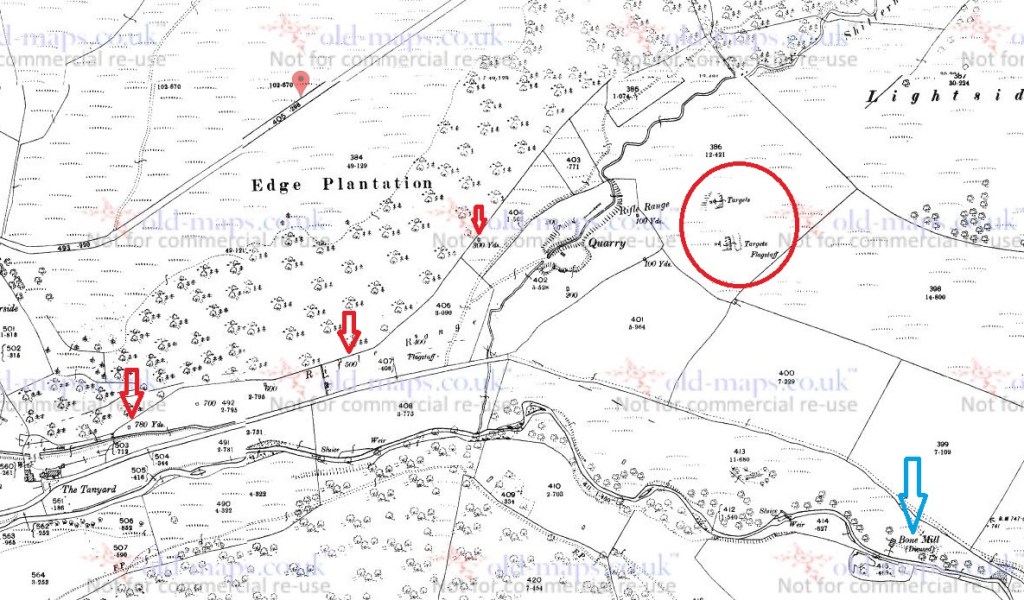
By the time the 1898 map was drawn, the targets had moved to Lightside, with shooting platforms along Shepley Street, here:

The range in 1898. Two targets on the hill, circled in red. The northern is the short range, again up to 300 yards, whilst the southern target is the long range, starting at 780 yards.

However, whichever direction you shot, it seemed to have been hard work, as Hamnett notes “It is a most difficult range… owing to the various strengths of the winds we get all blowing at the same time”. Anyone who has walked along Shepley Street and Doctor’s Gate will know what he is talking about.

So me being me, I decided to have a look around to see what, if anything could be seen on the ground. As it happens, it turns out quite a lot.

Quite an arty shot. The targets are clear against the skyline when viewed from below.
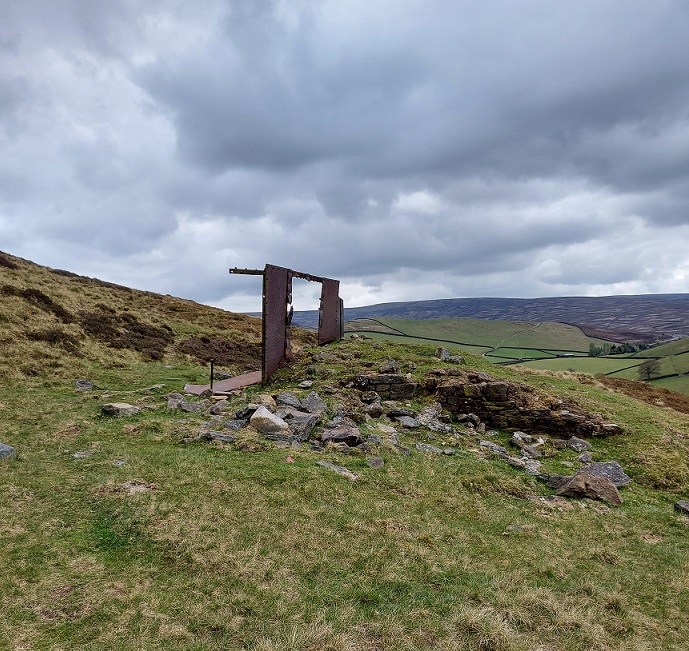
Closer up you can see the metal targets sitting on top of man made platforms – the shooting butts – held by drystone walling. Another arty shot.

Both targets are visible on the ground, and are essentially huge pieces of metal sitting on top of platform. Closer inspection shows it is very interesting.

Close up of the target face showing dents caused by rifle fire.
From behind the target, looking through the dents that have rusted through in the last 150 years of harsh Lightside weather.

Walking around the back of the target, I noticed some writing… ooooh, says I.

The rear of the targets

Now, with the eye of faith and if you squint after a snifter or three, I can just make out the following words:

“WOODS’ UNIVERSAL – unclear – TARGET. WOODS COCKSEDGE & CO. STOWMARKET. 1876”

Honestly, it does. Have another glass, and look again.

Nice! And it even gives a date, which is unusual in archaeology to say the least. There is a little bit about Woods, Cocksedge & Company here (and no sniggering… honestly! Don’t think I can’t hear you. I’ll have you know this is a serious blog), with more dotted about the internet. They seem to have been a standard iron foundry, founded in 1812 in Stowmarket, Suffolk, and which continues in one form or another until the early 20th century, perhaps even beyond. Research on the internet produced this advert, stolen as always, shamelessly, from this website.

A great advert, and one that gives us all sorts of additional information, including how to stand in a relaxed manner whilst being shot at by your own men.

The targets in the picture are clearly the same as the ones on the hillside – they have the same attachments, and you can see how they were fitted and braced when in use.

The advert is full of additional details – such as the fact that these were made from hematite iron (rather than wrought iron) (is the missing word on the target “hematite”?), and that Woods, Cocksedge & co. were supplying the government with their targets. I note also that they were supplying “nearly every foreign power”. I’m sure it was comforting for our soldiers to know that, as the bullets pinged around them, the reason that the foreign soldiers trying to kill them were so accurate in their shooting is that they were trained on the same targets as them.

It also states that the targets are “indestructible”, and they seemingly pretty much are – 150 years later, and I’m certain they would withstand modern rifle shot. Probably.

There were also some small finds – unsurprisingly, a number of bullets.

Left to right: Martini-Henry, Lee-Metford, Lee-Metford copper jacket, Lee Enfield.

What is interesting, though, is that these plot the history of British Army issued rifles from 1877 onwards. The militia were originally issued Snider-Enfield rifles, but these were used only on the original Chunal range, so we have no bullets from these. We know that in 1877, they were using the Martini-Henry rifles, and our earliest evidence is, then, on the left, the large lead slug of a Martini-Henry rifle – you’d know about it if one of those hit you. These bullets are interesting from a design point of view – they have a slightly hollow base that expands with the explosion of gunpowder behind it, connects with the grooves inside the rifle which, combined with its solid weight, makes it more accurate and very powerful.

Next, the Lee-Metford copper jacketed .303 round, which the company were issued on 18th September 1897, and which was responsible for these targets being installed. As Hamnett puts it “the greater velocity of the bullet of the new rifle made the old iron targets unsafe”, and they were replaced by the Woods’ Universal Hematite targets. So we have a date for their installation – sometime after September 1897, and I assume at this point the targets were moved from against Shire Hill to where we find them today.  Next to the bullet is the copper jacketing which is formed around the lead bullet – you can see how it has peeled away, and imagine the effect that the peeling and tiny razor sharp fragments would have if you were shot. It’s sometimes easy to forget that these small interesting lumps of metal were designed and made with just one purpose in mind – to create a large hole inside another human being.

Next to that is a standard early 20th century Lee-Enfield .303 round, and probably owes its occurrence at the range due to live-fire exercises carried out hereabouts in 1943 by a unit of commandoes. Neville Sharpe in Glossop Remembered (p.154) recalls the commandoes showing the local boys how to extract the cordite explosive inside cartridges to make fireworks… with predictable results. I also like the continuation of use, as though the land once used in a particular way somehow lends itself to that particular activity. The area is now home to the Old Glossop Clay Shooting Ground, and the hills once more ring with the sound of gunfire. They claim that the area was in use for shooting from the Second World War onwards, but we now know differently.

The path up to the targets also produced a few pieces of pottery:

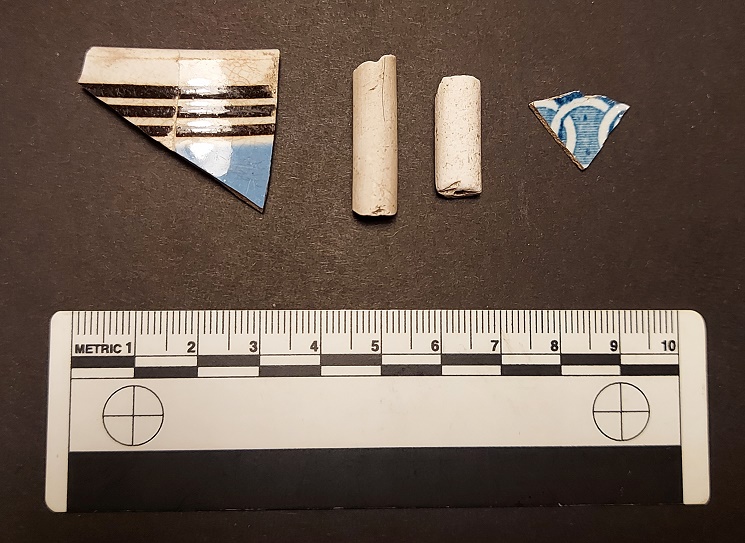
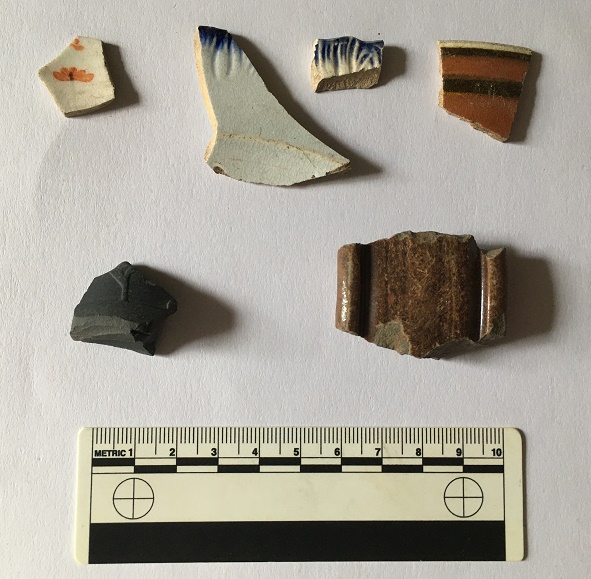
Some fairly worn sherds. I’m also trying out a black background to these photographs – what do you think?

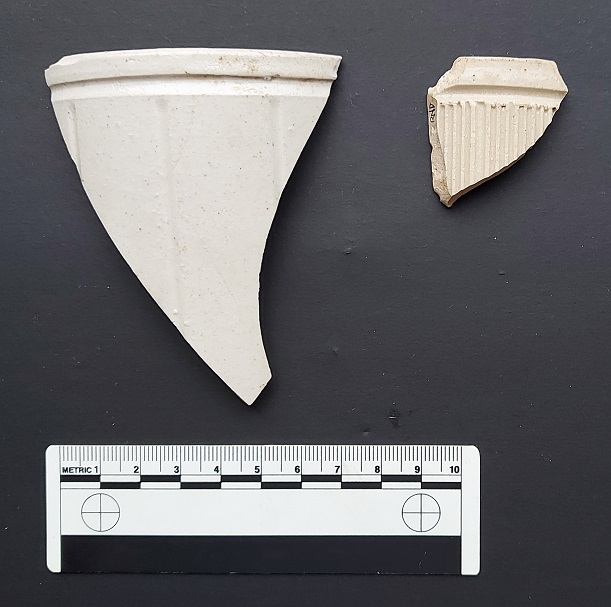
From the left, then: An Annular or Banded Ware rim sherd of a smallish jug (the diameter is 8cm, but curves inwardly slightly). Date wise, it’s probably late 19th century, so about the right date; I love this stuff. Two pipe stems, also of a similar date (I like to imagine them being smoked by bored soldiers wending their way up to the targets). And finally, a sherd of Transfer Printed pottery, which could date from anytime after 1840, but is probably the same date as everything else.

Hope you have enjoyed this jaunt down the military history of Glossop – the story of the militia is told in Hamnett’s History of Glossop, a copy of which is in the library, and it highly recommended. The range itself is on public access land, and right by a footpath, so go ahead and have a look (it’s a great place to fly a kite). But please don’t go digging around there – not only is lead highly toxic, without the landowner’s permission it is illegal. Plus, all you’ll find is lumps of twisted metal. The finds I made were lying on the surface.

My thanks for the company of Andy T on this particular jaunt – he’s a good bloke, mostly, and can be found on Twitter @Thorny61.

Please feel free to email me with comments and questions, even to point out that I am wrong about something. Until next time then, look after yourselves and each other.

Until then, I remain.

Your humble servant.

RH.

Archaeology · Longdendale · Pottery

Valehouse Pot

What ho, kind and gentle folk of the blog reading world!

Sooooo, today is back to some sense of normality in that I am looking at pottery.
Woo-hoo!” I hear you cry.
Well alright, some of you cried “woo-hoo!“.
Well alright, not that many of you if I’m honest. Certainly not enough of you.
Well tough… it’s my blog, and I like pottery, so we’re doing pottery. Now pay attention, I may ask questions.

Actually, this stuff is interesting in two ways. Firstly, as bits of archaeology. And secondly, I didn’t find them! No, that dubious honour rests with my friend and fellow delver and obsessive, Charles Winford Lodge (actually not his real name, but then you are reading a blog written by a man who has been dead for well over 100 years, so it’s probably best not to start asking too many questions at this point). He goes by @2hrTV on Twitter, and usually has something interesting to say on the subject of the history of Glossop and area. Usually… I mean, I can’t promise.

Anyway, the conversation – pretty normal for us – went along the lines of:
Him – “Years ago I found some pottery at Valehouse Reservoir. I’ve just re-found it in the house… want to see it?
Me – “Absolutely, my good man… lead on.”

Out it comes (in a plastic doughnut box from Tesco – price £1.10 – bear in mind this is the man who once gave me some pottery in a camembert box, so doughnuts are a step up). Most of them are fairly standard Victorian sherds, but one or two made me sit up. Now, the sherds had not been washed (tut! tut!), and so I volunteered to take them, clean them, and blog about them. Which is how I ended up washing up someone else’s broken old rubbish. Please, no one tell Mrs Hamnett… it might not end well. For any of us.
However, I think the risk was worth it.

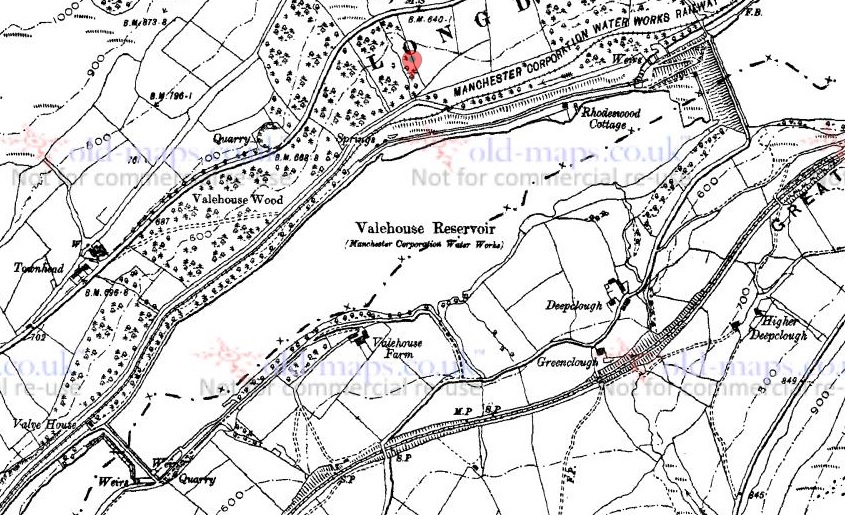
Valehouse is an interesting place; now just the name of a reservoir in the Longdendale Valley, below the Woodhead Road, it was once a village that in its prime, and prior to its flooding, had roughly 600 residents in 100 cottages with a number of shops, a school, and other amenities. Samuel Oldknow built the first mill here in 1775 – the first to harness the power of the Etherow – and it is after this point, and largely in the early 19th century, when the mills were substantially expanded, that the majority of houses were built to house the mill workers. The valley was flooded in 1869 to provide Manchester with water, and the mills and houses were all submerged. I also have a personal connection with the village in that my great great great grandfather, Benjamin Livesey, was born there in 1824.

Valehouse prior to the 1869 flooding. Note the large mill buildings, and the many houses.
Valehouse as it was in 1899, and indeed still. Note the large quantity of water and lack of houses.

So then, the pottery. It was recovered during a drought a few years ago, and from the area around the viewing platform on the north side of the reservoir. Having studied the sherds, it’s clear they can be split into two broad chronological groups – early 18th century and late 19th century – which probably represent two different origins. I’ll discuss the latest first, before looking at the oldest, and arguably more interesting.

Not, at first glance, particularly inspiring.

1 – A Victorian earthenware jar or jug, vertical ridged decoration, with a body diameter of 9cm, and glazed in a lovely cobalt blue colour. Nothing special, but quite fancy.

2 – Simple sherd of blue and white earthenware, with the bog standard transfer print.

3 – Thick base to a Late Victorian Codd Bottle. It has ‘TON-U-LYNE’ embossed on one side, and a little research gives us ‘R.A. Barrett & Co.’ of Ashton-Under-Lyne. They manufactured soft drinks and mineral water, and were particularly noted for their ginger beer. Their factory still stands in Dean Street, Ashton.

A complete Barrett & Co. Codd bottle, and the factory as it stands today. The bottle fragment above would have been made in this factory.

4 – Fragment of bottle, probably Victorian mineral water or beer.

5 – Another fragment of green glass – probably Victorian, as it is quite thin walled, but it does contain large numbers of bubbles, suggesting perhaps an earlier date.

6 – A large, thick walled, earthenware sherd, perhaps part of a lid to a very large “Brown Betty” teapot – it is certainly the right colour for this, and curves the right way. The surface colour is a mottled brown, and is a type that deliberately recalls the earlier, 18th century, manganese ware. Interestingly, you can see how this effect is achieved by looking at the break. Two colours of clay – one dark reddish brown and one a creamy buff – are loosely mixed, and the clay is shaped into the mould. It is first fired, then a clear or slightly yellow glaze applied, followed by a second higher temperature firing. Where the cream buff forms the surface, it is a yellow or golden brown, and where the reddish clay forms the surface, it produces a dark rich brown, together forming the mottled effect. I quite like it, but much prefer the original 17th century stuff.

The appetising looking Victorian mottled ware sherd. You can see how the different coloured clay affects the surface colour

Right, let’s move onto the arguably more interesting stuff.

This material dates from roughly the early 18th century – let’s say 1700 – 1750… ish.

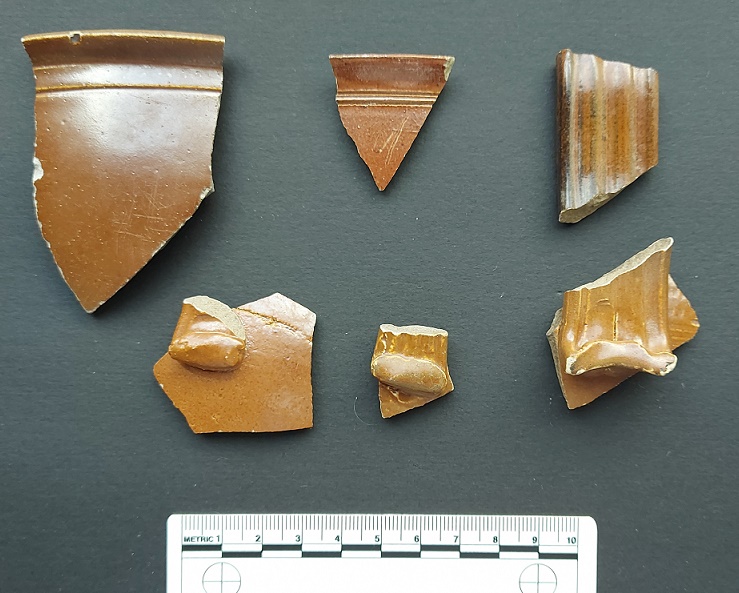
1 – Large and chunky strap handle probably of Nottingham Stoneware, and probably from a large jug or flagon. It measures 4.5cm wide, and is typical of its type. Stoneware is fired to a very high temperature, melting – or vitrifying – the clay, making it into a very hard and almost metallic pottery. It has a dark grey fabric, with a brown glazed surface which is very shiny – the result of adding iron to the glaze. Interestingly, this is not as fine or well made as the earliest material here, and shows some similarities with the later Derbyshire Stoneware, so it might be the somewhere in late 18th century.

2 – Base to a stoneware jug or jar, with a diameter of 10cm. This too has characteristics of both earlier Nottingham Stoneware and the later Derbyshire type – the glaze for example, is less lustrous than early sherds, but it has the classic grooved decoration running around the base. The underside shows wear suggestive of use and re-use over time. On balance, I’m going to say it is early, safe in the knowledge that no one is going to double check (as he scurries away and hides it).

3 – Lovely Nottingham Stoneware bowl, with a rim diameter of 13cm, and a slightly flaring out-turned rim. It’s thin walled, with a grey uniform fabric that was slipped in white before glazing. The surface glaze is a lovely melted chocolate colour, very lustrous and almost metallic looking, and is very characteristic, as is the horizontal grooved decoration on the exterior, and glaze drip marks on the interior. I liked this so much that a drew it using the archaeological method – essentially looking at the whole vessel in profile, and removing a quarter to allow both the interior and exterior to be shown.

The profile of the sherd is shown on the left, coloured in black – this shows the shape of the pot. The interior of the pot is shown next, with the wavy lines where the glaze dripped. Then the exterior of the vessel is shown next to that. I might do a post about this type of drawing, as I’d like to do more. It’s been a while since I did this last, though.

4 – This is a bit of an odd one. Stoneware, but potentially quite early. Certainly it fits with the 18th century stuff, but the surface is off – it looks like orange peel, dimpled all over with a salt glaze, and reminds me of the earlier 18th and even 17th century German stonewares that were imported in huge quantities. Whatever it is, it’s a huge rounded or pot bellied vessel with a diameter of roughly 26cm, despite being very thin walled. It is also a closed vessel, being glazed on the exterior only, so perhaps some form of small barrel or large bottle?

5 – Nottingham Stoneware – flask or bottle type. The body, shoulder, and beginning of the neck only, it has a body diameter of 18cm, so quite large despite being very thin walled. It has a double band of horizontal incised decoration which is showing the under slip where the glaze is thinnest. Like No.3, the glaze is lustrous and a melted chocolate in colour.

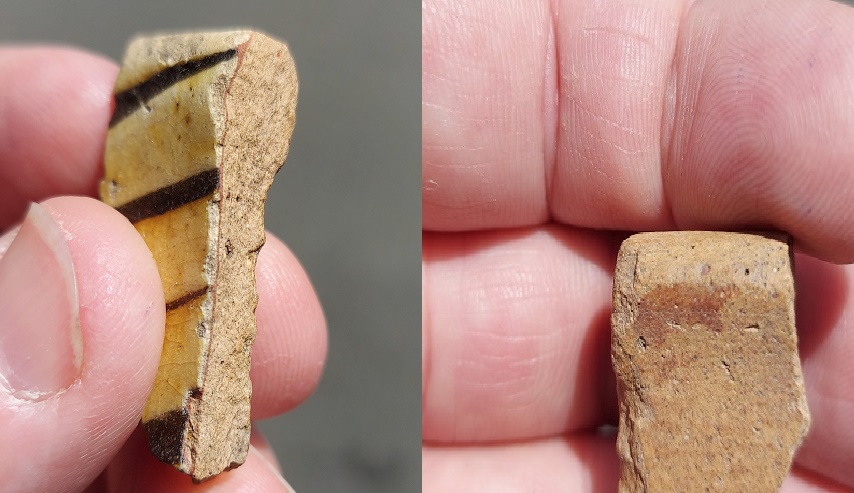
6. Finally, we have the star of the show – a rim fragment of a Staffordshire Slipware platter or large plate. This stuff is very diagnostic, and gives a clear date of between 1650 and 1750, with this sherd from 1700ish.

Interesting stuff!

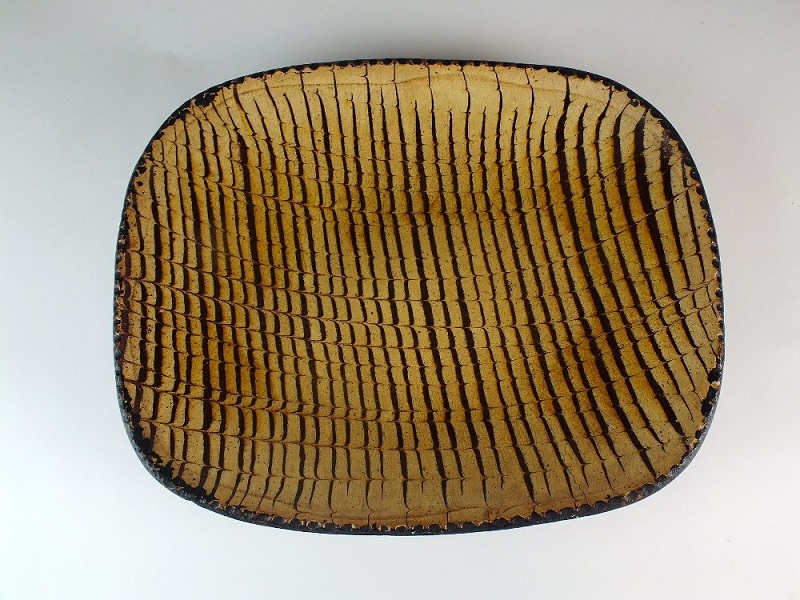
Slipware like this is quite good quality, and a step up from the wood or plain wares that the average man or woman would eat from – or rather take from, as this would be a communal dish that everyone would eat from. Often broadly rectangular (as this is, I think), they are shallow, and would be completely covered in this linear banded decoration of yellow and dark brown. It’s quite striking, and would be a blast of colour in a world that was otherwise quite drab, particularly in winter. I still can’t work out whether I love or hate this stuff! Here is a complete example:

A complete example of migraine inducing 18th century pottery.

The process of decorating the pot went as follows: the pot is first moulded, then fired at a low temperature. The interior, and only the interior, is covered in a red slip, then overlaid with a white slip, and a tool is then dragged through this white slip, revealing the red underneath. The whole interior is then covered in a clear glaze and fired, transforming the colours to dark brown on the red, and honey yellow on the white. The whole process can be seen if we look at the break on the sherd:

Right – some of the red slip splashed on the exterior of the sherd, it remains red because it hasn’t reacted with the glaze. Left – all there elements can be seen in the break: the red and white slips, the tool that scraped away the white slip, and the glaze that overlays the lot.

So what does all this mean, then?

Because the valley was flooded to create Valehouse Reservoir, it gives us a cut off point (a terminus ante quem in archaeological terms – essentially the latest time an event could have happened) – any buildings and such there must have been built before this point. However, that is not strictly true with portable objects, especially those found near the edge of the water – the reservoir was almost immediately a picnic and pleasure spot, and plates get broken, bottles get launched into the water, etc. So we can suggest tentatively that although some of the material will likely be from the village before it was drowned, most of the Victorian material, and in particular the Codd Bottle, was deposited after the reservoir was filled.

The same cannot be said for the earlier material, and therefore there was clearly some form of settlement here prior to the Victorian period, as no one in their right mind is going to carry around 150 year old pottery to throw in a reservoir. Alright, I might… but most people don’t. So this material has to be from an 18th century dump of some form… but from where. Studying a map of Vale House prior to flooding shows clearly the mill complex and all the houses.

I love playing around with Microsoft Paint!

Circled in red is the rough location of where the pottery was found. But here, in the green triangle, is an odd looking group of buildings. Set apart and in its own land, it looks like the standard farming hamlet for this area, made up of the farm building, outbuildings, and farm worker’s cottages. And in Bagshaw’s Directory for Cheshire dated 1850, we read of Joseph Roe, Farmer, Vale House Farm. Even the name ‘Vale House’ suggests a house of some importance. I wonder if, as so often happens, the local big house or manor house became less important over time and ended up as simply Vale House Farm. If so, then this might explain the 17th – 18th century pottery, and given that it’s made up of several different domestic vessels, suggests strongly that this is the midden, or rubbish dump, associated with the farmhouse. All we have to do now is wait for another drought and we can see what else is buried there.

Valehouse Reservoir today. Somewhere in the middle of that photograph, below the water, lies the remains of a 17th century farmhouse.

Hope you enjoyed this weeks romp around with pottery… let me know what you think, anything at all, even to tell me I’m wrong about the stoneware base (I’m not… it’s my site, and therefore I’m always right!). Also, if you have any pottery that you want me to look at… just don’t tell Mrs Hamnett.

Next month, we have a very interesting tale to tell… more of that later. For now, take care of yourselves and others, and until then, I remain.

Your humble servant,

RH

Archaeology · Pottery · Waterways of Glossop

A Bridge Over Troubled Water…

Blimey! January flew by, and so did February. Apologies for the lack of activity on the blog of late, I’ll be back to more regular posting from now on. What ho! Well here we are, once more in lockdown. I know its for the greater good, and you’d be a fool – and indeed a dangerous moron – not to follow the rules… but dash it all, it’s starting to be a bit of a bore! Right, once more with a glass of the stuff that cheers here we go.

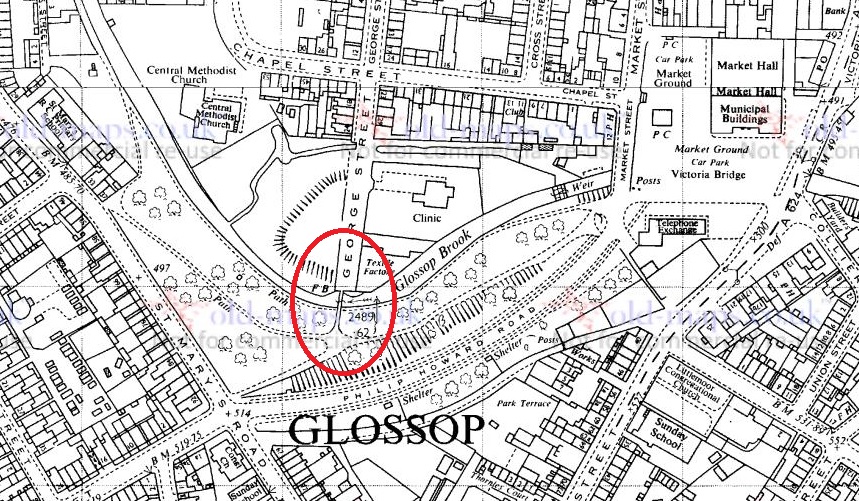
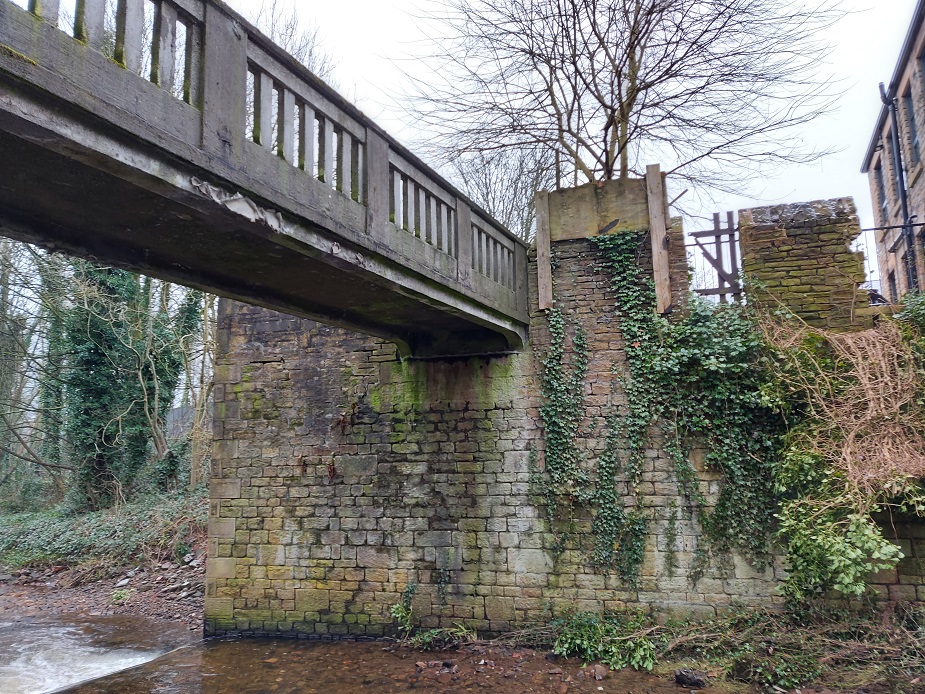
Whilst perusing the local history section of the library – during the heady days when such a thing was possible – I came upon an architectural drawing of the bridge over Glossop Brook at the end of George Street – officially known as ‘Coronation Bridge’. Now, those of you that know the bridge will also know that it isn’t the most lovely bridge in the world – it’s hidden away in the dark damp recesses of Harehills Park, covered in graffiti, and surrounded by the waste ground.

The location of the bridge is circled

But let’s look again, I say, as I think there is a hidden beauty here – a ‘rough diamond’ of sorts, only made of reinforced concrete. First, here is the architectural drawing:

It’s a very Art Deco style drawing, and quite fetching.

And here is the bridge as it is now:

Not the most attractive looking bridge, but I think it has a certain charm.

Comparing the plan with the actual bridge, they really did a good job. It is an understatement to say that I dislike concrete, but this has a certain Art Deco feel about it, and I honestly think it would look pretty good scrubbed up.

It is fairly forlorn, and could really do with a scrub up.
I like to imagine that the historical spirit of a place affects modern perceptions through things like graffiti: the foundry that once stood here would have been an extremely hot work environment – Hell Fire indeed.
Concrete, close up.
I particularly like the pink Mickey Mouse graffiti. What? It must be Mickey Mouse… look at the size of those ears.

The architectural drawing is dated 1928, so we might assume that it was built soon after that to replace the original Coronation Bridge, a railway footbridge that was presented to the town by Lord Howard in 1902 to celebrate the coronation of Edward VII. That bridge, notes the original Robert Hamnett, replaced other bridges that had been washed away numerous times by flooding. Now, far be it for me to question the original Mr Hamnett’s facts, but I can see no trace of these bridges on any of the earlier maps. For example, here is the area in 1880:

1880 1:500 scale. George Street is top centre, and you can see Shepley Mill and the George Street foundry.

Is it possible that he made a mistake?

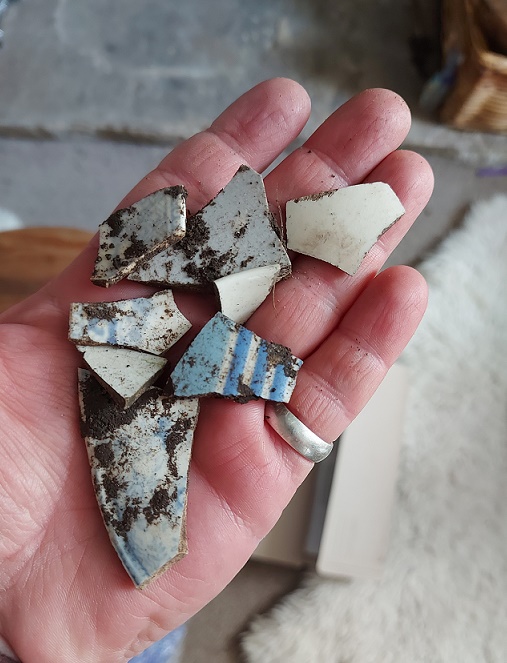
Harehills Park is interesting in itself – I won’t go into too much detail, as the Glossop Heritage Trust has an excellent article on its history which you can read here. It has been known variously as Harehills Wood, Harehills, the People’s Park, the Sandhole, and Pinch Belly Park. These last two names are derived from the fact that during the ‘Cotton Famine‘ of the early 1860’s – a situation caused by the lack of imported cotton from America due to the ongoing Civil War there – men were employed there digging sand in order to provide work for them. In 1921 the park was given to the people of Glossop by Lord Howard in appreciation of the men of Glossop who served in the First World War, but also as a memorial to his son Philip Fitzalan Howard, a lieutenant in the Welsh Guards who died of wounds in France on 24th May 1918. The park was extensively remodelled and landscaped at this time, including the construction of the bridge, and was used as a recreation grounds and promenading area. Prior to this, the area was described as “hideously ugly; hen pens fenced with old fish boxes; old salmon tins, rhubarb roots, and a good quantity of other rubbish with plenty of muck and sludge thrown in”, and was known as a place for bare-knuckle prize fighting. It was also noted that “one part of it seemed to be nothing more than a vast tipping place”, and it is this part, one assumes, that keeps producing pottery. It has a been a particularly fruitful site to find pottery, to be honest – none of it too old, but its always there.

Prior to washing.

One assumes that the pottery has not travelled very far from the place of use, and so we might suggest that much of this rubbish came from the houses on St Mary’s Road, allowing us a peak into the lives of those living there. A more systematic approach and proper archaeological investigation could tell us a great deal – this is essentially what we, as archaeologists, do with pottery. Anyway, the sherds:

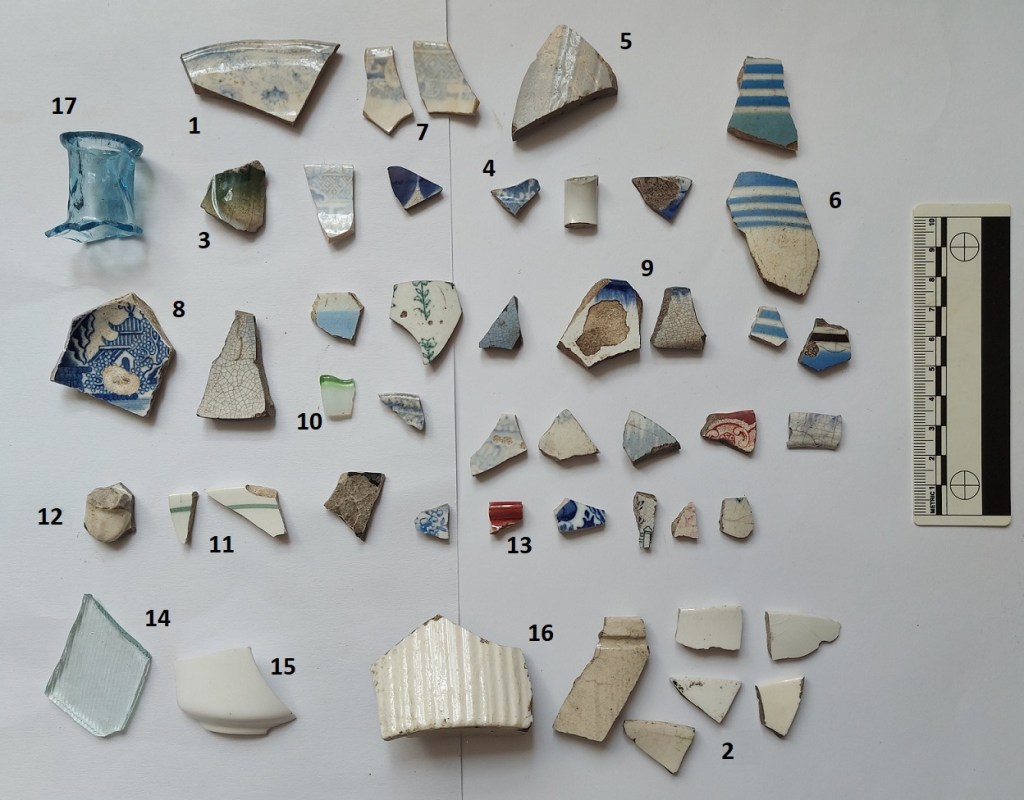
Fairly standard Late Victorian and Edwardian stuff, all from Harehills Park.

I’m not going to lie – a lot of it is pretty dull stuff, but there are some interesting bits and pieces, and this is a slice of domestic life in the Victorian and Edwardian periods.

  1. Plate or soup bow1 with an undulating rim of c.20cm, and a poor quality light blue transfer printed pattern – the transfer doesn’t match up at the join. Mid/Late Victorian
  2. 5 plain white rim sherds of 14, 8, 18, 16 and 16cm. Saucers, plates and cups. Victorian – 1920’s
  3. Fragment of a green glazed Majolica vessel, possibly vegetable-based. Utterly grotesque!
  4. Tiny fragment of a Sponge Ware decorated vessel. A rare occasion where I don’t know the shape – it has a carination in the body, so possibly an early mug or teacup. Victorian.
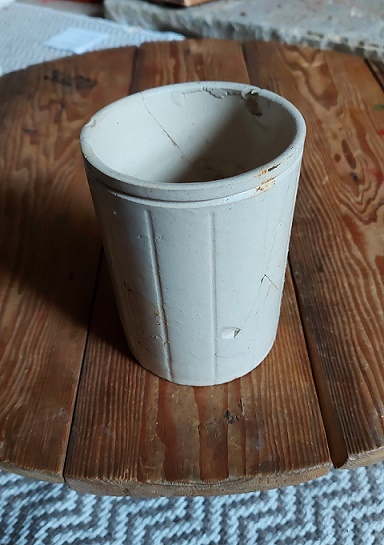
  5. Stone ware vessel, possibly a badly glazed marmalade pot – it has the grooves, but the surface is poor quality. C. 12cm diameter, so probably.
  6. 4 sherds of Annular Ware, Early to Late Victorian. This stuff starts much earlier than you expect (1780’s) and it looks almost modern.
  7. 2 sherds of a teacup rim, c.7cm rim diameter, and transfer printed on interior and exterior. Victorian.
  8. Base to a transfer printed willow pattern plate. Base diameter is 10cm, so the plate would be at least 10cm. The print shows a pagoda in the standard willow pattern style. Victorian.
  9. Rim sherds of 2 different Feather Edge bowls. Both date to between 1840 and 1890.
  10. A tiny fragment of green and white art glass bowl or cup, with an undulating rim. I quite like this.
  11. A saucer rim with a single green line below the edge. Refined, and quite nice. 12cm diameter.
  12. Handle to a whiteware cup. Quite fancy, and possibly Early Victorian. Or possibly not… this stuff is difficult to date properly.
  13. Red glazed rim to a jug or similar. Victorian.
  14. Flat glass shard with vertical (horizontal) grooves in, slight greenish tinge. Possibly the lens to a torch or car headlamp.
  15. Base and body of a porcelain teacup c.8cm in diameter, straight sided, 1920’s.
  16. Base and rim to 2 marmalade jars – base is 10cm diameter, rim is 11cm, Victorian to Edwardian.
  17. A beautifully coloured pale cobalt glass bottle. This is probably from a medicine bottle, and has what is called an ‘applied lip’, which means that the rim was made separately, and then melted onto the blown glass body. This is an inelegant solution to the problem of removing a blown glass bottle from the tube and leave a proper opening, and you can see the two parts twisted and melted together on the bit between the neck and shoulder in the next photo. You can read more about bottle finishings here:
Artful shot… shot, artfully.

What is also nice is that 3 sherds have maker’s marks on the bottom, allowing attribution and dates.

It’s not often I find maker’s marks. Nice.

Top sherd is marked either ‘Stone China’ or ‘Ironstone China’ which is a type of pottery that contains crushed feldspar in order to make it very strong and hardwearing. It was developed from about 1800 onwards, and this sherd is probably mid-Victorian. Bottom left is ‘Tuscan China’ made by RH and SL Plant at the Tuscan Works, Staffordshire. The logo dates it to the 1920’s and 1930’s, and was presumably broken and thrown away anytime after that, although presumably before the landscaping of the park. The bottom right is marked ‘Melba Bone China – Guaranteed Made In England’, and was made by Mayer and Sherratt, based in Longton, Staffordshire, and who operated between 1906 and 1941. So there you go.

Do have a look at the bridge the next time you go over or near it, as I think it deserves a closer look than it currently gets, and I hope that in the near future more is made of the area. Until then, look for pottery in the soil around the bridge, and think about mudlarking the bank of Glossop Brook there – I’m sure you’ll find something, but make sure you let me know what.

That’s all for this time. Apologies again for the lack of activity – real life has an annoying way of getting in the way of what you really want to do, but I will be posting more frequently… promise. Also, please do get in contact, for what ever reason, and follow me on Twitter too – I am quite active there. I am also working on a YouTube channel, where I can put videos of walks, mudlarking, digging, history bits, finds, and other shenanigans – it’s in the early stages, but I think it could be fun, but also a way of getting you all involved. Anyway, more soon, but in the meantime please take care of yourselves and each other – even just a cheery smile at your neighbour can make all the difference in these troublesome times. Until the next time I remain.

Your humble servant,

RH

Archaeology · Pottery · Whitfield

Bits of Pot and Some Updates

Mrs Hamnett complains that going for a walk with me is difficult – apparently I’m like a dog, running about looking for things. We’ll be walking along, talking, and I’ll disappear into a hedgeback or ditch, pulling out a bit of pot or stone, and leaving her talking to herself. Master Hamnett has now adopted the custom, and he regularly finds bits of pottery that he hands to me, looking very pleased with himself. This leaves small piles of pottery around the place, which get cleaned and put into bags with the intention of sharing them with you, gentle reader. And as you know, intention and actually doing are two widely different things – I’m going to have “well, I was going to, but what happened was…” carved on my headstone.

Well, not today. Today I do! I am seizing the day, grasping the nettle, taking the bull by the horns, striking whilst the iron is hot, and a host of other tired cliches. Today is a pot  and other bits day… but first a cup of tea.

Right, that’s better! Off we go.

A few months ago I posted this, a toy soldier fund by Master Hamnett at the Spencer Masonic Hall/Sunday School at the top of Whitfield Avenue. Well, we went back recently, and blow me… we found some more.

Pot 2
Bizarre, and slightly creepy. I love these things.

Bizarre. I can only think that someone was using this as a place to play with their soldiers, and then lost them. As I said before, these were my childhood (I still have them). From right to left: a 1:32 scale Airfix British Commando (mid 1970’s to, well, now in date). Then we have a copy of a 1:32 scale Airfix British 8th Army Desert Rat; it says ‘Made in Hong Kong’ on the bottom, which dates it to pre-1997, when Hong Kong became Chinese. Then there is the lower half of Marvel’s Iron Man, which has the date 2005 on the base. I suppose these are technically ‘rubbish’, being deposited only in the last few years, but I reasoned that if I picked up a Victorian child’s marble, then why not these too. If you recognise them, and want them back, give me a message. Above the toys is a squashed thimble, again probably of relatively recent vintage.

Some other bits and pieces found in the grounds:

M17
Other bits and pieces from the grounds of the Masonic Hall

From the top down, then. Randomly, fragments of a clay pigeon – which begs more questions than it answers. This is definitely rubbish, and will be going straight in the bin, but I thought I’d post it in the interests of completion. Below that, a copper roofing nail – Victorian or early 20th Century, and clearly from the roof of the building, dropped during a re-roofing, perhaps – I love these things, and have blogged about them previously. Below that, an ‘L-Headed’ machine cut wrought iron nail – probably used for flooring, and perhaps Victorian.

Continuing the revisit of that post, here is some more pottery from the area:

M1
A small haul, and nothing too spectacular.

Some odds and ends. Top row, from left, then: the bottom of a jar of some sort – earthernware, and with the letters ‘A’ and ‘D’ impressed on the bottom. It’s possible this is ‘MARMALADE’, as it’s the right type of jar, but I don’t think it’s an ‘L’ before the letters.  ‘M[AD]E IN ENGLAND’, perhaps? Next a saucer, then a black glazed open vessel, and then the chunky handle of a jug or similar, but certainly not a tea cup, the handles of which were delicate in the Victorian period, which is when all of this pottery dates from. Bottom row from left: a creamware jug, and from the curve of the sherd, this the rim of the spout; early Victorian, at a guess. Next, the base of an open bowl, then the interior shoulder of soup bowl, the base of a plate (complete with knife mark scratched into the glaze), and then the shoulder and neck of a small saltglazed stoneware bottle. Originally, it looked like this one, probably an ink bottle, and which has roughly the same dimensions:

M2
A stoneware bottle which, incidentally, I found in a Victorian tip in Broadbottom.

Next up, we have some interesting new bits from below Lean Town, picked up whilst I was waiting for Master Hamnett to finish at the excellent Inside Out Forest School in Gnat Hole Woods, not too far from Nat Nutter, as it happens.

Lent
Some very nice bits here. Oi! You there! Not you, you! Stop sighing… I can hear you muttering under your breath you know, it is not a “pile of old crap”. Honestly, the nerve of some people.

Top row: sherd of earthernware with painted orange flowers, which I thought looked nice. Then we have two different shell-edge ware vessels decorated a blue scalloped edge. The one on the right is the earlier, being made between 1780 and 1810, whilst the sherd on the left was made between 1800 and 1830. Then a sherd of annular or banded ware – the decoration looks very 1950’s to modern, but this stuff – usually in blue (there is an example below) – actually starts being made in the 1790’s. This one is Victorian. Second row on the left, a base sherd from a basalt stone ware bowl, roughly 1780-1830-ish, It’s a lovely example, very thin walled and with the bottom of an acanthus leaf or something coming up from the bottom. They were heavily influenced by Classical pottery, and it looks Roman orAncient Greek from a distance, but was in fact made by Josiah Wedgewood’s factory in Staffordshire. Then we have the handle to a monstrous stone ware jug or storage jar, and although it looks almost medieval, it probably came from a Victorian water jug or something. Following on from the mega post about Lean Town I’ll add this lot to the bag of bits, and I’m sure more will wash out over winter.

Moving on, we have a rim sherd of a pancheon and another sherd picked up from a path that leads from Bankswood Park in Hadfield to Mouselow.

Pann
Big chunky rim – I love these things.

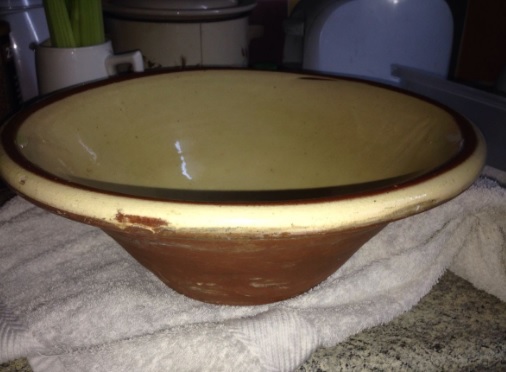
The smaller sherd is a from a cup or bowl with blue horizontal stripes on a white background – more annular or banded ware from the Victorian period. The larger sherd is part of the rim from a large pancheon – essentially a large mixing bowl that most kitchens in the 18th and 19th centuries would have had (I talked about them here). What looks like a yellow glaze is actually a clear glaze over a white slip – you can just about see it on the edges. Below is what it would have looked like, although this example is later and much smaller, the rim sherd suggesting a vessel 70+ cm in diameter.

Pan
A Victorian pancheon yesterday.

The path crosses another track which originally ran from Cemetery Road to Shaw, along what would become Shaw Lane, before it was bisected by the building of the railway.

ShM
1898 1:2500 OS map, courtesy of old-maps.co.uk

The lane actually skirts the edge of the Iron Age hillfort, and parts of it are preserved in footpaths and tracks, but I don’t want to get into this here, as it is a topic of another post. However, here are some photos of Shaw Lane as it crosses Mouse Low – the above pot fragment was found at this junction with the footpath, marked in red on the map.

ShSW
Overgrown and unused, this was Shaw Lane looking South West. In case you can’t see it, it’s the sunken road bit to the left of the tree in the centre of the photo. Apologies for the darkness.
ShNE
Shaw Lane looking North East. I need to explore this track – it looks so appealing!

Next we have a small collection of bits from the bottom of Cross Cliffe, along the road edge and by the track there. Nothing earth shattering, but a good selection.

CroPo
A good selection of bits, and a clay pipe!

Top row, from the left: a fairly substantial transfer printed soup bowl roughly 20cm in diameter; the base to a ceramic marmalade or preserve jar of about 10cm in diameter; a stoneware sherd from a storage jar of about 16cm in diameter. The thing that looks like a mint is either a button or the end to a hat pin, and is made from alabaster. Next row: sherd from a large jug or similar, with large hand-painted flowers on the exterior; rim of a stone ware ginger ale or lemonade bottle, with the very characteristic brown salt glazed surface; a fragment of willow pattern transfer-printed plate, and a stem of a clay pipe with, alas, no maker’s name, but some nice paring marks.

Ok, so this is turning into a far larger post than I had anticipated, and I’m going to draw a line under it for now – nobody, not even you, you wonderful and attentive people, wants to read a wall of text. Expect Part II either next time, or sometime in the future

So, to end with, for now at least, two superb examples of Glossop bricks, a gift from our equally superb neighbours (hello Helen and Sarah).

Pot 3
I love these things – simple and mundane, and literally stamped with their place of origin.

I don’t know a great deal about these bricks, but a future blog post might delve deeper. The company was based at Mouselow, with the clay extracted from nearby. It seems to have been founded in the 1920’s by a John Greenwood, and continued until the 1980’s. Somewhere in the garden I also have Glossop brick with both Greenwood’s name and Glossop printed on it – perhaps this was an earlier brick? There is some information on this website, but I can definitely feel a blog post coming on.

Bricks are so mundane, and yet so fascinating, and useful archaeological dating material too. And once they begin stamping the maker’s name into the frog (the dipped bit in the middle) – sometime around the mid-Victorian period – they become individual, too. I stumbled across this website the other day – a gigantic collection of photographs of bricks with the names showing, and all alphabetised; this is what the internet excels at, the dissemination of knowledge that would otherwise be inaccessible, and it is truly magnificent. I look upon these bricks with envy, but silent and certain in the knowledge of one single fact: were I to start a ‘brick collection’ Mrs Hamnett would forcibly and violently eject me from the marital home. I would be a single and homeless (and brickless) man again before you could say “now wait, dash it all”. No, she puts up with quite enough as it is, so this injustice and pain is a weight I must bear with quiet resignation. However, if someone does have a spare shed, you can contact me in the usual way…

Right, that’s your lot! And it is a lot… too much, in fact! The question of “what am I going to with it all” never really occurs to me, and beyond the obvious “put it on the blog” I have no idea. I’m going to have a clearout soon, and get rid of the more boring bits and pieces – the plain white china, etc. and bury them somewhere for future archaeologists to ponder over. In fact, I was going to do it last week, but what happened was…

More soon, but until then, take care of yourselves and each other.

And I remain, as always, your humble servant.

RH

Archaeology · Whitfield

Pressing Matters – Of Cheese and Wills

Good evening gentle readers. I say good evening, for this is when I am writing, but it could be anytime you are reading this. And indeed anyplace… which worries me slightly. Anyway, moving swiftly on.

Recently, I posted a hotch-potch, pickle-type post, that looked at the cheese press I found that was being used to fill up a hole in a trackway. Well, some interesting developments have, well… er… developed.

Firstly, it seems that the whole cheese press is present, which is excellent news. But alas it is broken into two pieces, which isn’t such excellent news. Still, the fact that it survives at all is pretty impressive. Secondly, and even more impressive, I think I might have identified to whom it belonged, which is amazing if true. Please note the use of the phrases “I think” and “if true“… I’ll leave it to you to decide.

Firstly, then, the press.

It’s complete, as in it’s all there, although as you can see it is sadly broken across the middle. It measures 94 x 43 cm, and about 10cm deep, so it’s not huge – and these things do come in huge sizes. I had a poke around mini excavation, just to reveal the edges, and to assess how much was there, but I didn’t want to dig too far – it is filling a large hole in a track after all.

Press1
Nice to see the whole thing – you can just make out the corresponding beam hole on the right.

Master Hamnett helped reveal the press, of course… any excuse to get dirty.

Press2
Master Hamnett ‘helping’ with the excavation and the photographs

It’s fantastic, and I honestly think that this needs to be removed from the road and put on display somewhere; it is a wonderful piece of evidence for life in 18th century rural Whitfield that deserves to be treated better than it currently is.

Right then, so who owned it? Well, I was reading through a collection of Glossop-based 17th and 18th Century wills the other evening.

Before we move on, perhaps we should examine that statement. I have just read it back, and the thought occurs to me… mine is perhaps not what you might call a ‘normal’ life. I mean, here I am, on a Friday night, reading 300 year old wills, and getting excited over some new bits of pottery I found yesterday. Sometimes it’s good to take stock of one’s life… and other times it’s good to simply leave one’s livestock alone.

Anyway, back to the wills. They have been digitised as part of the North West Derbyshire Sources project which is a truly remarkable source for local history and genealogy in this area, and filled with all kinds of information – if you don’t know the website, please do have look. The will that caught my eye was that of John Cowper (Cooper) of Whitfield, and dated 1750. The actual will is fairly bog standard, but is genuinely fascinating as it contains, in a nutshell, the contents of an average well-to-do household. Cooper was someone who we would now perceive as comfortably middle-class, but was then known as a yeoman farmer; someone who owns a small amount of land freehold (paying no rent), and who earns his living from it. I won’t reproduce the full preamble here as it is a wall of text – but it well worth a read (the full transcription is to be found here – it’s alphabetised, so look for John Cooper of 1749/50). However, the contents of the house is as follows:

Item Value (£ s d)
Imp/ Purse & Apparell 7    0    0
A large Bible & Clock 3    0    0
Two cows 6    0    0
A cupboard & table 0  15    0
Two coach chairs 15s 12 chairs 10s 1    5    0
One Fire Iron tongs, 3 bread Irons Fire Shovel & Brigg 0  15    0
One little Fire Iron, smoothing Iron Clever two Hand hooks & Spittle one frying pan 0    3    0
One Warming Pan a skellet a brass pan a brass pott & saucepan one Lead, Lead weight & Mustard Ball 0  15    0
8 Pewter Dishes one Tankard 1 Cup 4 porringers, Spoons 0  14    0
Books & Linnen Meal Cheese & Bacon 4  17    0
One Bedsted & Bedding & a little Cupboard ith Parlour 1    8    0
One Bedsted & bedding in the long Chamber 2  10    0
One Press 1  10    0
A Long table & one little oval table ith parlor Chamber 0  17    0
One bed & bedding ith Chamber over House 1    5    0
One meal ark 8s one Chest 10s one little chest 6s one Desk 5s one Box 1s ith same Chamber 1  10    0
One Cheese Tubb 5s one kimlin 2s Cheese fatts & other wooden ware 5s & one cheese press 3s 0  15    0
One little Ark in the Porch 1s 2 Iron potts 2s a Glass case two fall tables 2s a kneading trough 1s 0    6    0
One Shovel Mattock & Bill & Dock fork & Ax 0    3    0
One Stock of Bees at Thomas Cowpers 0  10    0
Huslement 0    5    0
46    3    0
In Bills 88    2    0
134  5    0

The items listed, then, are those that are considered of value in the mid 18th century, and if you look, it’s largely the things that we would take for granted. Imagine someone doing this to your house – have a look around. Would they mention your pots and pans? Or your fire irons (assuming you have a fire – everyone in the 18th century certainly would have). Or your bed linen? Or your cheese and bacon? It’s bizarre, yet it also makes sense. There were not many frivolities then; would bacon count as a frivolity if you had raised the pig, killed it, salted it and stored it? No, it would be a resource that you had earned. Your iPad would be listed, but Cowper had a clock (along with a large Bible, valued at £3 [£350 in modern money]. Your car would be listed, but Cowper had two cows and a hive of bees valued at £6s10 (£758.35 in modern money). Your all-singing, all-dancing, ride-on, lawn mower might be listed, but Cowper had “One Shovel Mattock & Bill & Dock fork & Ax” valued at three shillings (£17.50).

Some of the items listed needed a little further exploration. For example, the ‘Mustard Ball‘ valued with the rest of the pots and pans from the kitchen threw me. But it turns out that they were literally balls of powdered mustard.

tewkesbury-mustard-balls
Traditional mustard balls. Image stolen from the Tewkesbury Mustard Company website – there is a link to the site below… fascinating stuff.

The seeds were powdered, and mixed with some form of binder – wine, vinegar, honey or raisins, for example – and when needed, slices were taken and soaked in a liquid to soften them (in vinegar, or verjuice, for example – the sour juice of crab apples), and added to food. They are still made, as they were 700 years ago, by a company in Tewkesbury (the Tewkesbury Mustard Company) who make the best, apparently (and I have no reason to doubt that). Thanks also to this fascinating blog about historical food for the information.

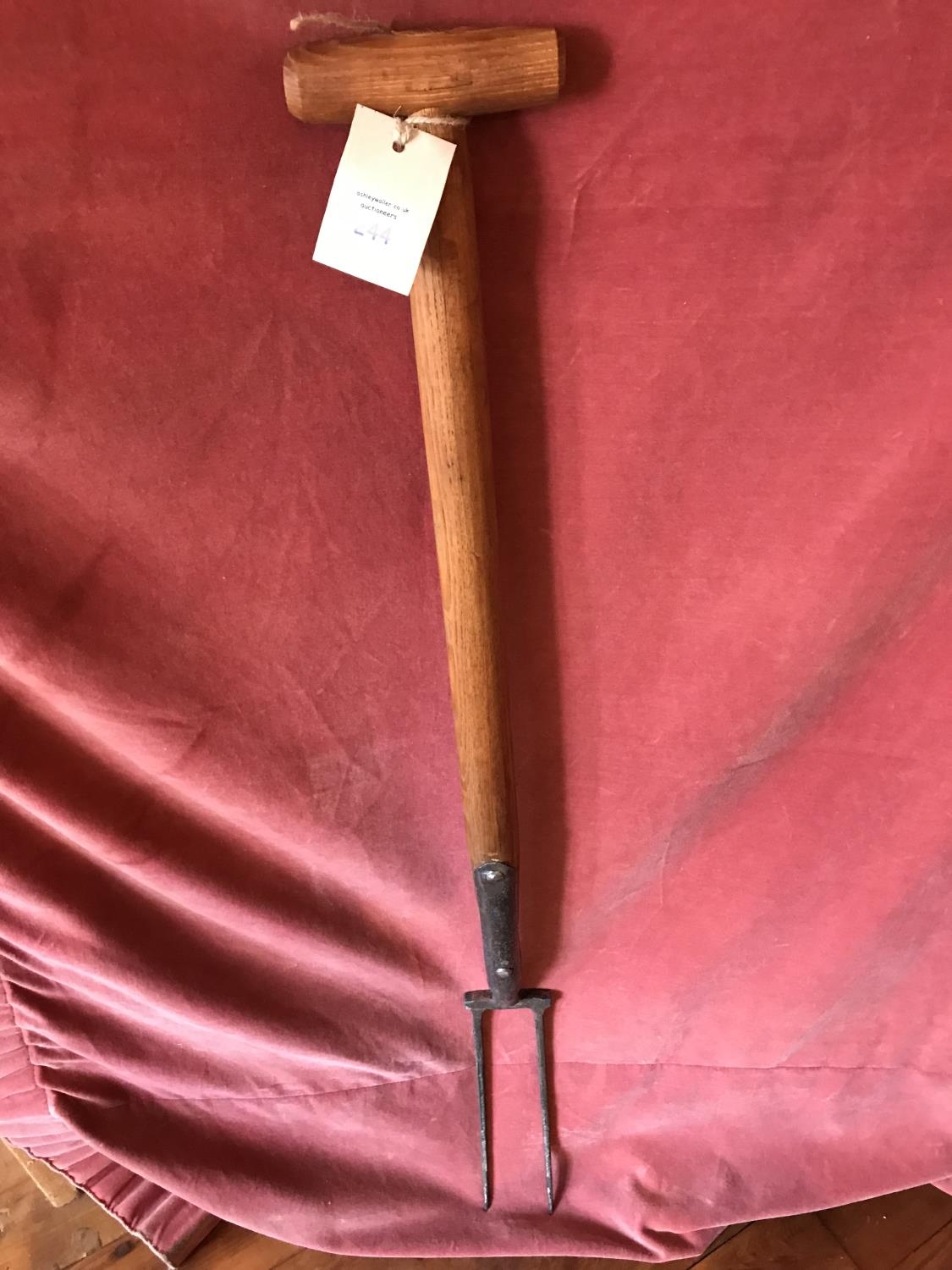
The above mentioned “Dock Fork” was also not something I had encountered before; a little research brought forth this:

Dock Fork
Dock fork, from the easyliveauction.com website – this one sold for £25… a bit more than the £17.50 it was valued at, with other implement, in 1750.

As anyone who has ever weeded a garden will know that docks are difficult buggers to remove, and yet are brittle, breaking and leaving root fragments that will flourish into full bushes of weeds in weeks. A problem to which the answer is a dock fork, that allows you to lift the whole plant without breaking it. Obviously.

The important bit for our purposes here are those items listed that are used in cheese making, and specifically the cheese press. As you have seen, it’s not a small item, nor is it something that everyone would own – it’s a specialist implement used on much more than a domestic scale. It, and the other cheesemaking equipment mentioned in the inventory, indicate the relatively large-scale making of cheese to be sold, and perhaps supplying everyone in the local area. As perhaps only a single farm in each area would have one, I would suggest that the one mentioned in John Cowper’s will is the one I discovered a while back, and which is now filling a hole in the track. I realise that it is impossible to prove, after all the stone has no provenance, nor do we have an address for John Cowper other than Whitfield. But Whitfield as a settlement was concentrated along Cliffe Road and Hague Street – the old road from Hayfield to (Old) Glossop, and largely around The Beehive (it arguably still is) – then it is likely that Cooper lived in this area too, and thus his cheese press has not moved far. Anyway, I’m convinced. The big question is… are you?

Whit
Whitfield – the medieval and post-medieval heart of the settlement along the main road from Hayfield to (Old) Glossop. For orientation, The Beehive is marked by the large orange arrow. The oldest building in Whitfield, Hob Hill Farm – which has a datestone of 1638 and associated 18th century buildings – is marked by the green arrow.

However, although we might not be able to pinpoint his house, we do have a way of working out the type of house Cowper lived in. Essentially, the people who were assessing the worldly goods of the testator went from room to room, recording what was in each, and thus the inventory provides us with a sort of snapshot that allows layout to be reconstructed. So, on the ground floor we have the Kitchen/Living Room. This was where the main fire was, and all the cooking and eating equipment was, including “One Warming Pan, a skellet, a brass pan, a brass pott, & saucepan” and “8 Pewter Dishes, one Tankard, 1 Cup, 4 porringers, Spoons“.

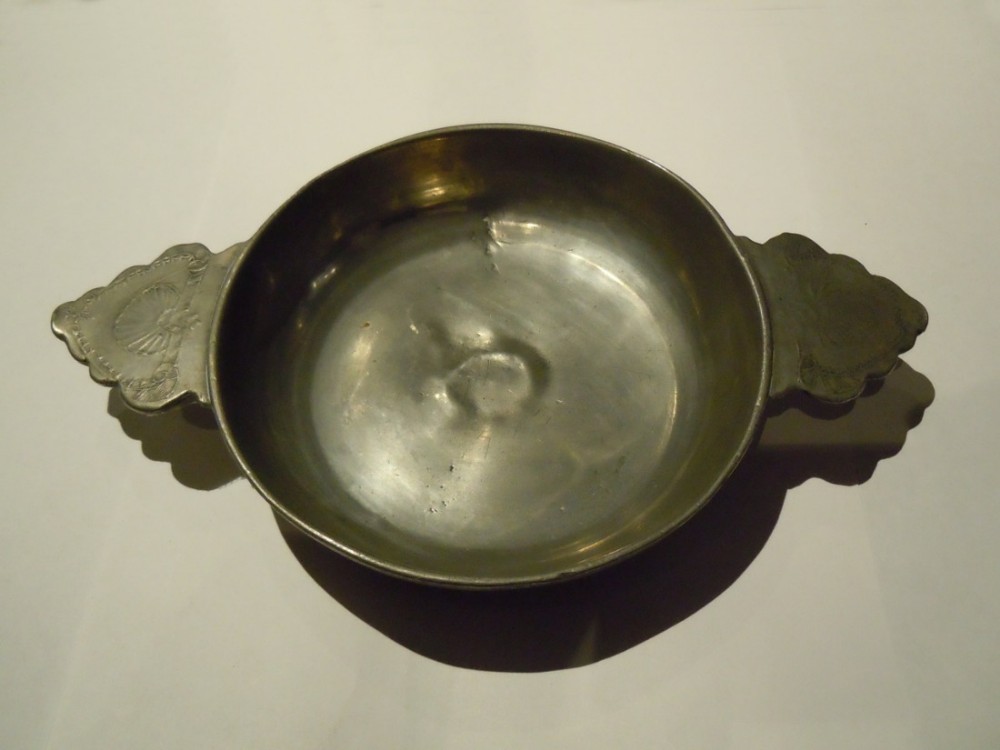
Porr
A 17th century pewter porringer – a bowl with a handle used for stews. They were incredibly popular in pottery as well as pewter until the 19th century, when meals became less ‘wet’ and plates became more popular.

This was a large long room – it contained “A cupboard & table“, as well as “Two coach chairs, 12 chairs” (which may be a mistake, as that seems a lot) – and had the fire at one end, and the door somewhere, possible in the middle of the long wall. There also seems to have been a pantry – probably just a built in cupboard – which contained “Books & Linnen, Meal, Cheese, & Bacon“.  Next to this is what is termed the ‘Parlour‘ in which there is a “One Bedsted & Bedding & a little Cupboard“. Moving up the stairs to the first floor, we have the Master Bedroom, termed here the ‘Long Parlour‘, and which was presumably over the Kitchen/Living Room, and containing “bedsted & bedding” and a “press“. Next door is the ‘Parlour Chamber‘, literally the bed chamber over the Parlour, which contained “a long table & one little oval table“. The next floor up, the attic room, was over the whole upper floor and is named the “Chamber Over House“. It containing “One bed & bedding” and “One meal ark, one Chest, one little chest, one Desk, one Box“. The ‘meal ark’ mentioned here, and the ‘meal’ in the Kitchen is oatmeal, used for bread or making oakcakes, and traditionally kept in a wooden box.

Meal
A 17th Century meal ark.

So then, five rooms in total, centred around the hearth and kitchen, and with three bedrooms. This layout is a classic of its kind – very simple, very basic, but very functional. And I have to say, quite cosy. There may have been outbuildings, perhaps containing the cheese making equipment, and certainly a ‘Porch‘ is mentioned, containing “One little Ark, 2 Iron potts, a Glass case, two fall tables” and “a kneading trough” for making bread.

Kne
A kneading trough, in which dough was kneaded and left to prove.

This type of house is described as a “Two Unit” type – essentially one large room divided into two rooms, one large and one small. The Handbook of Vernacular Architecture by R. W. Brunskill has a dozen different configurations of this type of building, and Cowper’s house could fit any one of them. Vernacular architecture refers to buildings on a domestic scale that use local building traditions, and local materials, rather than ‘fashionable’ architectural designs such as the grand halls and houses of the wealthy.

Will
The basic Two-Unit house plan. Cowper’s house was probably along the lines of ‘h’, although any could fit to be honest.

It’s just a pity that we can’t identify the actual house.

So there we are, cheese presses and wills… hope you enjoyed it. As always comments are very welcome, and I would be glad to hear from you. Please look after yourselves and each other, and until the next time, I remain

Your humble servant,

RH

Archaeology

Clay Pipes

What ho! wonderful people. In case you hadn’t worked it out by the title, today’s blog post is all about pipes. I may have mentioned previously that I absolutely love clay pipes – there is just something so tactile and personal about them. And yet as an object they were disposable; I have referred to them as the cigarette butt of the Victorian period, as often they were bought pre-filled with tobacco, smoked, and then thrown away. I have  previously posted a few good pipe fragments (here for example), but I have others…

This is no place for a general history of tobacco smoking, but it is worth mentioning that it was only 1580-ish that the first ships came back from the New World with the dried leaves as cargo. This provides us a nice terminus post quem (archaeology speak for the earliest possible date something could have happened) for clay pipes. Interestingly, we also have a terminus ante quem (archaeology speak for the latest date something could have happened) – the cigarette became very popular late in the reign of Victoria, gradually replacing the pipe, and it is generally taken that the use of clay pipes died out after about 1900. Obviously, this is not a hard and fast rule as people still smoked them (see one of the pipes below, for example) – and indeed you can still buy clay pipes – but it is a useful rule of thumb. So then, for a period of roughly 300 years, between 1600 and 1900, people were smoking these things. But the thing with clay pipes is that they are ridiculously breakable, which is good for us. Bowls are found rarely, and even more rarely complete, but the stems, looking like white cigarette butts, are very commonly found, and people amass huge numbers of them, even making them into jewellery.

If you interested in any way in clay pipes, then the National Pipe Archive website is for you – a goldmine of accessible factual information, and their ‘how to’ section covers everything from excavating and cleaning to dating and drawing. There is also a huge reference collection of books and articles on excavated pipes. I have lifted some of their images for illustrative purposes and make no claim to them – but please have a look.

Here is the anatomy of a pipe :

pipes[2]
Here you can see how it works, and the terminology used.

They were mass produced in huge quantities using a white ‘pipe clay’ formed in a mould, and then kiln fired. In terms of date, they are quite difficult to pin down precisely without lots of detailed information. The rule of thumb though is that the smaller the bowl, the earlier the pipe – tobacco was very expensive in the 16th and early 17th century, but became much cheaper later on, leading to larger bowls, and a more wide appeal. There is also some chronological variation in the stems too – the earlier pipes had thicker stems and the bore (the hole down the middle of the stem) was wider too. And there are also very subtle changes in shape of the bowl, the stem, the heel, and the tip, that allow rough dates to be given to the pipes, but these too are very broad. A huge amount of work has been done on dating pipes, but the reality is that it is not hard and fast, and unless you have a manufacturers name or mark, or it comes from a secure archaeological context, pipe dating is in half centuries and decades, rather than specific years.

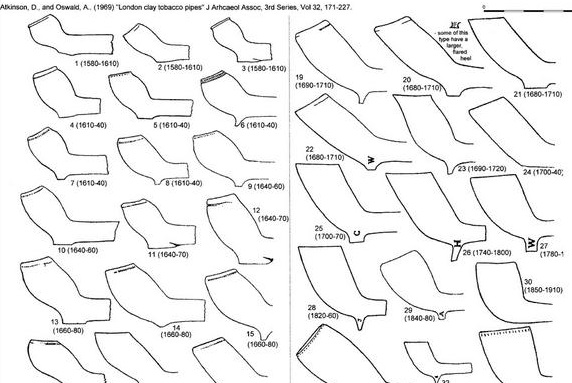
Here are some images showing dates for various pipe styles. It is worth remembering that each area has its own industry making these things, and thus what might apply in London, will probably not apply in Manchester, although the broader trends are applicable, and pipemakers did copy each other’s designs.

PipesBvLoHLgIIAEiGv_
London pipes showing the broad trends regarding sizes through time.

pipes[1]
A rather general image giving dating information.

So then, the pipes.

This first one is something of a rarity in that we can say a bit about it, and it has a date. It was found with some late 17th and 18th century pottery near Crowden, and thus I assumed it was of a similar date.

Pipes 4
The decoration is at the left of the stem

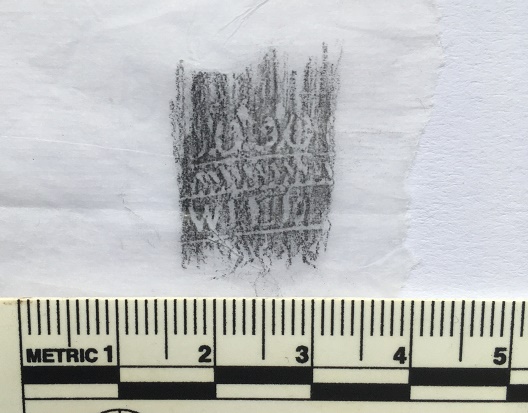
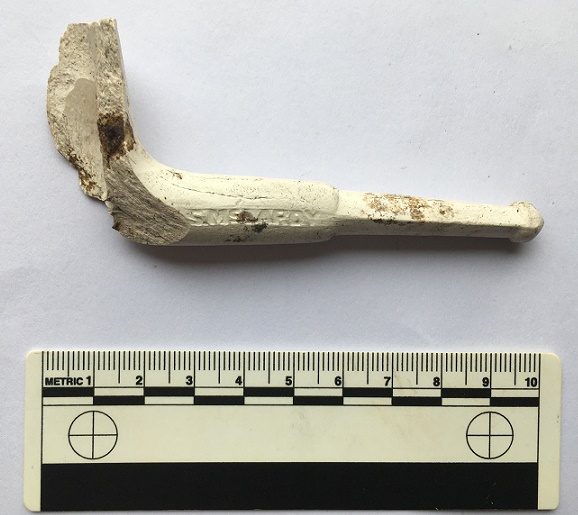
It was only when I cleaned it that I realised that it had a rolled stamp around it which at first I thought was simply decoration. It was only after I had taken a rubbing that I saw the name ‘WILD’ printed. Fantastic!

Pipes 5
It amazing the things you can do with cigarette papers.

Even more amazing, after only a few moments rummaging around some files, I found a perfect match to this stem from an excavation in Sheffield. This truly never happens! It was made by Thomas Wild, a pipemaker working in Rotherham between 1750 and 1790 – which is absolutely spot on for the date of the pottery.

Pipes 3
I’m hoping you see the match.

The published version of mine is is in the Clay Pipe report by S.D. White (2015) to be found here (No.13 in the catalogue). The location of Crowden on the Woodhead Pass means it would have had easy access to the market at Rotherham, and thus the pipes. Honestly, it’s not often that you can make a connection like that – the place of consumption to the place of production, and all along a single road. It’s even been made in the same mould. It’s things like this that keep me alive in archaeology, and makes it all worthwhile.

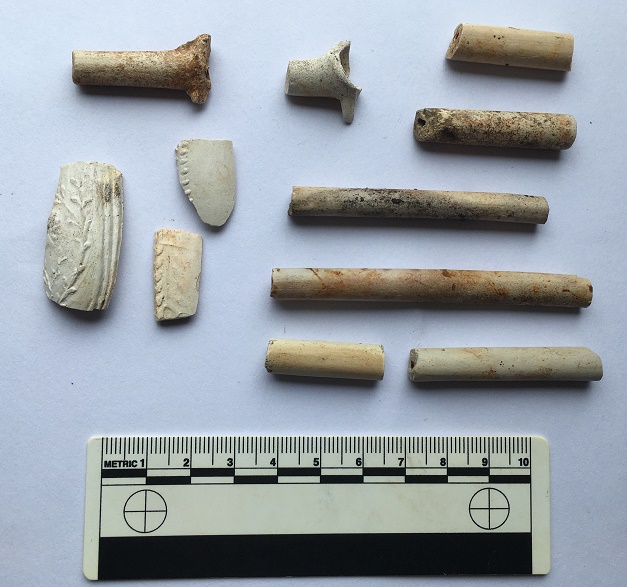
I found a few other fragments in the area of this pipe but nothing as spectacular as the stem, alas, although the bowl sherd on the bottom left is quite nicely decorated, and dates to the same period.

Pi1
The top two bits are also quite nice, being the back part of the bowl where it attaches to the stem, and with the spur underneath.

The next one is also a great find. From a Victorian dump near Hadfield, it just plopped out of the earth soil right in front of me.

Pi5
Beautiful!

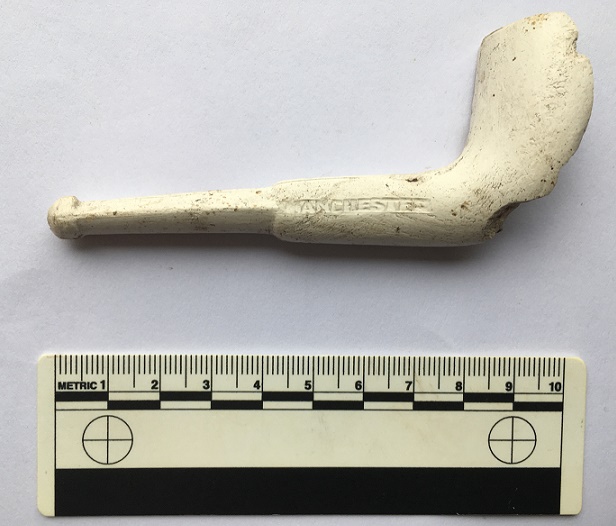
It is almost complete – missing just a part of the bowl – and looks as though it had never been smoked before it was presumably dropped and broken. It is an interesting shape in that it has a short stem, which means it was made for a manual worker of some form. The last thing you want if you are wheeling a barrow around or swinging a pickaxe is a long stem that would get caught and break. Manual workers would normally break off the stem to create what were called, for obvious reasons, ‘nose warmers’. Manufacturers caught on, and they made short stem pipes for such a market. This one, helpfully, has the manufacturer’s name on the side: Samuel McLardy of Manchester.

Pi6
Helpful people – sometimes – these pipemakers.

I was going to give you a history of McLardy as a pipe maker, but this blog run by a pipe expert has done an amazing job already (it’s well worth a look). Briefly, then, McLardy was born in Glasgow in 1842, and set up his company in Manchester in 1865 in Miller Street, and then later in Shudehill. By 1895 the company was making over 5 million pipes per year, which is astounding, but in keeping with clay pipes in general, sales dropped, and the company was ended in 1930. There is a sales catalogue from the 1920’s in the above blog, in which the above pipe is listed as #392 (page 1). This provides us with a good date for the pipe – roughly 1920, or possibly a little earlier – very late in the history of clay pipes, which is interesting.

Also from the same dump, was this lovely, if battered, bowl.

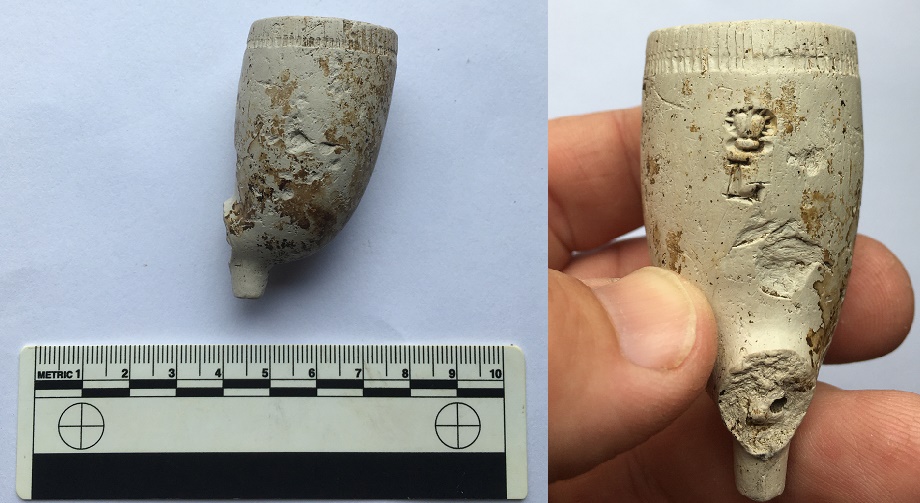
Pi2
Some nice rouletting around the rim.

Large, so late in date (1860-80 ish) it is marked with a crown above the letter ‘L’. A little bit of online research produced this article, which details the ‘Crowned L’ as a trademark of superior Gouda pipemakers of the 17th and 18th centuries. However, by the 19th century, English and Irish pipemakers were freely using the ‘Crowned L’ as a way of claiming that their pipes were of a similar standard, so the trademark became debased, and these pipes are very common. Incidentally, what on earth did we do before the internet? This sort of research would have taken weeks, months even; it took me less that 30 seconds – longer, in fact, to write this. Incredible.

I’ll end on an excellent, although sadly not complete, Victorian pipe. In the spirit of truthfulness, I should admit I found it on a Victorian tip in Lancashire, nowhere near Glossop, but it’s such a wonderfully ugly thing that it deserves its moment of fame.

Pi4
Ah, the garish Victorian aesthetics!

It is an eagle’s claw holding an egg. Of course it is… what else would you want to see whilst you were puffing away on your pipe – the Victorian equivalent of heavy metal fashion. It is missing two talons, but still quite remarkable. Apparently the Victorians were really into their novelty pipes – football being a particular favourite subject.

I know I keep saying it, but I love clay pipes.

Right, that’s your lot for now. Please send me your pictures or comments about pipes, or indeed about anything vaguely historical/archaeological… all comments are welcome.

But for now look after yourselves and each other, and until next time, I remain.

Your humble servant,

RH

Archaeology · Pottery · Whitfield

A Possible Pair of Post-Medieval Paths, a Potential Pub, and Plenty of Pottery.

As I have said many times before, I do love alliteration. What ho! and all that. I trust you are all keeping well in these odd times? Well, now this is a monumental post – it is precisely three years to the day that I made the first post on this blog (you can read it here if you want). When I first started it I had no idea what it was going to be, other than I had some interesting bits and pieces that I wanted to share, and which I thought other people living in Glossop moght be interested in. The blog is still pretty much that in aim – bits and pieces – and I was right… there are lots of you out there who seem to enjoy the ramblings of a man who gets excited by bits of old rubbish. So thank you, you wonderful people, for reading, and here’s to many more blog posts. Now, on with the show. RH

During the lockdown, Master Hamnett and I have been taking a daily constitutional up and around what has become known as the “secret passageways”. Overgrown and wild in places, even for a man of modest size such as myself it is a mysterious place, but to a 4 year old it is indeed another world. Naturally, I have been keeping an eye open for bits and pieces of history, and I think I have a story to tell. Possibly. Well, I certainly have some pottery to show, so there’s that!

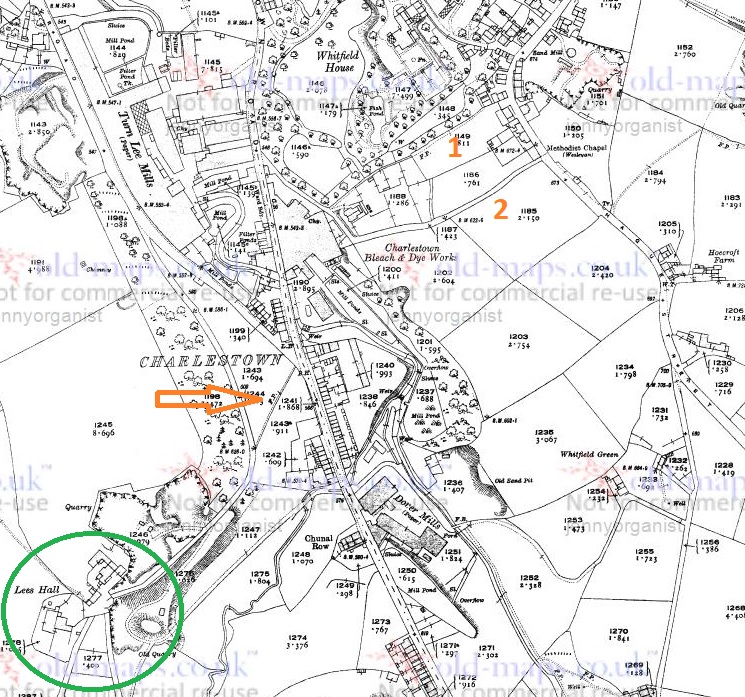
The route we walk is essentially along Hague Street, down one track to Charlestown Road, along, and then up another back to Hague Street. We often continue on and round if it’s not raining, but always walk these paths, which I have helpfully marked Tracks 1 and 2 on the map below:

M6
Tracks 1 & 2 at the top. Ignore the arrow and a circle for now… all will become clear!

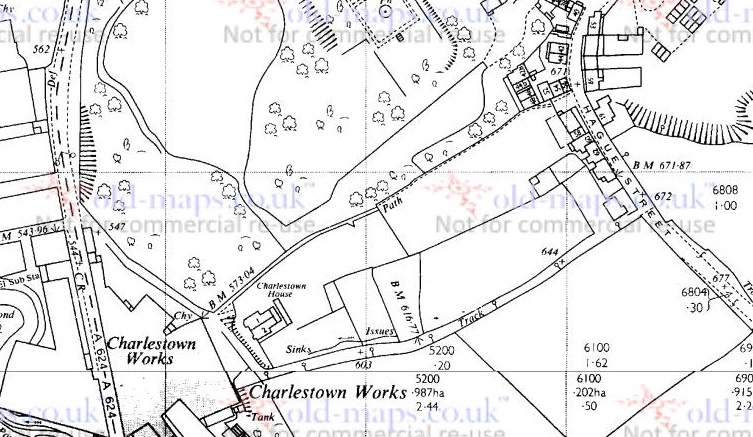
The tracks and immediate area are more clearly shown on the 1968 1:2500 map

m10
It’s a nice and short circular walk, if anyone fancies it.

The tracks are interesting in themselves in that they are once again an example of what I call the fossilisation of trackways – they are older tracks that no longer perform a function as such, but are preserved as footpaths. Certainly in this case as it makes no sense to have two tracks mere metres apart going between the same places. Instead, I think they are preserving the memory of a single older track, which I suggest below is Track 2, potentially the more interesting of the two. But I’m getting ahead of myself.

Track 1 runs down the side of this house, which was originally a pub called the Seven Stars (hence the sign on the door frame, although the sign above the door is a mystery… if you are reading this and own the house, could you tell us?).

M7
The one-time Seven Stars pub – I always feel a bit weird photographing people’s houses, but this is visible from the road, so it’s not as though I’m sneaking around gardens.

I know nothing about this establishment, but it was probably a beer house. As a reaction to the widespread and dangerous consumption of cheap gin – the so-called ‘Gin Craze’ of the late 18th century – the government encouraged more beer drinking (beer being considered relatively healthy) by allowing householders to open up their houses to brew and sell ale. These private houses became known as beer houses, and the individual paid a small fee to the local magistrates in return for an annual license allowing them to sell beer, but not the wines or spirits that the normal pub or inn could. If anyone has any information about the Seven Stars, please do get in contact.

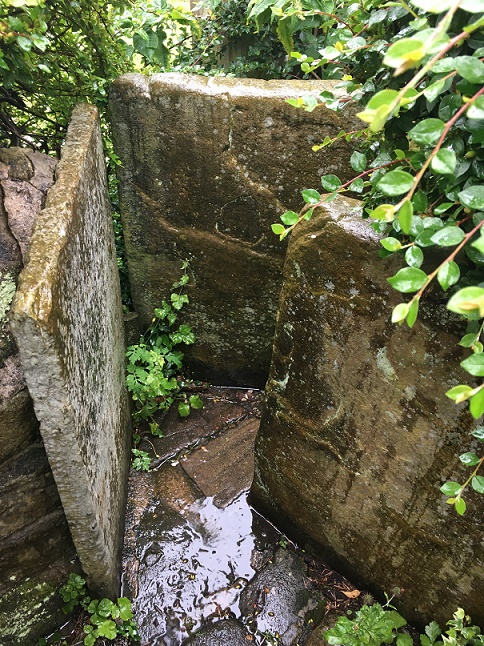
Just here is a series of upright stones presumably placed to stop horse riding or cycling. The gap between them is very thin; I might have put on a little weight during lockdown, but even I had to squeeze through.

M22
Breath in!

Carved onto one of these uprights are the intials ‘M.D.’ – I must have walked through these 100 times and never noticed the letters before, but the light and the rain were just right this time.

M23
And as you all know by now, I can’t resist carved graffiti.

Further down the footpath I noticed a reused quern or grind stone – possibly Victorian, but I suspect earlier – being used as a coping stone for the wall. And why not? It’s the perfect shape, and may well have been hanging around for centuries after being used to grind wheat into flour.

M9
The worn central hole is visible, and it’s possible the other half is around here somewhere.

About halfway down, you come face to face with more of those upright stones, although in this case I can only assume they were put there to stop a headless horseman! Honestly, they are quite unnerving.

M19
Not at all creepy and gravestone looking. Nope. Absolutely not.

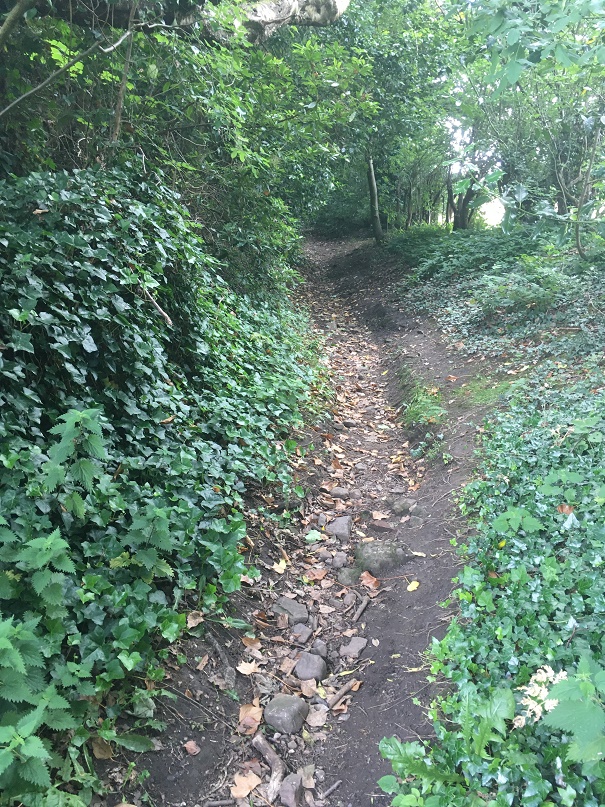
The path continues:

M18
Master Hamnett on the final stretch down to Charlestown Road. At the end of the path, in spring, there is a truly spectacular spread of wild garlic.

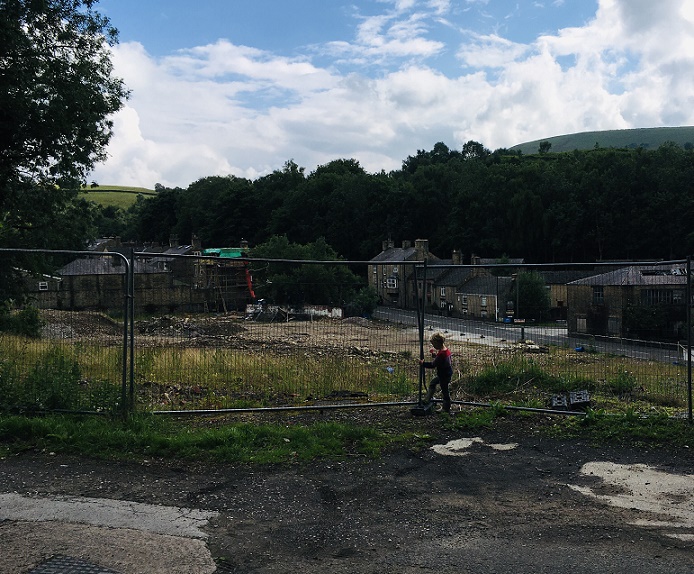
Until we arrive at Charlestown House, and the Charlestown Works that were – now demolished and awaiting houses.

M30
The site awaiting re-generation. The hairpin bend where Charlestown Road meets Turnlee Road is visible. Whitley Nab in the background right, Casa d’Italia left (very nice pizza, highly recommended). Dead ahead is Lees Hall, which is important… stick around!

So, here’s the pottery:

M3
A small assemblage of fairly typical Victorian bits, with a potentially earlier piece.

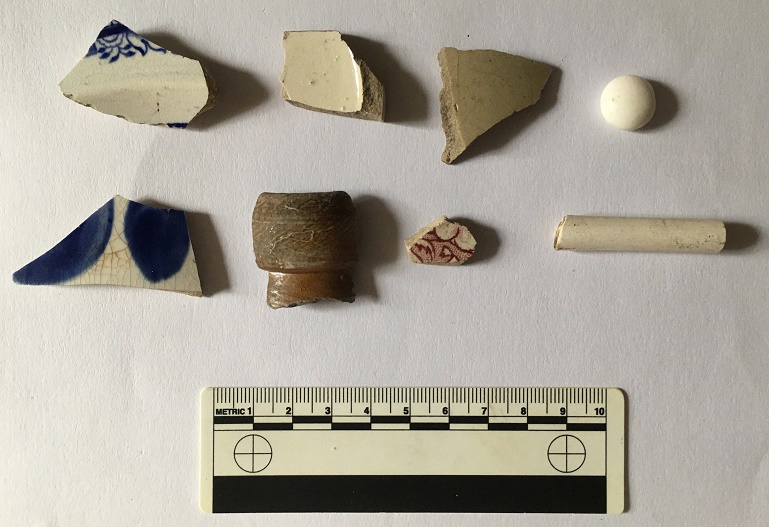
Top row, from the left: a base of a saucer or small plate; a huge chunky handle belonging to a large jug; a base of a glass jar or jug, or possibly from a tankard – it’s nice and decorative, but not expensive. Next is a fragment of a pedestal footed drinking cup, which is again fancy, but not especially expensive, it being just glazed earthernware. Then there is a rim to a large plate of some sort, being about 30cm in diameter.

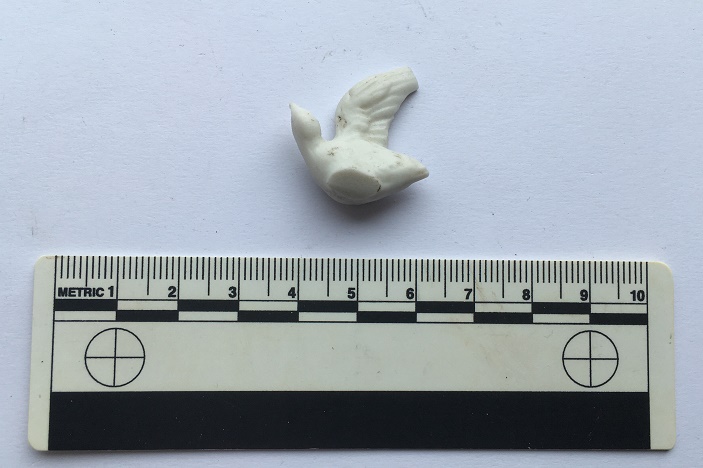
The lower row from the left: a fragment of a stoneware bottle, a chunk of a pancheon, and a fragment of a manganese glazed jug or similar thick walled vessel. Then we have two pieces of blue and white earthernware, and a base of a tea cup. There is nothing massively interesting, and it all seems to be Victorian in date, as we might expect… except for the manganese glazed jug! This is, I think, earlier – perhaps early 18th century. It’s quite characteristic, and although there was a revival of manganese glazed pottery in the Victorian period, this glaze is of relatively poor quality, and the fabric (the actual clay of the pot) is quite rough, both of which suggest an earlier date. Then there is this lovely bit of pot; it’s a china dove, shaped to fit onto what would have been a tasteless Victorian jug or bowl – you can see the flat bit where it was joined to the vessel it flew away from.

M4
Found lurking below some dandelions.

Then there was this:

m20
A bottle top

A screw bottle top, probably from a beer bottle or similar, and dating to the early 20th century. I love these things, and have blogged about them previously – here, for example. Unusually, this one doesn’t have the drink makers name or logo on the top, just the name of the bottler – R. Green of Leigh.

M21
Always nice to see.

Moving on to Track 2, there is a noticeable difference between the two. This one is more of an actual track; it is certainly wide enough to drive a horse and cart down it, and it seems to have had a surface at some stage. It is also deeply worn in places, which can be suggestive of an older trackway.

M26
Possibly worn by traffic, the track is quite deep in places.

M27
It’s not much to look at, but this is the surface of the track.

I’d love to put a trench across this track to see how it was made up.

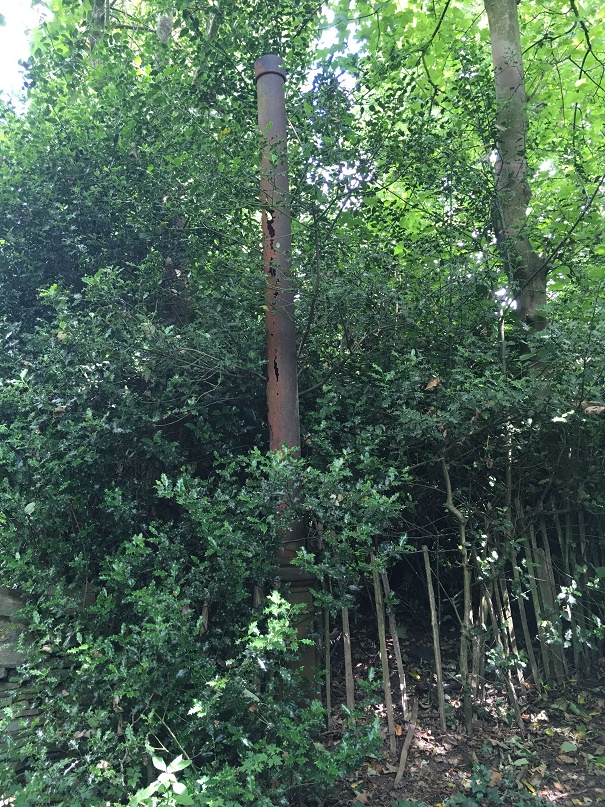
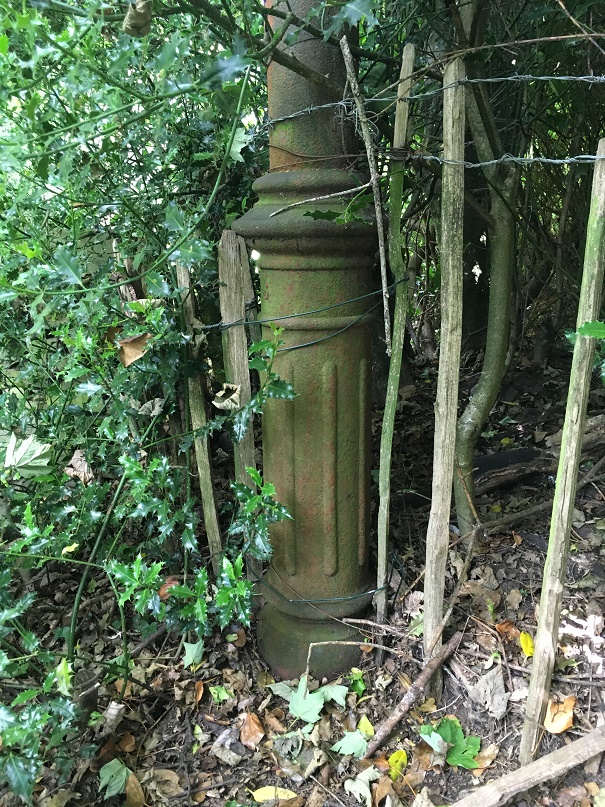
Further on, it has what seems to be a late 19th or probably early 20th century cast-iron streetlight, which is interesting and spookily out of place now, but suggests strongly that it was used as a ‘proper’ track until fairly recently.

m24
It has seen better days, but there it is, slowly being overtaken by nature.

m25
I can’t work out if it is gas or electric… further research is needed.

Right next to the streetlight is a gateway into a seemingly random field, and a benchmark on the gatepost – it’s been a while! This one – 616.77 above sea level – is a late addition as it is only marked on the 1968 1:2500 map. There was another benchmark marked on the opposite side of the track – 622.6ft above sea level – but it’s long gone (you can see it in the map above).

m13
The bench mark. This is what 616.77ft above sea level looks like.

The track continues until daylight is reached.

m32
I love this shot… artful (courtesy of the iphone filters, not talent on my part). Mrs and Master Hamnett providing the scale.

The top of the track, where it joins Hague Street again, is the site of the original Whitfield Methodist chapel – it is visible on the 1880 1:500 OS map:

M28
The chapel is clearly marked.

Built in 1813, it had seating for 200 worshippers, and at one time was the home of the pulpit from which John Wesley had preached in New Mills (as discussed in this post). There are more details about the chapel on the Glossop Heritage webpage.

It was demolished in 1885, and the site is now occupied by a private house, but there are some interesting re-used stones on the trackway which almost certainly came from the chapel. The one indicated by the arrow in particular seems to have been a window frame – originally it would have laid upright, and you can see where the wooden frame was bedded in, and possibly a cross bar set into the stone.

M29
I love Microsoft Paint!

A closer look reveals what might be a mason’s mark. Possibly… but then I really rather badly need glasses.

m31
Squinting, after two glasses of wine, and with the eye of faith…

So then, the pottery:

m14
Fairly standard stuff, but still nice.

Top row, left to right: a fragment of a large stoneware vessel with a cream glaze. I have photographed it showing the interior – it is roughly finished, and you can see wiping marks, and it probably came from a large cider flagon.

Next is an annular ware bowl or similar type, with the characteristic horizontal linear bands around the rim and below. Abrim from probably the same vessel is above it. Despite it looking 1950’s, this stuff ranges in date from the mid-18th century to the late Victorian; this is, I think, early 19th century. Next is a sherd of a cream ware jug, this being a part of the spout – you can tell by the twisted curve of the rim – again, early 19th century. Next is a stoneware flaring rim to a large jar, Victorian in date. Next we have a sherd of black glazed pottery which, I think, might be 18th century in date – the glaze seems to be lead based, which it isn’t in the Victorian period, and the fabric is very red, which is also common in Black Ware of the 18th century. I’ll post some more about this in the future – I’m actually trying to put together a crib sheet for pottery identification for this part of the country which some of you might be interested in (I know, I know, stop groaning… you don’t have to read this blog, you know. And I did say ‘some of you‘!). Beyond that is a fairly uninspiring selection of Victorian sherds at which even I pale!

Track 2 is odd – there’s summat rum about it. It has the air of a deserted roadway that was once of some importance, certainly important enough to have a substantial gateway and a streetlight on it. Looking at it, and thinking about the fossilisation I talked about above, I wonder if this was the line of an earlier track, perhaps even the medieval road that led from Whitfield to Lees Hall (which is circled in green in the first above – see, I told you it would all become apparent!). The hall, though 18th century in date now, stands on the site of a medieval manor house, possibly even the original manor house of Whitfield mentioned in the Domesday Book. It was certainly important in the medieval and early modern periods as the seat of the Manor of Glossop, where tax and tithe from Glossop and Whitfield was taken – first to the Earls of Shrewsbury, and then, from 1606 onwards, the Howards. The road from (Old) Glossop came through Cross Cliffe (discussed here), along what is now Cliffe Road through Whitfield, and from there down this track to Lees Hall. One less obvious part of it may be the footpath indicated by the orange arrow in the map above; I don’t think that it is the exact route the track would have taken, but it again ‘preserves’ the way in the landscape. I would suggest, then, that Track 2 is either this hugely important road fossilised into the landscape, or it broadly follows the line of that road which no longer exists. A point that may also support this is that on the 1968 OS map, also above, the track is marked by a series of ‘Boundary Mereing Symbols” (they look like lolipops – circles on sticks) which  apparently indicates that it is the boundary of a parish or parish council (here, for an explanation). Boundaries, or meres, often use ancient and established objects or features to lay out the area that is bounded – an old track is a very common and perfect example of this type of feature.

This part of Glossop – I suppose technically Whitfield – is very interesting.

Right, that’s your lot for today. As always, please feel free to comment – even if it’s simply to tell me I’m talking out of my hat. I have more that I am picking away at, but until then stay safe and look after each other. Oh, and happy anniversary.

And as always I remain, your humble servant,

RH

Cross Cliffe · Whitfield

Crossroad Blues: A Cross Cliffe Followup

Right… a sequel!

So, hopefully you all read the last post. And even more hopefully, it made sense to some of you. Ignoring the fact that the main point of writing it has been proven to be wrong, I mentioned in the post that I think there was once a crossroads at the bottom of Cliffe Road. Well, let’s concentrate on that! It’s just a t-junction now, where Cliffe Road joins Cross Cliffe (the road to the right), and continues down to Volcrepe and Bank Street (left)

Cross Cliffe 5
The site of the possible crossroads, and of Cross Cliffe Cross.

But originally, I suspect, it would have gone straight on, right up to the bridge that crosses Hurst Clough – like this:

Cross Cliffe - Map
The photo above shows the area circled in red, the proposed road is shown in green. The footbridge is noted on the map as FB.

However, the whole area has been monkeyed around with pretty seriously, with the main culprit being the building of a Cross Cliffe Mill on Hurst Clough there, as you can see very clearly in this map:

Cross Cliffe 8
The 1880 1:500 map shows both the mill and the projected route of the track. Interestingly, there is a gas lamp post marked at the junction.

So then, Cliffe Road is at the bottom, and Cross Cliffe runs to the right. My contention is that Cliffe Road once also continued on to the footbridge at the top of the map, and from there on to (Old) Glossop. Let me walk you through it.

Cliffe Road is the original medieval (and probably earlier) track that led from Hayfield down to Old Glossop (discussed HERE), and on which, at the junction of Whitfield Cross, stood the Anglo Saxon stone cross of Whitfield. Beyond this, it continues to what was originally a crossroads.

Cross Cliffe 3
The crossroads circled in green, with the arms shown roughly in red.

This crossroads was the junction of Bank Street (The Bank, coming ultimately from the Simmondley area), Cross Cliffe (the road leading to… well, I’m not certain, yet.), Cliffe Road (from Hayfield), and the track to Old Glossop heading north. But with the building of the mill in the early 1820’s, and specifically the mill pond, the old track was destroyed, pushing traffic further back toward Bank Street, and then along what became Volcrepe and Milltown, and giving us the kink in the road.

Cross Cliffe - Crossroad
Clockwise from bottom left: road down to Bank Street and now Milltown; Cliffe Road; Cross Cliffe; er… a hedge! The now blocked northern arm of the road.

Although the northern arm of the crossroads is no longer there, there is a path way preserving the route running to the right of the houses and leading down to the bridge.

Cross Cliffe - Path
The path beside the houses, preserving the memory of the trackway down to the bridge.

The original track lead down to a crossing over the brook there. It is now a modern concrete modern footbridge, but is clearly shown in older maps, and is thus presumably an older brook crossing – whether by bridge or as a ford.

Cross Cliffe 9
The bridge over Hurst Clough, standing in Whitfield and looking into Glossop… bandit country!

After crossing the brook, the track continued along what is now a curiously wide and unusually placed unnamed footpath between Shirebrook Drive and Silk Street.

Cross Cliffe - Path2
The track looking from Silk Street toward the footbridge.

I would suggest that this footpath is the memory of the original medieval and early modern trackway preserved (perhaps fossilised is a better word), as these things often are, in the Victorian architecture. Glossop is full of these odd footpaths that lead from A to B for seemingly no reason, and often for no gain; they just exist. I have suggested that Whitfield Avenue preserves the memory of a track, which in itself preserved the memory of the Roman road, and I wonder how many others also preserve a memory of a track or road (watch this space for more explorations). From Silk Street, the track would have gone up what is now Manor Park Road to [Old] Glossop, and the church and market there.

So there we have it – a lost crossroads, and the rediscovery of the medieval way into Glossop from Whitfield.

Comments, even to tell me I’m wrong, are always welcome.

In the meantime, stay safe, look after yourselves and each other, and there is more coming soon… honestly!

Until then, I remain, your humble servant,

RH

Archaeology · Graffiti · Pottery · Whitfield

Odd Bits and Pieces… and Cheese.

Well, this escalated quickly.

Apologies for the lack of posts recently, but things are a bit odd at the moment. Six weeks ago we were concerned about Covid19, but were still joking about it, and how it will amount to a fuss over nothing. Now, here I am in front of my computer in ‘lockdown’ for the foreseeable future, and a very real and sobering death count is still rising. It really is a strange time, and the country is a strange place; the start of it all reminds me of what my grandfather said of the ‘Phony War‘ – you knew something big was happening, but it wasn’t actually happening there and then. Well it is now.

Sadly, it also means that we have had to cancel all the tours and talks that I was involved in that were about to occur: in particular, the ‘By Seven Firs and Goldenstone‘ exploration of the legend and landscape of Alderley Edge, and the Objects Tell Stories evening of folklore and archaeology. Oh, and if you want to find out who I really am, you can watch me talking archaeology and ritual in the promo for that event here – I’m the one on the right.

More to the point, this has put something of a crimp in the Cabinet of Curiosities. Rest assured, though, I do have a backlog of posts that I have been trying to write that doesn’t involve me moving anywhere. And of course, there is now time to write… well there would be if Master Hamnett wasn’t being home schooled for the duration.

In the meantime let’s keep buggering on, as Churchill was fond of saying.

So I went for my state-mandated exercise the other day and found a few bits and pieces – random is the theme of today’s post. But first, a quiz. What’s this?

What
Ooooh, a mystery object!

I’ll give the answer at the end of the post… no peeking!

In the meantime, I spotted this sticking out of the ground:

What 2

Ooooh, thought I. The greenish colour of the glass gave it away as being older than mere litter, along with the thickness of the walls. Master Hamnett helped me hoik it out of the ground, and cleaned up it looks like this:

What 4
The lovely pale green colour is the result of impurities in the silicone, and dates it to the Victorian period or thereabouts.

You can just about make out the word ‘Glossop’ impressed in the glass. This was likely to have contained either carbonated water or beer, but a brief search of bottles reveals nothing similar. More research is definitely needed.

The small white object next to it is a fragment of a clay pipe, but interestingly, it has a some molded decoration on it. Here it is in close-up.

What 3

This is a fragment of stem, just at the point where it joins to the bowl. It is unclear what the completed decoration would look like – foliage perhaps? Dating clay pipe stems is always tricky, but the decorated types are usually late, so late Victorian is about right.

We later came across this stone with the letter ‘H’ carved on it, and being a connoisseur of such graffiti, I had to collect it.

What5
A Hague Street ‘H’

It’s nicely executed with a flourish of decoration in the form of drilled holes between the arms of the ‘H’ – I’d give it a 7/10.

Right. That mystery object… did you get it? I believe you, honestly!

Ok, well, it’s a cheese press. Yes, you read that correctly! A cheese press. A thing for squeezing the whey out of cheese curds. Well, technically, it’s half of a cheese press – it’s missing the right half.

The square hole on the left is to house an upright pole which, along with another on the right, now missing, held the pressing weight in place. The circle and lines carved into the surface allowed the whey to run off, leaving behind the solids which are then matured to make cheese. Cheese was home made, or at least farm made in small batches, until relatively recently, so the press must  have belonged to a farm nearby, as you aren’t going to shift that stone any great distance, when others, closer, would do to fill a hole.

What
The mystery object again.

Here’s a complete one in Bashall Eves in Lancashire:

What Lancashire_Cheese_Press_-_geograph.org.uk_-_431556
Cheese press in Lancashire, and used to make, well, Lancashire Cheese. Image shamelessly stolen from Wikipedia.

  And here is another one carved in the same manner as ours:

cheese-press
The cheese press in Draycott in the Moors churchyard. Photograph is courtesy of their local blog, and I hope they don’t mind me stealing it – please visit the blog here, it’s very good.

This one caused a bit of confusion, apparently – read all about it at this wonderful blog.

In terms of date… who knows? Certainly not hugely old – possibly Victorian, but equally possibly earlier. The only other one I have seen (which is how I know what it is) is propped up where I work at The Blackden Trust, and was in fact carved on the reverse of an old gravestone dated to the early 18th century, which at least gives us a date to work with. I’m going to write a little more about this soon, as it involves two of my greatest loves – archaeology and cheese… if we could just work in wine somehow, then it would be perfect.

Incidentally, the press is currently being used to fill a pot hole in a trackway, which I think is a shame. Sigh… I’ll add it to the list of historical objects things that need to be hoiked out and displayed properly (along with Whitfield Cross and the Whitfield Guide Stoop) – I think it would look great displayed at the wells. Seriously, I think we need to do something about reclaiming our heritage, as it is being slowly eroded. The guide stoop is currently under 3ft of soil, and looks like it will be left like that, So then, who’s with me?

Right. I’m off do some more gardening.

Please stay inside and stay safe, and take care of yourselves and each other.

More soon, I promise, but until then I remain,

Your humble servant,

RH

Archaeology · Pottery · Towns of Glossop

Lean Town Part 2 – The Finds

Welcome back to Part 2.

I love Lean Town – it’s a good walk from my house (even Master Hamnett can do it with the minimum of fuss… mostly), and yet feels oddly distant. The houses are beautiful, and I sometimes feel a tiny pang of jealousy as I pass, so it’s nice to finally do this blog post that has honestly been years in the making. Part 2 is the finds.

LT2
Lean Town from the bottom.

As you can see from the above photograph, the houses are perched on the edge of a steep slope. Now, in the Victorian period, there was no rubbish collection – all household waste that couldn’t be fed to livestock, burned in the fire, reused, repaired, sold for scrap, or spread on the food crops, had to be disposed of by the individual. Now, I’ve probably mentioned this before, but humans are essentially lazy creatures. Almost as a rule, they will take only two considerations into account when disposing of rubbish: 1) can I see it? 2) can I smell it?

With this in mind, you can usually tell where a waste dump – or midden – will be by studying the area and asking a simple question: where would I put the it to get it out of my sight and smell, but with the minimum amount of hassle? Houses, situated on a steep slope, hmmm… there’s only one place they would chuck it. Any thoughts?

That’s right, well done, you guessed correctly and win a sherd of pottery (please email me with an address if you want it… I have many!). Over the back wall went the rubbish, and on the footpath below that wall went I. And by Jove, what a trove! This was all lying on the surface on the footpath that would have originally led from the houses to the well. Between myself and Master Hamnett we cleared out all we could see, but wait for the next rainfall, and more will pop up.

LT - p
A proud parent! Master Hamnett was so excited to be picking the pottery up, stuffing it into his pocket, and walking along holding some in his hand. Like father like son…

So, what did we get? The short answer is masses of early Victorian to Edwardian bits and pieces – woo hoo! I divided the slope area into two sections: one directly below the back wall of the houses, and one a little further west along the slope.

LTP1
The assemblage from below the houses. Very impressive, and with some interesting bits in it.

LTP2
The assemblage from further west, also impressive.

Truthfully, they are both rubbish dump areas from the same set of houses, but old archaeological habits die hard, and it is easier to keep them separate than it is to re-separate them if I needed to after joining the groups. In pottery analysis we call this “splitting” as opposed to “lumping” – once lumped, pottery is almost impossible to split.

I’m only going to discuss the ‘interesting’ sherds here – there is a lot of it (see pictures above), and life is too short. As a pottery specialist, I have a system that I follow when studying pottery, the short version of which is that I look at only ‘feature’ sherds (bases, rims, handles, and decorated sherds), and discount the rest (there is also a very much longer version, believe me… I can talk for hours about it).

So then, here we are with the interesting bits. First up, below the houses:

LTP3
The interesting bits from directly below the houses.

Top row: glass side to a square sauce bottle – possibly HP sauce, but certainly very common in the Late Victorian period; one can’t help but think their food was quite bland. Upper rim is from an open bowl, possibly a cooking pot. It measures 20cm in diameter, and is glazed in what appears to be a slip-ware glaze, which puts it late 18th early 19th century. Lower rim is from a stoneware open bowl with a flat lip, measuring 24cm in diameter – probably a mixing or serving bowl, and mid-19th Century in date. Next to that, the top to a stoneware ink or beer bottle, mid to late 19th Century – I love this, aesthetically, it just so pleasing. Next to that a very fine impressed mug or tankard, 10cm in diameter, with purple glazed body. This is very delicate and fine, and the impressed pattern is lovely, it’s possibly Wedgwood, but if not it would nonetheless have been expensive – which makes me think.

On the left we have a large sherd from a pancheon (a large milk or mixing bowl), with the interior, rim, and upper exterior surface glazed. Here we can see the upper exterior, with the classic dripped surface, which, rather than it being the result of a mistake, is a deliberate decoration. This example is very interesting, as it has been given a manganese ‘mottled ware’ glaze, rather than the usual black, which makes me think this is an early example – mid to late 18th Century, I would say. You can see a more common black example next to it, complete with external drips. Sherds from pancheons are quite common, due in part to most people having one, but also to the fact that they are large (larger examples can be 60-70cm across), which means they produce many sherds when broken. The clay they are made from is always reddish-orange, with pale yellow or grey folds badly mixed into it – don’t ask me why, but it is always so.

LTP6
Greyish yellow folds within the clay. Is it odd that I find that quite appetising? Actually, perhaps a more important question is should I have shared that information with you, gentle readers?

Above the black pancheon sherd is a sherd of our old friend the feather edged ware bowl. It is another rather nice pearlware vessel, measuring perhaps 20cm in diameter, and was probably a shallow bowl with a flat edge. I have recently done some research on this type, and suggest a date of 1800-1830 for when this was made, which fits perfectly. A quick archaeological aside: when made, and when thrown away are two very different things – I have some of my grandmother’s crockery which I still use, and which must be at least 70 years old. Heirlooms like this do crop up in archaeology, and can cause problems, but generally, I would suggest that 10 years is probably a good innings for an average plate or bowl, especially when you remember there were few carpets and a lot of stone flagged floors.

The green glass fragment has the letter ‘F’ impressed on it, and is late Victorian or later. Next to that is a base to a delicate pearlware eggcup, measuring 4cm. Again, this is quite nice, as is the pearlware base and rim next to it (rim diameter of 18cm so a small plate or soup bowl). There are some spongeware sherds, and some blue and white transfer printed bits, including a green example which quite frankly shows how crappy some of these mass produced pots are – if you look closely, this one has a broken transfer roughly fitted together before being glazed. Above this, there is a moulded base to another very fine 18th Century tankard or mug. Below that, there is a creamware moulded bowl rim, probably quite early (1790-1800?), and again probably quite expensive. Finally, we have a group of stoneware vessels – bowls, storage jars, and the like. These are fairly standard, with impressed decoration (flowers, rouletting, and undulating lines), and date to, well, the Victorian period – made continuously, they were very utilitarian and common.

Next…

LTP4
The interesting bits from further west.

Top left, is a large, rounded stoneware bottle or closed shape of some sort – beer, perhaps? Certainly Victorian in date. Next to it is a black ware sherd, with an inscibed decorative band on the exterior, and dating to the late-18th and early 19th centuries. The shiny glaze is the result of lead being added. Far right on the top row is a salt-glazed stoneware sherd, again from bottle, and you can just make out where it forms into the neck. This is interesting, as it looks like it is a continental stoneware – imported gin, perhaps? Below that is a base fragment from a small sauce or syrup bottle – the glass is early, judging by the colour, so perhaps mid-Victorian, but do continue into the 1920’s. These are normally hand blown into a mould, and have a rough rim where it is cracked off the mouth piece – check out a good example here. Actually, the whole website What The Victorians Threw Away is an amazing resource – essentially run by another lunatic like me, if you like this blog, you will love that whole project… it’s basically what I would like to do if I had the time and money (donations always gratefully recieved!).

To the left of that is a pair of feather edge fragments, both on a pearl ware background, and both of the same age as the above example. Below these is a clear glass cup with a handle; it’s moulded not cut glass, but is nonetheless quite nice and fancy.  Below and left of this is a sponge ware sherd, possibly from a plate, and probably dating to the 1850’s. Above that (ignoring the tiny sherd) is a large fragment of a stoneware jam jar, and to the left of that is a large stoneware storage jar. The base diameter of this is 20cm, which makes it a monster – possibly a cider flagon, or similar. What is interesting is that it has a lot of wear on the bottom, meaning that it has been taken off and on a shelf or floor many times, and suggesting that it was refilled.

Below that is a large, roughly made, sherd from a large (2lb) stoneware jam jar, with the characteristic vertical fluting – once recognised, always seen! This has part of the base intact, with the words “ANCH” impressed into it.

LTP9
I love it when I come across words. You can see clearly the stoneware fabric, and the glaze peeking through from the sides of the jar

Unless it was ‘ANCHOVIES’, this could only be “MANCHESTER”, and thus it has to be a Whittaker & Son’s jar, the base of which would have originally looked like this:

LTP7
You can buy this one on ebay.

Love it! Moving on, below this, there are some random sherds, including four interesting ones. Top right, with the black tree on a brown background, is actually from a Mocha Ware pot, and would have originally looked something like this:

LTP10
Mocha Ware. I can’t make up my mind whether it is truly hideous or whether I like it?

The tree like effect is created by applying, amongst other things, tobacco juice to the slip, where it spreads to create the effect you can see. In terms of date, it begins to be made in the late 18th century, but this is probably early Victorian. There are other Mocha Ware sherds throughout the pile I found in Lean Town (for example, the sherd immediately below this one, or the two sherds below the bottle top in the first photograph), so it seems to have been quite popular here.

In the middle of the group is a base to a pearl ware bowl – quite fine, again, and small, with a base diameter of 6cm. Bottom left is an open bowl of mid-late 18th century date, in a slip-ware glaze. Right of that is another very fine tankard with a moulded base, and dating again to the late 18th century. To the right of the group, there is a delicate blue painted porcelain fragment, again thin and very fine, and quite expensive. To the right, we have some clay pipes – nothing interesting there, I just like them! Below them there is some more of the brown glazed stoneware – bowls and jars, and including a handle from a hefty jug, which in my mind was filled with frothy home-made ale (but then, to be fair, most thing in my mind are).

That’s the end of the pottery, but now for the other material. In archaeology we make a distinction between what we call ‘bulk finds’, that is, material (usually pottery) that occurs in large quantities, and ‘small finds’, which are individual items, unique to the site or objects that can tell us more about the site than the bulk finds. Often there is overlap – a piece of pottery with an inscription, for example – and usually the small finds are what most people would call ‘the goodies’! And so it is here:

LTP5
The small finds.

The stone on the left is, I think, a whetstone, used for sharpening knives. It is flat on both sides, worn on the surface and edges, and is the perfect shape, size, and stone type. It was probably discarded after being dropped and broken. Top is a glass stopper from a rather nice serving jar or wine carafe. It’s very delicate and beautiful – hand blown and hollow, with delicate cuts to give it a texture and grip around the top. Below this are a pair of marbles – right is brown glass with a white ribbon running through it – it’s worn, well loved, and certainly late Victorian. Left is a small, roughly made, ceramic marble, partly glazed and misshapen. Possibly early Victorian in date. Bottom is a tiny (2mm) glass bead, possibly from a decorated bag or similar. It’s lovely, and one assumes it was lost in the house, swept up, and thrown away with the rubbish. Don’t ask me how I spotted it… it just stood out against the soil.

So there we have it, Lean Town via the rubbish it once threw away, but what can we say? Firstly, the date. A lot of the material dates to the late 18th and early-mid 19th century, that is to the first decades of people living in the houses here. This is interesting, and suggests perhaps that in the late Victorian period, they buried most of their rubbish elsewhere. The second thing that stands out is the quality of the material – it better than you would expect from a simple worker’s household – some of it is very fine and tasteful, and it seems to have been expensive. Certainly the fine tankards, and the possible Wedgwood cup were, but also things like the glass stopper, the porcelain, and the pearl ware – not what I would expect from a humble mill worker’s house. I would suggest that after building it, Elizabeth Hampson lived here, or if not her, then someone like her – someone fairly well-to-do with taste. A little more research might reveal much more.

*

And finally, of course, what’s a blog post without a brace or two of benchmarks? There were several marked on the map:

Lean BM1
The upper part of the lane and…

Lean BM2
The lower part of the lane, including Lean Town itself and the footbridge.

Number 1 was easy to spot, although I suspect that the wall has been rebuilt, so it might not be in exactly the correct spot. Nonetheless, excellent work by whoever rebuilt the wall to include the benchmark – very conscientious! Here it is in all its glory.

LTBM1
This is what 705ft above see level looks like. Probably. I love the veining on the rock its carved on – each line representing a splashing wave laying down sand on a beach millions of years ago. Wow, that got deep!

Number 2 was also an easy spot, on the wall leading down.

LTBM2
This one is a bit worn, and seems to have been made sometime in the 1950’s or 60’s, as it doesn’t show on the earlier OS maps, so we have to go metric for this spot height – 201.34m above sea level (which Google informs me is 660.5ft in old money)

Number 3 should have been on the south east corner of the row of houses – I looked and couldn’t see anything (I didn’t look closely – nobody wants to be ‘that man who peered over our gate’, that’s how rumours start). According to this bench mark spotter’s website, the mark is definitely still there, but alas, I have no photo to show you.

Number 4, however, was there, on the stone base to the bridge across Bray Clough Brook.

LTBM4
The bridge has never struck me as being particularly old, and the bench mark doesn’t show on maps until the 1960’s, so I presume this is contemporary with Number 2 above. Anyway, here we are at 180.85m above sea level.

Bray Clough Brook joins Long Clough Brook a little farther upstream, and in turn it joins Glossop Brook at the bottom of Primrose Lane – I blogged about the confluence here.

Right then, I think that’s about it (I can hear you, you know, breathing a sigh of relief). I will try and be a bit more frequent in my posting… and try to tackle smaller subjects! When I started to write this, I really had no idea how large a post it would become! But there you go. Please, any comments and ideas are always welcome. More soon, I promise.

But until then, I remain.

Your humble servant,

RH