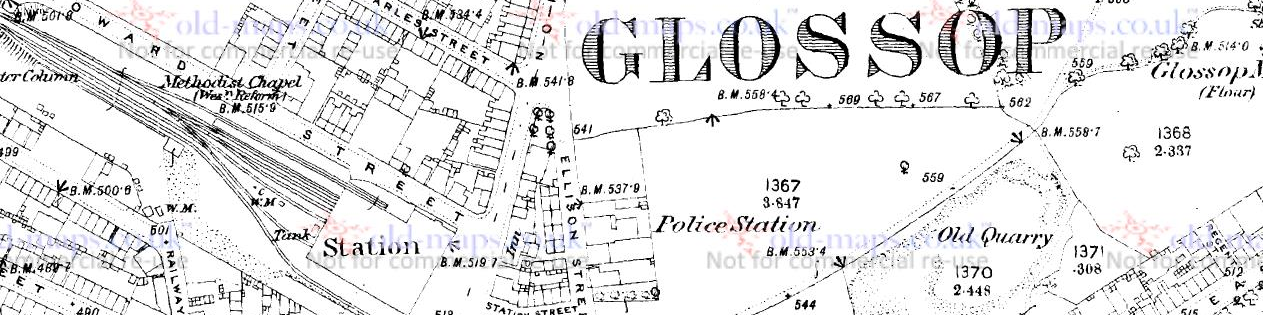
What ho! What ho! And, if you’ll permit me… What ho!
As promised… some pottery! Ahhhh, the screams of joy and happiness that accompany those words, always a pleasure to hear. The swearing is a bit off, but there is no accounting for some people. And the personal threats of violence are a bit much. And I think the man who appears to be forming some sort of one-man angry mob, complete with flaming torch and pitchfork, is a bit doo-lally… poor chap.
Pottery. We haven’t had too much of this lately, sadly (yes, thank you Mr Shouty-Outy… we know what you think only too well), and so here we are with a random selection of pottery sherds. I love this stuff so much; each sherd is a tiny fragment of the past, a tangible link to a long-gone world, and a tactile reminder that the past is all around us – we just need to look. And look I do, to the detriment of my back… old hunched Richard III they’ll call me soon enough (and yes, Mr Shouty-Outy, I know you have been calling me a Richard III for years, and yes, I too know rhyming slang).
Anyway, enough of the unpleasantries , on with the sherd-show!
First up, a small sherd from Derbyshire Level. Just by the urn-off for Brownhill Farm, they had dug a new manhole for the electricity or telecoms, and had disturbed some soil in doing so. Well, never looking a G H in the M, I looked to see what I could see, if anything. And lo… something! A sherd of Manganese Mottled Ware presented itself.
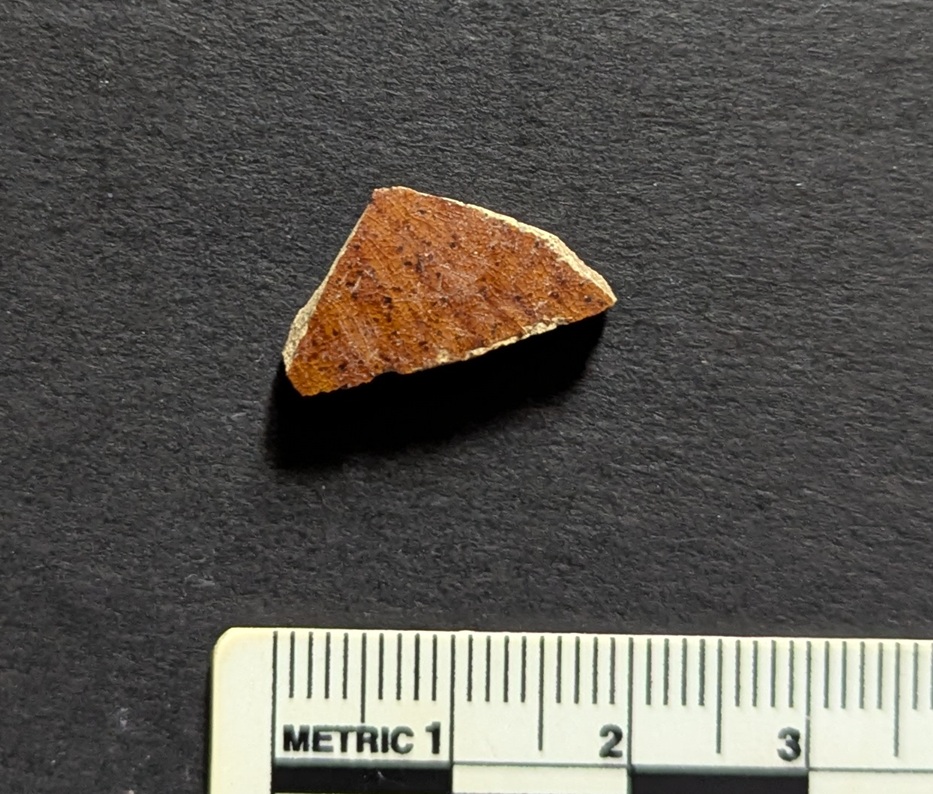
Absolutely lovely, the mottled brown surface produced by the manganese glaze melting in the kiln. I’ve talked about Manganese Mottled Ware in the Rough Guide to Pottery (Part 7 – here), and I think this sherd is part of the belly of a cup like this one:
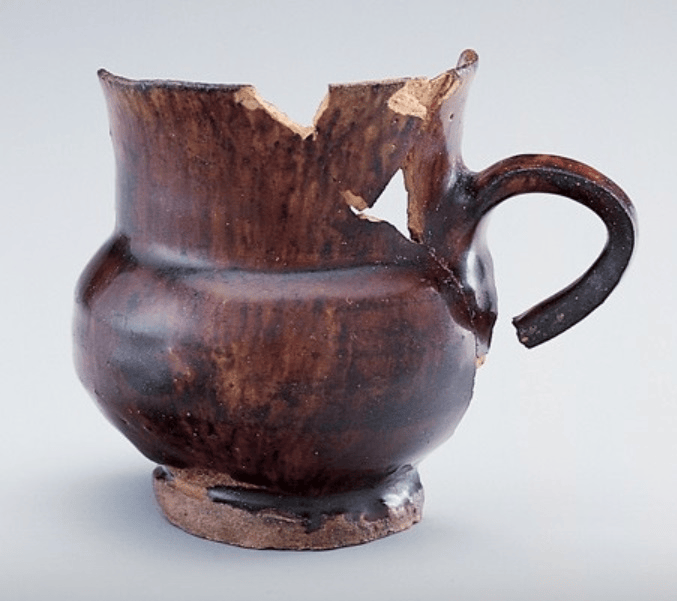
Dating to the early 18th century (1700 – 1720ish), it is small, very refined, and quite lovely. People often ask how I know how it is not more modern (and the Victorians did use manganese glaze), and I respond that it is all in the fabric – the meat of the pot, rather than the skin, so to speak. In the Victorian period, the fabric is always white, whereas the earlier stuff (mid 17th to mid 18th century) is always a yellow, cream, or very pale brown colour, and often with red or brown inclusions within it. It’s very characteristic, once you know it, and I wish I had a better camera in order to show it better.
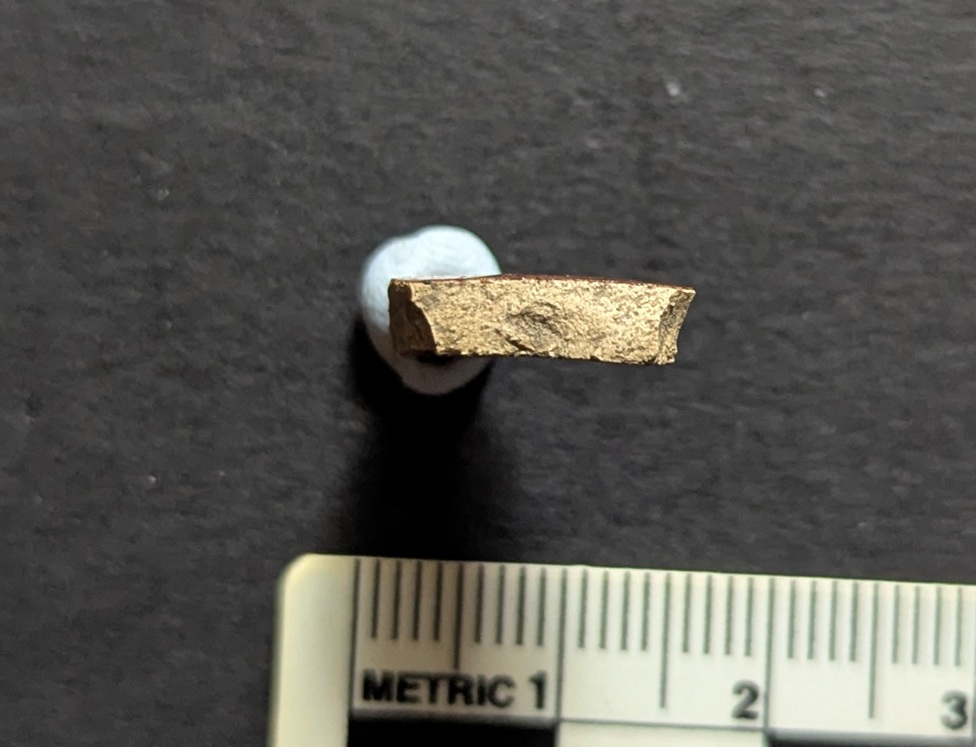
Next to it, amongst the soil. was this odd piece of bronze (or some other form of copper alloy):
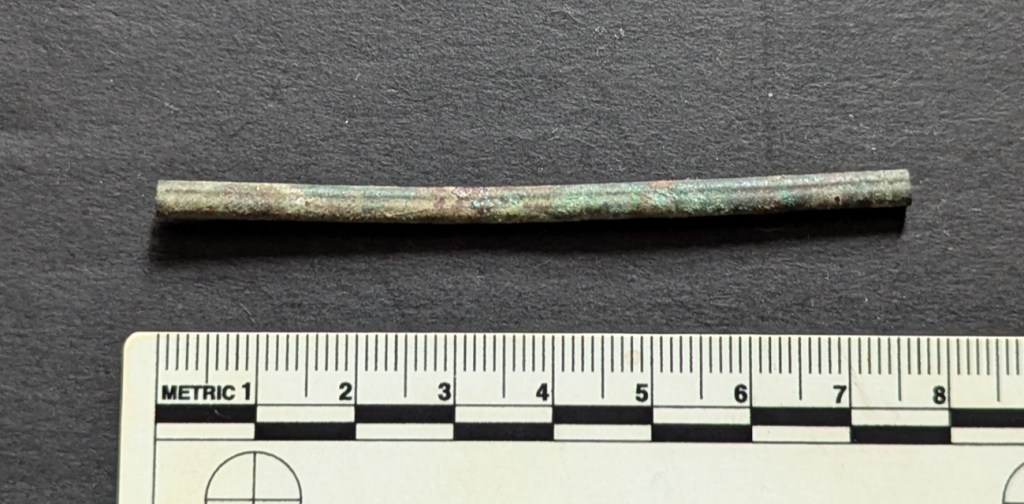
Thin, hollow, and vaguely peanut shaped in section, I have no idea what it is. It’s heavy – probably due to the high lead content in the bronze, which also suggests it is quite old; that and the fact that people didn’t use bronze for very much past the 18th century. The ends seem to be finished and smooth, so I don’t think its the shank of a spoon or similar that has broken off, and the surface looks almost as though it was silvered at some stage, but I can’t be sure. Also, the Roman road from Castleton (Navio) passes very close by, and whilst I don’t think it’s that old, who knows? Anyone any ideas? Let me know.
Sticking with Manganese Mottled Ware, here is a sherd from the site of Whitfield Green Farm:
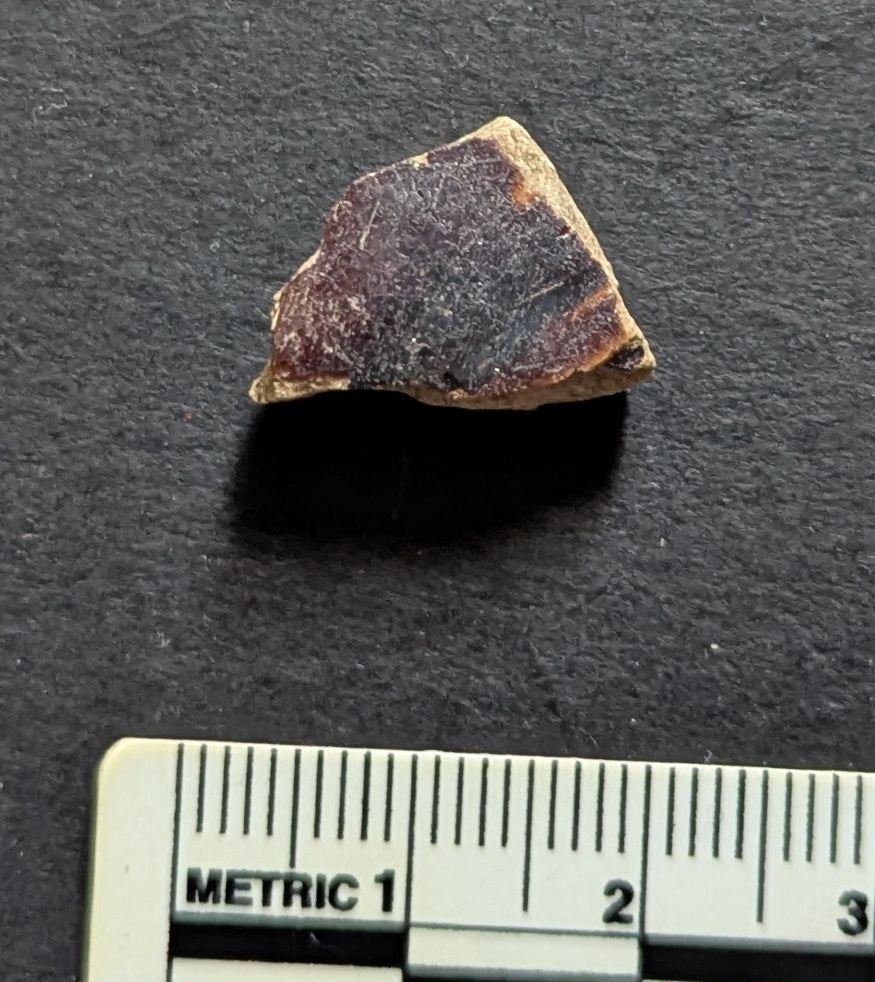
A body sherd from another mug or cup, similar to the one above, and of a similar age – late 17th or early 18th century. Also from Whitfield Green Farm (the track to Lean Town), and of a similar date, is this pile of sherds, some of which I glued back together to rebuild this base to a large pancheon
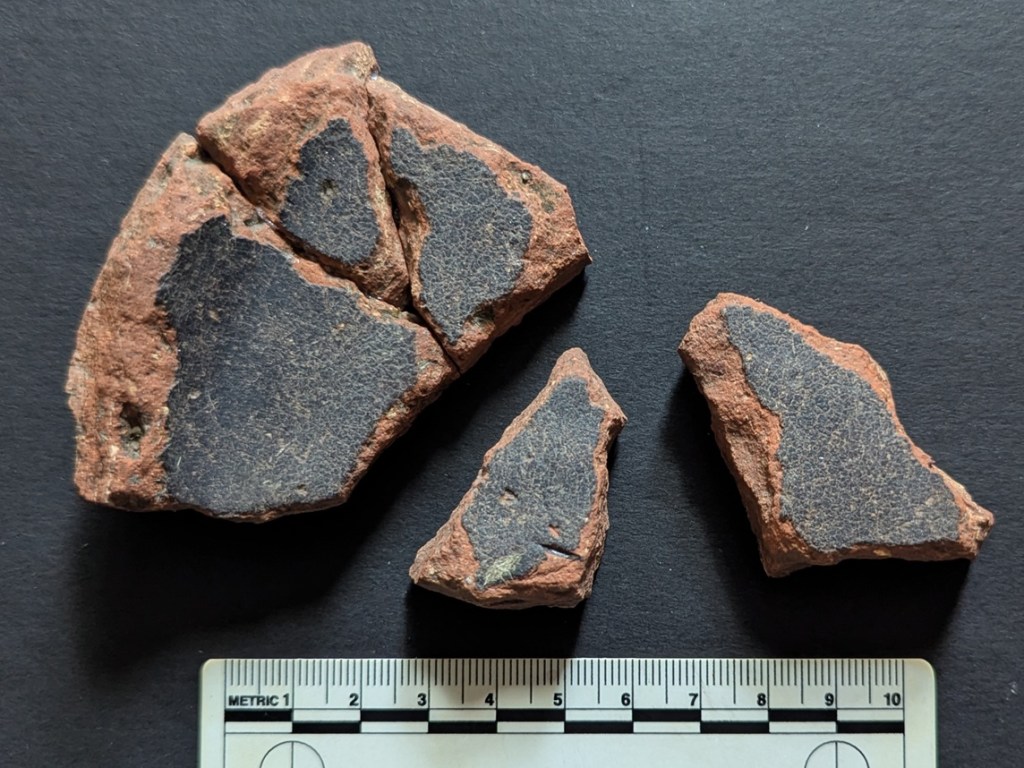
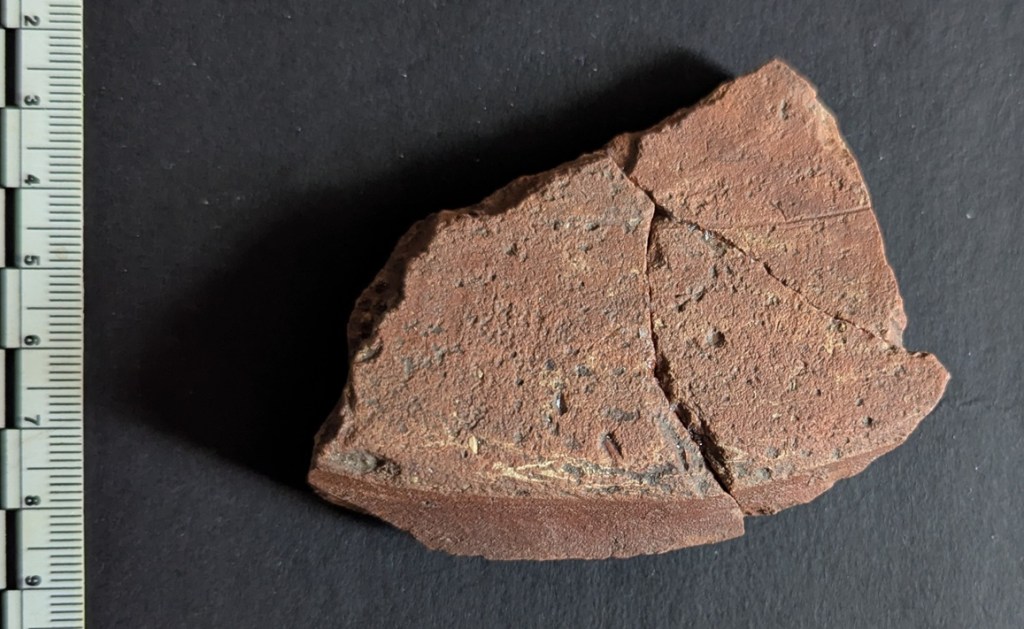
You can see from this photo that the exterior is slipped in a red, but not glazed, and the base also has a string mark where it was removed from the potter’s wheel. The clay also has that characteristic brown and cream marbling that I talked about here. The pancheon has a base diameter of 30cm or so…it’s huge!
Sticking with the Black Glazed pottery, we have a few sherds of late 17th or early 18th century pottery – those thick bands where it was turned on the wheel are a bit of a giveaway.
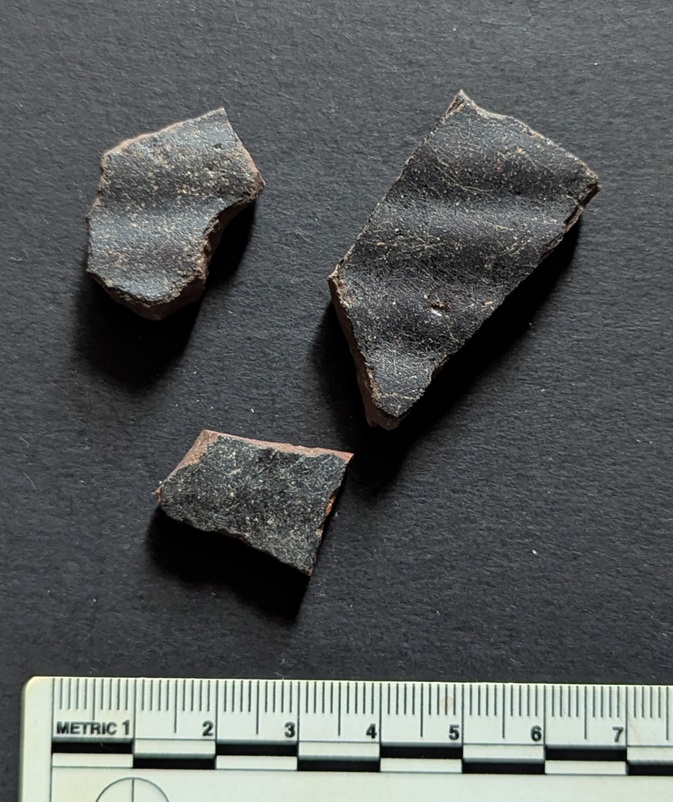
It’s almost Cistercian Ware, but later – an evolved form, if you will – and it has a very hard, almost vitrified fabric, with small inclusions, which also recalls the 17th century stuff.
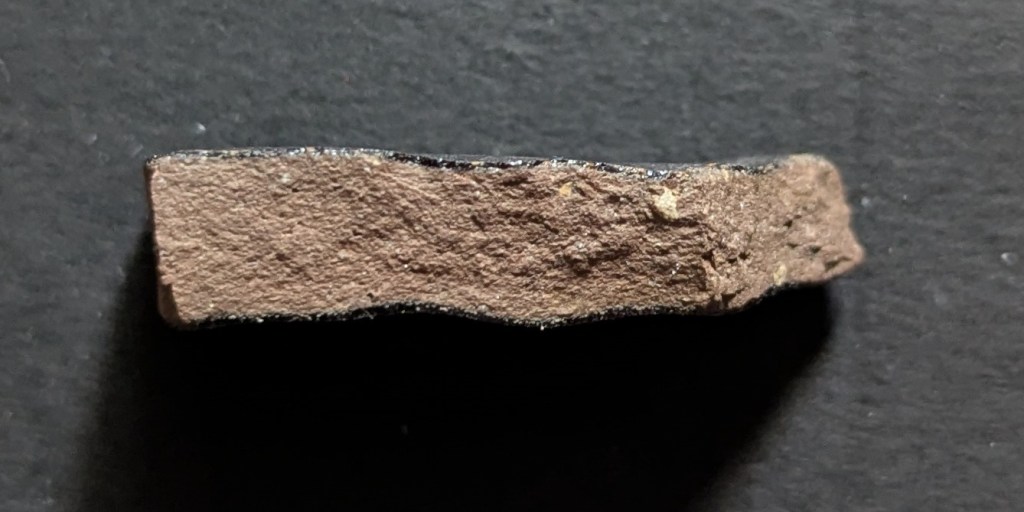
It’s early, I know that much, and is from an open bowl type vessel.
Here is a fragment of a clay pipe bowl I found in a field just of Derbyshire Level:
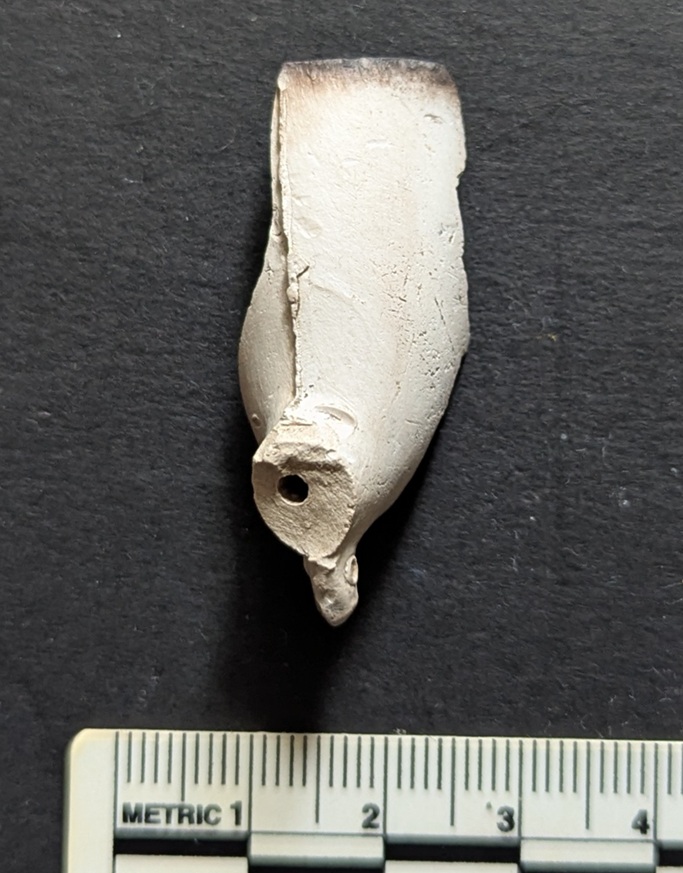
It’s very roughly made, and is early to mid 19th century in date, according to the charts shown here, and looking at the inside, you can see where the tobacco had burned the surface, which I find wonderful:
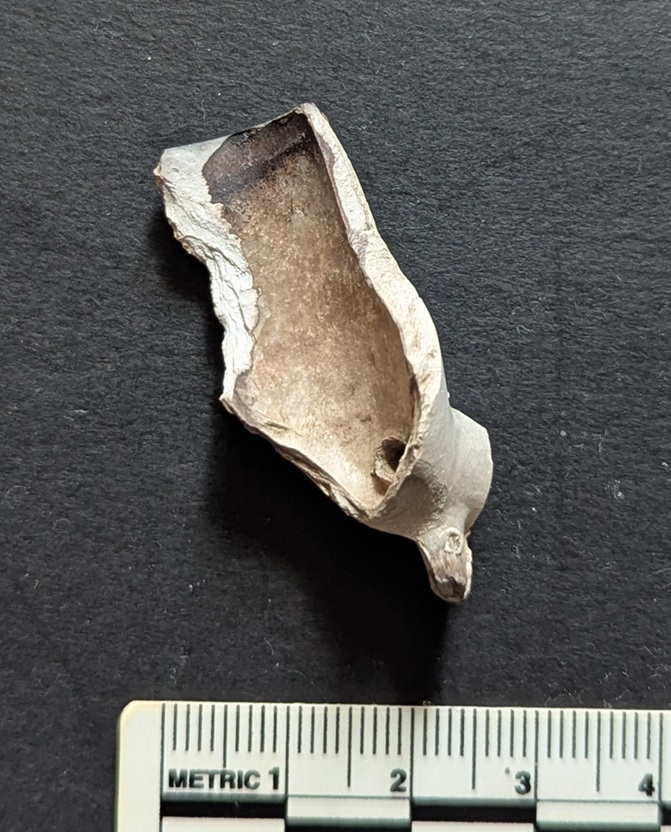
You can also see where the wire has pushed through the stem to create the hole through which smoke was drawn. I have tried to recreate what it would have looked like, with a slight forward tilting angle.
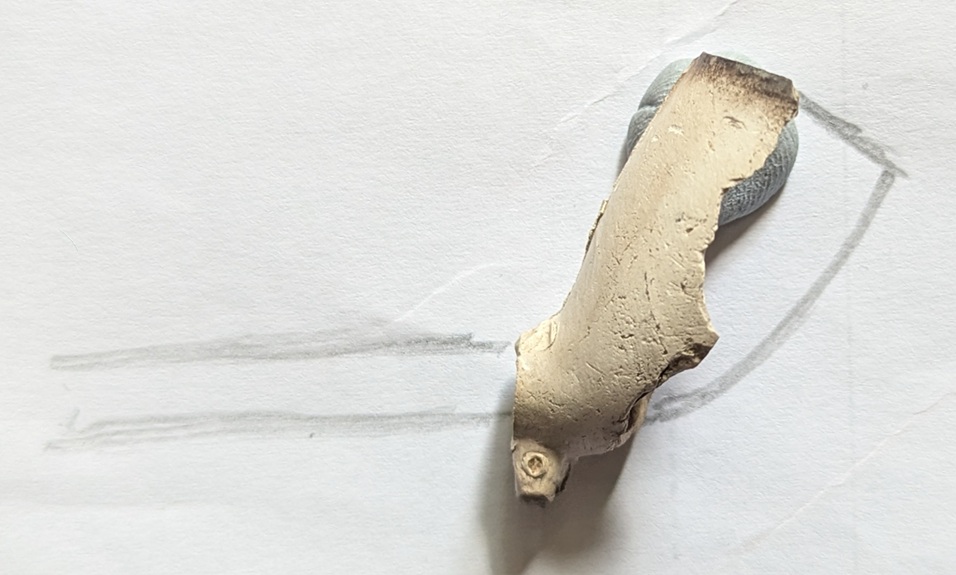
Not perfect, but it works… I think (I might have to change the image!)
Next we have a wonderful sherd of early Derbyshire Stoneware, found on the footpath across the field to the east of the graveyard of St Michael and All Angels, Mottram.
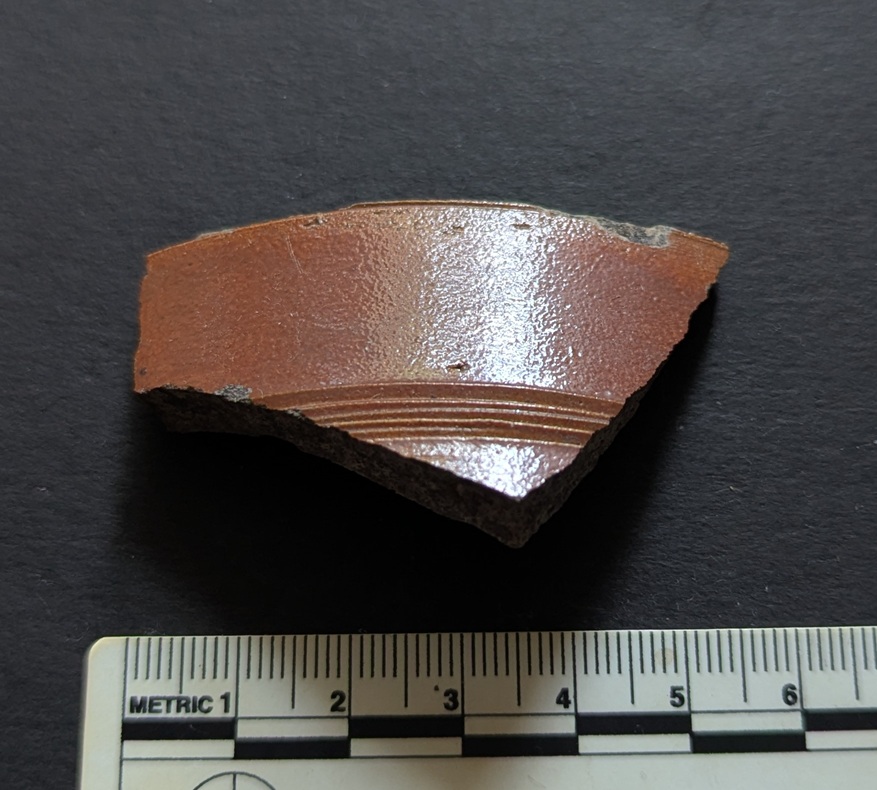
Right, so bear with me here whilst I do the sherd-nerdery, and explain what I mean by that. So, the earlier Nottingham Stoneware (c.1700 – 1800) is characterised by a chocolatey-brown slip, and refined shapes, thin walls, fine lathe-made horizontal decorative bands on the exterior, and an orange peel skin. This sherd has these features, absolutely, but the glaze is the darker brown of the later Derbyshire Stoneware (much more commonly found), and importantly, the interior is of a cream/grey colour (that is, it has not been slipped in the iron-rich paste that fires to the classic brown colour). This suggests to me that it bridges the gap between both, and perhaps giving a date of 1790-1820, just as production shifts to the potteries in Derbyshire. The shape is a flared-mouth open bowl, with a flat ledge rim, and although much broken, it had a diameter of roughly 18cm, so not large.
Sticking with brown stoneware, are these small sherds:
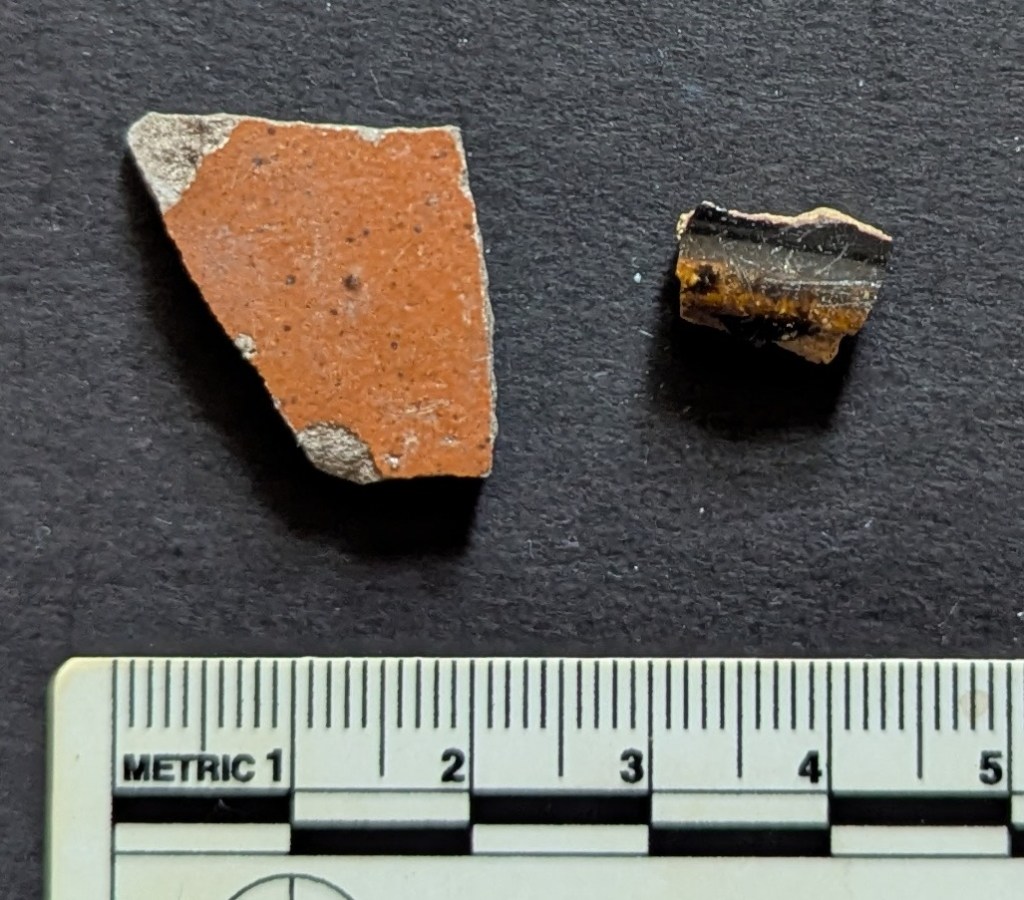
On the left is a bit of similarly aged early Derbyshire Stoneware – late 18th century, or thereabouts. It’s thin walled, and brown on the interior too, so probably an open shape. Not having the chocolate creamy colour of the early stuff, and yet too refined and orange-peeled of surface for the later stuff, it sits in the valley between both.
On the right, another tiny sherd of Manganese Mottled Ware, a body fragment with a horizontal band running around it:
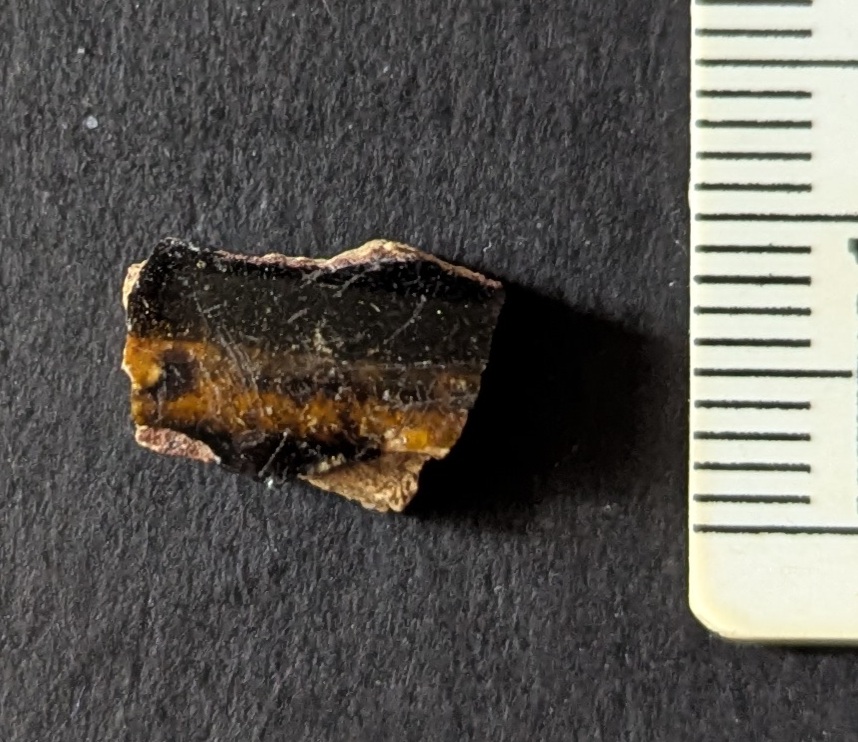
The pale creamy body is the same as that of the above Manganese Mottled Ware, and it is probably from a tankard or jug, as pictured here, from the wonderful Chipstone Foundation:
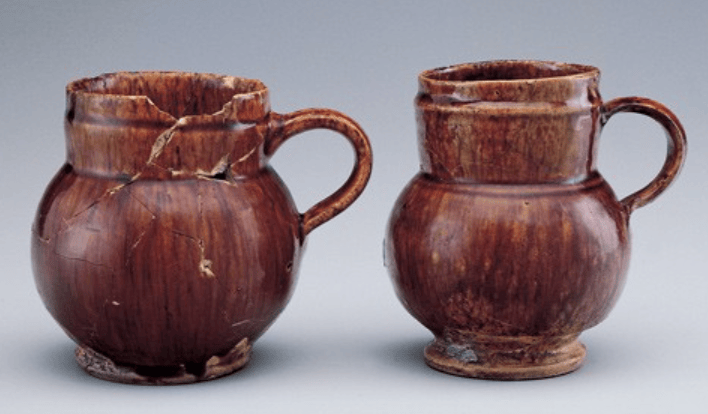
Both of these sherds were found in the soil of a flattened molehill in Manor Park, suggesting that something was happening in that area in the early 18th century – unsurprising, really, and it may be connected with the original Glossop Hall, known as Royle Hall, which was constructed from 1729 onwards. It also backs up my theory that you should ALWAYS CHECK A MOLEHILL, PEOPLE! It honestly is amazing what turns up whilst playing cricket with one’s son – this was found in the middle of our improvised pitch!
Also in Manor Park, by the duckpond, was this tiny fragment:
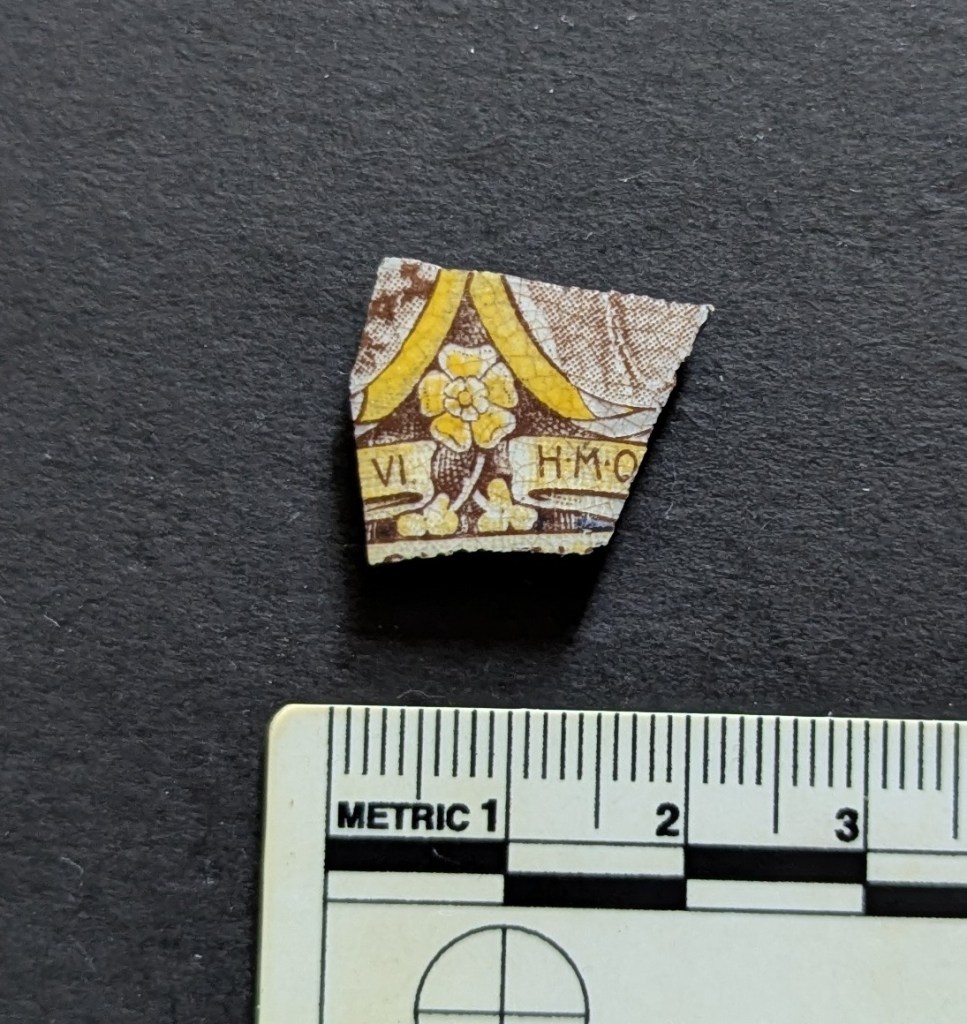
Using the clues in the design, a search online produced this complete version:
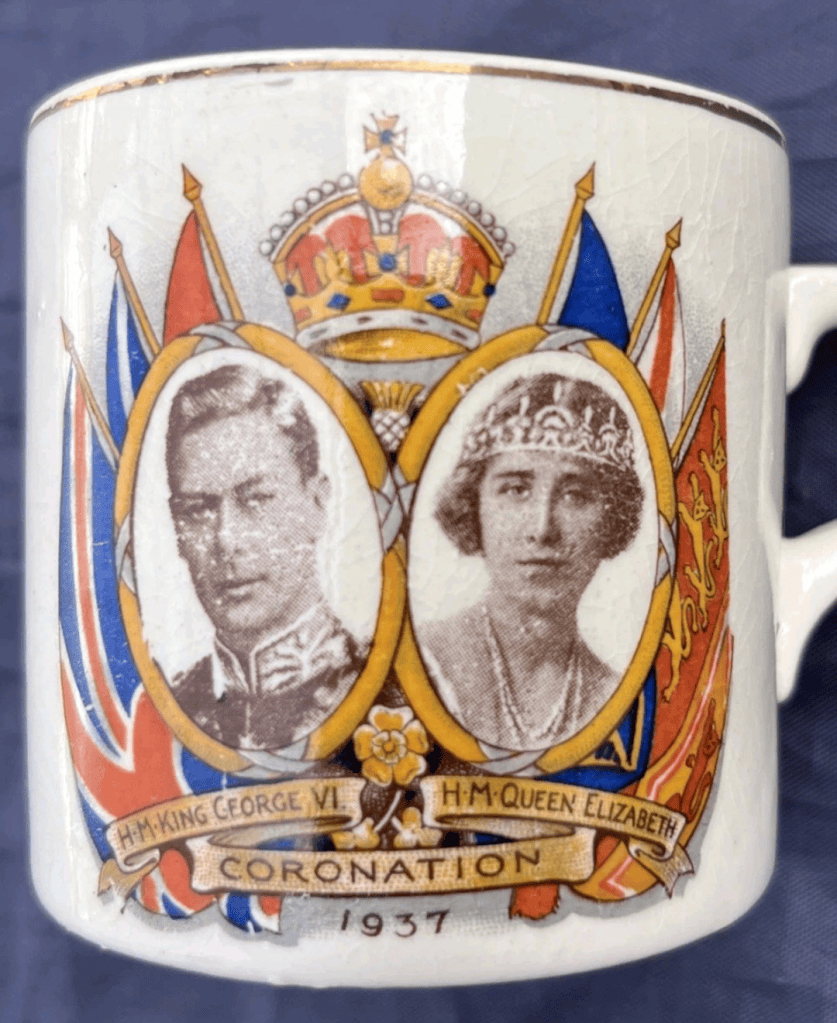
A cup celebrating the coronation of King George VI in 1937, which dates the pile of soil and rubbish in that area, deposited as part of the substantial landscaping that took place here over the years following its conversion from the garden of Glossop Hall to a public park in 1927. Love it, despite it being borderline not archaeology in my mind – only 101 years old.
And to end with, I’d like to shine a little light on Master CG. It is slightly related, in that it includes archaeology, but also… it’s my website! He’s growing up fast (he’s 10… eeeek!), but he’s an amazing young man, and a joy to go Wandering and adventuring with, and he’s also got a keen eye for pottery and other bits, including this lovely bottle. Discovered sticking out of the soil of the woodland path on the way to Hyde swimming baths (and whilst we were looking for conkers), he excavated it quickly, and lo… it was whole. I’m so proud of him – he’s genuinely an absolute corker!
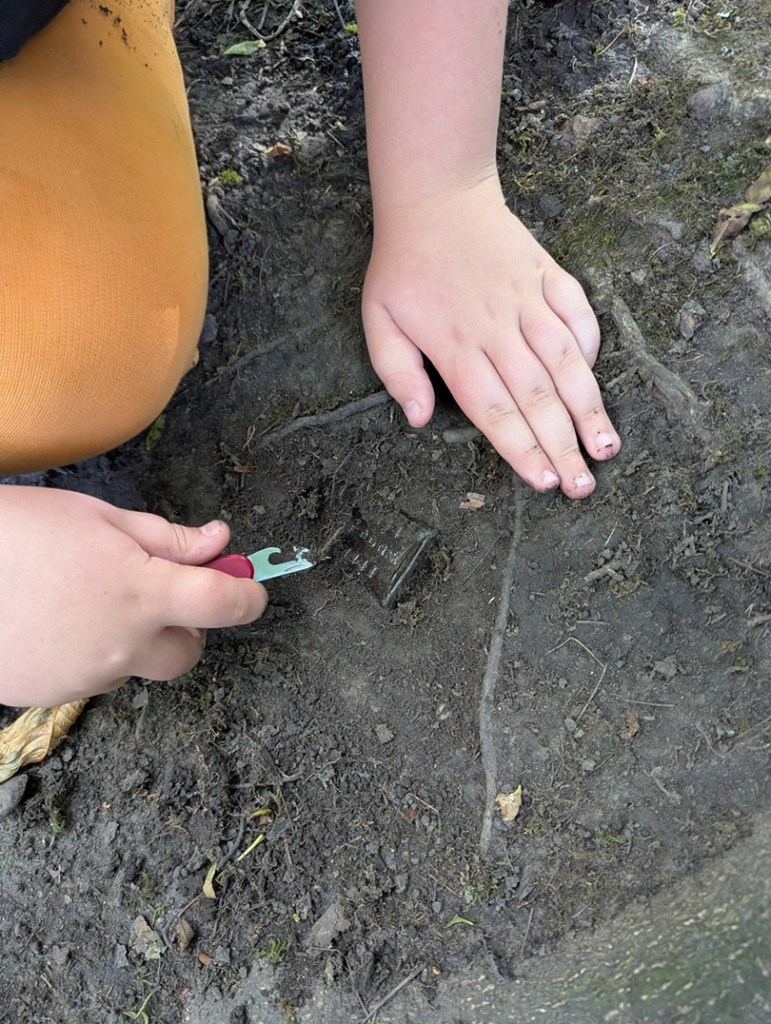
A small ‘teaspoons’ bottle – it has embossed measurements in teaspoons along the side so you didn’t need to measure it actually using a teaspoon.
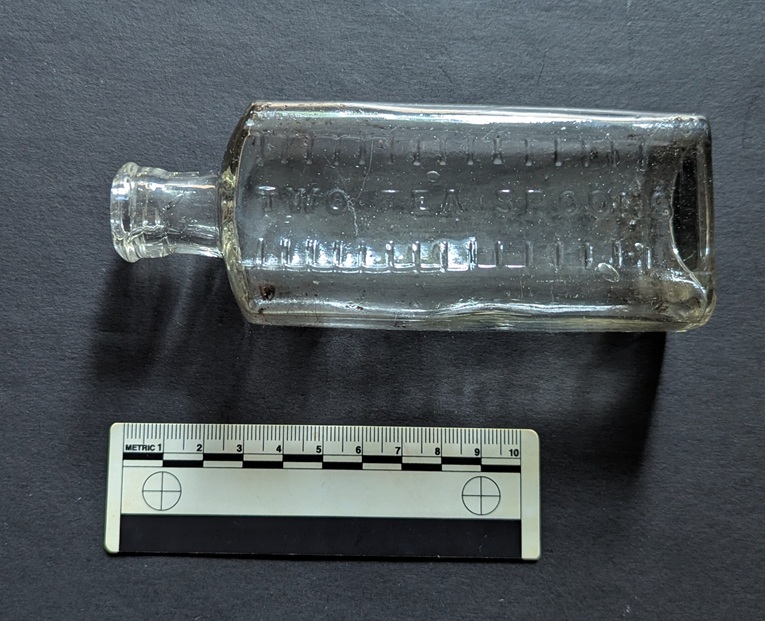
It has some lovely bubbles in the glass, a feature of the manufacturing process – which at this point consisted of molten glass hand blown into a mold, with the neck being shaped and applied afterwards.
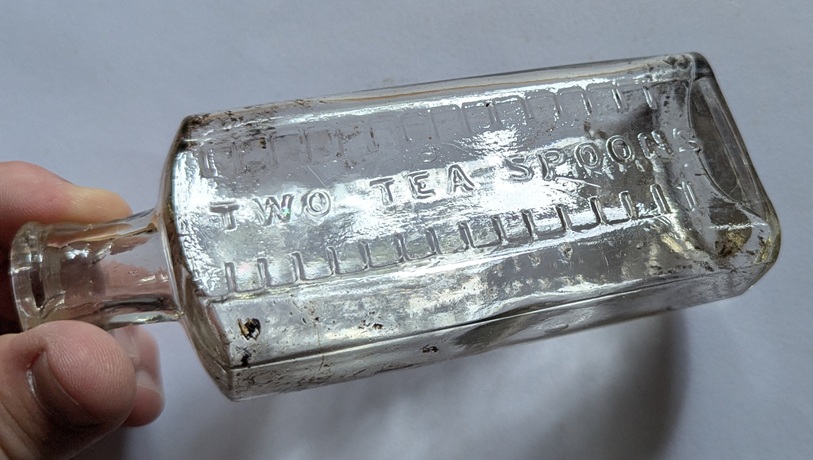
Probably late 19th century in date, and normally used for medicines, the ‘teaspoons’ (or ‘2 teaspoons’, as it is here) bottle is fairly common, but is always a joy to find, and certainly gives me a warm fatherly pride watching my son dig it up so deftly. Amazing stuff! And now… let’s play conkers!
That’s all for now, but more soon, promise. Until then, do look after yourselves and each other – we are all important… even you, Mr Shouty-Outy, even you. Until then, I remain.
Your humble servant,
TCG


Fascinating and I always wondered how they made the stems of clay pipes. We dug many pipe fragments up from our garden on Simmondley Lane.
LikeLike
It’s such a delicate looking thing, the pipe stem, but it seems to have been roughly made in a mould, with a wire shoved through it whilst in place (you can often see the ‘exit wound’ of the wire on the inside of the pipe bowl), and then, when leather dry and prior to firing, the clay ‘flashing’ was trimmed roughly, using a knife. I have disparagingly called the pipe stem the cigarette butt of the 19th century – smoked and thrown on the ground, which is true… but I honestly love them completely.
LikeLike