History · Placenames · Simmondley

The One Glossop… and the Many Glossops

What ho, wonderful folk! Summer is almost upon us, and we enter the finest time of year. Now don’t get me wrong, I’m fond of spring, and autumn is good. Even winter with it’s cold and dark can be lightened and warmed with a good fire and a glass of the stuff that cheers (if taken in the right dosage, as I am often reminded by the good Mrs C-G). But no, ask old TC-G which season he likes most, and the answer will always be… summer. This time of year fills me with a particular joy; it puts a spring in my step, a smile on the old fizzog, and a stirring in the loins (although that’s possibly the onion soup I had for lunch). Summer is indeed ‘icumen in’.

And indeed, it’s the stuff that cheers that leads us to today’s blog post – something a bit different, but fret not dear and gentle readers, for when have I ever steered you wrong?

I wonder then have you ever found yourself, glass in hand and perhaps swaying slightly, in a place to which you never set out to journey? I certainly have (and no, not that Turkish bordello… for the last time, I was only in there to ask for directions to the post office). No, a chance encounter with a place, perhaps exotic, otherworldy, strange and alien, like no other place on earth, and yet familiar? A few months ago I found myself, quite by accident, in The Globe pub quiz (and good evening JS!). It was a difficult quiz, and involved much mashing of the old B, and a distinct straining of the dashed M… if you catch one’s meaning.

But one question in particular flummoxed me: “How many Glossops are there?”.

I mean, there’s an existential crisis… what? Why surely there is only one? The singular, unique, one-of-a-kind place that we call home. This royal throne of kings, this scepter’d isle. This earth of majesty, this seat of Mars, this other Eden, demi-paradise. This fortress built by Nature for herself against infection and the hand of war. This blessed plot, this earth, this realm. This Glossop. (ok, I might have had a bit of help with the words there… my thanks to William what’s-his-face).

But no… apparently there are three. Who knew? Well, the quizmaster did. And several of the other teams did, apparently. But I bloody well didn’t. Not that I’m bitter or anything. And besides, none of the other teams could answer any of the questions in the ‘Pottery Identification’ round (alas, if only such a wondrous beast existed… one can but dream). 

So then, two other Glossops… blimey, there’s a thought. What wonders could these places offer us, what unearthly delights akin to the Globe quiz? Well, dear and gentle reader, let’s find out.

Introducing Glossop Number 2

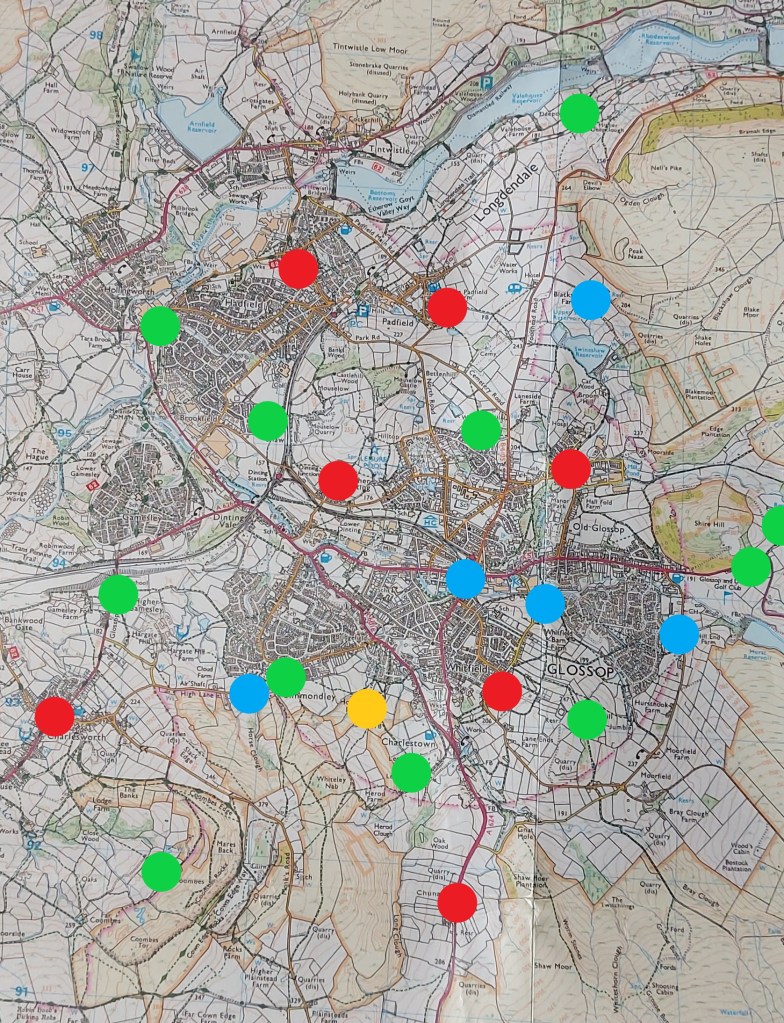
Where the red pin is, lies another Glossop, on the other side of the world.

Glossop, South Australia. A town roughly 250 miles north east of Adelaide (and just a mile or so north of the splendidly named township of ‘Winkie’). It’s a small place, with a population in 2016 of just 984 (compared with our Glossop’s 33,340 in 2021), mainly rural, and surrounded on all sides by vineyards – it’s right in the wine growing region, lucky people! (and presumably then the weather would be a tad warmer than that found in our corner of North Derbyshire!).

I am in awe of its triangular shape!

It was founded in 1921 as a settlement for returning soldiers, and is named after the equally splendidly named Vice Admiral John Collings Taswell Glossop (if anyone knows their Jeeves and Wooster, this could be Tuppy Glossop’s uncle). Vice Admiral Glossop was in command of HMAS Australia during the First World War, and was very active in the Royal Navy’s Australian wing.  

A little different from High Street West, this is Campbell Street, Glossop.

There looks to be some great camping and hiking to be done in the area, and there are several national parks based around the Murray River there. That stated, there’s not a lot more to say about the place, to be honest, but do feel free to have an explore on the internet, or in real life (oooooh, a tour of the wine country could be fun!). If you live in Glossop, Australia, and have stumbled upon this site, then please let yourself be known – we’d love to hear from you. 

But wait, there’s more!

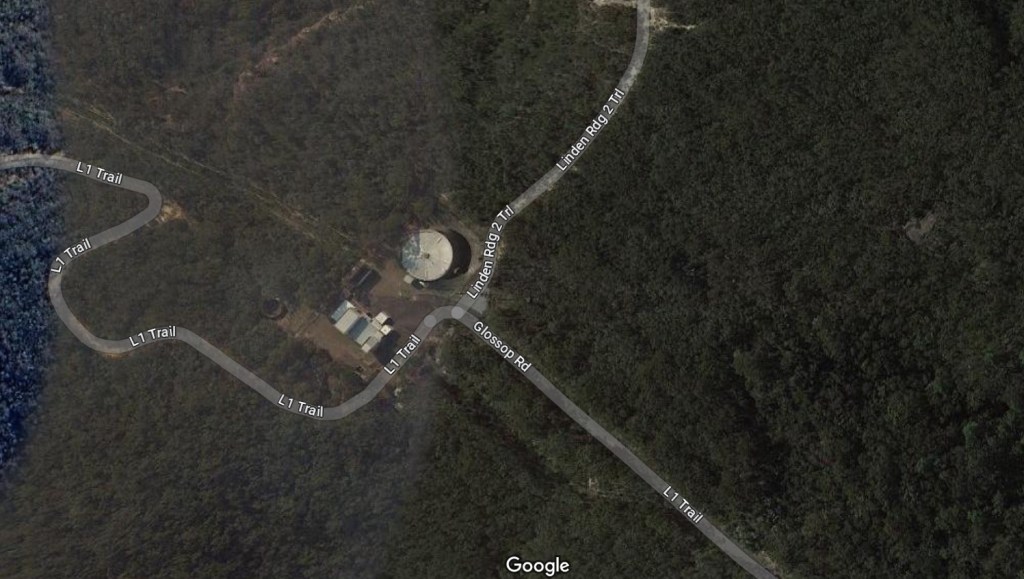
In New South Wales, Australia, there is a Glossop Reservoir. Situated near to the village of Linden, 40 miles NW of Sydney, it’s located at the end of Glossop Road, and absolutely smack dab in the middle of nowhere.

Glossop reservoir is the round thing at the end of Glossop Road.

I wonder why they have the name Glossop? Perhaps also connected to our man Vice Admiral Glossop? There is no more information I can find out about this place at all, so any information you have would be gratefully received.

And now for Glossop Number 3.

Will this Glossop be a throbbing metropolis? A mecca of marvelousness? A seething mass of humanity? A place of culture and wonder, or a modern-day Sodom and Gomorrah? Well, not exactly…

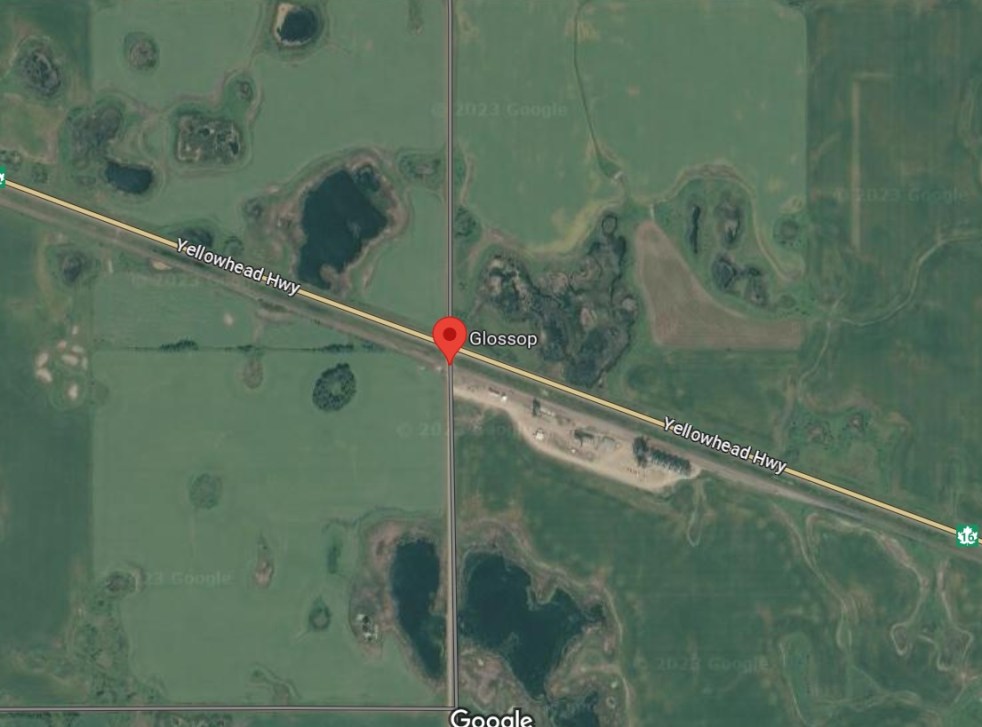
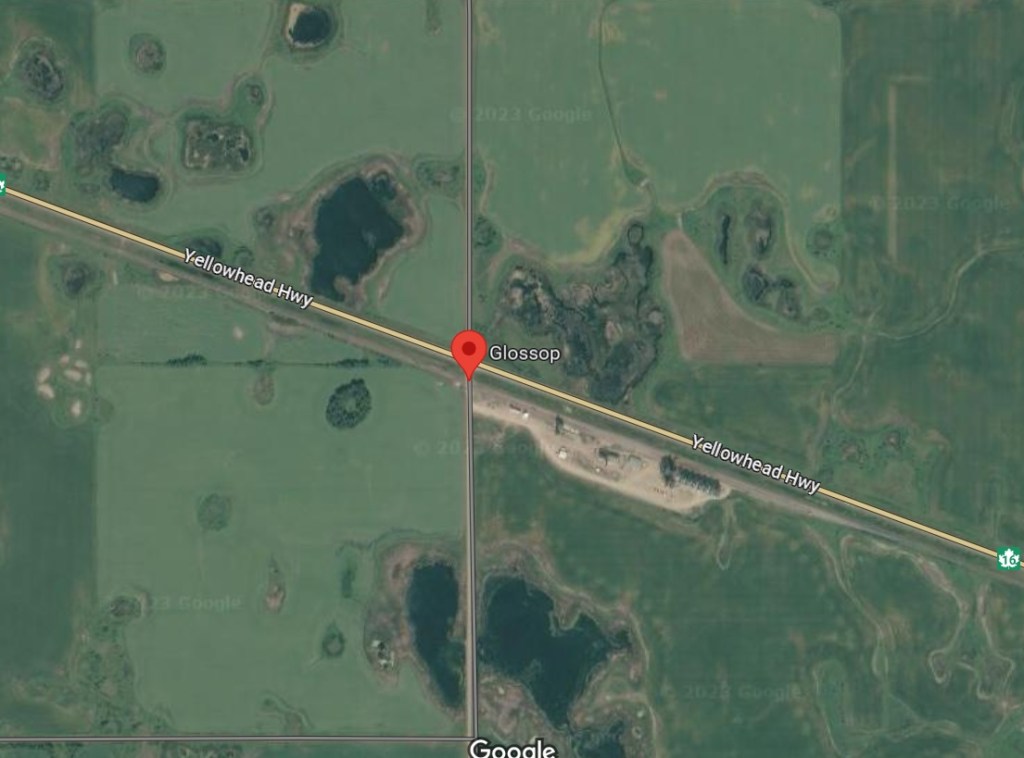
Ladies and gentlemen, welcome to Glossop, Manitoba, Canada.

What wonders await under that red pin?

Well, what can we say about Glossop, Manitoba.

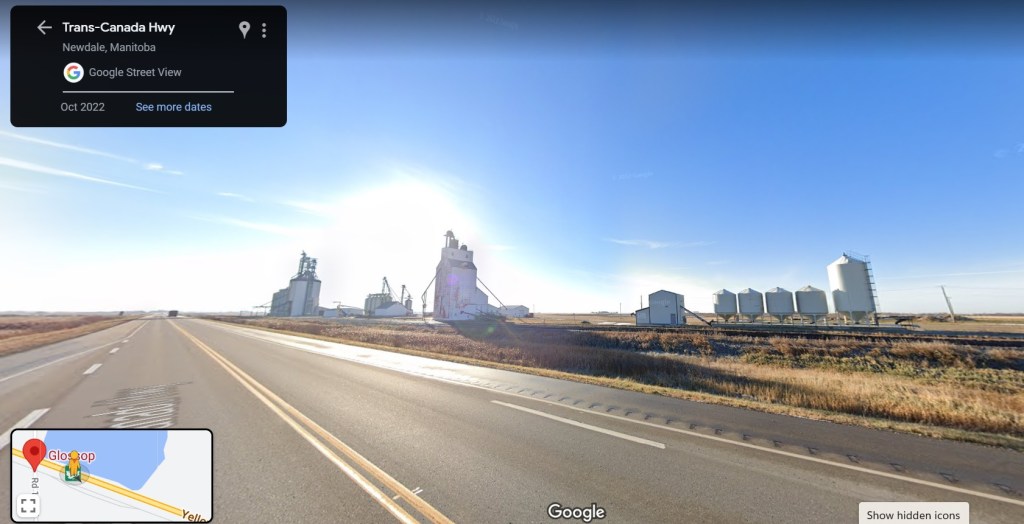
Well, no matter how you feel about Glossop, Derbyshire, it has something going for it. And as small as Glossop, South Australia, is, it has life… in that people actually live there. Glossop, Manitoba is… well… a road, next to a rail track. With some grain elevators on it.

Glossop, Manitoba… what can I say?

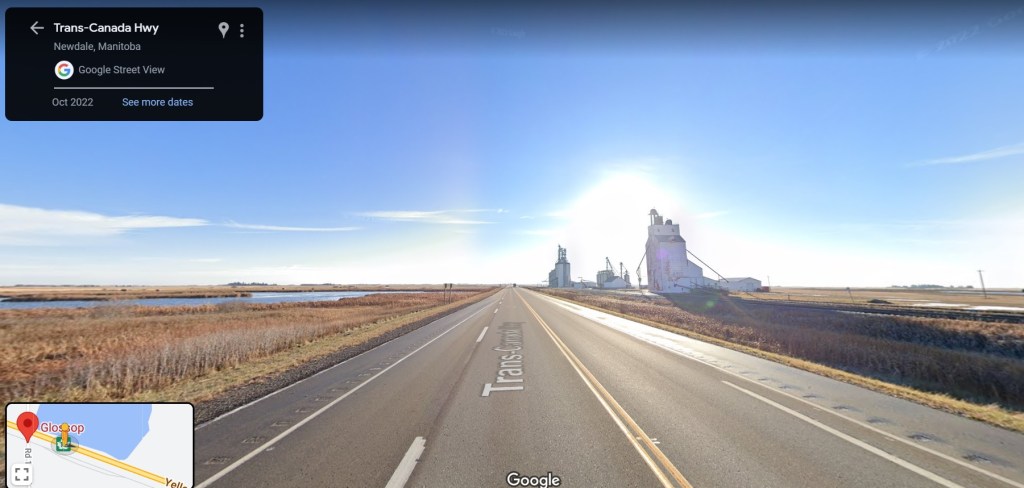
There must be something nearby… surely. Let’s look down the road:

Nope, nothing this way, let’s look behind us…
Nope, nothing.

What we can say is that it is situated 604m (1982ft) above sea level, is on the trans-Canadian Yellowhead highway, and is broadly equidistant between the settlements of Newdale and Strathclair… both of which seem to be quite nice, if on the small size (population “perhaps 200” and 709 respectively). What we can’t say, however, is why this place has the name Glossop, although presumably it’s named after someone with that surname.

However, a little more digging and… it turns out the grain silos are interesting.

Copyright Steve Boyko, and borrowed from this website.

Well… ok, let’s be honest for a moment, anyone who has ever read anything on this website knows that the word ‘interesting’ is very flexible (and honestly, we have stretched that word to the limit on this site), and I’m painfully aware that my particular niche interest doesn’t ring everyone’s bell. But even by our own relaxed standards, these grain elevators aren’t exactly riveting. However, this is exactly the sort of thing the internet was invented for – people with niche and minority interests meeting each other and sharing information – after all I’m here writing this, and all six of you (including Pablo in Puerto Rico… hola Pablo!) are out there reading it. The website ‘Grain Elevators of Canada’ has a whole page dedicated to those at Glossop, Manitoba, but I’m not going to steal their thunder, instead please do go and have a look at it.

But wait, there’s more…

Some 350 miles north east of Glossop, Manitoba, is Glossop Lake.

Even by Canadian standards, this place is in the middle of nowhere: 40 miles NE of the nearest settlement (Pikwitonei, population 55), and 150 miles east of Thompson, the ‘capital’ of northern Manitoba (population “fewer than 15,000”). You could only get to this place by hiking for several days, or possibly by boat. It is truly remote.

Which makes it particularly baffling that the only information about Glossop Lake available on the internet are from a Wikipedia page written in Cebuano, a language spoken almost exclusively in the Southern Phillipines… and with no obvious connection with an obscure lake in the frozen north of the Canadian wilds! Bizarre!

So what can we say about Lake Glossop. Well, it’s a shallow lake, situated 200m above sea level, and covers an area of 1.35km2. It is mostly pine covered, and the average temperature for the area is -5… so you’ll probably not want to go skinny dipping any time soon. There is neither a photograph, nor an explanation as to why it is called Glossop Lake, though presumably again named after a person.

So there we have it – the many Glossops of the world. I’d like to do a roadtrip to find these places, but honestly… that seems like a lot of hard work for very little reward! However, if anyone is going to any of the places mentioned, please let me know.

And whilst this post is not overtly archaeological, it does have some relevance. Gamesley, Simmondley, and even Glossop itself are all named after people, and all were imposed on the landscape by Anglo-Saxon settlers. What the native British (the ‘Celtic’ Romano British) called the area, if it had one, is lost to us (Dinting being the exception). This habit of naming after people or features in your own language can also be very helpful in identifying settlement patterns, ages, and the origins of the people doing the naming. And here it does get interesting. Simmondley means “the clearing” (or ley) belonging to someone called either Sigemund or Sigmundr. The former is a Saxon name, but the latter, however, is a Norse (Viking) name, and that might be important. I have a pet theory… we know that a small group of Scandinavians were allowed to settle in the hills to the east of Manchester, and there are a cluster of possible/probable Scandinavian names in the Simmondly area: sitch, storth, gate, nab, and possibly others. It makes me wonder if Simmondley’s origins are more Viking than Saxon. Just a thought, but it does illustrate the importance of names in a landscape. I’ll expand on this another time.

But for now, take care of yourselves and each other.

And I remain, your humble servant

TCG

Archaeology · History · Whitfield

Datestones

(And apologies to those of you who have ended up on this website expecting to find an informative article on the seed of the Phoenix dactylifera.)

What ho, magnificent readers! I trust you are all rude health as we stumble toward the season of goodwill and whatnot. I love this time of year, when the cold wind blows, and the… What’s that? What do you mean “get on with it!”. Honestly, the nerve of some people.

Righty ho. Datestones. Who doesn’t love a good datestone? I mean, what’s not to love? A little snapshot of the history of a building, a birth certificate if you will, recording both the date of birth, and, if we’re lucky, the parents too.

Normally, though not exclusively, located above the door, these carved stones preserve the date of construction and the initials of the person or family who paid for its construction. The are by and large the reserve of the aspirational ‘middle classes’ of society; the poor man doesn’t build his house, the rich man has a house that speaks for itself. Indeed, it is a statement to others: I have wealth enough to build this house. They seem to become popular in the 17th century, as the ‘yeoman farmer’ becomes a class of person, that is, a person who owns the land they farm. Indeed, it may be a result of that phenomena, a way of setting themselves apart from the simple tenant farmer, who doesn’t own the land he works. Glossop has several 17th century examples remaining, though many more will have been lost, sadly. They do show up, occasionally, as the one found by Glossop Brook at Harehills Park did, and which was saved and cemented into the brook wall. Interestingly, this example also shows that whilst datestones can be a boon to historians, they can also present problems if we are not careful. They can move easily, and be attached to other buildings giving a misleading date, as is the case there, and at Hall Fold Farm. Also, stones can be put in place to commemorate a rebuilding or alteration to an existing building, causing similar, if opposite, problems.

By the Victorian period it was common to put a date and/or name on a house you built, and a careful look at many rows of Victorian terraces around Glossop will reveal names and dates. With that in mind, I have restricted my research to those datestones that carry a date prior to Victoria’s reign, pre-1837. The following is a table of the ones I know about:

There are 28 datestones in the Glossop area (broadly defined), but there will be more lurking that I don’t know about, either attached to the building still, or lying in a garden. This blog post will concentrate on the examples from Whitfield, as it is turning into a much larger post than I had thought. Plus, in the interests of honesty and transparency… I haven’t got photographs of all of them yet!

Whitfield has some of the oldest buildings in the Glossop area, and although not really much of a ‘place’ now – essentially just a ‘suburb’ of Glossop – it was once hugely important, being built along the Chapel en le Frith to Glossop road. It gradually lost it’s importance with the rise of the mills based down in the valley, the economy here being agricultural. Whitfield’s one-time importance means that we find many old buildings and a number of datestones here. Indeed, Whitfield has more old buildings that Old Glossop, which with its Church and market, was the focus of the farmsteads and settlements of Glossodale. However, important places tend to be subject to more intense rebuilding over time, whereas more minor areas maintain their old buildings. I was going to do a distribution map of the old buildings, but changed my mind for that reason. Still, it’s worth noting that Whitfield underwent a bit of a building boom in the mid to late 18th century.

35 Whitfield Cross.

35 Whitfield Cross was built in 1773 as a farmhouse, and is a Grade II listed building – see here for more details. The narrow coursed stonework and stone mullioned windows are typical of the period.

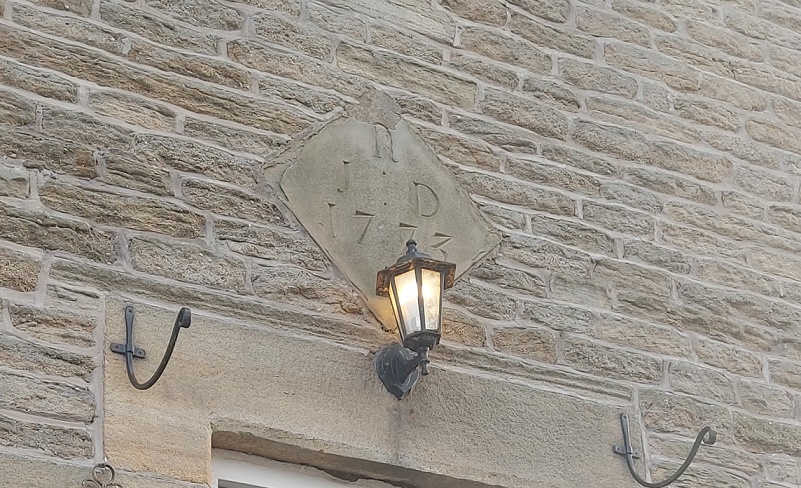
61 Hague Street.

61 Hague Street was also built in 1773, but as a pair of weaver’s cottages, and is also a Grade II listed building. 1773 must have been busy year, and Whitfield was clearly a happening place in the late 18th century. The datestone records the initials R. J. and D. Now, presumably the ‘R’ is the surname (possibly Robinson – the family being quite prominent in Whitfield) with ‘J’ and ‘D’ being the husband and wife who are responsible for the building. I have no information regarding the people, sadly, and any information would be appreciated.

Hob Hill Cottage

Hob Hill Cottage is a remarkable building dating to 1638, making it the second oldest building with a datestone in the Glossop area (after the Bulls Head in Old Glossop, dated 1607). Also built as a farmhouse, and also a Grade II listed building (there’s a theme developing here!), I suspect it might be the source of the lead came and glass, as well as some of the 18th century pottery, I found nearby, although truthfully any one of a number of buildings – existing or long gone – might be the source.

Old School House, Hague Street.

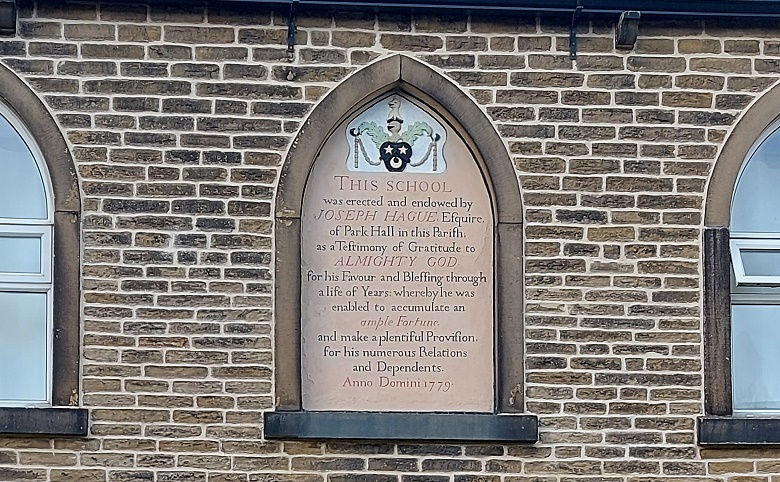
Another Grade II listed building now – the Old School House. Joseph Hague was something of an important man – indeed, the road on which the school (now private residences) sits is named after him. Born in Chunal in 1695, he rose from poverty to amass a fortune selling yarn to weavers and buying back the cloth they produced, to sell on. However, here is not the place for a discussion of his life, or of the school (the Glossop Heritage Trust does that very well here). Let us instead look at the wonderful inscription

“This school was erected and endowed by JOSEPH HAGUE Esquire,
of Park Hall in this Parish as a testimony of Gratitude to
ALMIGHTY GOD for his favour and Blessings through a life of
years whereby he was enabled to accumulate an ample fortune
and make a plentiful Provision for his numerous Relations and
Dependents. Anno Domini 1779.”

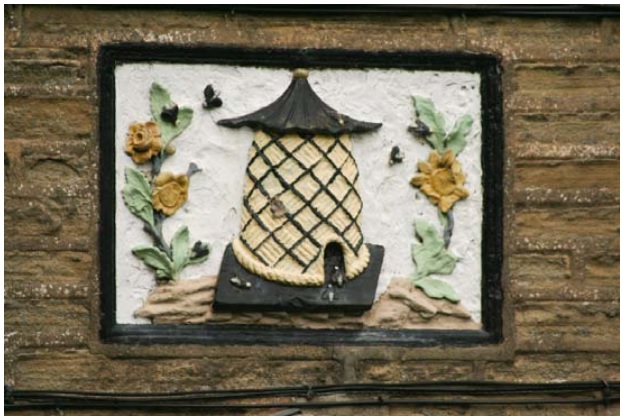
I enjoy the slightly boastful “ample fortune“… well, if you have it, why not? The beautiful carved relief plaque of the beehive over the main door – symbol of productivity and hard work – gave inspiration for the name of the pub over the road. The Beehive pub itself is an 18th century building, with a 19th century front added, and another example of the building boom of the 18th century in Whitfield.

Old School House, Hague Street. The beehive carved in relief, surrounded by Sunflowers, and crawling with characterful bees. I love this.
62 Hague Street

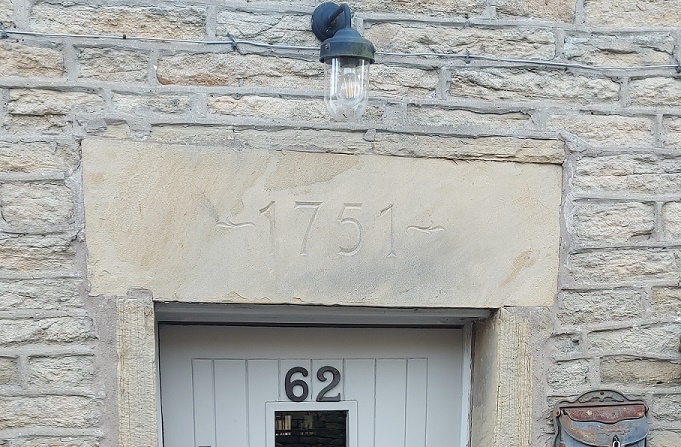
Another Grade II listed building, one of several together, and originally built as a ‘laithhouse’, that is a building made up of a house, barn and byre/shippon in one. It is a late example of the type if the date is to be taken at face value, but there you go… this corner of Derbyshire wasn’t exactly at the forefront of architectural fashion. There is also a bit of confusion regarding 62 Hague Street. As it stands now, there is a simple date of ‘1751′ above the door. However, the listing for the Grade II building notes that “No.62 originally had datestone inscribed RMS 1757” (read the full listing here). The present datestone is fairly modern, carved perhaps to replace the missing stone, but it doesn’t explain the difference in date. I thought it worth mentioning for the sake of documentation and completion.

41 – 51 Cliffe Road

So who was Joel Bennett? Born 11 April 1791 to son of George Bennett and Martha Cooper, he came from a large and important local family. He may have been the same Joel Bennet who was excommunicated from Littlemoor Independent Chapel in 1828 for “disorderly walking and impenitency” (source is here). I’m unsure of what is meant here by “disorderly walking”, but given the hotbed of radical religion that was Littlemoor, one assumes it wasn’t the Georgian equivalent of Monty Python’s Ministry of Silly Walks. He may also have bought Kinder Lee Mill in Chisworth with his brother James in 1823.

House at the bottom of Cliffe Road (4 Cross Cliff?)

This house, set back from Cross Cliffe almost at the bottom, has a wonderful datestone: stars, wheatsheaves, and a Masonic compass, with the letters ‘R’ ‘R’ ‘O’ and ‘S’. Actually, is that an ‘O’? Or perhaps a flower? I have no information about the place, nor the letters (Robinson again?), and one cannot simply knock on a door and say “What-ho… tell me about your house”. One tends to get stared at, with vague mutterings about “setting the dogs on you”, and “lunatics disturbing the peace”. Alas. If anyone has any information about this house, or indeed any of the houses, drop me a line.

Also, and seriously, if anyone knows of any more datestones that aren’t in the above list, and which date from before 1837, then please let me know. I’ll credit you, too, so you can be famous… to all 11 of you who read the blog (including Juan in Venezuela).

Oh, and some news. I’ve been working on the Glossop Cabinet YouTube account recently, and hopefully will be producing videos of me finding bits and pieces, mudlarking, talking archaeology, exploring, playing with pottery, and much more (can anyone else hear that groaning noise every time I mention pottery?). So if you like the blog, then you’ll love this. I’ll post a link asap.

Also, I’ve recently set up a Ko-Fi account which allows you lucky folk to ‘virtually’ buy me a drink if you wish. There is no pressure to do so, obviously; I do the blog because I enjoy doing it, and am constantly amazed that other people enjoy reading it (which is reward enough, it really is). However, if you do fancy buying me a pint to say cheers, I’ll never say no – please click this link, and mine’s a red.

That’s all for now I think. I’ll post something else before Christmas, possibly pottery related, you lucky lucky people (there’s that noise again). But until then, I remain,

Your humble servant,

RH

Dinting · History · Nicholas Garlick

The Blessed Nicholas Garlick – Glossop’s Almost Saint

What ho, gentle readers! I trust you are all well in these trying times?

I’ve been wanting to make this post for a while, but I’ve only recently got round to doing the research. And my, it is a fascinating story of a turbulent period of history, and of a person who is much less well known than he ought to be – Glossop’s own almost saint, the Blessed Nicholas Garlick. Why I say ‘almost saint‘ will become apparent, but here is a man who died a martyr, is venerated as such within the Roman Catholic Church, and yet – outside of St Mary’s Roman Catholic church here – he is little known about in Glossop. So, exactly 433 years to the day after his brutal death, read on.

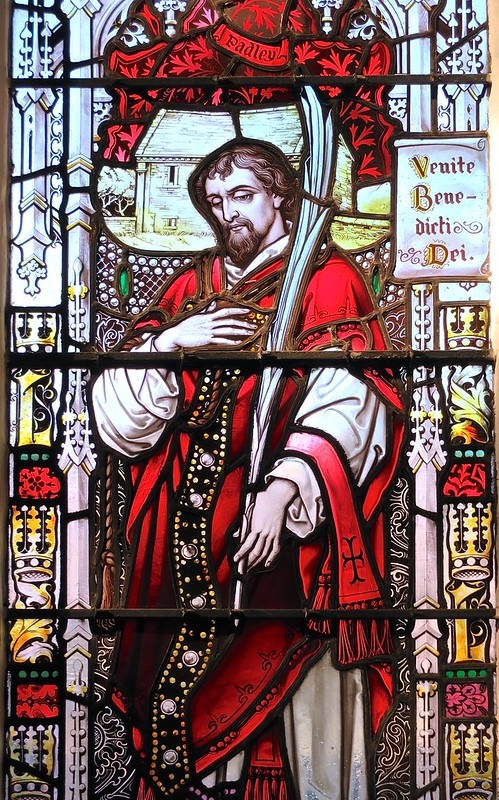
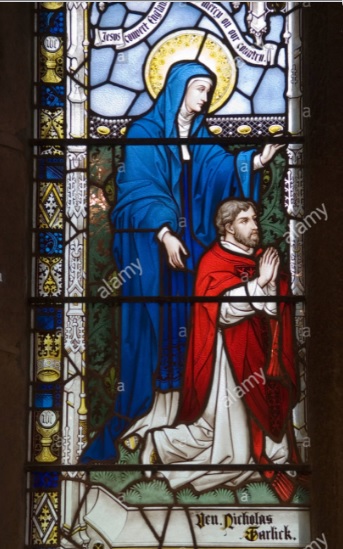
The Blessed Nicholas Garlick. This stained glass window is in the Lady Chapel of St Mary’s RC Church, in Derby.

Nicholas Garlick was born in about 1555 in Dinting, specifically in the hamlet now known as Higher Dinting, here:

The hamlet of Dinting as it was, one of the original settlements that made up Glossop.

Dinting is one of the oldest parts of Glossop. It is mentioned in the Domesday Book (I discussed it in a previous post – here), and I find it fascinating that somebody has lived on this very spot for at least 1000 years. The original Robert Hamnett notes that the Garlicks are an old family in the area, and the isolated hamlet was their home until relatively recently. Indeed, it is still quite a common surname in the Glossop area, and would seem to be chiefly associated with this part of the world.

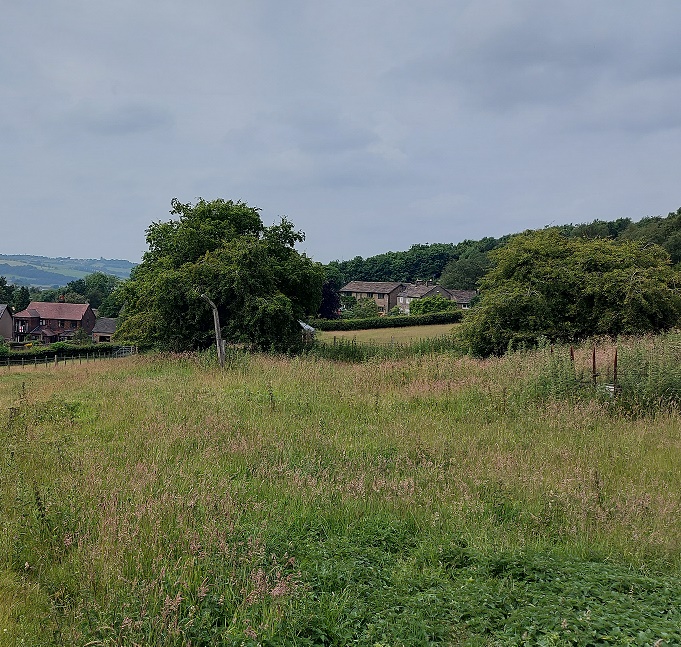
The hamlet of Dinting, nestled into Mouselow.
Dinting closer up. Surviving 17th and 18th century buildings cluster round this distinct place, far removed from what think of as Dinting – essentially the arches and the railway station.

Garlick was clearly an intelligent man and went to Oxford University, entering Gloucester Hall (now Worcester College) in January 1575. However, he lasted only 6 months at Oxford, and never graduated. Given what we know of his later actions, it is likely that he refused to take the Oath of Supremacy – something as a student he would be required to do – and was therefore dismissed. The Oath of Supremacy meant swearing acknowledgment that the monarch (Elizabeth I at the time) was Supreme Governor of the Church of England – something that a devout Roman Catholic simply couldn’t do, as he would have recognised only the Pope as the head of the Church. And here is the rub; Nicholas was a Roman Catholic in a time when Roman Catholics were mercilessly persecuted.

From 1533 onwards, Henry VIII’s ministers, led by the king himself, systematically dismantled the Roman Catholic faith in Britain, and replaced it with Protestant Christianity in the form of Anglicanism, and the Church of England. This was forced on the people, often against their will and under great duress, and much of what they had believed in prior to this was now declared ‘wrong’. I think it is difficult to overstate the effect that this would have on people, as the fundamentals of their religious world, that shaped their lives and structured their year, were upturned. Even simple things such as Mass now being celebrated in English, not Latin, or that praying for souls in purgatory, often loved ones, was pointless because there was no longer a purgatory. What was the simple man or woman to make of that? By the time Nicholas was born it was theoretically possible to be a practicing Roman Catholic, although you were known as a ‘recusant’ (somebody who refuses, in this case refuses to attend Anglican services), and were subject to heavy fines and social stigmatisation. However, the celebration of Mass in Roman Catholicism requires a priest, and both were expressly forbidden under pain of death.

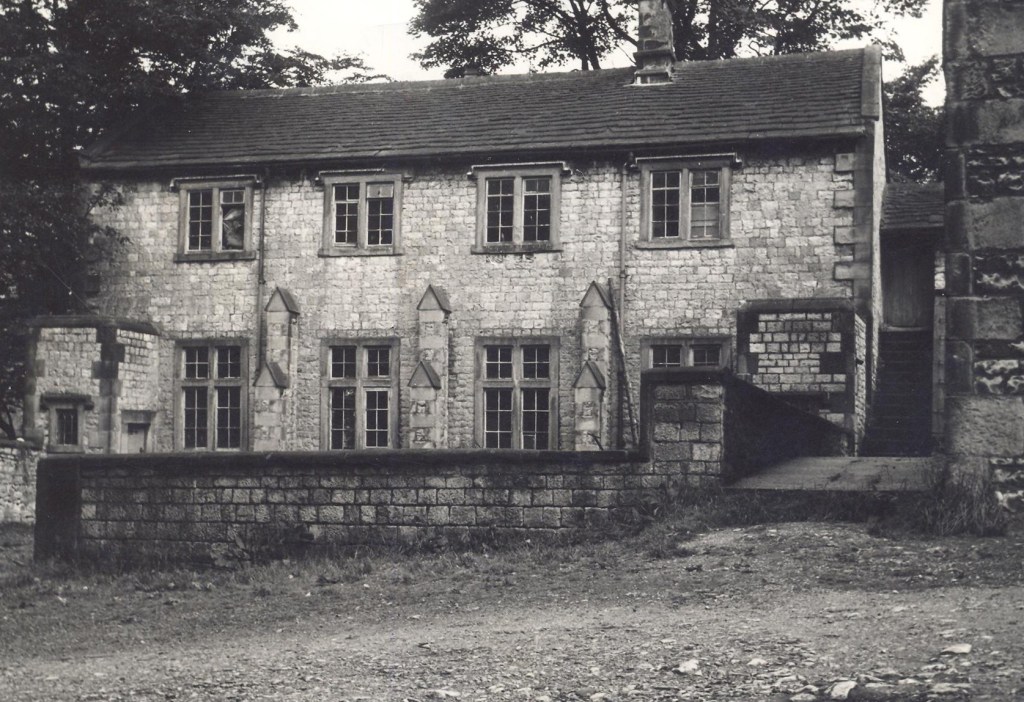
After leaving Oxford he moved to Tideswell, near Buxton, and became a school master at the Bishop Robert Pursglove’s Grammar School for a number of years (the school was founded in 1560, and the later 18th century incarnation of the building still stands).

Tideswell Grammar School as it is now – a later 18th century building replacing the 1560 Elizabethan one.

His Catholic faith was clearly strong at this time, as three of his pupils later became priests, and one, Christopher Buxton, was himself executed for his faith.

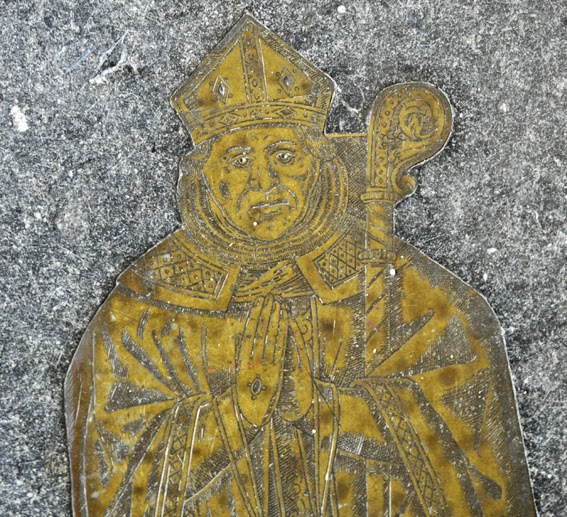
This is odd, though. Teaching of even a hint of Roman Catholic doctrine was expressly illegal, and could have landed Garlick a death sentence. So what’s going on? I dug around a bit, and it seems that Bishop Robert Pursglove who founded the school, and who employed Garlick, was an interesting character. A native of Tideswell, he was born in 1504, and later became a priest, then prior, then bishop. He seems to have swayed with the to-ing and fro-ing of the Reformation from Catholic to Protestant, and back again… and again. But, a little further research shows that he too refused to take the Oath of Supremacy on multiple occasions (something noted as highly suspect at the time), and an official Queen’s Council report of him records that he is “stiff in Papistry”, essentially he was clinging to the old religion, rather than embracing the new. He also enthusiastically embraced Queen Mary’s reintroduction of Roman Catholicism, becoming prebend of Southwell Minster, Nottinghamshire, during her reign. In addition, his memorial brass in Tideswell Church shows him in Roman Catholic Bishop’s dress, something that was also expressly forbidden by Elizabeth I.

Bishop Pursglove as a Roman Catholic bishop. The image is stolen from Distant Thoughts blog – written by a chap called Pursglove, and is an interesting read. Check out his mystery plate post, too. I’m dying to know more…

Pursglove also had strong connection with many recusant families in the area, some of whom were friends and relatives. North Derbyshire was known at the time as an area of strong recusancy, in particular in the area around Tideswell, and focussed on several local families – the Pegges, the Eyres, the Hunlokes, the Poles, and perhaps most important of all, the FitzHerberts. It seems, then, that the good Bishop played a significant role in that, even allowing distinctly Catholic teaching in his school. All this is speculative, of course, but the evidence does add up – Pursglove was probably a recusant Catholic. The fact that he was never investigated, arrested, or even publicly chastised, despite playing fast and lose with the rules, suggests he enjoyed a measure of protection, but I really don’t understand how. This too might explain Garlick’s next move. Bishop Pursglove died in May 1580, and on 22nd June 1581, Garlick enters the English College at Rheims in France. We might speculate that the death of Pursglove, and the loss of the protection he gave, forced Garlick to leave Tideswell, and probably hastily.

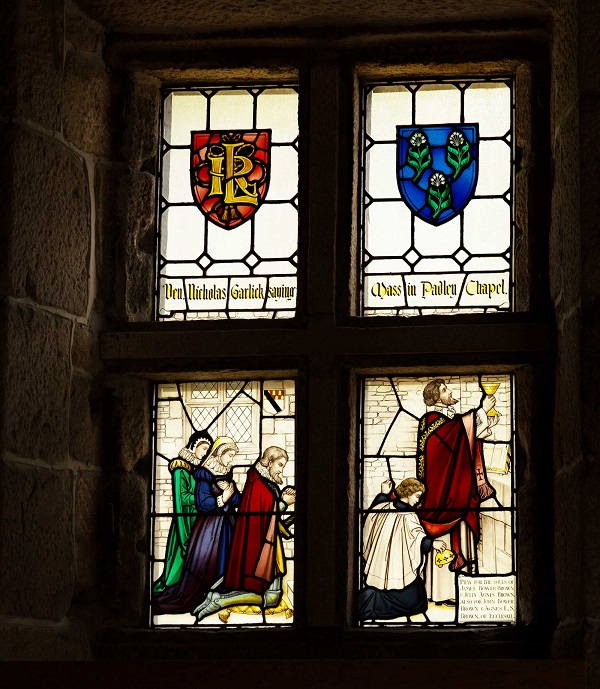
Garlick at prayer, Padley Chapel.

The English College was founded by exiled English Roman Catholic priests with the purpose of allowing English priests in training to continue their studies. But it also produced missionary priests who were to enter England covertly, minister to existing Catholics and attempt re-conversion of the country. This was what Nicholas trained to do, and he was ordained as a priest in March 1582, leaving for England as a missionary on 25th January 1583.

We know very little of his whereabouts until 1585 when he is caught, arrested, and banished, with the knowledge that if he is caught again he will be executed, as ministering as a priest was at the time a treasonable offence. The reason for this was simple – priests swear an oath of fealty to the Pope as head of the Church, and the papacy was at the time actively supporting France and Spain in their aggressions against England, and was actively seeking the conversion of the country back to Catholicism (indeed, Pope Sixtus V gave his blessing to the Spanish Armada as a crusade against the English). Garlick arrived back in Rheims on 17th October 1585, and two days later he headed back to England.

Once again his whereabouts are unclear, but a spy’s report of 16th September 1586 notes that he “laboureth with diligence in Hampshire and Dorsetshire”, and he crops up in Derbyshire in a government list of recusants in March 1588. He is clearly doing his duty, and is ministering to the needs of recusant Catholics in the area, and it this that is his undoing.

We have to remember that this is the time of Priest’s Holes: priests come to the houses of recusant Catholics and stay for periods of time, acting as a priest to the family and others nearby. However, there are significant networks of spies on the lookout for just such activity, so it all has to be done in secret, and if the officials come knocking, the priest has to be hidden in a Priest’s Hole. If they are caught the whole family would suffer, and the priest would be executed. Horrifically.

On the 12th July 1588 Garlick, and another priest was staying with the Catholic FitzHerbert family in Padley Hall, Padley, about 8 miles from Tideswell. The FitzHerberts were a well known and powerful recusant Catholic family, and whilst they carefully towed the legal line, they steadfastly refused to give up their faith, and this made them a huge target on the hit list of the authorities.

And the worst happened.

Garlick saying mass at the private chapel in Padley Hall. From the stained glass of Padley Chapel.

The sequence of events was actually set in motion by two individuals: Richard Topcliffe, and Thomas FitzHerbert, the son of John FitzHerbert of Padley Hall. Topcliffe was a Catholic catcher par excellence, who liked nothing more than to arrest, torture, and brutalise recusant Catholics and priests – he was, quite simply, a psychopath who enjoyed his work, and was allowed to do so by the authorities. He also had a personal vendetta against the FitzHerbert family. Thomas FitzHerbert on the other hand was seemingly an ambitious, cold-blooded, and immature moron who could think of nothing more than his inheritance. Between them, they came up with a plan that FitzHerbert would pay Topcliffe £3000 if he prosecuted to death his father (John), uncle (Sir Thomas), and cousin (William Basset) in order that Thomas would inherit the estate of Sir Thomas.

It was Thomas’s tip off that sent George Talbot, Earl of Shrewsbury, to arrest his father, and it was Nicholas Garlick’s bad luck to be at Padley Hall when he arrived. The priests, along with John FitzHerbert, his son Anthony, three of his daughters – Jane, Maud, and Mary – and ten servants were all arrested, and the whole party was transferred to jail in Derby. Another Glossop connection here is that George Talbot, Earl of Shrewsbury, was also the lord of Glossop – hence Talbot Road, Talbot Street, and Shrewsbury Street.

The arrest of Nicholas Garlick – from the stained glass of Padley Chapel.

On the 23rd July 1588, the priests were tried for High Treason, and for coming into the kingdom and “seducing” the Queen’s subjects. Garlick’s response was “I have not come to seduce, but to induce men to the Catholic faith. For this end have I come to the country, and for this will I work as long as I live“. Not the best defence, and he was inevitably found guilty. Garlick, along with Ludlam, and another priest, Richard Simpson, was sentenced to be hanged, drawn and quartered:

“That you and each of you be carried to the place from whence you came, and from thence be drawn on a hurdle to the place of execution, and be there severally hanged, but cut down while you are alive; that your privy members be cut off; that your bowels be taken out and burnt before your faces; that your heads be severed from your bodies; that your bodies be divided into four-quarters, and that your quarters be at the Queen’s disposal; and the Lord have mercy on your souls.”.

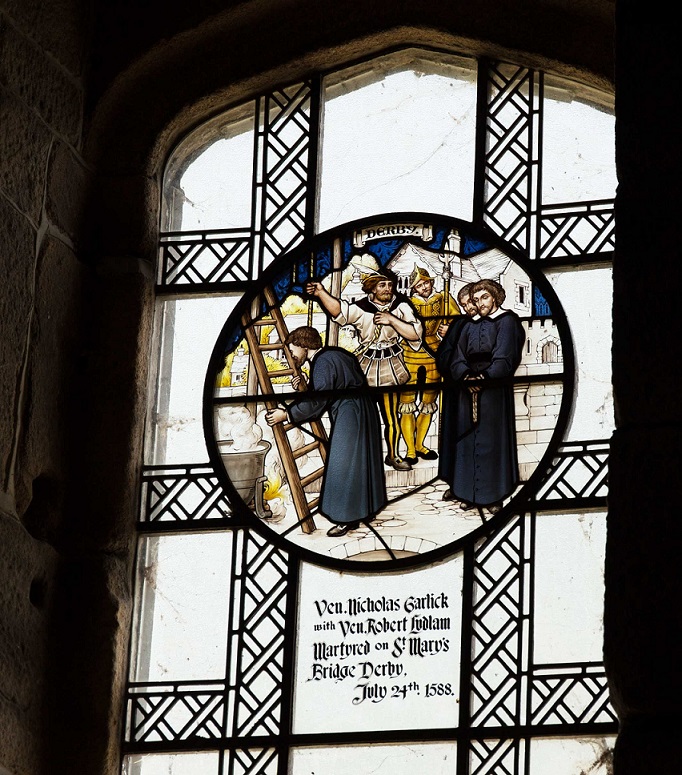
The sentence was carried out the next day, 24th July 1588. The three priests were taken to St Mary’s Bridge in Derby, with Garlick joking and making merry as they went, even reminiscing with a passer-by about the days they went shooting together, remarking that he was about to “shoot off such a shot as I never shot in all my life“. However, it seems that the local authorities were not well versed in this sort of execution, and the cauldron to be used for the burning of the condemned’s entrails was not hot enough, so there was a delay. Garlick, ever the priest, used this delay to deliver a final sermon, ending by throwing into the crowd religious texts extolling the virtue of the Roman Catholic faith; tradition states that everyone who read the texts were converted. At last, the time came. Simpson was to be executed first, but Garlick moved to the ladder ahead of him, and kissing it, calmly went to that most brutal of deaths. A further calamity occurred – he was hanged for a short time, but as he was taken down from the gallows to be disemboweled, it was noticed that he was still wearing his doublet, and by the time it was removed he was fully conscious and awake, alert to what was happening to him.

Garlick kissing the ladders to the execution platform. Again, from the stained glass of Padley Chapel.

The sentence duly carried out, the heads and quartered body parts of the three priests were put on spikes and displayed on the bridge and elsewhere around Derby, and then tarred and distributed.

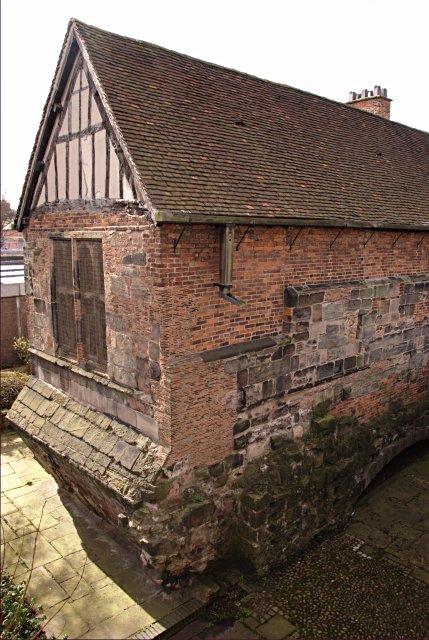
Chapel of St Mary on the Bridge, Derby – here he was executed, and his head spiked on the bridge, the remains of which can be seen underneath and attached to the chapel. From here.

It is entirely likely that, given his birth and familial connection with Glossop, one part or another of his worldly remains would have been displayed here, and probably at the market cross in Old Glossop. A sobering thought. Another local legend records that the body parts were removed, and that Garlick’s head was buried at Tideswell church.

An anonymous poem written probably by someone who was a witness to the horrific scene runs thus:

When Garlick did the ladder kiss,
And Sympson after hie,
Methought that there St. Andrew was
Desirous for to die.

When Ludlam lookèd smilingly,
And joyful did remain,
It seemed St. Stephen was standing by,
For to be stoned again.

And what if Sympson seemed to yield,
For doubt and dread to die;
He rose again, and won the field
And died most constantly.

His watching, fasting, shirt of hair;
His speech, his death, and all,
Do record give, do witness bear,
He wailed his former fall.

In 1888, the two Padley Martyrs, as they became known, were given the title ‘Venerable’ by the church – this means they have been declared a ‘servant of God‘, and that they had ‘heroic virtue‘ – essentially the recognition of one’s life work, as well as one’s death. This led to the creation of an annual pilgrimage to Padley Chapel – the converted former gatehouse of the now ruined Padley Hall.

Commemorative card and medal printed and minted following the 1888 declaration of the title ‘Venerable’.

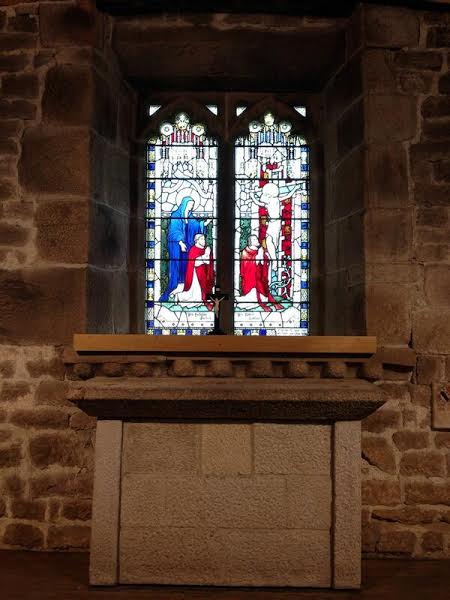
There would have been a private chapel in the hall, and it is suggested that this was in the upper part of the gatehouse. In 1934 the original 16th century altar stone was discovered buried in the garden where it had been hidden by the FitzHerberts prior to their arrest, and would have been the original one that Nichols would have used to celebrate Mass; it now forms the altar in the chapel there.

The altar at Padley Chapel, complete with original stone.

Then, on 22nd November 1987, Nicholas Garlick was Beatified by Pope John Paul II. This is a significant event, and is one of the necessary steps on the road to being declared a saint; if the Church confirms a miracle through his intercession, then he will officially be declared Saint Nicholas of Dinting. Whatever your personal beliefs, it is quite a journey from Dinting to the right hand of God.

Family Hamnett recently visited the chapel and ruined hall – it’s remarkable what is still standing and can be seen, and it’s a wonderful romantic ruin, set in lovely walking country, and with an astonishing, if grim, history:

Padley Chapel, originally the gatehouse to Padley Hall. And a standing stone, too – probably a track marker rather than a prehistoric stone.
The north western range, containing the great hall. There are three doors in front of us – left into the great hall with the huge fireplace behind, right into an ante-room, and middle up a spiral staircase, the base of which can be seen. Look how worn the door steps are.
Close up of the spiral staircase base. Fanstastic!
Master Hamnett exploring the ruined fireplace. It’s huge!
There are lots of medieval tracery and carved bits lying around – some have been incorporated into a wall, but others can be seen.
I also found a Victorian John Smith’s of Tadcaster beer bottle in a wall, which was a nice bonus!
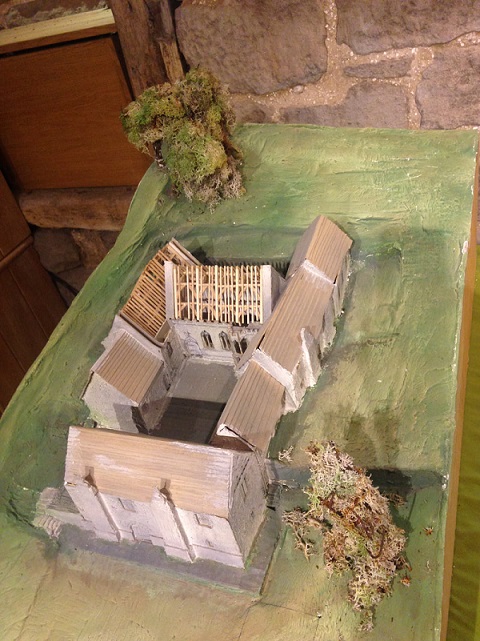
A photograph of a reconstruction of Padley Hall, shamelessly taken from the Time Travellers’ website – they seem to be a good bunch of archaeological types, so go check them out, especially if you live near Sheffield.

The whole place is amazing, and well worth a visit.

If you are interested in this period of history, I cannot recommend highly enough The Stripping Of The Altars by Eamon Duffy – it studies both the state of Catholic religion in England prior to the Reformation, as well as the sweeping and catastrophic changes that occur during and after. Have a look on Amazon, but please make sure you buy it at Bay Tree Books on High Street West in Glossop. An added bonus is that it might be me that sells it to you.

Another view of Nicholas Garlick. Here he is pictured holding a knife in the traditional style of portraying saints holding the method of their martyrdom. This one from the Lady Chapel of St Mary’s Church, Derby (via this website)

I hope you enjoyed this slightly longer than usual post, and unusual subject matter. More pottery next time. What do you mean, “no, please no, spare us the pottery“? I can hear you, you know. Honestly, the nerve of some people. More soon, but until then look after yourselves and each other, and as always, I remain.

Your humble servant,

RH