Archaeology · Pottery · Pottery Guide

The Rough Guide to Pottery Pt.2 – Spongeware.

What ho, dear and gentle readers! Well, here we are again… pottery time! The second part of the Pottery Guide has hoved into view, and what a treat we have for you. I am going to go ahead and apologise in advance – it is heavy on pottery, but useful and fun, I hope. (Can anyone else hear that groaning and wailing… and gnashing of teeth. And no, no I don’t care about your “sainted aunt”, whoever is shouting).

SPONGEWARE
DATE: 1830’s – 1900’s
DESCRIPTION: Colourful repeated patterns printed with a sponge on a white background.
SHAPES: Bowls are very common, cups, mugs, tankards, small plates, larger plates, and jugs.

Wonderful, cheerful, simplistic, and yet incredibly attractive (not me, madam, but thank you). I have an almost childlike obsession with this pottery type, and it always makes me happy when I find some. Spongeware is characterised by shapes made with a natural sea sponge dipped into a coloured slip and dabbed onto a white background. The pot is then glazed and fired. The sponge is either applied all over, or it is cut into geometric shapes (diamonds, concentric circles, spirals, stars, zig-zags, swirls, etc.) or naturalistic forms (flowers, leaves, shamrocks, etc.), and dabbed in repeated patterns around the vessel.
20220211_141443
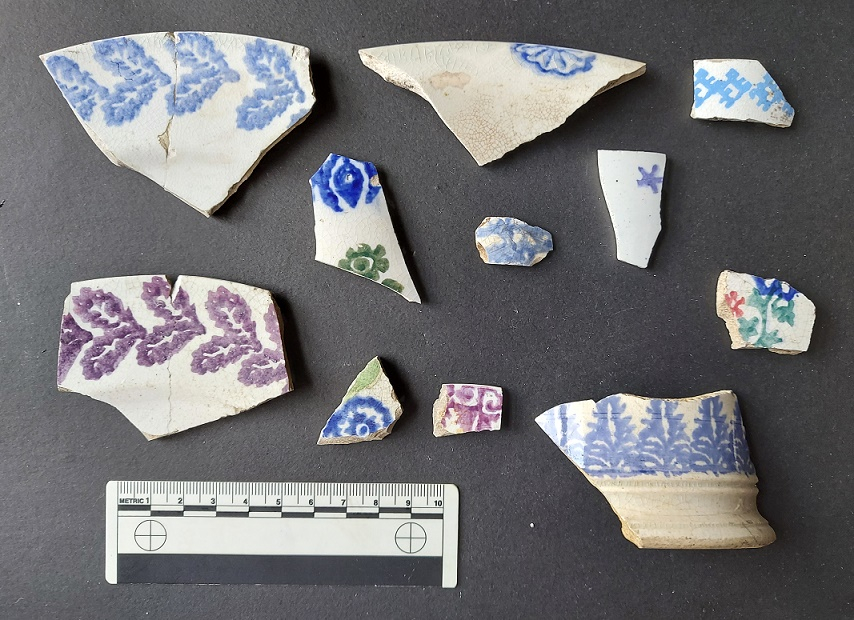
1. Spongeware. Lovely stuff, in pastel colours and very pleasing designs.

These patterns and shapes are fuzzy at the edges (the result of the sponge effect), are sometimes combined with hand-painted decoration (bands, blobs, leaves, etc.), with colours of a limited and pastel palette – light purple, blue, light green, yellow, pink, light red, etc.

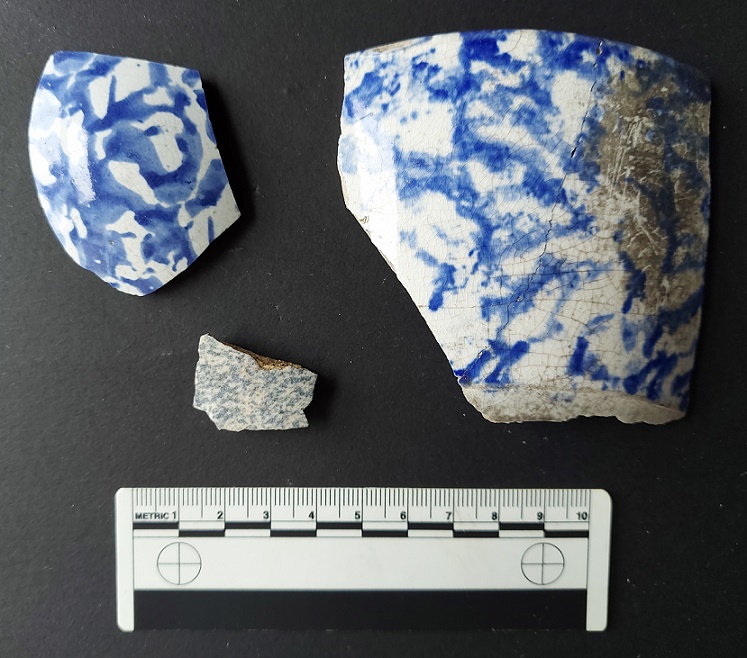
2. In addition to the sponged designs, we can see here painted flourishes and designs.
3. The designs can be printed all over, rather than in discrete patterns. The grey painted sherd, bottom left, is an example of what is sometimes known in America as ‘Spatterware’.

The pottery itself is normally of a fairly poor quality Pearlware (pre-1850) or Whiteware, with a earthernware fabric that is white or off-white.
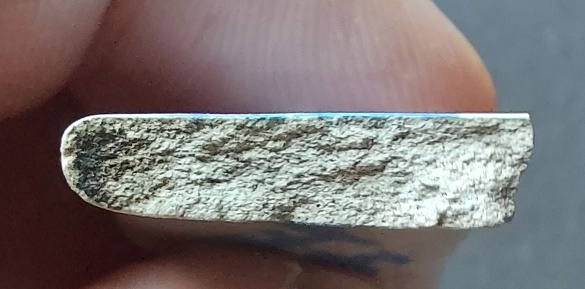
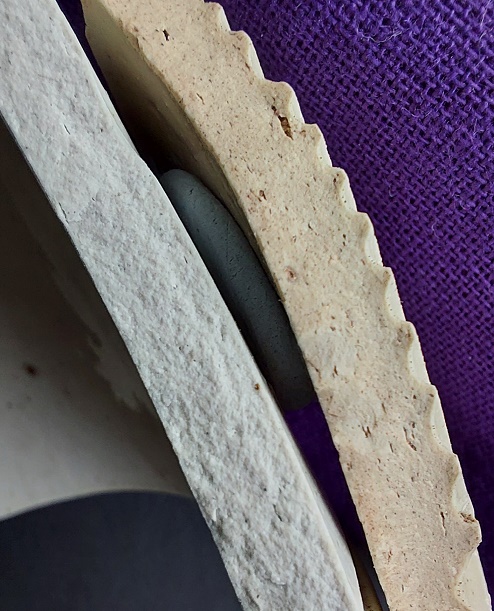
4. Fabric – white or off-white bog standard earthernware. You can see the painted decoration in section here, overlaid by the glaze.

Sherds can sometimes be found broken with jagged rather than smooth edges, indicative of a low temperature firing and poor quality clay. Lovely though it is, it is Spongeware is not high quality, but it is the very essence of cheap and cheerful. 

5. The poor quality of the glaze is very clear here.
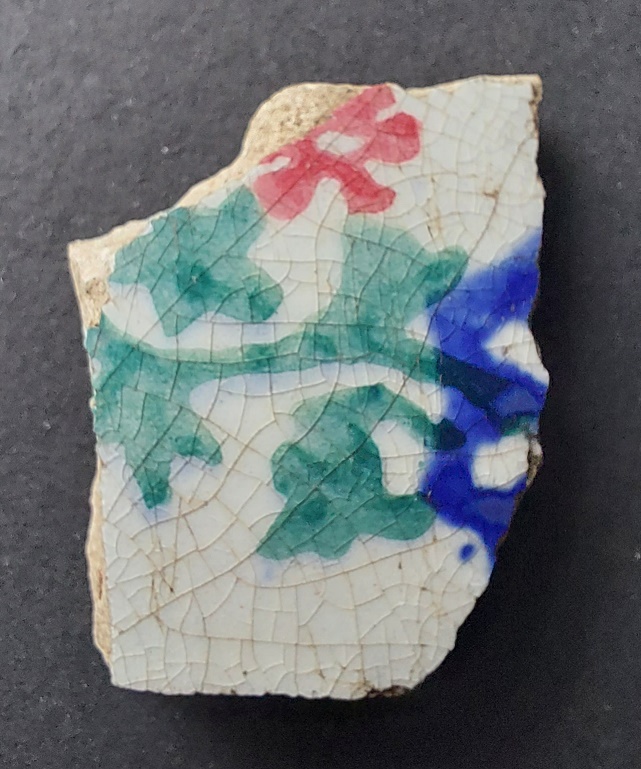
6. One of my favourite sherds, up close. You can see the way the decoration has been applied. You can also the jagged edges that indicate poor quality pottery, and the crazed glaze, possibly the result of heat, or more likely, a poor glaze.

Spongeware is often associated with Scotland where it was made in great quantities, but there were also manufacturing centres in Stoke on Trent and other parts of the Midlands. These vessels were mass produced – probably ‘sponged’ as piece work at home (and thus probably by women) – and supplied to a ready market that wanted a more colourful, and cheaper, pottery than the transfer printed material that dominated the market.    

American studies indicate there are broad chronological variations within the ware group. America and Canada were huge export markets for Spongeware, and given the relative newness of their country in terms of European material, a lot of research has been conducted on even the smallest and most common bits of pottery that would be overlooked here. The three variations within Spongeware are:
All-Over:
Densley packed, the natural random patterning of the sponge is used to cover the whole vessel, or dabbed in distinct areas – the upper part of bowls for example. Spatterware is the American name for this type of pottery, as it looks as though the paint has been spattered on randomly, occasionally in several colours one over another. Looking closely, it is possible to see the tell-tale repeated patterns of holes in the unshaped natural sponges (Photo 3 above). This type appears to have been most popular up to the 1860’s.   
Cut Sponge
Here the sponge was shaped into neat geometric and naturalistic forms, and the patterns repeated. Starts in the 1840’s, and is popular until the 1880’s. The addition of painted decoration to this form seems to appear in the latter part of the 19th century and last into the early 20th century (Photos 1 & 2 above).
Open Sponge
Similar to Cut Sponge, but the shapes are more natural and less regular, rigid and geometric. This type seems to have been most popular from c.1850 to c.1900 (the blue sherds in Photo 3 above).

This stated, there is a lot of overlap between styles, and I’m not convinced the chronology is as straightforward as that. Also, does the American market reflect what was happening here? As I say, it is a broad guide, use it as you will.

Spongeware, in it’s modern incarnation, is still a popular design for plates, and Hamnett Towers has a dinner service decorated with designs made using this very attractive style. I should invite you all for cocktails and a slap up feed, and you can have a look (black tie, of course… I have standards).

Right ho, that’s it for this week. I have a few, less pottery focused articles in the pipeline (what do you mean “praise be”? Honestly, some people.) which I’ll get on asap. My life is fairly jam packed with Glossop related archaeology and history at the moment, which is great, if a little scary! I am working with the good folk of Glossop Creates developing a walk that involves history and bits of pot… watch this space. I was also recently in the Glossop Chronicle (read it here – the edition is dated 3/2/2022, and it’s page 11), and the Glossop Creates blog, too. The organisation, based in the historic gasworks on Arundel Street, has some wonderful and big ideas for the town, and deserves to be lauded from the rooftops for their vision. So there!

More about this, and other exciting things, next time, but until then, look after yourselves and each other, and I remain.

Your humble servant,

RH
Archaeology · Pottery Guide

The Rough Guide to Pottery Pt.1 – Brown Stoneware & Marmalade Pots

What ho, Glossop!

Happy new year wonderful folk of the blog reading world. I hope you all had a safe and restful Christmas at the very least. Today’s blog post is the first part of the much talked about Pottery Guide. You lucky people, you.

Over the last few years I have been toying with the idea of putting together a sort of ‘spotter’s guide to bits of old pot‘. I get a few emails a month from people asking “what is this?” or “where can I find out more about the pottery?” (What? What’s that you say? No, I’m not “having a laugh“, thank you very much. And don’t think I can’t hear you making snoring noises, either… honestly). It seems that most people who read this blog also like dipping into brooks, fields, tracks, and gardens, and pulling out bits of old stuff and pondering. Which is great, because that’s precisely what the blog is about. However, there is no simple guide to identifying what it is you have in your hand. Either they’re very dry academic archaeology (and even then, they generally don’t look at Victorian or Georgian pottery – that’s the stuff we normally dig through to get to the good stuff!). Or they are aimed at collectors, and thus look at only whole pots that live in glass cases and are fawned over by incredibly dull people. In 27 years of being an archaeologist, I have never once found a whole pot. And I certainly haven’t seen one rolling down Shelf Brook in Manor Park. I have, however, seen many thousands of bits of pot doing just that. And here’s the rub: the whole pot is ‘nice’ to look at, but sherds are the meat and two veg of archaeology… if that’s the phrase I’m looking for. Anyway, sherds are the lifeblood of archaeology, and from where we can explore the past in a way that is open to everyone and is fun. But in order to do that, we need to know what you have in your hand. My background as an archaeologist is early bronze age Crete… which is about a far from Victorian Glossop as it is possible to get (2,500 miles, 5,500 years, give or take), so I must admit part of the reason for doing this guide is that I too could learn about what it is I am finding. To do this, I read just about everything I can get my hands on, ranging from academic reports… to “a bloke on the internet”. And now, I can pass that info onto you so that before long, you too can be thrilling people with your knowledge of bits of old pot… honestly, I’m quite a hit at parties.

Anyway, Let’s start with some of the most recognisable and common stuff.

  • MARMALADE JARS

DATE: 1870’s – 1920’s
DESCRIPTION: Grey stoneware with a creamy surface, and characteristic external vertical ribbing.
SHAPES: Well… Jars.

These are such a distinctive type, and are so commonly found, that I thought we’d start here. Commonly known as marmalade jars, but actually any and all preserved fruit were kept in them, with a paper label pasted on the outside, and a horizontal groove running below the rim to take the string that kept the wax paper or cloth lid in place.

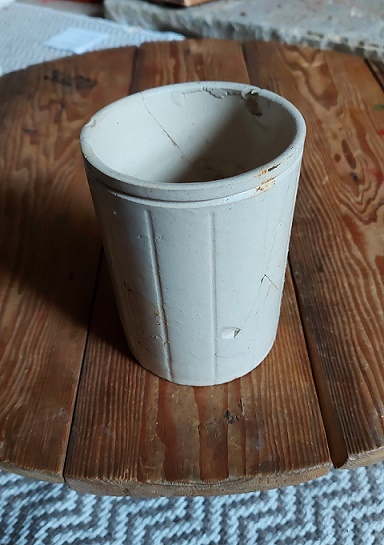
The humble marmalade jar. You can see the groove below the rim to hold the string in place. This one I found broken, and glued it back together. It now holds pens and other assorted bits.

A very hard creamy-grey stoneware fabric, solid, but with small voids. A roughly applied clear salt glaze (drips are common) internally and externally, with a slightly orange-peel surface (although often the base isn’t glazed).

The fabric: left is a new break, and is paler. Right shows some staining, but is more creamy anyway. You can see how solid the fabric is, but also the tiny voids created by gas during the firing. You can also make out the external grooves.
The surface up close; you can see the rough glaze – slightly orange peel. Also, you can see tiny flecks of discolouration – it isn’t a uniform colour.

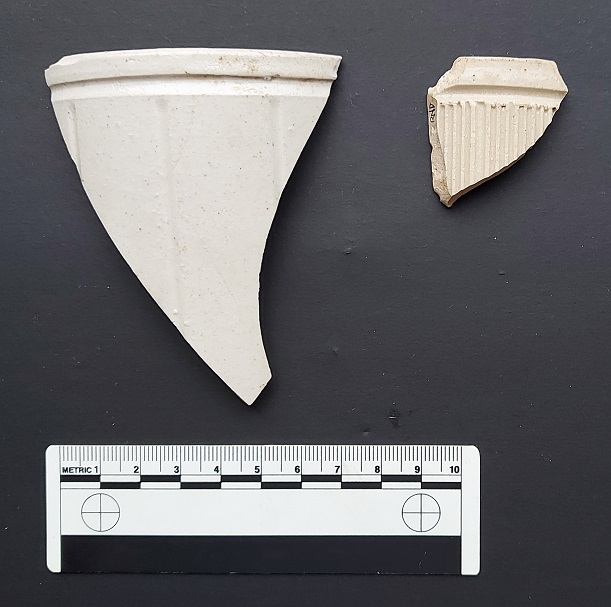
They are exclusively open-ended jars of varying heights and widths, usually c.15cm tall. Beyond the colour and surface, the most recognisable bit of this pottery type are the vertical stripes, which can be very close together – either continuously or broken up by larger grooves – or spaced far apart (see photographs).

Rim sherds from two different jars. Once you recognise them, you’ll start spotting them everywhere.

Sometimes the base is stamped with the preserve maker’s name – commonly the lighthouse and name of WP Hartley – a company still making jam as ‘Hartley’s’.

The lighthouse logo of WP Hartley. You can see how coarse the finish is on the base.

Chronologically, they are late Victorian to Edwardian in date – WP Hartley seems to have designed the distinctive jars in the 1870’s, moved the factory to Aintree in Liverpool in 1886, and opened a second factory in London in 1901, so whether the base stamp mentions Liverpool and London will give a rough date. I have no end date for their use, but it is likely in the 1920’s when most companies switched from stoneware to the cheaper glass bottles and jars. That stated, the jars are very useful (I keep pens in one) and they are very hard-wearing, so it is likely that some were in use long after they stopped being made.

  • BROWN STONEWARE

DATE: 1700 – 1920’s
DESCRIPTION: Grey fabric with a shiny brown all-over salt glaze, often with rouletted decoration.
SHAPES: Cups, bowls, jugs (Nottingham Stoneware). Storage Jars, colanders, starch pans, stock pots, stew pots, bowls, bread crocks, pans, etc. (Derbyshire Stoneware)

Ah, Brown Stoneware, how… brown you are. Characterised by a shiny brown all-over salt glaze and a light grey stoneware fabric, it is instantly recognizable. Perhaps because it is so distinctive, but also because it is a stoneware and thus virtually indestructible, this stuff appears everywhere. It is also difficult to date with any certainty. However, it can be broken down into two types of different dates (although there is overlap): the Nottingham and Derbyshire Stonewares.

Nottingham Stoneware (c.1700 – c.1800)
A shiny milk chocolate brown surface interior and exterior, caused by the salt glaze with added iron, and often more glassy or creamy than the Derbyshire type.

Nottingham Brown Stoneware. Chocolatey glaze, thin walls, and strap handles; this stuff is very nice.

It usually has a white slip underglaze visible in the break, between the classic grey stoneware fabric and brown surface.

The white-ish underglaze is visible beneath the brown iron-rich salt glaze, and is noticeable against the grey stoneware fabric. The surface also has the orange-peel look that characterises salt glazes.
A view of the grey stoneware fabric, note also the voids and the white underglaze on the exterior wall (right). I really am rather bad at taking photographs… I need to learn how to use my phone’s macro setting better.

It is often found in thin walled vessels – cups and bowls (tablewares). Also, noticeable are wide strap handles, with vertical ribbing and thumb impressions where they were attached to a jug body. Decoration consists of horizontal incised lines done on a lathe, often in multiples, and rarer impressed decorative patterns in between the lines – snakeskin, basketweave, zig-zags – often done with a roulette wheels. Out-turned rims and bases with multiple bands around them are also common.

Nottingham stoneware was popular in the 18th century, but by the end of the 18th century couldn’t compete with the more decorative styles then coming out of Staffordshire, and the style faded away. However, the tradition was continued by potters in Derbyshire, who began to specialise in utilitarian kitchenwares – storage and cookery – rather than tablewares they previously made.

Derbyshire Stoneware (c.1800 – c.1920)
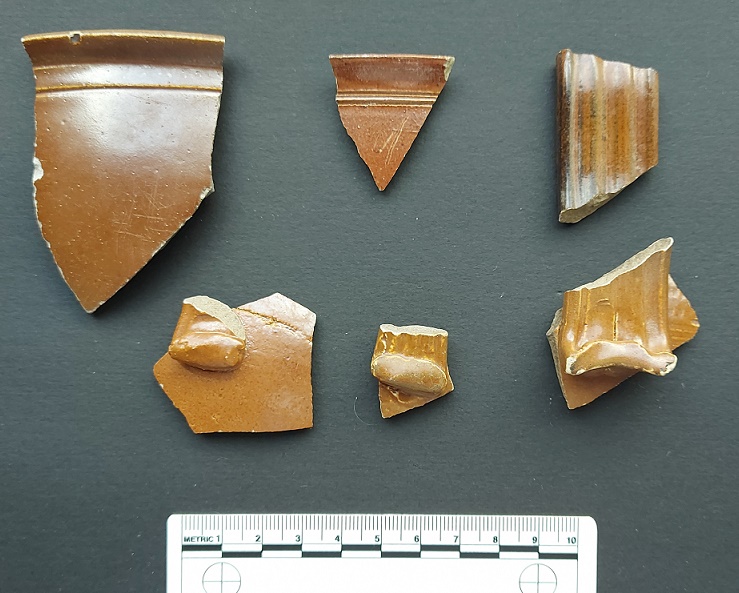
A similar, but often a little darker, shiny brown surface, made by the same iron-rich salt glaze, but a little less glassy or chocolatey.

Wonderful stuff. The iron-rich glaze almost glows.
Again, it glows. The sherd on the left seems to have less iron its saltglaze, and has reverted to the almost classic saltglaze surface – speckled light brown and orange peel texture. I love the interplay of the undulating lines, coarsely rouletted into the body.

Also, whilst the majority of vessels have a brown interior and exterior, some have a cream, white, or olive coloured interior (I have a hunch these are later).

The creamy interior of a later vessel. The glaze is speckled in a similar manner to the marmalade pot above.

The fabric is the same classic grey stoneware, but normally with no white underglaze. Thick walled vessels are the norm, with the emphasis on cooking and storage – utilitarian rather than flashy serving and eating/drinking.

Light grey – classic stoneware fabric.

Impressed decoration consists of roughly made rouletted shapes – very small crude stars, circles, crescents, flowers, dots, etc., sometimes horizontal, sometimes in flowing wavy lines.

It could almost be Roman. Almost.
Very shiny, almost lustrous.

An interesting advert dating from about 1880 gives a good idea of the kinds of vessels and decoration available at that point and beyond:

I love this. These are some of the various vessels that you’ll encounter… in pieces, of course.

Here endeth today’s lecture. Now go forth and forage, good people! Seek and ye shall find. And please, let me know what you do find – I’d like to do a community thing, where you all send me images of the bits you find and some names, and I’ll put them on the blog. I don’t know why, but my mind keeps going to ‘The Gallery’ on Take Hart…

Anyway, more soon (not just pottery, honestly… I have some interesting stuff in the pipeline), but until then take care of yourselves and each other. And until then, I remain, your humble servant.

RH