What ho you wonderful people, you! But before we go on, some words…
MUDLARKING (verb)
The activity of searching the mud (= soft, wet ground) near rivers trying to find valuable or interesting objects.
POKE (verb)
To push a finger or other pointed object quickly into someone or something (Cambridge Dictionary)
A short one today (a lengthier one is in the pipeline), to announce the big news…. Glossop’s first Big Dig event. As some of you might know, I have been commissioned by Glossop Creates to develop a campaign involving their wonderful ‘Living Room‘ digital community archive (more about this soon). As a resident paired creative type (and Glossop’s premier sherd-botherer) I came up with a plan to get you all involved in what is shaping up to be an exciting project – The Big Dig.
So what is it?
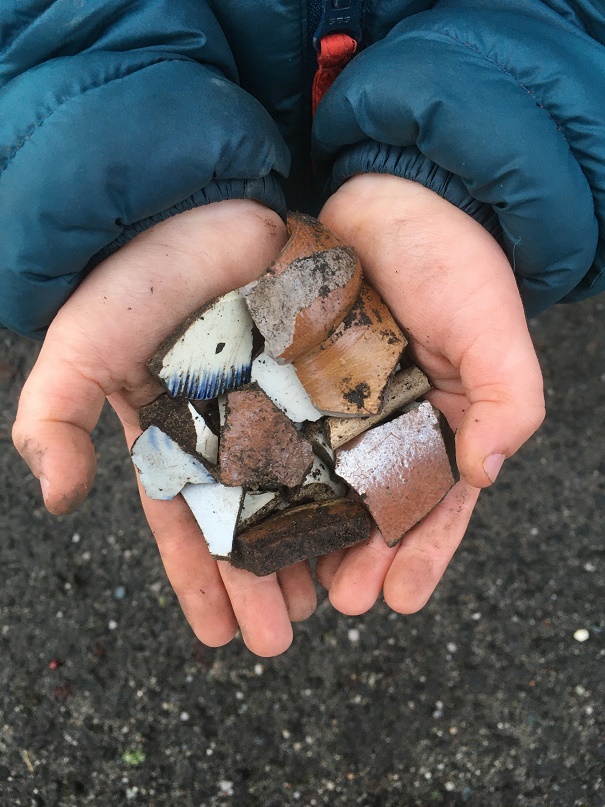
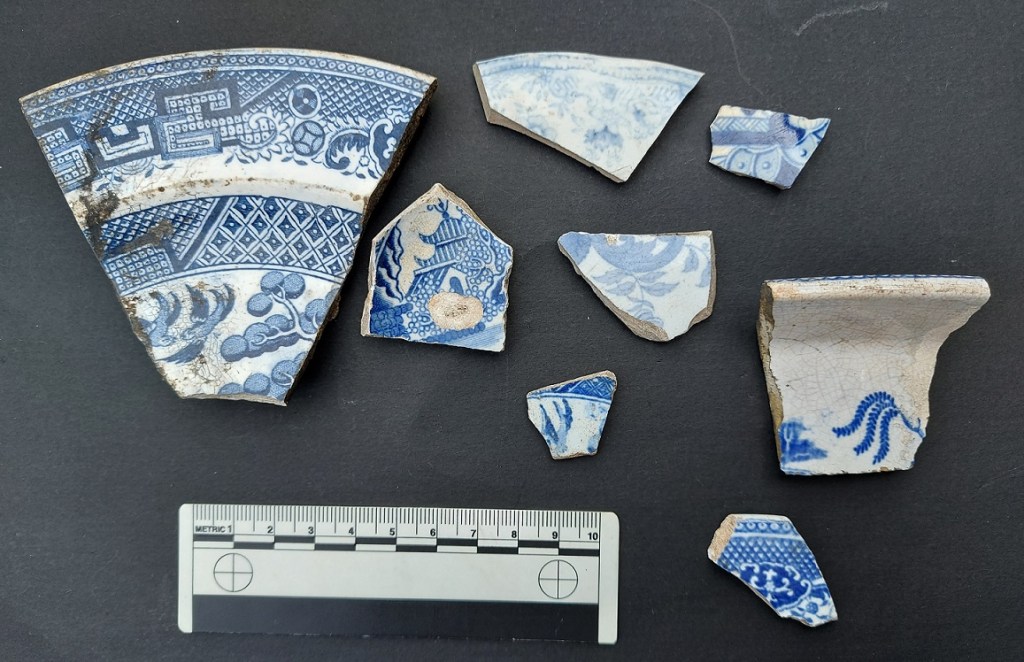
Most of you who read this blog will already know that wherever you walk in Glossop – parks, footpaths, gardens, streams and brooks, allotments, etc. – there are bits of pottery and glass leaping like spring salmon out at you. This is the legacy of the Victorians and others, with them nightsoiling, dumping, or simply being littering oiks. However, what this stuff does is tell a story, as I like to show on the blog – each sherd was once part of a bigger vessel, and usually we can find a date and form for it. But each sherd is also a piece of social history, belonging to a person and a life, and is a part of the heritage of Glossop. And now I want you to all get involved in finding and understanding our shared history. Here’s how:
Well, firstly, don’t worry… it doesn’t involve any digging as such (so put down the shovels, mattocks, pickaxes, hoes, trowels, etc…. you look like a medieval angry mob. And you madam, step away from the JCB). It’s more a mudlark, a gentle poke about if you will (the phrase Glossop’s Gentle Pokeabout just didn’t have the same ‘zing’ as the ‘Big Dig’). I have prepared Big Dig packs that can be picked up from a number of places around the town, and which contain, amongst other objects, a wooden dessert spoon (for poking about) and a plastic zip lock bag (for the finds). So then…
Find a spot to mudlark. Think places like: your back garden, the allotment, a footpath, a hedgerow, an old quarry, a molehill, walking up a hill, walking down a hill, paddling in Glossop Brook, skateboarding at Manor Park. But don’t stray onto private land, and please stay away from protected archaeology – it is very illegal and not at all helpful to dig anywhere near Melandra Roman fort, for example – remember, we’re poking about, not excavating!
Poke about, using your spoon. A very useful tool is a spoon, and I carry one with me for just such occasions. Remember, no digging as such, just moving soil, turning over stones and twigs, shuffling spiders out of the way, poking at bits of pottery, stirring your tea, etc.
Place your finds into the supplied plastic bag – finds might include pottery (very common), stone, glass, wood, beads, bottles, metal, bone, leather, gold, The Holy Grail (less common), the Ark of the Covenant, and possibly Shergar. Importantly, write where you found the material on the outside of the bag. This bit is very important.
Hand the bag back to where you got it, and it’ll find its way to me, and then to the wider world.
The idea is that we’ll look at the material, give it a date and analyse it, and then enter the photographs and details onto the interactive map on the Living Room website here. Essentially, it’s the blog, but made larger, and involving you. You’ll be able to access the map and descriptions, and see the past come alive in the coming weeks and months. Please also enter your thoughts, feeling, stories, experiences, photographs and film about the Big Dig onto the website, too – I want this to be a truly community based experience. Also use the Twitter hashtag #GBD23 to get involved, we want to see your photographs of dirty hands and wonderful pottery bits.
There are, however, some things to be aware of:
Exercise common sense, and be aware of others around you. Be safe, especially around water, and remember pottery, and particularly glass, can have sharp edges.
Respect private property; your neighbour’s garden may have a Roman vase in it, but sadly unless you have their permission, it’s theirs. But you might have something better in yours.
It is especially important to stay away from Scheduled Ancient Monuments – Melandra Roman Fort, for example.
And a final message. If you fall in Glossop Brook, tear your trousers, get the whole family muddy, scratch your hands on blackberry bushes, and end up with half an old plate to show for it… good! That’s exactly what Glossop’s Big Dig is all about.
All joking aside, whilst a lot of this pottery will be fairly mundane, if interesting, Victorian bits and pieces, 17th and 18th century pottery is also quite common in the area, and that has the potential to change what we know about Glossop’s past, and at the very least suggest places for further research. This is the first step in a process that might lead… well, who knows where, but I have big plans. The kits will be available form Glossop Library from Tuesday 25th April (the first 50 bags will have exclusive ‘Glossop’s Big Dig‘ badges in them, courtesy of of the amazing people at Kin.Der). Come down and see us on the day, or pick one up from a number of other places in town. The Big Dig will be running for as long as people want to do it – the process begins immediately, but we will continue to upload material to the website, with periodical updates on the blog.
So then, it is with great honour and pomp that I invite you to become members of that most auspicious, exclusive, and frankly alarming, club – the ‘Sherd Herd‘ (badges and t-shirts forthcoming). And as chief Sherd Nerd, I implore you all to go forth, forage, and find, record where you find it, and get involved.
My thanks to the truly wonderful Glossop Creates for allowing this opportunity – they have some great plans for our town, and want to involve everyone. So let’s do this.
Until the next time, look after yourselves and each other. And go find things – #GBD23
Firstly, let me offer my apologies for the distinct lack of activity following my last post two months ago. I try and post at least an article a month, and the intention is there, but sometimes life just stops me. And life in CG Towers has been somewhat tense and trying recently, for one reason or another. Health concerns – both mental and physical – have taken their toll, as has some serious repair/building work. Amidst all this I simply ran out of steam and disengaged from my ‘normal’ life to focus on matters far more important and urgent. Mercifully, the worst has passed, but I am struggling to recapture my previous vim, vigour, and verdigris… if that’s the word I’m fumbling for. So there we are, and here we are, and this post is the first one now that the corner has hopefully been turned. On, ever on… if sometimes a little slowly and shakily.
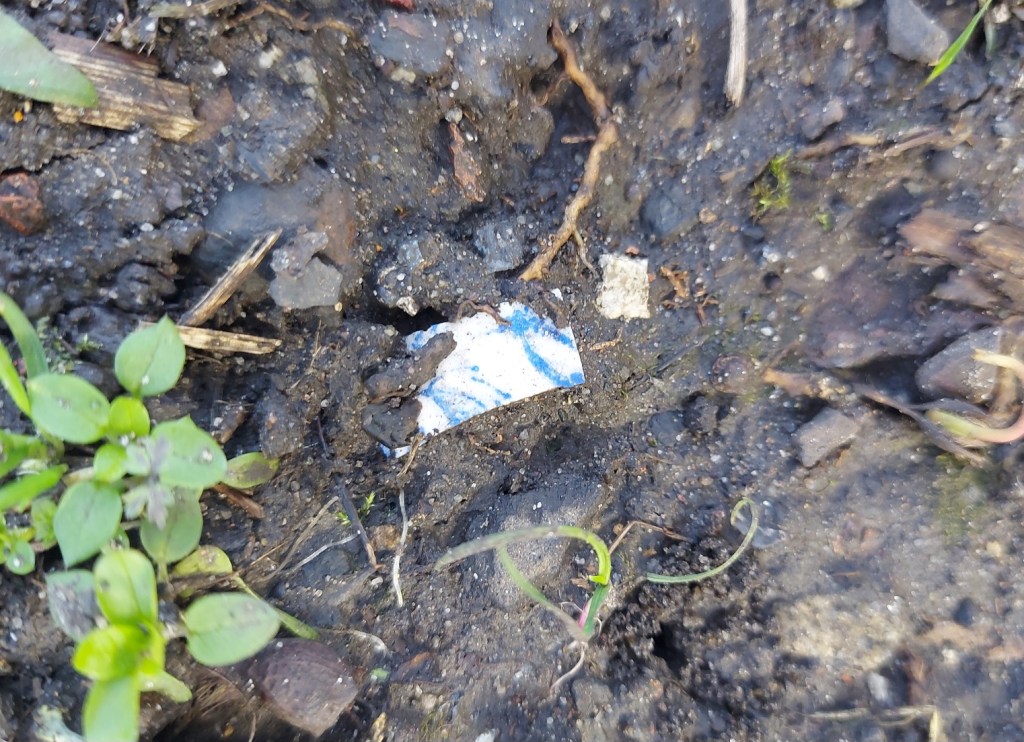
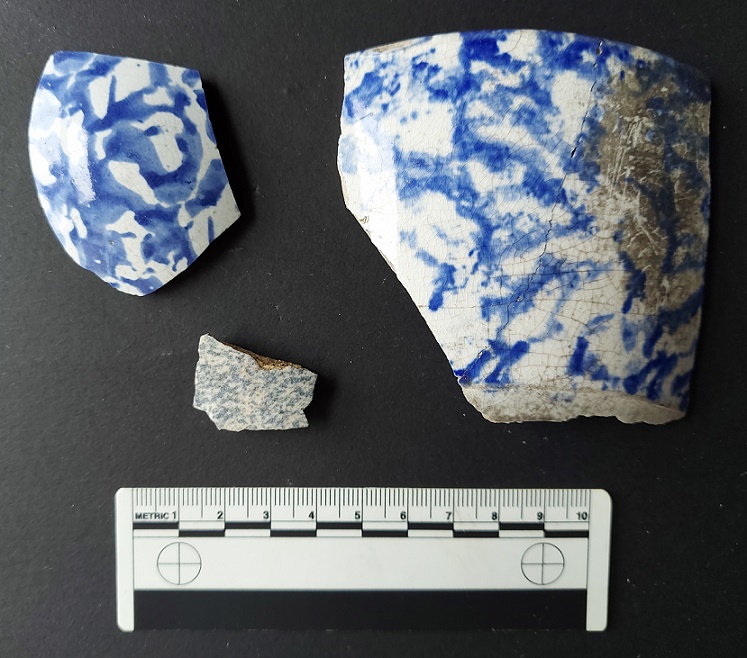
As I passed through Harehills the other day I felt that familiar tingle, the magnetic impulse that exists ‘twixt sherd and nerd. Glancing here and there my eyes picked out some blue amongst the greys, greens, and browns, and lo! ‘Twas a sherd, a thing of joy, a glimmer of hope, heart, and humour.
Small, dirty, forgotten… but full of promise.
Stooping, I quickly photographed it, aware that a dog walker was slowly backing away from me in that way that people do. And then I picked it up. I love moments like this, and it’s why I do what I do. It’s not just the joy of finding a bit of treasure, a childhood pleasure that has never left me, but to hold in your hand a little piece of the past, a fragment of life long gone, with all the possibilities – that’s the key, and why I became an archaeologist… as if I ever wasn’t. I began to look at the sherd, to analyse and understand it. And then a thought: I’ll take you, gentle reader, on the journey of discovery with me, and we can unlock the secrets of the sherd together. This could be a bit of fun. Of course, “could” and “fun” in that sentence are used with caution, obviously.
The unwashed sherd, still full of promise.
Home it came, unwashed in my jacket pocket – for dramatic effect I resisted the urge to wipe it. What secrets would be revealed I wondered, as I ran it under the tap, and scrubbed it with an old toothbrush I keep for just such a purpose (of medium hardness, for those taking notes). First one side then the other, to expose the surface, and then each of the four edges, so that the important fabric is revealed. An interesting aside – sherds normally break into broadly geometrical shapes of 4 or 5 sides, but rarely more or less. This is one of the ways that you can spot a sherd from a distance, as nature rarely has 4 or 5 sided shapes, not does it often have straight-ish edges.
The cleaned sherd. It’s quite a pretty blue, not the normal cobalt blue of the Willow Pattern.
During the cleaning process, a number of things became apparent. Firstly, it came from a thin-walled vessel, which, coupled with having a diameter of roughly 10cm, suggests it is likely to have been part of a cup. Bigger vessels have thicker walls, and table wares – the pots from which you eat and especially drink (as opposed to preparing, cooking, or serving) tend to be more delicate and have thinner walls.
Secondly, both the exterior and interior surface was rough and dull. This is not how it would have been originally – it should have been smooth and shiny – but is the result of post-depositional activity… in this case, fire. Until the 1920’s, Harehills was used in part as a rubbish dump, and fires were often deliberately set in order to keep the smell down, and rats and flies away. They could start accidentally also, as people would clear out their coal fire which often contained smouldering cinders. Indeed, the 1928 Glossop ‘state of the union’ report tells us that one dump, “about 20ft in depth, had been on fire for many years“. The heat melts and bubbles the surface, causing the tiny holes and pitting you can just make out.
Exterior, close up.
The interior, too, has the pitting
The pinkish staining on the interior is possibly a grease stain, or perhaps also the result of post-depositional activity, with the colour leaching out of some other piece of rubbish?
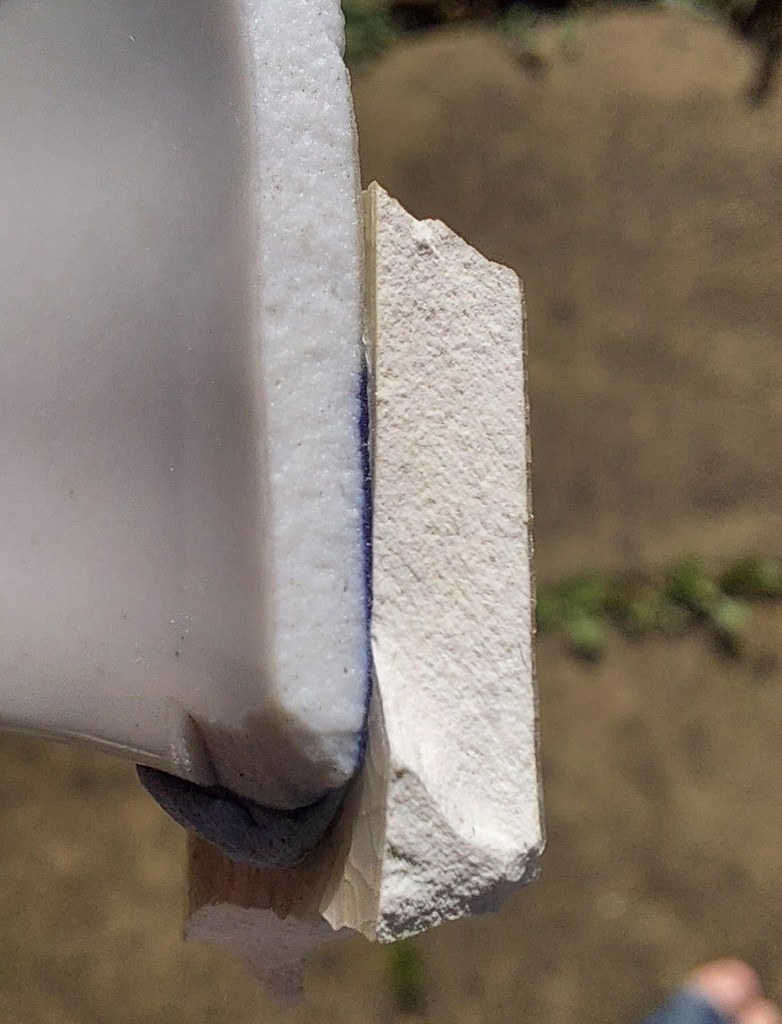
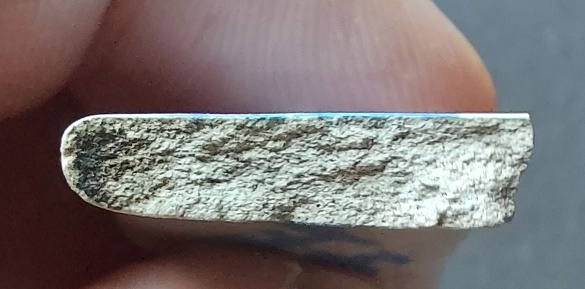
Looking at the break we can see the fabric, which in this case is a fairly poor quality greyish Bone China.
You can also see the surfaces in section – the thin white line on either edge.
Now, given that the edges shows no sign of being burnt, unlike the surface, it seems that the sherd was broken off a larger piece after the fire damage had been done, suggesting that it has moved around a bit since it was first thrown away. This is also shown by the scratches you can see on the interior; they’re not like those made by a knife on a plate (and how hard do you have to stir a cup of tea to mark the glaze?), but have been made by close proximity to, and movement over, stones.
Moving onto the decoration. Obviously it’s blue and white, but the colour of the blue is odd, and it looks more like a spongeware pattern, with the blurred graininess you associate with the printing process, than the standard cobalt transfer printed whatnot. On balance, I’d say its a somewhat poor quality transfer which has a graininess to it. The image is something floral; I can see leaves, but not those found in the usual willow pattern pottery, but something more naturalistic, and which might suggests a later date for the cup.
The most obvious aspect of decoration is the fluting running vertically up the body of the cup (clearly visible in the fabric photograph above). This was quite a common decorative theme in the late Victorian and early 20th cemtury, with some even running diagonally up the body, spiralling around it.
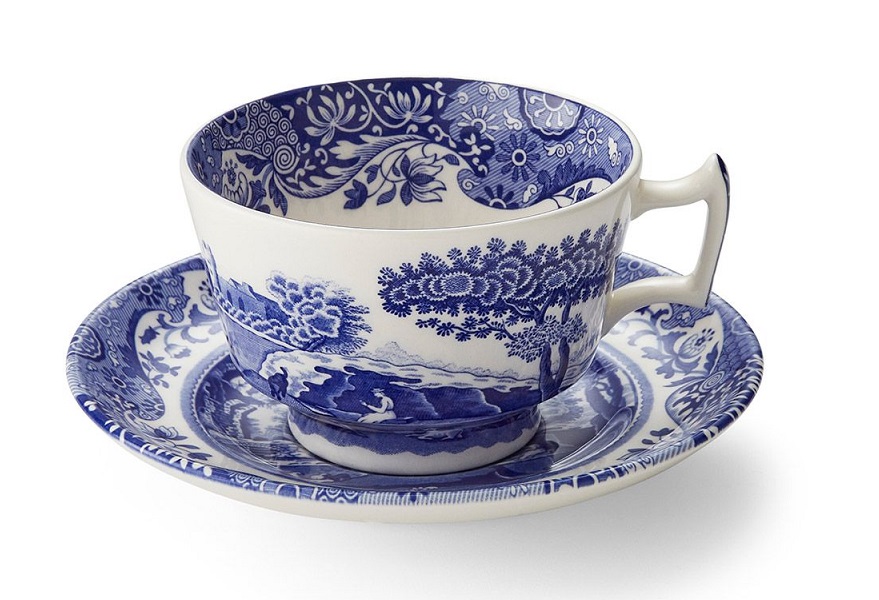
So, putting it all together, and knowing what we know, we can work out what it might have looked like originally, and a short while later we go from inch long sherd to this…
Not this 100% precisely, but near as dammit. Image nicked from this website here.
So there we go – from muddy sherd to teacup in a few minutes. It’s amazing how much information can be retrieved from just a small fragment. But honestly though, all sherds have a similar story to tell, and each one can give us all the information, we just have to look and listen. Now, your turn! Go for a walk through Harehills, or Manor Park, or indeed anywhere else where there are herds of sherds, pick one up, and see if you can find the story. Let me know how you get on.
Right, that’s all for this time, and I hope you enjoyed it. I’d like to say I’ll make up for my absence by posting lots more soon, but I don’t want to set myself up to fail, and cause more pressure for myself. More is coming, though: I have a much bigger pottery post which is almost done, but I’ll wait a little while before posting it. Also, I have some big news in the pipeline. BIG news, to be honest… so watch this space.
In the meantime look after yourselves and each other. And remember that if someone says they’re “alright”, they might not be. We all need a little help from time to time.
The Christmas season is upon us once more, and my word it seems to have come round again very quickly… in my mind it’s only September! It’s also bloody cold at the moment, and despite the protestations of Mrs C-G, the heating is not going on… honestly woman, just put another jumper on! Anyway, kind and wonderful folk of the blog-reading variety, here’s a little offering to keep you warm.
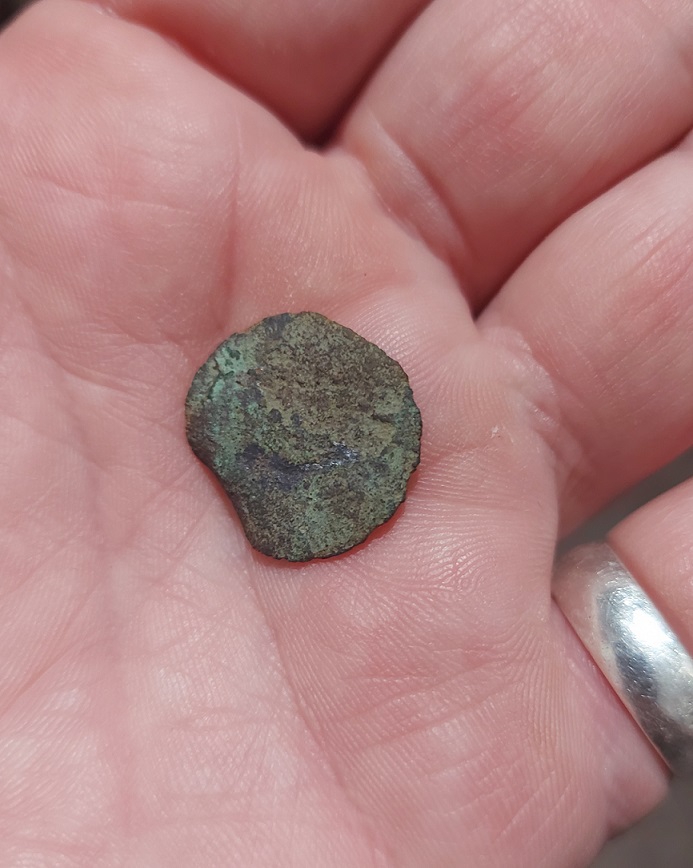
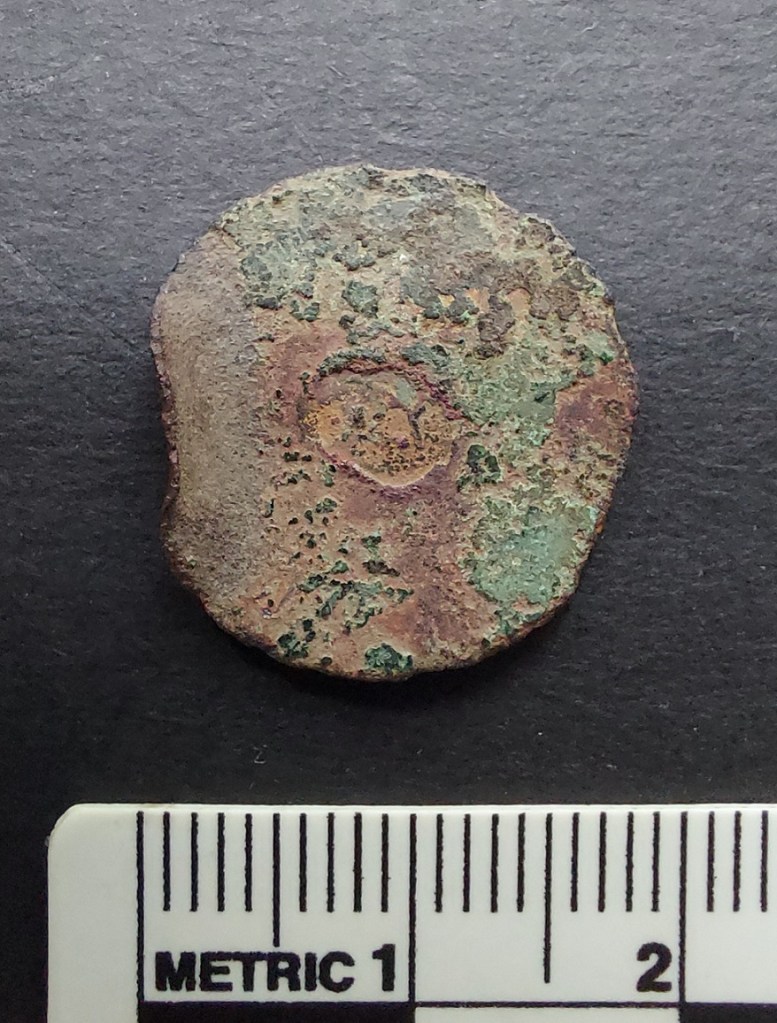
So, a number of years ago (22 July 2018 according to my records), I found this object on the footpath below Lean Town:
A metallic disc. And no, before you ask, I’m not deformed… I just have chunky and somewhat stubby fingers, Nor is it me holding the disc with my foot/toes either, as someone once ‘amusingly‘ commented.
“A coin” I thought, excitedly. And I still think it is. Well, a trade token, perhaps, but it has no discernible features that allow identification; it is completely effaced. A closer look reveals that some of the original surface has survived, revealing the dark green of oxidised bronze – so we know what it was made from. It is very thin, and seems to be relatively poor quality metal, so I err on the side of it being a trade token of some type, rather than a coin.
A close up. The central circular worn patch is the result of wear, and it looks as though the metal has delaminated. You can see the original surface – smooth green patches – above and to the right of the circular wear patch. Another close up. This side seems more worn, although the original surface is visible in places.
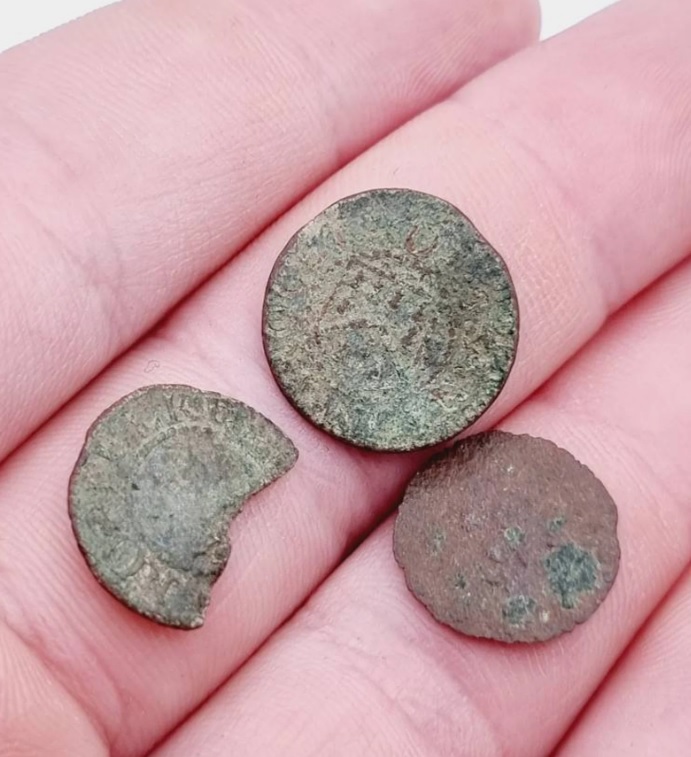
A trade token, incidentally, was a privately minted token used as small change between people, or for a specific retailer or trader. They were common in the 17th century and later when small denomination coins were rare, and often come with the name of the trader, or other information. This one… alas!
Some trade tokens – not mine, but some for sale here.
However, for me, the most interesting thing about it is that it has been bent on the edge, and this wasn’t accidental:
The bend is clearly not accidental, but instead deliberate and thoughtful.
As damage goes, it seems to be very targeted, unlike the rest of the damage which is the result of acidic ground conditions. No, this is a deliberate bend, put there by human intention, and that, dear and gentle readers, neatly leads us into an obsession of mine: the bent coin.
As you might have noticed I have a tendency to be somewhat… focused, shall we say? Yes, I know other words are available, but I was being kind to myself! In my real life, I am honestly a shambles; a veritable clown-car at times, complete with wheels that regularly fall off and an enormous horn (madam, calm yourself please, this is not that sort of website). But by Jove, when it comes to archaeology, I can tell you the what, where, and when with almost surgical precision, complete with spreadsheets, plastic bags, labels, and typologies – with archaeology, then, I am mustard, tickety-boo and, I’d venture, oojah-cum-spiff. The ability to focus on single topics in such a way means that I sometimes fall down rabbit holes (literally, as it happens, as well as figuratively) and become obsessed with certain features, topics, and objects… and so it was here with bent coins.
A number of years ago, whilst sorting the small finds at the Blackden Trust, I came across a coin that had been bent into something of an ‘S’ shape. “Hmmmmm…” thought I, and off I wandered – and wondered… why would a coin be bent like that?
A survey of what little literature there is on the subject revealed that coins bent in this manner are a relatively common find by metal detectorists. Further research revealed a fascinating history of coin bending traditions that begin in the medieval period as an important, if not official, religious function, which later shifts to encompass such concerns as love, luck, and loss.
A silver sixpence of the 1690’s bent into an ‘S’ shape. It must have taken some effort to do. I mean, perhaps not lots, but it’s not the sort of thing you can do accidentally. You can often see teeth marks in the bends, which may answer the question of how it was done.
The first account we have of coins being bent in a deliberate manner comes from the 1160’s or 1170’s. A monk from Durham had injured his testicles in a riding accident (look, I’m not making this up, I promise. And there is absolutely nothing funny about a monk with knackered knackers. Nothing at all. Nope.) Anyway, in pain and desperation, the poor chap bent a coin and dedicated it to St. Cuthbert, asking for the saint’s help, and promising to go on a pilgrimage to the shrine of the saint on Lindisfarne to make an offering of the coin. Once there, the monk made the offering and immediately began to recover. Here, then, we are presented with the essentials of the medieval practice; the idea behind the bending of the coin being one of mutually beneficial exchange designed to strike a deal with the saint. A coin is held aloft and bent in honour of that particular saint, with the hope that they will intercede on your behalf. In return you’ll undertake a pilgrimage and deposit the same coin at the saint’s shrine in order to further promote their glory.
This was a common practice in the medieval period: we hear of a William Child, a constable from Peterborough, bending a coin over his ‘dead’ child in the name of Simon de Montfort and the child miraculously recovered. When, during a storm at sea, a man amongst the crew of a ship bent coin with the words “I vow myself and this penny to my lord St. Wulftan”, the storm passed with the miracle attributed to Wulfstan. A coin bent to St. Wulfstan calmed a woman “in the grip of insanity” when it was tied around her neck, and a coin bent over a still-born child and dedicated to St. Richard of Chichester effected an immediate cure. Following an injury, a certain Alice had a suppurating foot, and her father bent a coin to St. Thomas Cantilupe, afterwards making a pilgrimage to his shrine at Hereford. Ann Plott was run over by a cart in 1485 on the Isle of Sheppey, one of her neighbours bent a coin over her body and she recovered. A certain Katherine Bailey, blind in one eye, was told by a stranger to bend a coin to Henry VI; making a mental promise to do so, she found she could see with both eyes. Somewhat bizarrely, it helped with criminals as well as the innocent; in the early 1290’s, a William Cragh was hanged for arson and 13 counts of homicide. Taken from the gallows, a coin was bent over him, and miraculously he lived, apparently for another 15 years.
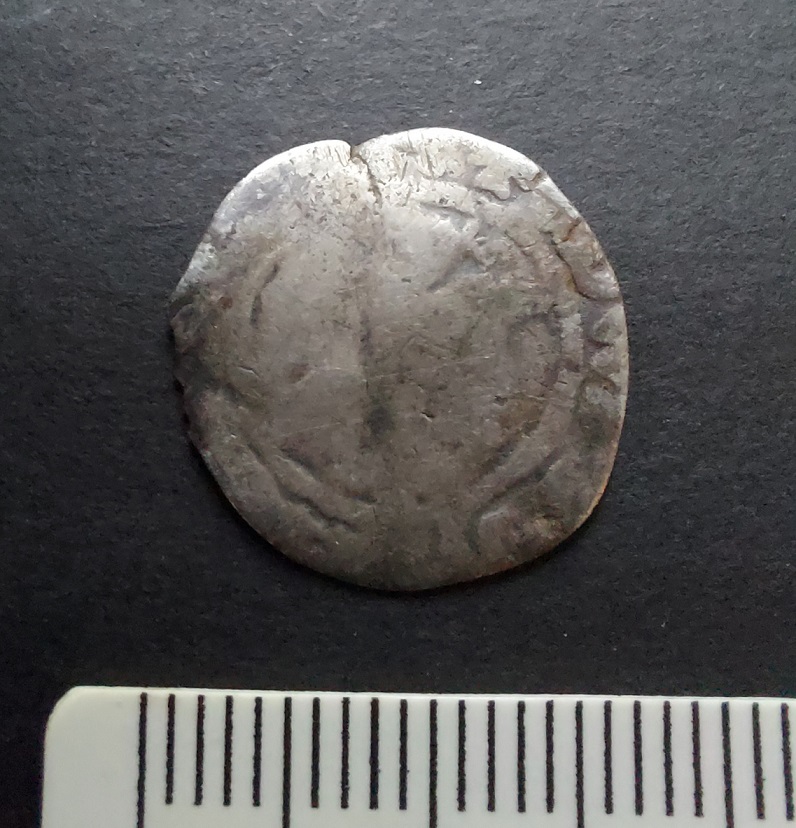
A half groat of Henry VII (1485 – 1509). The coin has been bent double at some stage in its life – you can see the crease running top to bottom.
A lot can be made of the symbolism of bending a coin, and even the shape can be open to interpretation. The coin itself may have been seen as a relic of the miracle it brought about, and worn round the neck it may have acted as a talisman. Medieval ‘popular religion’ (i.e. not officially allowed by the Church, but done anyway) and magical practice are interests of mine, but I won’t go into it here (never mind yelling “thankGod“. And the person bending a 20p coin asking for help in getting me to stop talking about pottery is, frankly, just being rude). Buy me a drink sometime, though, and I’ll tell you allllllllll about it!
During the reign of Henry VIII, the religious upheaval of the Reformation meant the role of saints within the Church was very much downplayed, and the practice of bending a coin lost it religious meaning. However, coins continued to be bent, only now redefined as tokens of love or remembrance. The meaning is the same – faith, promise, and devotion – but the object of this faith and devotion shifted from a saint to a person, and from the sacred to the secular.
A sixpence of William III dated 1696.
Thus we read of Alice Benden, a protestant martyr, who in 1557 gave her brother a ‘bowed shilling’ as a keepsake on the occasion of her execution. In a letter dated 1790 we read the following: “I have a bent sixpence with a hole through it, which was given by my only brother as a keepsake”. More commonly, though, they were given as love tokens by one, or both, of the partners as a way of promising their faithfulness, and showing their devotion to one another, and references to this activity are found in literature. Indeed, the giving of a coin was a similar gesture to giving an engagement ring, and was often understood to be a statement of betrothal or marriage. In 1715, Lady Bridget Osbourne, eldest daughter of the 2nd Duke of Leeds, gave the Reverend William Williams half a gold coin “which she had almost bent double with her teeth” as a way of announcing her intention to marry him. The ensuing clandestine marriage produced a scandal that was played out in court, with the coin figuring quite prominently within the case. It is interesting that here the protagonists are educated middle and upper class individuals, suggesting that all elements of society understood the gesture.
A silver shilling of George III (1816) that has been bent into an ‘S’ shape. What is interesting about this coin is that it has obviously been kept for a long time – the coin is very worn along the bend. Was it a treasured possession and kept in the pocket?
Bent coins were also considered lucky, and people carried them on their watch chains, or around their necks, and were often referred to as ‘touch pieces’. George Eliot in Silas Marner writes “You’ve got the beauty, you see, and I’ve got the luck, so you must keep me by you for your crooked sixpence; you’ll never get along without me”. They were also used to protect against witchcraft; milk that wouldn’t churn properly had a bent coin dipped in it to reverse the spell that was assumed to be the cause of the problem. We also read about more direct action against alleged witches, animals believed to be the witch in disguise were shot with a bent coin to lift a curse.
As a practice, coin bending seems to have ceased by the early Victorian period, although examples are known from as late as 1860’s. After this period, and into the early 20th century, coins were still used as keepsakes and love tokens, but were inscribed with names, verse, dates, and pictures instead.
It’s quite a story from a little disc of metal I almost overlooked as it lay in the mud. Makes you wonder what else is there… And as you can see I have collected a number of bent coins over the years (actually, quite a number. In fact, I’m not going to lie to you, I have many. Just don’t tell Mrs C-G, she has no idea! Bloody rabbit holes). Some of this blog post was extracted from a dense academic paper I have written on the subject – complete with references and soooo much more information. If anyone is interested, I will happily send you a copy – drop me an email. In fact get in touch anyway, wonderful blog reading folk, even to tell me you want more pottery posts. What’s that? Of course you do!
In other news, I have written a story for the Glossop Winter Story Trail organised by the incredible people of Glossop Creates. The idea is 24 creative types (myself included) have written short stories that are displayed in shop windows dotted all over Glossop town centre – follow the trail to read them all and uncover a hidden poem. Mine, obviously, is the story of a sherd of pottery and can be read in the window of The Bureau on Henry Street, Norfolk Square. You can also listen to it being read here.
Right then, I’m off to clean some pottery in preparation for the next instalment (which may happen before the New Year). In the meantime, have a wonderful Christmas, and as always, take care of yourselves and each other. I remain, Your humble servant.
We have today yet another instalment of that momentous work The Rough Guide to Pottery – it truly is the gift that keeps on giving. Try to contain your excitement, but I know it is difficult. Mrs Hamnett herself commented only the other day, as I was explaining the process of making a 17th century slip ware bowl, how lucky she was to have married me. And Master Hamnett runs and hides from me screaming “go away!” whenever I show him a lovely piece of stoneware… the playful scamp.
So then… Porcelain.
A modern Spode porcelain teacup and saucer – stolen shamelessly from their website here.
Here we stray into the realm of real ‘collectors’ and people who spend hundreds of thousands of pounds on a cup. Fair play to them I say, but to be honest, to me and you the minute details of rare and collectible porcelain don’t matter that much.
A Victorian pair of tea/coffee cups – £13 on ebay here (and no, they are not mine!)
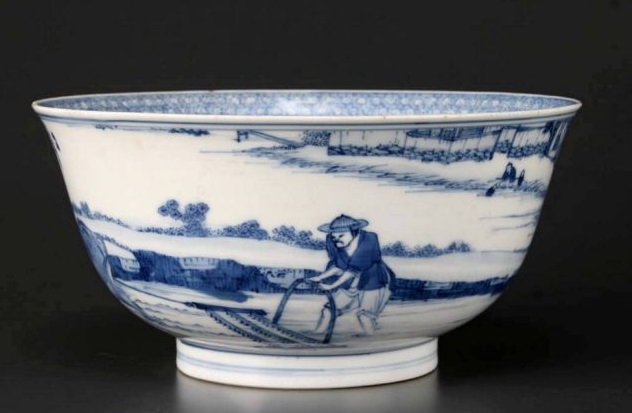
True Porcelain was developed in China in the 9th century, and is essentially a very refined stoneware. It is often delicate with very thin walls – so thin that you can see light through them – yet is very hard wearing and tough. Its development was due to an aesthetic search to find a substance that was as hard and cold as jade, and yet gave a ringing tone when struck, like bronze. True Porcelain is made from a mixture of the mineral feldspar and kaolin, a type of clay, and fired to a very high temperature (1400°) which vitrifies (melts) it into an almost glass-like state. It was exported to Europe from 1500s onwards, and was hugely different to the coarse earthernwares that made up European pottery then; this stuff was incomparable (that thing your 3-year-old made using Playdoh versus the finest China).
The genuine thing; late 17th/early 18th century Chinese porcelain. A mere snip at £38,000!
Porcelain became very popular in the 17th and 18th centuries, particularly due to tea and coffee consumption among the wealthy being fashionable – essentially they wanted something similarly exclusive to drink out of. It honestly amazes me how much of history is driven by fashion and the need to be different and ahead of the crowd – something that isn’t going to change any time soon.
Now, being imported from China meant it was hugely expensive, and many factories began to try and make it. However, no one really knew how it was done. Meisson in Germany began producing very similar pottery in the 1710’s, and others in Europe and the UK had early successes, often involving adding glass dust to fine clays. A significant breakthrough came in the mid 1790’s when Josiah Spode perfected what became known as Bone China. Here, a very fine clay is mixed with about 25% crushed burnt bone, and fired. This produced an almost identical porcelain, and it allowed the mass production of the pottery which is still going today. Also, as it became affordable, it was no longer an exclusive product despite still having a ‘classy’, even snobbish, image. Personally, I prefer an earthernware mug, but my grandparents generation would have scowled at my choice of cup. Now, at the risk of incurring the wrath of Porcelain experts, I’m lumping true imported Porcelain with Bone China here.
Does exactly what it says on the bottom on the early 20th century teacup
There are no perceptible differences at the level at which we are working, nor is it vital that we pinpoint a date of something – we are simply having fun (admittedly some of us take our fun more seriously than others who, for example, don’t clean their pottery. Or who use an egg as a photographic scale. I’m not naming names, you know who you are.). If you do want to go down that rabbit hole, there are dozens of books on the subject that allow you to explore dates, patterns, shapes, types, names, etc. However, for our purposes, it all goes under the heading PORCELAIN. I expect a visit from the heavy thugs of the porcelain collecting world within moments of publishing this.
PORCELAIN (aka Bone China, China) DATE: Realistically c.1800 – Now. Theoretically, but unlikely, 1500 onwards. DESCRIPTION: Thin walled vessels, delicate, with many different decorative motifs and colours, occasionally with gilding. SHAPES: Most shapes, but very commonly tea/coffee cups, saucers, small plates.
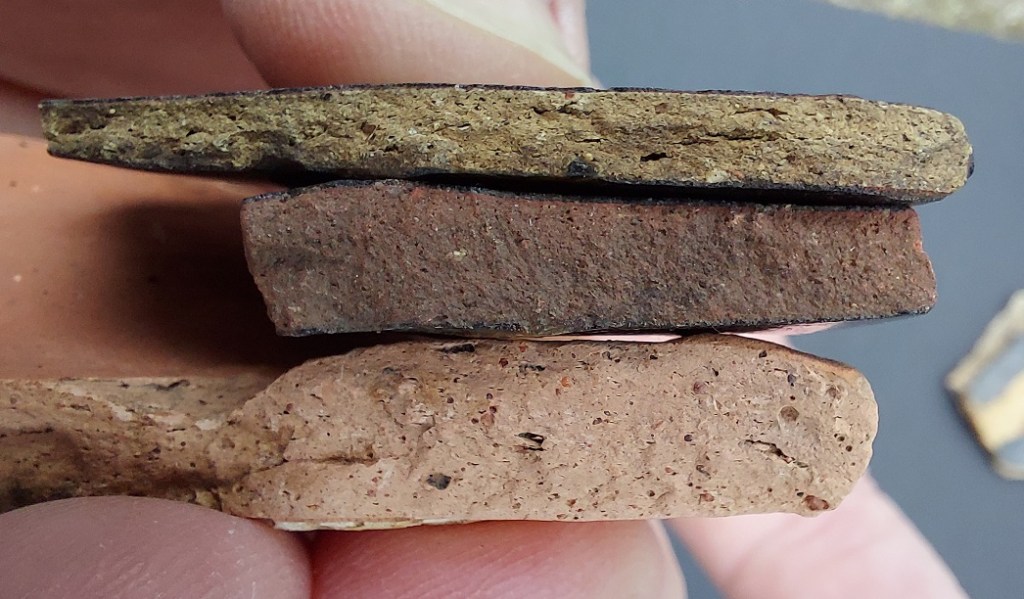
Very thin walls, but is very hard, especially when compared with ‘normal’ pottery. The fabric is white or very pale grey, with perhaps a hint of blue, and with no inclusions – it is pure. The texture is very glassy, and is grainy with tiny voids – it reminds me of cauliflower heads, or snow. See this comparison with earthernware, for example:
Porcelain left, earthernware right (my bare foot, bottom right… it’s probably for the best we move on, really). The difference in the fabrics is very noticeable, it’s almost wet(porcelain) versus dry (earthernware).
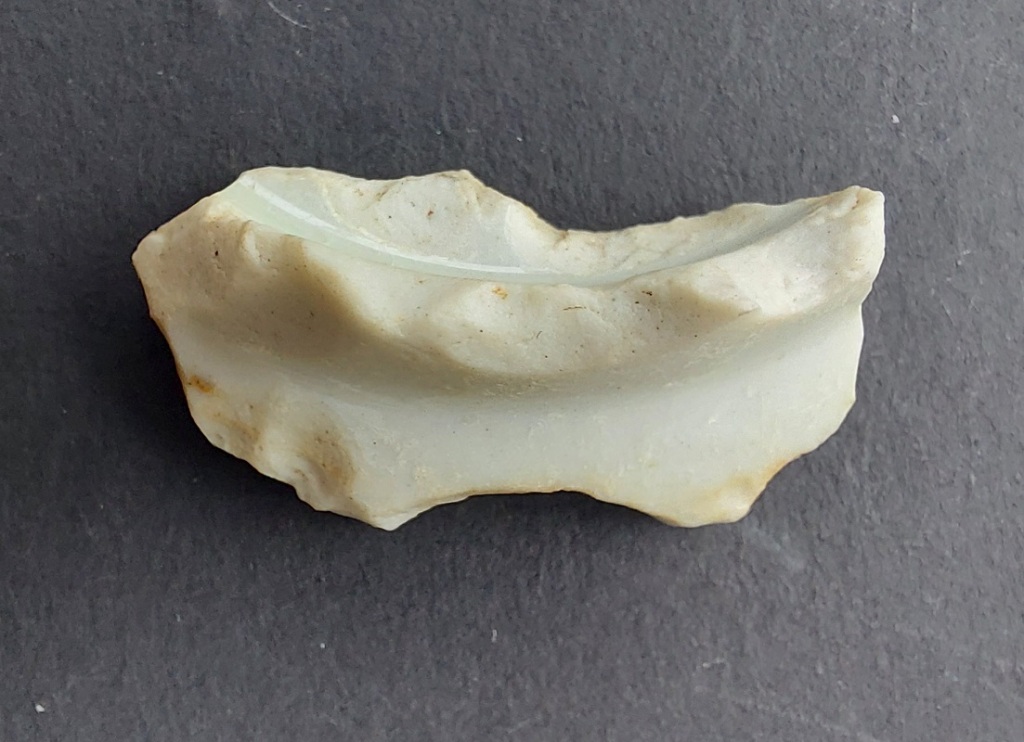
It also breaks like glass or flint, rather than pottery, with tiny flattish flakes and sharp edges.
It’s odd stuff! You can see how it breaks into flakes, and I remember reading about Australian Aboriginal tribes using telegraph wire insulators to make stone tools. Makes sense.
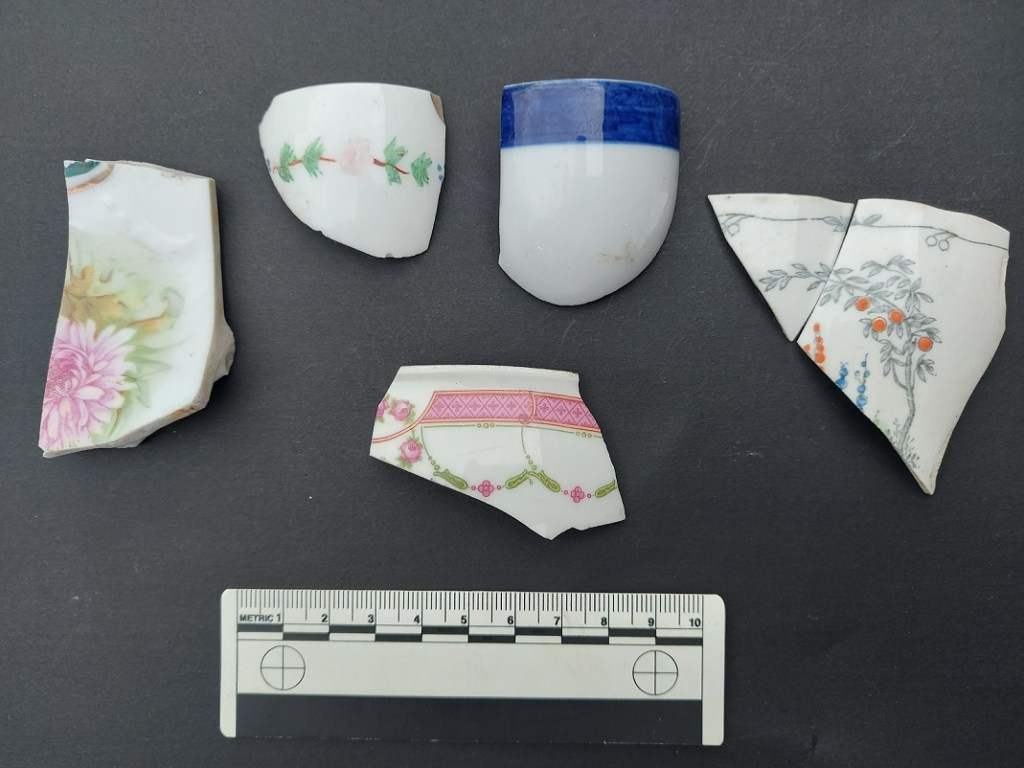
Banging sherds together, they make a high ringing sound – a ‘tink’, rather than a ‘thunk’ if you see what I mean (don’t look at me like that…). Also, if you hold a sherd up to a light, you should be able to see through it – try moving a finger between the sherd and the light source. The surface is very shiny with the glaze visible in the section as a clear white line, often with the paint of the decoration bleeding into it. Decoration is fine hand-painted images, normally in blue, though other colours are found, and normally of naturalistic scenes – flowers, landscapes, trees, etc. The start of the obsession with ‘Chinese’ decorations (including ‘Willow Pattern’) can be traced to the original porcelain vessels. Shapes are largely bowls, delicate teacups, plates and saucers, though teapots, milk jugs, and other shapes do occur. Other decoration can be painted over the top of the glaze. Later examples of Porcelain/Bone China can be very colourful, and very fine, too, often with a gold leaf gilding.
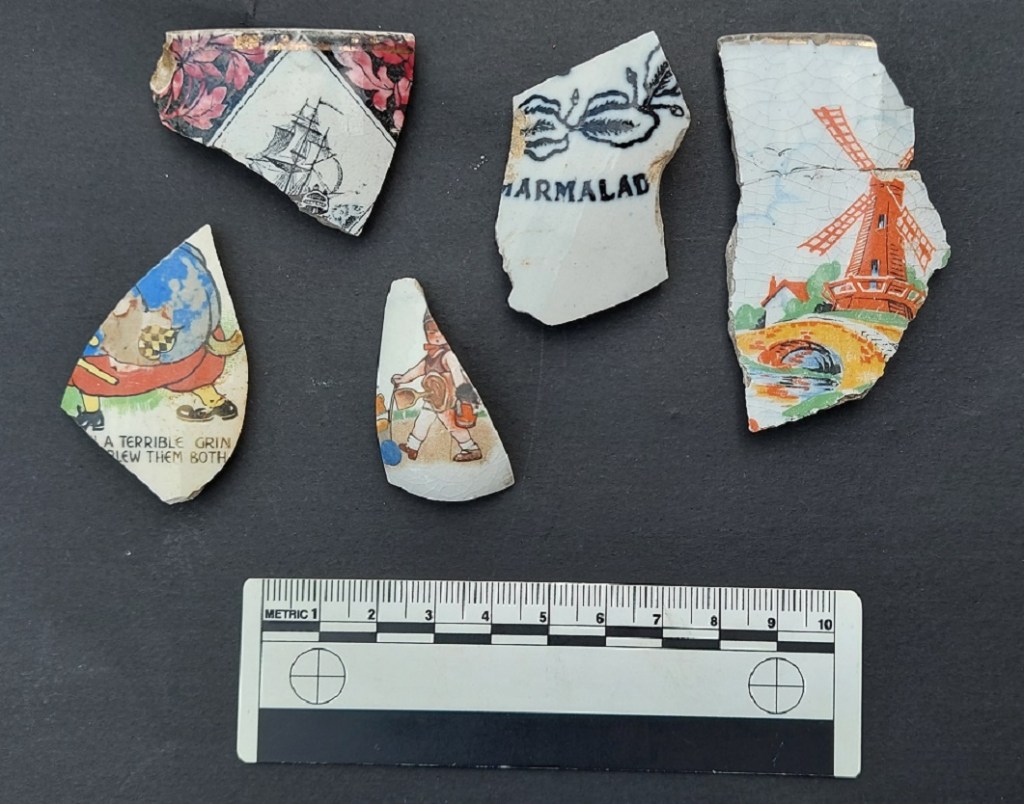
A random selection of Glossop found sherds of porcelain showing a range of decoration. I have to say, it’s all a little gaudy for my tastes.
This is more like it – a flowing, living, painted decoration – fluid lines, almost jazz-like in improvisation. Lovely stuff. I found this tiny sherd in the River Thames a few years ago, and it is one of my favourite sherds. Blimey, now there’s a phrase I never expected to type!
Now, because I love you so much, and I know how much you enjoy my ramblings about pottery (I’m ignoring you – you don’t have to be here, you know), I thought I’d add another related ware type.
Whilst searching for an easy Porcelain recipe, Wedgewood made numerous innovations in pottery (including the famous Jasper Ware), one of which was Basalt Ware. Although it is rare, I love this stuff.
Some Black Basalt Ware. As I say, I really like this stuff.
BLACK BASALT WARE (aka Basalt Ware or Basaltes) DATE: 1770-1820 DESCRIPTION: It is characterised by a black surface, thin walls, and impressed – not painted – decoration. Very classical Greek and Roman influenced motifs and designs. SHAPES: Cups, Bowls, Tea & Coffee Sets, Vases, Busts, Plaques, Figurines, and Relief Medallions.
A red clay is mixed with manganese oxide, which gives it its black colour, and it is fired to a very high temperature to make a refined stoneware. It is hard-wearing, and, like porcelain, doesn’t break like ‘normal’ pottery, but more like glass, with straightish sharp edges. The fabric is very hard and very dense, as you would expect, and is totally uniform – there are no inclusions – but it is quite grainy, again, like porcelain. The gloss surface can be dull or shiny, though never a brilliant shine, and there is no glaze or surface; the fabric is the pot, which seems odd.
Here is the fabric – hard and grainy, but there is no surface. You can also see the voids that are formed by gasses produced during firing.
Impressed decoration, very Classical in inspiration.
More impressed decoration – this time the base of a tree or shrub.
Thin walled, it has impressed and embossed decoration – rouletting, geometric shapes, naturalistic scenes with classical motifs and flora. It looks vaguely Roman, and is very heavily influenced by the Greek, Roman, and Egyptian antiquities that were being unearthed at that time, and which were fuelling the Georgian neo-classical obsession in all aspects of life. As a pottery type it’s not common, but you can occasionally find it here and there.
Well then, excitement over. That’s all for this time.
There is lots in the pipeline – both Glossop related, and further afield – so watch this space, and as always I have several large posts ready written – so perhaps two this month? You lucky people, you!
I also have a thing coming up – one of this public speaking things that I can’t seem to stop doing! This one is in Chester, and is a folklore/archaeology ‘discussion’ with the wonderful Elizabeth Garner, and called ‘The Gold In Your Back Yard‘. It’s free, but do book through Eventbrite here. It will, of course, be amazing… I think. But if not, you can just sit at the back and ask awkward questions! I’ll also shamelessly plug Liz’s book, Lost and Found (buy it here). It is a wonderful collection of folktales, beautifully told. She also mentions this archaeologist bloke, Tim Campbell-something-or-other. Honestly though, it is well worth buying.
More soon, I promise. But until then, look after yourselves and each other. And I remain,
Nope, no pottery today. Instead we have tracks. And stones. And holes. Look, just read on… it’s simpler.
Now, I do love a good track. Ask anyone who knows me, and they’ll say “why yes, that ruggedly handsome, wonderously whiskered, and all-round splendid chap does indeed love a good track or two“. I also love a good stone. In fact, ask anyone who knows me, and they’ll say “why yes, that marvellous man, that genius gentleman, that… ” What’s that? What do you mean “get on with it!“? Honestly.
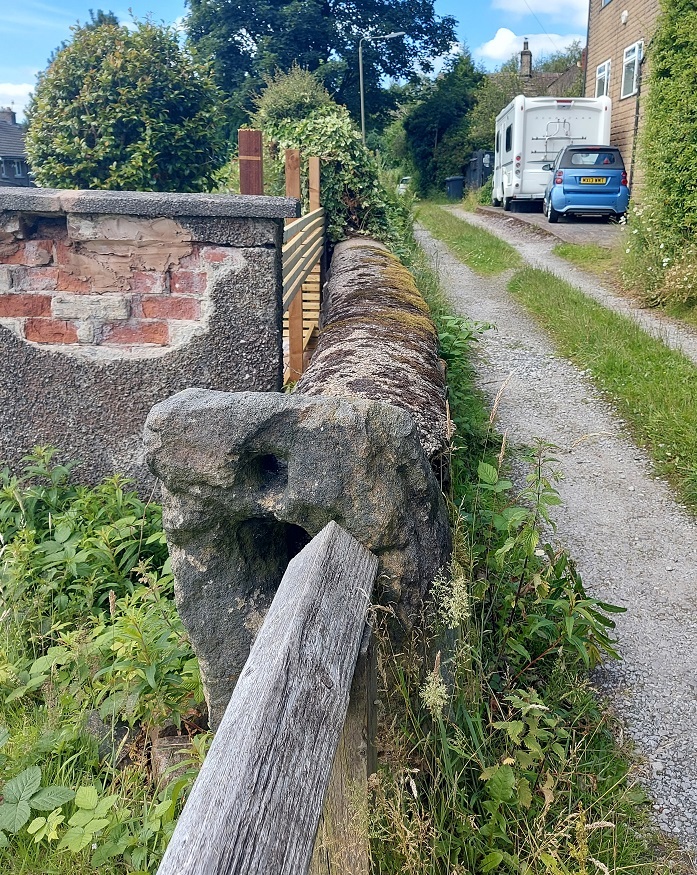
Ok, so several years ago I noticed that dotted around the Glossop area are a number of standing stones that have holes carved in them. I did wonder about them, but presumed they were a form of gatepost, even if they didn’t seem to be in a place one would expect a gatepost.
A holed stone on Hague Street. They remind a bit of Hattifatteners from the Moomin stories… they probably come to life at night.
More recently I have been looking at tracks:
TRACK (noun) A rough path or road, typically one beaten by use rather than constructed.
And more specifically, the old – medieval or post-medieval (10th – 17th centuries) – trackways that dotted the area. Glossop is a great example of what we call a medieval ‘dispersed settlement’ – essentially, whilst there is a central focus – Old Glossop, with the church and market – most people actually lived in the many surrounding ‘dispersed’ farmsteads – Heath, Dinting, Ashes, Jumble, etc. People came together every Sunday for Mass, as well as other feast days and holy-days, for market days, as well as socially – for a drink in the tavern, for example. But by and large, Glossop in the medieval and early modern periods was dispersed throughout the valley in farmsteads. In this instance, a farmstead may be understood as a farmhouse and associated buildings – barns, shippons, and various ‘farm-ey’ outbuildings – as well as houses for the farmworkers. In total, we’re looking at perhaps 20 people or so for a larger farmstead, maybe 5 for a smaller. Of course, people need to travel, and roads were made through the landscape, connecting these farmsteads, and it these I incredibly interesting.
This is the track that runs down from Ashes to Dinting – once the main thoroughfare, now a beautiful sunken trackway, or holloway as they are known, its age is shown by its depth, worn through use.
They were not just a means of physical movement through the landscape, but also a conduit for other aspects of life. As packhorse routes (no horse and carts here, just heavily laden beasts of burden) they connected everybody, and allowed goods and produce to move between places and markets. News of the wider world also moved along these tracks – a new king or a new religion, or news of battles and wonders in far off places. But so did disease and infection; the Black Death and Great Plague once walked these tracks. We also encounter the more local and personal aspects of life, too: newlyweds from church, newborns from baptisms, and the final journey from the farmstead to the church yard, as the deceased was carried for burial, often for miles, along the tracks, followed by mourning family and friends. All of life is contained in a track, worn deep by use, and all of history held there, if only we could access it.
However, the collision of stone and track didn’t connect until last year, when it occurred with an audible click at Pyegrove.
Pyegrove circled in red. For orientation, the Snake Pass runs horizontally across the bottom, with the Commercial Inn on Manor Park Road circled in blue on the right, and the Royal Oak, left. Note the green arrow. Map from the marvellous and incredibly useful National Library of Scotland map website – well worth an explore.
An afternoon playdate with Master Hamnett and his friend led us to Manor Park via Pyegrove. Now Pyegrove is an interesting corner of Glossop, with a long history; the name means the copse or thicket’ (grove or greve, as it is in older maps) of the magpie (the ‘Pie’ or ‘Pye’ element) which suits its location below Shire Hill perfectly. The house here has a datestone that reads “I.M.A. 1747” (no photographs, alas… it’s difficult to even see it without overtly trespassing), so that the house is at least that early. However, in the baptism record of a John Shepperd at Glossop on Christmas Day 1735, his father (Robert Shepperd the Younger) gives his address as Pyegreve, so we know something else was there at an earlier date. Pyegrove is, I suspect, another medieval farmstead… but all that (along with tales of Buffalo Bill) is for another time. Let’s return to tracks and stones.
The footpath at Pyegrove splits – right skirts Shire Hill down to Mossy Lea, left ploughs on over the playing fields to Glossop.
Tarmacked, unlike the original, choose your path wisely.
But just at the split I noticed this:
Oooooh!, thought I – a holed stone…
It was at that point it suddenly struck me, and as I stood there gasping like a stunned fish, ignoring the children, and mentally ran over all the holed stones I knew about (5 at that point). Of course, I thought, they all marked a junction in a footpath or track! And all of those tracks, I was fairly certain (and am now convinced) were the preservation of early (medieval or post-medieval) trackways between farmsteads. I have talked about this before – the fossilisation of early trackways, preserved as footpaths within modern settings, but in essence once the newer – and much better – roads were constructed for the mills (1790’s onwards), these old roads fell out of use, but as they often were more direct, and were known by locals who still used them, they gradually became public rights of way.
The stones, being big and heavy, are often not moved, so there they sit as testament to the tracks that were once the main roads between the dispersed settlements that made up Glossop. I know of 9 holed stones now (and two more that might be relevant), and looking closely at the stones, they all share similar aspects. Upright, and roughly shaped from millstone grit or similar gritstone, and they seem quite worn – usually an indicator of age. The hole, made through the stone, is broadly square in shape, measuring between 3 and 4 inches across, roughly carved, and placed in the top third of the stone. I am convinced they were shaped and set up by the same group of people to make using the notoriously bad road system around Glossop easier. Of the stones, the obvious question is why does it have a hole in it? My first thought was that it would mark the stone as different from others that might be in the area, making sure that a junction wouldn’t be missed in the dark or bad weather. This might be the case, but then I remembered reading that in 1693 a law was passed that trackways had to have a guide post showing destinations (the Whitfield Guide Stoop was a result of this law, but probably a later incarnation), and I wonder if the hole was there to allow a wooden sign to be placed in it with destination painted or carved on it? Or perhaps a simple stick pointing the way? Any thoughts on this, o’ wonderful readers? I also wonder how far this tradition continues – certainly I know of no others in surrounding areas – even Tintwistle or Hadfield, for example, seem to have no holed stones, although I’m happy to be proven wrong. .
But let’s have a virtual explore the Pyegrove to Glossop track here, starting at the stone that started it all.
Ignore the later drilled circular hole, and the rusty bolt through the hole – this is a classic junction marker, with its ‘square’ hole and rough shaping.
Ignoring the A57/Snake Pass (opened in 1821, although bits are older), behind us is what is now Derbyshire Level, with the farmsteads of The Hurst, Jumble, and Gnat Hole, and also the road to Whitfield and Chapel en le Frith. Going left, then, a track along the edge of some houses leads out into Pyegrove Playing Fields.
Looking back at Pyegrove, the overgrown track hides what was once a main thoroughfare into Glossop. O’ for an excavation of this track!
Along the northern edge of the playing fields the track is no longer used, but is visible as a ‘holloway’ – a track worn deep with use.
Here is the Holloway, Green Way, or sunken trackway, depending on how you call it. Do you known what, it’s oddly difficult to photograph a dip in the field, but it is there… honestly!
We join the track again at the corner of the playing field, where there is a lovely squared off standing stone.
A simple standing stone, if such a thing exists.
This seems to mark the junction of a track that originates at Cross Cliffe, here marked in blue:
The trackway is visible in the older maps, and although it fizzles out on the ground, it is preserved in field boundaries and fossilised in strangely preserved bits of pathway.
Whilst it is just about marked on older maps, it is no longer in use, although its memory is fossilised in this bit of unnecessary and unusually wide stretch of pedestrianised path leading from the Snake Pass to Pyegrove Park (marked with a red circle in the above map)
Oddly wide, and completely unnecessary, this is the fossilisation of an older track from Cross Cliffe.
These simple – unholed – standing stones sometimes mark junctions, but more normally simply mark the line of a path where is might not be obvious, particularly in the dark or rough environment (I know of about 12 of these, too).
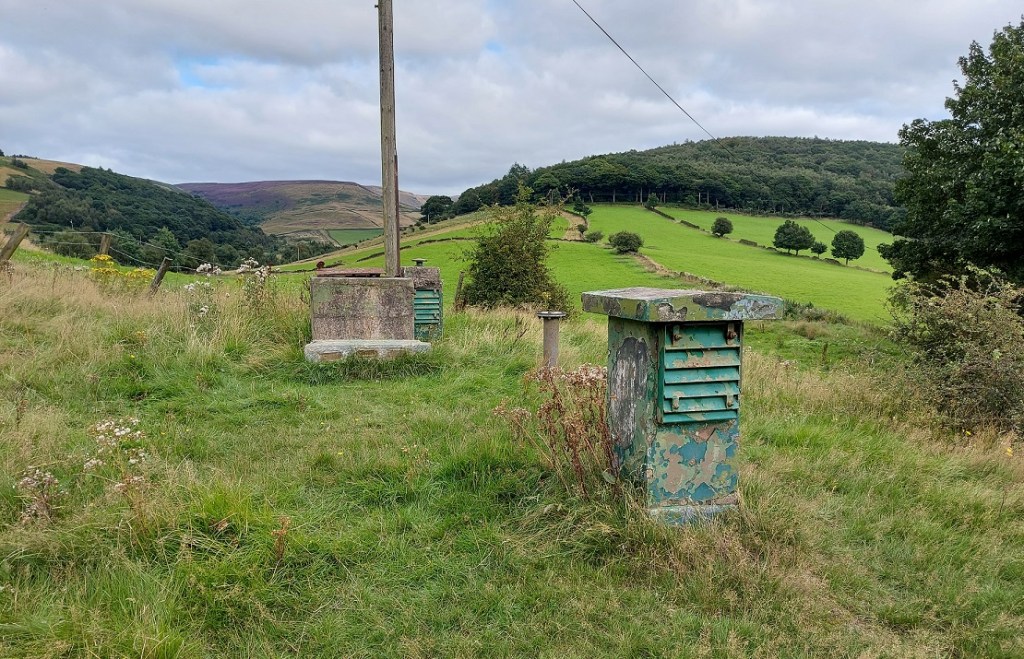
We continue along our Pyegrove track beyond the stone and past the remains of the Royal Observer Corps station. Briefly, the station was meant to monitor potential enemy aircraft in the immediate post-WWII period, but it would also serve as a monitoring post, observing and recording the effects of any nuclear detonation on Manchester – wind speed, radiation levels, blast radius, etc. This is why it is built into the hillside, 15ft below ground level. A sobering thought, and one sadly now relevant once more. This will also be the subject of a future blog post, don’t worry!
An interesting slice of much more modern history, but one that is certainly worth a look at .
Back to the task in hand, and on to another standing stone. This one, looking for all the world like a gravestone, was originally one of a pair (its partner is embedded, horizontally now, in the wall.
One of a pair – the other can be seen lying horizontally built into the wall – same stone type, same width, same depth, and presumably the same length, accounting for a few feet underground.
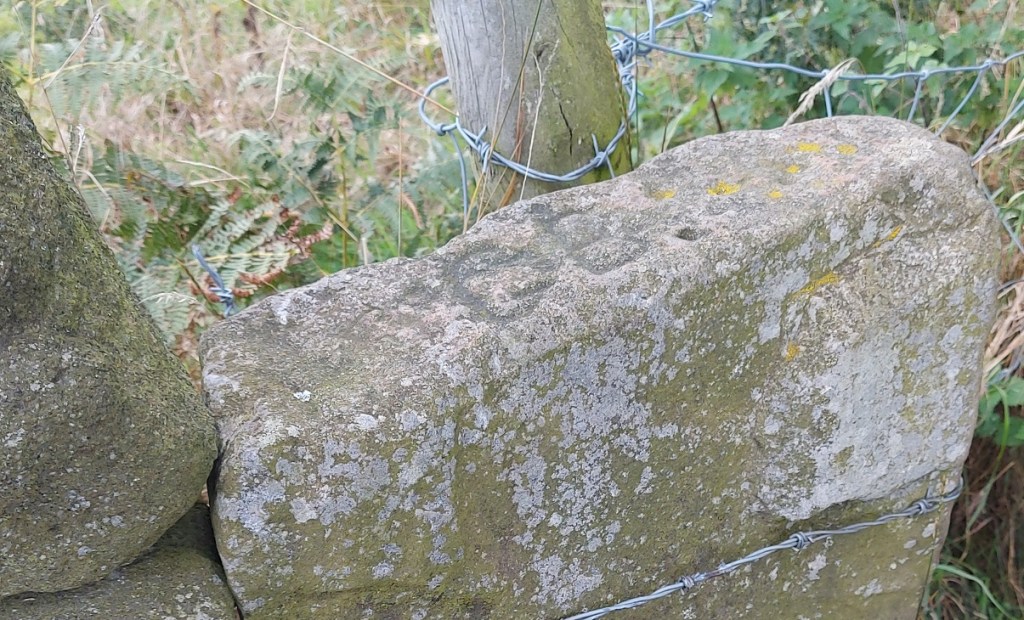
These gravestone pairs are usually found mid track or at the start of junctions, and seem to be a later addition to the tracks (probably post-1790’s) and seem to be an attempt to force packhorses and traffic onto the newer roads (and presumably so they can pay the tolls) – and early form of traffic calming, if you will. I am fairly certain with the date of c.1800 as Whitfield Cross was used as a partner to one of these ‘gravestone’ pairings after it was moved in about 1800. There is some graffiti carved on the top of this stone – ‘G.B.’.
G.B. step forward and take a bow – I do like a bit of carved graffiti.
From here we continue, round the corner, to the farmstead of Hall Fold.
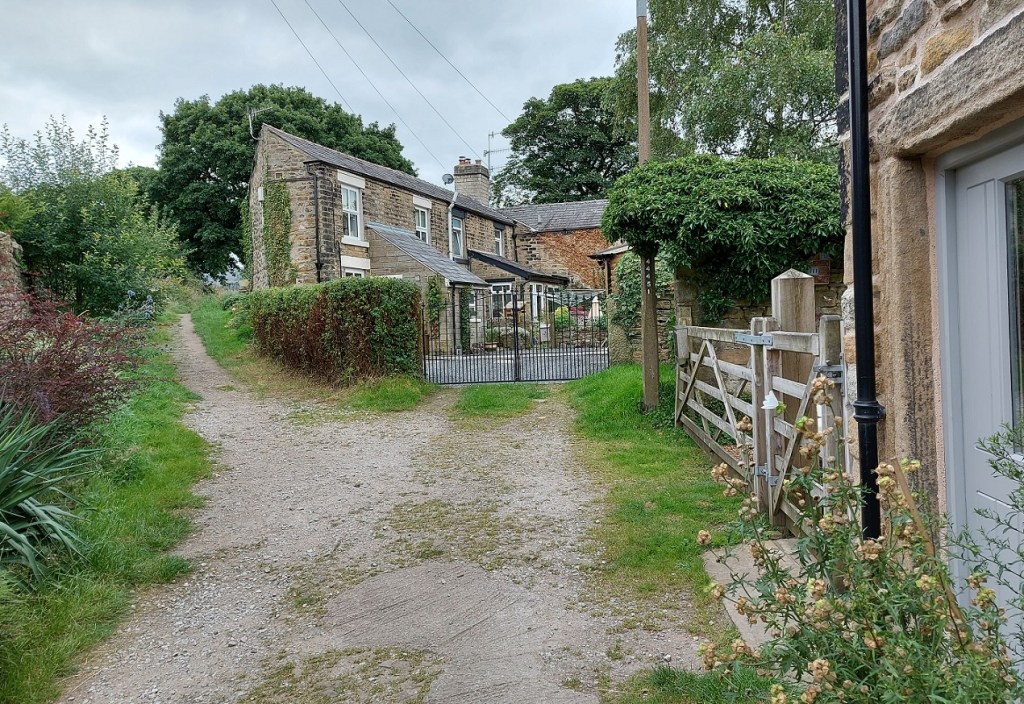
Converted barn and outbuildings of the farmstead of Hall Fold
A datestone here records ‘J.S.J. 1806’, but this was apparently found when the owner was digging a foundation, and clearly Hall Fold Farm is older that that.
Not my photo – stolen shamelessly from the Old Glossop website, which has a bit of history and a series of very interesting photographs of Hall Fold Farm – here.
The name itself may refer to a long demolished, possibly medieval, original Glossop Hall (Manor Park Road was once known as Hall Street). This is also the location of a junction – our track is joined from one that comes from Whitfield (an extension of this one).
A fork in the track!
Our track from Pyegrove is on the left hand, but the one from Whitfield comes via Old Glossop Cricket Club, and would have come through the gates ahead. Though no longer in use, its presence is preserved in field boundaries and the fact that these houses (c.1830’s) respect the track, which is why they are built at that strange angle. It’s also visible in LIDAR under the cricket pitch.
Sadly, no marker stone remains at Hall Fold Farm (although I didn’t start poking around people’s gardens, and it may well be lurking somewhere – large stones are hard to completely lose). From here, the medieval centre of Glossop is a hop, skip and a jump… if you are feeling so inclined.
I have to say, though, walking into Glossop this way is a much more interesting – and authentic – experience, and one that is very different from walking along Manor Park Road! We take our modern roads for granted, and I’m not going to lie – the idea of moving along these tracks in bad weather and in darkness fills me with fear.
This is a small part of a much larger project I’m working on, tracing these tracks all over Glossopdale. Each of the settlements that make up ‘Glossop’ – from Wooley Bridge in the west, to Pyegrove in the east, Tintwistle at the north, to Chunal in the south – have multiple tracks linking them, and for the large part they are still there, often hidden, occasionally ‘fossilised’ as footpaths, or even still in use. This is truly an overlooked, and indeed largely undiscovered, aspect of Glossop’s pre-Victorian/pre-Industrial history, but one that was vital to its development. And I have to say it is great fun being able to walk these ways, and pondering the history they hold – if anyone fancies joining me, give me a shout. Also, and this is a serious request, if anyone knows of any holed stones (or any standing stones, for that matter) that I might not know about, please do get in touch – often half hidden in hedgerows, they will lurk where two or more tracks join.
Right, that’s all for now. More pottery next time (did anyone else hear that high-pitched screaming sound?), but until then look after yourselves and each other, and I remain,
Look, it’s no use yelling “for the love of Jove, not more bloody pottery!” No one is forcing you to be here. Honestly, I haven’t even started yet, and here you are, giving your two penn’orth.
What ho! Wonderful readers. Welcome, welcome, welcome.
A quick one today – Part 5 of my best-selling, most talked about book of the year, Booker Prize shortlisted Guide to Bits of Old Pot. I have a brace of posts almost ready to go, but to keep you going I thought I’d publish this. Enjoy.
TRANSFER PRINTED WARE (aka Willow Pattern, Blue & White) DATE: 1800 – Now DESCRIPTION: A cobalt blue pattern or image on a white background. Also, red, brown, black, or green. SHAPES: Any and all vessel shapes – from delicate tea cups to whacking great soup tureens – literally everything.
Ah yes… Transfer Printed Ware. If you are going to find pottery, this is the stuff you’ll find, and in particular the ‘Willow Pattern’ pottery. It dominated the 19th century, and arguably a large portion of the 20th – it is everywhere. I have actually dreaded writing this part of the guide, probably because of the quantity of material, but also I’m worried that it might not appeal to all of you (*sigh, yes I know it doesn’t appeal to you. And look here, there’s no need to use language like that… there are ladies present, and calling me a “honking tallywacker” is hardly becoming of a gentleman.”). But it turns out that it’s exactly the sort of thing appeals to (most of) my readers.
As we have covered previously, 18th & 19th century potters were trying to find the perfect blue and white decoration on a perfect white background to match the desirable Porcelain being imported from China. Tin Glazed Pottery (or Delft) certainly filled that gap, but it really wasn’t perfect. An easier form of decoration was wanted, and the idea of transfer printing began to take shape in roughly 1750, being applied to Porcelain only at this point. It was in about 1785 that the process successfully began to be applied to earthernware, being perfected by that wizard of English pottery, Josiah Spode.
A random selection of Blue & White Transfer Printed pottery.
The process is relatively simple if a little convoluted. Firstly, an image was engraved in a copper plate, as was done for book illustrations at the time, and applied to an oiled tissue paper using a cobalt ink – this being the only colour at the time that would survive the firing process. This is the ‘transfer’. Next, a vessel is ‘biscuit’ fired – that is fired without glaze, and at a lower temperature, to make it hard and able to take the transfer print. The transfer paper is then pressed onto the surface of the vessel, with the ink absorbed in the fabric. The pot is then fired a second time to remove oils and fix the ink into the clay body. Next, a glaze is applied, and then it is fired a third and final time. Originally applied to Creamware, then Pearlware, it became a standard decoration for White Ware, and by 1820 TPW was everywhere, and being used for all sorts of images. A brown ink was developed in roughly 1835, a green chrome ink in 1850, and a red ink at about this time, too.
Various coloured Transfer Printed plates. And of varying quality.
Eventually a technique for multi colour printing was developed by the pottery factory F.R. Pratt, allowing full images to be put onto vessels from late 19th century on.
Pratt’s development meant that anything could be printed in any colour. These date to very late Victorian and early 20th Century.
A technique called ‘Flow Blue’ was perfected around 1800, in which the cobalt blue transfer print was deliberately smudged or blurred. The pot is prepared as normal, but during the firing a ‘flow powder’ (a mixture of 22% salt, 40% white lead, 30% calcium carbonate, and 8% borax) was added into the kiln, giving off a chlorine gas which caused the cobalt to diffuse or blur into the glaze.
Flow Blue. For some reason, I just couldn’t take a good photograph of this. I must have spent 20 minutes getting more and more frustrated, taking endless shots of just this scene. To be honest, even looking at it now makes me angry.
Sometimes this changed into a more purple colour, termed ‘Mulberry’, occasionally it was highlighted with gold.
My only piece of Mulberry Flow Blue.
Flow Blue’s popularity peaked around mid-century, and as a style lasted until perhaps 1900. The more extreme blurred examples may have been sold as cheaply as ‘seconds’, and were thus popular with the poorer market. Indeed, for many years I just thought that Flow Blue style was just really badly made TPW, and only fairly recently did I discover that it was deliberate.
In terms of decoration, I don’t know where to begin; from classical scenes to commemorative plates, souvenirs from castles, to children’s rhymes – literally anything and everything was inked onto the vessels. You may get lucky and find a name or a date, or a maker’s mark from the underside of a plate. Or it may just be a pattern from the edge. The classic is of course the ‘Willow Pattern’, with its spurious story of lovers turned into birds. This was, and still is, reproduced in huge numbers: it is everywhere. In fact, so common was this pattern that it is used – incorrectly – as a short hand for all Blue & White pottery.
The actual Willow Pattern – image from Wikipedia.
Theoretically, though, given infinite time and patience, one could identify and date any sherd using the wealth of pattern books that were kept by the factories that made them, but even for a certified sherd nerd such as myself, that way madness lies!
Transfer Printed Ware began life as a prestigious and very exclusive pottery type, with the early stuff being of incredibly high quality. Once it began to be mass produced, as always happens, the quality began slipping, until the lower end of the market was cheaply produced and sold for next to nothing. This produced some shoddy designs and duff workmanship; sometimes you can see where the transfer has slipped, where bits overlie each other or don’t join in the pattern as they should. I do like these mistakes – I think it adds a human touch.
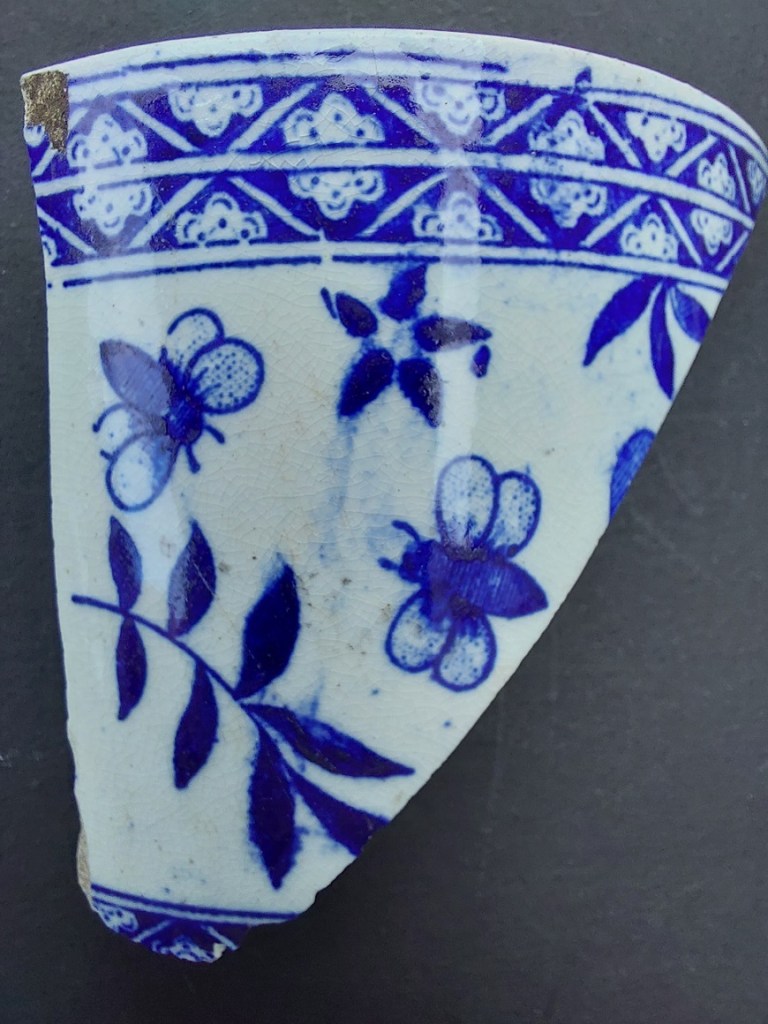
At first glance, quite attractive – bees and flowers, what’s not to love. But look closely – it’s blurred, there are smudges, blobs, lines stop and start, patterns don’t meet. This is budget pottery of the lowest order. I love it!
Allied to Transfer Printed Ware, although not actually transfer printed, is this stuff:
SHELL EDGED WARE (aka Feather Edged/Edge) DATE: 1780 – 1890 DESCRIPTION: Plain white bowl or plate rim decorated with crinkly ‘feathering’ and painted blue (occasionally green). SHAPES: Plates, wide rimmed soup bowls, tureens.
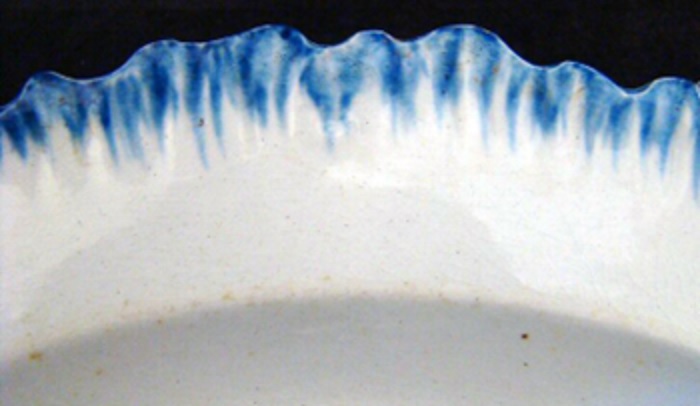
This type of decoration is very distinct, and was fairly common in the late 18th and early-mid 19th centuries making it a frequent find. Once seen, it never forgotten.
A varied selection of Shell Edged Ware. You can see the blue-tinged Pearlware of some of these sherds, dating them to roughly pre-1830. I also realised I don’t have any green edged sherds.
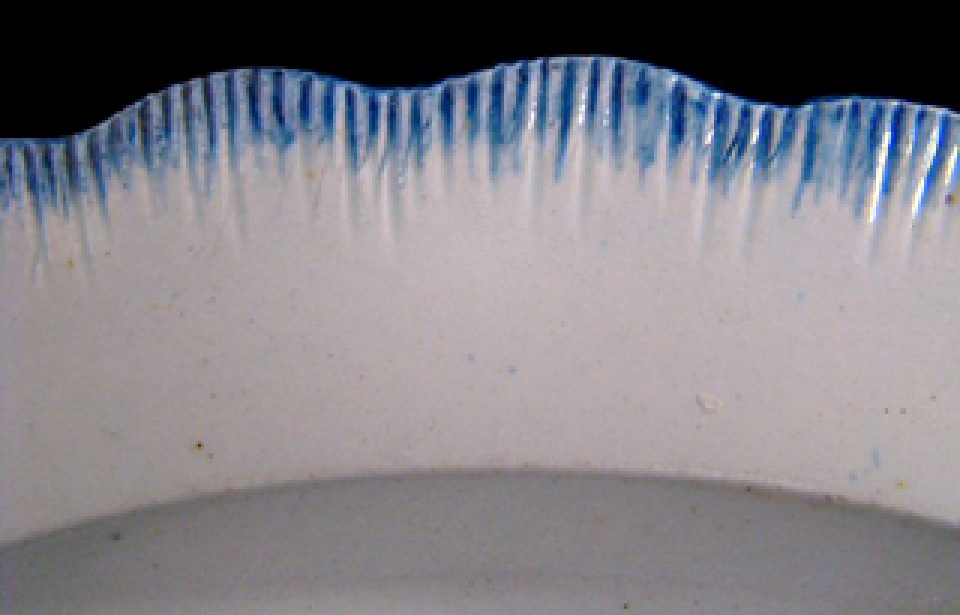
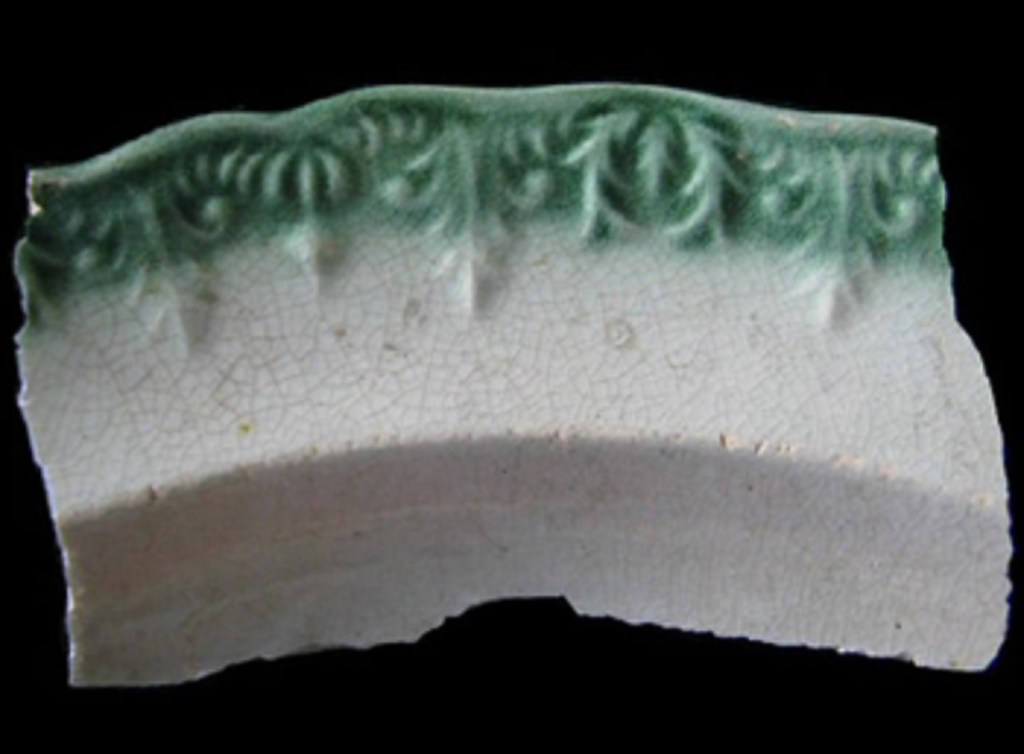
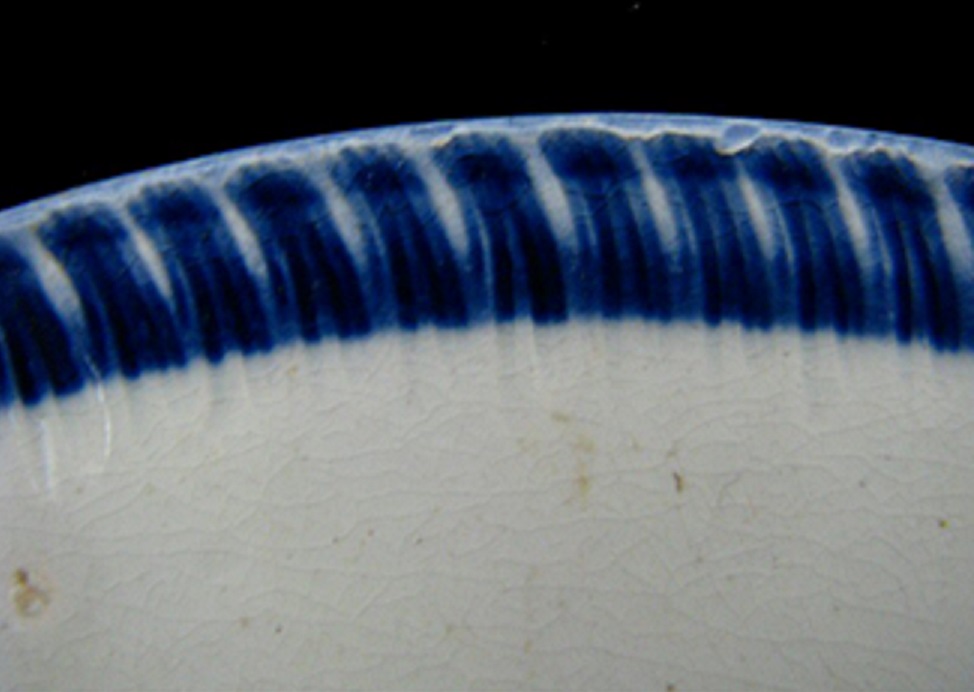
Essentially a plain white bowl or plate – Creamware, Pearlware, or Whiteware – is decorated on the rim edge with a feathered type decoration in cobalt blue or, less commonly, chrome green. The rim may or may not be undulating, and the feathering may or may not be impressed into the clay, but it is always painted to look feathered or shell-like. I seem to be a magnet for this stuff, but it’s always a welcome find.
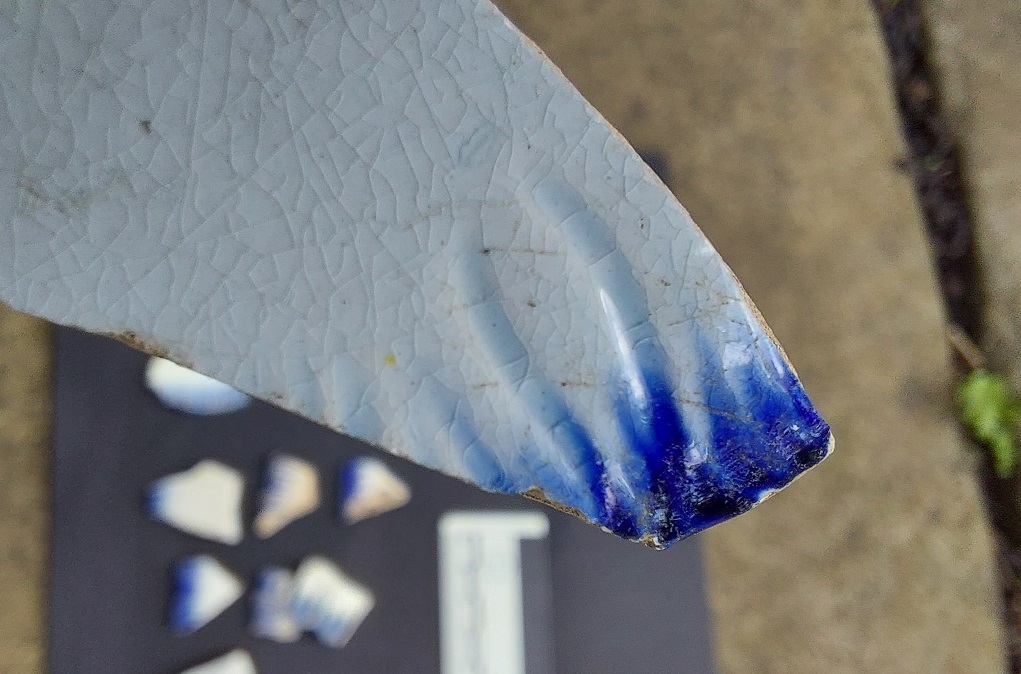
Lovely shot. You can see the cobalt blue edge, and impressed decorative ‘feathering’ that here has been filled with the blue tinged glaze that makes up Pearlware. I improved the shot by cropping out my gnarled bare feet that were visible at the bottom of the photo.
Interestingly, there seems to have been a development in the style, allowing a broad date to be given to some sherds. This is based on American data – much of this ware type was exported, and there was some serious work done on dating it – and I’m not sure how applicable it is in England. Chronologically then:
Type 1. I must add that I don’t own the rights to this, or any of the following images, and cannot now recall from where I stole them, shamelessly as always. Apologies if it is your image.
Type 2 (1800-1830’s)
Symmetrical scalloped rim, impressed curved or straight lines, blue/green edging.
Type 2
3) 1820’s-1830’s
Symmetrical scalloped rim, impressed curved or straight lines, embossed decoration below – garlands, flowers, wheat, feathers, etc. blue/green edging
Type 3
Type 4 (1840’s – 1860’s)
Unscalloped rim, impressed curved or straight lines, normally blue edging, not green.
Type 4
5) 1860’s – 1890’s
Scalloped rim, no impressed lines – the paint is applied to make it look like impressing. Blue edging.
Type 5
As I say, the academic rigour is there, but whether this is a ‘true’ chronology rather than reflecting deposition dates (that is the date which the pottery was manufactured, as opposed to the date ended up in the ground – which, given I still use my grandmother’s stoneware pie dish to cook with, could be as much as 100 years or more), I couldn’t possibly comment. And here we stray into the strange realm of archaeological pottery studies; I could talk it all day, but I fear some of you may become violent, and nothing takes the shine off a chap’s day like an angry mob.
Right, I think that’s all for today. I do have more pottery to publish, but I might save that for another time – I don’t want to over-egg the pudding, so to speak.
More soon, but until then look after yourselves and each other, and I remain.
So, right now, as we hurtle toward the solstice, is my favourite time of the year. Spring into summer – the days are long, my birthday is hoving into view (19th July, if anyone is interested… and a dark fruity red, if anyone is feeling flush). It also means time spent in the garden, planting and preparing the soil. Hamnett Towers is blessed with a small back garden (utterly destroyed by chickens… honestly, it looks like the Western Front), and a slightly larger front garden where the vegetables are planted. Both of these forces of nature – chicken and man – excavate all sorts of goodies. Predictably, I have kept everything I have found, and kept them separate; Hamnett Towers was at one point two separate ‘back-to-back’ terraced houses, so the archaeology of either side might tell a slightly different story (old archaeological habit). And so far, this year has produced some very interesting bits.
So, please join me in the garden. Ah, sorry, no shorts or baseball caps please – this is an English gentleman’s abode; t-shirts I can just about cope with, but I mean, a chap has to have standards dash it!
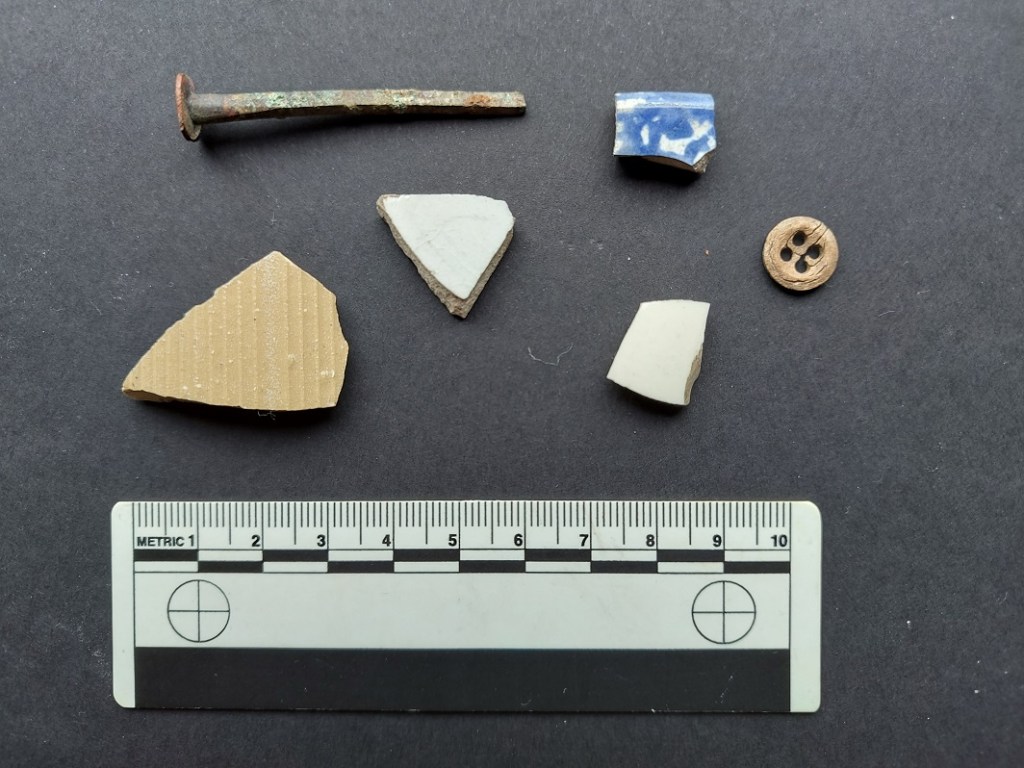
Here’s the day’s findings from the front garden:
A selection of the history of the land the garden has decided to show us this year… so far.
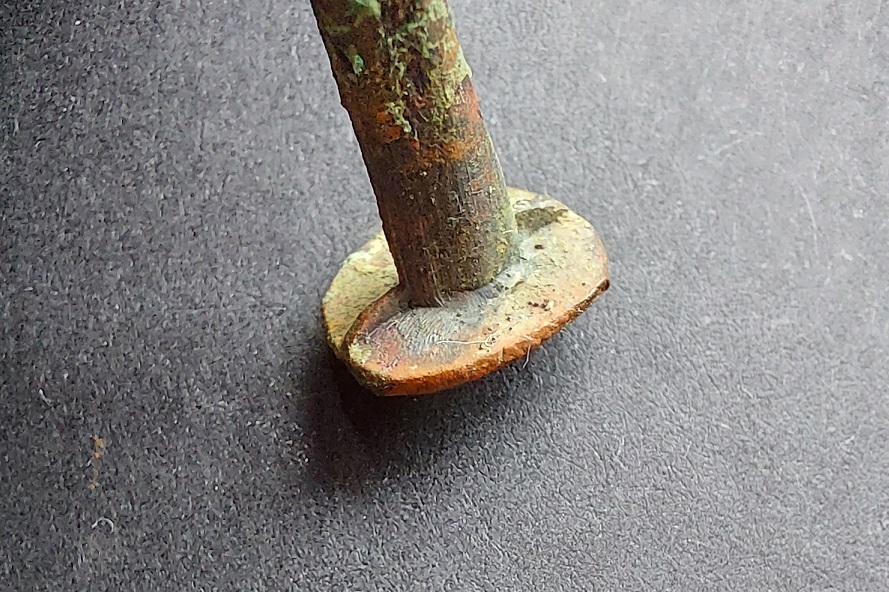
Let’s start with the nail – a Victorian, hand-made, copper roof nail, to be precise. I’m something of a magnet for these things, and they seem to find me wherever I go. They are truly mundane – the nail that holds on a roof tile – and yet are such lovely and tactile things (I’ve blogged about them before – here – FIVE years ago… blimey!). Copper was used as it is largely resistant to corrosion, and their square section is a dead giveaway of age.
Lovely green verdegris competes with rust (the result of it lying next to something iron based) on the surface.
They are made relatively simply, but by hand. Each nail is cut via a press from a long flattened strip of copper (thus the square body of the nail). It is then placed into a small mold or former, point down, and the exposed top is hammered by hand until it flattens out, forming the nail head. Close-up you can see the two flashing strips formed as the soft copper is driven between the halves of the mold.
A close up of the underside of the nail head, clearly showing the copper flashing.
The nail may have come from my house roof, which is a great thought.
Next to the nail is a sherd of spongeware, probably from a large bowl or shallow dish. I find a lot of this particular vessel in the garden, and I might have to try and reconstruct it sometime (follow the link above, 3rd photograph down, on the right for more of the same bowl).
Next row, a sherd of marmalade/preserve jar (here, for more information), and then two thoroughly uninspiring sherds of white glazed pottery. Then, this beauty!
Super. An amazing chance find whilst whilst putting in some pea and bean plants… half of which were eaten on the first night by what can only be imagined as a biblical plague of famished slugs – honestly, I swear I could hear a very slow moving rumbling sound. If you’ll pardon the French… Bastards!
Wonderful! A small bone button, and almost certainly Victorian in date. Delicate, handmade, and slightly off-centre, it is lovely. Again, something so mundane – every item of clothing would have had a dozen of these; will people be cooing over the zips in our trousers in 100 years? And yet, here we are, admiring it’s beauty. Bone was such a common substance in the pre-20th century, and we tend to shy away from it as a material now – how many of us would brush our teeth with a bone toothbrush? Or use bone game pieces? I think we have become a little squeamish. Yet, it was a major resource in history – so many animals, so much bone. Bone preserves very well in the right conditions, and although this has cracked with age, I bet it could be sewn on and used again.
Right then, the image of the Somme, c.1916, that is the back garden. There’s always something that turns up here, not all of it interesting, but usually worth a look. And this year is no exception, with a couple of very nice finds.
A rather motley looking collection, I must admit.
So then… top left we have bonfire glass. Essentially glass that has been melted in a fire. This may have been accidental, or just the result of rubbish disposal. Often Victorian and later rubbish dumps were set on fire to keep the rat population down, and bonfire glass can be quite pretty. This one… not so much.
It’s quite a cool object, but not particularly pretty.
Ignore the next sherd for the moment, and move onto the cream coloured stoneware sherd, possibly from a flask or other oval shaped vessel. Then we have some glass – it is quite chunky, which indicates it is old, but isn’t that lovely green colour, nor full of bubbles, that would indicate a Victorian date. Probably Early 20th century, and likely from a small bottle – perhaps medicine or similar.
Ignoring the other reddish coloured sherds, again for the moment, we have this beauty:
You can see the striations caused by wiping the red under-glaze slip with a wet rag – the marks of the potter preserved for eternity in clay. Lovely stuff!
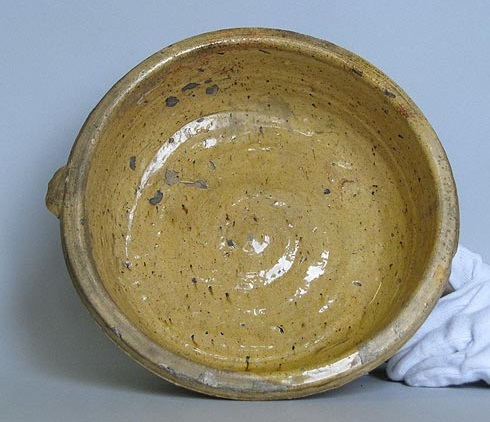
This is often called Pancheon Ware, after the large (50cm+) pancheon bowls that were extremely common from the 17th century to the early Victorian period. The correct term should be Post Medieval Redware, but that covers a multitude of pottery types and shapes from c.1550s to the Victorian period, of which this is just one.
Essentially a large mixing bowl, bread proving bowl, or vessel to allow cream to separate from milk. This is a lovely antique example, the image of which was stolen from this website which sold it for £195.
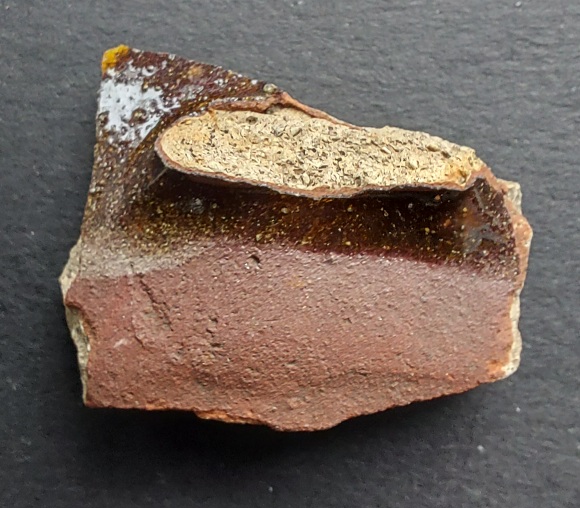
They often occur in huge chunks up to 2cm thick, and are usually glazed only on the interior to make it waterproof. I’ve talked about them before, but this is a nice example, showing the red slip on the surface, and then the dark brown glaze, made by adding iron oxide to a lead glaze, producing the deep shiny colour. The glaze on this, as with many, has been allowed to slop over the side and stop just below the rim, producing a messy natural decoration (the example above shows the glaze stopping on the rim, but you can see the effect they are going for).
Below and right of this sherd there are 4 sherds of standard Victorian to mid 20th century whitewares nothing inspiring, or even particularly worth writing about, although there is a rim of a bone china cup. Below and left is a single fragment of a clay pipe stem. Again, nothing exciting – the hole, or bore, through the middle of the stem is narrow which tells us that it is Victorian in date (broadly, a wide bore = 17th to early 18th century, a narrow bore = late 18th to 19th century). Still, it’s a bit of social history… I just wish I could find a bowl!
Then there was the treasure! Occasionally, certainly not often, I find something made of metal. And a few weeks ago, as those who follow me on twitter will know, I found a metal button.
Tiny, just 1cm in diameter, and very delicate. Amazing it survived, to be honest. And even more amazing it was seen.
Well, no… credit where credit’s due – I didn’t find it, Master Hamnett did, with his six year old eagle eyes. A lovely little 2 eye brass button, probably Victorian in date. It’s probably from a child’s dress, probably something like this:
A heavy linen dress for a child. It is beautifully decorated with hand-made edging.
And if you look closely using a decent magnifying glass, rather than the dodgy macro setting on my phone, you can see the remains of the original cloth that would have covered it:
Amazing that the cloth has been preserved, trapped between the two sides of the button’s lip.
It would have looked like this when new:
Small and delicate, and lovingly sewn on.
The thing I love about this is that the child must have lived and grown up exactly where Master Hamnett is now, and doing many of the same things. There is real sense of connection to the past through a single, small and dirty, seemingly uninspiring object. By the way, the story of the Victorian child’s dress (one of several, I hasten to add) is for another time, but it is from a probable apotropaic cache that was donated to me for safekeeping. One of two I now curate. I really don’t have enough time to write all this up, so if someone want to donate a stack of cash to allow me to write, please feel free!
And now this, the real treasure. Quite literally, for once.
Gnarled is the word. I had no idea what it was when I picked it up.
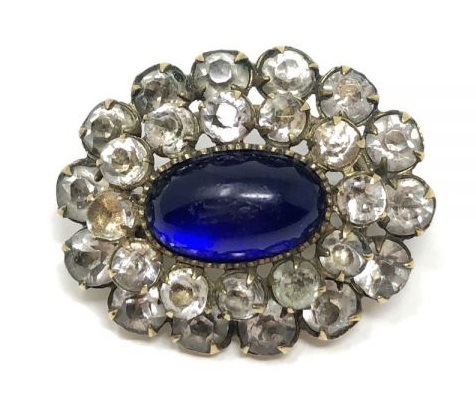
I know at first glance it looks like something has blown it up, but look beyond that, and it’s a wonderful, if completely knackered, piece Victorian costume jewellery brooch. It’s missing just about everything, including the central glass stone, but would have been very pretty – probably looking something like this:
Picture stolen from this website… the brooch is still there. Honest, guv.
I didn’t know what it was when I picked it up, but it was that greyish green that indicated a copper alloy (brass or bronze, for example), and is something I always pick up. It was only when cleaning it that I noticed the paste stones.
You can see the cut paste stone in it’s setting, and all the other setting missing theirs. There are three stones still on the brooch, and very little else.
Amazing, really. And this was just a small amount of time poking around, getting really close and personal with the soil in my garden. And my garden is not unique by any stretch, not even close. I guarantee, every garden in Glossop – no, the country – will produce some treasure – whether it’s early Victorian annular ware from a house near the station, a broken bottle rim from a former pub, a pipe stem from a current pub, or a piece of Victorian child’s plate from a modern garden in Simmondley (all examples from experience). Obviously, I realise that not everyone is lucky enough to have a garden, but we all can access some green space. As an experiment, this evening, pour yourself a drop of the stuff that cheers, and go and sit on what ever patch of earth is closest to you. This may be your garden, or it might be a park, or someone else’s garden, a playing field, or public footpath, or whatever. Now sit down and take a deep breath, listen to the sounds – birds or traffic – tune in, and simply look around you. If you can, dig about a bit, and don’t be frightened of getting your hands dirty, either. With enough time, something will turn up. And please, mail me the results.
Right, that’s about it I think. Next time more pottery – essentially a part 2 to this post, looking at the pottery I told you to ignore above. A competition! If you can get back to me and tell me what they are, and why they are not our type of thing, before I can post the next article, you can win those bits of pottery. Woohoo! (Now look here, Mr Shouty… some people like pottery, you know. And no, I’m not “having a laugh“).
More very soon, but until then, look after yourselves and each other.
What ho, dear and gentle readers! Well, here we are again… pottery time! The second part of the Pottery Guide has hoved into view, and what a treat we have for you. I am going to go ahead and apologise in advance – it is heavy on pottery, but useful and fun, I hope. (Can anyone else hear that groaning and wailing… and gnashing of teeth. And no, no I don’t care about your “sainted aunt”, whoever is shouting).
SPONGEWARE DATE: 1830’s – 1900’s DESCRIPTION: Colourful repeated patterns printed with a sponge on a white background. SHAPES: Bowls are very common, cups, mugs, tankards, small plates, larger plates, and jugs.
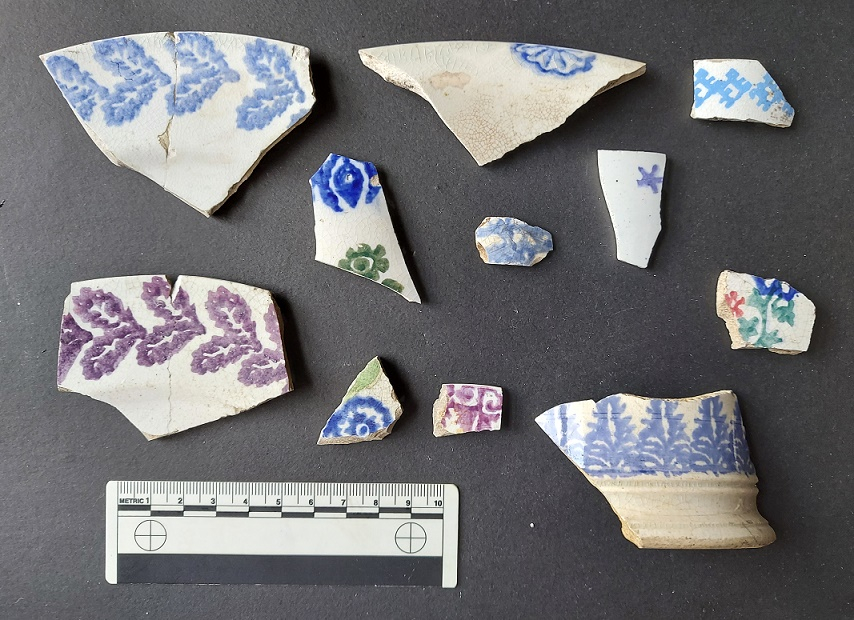
Wonderful, cheerful, simplistic, and yet incredibly attractive (not me, madam, but thank you). I have an almost childlike obsession with this pottery type, and it always makes me happy when I find some. Spongeware is characterised by shapes made with a natural sea sponge dipped into a coloured slip and dabbed onto a white background. The pot is then glazed and fired. The sponge is either applied all over, or it is cut into geometric shapes (diamonds, concentric circles, spirals, stars, zig-zags, swirls, etc.) or naturalistic forms (flowers, leaves, shamrocks, etc.), and dabbed in repeated patterns around the vessel.
1. Spongeware. Lovely stuff, in pastel colours and very pleasing designs.
These patterns and shapes are fuzzy at the edges (the result of the sponge effect), are sometimes combined with hand-painted decoration (bands, blobs, leaves, etc.), with colours of a limited and pastel palette – light purple, blue, light green, yellow, pink, light red, etc.
2. In addition to the sponged designs, we can see here painted flourishes and designs.
3. The designs can be printed all over, rather than in discrete patterns. The grey painted sherd, bottom left, is an example of what is sometimes known in America as ‘Spatterware’.
The pottery itself is normally of a fairly poor quality Pearlware (pre-1850) or Whiteware, with a earthernware fabric that is white or off-white.
4. Fabric – white or off-white bog standard earthernware. You can see the painted decoration in section here, overlaid by the glaze.
Sherds can sometimes be found broken with jagged rather than smooth edges, indicative of a low temperature firing and poor quality clay. Lovely though it is, it is Spongeware is not high quality, but it is the very essence of cheap and cheerful.
5. The poor quality of the glaze is very clear here.
6. One of my favourite sherds, up close. You can see the way the decoration has been applied. You can also the jagged edges that indicate poor quality pottery, and the crazed glaze, possibly the result of heat, or more likely, a poor glaze.
Spongeware is often associated with Scotland where it was made in great quantities, but there were also manufacturing centres in Stoke on Trent and other parts of the Midlands. These vessels were mass produced – probably ‘sponged’ as piece work at home (and thus probably by women) – and supplied to a ready market that wanted a more colourful, and cheaper, pottery than the transfer printed material that dominated the market.
American studies indicate there are broad chronological variations within the ware group. America and Canada were huge export markets for Spongeware, and given the relative newness of their country in terms of European material, a lot of research has been conducted on even the smallest and most common bits of pottery that would be overlooked here. The three variations within Spongeware are: All-Over: Densley packed, the natural random patterning of the sponge is used to cover the whole vessel, or dabbed in distinct areas – the upper part of bowls for example. Spatterware is the American name for this type of pottery, as it looks as though the paint has been spattered on randomly, occasionally in several colours one over another. Looking closely, it is possible to see the tell-tale repeated patterns of holes in the unshaped natural sponges (Photo 3 above). This type appears to have been most popular up to the 1860’s. Cut Sponge Here the sponge was shaped into neat geometric and naturalistic forms, and the patterns repeated. Starts in the 1840’s, and is popular until the 1880’s. The addition of painted decoration to this form seems to appear in the latter part of the 19th century and last into the early 20th century (Photos 1 & 2 above). Open Sponge Similar to Cut Sponge, but the shapes are more natural and less regular, rigid and geometric. This type seems to have been most popular from c.1850 to c.1900 (the blue sherds in Photo 3 above).
This stated, there is a lot of overlap between styles, and I’m not convinced the chronology is as straightforward as that. Also, does the American market reflect what was happening here? As I say, it is a broad guide, use it as you will.
Spongeware, in it’s modern incarnation, is still a popular design for plates, and Hamnett Towers has a dinner service decorated with designs made using this very attractive style. I should invite you all for cocktails and a slap up feed, and you can have a look (black tie, of course… I have standards).
Right ho, that’s it for this week. I have a few, less pottery focused articles in the pipeline (what do you mean “praise be”? Honestly, some people.) which I’ll get on asap. My life is fairly jam packed with Glossop related archaeology and history at the moment, which is great, if a little scary! I am working with the good folk of Glossop Creates developing a walk that involves history and bits of pot… watch this space. I was also recently in the Glossop Chronicle (read it here – the edition is dated 3/2/2022, and it’s page 11), and the Glossop Creates blog, too. The organisation, based in the historic gasworks on Arundel Street, has some wonderful and big ideas for the town, and deserves to be lauded from the rooftops for their vision. So there!
More about this, and other exciting things, next time, but until then, look after yourselves and each other, and I remain.
(And apologies to those of you who have ended up on this website expecting to find an informative article on the seed of the Phoenix dactylifera.)
What ho, magnificent readers! I trust you are all rude health as we stumble toward the season of goodwill and whatnot. I love this time of year, when the cold wind blows, and the… What’s that? What do you mean “get on with it!”. Honestly, the nerve of some people.
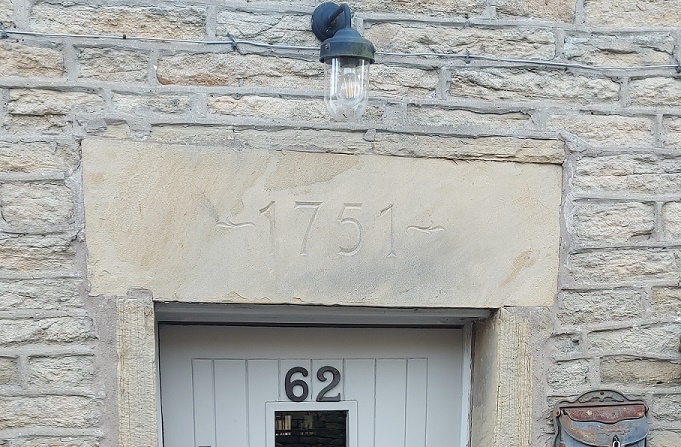
Righty ho. Datestones. Who doesn’t love a good datestone? I mean, what’s not to love? A little snapshot of the history of a building, a birth certificate if you will, recording both the date of birth, and, if we’re lucky, the parents too.
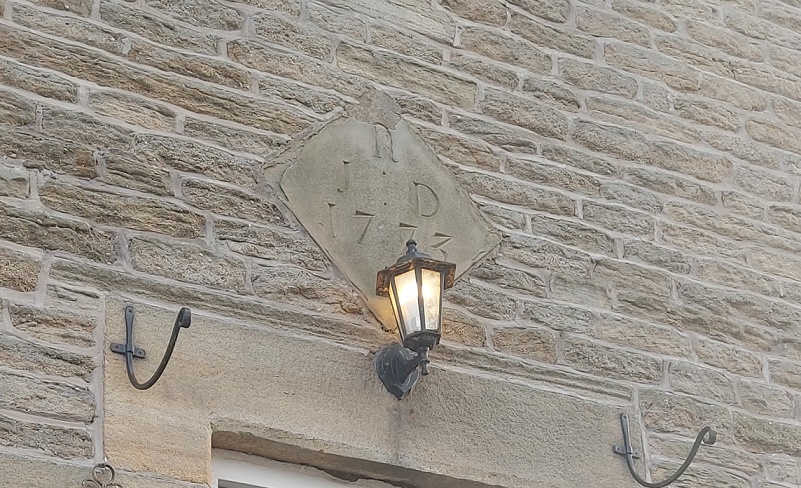
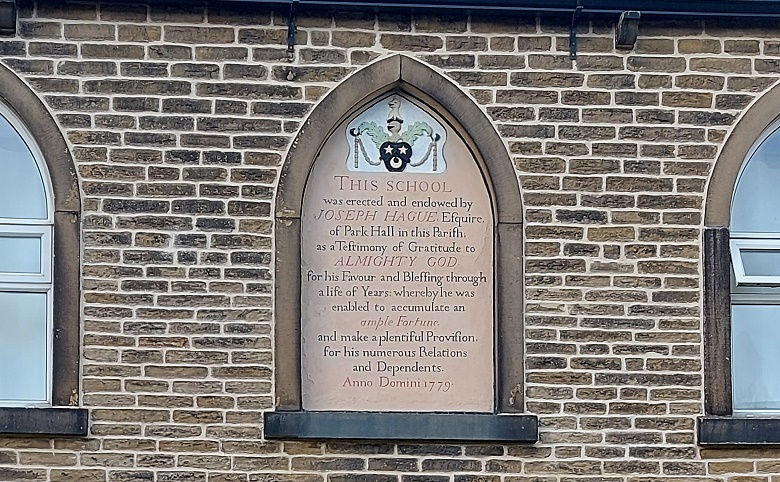
Normally, though not exclusively, located above the door, these carved stones preserve the date of construction and the initials of the person or family who paid for its construction. The are by and large the reserve of the aspirational ‘middle classes’ of society; the poor man doesn’t build his house, the rich man has a house that speaks for itself. Indeed, it is a statement to others: I have wealth enough to build this house. They seem to become popular in the 17th century, as the ‘yeoman farmer’ becomes a class of person, that is, a person who owns the land they farm. Indeed, it may be a result of that phenomena, a way of setting themselves apart from the simple tenant farmer, who doesn’t own the land he works. Glossop has several 17th century examples remaining, though many more will have been lost, sadly. They do show up, occasionally, as the one found by Glossop Brook at Harehills Park did, and which was saved and cemented into the brook wall. Interestingly, this example also shows that whilst datestones can be a boon to historians, they can also present problems if we are not careful. They can move easily, and be attached to other buildings giving a misleading date, as is the case there, and at Hall Fold Farm. Also, stones can be put in place to commemorate a rebuilding or alteration to an existing building, causing similar, if opposite, problems.
By the Victorian period it was common to put a date and/or name on a house you built, and a careful look at many rows of Victorian terraces around Glossop will reveal names and dates. With that in mind, I have restricted my research to those datestones that carry a date prior to Victoria’s reign, pre-1837. The following is a table of the ones I know about:
There are 28 datestones in the Glossop area (broadly defined), but there will be more lurking that I don’t know about, either attached to the building still, or lying in a garden. This blog post will concentrate on the examples from Whitfield, as it is turning into a much larger post than I had thought. Plus, in the interests of honesty and transparency… I haven’t got photographs of all of them yet!
Whitfield has some of the oldest buildings in the Glossop area, and although not really much of a ‘place’ now – essentially just a ‘suburb’ of Glossop – it was once hugely important, being built along the Chapel en le Frith to Glossop road. It gradually lost it’s importance with the rise of the mills based down in the valley, the economy here being agricultural. Whitfield’s one-time importance means that we find many old buildings and a number of datestones here. Indeed, Whitfield has more old buildings that Old Glossop, which with its Church and market, was the focus of the farmsteads and settlements of Glossodale. However, important places tend to be subject to more intense rebuilding over time, whereas more minor areas maintain their old buildings. I was going to do a distribution map of the old buildings, but changed my mind for that reason. Still, it’s worth noting that Whitfield underwent a bit of a building boom in the mid to late 18th century.
35 Whitfield Cross.
35 Whitfield Cross was built in 1773 as a farmhouse, and is a Grade II listed building – see here for more details. The narrow coursed stonework and stone mullioned windows are typical of the period.
31 Hague Street.
31 Hague Street was also built in 1773, but as a pair of weaver’s cottages, and is also a Grade II listed building. 1773 must have been busy year, and Whitfield was clearly a happening place in the late 18th century. The datestone records the initials R. J. and D. Now, presumably the ‘R’ is the surname (possibly Robinson – the family being quite prominent in Whitfield) with ‘J’ and ‘D’ being the husband and wife who are responsible for the building. I have no information regarding the people, sadly, and any information would be appreciated.
Hob Hill Cottage
Hob Hill Cottage is a remarkable building dating to 1638, making it the second oldest building with a datestone in the Glossop area (after the Bulls Head in Old Glossop, dated 1607). Also built as a farmhouse, and also a Grade II listed building (there’s a theme developing here!), I suspect it might be the source of the lead came and glass, as well as some of the 18th century pottery, I found nearby, although truthfully any one of a number of buildings – existing or long gone – might be the source.
Old School House, Hague Street.
Another Grade II listed building now – the Old School House. Joseph Hague was something of an important man – indeed, the road on which the school (now private residences) sits is named after him. Born in Chunal in 1695, he rose from poverty to amass a fortune selling yarn to weavers and buying back the cloth they produced, to sell on. However, here is not the place for a discussion of his life, or of the school (the Glossop Heritage Trust does that very well here). Let us instead look at the wonderful inscription
“This school was erected and endowed by JOSEPH HAGUE Esquire, of Park Hall in this Parish as a testimony of Gratitude to ALMIGHTY GOD for his favour and Blessings through a life of years whereby he was enabled to accumulate an ample fortune and make a plentiful Provision for his numerous Relations and Dependents. Anno Domini 1779.”
I enjoy the slightly boastful “ample fortune“… well, if you have it, why not? The beautiful carved relief plaque of the beehive over the main door – symbol of productivity and hard work – gave inspiration for the name of the pub over the road. The Beehive pub itself is an 18th century building, with a 19th century front added, and another example of the building boom of the 18th century in Whitfield.
Old School House, Hague Street. The beehive carved in relief, surrounded by Sunflowers, and crawling with characterful bees. I love this. 62 Hague Street
Another Grade II listed building, one of several together, and originally built as a ‘laithhouse’, that is a building made up of a house, barn and byre/shippon in one. It is a late example of the type if the date is to be taken at face value, but there you go… this corner of Derbyshire wasn’t exactly at the forefront of architectural fashion. There is also a bit of confusion regarding 62 Hague Street. As it stands now, there is a simple date of ‘1751′ above the door. However, the listing for the Grade II building notes that “No.62 originally had datestone inscribed RMS 1757” (read the full listing here). The present datestone is fairly modern, carved perhaps to replace the missing stone, but it doesn’t explain the difference in date. I thought it worth mentioning for the sake of documentation and completion.
41 – 51 Cliffe Road
So who was Joel Bennett? Born 11 April 1791 to son of George Bennett and Martha Cooper, he came from a large and important local family. He may have been the same Joel Bennet who was excommunicated from Littlemoor Independent Chapel in 1828 for “disorderly walking and impenitency” (source is here). I’m unsure of what is meant here by “disorderly walking”, but given the hotbed of radical religion that was Littlemoor, one assumes it wasn’t the Georgian equivalent of Monty Python’s Ministry of Silly Walks. He may also have bought Kinder Lee Mill in Chisworth with his brother James in 1823.
House at the bottom of Cliffe Road (4 Cross Cliff?)
This house, set back from Cross Cliffe almost at the bottom, has a wonderful datestone: stars, wheatsheaves, and a Masonic compass, with the letters ‘R’ ‘R’ ‘O’ and ‘S’. Actually, is that an ‘O’? Or perhaps a flower? I have no information about the place, nor the letters (Robinson again?), and one cannot simply knock on a door and say “What-ho… tell me about your house”. One tends to get stared at, with vague mutterings about “setting the dogs on you”, and “lunatics disturbing the peace”. Alas. If anyone has any information about this house, or indeed any of the houses, drop me a line.
Also, and seriously, if anyone knows of any more datestones that aren’t in the above list, and which date from before 1837, then please let me know. I’ll credit you, too, so you can be famous… to all 11 of you who read the blog (including Juan in Venezuela).
Oh, and some news. I’ve been working on the Glossop Cabinet YouTube account recently, and hopefully will be producing videos of me finding bits and pieces, mudlarking, talking archaeology, exploring, playing with pottery, and much more (can anyone else hear that groaning noise every time I mention pottery?). So if you like the blog, then you’ll love this. I’ll post a link asap.
Also, I’ve recently set up a Ko-Fi account which allows you lucky folk to ‘virtually’ buy me a drink if you wish. There is no pressure to do so, obviously; I do the blog because I enjoy doing it, and am constantly amazed that other people enjoy reading it (which is reward enough, it really is). However, if you do fancy buying me a pint to say cheers, I’ll never say no – please click this link, and mine’s a red.
That’s all for now I think. I’ll post something else before Christmas, possibly pottery related, you lucky lucky people (there’s that noise again). But until then, I remain,
What ho, wonderful blog reading folk! I trust the Autumn is going well for you all? And hopefully, now that restrictions have eased, we will be able to do a bit more.
A fascinating one this time – well I think so. There’s a place, if you know where to look… Oh, go on then, I’ll tell you.
At Mossy Lea, to the north west of Shire Hill, there is a Victorian rifle range marked on the map. “Hmm” thought I, “I wonder what is there?” It turns out that it is a thoroughly interesting place, chock full of history. Here it is on the map:
Circled in orange. I meant the circle to be red, but for some reason I clicked the wrong button and couldn’t be fussed re-doing it. I don’t know why I shared that, it’s not like it’s important. To be honest, I’m not sure anyone reads these bits anyway.
But why was it there? Well, following the Crimean War (1853-56), and amid rumblings in Europe, particularly between France and Austria, it became clear Britain needed a larger, more efficient, armed force. In 1859 the decision was taken to boost home defence and operational forces with the creation of the volunteer rifle corps. The forerunner to our Territorial Army, these ‘part-time’ soldiers could be called upon to fight should the need arise.
It was desired that Glossop should have its own corps, and so in this way, on June 14th 1875, 23rd Derbyshire Rifle Volunteers was formed, with the first inspection of the corps taking place July 29th, 1876, at Stockport. They were drilled frequently, just like the regular army, with a parade ground off Shepley Street in Old Glossop, and a drill hall in the market hall – the entrance nearest to the post office.
Here is the Corps pictured in 1914 outside the Drill Hall. Image stolen shamelessly from the Glossop Heritage Page which gives a fantastic history of the Glossop Corps – read it here. Incidentally, the chap bottom row 3rd from left with the flat cap on – I am certain I’ve seen him drinking in the Beehive.
And of course they trained frequently on the rifle range. The original rifle range was at Chunal – probably around what was once The Grouse pub (now a private house). Hamnett notes that it was “most inconvenient” as the men had to shoot over the highway when shooting at long range, which was causing delays. Yes, you read that correctly… now let it sink in a moment.
Shooting. Actual bullets. Over a public road.
So “for the safety of the public it was removed to Mossy Lea“. You don’t say. Shooting here commenced on 6th June 1877, and it is then that we join it. The original line of the range was shooting at targets against Shire Hill, as seen in this 1880 map:
The range as it appeared in 1880. Targets (arrowed in orange) against Shire Hill, with the shooting platforms progressing up the hill in 50 yard increments up to 1000 yards – well over half a mile. A shorter range, up to 300 yards is south east of the first. Marked in green are the flagstaffs that would show a red flag warning that live firing was taking place.
By the time the 1898 map was drawn, the targets had moved to Lightside, with shooting platforms along Shepley Street, here:
The range in 1898. Two targets on the hill, circled in red. The northern is the short range, again up to 300 yards, whilst the southern target is the long range, starting at 780 yards.
However, whichever direction you shot, it seemed to have been hard work, as Hamnett notes “It is a most difficult range… owing to the various strengths of the winds we get all blowing at the same time”. Anyone who has walked along Shepley Street and Doctor’s Gate will know what he is talking about.
So me being me, I decided to have a look around to see what, if anything could be seen on the ground. As it happens, it turns out quite a lot.
Quite an arty shot. The targets are clear against the skyline when viewed from below.
Closer up you can see the metal targets sitting on top of man made platforms – the shooting butts – held by drystone walling. Another arty shot.
Both targets are visible on the ground, and are essentially huge pieces of metal sitting on top of platform. Closer inspection shows it is very interesting.
Close up of the target face showing dents caused by rifle fire.
From behind the target, looking through the dents that have rusted through in the last 150 years of harsh Lightside weather.
Walking around the back of the target, I noticed some writing… ooooh, says I.
The rear of the targets
Now, with the eye of faith and if you squint after a snifter or three, I can just make out the following words:
Honestly, it does. Have another glass, and look again.
Nice! And it even gives a date, which is unusual in archaeology to say the least. There is a little bit about Woods, Cocksedge & Company here (and no sniggering… honestly! Don’t think I can’t hear you. I’ll have you know this is a serious blog), with more dotted about the internet. They seem to have been a standard iron foundry, founded in 1812 in Stowmarket, Suffolk, and which continues in one form or another until the early 20th century, perhaps even beyond. Research on the internet produced this advert, stolen as always, shamelessly, from this website.
A great advert, and one that gives us all sorts of additional information, including how to stand in a relaxed manner whilst being shot at by your own men.
The targets in the picture are clearly the same as the ones on the hillside – they have the same attachments, and you can see how they were fitted and braced when in use.
The advert is full of additional details – such as the fact that these were made from hematite iron (rather than wrought iron) (is the missing word on the target “hematite”?), and that Woods, Cocksedge & co. were supplying the government with their targets. I note also that they were supplying “nearly every foreign power”. I’m sure it was comforting for our soldiers to know that, as the bullets pinged around them, the reason that the foreign soldiers trying to kill them were so accurate in their shooting is that they were trained on the same targets as them.
It also states that the targets are “indestructible”, and they seemingly pretty much are – 150 years later, and I’m certain they would withstand modern rifle shot. Probably.
There were also some small finds – unsurprisingly, a number of bullets.
Left to right: Martini-Henry, Lee-Metford, Lee-Metford copper jacket, Lee Enfield.
What is interesting, though, is that these plot the history of British Army issued rifles from 1877 onwards. The militia were originally issued Snider-Enfield rifles, but these were used only on the original Chunal range, so we have no bullets from these. We know that in 1877, they were using the Martini-Henry rifles, and our earliest evidence is, then, on the left, the large lead slug of a Martini-Henry rifle – you’d know about it if one of those hit you. These bullets are interesting from a design point of view – they have a slightly hollow base that expands with the explosion of gunpowder behind it, connects with the grooves inside the rifle which, combined with its solid weight, makes it more accurate and very powerful.
Next, the Lee-Metford copper jacketed .303 round, which the company were issued on 18th September 1897, and which was responsible for these targets being installed. As Hamnett puts it “the greater velocity of the bullet of the new rifle made the old iron targets unsafe”, and they were replaced by the Woods’ Universal Hematite targets. So we have a date for their installation – sometime after September 1897, and I assume at this point the targets were moved from against Shire Hill to where we find them today. Next to the bullet is the copper jacketing which is formed around the lead bullet – you can see how it has peeled away, and imagine the effect that the peeling and tiny razor sharp fragments would have if you were shot. It’s sometimes easy to forget that these small interesting lumps of metal were designed and made with just one purpose in mind – to create a large hole inside another human being.
Next to that is a standard early 20th century Lee-Enfield .303 round, and probably owes its occurrence at the range due to live-fire exercises carried out hereabouts in 1943 by a unit of commandoes. Neville Sharpe in Glossop Remembered (p.154) recalls the commandoes showing the local boys how to extract the cordite explosive inside cartridges to make fireworks… with predictable results. I also like the continuation of use, as though the land once used in a particular way somehow lends itself to that particular activity. The area is now home to the Old Glossop Clay Shooting Ground, and the hills once more ring with the sound of gunfire. They claim that the area was in use for shooting from the Second World War onwards, but we now know differently.
The path up to the targets also produced a few pieces of pottery:
Some fairly worn sherds. I’m also trying out a black background to these photographs – what do you think?
From the left, then: An Annular or Banded Ware rim sherd of a smallish jug (the diameter is 8cm, but curves inwardly slightly). Date wise, it’s probably late 19th century, so about the right date; I love this stuff. Two pipe stems, also of a similar date (I like to imagine them being smoked by bored soldiers wending their way up to the targets). And finally, a sherd of Transfer Printed pottery, which could date from anytime after 1840, but is probably the same date as everything else.
Hope you have enjoyed this jaunt down the military history of Glossop – the story of the militia is told in Hamnett’s History of Glossop, a copy of which is in the library, and it highly recommended. The range itself is on public access land, and right by a footpath, so go ahead and have a look (it’s a great place to fly a kite). But please don’t go digging around there – not only is lead highly toxic, without the landowner’s permission it is illegal. Plus, all you’ll find is lumps of twisted metal. The finds I made were lying on the surface.
My thanks for the company of Andy T on this particular jaunt – he’s a good bloke, mostly, and can be found on Twitter @Thorny61.
Please feel free to email me with comments and questions, even to point out that I am wrong about something. Until next time then, look after yourselves and each other.